ARIN Support for
DNSSEC and RPKI
    ION San Diego
  11 December 2012
  Pete Toscano, ARIN
2


DNS and BGP
•  They have been around for a
   long time.
    •  DNS: 1982
    •  BGP: 1989
•  They are not very secure.
•  Methods for securing them exist.
3


DNSSEC
•  Domain Name System Security
   Extensions
•  Took a while to implement --
   •  Design work started in 1993 at IETF 28.
   •  The root zone signed: July 15th, 2010.
4


DNSSEC
•  Designed to verify data integrity and
   authenticity.
•  Does not prevent data snooping.
•  Generally, that first point outweighs
   these others.
5


DNSSEC
•  DNSSEC is an overlay on top of DNS,
   not a replacement.
•  Uses public key cryptography and a
   chain of trust similar to X.509
   certificates.
6


DNSSEC
•  Adds six new RR types and extension
   mechanisms for DNS (EDNS).
    •  DNSKEY
    •  DS
    •  RRSIG
    •  NSEC
    •  NSEC3
    •  NSEC3PARM
7


DNSSEC
•  DNSKEY: The public keys. Either a Key
   Signing Key (KSK) or Zone Signing Key
   (ZSK).
•  DS: Delegation Signer. Hashes and
   identifies the KSK of a signed,
   delegated child zone.
8


DNSSEC
•  RRSIG: Resource Record Signature.
   Every RRset for each name has a single
   RRSIG. There are two exceptions:
    •  NS records at delegation points.
    •  Glue records.
•  DNSKEY RRSIGs are signed by the KSK,
   all others by ZSK.
9


DNSSEC
•  NSEC/NSEC3: Next Secure Record /
   Next Secure Record version 3.
    •  Used to prove the non-existence of a resource
       record.
10


DNSSEC
• A   simple example of securing a zone.
      example.com.       SOA [SOA STUFF]!
                         NS   ns!
                         MX   10 mail!
      mail               A    128.66.0.100!
                         AAAA 2001:db8::100!
      ns                 A    128.66.0.10!
                         AAAA 2001:db8::10!
      sub                NS   ns.sub!
      ns.sub             A    128.66.10.10!
                         AAAA 2001:db8:10::10!
                     !
11


DNSSEC
• Throw     in the keys...
   example.com.     SOA [SOA STUFF]!
                    NS   ns!
                    MX   10 mail!
                    DNSKEY 256 [DNSKEY STUFF]; ZSK!
                    DNSKEY 257 [DNSKEY STUFF]; KSK!
   mail             A    128.66.0.100!
                    AAAA 2001:db8::100!
   ns               A    128.66.0.10!
                    AAAA 2001:db8::10!
   sub              NS   ns.sub!
   ns.sub           A    128.66.10.10!
                    AAAA 2001:db8:10::10!
12


DNSSEC
•  Add the NSEC records so that all gaps are
   accounted for...
     example.com.          SOA [SOA STUFF]!
     example.com.          NS   ns!
     example.com.          MX   10 mail!
     example.com.          DNSKEY 256 [DNSKEY STUFF]; ZSK!
     example.com.          DNSKEY 257 [DNSKEY STUFF]; KSK!
     example.com.          NSEC mail.example.com. SOA NS MX DNSKEY NSEC!
     mail.example.com.     A    128.66.0.100!
     mail.example.com.     AAAA 2001:db8::100!
     mail.example.com.     NSEC ns.example.com. A AAAA NSEC!
     ns.example.com.       A    128.66.0.10!
     ns.example.com.       AAAA 2001:db8::10!
     ns.example.com.       NSEC sub.example.com. A AAAA NSEC!
     sub.example.com.      NS   ns.sub!
     sub.example.com.      NSEC example.com. NS NSEC!
     ns.sub.example.com.   A    128.66.10.10!
     ns.sub.example.com.   AAAA 2001:db8:10::10!


• NSEC doesn’t do glue.
• Zone enumeration? That’s                    where NSEC3 comes in.
DNSSEC                                             13

•  Sign each label’s RRset and update NSECs...
   example.com.          SOA [SOA STUFF]!
   example.com.          RRSIG SOA [RRSIG STUFF]!
   example.com.          NS   ns!
   example.com.          RRSIG NS [RRSIG STUFF]!
   example.com.          MX   10 mail!
   example.com.          RRSIG MX [RRSIG STUFF]!
   example.com.          DNSKEY 256 [DNSKEY STUFF]; ZSK!
   example.com.          DNSKEY 257 [DNSKEY STUFF]; KSK!
   example.com.          RRSIG DNSKEY [RRSIG STUFF]!
   example.com.          NSEC mail.example.com. SOA NS MX DNSKEY NSEC RRSIG!
   example.com.          RRSIG NSEC [RRSIG STUFF]!
   mail.example.com.     A    128.66.0.100!
   mail.example.com.     RRSIG A [RRSIG STUFF]!
   mail.example.com.     AAAA 2001:db8::100!
   mail.example.com.     RRSIG AAAA [RRSIG STUFF]!
   mail.example.com.     NSEC ns.example.com. A AAAA NSEC RRSIG!
   mail.example.com.     RRSIG NSEC [RRSIG STUFF]!
   ns.example.com.       A    128.66.0.10!
   ns.example.com.       RRSIG A [RRSIG STUFF]!
   ns.example.com.       AAAA 2001:db8::10!
   ns.example.com.       RRSIG AAAA [RRSIGSTUFF]!
   ns.example.com.       NSEC sub.example.com. A AAAA NSEC RRSIG!
   ns.example.com.       RRSIG NSEC [RRSIG STUFF]!
   sub.example.com.      NS   ns.sub!
   sub.example.com.      NSEC example.com. NS NSEC RRSIG!
   sub.example.com.      RRSIG NSEC [RRSIG STUFF]!
   ns.sub.example.com.   A    128.66.10.10!
   ns.sub.example.com.   AAAA 2001:db8:10::10!
DNSSEC                                              14

•  Signed delegations. Add DS records and update
   NSEC and RRSIGs.
     example.com.          SOA [SOA STUFF]!
     example.com.          RRSIG SOA [RRSIG STUFF]!
     example.com.          NS   ns!
     example.com.          RRSIG NS [RRSIG STUFF]!
     example.com.          MX   10 mail!
     example.com.          RRSIG MX [RRSIG STUFF]!
     example.com.          DNSKEY 256 [DNSKEY STUFF]; ZSK!
     example.com.          DNSKEY 257 [DNSKEY STUFF]; KSK!
     example.com.          RRSIG DNSKEY [RRSIG STUFF]!
     example.com.          NSEC mail.example.com. SOA NS MX DNSKEY NSEC RRSIG!
     example.com.          RRSIG NSEC [RRSIG STUFF]!
     mail.example.com.     A    128.66.0.100!
     mail.example.com.     RRSIG A [RRSIG STUFF]!
     mail.example.com.     AAAA 2001:db8::100!
     mail.example.com.     RRSIG AAAA [RRSIG STUFF]!
     mail.example.com.     NSEC ns.example.com. A AAAA NSEC RRSIG!
     mail.example.com.     RRSIG NSEC [RRSIG STUFF]!
     ns.example.com.       A    128.66.0.10!
     ns.example.com.       RRSIG A [RRSIG STUFF]!
     ns.example.com.       AAAA 2001:db8::10!
     ns.example.com.       RRSIG AAAA [RRSIG STUFF]!
     ns.example.com.       NSEC sub.example.com. A AAAA NSEC RRSIG!
     ns.example.com.       RRSIG NSEC [RRSIG STUFF]!
     sub.example.com.      NS   ns.sub!
     sub.example.com.      DS [Hash of sub’s KSK]!
     sub.example.com.      RRSIG DS [RRSIG STUFF]!
     sub.example.com.      NSEC example.com. NS DS NSEC RRSIG!
     sub.example.com.      RRSIG NSEC [RRSIG STUFF]!
     ns.sub.example.com.   A    128.66.10.10!
     ns.sub.example.com.   AAAA 2001:db8:10::10!
15


DNSSEC
•  What to do with all this extra data?
•  Publishing the signed data is only half
   the battle.
•  The authoritative DNS responses need
   to be validated.
16


DNSSEC
•  Response validation involves following
   a chain of trust from the trust anchor
   to the answer received.
•  Typically, the root zone’s KSK == Trust
   Anchor
17


DNSSEC
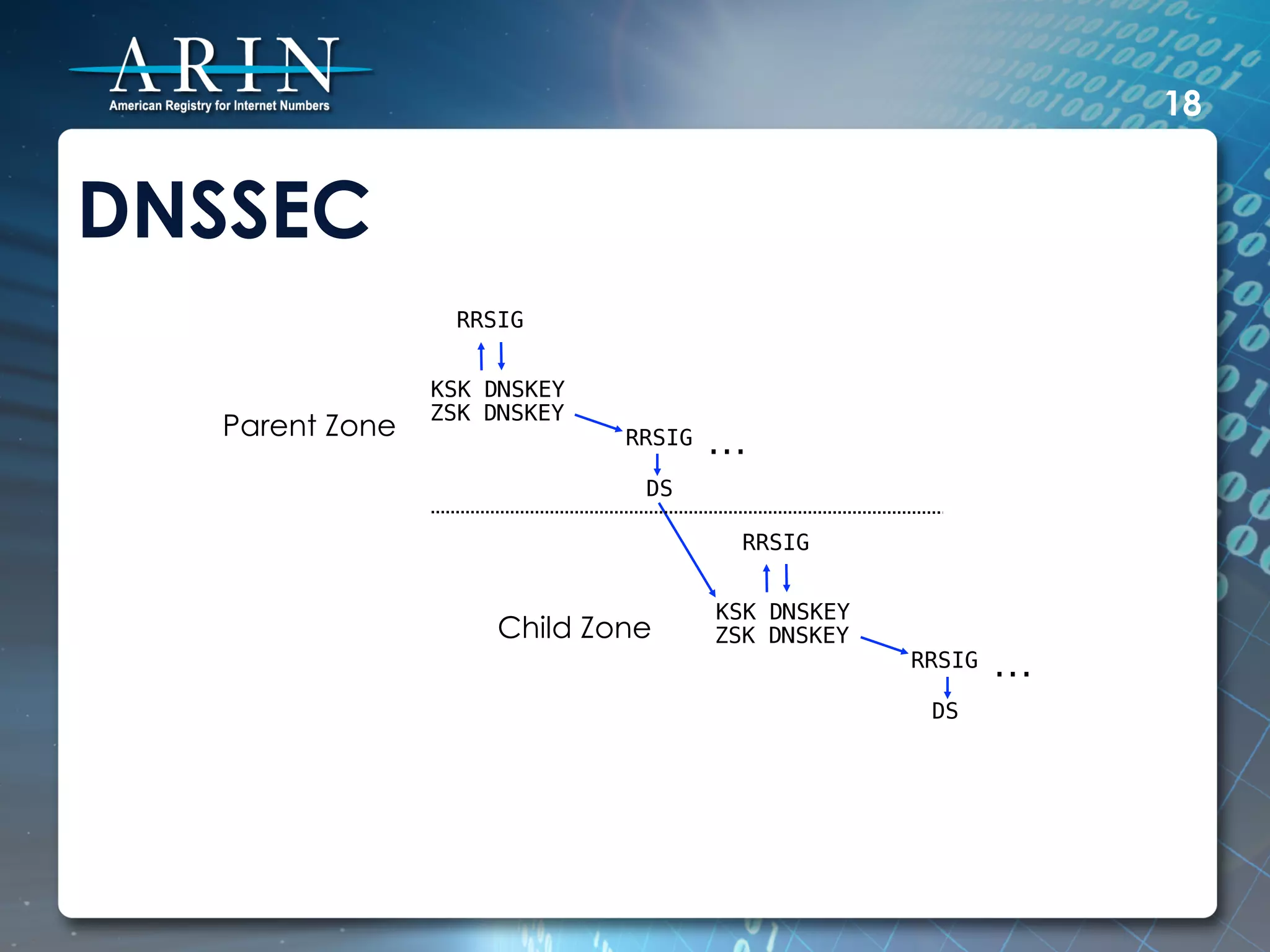
•  The backbone of the chain of trust is
   the DS, DNSKEY, RRSIG interaction.
•  Trust travels from the parent zone
   down to the child zone. Repeat until
   the target zone is found.
•  Start at the trust anchor’s zone.
18


DNSSEC
                  RRSIG!


                KSK DNSKEY!
                ZSK DNSKEY!
  Parent Zone                 RRSIG! ...!

                               DS!

                                        RRSIG!


                                      KSK DNSKEY!
                     Child Zone       ZSK DNSKEY!
                                                    RRSIG! ...!

                                                     DS!
19


DNSSEC
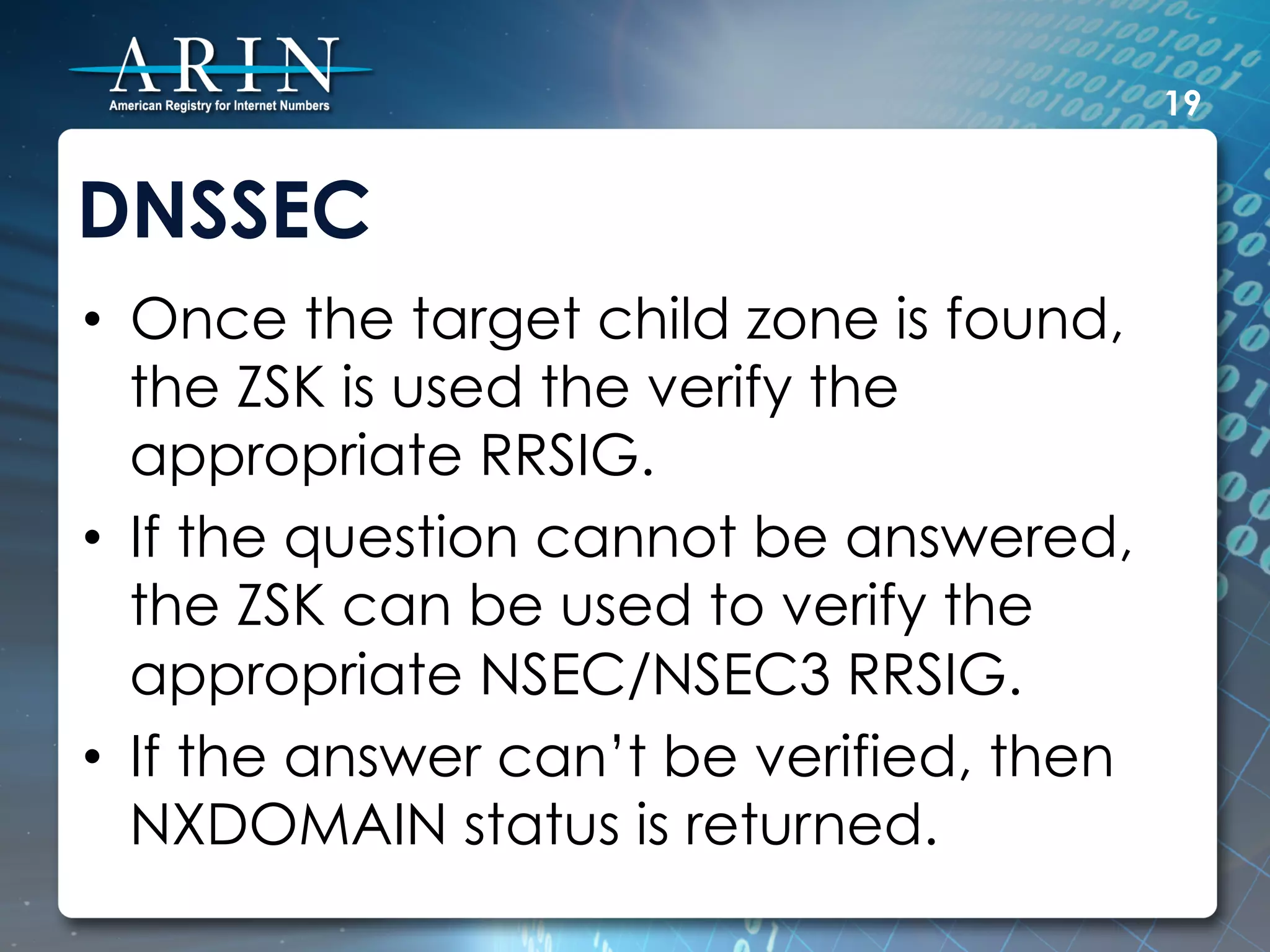
•  Once the target child zone is found,
   the ZSK is used the verify the
   appropriate RRSIG.
•  If the question cannot be answered,
   the ZSK can be used to verify the
   appropriate NSEC/NSEC3 RRSIG.
•  If the answer can’t be verified, then
   NXDOMAIN status is returned.
20


DNSSEC
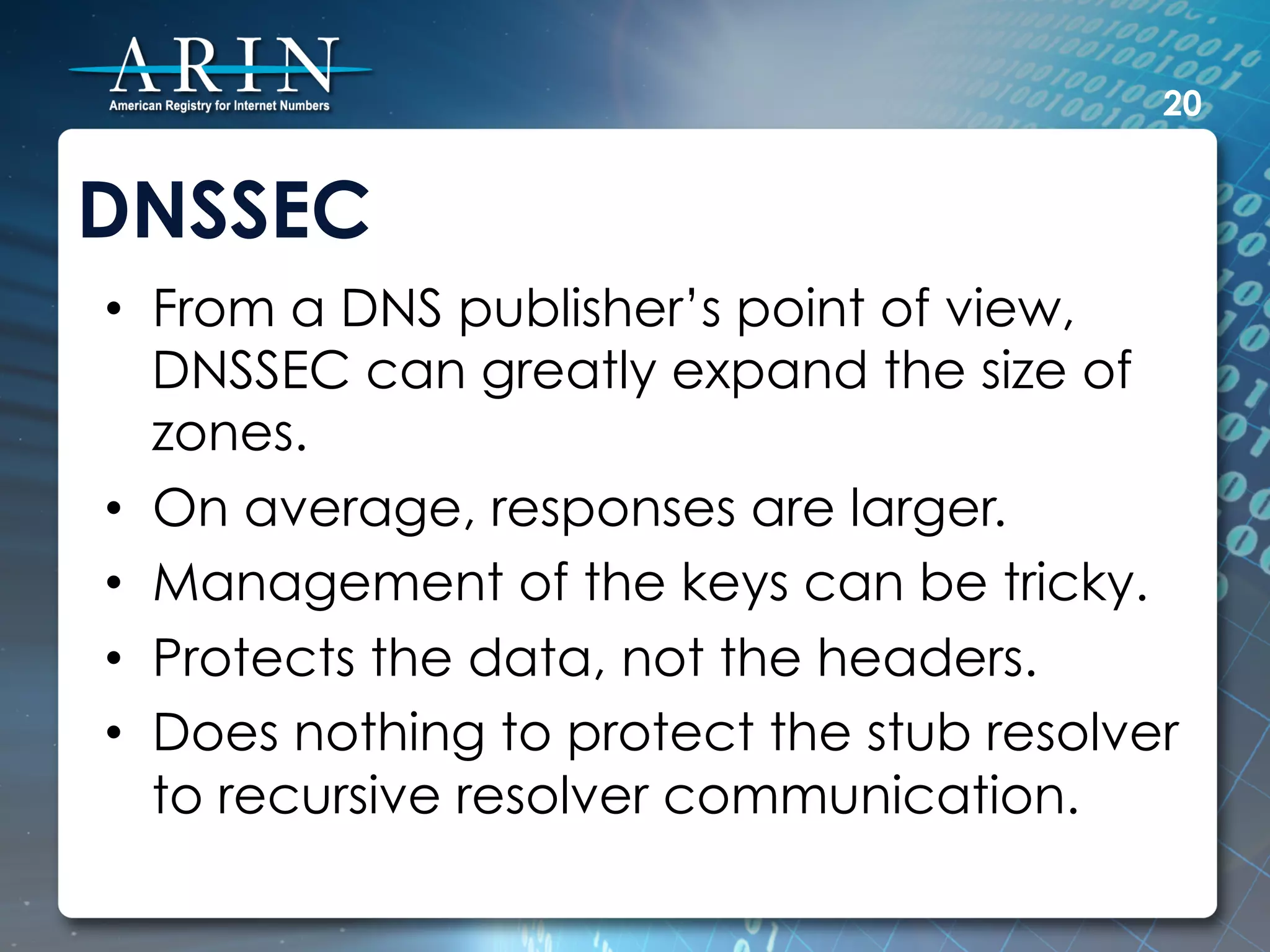
•  From a DNS publisher’s point of view,
   DNSSEC can greatly expand the size of
   zones.
•  On average, responses are larger.
•  Management of the keys can be tricky.
•  Protects the data, not the headers.
•  Does nothing to protect the stub resolver
   to recursive resolver communication.
21


DNSSEC
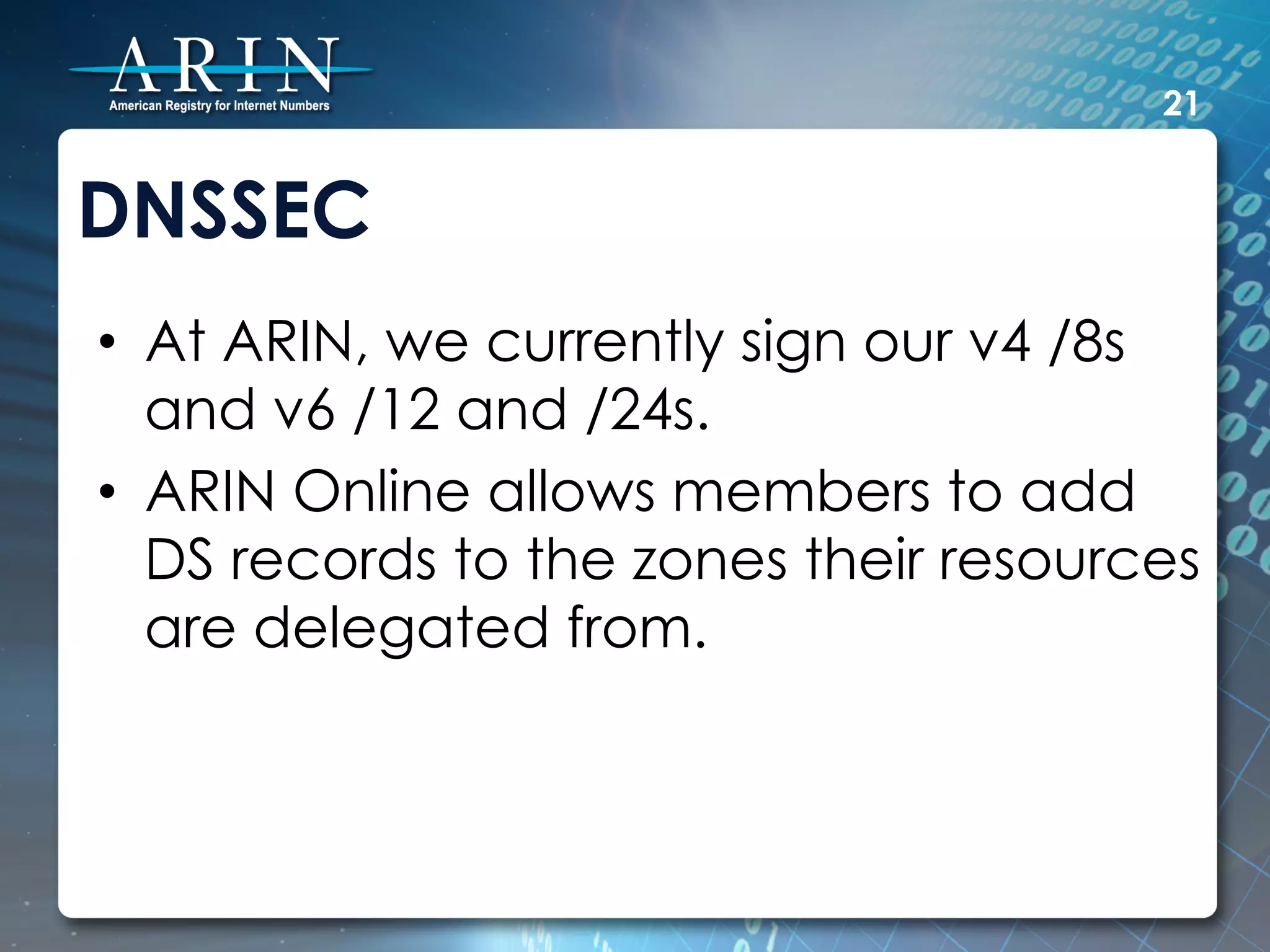
•  At ARIN, we currently sign our v4 /8s
   and v6 /12 and /24s.
•  ARIN Online allows members to add
   DS records to the zones their resources
   are delegated from.
22


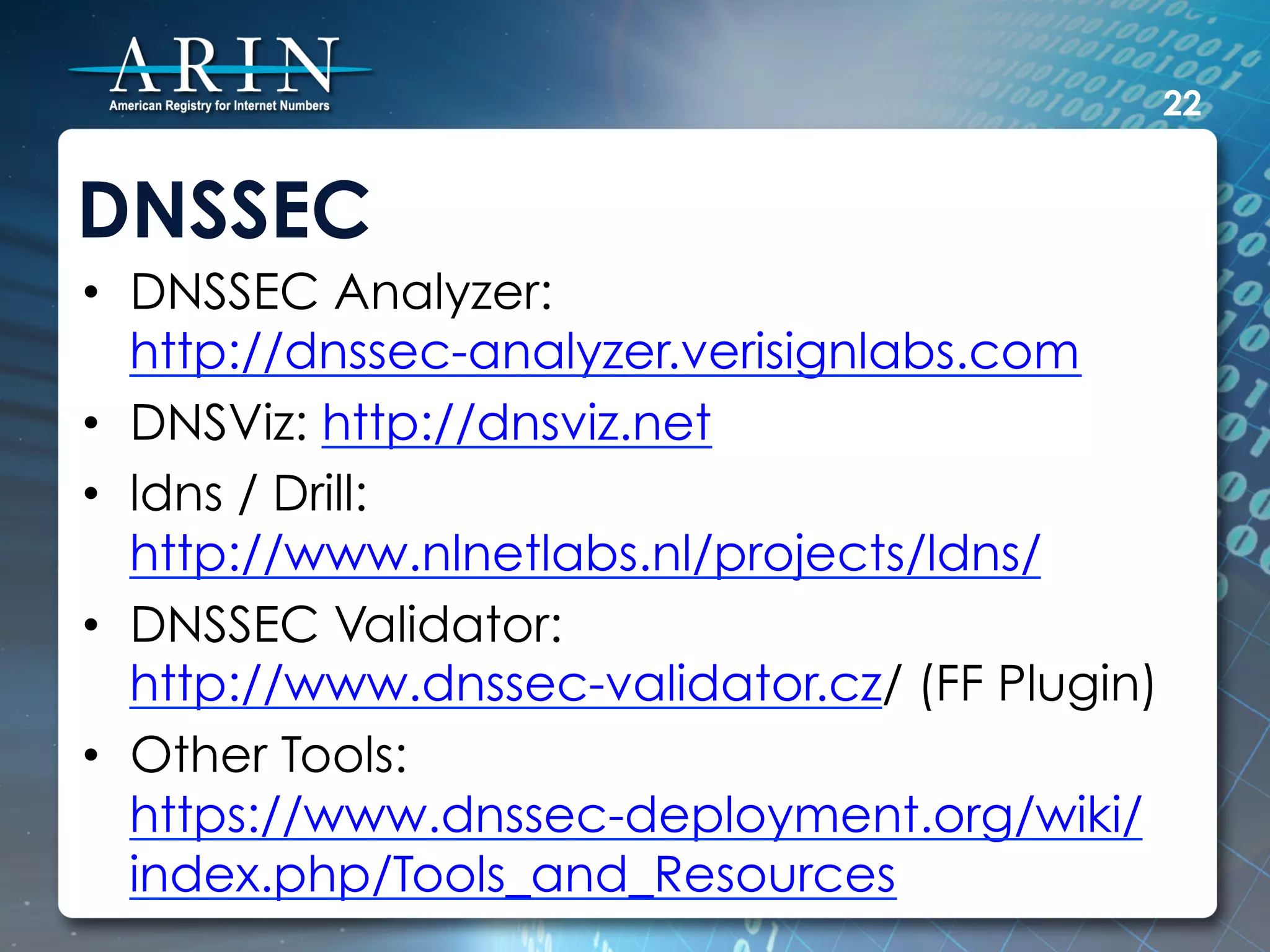
DNSSEC
•  DNSSEC Analyzer:
   http://dnssec-analyzer.verisignlabs.com
•  DNSViz: http://dnsviz.net
•  ldns / Drill:
   http://www.nlnetlabs.nl/projects/ldns/
•  DNSSEC Validator:
   http://www.dnssec-validator.cz/ (FF Plugin)
•  Other Tools:
   https://www.dnssec-deployment.org/wiki/
   index.php/Tools_and_Resources
23


RPKI
24

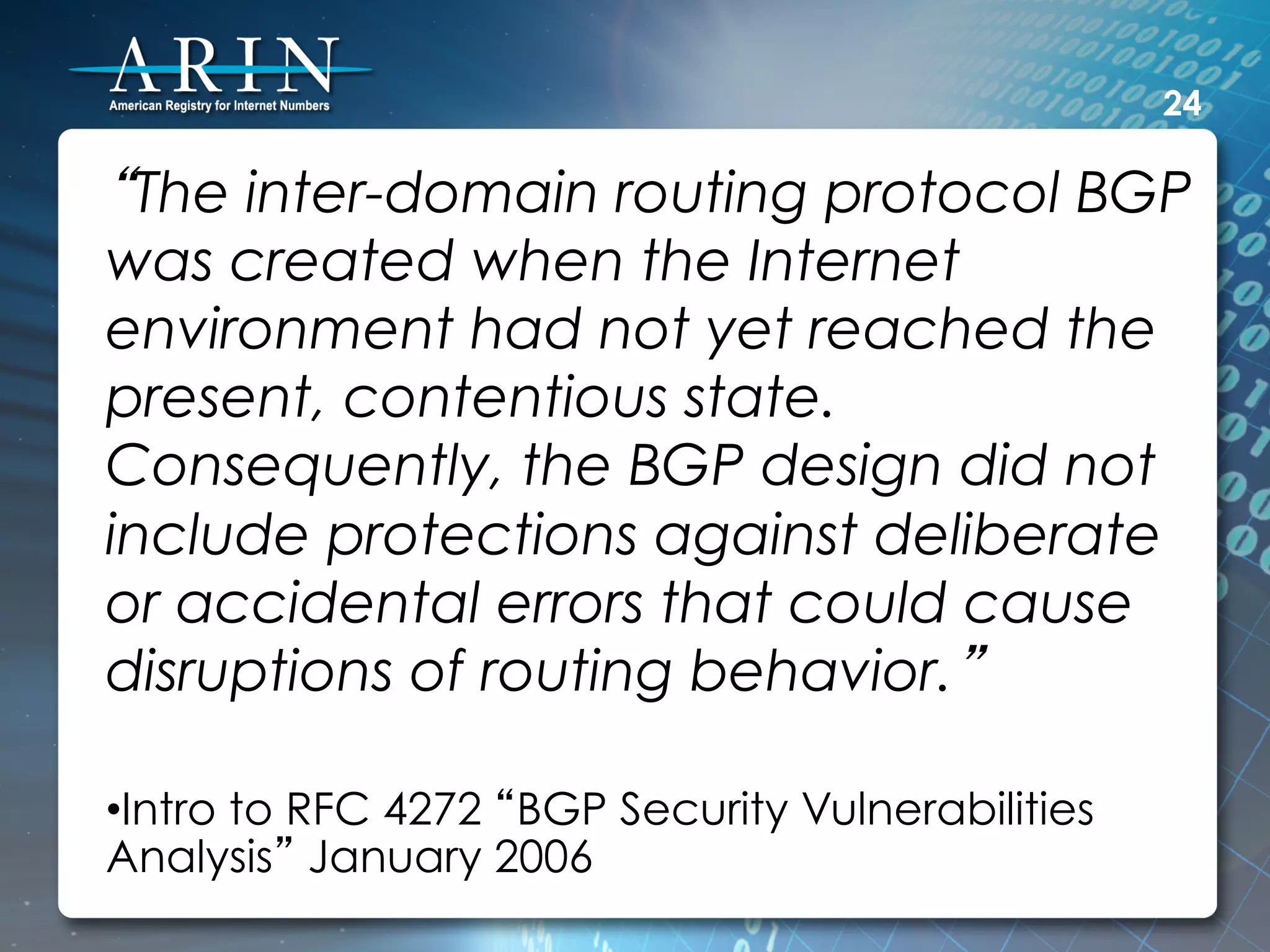
“The inter-domain routing protocol BGP
was created when the Internet
environment had not yet reached the
present, contentious state.
Consequently, the BGP design did not
include protections against deliberate
or accidental errors that could cause
disruptions of routing behavior.”

• Intro to RFC 4272 “BGP Security Vulnerabilities
Analysis” January 2006
25


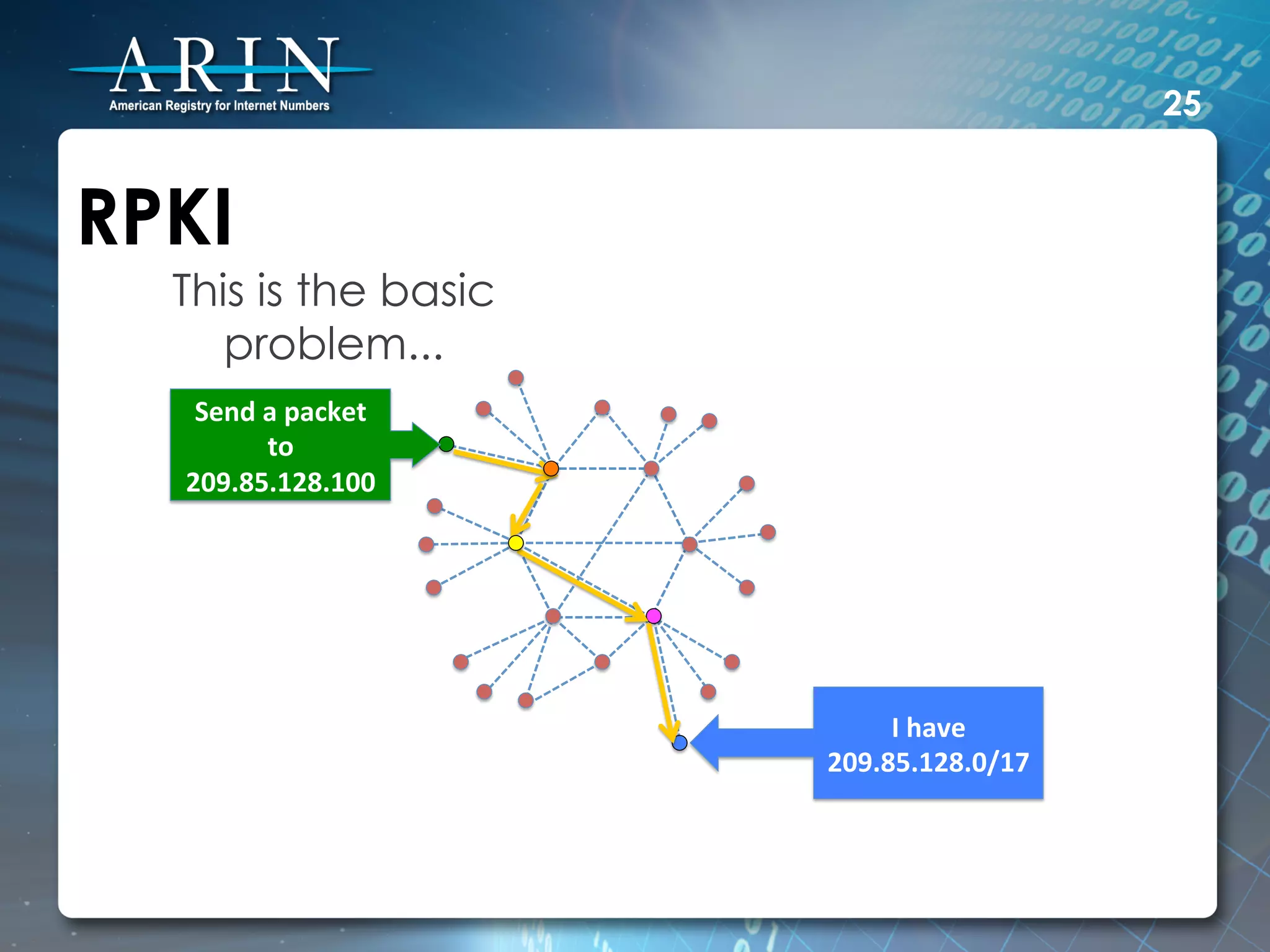
RPKI
  This is the basic
     problem...
   Send	
  a	
  packet	
  
           to	
  
  209.85.128.100	


                                  I	
  have	
  
                             209.85.128.0/17	
  
26


RPKI
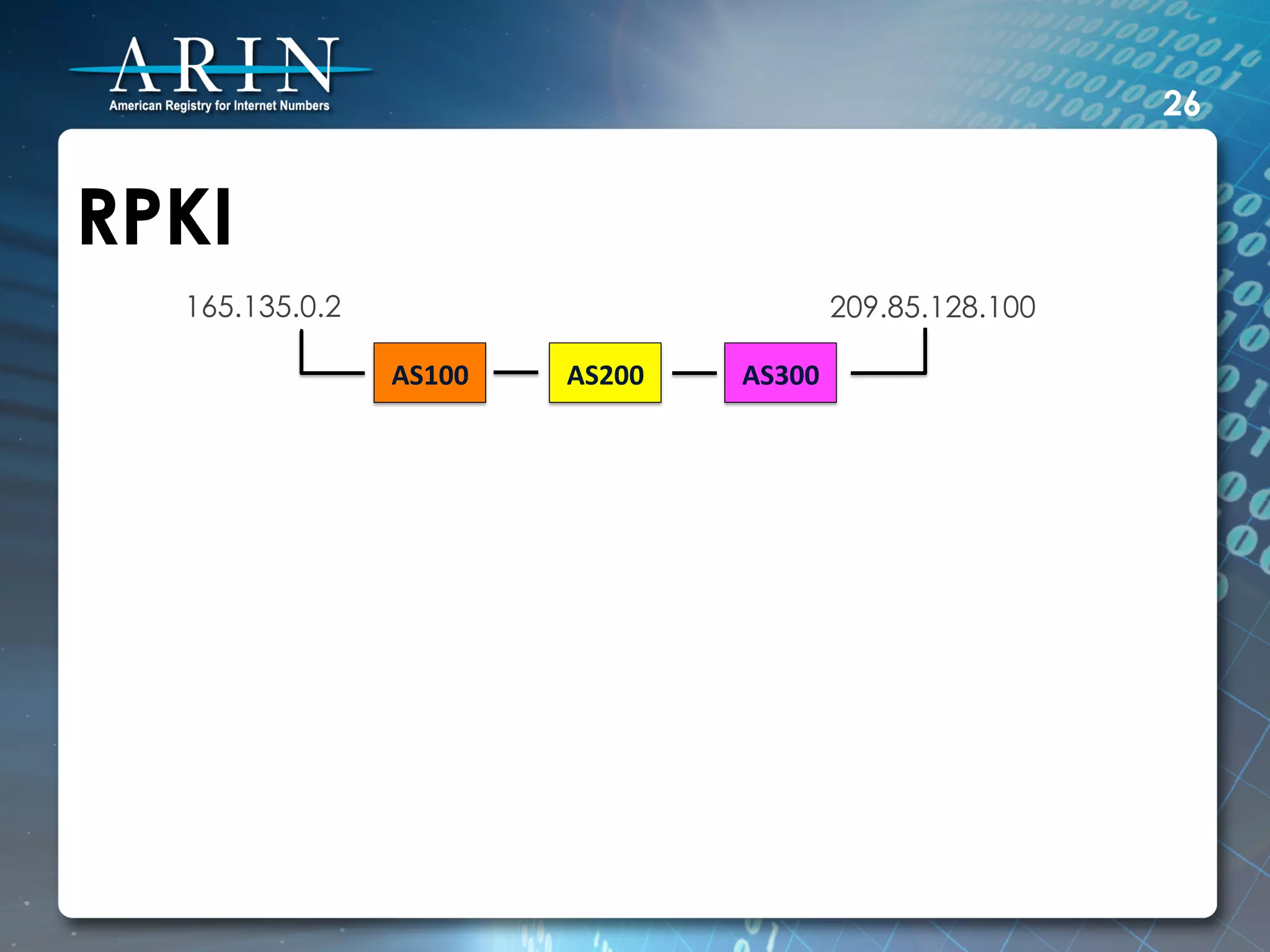
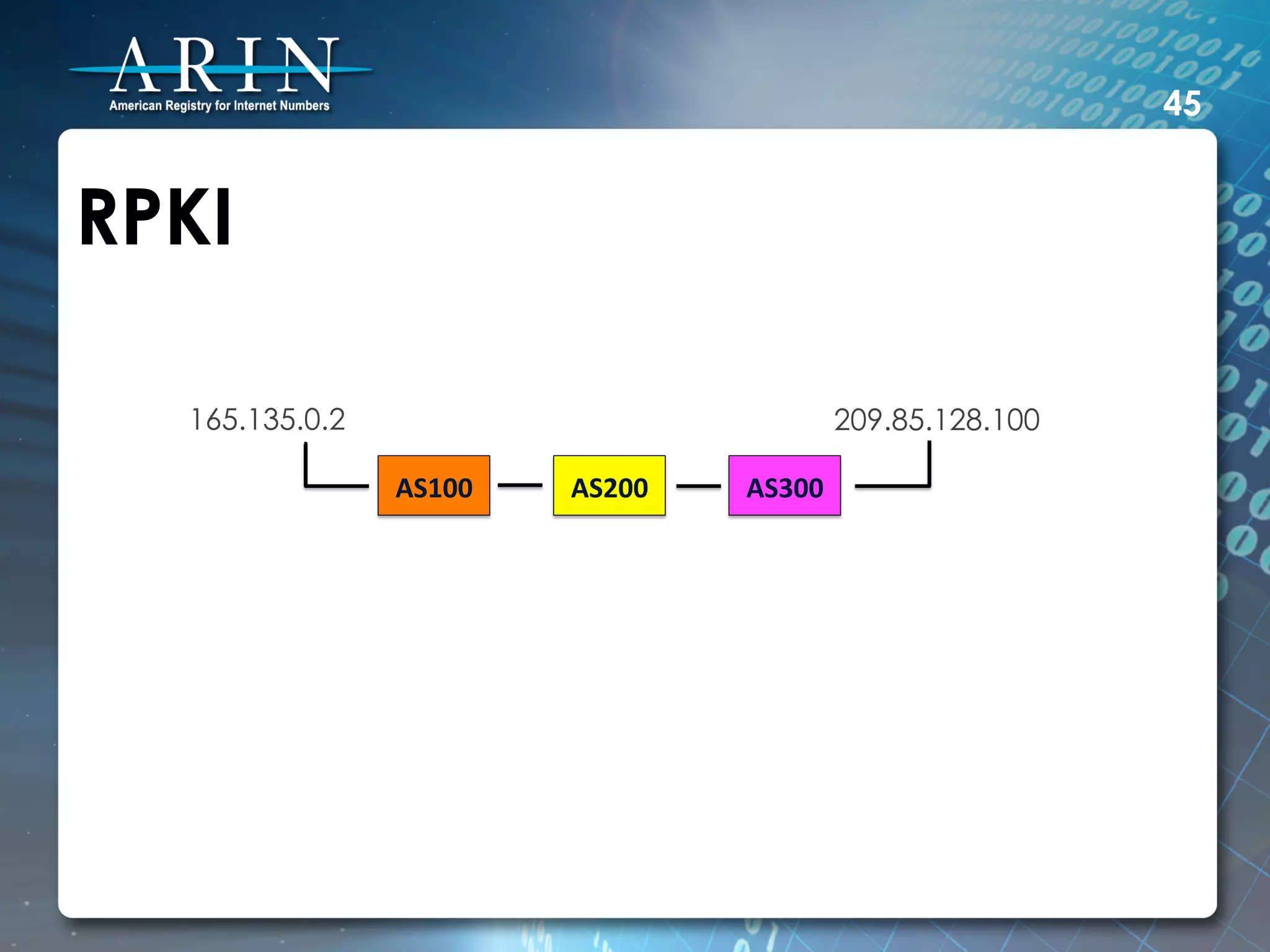
  165.135.0.2                                       209.85.128.100

                AS100	
     AS200	
     AS300	
  
27


RPKI
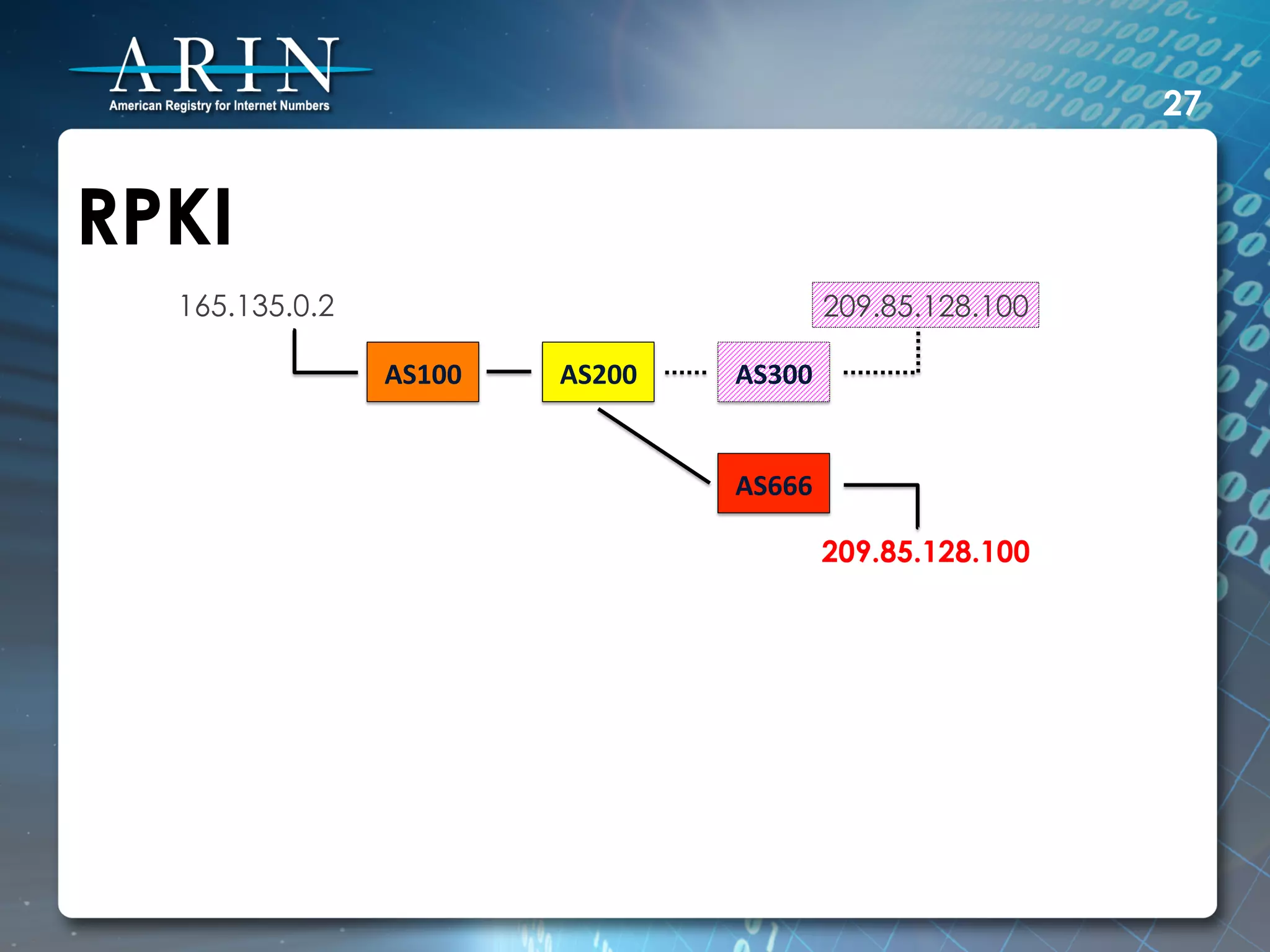
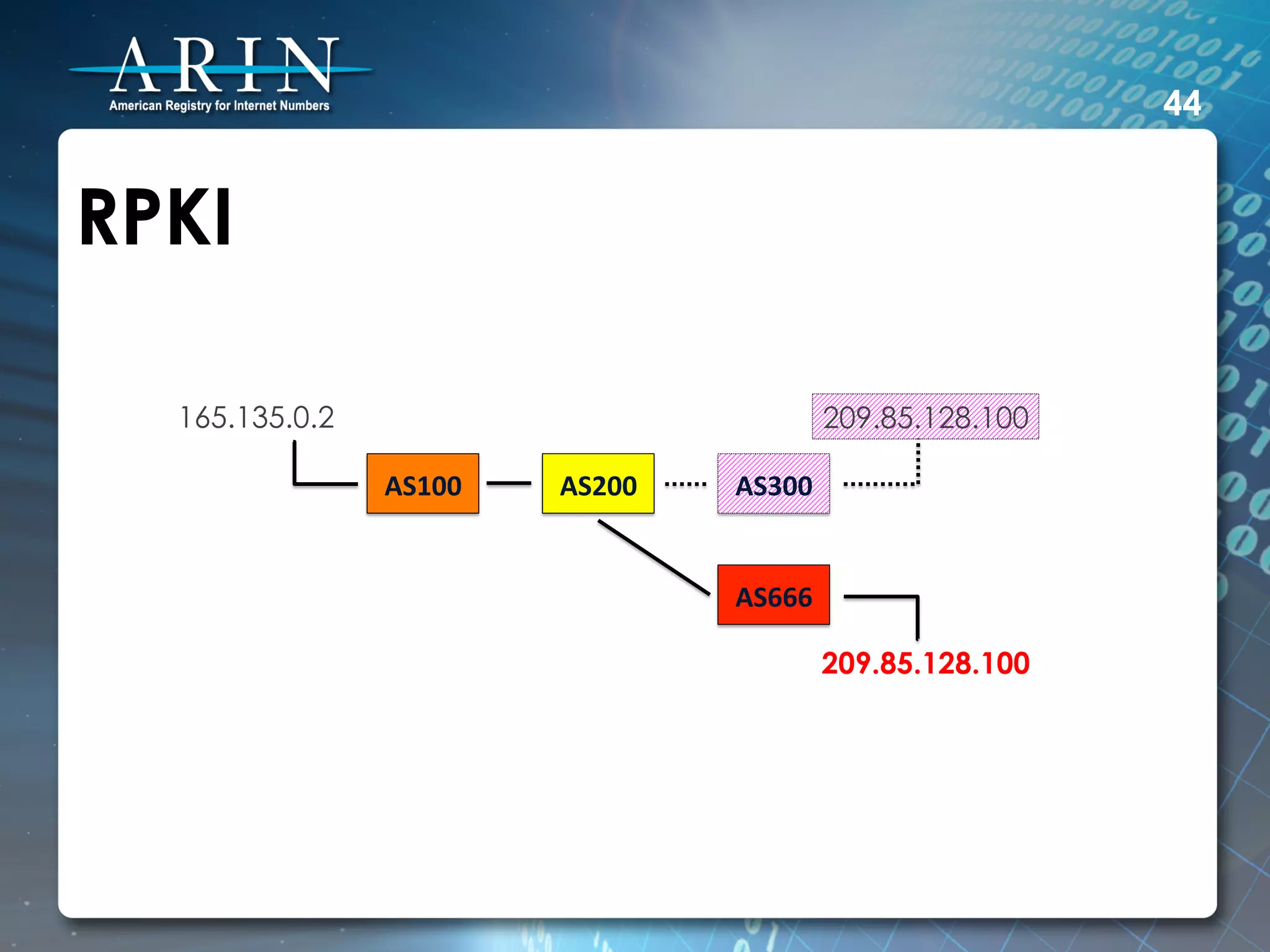
  165.135.0.2                                       209.85.128.100

                AS100	
     AS200	
     AS300	


                                        AS666	
  

                                                    209.85.128.100
28


RPKI
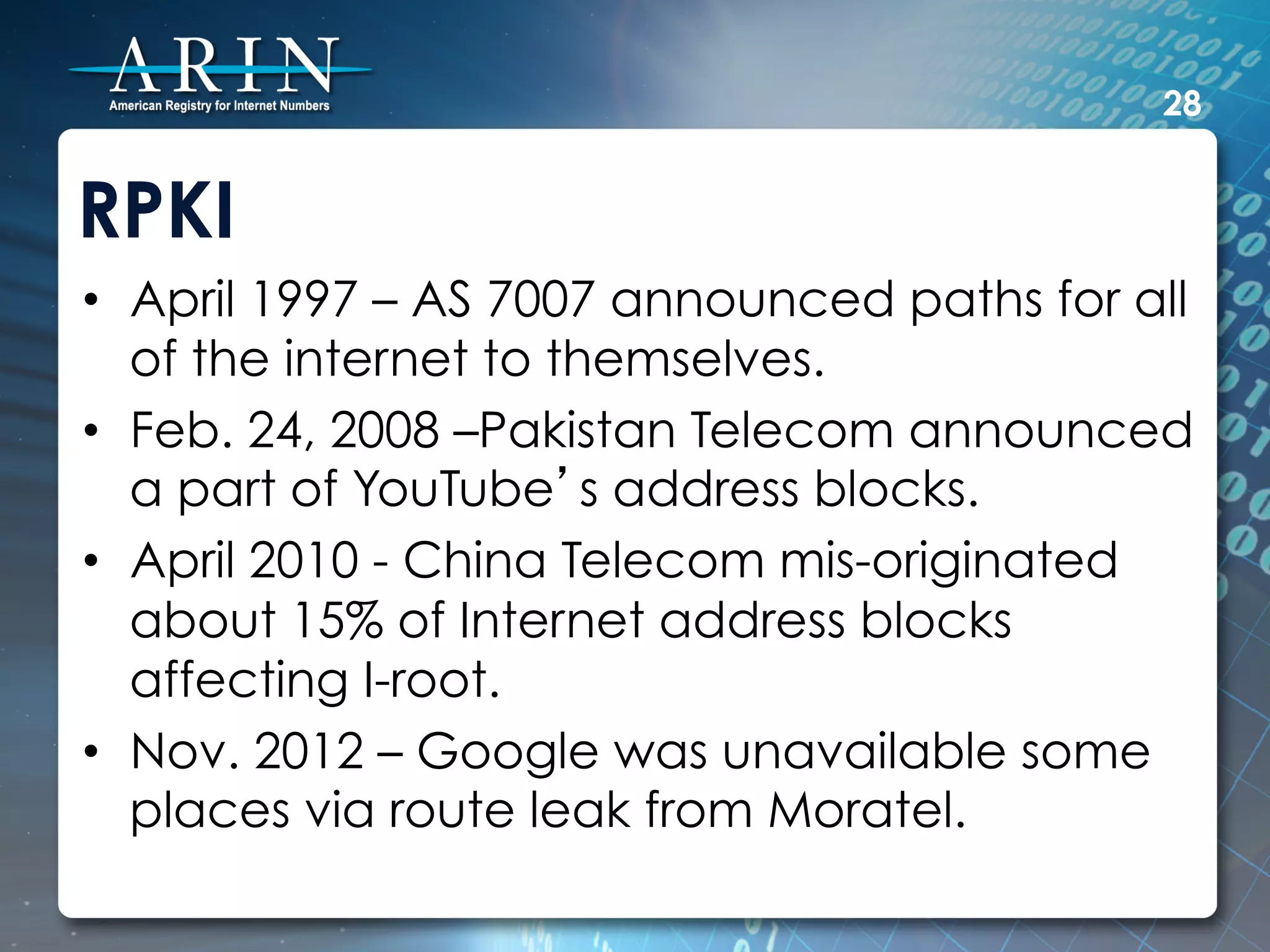
•  April 1997 – AS 7007 announced paths for all
   of the internet to themselves.
•  Feb. 24, 2008 –Pakistan Telecom announced
   a part of YouTube’s address blocks.
•  April 2010 - China Telecom mis-originated
   about 15% of Internet address blocks
   affecting I-root.
•  Nov. 2012 – Google was unavailable some
   places via route leak from Moratel.
29


RPKI
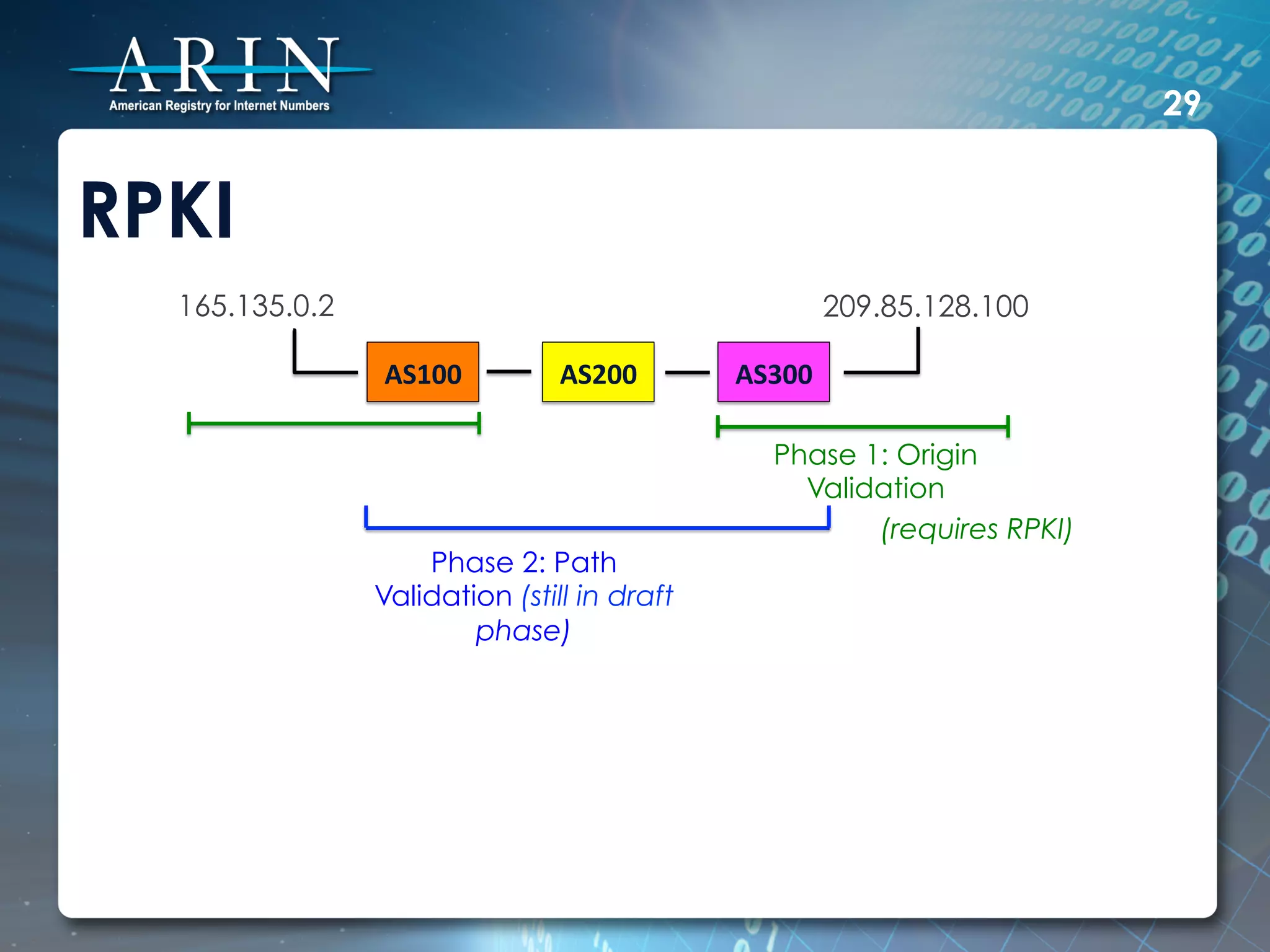
  165.135.0.2                                            209.85.128.100

                AS100	
         AS200	
      AS300	
  

                                                 Phase 1: Origin
                                                   Validation
                                                        (requires RPKI)
                    Phase 2: Path
                Validation (still in draft
                        phase)
30


RPKI
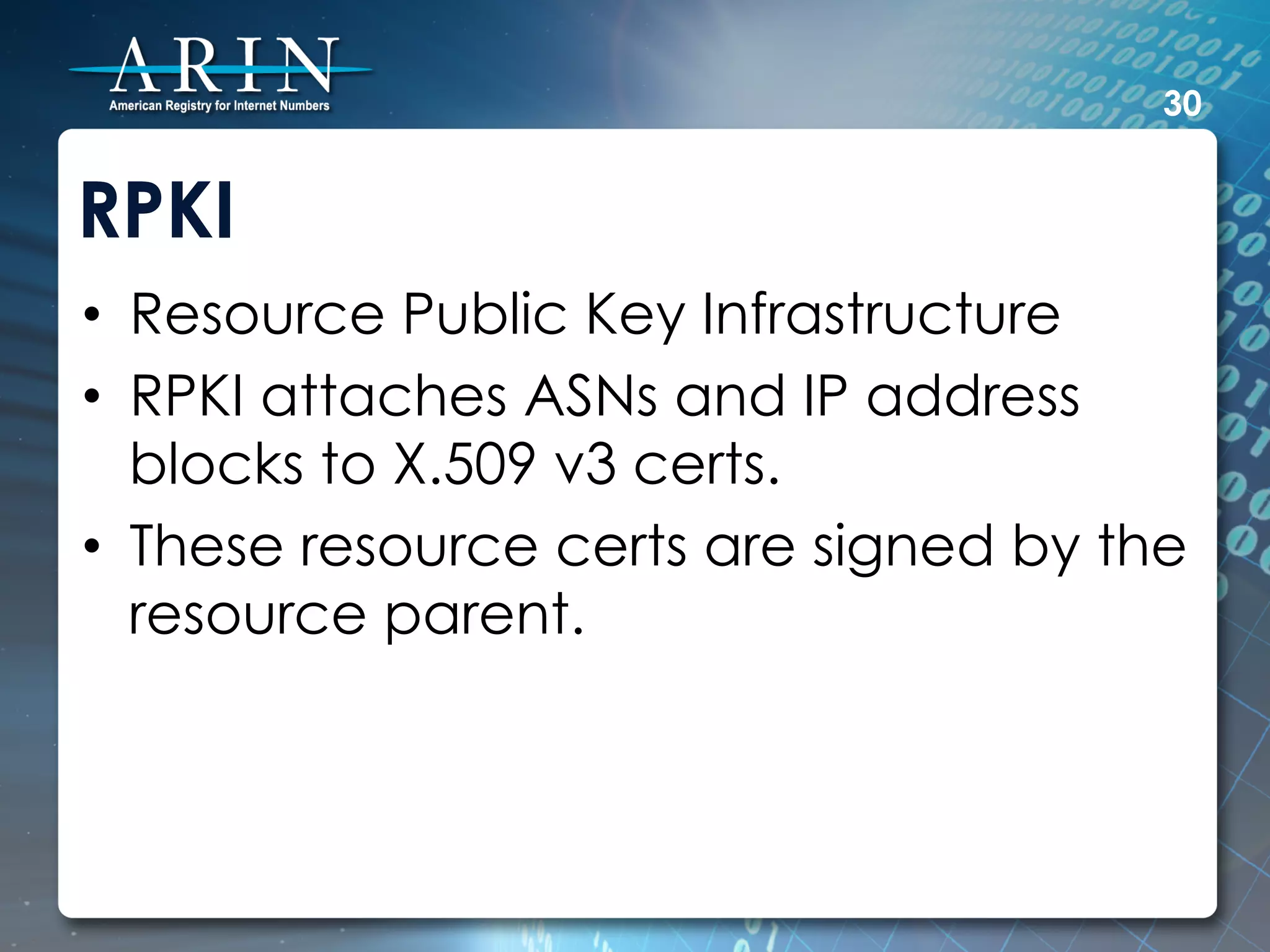
•  Resource Public Key Infrastructure
•  RPKI attaches ASNs and IP address
   blocks to X.509 v3 certs.
•  These resource certs are signed by the
   resource parent.
31


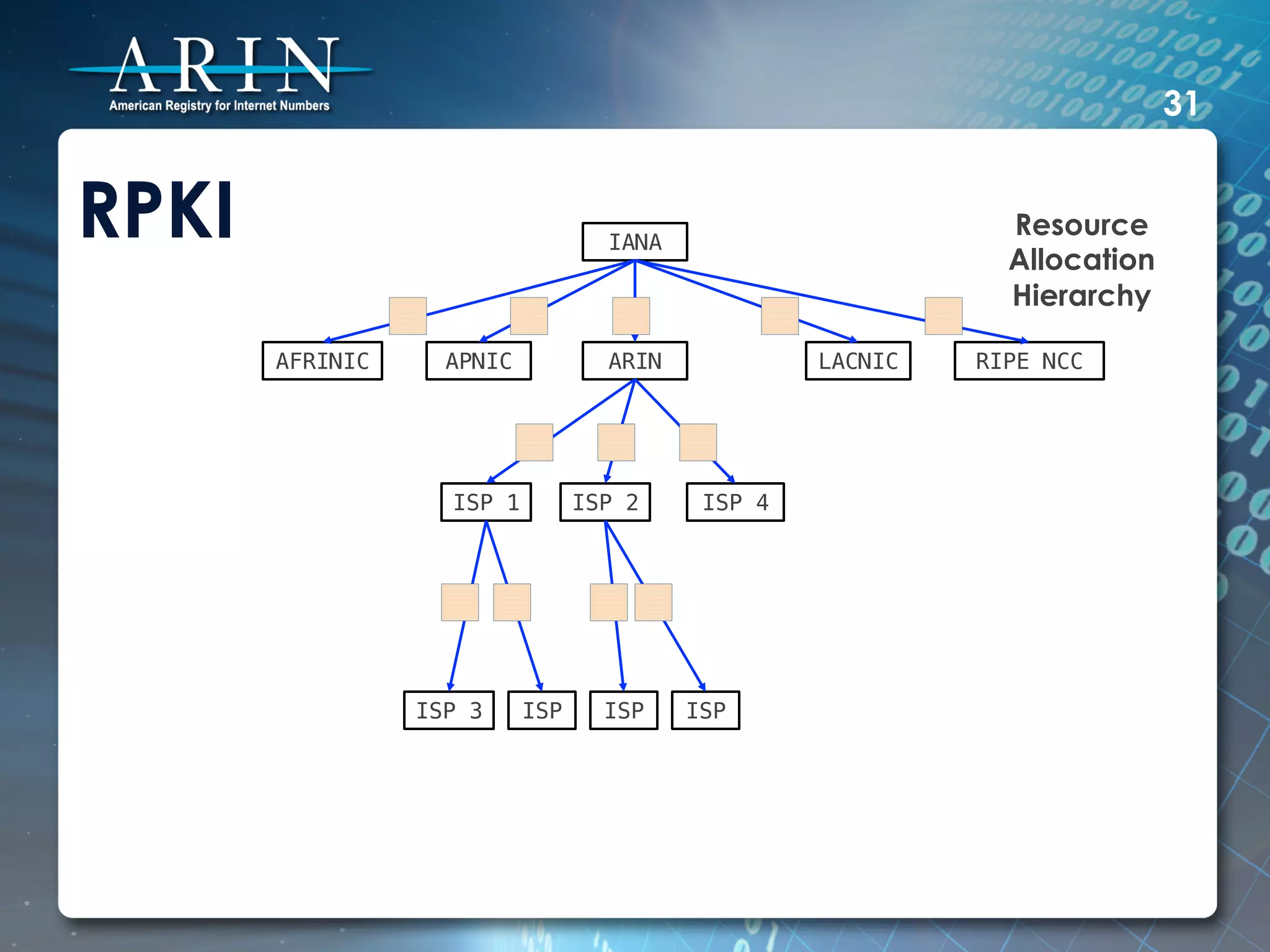
RPKI                                    IANA!
                                                                      Resource
                                                                      Allocation
                                                                      Hierarchy

       AFRINIC!     APNIC!              ARIN!             LACNIC!   RIPE NCC!


                     ISP 1!          ISP 2!      ISP 4!


                  ISP 3!      ISP!     ISP!     ISP!
32
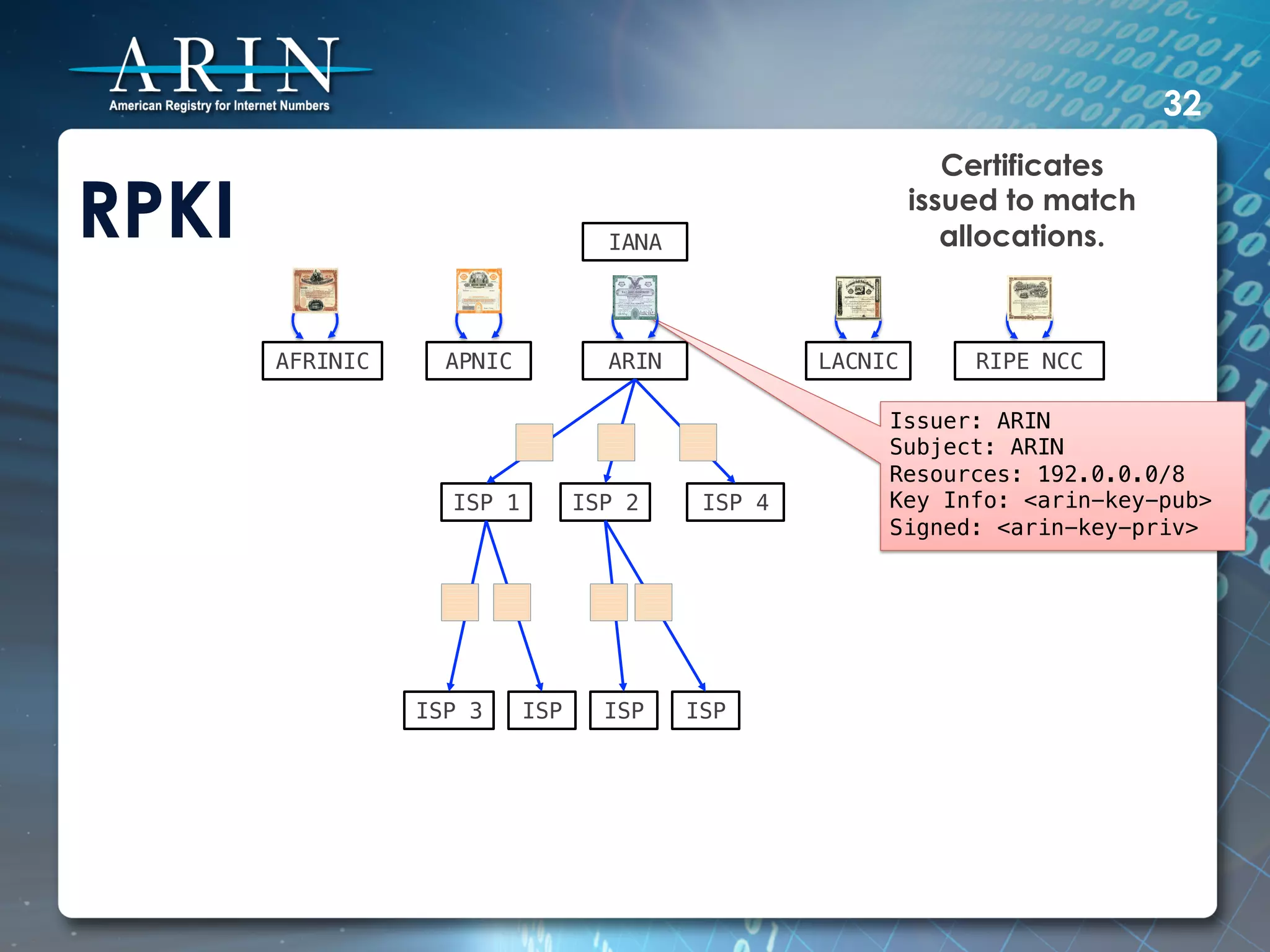
                                                                       Certificates

RPKI                                    IANA!
                                                                    issued to match
                                                                       allocations.


       AFRINIC!     APNIC!              ARIN!             LACNIC!       RIPE NCC!

                                                                Issuer: ARIN!
                                                                Subject: ARIN!
                                                                Resources: 192.0.0.0/8!
                     ISP 1!          ISP 2!      ISP 4!         Key Info: <arin-key-pub>!
                                                                Signed: <arin-key-priv>!


                  ISP 3!      ISP!     ISP!     ISP!
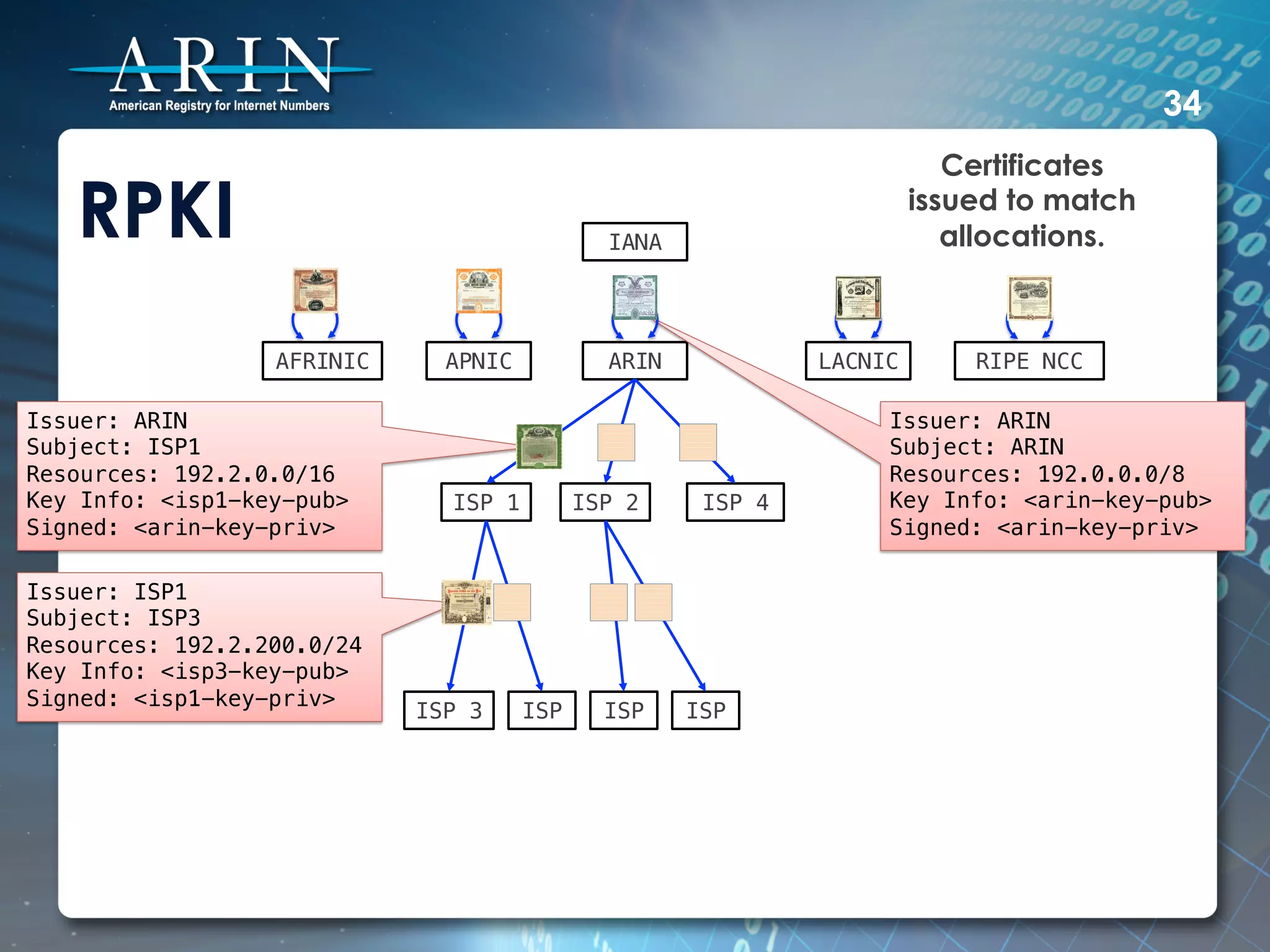
33
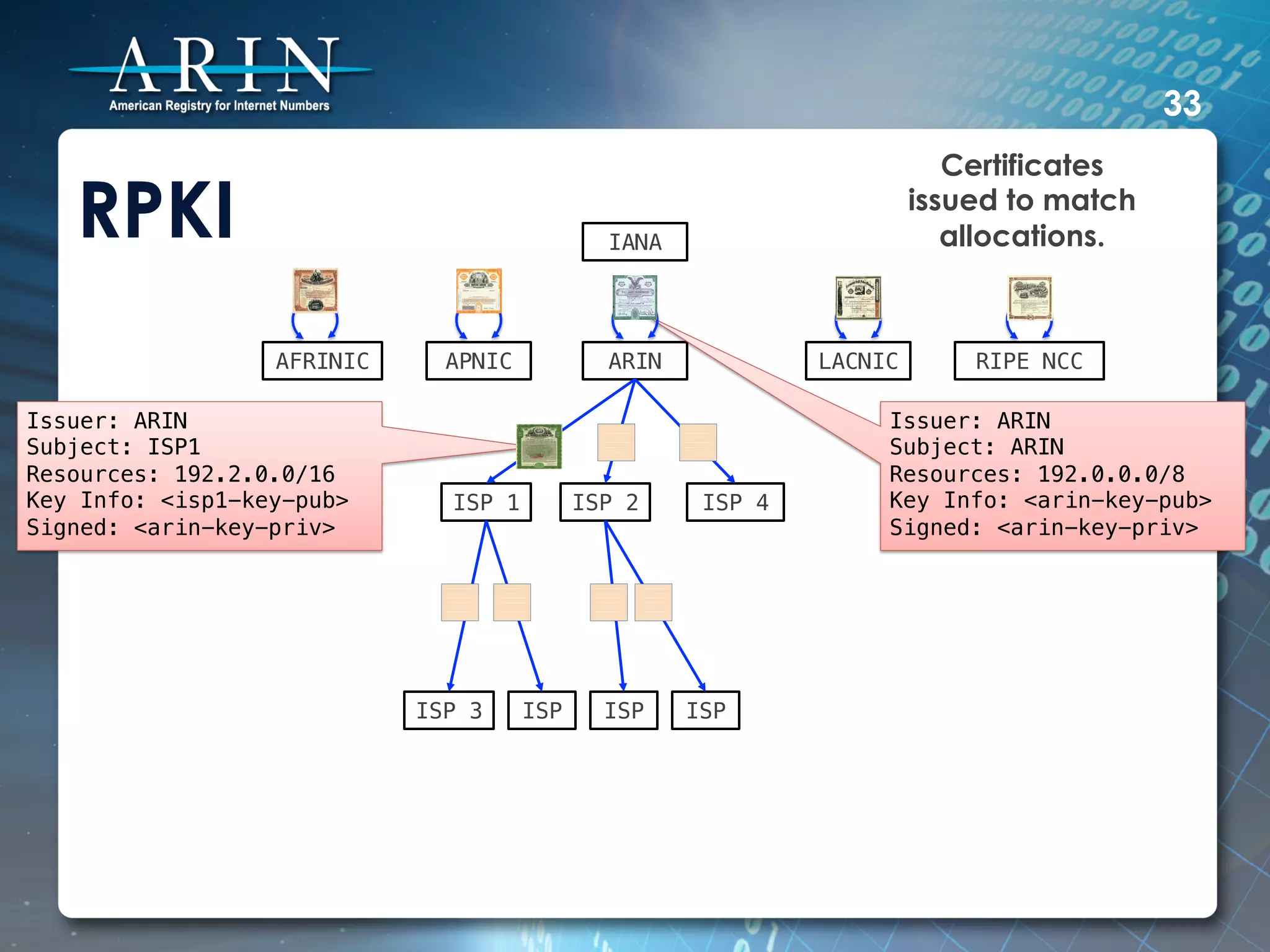
                                                                                   Certificates

   RPKI                                             IANA!
                                                                                issued to match
                                                                                   allocations.


                   AFRINIC!     APNIC!              ARIN!             LACNIC!       RIPE NCC!

Issuer: ARIN!                                                               Issuer: ARIN!
Subject: ISP1!                                                              Subject: ARIN!
Resources: 192.2.0.0/16!                                                    Resources: 192.0.0.0/8!
Key Info: <isp1-key-pub>!        ISP 1!          ISP 2!      ISP 4!         Key Info: <arin-key-pub>!
Signed: <arin-key-priv>!                                                    Signed: <arin-key-priv>!


                              ISP 3!      ISP!     ISP!     ISP!
34
                                                                                   Certificates

   RPKI                                             IANA!
                                                                                issued to match
                                                                                   allocations.


                   AFRINIC!     APNIC!              ARIN!             LACNIC!       RIPE NCC!

Issuer: ARIN!                                                               Issuer: ARIN!
Subject: ISP1!                                                              Subject: ARIN!
Resources: 192.2.0.0/16!                                                    Resources: 192.0.0.0/8!
Key Info: <isp1-key-pub>!        ISP 1!          ISP 2!      ISP 4!         Key Info: <arin-key-pub>!
Signed: <arin-key-priv>!                                                    Signed: <arin-key-priv>!

Issuer: ISP1!
Subject: ISP3!
Resources: 192.2.200.0/24!
Key Info: <isp3-key-pub>!
Signed: <isp1-key-priv>!
                              ISP 3!      ISP!     ISP!     ISP!
35


RPKI
•  Address holders issue Route Origin
   Authorizations (ROAs).
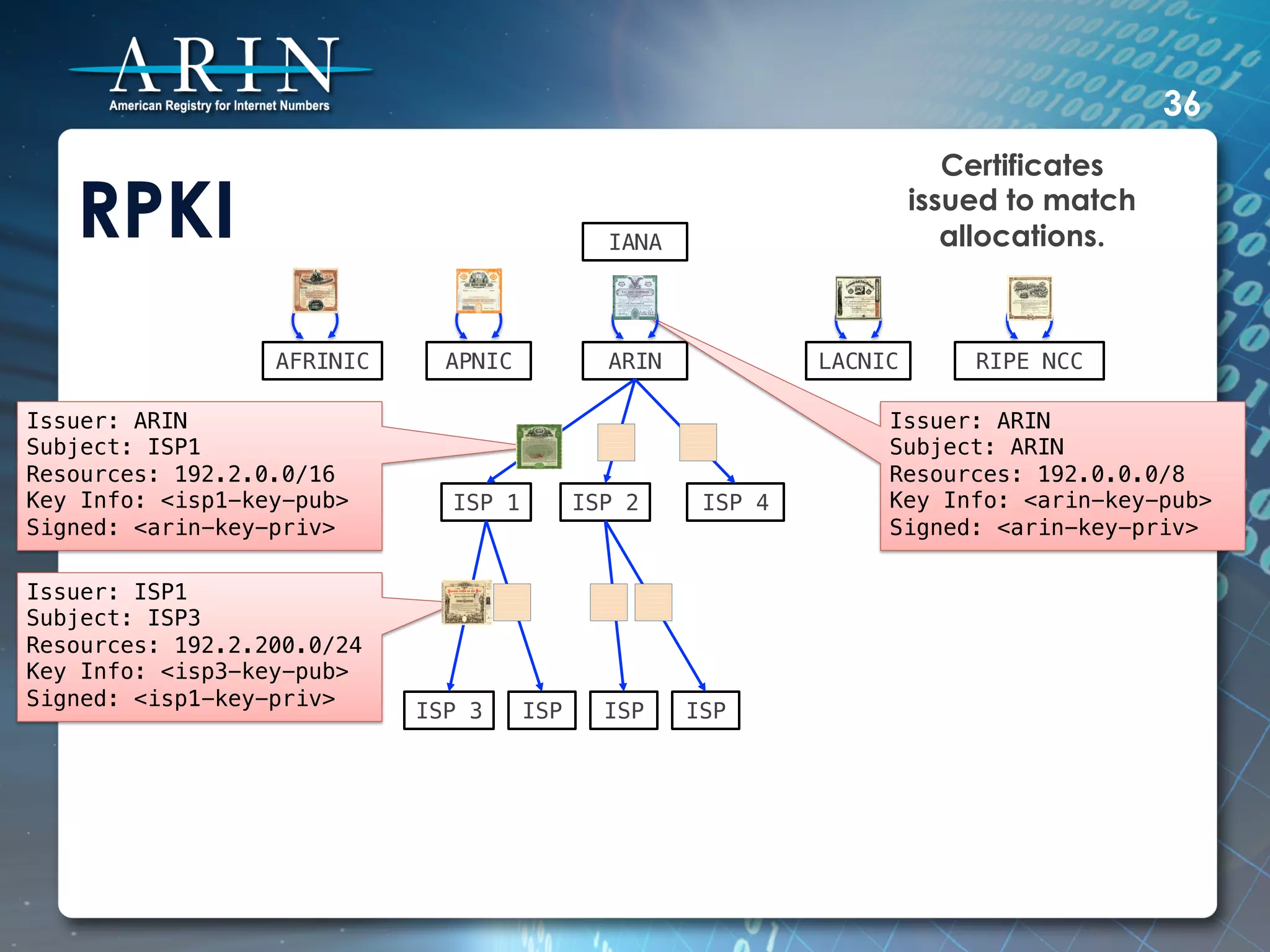
36
                                                                                   Certificates

   RPKI                                             IANA!
                                                                                issued to match
                                                                                   allocations.


                   AFRINIC!     APNIC!              ARIN!             LACNIC!       RIPE NCC!

Issuer: ARIN!                                                               Issuer: ARIN!
Subject: ISP1!                                                              Subject: ARIN!
Resources: 192.2.0.0/16!                                                    Resources: 192.0.0.0/8!
Key Info: <isp1-key-pub>!        ISP 1!          ISP 2!      ISP 4!         Key Info: <arin-key-pub>!
Signed: <arin-key-priv>!                                                    Signed: <arin-key-priv>!

Issuer: ISP1!
Subject: ISP3!
Resources: 192.2.200.0/24!
Key Info: <isp3-key-pub>!
Signed: <isp1-key-priv>!
                              ISP 3!      ISP!     ISP!     ISP!
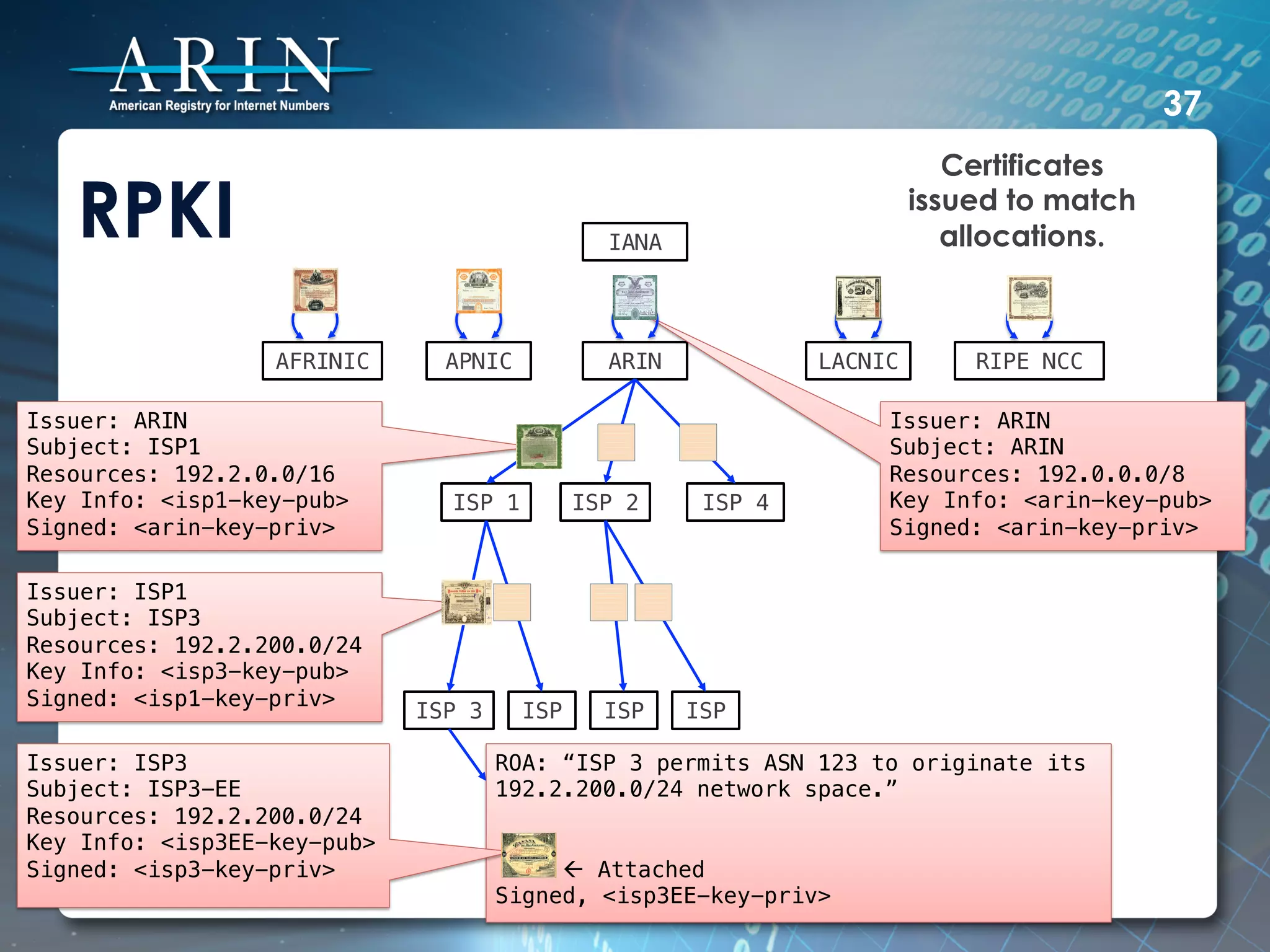
37
                                                                                    Certificates

   RPKI                                              IANA!
                                                                                 issued to match
                                                                                    allocations.


                   AFRINIC!     APNIC!               ARIN!             LACNIC!       RIPE NCC!

Issuer: ARIN!                                                                Issuer: ARIN!
Subject: ISP1!                                                               Subject: ARIN!
Resources: 192.2.0.0/16!                                                     Resources: 192.0.0.0/8!
Key Info: <isp1-key-pub>!        ISP 1!           ISP 2!      ISP 4!         Key Info: <arin-key-pub>!
Signed: <arin-key-priv>!                                                     Signed: <arin-key-priv>!

Issuer: ISP1!
Subject: ISP3!
Resources: 192.2.200.0/24!
Key Info: <isp3-key-pub>!
Signed: <isp1-key-priv>!
                              ISP 3!       ISP!     ISP!     ISP!

Issuer: ISP3!                          ROA: “ISP 3 permits ASN 123 to originate its
Subject: ISP3-EE!                      192.2.200.0/24 network space.”!
Resources: 192.2.200.0/24!             !
Key Info: <isp3EE-key-pub>!            !
Signed: <isp3-key-priv>!                    ß Attached!
                                       Signed, <isp3EE-key-priv>!
                                       !
38


RPKI
•  Two RPKI implementation types:
    •  Delegated: Each participating node
       becomes a CA and runs their own RPKI
       repository, delegated to by the parent CA.
    •  Hosted: The RIR runs the CA functionality for
       interested participants.
39


RPKI
•  For most participants, running a CA
   would be an insurmountable
   obstacle to the implementation of
   RPKI.
•  This is why the hosted option exists.
40


RPKI
•  Regardless of the method used,
   the RPKI repositories are published.
•  TAL: Trust Anchor Locator
    •  Points to the rsync entry point of that
       repo.
    •  Includes that repo’s public key.
41


RPKI
•  Reliant third parties would gather all
   relevant TALs.
•  Get all of the RPKI repos.
•  Validate, validate, validate.
42


RPKI
•  Once we have validated ROAs and
   the backing resource hierarchy, what
   do we do?
43


RPKI
•  Once we have validated ROAs and
   the backing resource hierarchy, what
   do we do?
•  Use ROAs to weight BGP path
   announcements as they’re received.
44


RPKI

  165.135.0.2                                       209.85.128.100

                AS100	
     AS200	
     AS300	


                                        AS666	
  

                                                    209.85.128.100
45


RPKI

  165.135.0.2                                       209.85.128.100

                AS100	
     AS200	
     AS300	
  
46


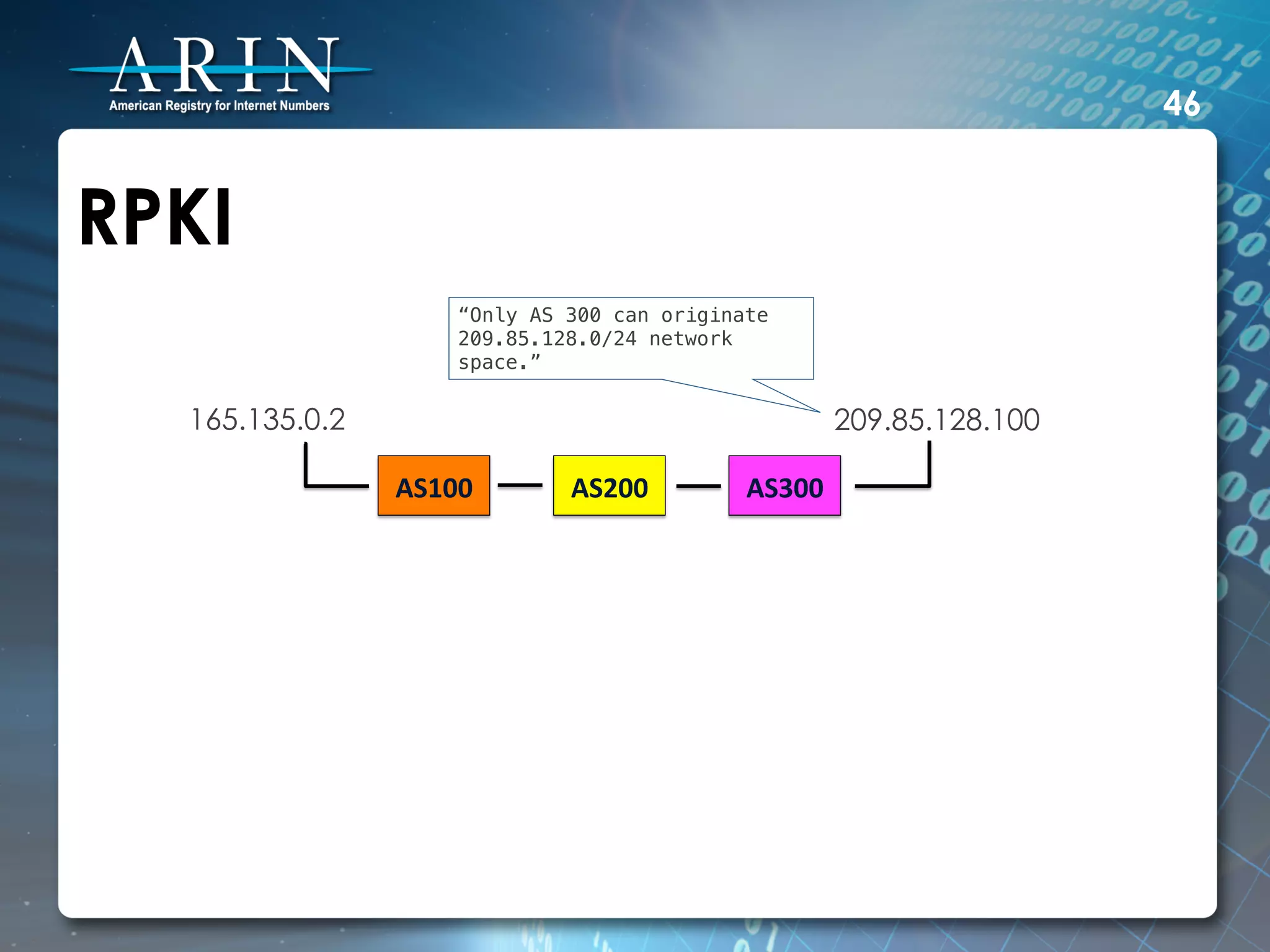
RPKI
                      “Only AS 300 can originate
                      209.85.128.0/24 network
                      space.”!


  165.135.0.2                                             209.85.128.100

                AS100	
        AS200	
        AS300	
  
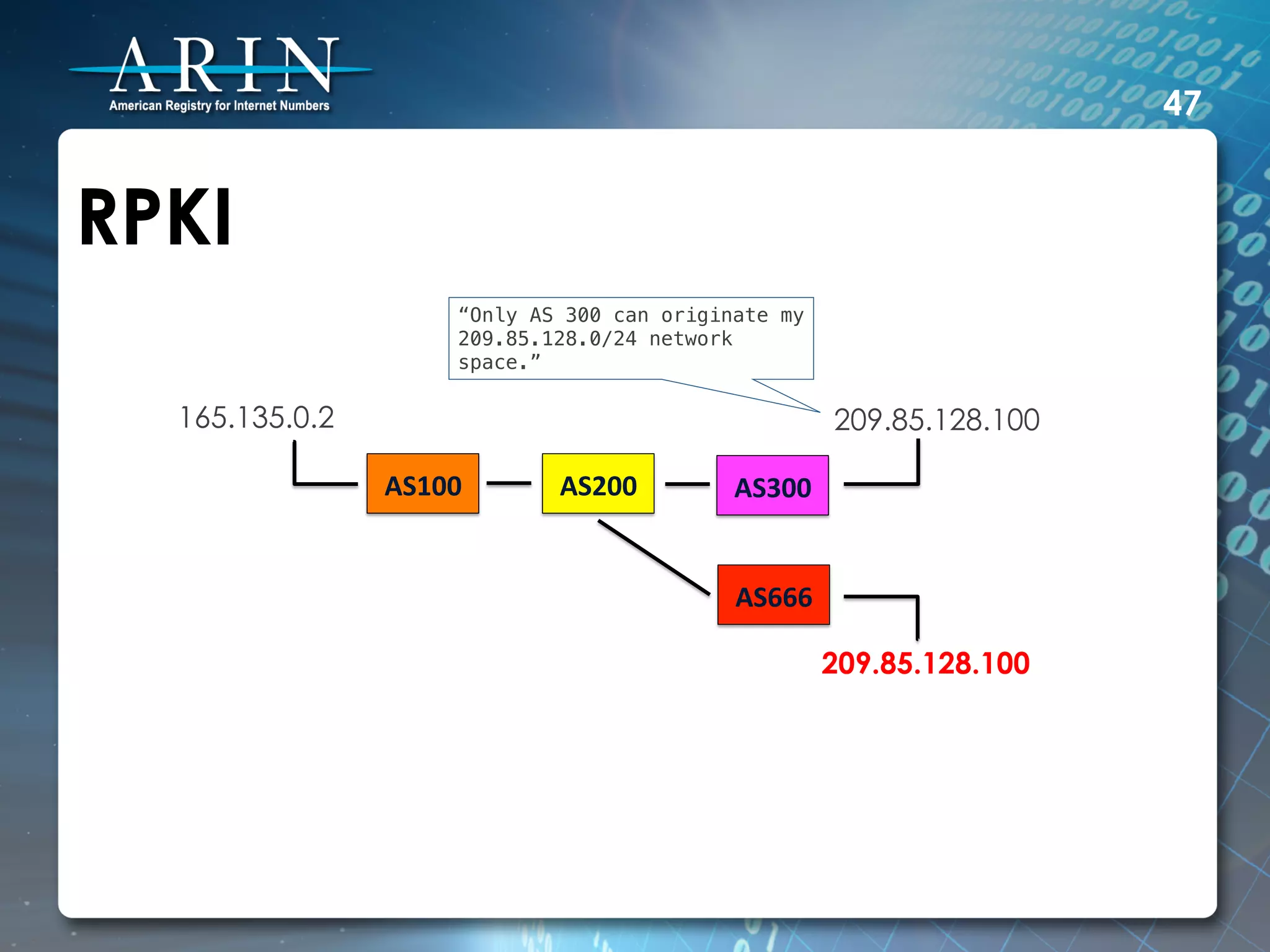
47


RPKI
                       “Only AS 300 can originate my
                       209.85.128.0/24 network
                       space.”!

  165.135.0.2                                             209.85.128.100

                AS100	
        AS200	
        AS300	


                                              AS666	
  

                                                          209.85.128.100
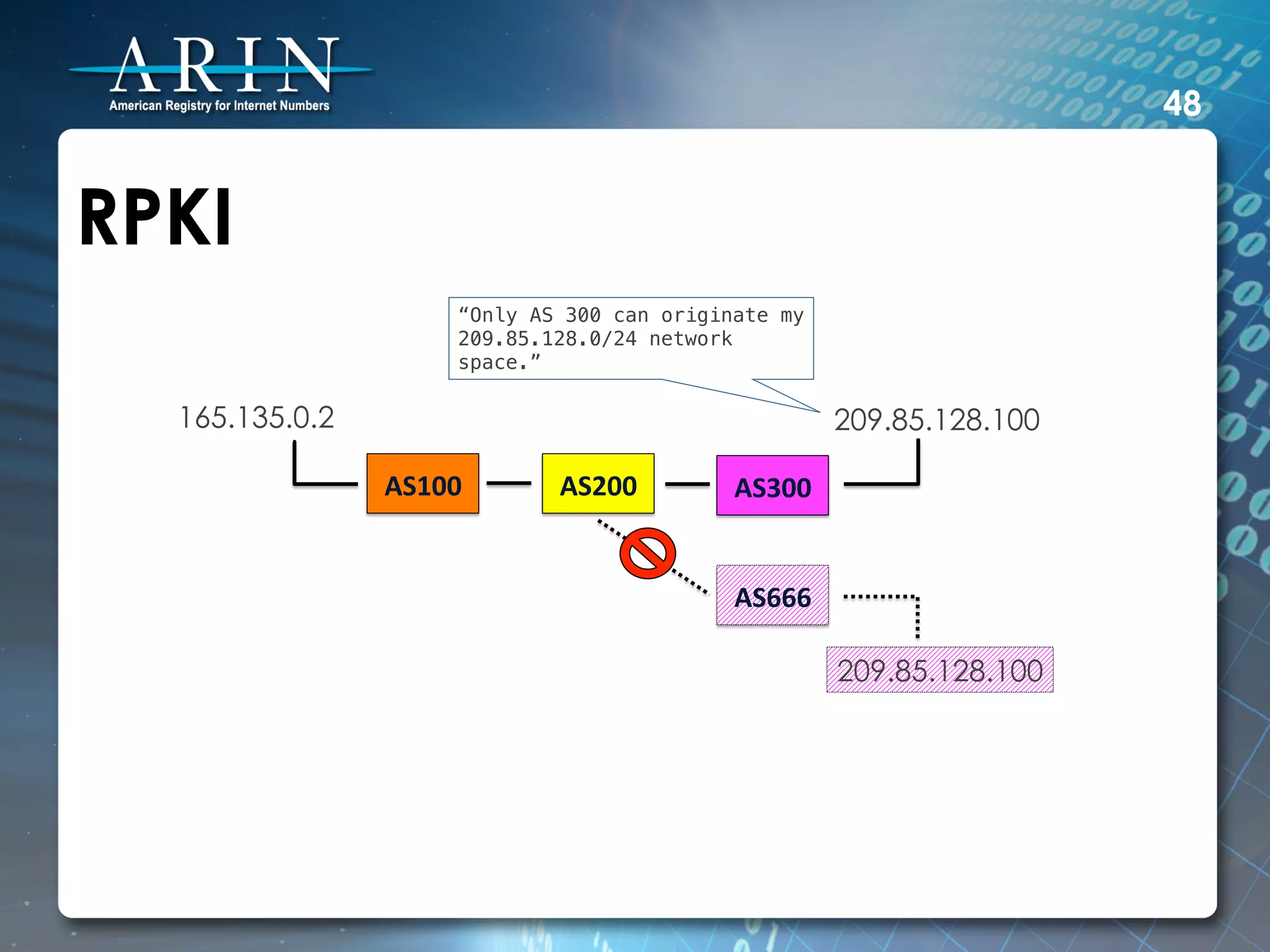
48


RPKI
                       “Only AS 300 can originate my
                       209.85.128.0/24 network
                       space.”!

  165.135.0.2                                             209.85.128.100

                AS100	
        AS200	
        AS300	


                                              AS666	
  

                                                          209.85.128.100
49


RPKI
•  Border routers use the RPKI with the
   RPKI/Router protocol.
•  http://tools.ietf.org/html/draft-ietf-
   sidr-rpki-rtr
•  Implemented on Cisco IOS and
   Quagga. JunOS recently added.
50


RPKI
•  Offload validation and origin
   evaluation to some other box.
•  “Valid”, “Invalid”, “Unknown”
•  What’s done with these values is up to
   the local policy.
51

RPKI
•  As with DNSSEC, the more buy in, the
   better the security.
•  Be a good netizen: certify your
   resources.
•  Even better: publish ROAs.
•  Be the best happy shiny: validate
   route origins as support allows.
52


RPKI @ ARIN
•  Only hosted model is currently
   implemented.
•  The delegated model will be
   released in the not-too-distant future.
•  Non-repudiation requirement.
•  Third parties need to sign a RPA
   before getting the TAL.
53


Future of RPKI
•  Single TAL.
•  Inter-RIR transfers.
•  Integrated with a path validation
   system.
54


Questions

ION San Diego - ARIN Support for DNSSEC and RPKI

  • 1.
    ARIN Support for DNSSECand RPKI ION San Diego 11 December 2012 Pete Toscano, ARIN
  • 2.
    2 DNS and BGP • They have been around for a long time. •  DNS: 1982 •  BGP: 1989 •  They are not very secure. •  Methods for securing them exist.
  • 3.
    3 DNSSEC •  Domain NameSystem Security Extensions •  Took a while to implement -- •  Design work started in 1993 at IETF 28. •  The root zone signed: July 15th, 2010.
  • 4.
    4 DNSSEC •  Designed toverify data integrity and authenticity. •  Does not prevent data snooping. •  Generally, that first point outweighs these others.
  • 5.
    5 DNSSEC •  DNSSEC isan overlay on top of DNS, not a replacement. •  Uses public key cryptography and a chain of trust similar to X.509 certificates.
  • 6.
    6 DNSSEC •  Adds sixnew RR types and extension mechanisms for DNS (EDNS). •  DNSKEY •  DS •  RRSIG •  NSEC •  NSEC3 •  NSEC3PARM
  • 7.
    7 DNSSEC •  DNSKEY: Thepublic keys. Either a Key Signing Key (KSK) or Zone Signing Key (ZSK). •  DS: Delegation Signer. Hashes and identifies the KSK of a signed, delegated child zone.
  • 8.
    8 DNSSEC •  RRSIG: ResourceRecord Signature. Every RRset for each name has a single RRSIG. There are two exceptions: •  NS records at delegation points. •  Glue records. •  DNSKEY RRSIGs are signed by the KSK, all others by ZSK.
  • 9.
    9 DNSSEC •  NSEC/NSEC3: NextSecure Record / Next Secure Record version 3. •  Used to prove the non-existence of a resource record.
  • 10.
    10 DNSSEC • A simple example of securing a zone. example.com. SOA [SOA STUFF]! NS ns! MX 10 mail! mail A 128.66.0.100! AAAA 2001:db8::100! ns A 128.66.0.10! AAAA 2001:db8::10! sub NS ns.sub! ns.sub A 128.66.10.10! AAAA 2001:db8:10::10! !
  • 11.
    11 DNSSEC • Throw in the keys... example.com. SOA [SOA STUFF]! NS ns! MX 10 mail! DNSKEY 256 [DNSKEY STUFF]; ZSK! DNSKEY 257 [DNSKEY STUFF]; KSK! mail A 128.66.0.100! AAAA 2001:db8::100! ns A 128.66.0.10! AAAA 2001:db8::10! sub NS ns.sub! ns.sub A 128.66.10.10! AAAA 2001:db8:10::10!
  • 12.
    12 DNSSEC •  Add theNSEC records so that all gaps are accounted for... example.com. SOA [SOA STUFF]! example.com. NS ns! example.com. MX 10 mail! example.com. DNSKEY 256 [DNSKEY STUFF]; ZSK! example.com. DNSKEY 257 [DNSKEY STUFF]; KSK! example.com. NSEC mail.example.com. SOA NS MX DNSKEY NSEC! mail.example.com. A 128.66.0.100! mail.example.com. AAAA 2001:db8::100! mail.example.com. NSEC ns.example.com. A AAAA NSEC! ns.example.com. A 128.66.0.10! ns.example.com. AAAA 2001:db8::10! ns.example.com. NSEC sub.example.com. A AAAA NSEC! sub.example.com. NS ns.sub! sub.example.com. NSEC example.com. NS NSEC! ns.sub.example.com. A 128.66.10.10! ns.sub.example.com. AAAA 2001:db8:10::10! • NSEC doesn’t do glue. • Zone enumeration? That’s where NSEC3 comes in.
  • 13.
    DNSSEC 13 •  Sign each label’s RRset and update NSECs... example.com. SOA [SOA STUFF]! example.com. RRSIG SOA [RRSIG STUFF]! example.com. NS ns! example.com. RRSIG NS [RRSIG STUFF]! example.com. MX 10 mail! example.com. RRSIG MX [RRSIG STUFF]! example.com. DNSKEY 256 [DNSKEY STUFF]; ZSK! example.com. DNSKEY 257 [DNSKEY STUFF]; KSK! example.com. RRSIG DNSKEY [RRSIG STUFF]! example.com. NSEC mail.example.com. SOA NS MX DNSKEY NSEC RRSIG! example.com. RRSIG NSEC [RRSIG STUFF]! mail.example.com. A 128.66.0.100! mail.example.com. RRSIG A [RRSIG STUFF]! mail.example.com. AAAA 2001:db8::100! mail.example.com. RRSIG AAAA [RRSIG STUFF]! mail.example.com. NSEC ns.example.com. A AAAA NSEC RRSIG! mail.example.com. RRSIG NSEC [RRSIG STUFF]! ns.example.com. A 128.66.0.10! ns.example.com. RRSIG A [RRSIG STUFF]! ns.example.com. AAAA 2001:db8::10! ns.example.com. RRSIG AAAA [RRSIGSTUFF]! ns.example.com. NSEC sub.example.com. A AAAA NSEC RRSIG! ns.example.com. RRSIG NSEC [RRSIG STUFF]! sub.example.com. NS ns.sub! sub.example.com. NSEC example.com. NS NSEC RRSIG! sub.example.com. RRSIG NSEC [RRSIG STUFF]! ns.sub.example.com. A 128.66.10.10! ns.sub.example.com. AAAA 2001:db8:10::10!
  • 14.
    DNSSEC 14 •  Signed delegations. Add DS records and update NSEC and RRSIGs. example.com. SOA [SOA STUFF]! example.com. RRSIG SOA [RRSIG STUFF]! example.com. NS ns! example.com. RRSIG NS [RRSIG STUFF]! example.com. MX 10 mail! example.com. RRSIG MX [RRSIG STUFF]! example.com. DNSKEY 256 [DNSKEY STUFF]; ZSK! example.com. DNSKEY 257 [DNSKEY STUFF]; KSK! example.com. RRSIG DNSKEY [RRSIG STUFF]! example.com. NSEC mail.example.com. SOA NS MX DNSKEY NSEC RRSIG! example.com. RRSIG NSEC [RRSIG STUFF]! mail.example.com. A 128.66.0.100! mail.example.com. RRSIG A [RRSIG STUFF]! mail.example.com. AAAA 2001:db8::100! mail.example.com. RRSIG AAAA [RRSIG STUFF]! mail.example.com. NSEC ns.example.com. A AAAA NSEC RRSIG! mail.example.com. RRSIG NSEC [RRSIG STUFF]! ns.example.com. A 128.66.0.10! ns.example.com. RRSIG A [RRSIG STUFF]! ns.example.com. AAAA 2001:db8::10! ns.example.com. RRSIG AAAA [RRSIG STUFF]! ns.example.com. NSEC sub.example.com. A AAAA NSEC RRSIG! ns.example.com. RRSIG NSEC [RRSIG STUFF]! sub.example.com. NS ns.sub! sub.example.com. DS [Hash of sub’s KSK]! sub.example.com. RRSIG DS [RRSIG STUFF]! sub.example.com. NSEC example.com. NS DS NSEC RRSIG! sub.example.com. RRSIG NSEC [RRSIG STUFF]! ns.sub.example.com. A 128.66.10.10! ns.sub.example.com. AAAA 2001:db8:10::10!
  • 15.
    15 DNSSEC •  What todo with all this extra data? •  Publishing the signed data is only half the battle. •  The authoritative DNS responses need to be validated.
  • 16.
    16 DNSSEC •  Response validationinvolves following a chain of trust from the trust anchor to the answer received. •  Typically, the root zone’s KSK == Trust Anchor
  • 17.
    17 DNSSEC •  The backboneof the chain of trust is the DS, DNSKEY, RRSIG interaction. •  Trust travels from the parent zone down to the child zone. Repeat until the target zone is found. •  Start at the trust anchor’s zone.
  • 18.
    18 DNSSEC RRSIG! KSK DNSKEY! ZSK DNSKEY! Parent Zone RRSIG! ...! DS! RRSIG! KSK DNSKEY! Child Zone ZSK DNSKEY! RRSIG! ...! DS!
  • 19.
    19 DNSSEC •  Once thetarget child zone is found, the ZSK is used the verify the appropriate RRSIG. •  If the question cannot be answered, the ZSK can be used to verify the appropriate NSEC/NSEC3 RRSIG. •  If the answer can’t be verified, then NXDOMAIN status is returned.
  • 20.
    20 DNSSEC •  From aDNS publisher’s point of view, DNSSEC can greatly expand the size of zones. •  On average, responses are larger. •  Management of the keys can be tricky. •  Protects the data, not the headers. •  Does nothing to protect the stub resolver to recursive resolver communication.
  • 21.
    21 DNSSEC •  At ARIN,we currently sign our v4 /8s and v6 /12 and /24s. •  ARIN Online allows members to add DS records to the zones their resources are delegated from.
  • 22.
    22 DNSSEC •  DNSSEC Analyzer: http://dnssec-analyzer.verisignlabs.com •  DNSViz: http://dnsviz.net •  ldns / Drill: http://www.nlnetlabs.nl/projects/ldns/ •  DNSSEC Validator: http://www.dnssec-validator.cz/ (FF Plugin) •  Other Tools: https://www.dnssec-deployment.org/wiki/ index.php/Tools_and_Resources
  • 23.
  • 24.
    24 “The inter-domain routingprotocol BGP was created when the Internet environment had not yet reached the present, contentious state. Consequently, the BGP design did not include protections against deliberate or accidental errors that could cause disruptions of routing behavior.” • Intro to RFC 4272 “BGP Security Vulnerabilities Analysis” January 2006
  • 25.
    25 RPKI Thisis the basic problem... Send  a  packet   to   209.85.128.100   I  have   209.85.128.0/17  
  • 26.
    26 RPKI 165.135.0.2 209.85.128.100 AS100   AS200   AS300  
  • 27.
    27 RPKI 165.135.0.2 209.85.128.100 AS100   AS200   AS300   AS666   209.85.128.100
  • 28.
    28 RPKI •  April 1997– AS 7007 announced paths for all of the internet to themselves. •  Feb. 24, 2008 –Pakistan Telecom announced a part of YouTube’s address blocks. •  April 2010 - China Telecom mis-originated about 15% of Internet address blocks affecting I-root. •  Nov. 2012 – Google was unavailable some places via route leak from Moratel.
  • 29.
    29 RPKI 165.135.0.2 209.85.128.100 AS100   AS200   AS300   Phase 1: Origin Validation (requires RPKI) Phase 2: Path Validation (still in draft phase)
  • 30.
    30 RPKI •  Resource PublicKey Infrastructure •  RPKI attaches ASNs and IP address blocks to X.509 v3 certs. •  These resource certs are signed by the resource parent.
  • 31.
    31 RPKI IANA! Resource Allocation Hierarchy AFRINIC! APNIC! ARIN! LACNIC! RIPE NCC! ISP 1! ISP 2! ISP 4! ISP 3! ISP! ISP! ISP!
  • 32.
    32 Certificates RPKI IANA! issued to match allocations. AFRINIC! APNIC! ARIN! LACNIC! RIPE NCC! Issuer: ARIN! Subject: ARIN! Resources: 192.0.0.0/8! ISP 1! ISP 2! ISP 4! Key Info: <arin-key-pub>! Signed: <arin-key-priv>! ISP 3! ISP! ISP! ISP!
  • 33.
    33 Certificates RPKI IANA! issued to match allocations. AFRINIC! APNIC! ARIN! LACNIC! RIPE NCC! Issuer: ARIN! Issuer: ARIN! Subject: ISP1! Subject: ARIN! Resources: 192.2.0.0/16! Resources: 192.0.0.0/8! Key Info: <isp1-key-pub>! ISP 1! ISP 2! ISP 4! Key Info: <arin-key-pub>! Signed: <arin-key-priv>! Signed: <arin-key-priv>! ISP 3! ISP! ISP! ISP!
  • 34.
    34 Certificates RPKI IANA! issued to match allocations. AFRINIC! APNIC! ARIN! LACNIC! RIPE NCC! Issuer: ARIN! Issuer: ARIN! Subject: ISP1! Subject: ARIN! Resources: 192.2.0.0/16! Resources: 192.0.0.0/8! Key Info: <isp1-key-pub>! ISP 1! ISP 2! ISP 4! Key Info: <arin-key-pub>! Signed: <arin-key-priv>! Signed: <arin-key-priv>! Issuer: ISP1! Subject: ISP3! Resources: 192.2.200.0/24! Key Info: <isp3-key-pub>! Signed: <isp1-key-priv>! ISP 3! ISP! ISP! ISP!
  • 35.
    35 RPKI •  Address holdersissue Route Origin Authorizations (ROAs).
  • 36.
    36 Certificates RPKI IANA! issued to match allocations. AFRINIC! APNIC! ARIN! LACNIC! RIPE NCC! Issuer: ARIN! Issuer: ARIN! Subject: ISP1! Subject: ARIN! Resources: 192.2.0.0/16! Resources: 192.0.0.0/8! Key Info: <isp1-key-pub>! ISP 1! ISP 2! ISP 4! Key Info: <arin-key-pub>! Signed: <arin-key-priv>! Signed: <arin-key-priv>! Issuer: ISP1! Subject: ISP3! Resources: 192.2.200.0/24! Key Info: <isp3-key-pub>! Signed: <isp1-key-priv>! ISP 3! ISP! ISP! ISP!
  • 37.
    37 Certificates RPKI IANA! issued to match allocations. AFRINIC! APNIC! ARIN! LACNIC! RIPE NCC! Issuer: ARIN! Issuer: ARIN! Subject: ISP1! Subject: ARIN! Resources: 192.2.0.0/16! Resources: 192.0.0.0/8! Key Info: <isp1-key-pub>! ISP 1! ISP 2! ISP 4! Key Info: <arin-key-pub>! Signed: <arin-key-priv>! Signed: <arin-key-priv>! Issuer: ISP1! Subject: ISP3! Resources: 192.2.200.0/24! Key Info: <isp3-key-pub>! Signed: <isp1-key-priv>! ISP 3! ISP! ISP! ISP! Issuer: ISP3! ROA: “ISP 3 permits ASN 123 to originate its Subject: ISP3-EE! 192.2.200.0/24 network space.”! Resources: 192.2.200.0/24! ! Key Info: <isp3EE-key-pub>! ! Signed: <isp3-key-priv>! ß Attached! Signed, <isp3EE-key-priv>! !
  • 38.
    38 RPKI •  Two RPKIimplementation types: •  Delegated: Each participating node becomes a CA and runs their own RPKI repository, delegated to by the parent CA. •  Hosted: The RIR runs the CA functionality for interested participants.
  • 39.
    39 RPKI •  For mostparticipants, running a CA would be an insurmountable obstacle to the implementation of RPKI. •  This is why the hosted option exists.
  • 40.
    40 RPKI •  Regardless ofthe method used, the RPKI repositories are published. •  TAL: Trust Anchor Locator •  Points to the rsync entry point of that repo. •  Includes that repo’s public key.
  • 41.
    41 RPKI •  Reliant thirdparties would gather all relevant TALs. •  Get all of the RPKI repos. •  Validate, validate, validate.
  • 42.
    42 RPKI •  Once wehave validated ROAs and the backing resource hierarchy, what do we do?
  • 43.
    43 RPKI •  Once wehave validated ROAs and the backing resource hierarchy, what do we do? •  Use ROAs to weight BGP path announcements as they’re received.
  • 44.
    44 RPKI 165.135.0.2 209.85.128.100 AS100   AS200   AS300   AS666   209.85.128.100
  • 45.
    45 RPKI 165.135.0.2 209.85.128.100 AS100   AS200   AS300  
  • 46.
    46 RPKI “Only AS 300 can originate 209.85.128.0/24 network space.”! 165.135.0.2 209.85.128.100 AS100   AS200   AS300  
  • 47.
    47 RPKI “Only AS 300 can originate my 209.85.128.0/24 network space.”! 165.135.0.2 209.85.128.100 AS100   AS200   AS300   AS666   209.85.128.100
  • 48.
    48 RPKI “Only AS 300 can originate my 209.85.128.0/24 network space.”! 165.135.0.2 209.85.128.100 AS100   AS200   AS300   AS666   209.85.128.100
  • 49.
    49 RPKI •  Border routersuse the RPKI with the RPKI/Router protocol. •  http://tools.ietf.org/html/draft-ietf- sidr-rpki-rtr •  Implemented on Cisco IOS and Quagga. JunOS recently added.
  • 50.
    50 RPKI •  Offload validationand origin evaluation to some other box. •  “Valid”, “Invalid”, “Unknown” •  What’s done with these values is up to the local policy.
  • 51.
    51 RPKI •  As withDNSSEC, the more buy in, the better the security. •  Be a good netizen: certify your resources. •  Even better: publish ROAs. •  Be the best happy shiny: validate route origins as support allows.
  • 52.
    52 RPKI @ ARIN • Only hosted model is currently implemented. •  The delegated model will be released in the not-too-distant future. •  Non-repudiation requirement. •  Third parties need to sign a RPA before getting the TAL.
  • 53.
    53 Future of RPKI • Single TAL. •  Inter-RIR transfers. •  Integrated with a path validation system.
  • 54.