Agenda
●   Who are we etc.
●   DNS
●   DNSSEC
●   Bind and DNSSEC
●   OpenDNSSEC
●   Other fun stuff
Who we are
●   Georg
Netic
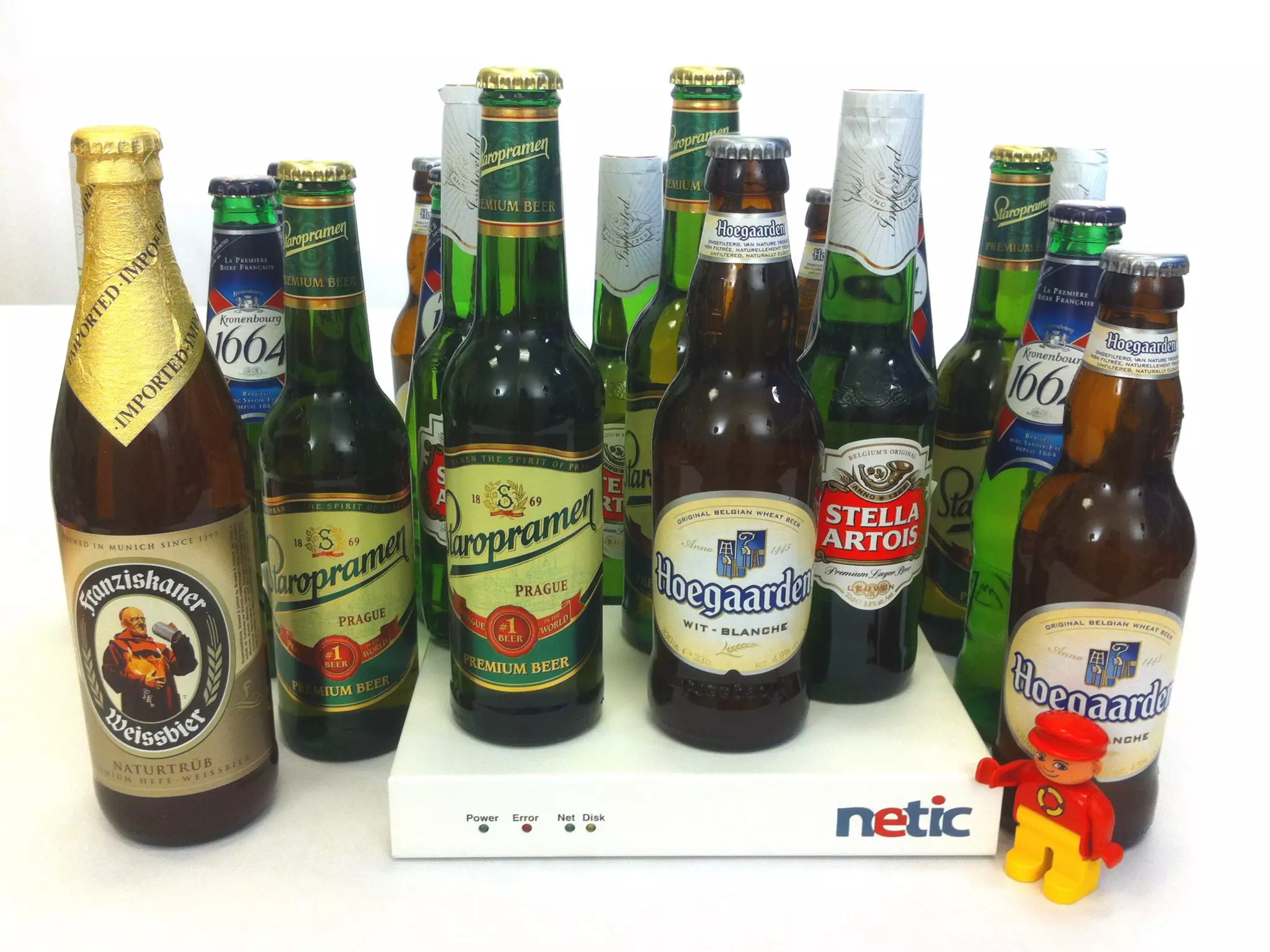
●   ØL
Netic
●   IT-konsulent og -hostingvirksomhed i Aalborg
    –   Specialiserede hostingydelser i egne datacentre el. hos kunden
    –   Udvikling af egne produkter el. opgaver for kunder
    –   Fokus på kvalitet
    –   Vi bruger i høj grad open source software, f.eks. Linux &
        FreeBSD
    –   16 ansatte, medarbejderejet
    –   Godt socialt samværd og dygtige kollegaer
    –   Kunder spænder over alt fra ISP'er og IT-virksomheder over
        private firmaer til offentlige institutioner
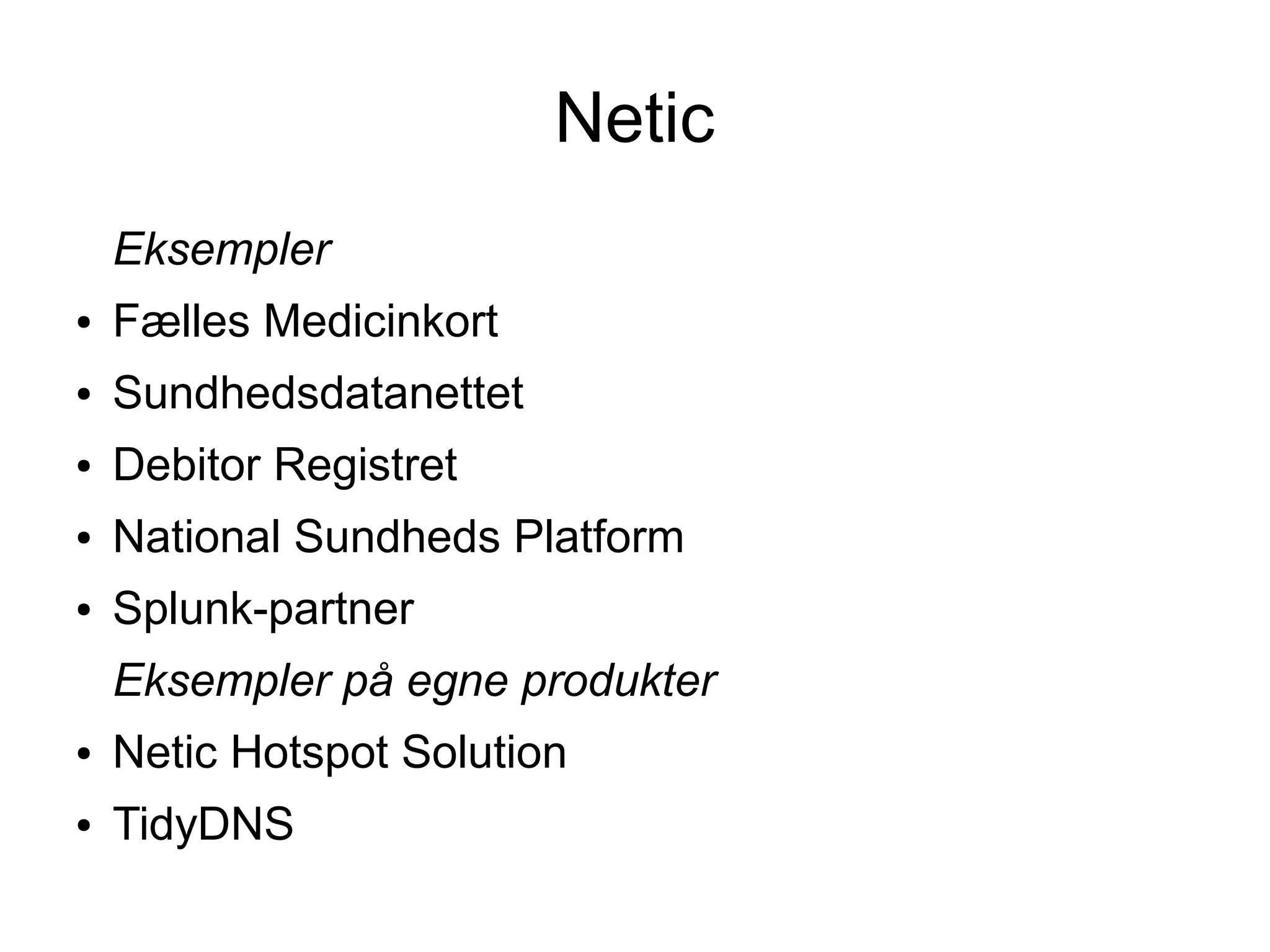
Netic
    Eksempler
●   Fælles Medicinkort
●   Sundhedsdatanettet
●   Debitor Registret
●   National Sundheds Platform
●   Splunk-partner
    Eksempler på egne produkter
●   Netic Hotspot Solution
●   TidyDNS
Netic
DNS, DNSSEC, ...
●   Overblik over folks erfaringer
●   DNS
●   DNSSEC
●   OpenDNSSEC
Motivation
●   Kaminsky
●   Klip med Phil Regnaults ;-)
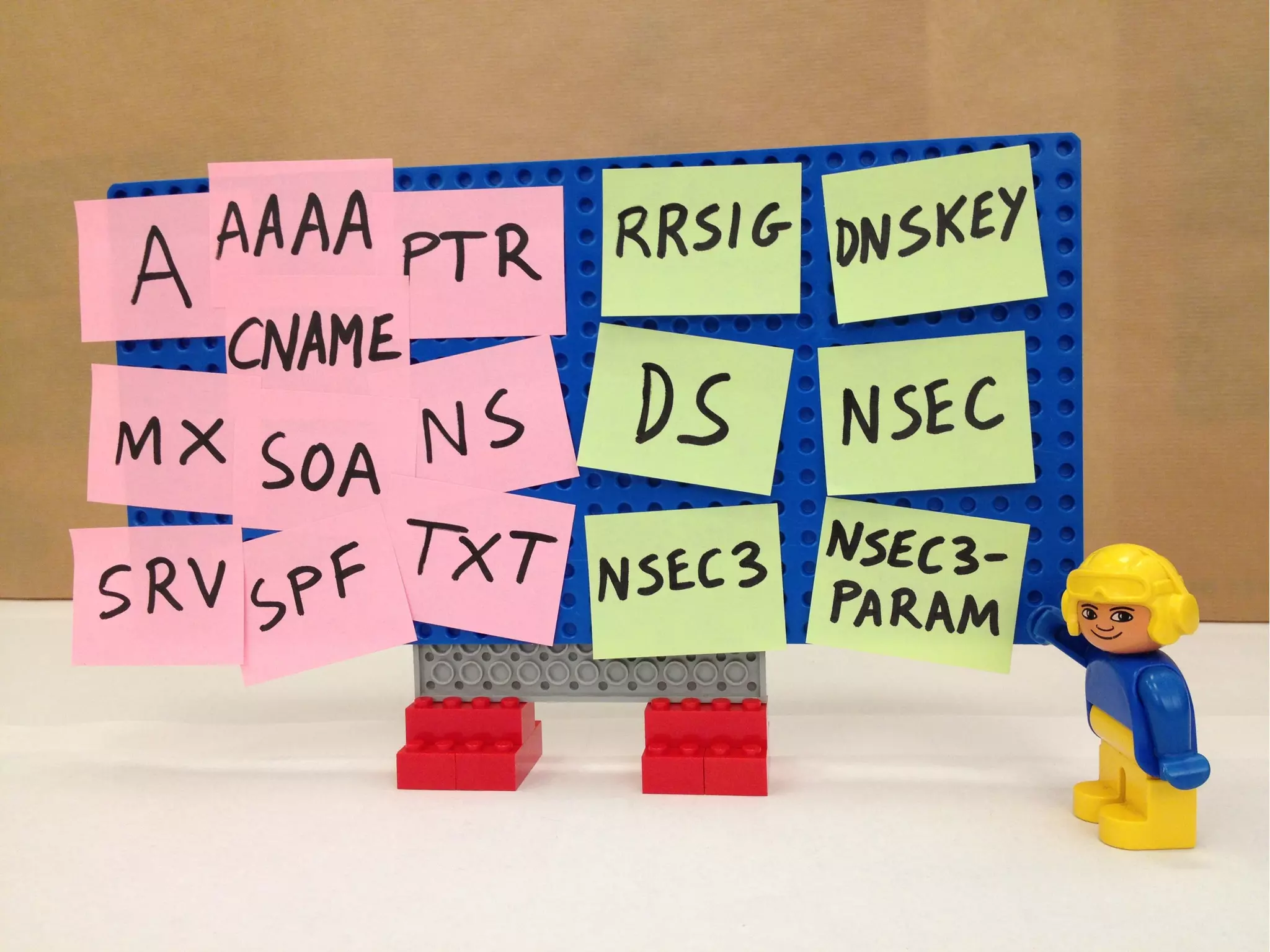
●   Ny teknologi!
●   Nye muligheder
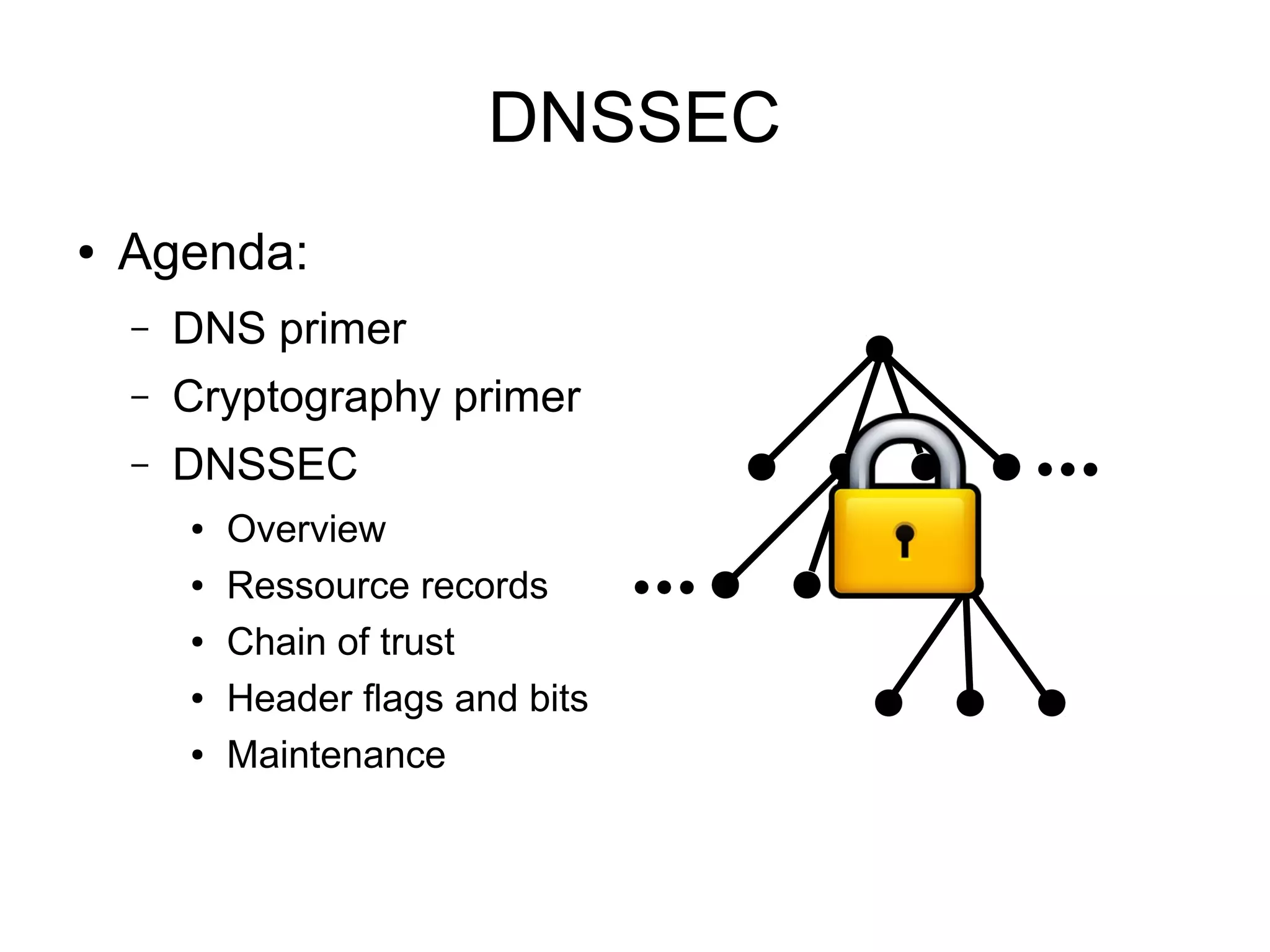
DNSSEC
●   Agenda:
    –   DNS primer
    –   Cryptography primer
    –   DNSSEC
        ●   Overview
        ●   Ressource records
        ●   Chain of trust
        ●   Header flags and bits
        ●   Maintenance
DNS primer
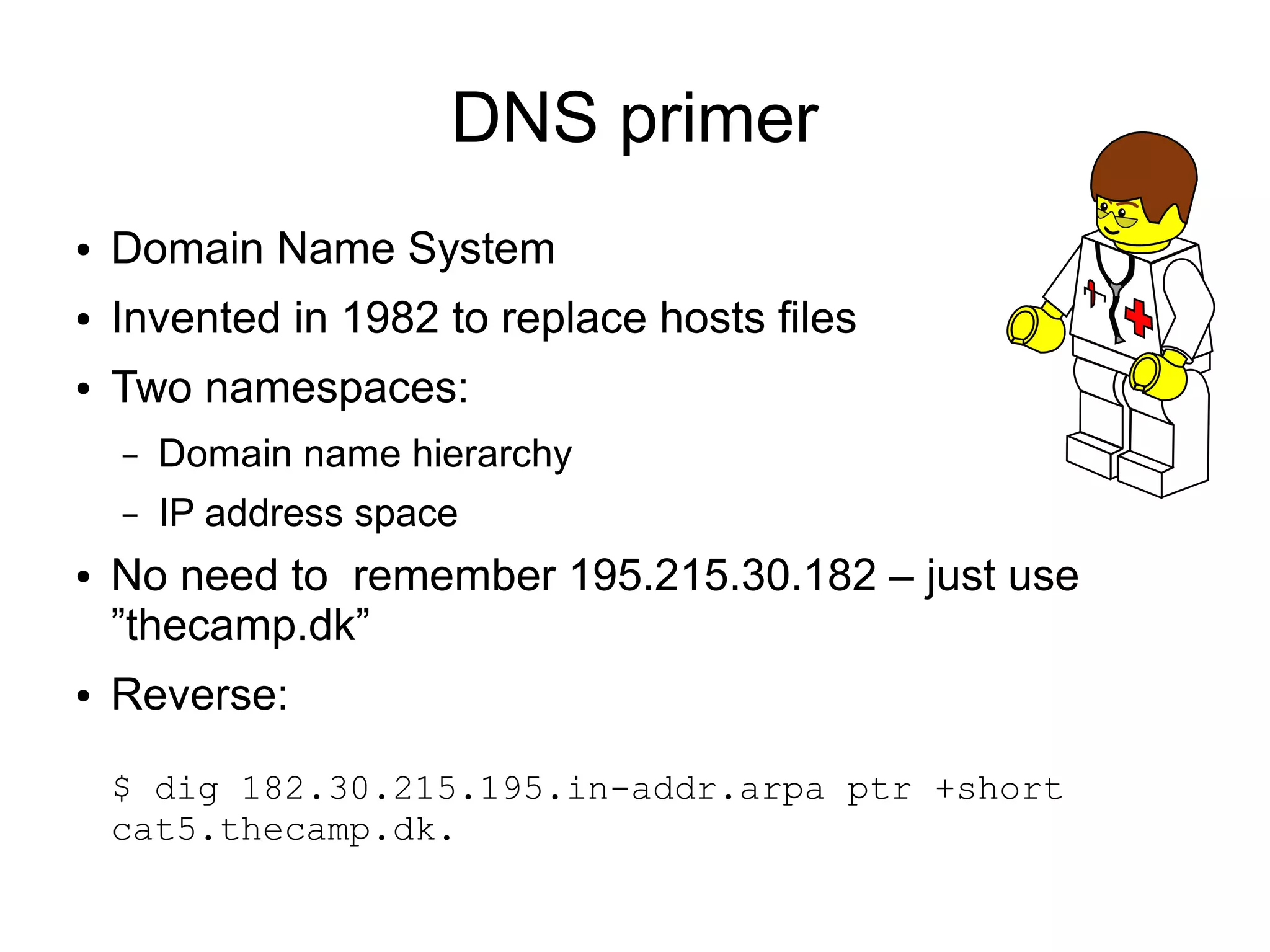
●   Domain Name System
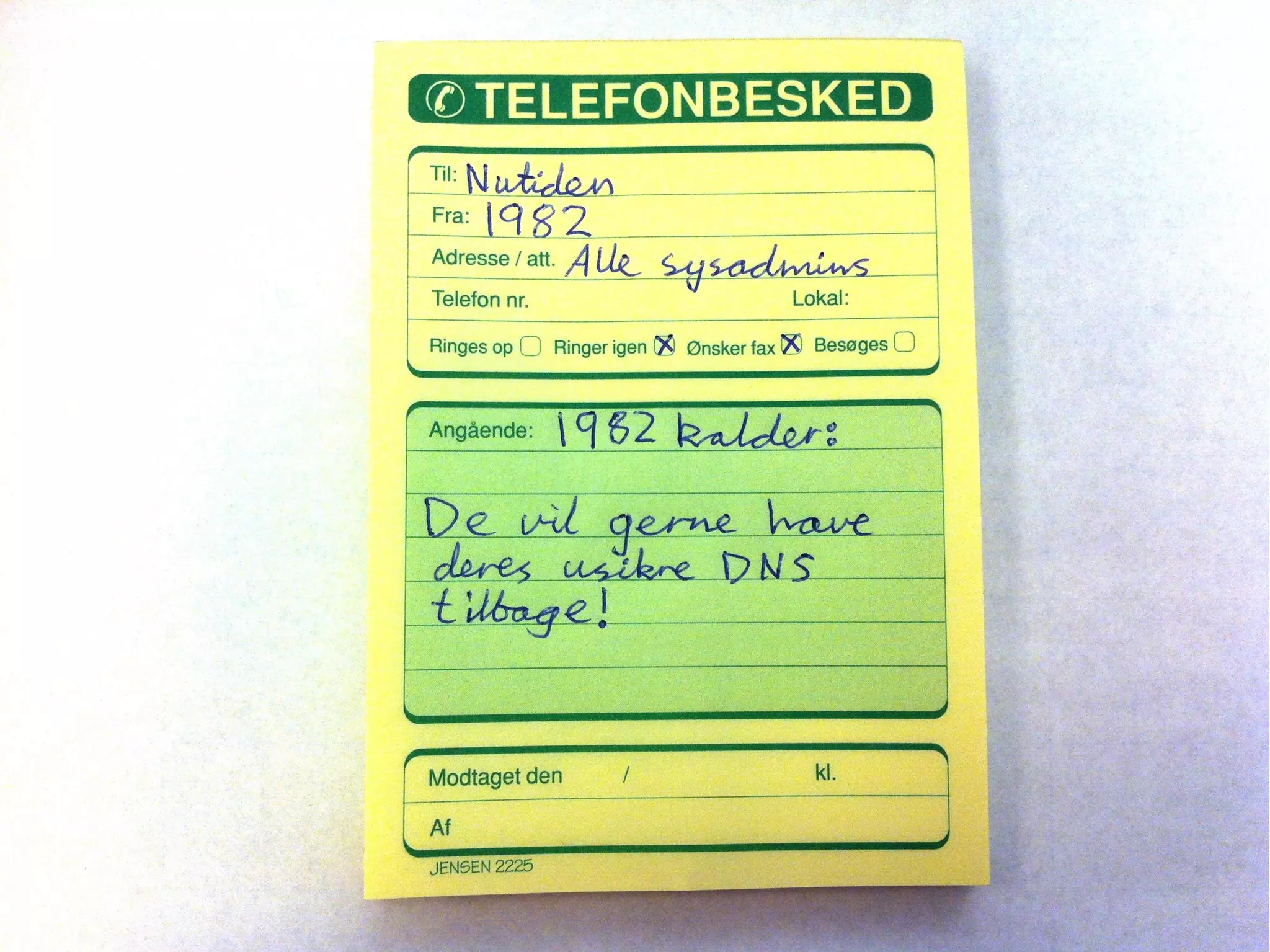
●   Invented in 1982 to replace hosts files
●   Two namespaces:
    –   Domain name hierarchy
    –   IP address space
●   No need to remember 195.215.30.182 – just use
    ”thecamp.dk”
●   Reverse:

    $ dig 182.30.215.195.in-addr.arpa ptr +short
    cat5.thecamp.dk.
DNS primer
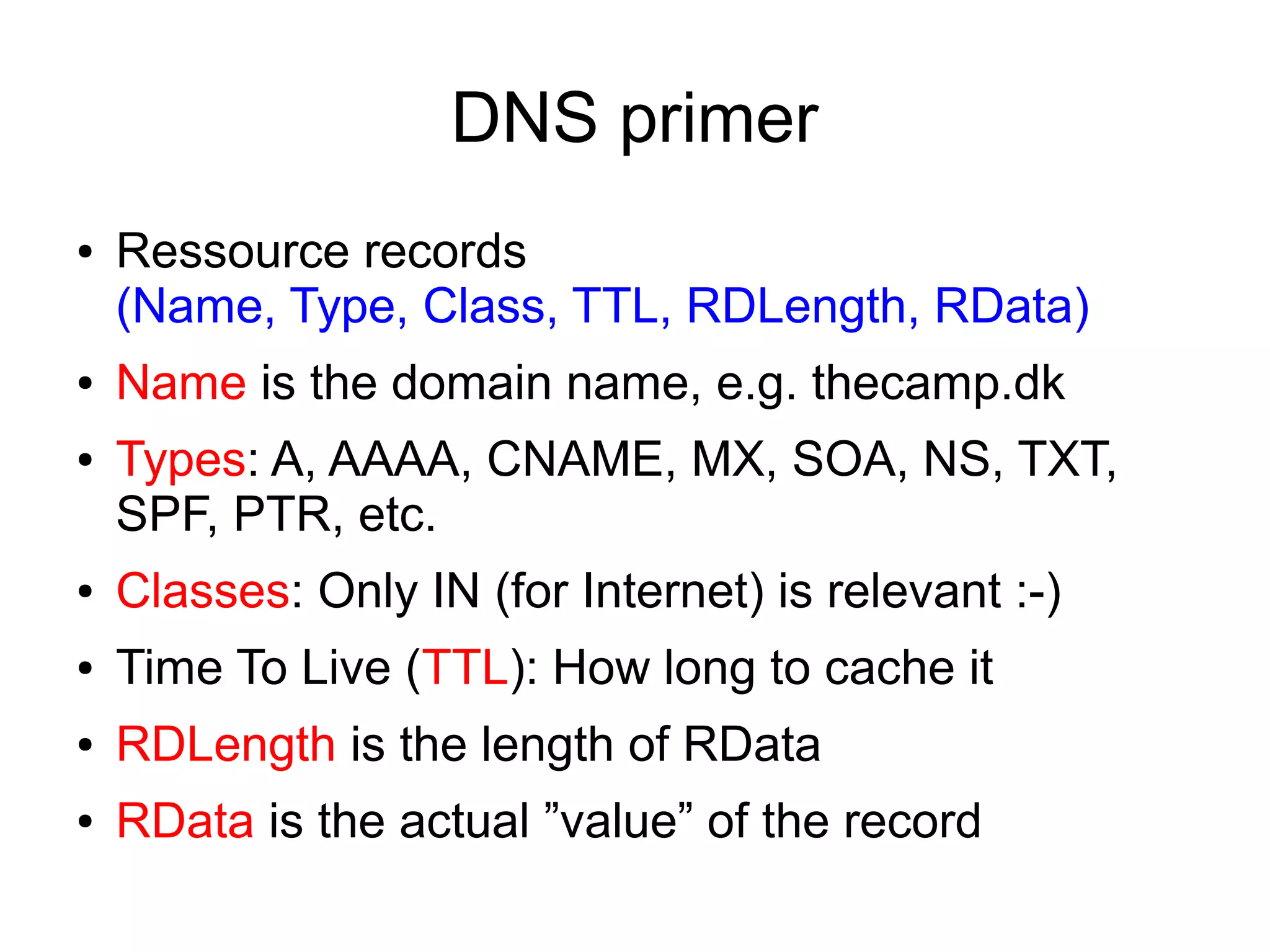
●   Ressource records
    (Name, Type, Class, TTL, RDLength, RData)
●   Name is the domain name, e.g. thecamp.dk
●   Types: A, AAAA, CNAME, MX, SOA, NS, TXT,
    SPF, PTR, etc.
●   Classes: Only IN (for Internet) is relevant :-)
●   Time To Live (TTL): How long to cache it
●   RDLength is the length of RData
●   RData is the actual ”value” of the record
DNS primer
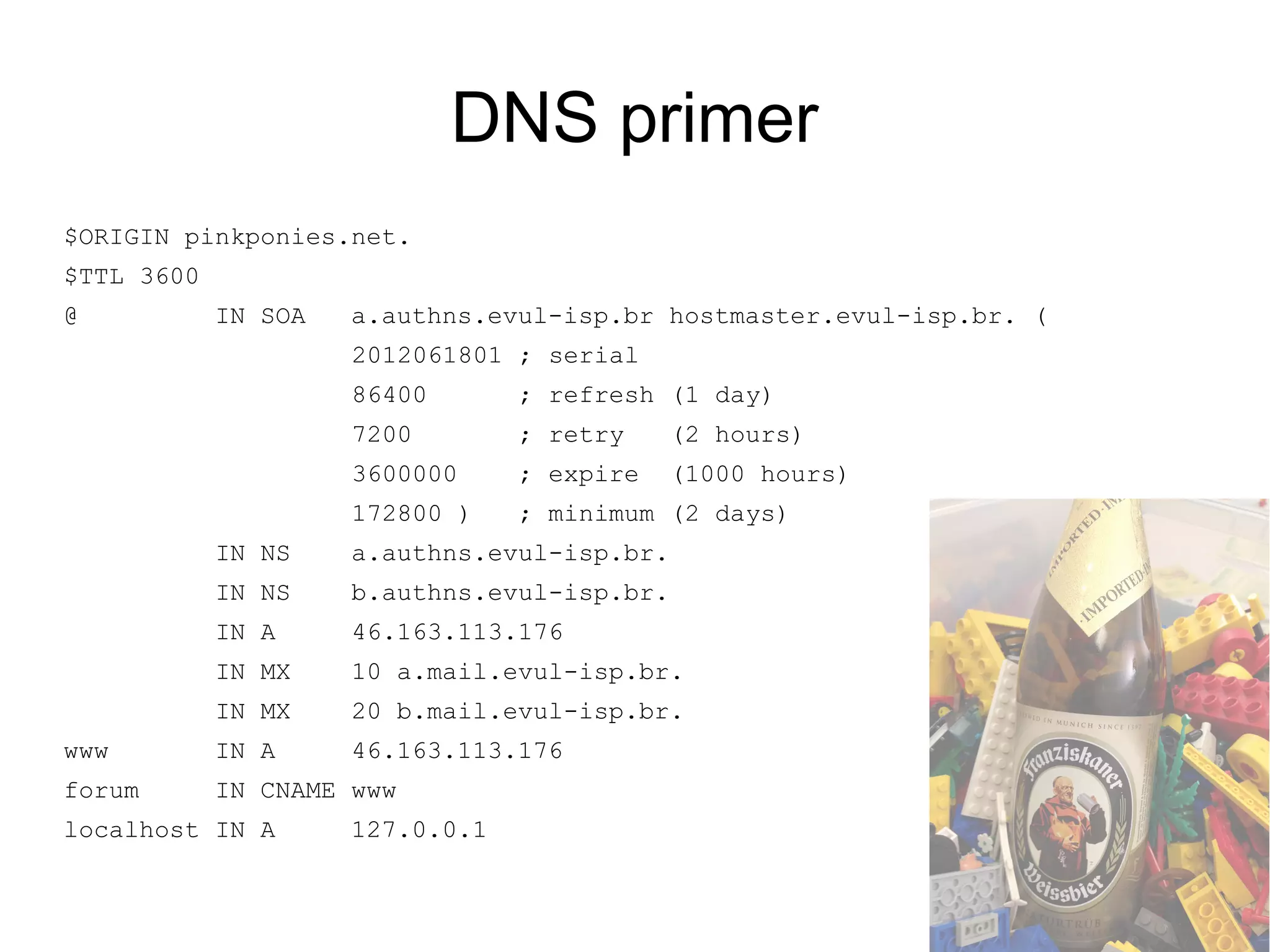
$ORIGIN pinkponies.net.
$TTL 3600
@           IN SOA   a.authns.evul-isp.br hostmaster.evul-isp.br. (
                     2012061801 ; serial
                     86400       ; refresh (1 day)
                     7200        ; retry     (2 hours)
                     3600000     ; expire    (1000 hours)
                     172800 )    ; minimum (2 days)
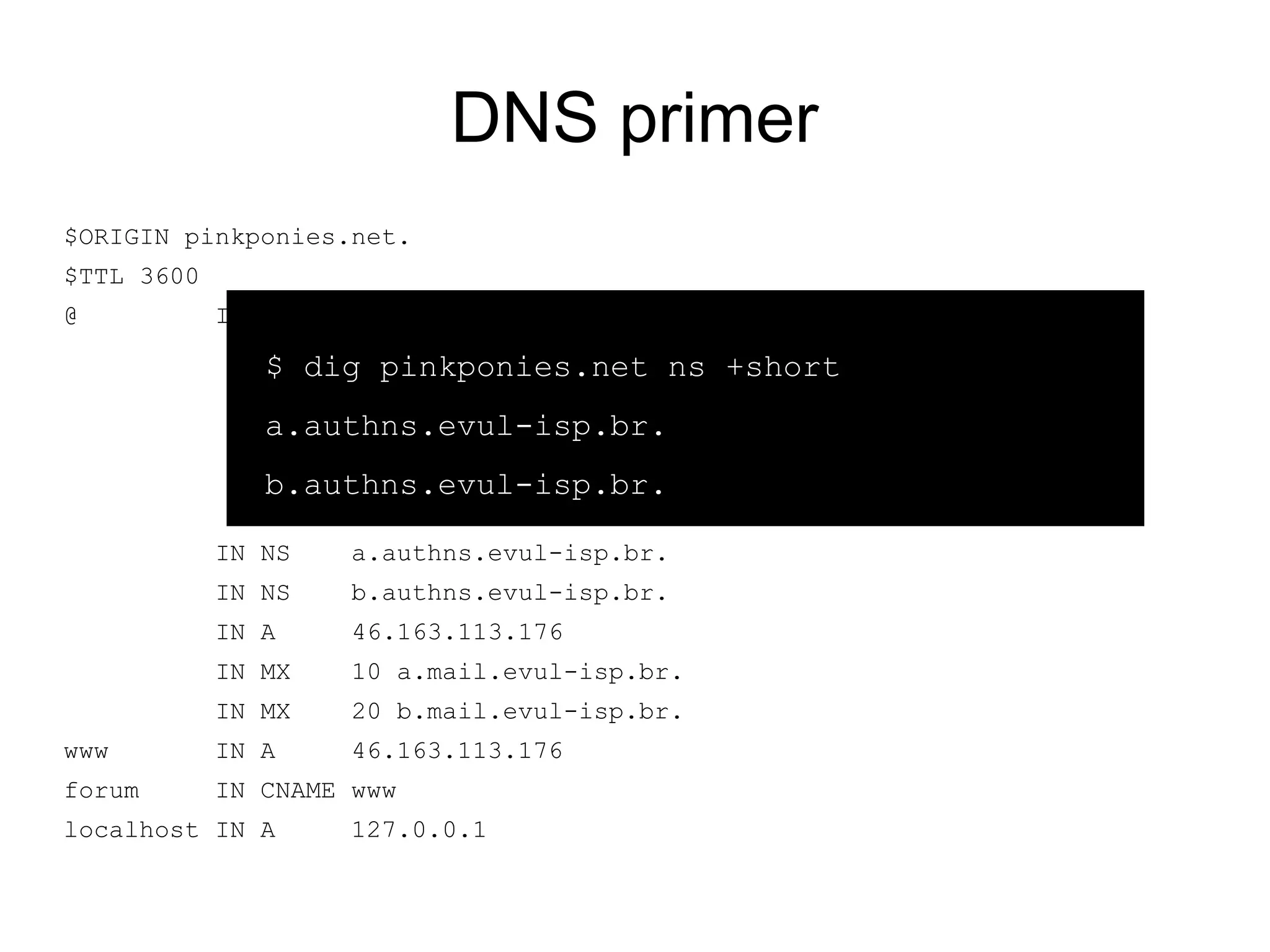
            IN NS    a.authns.evul-isp.br.
            IN NS    b.authns.evul-isp.br.
            IN A     46.163.113.176
            IN MX    10 a.mail.evul-isp.br.
            IN MX    20 b.mail.evul-isp.br.
www         IN A     46.163.113.176
forum       IN CNAME www
localhost IN A       127.0.0.1
DNS primer
$ORIGIN pinkponies.net.
$TTL 3600
@           IN SOA   a.authns.evul-isp.br hostmaster.evul-isp.br. (
                    201 ; serial
               $ dig pinkponies.net ns +short
                     86400       ; refresh (1 day)
               a.authns.evul-isp.br. (2
                    7200    ; retry           hours)

               b.authns.evul-isp.br. (1000
                    3600000 ; expire             hours)
                     172800 )    ; minimum (2 days)
            IN NS    a.authns.evul-isp.br.
            IN NS    b.authns.evul-isp.br.
            IN A     46.163.113.176
            IN MX    10 a.mail.evul-isp.br.
            IN MX    20 b.mail.evul-isp.br.
www         IN A     46.163.113.176
forum       IN CNAME www
localhost IN A       127.0.0.1
DNS primer
$ORIGIN pinkponies.net.
$TTL 3600
@           IN SOA   a.authns.evul-isp.br hostmaster.evul-isp.br. (
                     2012061801 ; serial
                     86400       ; refresh (1 day)
                     7200        ; retry     (2 hours)
                     3600000     ; expire    (1000 hours)
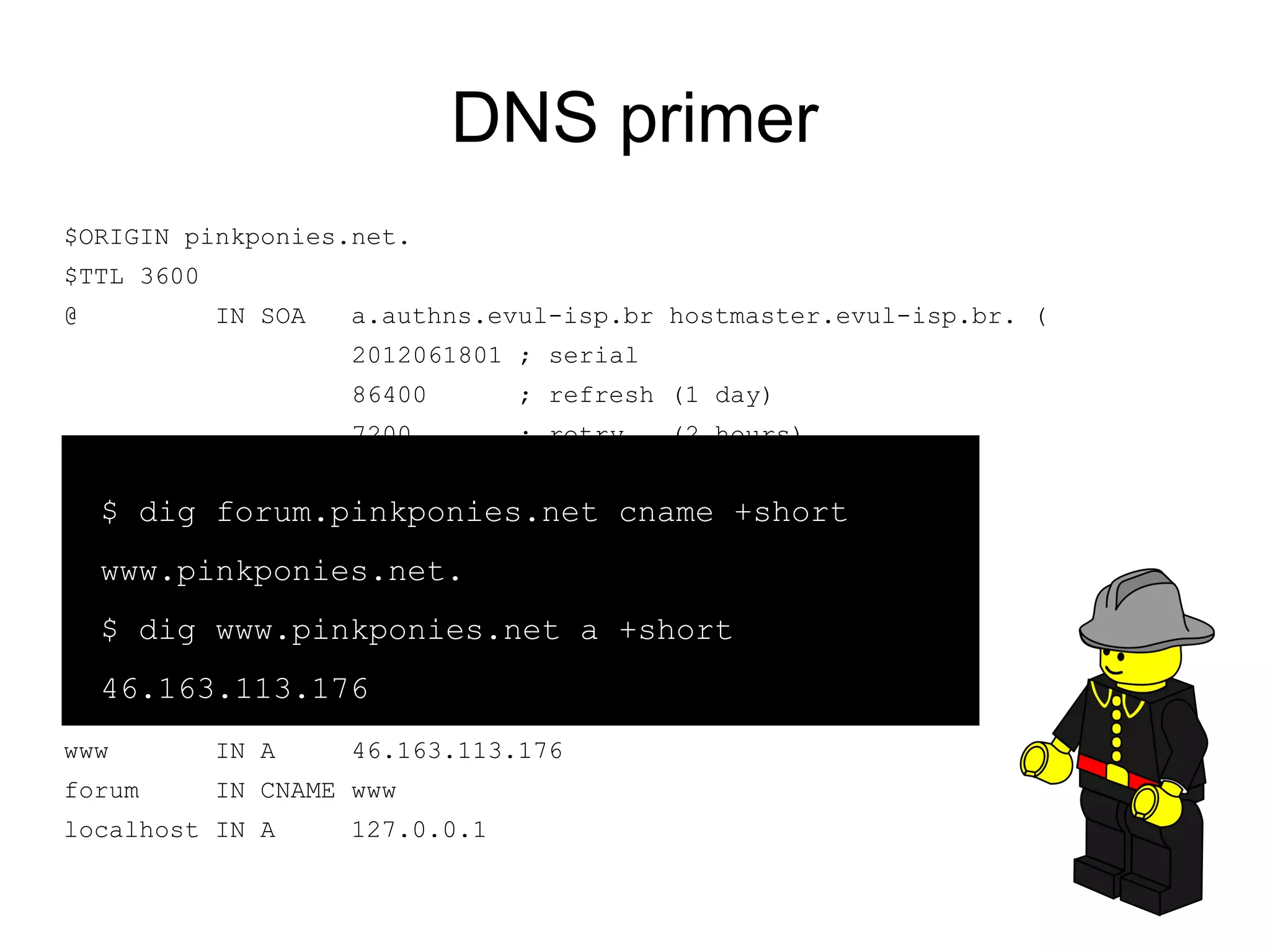
    $ dig forum.pinkponies.net cnamedays)
                 172800 ) ; minimum (2 +short
            IN NS    a.authns.evul-isp.br.
    www.pinkponies.net.
            IN NS    b.authns.evul-isp.br.
    $ dig IN A
          www.pinkponies.net a +short
                 46.163.113.176
            IN MX    10 a.mail.evul-isp.br.
    46.163.113.176
            IN MX    20 b.mail.evul-isp.br.
www         IN A     46.163.113.176
forum       IN CNAME www
localhost IN A       127.0.0.1
DNS primer
$ORIGIN pinkponies.net.
$TTL 3600
@           IN SOA   a.authns.evul-isp.br hostmaster.evul-isp.br. (
                     2012061801 ; serial
                     86400       ; refresh (1 day)
                     7200        ; retry     (2 hours)
                     3600000     ; expire    (1000 hours)
                     172800 )    ; minimum (2 days)
            IN NS    a.authns.evul-isp.br.
            IN NS    b.authns.evul-isp.br.
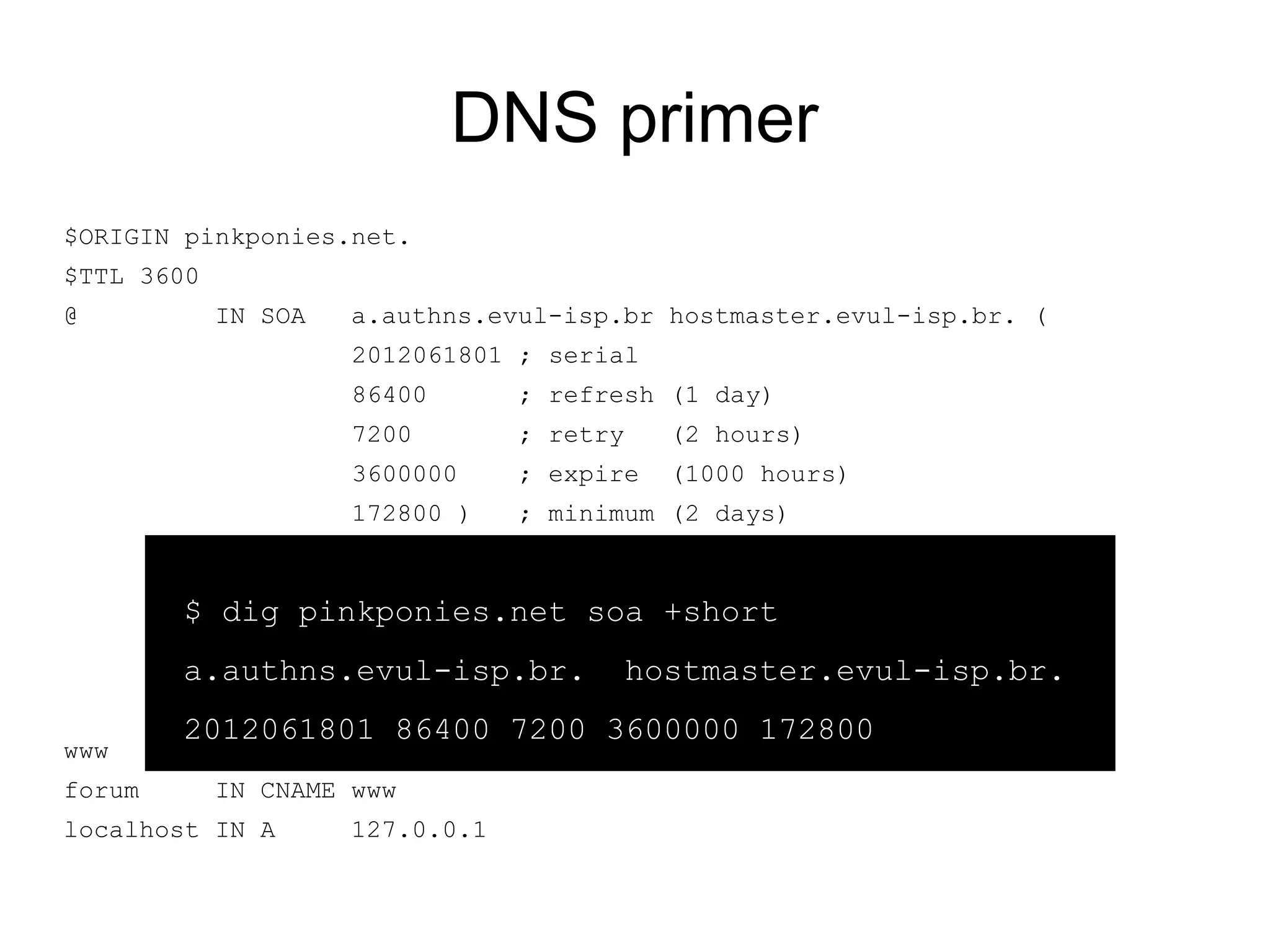
        $ dig pinkponies.net soa +short
            IN A     46.163.113.176
        a.authns.evul-isp.br. hostmaster.evul-isp.br.
          IN MX  10 a.mail.evul-isp.br.
            IN MX    20 b.mail.evul-isp.br.
        2012061801 86400 7200 3600000 172800
www         IN A     46.163.113.176
forum       IN CNAME www
localhost IN A       127.0.0.1
DNS primer
$ORIGIN pinkponies.net.
$TTL 3600
@           IN SOA   a.authns.evul-isp.br hostmaster.evul-isp.br. (


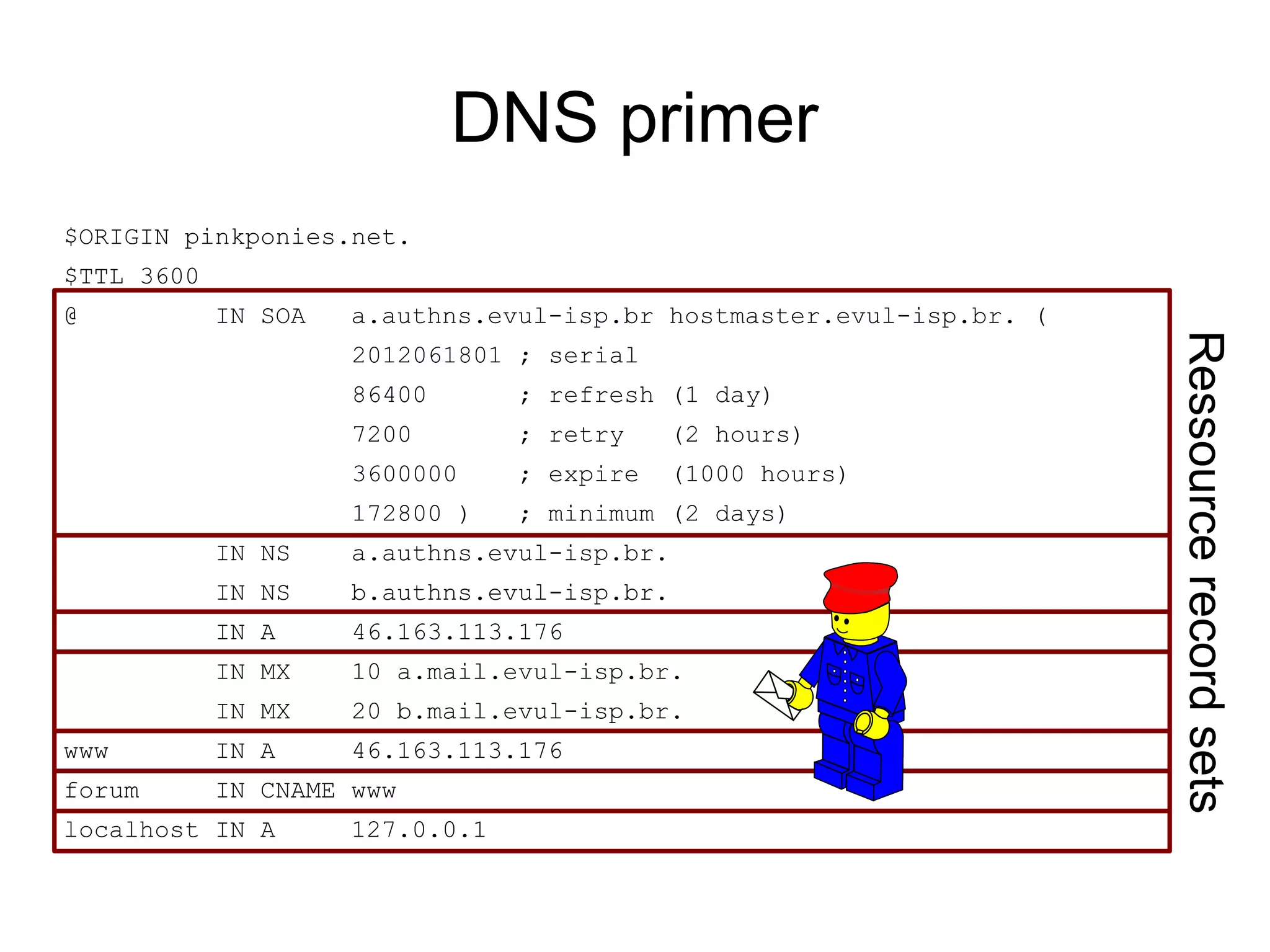
                                                                      Ressource record sets
                     2012061801 ; serial
                     86400       ; refresh (1 day)
                     7200        ; retry     (2 hours)
                     3600000     ; expire    (1000 hours)
                     172800 )    ; minimum (2 days)
            IN NS    a.authns.evul-isp.br.
            IN NS    b.authns.evul-isp.br.
            IN A     46.163.113.176
            IN MX    10 a.mail.evul-isp.br.
            IN MX    20 b.mail.evul-isp.br.
www         IN A     46.163.113.176
forum       IN CNAME www
localhost IN A       127.0.0.1
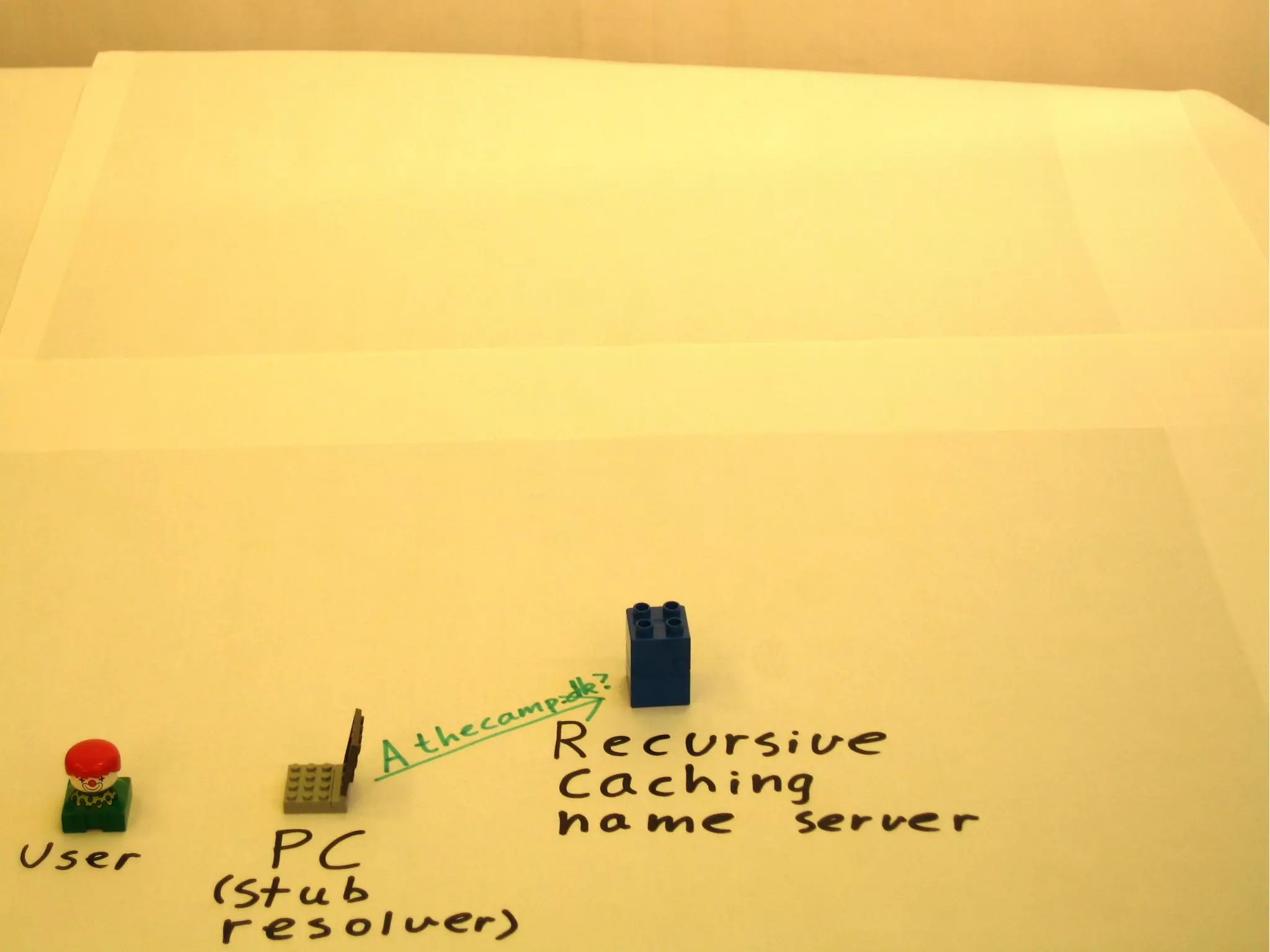
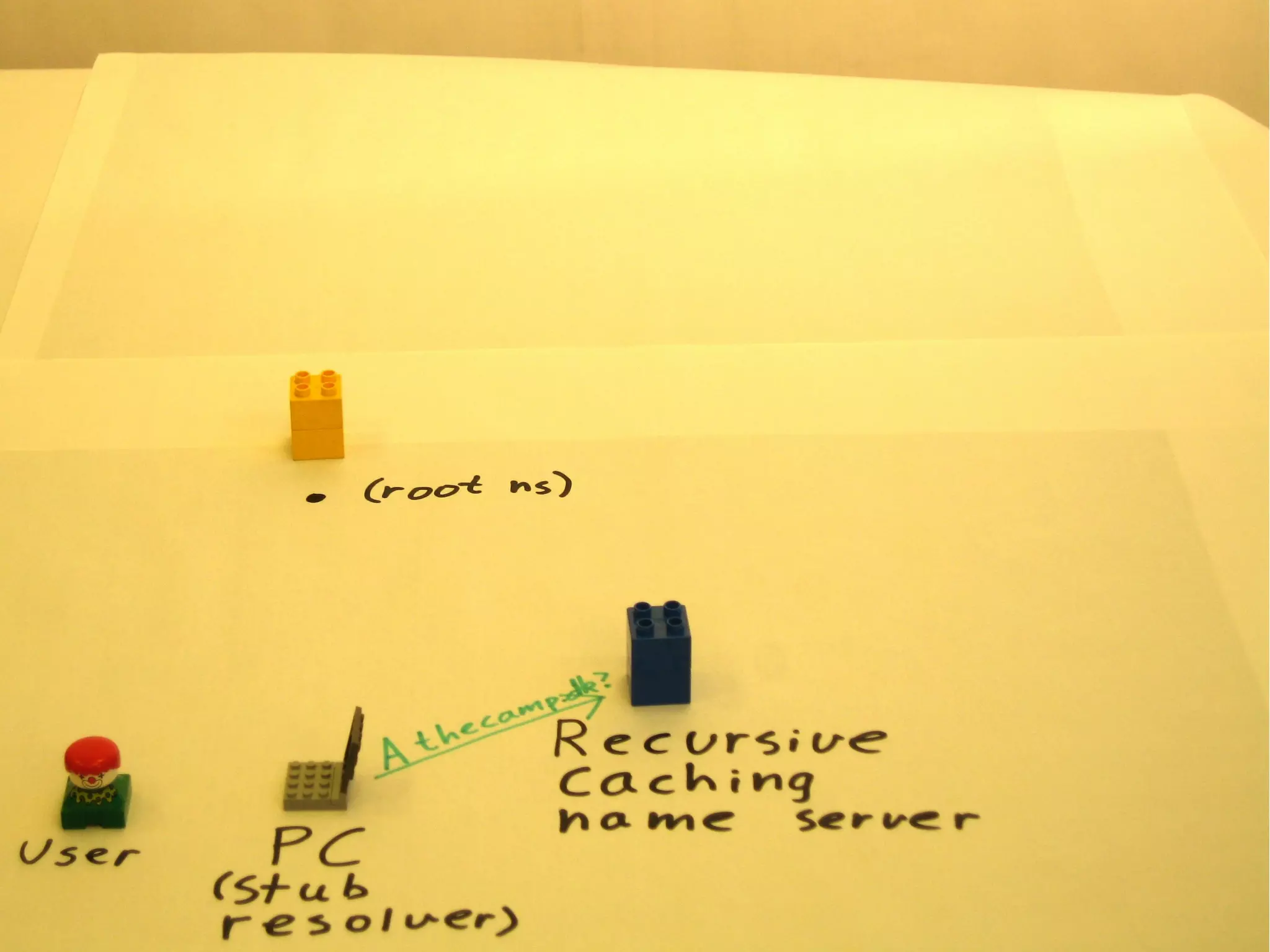
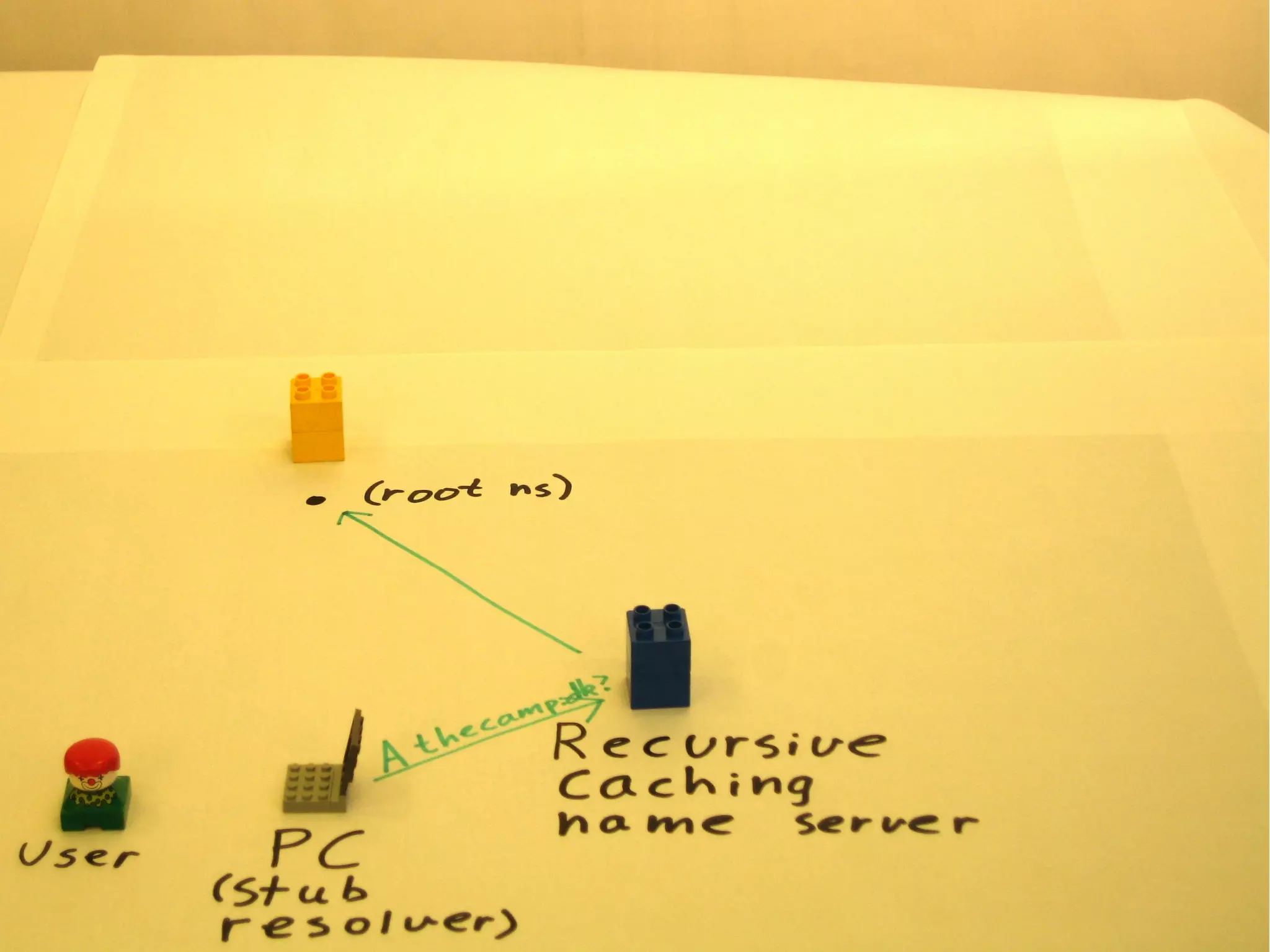
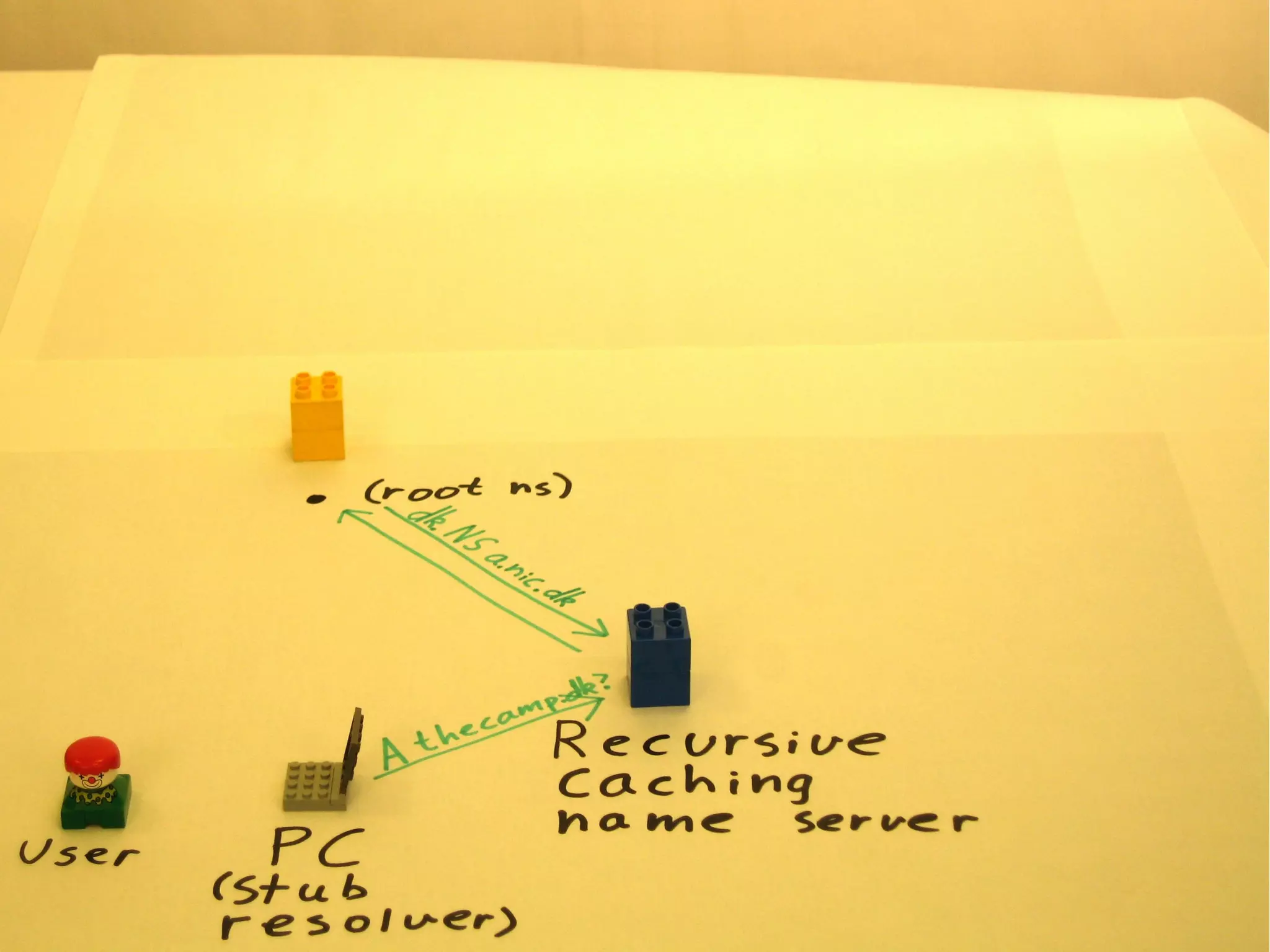
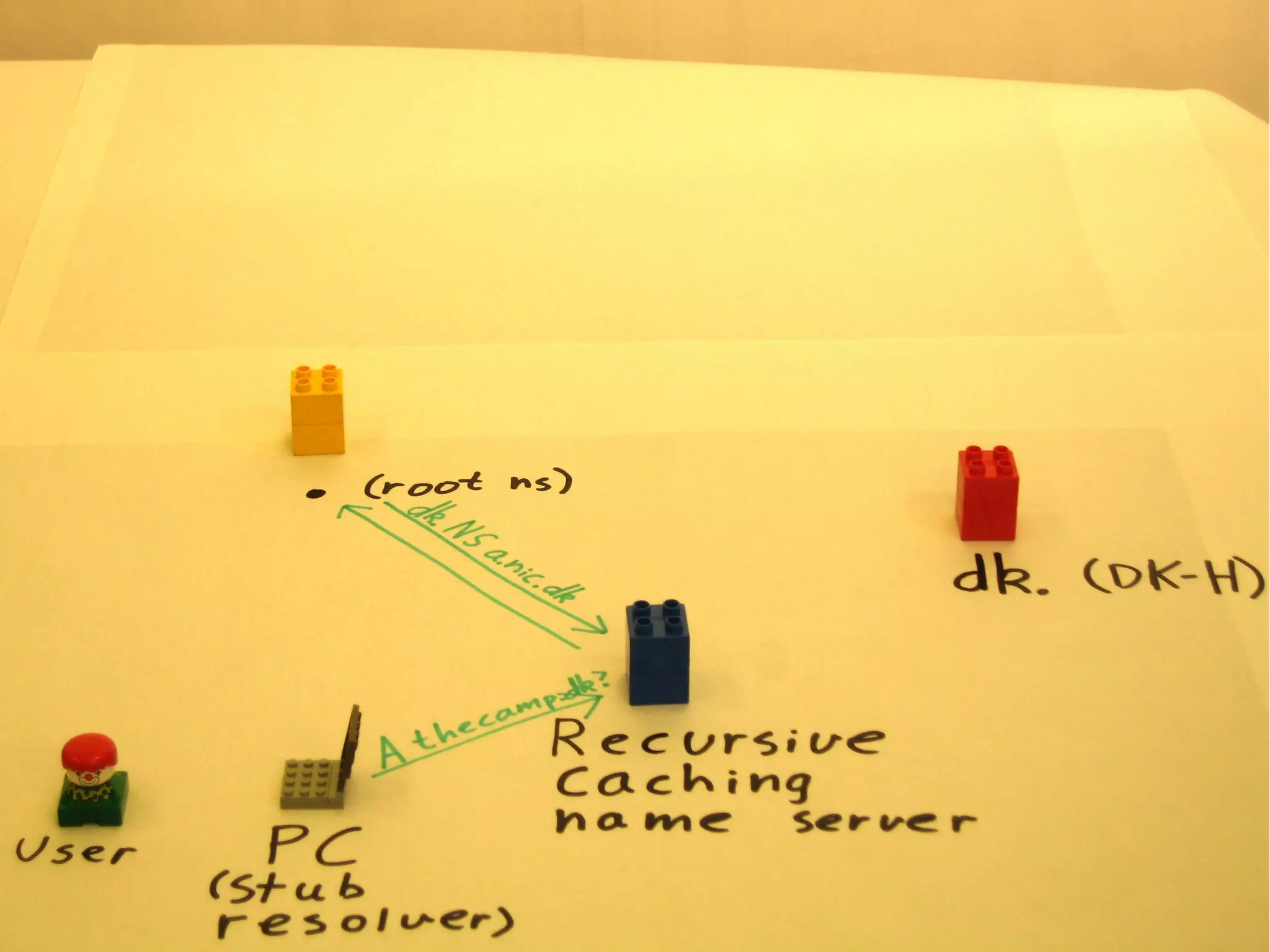
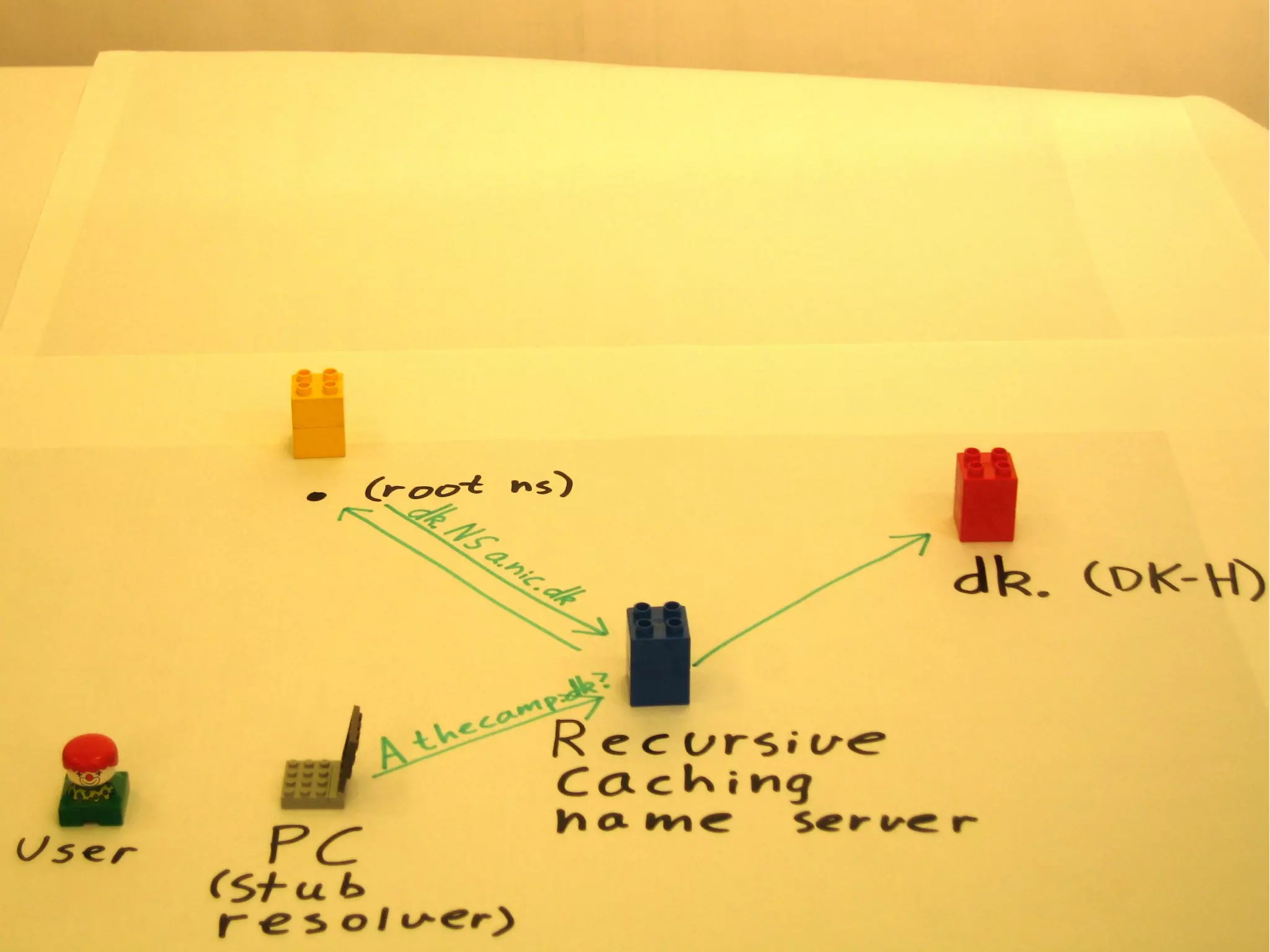
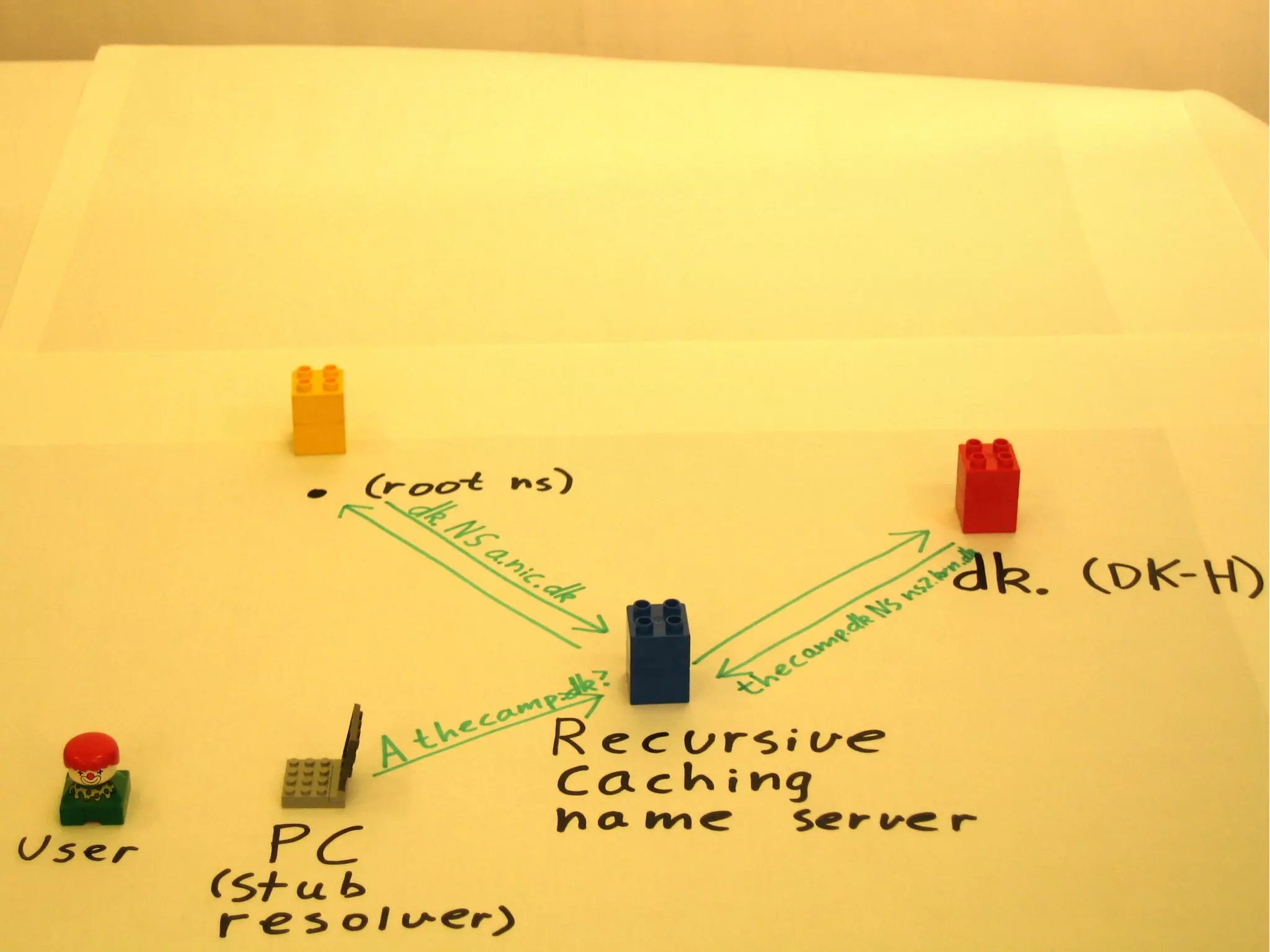
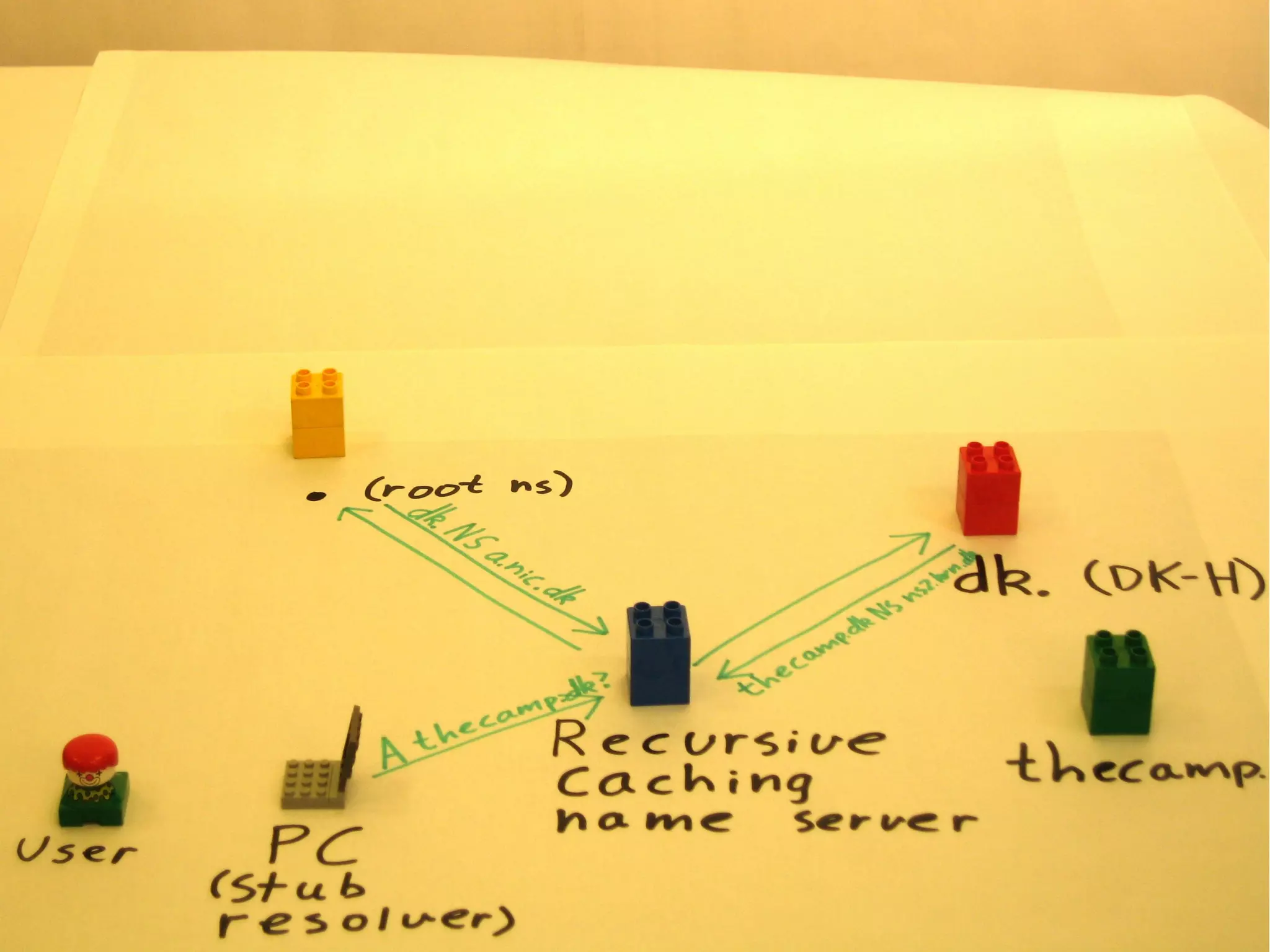
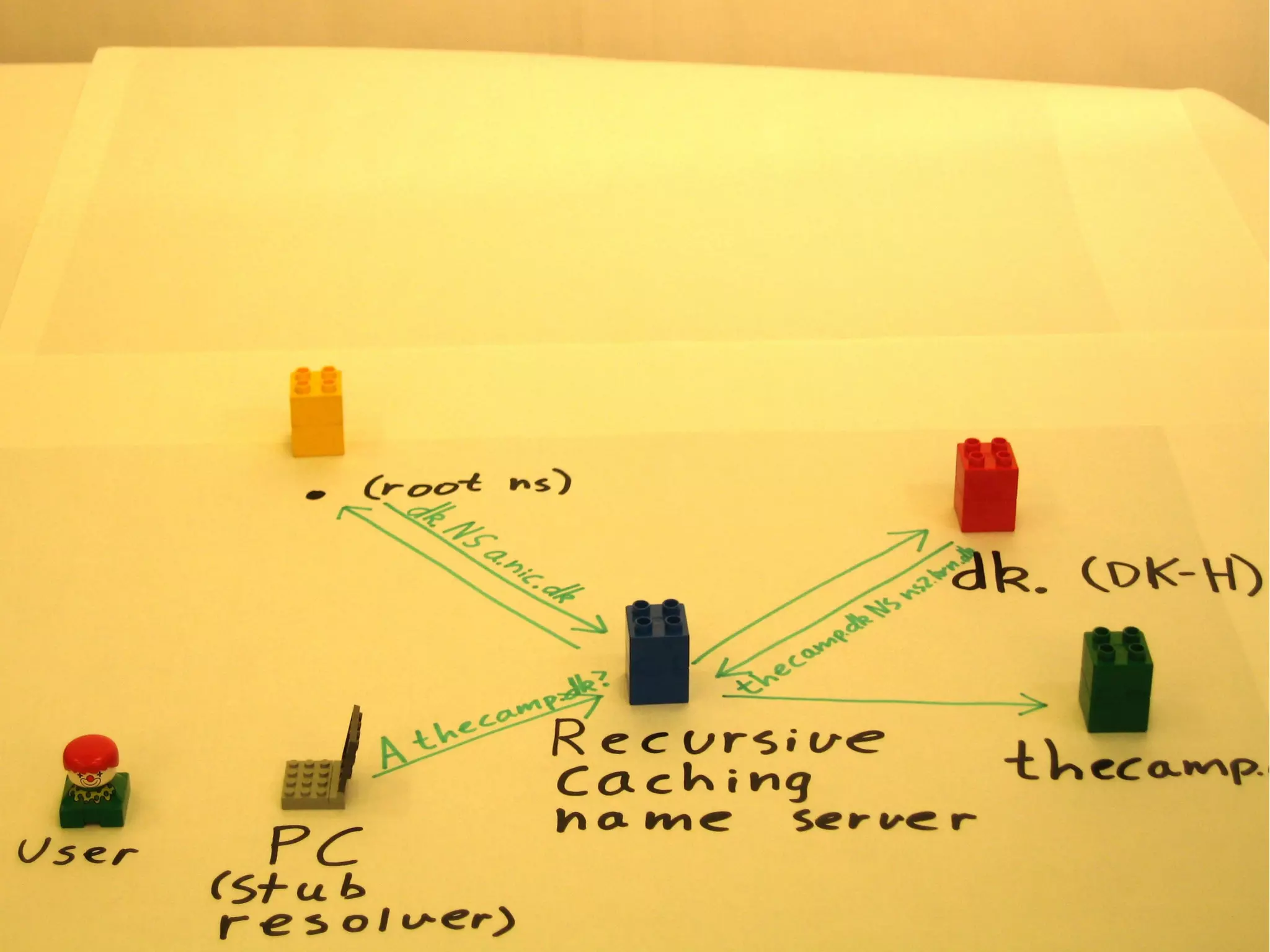
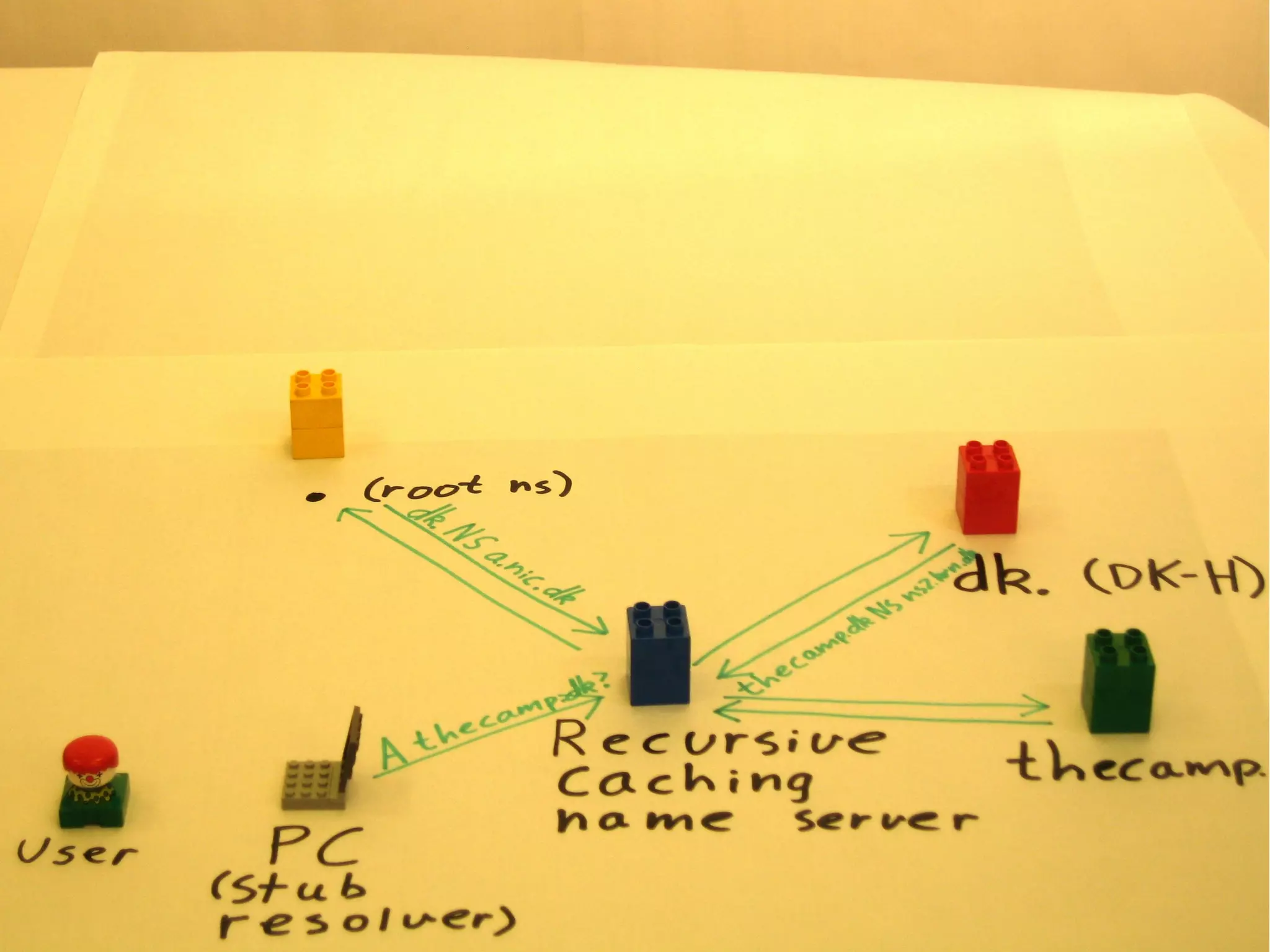
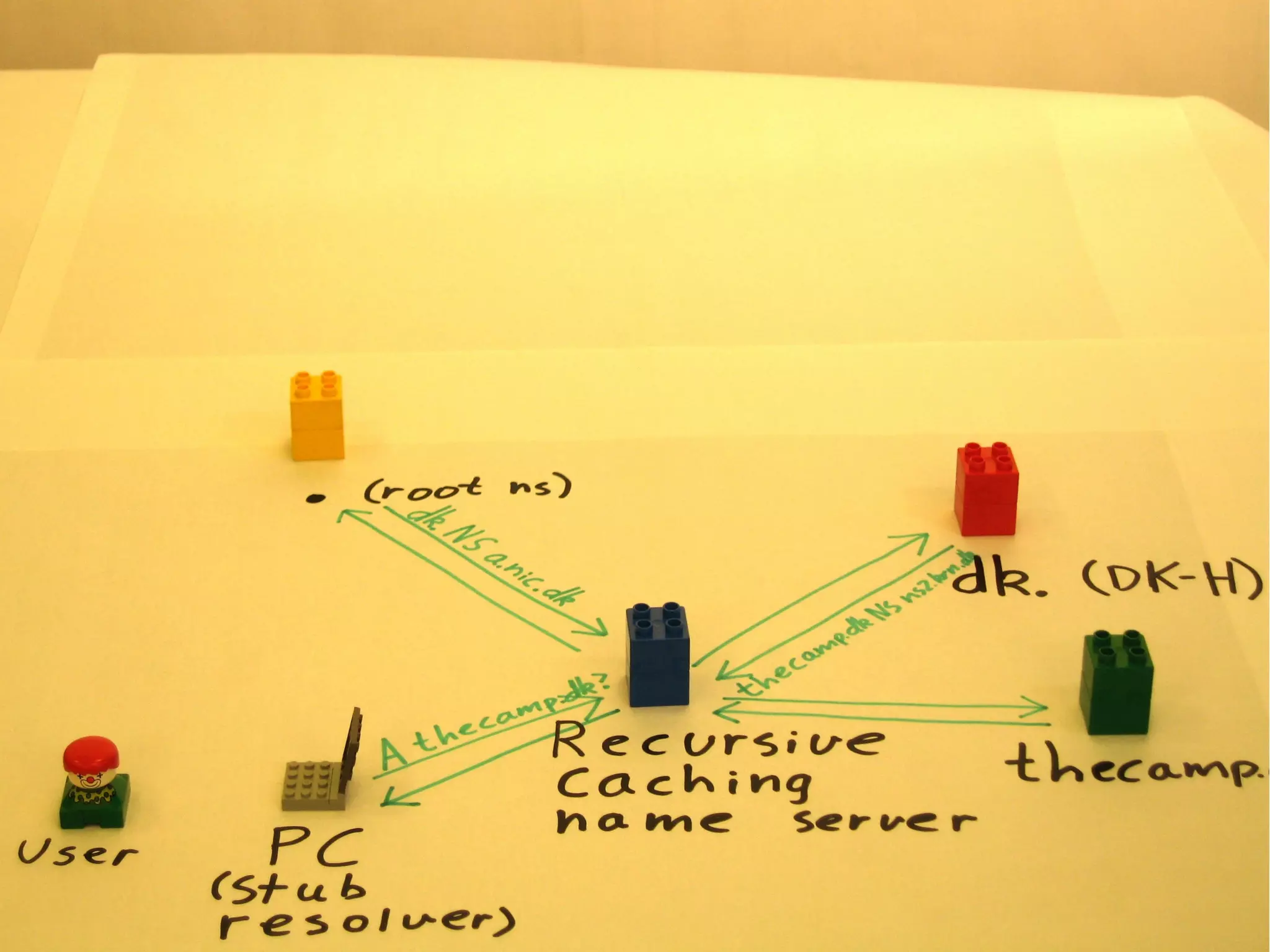
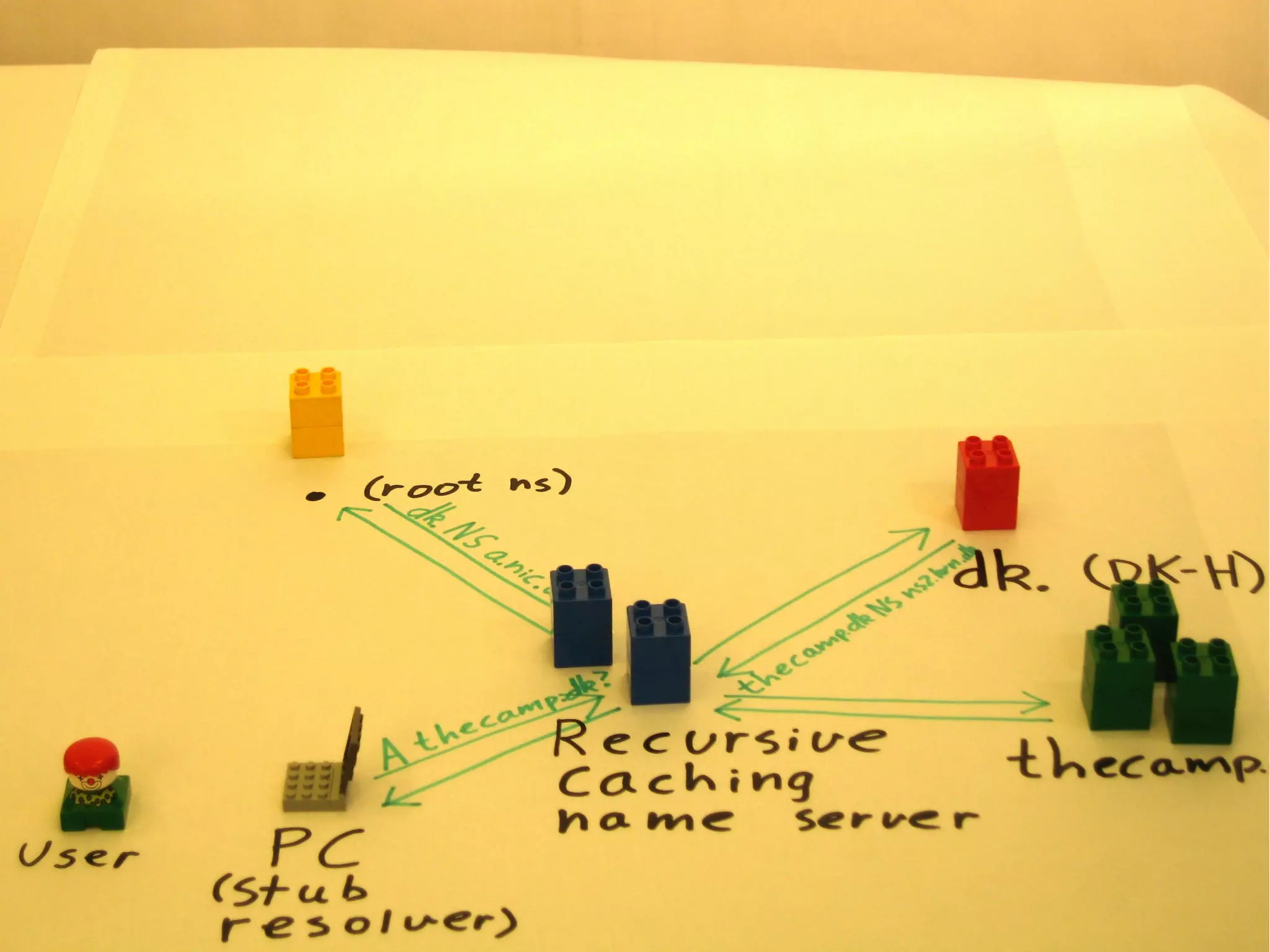
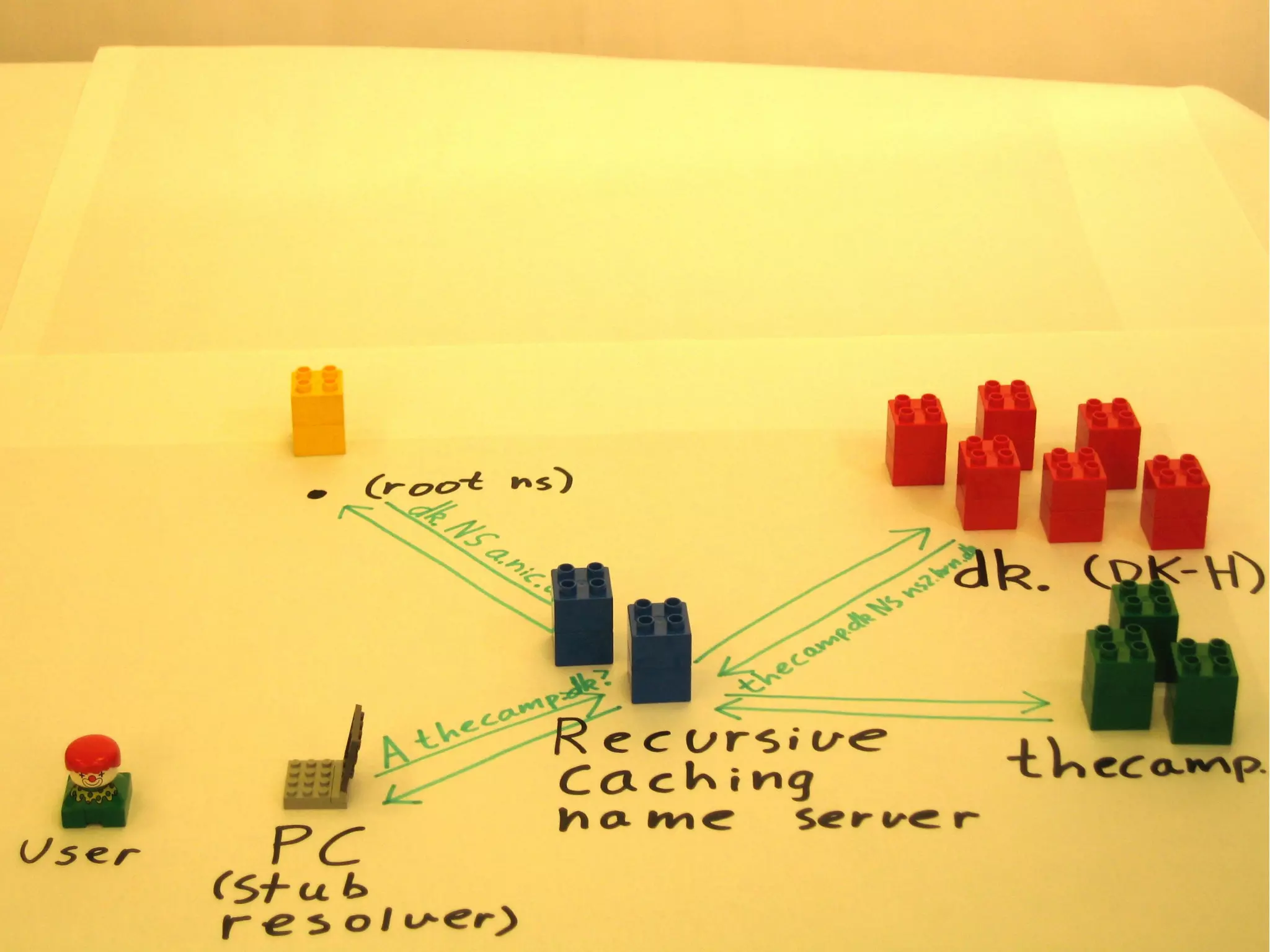
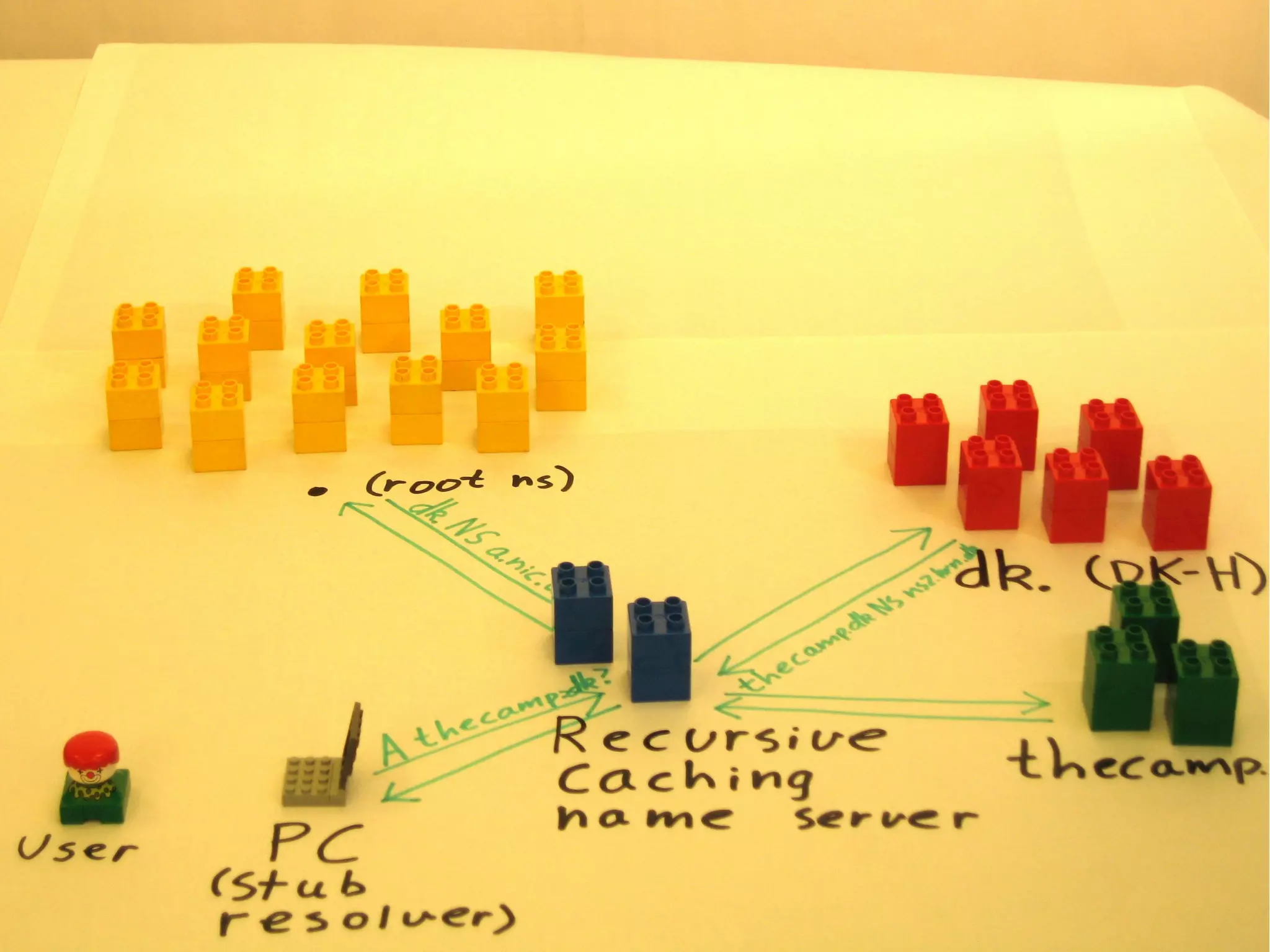
DNS primer
                    . (root)
                                                [a-m].root-servers.net


              dk.               [bclps].nic.dk


                                       thecamp.dk.                       andersine.tdu.dk
                                                                         fjotte.krn.dk
                                                                         ns2.krn.dk

video.thecamp.dk.                                www.thecamp.dk.
                               ftp
                                     . th
                                            ec
                                              am
                                                p.d
                                                   k.
DNS primer
DNS primer
DNS primer
DNS primer
DNS primer
DNS primer
DNS primer
DNS primer
DNS primer
DNS primer
DNS primer
DNS primer
DNS primer
DNS primer
DNS primer
DNS primer
DNS primer
Cryptography primer
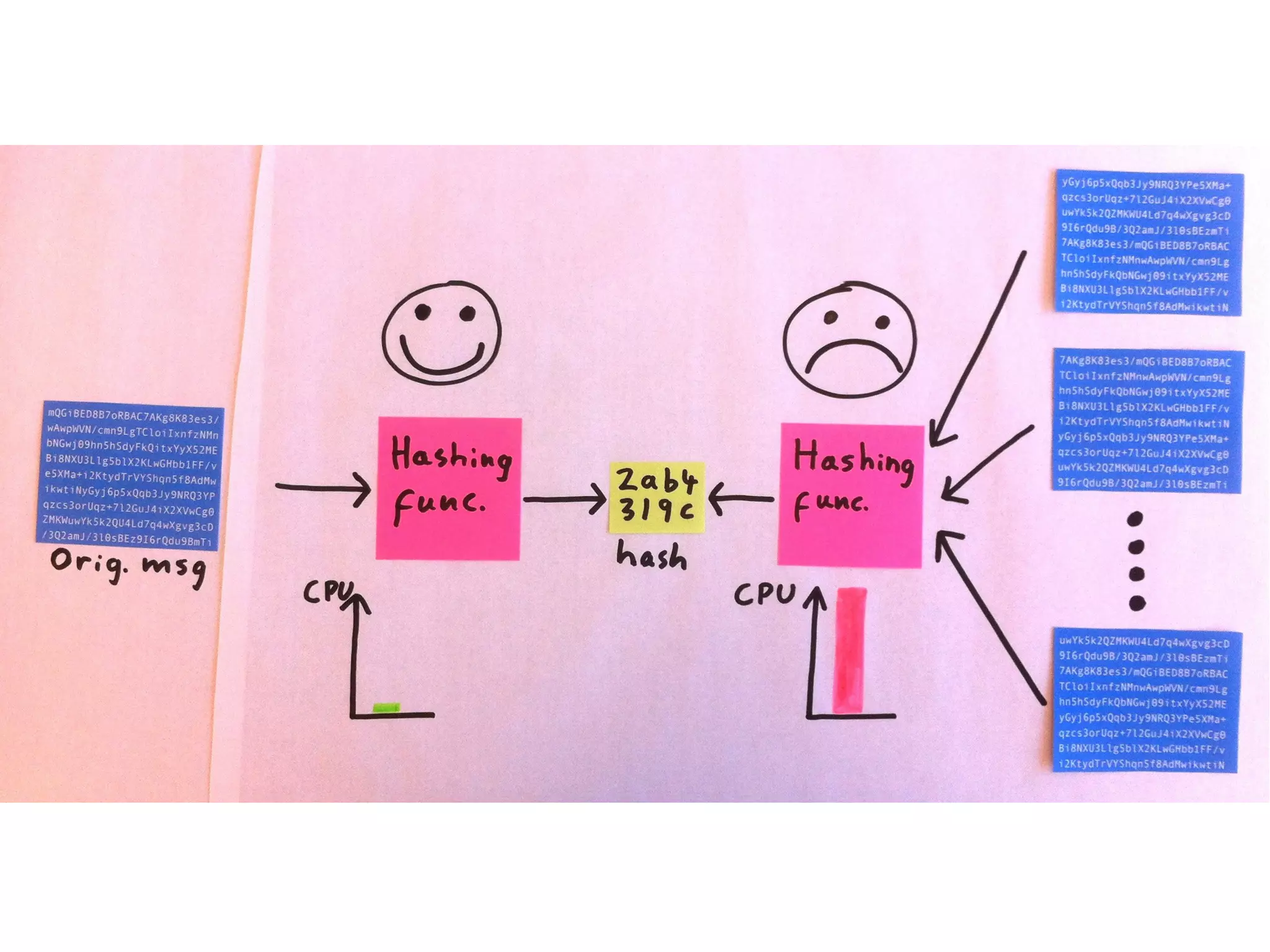
●   Cryptographic hash functions
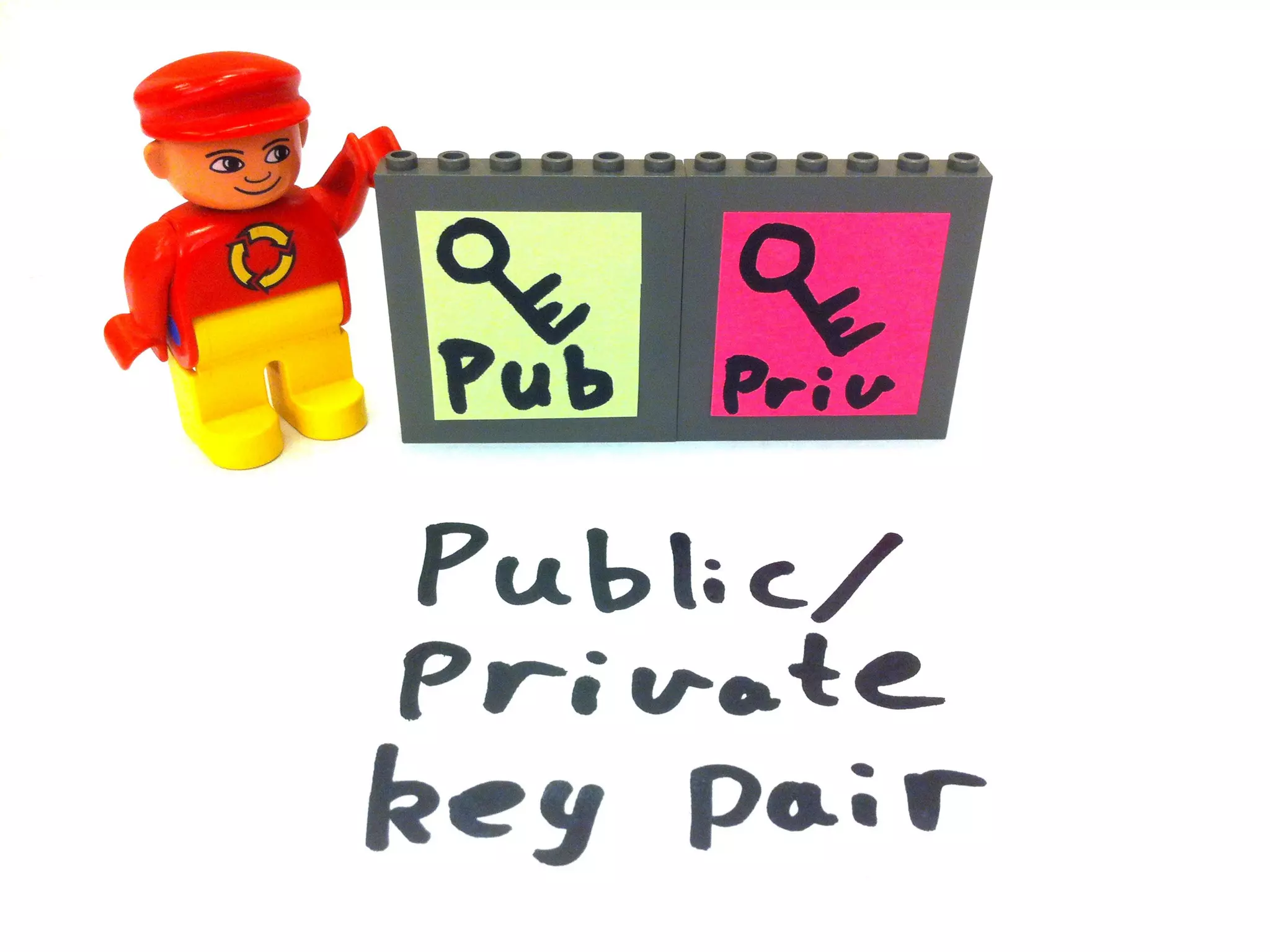
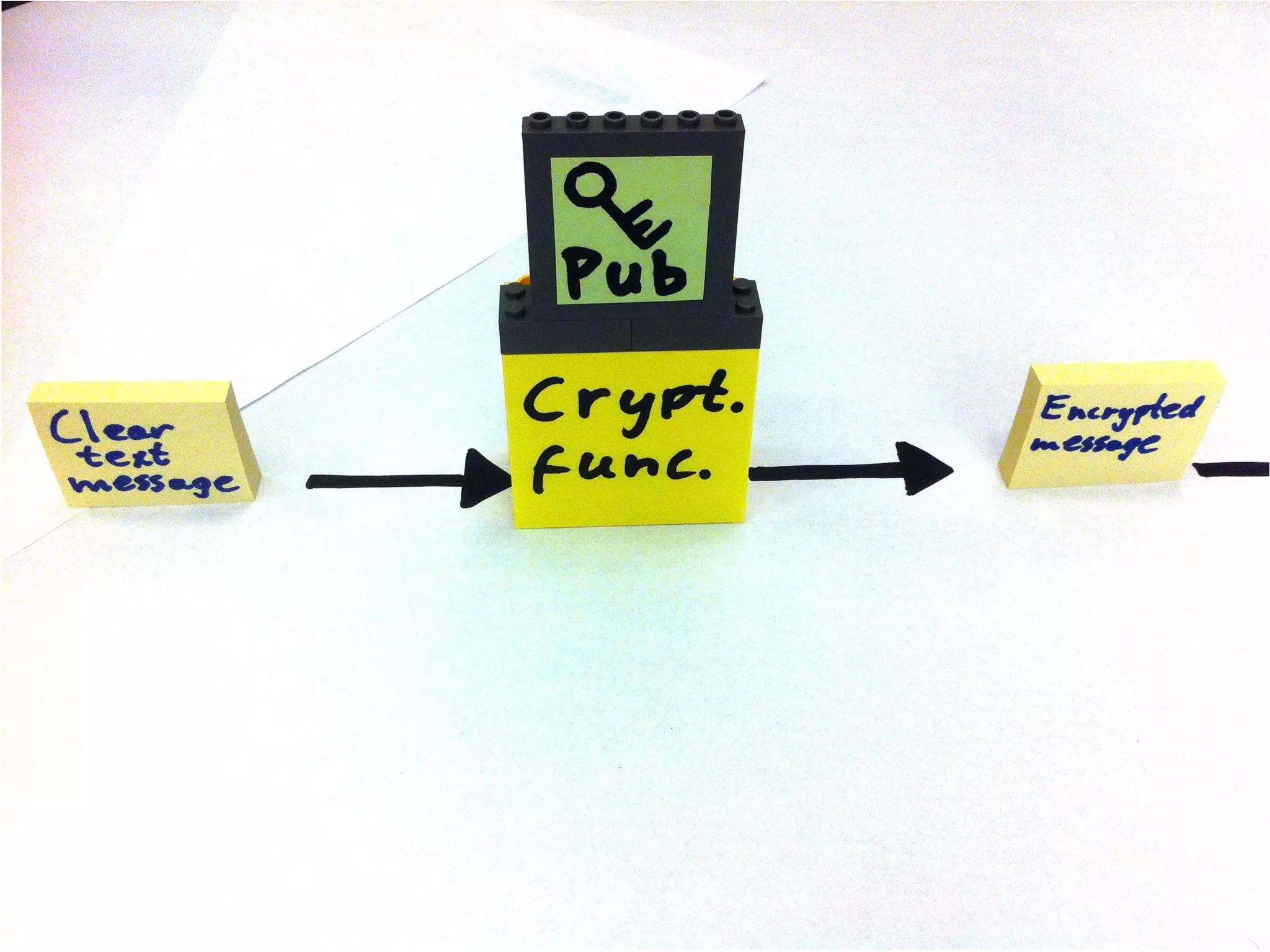
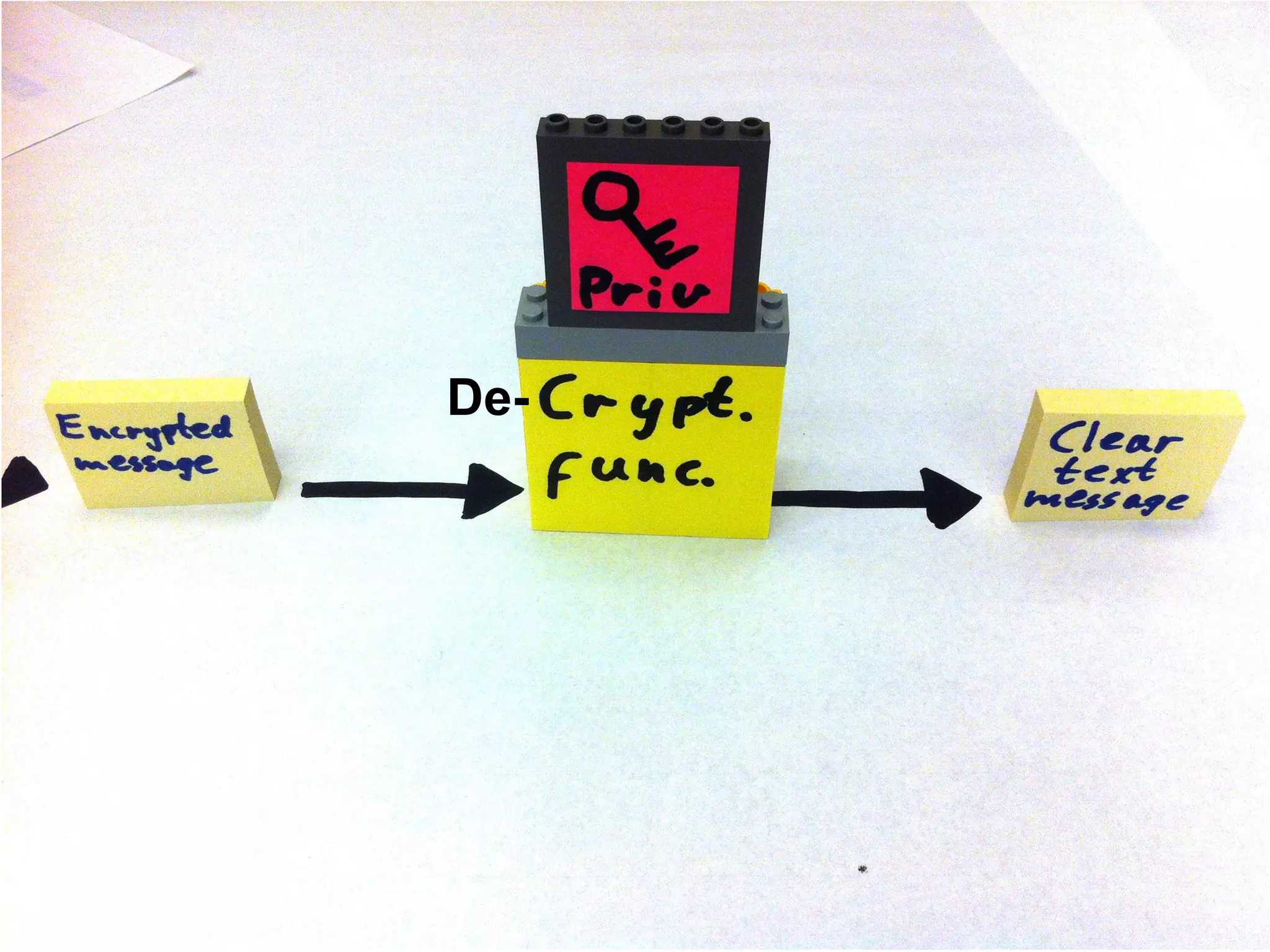
●   Public-key cryptography
    –   Public/private key pair
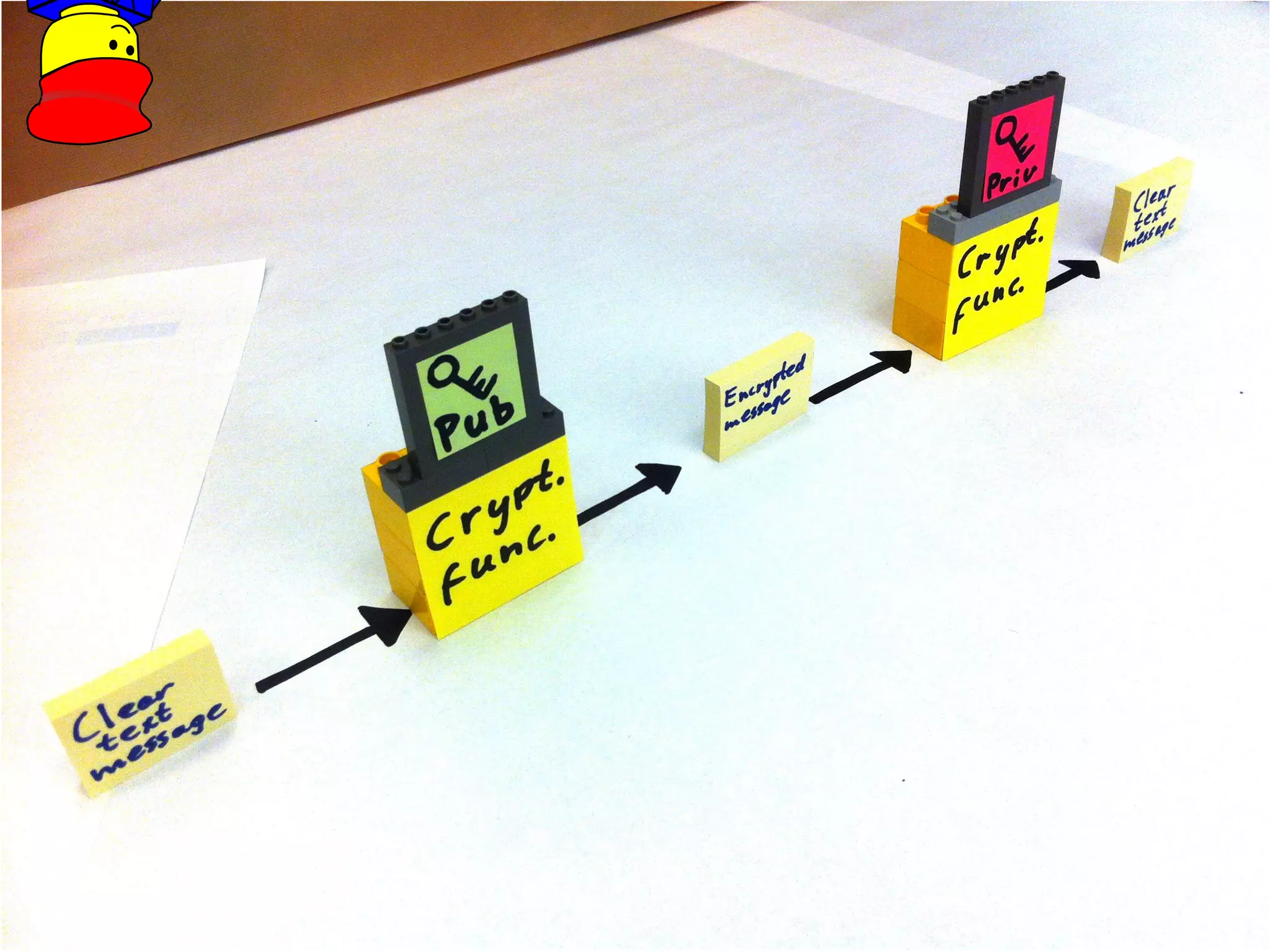
    –   Encryption/decryption
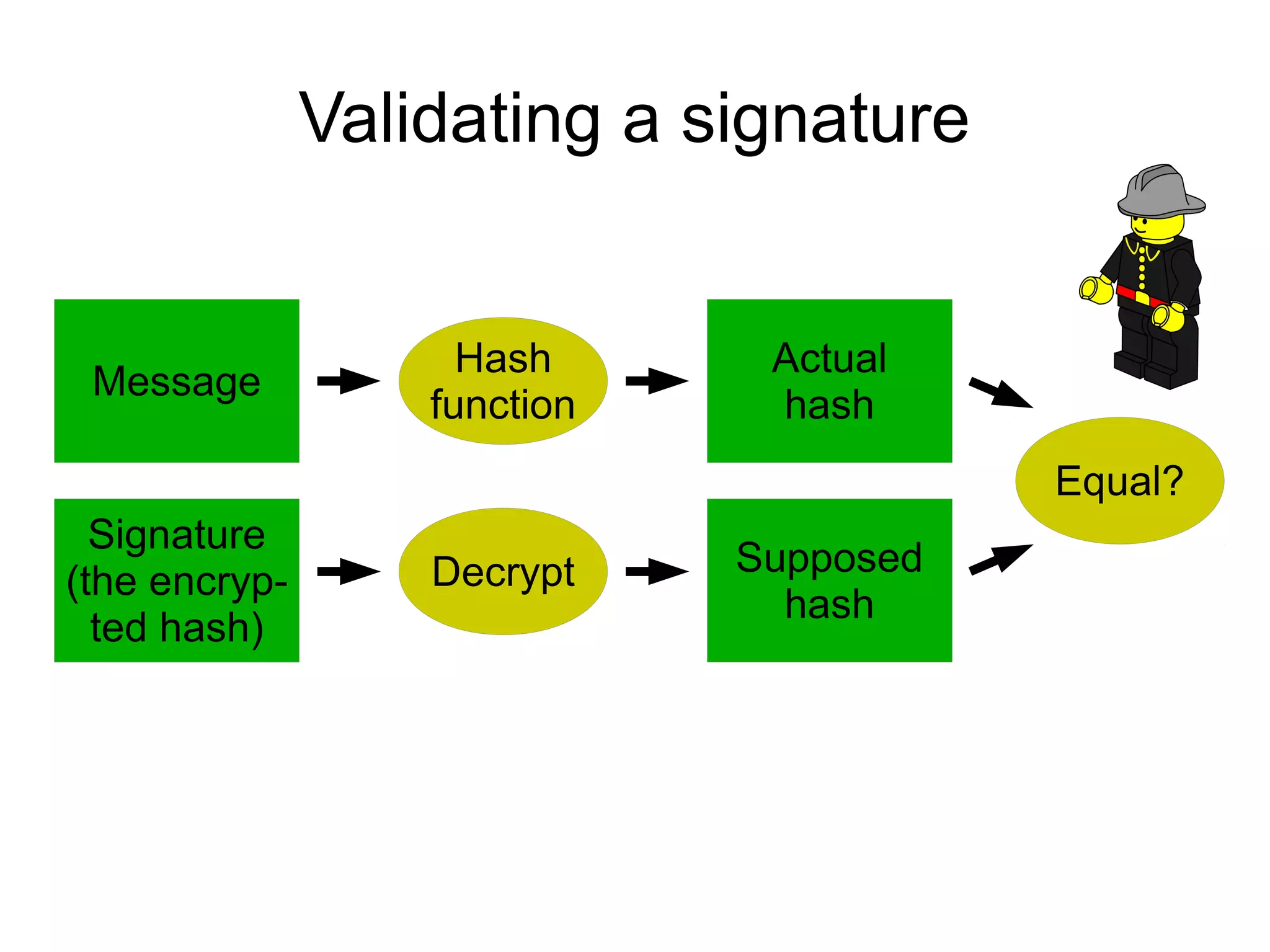
    –   Signing/validating
Cryptography primer
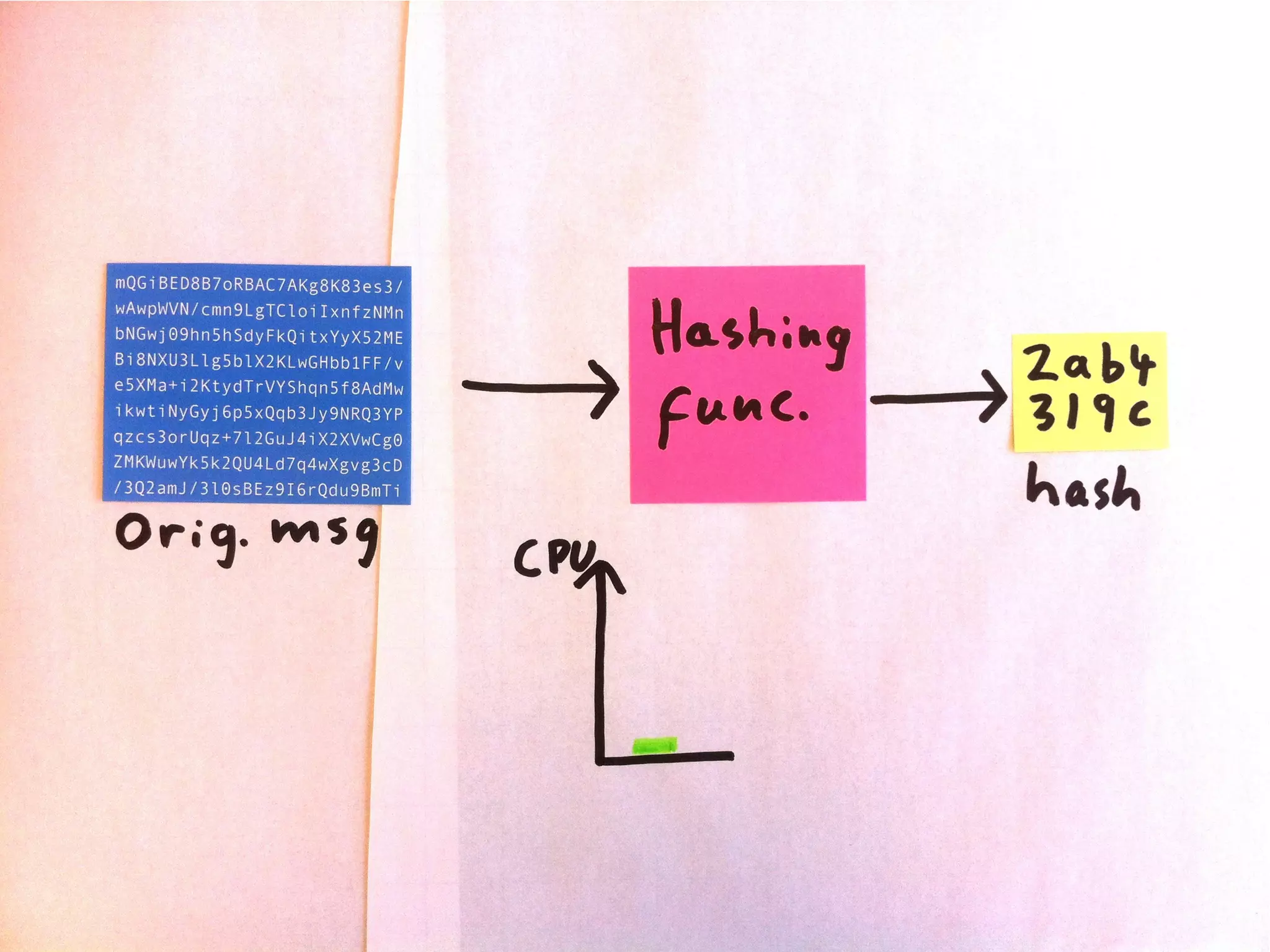
Cryptographic hash functions
●   The ideal CHF:
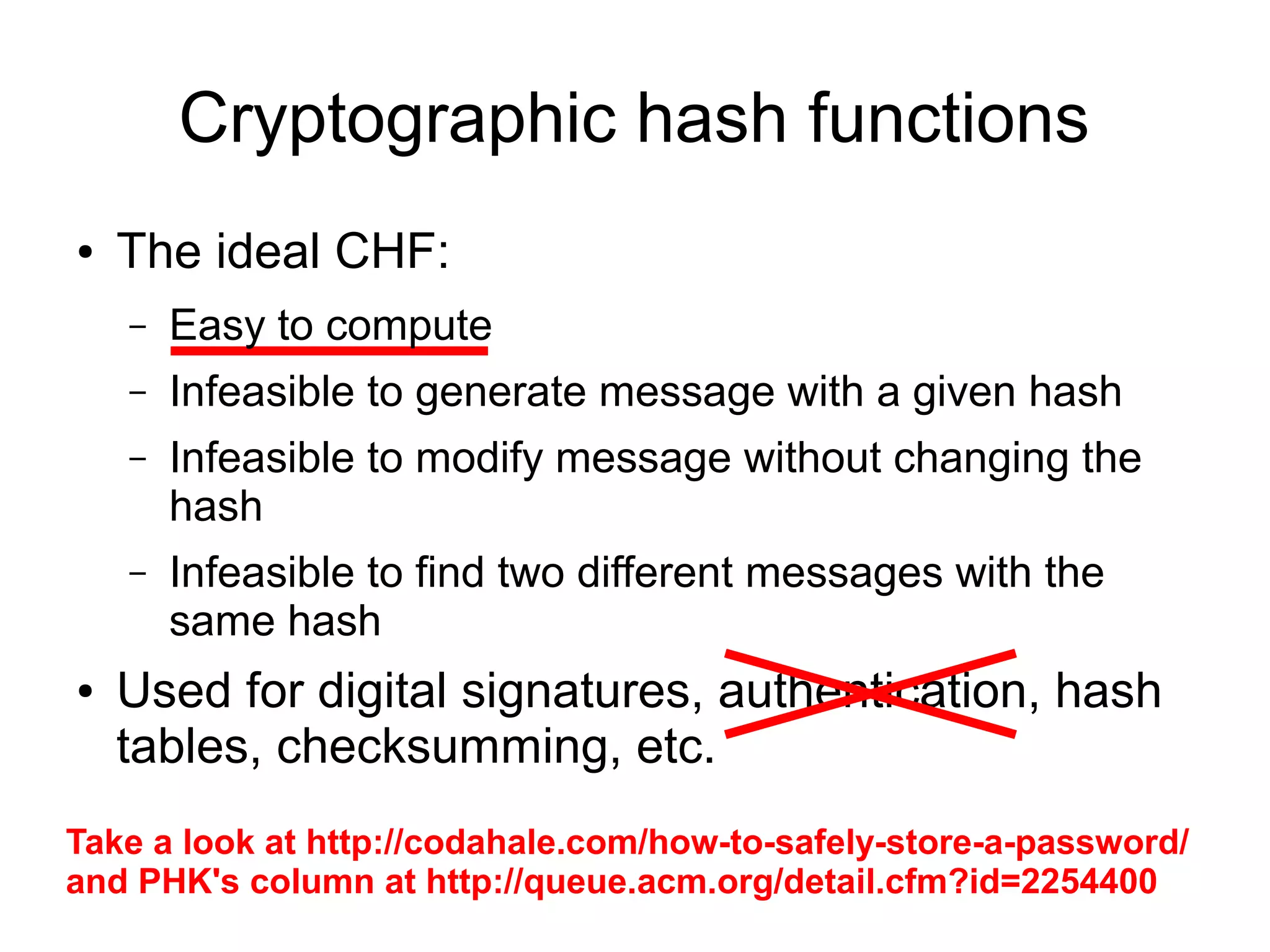
    –   Easy to compute
    –   Infeasible to generate message with a given hash
    –   Infeasible to modify message without changing the
        hash
    –   Infeasible to find two different messages with the
        same hash
●   Used for digital signatures, authentication, hash
    tables, checksumming, etc.
Cryptographic hash functions
●   The ideal CHF:
    –   Easy to compute
    –   Infeasible to generate message with a given hash
    –   Infeasible to modify message without changing the
        hash
    –   Infeasible to find two different messages with the
        same hash
●   Used for digital signatures, authentication, hash
    tables, checksumming, etc.
Take a look at http://codahale.com/how-to-safely-store-a-password/
and PHK's column at http://queue.acm.org/detail.cfm?id=2254400
Cryptographic hash functions
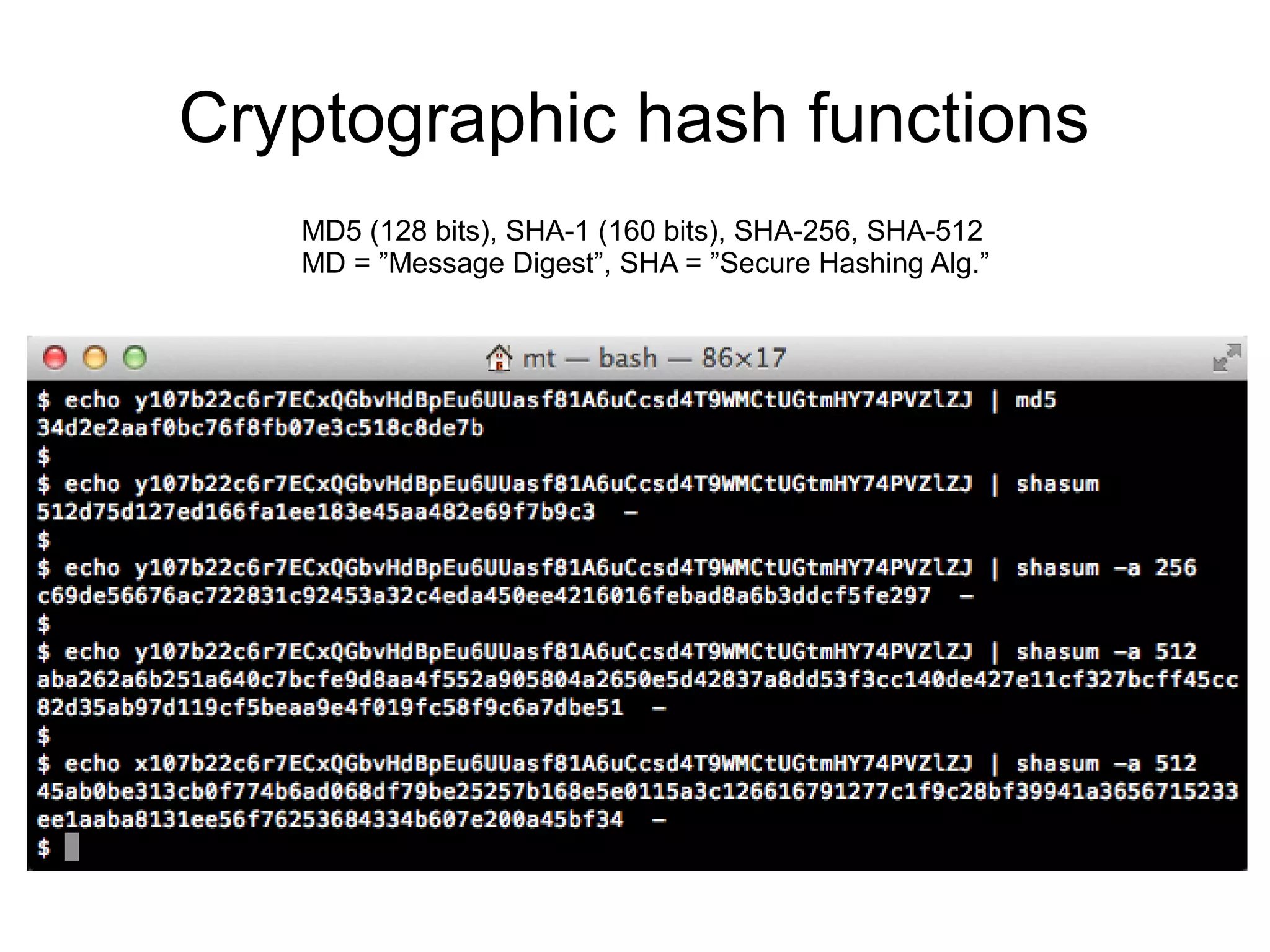
   MD5 (128 bits), SHA-1 (160 bits), SHA-256, SHA-512
   MD = ”Message Digest”, SHA = ”Secure Hashing Alg.”
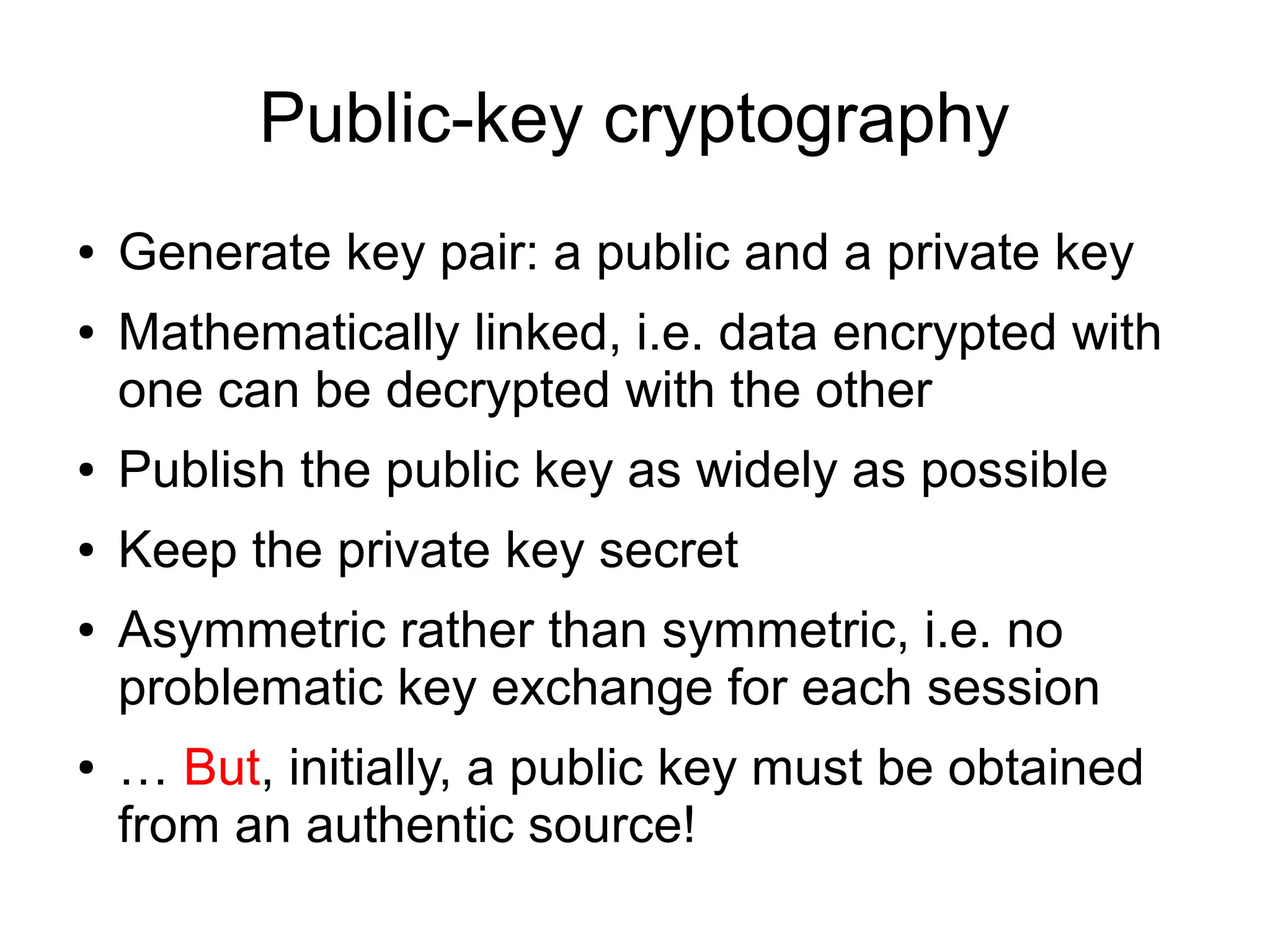
Public-key cryptography
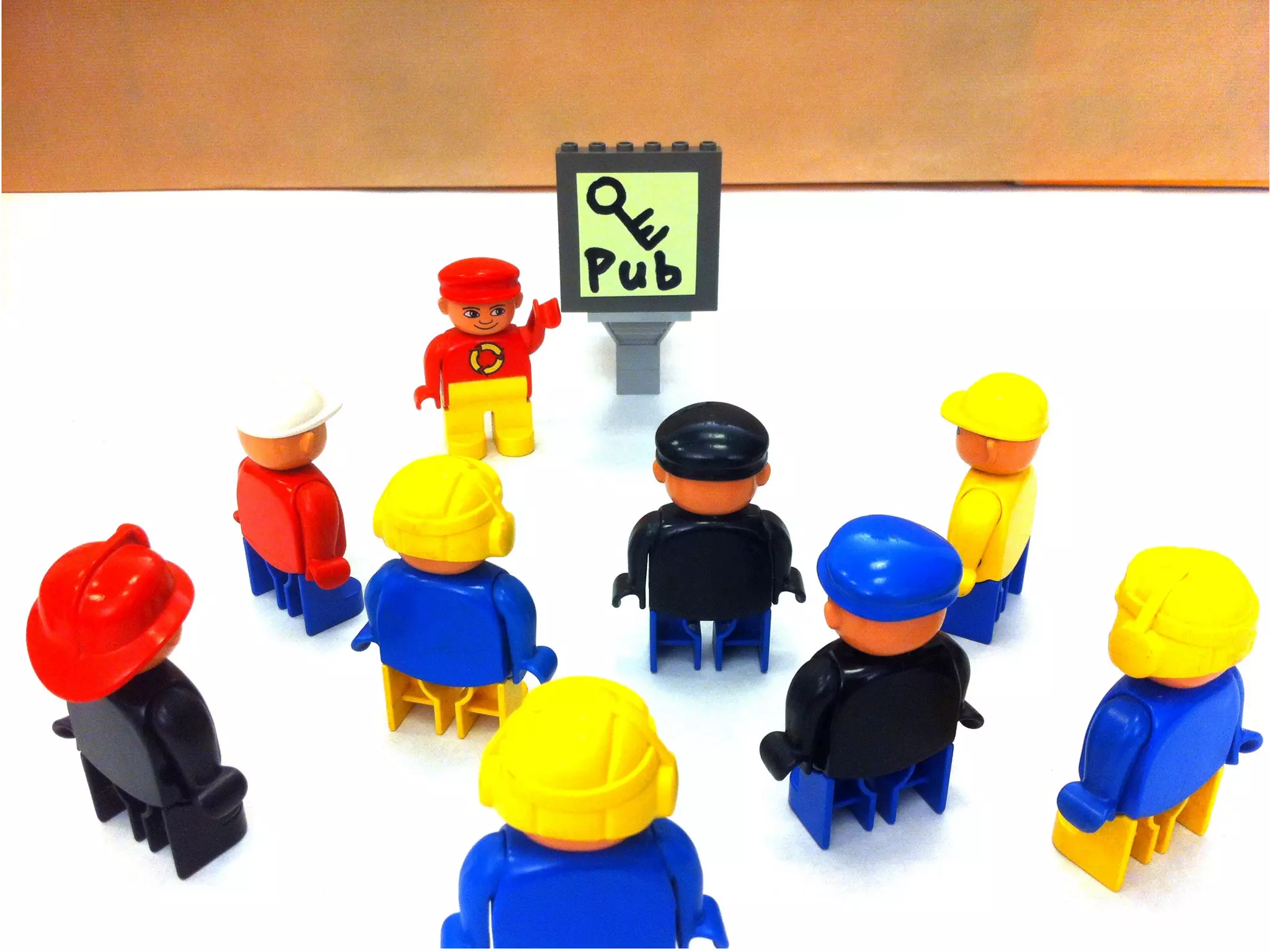
●   Generate key pair: a public and a private key
●   Mathematically linked, i.e. data encrypted with
    one can be decrypted with the other
●   Publish the public key as widely as possible
●   Keep the private key secret
●   Asymmetric rather than symmetric, i.e. no
    problematic key exchange for each session
●   … But, initially, a public key must be obtained
    from an authentic source!
Cryptography primer
Cryptography primer
Cryptography primer
Cryptography primer
Cryptography primer
Cryptography primer


   De-
Cryptography primer
Validating a signature


                     Hash      Actual
 Message
                   function    hash
                                         Equal?
  Signature
                   Decrypt    Supposed
(the encryp-
                                hash
  ted hash)
Validating a signature


                       Hash                 Actual
 Message
                     function               hash
                                                                Equal?
  Signature
                     Decrypt              Supposed
(the encryp-
                                            hash
  ted hash)


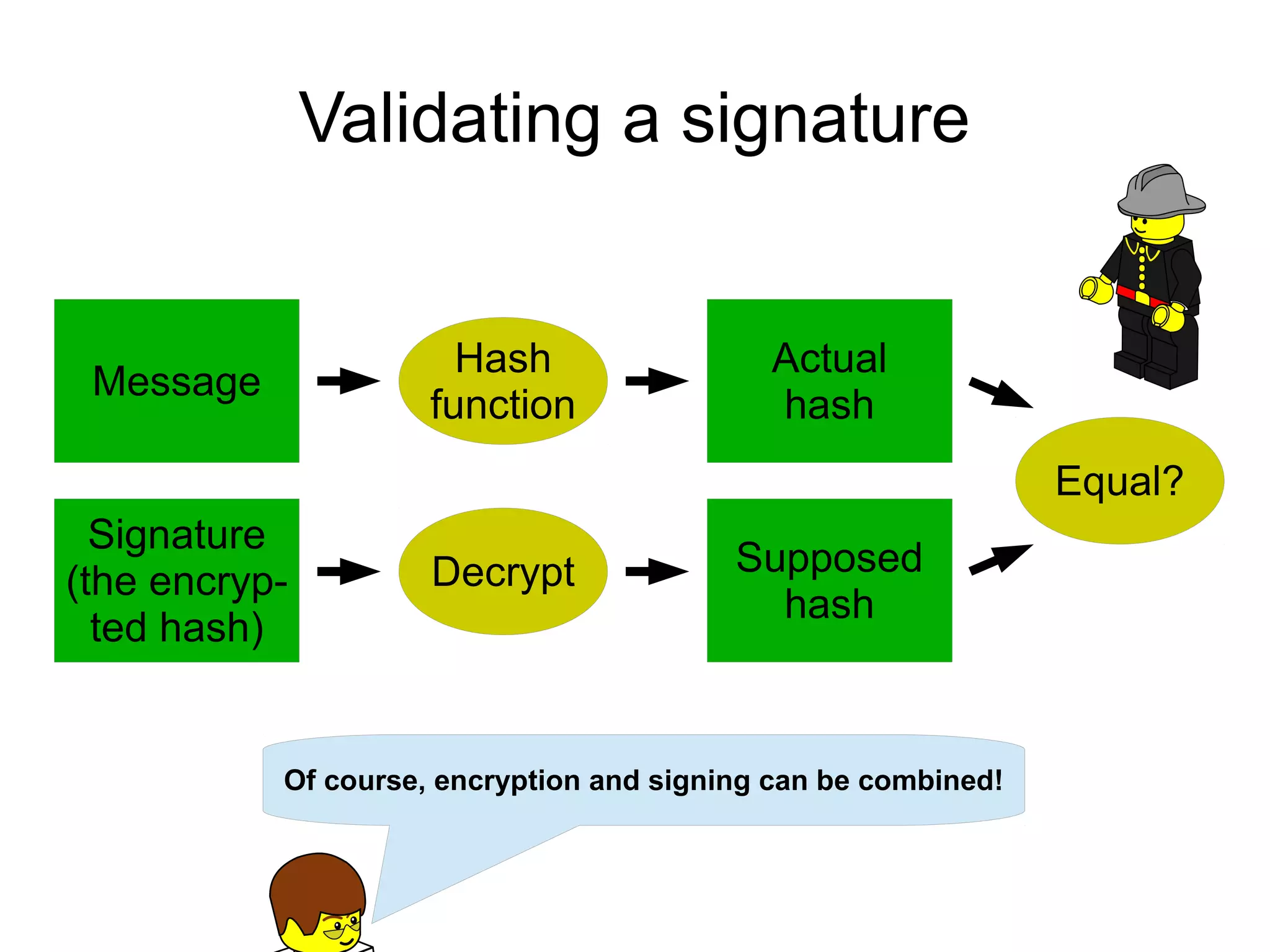
           Of course, encryption and signing can be combined!
DNSSEC
●   Two sides of the coin:
    –   A tree of signed zones being served by
        authoritative name servers
    –   Validating resolvers/name servers
●   We will return to the latter later
●   DNS + some new stuff:
    –   Ressource records
    –   Chain of trust
    –   New header flags and bits
    –   Maintenance
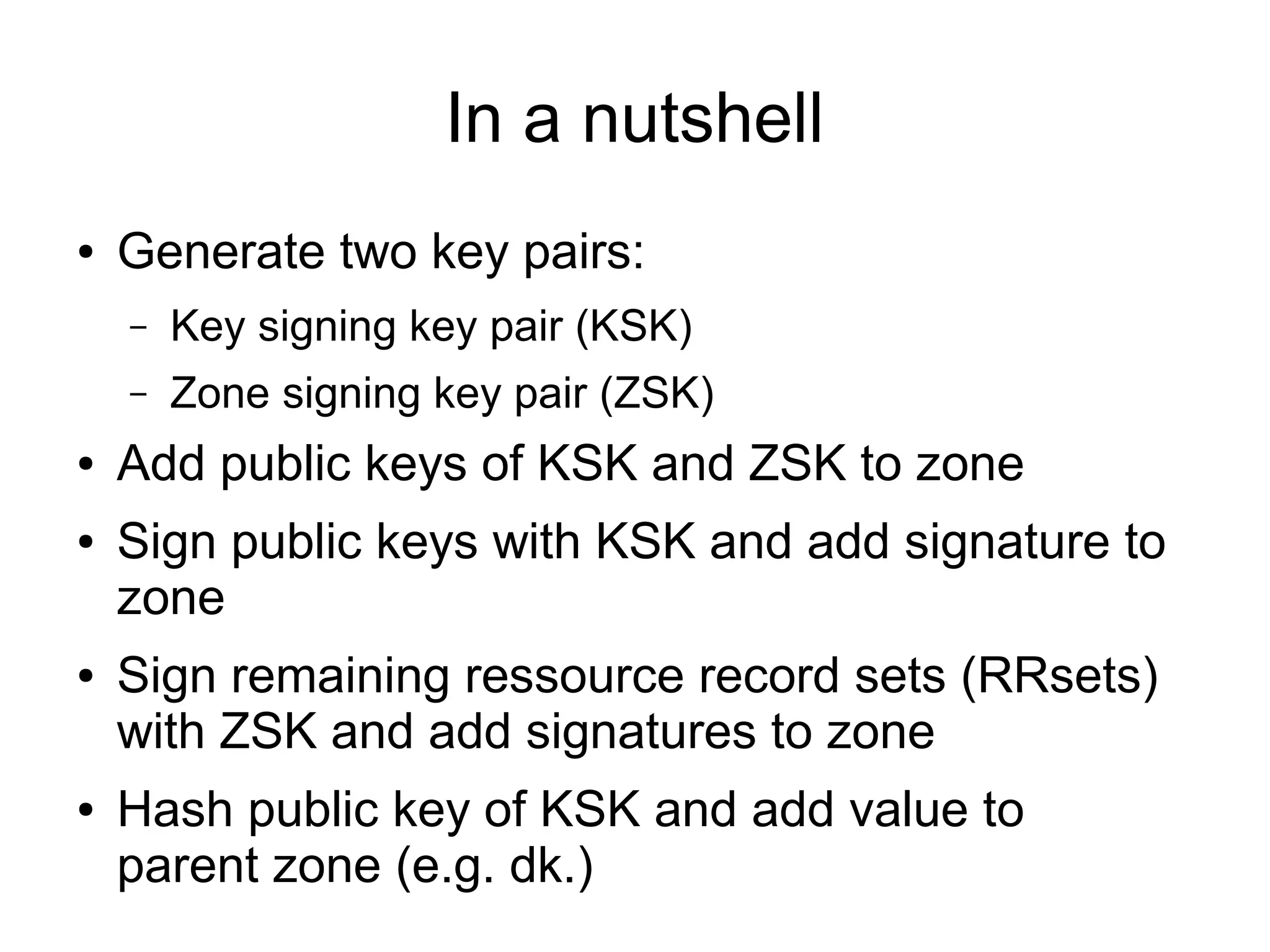
In a nutshell
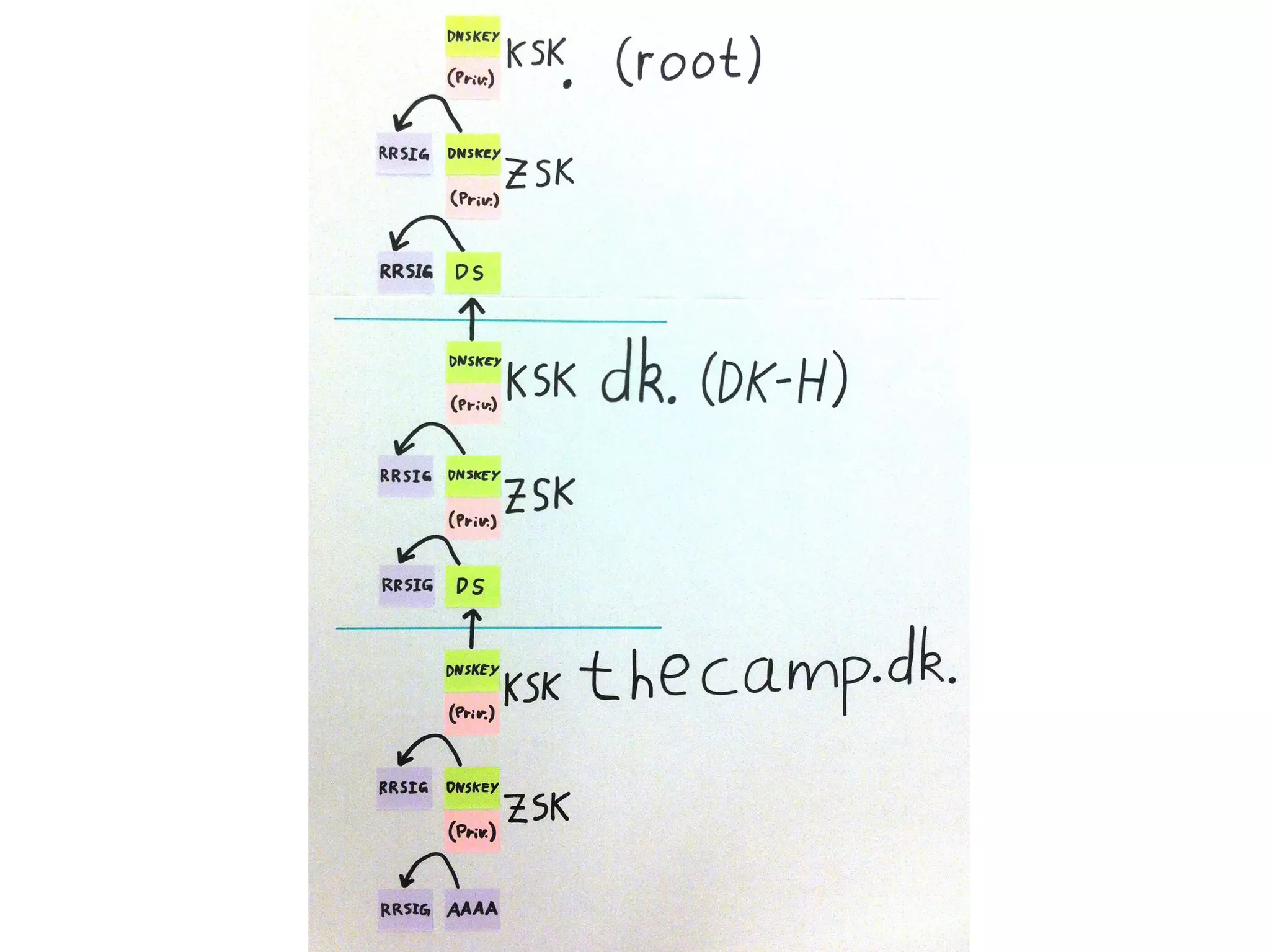
●   Generate two key pairs:
    –   Key signing key pair (KSK)
    –   Zone signing key pair (ZSK)
●   Add public keys of KSK and ZSK to zone
●   Sign public keys with KSK and add signature to
    zone
●   Sign remaining ressource record sets (RRsets)
    with ZSK and add signatures to zone
●   Hash public key of KSK and add value to
    parent zone (e.g. dk.)
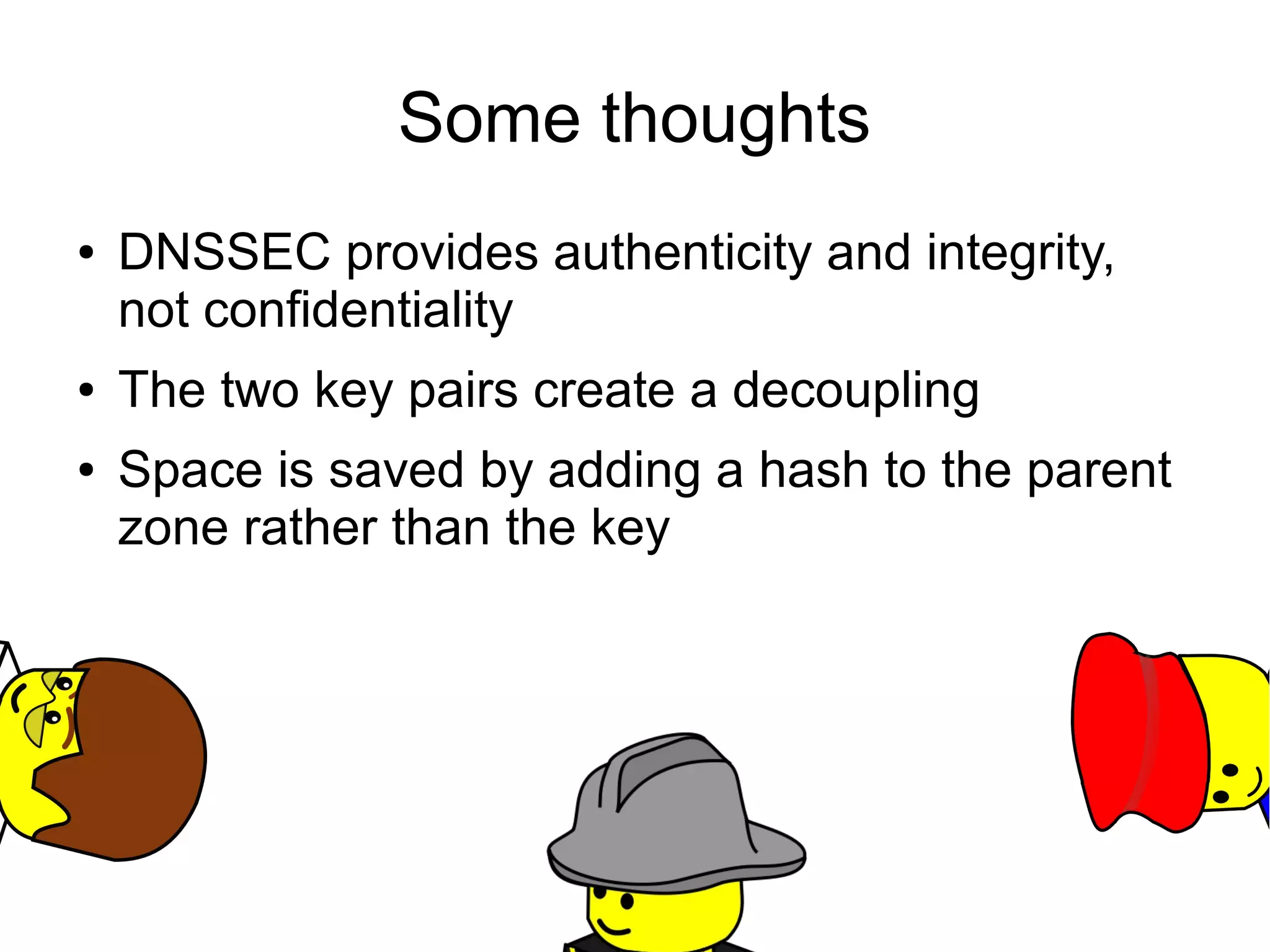
Some thoughts
●   DNSSEC provides authenticity and integrity,
    not confidentiality
●   The two key pairs create a decoupling
●   Space is saved by adding a hash to the parent
    zone rather than the key
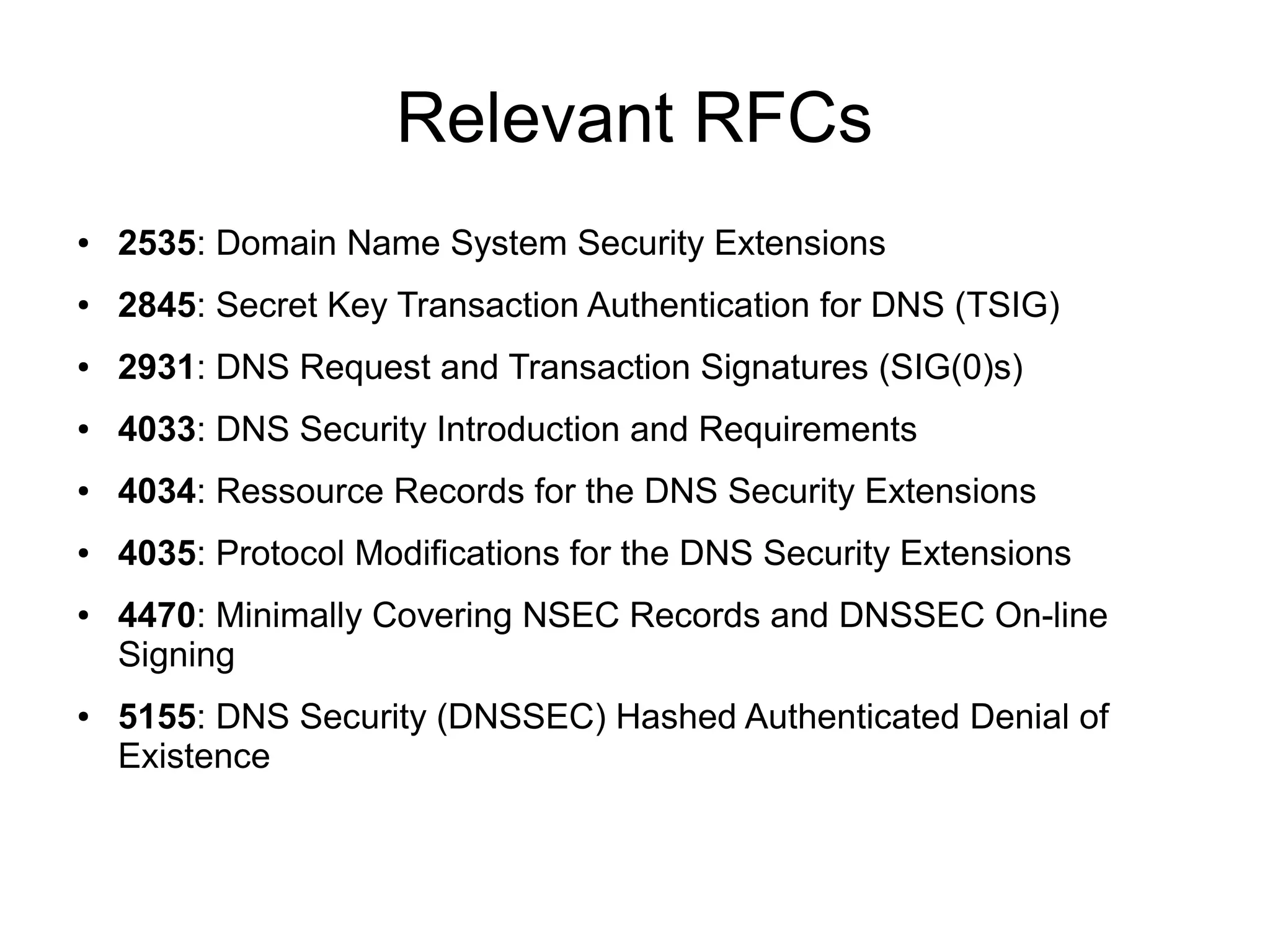
Relevant RFCs
●   2535: Domain Name System Security Extensions
●   2845: Secret Key Transaction Authentication for DNS (TSIG)
●   2931: DNS Request and Transaction Signatures (SIG(0)s)
●   4033: DNS Security Introduction and Requirements
●   4034: Ressource Records for the DNS Security Extensions
●   4035: Protocol Modifications for the DNS Security Extensions
●   4470: Minimally Covering NSEC Records and DNSSEC On-line
    Signing
●   5155: DNS Security (DNSSEC) Hashed Authenticated Denial of
    Existence
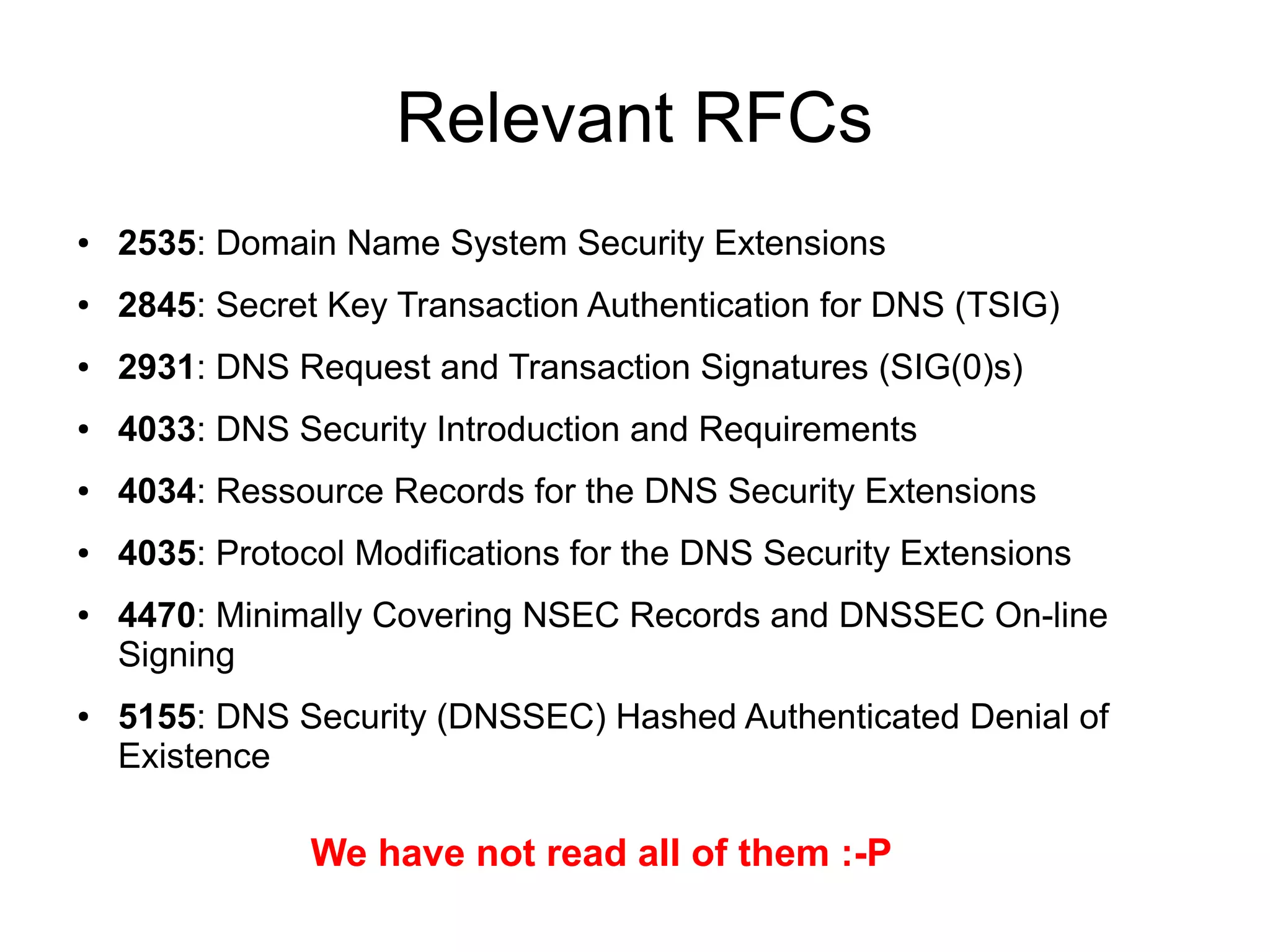
Relevant RFCs
●   2535: Domain Name System Security Extensions
●   2845: Secret Key Transaction Authentication for DNS (TSIG)
●   2931: DNS Request and Transaction Signatures (SIG(0)s)
●   4033: DNS Security Introduction and Requirements
●   4034: Ressource Records for the DNS Security Extensions
●   4035: Protocol Modifications for the DNS Security Extensions
●   4470: Minimally Covering NSEC Records and DNSSEC On-line
    Signing
●   5155: DNS Security (DNSSEC) Hashed Authenticated Denial of
    Existence

                We have not read all of them :-P
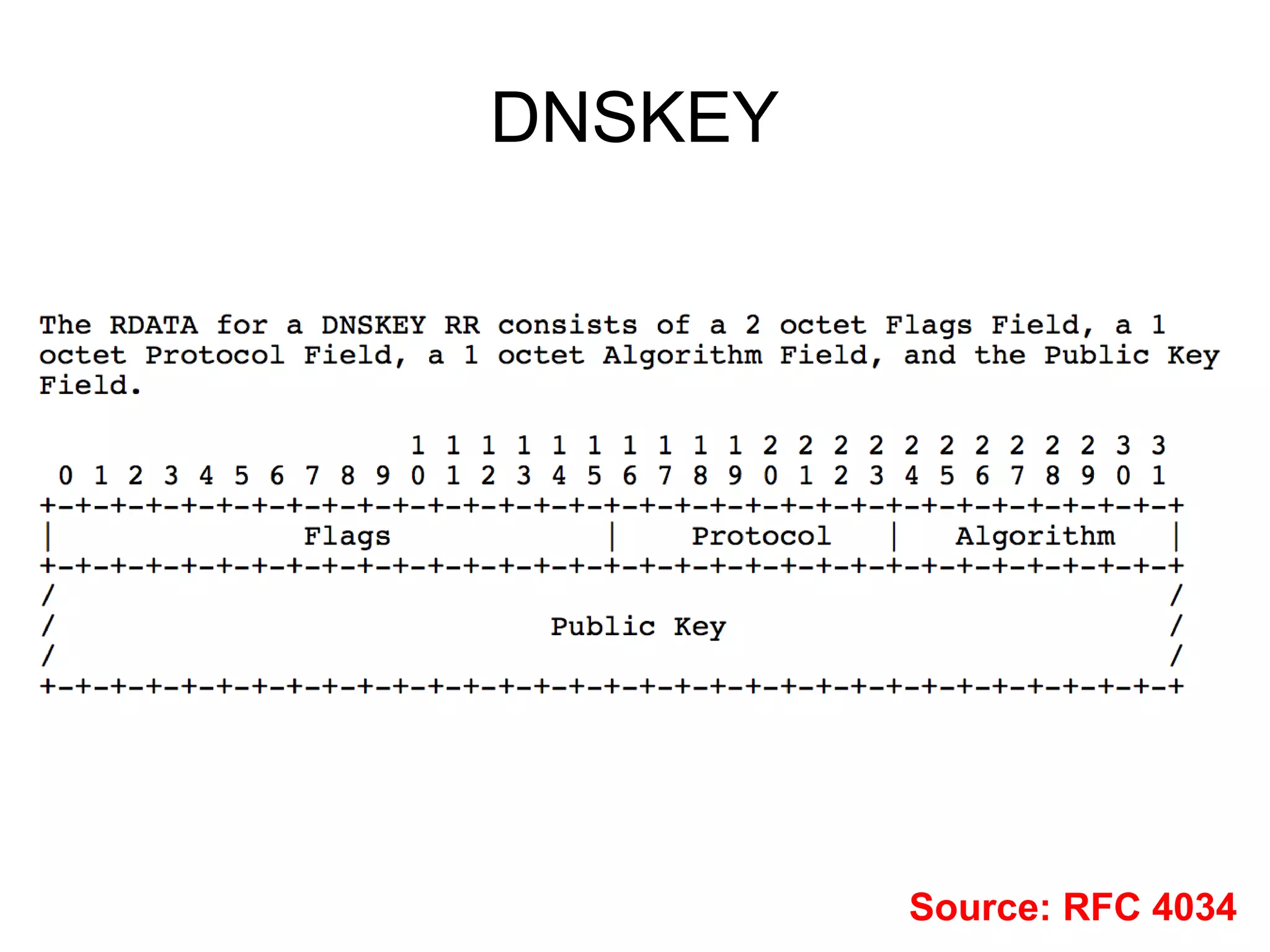
DNSKEY


         Source: RFC 4034
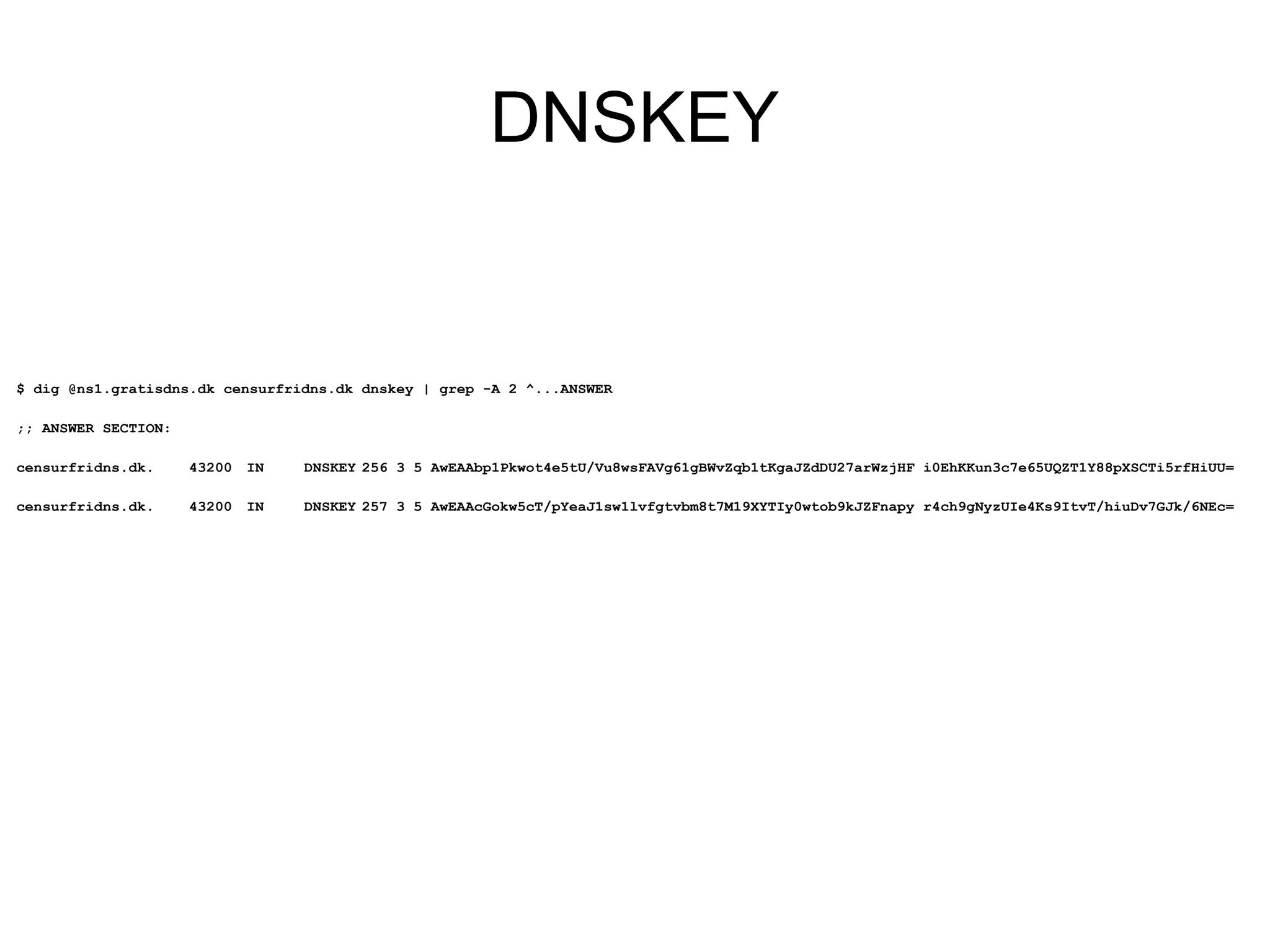
DNSKEY


$ dig @ns1.gratisdns.dk censurfridns.dk dnskey | grep -A 2 ^...ANSWER

;; ANSWER SECTION:

censurfridns.dk.     43200 IN    DNSKEY 256 3 5 AwEAAbp1Pkwot4e5tU/Vu8wsFAVg61gBWvZqb1tKgaJZdDU27arWzjHF i0EhKKun3c7e65UQZT1Y88pXSCTi5rfHiUU=

censurfridns.dk.     43200 IN    DNSKEY 257 3 5 AwEAAcGokw5cT/pYeaJ1sw1lvfgtvbm8t7M19XYTIy0wtob9kJZFnapy r4ch9gNyzUIe4Ks9ItvT/hiuDv7GJk/6NEc=
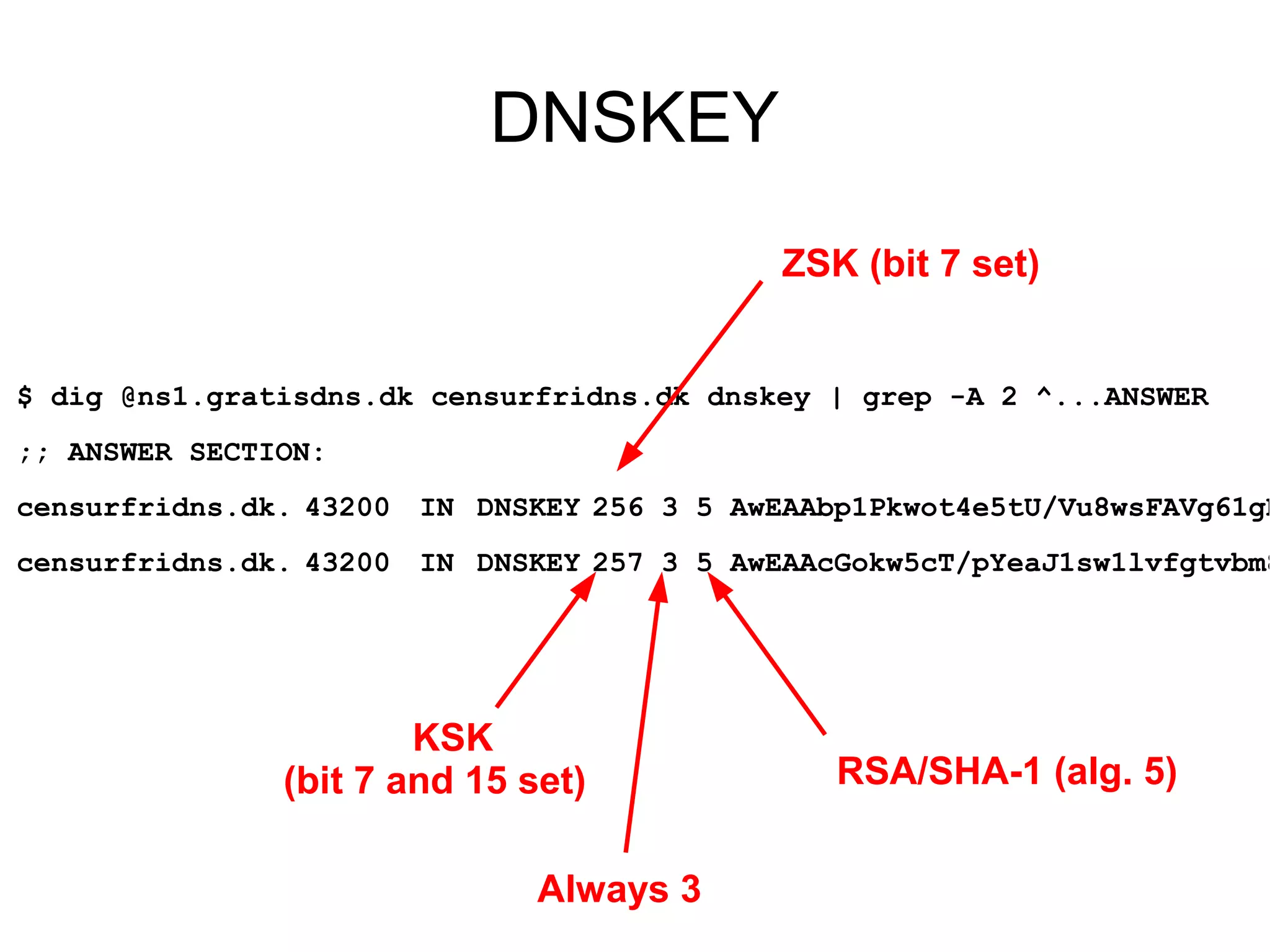
DNSKEY
                                            ZSK (bit 7 set)


$ dig @ns1.gratisdns.dk censurfridns.dk dnskey | grep -A 2 ^...ANSWER
;; ANSWER SECTION:
censurfridns.dk. 43200 IN DNSKEY 256 3 5 AwEAAbp1Pkwot4e5tU/Vu8wsFAVg61gB
censurfridns.dk. 43200 IN DNSKEY 257 3 5 AwEAAcGokw5cT/pYeaJ1sw1lvfgtvbm8


                       KSK
               (bit 7 and 15 set)              RSA/SHA-1 (alg. 5)


                              Always 3
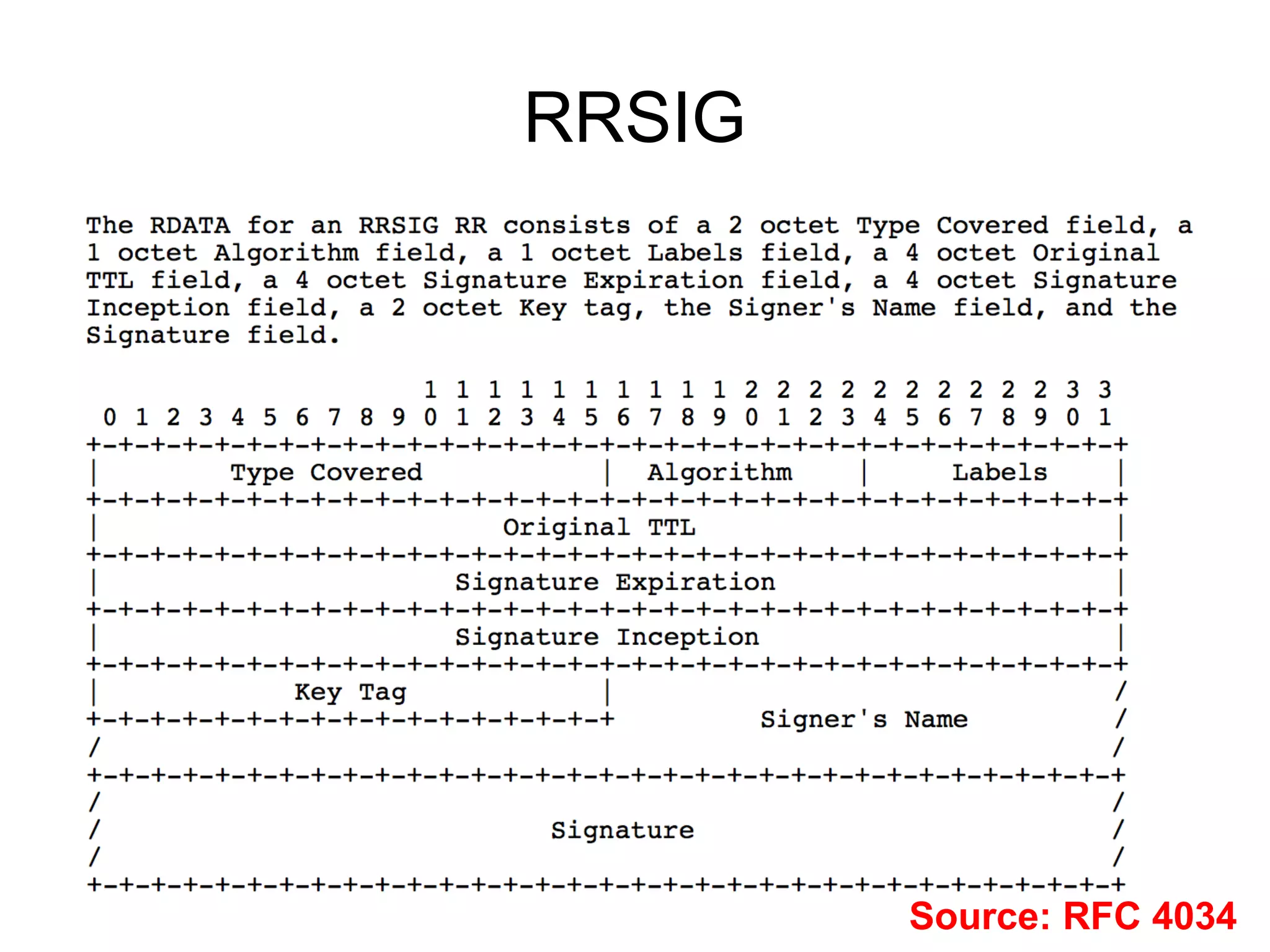
RRSIG


        Source: RFC 4034
RRSIG


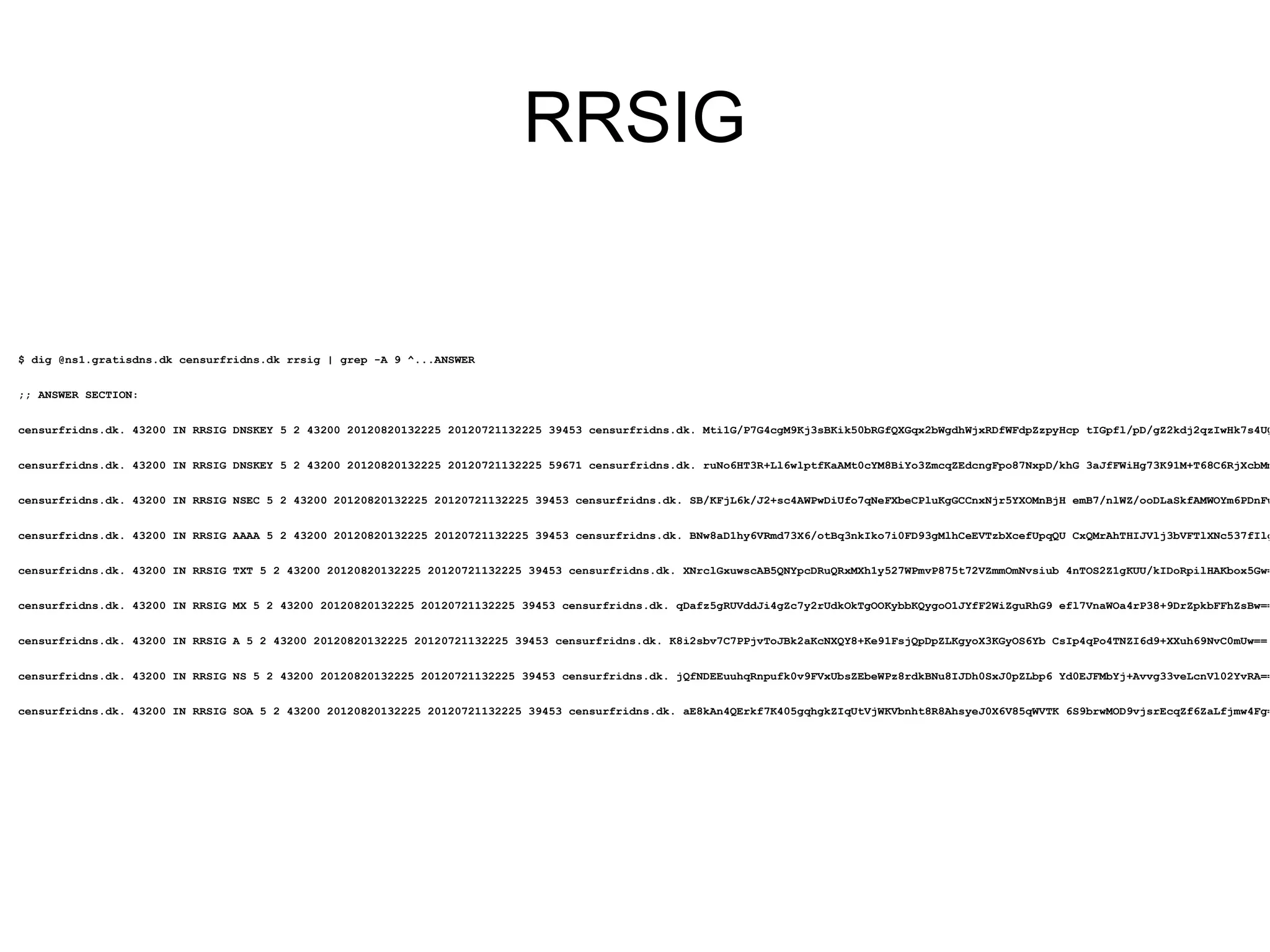
$ dig @ns1.gratisdns.dk censurfridns.dk rrsig | grep -A 9 ^...ANSWER


;; ANSWER SECTION:


censurfridns.dk. 43200 IN RRSIG DNSKEY 5 2 43200 20120820132225 20120721132225 39453 censurfridns.dk. Mti1G/P7G4cgM9Kj3sBKik50bRGfQXGqx2bWgdhWjxRDfWFdpZzpyHcp tIGpfl/pD/gZ2kdj2qzIwHk7s4UQ


censurfridns.dk. 43200 IN RRSIG DNSKEY 5 2 43200 20120820132225 20120721132225 59671 censurfridns.dk. ruNo6HT3R+Ll6wlptfKaAMt0cYM8BiYo3ZmcqZEdcngFpo87NxpD/khG 3aJfFWiHg73K91M+T68C6RjXcbMm


censurfridns.dk. 43200 IN RRSIG NSEC 5 2 43200 20120820132225 20120721132225 39453 censurfridns.dk. SB/KFjL6k/J2+sc4AWPwDiUfo7qNeFXbeCPluKgGCCnxNjr5YXOMnBjH emB7/nlWZ/ooDLaSkfAMWOYm6PDnFw


censurfridns.dk. 43200 IN RRSIG AAAA 5 2 43200 20120820132225 20120721132225 39453 censurfridns.dk. BNw8aD1hy6VRmd73X6/otBq3nkIko7i0FD93gMlhCeEVTzbXcefUpqQU CxQMrAhTHIJVlj3bVFTlXNc537fIlg


censurfridns.dk. 43200 IN RRSIG TXT 5 2 43200 20120820132225 20120721132225 39453 censurfridns.dk. XNrclGxuwscAB5QNYpcDRuQRxMXh1y527WPmvP875t72VZmmOmNvsiub 4nTOS2Z1gKUU/kIDoRpilHAKbox5Gw=


censurfridns.dk. 43200 IN RRSIG MX 5 2 43200 20120820132225 20120721132225 39453 censurfridns.dk. qDafz5gRUVddJi4gZc7y2rUdkOkTgOOKybbKQygoO1JYfF2WiZguRhG9 efl7VnaWOa4rP38+9DrZpkbFFhZsBw==


censurfridns.dk. 43200 IN RRSIG A 5 2 43200 20120820132225 20120721132225 39453 censurfridns.dk. K8i2sbv7C7PPjvToJBk2aKcNXQY8+Ke91FsjQpDpZLKgyoX3KGyOS6Yb CsIp4qPo4TNZI6d9+XXuh69NvC0mUw==


censurfridns.dk. 43200 IN RRSIG NS 5 2 43200 20120820132225 20120721132225 39453 censurfridns.dk. jQfNDEEuuhqRnpufk0v9FVxUbsZEbeWPz8rdkBNu8IJDh0SxJ0pZLbp6 Yd0EJFMbYj+Avvg33veLcnVl02YvRA==


censurfridns.dk. 43200 IN RRSIG SOA 5 2 43200 20120820132225 20120721132225 39453 censurfridns.dk. aE8kAn4QErkf7K405gqhgkZIqUtVjWKVbnht8R8AhsyeJ0X6V85qWVTK 6S9brwMOD9vjsrEcqZf6ZaLfjmw4Fg=
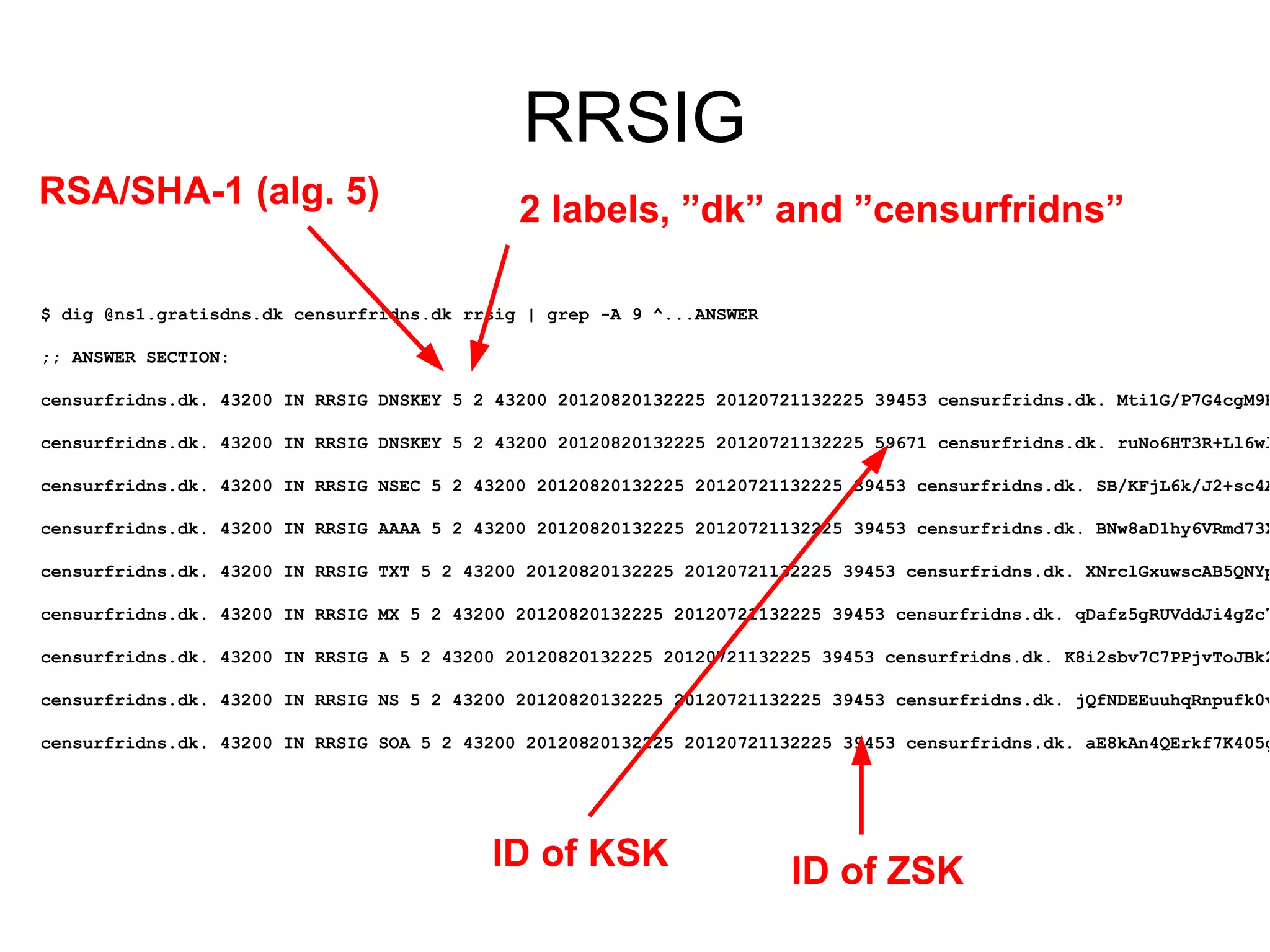
RRSIG
RSA/SHA-1 (alg. 5)                           2 labels, ”dk” and ”censurfridns”

$ dig @ns1.gratisdns.dk censurfridns.dk rrsig | grep -A 9 ^...ANSWER

;; ANSWER SECTION:

censurfridns.dk. 43200 IN RRSIG DNSKEY 5 2 43200 20120820132225 20120721132225 39453 censurfridns.dk. Mti1G/P7G4cgM9K

censurfridns.dk. 43200 IN RRSIG DNSKEY 5 2 43200 20120820132225 20120721132225 59671 censurfridns.dk. ruNo6HT3R+Ll6wl

censurfridns.dk. 43200 IN RRSIG NSEC 5 2 43200 20120820132225 20120721132225 39453 censurfridns.dk. SB/KFjL6k/J2+sc4A

censurfridns.dk. 43200 IN RRSIG AAAA 5 2 43200 20120820132225 20120721132225 39453 censurfridns.dk. BNw8aD1hy6VRmd73X

censurfridns.dk. 43200 IN RRSIG TXT 5 2 43200 20120820132225 20120721132225 39453 censurfridns.dk. XNrclGxuwscAB5QNYp

censurfridns.dk. 43200 IN RRSIG MX 5 2 43200 20120820132225 20120721132225 39453 censurfridns.dk. qDafz5gRUVddJi4gZc7

censurfridns.dk. 43200 IN RRSIG A 5 2 43200 20120820132225 20120721132225 39453 censurfridns.dk. K8i2sbv7C7PPjvToJBk2

censurfridns.dk. 43200 IN RRSIG NS 5 2 43200 20120820132225 20120721132225 39453 censurfridns.dk. jQfNDEEuuhqRnpufk0v

censurfridns.dk. 43200 IN RRSIG SOA 5 2 43200 20120820132225 20120721132225 39453 censurfridns.dk. aE8kAn4QErkf7K405g


                                          ID of KSK                    ID of ZSK
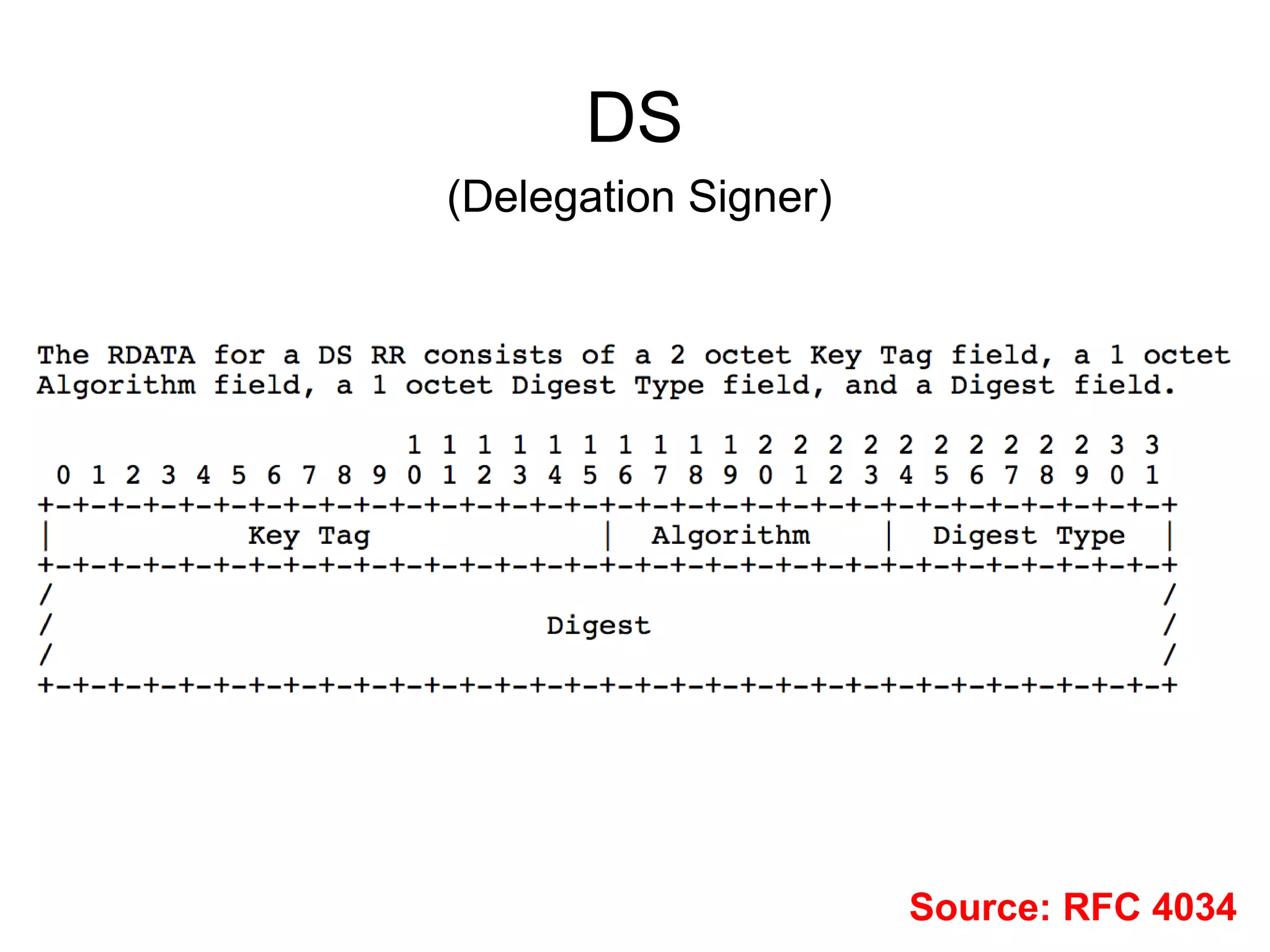
DS
(Delegation Signer)


                      Source: RFC 4034
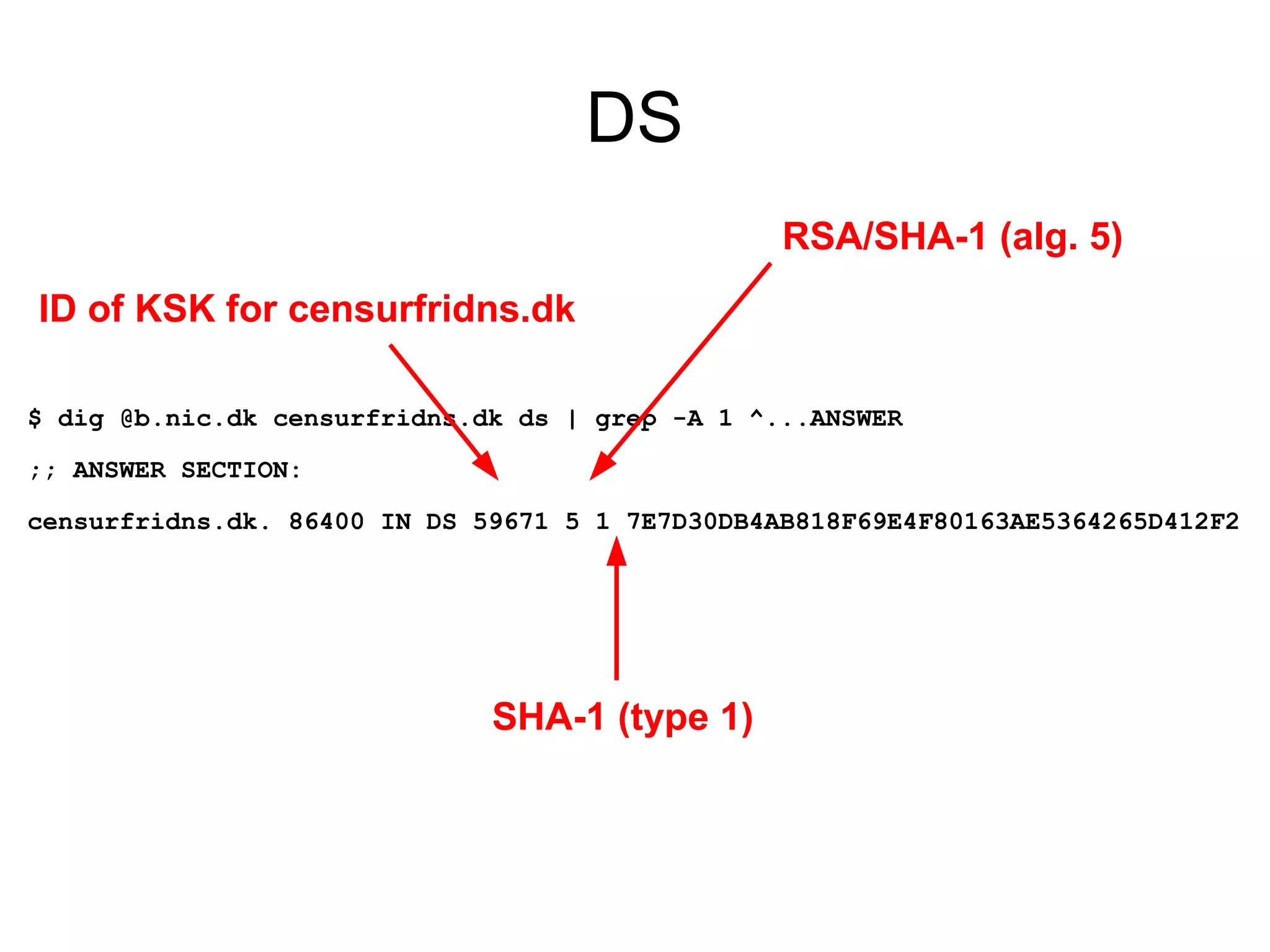
DS
                                                 RSA/SHA-1 (alg. 5)
ID of KSK for censurfridns.dk

$ dig @b.nic.dk censurfridns.dk ds | grep -A 1 ^...ANSWER

;; ANSWER SECTION:

censurfridns.dk. 86400 IN DS 59671 5 1 7E7D30DB4AB818F69E4F80163AE5364265D412F2


                              SHA-1 (type 1)
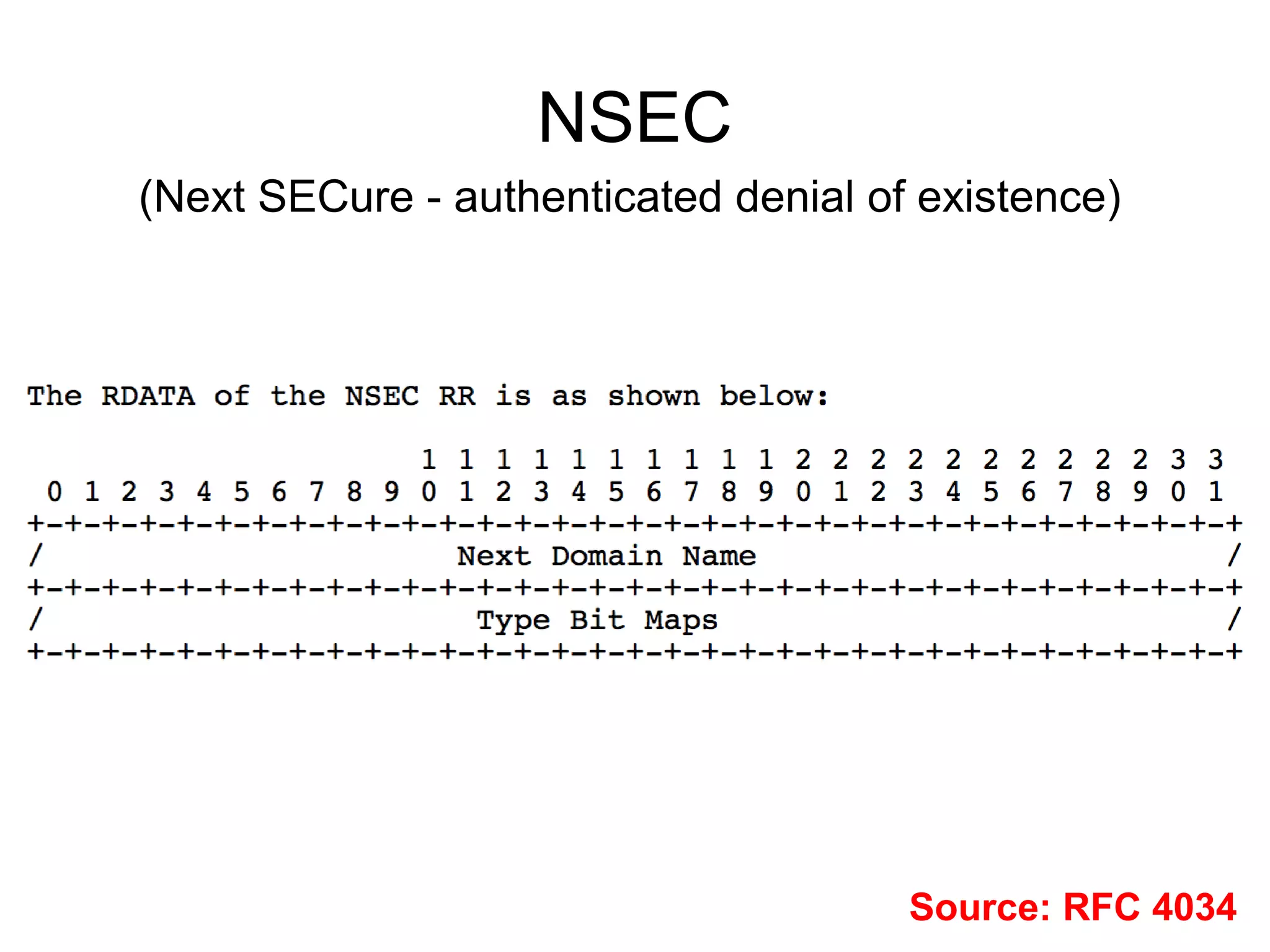
NSEC
(Next SECure - authenticated denial of existence)


                                      Source: RFC 4034
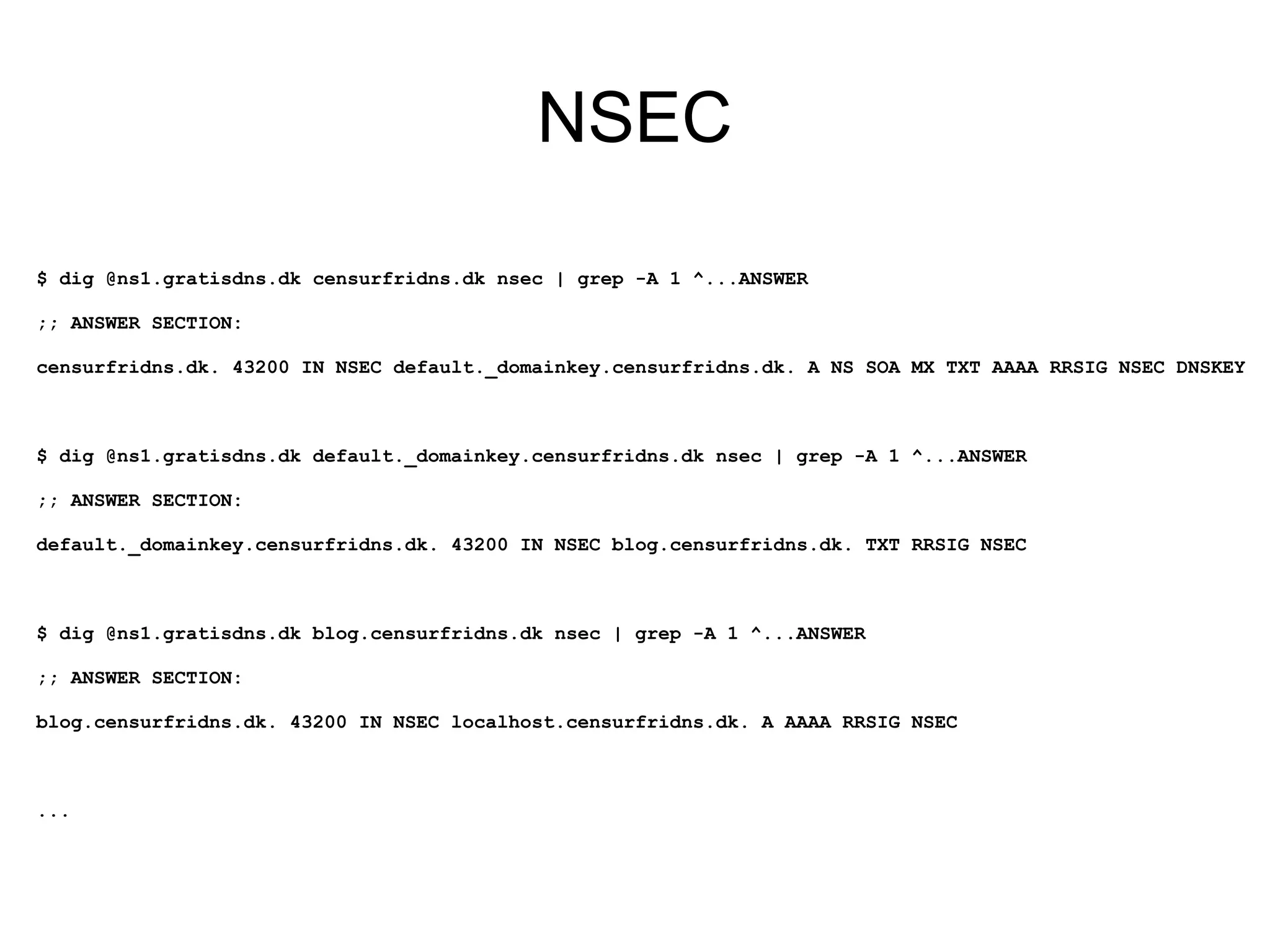
NSEC

$ dig @ns1.gratisdns.dk censurfridns.dk nsec | grep -A 1 ^...ANSWER

;; ANSWER SECTION:

censurfridns.dk. 43200 IN NSEC default._domainkey.censurfridns.dk. A NS SOA MX TXT AAAA RRSIG NSEC DNSKEY


$ dig @ns1.gratisdns.dk default._domainkey.censurfridns.dk nsec | grep -A 1 ^...ANSWER

;; ANSWER SECTION:

default._domainkey.censurfridns.dk. 43200 IN NSEC blog.censurfridns.dk. TXT RRSIG NSEC


$ dig @ns1.gratisdns.dk blog.censurfridns.dk nsec | grep -A 1 ^...ANSWER

;; ANSWER SECTION:

blog.censurfridns.dk. 43200 IN NSEC localhost.censurfridns.dk. A AAAA RRSIG NSEC


...
NSEC

$ NEXT=censurfridns.dk; while true; do echo $NEXT; NEXT=`dig @ns1.gratisdns.dk $NEXT
nsec +short | cut -d ' ' -f 1`; if [ "$NEXT" = "censurfridns.dk." ]; then break; fi;
done

censurfridns.dk

default._domainkey.censurfridns.dk.

blog.censurfridns.dk.

localhost.censurfridns.dk.

ns1.censurfridns.dk.

ns1a.censurfridns.dk.

ns1b.censurfridns.dk.

ns2.censurfridns.dk.

www.censurfridns.dk.
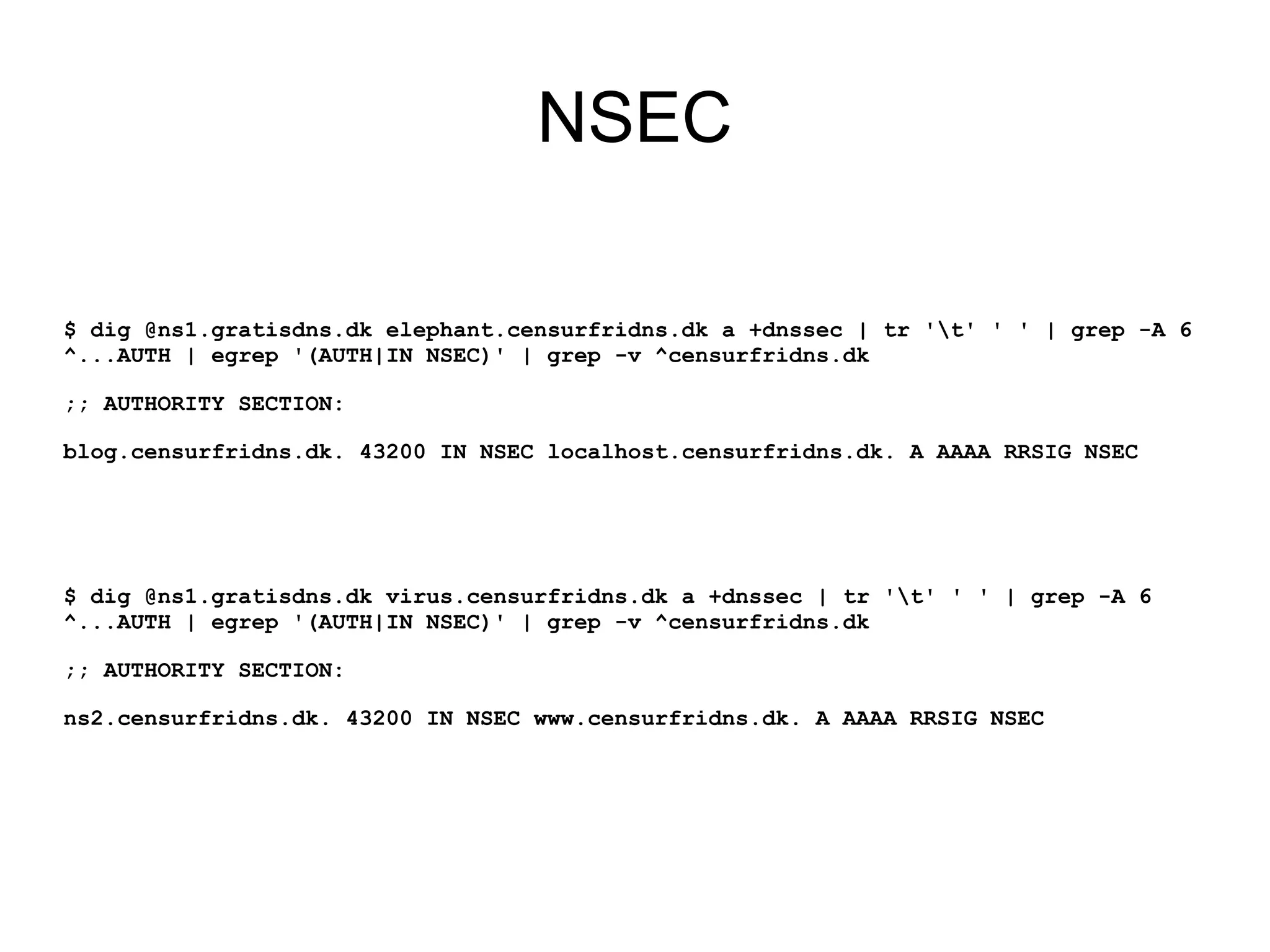
NSEC

$ dig @ns1.gratisdns.dk elephant.censurfridns.dk a +dnssec | tr 't' ' ' | grep -A 6
^...AUTH | egrep '(AUTH|IN NSEC)' | grep -v ^censurfridns.dk

;; AUTHORITY SECTION:

blog.censurfridns.dk. 43200 IN NSEC localhost.censurfridns.dk. A AAAA RRSIG NSEC


$ dig @ns1.gratisdns.dk virus.censurfridns.dk a +dnssec | tr 't' ' ' | grep -A 6
^...AUTH | egrep '(AUTH|IN NSEC)' | grep -v ^censurfridns.dk

;; AUTHORITY SECTION:

ns2.censurfridns.dk. 43200 IN NSEC www.censurfridns.dk. A AAAA RRSIG NSEC
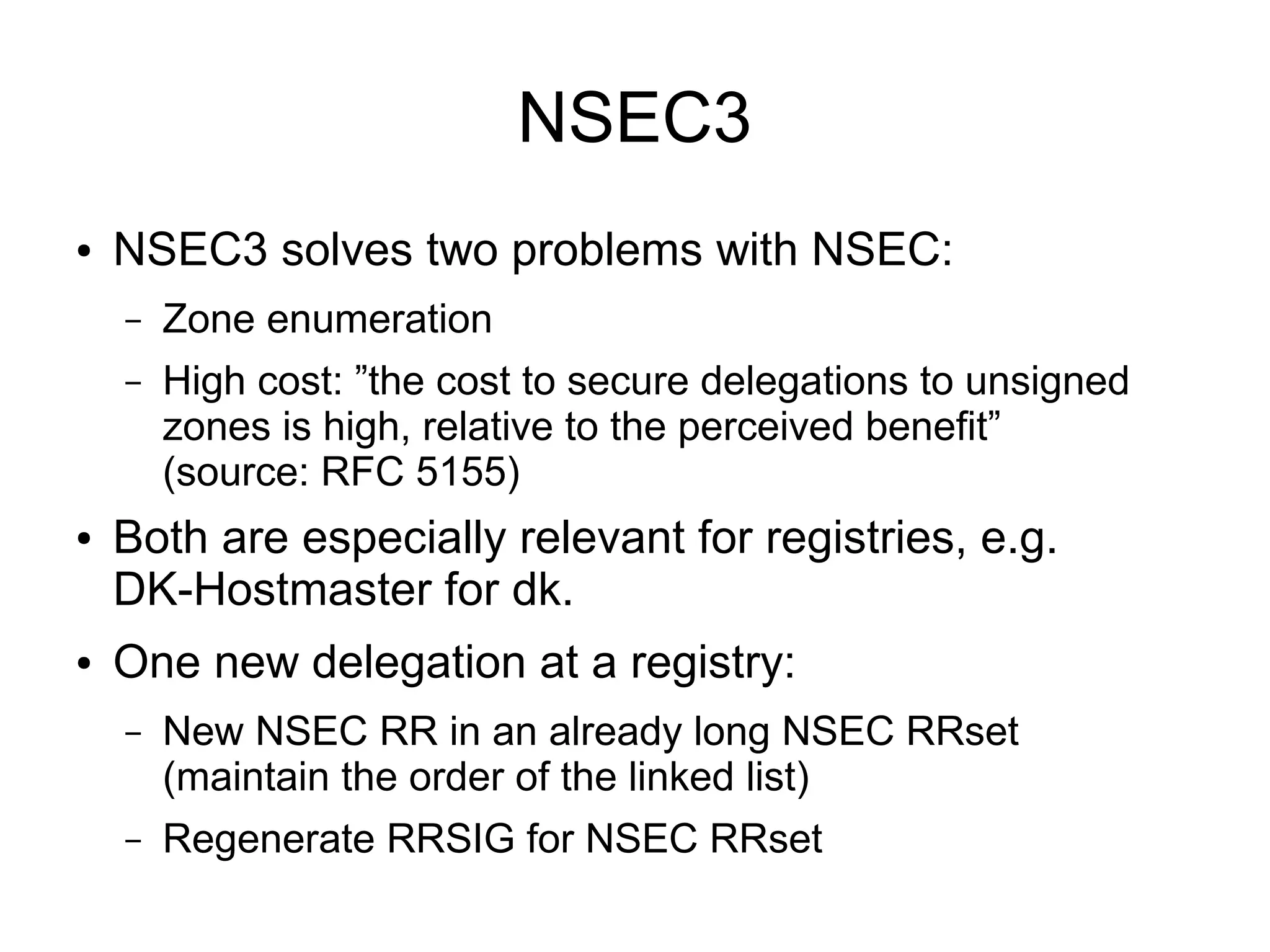
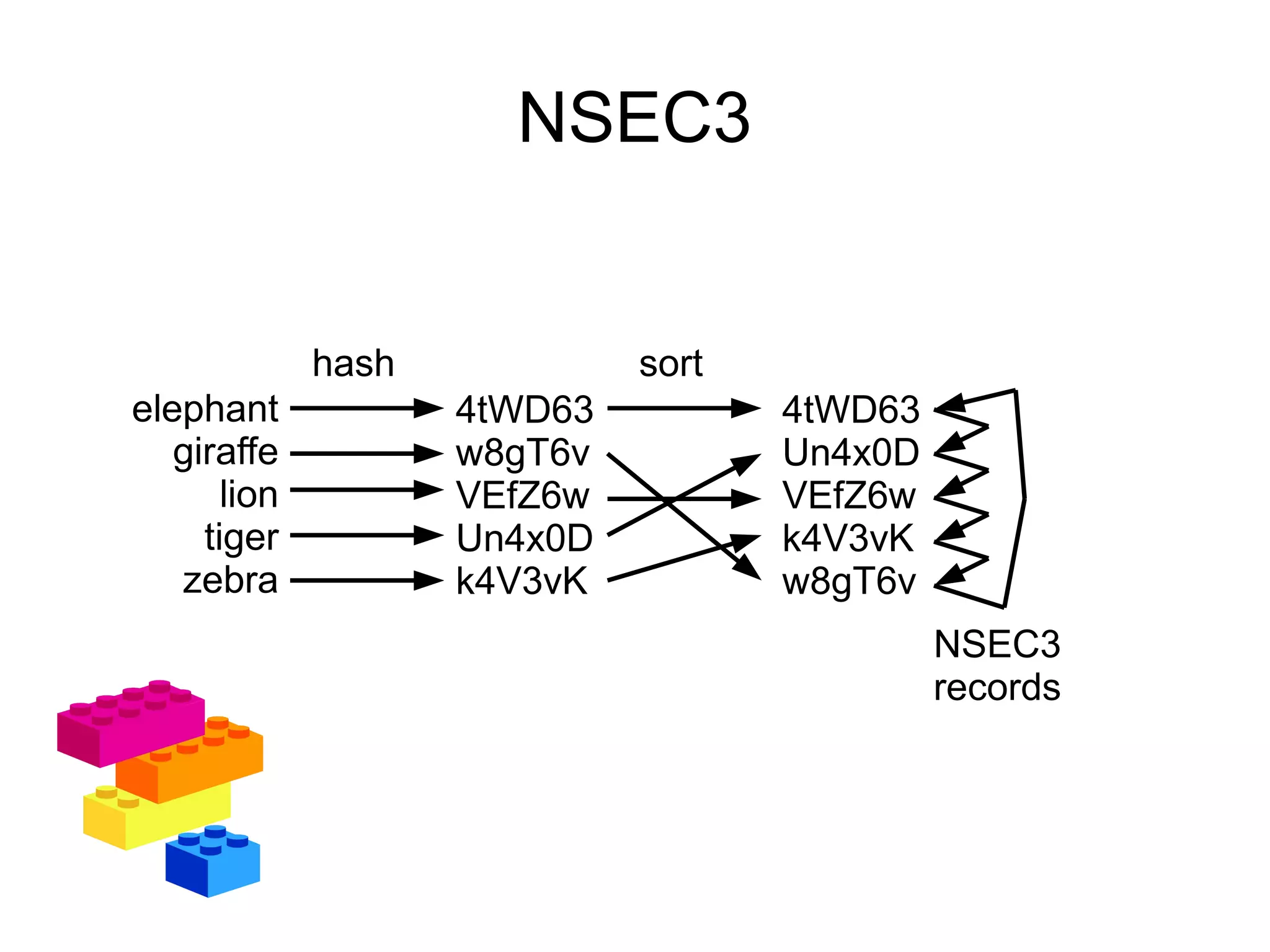
NSEC3
●   NSEC3 solves two problems with NSEC:
    –   Zone enumeration
    –   High cost: ”the cost to secure delegations to unsigned
        zones is high, relative to the perceived benefit”
        (source: RFC 5155)
●   Both are especially relevant for registries, e.g.
    DK-Hostmaster for dk.
●   One new delegation at a registry:
    –   New NSEC RR in an already long NSEC RRset
        (maintain the order of the linked list)
    –   Regenerate RRSIG for NSEC RRset
NSEC3


              hash            sort
elephant             4tWD63          4tWD63
   giraffe           w8gT6v          Un4x0D
       lion          VEfZ6w          VEfZ6w
     tiger           Un4x0D          k4V3vK
   zebra             k4V3vK          w8gT6v
                                              NSEC3
                                              records
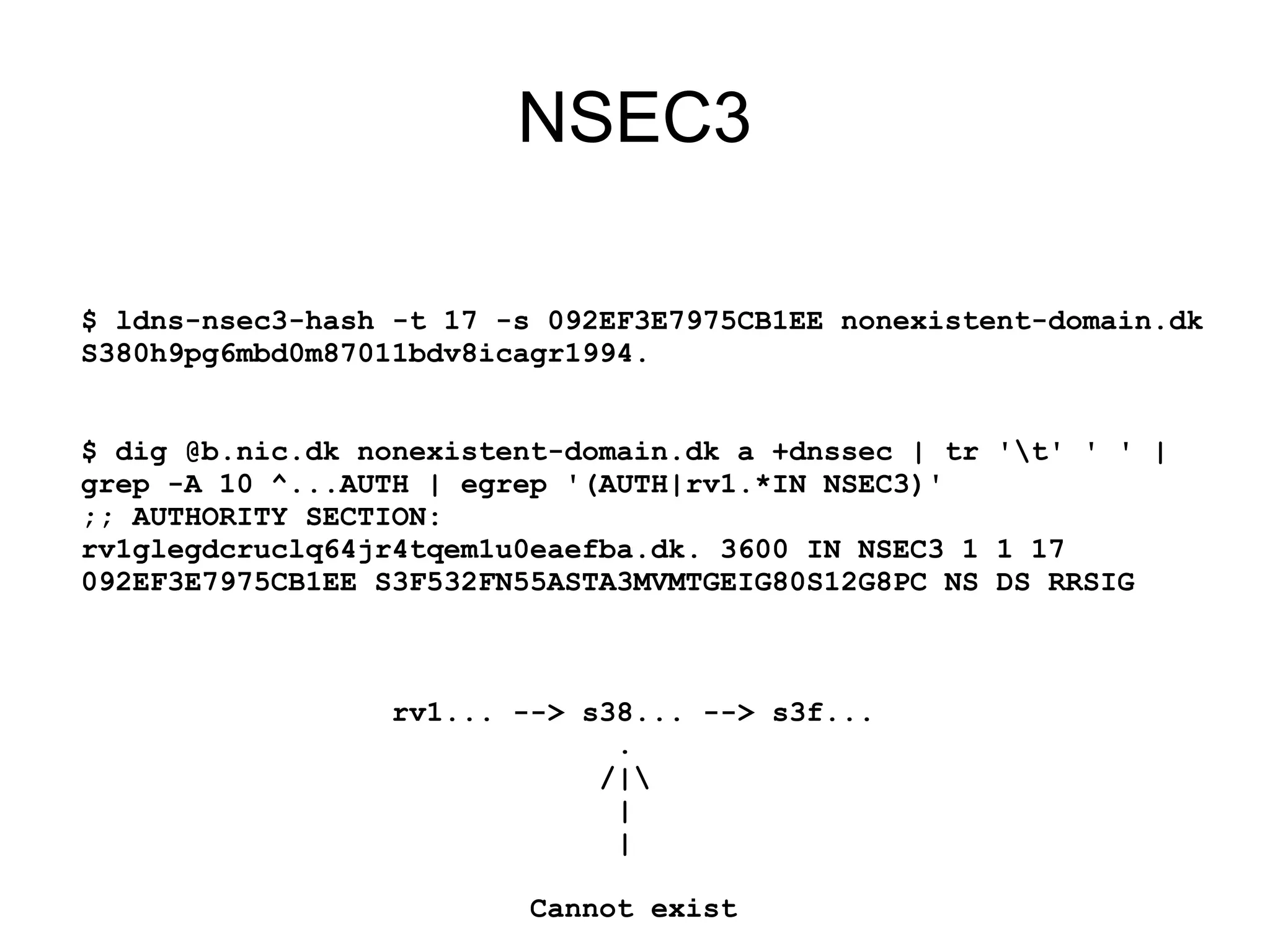
NSEC3

$ ldns-nsec3-hash -t 17 -s 092EF3E7975CB1EE nonexistent-domain.dk
S380h9pg6mbd0m87011bdv8icagr1994.


$ dig @b.nic.dk nonexistent-domain.dk a +dnssec | tr 't' ' ' |
grep -A 10 ^...AUTH | egrep '(AUTH|rv1.*IN NSEC3)'
;; AUTHORITY SECTION:
rv1glegdcruclq64jr4tqem1u0eaefba.dk. 3600 IN NSEC3 1 1 17
092EF3E7975CB1EE S3F532FN55ASTA3MVMTGEIG80S12G8PC NS DS RRSIG


                  rv1... --> s38... --> s3f...
                               .
                              /|
                               |
                               |

                          Cannot exist
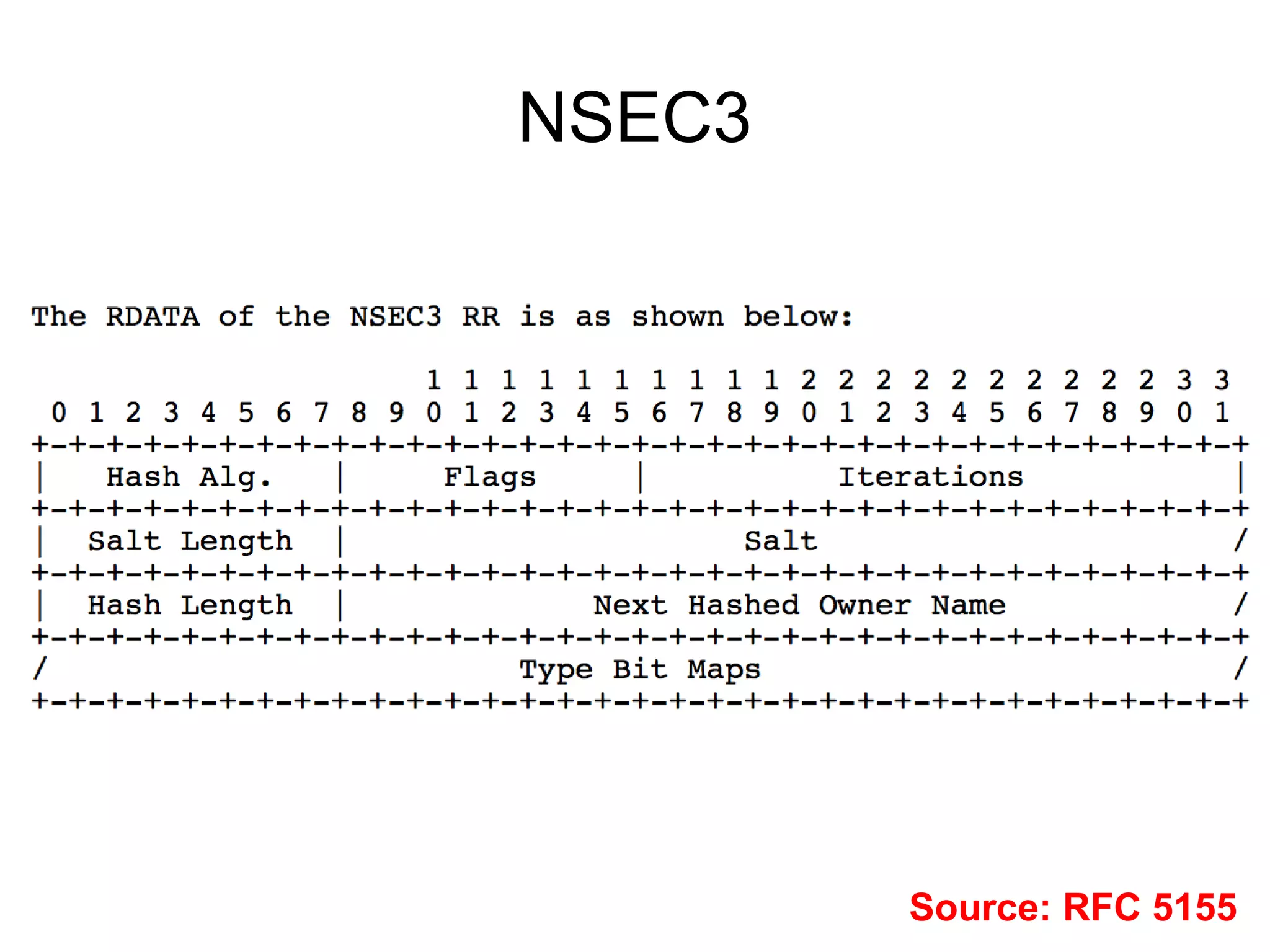
NSEC3


        Source: RFC 5155
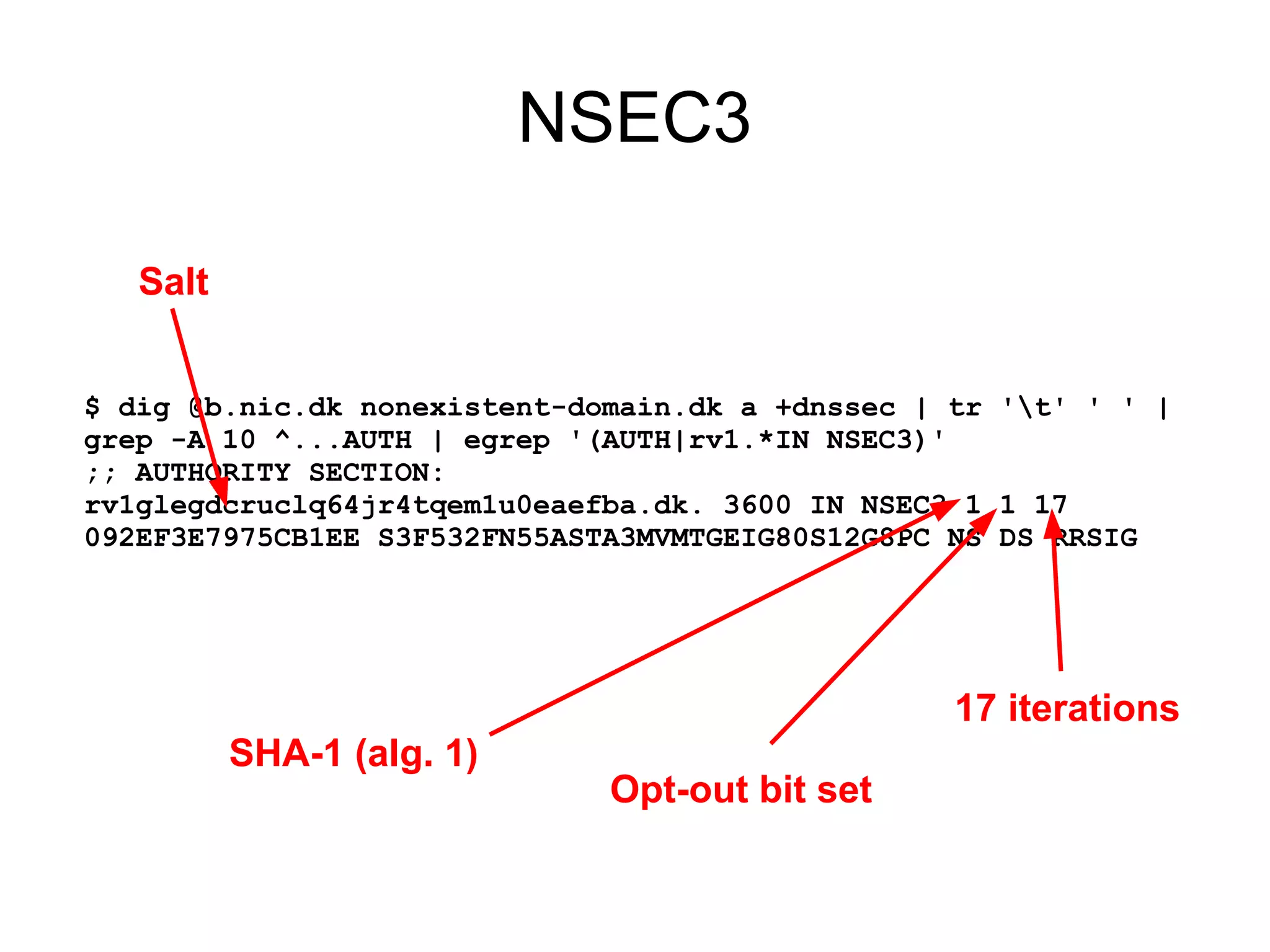
NSEC3

   Salt


$ dig @b.nic.dk nonexistent-domain.dk a +dnssec | tr 't' ' ' |
grep -A 10 ^...AUTH | egrep '(AUTH|rv1.*IN NSEC3)'
;; AUTHORITY SECTION:
rv1glegdcruclq64jr4tqem1u0eaefba.dk. 3600 IN NSEC3 1 1 17
092EF3E7975CB1EE S3F532FN55ASTA3MVMTGEIG80S12G8PC NS DS RRSIG


                                                  17 iterations
          SHA-1 (alg. 1)
                              Opt-out bit set
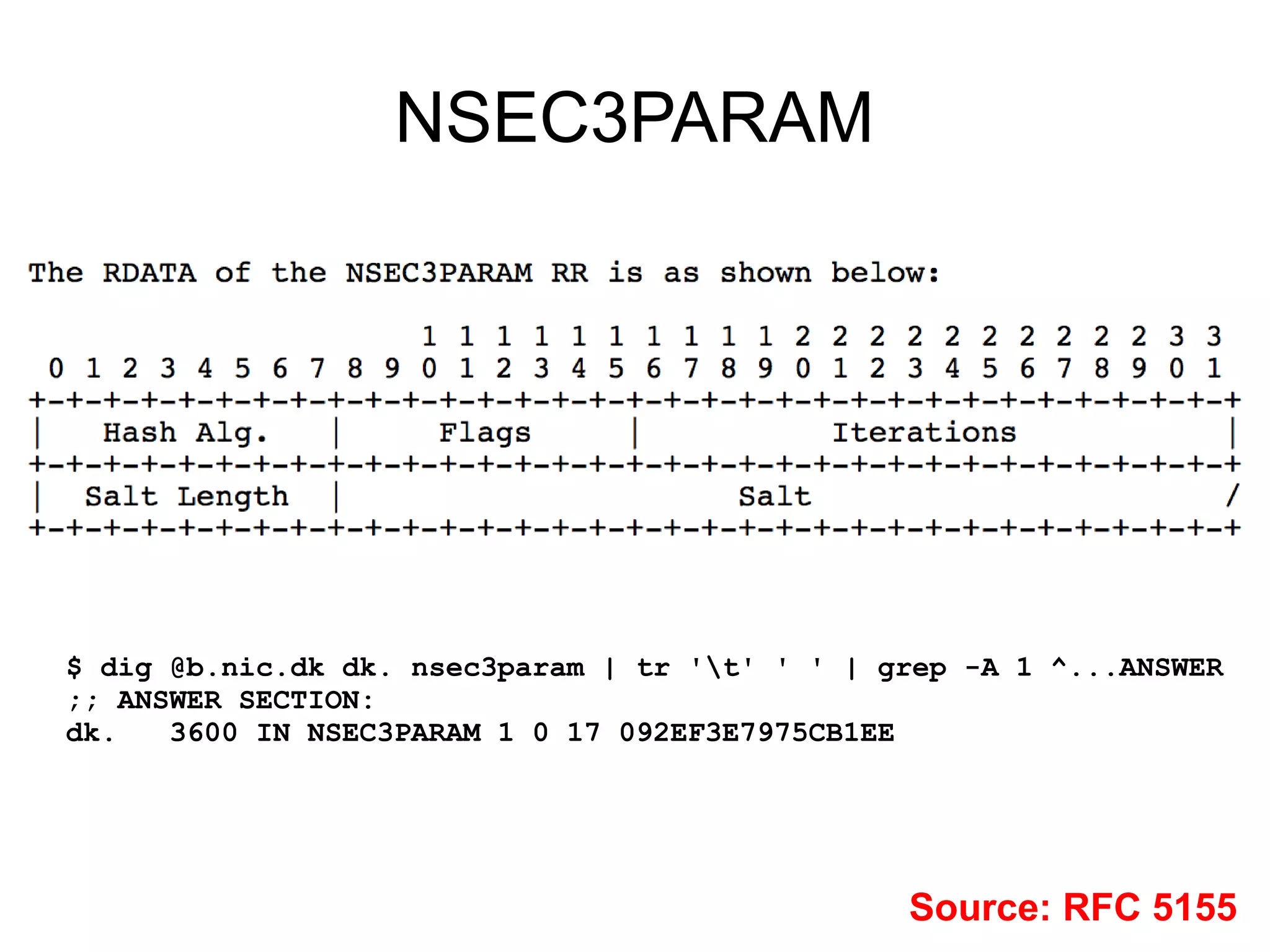
NSEC3PARAM


$ dig @b.nic.dk dk. nsec3param | tr 't' ' ' | grep -A 1 ^...ANSWER
;; ANSWER SECTION:
dk.   3600 IN NSEC3PARAM 1 0 17 092EF3E7975CB1EE


                                                Source: RFC 5155
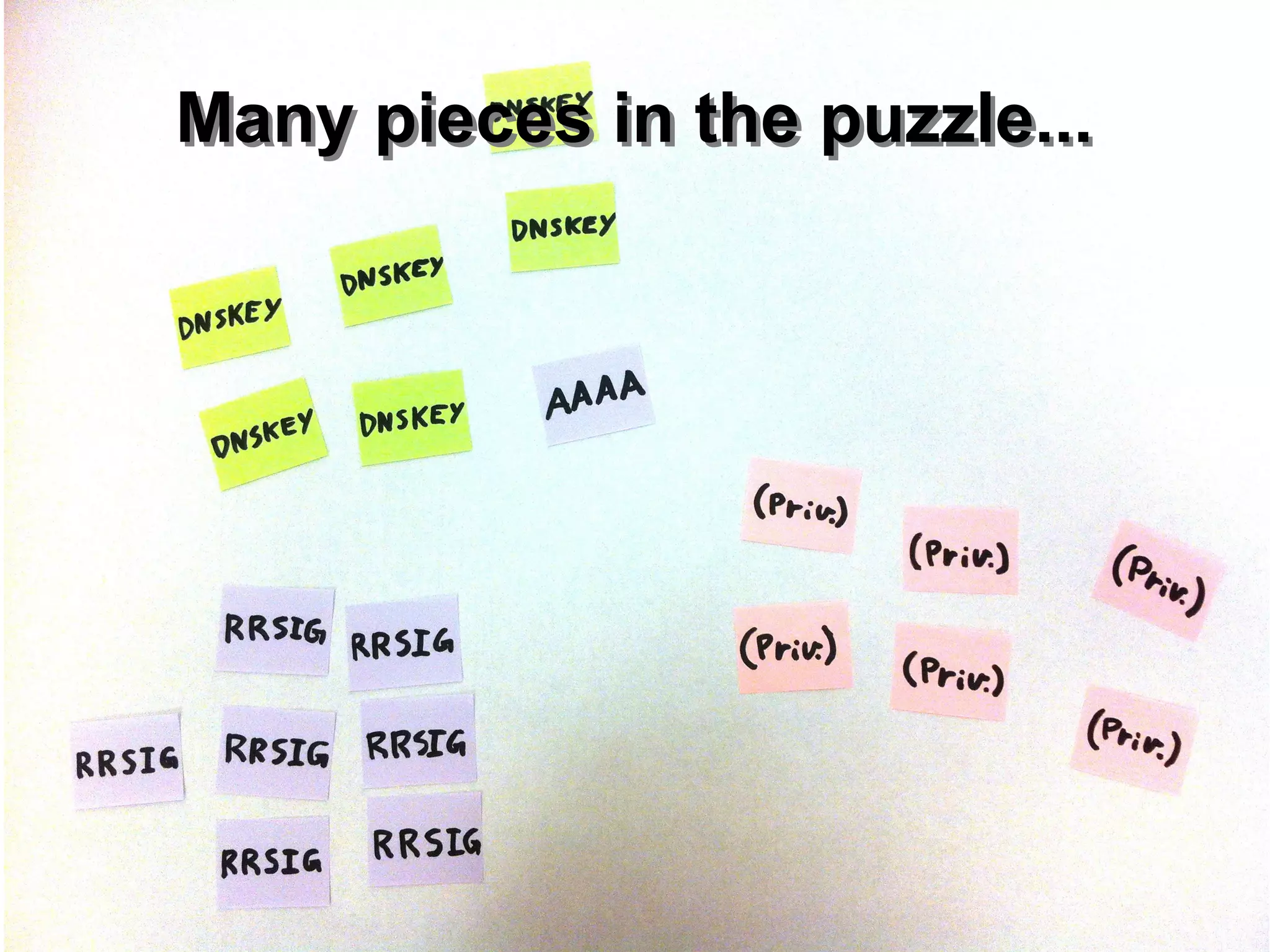
Many pieces in the puzzle...
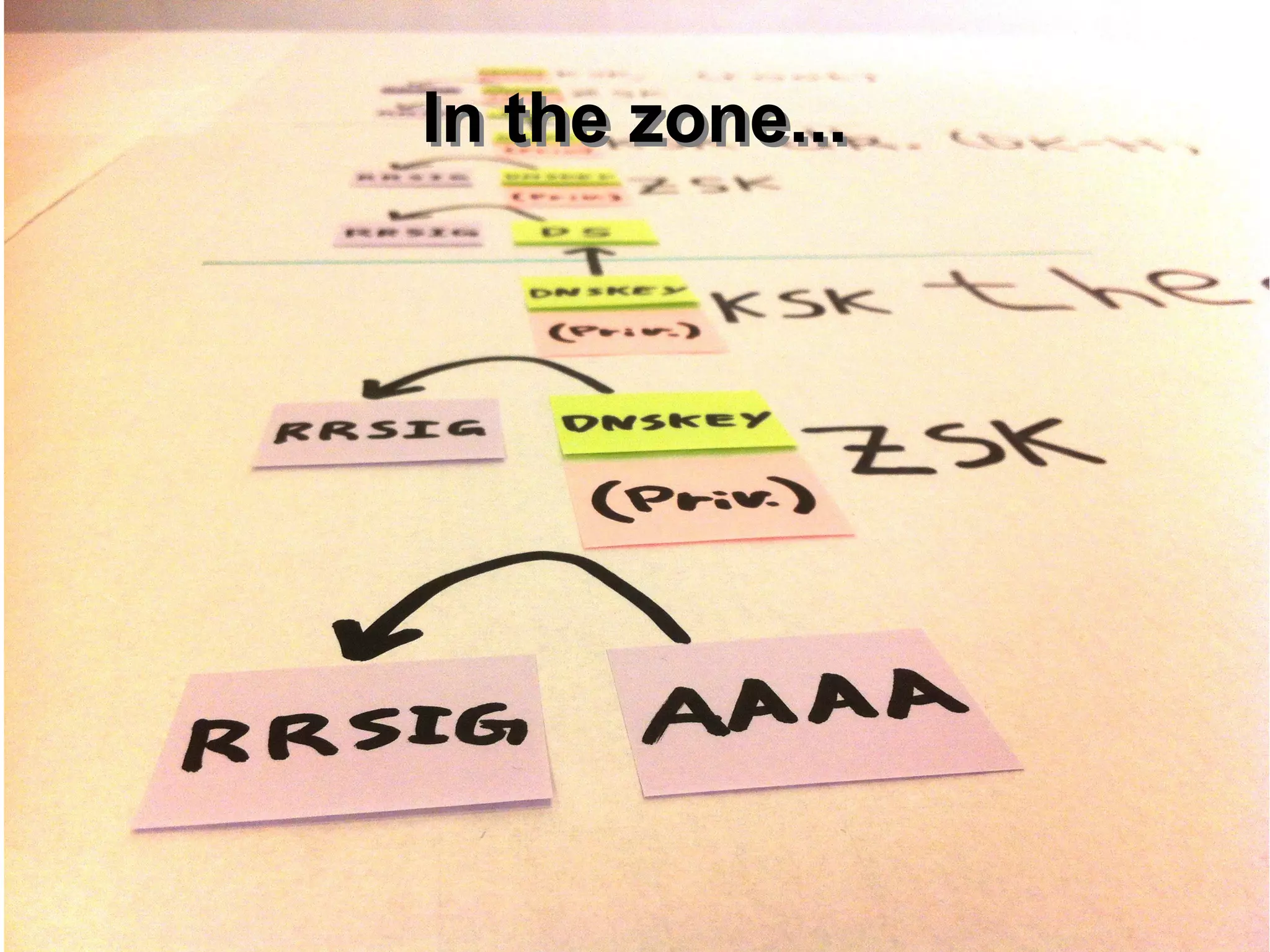
In the zone...
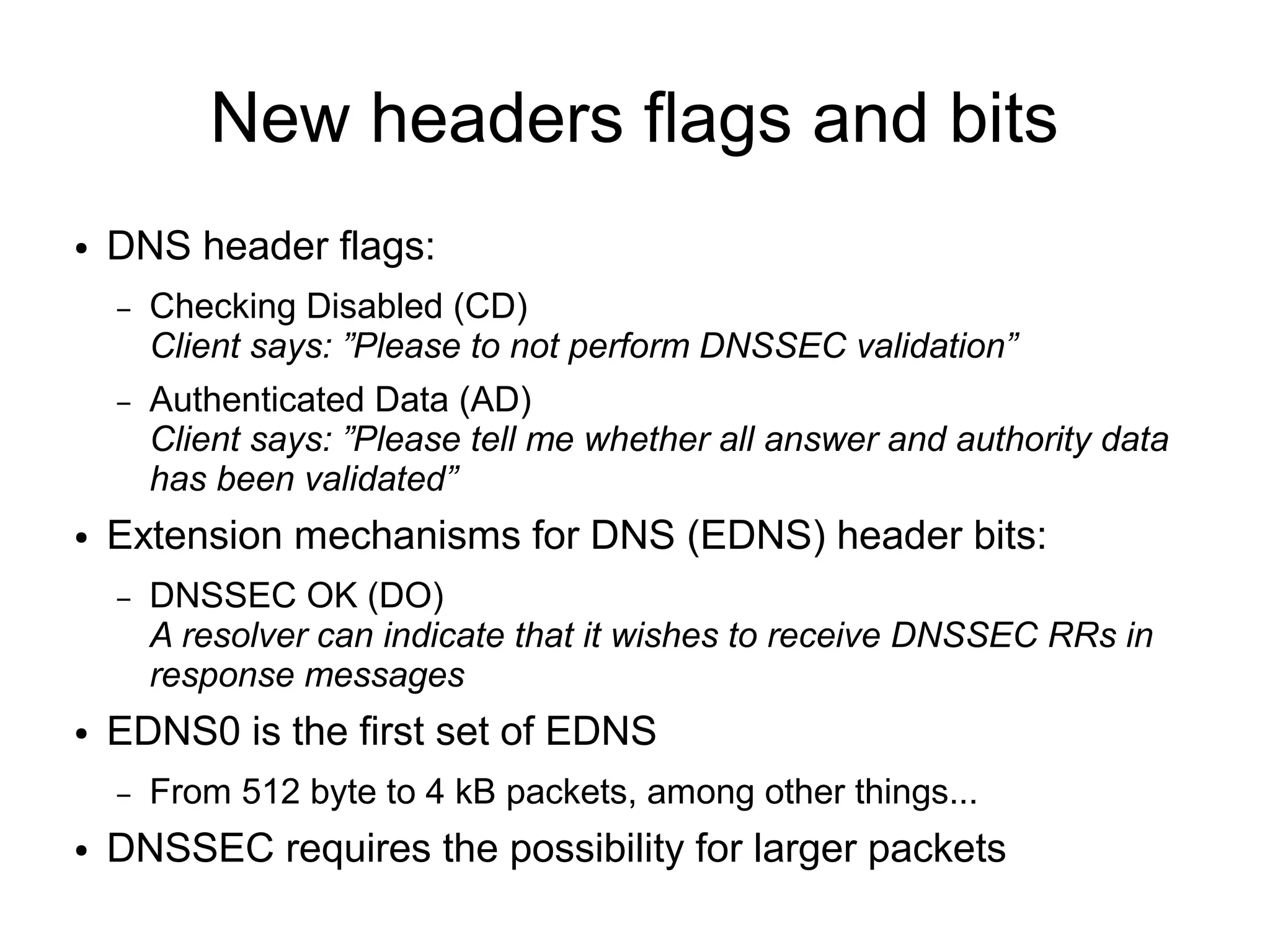
New headers flags and bits
●   DNS header flags:
    –   Checking Disabled (CD)
        Client says: ”Please to not perform DNSSEC validation”
    –   Authenticated Data (AD)
        Client says: ”Please tell me whether all answer and authority data
        has been validated”
●   Extension mechanisms for DNS (EDNS) header bits:
    –   DNSSEC OK (DO)
        A resolver can indicate that it wishes to receive DNSSEC RRs in
        response messages
●   EDNS0 is the first set of EDNS
    –   From 512 byte to 4 kB packets, among other things...
●   DNSSEC requires the possibility for larger packets
Support in dig
$ man dig | grep -B 1 -A 1 -i checking

       +[no]cdflag

           Set [do not set] the CD (checking disabled) bit in the query. This

           requests the server to not perform DNSSEC validation of responses.


$ man dig | grep -B 1 -A 6 -i 'authentic data'

       +[no]adflag

           Set [do not set] the AD (authentic data) bit in the query. This

           requests the server to return whether all of the answer and

           authority sections have all been validated as secure according to

           the security policy of the server. AD=1 indicates that all records

           have been validated as secure and the answer is not from a OPT-OUT

           range. AD=0 indicate that some part of the answer was insecure or

           not validated.
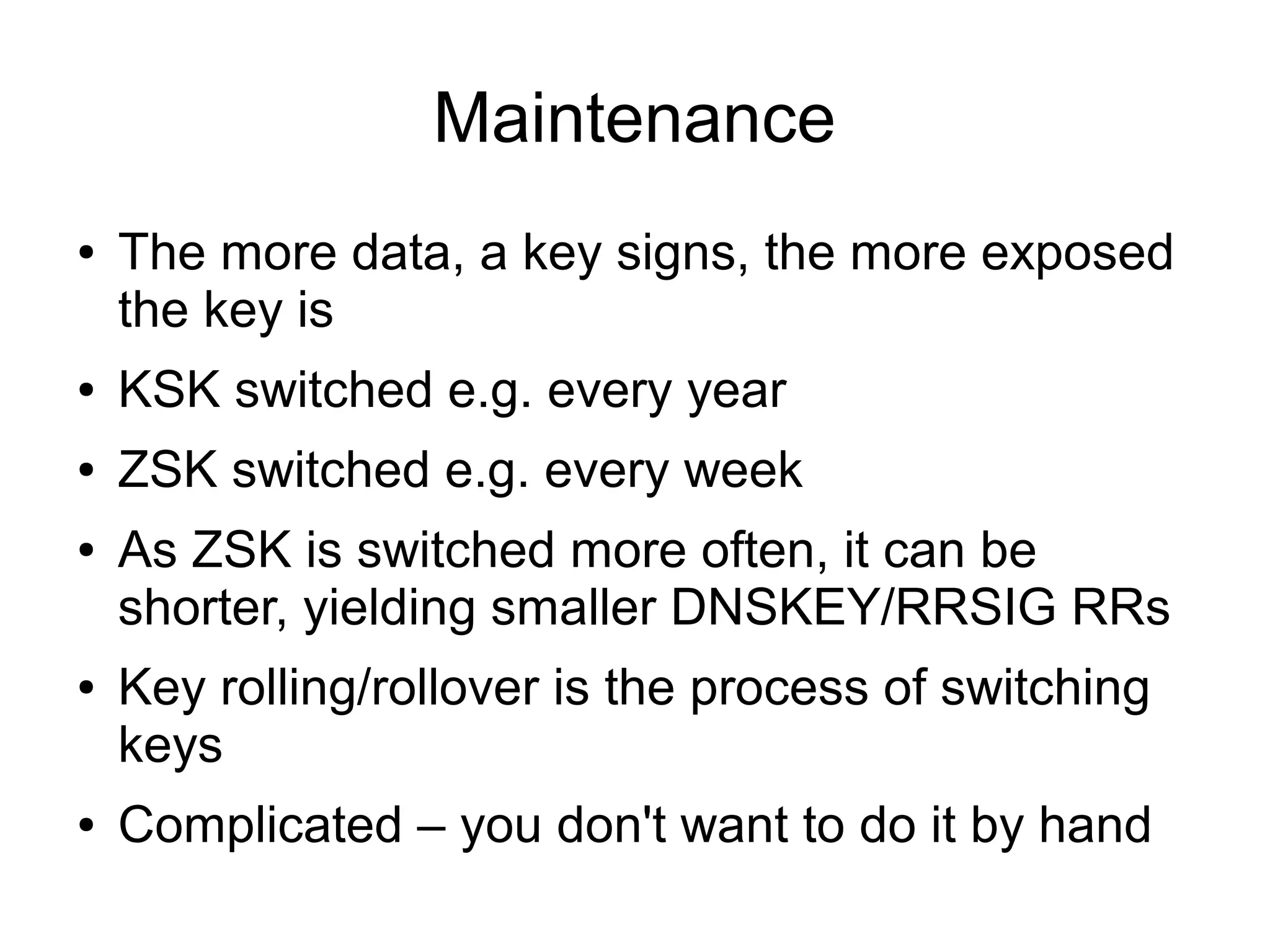
Maintenance
●   The more data, a key signs, the more exposed
    the key is
●   KSK switched e.g. every year
●   ZSK switched e.g. every week
●   As ZSK is switched more often, it can be
    shorter, yielding smaller DNSKEY/RRSIG RRs
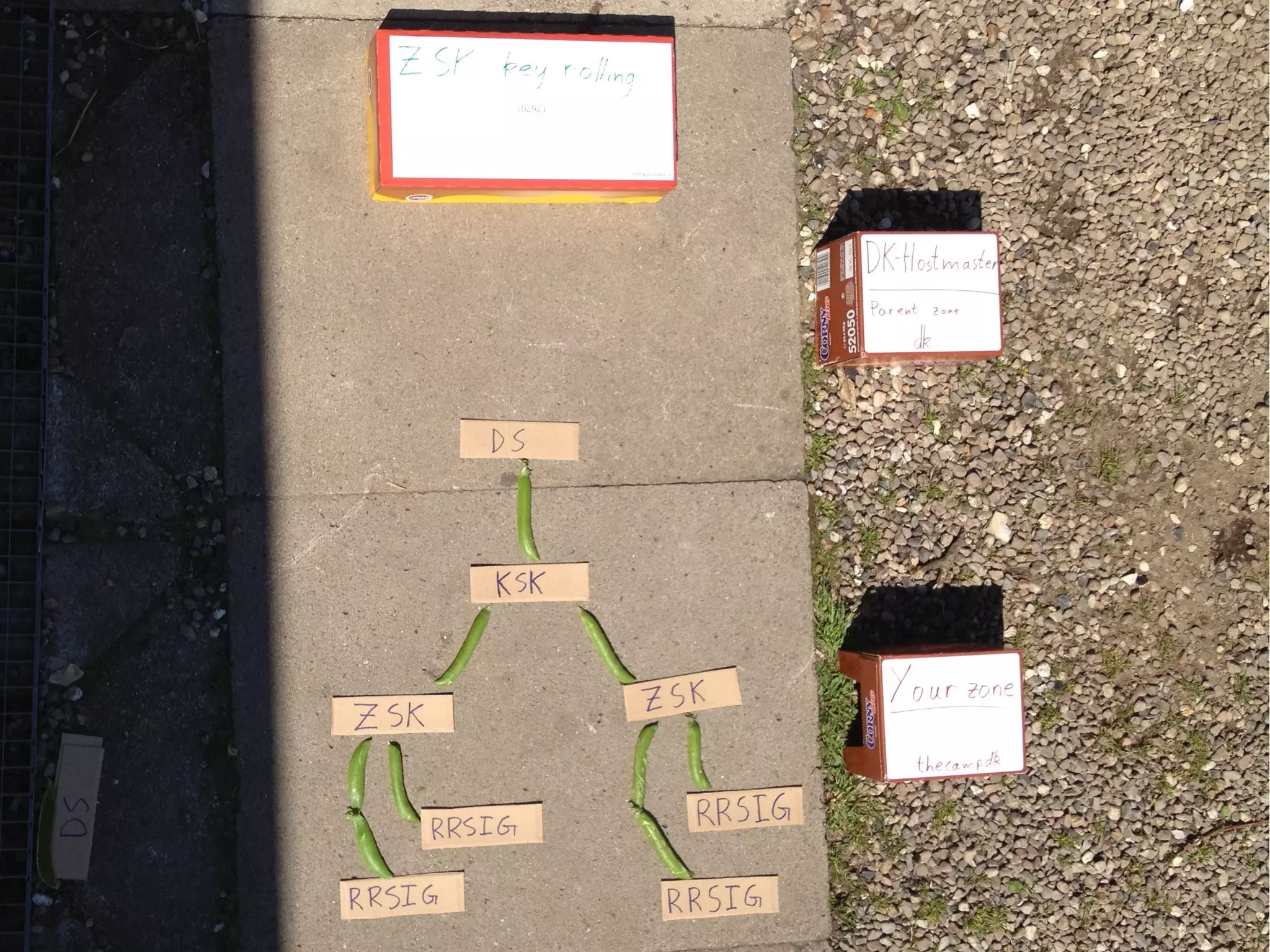
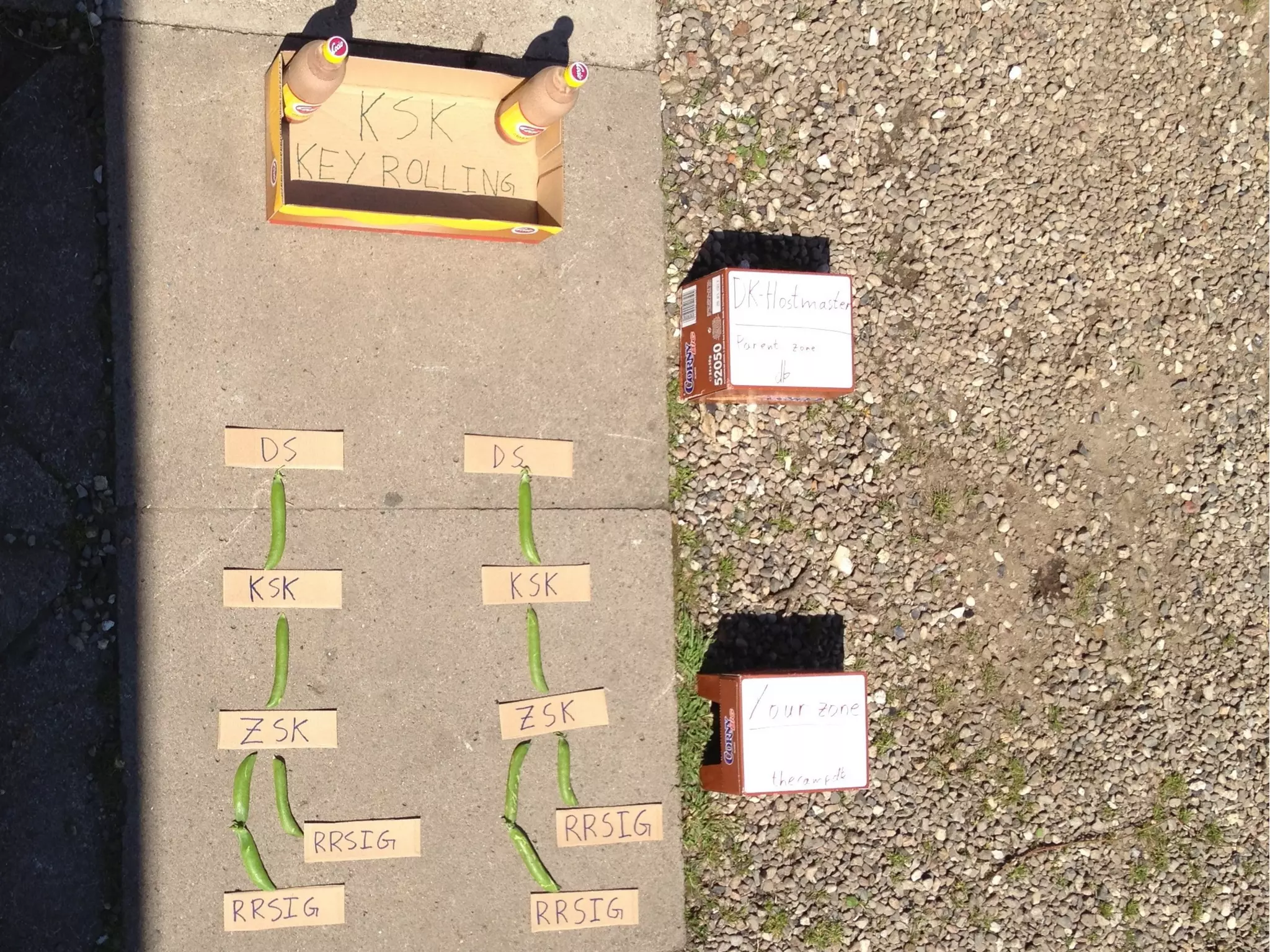
●   Key rolling/rollover is the process of switching
    keys
●   Complicated – you don't want to do it by hand
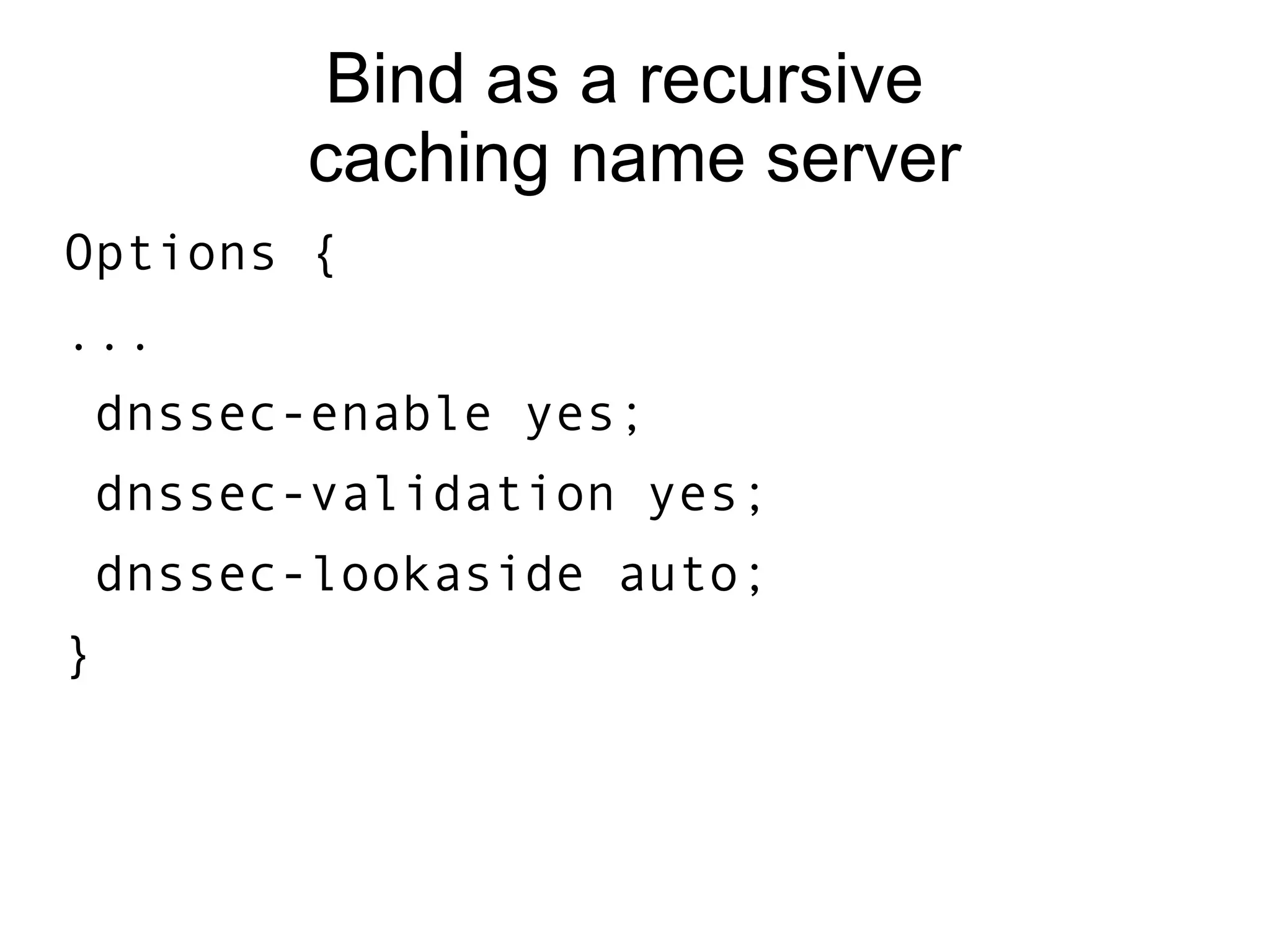
Bind as a recursive
       caching name server
Options {
...
dnssec-enable yes;
dnssec-validation yes;
dnssec-lookaside auto;
}
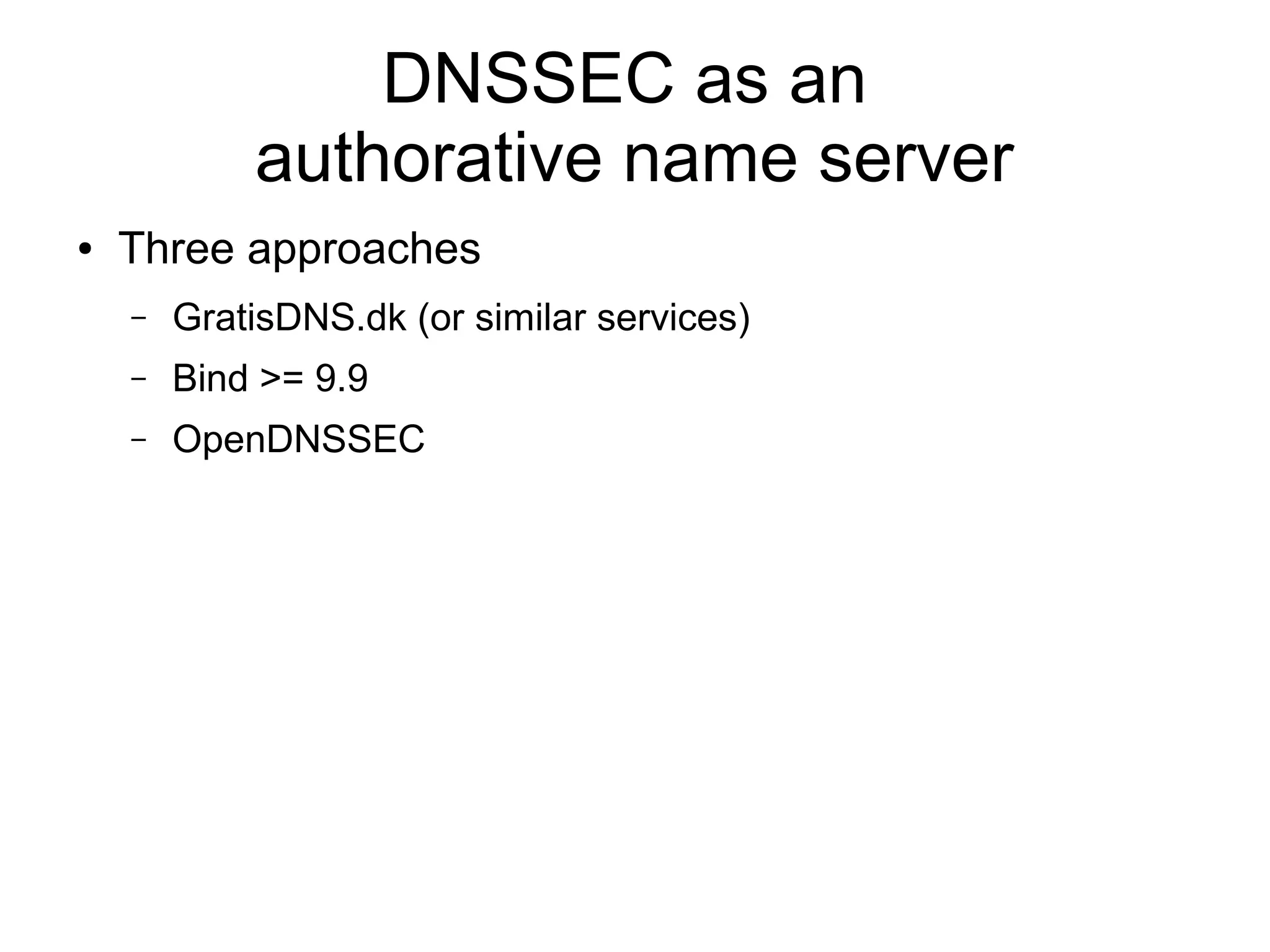
DNSSEC as an
            authorative name server
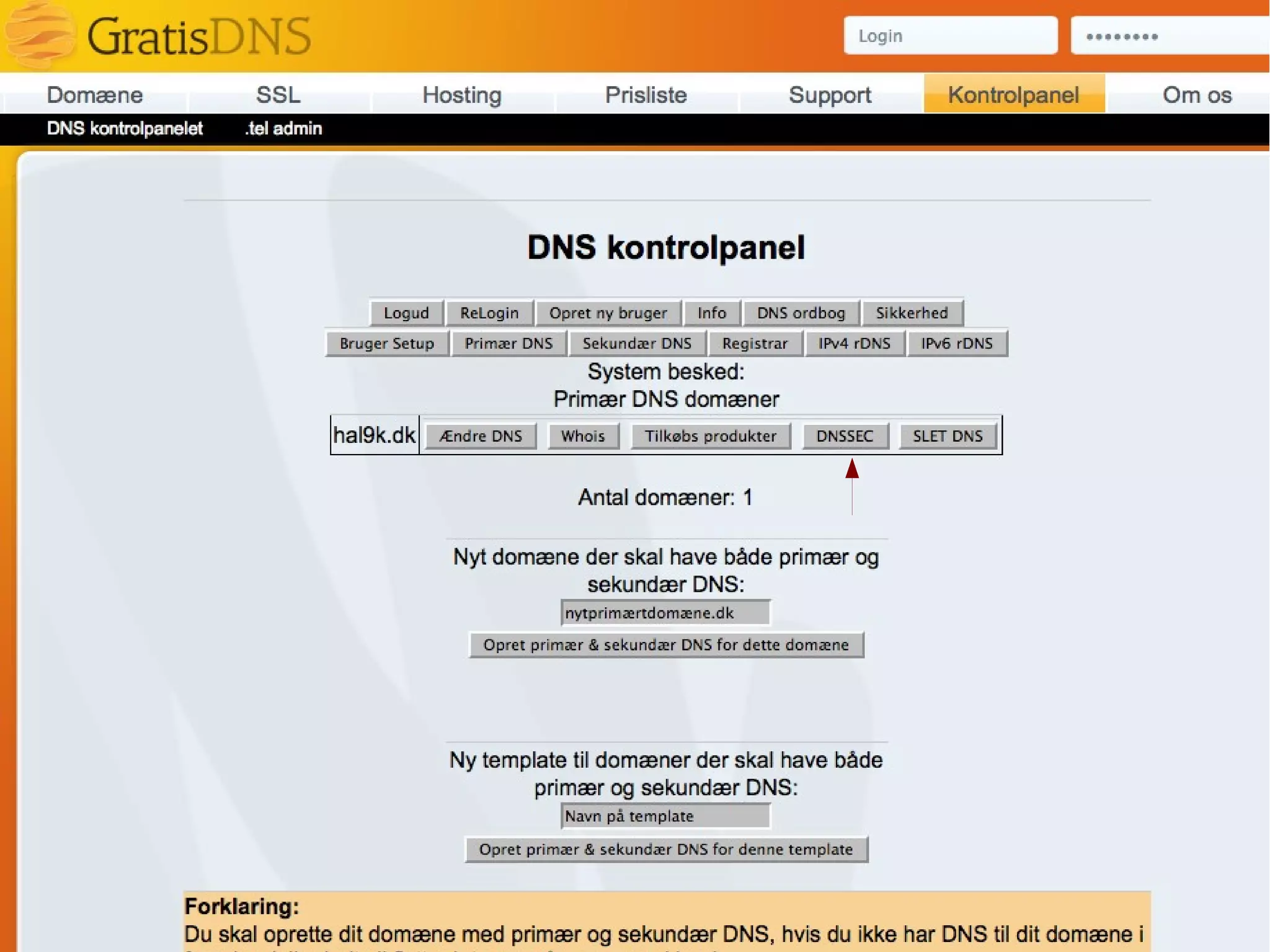
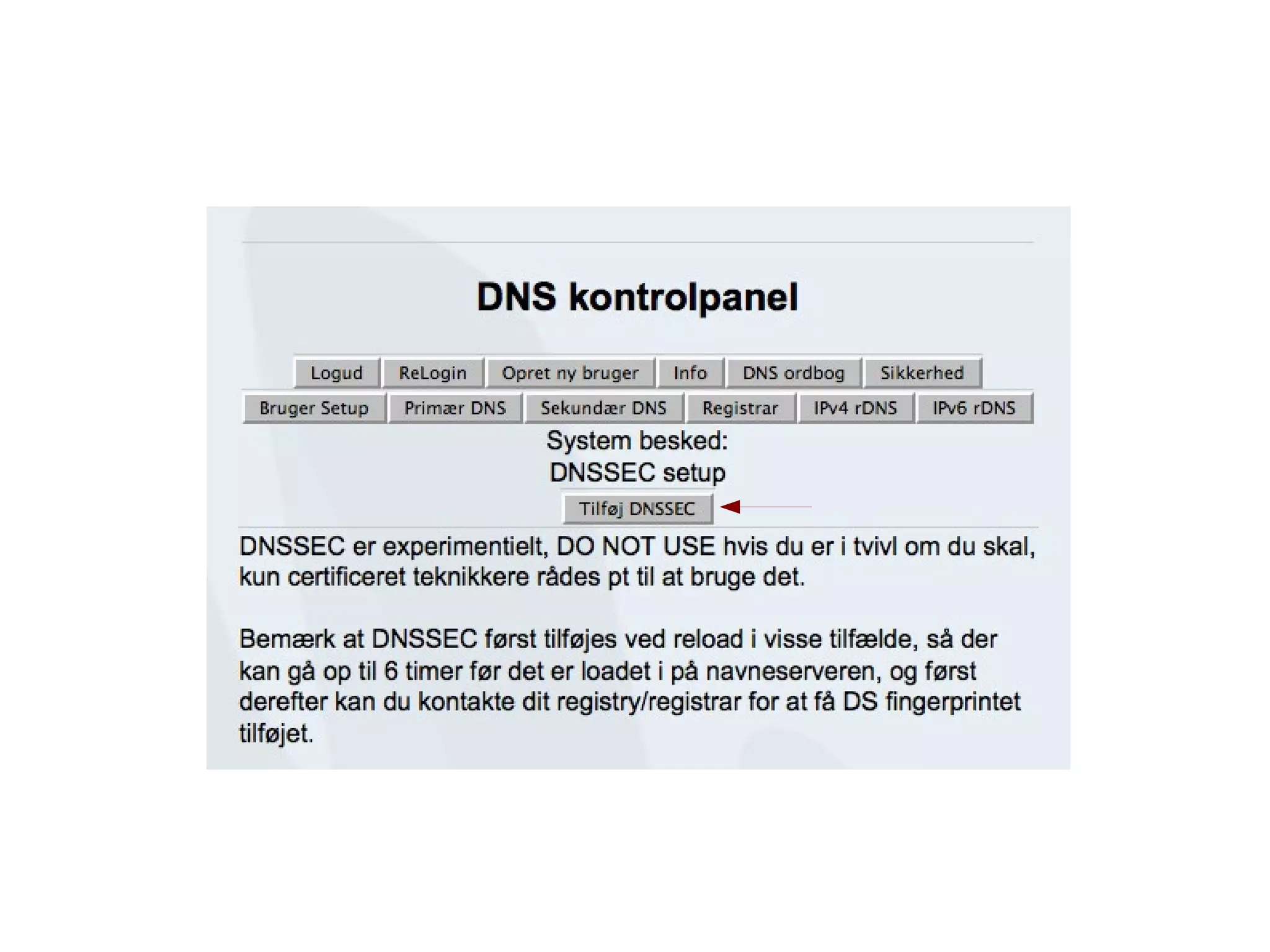
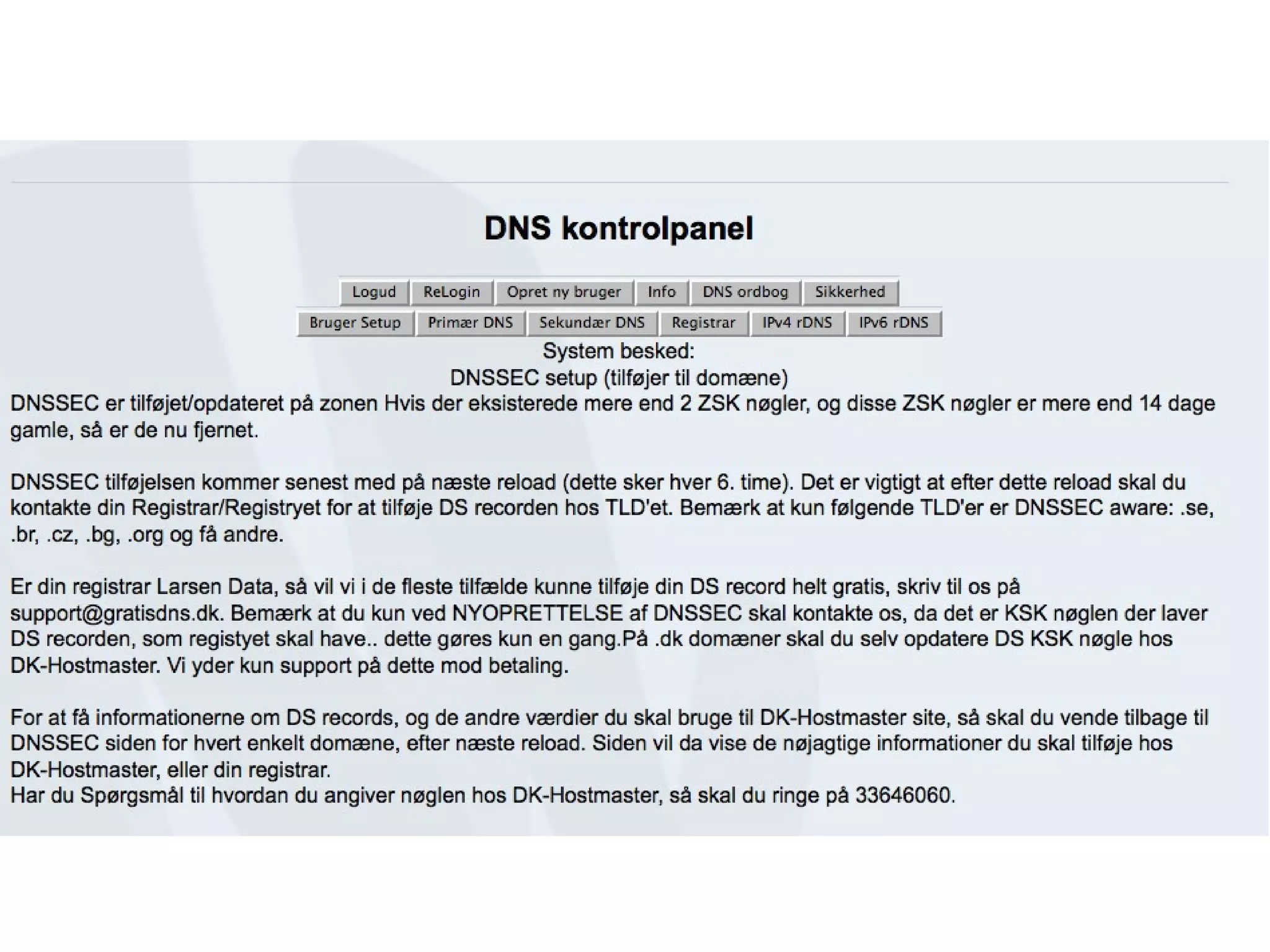
●   Three approaches
    –   GratisDNS.dk (or similar services)
    –   Bind >= 9.9
    –   OpenDNSSEC
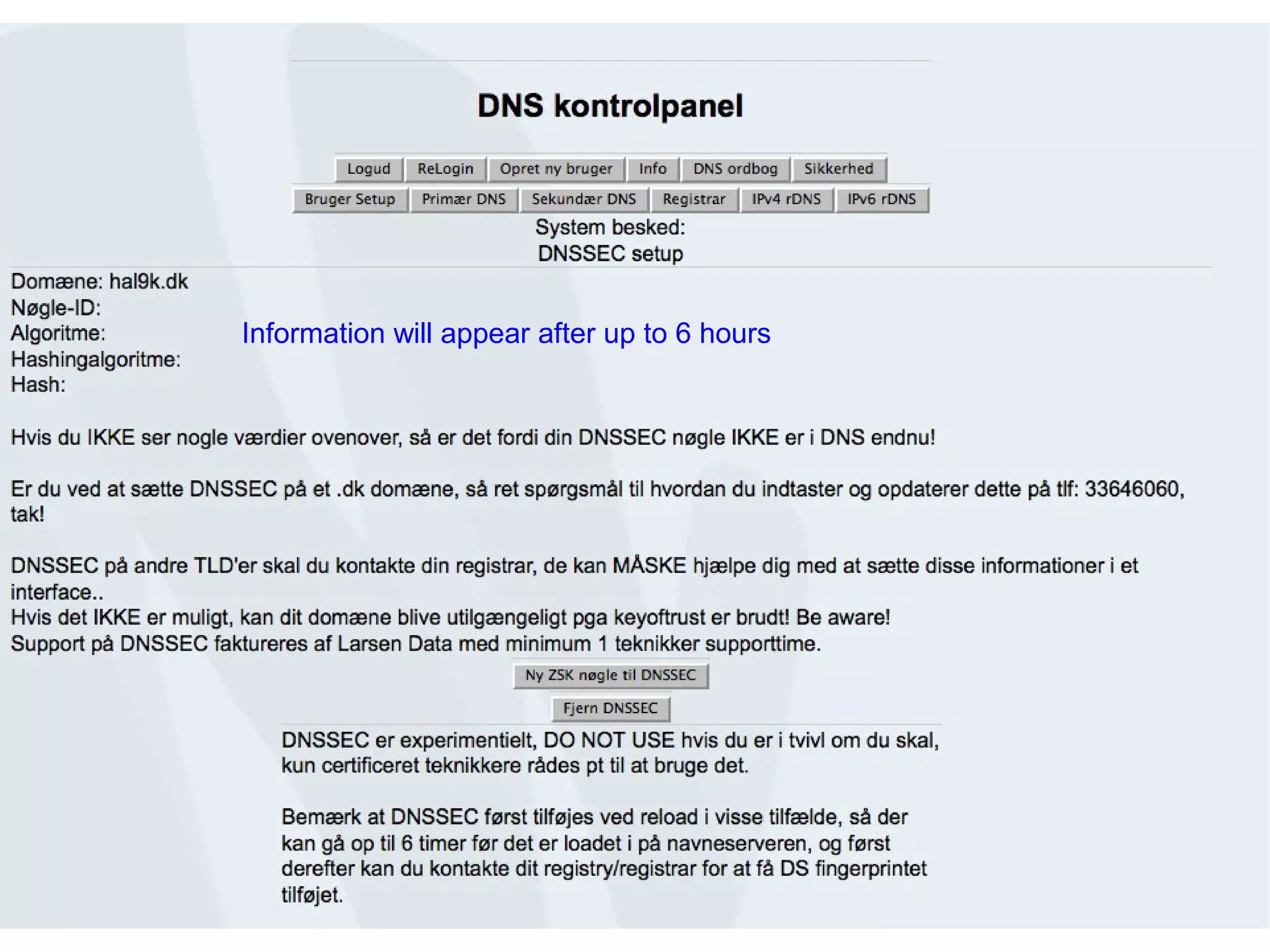
GratisDNS
Information will appear after up to 6 hours
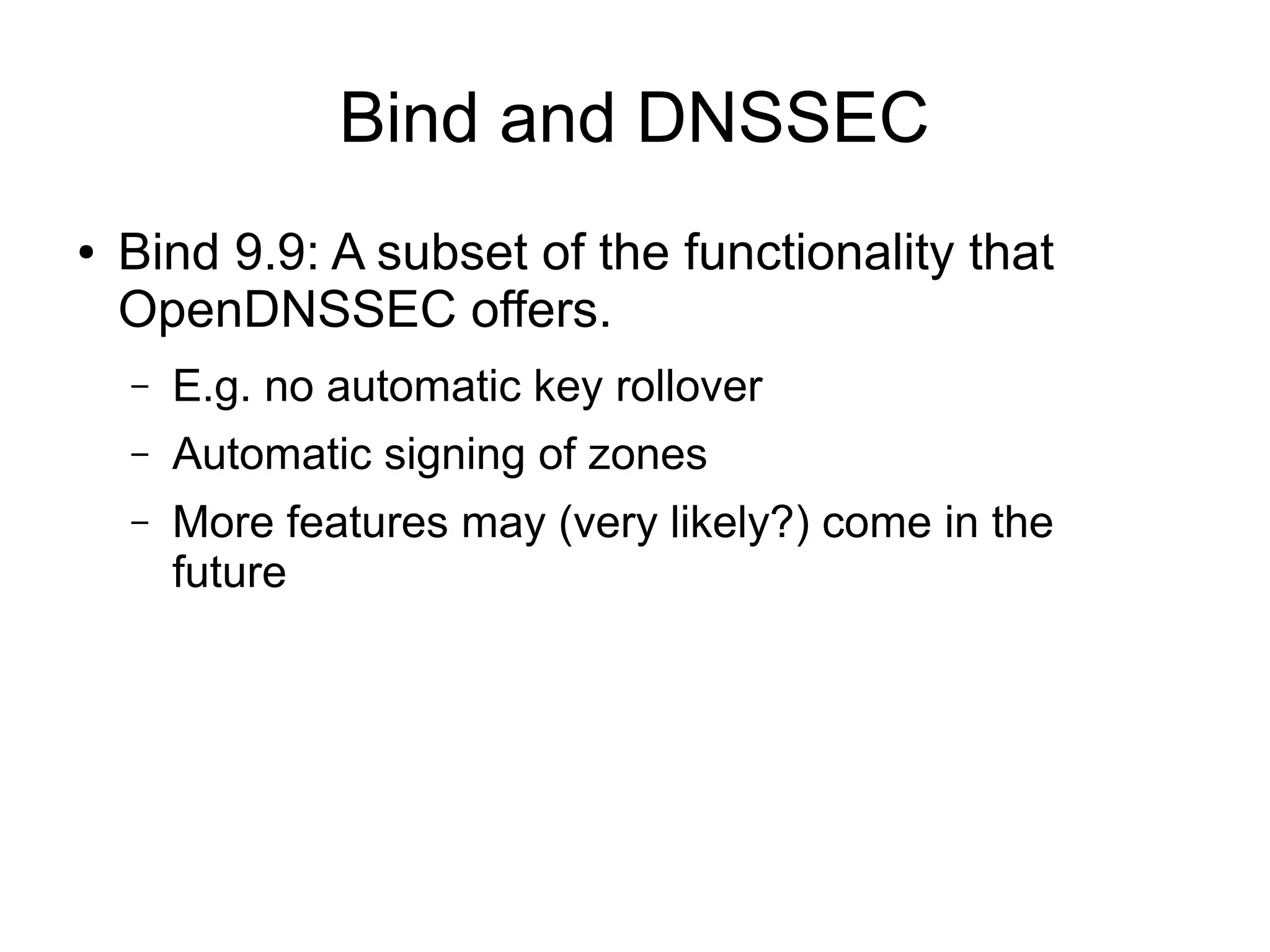
Bind and DNSSEC
●   Bind 9.9: A subset of the functionality that
    OpenDNSSEC offers.
    –   E.g. no automatic key rollover
    –   Automatic signing of zones
    –   More features may (very likely?) come in the
        future
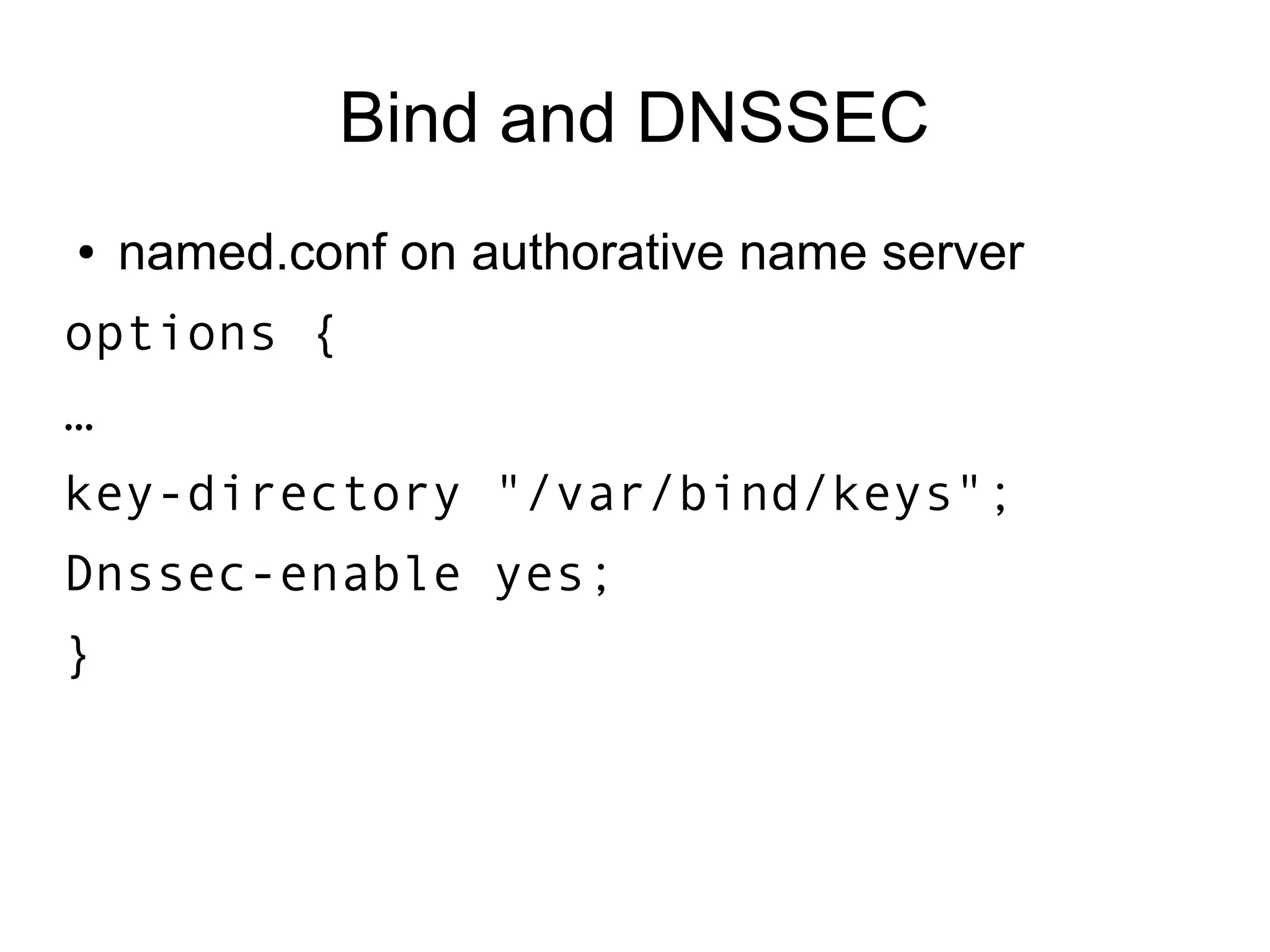
Bind and DNSSEC
●   named.conf on authorative name server
options {
…
key-directory "/var/bind/keys";
Dnssec-enable yes;
}
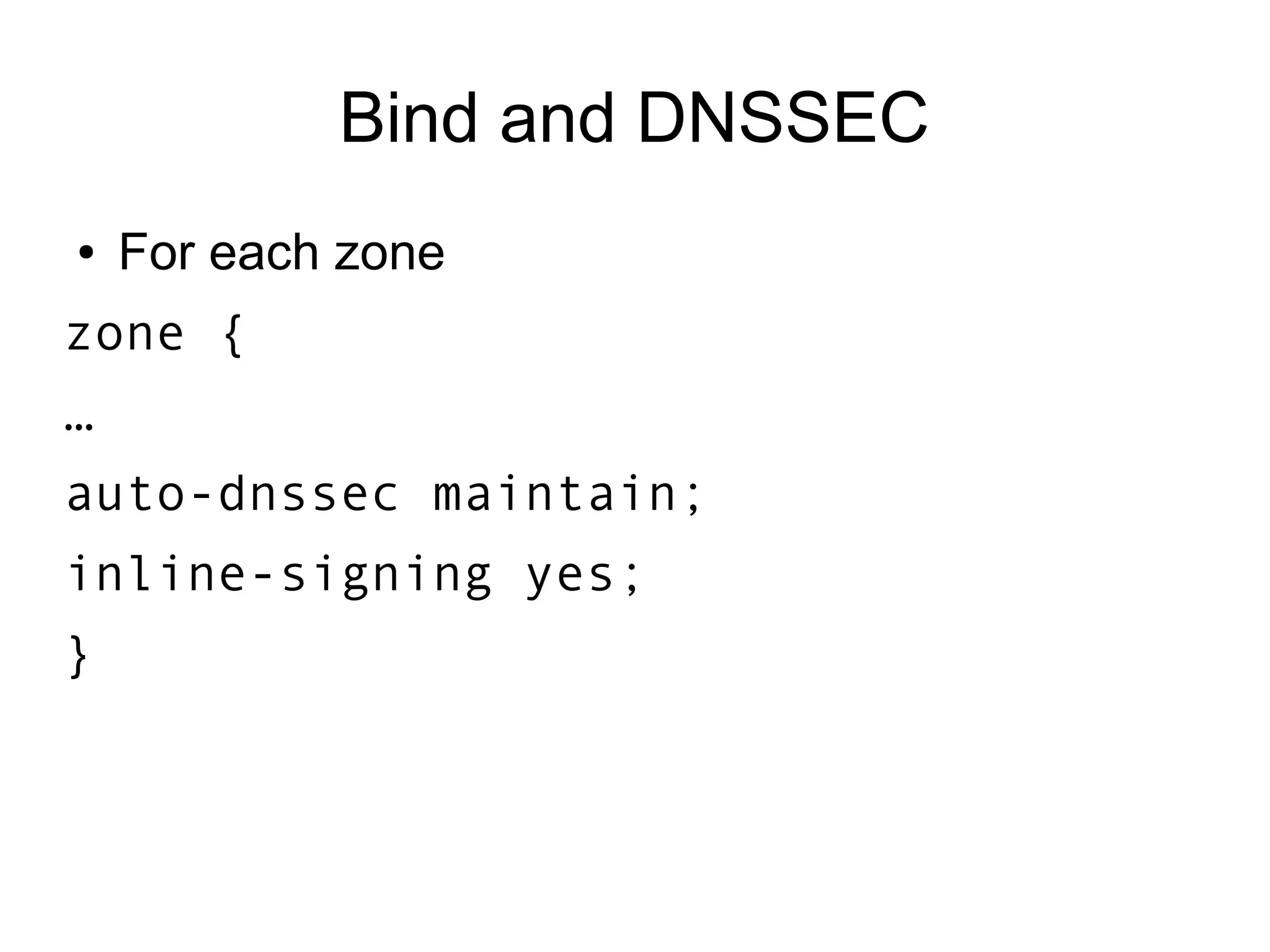
Bind and DNSSEC
●   For each zone
zone {
…
auto-dnssec maintain;
inline-signing yes;
}
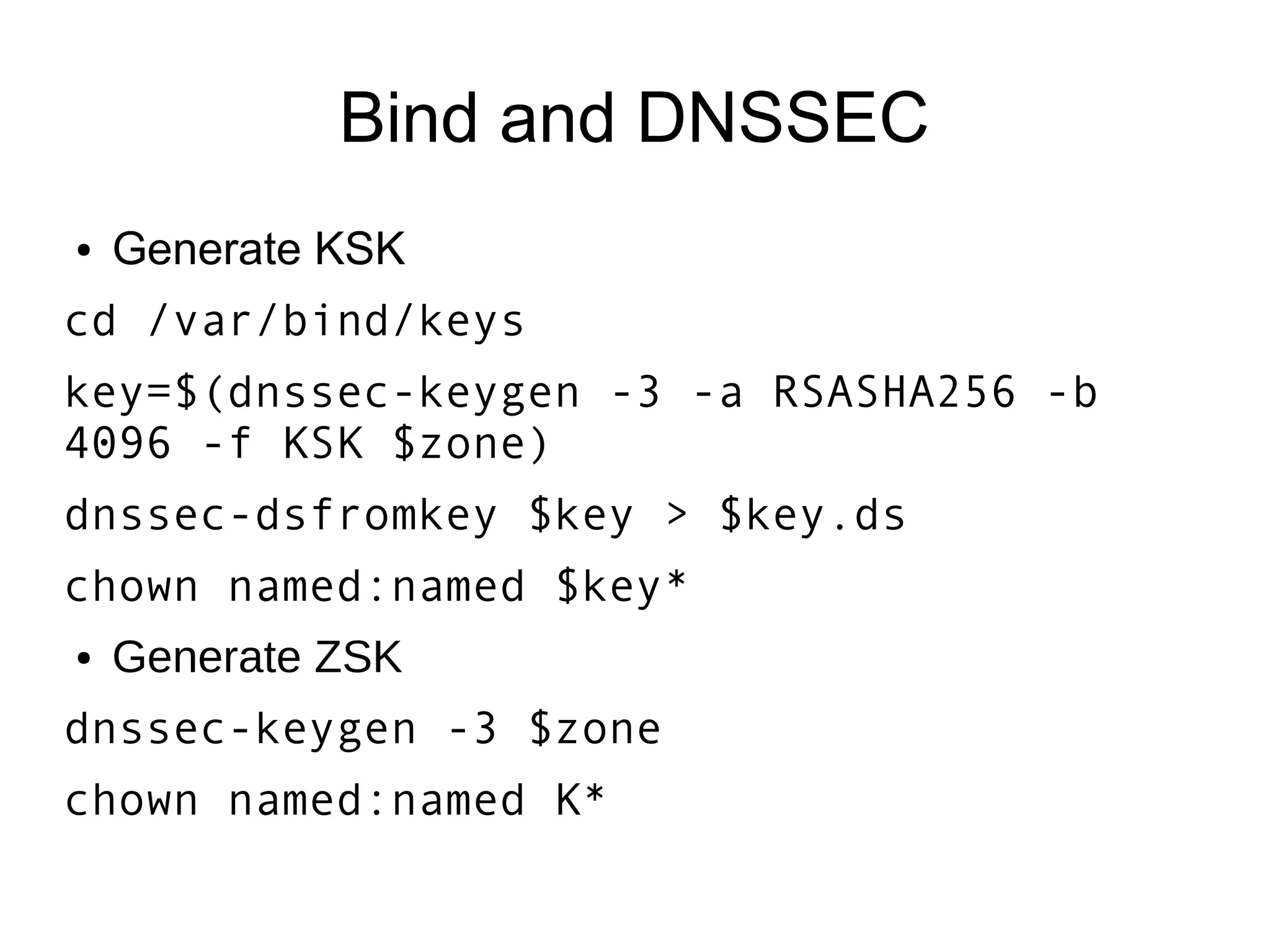
Bind and DNSSEC
●   Generate KSK
cd /var/bind/keys
key=$(dnssec-keygen -3 -a RSASHA256 -b
4096 -f KSK $zone)
dnssec-dsfromkey $key > $key.ds
chown named:named $key*
●   Generate ZSK
dnssec-keygen -3 $zone
chown named:named K*
Bind and DNSSEC
●   Upload to parent
    –   dnssec-dsfromkey $keyfile
●   Key rollover
Bind and DNSSEC
●   That was way to easy and not feature rich
    enough, so lets move on to OpenDNSSEC :-)
OpenDNSSEC
●   What is OpenDNSSEC
●   Why OpenDNSSEC
●   Architecture
●   Configuration
●   Manual upload of keys to parent
●   Validator
●   HSM's (Hardware Security Module)
What is OpenDNSSEC


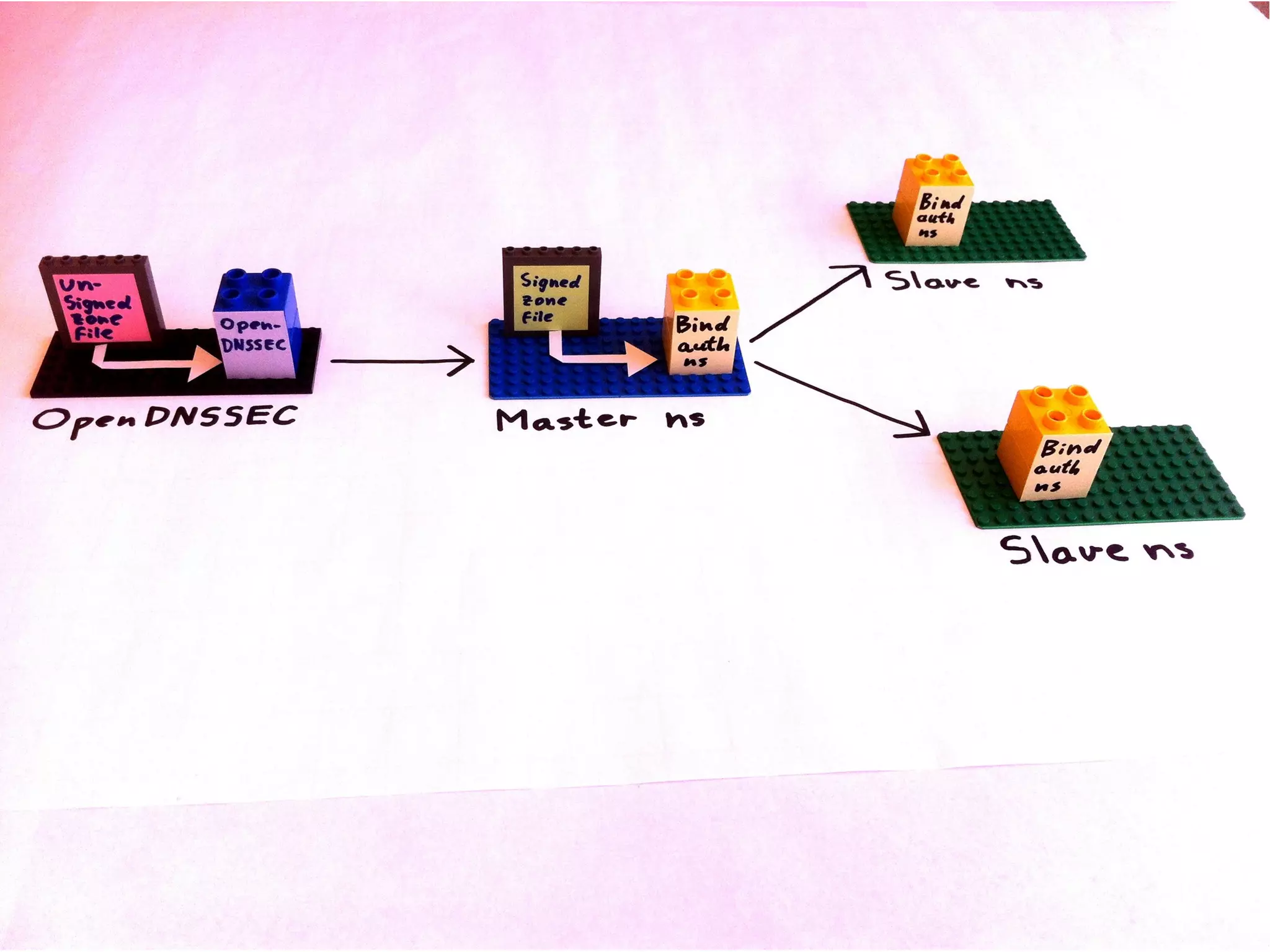
● OpenDNSSEC maintains the signing of your
zones.
● It is not a name server

● Used by .se, .dk, .nl and .co.uk registries

● Originally a .se registry project but is now

backed by, among other, the above registries.
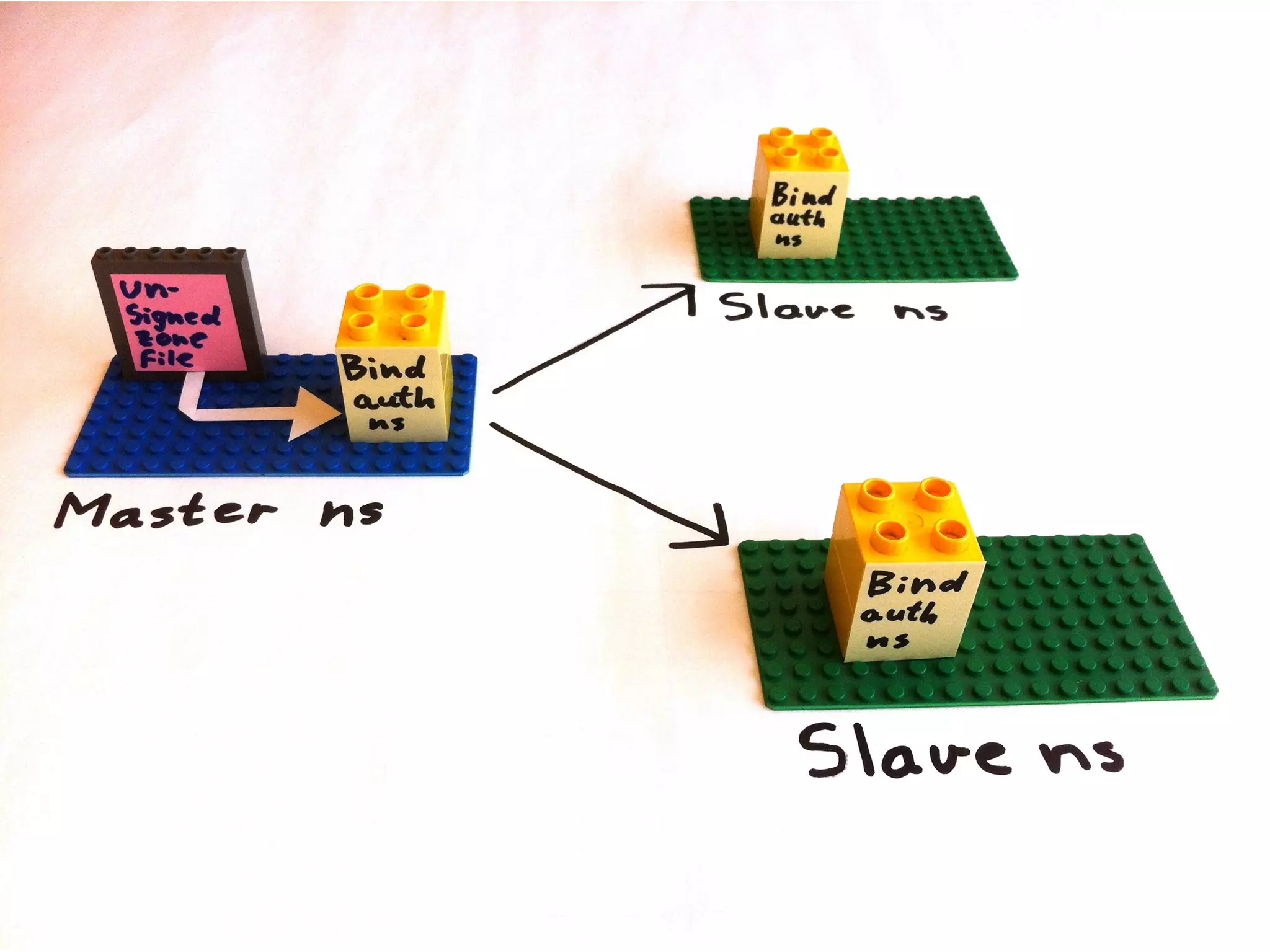
Before DNSSEC
Introducing OpenDNSSEC
Why OpenDNSSEC
●   Using Bind's tools does not take care of rolling
    keys (KSK, ZSK)
●   OpenDNSSEC automating the process of
    keeping track of DNSSEC keys and the signing of
    zones
●   Communication to parent zone (e.g. epp-client)
●   Scalability (multiple threads, multiple HSM's)
●   Security (HSM)
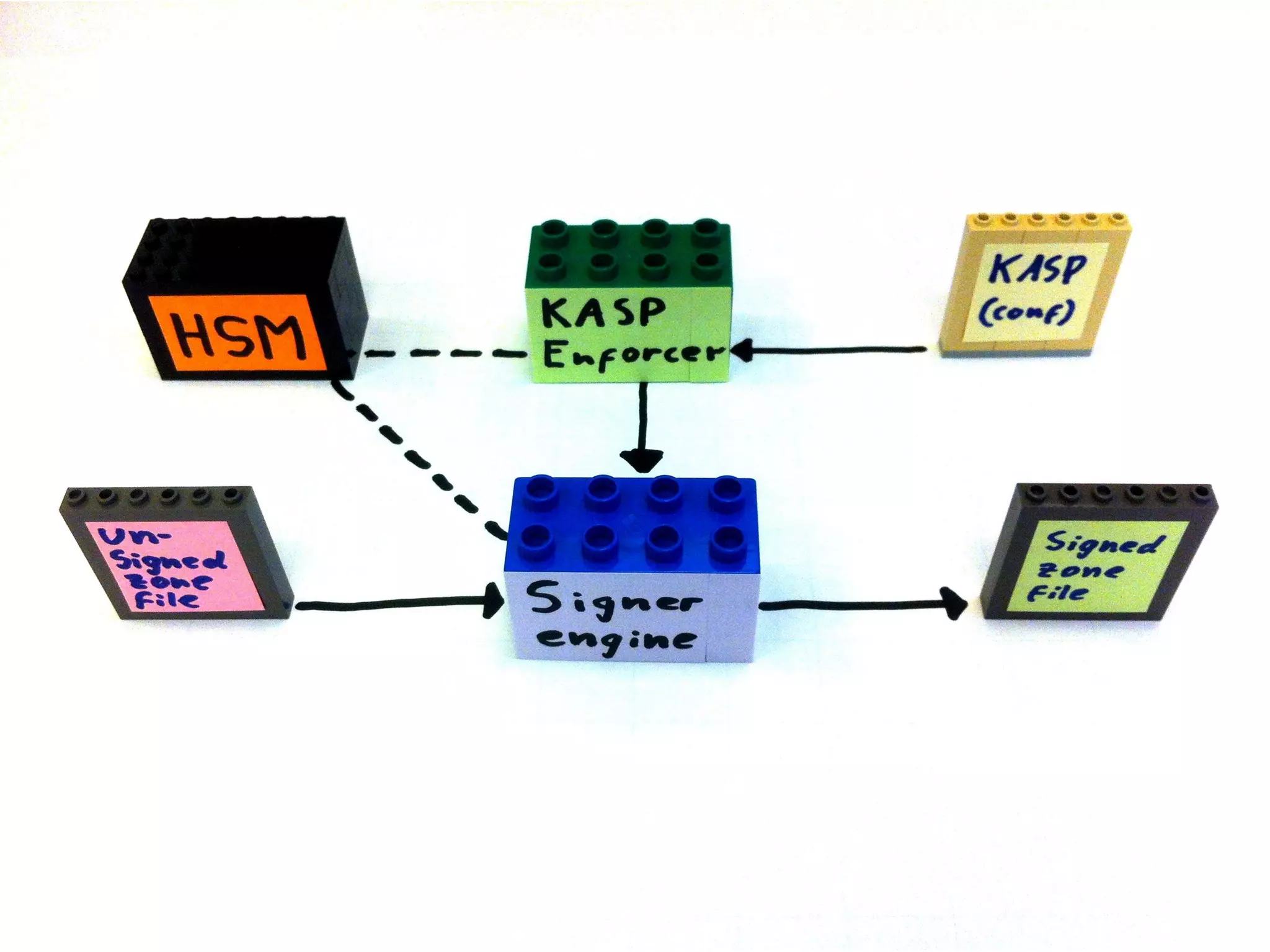
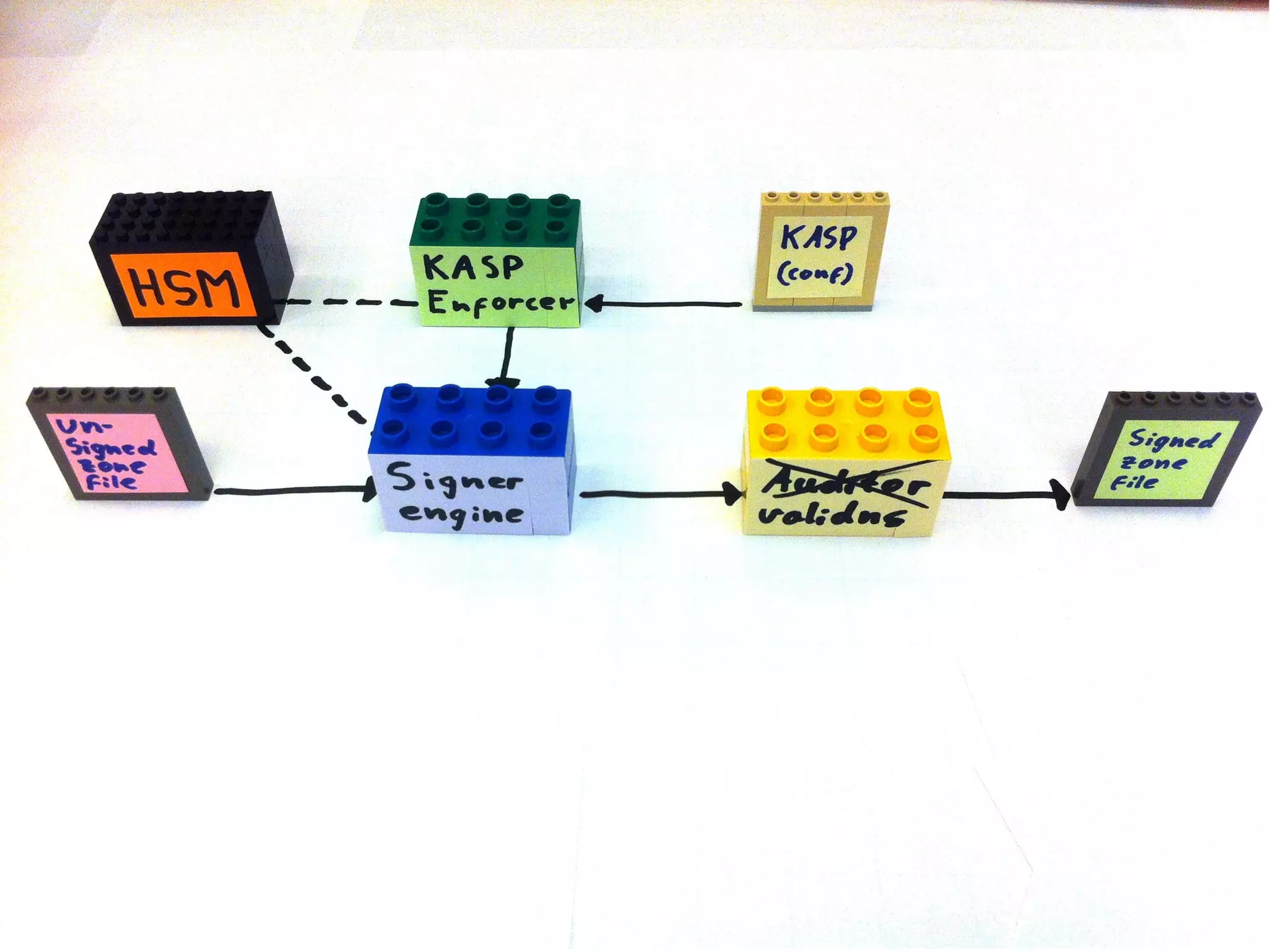
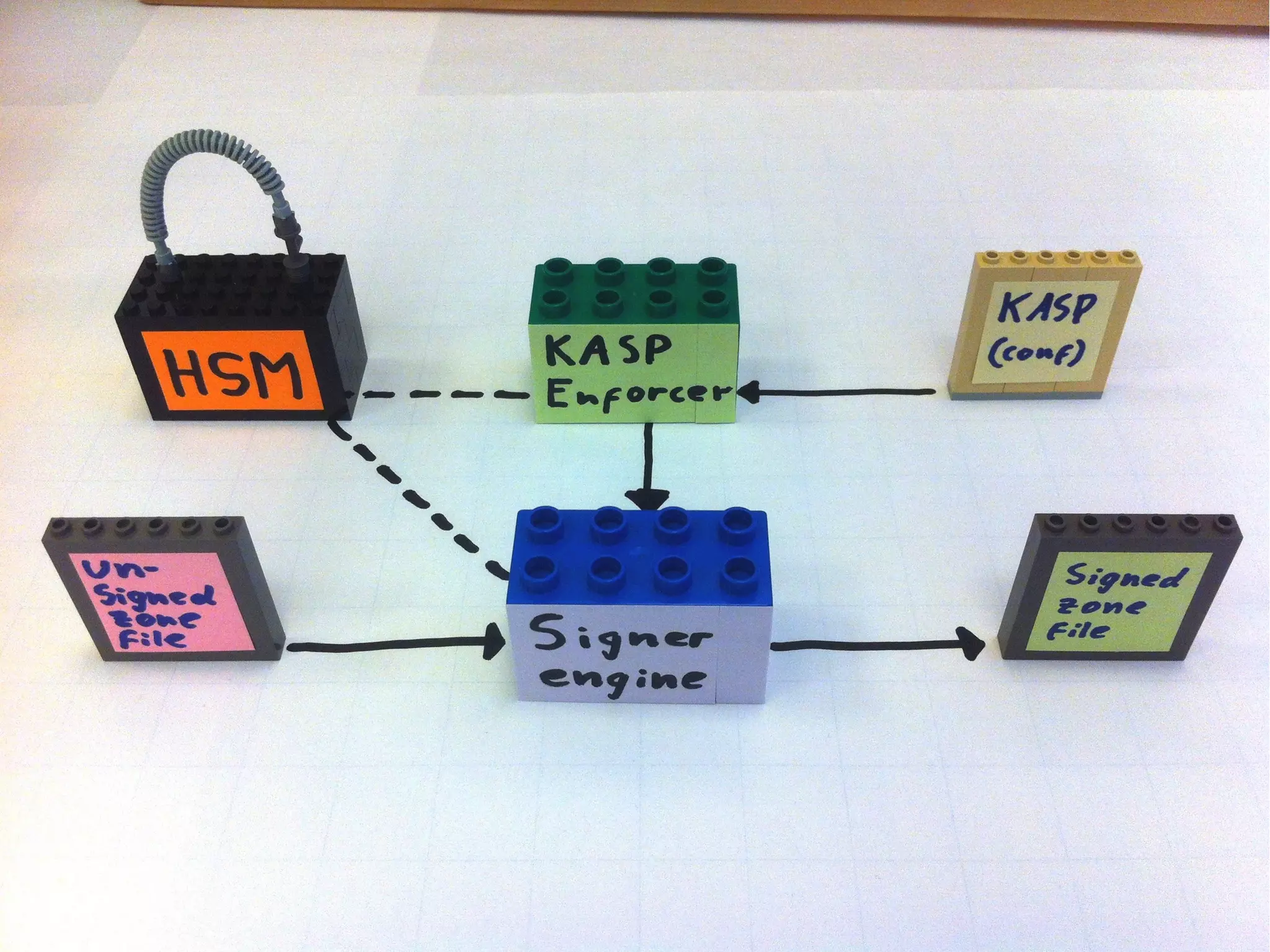
OpenDNSSEC architecture
***ENFORCER***


Key and Signature Policy
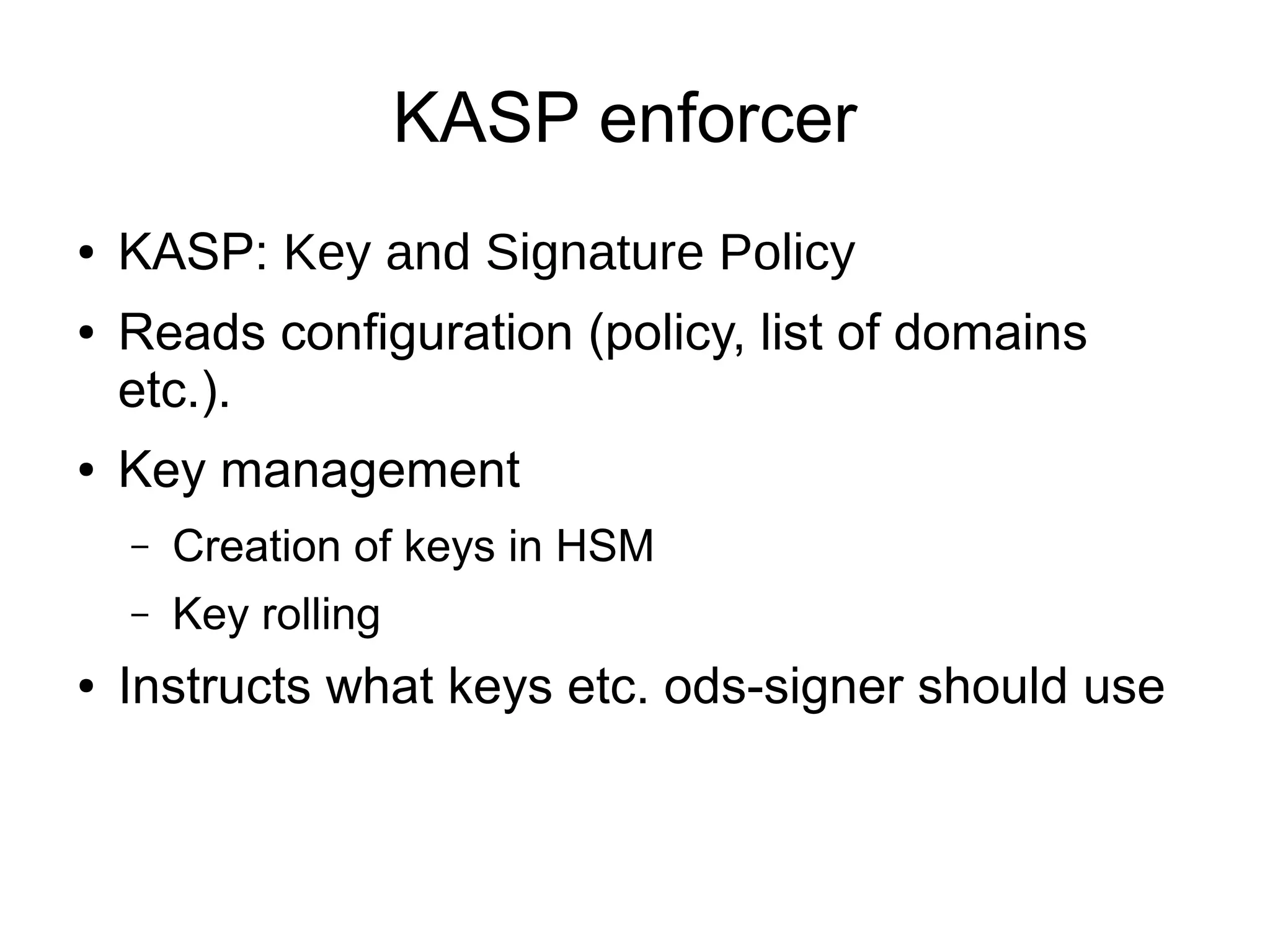
KASP enforcer
●   KASP: Key and Signature Policy
●   Reads configuration (policy, list of domains
    etc.).
●   Key management
    –   Creation of keys in HSM
    –   Key rolling
●   Instructs what keys etc. ods-signer should use
Key rolling
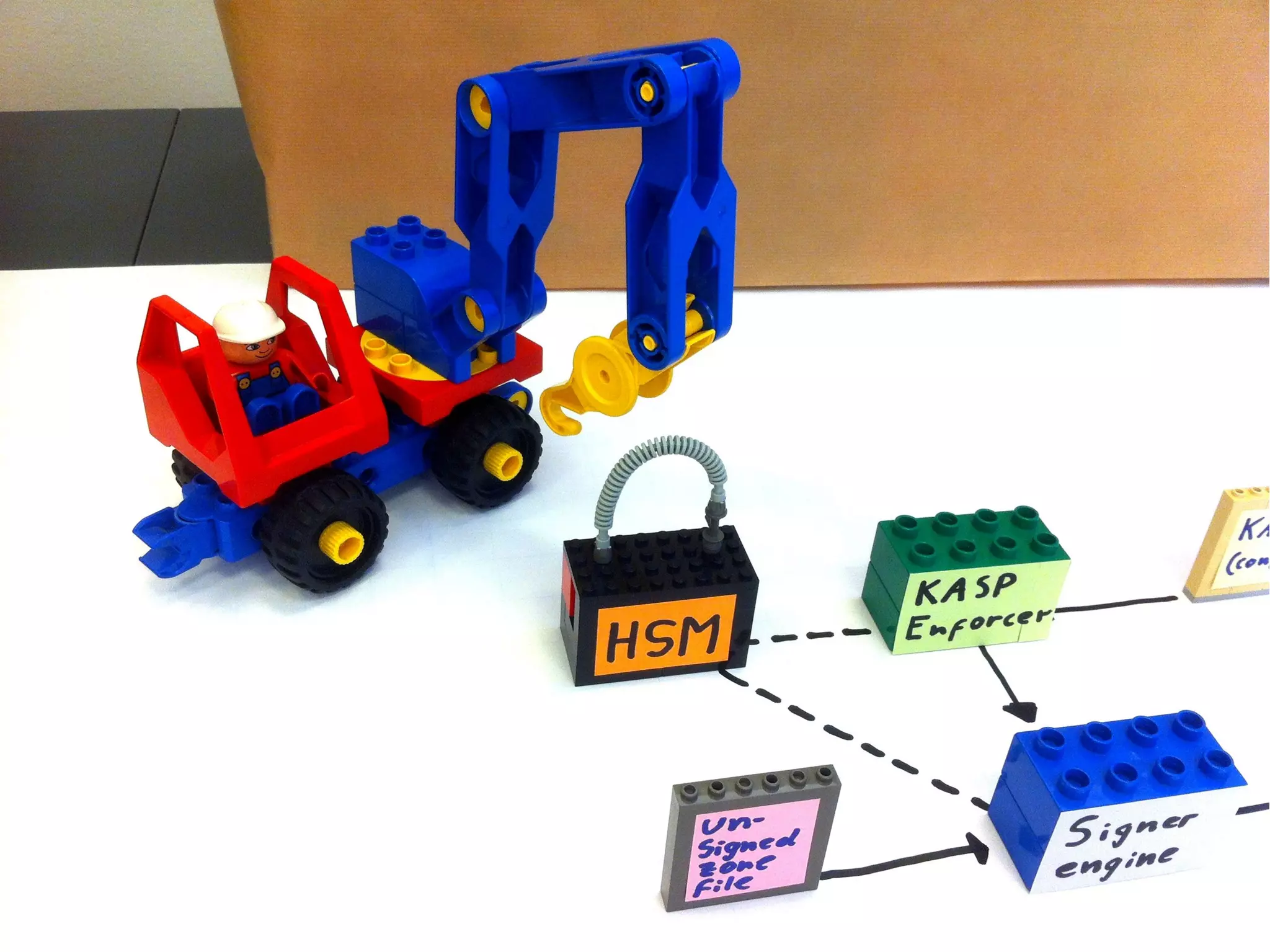
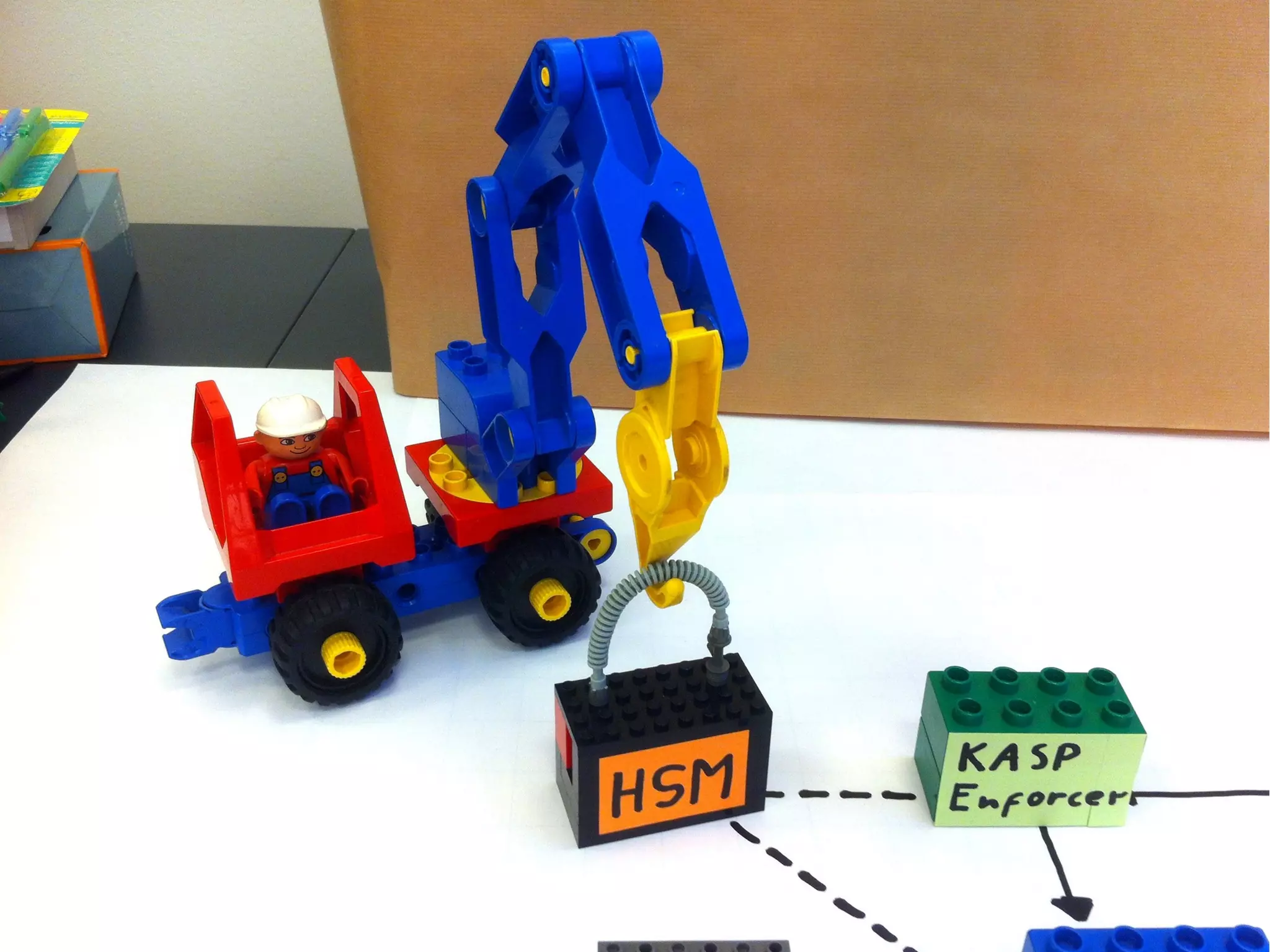
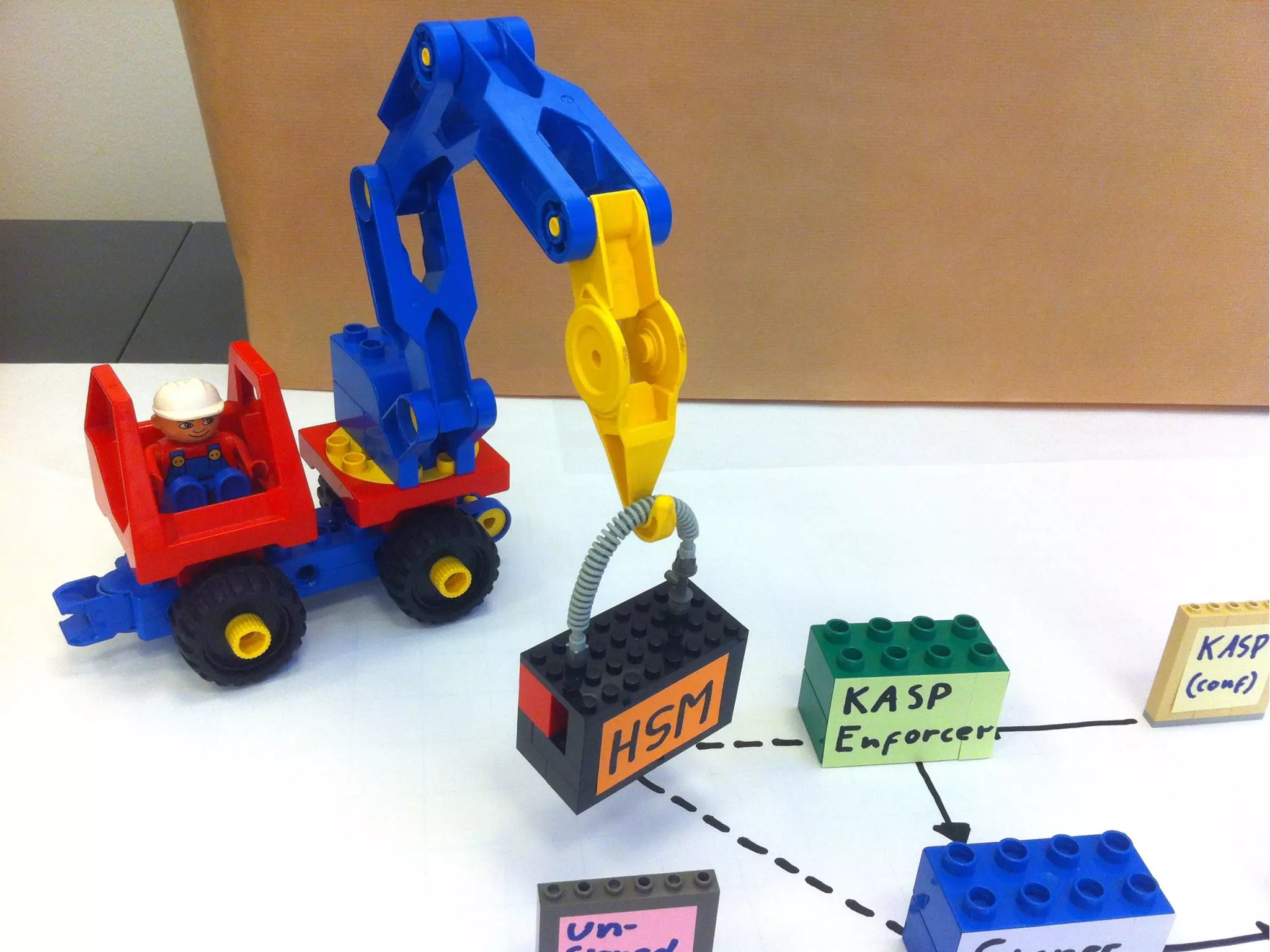
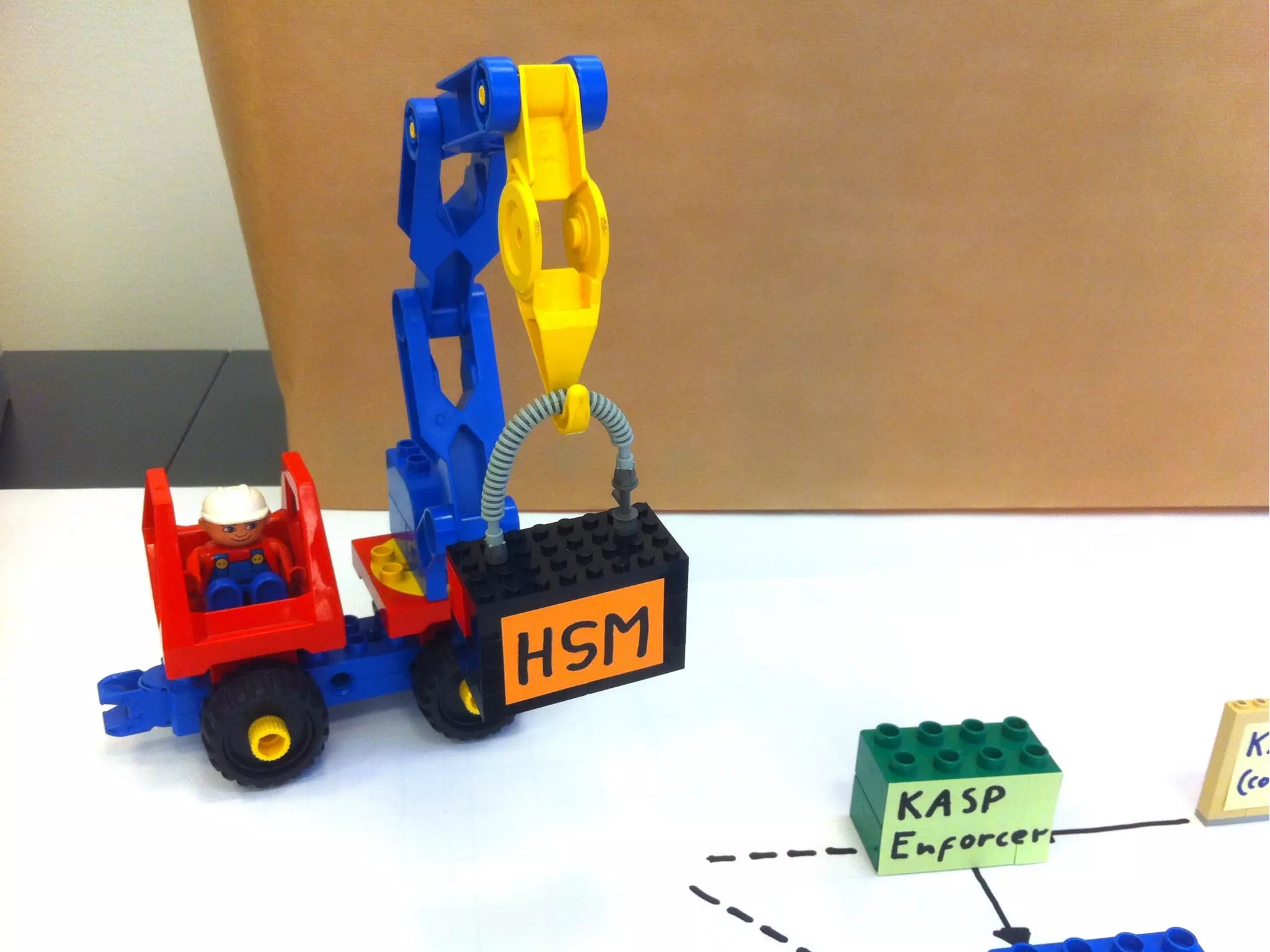
HSM
●   Hardware Security Module
    –   Stores and generates keys
    –   Signs records
    –   Hardware accellerated signing and key generation
●   PKCS#11 interface
●   SoftHSM
    –   No hardware required
    –   Simple configuration
    –   Developed for OpenDNSSEC
    –   Not as über secure as some hardware based HSM's
Configuration files
●   conf.xml
    –   Overall configuration
●   kasp.xml
    –   Key and signature policy
●   zonefetch.xml
    –   Optional: Receive zones via AXFR
●   zonelist.xml
    –   List of zones, how to fetch and publish them and a
        pointer to policy in kasp.xml. Maintained by
        OpenDNSSEC, but manual editing is possible.
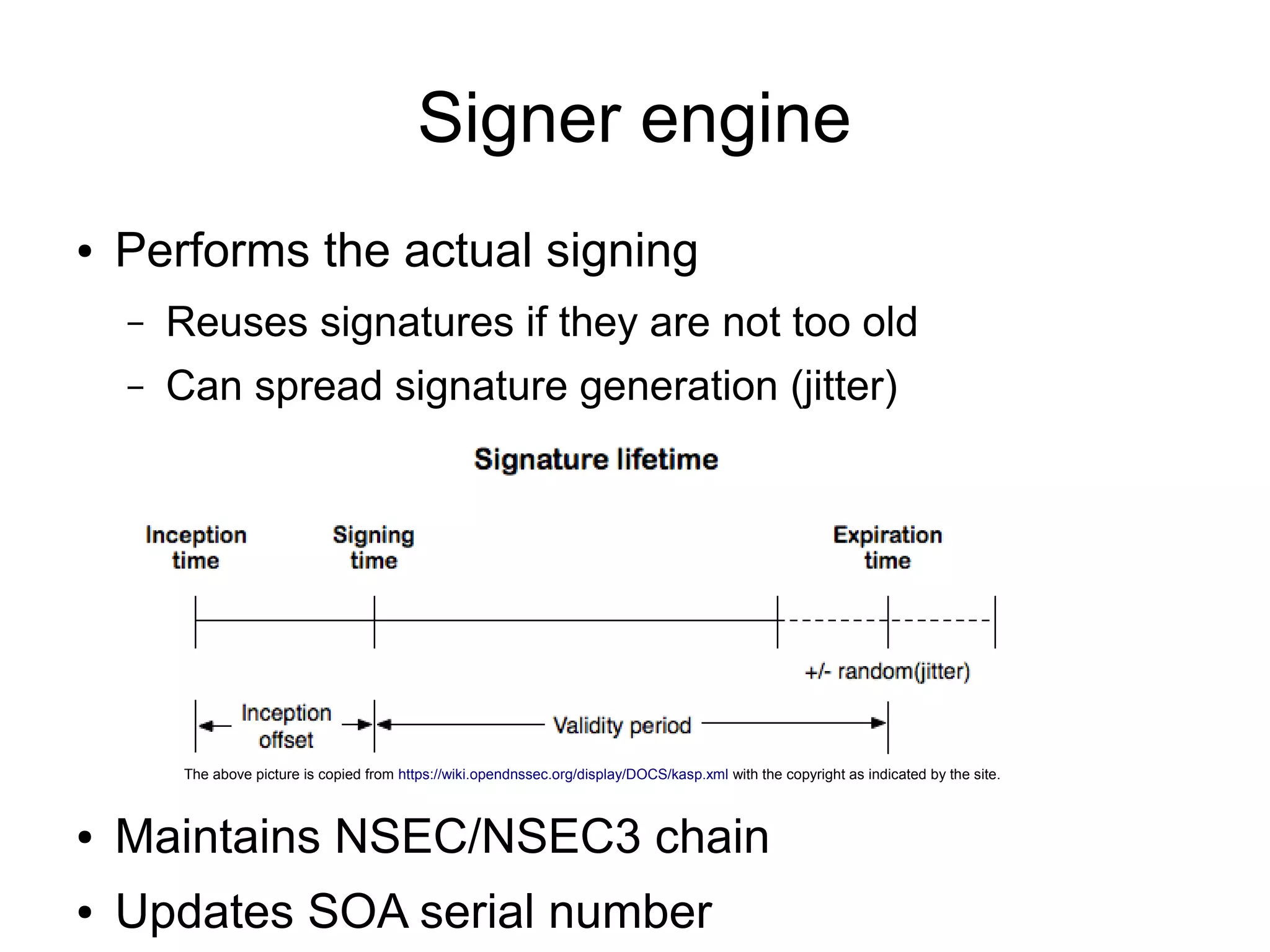
Signer engine
●   Performs the actual signing
    –   Reuses signatures if they are not too old
    –   Can spread signature generation (jitter)


         The above picture is copied from https://wiki.opendnssec.org/display/DOCS/kasp.xml with the copyright as indicated by the site.


●   Maintains NSEC/NSEC3 chain
●   Updates SOA serial number
Bind
●   named.conf
    –   dnssec-enable yes;
●   Restart bind
●   Configure firewall to accept 4096 Byte UDP-
    packets on port 53 due to EDNS0.
Installing and running
                 OpenDNSSEC
●   Lets jump to the wiki
    –   Will be put online together with the video as a .pdf
OpenDNSSEC Roadmap
●   From verison 1.4 the KASP auditor is obsolete
    –   We will show an example with validns
●   Version 2.0: Support for passing through
    unsigned zones
●   My wishlist:
    –   Support for split horizon
        ●   https://issues.opendnssec.org/browse/OPENDNSSEC-232
        ●   “Please feel free to vote on this and add comments.”
Manual upload of DS to parent
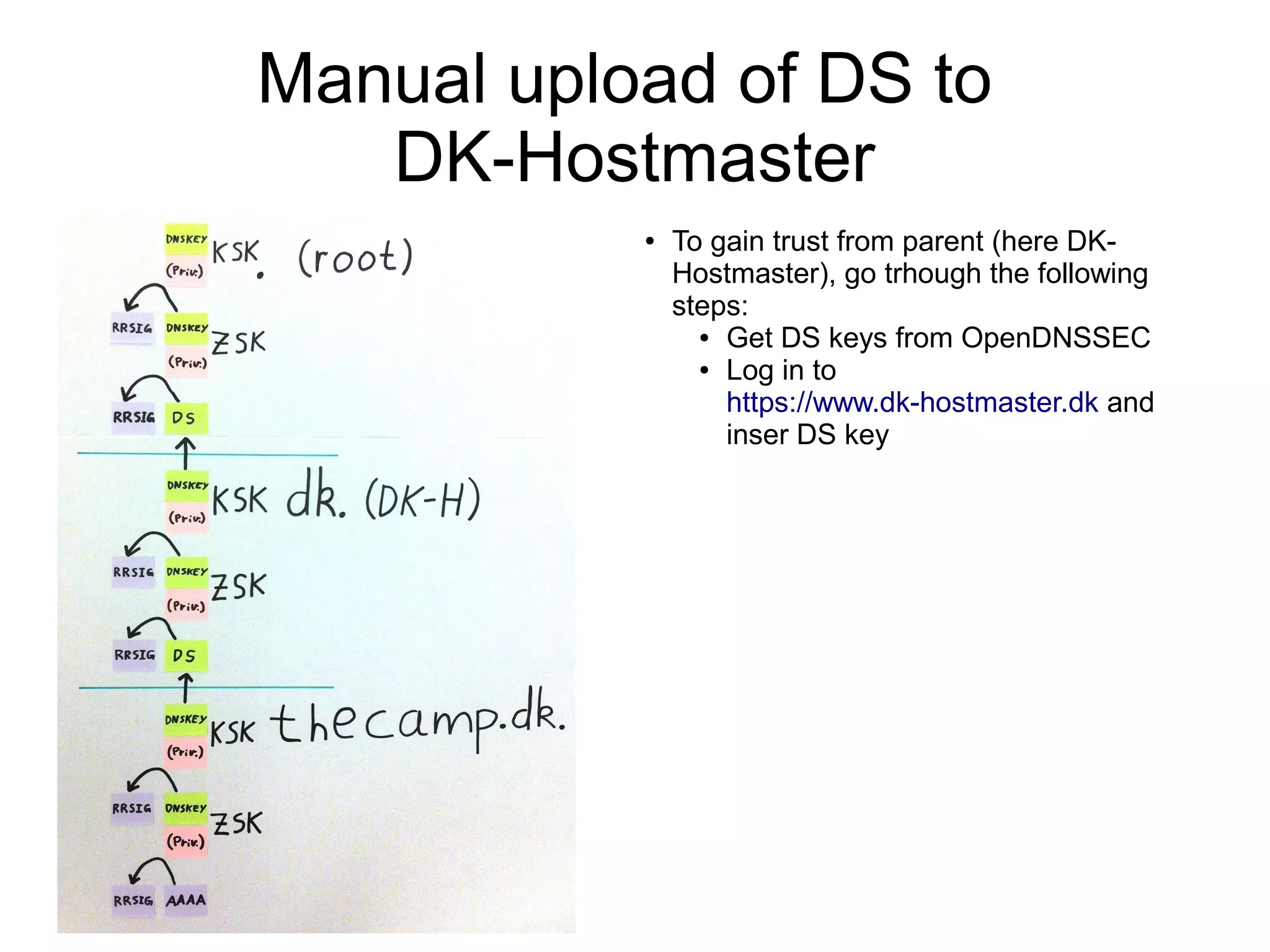
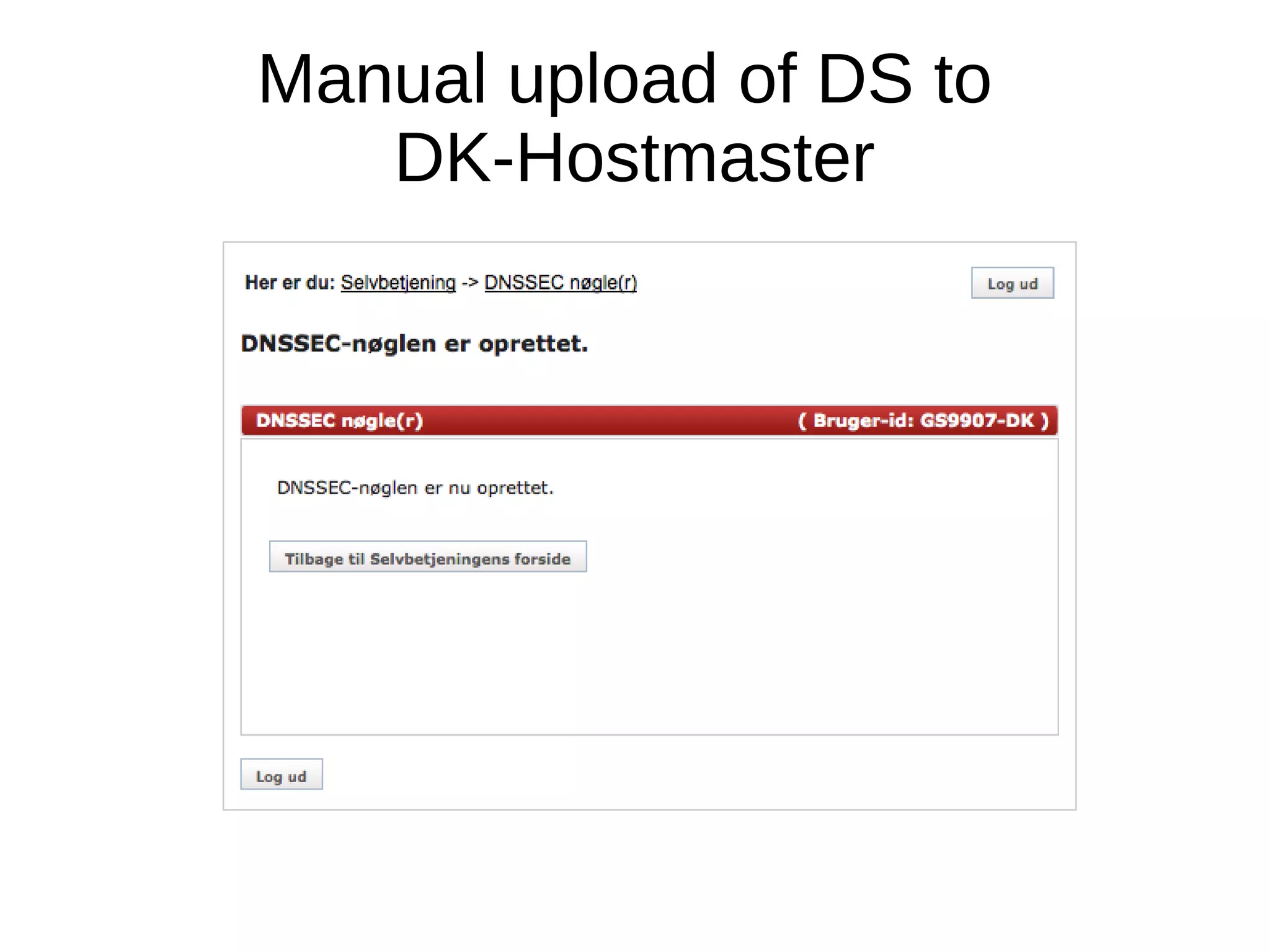
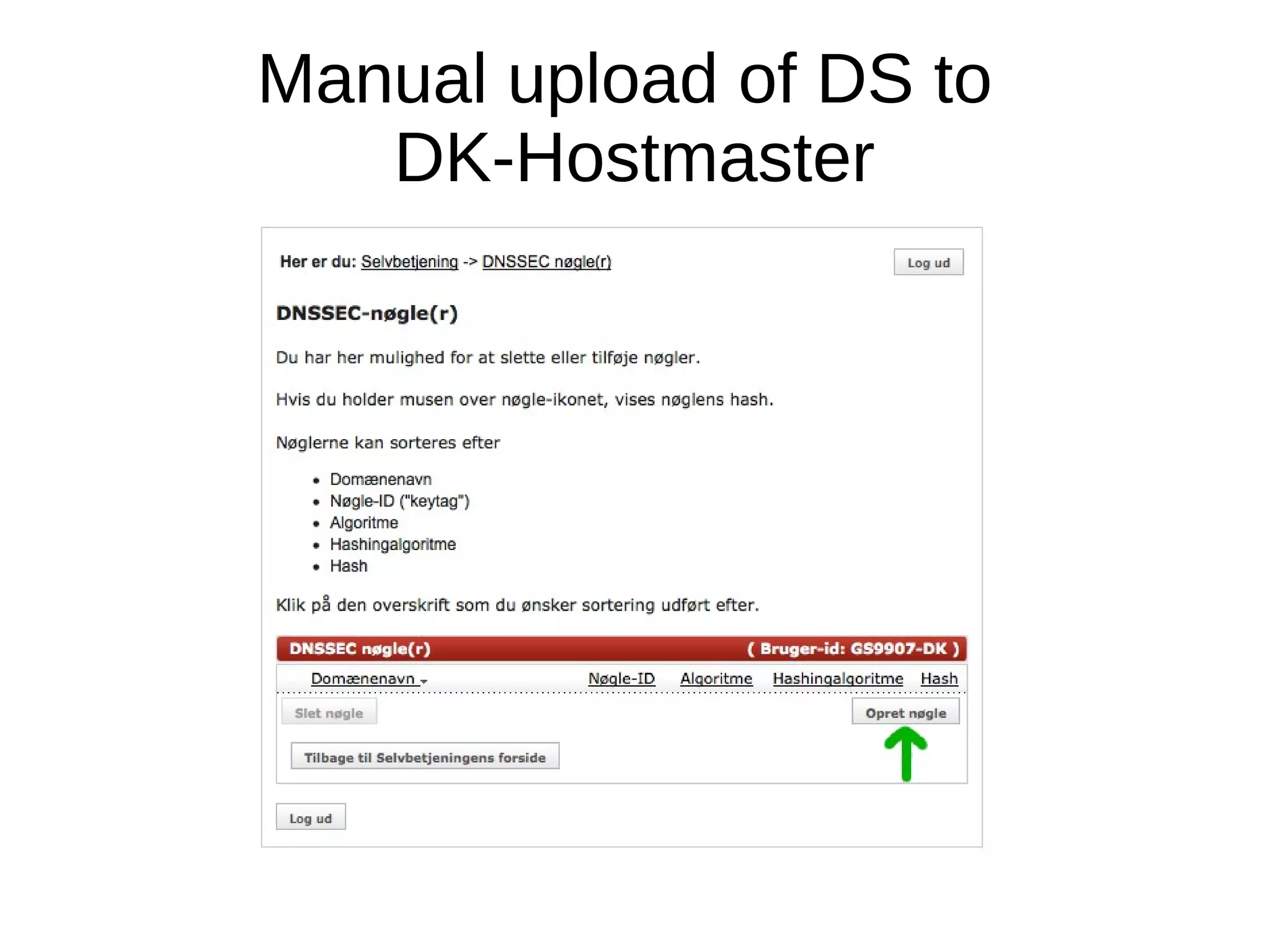
Manual upload of DS to
   DK-Hostmaster
           ●   To gain trust from parent (here DK-
               Hostmaster), go trhough the following
               steps:
                 ● Get DS keys from OpenDNSSEC

                 ● Log in to

                   https://www.dk-hostmaster.dk and
                   inser DS key
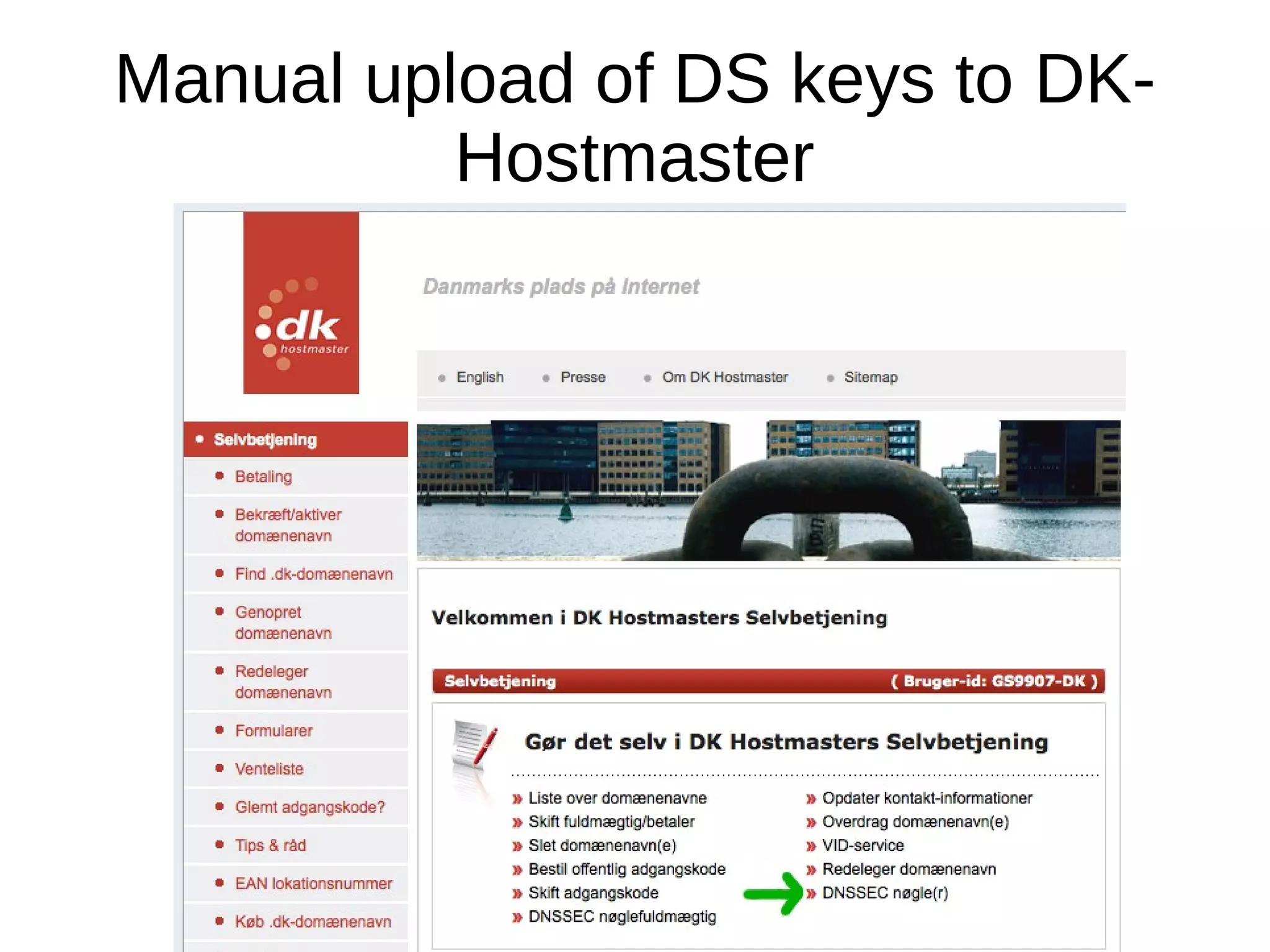
Manual upload of DS keys to DK-
          Hostmaster
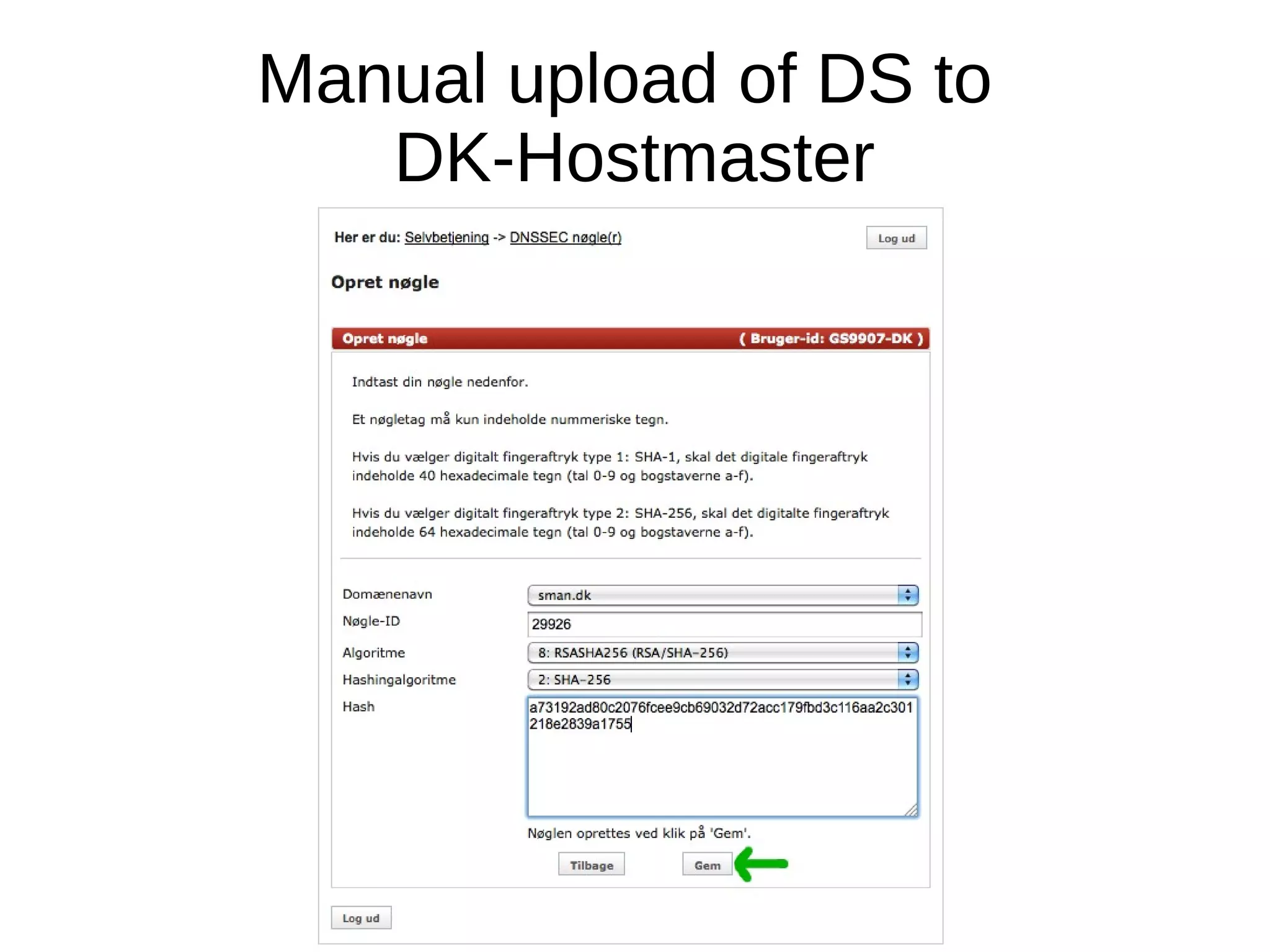
Manual upload of DS to
   DK-Hostmaster
Manual upload of DS to
   DK-Hostmaster
Manual upload of DS to
   DK-Hostmaster
Manual upload of DS to
           DK-Hostmaster
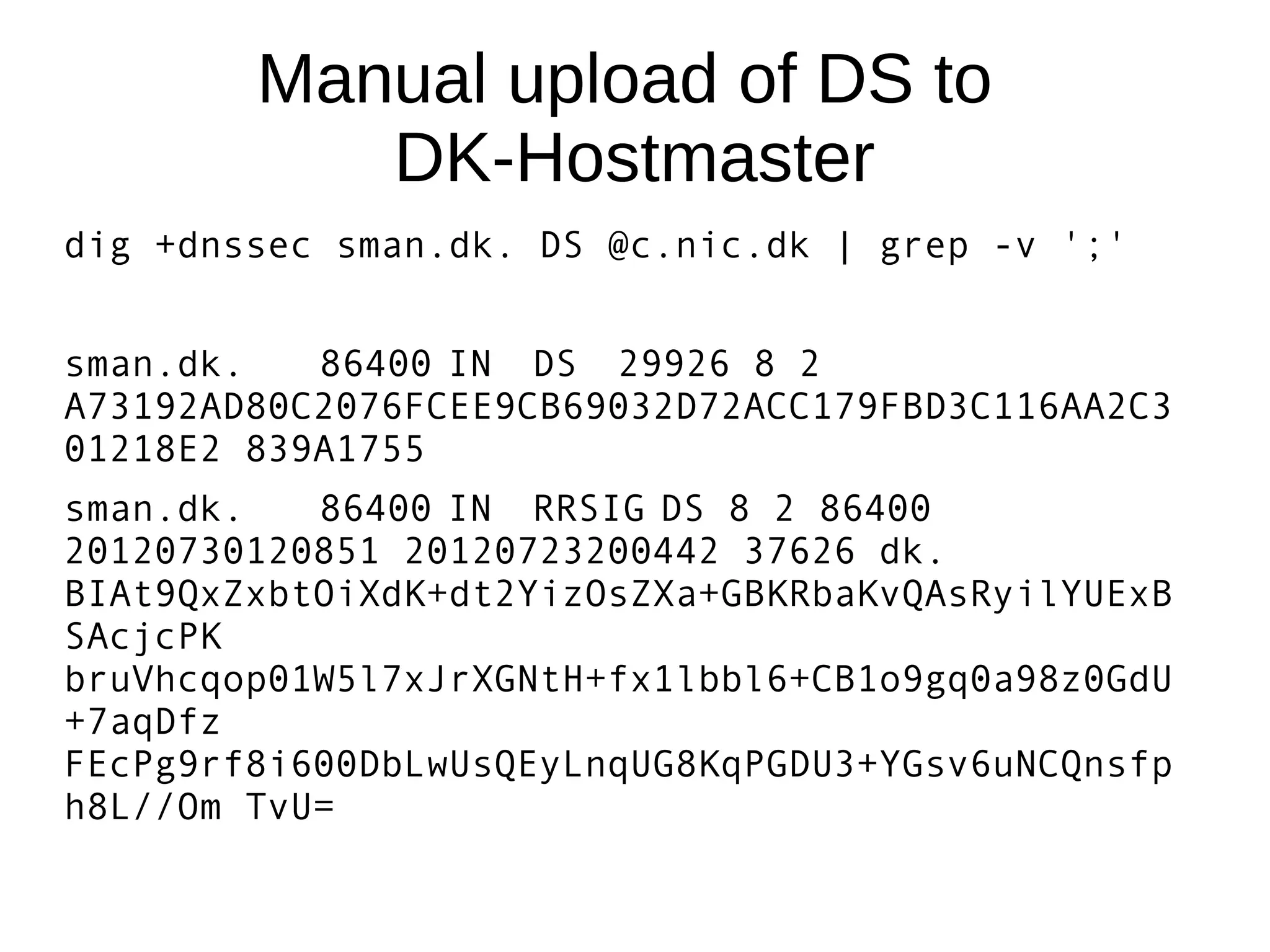
dig +dnssec sman.dk. DS @c.nic.dk | grep -v ';'


sman.dk.   86400 IN DS 29926 8 2
A73192AD80C2076FCEE9CB69032D72ACC179FBD3C116AA2C3
01218E2 839A1755
sman.dk.   86400 IN RRSIG DS 8 2 86400
20120730120851 20120723200442 37626 dk.
BIAt9QxZxbtOiXdK+dt2YizOsZXa+GBKRbaKvQAsRyilYUExB
SAcjcPK
bruVhcqop01W5l7xJrXGNtH+fx1lbbl6+CB1o9gq0a98z0GdU
+7aqDfz
FEcPg9rf8i600DbLwUsQEyLnqUG8KqPGDU3+YGsv6uNCQnsfp
h8L//Om TvU=
Validation of zone files
validns
●   http://www.validns.net
●   Used by several major DNS operators
●   Check syntax and more
●   Checks for valid DNSSEC signatures, NSEC{,3}
    chains, outdated signatures etc.
●   Not checking delegations
●   Reads local files
●   Written in C and scales well. Uses OpenSSL.
●   Similar software: See also
    http://yazvs.verisignlabs.com/
Demonstration
●   Lets have a look at a server running
    OpenDNSSEC
Let's have a closer look at
 hardware based HSM's
HSM
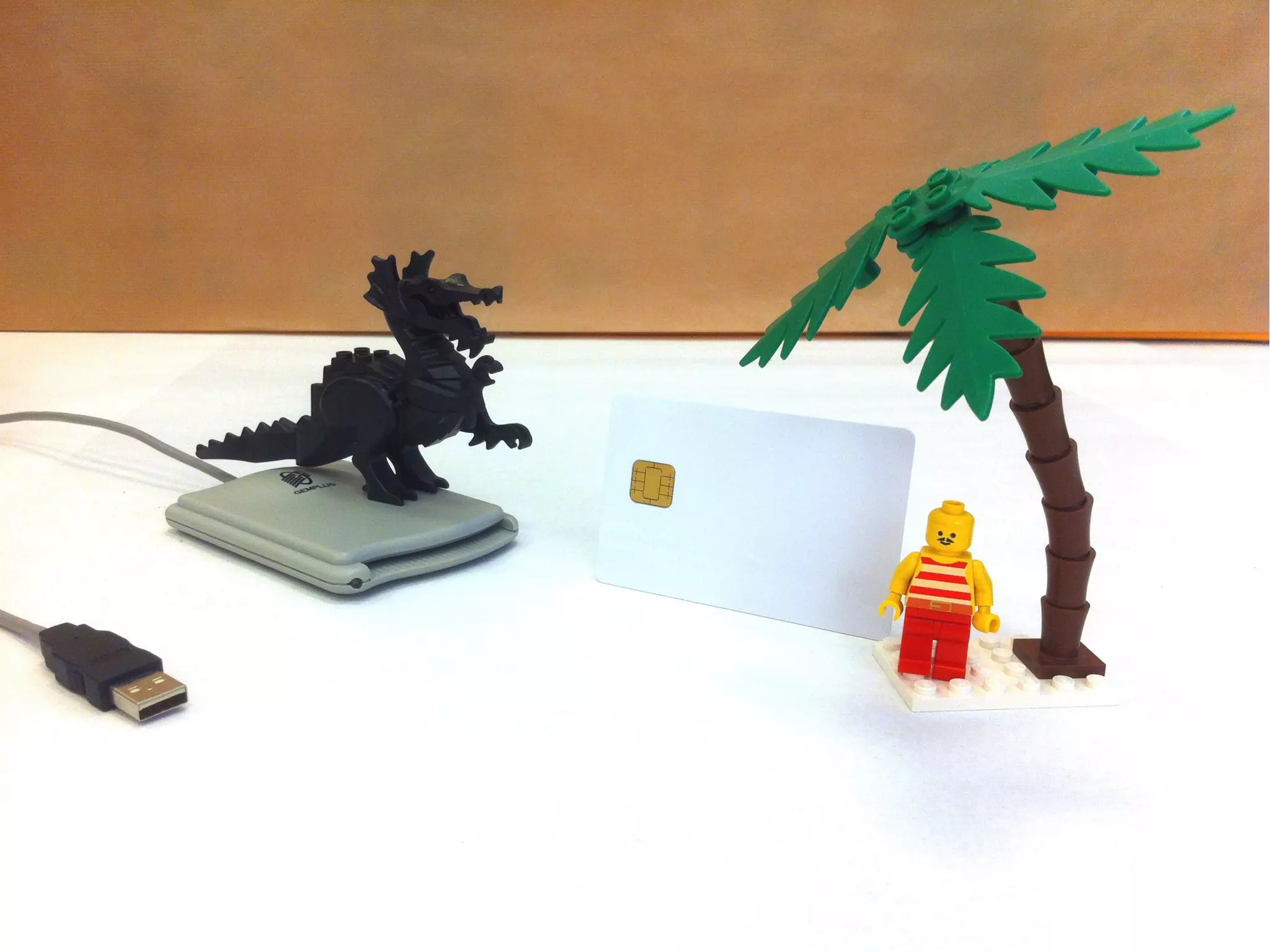
●   SoftHSM
●   Cheap solution (~200 DKK):
    –   http://www.gooze.eu/feitian-pki-smartcard-ftcos-pk-01c
        ●   http://www.ewak.net/blog/?p=101
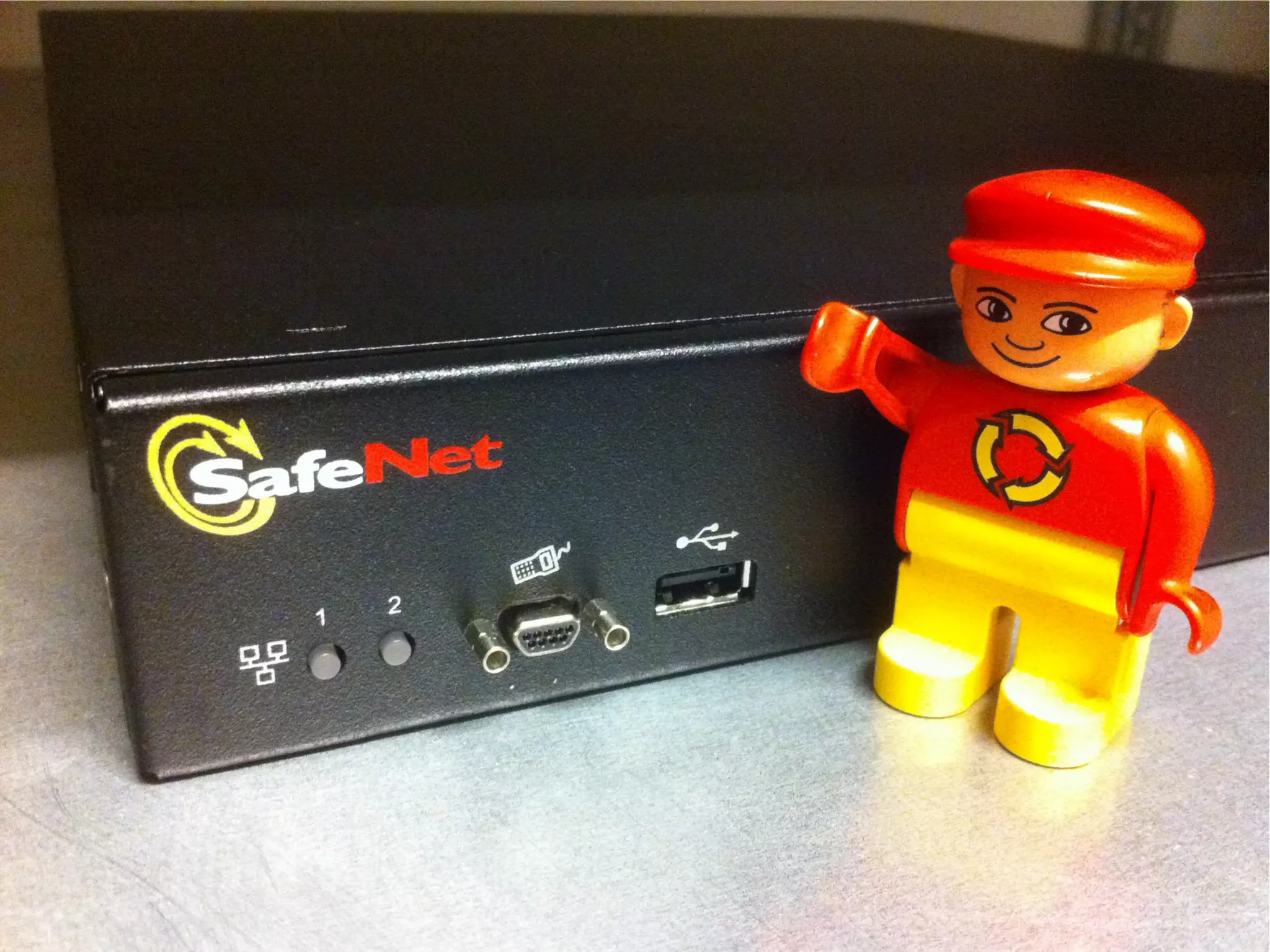
●   More expencive:
    –   SafeNet Luna SA
        ●   Faster, more secure
●   See also:
    –   https://wiki.opendnssec.org/display/DOCREF/HSM+B
        uyers%27+Guide
Fetition PKI
●   Feitian PKI smartcard (FTCOS / PK-01C)
    –   http://www.gooze.eu/feitian-pki-smartcard-ftcos-
        pk-01c
        ●   http://www.ewak.net/blog/?p=101
Luna SA
Luna SA
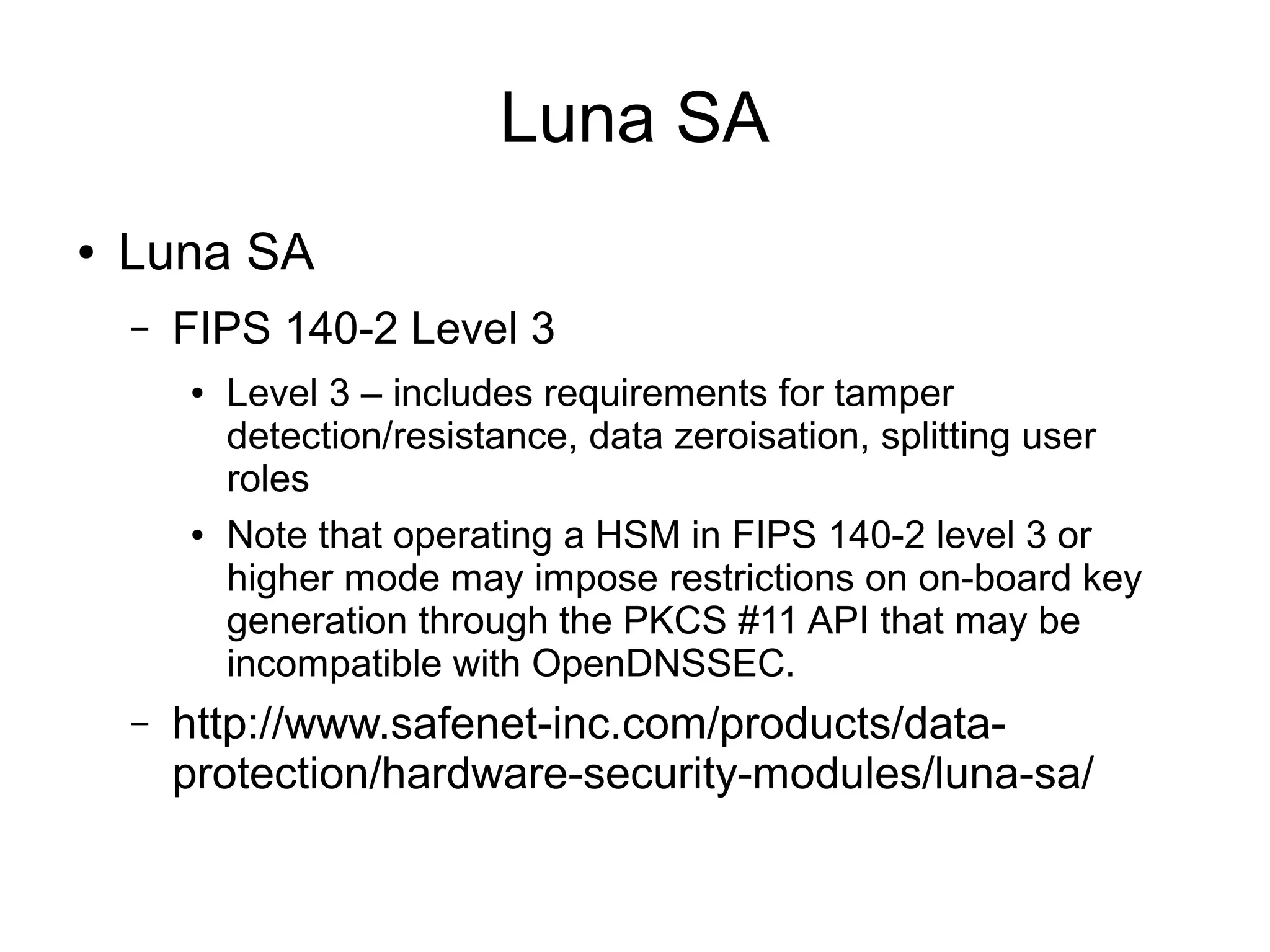
●   Luna SA
    –   FIPS 140-2 Level 3
        ●   Level 3 – includes requirements for tamper
            detection/resistance, data zeroisation, splitting user
            roles
        ●   Note that operating a HSM in FIPS 140-2 level 3 or
            higher mode may impose restrictions on on-board key
            generation through the PKCS #11 API that may be
            incompatible with OpenDNSSEC.
    –   http://www.safenet-inc.com/products/data-
        protection/hardware-security-modules/luna-sa/
Debugging/validation
●   Zone verification (we covered that earlier)
    –   ods-validator
    –   validns
    –   yazvs
●   Online tools
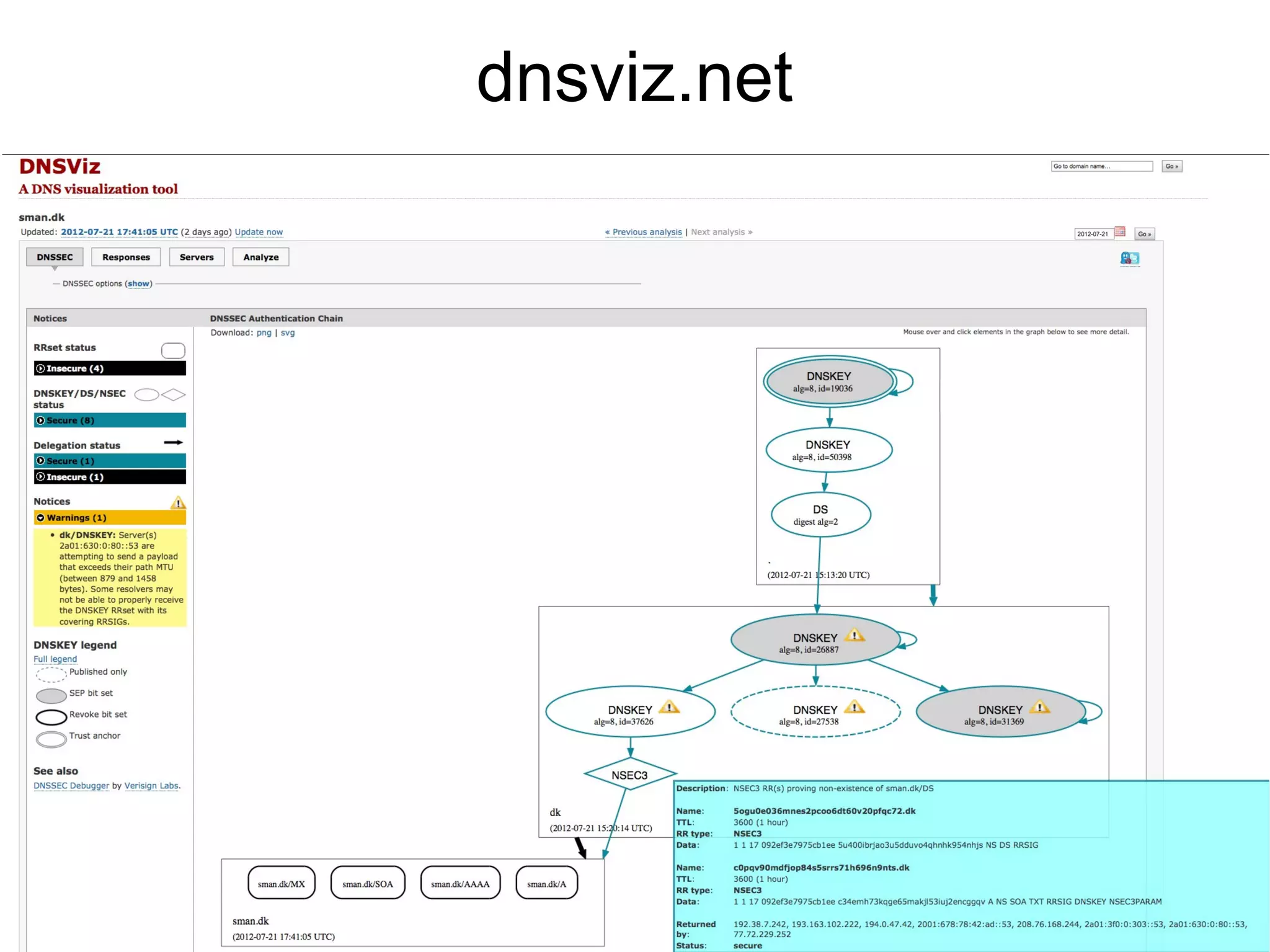
    –   http://dnsviz.net
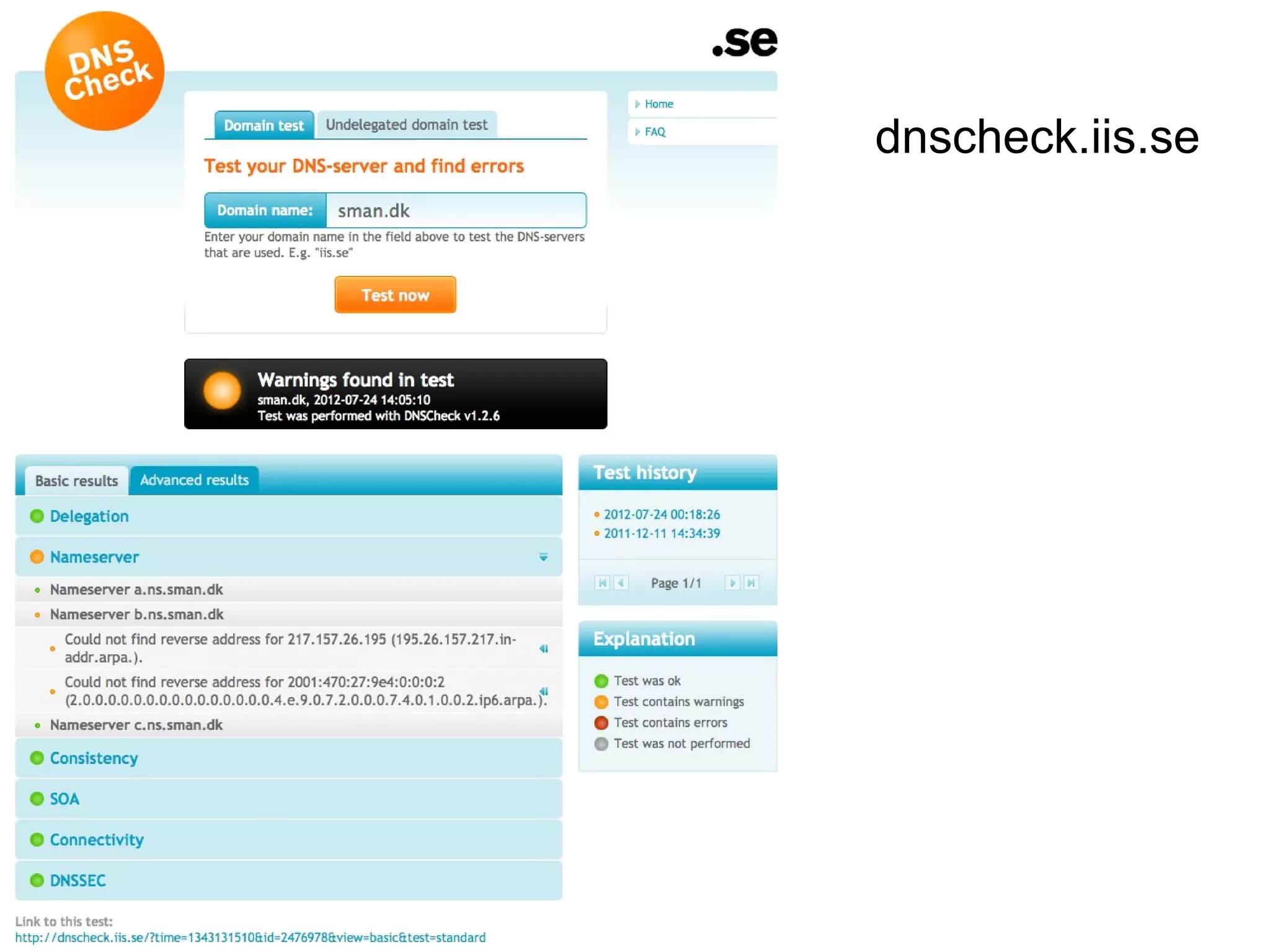
    –   http://dnscheck.iis.se
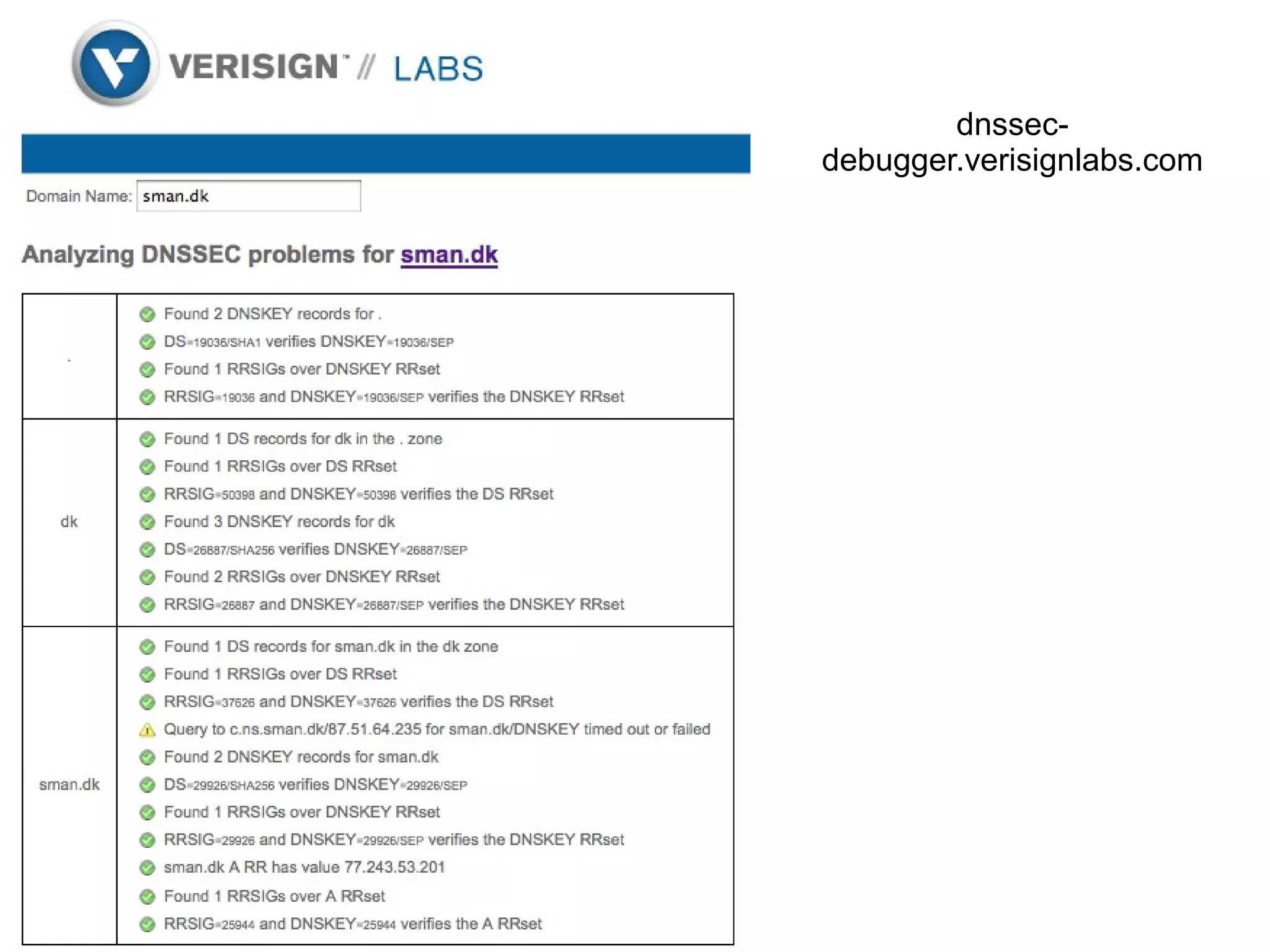
    –   http://dnssec-debugger.verisignlabs.com
dnsviz.net
dnscheck.iis.se
dnssec-
debugger.verisignlabs.com
Monitoring
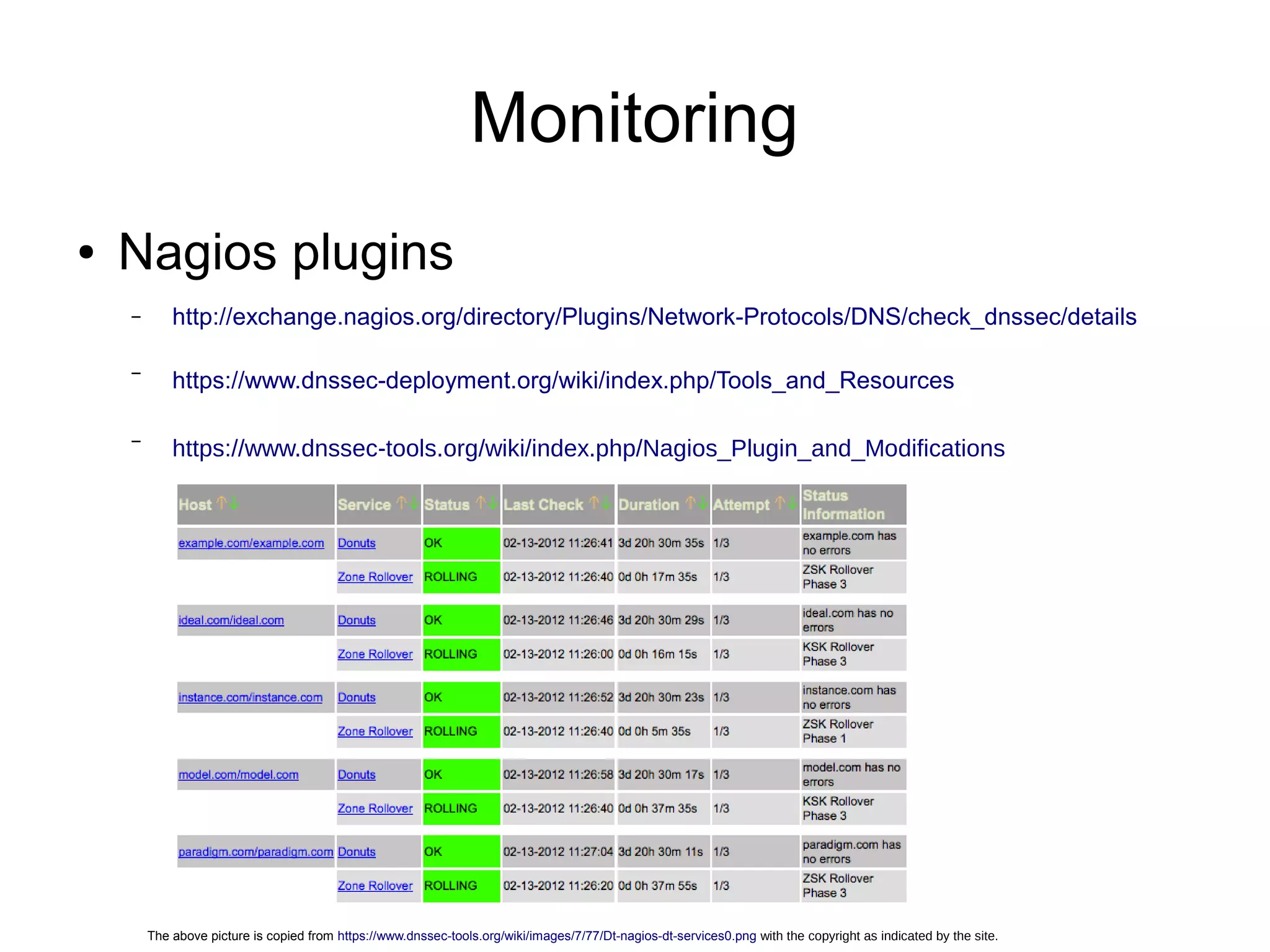
●   Nagios plugins
    –       http://exchange.nagios.org/directory/Plugins/Network-Protocols/DNS/check_dnssec/details

    –
            https://www.dnssec-deployment.org/wiki/index.php/Tools_and_Resources

    –
            https://www.dnssec-tools.org/wiki/index.php/Nagios_Plugin_and_Modifications


        The above picture is copied from https://www.dnssec-tools.org/wiki/images/7/77/Dt-nagios-dt-services0.png with the copyright as indicated by the site.
Automation of upload of DS to
                parent zone
●   dk. / DK-Hostmaster
    –   EPP test from the end of august at DK-Hostmaster
         ●   Only for registrars
    –   DSU: https://www.dk-hostmaster.dk/noter-om-teknik/dnssec/dsu/
         ●   Simple protocol (which is awesome!)
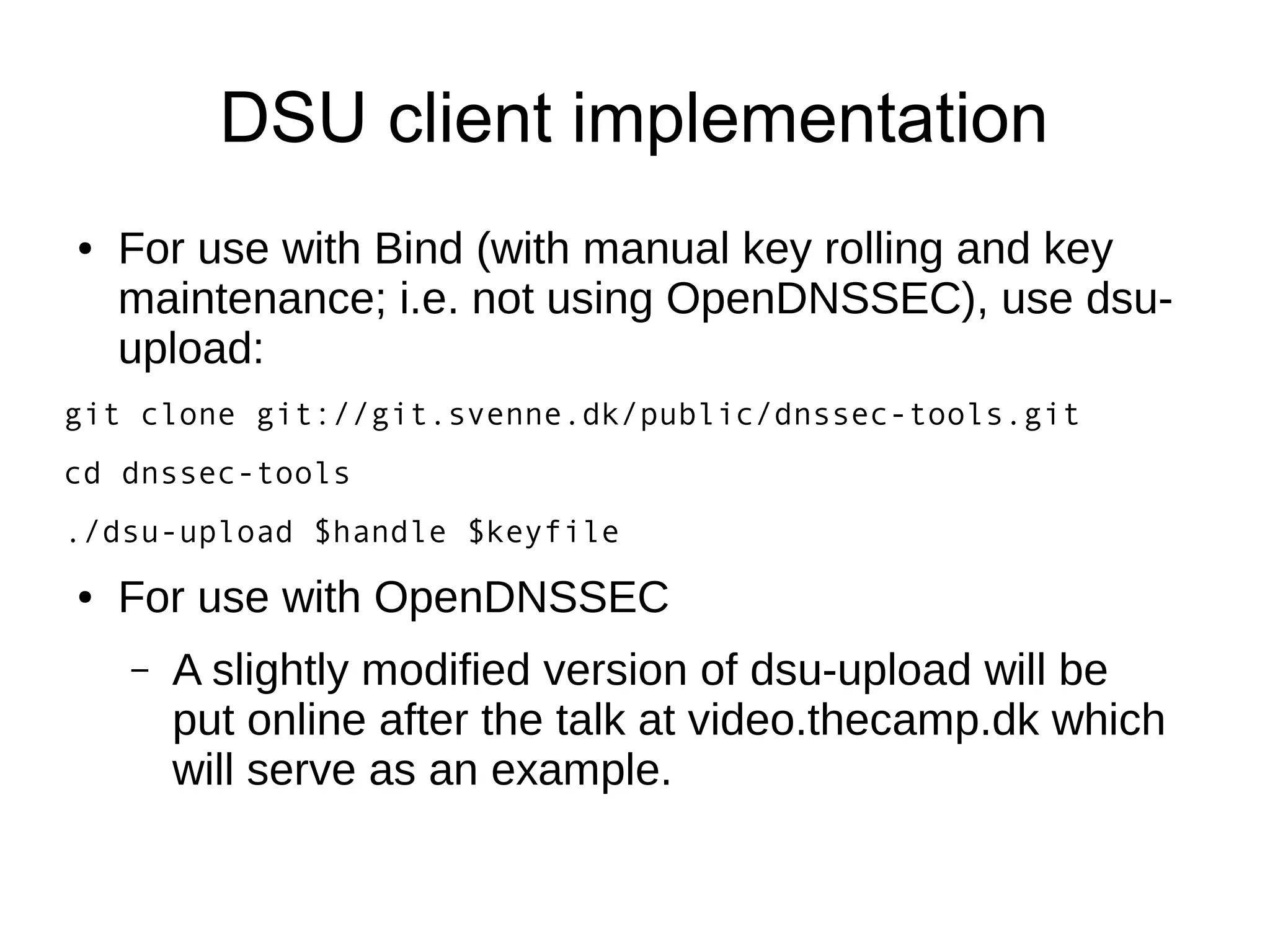
DSU client implementation
●   For use with Bind (with manual key rolling and key
    maintenance; i.e. not using OpenDNSSEC), use dsu-
    upload:
git clone git://git.svenne.dk/public/dnssec-tools.git
cd dnssec-tools
./dsu-upload $handle $keyfile
●   For use with OpenDNSSEC
    –   A slightly modified version of dsu-upload will be
        put online after the talk at video.thecamp.dk which
        will serve as an example.
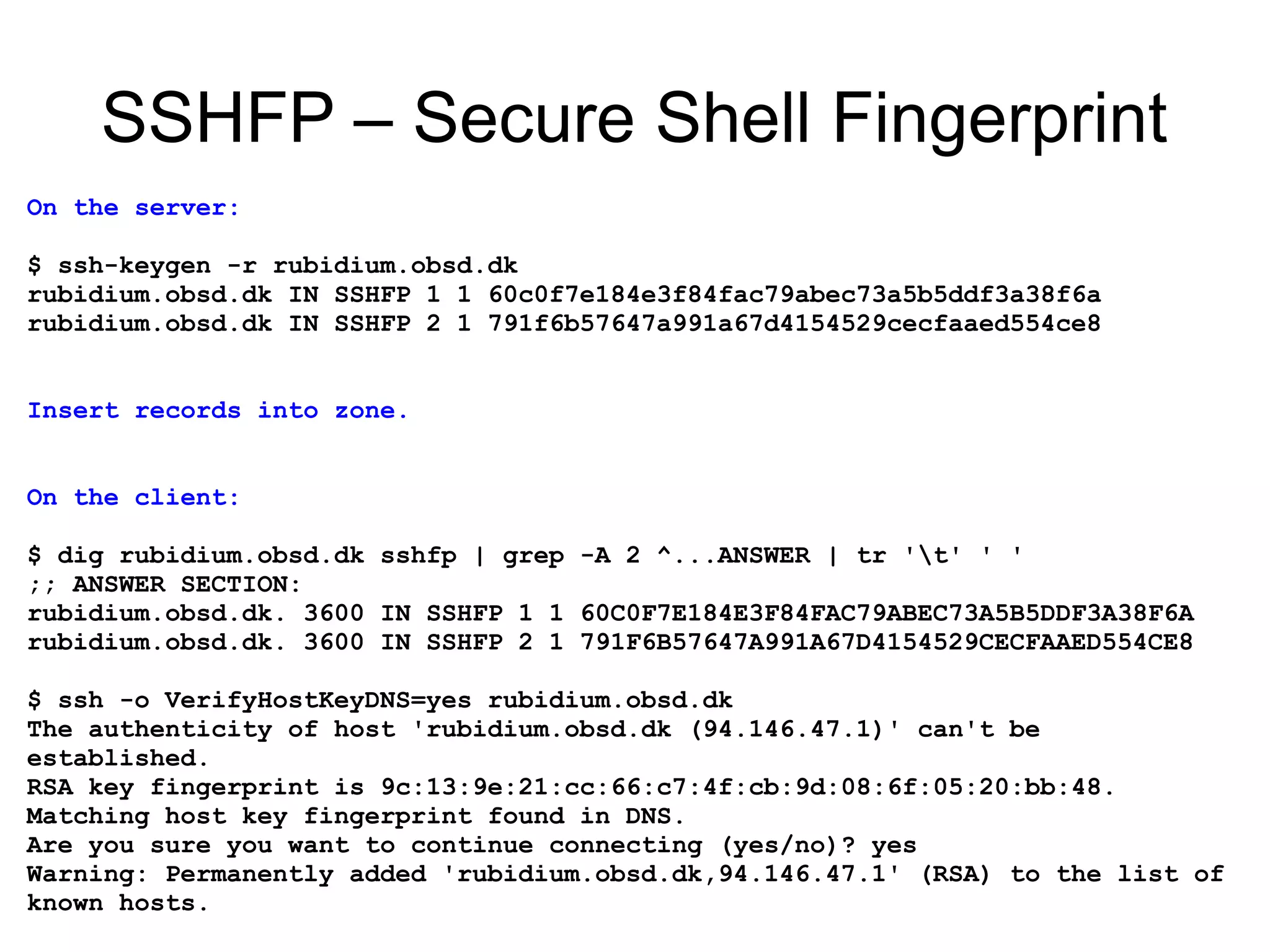
SSHFP – Secure Shell Fingerprint
On the server:

$ ssh-keygen -r rubidium.obsd.dk
rubidium.obsd.dk IN SSHFP 1 1 60c0f7e184e3f84fac79abec73a5b5ddf3a38f6a
rubidium.obsd.dk IN SSHFP 2 1 791f6b57647a991a67d4154529cecfaaed554ce8


Insert records into zone.


On the client:

$ dig rubidium.obsd.dk sshfp | grep -A 2 ^...ANSWER | tr 't' ' '
;; ANSWER SECTION:
rubidium.obsd.dk. 3600 IN SSHFP 1 1 60C0F7E184E3F84FAC79ABEC73A5B5DDF3A38F6A
rubidium.obsd.dk. 3600 IN SSHFP 2 1 791F6B57647A991A67D4154529CECFAAED554CE8

$ ssh -o VerifyHostKeyDNS=yes rubidium.obsd.dk
The authenticity of host 'rubidium.obsd.dk (94.146.47.1)' can't be
established.
RSA key fingerprint is 9c:13:9e:21:cc:66:c7:4f:cb:9d:08:6f:05:20:bb:48.
Matching host key fingerprint found in DNS.
Are you sure you want to continue connecting (yes/no)? yes
Warning: Permanently added 'rubidium.obsd.dk,94.146.47.1' (RSA) to the list of
known hosts.
TLSA
 ●   IETF wg: http://datatracker.ietf.org/wg/dane/
     –   http://datatracker.ietf.org/doc/draft-ietf-dane-protocol/?inclu
 ●   Makes it possible to include a hash for e.g. an
     SSL certificate in DNS:
echo | openssl s_client -connect blog.sman.dk:443 2>/dev/null | openssl x509 |python -c 'import sys,
hashlib; cert="".join(sys.stdin.read().strip().split("n")[1:-1]); print
hashlib.sha256(cert.decode("base64")).hexdigest()'

3510ad32ad9d2aa02ddee3ebc0d36ce53a9cb283e02bff6cb2be26ac957d3adb

_443._tcp.blog IN TLSA 1 1 1 3510ad32ad9d2aa02ddee3ebc0d36ce53a9cb283e02bff6cb2be26ac957d3adb


 ●   Current status: Internet-Draft
     –   Expires: December 16, 2012
 ●   Mozilla seems to be working on support for it
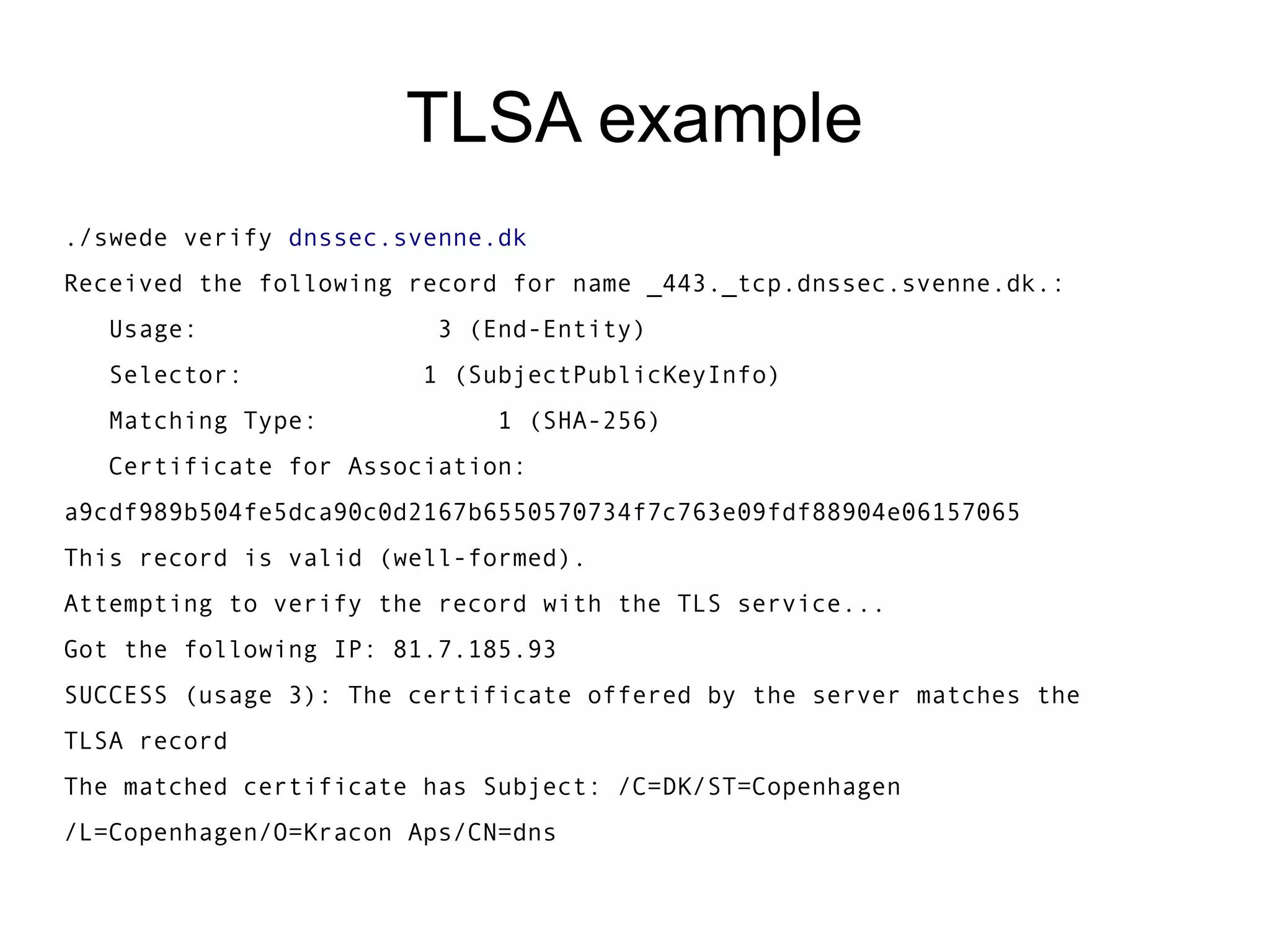
TLSA example
./swede verify dnssec.svenne.dk
Received the following record for name _443._tcp.dnssec.svenne.dk.:
   Usage:                3 (End-Entity)
   Selector:            1 (SubjectPublicKeyInfo)
   Matching Type:            1 (SHA-256)
   Certificate for Association:  
a9cdf989b504fe5dca90c0d2167b6550570734f7c763e09fdf88904e06157065
This record is valid (well-formed).
Attempting to verify the record with the TLS service...
Got the following IP: 81.7.185.93
SUCCESS (usage 3): The certificate offered by the server matches the
TLSA record
The matched certificate has Subject: /C=DK/ST=Copenhagen
/L=Copenhagen/O=Kracon Aps/CN=dns
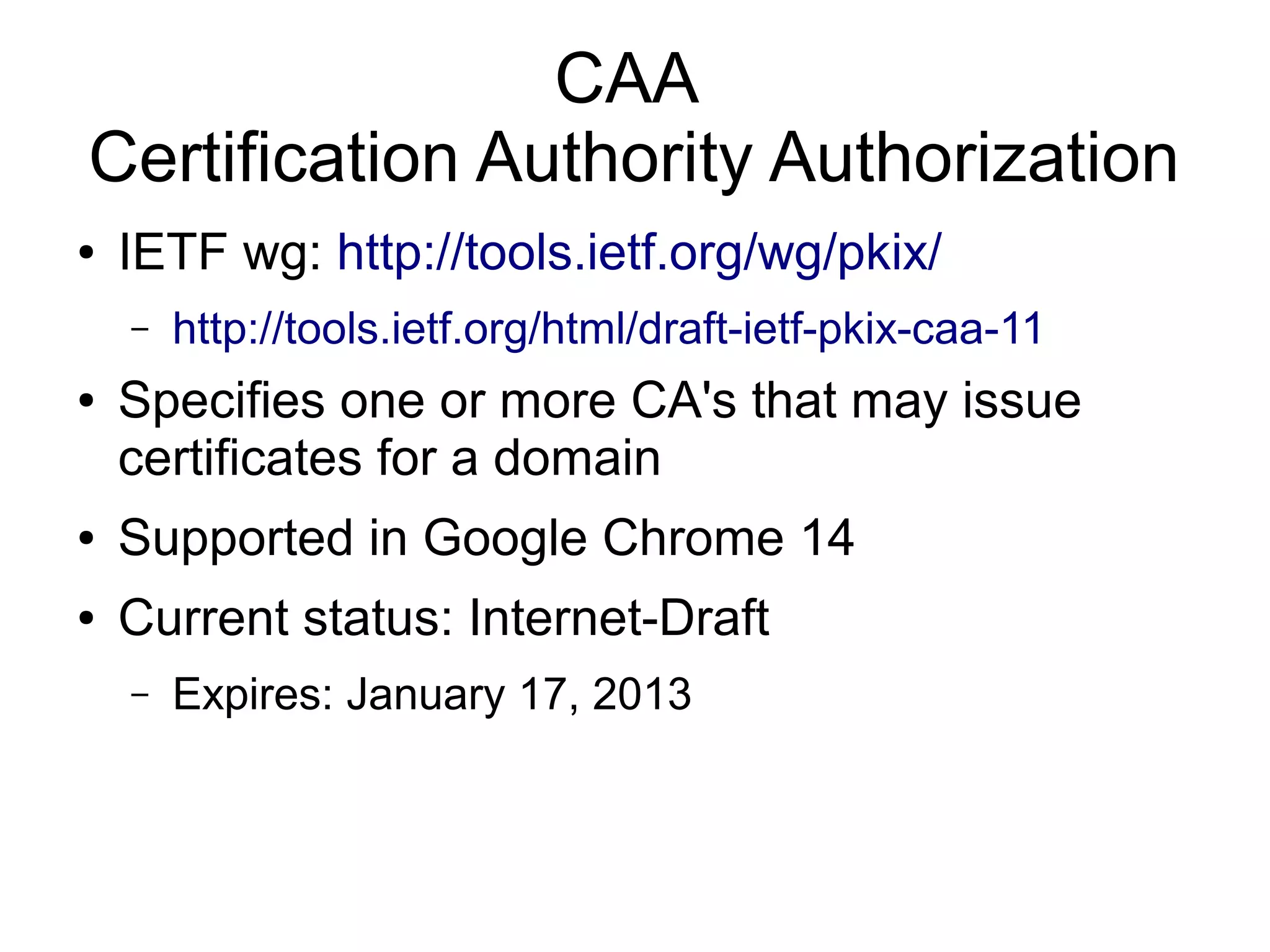
CAA
Certification Authority Authorization
●   IETF wg: http://tools.ietf.org/wg/pkix/
    –   http://tools.ietf.org/html/draft-ietf-pkix-caa-11
●   Specifies one or more CA's that may issue
    certificates for a domain
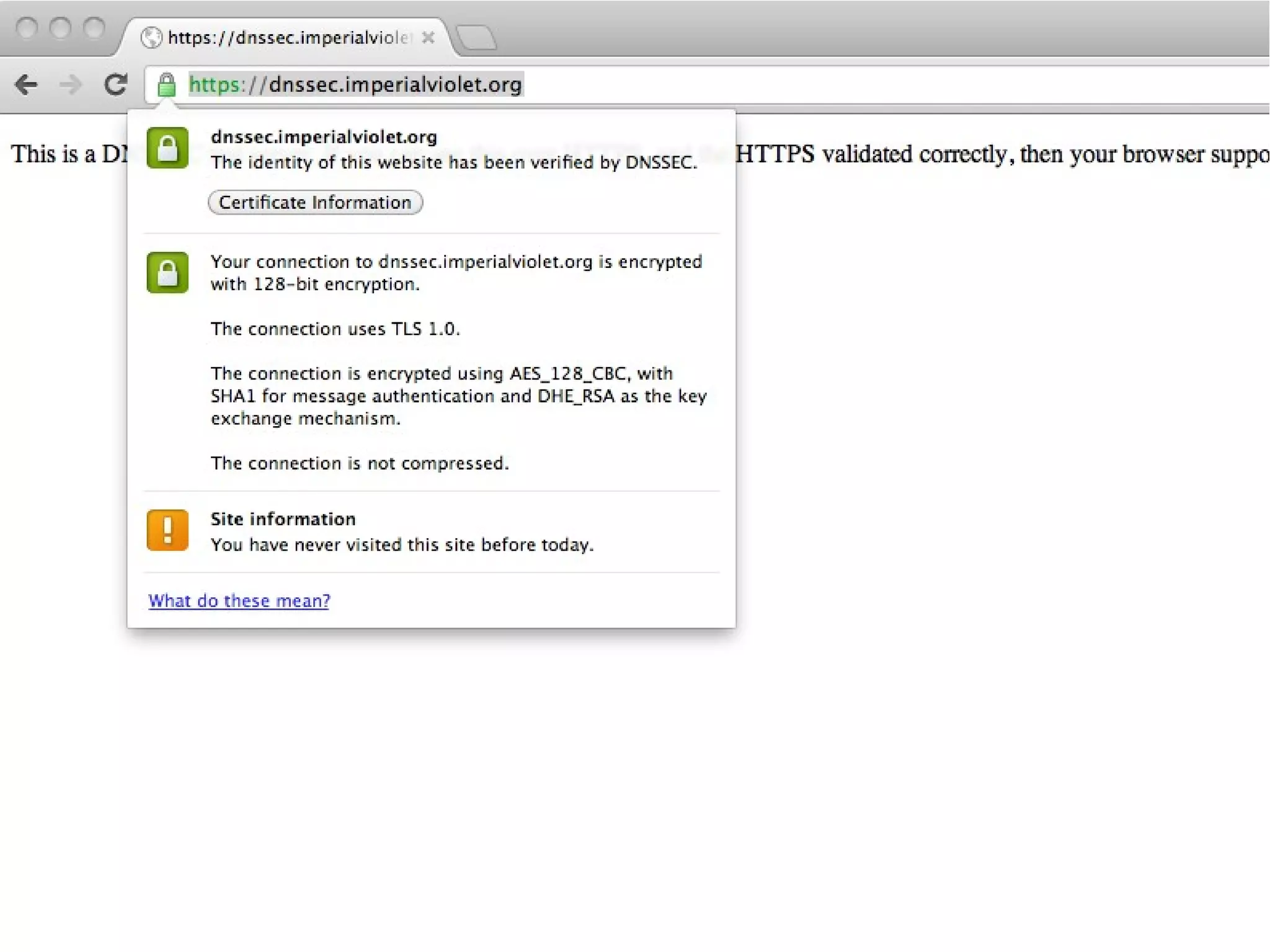
●   Supported in Google Chrome 14
●   Current status: Internet-Draft
    –   Expires: January 17, 2013
2012 07-24 dnssec-og_open_dnssec_-_martin_toft_og_georg_sluyterman_slideshow

2012 07-24 dnssec-og_open_dnssec_-_martin_toft_og_georg_sluyterman_slideshow

  • 3.
    Agenda ● Who are we etc. ● DNS ● DNSSEC ● Bind and DNSSEC ● OpenDNSSEC ● Other fun stuff
  • 4.
  • 5.
  • 6.
    Netic ● IT-konsulent og -hostingvirksomhed i Aalborg – Specialiserede hostingydelser i egne datacentre el. hos kunden – Udvikling af egne produkter el. opgaver for kunder – Fokus på kvalitet – Vi bruger i høj grad open source software, f.eks. Linux & FreeBSD – 16 ansatte, medarbejderejet – Godt socialt samværd og dygtige kollegaer – Kunder spænder over alt fra ISP'er og IT-virksomheder over private firmaer til offentlige institutioner
  • 7.
    Netic Eksempler ● Fælles Medicinkort ● Sundhedsdatanettet ● Debitor Registret ● National Sundheds Platform ● Splunk-partner Eksempler på egne produkter ● Netic Hotspot Solution ● TidyDNS
  • 8.
  • 9.
    DNS, DNSSEC, ... ● Overblik over folks erfaringer ● DNS ● DNSSEC ● OpenDNSSEC
  • 10.
    Motivation ● Kaminsky ● Klip med Phil Regnaults ;-) ● Ny teknologi! ● Nye muligheder
  • 11.
    DNSSEC ● Agenda: – DNS primer – Cryptography primer – DNSSEC ● Overview ● Ressource records ● Chain of trust ● Header flags and bits ● Maintenance
  • 12.
    DNS primer ● Domain Name System ● Invented in 1982 to replace hosts files ● Two namespaces: – Domain name hierarchy – IP address space ● No need to remember 195.215.30.182 – just use ”thecamp.dk” ● Reverse: $ dig 182.30.215.195.in-addr.arpa ptr +short cat5.thecamp.dk.
  • 13.
    DNS primer ● Ressource records (Name, Type, Class, TTL, RDLength, RData) ● Name is the domain name, e.g. thecamp.dk ● Types: A, AAAA, CNAME, MX, SOA, NS, TXT, SPF, PTR, etc. ● Classes: Only IN (for Internet) is relevant :-) ● Time To Live (TTL): How long to cache it ● RDLength is the length of RData ● RData is the actual ”value” of the record
  • 14.
    DNS primer $ORIGIN pinkponies.net. $TTL3600 @ IN SOA a.authns.evul-isp.br hostmaster.evul-isp.br. ( 2012061801 ; serial 86400 ; refresh (1 day) 7200 ; retry (2 hours) 3600000 ; expire (1000 hours) 172800 ) ; minimum (2 days) IN NS a.authns.evul-isp.br. IN NS b.authns.evul-isp.br. IN A 46.163.113.176 IN MX 10 a.mail.evul-isp.br. IN MX 20 b.mail.evul-isp.br. www IN A 46.163.113.176 forum IN CNAME www localhost IN A 127.0.0.1
  • 15.
    DNS primer $ORIGIN pinkponies.net. $TTL3600 @ IN SOA a.authns.evul-isp.br hostmaster.evul-isp.br. ( 201 ; serial $ dig pinkponies.net ns +short 86400 ; refresh (1 day) a.authns.evul-isp.br. (2 7200 ; retry hours) b.authns.evul-isp.br. (1000 3600000 ; expire hours) 172800 ) ; minimum (2 days) IN NS a.authns.evul-isp.br. IN NS b.authns.evul-isp.br. IN A 46.163.113.176 IN MX 10 a.mail.evul-isp.br. IN MX 20 b.mail.evul-isp.br. www IN A 46.163.113.176 forum IN CNAME www localhost IN A 127.0.0.1
  • 16.
    DNS primer $ORIGIN pinkponies.net. $TTL3600 @ IN SOA a.authns.evul-isp.br hostmaster.evul-isp.br. ( 2012061801 ; serial 86400 ; refresh (1 day) 7200 ; retry (2 hours) 3600000 ; expire (1000 hours) $ dig forum.pinkponies.net cnamedays) 172800 ) ; minimum (2 +short IN NS a.authns.evul-isp.br. www.pinkponies.net. IN NS b.authns.evul-isp.br. $ dig IN A www.pinkponies.net a +short 46.163.113.176 IN MX 10 a.mail.evul-isp.br. 46.163.113.176 IN MX 20 b.mail.evul-isp.br. www IN A 46.163.113.176 forum IN CNAME www localhost IN A 127.0.0.1
  • 17.
    DNS primer $ORIGIN pinkponies.net. $TTL3600 @ IN SOA a.authns.evul-isp.br hostmaster.evul-isp.br. ( 2012061801 ; serial 86400 ; refresh (1 day) 7200 ; retry (2 hours) 3600000 ; expire (1000 hours) 172800 ) ; minimum (2 days) IN NS a.authns.evul-isp.br. IN NS b.authns.evul-isp.br. $ dig pinkponies.net soa +short IN A 46.163.113.176 a.authns.evul-isp.br. hostmaster.evul-isp.br. IN MX 10 a.mail.evul-isp.br. IN MX 20 b.mail.evul-isp.br. 2012061801 86400 7200 3600000 172800 www IN A 46.163.113.176 forum IN CNAME www localhost IN A 127.0.0.1
  • 18.
    DNS primer $ORIGIN pinkponies.net. $TTL3600 @ IN SOA a.authns.evul-isp.br hostmaster.evul-isp.br. ( Ressource record sets 2012061801 ; serial 86400 ; refresh (1 day) 7200 ; retry (2 hours) 3600000 ; expire (1000 hours) 172800 ) ; minimum (2 days) IN NS a.authns.evul-isp.br. IN NS b.authns.evul-isp.br. IN A 46.163.113.176 IN MX 10 a.mail.evul-isp.br. IN MX 20 b.mail.evul-isp.br. www IN A 46.163.113.176 forum IN CNAME www localhost IN A 127.0.0.1
  • 19.
    DNS primer . (root) [a-m].root-servers.net dk. [bclps].nic.dk thecamp.dk. andersine.tdu.dk fjotte.krn.dk ns2.krn.dk video.thecamp.dk. www.thecamp.dk. ftp . th ec am p.d k.
  • 20.
  • 21.
  • 22.
  • 23.
  • 24.
  • 25.
  • 26.
  • 27.
  • 28.
  • 29.
  • 30.
  • 31.
  • 32.
  • 33.
  • 34.
  • 35.
  • 36.
  • 37.
    Cryptography primer ● Cryptographic hash functions ● Public-key cryptography – Public/private key pair – Encryption/decryption – Signing/validating
  • 38.
  • 40.
    Cryptographic hash functions ● The ideal CHF: – Easy to compute – Infeasible to generate message with a given hash – Infeasible to modify message without changing the hash – Infeasible to find two different messages with the same hash ● Used for digital signatures, authentication, hash tables, checksumming, etc.
  • 41.
    Cryptographic hash functions ● The ideal CHF: – Easy to compute – Infeasible to generate message with a given hash – Infeasible to modify message without changing the hash – Infeasible to find two different messages with the same hash ● Used for digital signatures, authentication, hash tables, checksumming, etc. Take a look at http://codahale.com/how-to-safely-store-a-password/ and PHK's column at http://queue.acm.org/detail.cfm?id=2254400
  • 42.
    Cryptographic hash functions MD5 (128 bits), SHA-1 (160 bits), SHA-256, SHA-512 MD = ”Message Digest”, SHA = ”Secure Hashing Alg.”
  • 43.
    Public-key cryptography ● Generate key pair: a public and a private key ● Mathematically linked, i.e. data encrypted with one can be decrypted with the other ● Publish the public key as widely as possible ● Keep the private key secret ● Asymmetric rather than symmetric, i.e. no problematic key exchange for each session ● … But, initially, a public key must be obtained from an authentic source!
  • 44.
  • 45.
  • 46.
  • 47.
  • 48.
  • 49.
  • 50.
  • 51.
    Validating a signature Hash Actual Message function hash Equal? Signature Decrypt Supposed (the encryp- hash ted hash)
  • 52.
    Validating a signature Hash Actual Message function hash Equal? Signature Decrypt Supposed (the encryp- hash ted hash) Of course, encryption and signing can be combined!
  • 53.
    DNSSEC ● Two sides of the coin: – A tree of signed zones being served by authoritative name servers – Validating resolvers/name servers ● We will return to the latter later ● DNS + some new stuff: – Ressource records – Chain of trust – New header flags and bits – Maintenance
  • 54.
    In a nutshell ● Generate two key pairs: – Key signing key pair (KSK) – Zone signing key pair (ZSK) ● Add public keys of KSK and ZSK to zone ● Sign public keys with KSK and add signature to zone ● Sign remaining ressource record sets (RRsets) with ZSK and add signatures to zone ● Hash public key of KSK and add value to parent zone (e.g. dk.)
  • 55.
    Some thoughts ● DNSSEC provides authenticity and integrity, not confidentiality ● The two key pairs create a decoupling ● Space is saved by adding a hash to the parent zone rather than the key
  • 56.
    Relevant RFCs ● 2535: Domain Name System Security Extensions ● 2845: Secret Key Transaction Authentication for DNS (TSIG) ● 2931: DNS Request and Transaction Signatures (SIG(0)s) ● 4033: DNS Security Introduction and Requirements ● 4034: Ressource Records for the DNS Security Extensions ● 4035: Protocol Modifications for the DNS Security Extensions ● 4470: Minimally Covering NSEC Records and DNSSEC On-line Signing ● 5155: DNS Security (DNSSEC) Hashed Authenticated Denial of Existence
  • 57.
    Relevant RFCs ● 2535: Domain Name System Security Extensions ● 2845: Secret Key Transaction Authentication for DNS (TSIG) ● 2931: DNS Request and Transaction Signatures (SIG(0)s) ● 4033: DNS Security Introduction and Requirements ● 4034: Ressource Records for the DNS Security Extensions ● 4035: Protocol Modifications for the DNS Security Extensions ● 4470: Minimally Covering NSEC Records and DNSSEC On-line Signing ● 5155: DNS Security (DNSSEC) Hashed Authenticated Denial of Existence We have not read all of them :-P
  • 59.
    DNSKEY Source: RFC 4034
  • 60.
    DNSKEY $ dig @ns1.gratisdns.dkcensurfridns.dk dnskey | grep -A 2 ^...ANSWER ;; ANSWER SECTION: censurfridns.dk. 43200 IN DNSKEY 256 3 5 AwEAAbp1Pkwot4e5tU/Vu8wsFAVg61gBWvZqb1tKgaJZdDU27arWzjHF i0EhKKun3c7e65UQZT1Y88pXSCTi5rfHiUU= censurfridns.dk. 43200 IN DNSKEY 257 3 5 AwEAAcGokw5cT/pYeaJ1sw1lvfgtvbm8t7M19XYTIy0wtob9kJZFnapy r4ch9gNyzUIe4Ks9ItvT/hiuDv7GJk/6NEc=
  • 61.
    DNSKEY ZSK (bit 7 set) $ dig @ns1.gratisdns.dk censurfridns.dk dnskey | grep -A 2 ^...ANSWER ;; ANSWER SECTION: censurfridns.dk. 43200 IN DNSKEY 256 3 5 AwEAAbp1Pkwot4e5tU/Vu8wsFAVg61gB censurfridns.dk. 43200 IN DNSKEY 257 3 5 AwEAAcGokw5cT/pYeaJ1sw1lvfgtvbm8 KSK (bit 7 and 15 set) RSA/SHA-1 (alg. 5) Always 3
  • 62.
    RRSIG Source: RFC 4034
  • 63.
    RRSIG $ dig @ns1.gratisdns.dkcensurfridns.dk rrsig | grep -A 9 ^...ANSWER ;; ANSWER SECTION: censurfridns.dk. 43200 IN RRSIG DNSKEY 5 2 43200 20120820132225 20120721132225 39453 censurfridns.dk. Mti1G/P7G4cgM9Kj3sBKik50bRGfQXGqx2bWgdhWjxRDfWFdpZzpyHcp tIGpfl/pD/gZ2kdj2qzIwHk7s4UQ censurfridns.dk. 43200 IN RRSIG DNSKEY 5 2 43200 20120820132225 20120721132225 59671 censurfridns.dk. ruNo6HT3R+Ll6wlptfKaAMt0cYM8BiYo3ZmcqZEdcngFpo87NxpD/khG 3aJfFWiHg73K91M+T68C6RjXcbMm censurfridns.dk. 43200 IN RRSIG NSEC 5 2 43200 20120820132225 20120721132225 39453 censurfridns.dk. SB/KFjL6k/J2+sc4AWPwDiUfo7qNeFXbeCPluKgGCCnxNjr5YXOMnBjH emB7/nlWZ/ooDLaSkfAMWOYm6PDnFw censurfridns.dk. 43200 IN RRSIG AAAA 5 2 43200 20120820132225 20120721132225 39453 censurfridns.dk. BNw8aD1hy6VRmd73X6/otBq3nkIko7i0FD93gMlhCeEVTzbXcefUpqQU CxQMrAhTHIJVlj3bVFTlXNc537fIlg censurfridns.dk. 43200 IN RRSIG TXT 5 2 43200 20120820132225 20120721132225 39453 censurfridns.dk. XNrclGxuwscAB5QNYpcDRuQRxMXh1y527WPmvP875t72VZmmOmNvsiub 4nTOS2Z1gKUU/kIDoRpilHAKbox5Gw= censurfridns.dk. 43200 IN RRSIG MX 5 2 43200 20120820132225 20120721132225 39453 censurfridns.dk. qDafz5gRUVddJi4gZc7y2rUdkOkTgOOKybbKQygoO1JYfF2WiZguRhG9 efl7VnaWOa4rP38+9DrZpkbFFhZsBw== censurfridns.dk. 43200 IN RRSIG A 5 2 43200 20120820132225 20120721132225 39453 censurfridns.dk. K8i2sbv7C7PPjvToJBk2aKcNXQY8+Ke91FsjQpDpZLKgyoX3KGyOS6Yb CsIp4qPo4TNZI6d9+XXuh69NvC0mUw== censurfridns.dk. 43200 IN RRSIG NS 5 2 43200 20120820132225 20120721132225 39453 censurfridns.dk. jQfNDEEuuhqRnpufk0v9FVxUbsZEbeWPz8rdkBNu8IJDh0SxJ0pZLbp6 Yd0EJFMbYj+Avvg33veLcnVl02YvRA== censurfridns.dk. 43200 IN RRSIG SOA 5 2 43200 20120820132225 20120721132225 39453 censurfridns.dk. aE8kAn4QErkf7K405gqhgkZIqUtVjWKVbnht8R8AhsyeJ0X6V85qWVTK 6S9brwMOD9vjsrEcqZf6ZaLfjmw4Fg=
  • 64.
    RRSIG RSA/SHA-1 (alg. 5) 2 labels, ”dk” and ”censurfridns” $ dig @ns1.gratisdns.dk censurfridns.dk rrsig | grep -A 9 ^...ANSWER ;; ANSWER SECTION: censurfridns.dk. 43200 IN RRSIG DNSKEY 5 2 43200 20120820132225 20120721132225 39453 censurfridns.dk. Mti1G/P7G4cgM9K censurfridns.dk. 43200 IN RRSIG DNSKEY 5 2 43200 20120820132225 20120721132225 59671 censurfridns.dk. ruNo6HT3R+Ll6wl censurfridns.dk. 43200 IN RRSIG NSEC 5 2 43200 20120820132225 20120721132225 39453 censurfridns.dk. SB/KFjL6k/J2+sc4A censurfridns.dk. 43200 IN RRSIG AAAA 5 2 43200 20120820132225 20120721132225 39453 censurfridns.dk. BNw8aD1hy6VRmd73X censurfridns.dk. 43200 IN RRSIG TXT 5 2 43200 20120820132225 20120721132225 39453 censurfridns.dk. XNrclGxuwscAB5QNYp censurfridns.dk. 43200 IN RRSIG MX 5 2 43200 20120820132225 20120721132225 39453 censurfridns.dk. qDafz5gRUVddJi4gZc7 censurfridns.dk. 43200 IN RRSIG A 5 2 43200 20120820132225 20120721132225 39453 censurfridns.dk. K8i2sbv7C7PPjvToJBk2 censurfridns.dk. 43200 IN RRSIG NS 5 2 43200 20120820132225 20120721132225 39453 censurfridns.dk. jQfNDEEuuhqRnpufk0v censurfridns.dk. 43200 IN RRSIG SOA 5 2 43200 20120820132225 20120721132225 39453 censurfridns.dk. aE8kAn4QErkf7K405g ID of KSK ID of ZSK
  • 65.
    DS (Delegation Signer) Source: RFC 4034
  • 66.
    DS RSA/SHA-1 (alg. 5) ID of KSK for censurfridns.dk $ dig @b.nic.dk censurfridns.dk ds | grep -A 1 ^...ANSWER ;; ANSWER SECTION: censurfridns.dk. 86400 IN DS 59671 5 1 7E7D30DB4AB818F69E4F80163AE5364265D412F2 SHA-1 (type 1)
  • 67.
    NSEC (Next SECure -authenticated denial of existence) Source: RFC 4034
  • 68.
    NSEC $ dig @ns1.gratisdns.dkcensurfridns.dk nsec | grep -A 1 ^...ANSWER ;; ANSWER SECTION: censurfridns.dk. 43200 IN NSEC default._domainkey.censurfridns.dk. A NS SOA MX TXT AAAA RRSIG NSEC DNSKEY $ dig @ns1.gratisdns.dk default._domainkey.censurfridns.dk nsec | grep -A 1 ^...ANSWER ;; ANSWER SECTION: default._domainkey.censurfridns.dk. 43200 IN NSEC blog.censurfridns.dk. TXT RRSIG NSEC $ dig @ns1.gratisdns.dk blog.censurfridns.dk nsec | grep -A 1 ^...ANSWER ;; ANSWER SECTION: blog.censurfridns.dk. 43200 IN NSEC localhost.censurfridns.dk. A AAAA RRSIG NSEC ...
  • 69.
    NSEC $ NEXT=censurfridns.dk; whiletrue; do echo $NEXT; NEXT=`dig @ns1.gratisdns.dk $NEXT nsec +short | cut -d ' ' -f 1`; if [ "$NEXT" = "censurfridns.dk." ]; then break; fi; done censurfridns.dk default._domainkey.censurfridns.dk. blog.censurfridns.dk. localhost.censurfridns.dk. ns1.censurfridns.dk. ns1a.censurfridns.dk. ns1b.censurfridns.dk. ns2.censurfridns.dk. www.censurfridns.dk.
  • 70.
    NSEC $ dig @ns1.gratisdns.dkelephant.censurfridns.dk a +dnssec | tr 't' ' ' | grep -A 6 ^...AUTH | egrep '(AUTH|IN NSEC)' | grep -v ^censurfridns.dk ;; AUTHORITY SECTION: blog.censurfridns.dk. 43200 IN NSEC localhost.censurfridns.dk. A AAAA RRSIG NSEC $ dig @ns1.gratisdns.dk virus.censurfridns.dk a +dnssec | tr 't' ' ' | grep -A 6 ^...AUTH | egrep '(AUTH|IN NSEC)' | grep -v ^censurfridns.dk ;; AUTHORITY SECTION: ns2.censurfridns.dk. 43200 IN NSEC www.censurfridns.dk. A AAAA RRSIG NSEC
  • 71.
    NSEC3 ● NSEC3 solves two problems with NSEC: – Zone enumeration – High cost: ”the cost to secure delegations to unsigned zones is high, relative to the perceived benefit” (source: RFC 5155) ● Both are especially relevant for registries, e.g. DK-Hostmaster for dk. ● One new delegation at a registry: – New NSEC RR in an already long NSEC RRset (maintain the order of the linked list) – Regenerate RRSIG for NSEC RRset
  • 72.
    NSEC3 hash sort elephant 4tWD63 4tWD63 giraffe w8gT6v Un4x0D lion VEfZ6w VEfZ6w tiger Un4x0D k4V3vK zebra k4V3vK w8gT6v NSEC3 records
  • 73.
    NSEC3 $ ldns-nsec3-hash -t17 -s 092EF3E7975CB1EE nonexistent-domain.dk S380h9pg6mbd0m87011bdv8icagr1994. $ dig @b.nic.dk nonexistent-domain.dk a +dnssec | tr 't' ' ' | grep -A 10 ^...AUTH | egrep '(AUTH|rv1.*IN NSEC3)' ;; AUTHORITY SECTION: rv1glegdcruclq64jr4tqem1u0eaefba.dk. 3600 IN NSEC3 1 1 17 092EF3E7975CB1EE S3F532FN55ASTA3MVMTGEIG80S12G8PC NS DS RRSIG rv1... --> s38... --> s3f... . /| | | Cannot exist
  • 74.
    NSEC3 Source: RFC 5155
  • 75.
    NSEC3 Salt $ dig @b.nic.dk nonexistent-domain.dk a +dnssec | tr 't' ' ' | grep -A 10 ^...AUTH | egrep '(AUTH|rv1.*IN NSEC3)' ;; AUTHORITY SECTION: rv1glegdcruclq64jr4tqem1u0eaefba.dk. 3600 IN NSEC3 1 1 17 092EF3E7975CB1EE S3F532FN55ASTA3MVMTGEIG80S12G8PC NS DS RRSIG 17 iterations SHA-1 (alg. 1) Opt-out bit set
  • 76.
    NSEC3PARAM $ dig @b.nic.dkdk. nsec3param | tr 't' ' ' | grep -A 1 ^...ANSWER ;; ANSWER SECTION: dk. 3600 IN NSEC3PARAM 1 0 17 092EF3E7975CB1EE Source: RFC 5155
  • 77.
    Many pieces inthe puzzle...
  • 78.
  • 80.
    New headers flagsand bits ● DNS header flags: – Checking Disabled (CD) Client says: ”Please to not perform DNSSEC validation” – Authenticated Data (AD) Client says: ”Please tell me whether all answer and authority data has been validated” ● Extension mechanisms for DNS (EDNS) header bits: – DNSSEC OK (DO) A resolver can indicate that it wishes to receive DNSSEC RRs in response messages ● EDNS0 is the first set of EDNS – From 512 byte to 4 kB packets, among other things... ● DNSSEC requires the possibility for larger packets
  • 81.
    Support in dig $man dig | grep -B 1 -A 1 -i checking +[no]cdflag Set [do not set] the CD (checking disabled) bit in the query. This requests the server to not perform DNSSEC validation of responses. $ man dig | grep -B 1 -A 6 -i 'authentic data' +[no]adflag Set [do not set] the AD (authentic data) bit in the query. This requests the server to return whether all of the answer and authority sections have all been validated as secure according to the security policy of the server. AD=1 indicates that all records have been validated as secure and the answer is not from a OPT-OUT range. AD=0 indicate that some part of the answer was insecure or not validated.
  • 82.
    Maintenance ● The more data, a key signs, the more exposed the key is ● KSK switched e.g. every year ● ZSK switched e.g. every week ● As ZSK is switched more often, it can be shorter, yielding smaller DNSKEY/RRSIG RRs ● Key rolling/rollover is the process of switching keys ● Complicated – you don't want to do it by hand
  • 83.
    Bind as arecursive caching name server Options { ... dnssec-enable yes; dnssec-validation yes; dnssec-lookaside auto; }
  • 84.
    DNSSEC as an authorative name server ● Three approaches – GratisDNS.dk (or similar services) – Bind >= 9.9 – OpenDNSSEC
  • 85.
  • 89.
    Information will appearafter up to 6 hours
  • 91.
    Bind and DNSSEC ● Bind 9.9: A subset of the functionality that OpenDNSSEC offers. – E.g. no automatic key rollover – Automatic signing of zones – More features may (very likely?) come in the future
  • 92.
    Bind and DNSSEC ● named.conf on authorative name server options { … key-directory "/var/bind/keys"; Dnssec-enable yes; }
  • 93.
    Bind and DNSSEC ● For each zone zone { … auto-dnssec maintain; inline-signing yes; }
  • 94.
    Bind and DNSSEC ● Generate KSK cd /var/bind/keys key=$(dnssec-keygen -3 -a RSASHA256 -b 4096 -f KSK $zone) dnssec-dsfromkey $key > $key.ds chown named:named $key* ● Generate ZSK dnssec-keygen -3 $zone chown named:named K*
  • 95.
    Bind and DNSSEC ● Upload to parent – dnssec-dsfromkey $keyfile ● Key rollover
  • 96.
    Bind and DNSSEC ● That was way to easy and not feature rich enough, so lets move on to OpenDNSSEC :-)
  • 98.
    OpenDNSSEC ● What is OpenDNSSEC ● Why OpenDNSSEC ● Architecture ● Configuration ● Manual upload of keys to parent ● Validator ● HSM's (Hardware Security Module)
  • 99.
    What is OpenDNSSEC ●OpenDNSSEC maintains the signing of your zones. ● It is not a name server ● Used by .se, .dk, .nl and .co.uk registries ● Originally a .se registry project but is now backed by, among other, the above registries.
  • 100.
  • 102.
  • 104.
    Why OpenDNSSEC ● Using Bind's tools does not take care of rolling keys (KSK, ZSK) ● OpenDNSSEC automating the process of keeping track of DNSSEC keys and the signing of zones ● Communication to parent zone (e.g. epp-client) ● Scalability (multiple threads, multiple HSM's) ● Security (HSM)
  • 105.
  • 106.
  • 107.
    KASP enforcer ● KASP: Key and Signature Policy ● Reads configuration (policy, list of domains etc.). ● Key management – Creation of keys in HSM – Key rolling ● Instructs what keys etc. ods-signer should use
  • 108.
  • 111.
    HSM ● Hardware Security Module – Stores and generates keys – Signs records – Hardware accellerated signing and key generation ● PKCS#11 interface ● SoftHSM – No hardware required – Simple configuration – Developed for OpenDNSSEC – Not as über secure as some hardware based HSM's
  • 112.
    Configuration files ● conf.xml – Overall configuration ● kasp.xml – Key and signature policy ● zonefetch.xml – Optional: Receive zones via AXFR ● zonelist.xml – List of zones, how to fetch and publish them and a pointer to policy in kasp.xml. Maintained by OpenDNSSEC, but manual editing is possible.
  • 113.
    Signer engine ● Performs the actual signing – Reuses signatures if they are not too old – Can spread signature generation (jitter) The above picture is copied from https://wiki.opendnssec.org/display/DOCS/kasp.xml with the copyright as indicated by the site. ● Maintains NSEC/NSEC3 chain ● Updates SOA serial number
  • 114.
    Bind ● named.conf – dnssec-enable yes; ● Restart bind ● Configure firewall to accept 4096 Byte UDP- packets on port 53 due to EDNS0.
  • 115.
    Installing and running OpenDNSSEC ● Lets jump to the wiki – Will be put online together with the video as a .pdf
  • 116.
    OpenDNSSEC Roadmap ● From verison 1.4 the KASP auditor is obsolete – We will show an example with validns ● Version 2.0: Support for passing through unsigned zones ● My wishlist: – Support for split horizon ● https://issues.opendnssec.org/browse/OPENDNSSEC-232 ● “Please feel free to vote on this and add comments.”
  • 117.
    Manual upload ofDS to parent
  • 118.
    Manual upload ofDS to DK-Hostmaster ● To gain trust from parent (here DK- Hostmaster), go trhough the following steps: ● Get DS keys from OpenDNSSEC ● Log in to https://www.dk-hostmaster.dk and inser DS key
  • 119.
    Manual upload ofDS keys to DK- Hostmaster
  • 120.
    Manual upload ofDS to DK-Hostmaster
  • 121.
    Manual upload ofDS to DK-Hostmaster
  • 122.
    Manual upload ofDS to DK-Hostmaster
  • 123.
    Manual upload ofDS to DK-Hostmaster dig +dnssec sman.dk. DS @c.nic.dk | grep -v ';' sman.dk. 86400 IN DS 29926 8 2 A73192AD80C2076FCEE9CB69032D72ACC179FBD3C116AA2C3 01218E2 839A1755 sman.dk. 86400 IN RRSIG DS 8 2 86400 20120730120851 20120723200442 37626 dk. BIAt9QxZxbtOiXdK+dt2YizOsZXa+GBKRbaKvQAsRyilYUExB SAcjcPK bruVhcqop01W5l7xJrXGNtH+fx1lbbl6+CB1o9gq0a98z0GdU +7aqDfz FEcPg9rf8i600DbLwUsQEyLnqUG8KqPGDU3+YGsv6uNCQnsfp h8L//Om TvU=
  • 124.
  • 126.
    validns ● http://www.validns.net ● Used by several major DNS operators ● Check syntax and more ● Checks for valid DNSSEC signatures, NSEC{,3} chains, outdated signatures etc. ● Not checking delegations ● Reads local files ● Written in C and scales well. Uses OpenSSL. ● Similar software: See also http://yazvs.verisignlabs.com/
  • 127.
    Demonstration ● Lets have a look at a server running OpenDNSSEC
  • 128.
    Let's have acloser look at hardware based HSM's
  • 136.
    HSM ● SoftHSM ● Cheap solution (~200 DKK): – http://www.gooze.eu/feitian-pki-smartcard-ftcos-pk-01c ● http://www.ewak.net/blog/?p=101 ● More expencive: – SafeNet Luna SA ● Faster, more secure ● See also: – https://wiki.opendnssec.org/display/DOCREF/HSM+B uyers%27+Guide
  • 138.
    Fetition PKI ● Feitian PKI smartcard (FTCOS / PK-01C) – http://www.gooze.eu/feitian-pki-smartcard-ftcos- pk-01c ● http://www.ewak.net/blog/?p=101
  • 139.
  • 140.
    Luna SA ● Luna SA – FIPS 140-2 Level 3 ● Level 3 – includes requirements for tamper detection/resistance, data zeroisation, splitting user roles ● Note that operating a HSM in FIPS 140-2 level 3 or higher mode may impose restrictions on on-board key generation through the PKCS #11 API that may be incompatible with OpenDNSSEC. – http://www.safenet-inc.com/products/data- protection/hardware-security-modules/luna-sa/
  • 141.
    Debugging/validation ● Zone verification (we covered that earlier) – ods-validator – validns – yazvs ● Online tools – http://dnsviz.net – http://dnscheck.iis.se – http://dnssec-debugger.verisignlabs.com
  • 142.
  • 143.
  • 144.
  • 145.
    Monitoring ● Nagios plugins – http://exchange.nagios.org/directory/Plugins/Network-Protocols/DNS/check_dnssec/details – https://www.dnssec-deployment.org/wiki/index.php/Tools_and_Resources – https://www.dnssec-tools.org/wiki/index.php/Nagios_Plugin_and_Modifications The above picture is copied from https://www.dnssec-tools.org/wiki/images/7/77/Dt-nagios-dt-services0.png with the copyright as indicated by the site.
  • 146.
    Automation of uploadof DS to parent zone ● dk. / DK-Hostmaster – EPP test from the end of august at DK-Hostmaster ● Only for registrars – DSU: https://www.dk-hostmaster.dk/noter-om-teknik/dnssec/dsu/ ● Simple protocol (which is awesome!)
  • 147.
    DSU client implementation ● For use with Bind (with manual key rolling and key maintenance; i.e. not using OpenDNSSEC), use dsu- upload: git clone git://git.svenne.dk/public/dnssec-tools.git cd dnssec-tools ./dsu-upload $handle $keyfile ● For use with OpenDNSSEC – A slightly modified version of dsu-upload will be put online after the talk at video.thecamp.dk which will serve as an example.
  • 148.
    SSHFP – SecureShell Fingerprint On the server: $ ssh-keygen -r rubidium.obsd.dk rubidium.obsd.dk IN SSHFP 1 1 60c0f7e184e3f84fac79abec73a5b5ddf3a38f6a rubidium.obsd.dk IN SSHFP 2 1 791f6b57647a991a67d4154529cecfaaed554ce8 Insert records into zone. On the client: $ dig rubidium.obsd.dk sshfp | grep -A 2 ^...ANSWER | tr 't' ' ' ;; ANSWER SECTION: rubidium.obsd.dk. 3600 IN SSHFP 1 1 60C0F7E184E3F84FAC79ABEC73A5B5DDF3A38F6A rubidium.obsd.dk. 3600 IN SSHFP 2 1 791F6B57647A991A67D4154529CECFAAED554CE8 $ ssh -o VerifyHostKeyDNS=yes rubidium.obsd.dk The authenticity of host 'rubidium.obsd.dk (94.146.47.1)' can't be established. RSA key fingerprint is 9c:13:9e:21:cc:66:c7:4f:cb:9d:08:6f:05:20:bb:48. Matching host key fingerprint found in DNS. Are you sure you want to continue connecting (yes/no)? yes Warning: Permanently added 'rubidium.obsd.dk,94.146.47.1' (RSA) to the list of known hosts.
  • 149.
    TLSA ● IETF wg: http://datatracker.ietf.org/wg/dane/ – http://datatracker.ietf.org/doc/draft-ietf-dane-protocol/?inclu ● Makes it possible to include a hash for e.g. an SSL certificate in DNS: echo | openssl s_client -connect blog.sman.dk:443 2>/dev/null | openssl x509 |python -c 'import sys, hashlib; cert="".join(sys.stdin.read().strip().split("n")[1:-1]); print hashlib.sha256(cert.decode("base64")).hexdigest()' 3510ad32ad9d2aa02ddee3ebc0d36ce53a9cb283e02bff6cb2be26ac957d3adb _443._tcp.blog IN TLSA 1 1 1 3510ad32ad9d2aa02ddee3ebc0d36ce53a9cb283e02bff6cb2be26ac957d3adb ● Current status: Internet-Draft – Expires: December 16, 2012 ● Mozilla seems to be working on support for it
  • 150.
    TLSA example ./swede verifydnssec.svenne.dk Received the following record for name _443._tcp.dnssec.svenne.dk.:    Usage:                3 (End-Entity)    Selector:            1 (SubjectPublicKeyInfo)    Matching Type:            1 (SHA-256)    Certificate for Association:   a9cdf989b504fe5dca90c0d2167b6550570734f7c763e09fdf88904e06157065 This record is valid (well-formed). Attempting to verify the record with the TLS service... Got the following IP: 81.7.185.93 SUCCESS (usage 3): The certificate offered by the server matches the TLSA record The matched certificate has Subject: /C=DK/ST=Copenhagen /L=Copenhagen/O=Kracon Aps/CN=dns
  • 151.
    CAA Certification Authority Authorization ● IETF wg: http://tools.ietf.org/wg/pkix/ – http://tools.ietf.org/html/draft-ietf-pkix-caa-11 ● Specifies one or more CA's that may issue certificates for a domain ● Supported in Google Chrome 14 ● Current status: Internet-Draft – Expires: January 17, 2013