English
Teacher: Arminda
Walrus
Golden Eagle


    Elk


                               Lynx


      Wolf        Brown Bear
All 3- and 4-year-old children in Scotland are
entitled to a free nursery place. Formal primary
education begins at approximately 5 years old and lasts
for 7 years. Today, children in Scotland study Standard
Grades, or more recently Intermediate qualifications
between the ages of 14 and 16. The school leaving age is
16, after which students may choose to remain at school
and study for Access, Intermediate or Higher Grade and
Advanced Higher qualifications.
     There are 15 Scottish universities, some of which
are amongst the oldest in the world. These include the
University of St Andrews, the University of Glasgow, the
University of Aberdeen, the University of Edinburgh, the
Heriot-Watt University, and the University of Dundee –
many of which are ranked amongst the best in the UK.
University of   University of Dundee
                          St Andrews
Heriot-Watt
University


  University of Glasgow
                                            University of Aberdeen
Scottish literature includes text written in
English, Scottish Gaelic, Scots, French, and Latin. The
poet and songwriter Robert Burns wrote in the Scots
language, although much of his writing is also in English
and in a "light" Scots dialect which is more accessible to
a wider audience. Similarly, the writings of Sir Walter
Scott and Sir Arthur Conan Doyle were internationally
successful during the 19th and early 20th Centuries.
     More recently, author J.K. Rowling has become one
of the most popular authors in the world (and one of the
wealthiest) through her Harry Potter series, which she
began writing from a coffee-shop in Edinburgh.
     Scottish theatre has for many years played an
important role in Scottish society, from the music hall
variety of Sir Harry Lauder and his contemporaries to the
more serious plays put on at the Citizens Theatre in
Glasgow and many other theatres throughout Scotland.
Sport is an important element in Scottish culture, with
the country hosting many of its own national sporting
competitions. It enjoys independent representation at many
international sporting events including the FIFA World
Cup, the Rugby Union World Cup, the Rugby League World
Cup, the Cricket World Cup and the Commonwealth
Games, but not at the Olympic Games where Scottish athletes
are part of the Great Britain team. Scotland has its own
national governing bodies, such as the Scottish Football
Association and the Scottish Rugby Union.
Robert Burns
                    Citizens Theatre
                                       J.K. Rowling
Sir Walter Scott


                   Bagpipe

                                        Sir Arthur Conan Doyle


Sir Harry Lauder    Bagpipe band
The Royal Standard of Scotland, a banner showing the
Royal Arms of Scotland, is also frequently to be
seen, particularly at sporting events involving a Scottish
team. Often called the Lion Rampant (after its chief
heraldic device), it is technically the property of the
monarch and its use by anybody else is illegal, although
this is almost universally ignored, and never enforced.
The unicorn is also used as a heraldic symbol of Scotland.
The Royal Coat of Arms of Scotland, used prior to 1603
by the Kings of Scotland, incorporated a lion rampant
shield supported by two unicorns. On the Union of the
Crowns, the Arms were quartered with those of England
and Ireland, and one unicorn was replaced by a lion (the
supporters of England).
The Honours of Scotland, the Scottish Crown Jewels, are
displayed in the Crown Room of Edinburgh Castle, from
where they are removed only for State Occasions.
Stylised versions of the Crown of Scotland appear upon
the badges of the Royal Regiment of Scotland, those of
the Scottish Police Forces, the Scottish Ambulance
Service and upon Royal Mail premises, vehicles and
pillar/wall boxes in Scotland.
William Wallace, a national hero and a leader in the
Scottish Wars of Independence.
The thistle, the floral emblem of Scotland, features in
many Scottish symbols and logos, and on UK currency.
Heather is also considered to be a symbol of Scotland.
St Andrew's Day, the 30 November, is the national
day, although Burns' Night tends to be more widely
observed. Tartan Day is a recent innovation from
Canada. In 2006, the Scottish Parliament passed the St.
Andrew's Day Bank Holiday (Scotland) Act
2007, designating the day to be an official bank holiday
Scotland has no official national anthem. There are
several candidates, however: Flower of Scotland is
popularly held to be the National Anthem of
Scotland, and is played at events such as football and
rugby matches involving the Scotland national
teams, and as of 2010 is used for the Scottish team at
the Commonwealth Games. Other candidates include
Scotland the Brave, Highland Cathedral, Scots Wha Hae
and A Man's A Man for A' That. [1]
Tartan is a specific woven textile pattern that often
signifies a particular Scottish clan, as featured in a kilt.
The kilt is a kilt men, pleated at the back, pierced the
front, the length of the waist to the knees. In
Scotland, was originally made and traditionally woven
of wool and tartan patterns, being used by warriors
and scouts clans, each clan having its own tartan. It
was the typical dress of men and boys of the Scottish
Highlands of the sixteenth century.
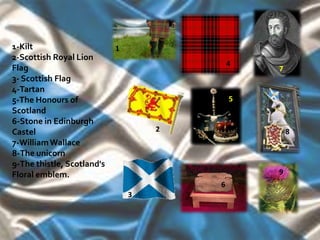
1-Kilt                      1
2-Scottish Royal Lion
                                            4
Flag                                            7
3- Scottish Flag
4-Tartan
5-The Honours of                            5
Scotland
6-Stone in Edinburgh
Castel                              2               8
7-William Wallace
8-The unicorn
9-The thistle, Scotland's
Floral emblem.                                  9
                                        6
                                3
Scotland

Scotland

  • 1.
  • 6.
    Walrus Golden Eagle Elk Lynx Wolf Brown Bear
  • 9.
    All 3- and4-year-old children in Scotland are entitled to a free nursery place. Formal primary education begins at approximately 5 years old and lasts for 7 years. Today, children in Scotland study Standard Grades, or more recently Intermediate qualifications between the ages of 14 and 16. The school leaving age is 16, after which students may choose to remain at school and study for Access, Intermediate or Higher Grade and Advanced Higher qualifications. There are 15 Scottish universities, some of which are amongst the oldest in the world. These include the University of St Andrews, the University of Glasgow, the University of Aberdeen, the University of Edinburgh, the Heriot-Watt University, and the University of Dundee – many of which are ranked amongst the best in the UK.
  • 10.
    University of University of Dundee St Andrews Heriot-Watt University University of Glasgow University of Aberdeen
  • 12.
    Scottish literature includestext written in English, Scottish Gaelic, Scots, French, and Latin. The poet and songwriter Robert Burns wrote in the Scots language, although much of his writing is also in English and in a "light" Scots dialect which is more accessible to a wider audience. Similarly, the writings of Sir Walter Scott and Sir Arthur Conan Doyle were internationally successful during the 19th and early 20th Centuries. More recently, author J.K. Rowling has become one of the most popular authors in the world (and one of the wealthiest) through her Harry Potter series, which she began writing from a coffee-shop in Edinburgh. Scottish theatre has for many years played an important role in Scottish society, from the music hall variety of Sir Harry Lauder and his contemporaries to the more serious plays put on at the Citizens Theatre in Glasgow and many other theatres throughout Scotland.
  • 13.
    Sport is animportant element in Scottish culture, with the country hosting many of its own national sporting competitions. It enjoys independent representation at many international sporting events including the FIFA World Cup, the Rugby Union World Cup, the Rugby League World Cup, the Cricket World Cup and the Commonwealth Games, but not at the Olympic Games where Scottish athletes are part of the Great Britain team. Scotland has its own national governing bodies, such as the Scottish Football Association and the Scottish Rugby Union.
  • 14.
    Robert Burns Citizens Theatre J.K. Rowling Sir Walter Scott Bagpipe Sir Arthur Conan Doyle Sir Harry Lauder Bagpipe band
  • 17.
    The Royal Standardof Scotland, a banner showing the Royal Arms of Scotland, is also frequently to be seen, particularly at sporting events involving a Scottish team. Often called the Lion Rampant (after its chief heraldic device), it is technically the property of the monarch and its use by anybody else is illegal, although this is almost universally ignored, and never enforced. The unicorn is also used as a heraldic symbol of Scotland. The Royal Coat of Arms of Scotland, used prior to 1603 by the Kings of Scotland, incorporated a lion rampant shield supported by two unicorns. On the Union of the Crowns, the Arms were quartered with those of England and Ireland, and one unicorn was replaced by a lion (the supporters of England). The Honours of Scotland, the Scottish Crown Jewels, are displayed in the Crown Room of Edinburgh Castle, from where they are removed only for State Occasions.
  • 18.
    Stylised versions ofthe Crown of Scotland appear upon the badges of the Royal Regiment of Scotland, those of the Scottish Police Forces, the Scottish Ambulance Service and upon Royal Mail premises, vehicles and pillar/wall boxes in Scotland. William Wallace, a national hero and a leader in the Scottish Wars of Independence. The thistle, the floral emblem of Scotland, features in many Scottish symbols and logos, and on UK currency. Heather is also considered to be a symbol of Scotland. St Andrew's Day, the 30 November, is the national day, although Burns' Night tends to be more widely observed. Tartan Day is a recent innovation from Canada. In 2006, the Scottish Parliament passed the St. Andrew's Day Bank Holiday (Scotland) Act 2007, designating the day to be an official bank holiday
  • 19.
    Scotland has noofficial national anthem. There are several candidates, however: Flower of Scotland is popularly held to be the National Anthem of Scotland, and is played at events such as football and rugby matches involving the Scotland national teams, and as of 2010 is used for the Scottish team at the Commonwealth Games. Other candidates include Scotland the Brave, Highland Cathedral, Scots Wha Hae and A Man's A Man for A' That. [1] Tartan is a specific woven textile pattern that often signifies a particular Scottish clan, as featured in a kilt. The kilt is a kilt men, pleated at the back, pierced the front, the length of the waist to the knees. In Scotland, was originally made and traditionally woven of wool and tartan patterns, being used by warriors and scouts clans, each clan having its own tartan. It was the typical dress of men and boys of the Scottish Highlands of the sixteenth century.
  • 20.
    1-Kilt 1 2-Scottish Royal Lion 4 Flag 7 3- Scottish Flag 4-Tartan 5-The Honours of 5 Scotland 6-Stone in Edinburgh Castel 2 8 7-William Wallace 8-The unicorn 9-The thistle, Scotland's Floral emblem. 9 6 3