Welcome ECE Students
Welcome To Peru
(South America)
History & Overview of Peru
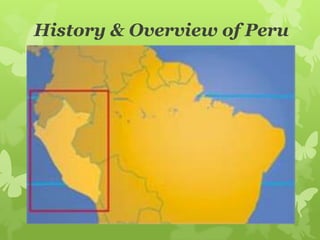
 Peru is the third largest country in South
America. The capital city in Peru is the Lime;
area has a population of 8.27 million. Peru is
the Western South America, bordering the
South Pacific Ocean, between Chile and
Ecuador. In Peru the language they speak is
Spanish.
 The Ethnic of Peru Amerindian (45%), Mestizo
(37%)-mixed Amerindian and white), European
(15%), African, Japanese, Chinese, and other
(3%). And there is Roman Catholic (90%) in
Peru. And the temperature of Peru is moderate
year-round, averaging 65°F (18°C). And Peru
has gold, silver, copper, iron and natural gas.
The History of the
Childcare System
Childcare is caring for and supervision of a child
or children. Peru is still one of the countries in
Latin America with the highest level of income
inequality.
Nearly one out of two Peruvians lives in poverty-
three out of five in the case of children.
 In 1902, the first kindergarten for children 2 to 8 year
old.
 In 1985, Childcare started breakfast program in the
slums of Peru feeding around 500 children.
 In 1993:Ministry of education and UNICEF
developed the national house daycare
certifies.
Constitution makes compulsion for children
aged 5 to 6 year old to have one year early
education primary school.
The Underlying
Philosophy
 Great difference due to household income and
demographic.
- More focus is placed on children over 3 years old.
 Government believes it’s important for younger children
to have early education to promote good nutrition,
health and immunization.
 Regarding art, independence and creativity, Peru
believe these are important educational points.
Childcare Availability
 2 main types of childcare include government funded
(formal) and community based centers (informal)
 Formal centers are found mostly in the city
focus is placed on education and integration into primary
school
 Community centers are located in rural neighborhoods
focus is placed on health and nutrition
 Private centers are available but limited
ECCE vs. ECE
Formal training: Professionals require 3 or 5 year degree
support staff including nutritionist and
social workers available
(Primary and Secondary school)
Informal training: Depends on age group for child care
community agents/professionals usually
provide some materials and training for
educators
(Community based day care)

Peru powerpoint

  • 1.
    Welcome ECE Students WelcomeTo Peru (South America)
  • 2.
  • 3.
    History & Overviewof Peru  Peru is the third largest country in South America. The capital city in Peru is the Lime; area has a population of 8.27 million. Peru is the Western South America, bordering the South Pacific Ocean, between Chile and Ecuador. In Peru the language they speak is Spanish.  The Ethnic of Peru Amerindian (45%), Mestizo (37%)-mixed Amerindian and white), European (15%), African, Japanese, Chinese, and other (3%). And there is Roman Catholic (90%) in Peru. And the temperature of Peru is moderate year-round, averaging 65°F (18°C). And Peru has gold, silver, copper, iron and natural gas.
  • 4.
    The History ofthe Childcare System Childcare is caring for and supervision of a child or children. Peru is still one of the countries in Latin America with the highest level of income inequality. Nearly one out of two Peruvians lives in poverty- three out of five in the case of children.
  • 5.
     In 1902,the first kindergarten for children 2 to 8 year old.  In 1985, Childcare started breakfast program in the slums of Peru feeding around 500 children.  In 1993:Ministry of education and UNICEF developed the national house daycare certifies. Constitution makes compulsion for children aged 5 to 6 year old to have one year early education primary school.
  • 6.
    The Underlying Philosophy  Greatdifference due to household income and demographic. - More focus is placed on children over 3 years old.  Government believes it’s important for younger children to have early education to promote good nutrition, health and immunization.  Regarding art, independence and creativity, Peru believe these are important educational points.
  • 7.
    Childcare Availability  2main types of childcare include government funded (formal) and community based centers (informal)  Formal centers are found mostly in the city focus is placed on education and integration into primary school  Community centers are located in rural neighborhoods focus is placed on health and nutrition  Private centers are available but limited
  • 8.
    ECCE vs. ECE Formaltraining: Professionals require 3 or 5 year degree support staff including nutritionist and social workers available (Primary and Secondary school) Informal training: Depends on age group for child care community agents/professionals usually provide some materials and training for educators (Community based day care)