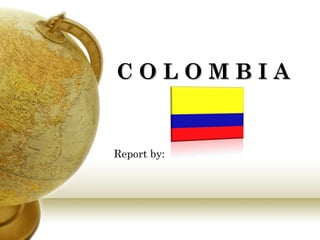
C O L O M B I AC O L O M B I A
Report by:
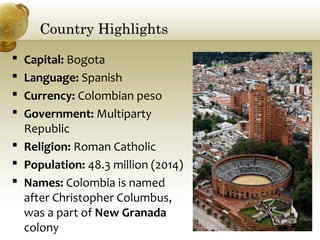
Country HighlightsCountry Highlights
 Capital: Bogota
 Language: Spanish
 Currency: Colombian peso
 Government: Multiparty
Republic
 Religion: Roman Catholic
 Population: 48.3 million (2014)
 Names: Colombia is named
after Christopher Columbus,
was a part of New Granada
colony
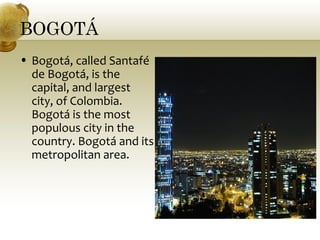
BOGOTÁ
• Bogotá, called Santafé
de Bogotá, is the
capital, and largest
city, of Colombia.
Bogotá is the most
populous city in the
country. Bogotá and its
metropolitan area.
Colombian ClimateColombian Climate
Colombia has many extremes of landscape, and
different elevations dictate various climates:
1. Hot zone (tierra caliente)
2. Temperate zone (tierra templada)
3. Cold zone (tierra fria)
4. Bleak and treeless zone (paramos)
People: AppearancePeople: Appearance
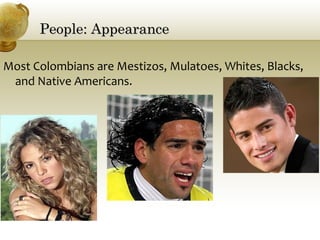
Most Colombians are Mestizos, Mulatoes, Whites, Blacks,
and Native Americans.
The people of Colombia
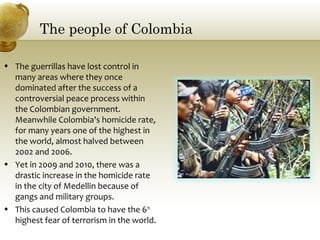
• The guerrillas have lost control in
many areas where they once
dominated after the success of a
controversial peace process within
the Colombian government.
Meanwhile Colombia's homicide rate,
for many years one of the highest in
the world, almost halved between
2002 and 2006.
• Yet in 2009 and 2010, there was a
drastic increase in the homicide rate
in the city of Medellin because of
gangs and military groups.
• This caused Colombia to have the 6th
highest fear of terrorism in the world.
Drug wars
For most of the 1980s, 90s & early 2000s, the Colombian
government was engaged in civil war which involved the
following groups:
•FARC (left wing rebels)
•ELN (left wing rebels)
•AUC (right wing paramilitaries)
Under President Uribe, the FARC rebels were brought
under control. The current President Santos is trying to
negotiate a long term peace agreement with the FARC.
Drugs In Colombia
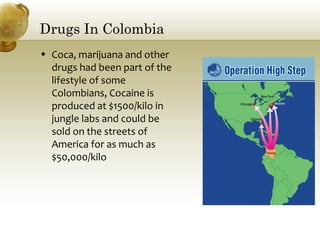
• Coca, marijuana and other
drugs had been part of the
lifestyle of some
Colombians, Cocaine is
produced at $1500/kilo in
jungle labs and could be
sold on the streets of
America for as much as
$50,000/kilo
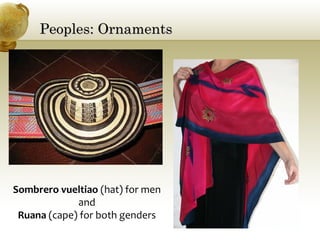
Peoples: OrnamentsPeoples: Ornaments
Sombrero vueltiao (hat) for men
and
Ruana (cape) for both genders
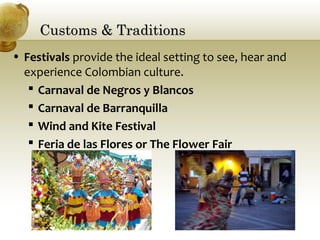
Customs & TraditionsCustoms & Traditions
• Festivals provide the ideal setting to see, hear and
experience Colombian culture.
 Carnaval de Negros y Blancos
 Carnaval de Barranquilla
 Wind and Kite Festival
 Feria de las Flores or The Flower Fair
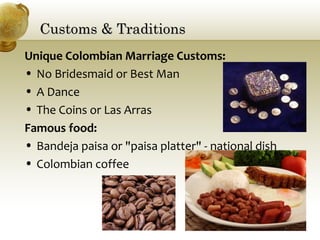
Customs & TraditionsCustoms & Traditions
Unique Colombian Marriage Customs:
• No Bridesmaid or Best Man
• A Dance
• The Coins or Las Arras
Famous food:
• Bandeja paisa or "paisa platter" - national dish
• Colombian coffee
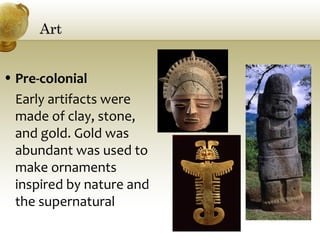
ArtArt
• Pre-colonial
Early artifacts were
made of clay, stone,
and gold. Gold was
abundant was used to
make ornaments
inspired by nature and
the supernatural
ArtArt
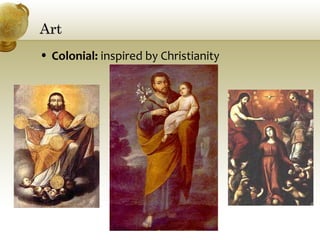
• Colonial: inspired by Christianity
ArtArt
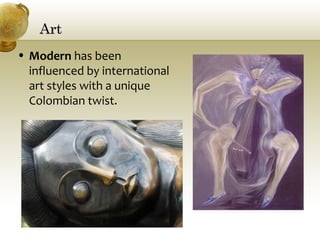
• Modern has been
influenced by international
art styles with a unique
Colombian twist.
Language: SpanishLanguage: Spanish
• Hola – Hello
• Adios – Goodbye
• Gracias – Thank you
• Si – Yes
• No – No
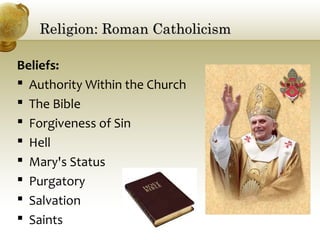
Religion: Roman CatholicismReligion: Roman Catholicism
Beliefs:
 Authority Within the Church
 The Bible
 Forgiveness of Sin
 Hell
 Mary's Status
 Purgatory
 Salvation
 Saints
Religion: Roman CatholicismReligion: Roman Catholicism
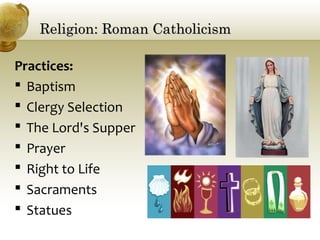
Practices:
 Baptism
 Clergy Selection
 The Lord's Supper
 Prayer
 Right to Life
 Sacraments
 Statues
Geography: Location &Geography: Location &
NeighboursNeighbours
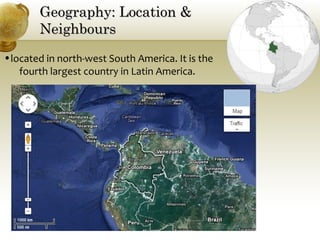
•located in north-west South America. It is the
fourth largest country in Latin America.
Map of ColombiaMap of Colombia
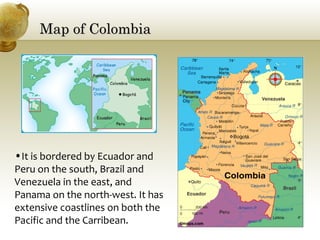
•It is bordered by Ecuador and
Peru on the south, Brazil and
Venezuela in the east, and
Panama on the north-west. It has
extensive coastlines on both the
Pacific and the Carribean.
GeographyGeography
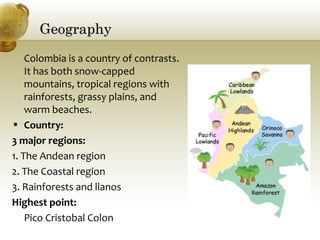
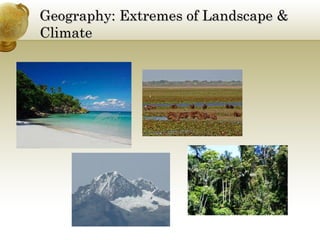
Colombia is a country of contrasts.
It has both snow-capped
mountains, tropical regions with
rainforests, grassy plains, and
warm beaches.
• Country:
3 major regions:
1. The Andean region
2. The Coastal region
3. Rainforests and llanos
Highest point:
Pico Cristobal Colon
Geography: Extremes of Landscape &Geography: Extremes of Landscape &
ClimateClimate
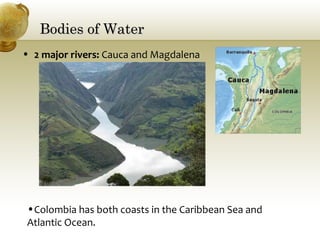
Bodies of WaterBodies of Water
• 2 major rivers: Cauca and Magdalena
•Colombia has both coasts in the Caribbean Sea and
Atlantic Ocean.
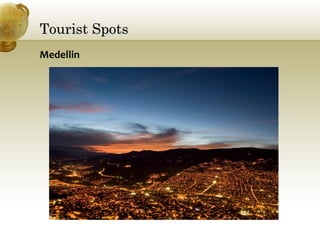
Tourist SpotsTourist Spots
Medellin
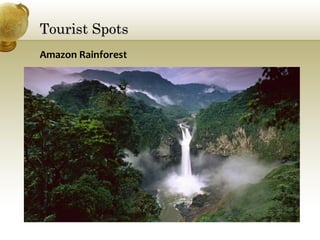
Tourist SpotsTourist Spots
Amazon Rainforest
Tourist SpotsTourist Spots
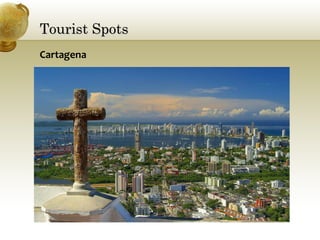
Cartagena
Tourist SpotsTourist Spots
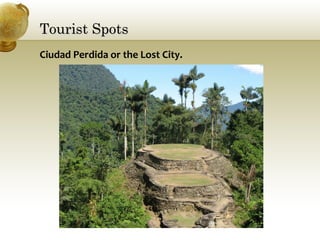
Ciudad Perdida or the Lost City.
Tourist SpotsTourist Spots
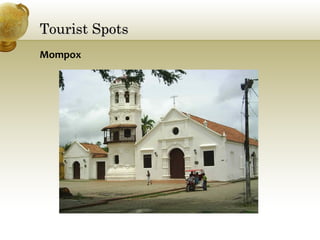
Mompox
CHICAMOCHA
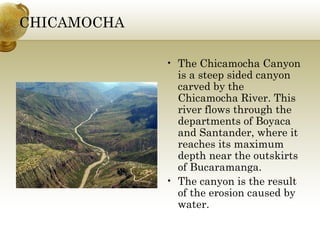
• The Chicamocha Canyon
is a steep sided canyon
carved by the
Chicamocha River. This
river flows through the
departments of Boyaca
and Santander, where it
reaches its maximum
depth near the outskirts
of Bucaramanga.
• The canyon is the result
of the erosion caused by
water.
HistoryHistory
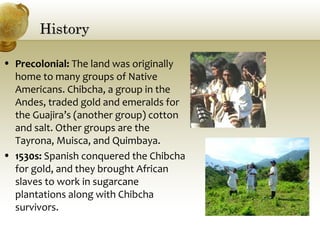
• Precolonial: The land was originally
home to many groups of Native
Americans. Chibcha, a group in the
Andes, traded gold and emeralds for
the Guajira’s (another group) cotton
and salt. Other groups are the
Tayrona, Muisca, and Quimbaya.
• 1530s: Spanish conquered the Chibcha
for gold, and they brought African
slaves to work in sugarcane
plantations along with Chibcha
survivors.
History: Legend of El DoradoHistory: Legend of El Dorado
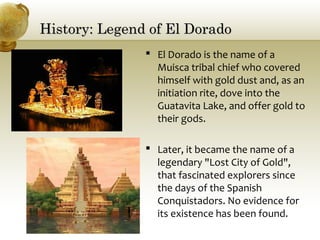
 El Dorado is the name of a
Muisca tribal chief who covered
himself with gold dust and, as an
initiation rite, dove into the
Guatavita Lake, and offer gold to
their gods.
 Later, it became the name of a
legendary "Lost City of Gold",
that fascinated explorers since
the days of the Spanish
Conquistadors. No evidence for
its existence has been found.
History
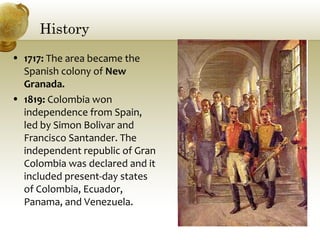
• 1717: The area became the
Spanish colony of New
Granada.
• 1819: Colombia won
independence from Spain,
led by Simon Bolivar and
Francisco Santander. The
independent republic of Gran
Colombia was declared and it
included present-day states
of Colombia, Ecuador,
Panama, and Venezuela.
HistoryHistory
• 1830: This republic has disintegrated and Colombia (with
Panama), Ecuador, and Venezuela became independent
nations. During this period, the Liberal and Conservative
parties were founded.
• 19th
century was characterized by rivalry and armed struggles
between Liberal and Conservative factions.
• 1899-1902: War of a thousand days – a civil war over
government disagreements. Another civil strife known as
‘The Violence’ flared again in 1948-1959.
• 1980s: Some wealthy Colombians engage in illegal drug
trade. The government campaigned to stop this, but has met
violent resistance from durg lords.
• Today Colombia is the third largest oil producer in South
America.
Thank You !

Colombia

  • 1.
    C O LO M B I AC O L O M B I A Report by:
  • 2.
    Country HighlightsCountry Highlights Capital: Bogota  Language: Spanish  Currency: Colombian peso  Government: Multiparty Republic  Religion: Roman Catholic  Population: 48.3 million (2014)  Names: Colombia is named after Christopher Columbus, was a part of New Granada colony
  • 3.
    BOGOTÁ • Bogotá, calledSantafé de Bogotá, is the capital, and largest city, of Colombia. Bogotá is the most populous city in the country. Bogotá and its metropolitan area.
  • 4.
    Colombian ClimateColombian Climate Colombiahas many extremes of landscape, and different elevations dictate various climates: 1. Hot zone (tierra caliente) 2. Temperate zone (tierra templada) 3. Cold zone (tierra fria) 4. Bleak and treeless zone (paramos)
  • 5.
    People: AppearancePeople: Appearance MostColombians are Mestizos, Mulatoes, Whites, Blacks, and Native Americans.
  • 6.
    The people ofColombia • The guerrillas have lost control in many areas where they once dominated after the success of a controversial peace process within the Colombian government. Meanwhile Colombia's homicide rate, for many years one of the highest in the world, almost halved between 2002 and 2006. • Yet in 2009 and 2010, there was a drastic increase in the homicide rate in the city of Medellin because of gangs and military groups. • This caused Colombia to have the 6th highest fear of terrorism in the world.
  • 7.
    Drug wars For mostof the 1980s, 90s & early 2000s, the Colombian government was engaged in civil war which involved the following groups: •FARC (left wing rebels) •ELN (left wing rebels) •AUC (right wing paramilitaries) Under President Uribe, the FARC rebels were brought under control. The current President Santos is trying to negotiate a long term peace agreement with the FARC.
  • 8.
    Drugs In Colombia •Coca, marijuana and other drugs had been part of the lifestyle of some Colombians, Cocaine is produced at $1500/kilo in jungle labs and could be sold on the streets of America for as much as $50,000/kilo
  • 9.
    Peoples: OrnamentsPeoples: Ornaments Sombrerovueltiao (hat) for men and Ruana (cape) for both genders
  • 10.
    Customs & TraditionsCustoms& Traditions • Festivals provide the ideal setting to see, hear and experience Colombian culture.  Carnaval de Negros y Blancos  Carnaval de Barranquilla  Wind and Kite Festival  Feria de las Flores or The Flower Fair
  • 11.
    Customs & TraditionsCustoms& Traditions Unique Colombian Marriage Customs: • No Bridesmaid or Best Man • A Dance • The Coins or Las Arras Famous food: • Bandeja paisa or "paisa platter" - national dish • Colombian coffee
  • 12.
    ArtArt • Pre-colonial Early artifactswere made of clay, stone, and gold. Gold was abundant was used to make ornaments inspired by nature and the supernatural
  • 13.
  • 14.
    ArtArt • Modern hasbeen influenced by international art styles with a unique Colombian twist.
  • 15.
    Language: SpanishLanguage: Spanish •Hola – Hello • Adios – Goodbye • Gracias – Thank you • Si – Yes • No – No
  • 16.
    Religion: Roman CatholicismReligion:Roman Catholicism Beliefs:  Authority Within the Church  The Bible  Forgiveness of Sin  Hell  Mary's Status  Purgatory  Salvation  Saints
  • 17.
    Religion: Roman CatholicismReligion:Roman Catholicism Practices:  Baptism  Clergy Selection  The Lord's Supper  Prayer  Right to Life  Sacraments  Statues
  • 18.
    Geography: Location &Geography:Location & NeighboursNeighbours •located in north-west South America. It is the fourth largest country in Latin America.
  • 19.
    Map of ColombiaMapof Colombia •It is bordered by Ecuador and Peru on the south, Brazil and Venezuela in the east, and Panama on the north-west. It has extensive coastlines on both the Pacific and the Carribean.
  • 20.
    GeographyGeography Colombia is acountry of contrasts. It has both snow-capped mountains, tropical regions with rainforests, grassy plains, and warm beaches. • Country: 3 major regions: 1. The Andean region 2. The Coastal region 3. Rainforests and llanos Highest point: Pico Cristobal Colon
  • 21.
    Geography: Extremes ofLandscape &Geography: Extremes of Landscape & ClimateClimate
  • 22.
    Bodies of WaterBodiesof Water • 2 major rivers: Cauca and Magdalena •Colombia has both coasts in the Caribbean Sea and Atlantic Ocean.
  • 23.
  • 24.
  • 25.
  • 26.
    Tourist SpotsTourist Spots CiudadPerdida or the Lost City.
  • 27.
  • 28.
    CHICAMOCHA • The ChicamochaCanyon is a steep sided canyon carved by the Chicamocha River. This river flows through the departments of Boyaca and Santander, where it reaches its maximum depth near the outskirts of Bucaramanga. • The canyon is the result of the erosion caused by water.
  • 29.
    HistoryHistory • Precolonial: Theland was originally home to many groups of Native Americans. Chibcha, a group in the Andes, traded gold and emeralds for the Guajira’s (another group) cotton and salt. Other groups are the Tayrona, Muisca, and Quimbaya. • 1530s: Spanish conquered the Chibcha for gold, and they brought African slaves to work in sugarcane plantations along with Chibcha survivors.
  • 30.
    History: Legend ofEl DoradoHistory: Legend of El Dorado  El Dorado is the name of a Muisca tribal chief who covered himself with gold dust and, as an initiation rite, dove into the Guatavita Lake, and offer gold to their gods.  Later, it became the name of a legendary "Lost City of Gold", that fascinated explorers since the days of the Spanish Conquistadors. No evidence for its existence has been found.
  • 31.
    History • 1717: Thearea became the Spanish colony of New Granada. • 1819: Colombia won independence from Spain, led by Simon Bolivar and Francisco Santander. The independent republic of Gran Colombia was declared and it included present-day states of Colombia, Ecuador, Panama, and Venezuela.
  • 32.
    HistoryHistory • 1830: Thisrepublic has disintegrated and Colombia (with Panama), Ecuador, and Venezuela became independent nations. During this period, the Liberal and Conservative parties were founded. • 19th century was characterized by rivalry and armed struggles between Liberal and Conservative factions. • 1899-1902: War of a thousand days – a civil war over government disagreements. Another civil strife known as ‘The Violence’ flared again in 1948-1959. • 1980s: Some wealthy Colombians engage in illegal drug trade. The government campaigned to stop this, but has met violent resistance from durg lords. • Today Colombia is the third largest oil producer in South America.
  • 33.