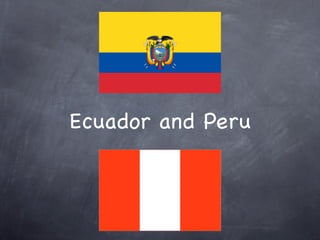
Ecuador and Peru
ECUADOR: Location
ECUADOR: Location


“Ecuador” is the Spanish word for (1) EQUATOR, which
runs through the country.
ECUADOR: Location


“Ecuador” is the Spanish word for (1) EQUATOR, which
runs through the country.

West of Ecuador is the Pacific Ocean and the (2)
GALAPAGOS ISLANDS.
ECUADOR: Location


“Ecuador” is the Spanish word for (1) EQUATOR, which
runs through the country.

West of Ecuador is the Pacific Ocean and the (2)
GALAPAGOS ISLANDS.

(3) COLOMBIA is to the north and (4) PERU is to the
east and south.
Land and Climate
Land and Climate
(5) SWAMPS and FERTILE PLAINS stretch along the
coast.
Land and Climate
(5) SWAMPS and FERTILE PLAINS stretch along the
coast.

The (6) ANDES MOUNTAINS run through the center of
the country. (HOW WERE THE ANDES FORMED?)
Land and Climate
(5) SWAMPS and FERTILE PLAINS stretch along the
coast.

The (6) ANDES MOUNTAINS run through the center of
the country. (HOW WERE THE ANDES FORMED?)
    the South American (continental) plate
    collided with the Nazca Plate (oceanic)
Land and Climate
(5) SWAMPS and FERTILE PLAINS stretch along the
coast.

The (6) ANDES MOUNTAINS run through the center of
the country. (HOW WERE THE ANDES FORMED?)
Land and Climate
(5) SWAMPS and FERTILE PLAINS stretch along the
coast.

The (6) ANDES MOUNTAINS run through the center of
the country. (HOW WERE THE ANDES FORMED?)

The (7) PERU CURRENT in the Pacific helps keep
temperatures mild.
Land and Climate
(5) SWAMPS and FERTILE PLAINS stretch along the
coast.

The (6) ANDES MOUNTAINS run through the center of
the country. (HOW WERE THE ANDES FORMED?)

The (7) PERU CURRENT in the Pacific helps keep
temperatures mild.

In the east are hot and humid (8) RAIN FORESTS.
Land and Climate
(5) SWAMPS and FERTILE PLAINS stretch along the
coast.

The (6) ANDES MOUNTAINS run through the center of
the country. (HOW WERE THE ANDES FORMED?)

The (7) PERU CURRENT in the Pacific helps keep
temperatures mild.

In the east are hot and humid (8) RAIN FORESTS.

The capital, (9) QUITO, lies more than 9,000 feet above
sea level.
Economy
Economy

(10) AGRICULTURE is the most important economic
activity.
Economy

(10) AGRICULTURE is the most important economic
activity.

Along the (11) COASTAL LOWLANDS bananas, cacao,
coffee, rice, and sugarcane are grown.
Economy

(10) AGRICULTURE is the most important economic
activity.

Along the (11) COASTAL LOWLANDS bananas, cacao,
coffee, rice, and sugarcane are grown.

In the (12) ANDEAN HIGHLANDS, farmers grow coffee,
beans, corn, potatoes, and wheat.
Economy

(10) AGRICULTURE is the most important economic
activity.

Along the (11) COASTAL LOWLANDS bananas, cacao,
coffee, rice, and sugarcane are grown.

In the (12) ANDEAN HIGHLANDS, farmers grow coffee,
beans, corn, potatoes, and wheat.

(13) PETROLEUM is also found in the lowlands in the
east.
People
People

(14) MESTIZOS and NATIVE AMERICANS each make up
about (15) 40% of the population.
People

(14) MESTIZOS and NATIVE AMERICANS each make up
about (15) 40% of the population.

(16) SPANISH is the official language, but many Native
Americans speak their traditional languages.
People

(14) MESTIZOS and NATIVE AMERICANS each make up
about (15) 40% of the population.

(16) SPANISH is the official language, but many Native
Americans speak their traditional languages.

There are about (17) 12.6 million people; about half of
the population lives along the coast.
People

(14) MESTIZOS and NATIVE AMERICANS each make up
about (15) 40% of the population.

(16) SPANISH is the official language, but many Native
Americans speak their traditional languages.

There are about (17) 12.6 million people; about half of
the population lives along the coast.

The largest city is the port of (18) GUAYAQUIL.
Did you know?
Did you know?

Ecuador’s mountains are home to (19) CLOUD FORESTS,
tropical mountain forests that are constantly covered in
clouds and mist.
Did you know?

Ecuador’s mountains are home to (19) CLOUD FORESTS,
tropical mountain forests that are constantly covered in
clouds and mist.

More than a million species of (20) INSECTS, 1,500
species of birds, and 4,500 species of (21) BUTTERFLIES
live in Ecuador.
Did you know?

Ecuador’s mountains are home to (19) CLOUD FORESTS,
tropical mountain forests that are constantly covered in
clouds and mist.

More than a million species of (20) INSECTS, 1,500
species of birds, and 4,500 species of (21) BUTTERFLIES
live in Ecuador.

The rain forest is home to the world’s loudest monkey
(the howler monkey) and smallest monkey (the pygmy
marmoset).
PERU: Location
PERU: Location


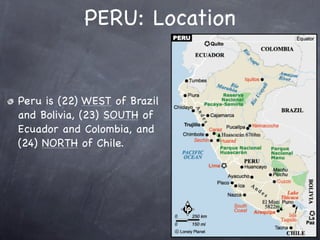
Peru is (22) WEST of Brazil
and Bolivia, (23) SOUTH of
Ecuador and Colombia, and
(24) NORTH of Chile.
PERU: Location


Peru is (22) WEST of Brazil
and Bolivia, (23) SOUTH of
Ecuador and Colombia, and
(24) NORTH of Chile.

To the west of Peru is the
(25) PACIFIC OCEAN.
Land and Climate
Land and Climate
In Peru, there are dry (26) DESERTS, snowcapped
mountains (the (27) ANDES), and hot, humid (28) RAIN
FORESTS.
Land and Climate
In Peru, there are dry (26) DESERTS, snowcapped
mountains (the (27) ANDES), and hot, humid (28) RAIN
FORESTS.

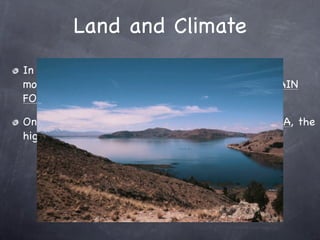
On Peru’s border with Bolivia is (29) LAKE TITICACA, the
highest navigable lake in the world.
Land and Climate
In Peru, there are dry (26) DESERTS, snowcapped
mountains (the (27) ANDES), and hot, humid (28) RAIN
FORESTS.

On Peru’s border with Bolivia is (29) LAKE TITICACA, the
highest navigable lake in the world.
Land and Climate
In Peru, there are dry (26) DESERTS, snowcapped
mountains (the (27) ANDES), and hot, humid (28) RAIN
FORESTS.

On Peru’s border with Bolivia is (29) LAKE TITICACA, the
highest navigable lake in the world.
Land and Climate
In Peru, there are dry (26) DESERTS, snowcapped
mountains (the (27) ANDES), and hot, humid (28) RAIN
FORESTS.

On Peru’s border with Bolivia is (29) LAKE TITICACA, the
highest navigable lake in the world.

East of the Andes is the (30) AMAZON BASIN.
Land and Climate
In Peru, there are dry (26) DESERTS, snowcapped
mountains (the (27) ANDES), and hot, humid (28) RAIN
FORESTS.

On Peru’s border with Bolivia is (29) LAKE TITICACA, the
highest navigable lake in the world.

East of the Andes is the (30) AMAZON BASIN.

The (31) PERU CURRENT in the Pacific Ocean is a cool
water climate. It helps keep the temperature mild, even
though Peru is near the Equator.
Economy
Economy

Peru’s largest exports are (32) COPPER and FISH.
Economy

Peru’s largest exports are (32) COPPER and FISH.

One third of people work in (33) AGRICULTURE - they
grow sugarcane, cotton, and coffee for export.
Economy

Peru’s largest exports are (32) COPPER and FISH.

One third of people work in (33) AGRICULTURE - they
grow sugarcane, cotton, and coffee for export.

Most people work on (34) SUBSISTENCE FARMS.
Economy

Peru’s largest exports are (32) COPPER and FISH.

One third of people work in (33) AGRICULTURE - they
grow sugarcane, cotton, and coffee for export.

Most people work on (34) SUBSISTENCE FARMS.

Native Americans in Peru were the first people ever to
grow (35) POTATOES.
Economy

Peru’s largest exports are (32) COPPER and FISH.

One third of people work in (33) AGRICULTURE - they
grow sugarcane, cotton, and coffee for export.

Most people work on (34) SUBSISTENCE FARMS.

Native Americans in Peru were the first people ever to
grow (35) POTATOES.

Today, the main crop is still (36) POTATOES.
History
History
The (37) INCAN EMPIRE existed in what is now Peru. It
stretched more than 2,500 miles along the (38) ANDES
MOUNTAINS.
History
The (37) INCAN EMPIRE existed in what is now Peru. It
stretched more than 2,500 miles along the (38) ANDES
MOUNTAINS.
The Incans had courts, military posts, trade inspections,
work rules, and complex systems of record keeping.
History
The (37) INCAN EMPIRE existed in what is now Peru. It
stretched more than 2,500 miles along the (38) ANDES
MOUNTAINS.
The Incans had courts, military posts, trade inspections,
work rules, and complex systems of record keeping.
They built (39) IRRIGATION SYSTEMS, roads, and
suspension bridges to connect their empire to the capital
(40) CUZCO.
History
The (37) INCAN EMPIRE existed in what is now Peru. It
stretched more than 2,500 miles along the (38) ANDES
MOUNTAINS.
The Incans had courts, military posts, trade inspections,
work rules, and complex systems of record keeping.
They built (39) IRRIGATION SYSTEMS, roads, and
suspension bridges to connect their empire to the capital
(40) CUZCO.
Today, the Incan ruins can be seen in (41) MACHU
PICCHU.
History
The (37) INCAN EMPIRE existed in what is now Peru. It
stretched more than 2,500 miles along the (38) ANDES
MOUNTAINS.
The Incans had courts, military posts, trade inspections,
work rules, and complex systems of record keeping.
They built (39) IRRIGATION SYSTEMS, roads, and
suspension bridges to connect their empire to the capital
(40) CUZCO.
Today, the Incan ruins can be seen in (41) MACHU
PICCHU.
Spain conquered the Incans in the early (42) 1500’S.
History
The (37) INCAN EMPIRE existed in what is now Peru. It
stretched more than 2,500 miles along the (38) ANDES
MOUNTAINS.
The Incans had courts, military posts, trade inspections,
work rules, and complex systems of record keeping.
They built (39) IRRIGATION SYSTEMS, roads, and
suspension bridges to connect their empire to the capital
(40) CUZCO.
Today, the Incan ruins can be seen in (41) MACHU
PICCHU.
Spain conquered the Incans in the early (42) 1500’S.
Peru gained its independence in (43) 1820.
Government
Government

There is a new (44) CONSTITUTION that was adopted
in 1993.
Government

There is a new (44) CONSTITUTION that was adopted
in 1993.

There is an elected president and (45) TWO vice
presidents.
Government

There is a new (44) CONSTITUTION that was adopted
in 1993.

There is an elected president and (45) TWO vice
presidents.

All Peruvians over (46) 18 may vote, except for those
serving in the (47) MILITARY.
People
People
Peru’s (48) 27.1 million people live mostly along the
coast.
People
Peru’s (48) 27.1 million people live mostly along the
coast.

The capital, (49) LIMA, is the largest city with 7 million
people.
People
Peru’s (48) 27.1 million people live mostly along the
coast.

The capital, (49) LIMA, is the largest city with 7 million
people.

About half of the people are Native Americans. Many
live in the highlands or rain forests and follow a (50)
TRADITIONAL way of life.
People
Peru’s (48) 27.1 million people live mostly along the
coast.

The capital, (49) LIMA, is the largest city with 7 million
people.

About half of the people are Native Americans. Many
live in the highlands or rain forests and follow a (50)
TRADITIONAL way of life.

The national religion is (51) CATHOLICISM and the
official language is (52) SPANISH.
Did you know?
Did you know?

Peru has more than (53) 1,500 species of bird, more
than all birds in North America and Europe (54)
COMBINED.
Did you know?

Peru has more than (53) 1,500 species of bird, more
than all birds in North America and Europe (54)
COMBINED.

The (54) VICUNA, an animal related to the llama, has
wool so soft that in ancient times only nobles were
allowed to wear clothing made from it.
Did you know?

Peru has more than (53) 1,500 species of bird, more
than all birds in North America and Europe (54)
COMBINED.

The (54) VICUNA, an animal related to the llama, has
wool so soft that in ancient times only nobles were
allowed to wear clothing made from it.

The (55) ANDES MOUNTAINS are the second-tallest
mountains in the world.

Ecuador and Peru

  • 1.
  • 2.
  • 3.
    ECUADOR: Location “Ecuador” isthe Spanish word for (1) EQUATOR, which runs through the country.
  • 4.
    ECUADOR: Location “Ecuador” isthe Spanish word for (1) EQUATOR, which runs through the country. West of Ecuador is the Pacific Ocean and the (2) GALAPAGOS ISLANDS.
  • 5.
    ECUADOR: Location “Ecuador” isthe Spanish word for (1) EQUATOR, which runs through the country. West of Ecuador is the Pacific Ocean and the (2) GALAPAGOS ISLANDS. (3) COLOMBIA is to the north and (4) PERU is to the east and south.
  • 7.
  • 8.
    Land and Climate (5)SWAMPS and FERTILE PLAINS stretch along the coast.
  • 9.
    Land and Climate (5)SWAMPS and FERTILE PLAINS stretch along the coast. The (6) ANDES MOUNTAINS run through the center of the country. (HOW WERE THE ANDES FORMED?)
  • 10.
    Land and Climate (5)SWAMPS and FERTILE PLAINS stretch along the coast. The (6) ANDES MOUNTAINS run through the center of the country. (HOW WERE THE ANDES FORMED?) the South American (continental) plate collided with the Nazca Plate (oceanic)
  • 11.
    Land and Climate (5)SWAMPS and FERTILE PLAINS stretch along the coast. The (6) ANDES MOUNTAINS run through the center of the country. (HOW WERE THE ANDES FORMED?)
  • 12.
    Land and Climate (5)SWAMPS and FERTILE PLAINS stretch along the coast. The (6) ANDES MOUNTAINS run through the center of the country. (HOW WERE THE ANDES FORMED?) The (7) PERU CURRENT in the Pacific helps keep temperatures mild.
  • 13.
    Land and Climate (5)SWAMPS and FERTILE PLAINS stretch along the coast. The (6) ANDES MOUNTAINS run through the center of the country. (HOW WERE THE ANDES FORMED?) The (7) PERU CURRENT in the Pacific helps keep temperatures mild. In the east are hot and humid (8) RAIN FORESTS.
  • 14.
    Land and Climate (5)SWAMPS and FERTILE PLAINS stretch along the coast. The (6) ANDES MOUNTAINS run through the center of the country. (HOW WERE THE ANDES FORMED?) The (7) PERU CURRENT in the Pacific helps keep temperatures mild. In the east are hot and humid (8) RAIN FORESTS. The capital, (9) QUITO, lies more than 9,000 feet above sea level.
  • 15.
  • 16.
    Economy (10) AGRICULTURE isthe most important economic activity.
  • 17.
    Economy (10) AGRICULTURE isthe most important economic activity. Along the (11) COASTAL LOWLANDS bananas, cacao, coffee, rice, and sugarcane are grown.
  • 18.
    Economy (10) AGRICULTURE isthe most important economic activity. Along the (11) COASTAL LOWLANDS bananas, cacao, coffee, rice, and sugarcane are grown. In the (12) ANDEAN HIGHLANDS, farmers grow coffee, beans, corn, potatoes, and wheat.
  • 19.
    Economy (10) AGRICULTURE isthe most important economic activity. Along the (11) COASTAL LOWLANDS bananas, cacao, coffee, rice, and sugarcane are grown. In the (12) ANDEAN HIGHLANDS, farmers grow coffee, beans, corn, potatoes, and wheat. (13) PETROLEUM is also found in the lowlands in the east.
  • 20.
  • 21.
    People (14) MESTIZOS andNATIVE AMERICANS each make up about (15) 40% of the population.
  • 22.
    People (14) MESTIZOS andNATIVE AMERICANS each make up about (15) 40% of the population. (16) SPANISH is the official language, but many Native Americans speak their traditional languages.
  • 23.
    People (14) MESTIZOS andNATIVE AMERICANS each make up about (15) 40% of the population. (16) SPANISH is the official language, but many Native Americans speak their traditional languages. There are about (17) 12.6 million people; about half of the population lives along the coast.
  • 24.
    People (14) MESTIZOS andNATIVE AMERICANS each make up about (15) 40% of the population. (16) SPANISH is the official language, but many Native Americans speak their traditional languages. There are about (17) 12.6 million people; about half of the population lives along the coast. The largest city is the port of (18) GUAYAQUIL.
  • 25.
  • 26.
    Did you know? Ecuador’smountains are home to (19) CLOUD FORESTS, tropical mountain forests that are constantly covered in clouds and mist.
  • 27.
    Did you know? Ecuador’smountains are home to (19) CLOUD FORESTS, tropical mountain forests that are constantly covered in clouds and mist. More than a million species of (20) INSECTS, 1,500 species of birds, and 4,500 species of (21) BUTTERFLIES live in Ecuador.
  • 28.
    Did you know? Ecuador’smountains are home to (19) CLOUD FORESTS, tropical mountain forests that are constantly covered in clouds and mist. More than a million species of (20) INSECTS, 1,500 species of birds, and 4,500 species of (21) BUTTERFLIES live in Ecuador. The rain forest is home to the world’s loudest monkey (the howler monkey) and smallest monkey (the pygmy marmoset).
  • 29.
  • 30.
    PERU: Location Peru is(22) WEST of Brazil and Bolivia, (23) SOUTH of Ecuador and Colombia, and (24) NORTH of Chile.
  • 31.
    PERU: Location Peru is(22) WEST of Brazil and Bolivia, (23) SOUTH of Ecuador and Colombia, and (24) NORTH of Chile. To the west of Peru is the (25) PACIFIC OCEAN.
  • 32.
  • 33.
    Land and Climate InPeru, there are dry (26) DESERTS, snowcapped mountains (the (27) ANDES), and hot, humid (28) RAIN FORESTS.
  • 34.
    Land and Climate InPeru, there are dry (26) DESERTS, snowcapped mountains (the (27) ANDES), and hot, humid (28) RAIN FORESTS. On Peru’s border with Bolivia is (29) LAKE TITICACA, the highest navigable lake in the world.
  • 35.
    Land and Climate InPeru, there are dry (26) DESERTS, snowcapped mountains (the (27) ANDES), and hot, humid (28) RAIN FORESTS. On Peru’s border with Bolivia is (29) LAKE TITICACA, the highest navigable lake in the world.
  • 36.
    Land and Climate InPeru, there are dry (26) DESERTS, snowcapped mountains (the (27) ANDES), and hot, humid (28) RAIN FORESTS. On Peru’s border with Bolivia is (29) LAKE TITICACA, the highest navigable lake in the world.
  • 37.
    Land and Climate InPeru, there are dry (26) DESERTS, snowcapped mountains (the (27) ANDES), and hot, humid (28) RAIN FORESTS. On Peru’s border with Bolivia is (29) LAKE TITICACA, the highest navigable lake in the world. East of the Andes is the (30) AMAZON BASIN.
  • 38.
    Land and Climate InPeru, there are dry (26) DESERTS, snowcapped mountains (the (27) ANDES), and hot, humid (28) RAIN FORESTS. On Peru’s border with Bolivia is (29) LAKE TITICACA, the highest navigable lake in the world. East of the Andes is the (30) AMAZON BASIN. The (31) PERU CURRENT in the Pacific Ocean is a cool water climate. It helps keep the temperature mild, even though Peru is near the Equator.
  • 39.
  • 40.
    Economy Peru’s largest exportsare (32) COPPER and FISH.
  • 41.
    Economy Peru’s largest exportsare (32) COPPER and FISH. One third of people work in (33) AGRICULTURE - they grow sugarcane, cotton, and coffee for export.
  • 42.
    Economy Peru’s largest exportsare (32) COPPER and FISH. One third of people work in (33) AGRICULTURE - they grow sugarcane, cotton, and coffee for export. Most people work on (34) SUBSISTENCE FARMS.
  • 43.
    Economy Peru’s largest exportsare (32) COPPER and FISH. One third of people work in (33) AGRICULTURE - they grow sugarcane, cotton, and coffee for export. Most people work on (34) SUBSISTENCE FARMS. Native Americans in Peru were the first people ever to grow (35) POTATOES.
  • 44.
    Economy Peru’s largest exportsare (32) COPPER and FISH. One third of people work in (33) AGRICULTURE - they grow sugarcane, cotton, and coffee for export. Most people work on (34) SUBSISTENCE FARMS. Native Americans in Peru were the first people ever to grow (35) POTATOES. Today, the main crop is still (36) POTATOES.
  • 45.
  • 46.
    History The (37) INCANEMPIRE existed in what is now Peru. It stretched more than 2,500 miles along the (38) ANDES MOUNTAINS.
  • 47.
    History The (37) INCANEMPIRE existed in what is now Peru. It stretched more than 2,500 miles along the (38) ANDES MOUNTAINS. The Incans had courts, military posts, trade inspections, work rules, and complex systems of record keeping.
  • 48.
    History The (37) INCANEMPIRE existed in what is now Peru. It stretched more than 2,500 miles along the (38) ANDES MOUNTAINS. The Incans had courts, military posts, trade inspections, work rules, and complex systems of record keeping. They built (39) IRRIGATION SYSTEMS, roads, and suspension bridges to connect their empire to the capital (40) CUZCO.
  • 49.
    History The (37) INCANEMPIRE existed in what is now Peru. It stretched more than 2,500 miles along the (38) ANDES MOUNTAINS. The Incans had courts, military posts, trade inspections, work rules, and complex systems of record keeping. They built (39) IRRIGATION SYSTEMS, roads, and suspension bridges to connect their empire to the capital (40) CUZCO. Today, the Incan ruins can be seen in (41) MACHU PICCHU.
  • 50.
    History The (37) INCANEMPIRE existed in what is now Peru. It stretched more than 2,500 miles along the (38) ANDES MOUNTAINS. The Incans had courts, military posts, trade inspections, work rules, and complex systems of record keeping. They built (39) IRRIGATION SYSTEMS, roads, and suspension bridges to connect their empire to the capital (40) CUZCO. Today, the Incan ruins can be seen in (41) MACHU PICCHU. Spain conquered the Incans in the early (42) 1500’S.
  • 51.
    History The (37) INCANEMPIRE existed in what is now Peru. It stretched more than 2,500 miles along the (38) ANDES MOUNTAINS. The Incans had courts, military posts, trade inspections, work rules, and complex systems of record keeping. They built (39) IRRIGATION SYSTEMS, roads, and suspension bridges to connect their empire to the capital (40) CUZCO. Today, the Incan ruins can be seen in (41) MACHU PICCHU. Spain conquered the Incans in the early (42) 1500’S. Peru gained its independence in (43) 1820.
  • 52.
  • 53.
    Government There is anew (44) CONSTITUTION that was adopted in 1993.
  • 54.
    Government There is anew (44) CONSTITUTION that was adopted in 1993. There is an elected president and (45) TWO vice presidents.
  • 55.
    Government There is anew (44) CONSTITUTION that was adopted in 1993. There is an elected president and (45) TWO vice presidents. All Peruvians over (46) 18 may vote, except for those serving in the (47) MILITARY.
  • 56.
  • 57.
    People Peru’s (48) 27.1million people live mostly along the coast.
  • 58.
    People Peru’s (48) 27.1million people live mostly along the coast. The capital, (49) LIMA, is the largest city with 7 million people.
  • 59.
    People Peru’s (48) 27.1million people live mostly along the coast. The capital, (49) LIMA, is the largest city with 7 million people. About half of the people are Native Americans. Many live in the highlands or rain forests and follow a (50) TRADITIONAL way of life.
  • 60.
    People Peru’s (48) 27.1million people live mostly along the coast. The capital, (49) LIMA, is the largest city with 7 million people. About half of the people are Native Americans. Many live in the highlands or rain forests and follow a (50) TRADITIONAL way of life. The national religion is (51) CATHOLICISM and the official language is (52) SPANISH.
  • 61.
  • 62.
    Did you know? Peruhas more than (53) 1,500 species of bird, more than all birds in North America and Europe (54) COMBINED.
  • 63.
    Did you know? Peruhas more than (53) 1,500 species of bird, more than all birds in North America and Europe (54) COMBINED. The (54) VICUNA, an animal related to the llama, has wool so soft that in ancient times only nobles were allowed to wear clothing made from it.
  • 64.
    Did you know? Peruhas more than (53) 1,500 species of bird, more than all birds in North America and Europe (54) COMBINED. The (54) VICUNA, an animal related to the llama, has wool so soft that in ancient times only nobles were allowed to wear clothing made from it. The (55) ANDES MOUNTAINS are the second-tallest mountains in the world.