1
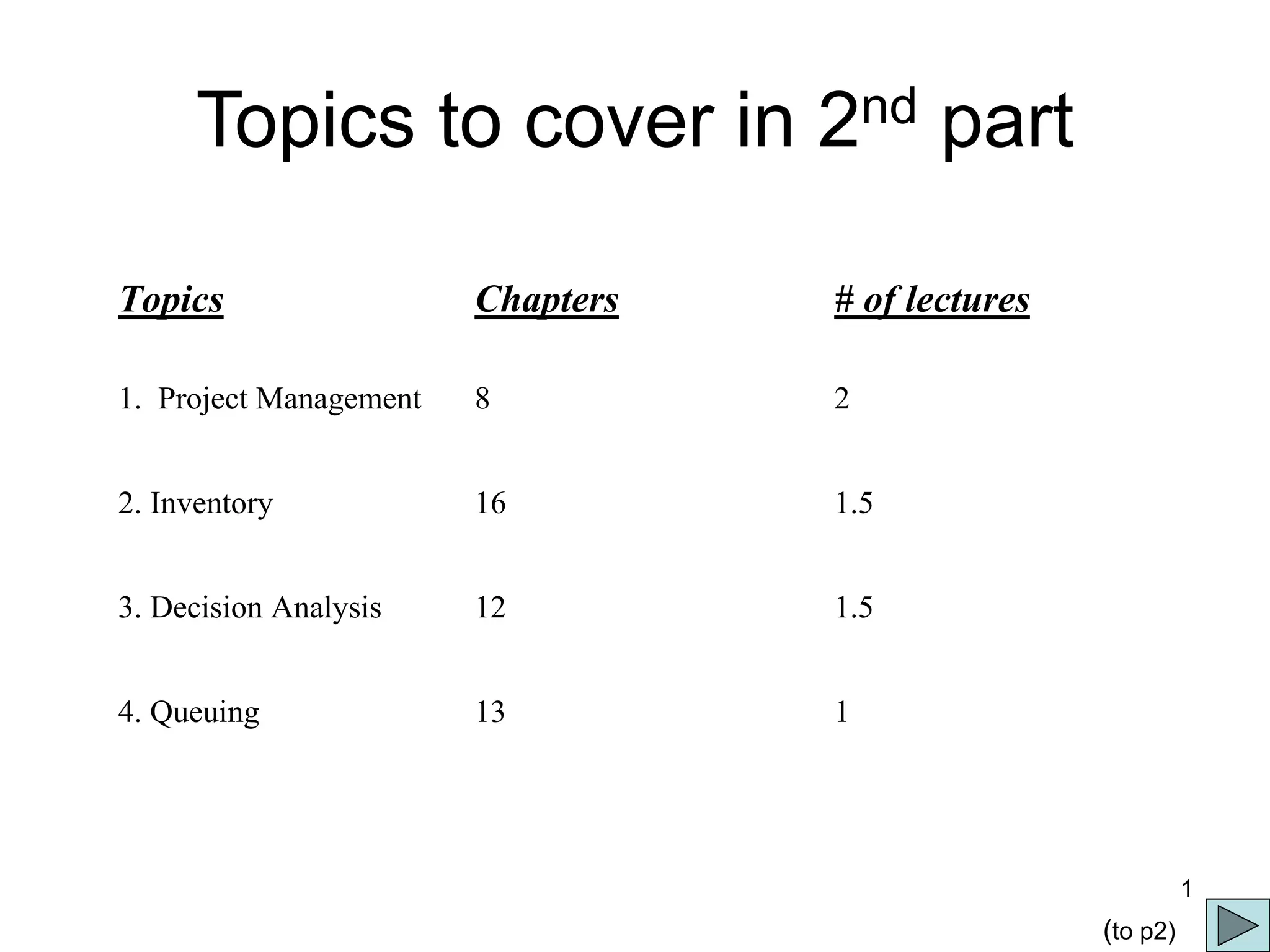
Topics to cover in 2nd part
Topics Chapters # of lectures
1. Project Management 8 2
2. Inventory 16 1.5
3. Decision Analysis 12 1.5
4. Queuing 13 1
(to p2)
2
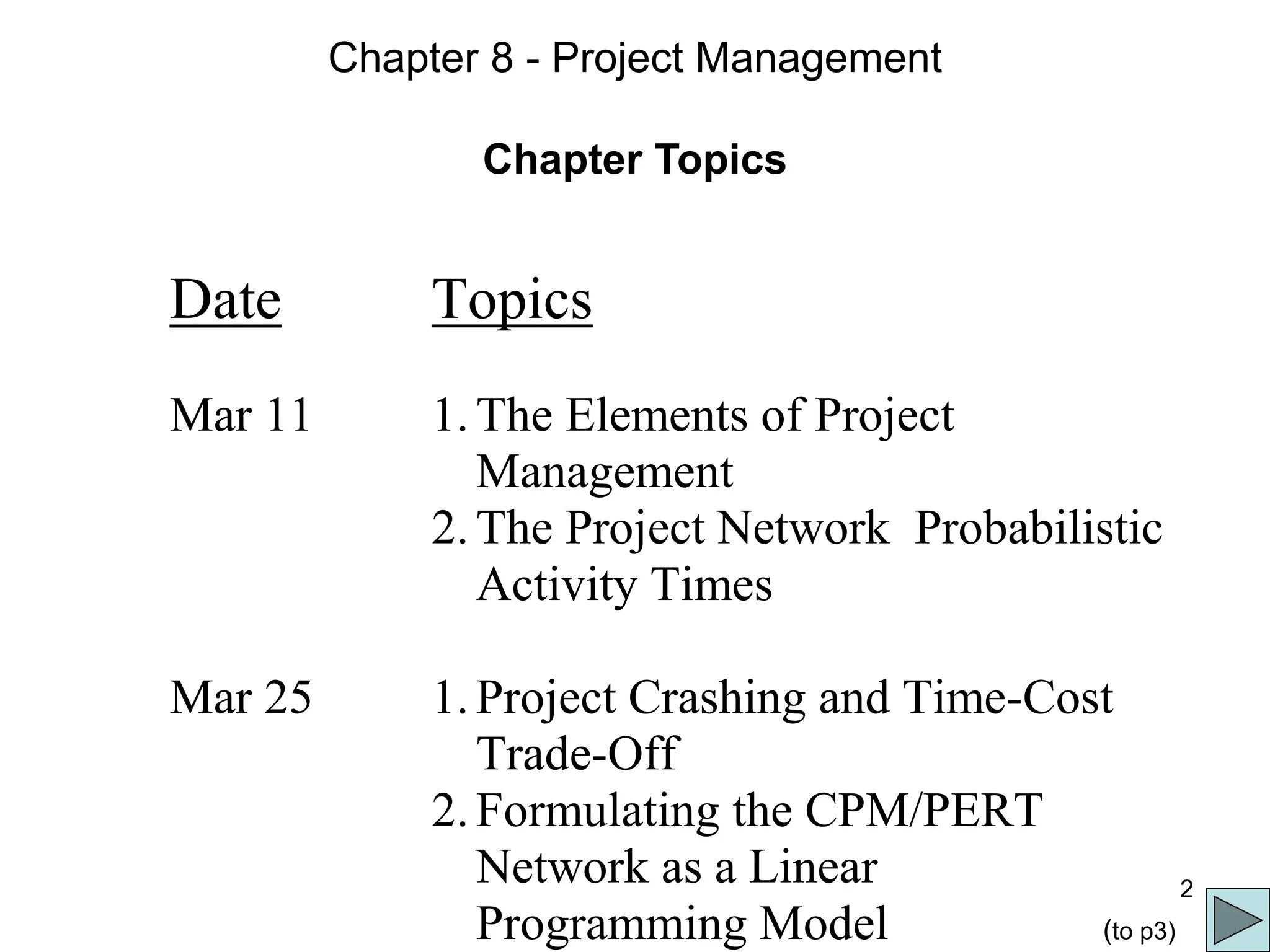
Chapter 8 - Project Management
Chapter Topics
Date Topics
Mar 11 1.The Elements of Project
Management
2.The Project Network Probabilistic
Activity Times
Mar 25 1.Project Crashing and Time-Cost
Trade-Off
2.Formulating the CPM/PERT
Network as a Linear
Programming Model (to p3)
3
Project Management
Questions:
1. Why do we need to study Project
Management?
2. How does a project management
technique work?
(to p4)
(to p5)
4
Objective
• The main purpose is to govern the
operations of a project such that all
activities involved are well administrated
and that we can also control its
completion time
(to p3)
5
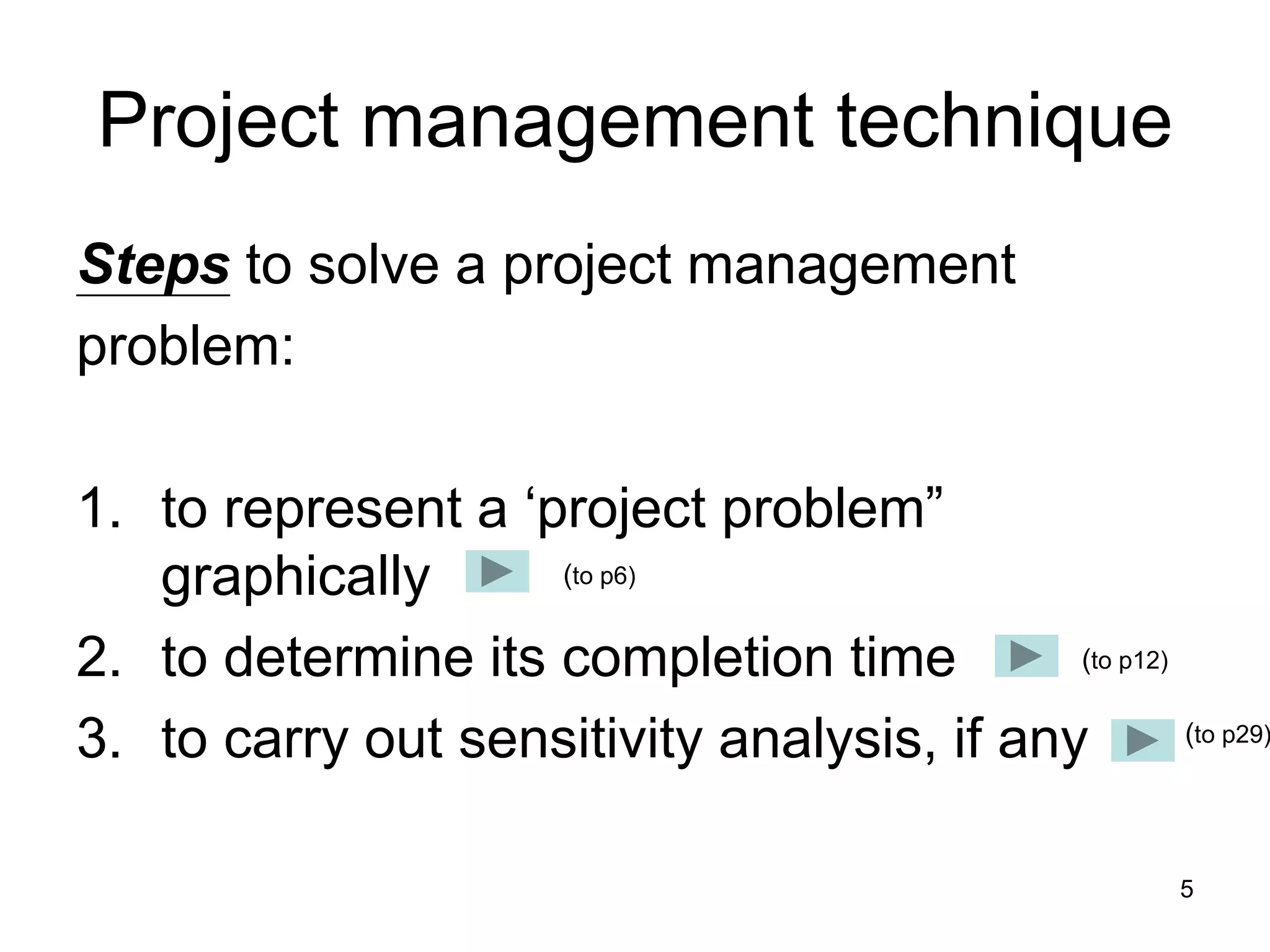
Project management technique
Steps to solve a project management
problem:
1. to represent a ‘project problem”
graphically
2. to determine its completion time
3. to carry out sensitivity analysis, if any
(to p6)
(to p12)
(to p29)
6
1. Represent a ‘project problem”
graphically
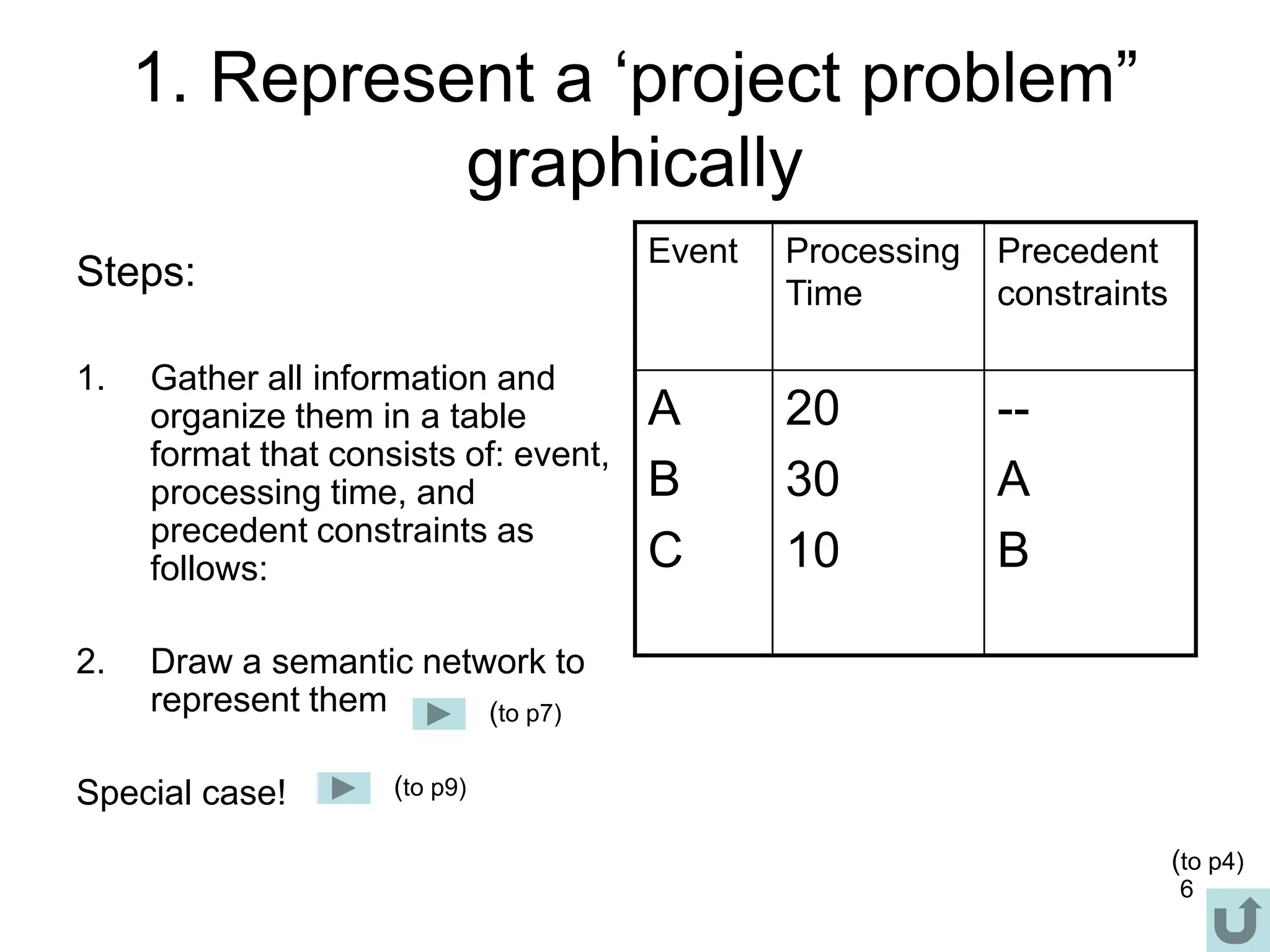
Steps:
1. Gather all information and
organize them in a table
format that consists of: event,
processing time, and
precedent constraints as
follows:
2. Draw a semantic network to
represent them
Special case!
Event Processing
Time
Precedent
constraints
A
B
C
20
30
10
--
A
B
(to p7)
(to p9)
(to p4)
7
Semantic network to represent them
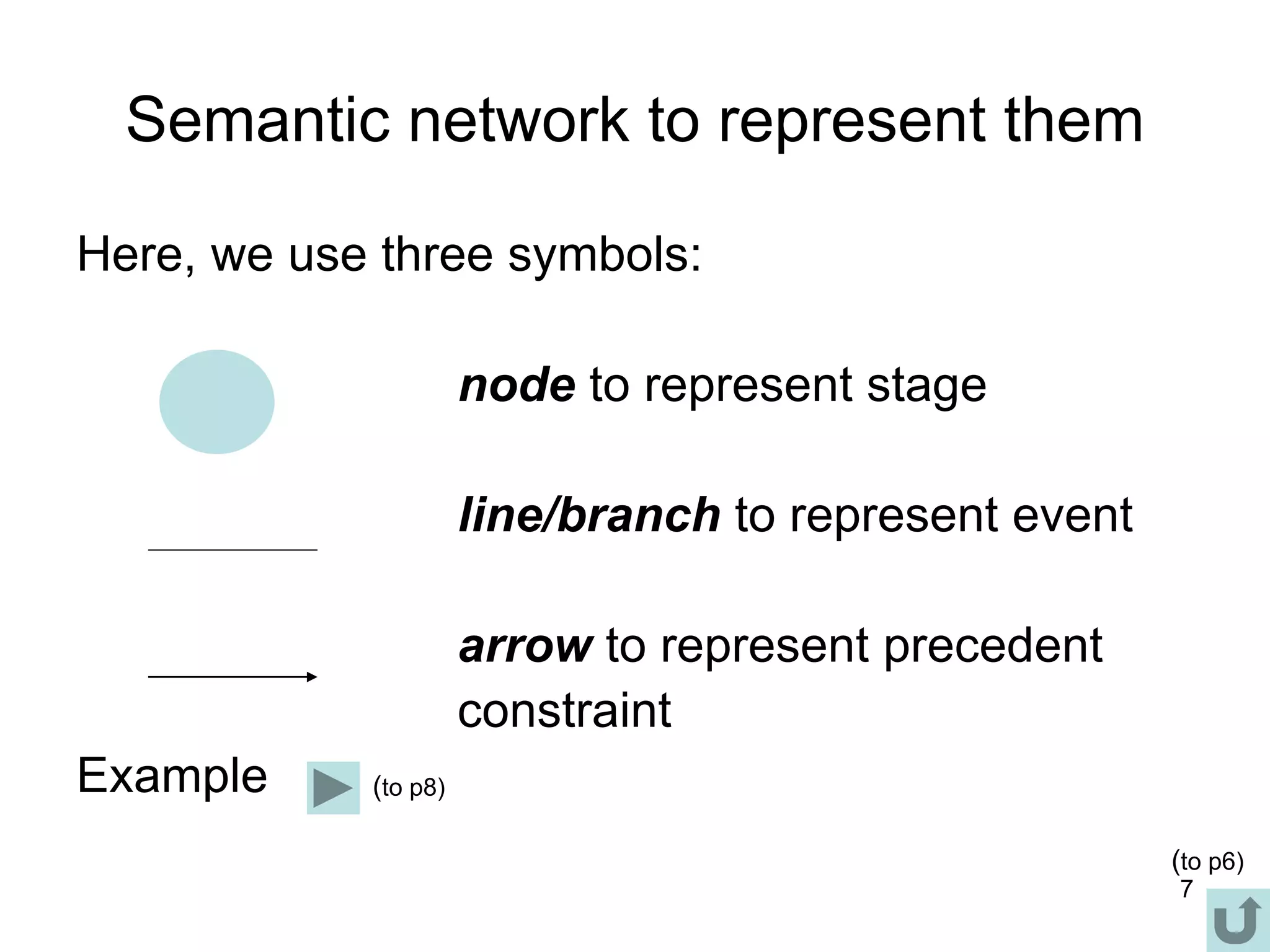
Here, we use three symbols:
node to represent stage
line/branch to represent event
arrow to represent precedent
constraint
Example (to p8)
(to p6)
8
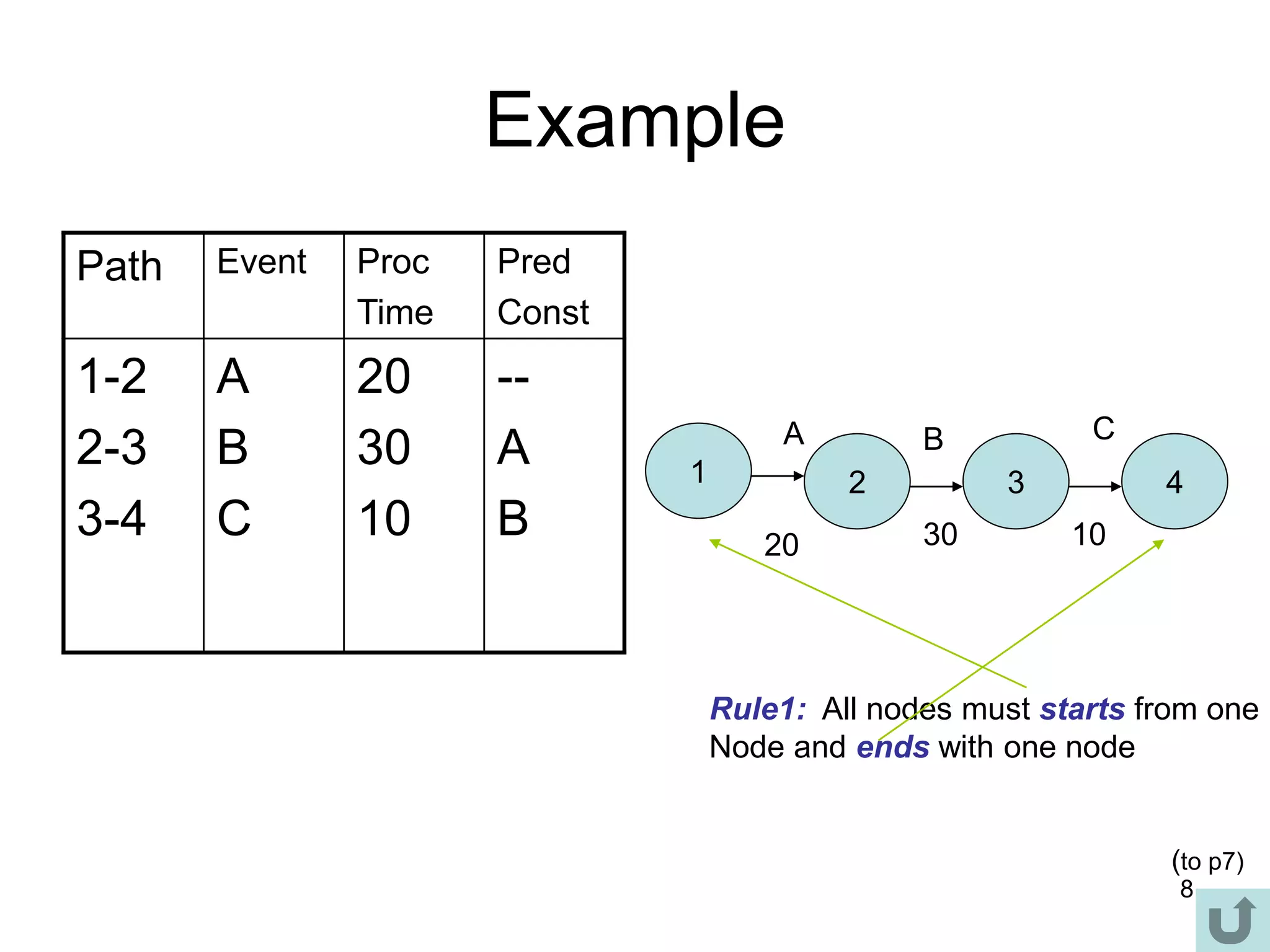
Example
1 2 3
Path Event Proc
Time
Pred
Const
1-2
2-3
3-4
A
B
C
20
30
10
--
A
B
A
4
C
B
20 30 10
Rule1: All nodes must starts from one
Node and ends with one node
(to p7)
9
Special case!
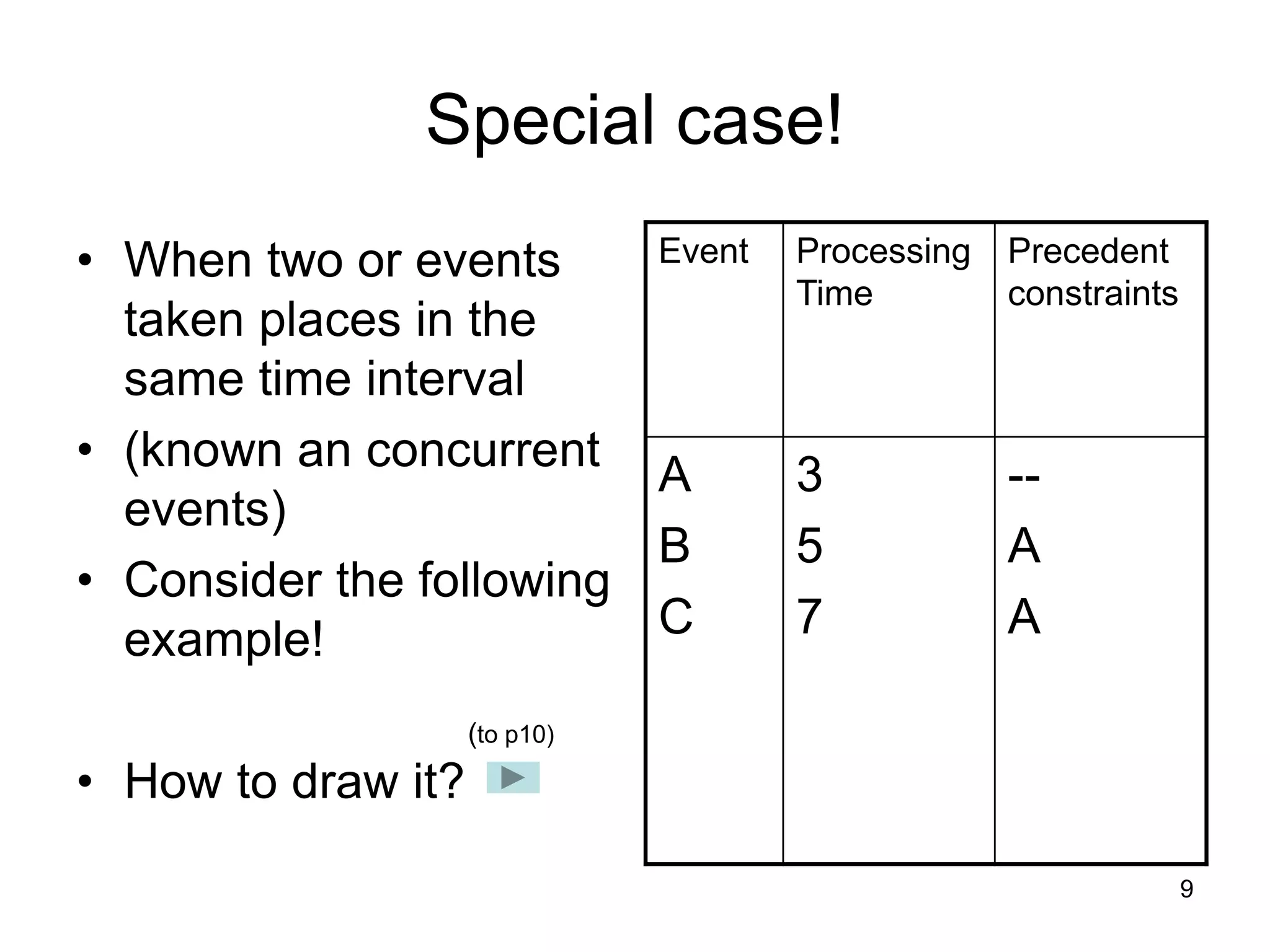
• When two or events
taken places in the
same time interval
• (known an concurrent
events)
• Consider the following
example!
• How to draw it?
Event Processing
Time
Precedent
constraints
A
B
C
3
5
7
--
A
A
(to p10)
10
Case 1
1 2 3
A B
C
3
5
7
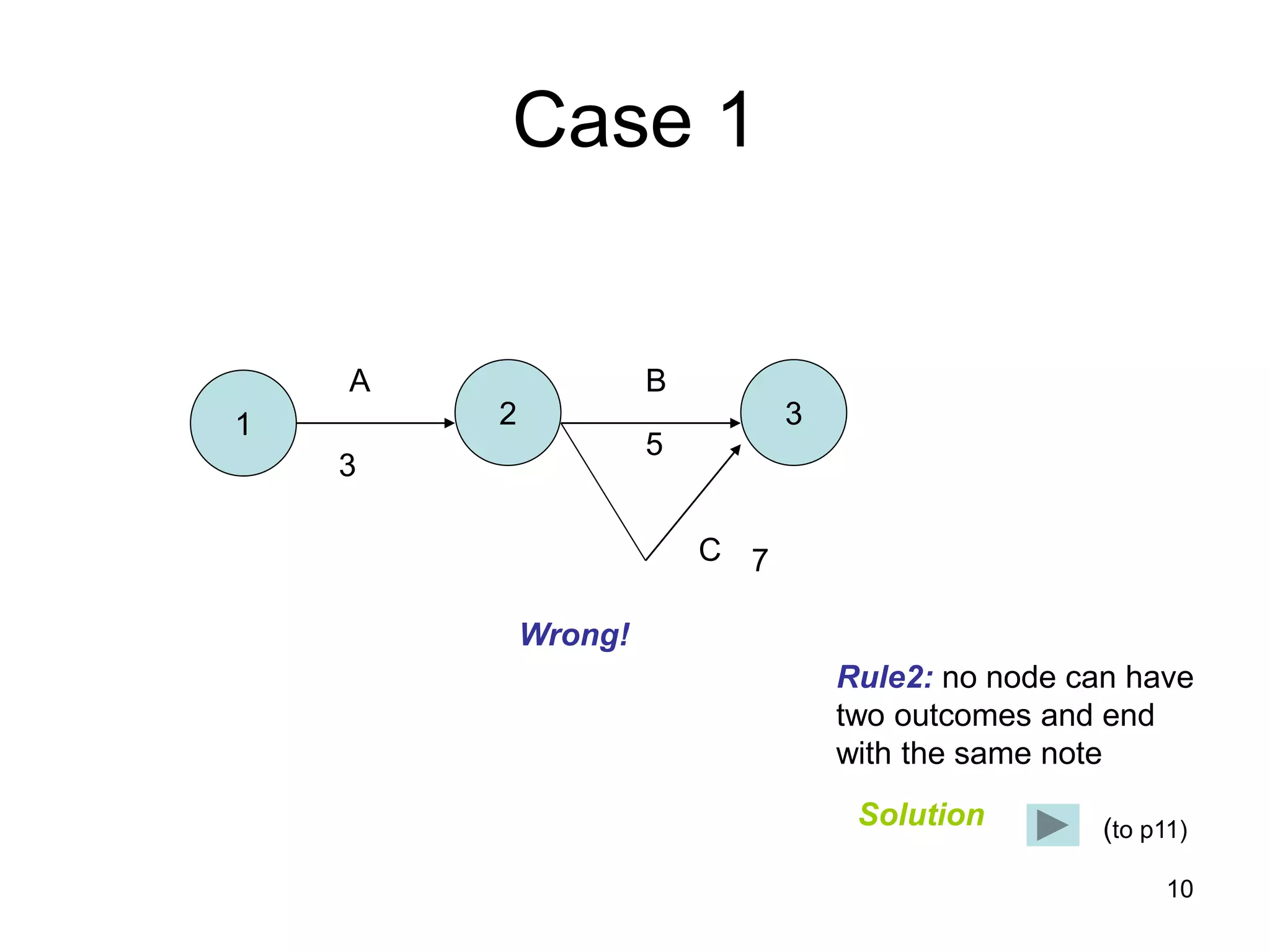
Wrong!
Rule2: no node can have
two outcomes and end
with the same note
Solution (to p11)
11
Solutions for Rule 2
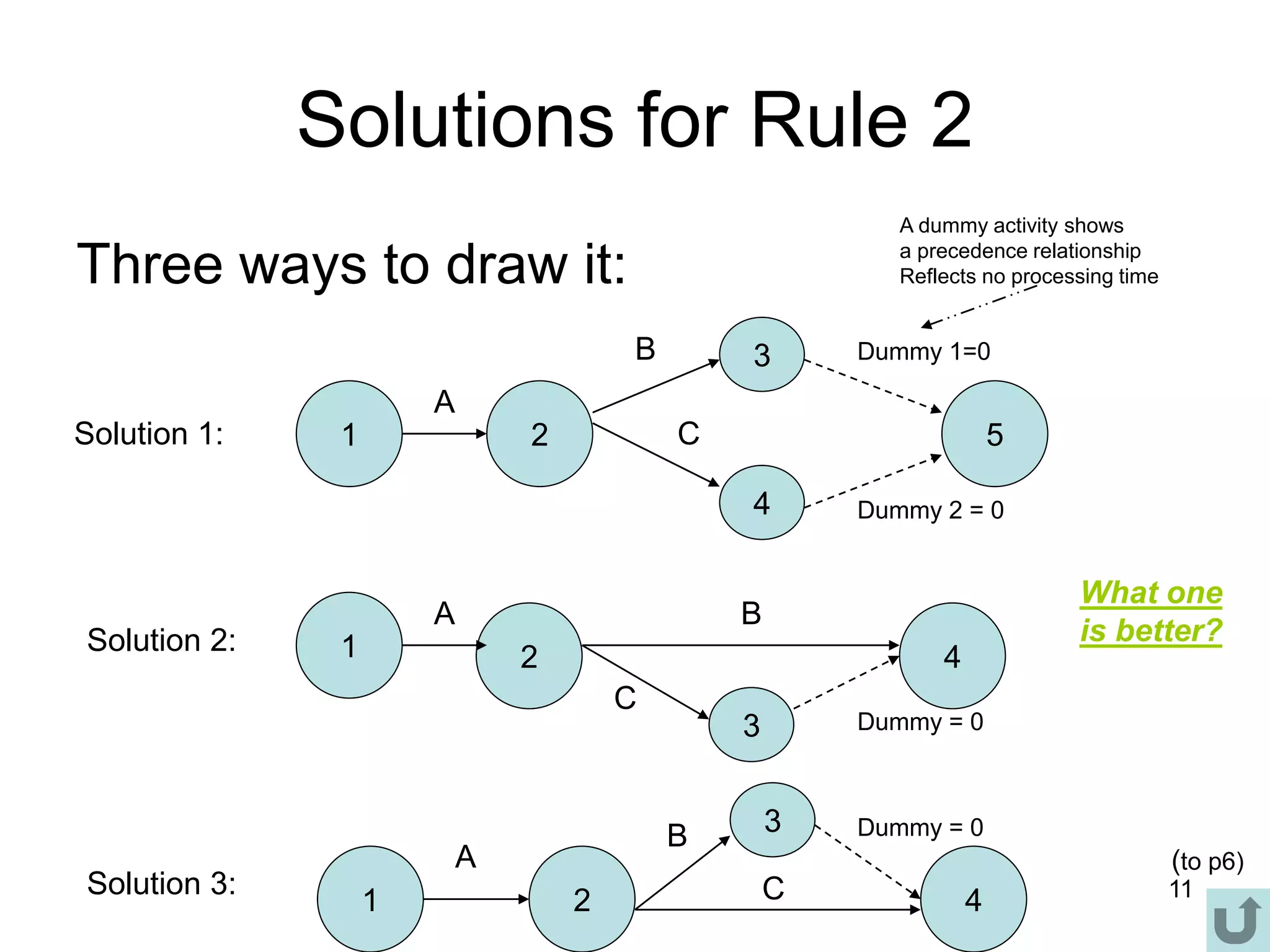
Three ways to draw it:
1 2
3
4
5
A
B
C
Dummy 1=0
Dummy 2 = 0
1 2
3
4
A B
C
Dummy = 0
1 2
3
4
A
B
C
Dummy = 0
Solution 1:
Solution 2:
Solution 3:
What one
is better?
A dummy activity shows
a precedence relationship
Reflects no processing time
(to p6)
12
2. Determine its completion time
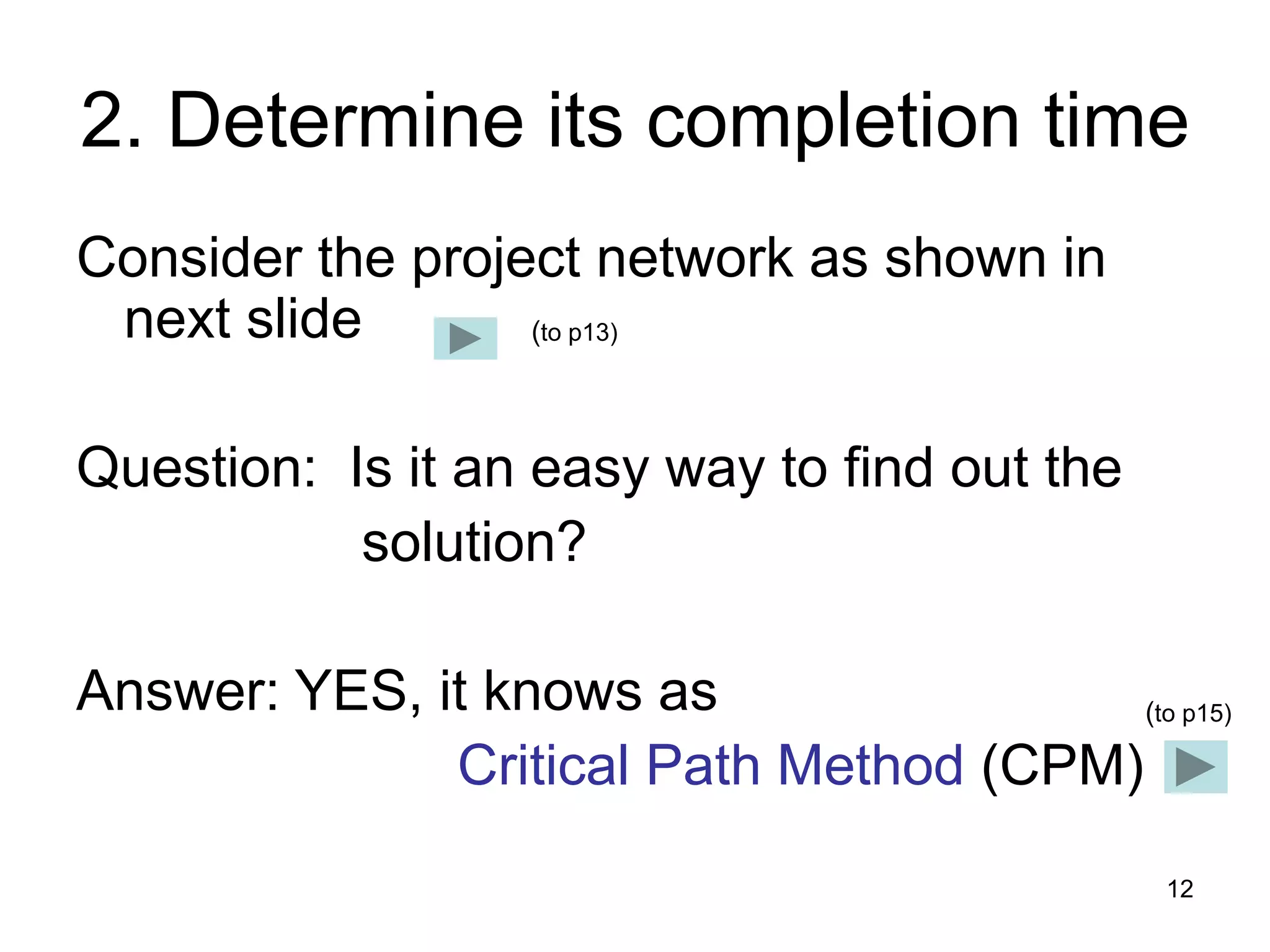
Consider the project network as shown in
next slide
Question: Is it an easy way to find out the
solution?
Answer: YES, it knows as
Critical Path Method (CPM)
(to p15)
(to p13)
13
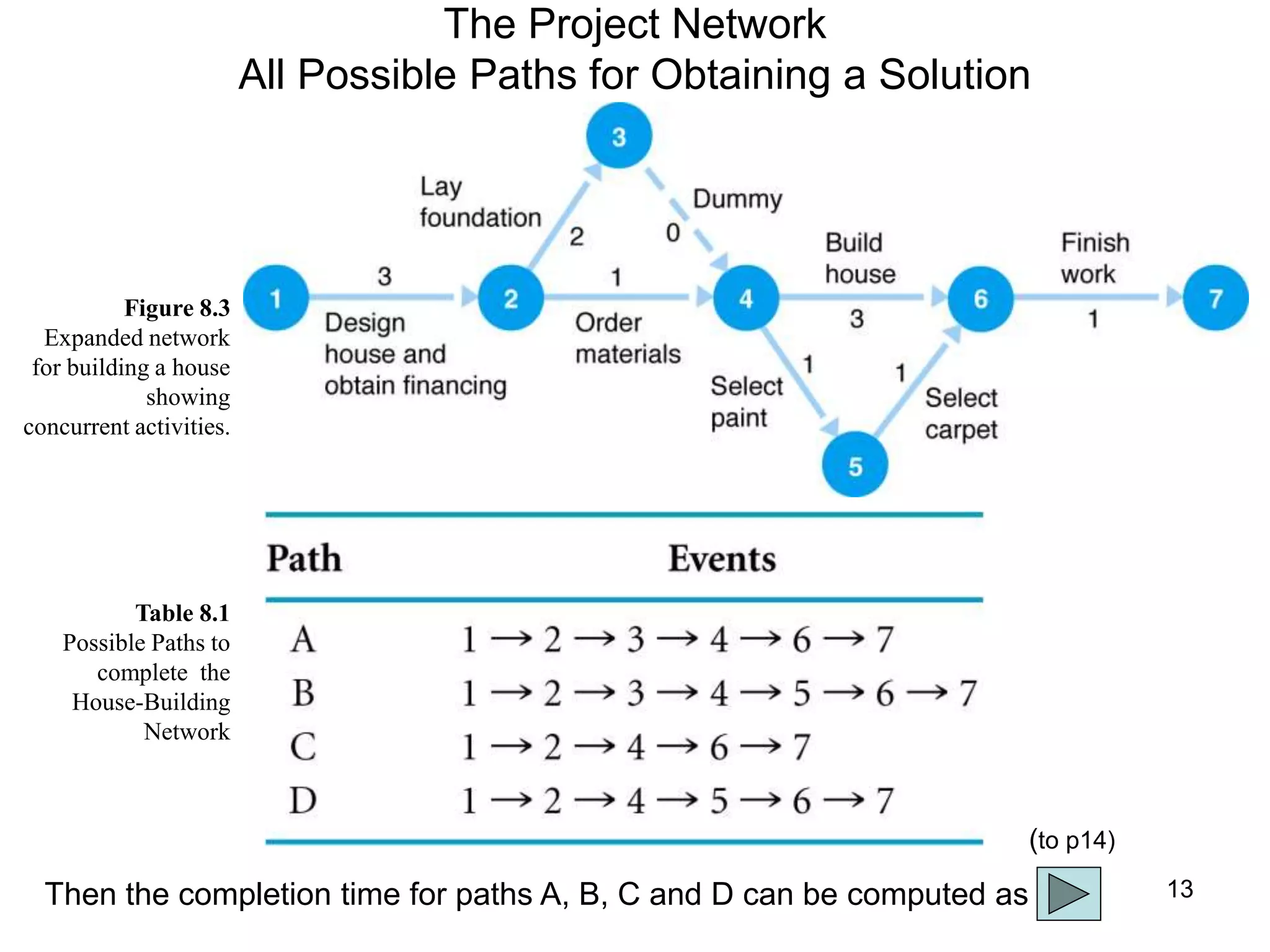
The Project Network
All Possible Paths for Obtaining a Solution
Figure 8.3
Expanded network
for building a house
showing
concurrent activities.
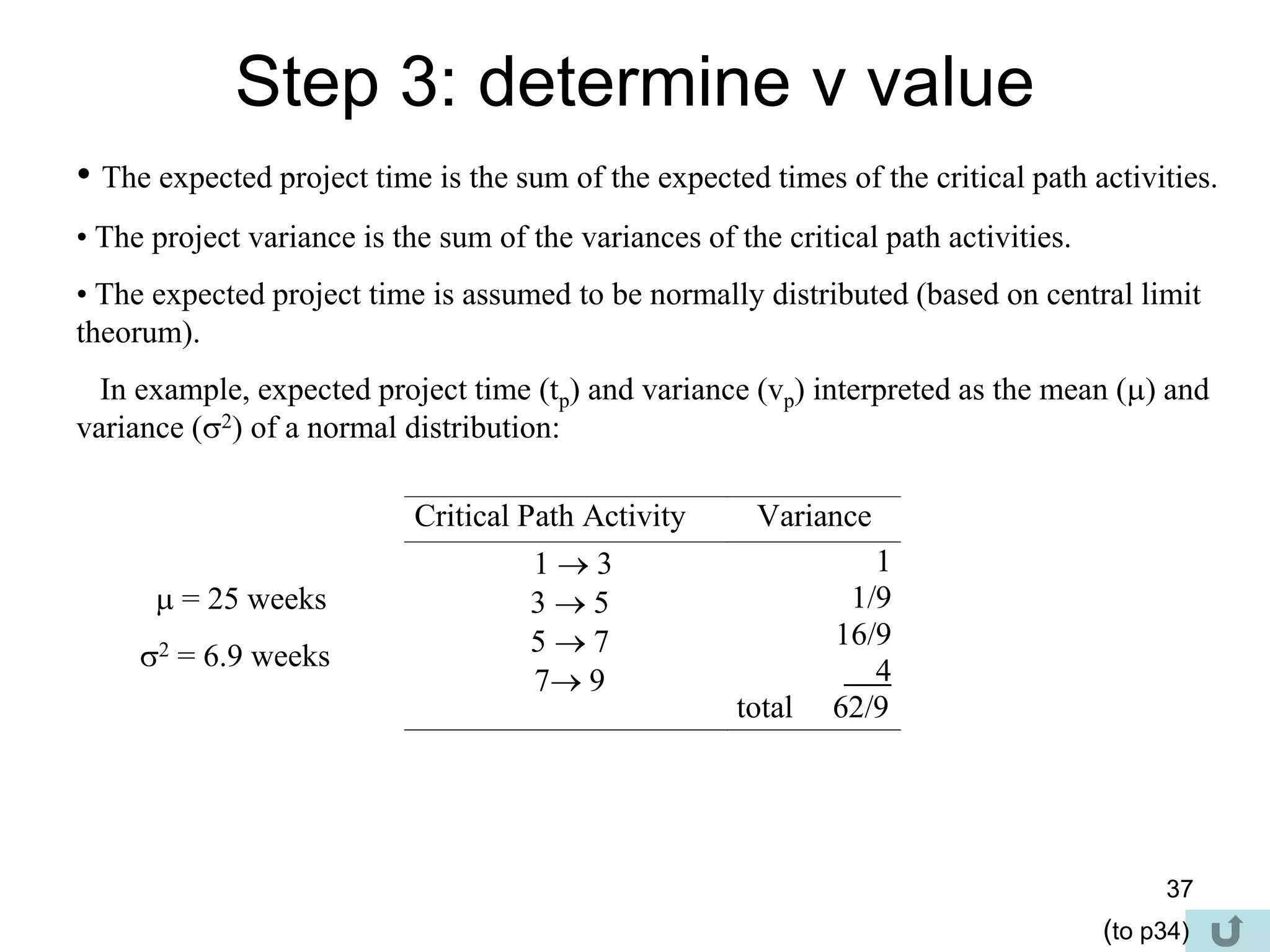
Table 8.1
Possible Paths to
complete the
House-Building
Network
Then the completion time for paths A, B, C and D can be computed as
(to p14)
14
The Project Network
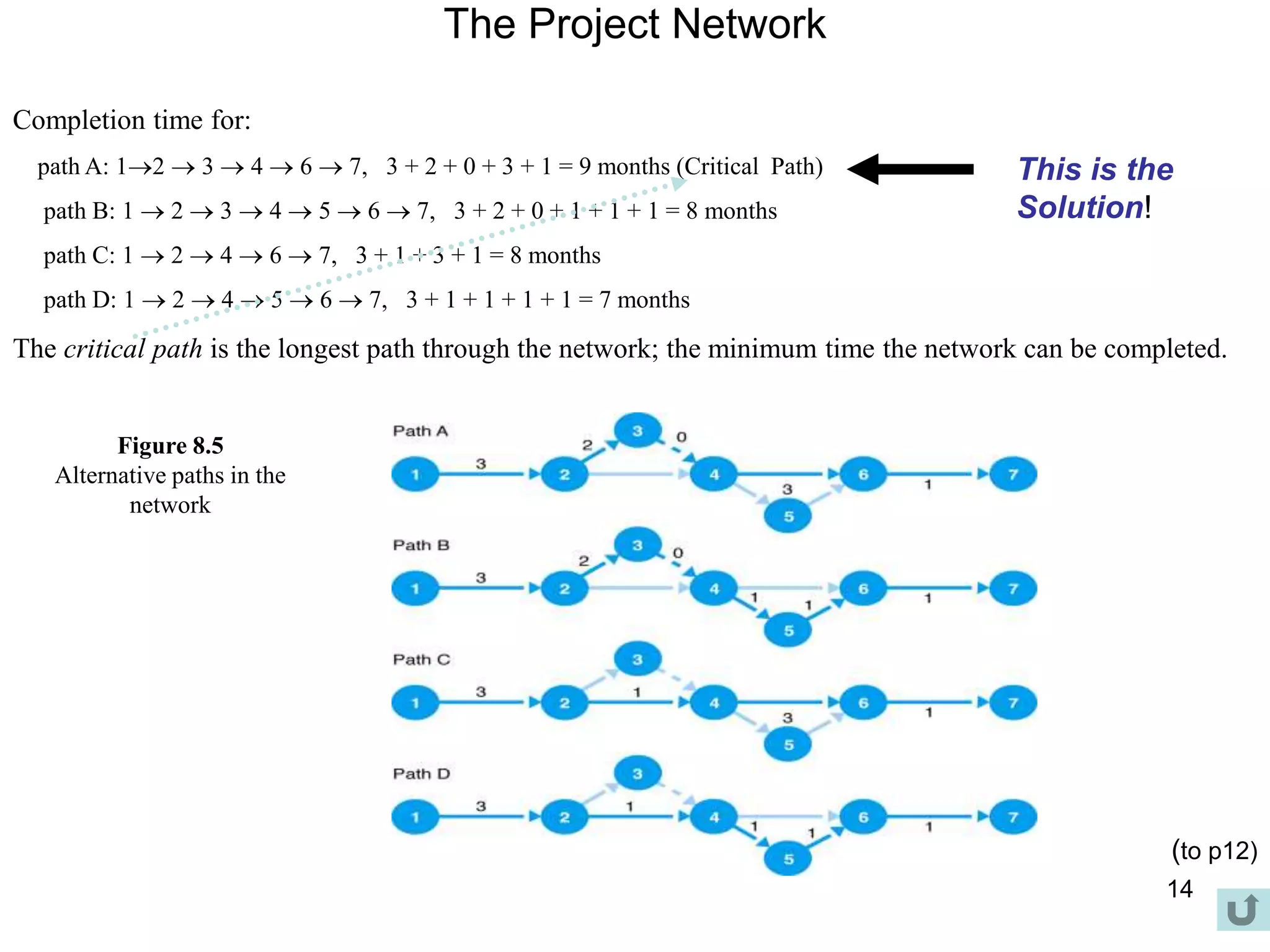
Completion time for:
path A: 12  3  4  6  7, 3 + 2 + 0 + 3 + 1 = 9 months (Critical Path)
path B: 1  2  3  4  5  6  7, 3 + 2 + 0 + 1 + 1 + 1 = 8 months
path C: 1  2  4  6  7, 3 + 1 + 3 + 1 = 8 months
path D: 1  2  4  5  6  7, 3 + 1 + 1 + 1 + 1 = 7 months
The critical path is the longest path through the network; the minimum time the network can be completed.
Figure 8.5
Alternative paths in the
network
This is the
Solution!
(to p12)
15
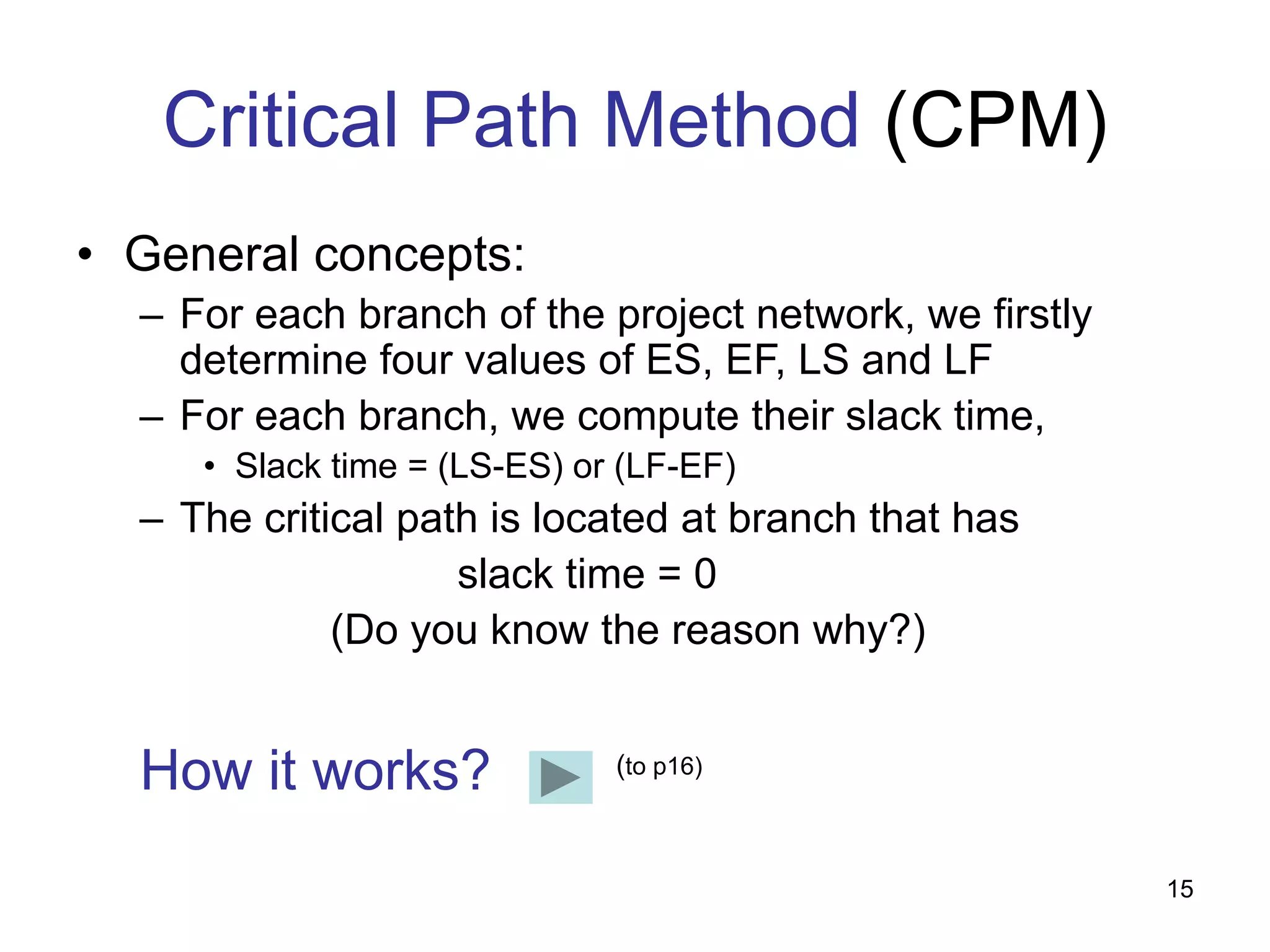
Critical Path Method (CPM)
• General concepts:
– For each branch of the project network, we firstly
determine four values of ES, EF, LS and LF
– For each branch, we compute their slack time,
• Slack time = (LS-ES) or (LF-EF)
– The critical path is located at branch that has
slack time = 0
(Do you know the reason why?)
How it works? (to p16)
16
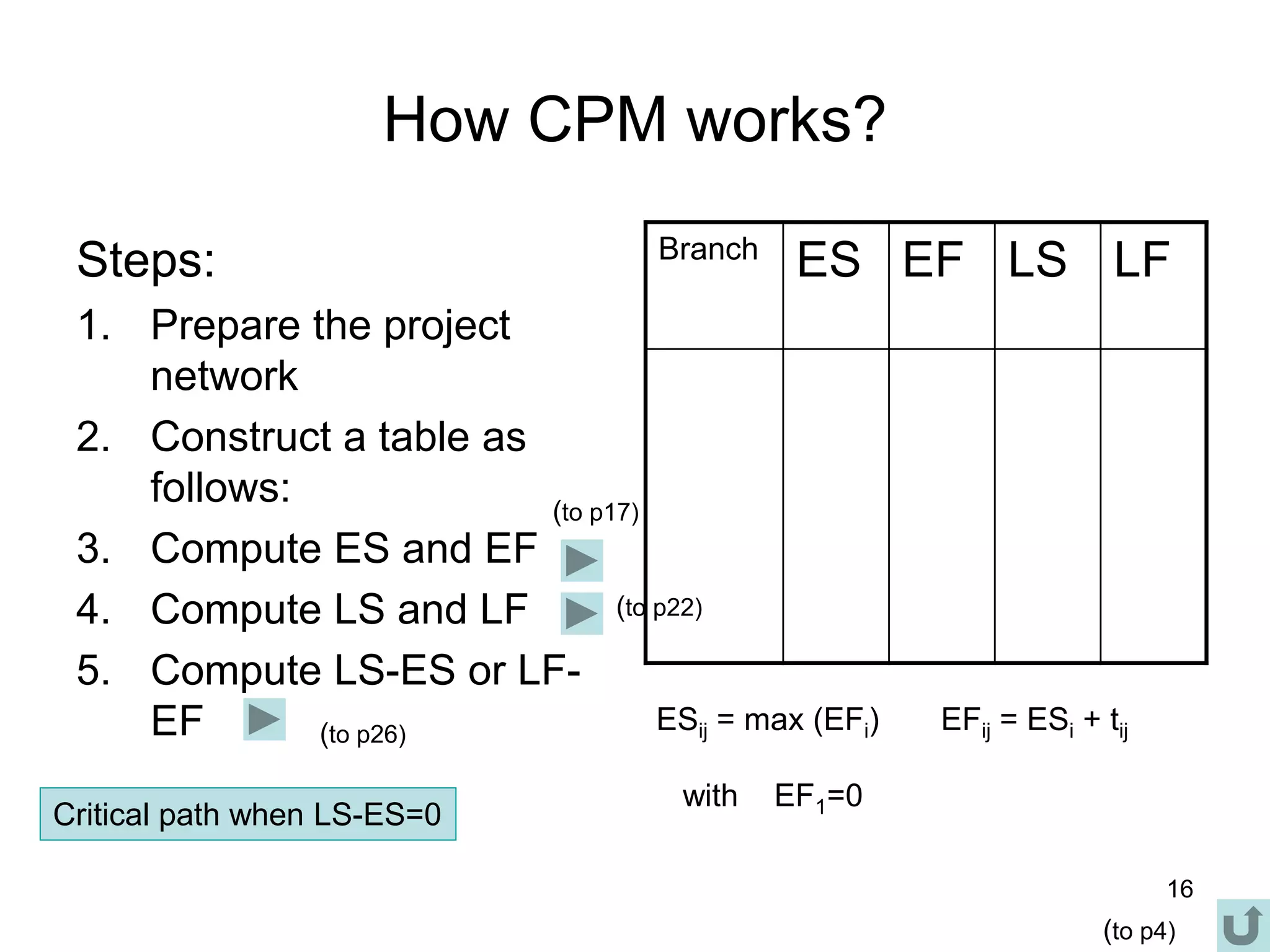
How CPM works?
Steps:
1. Prepare the project
network
2. Construct a table as
follows:
3. Compute ES and EF
4. Compute LS and LF
5. Compute LS-ES or LF-
EF
Branch
ES EF LS LF
ESij = max (EFi) EFij = ESi + tij
with EF1=0
Critical path when LS-ES=0
(to p4)
(to p17)
(to p26)
(to p22)
17
Compute ES and EF
Note:
When computing these values, the pattern
is like moving zic-zac format by firstly
computer ES12 and then adding it to EF12
and move to next branch by copying the
max values of the branch 1-2 to say, 2-3
We compute them from top to bottom!
Their relationship :
Example 1:
(to p18)
(to p22)
(to p19)
18
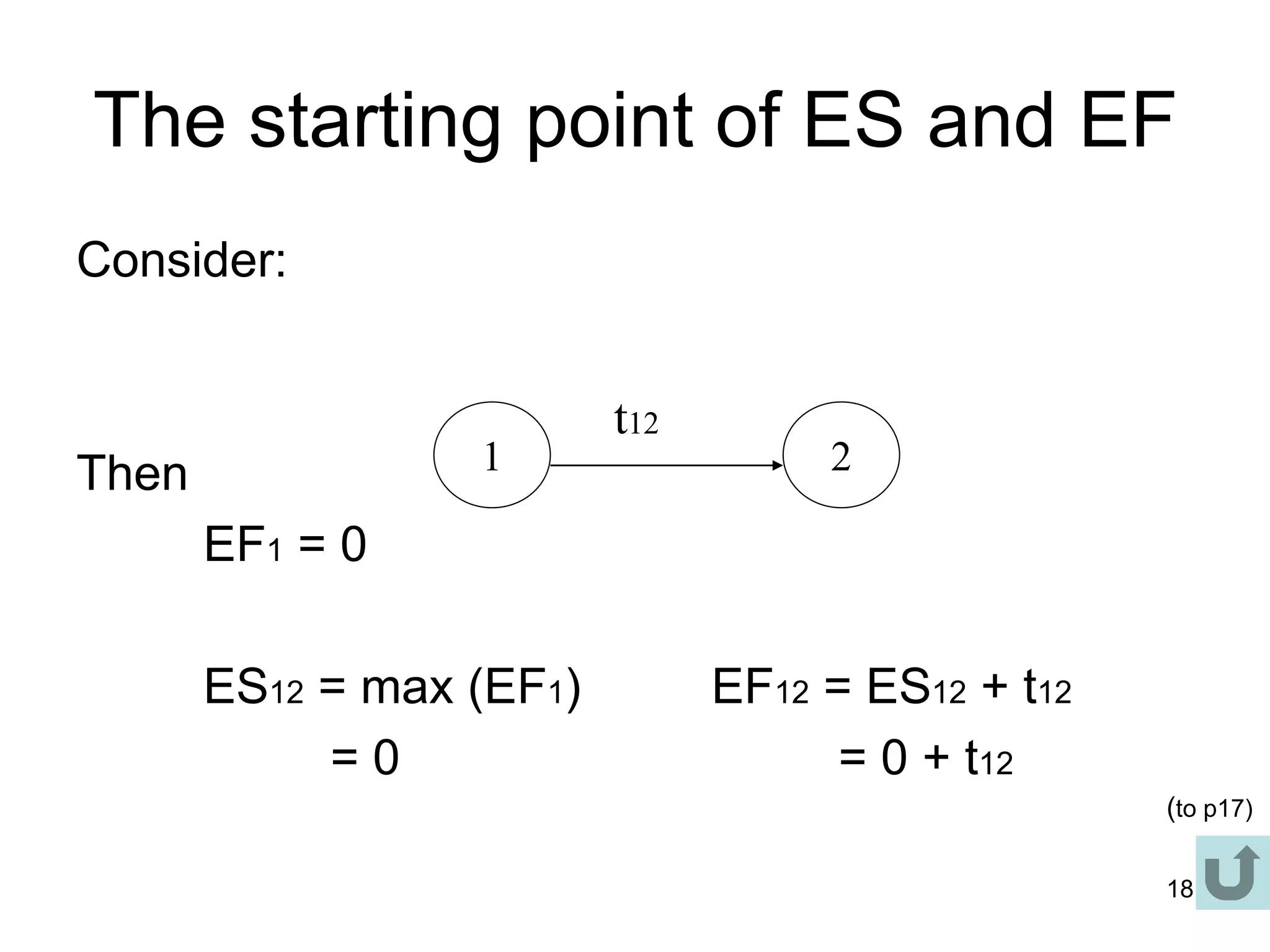
The starting point of ES and EF
Consider:
Then
EF1 = 0
ES12 = max (EF1) EF12 = ES12 + t12
= 0 = 0 + t12
1 2
t12
(to p17)
19
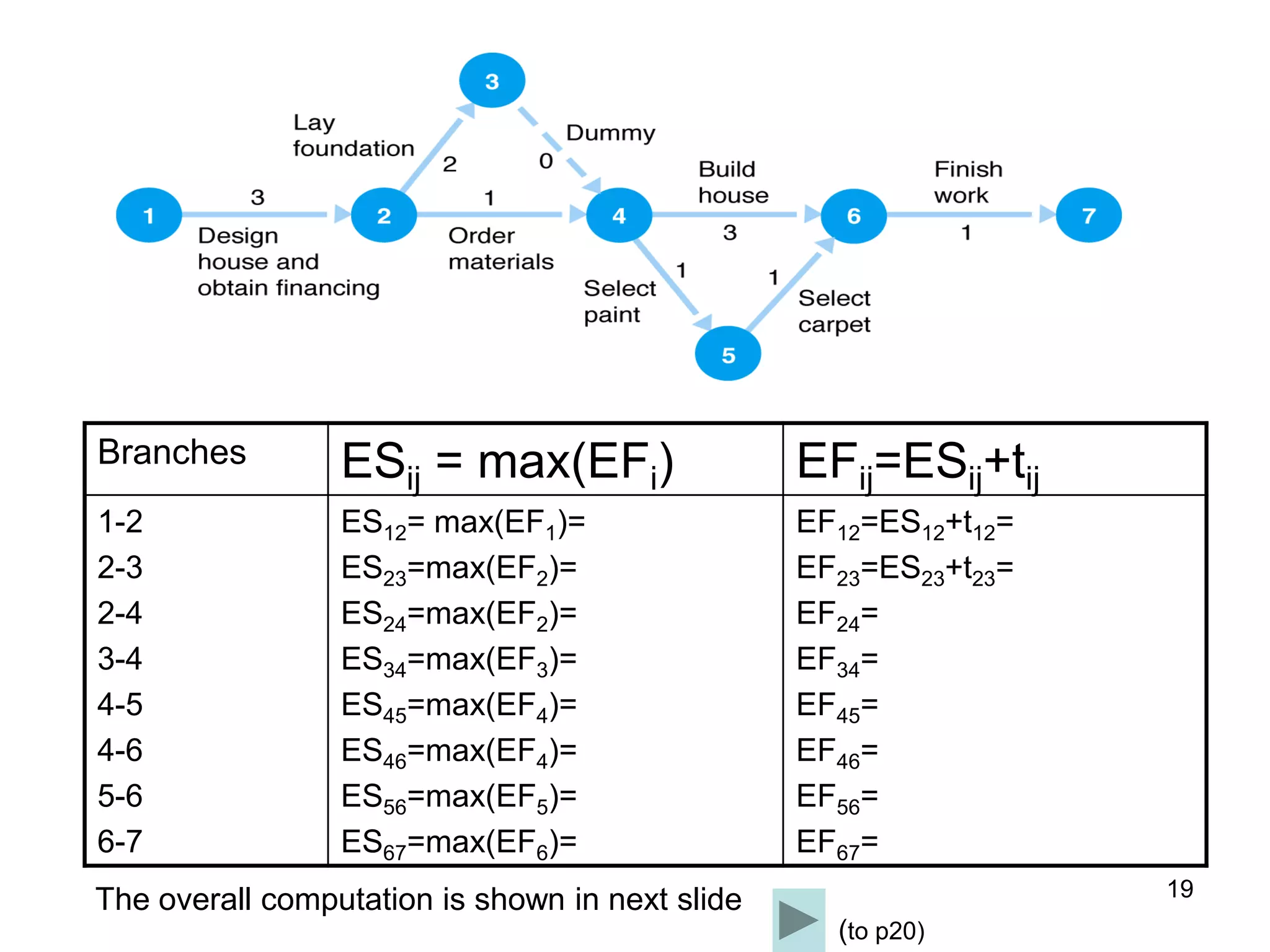
Branches ESij = max(EFi) EFij=ESij+tij
1-2
2-3
2-4
3-4
4-5
4-6
5-6
6-7
ES12= max(EF1)=
ES23=max(EF2)=
ES24=max(EF2)=
ES34=max(EF3)=
ES45=max(EF4)=
ES46=max(EF4)=
ES56=max(EF5)=
ES67=max(EF6)=
EF12=ES12+t12=
EF23=ES23+t23=
EF24=
EF34=
EF45=
EF46=
EF56=
EF67=
The overall computation is shown in next slide
(to p20)
20
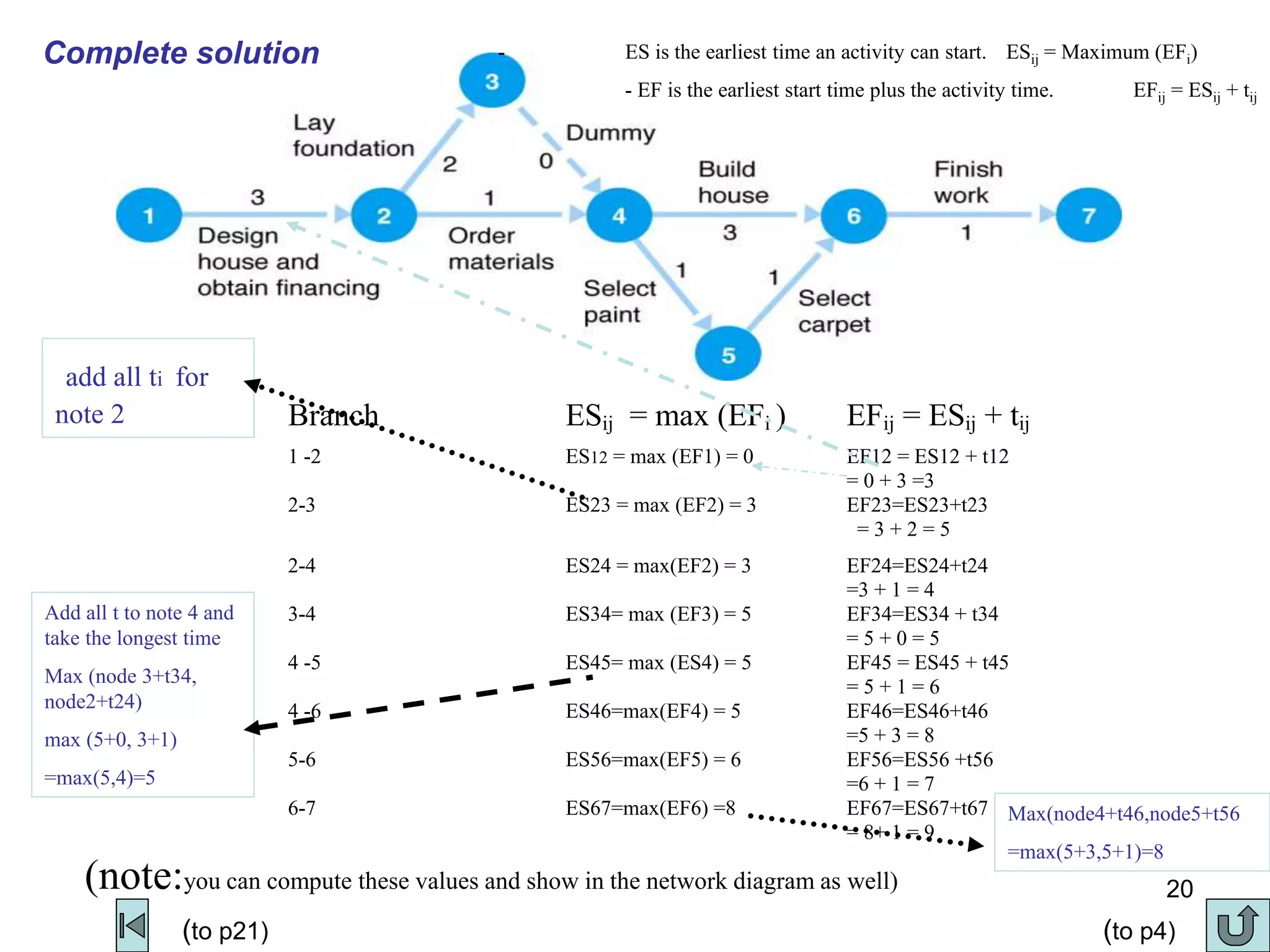
Branch ESij = max (EFi ) EFij = ESij + tij
1 -2
2-3
ES12 = max (EF1) = 0
ES23 = max (EF2) = 3
EF12 = ES12 + t12
= 0 + 3 =3
EF23=ES23+t23
= 3 + 2 = 5
2-4
3-4
4 -5
ES24 = max(EF2) = 3
ES34= max (EF3) = 5
ES45= max (ES4) = 5
EF24=ES24+t24
=3 + 1 = 4
EF34=ES34 + t34
= 5 + 0 = 5
EF45 = ES45 + t45
= 5 + 1 = 6
4 -6
5-6
6-7
ES46=max(EF4) = 5
ES56=max(EF5) = 6
ES67=max(EF6) =8
EF46=ES46+t46
=5 + 3 = 8
EF56=ES56 +t56
=6 + 1 = 7
EF67=ES67+t67
= 8+ 1 = 9
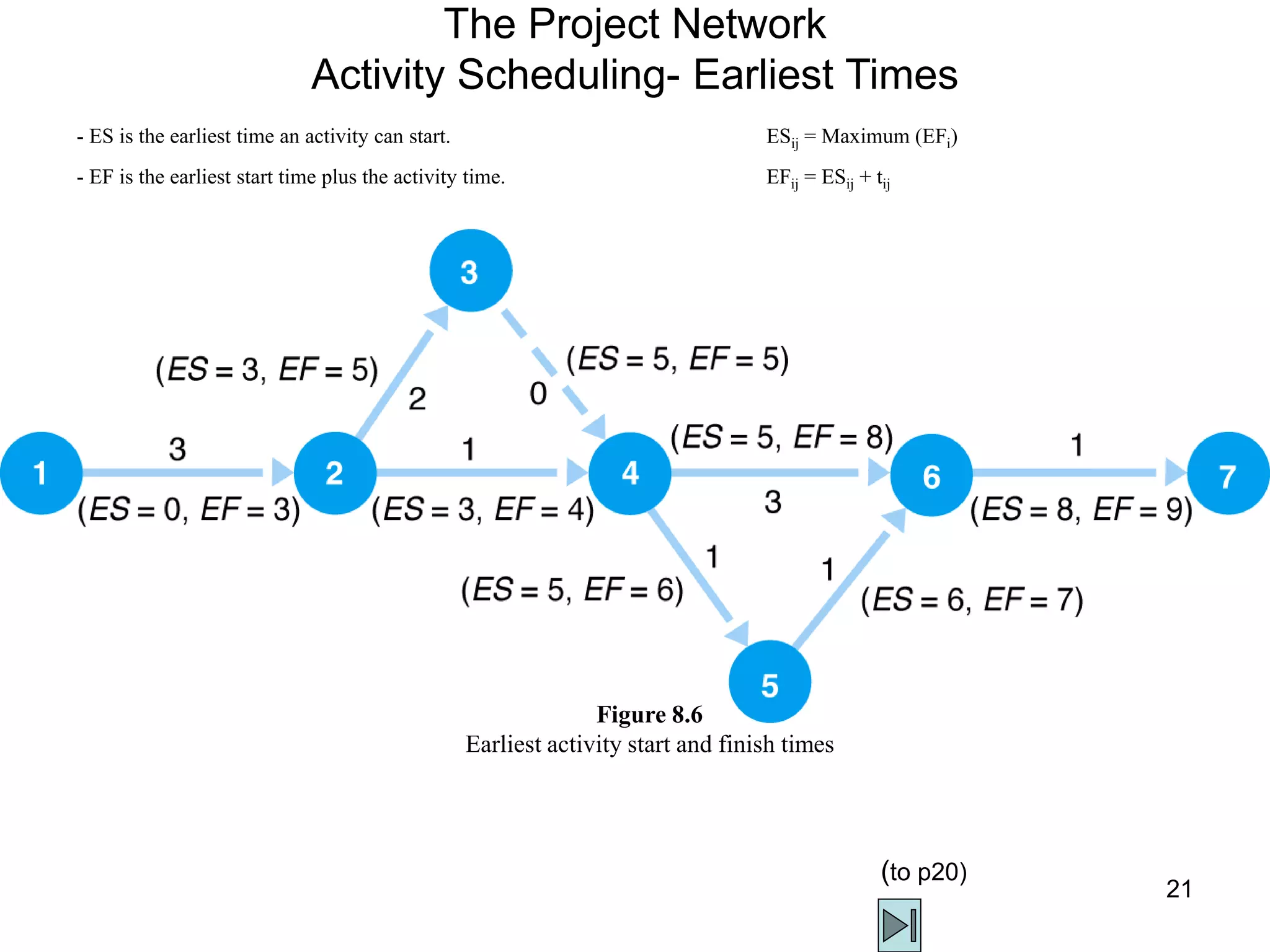
- ES is the earliest time an activity can start. ESij = Maximum (EFi)
- EF is the earliest start time plus the activity time. EFij = ESij + tij
(note:you can compute these values and show in the network diagram as well)
Add all t to note 4 and
take the longest time
Max (node 3+t34,
node2+t24)
max (5+0, 3+1)
=max(5,4)=5
add all ti for
note 2
Max(node4+t46,node5+t56
=max(5+3,5+1)=8
Complete solution
(to p4)
(to p21)
21
The Project Network
Activity Scheduling- Earliest Times
- ES is the earliest time an activity can start. ESij = Maximum (EFi)
- EF is the earliest start time plus the activity time. EFij = ESij + tij
Figure 8.6
Earliest activity start and finish times
(to p20)
22
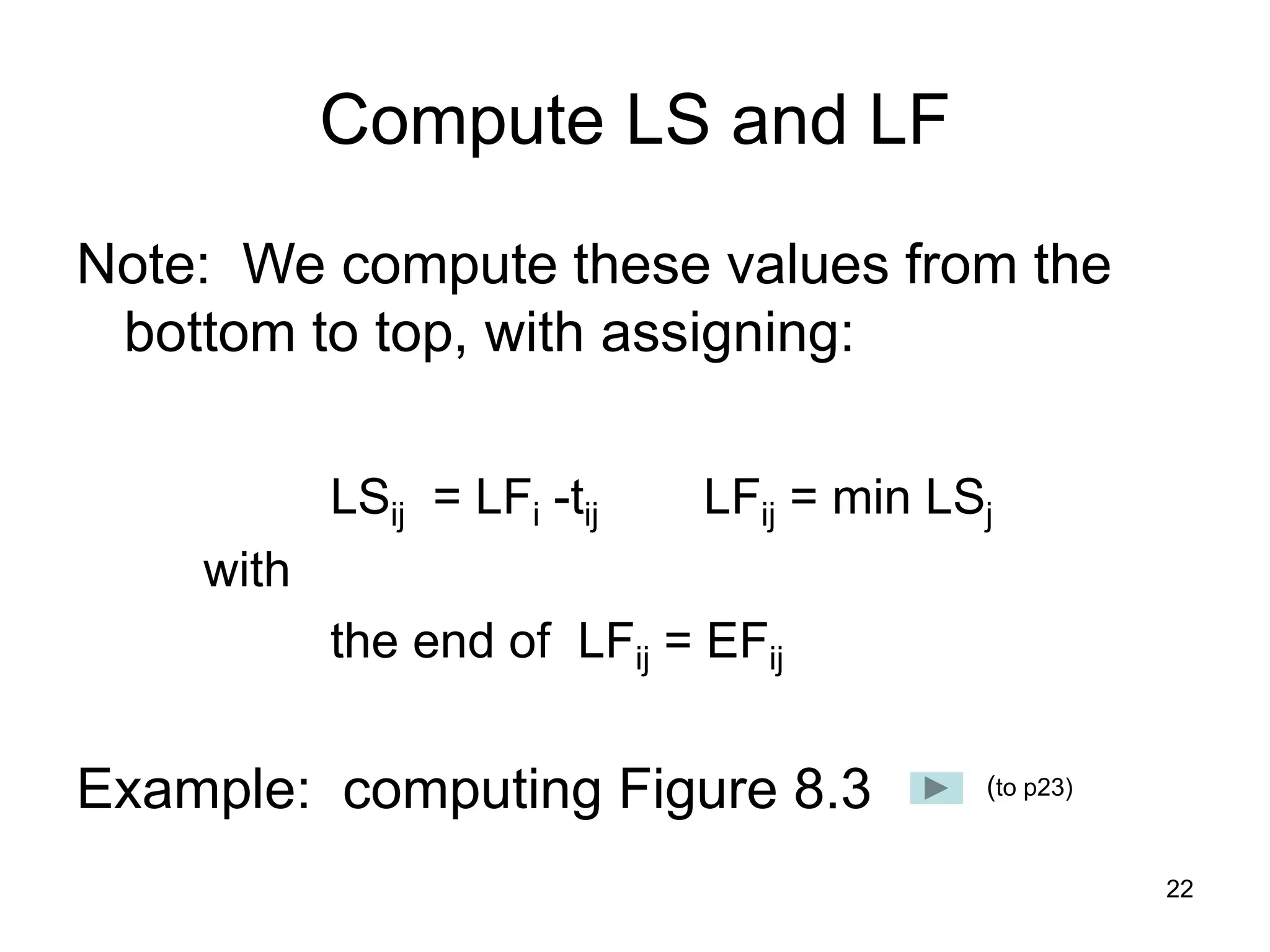
Compute LS and LF
Note: We compute these values from the
bottom to top, with assigning:
LSij = LFi -tij LFij = min LSj
with
the end of LFij = EFij
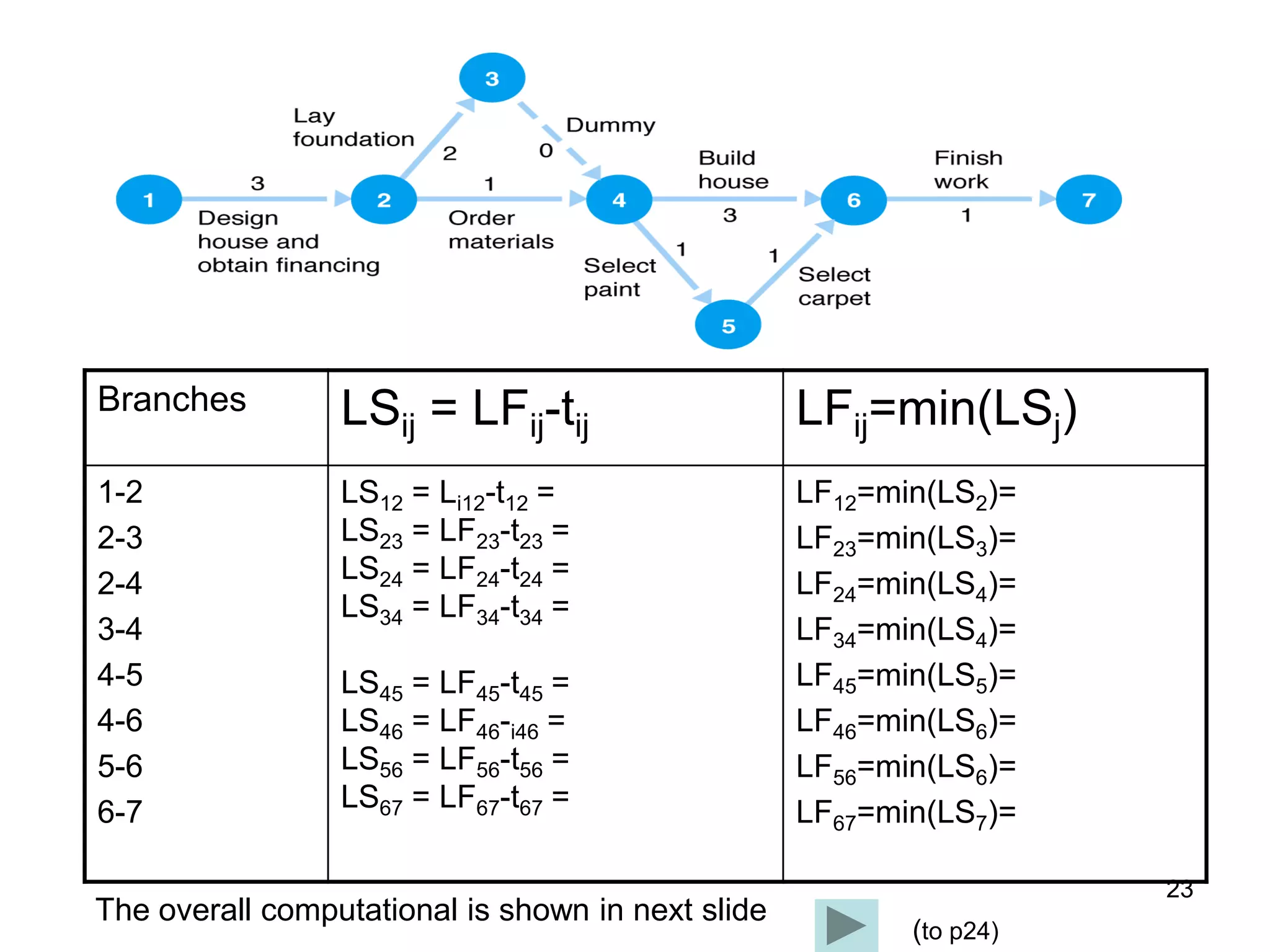
Example: computing Figure 8.3 (to p23)
23
Branches LSij = LFij-tij LFij=min(LSj)
1-2
2-3
2-4
3-4
4-5
4-6
5-6
6-7
LS12 = Li12-t12 =
LS23 = LF23-t23 =
LS24 = LF24-t24 =
LS34 = LF34-t34 =
LS45 = LF45-t45 =
LS46 = LF46-i46 =
LS56 = LF56-t56 =
LS67 = LF67-t67 =
LF12=min(LS2)=
LF23=min(LS3)=
LF24=min(LS4)=
LF34=min(LS4)=
LF45=min(LS5)=
LF46=min(LS6)=
LF56=min(LS6)=
LF67=min(LS7)=
The overall computational is shown in next slide
(to p24)
24
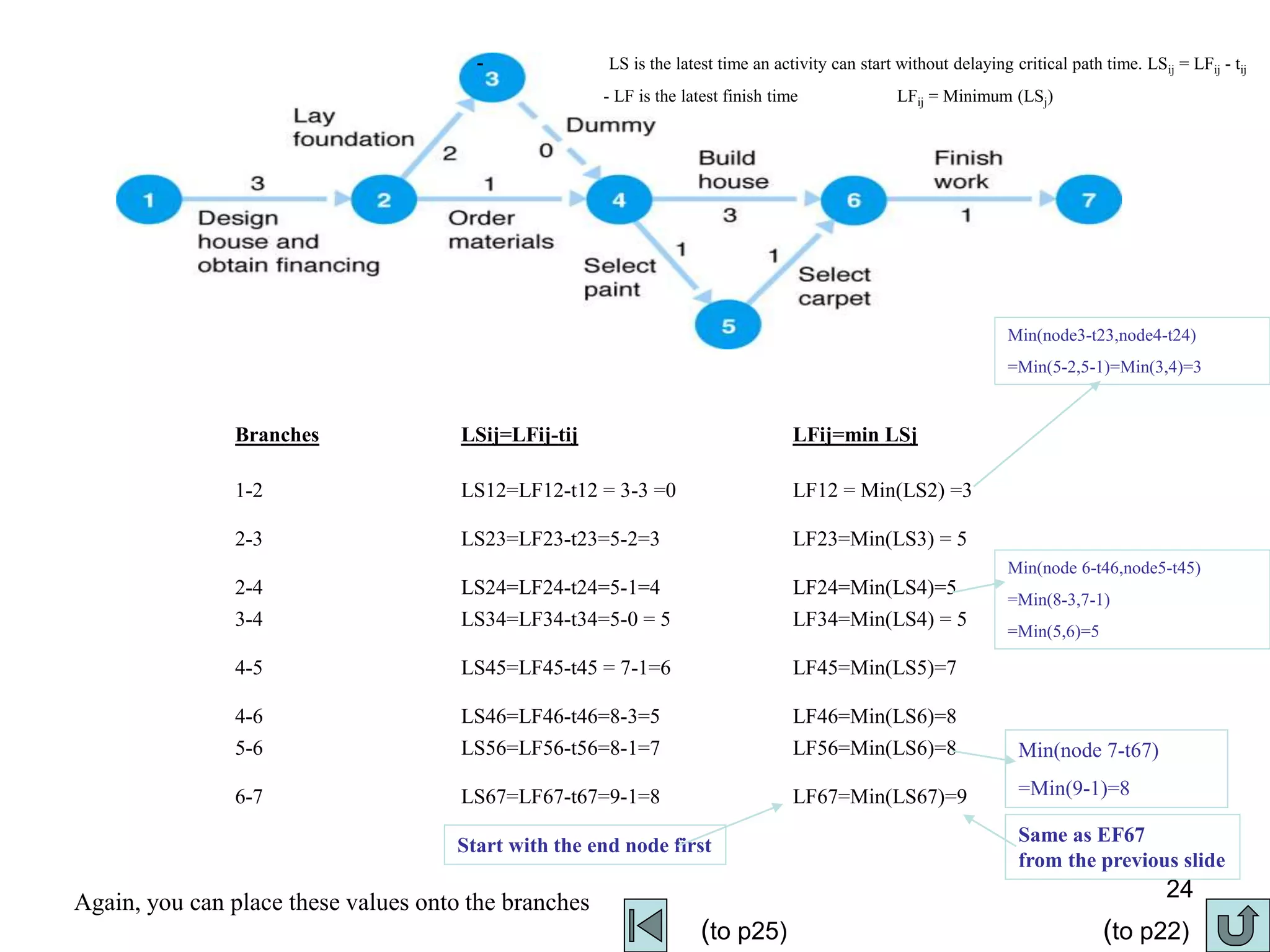
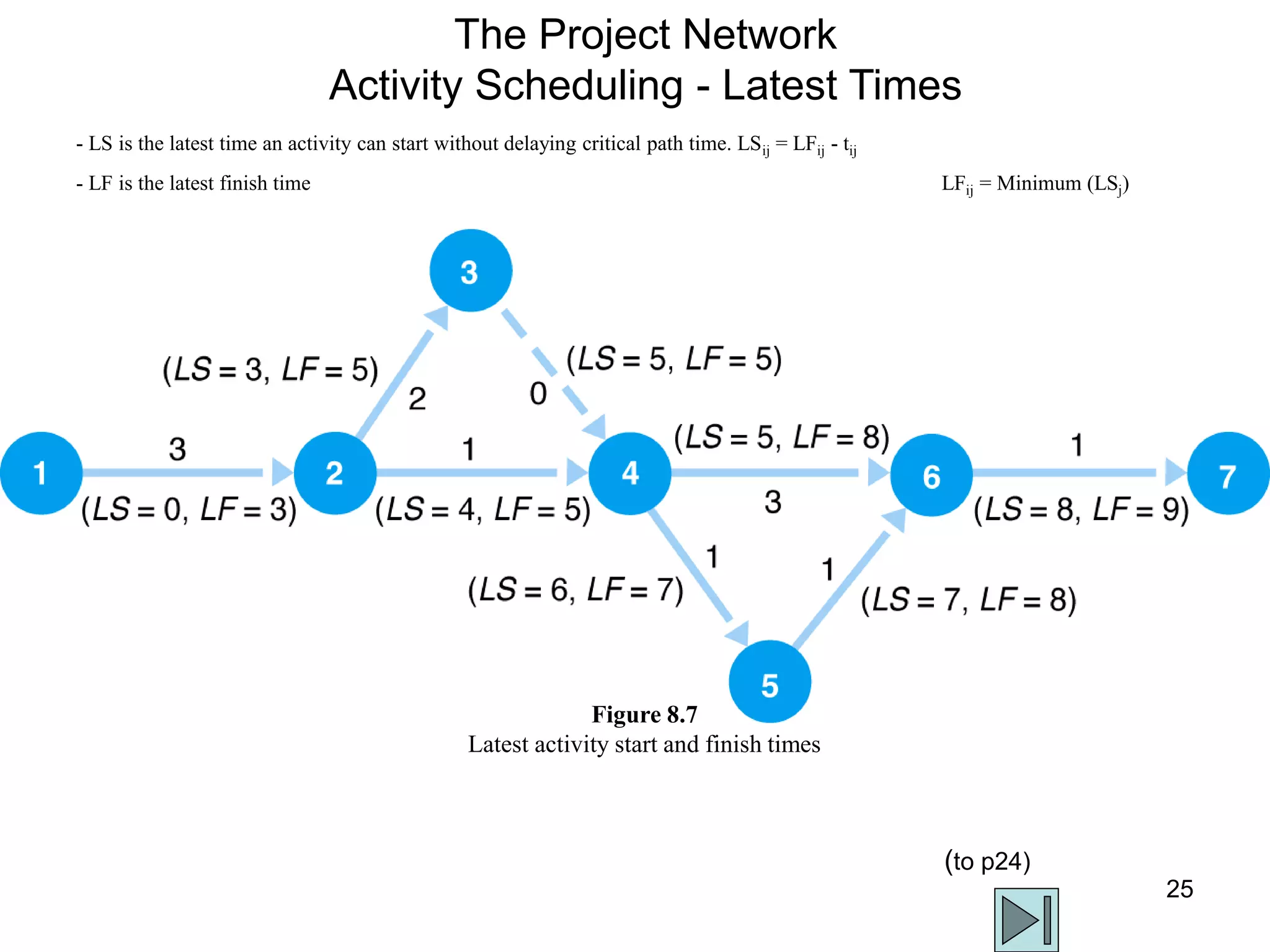
- LS is the latest time an activity can start without delaying critical path time. LSij = LFij - tij
- LF is the latest finish time LFij = Minimum (LSj)
Branches LSij=LFij-tij LFij=min LSj
1-2
2-3
2-4
LS12=LF12-t12 = 3-3 =0
LS23=LF23-t23=5-2=3
LS24=LF24-t24=5-1=4
LF12 = Min(LS2) =3
LF23=Min(LS3) = 5
LF24=Min(LS4)=5
3-4
4-5
4-6
LS34=LF34-t34=5-0 = 5
LS45=LF45-t45 = 7-1=6
LS46=LF46-t46=8-3=5
LF34=Min(LS4) = 5
LF45=Min(LS5)=7
LF46=Min(LS6)=8
5-6
6-7
LS56=LF56-t56=8-1=7
LS67=LF67-t67=9-1=8
LF56=Min(LS6)=8
LF67=Min(LS67)=9
Start with the end node first
Same as EF67
from the previous slide
Again, you can place these values onto the branches
Min(node 6-t46,node5-t45)
=Min(8-3,7-1)
=Min(5,6)=5
Min(node3-t23,node4-t24)
=Min(5-2,5-1)=Min(3,4)=3
Min(node 7-t67)
=Min(9-1)=8
(to p25) (to p22)
25
The Project Network
Activity Scheduling - Latest Times
- LS is the latest time an activity can start without delaying critical path time. LSij = LFij - tij
- LF is the latest finish time LFij = Minimum (LSj)
Figure 8.7
Latest activity start and finish times
(to p24)
26
Compute LS-ES or LF-EF
Two ways you can achieve it:
1. by compiling slack, Sij
2. by showing branches
(to p27)
(to p28)
(to p16)
27
The Project Network
Calculating Activity Slack Time
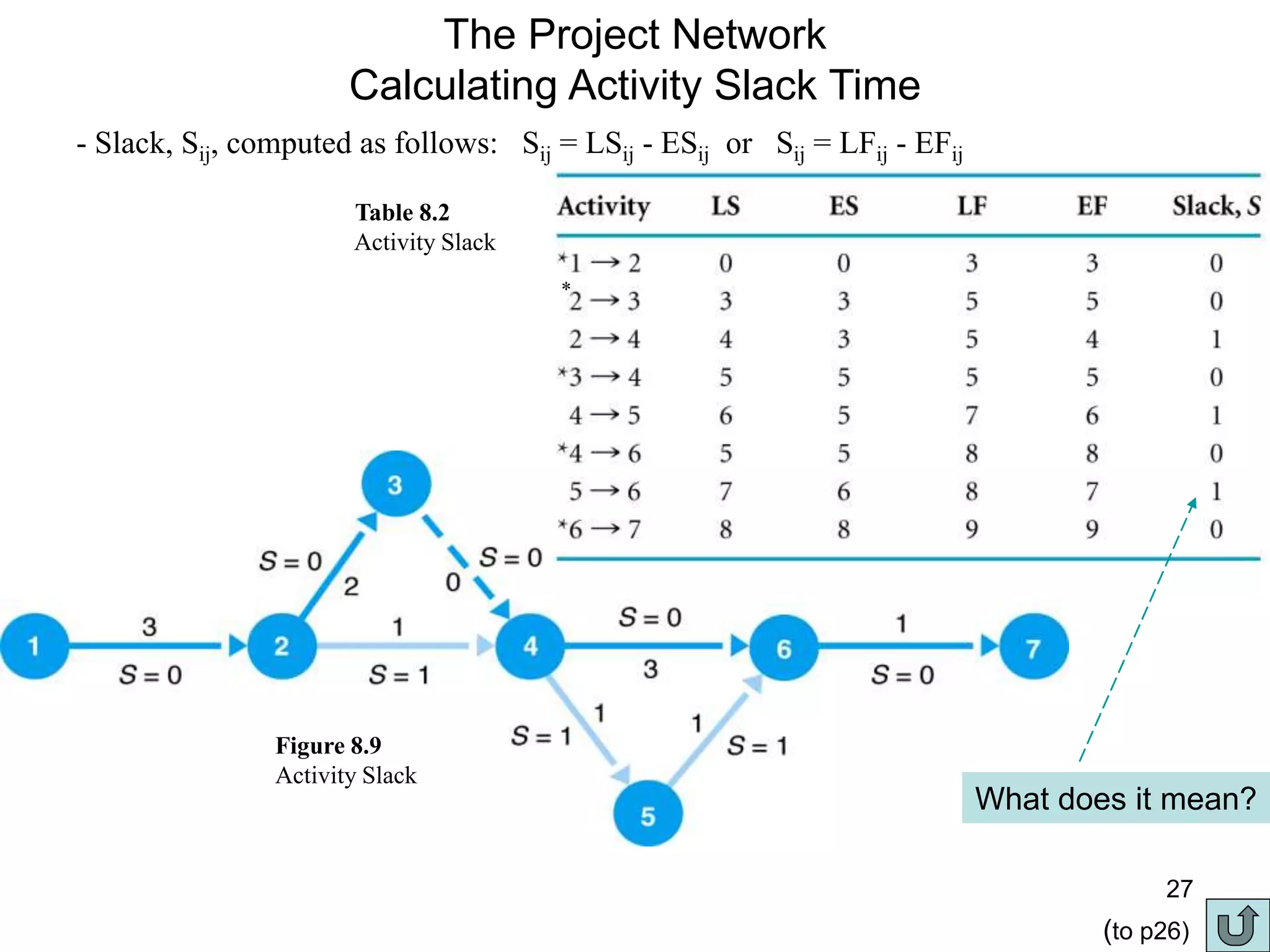
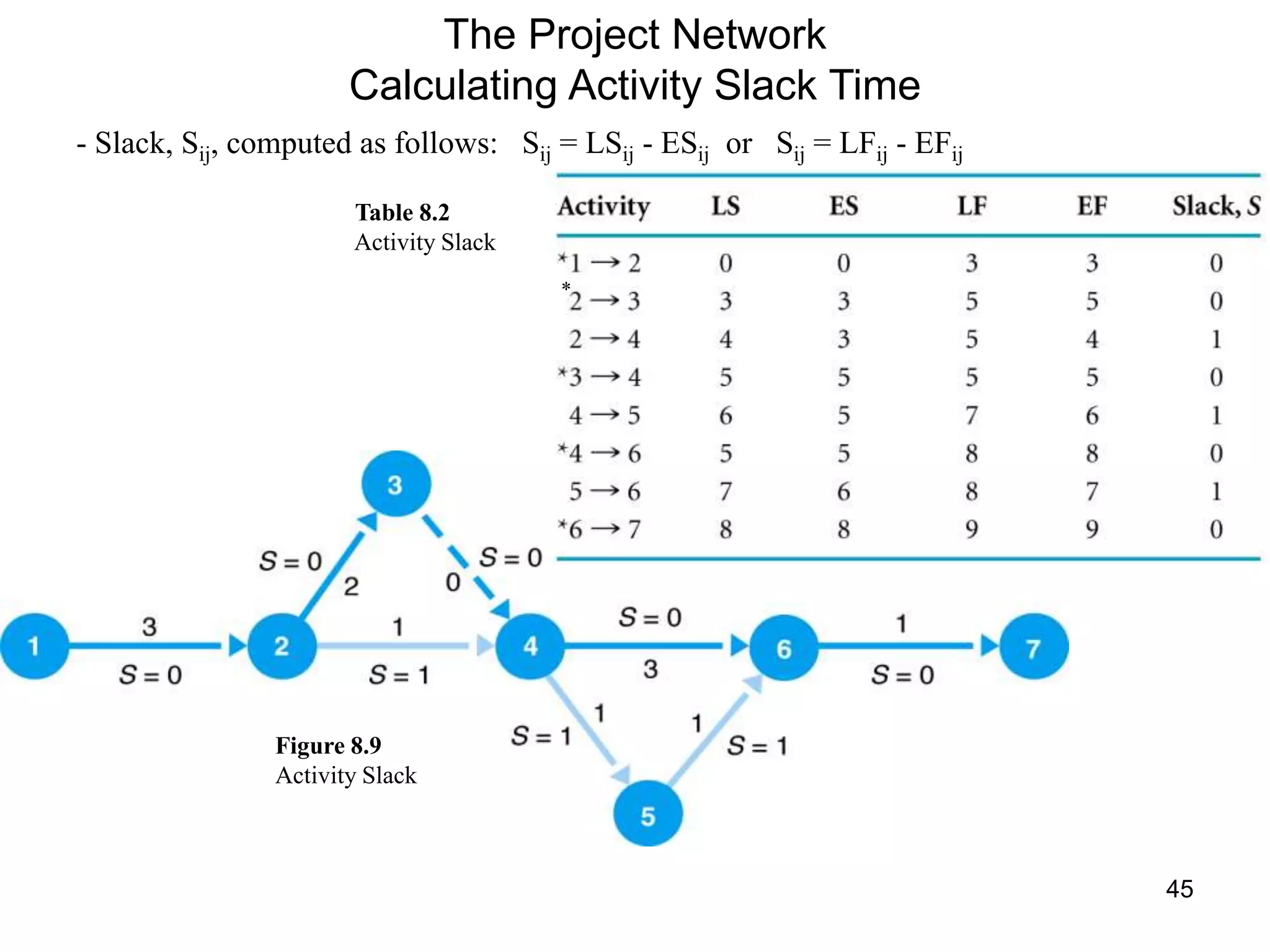
- Slack, Sij, computed as follows: Sij = LSij - ESij or Sij = LFij - EFij
Table 8.2
Activity Slack
Figure 8.9
Activity Slack
*
What does it mean?
(to p26)
28
The Project Network
Activity Slack
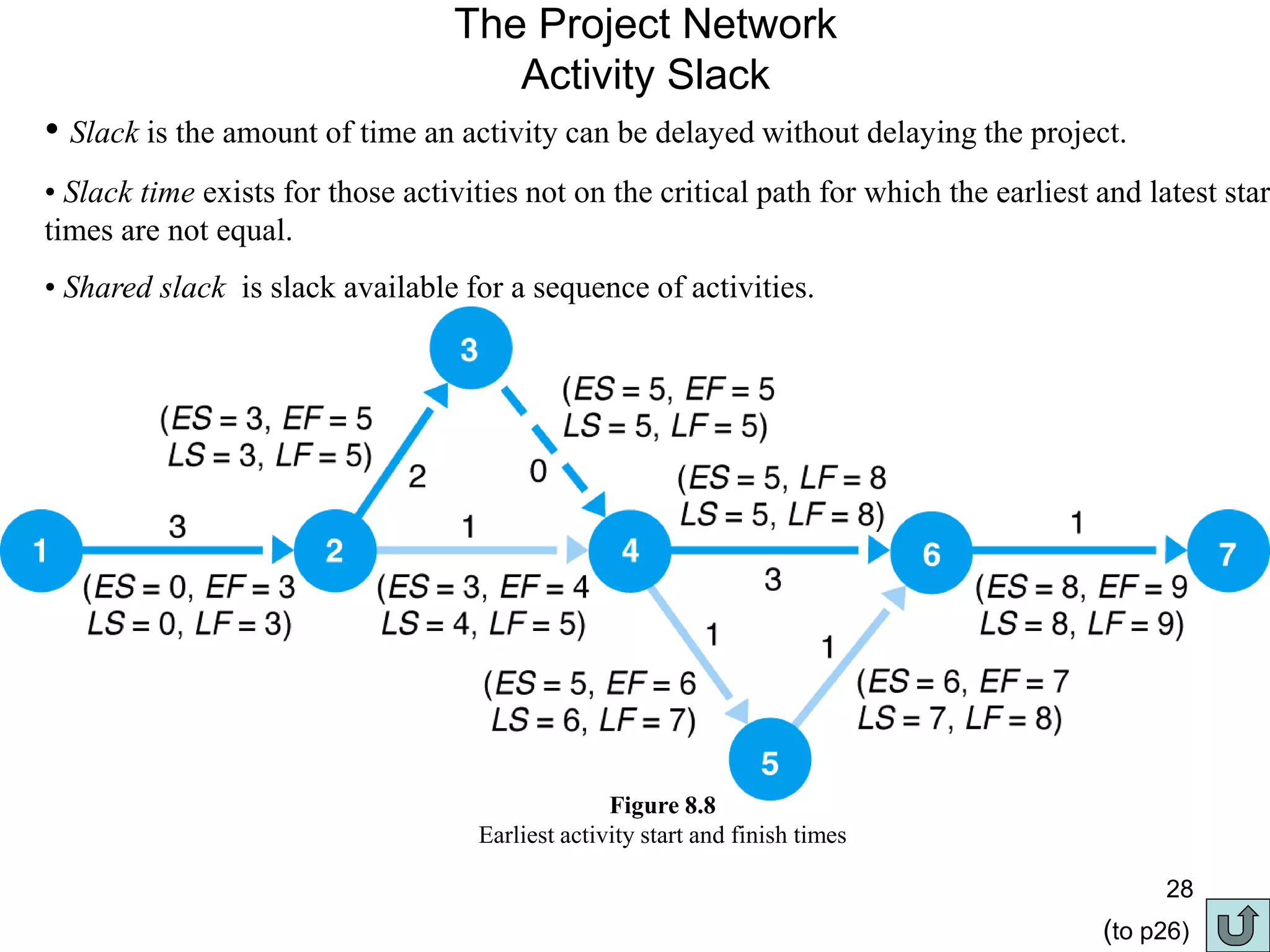
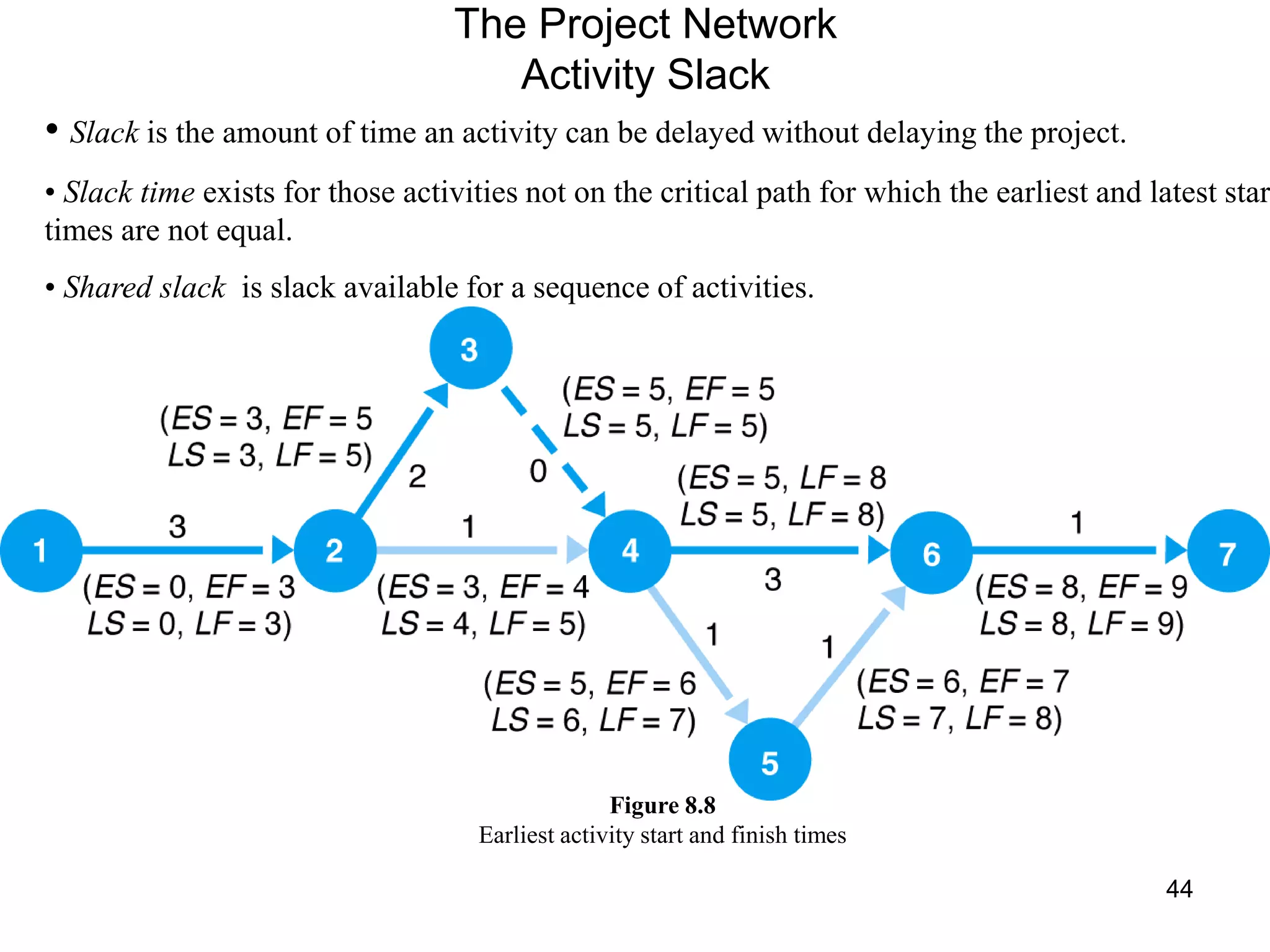
• Slack is the amount of time an activity can be delayed without delaying the project.
• Slack time exists for those activities not on the critical path for which the earliest and latest star
times are not equal.
• Shared slack is slack available for a sequence of activities.
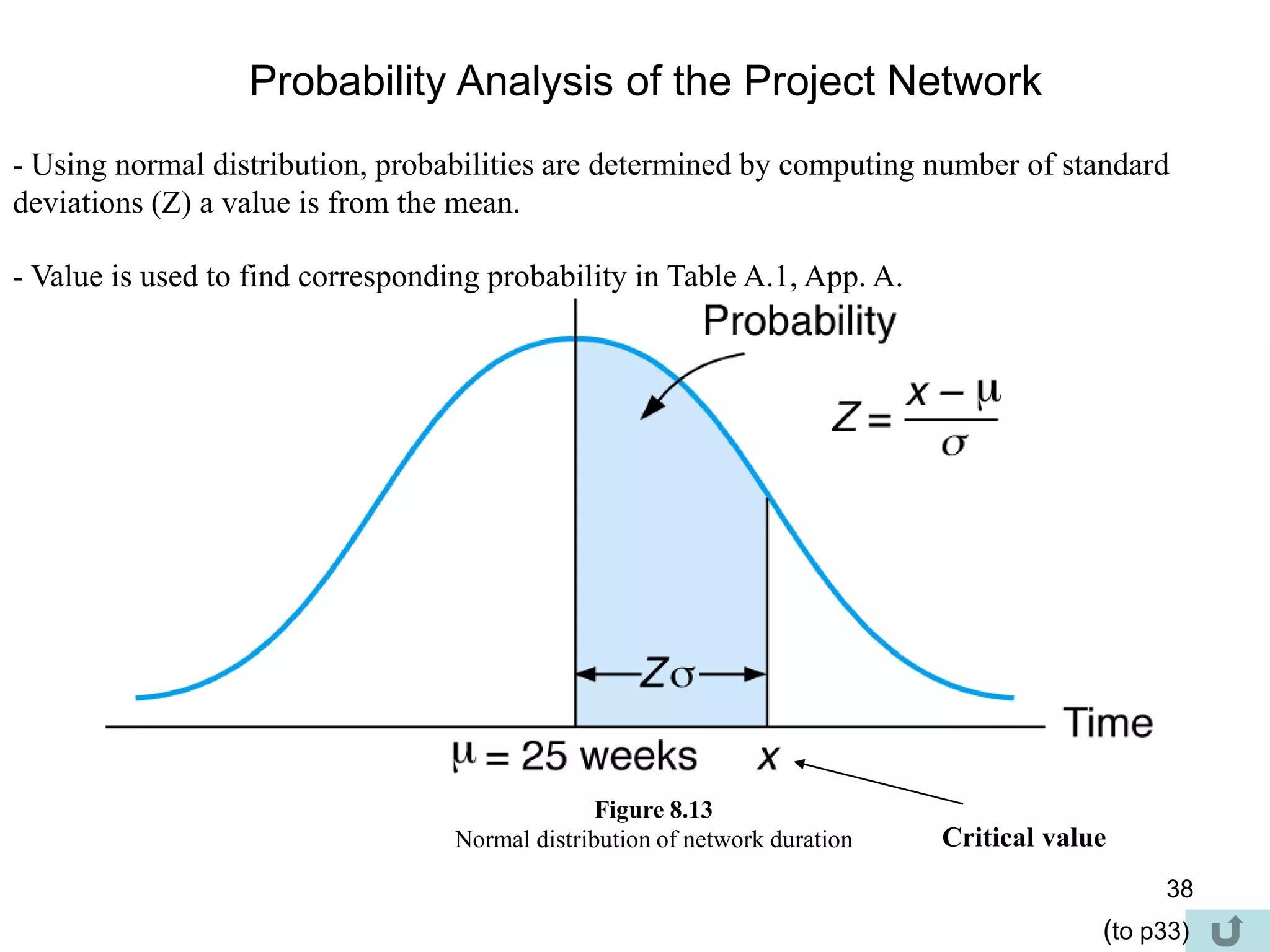
Figure 8.8
Earliest activity start and finish times
(to p26)
29
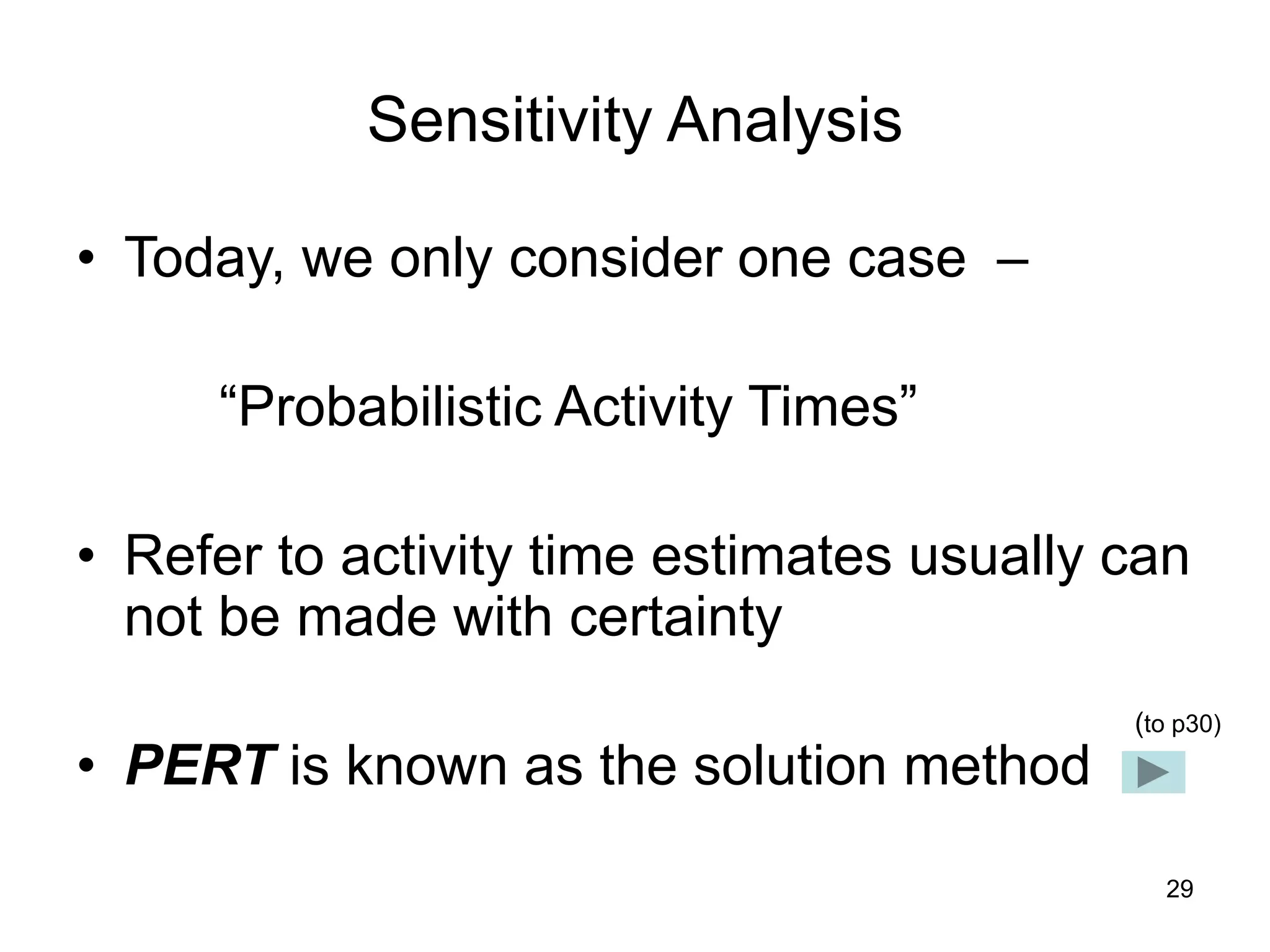
Sensitivity Analysis
• Today, we only consider one case –
“Probabilistic Activity Times”
• Refer to activity time estimates usually can
not be made with certainty
• PERT is known as the solution method
(to p30)
30
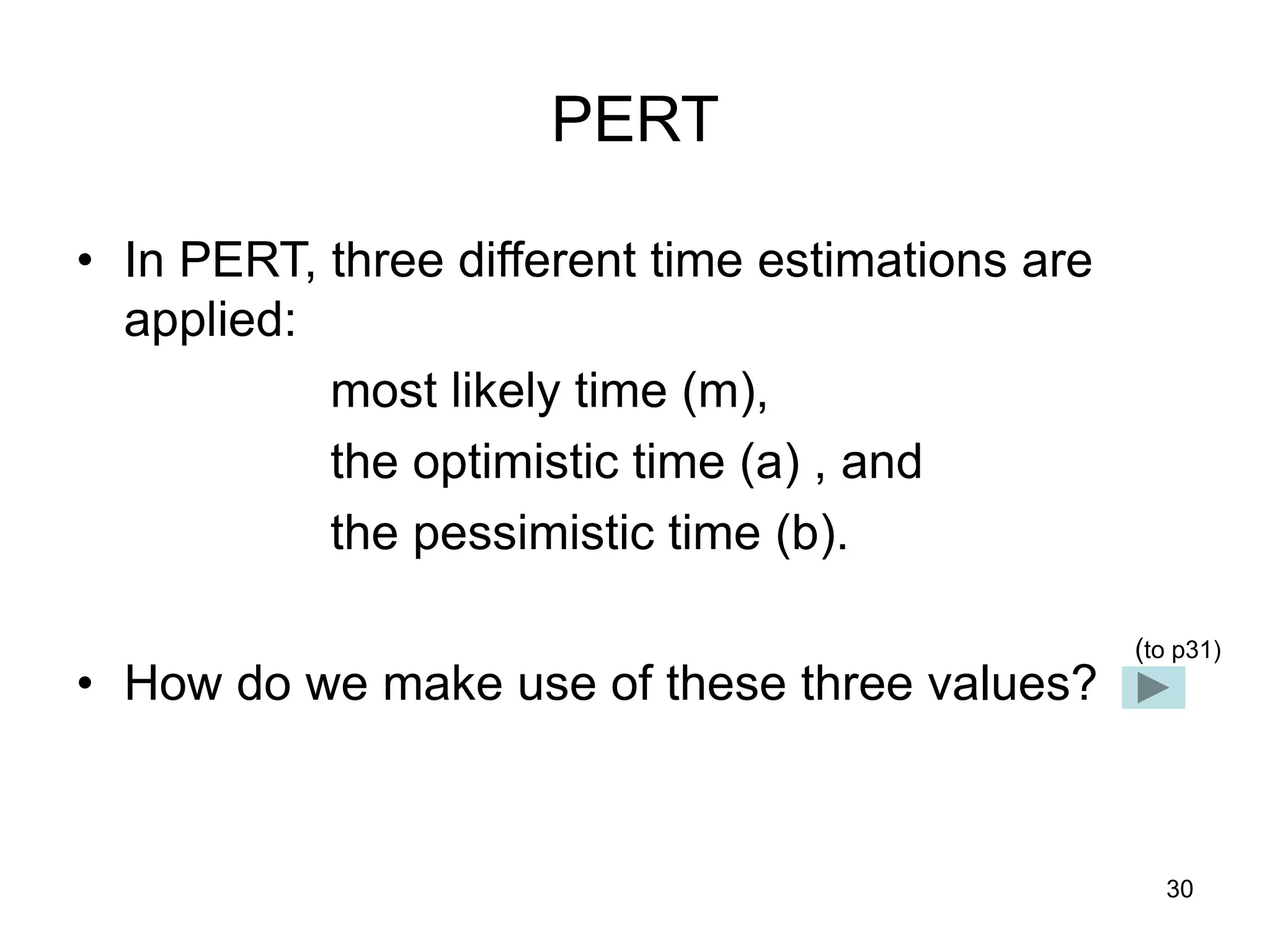
PERT
• In PERT, three different time estimations are
applied:
most likely time (m),
the optimistic time (a) , and
the pessimistic time (b).
• How do we make use of these three values?
(to p31)
31
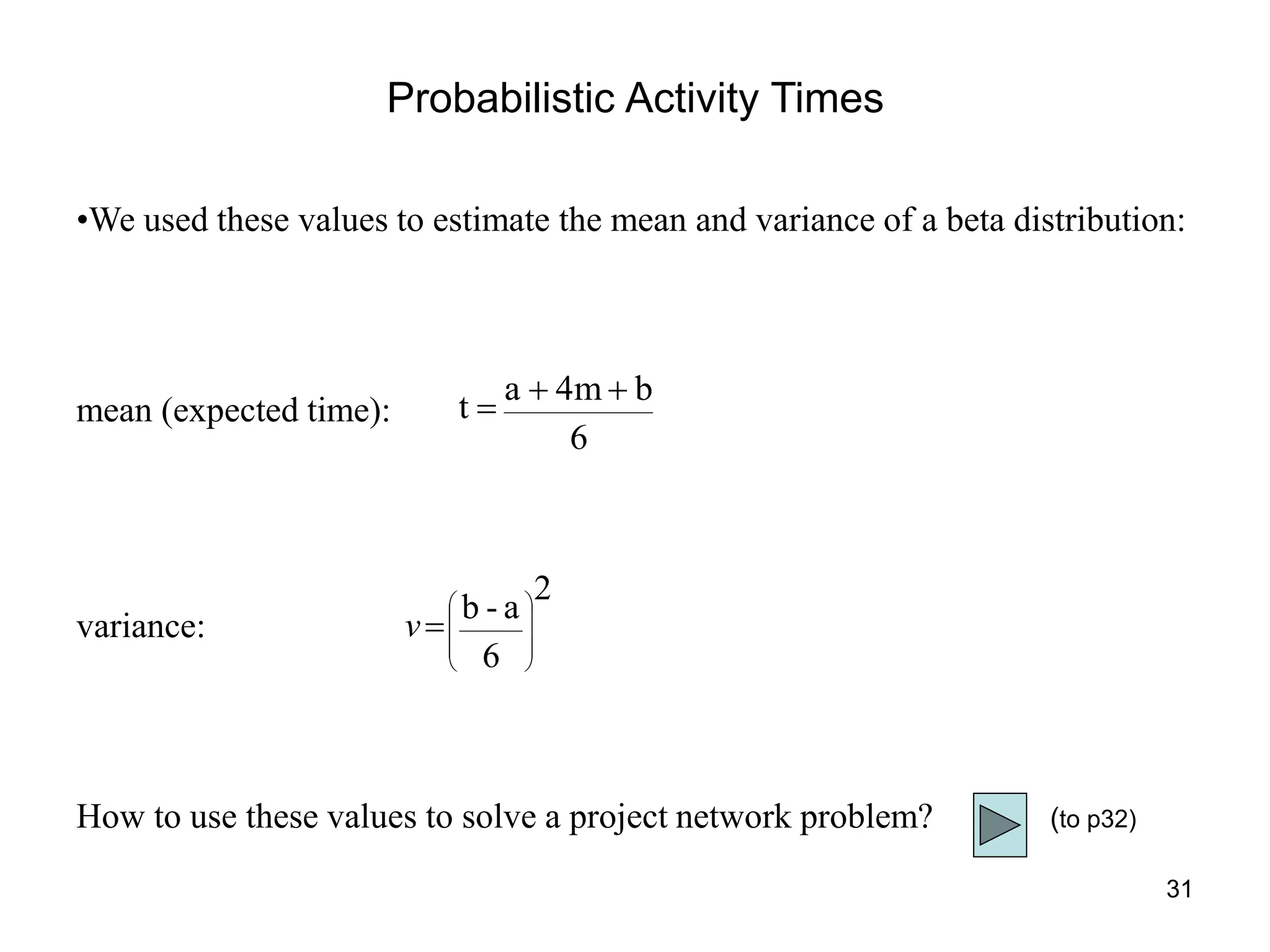
Probabilistic Activity Times
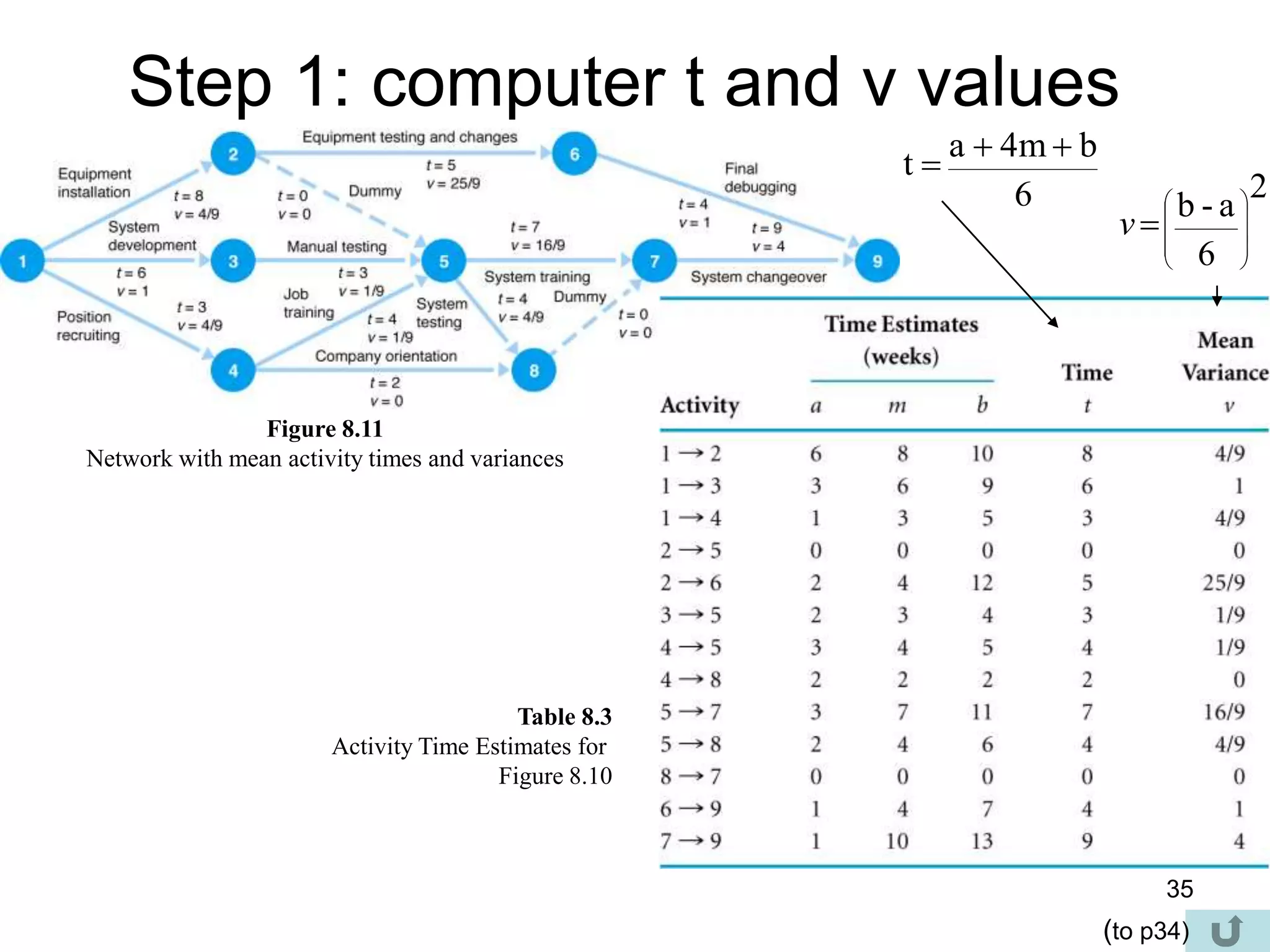
•We used these values to estimate the mean and variance of a beta distribution:
mean (expected time):
variance:
How to use these values to solve a project network problem?
6
b
4m
a
t



2
6
a
-
b











v
(to p32)
32
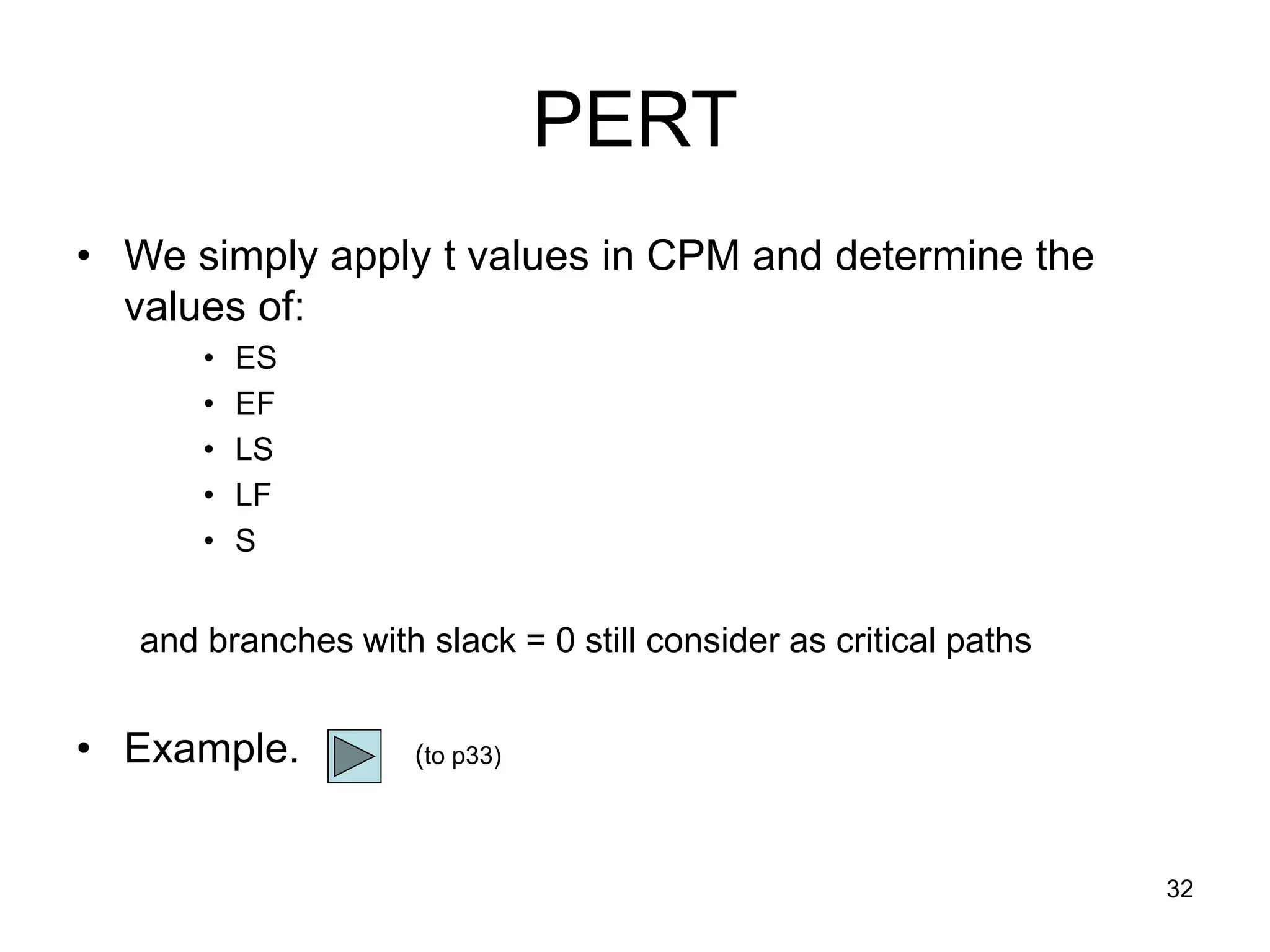
PERT
• We simply apply t values in CPM and determine the
values of:
• ES
• EF
• LS
• LF
• S
and branches with slack = 0 still consider as critical paths
• Example. (to p33)
33
Procedures for PERT
Step 1: based on the values of a, b and m,
determine the t and v values for each path
Step 2: determine the critical path by using t
values in the CPM
Step 3: compute its corresponding means and
standard deviations according.
Example
Result implication
Applications
(to p34)
(to p38)
(to p39)
34
PERT Example
• Step 1: computer t and v values
• Step 2: determine the CPM
• Step 3: determine v value
(to p35)
(to p36)
(to p37)
(to p33)
35
Step 1: computer t and v values
Figure 8.11
Network with mean activity times and variances
Table 8.3
Activity Time Estimates for
Figure 8.10
6
b
4m
a
t



2
6
a
-
b











v
(to p34)
36
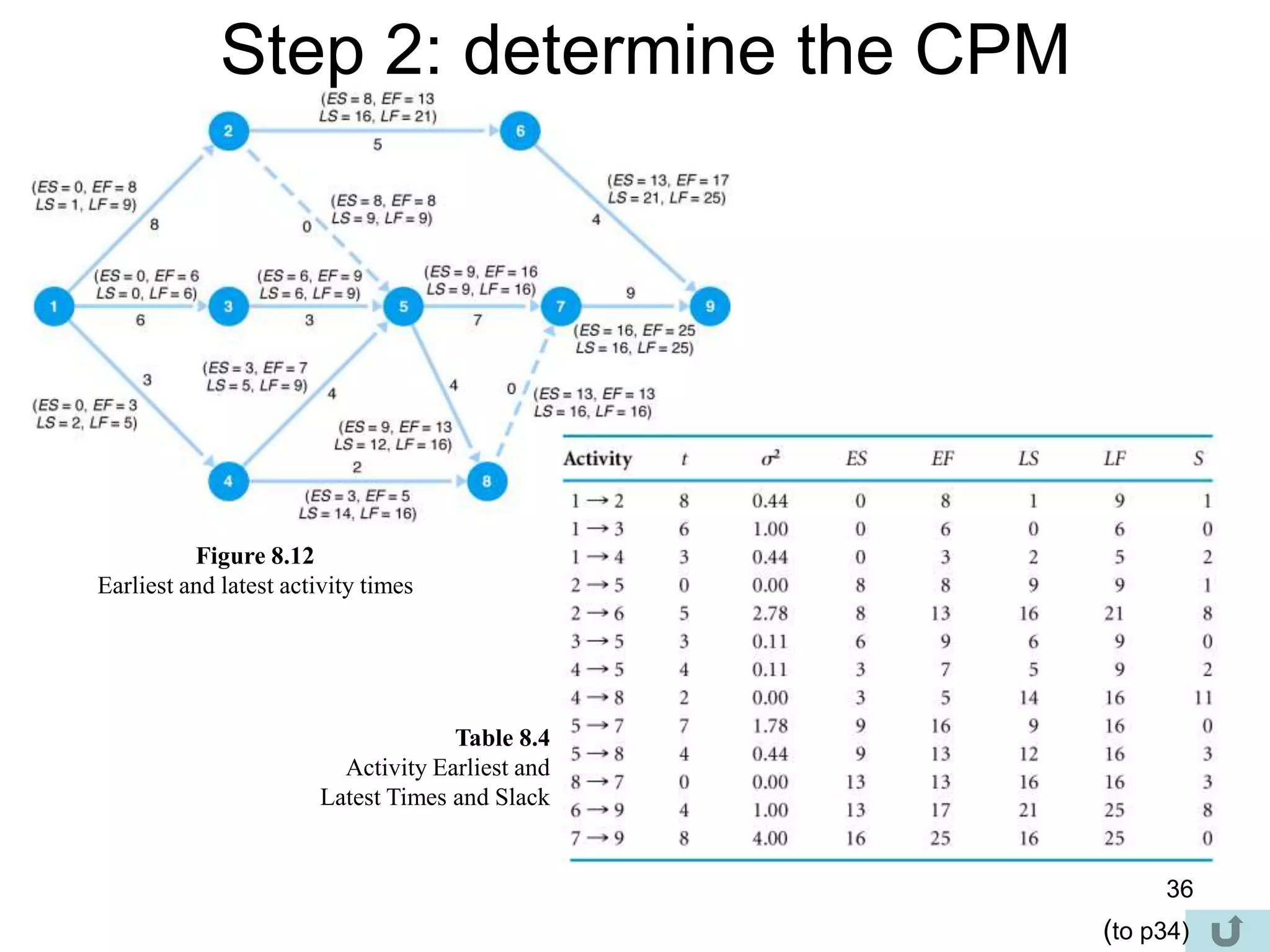
Step 2: determine the CPM
Figure 8.12
Earliest and latest activity times
Table 8.4
Activity Earliest and
Latest Times and Slack
(to p34)
37
Step 3: determine v value
• The expected project time is the sum of the expected times of the critical path activities.
• The project variance is the sum of the variances of the critical path activities.
• The expected project time is assumed to be normally distributed (based on central limit
theorum).
In example, expected project time (tp) and variance (vp) interpreted as the mean () and
variance (2) of a normal distribution:
 = 25 weeks
2 = 6.9 weeks
Critical Path Activity Variance
1  3
3  5
5  7
7 9
1
1/9
16/9
4
total 62/9
(to p34)
38
Probability Analysis of the Project Network
- Using normal distribution, probabilities are determined by computing number of standard
deviations (Z) a value is from the mean.
- Value is used to find corresponding probability in Table A.1, App. A.
Figure 8.13
Normal distribution of network duration Critical value
(to p33)
39
Consider when
x = 30
x = 22
Tutorial Assignment
(to p40)
(to p41)
(to p42)
40
Probability Analysis of the Project Network
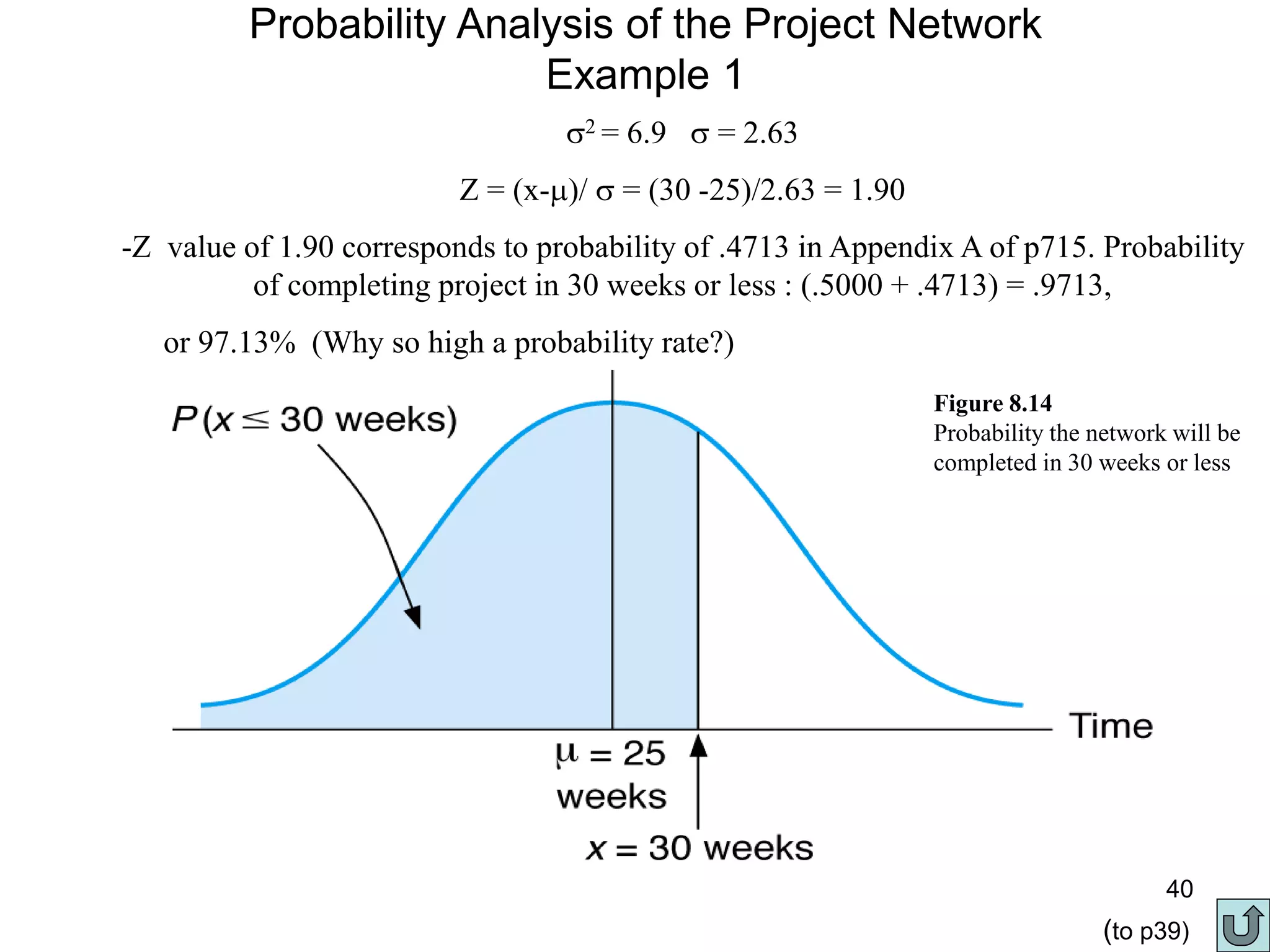
Example 1
2 = 6.9  = 2.63
Z = (x-)/  = (30 -25)/2.63 = 1.90
-Z value of 1.90 corresponds to probability of .4713 in Appendix A of p715. Probability
of completing project in 30 weeks or less : (.5000 + .4713) = .9713,
or 97.13% (Why so high a probability rate?)
Figure 8.14
Probability the network will be
completed in 30 weeks or less
(to p39)
41
Probability Analysis of the Project Network
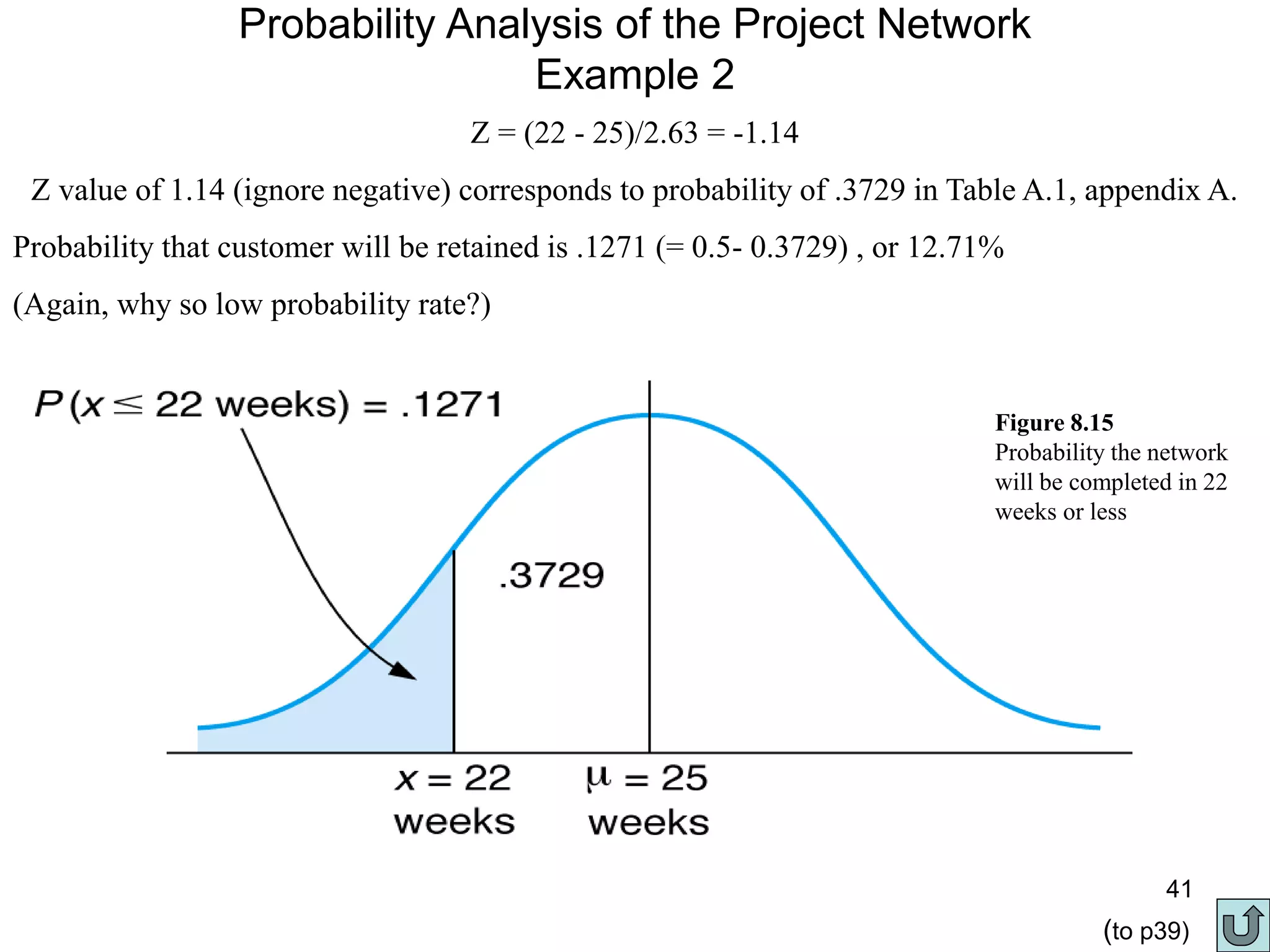
Example 2
Z = (22 - 25)/2.63 = -1.14
Z value of 1.14 (ignore negative) corresponds to probability of .3729 in Table A.1, appendix A.
Probability that customer will be retained is .1271 (= 0.5- 0.3729) , or 12.71%
(Again, why so low probability rate?)
Figure 8.15
Probability the network
will be completed in 22
weeks or less
(to p39)
42
Tutorial Assignment
• Try to use QM to solve CPM/PERT
problems (see slide 19)
• Exercises (Chapter 8)
– Old: 8, 10, 17
– New: 4, 6, 11
(to p43)
43
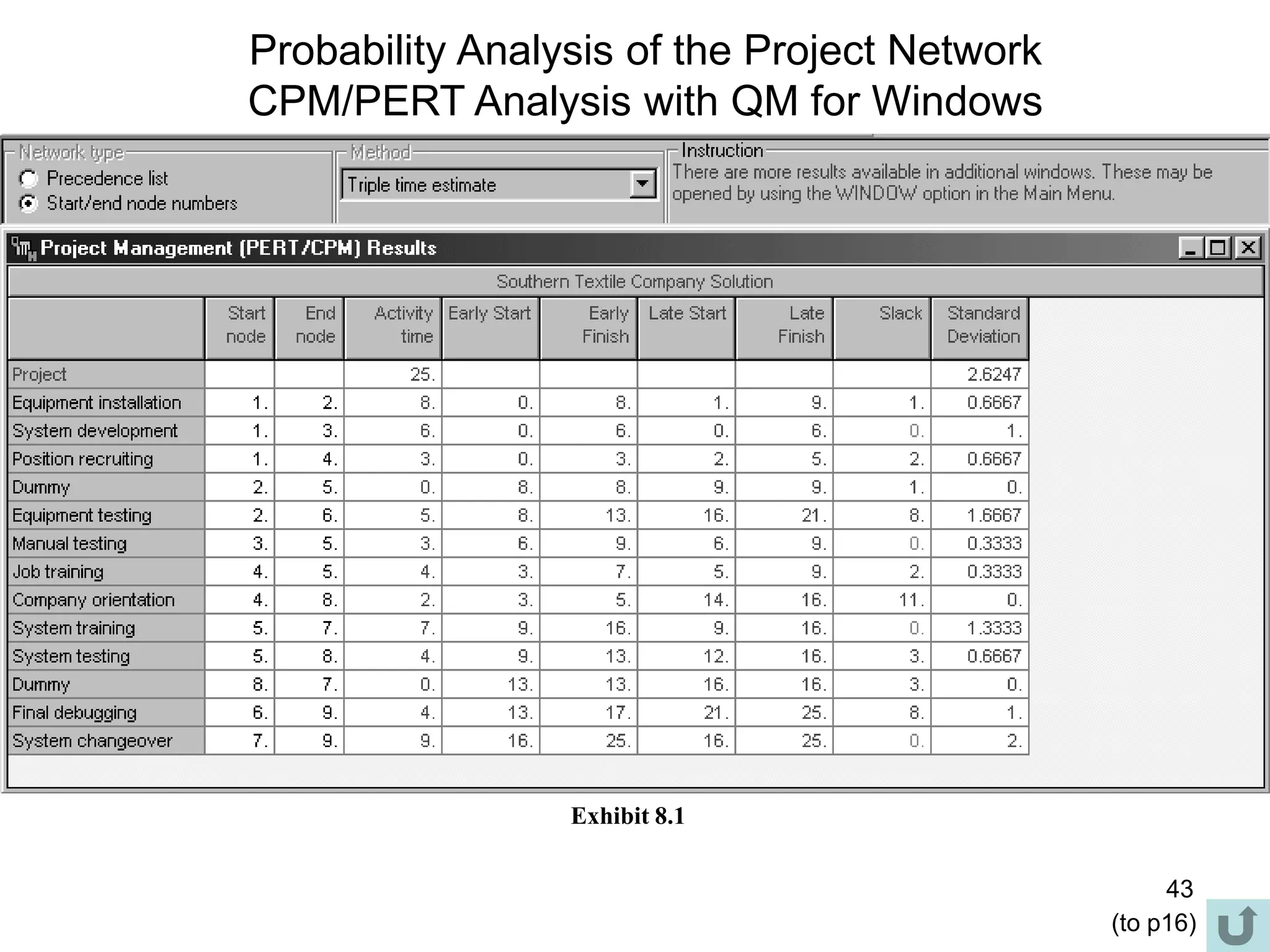
Probability Analysis of the Project Network
CPM/PERT Analysis with QM for Windows
Exhibit 8.1
(to p16)
44
The Project Network
Activity Slack
• Slack is the amount of time an activity can be delayed without delaying the project.
• Slack time exists for those activities not on the critical path for which the earliest and latest star
times are not equal.
• Shared slack is slack available for a sequence of activities.
Figure 8.8
Earliest activity start and finish times
45
The Project Network
Calculating Activity Slack Time
- Slack, Sij, computed as follows: Sij = LSij - ESij or Sij = LFij - EFij
Table 8.2
Activity Slack
Figure 8.9
Activity Slack
*

pert_n_cpm.ppt

  • 1.
    1 Topics to coverin 2nd part Topics Chapters # of lectures 1. Project Management 8 2 2. Inventory 16 1.5 3. Decision Analysis 12 1.5 4. Queuing 13 1 (to p2)
  • 2.
    2 Chapter 8 -Project Management Chapter Topics Date Topics Mar 11 1.The Elements of Project Management 2.The Project Network Probabilistic Activity Times Mar 25 1.Project Crashing and Time-Cost Trade-Off 2.Formulating the CPM/PERT Network as a Linear Programming Model (to p3)
  • 3.
    3 Project Management Questions: 1. Whydo we need to study Project Management? 2. How does a project management technique work? (to p4) (to p5)
  • 4.
    4 Objective • The mainpurpose is to govern the operations of a project such that all activities involved are well administrated and that we can also control its completion time (to p3)
  • 5.
    5 Project management technique Stepsto solve a project management problem: 1. to represent a ‘project problem” graphically 2. to determine its completion time 3. to carry out sensitivity analysis, if any (to p6) (to p12) (to p29)
  • 6.
    6 1. Represent a‘project problem” graphically Steps: 1. Gather all information and organize them in a table format that consists of: event, processing time, and precedent constraints as follows: 2. Draw a semantic network to represent them Special case! Event Processing Time Precedent constraints A B C 20 30 10 -- A B (to p7) (to p9) (to p4)
  • 7.
    7 Semantic network torepresent them Here, we use three symbols: node to represent stage line/branch to represent event arrow to represent precedent constraint Example (to p8) (to p6)
  • 8.
    8 Example 1 2 3 PathEvent Proc Time Pred Const 1-2 2-3 3-4 A B C 20 30 10 -- A B A 4 C B 20 30 10 Rule1: All nodes must starts from one Node and ends with one node (to p7)
  • 9.
    9 Special case! • Whentwo or events taken places in the same time interval • (known an concurrent events) • Consider the following example! • How to draw it? Event Processing Time Precedent constraints A B C 3 5 7 -- A A (to p10)
  • 10.
    10 Case 1 1 23 A B C 3 5 7 Wrong! Rule2: no node can have two outcomes and end with the same note Solution (to p11)
  • 11.
    11 Solutions for Rule2 Three ways to draw it: 1 2 3 4 5 A B C Dummy 1=0 Dummy 2 = 0 1 2 3 4 A B C Dummy = 0 1 2 3 4 A B C Dummy = 0 Solution 1: Solution 2: Solution 3: What one is better? A dummy activity shows a precedence relationship Reflects no processing time (to p6)
  • 12.
    12 2. Determine itscompletion time Consider the project network as shown in next slide Question: Is it an easy way to find out the solution? Answer: YES, it knows as Critical Path Method (CPM) (to p15) (to p13)
  • 13.
    13 The Project Network AllPossible Paths for Obtaining a Solution Figure 8.3 Expanded network for building a house showing concurrent activities. Table 8.1 Possible Paths to complete the House-Building Network Then the completion time for paths A, B, C and D can be computed as (to p14)
  • 14.
    14 The Project Network Completiontime for: path A: 12  3  4  6  7, 3 + 2 + 0 + 3 + 1 = 9 months (Critical Path) path B: 1  2  3  4  5  6  7, 3 + 2 + 0 + 1 + 1 + 1 = 8 months path C: 1  2  4  6  7, 3 + 1 + 3 + 1 = 8 months path D: 1  2  4  5  6  7, 3 + 1 + 1 + 1 + 1 = 7 months The critical path is the longest path through the network; the minimum time the network can be completed. Figure 8.5 Alternative paths in the network This is the Solution! (to p12)
  • 15.
    15 Critical Path Method(CPM) • General concepts: – For each branch of the project network, we firstly determine four values of ES, EF, LS and LF – For each branch, we compute their slack time, • Slack time = (LS-ES) or (LF-EF) – The critical path is located at branch that has slack time = 0 (Do you know the reason why?) How it works? (to p16)
  • 16.
    16 How CPM works? Steps: 1.Prepare the project network 2. Construct a table as follows: 3. Compute ES and EF 4. Compute LS and LF 5. Compute LS-ES or LF- EF Branch ES EF LS LF ESij = max (EFi) EFij = ESi + tij with EF1=0 Critical path when LS-ES=0 (to p4) (to p17) (to p26) (to p22)
  • 17.
    17 Compute ES andEF Note: When computing these values, the pattern is like moving zic-zac format by firstly computer ES12 and then adding it to EF12 and move to next branch by copying the max values of the branch 1-2 to say, 2-3 We compute them from top to bottom! Their relationship : Example 1: (to p18) (to p22) (to p19)
  • 18.
    18 The starting pointof ES and EF Consider: Then EF1 = 0 ES12 = max (EF1) EF12 = ES12 + t12 = 0 = 0 + t12 1 2 t12 (to p17)
  • 19.
    19 Branches ESij =max(EFi) EFij=ESij+tij 1-2 2-3 2-4 3-4 4-5 4-6 5-6 6-7 ES12= max(EF1)= ES23=max(EF2)= ES24=max(EF2)= ES34=max(EF3)= ES45=max(EF4)= ES46=max(EF4)= ES56=max(EF5)= ES67=max(EF6)= EF12=ES12+t12= EF23=ES23+t23= EF24= EF34= EF45= EF46= EF56= EF67= The overall computation is shown in next slide (to p20)
  • 20.
    20 Branch ESij =max (EFi ) EFij = ESij + tij 1 -2 2-3 ES12 = max (EF1) = 0 ES23 = max (EF2) = 3 EF12 = ES12 + t12 = 0 + 3 =3 EF23=ES23+t23 = 3 + 2 = 5 2-4 3-4 4 -5 ES24 = max(EF2) = 3 ES34= max (EF3) = 5 ES45= max (ES4) = 5 EF24=ES24+t24 =3 + 1 = 4 EF34=ES34 + t34 = 5 + 0 = 5 EF45 = ES45 + t45 = 5 + 1 = 6 4 -6 5-6 6-7 ES46=max(EF4) = 5 ES56=max(EF5) = 6 ES67=max(EF6) =8 EF46=ES46+t46 =5 + 3 = 8 EF56=ES56 +t56 =6 + 1 = 7 EF67=ES67+t67 = 8+ 1 = 9 - ES is the earliest time an activity can start. ESij = Maximum (EFi) - EF is the earliest start time plus the activity time. EFij = ESij + tij (note:you can compute these values and show in the network diagram as well) Add all t to note 4 and take the longest time Max (node 3+t34, node2+t24) max (5+0, 3+1) =max(5,4)=5 add all ti for note 2 Max(node4+t46,node5+t56 =max(5+3,5+1)=8 Complete solution (to p4) (to p21)
  • 21.
    21 The Project Network ActivityScheduling- Earliest Times - ES is the earliest time an activity can start. ESij = Maximum (EFi) - EF is the earliest start time plus the activity time. EFij = ESij + tij Figure 8.6 Earliest activity start and finish times (to p20)
  • 22.
    22 Compute LS andLF Note: We compute these values from the bottom to top, with assigning: LSij = LFi -tij LFij = min LSj with the end of LFij = EFij Example: computing Figure 8.3 (to p23)
  • 23.
    23 Branches LSij =LFij-tij LFij=min(LSj) 1-2 2-3 2-4 3-4 4-5 4-6 5-6 6-7 LS12 = Li12-t12 = LS23 = LF23-t23 = LS24 = LF24-t24 = LS34 = LF34-t34 = LS45 = LF45-t45 = LS46 = LF46-i46 = LS56 = LF56-t56 = LS67 = LF67-t67 = LF12=min(LS2)= LF23=min(LS3)= LF24=min(LS4)= LF34=min(LS4)= LF45=min(LS5)= LF46=min(LS6)= LF56=min(LS6)= LF67=min(LS7)= The overall computational is shown in next slide (to p24)
  • 24.
    24 - LS isthe latest time an activity can start without delaying critical path time. LSij = LFij - tij - LF is the latest finish time LFij = Minimum (LSj) Branches LSij=LFij-tij LFij=min LSj 1-2 2-3 2-4 LS12=LF12-t12 = 3-3 =0 LS23=LF23-t23=5-2=3 LS24=LF24-t24=5-1=4 LF12 = Min(LS2) =3 LF23=Min(LS3) = 5 LF24=Min(LS4)=5 3-4 4-5 4-6 LS34=LF34-t34=5-0 = 5 LS45=LF45-t45 = 7-1=6 LS46=LF46-t46=8-3=5 LF34=Min(LS4) = 5 LF45=Min(LS5)=7 LF46=Min(LS6)=8 5-6 6-7 LS56=LF56-t56=8-1=7 LS67=LF67-t67=9-1=8 LF56=Min(LS6)=8 LF67=Min(LS67)=9 Start with the end node first Same as EF67 from the previous slide Again, you can place these values onto the branches Min(node 6-t46,node5-t45) =Min(8-3,7-1) =Min(5,6)=5 Min(node3-t23,node4-t24) =Min(5-2,5-1)=Min(3,4)=3 Min(node 7-t67) =Min(9-1)=8 (to p25) (to p22)
  • 25.
    25 The Project Network ActivityScheduling - Latest Times - LS is the latest time an activity can start without delaying critical path time. LSij = LFij - tij - LF is the latest finish time LFij = Minimum (LSj) Figure 8.7 Latest activity start and finish times (to p24)
  • 26.
    26 Compute LS-ES orLF-EF Two ways you can achieve it: 1. by compiling slack, Sij 2. by showing branches (to p27) (to p28) (to p16)
  • 27.
    27 The Project Network CalculatingActivity Slack Time - Slack, Sij, computed as follows: Sij = LSij - ESij or Sij = LFij - EFij Table 8.2 Activity Slack Figure 8.9 Activity Slack * What does it mean? (to p26)
  • 28.
    28 The Project Network ActivitySlack • Slack is the amount of time an activity can be delayed without delaying the project. • Slack time exists for those activities not on the critical path for which the earliest and latest star times are not equal. • Shared slack is slack available for a sequence of activities. Figure 8.8 Earliest activity start and finish times (to p26)
  • 29.
    29 Sensitivity Analysis • Today,we only consider one case – “Probabilistic Activity Times” • Refer to activity time estimates usually can not be made with certainty • PERT is known as the solution method (to p30)
  • 30.
    30 PERT • In PERT,three different time estimations are applied: most likely time (m), the optimistic time (a) , and the pessimistic time (b). • How do we make use of these three values? (to p31)
  • 31.
    31 Probabilistic Activity Times •Weused these values to estimate the mean and variance of a beta distribution: mean (expected time): variance: How to use these values to solve a project network problem? 6 b 4m a t    2 6 a - b            v (to p32)
  • 32.
    32 PERT • We simplyapply t values in CPM and determine the values of: • ES • EF • LS • LF • S and branches with slack = 0 still consider as critical paths • Example. (to p33)
  • 33.
    33 Procedures for PERT Step1: based on the values of a, b and m, determine the t and v values for each path Step 2: determine the critical path by using t values in the CPM Step 3: compute its corresponding means and standard deviations according. Example Result implication Applications (to p34) (to p38) (to p39)
  • 34.
    34 PERT Example • Step1: computer t and v values • Step 2: determine the CPM • Step 3: determine v value (to p35) (to p36) (to p37) (to p33)
  • 35.
    35 Step 1: computert and v values Figure 8.11 Network with mean activity times and variances Table 8.3 Activity Time Estimates for Figure 8.10 6 b 4m a t    2 6 a - b            v (to p34)
  • 36.
    36 Step 2: determinethe CPM Figure 8.12 Earliest and latest activity times Table 8.4 Activity Earliest and Latest Times and Slack (to p34)
  • 37.
    37 Step 3: determinev value • The expected project time is the sum of the expected times of the critical path activities. • The project variance is the sum of the variances of the critical path activities. • The expected project time is assumed to be normally distributed (based on central limit theorum). In example, expected project time (tp) and variance (vp) interpreted as the mean () and variance (2) of a normal distribution:  = 25 weeks 2 = 6.9 weeks Critical Path Activity Variance 1  3 3  5 5  7 7 9 1 1/9 16/9 4 total 62/9 (to p34)
  • 38.
    38 Probability Analysis ofthe Project Network - Using normal distribution, probabilities are determined by computing number of standard deviations (Z) a value is from the mean. - Value is used to find corresponding probability in Table A.1, App. A. Figure 8.13 Normal distribution of network duration Critical value (to p33)
  • 39.
    39 Consider when x =30 x = 22 Tutorial Assignment (to p40) (to p41) (to p42)
  • 40.
    40 Probability Analysis ofthe Project Network Example 1 2 = 6.9  = 2.63 Z = (x-)/  = (30 -25)/2.63 = 1.90 -Z value of 1.90 corresponds to probability of .4713 in Appendix A of p715. Probability of completing project in 30 weeks or less : (.5000 + .4713) = .9713, or 97.13% (Why so high a probability rate?) Figure 8.14 Probability the network will be completed in 30 weeks or less (to p39)
  • 41.
    41 Probability Analysis ofthe Project Network Example 2 Z = (22 - 25)/2.63 = -1.14 Z value of 1.14 (ignore negative) corresponds to probability of .3729 in Table A.1, appendix A. Probability that customer will be retained is .1271 (= 0.5- 0.3729) , or 12.71% (Again, why so low probability rate?) Figure 8.15 Probability the network will be completed in 22 weeks or less (to p39)
  • 42.
    42 Tutorial Assignment • Tryto use QM to solve CPM/PERT problems (see slide 19) • Exercises (Chapter 8) – Old: 8, 10, 17 – New: 4, 6, 11 (to p43)
  • 43.
    43 Probability Analysis ofthe Project Network CPM/PERT Analysis with QM for Windows Exhibit 8.1 (to p16)
  • 44.
    44 The Project Network ActivitySlack • Slack is the amount of time an activity can be delayed without delaying the project. • Slack time exists for those activities not on the critical path for which the earliest and latest star times are not equal. • Shared slack is slack available for a sequence of activities. Figure 8.8 Earliest activity start and finish times
  • 45.
    45 The Project Network CalculatingActivity Slack Time - Slack, Sij, computed as follows: Sij = LSij - ESij or Sij = LFij - EFij Table 8.2 Activity Slack Figure 8.9 Activity Slack *