Writing to Persuade

Speech writing
Smoking ban. Right or
wrong?
          Copyright 2007 www.englishteaching.co.uk
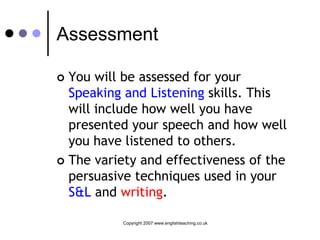
Assessment

 You will be assessed for your
  Speaking and Listening skills. This
  will include how well you have
  presented your speech and how well
  you have listened to others.
 The variety and effectiveness of the
  persuasive techniques used in your
  S&L and writing.

          Copyright 2007 www.englishteaching.co.uk
Persuasive Techniques
           match the technique to the definition
1.    Cluster of three                         A.      Using metaphors or similes to illustrate
2.    Alliteration                                     your point
3.    Forceful phrases                         B.      Gets your audience to stop and think
                                               C.      Using words such as
4.    Personal pronouns                                demand/urge/want
5.    Figurative Language                      D.      Little stories to create sympathy
                                               E.      Using words such as ‘you’, ‘we’, ‘us’ or ‘I’
6.    Anecdotes
                                               F.      Two or more words starting with the
7.    Emotive Language                                 same letter
8.    Emotive pictures                         G.      Pictures used to create sympathy
9.    Using facts and figures                  H.      Three words or phrases to emphasize a
                                                       point
10.   Rhetorical Questions                     I.      Using language to create sympathy to
11.   Short sentences                          J.      Using a professional opinion to back up
                                                       facts and figures
                                               K.      Questions that can not be answered


                                Copyright 2007 www.englishteaching.co.uk
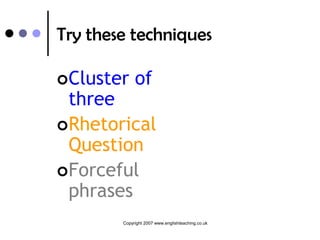
Try these techniques

Cluster     of
 three
Rhetorical
 Question
Forceful
 phrases
        Copyright 2007 www.englishteaching.co.uk
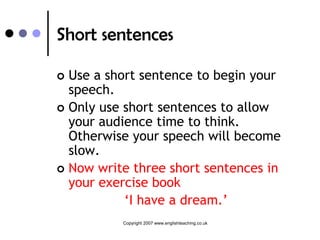
Short sentences

 Use a short sentence to begin your
  speech.
 Only use short sentences to allow
  your audience time to think.
  Otherwise your speech will become
  slow.
 Now write three short sentences in
  your exercise book
           ‘I have a dream.’
          Copyright 2007 www.englishteaching.co.uk
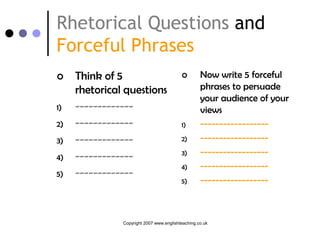
Rhetorical Questions and
Forceful Phrases
    Think of 5                                   Now write 5 forceful
     rhetorical questions                          phrases to persuade
                                                   your audience of your
1)   -------------                                 views
2)   -------------                        1)       ------------------
3)   -------------                        2)       ------------------
4)   -------------                        3)       ------------------
                                          4)       ------------------
5)   -------------
                                          5)       ------------------


               Copyright 2007 www.englishteaching.co.uk
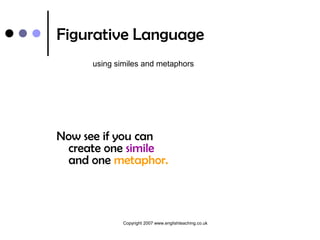
Figurative Language
     using similes and metaphors


Now see if you can
 create one simile
 and one metaphor.


             Copyright 2007 www.englishteaching.co.uk
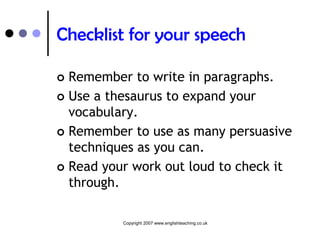
Checklist for your speech

 Remember to write in paragraphs.
 Use a thesaurus to expand your
  vocabulary.
 Remember to use as many persuasive
  techniques as you can.
 Read your work out loud to check it
  through.

          Copyright 2007 www.englishteaching.co.uk

Persaude

  • 1.
    Writing to Persuade Speechwriting Smoking ban. Right or wrong? Copyright 2007 www.englishteaching.co.uk
  • 2.
    Assessment  You willbe assessed for your Speaking and Listening skills. This will include how well you have presented your speech and how well you have listened to others.  The variety and effectiveness of the persuasive techniques used in your S&L and writing. Copyright 2007 www.englishteaching.co.uk
  • 3.
    Persuasive Techniques match the technique to the definition 1. Cluster of three A. Using metaphors or similes to illustrate 2. Alliteration your point 3. Forceful phrases B. Gets your audience to stop and think C. Using words such as 4. Personal pronouns demand/urge/want 5. Figurative Language D. Little stories to create sympathy E. Using words such as ‘you’, ‘we’, ‘us’ or ‘I’ 6. Anecdotes F. Two or more words starting with the 7. Emotive Language same letter 8. Emotive pictures G. Pictures used to create sympathy 9. Using facts and figures H. Three words or phrases to emphasize a point 10. Rhetorical Questions I. Using language to create sympathy to 11. Short sentences J. Using a professional opinion to back up facts and figures K. Questions that can not be answered Copyright 2007 www.englishteaching.co.uk
  • 4.
    Try these techniques Cluster of three Rhetorical Question Forceful phrases Copyright 2007 www.englishteaching.co.uk
  • 5.
    Short sentences  Usea short sentence to begin your speech.  Only use short sentences to allow your audience time to think. Otherwise your speech will become slow.  Now write three short sentences in your exercise book ‘I have a dream.’ Copyright 2007 www.englishteaching.co.uk
  • 6.
    Rhetorical Questions and ForcefulPhrases  Think of 5  Now write 5 forceful rhetorical questions phrases to persuade your audience of your 1) ------------- views 2) ------------- 1) ------------------ 3) ------------- 2) ------------------ 4) ------------- 3) ------------------ 4) ------------------ 5) ------------- 5) ------------------ Copyright 2007 www.englishteaching.co.uk
  • 7.
    Figurative Language using similes and metaphors Now see if you can create one simile and one metaphor. Copyright 2007 www.englishteaching.co.uk
  • 8.
    Checklist for yourspeech  Remember to write in paragraphs.  Use a thesaurus to expand your vocabulary.  Remember to use as many persuasive techniques as you can.  Read your work out loud to check it through. Copyright 2007 www.englishteaching.co.uk