Personalized Medicine
via molecular interrogation, data
mining and systems biology
Gerry Lushington
KU Molecular Graphics & Modeling Lab
K-INBRE Bioinformatics Core
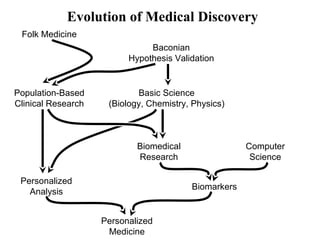
Folk Medicine
Baconian
Hypothesis Validation
Basic Science
(Biology, Chemistry, Physics)
Population-Based
Clinical Research
Personalized
Analysis
Computer
Science
Biomedical
Research
Biomarkers
Personalized
Medicine
Evolution of Medical Discovery
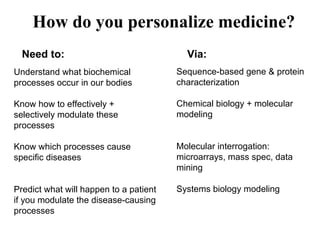
How do you personalize medicine?
Need to: Via:
Understand what biochemical
processes occur in our bodies
Know how to effectively +
selectively modulate these
processes
Know which processes cause
specific diseases
Predict what will happen to a patient
if you modulate the disease-causing
processes
Sequence-based gene & protein
characterization
Chemical biology + molecular
modeling
Molecular interrogation:
microarrays, mass spec, data
mining
Systems biology modeling
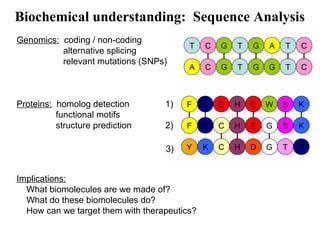
Biochemical understanding: Sequence Analysis
Genomics: coding / non-coding
alternative splicing
relevant mutations (SNPs)
Proteins: homolog detection
functional motifs
structure prediction
Implications:
What biomolecules are we made of?
What do these biomolecules do?
How can we target them with therapeutics?
T C
R HF C GE
A C
G TA CG T
G TG CG T
KS
K HY C GD RT
R HF E WE KS1)
2)
3)
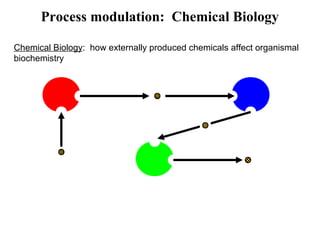
Process modulation: Chemical Biology
Chemical Biology: how externally produced chemicals affect organismal
biochemistry
Chemical Biology: how externally produced chemicals affect organismal
biochemistry
Inhibitor
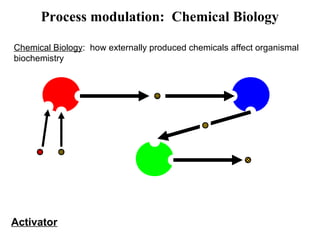
Process modulation: Chemical Biology
Chemical Biology: how externally produced chemicals affect organismal
biochemistry
Activator
Process modulation: Chemical Biology
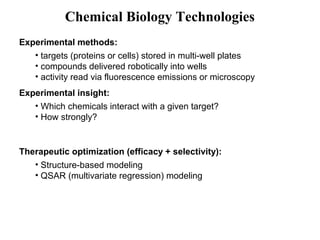
Chemical Biology Technologies
Therapeutic optimization (efficacy + selectivity):
• Structure-based modeling
• QSAR (multivariate regression) modeling
Experimental methods:
• targets (proteins or cells) stored in multi-well plates
• compounds delivered robotically into wells
• activity read via fluorescence emissions or microscopy
Experimental insight:
• Which chemicals interact with a given target?
• How strongly?
Molecular Docking
Non-covalent inhibitor evaluation:
Conformation search driven by
Free energy estimation:
E = Electrostatics + vdW + Entropy
Structure based SAR
Target specificity: bind well only to desired receptor, not to others
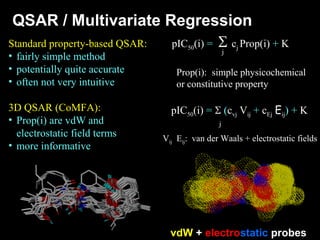
QSAR / Multivariate Regression
Standard property-based QSAR:
• fairly simple method
• potentially quite accurate
• often not very intuitive
3D QSAR (CoMFA):
• Prop(i) are vdW and
electrostatic field terms
• more informative
pIC50(i) =  cj Prop(i) + K
j
pIC50(i) = (cvj Vij + cEj Eij) + K
j
vdW + electrostatic probes
Prop(i): simple physicochemical
or constitutive property
Vij, Eij: van der Waals + electrostatic fields
Therapeutic Limitation
No single gene/protein bears complete responsibility for a given disease
Coping Strategies
Analyze microarray data to identify which genes are disproportionately
more or less active in performing protein translation in diseased tissue
Use mass spec to identify specific molecules with abnormally high or low
abundance
Use informatics techniques to determine which anomalies are significant
and causative
Achievements of Functional Targeting
Understand biochemical role of key genes/proteins + how to modulate
these roles
Molecular interrogation: mass spectrometry
supports rapid assessment of the tissue prevalence of functionally
relevant biomolecules, including:
- Proteins (native, spliced or modified)
- Lipids
- Metabolites
- Transmitters
- Toxins
- Therapeutics
- etc.
Ablation
Sample
Force
Molecular
Mass
 Time to reach
detector
MS has the potential to
produce much more
information than microarray
studies, but poses very
complex challenges
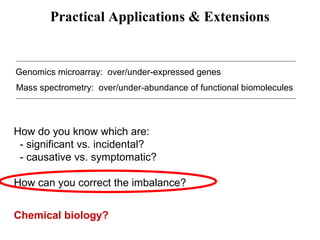
How do you know which are:
- significant vs. incidental?
- causative vs. symptomatic?
How can you correct the imbalance?
Genomics microarray: over/under-expressed genes
Mass spectrometry: over/under-abundance of functional biomolecules
Practical Applications & Extensions
How do you know which are:
- significant vs. incidental?
- causative vs. symptomatic?
How can you correct the imbalance?
Genomics microarray: over/under-expressed genes
Mass spectrometry: over/under-abundance of functional biomolecules
Practical Applications & Extensions
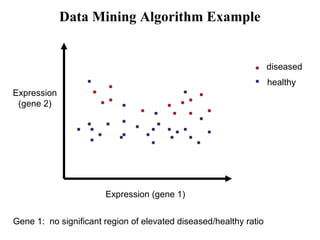
Datamining over healthy vs. diseased samples
Data Mining Algorithm Example
Expression
(gene 2)
Expression (gene 1)
diseased
healthy
Data Mining Algorithm Example
Expression
(gene 2)
Expression (gene 1)
diseased
healthy
Gene 1: no significant region of elevated diseased/healthy ratio
Data Mining Algorithm Example
Expression
(gene 2)
Expression (gene 1)
diseased
healthy
Gene 2: has significant region of elevated diseased/healthy ratio
Data Mining Algorithm Example
Expression
(gene 2)
Expression (gene 3)
diseased
healthy
Genes 2,3: strong region of elevated diseased/healthy ratio
How do you know which are:
- significant vs. incidental?
- causative vs. symptomatic?
How can you correct the imbalance?
Genomics microarray: over/under-expressed genes
Mass spectrometry: over/under-abundance of functional biomolecules
Practical Applications & Extensions
Knockouts: genetic engineering or chemical biology
How do you know which are:
- significant vs. incidental?
- causative vs. symptomatic?
How can you correct the imbalance?
Genomics microarray: over/under-expressed genes
Mass spectrometry: over/under-abundance of functional biomolecules
Practical Applications & Extensions
Chemical biology?
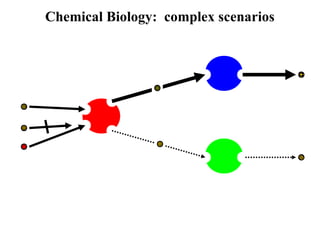
Chemical Biology: complex scenarios
?
?
?
?
?
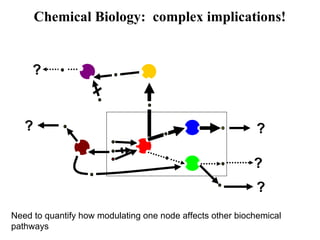
Chemical Biology: complex implications!
Need to quantify how modulating one node affects other biochemical
pathways
Systems Biology
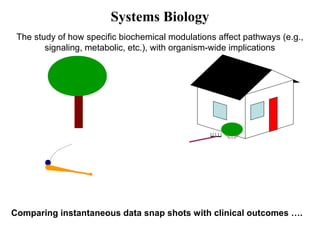
The study of how specific biochemical modulations affect pathways (e.g.,
signaling, metabolic, etc.), with organism-wide implications
Single genechip microarray, mass spec and chemical biology
experiments give dependency snapshots
Systems Biology
The study of how specific biochemical modulations affect pathways (e.g.,
signaling, metabolic, etc.), with organism-wide implications
Comparing instantaneous data snap shots with clinical outcomes ….
Systems Biology
The study of how specific biochemical modulations affect pathways (e.g.,
signaling, metabolic, etc.), with organism-wide implications
without observing intermediate steps …..
Systems Biology
The study of how specific biochemical modulations affect pathways (e.g.,
signaling, metabolic, etc.), with organism-wide implications
that play key roles in determining the outcomes …..
Systems Biology
The study of how specific biochemical modulations affect pathways (e.g.,
signaling, metabolic, etc.), with organism-wide implications
can lead to erroneous conclusions!
a
b
x
c
d
e
f
A
B
C
[c] = KaxA [a]k
[x]j
[A]l
KcB [c]m
[B]n
[d] = KbA [b]k
[A]l
KdxC [d]m
[x]j
[C]n
[e] = KcB [c]m
[B]n
[f] = KdC [d]m
[C]n
[a] = 1
KaxA [a]k
[x]j
[A]l
[b] = KxA [x]j
[A]l
KaA [a]k
[A]l
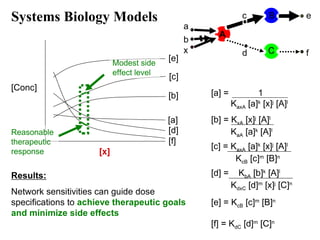
Systems Biology Models
[Conc]
time
[a]
[d]
[f]
[c]
[b]
[e]
x administered
Procedure:
Microarray, MS or chemical biology data
Record multiple time points
Perturb the system (i.e., add x)
Fit concentrations to coupled equations
a
b
x
c
d
e
f
A
B
C
[c] = KaxA [a]k
[x]j
[A]l
KcB [c]m
[B]n
[d] = KbA [b]k
[A]l
KdxC [d]m
[x]j
[C]n
[e] = KcB [c]m
[B]n
[f] = KdC [d]m
[C]n
[a] = 1
KaxA [a]k
[x]j
[A]l
[b] = KxA [x]j
[A]l
KaA [a]k
[A]l
Systems Biology Models
[Conc]
time
[a]
[d]
[f]
[c]
[b]
[e]
x administered
Results:
Network sensitivities can pinpoint possible side
effects
a
b
x
c
d
e
f
A
B
C
[c] = KaxA [a]k
[x]j
[A]l
KcB [c]m
[B]n
[d] = KbA [b]k
[A]l
KdxC [d]m
[x]j
[C]n
[e] = KcB [c]m
[B]n
[f] = KdC [d]m
[C]n
[a] = 1
KaxA [a]k
[x]j
[A]l
[b] = KxA [x]j
[A]l
KaA [a]k
[A]l
Systems Biology Models
[Conc]
time
[a]
[d]
[f]
[c]
[b]
[e]
x administered
Procedure:
Examine difference patient responses
a
b
x
c
d
e
f
A
B
C
[c] = KaxA [a]k
[x]j
[A]l
KcB [c]m
[B]n
[d] = KbA [b]k
[A]l
KdxC [d]m
[x]j
[C]n
[e] = KcB [c]m
[B]n
[f] = KdC [d]m
[C]n
[a] = 1
KaxA [a]k
[x]j
[A]l
[b] = KxA [x]j
[A]l
KaA [a]k
[A]l
Systems Biology Models
Results:
Patient 2 has decreased susceptibility to side
effects
May be able to boost dosage
without negative consequences
[Conc]
time
[a]
[d]
[f]
[c]
[b]
[e]
x administered
a
b
x
c
d
e
f
A
B
C
[c] = KaxA [a]k
[x]j
[A]l
KcB [c]m
[B]n
[d] = KbA [b]k
[A]l
KdxC [d]m
[x]j
[C]n
[e] = KcB [c]m
[B]n
[f] = KdC [d]m
[C]n
[a] = 1
KaxA [a]k
[x]j
[A]l
[b] = KxA [x]j
[A]l
KaA [a]k
[A]l
Systems Biology Models
[Conc]
time
[a]
[d]
[f]
[c]
[b]
[e]
x administered
Results:
Patient 3 has diminished therapeutic
response
May need to find another drug
or target or also address [c]
a
b
x
c
d
e
f
A
B
C
[c] = KaxA [a]k
[x]j
[A]l
KcB [c]m
[B]n
[d] = KbA [b]k
[A]l
KdxC [d]m
[x]j
[C]n
[e] = KcB [c]m
[B]n
[f] = KdC [d]m
[C]n
[a] = 1
KaxA [a]k
[x]j
[A]l
[b] = KxA [x]j
[A]l
KaA [a]k
[A]l
Systems Biology Models
[Conc]
[x]
[d]
[f]
[a]
[b]
[c]
[e]
Procedure:
Microarray, MS or chemical biology data
Record multiple dose response points
Time average
Fit concentrations to coupled equations
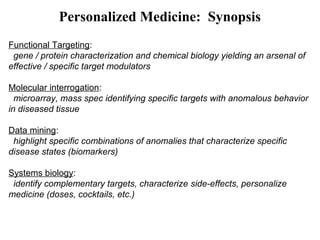
Personalized Medicine: Synopsis
Functional Targeting:
gene / protein characterization and chemical biology yielding an arsenal of
effective / specific target modulators
Molecular interrogation:
microarray, mass spec identifying specific targets with anomalous behavior
in diseased tissue
Data mining:
highlight specific combinations of anomalies that characterize specific
disease states (biomarkers)
Systems biology:
identify complementary targets, characterize side-effects, personalize
medicine (doses, cocktails, etc.)
Questions / Comments
glushington@ku.edu
785-864-1140

Personalized medicine

  • 1.
    Personalized Medicine via molecularinterrogation, data mining and systems biology Gerry Lushington KU Molecular Graphics & Modeling Lab K-INBRE Bioinformatics Core
  • 2.
    Folk Medicine Baconian Hypothesis Validation BasicScience (Biology, Chemistry, Physics) Population-Based Clinical Research Personalized Analysis Computer Science Biomedical Research Biomarkers Personalized Medicine Evolution of Medical Discovery
  • 3.
    How do youpersonalize medicine? Need to: Via: Understand what biochemical processes occur in our bodies Know how to effectively + selectively modulate these processes Know which processes cause specific diseases Predict what will happen to a patient if you modulate the disease-causing processes Sequence-based gene & protein characterization Chemical biology + molecular modeling Molecular interrogation: microarrays, mass spec, data mining Systems biology modeling
  • 4.
    Biochemical understanding: SequenceAnalysis Genomics: coding / non-coding alternative splicing relevant mutations (SNPs) Proteins: homolog detection functional motifs structure prediction Implications: What biomolecules are we made of? What do these biomolecules do? How can we target them with therapeutics? T C R HF C GE A C G TA CG T G TG CG T KS K HY C GD RT R HF E WE KS1) 2) 3)
  • 5.
    Process modulation: ChemicalBiology Chemical Biology: how externally produced chemicals affect organismal biochemistry
  • 6.
    Chemical Biology: howexternally produced chemicals affect organismal biochemistry Inhibitor Process modulation: Chemical Biology
  • 7.
    Chemical Biology: howexternally produced chemicals affect organismal biochemistry Activator Process modulation: Chemical Biology
  • 8.
    Chemical Biology Technologies Therapeuticoptimization (efficacy + selectivity): • Structure-based modeling • QSAR (multivariate regression) modeling Experimental methods: • targets (proteins or cells) stored in multi-well plates • compounds delivered robotically into wells • activity read via fluorescence emissions or microscopy Experimental insight: • Which chemicals interact with a given target? • How strongly?
  • 9.
    Molecular Docking Non-covalent inhibitorevaluation: Conformation search driven by Free energy estimation: E = Electrostatics + vdW + Entropy Structure based SAR Target specificity: bind well only to desired receptor, not to others
  • 10.
    QSAR / MultivariateRegression Standard property-based QSAR: • fairly simple method • potentially quite accurate • often not very intuitive 3D QSAR (CoMFA): • Prop(i) are vdW and electrostatic field terms • more informative pIC50(i) =  cj Prop(i) + K j pIC50(i) = (cvj Vij + cEj Eij) + K j vdW + electrostatic probes Prop(i): simple physicochemical or constitutive property Vij, Eij: van der Waals + electrostatic fields
  • 11.
    Therapeutic Limitation No singlegene/protein bears complete responsibility for a given disease Coping Strategies Analyze microarray data to identify which genes are disproportionately more or less active in performing protein translation in diseased tissue Use mass spec to identify specific molecules with abnormally high or low abundance Use informatics techniques to determine which anomalies are significant and causative Achievements of Functional Targeting Understand biochemical role of key genes/proteins + how to modulate these roles
  • 13.
    Molecular interrogation: massspectrometry supports rapid assessment of the tissue prevalence of functionally relevant biomolecules, including: - Proteins (native, spliced or modified) - Lipids - Metabolites - Transmitters - Toxins - Therapeutics - etc. Ablation Sample Force Molecular Mass  Time to reach detector MS has the potential to produce much more information than microarray studies, but poses very complex challenges
  • 14.
    How do youknow which are: - significant vs. incidental? - causative vs. symptomatic? How can you correct the imbalance? Genomics microarray: over/under-expressed genes Mass spectrometry: over/under-abundance of functional biomolecules Practical Applications & Extensions
  • 15.
    How do youknow which are: - significant vs. incidental? - causative vs. symptomatic? How can you correct the imbalance? Genomics microarray: over/under-expressed genes Mass spectrometry: over/under-abundance of functional biomolecules Practical Applications & Extensions Datamining over healthy vs. diseased samples
  • 16.
    Data Mining AlgorithmExample Expression (gene 2) Expression (gene 1) diseased healthy
  • 17.
    Data Mining AlgorithmExample Expression (gene 2) Expression (gene 1) diseased healthy Gene 1: no significant region of elevated diseased/healthy ratio
  • 18.
    Data Mining AlgorithmExample Expression (gene 2) Expression (gene 1) diseased healthy Gene 2: has significant region of elevated diseased/healthy ratio
  • 19.
    Data Mining AlgorithmExample Expression (gene 2) Expression (gene 3) diseased healthy Genes 2,3: strong region of elevated diseased/healthy ratio
  • 20.
    How do youknow which are: - significant vs. incidental? - causative vs. symptomatic? How can you correct the imbalance? Genomics microarray: over/under-expressed genes Mass spectrometry: over/under-abundance of functional biomolecules Practical Applications & Extensions Knockouts: genetic engineering or chemical biology
  • 21.
    How do youknow which are: - significant vs. incidental? - causative vs. symptomatic? How can you correct the imbalance? Genomics microarray: over/under-expressed genes Mass spectrometry: over/under-abundance of functional biomolecules Practical Applications & Extensions Chemical biology?
  • 22.
  • 23.
    ? ? ? ? ? Chemical Biology: compleximplications! Need to quantify how modulating one node affects other biochemical pathways
  • 24.
    Systems Biology The studyof how specific biochemical modulations affect pathways (e.g., signaling, metabolic, etc.), with organism-wide implications Single genechip microarray, mass spec and chemical biology experiments give dependency snapshots
  • 25.
    Systems Biology The studyof how specific biochemical modulations affect pathways (e.g., signaling, metabolic, etc.), with organism-wide implications Comparing instantaneous data snap shots with clinical outcomes ….
  • 26.
    Systems Biology The studyof how specific biochemical modulations affect pathways (e.g., signaling, metabolic, etc.), with organism-wide implications without observing intermediate steps …..
  • 27.
    Systems Biology The studyof how specific biochemical modulations affect pathways (e.g., signaling, metabolic, etc.), with organism-wide implications that play key roles in determining the outcomes …..
  • 28.
    Systems Biology The studyof how specific biochemical modulations affect pathways (e.g., signaling, metabolic, etc.), with organism-wide implications can lead to erroneous conclusions!
  • 29.
    a b x c d e f A B C [c] = KaxA[a]k [x]j [A]l KcB [c]m [B]n [d] = KbA [b]k [A]l KdxC [d]m [x]j [C]n [e] = KcB [c]m [B]n [f] = KdC [d]m [C]n [a] = 1 KaxA [a]k [x]j [A]l [b] = KxA [x]j [A]l KaA [a]k [A]l Systems Biology Models [Conc] time [a] [d] [f] [c] [b] [e] x administered Procedure: Microarray, MS or chemical biology data Record multiple time points Perturb the system (i.e., add x) Fit concentrations to coupled equations
  • 30.
    a b x c d e f A B C [c] = KaxA[a]k [x]j [A]l KcB [c]m [B]n [d] = KbA [b]k [A]l KdxC [d]m [x]j [C]n [e] = KcB [c]m [B]n [f] = KdC [d]m [C]n [a] = 1 KaxA [a]k [x]j [A]l [b] = KxA [x]j [A]l KaA [a]k [A]l Systems Biology Models [Conc] time [a] [d] [f] [c] [b] [e] x administered Results: Network sensitivities can pinpoint possible side effects
  • 31.
    a b x c d e f A B C [c] = KaxA[a]k [x]j [A]l KcB [c]m [B]n [d] = KbA [b]k [A]l KdxC [d]m [x]j [C]n [e] = KcB [c]m [B]n [f] = KdC [d]m [C]n [a] = 1 KaxA [a]k [x]j [A]l [b] = KxA [x]j [A]l KaA [a]k [A]l Systems Biology Models [Conc] time [a] [d] [f] [c] [b] [e] x administered Procedure: Examine difference patient responses
  • 32.
    a b x c d e f A B C [c] = KaxA[a]k [x]j [A]l KcB [c]m [B]n [d] = KbA [b]k [A]l KdxC [d]m [x]j [C]n [e] = KcB [c]m [B]n [f] = KdC [d]m [C]n [a] = 1 KaxA [a]k [x]j [A]l [b] = KxA [x]j [A]l KaA [a]k [A]l Systems Biology Models Results: Patient 2 has decreased susceptibility to side effects May be able to boost dosage without negative consequences [Conc] time [a] [d] [f] [c] [b] [e] x administered
  • 33.
    a b x c d e f A B C [c] = KaxA[a]k [x]j [A]l KcB [c]m [B]n [d] = KbA [b]k [A]l KdxC [d]m [x]j [C]n [e] = KcB [c]m [B]n [f] = KdC [d]m [C]n [a] = 1 KaxA [a]k [x]j [A]l [b] = KxA [x]j [A]l KaA [a]k [A]l Systems Biology Models [Conc] time [a] [d] [f] [c] [b] [e] x administered Results: Patient 3 has diminished therapeutic response May need to find another drug or target or also address [c]
  • 34.
    a b x c d e f A B C [c] = KaxA[a]k [x]j [A]l KcB [c]m [B]n [d] = KbA [b]k [A]l KdxC [d]m [x]j [C]n [e] = KcB [c]m [B]n [f] = KdC [d]m [C]n [a] = 1 KaxA [a]k [x]j [A]l [b] = KxA [x]j [A]l KaA [a]k [A]l Systems Biology Models [Conc] [x] [d] [f] [a] [b] [c] [e] Procedure: Microarray, MS or chemical biology data Record multiple dose response points Time average Fit concentrations to coupled equations
  • 36.
    Personalized Medicine: Synopsis FunctionalTargeting: gene / protein characterization and chemical biology yielding an arsenal of effective / specific target modulators Molecular interrogation: microarray, mass spec identifying specific targets with anomalous behavior in diseased tissue Data mining: highlight specific combinations of anomalies that characterize specific disease states (biomarkers) Systems biology: identify complementary targets, characterize side-effects, personalize medicine (doses, cocktails, etc.)
  • 37.