DNA &
Personalized
Medicine
e-Patient Connections
October 27, 2009
@23andme
@akhomenko
genetics just got personal.
What is Personalized Medicine?
“The application of genomic and molecular data to better target the
delivery of health care, facilitate the discovery and clinical testing of
new products, and help determine a person's predisposition to a
particular disease or condition.”
Proposed Senate Bill S.976
Sponsored by Barack Obama in 2007
genetics just got personal.
“A form of medicine that uses
information about a person’s genes,
proteins, and environment to prevent,
diagnose, and treat disease.”
National Cancer Institute website
“The use of genetic susceptibility
or pharmacogenetic testing to
tailor an individual's preventive
care or drug therapy.”
Nature Genetics website
Brief History of Genomics
Human Genome Project: first complete
sequence of the human genome
- started in 1990
- first draft in 2000
- completed in 2003
genetics just got personal.
Brief History of Genomics
HapMap project: haplotype map of
the human genome, key resource
for research
- started in 2002
- phase 1 published in 2005
- phase 2 published in 2007
genetics just got personal.
Brief History of Genomics
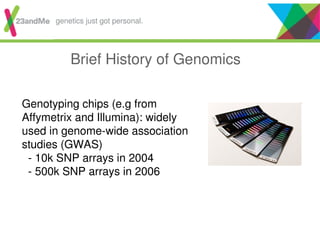
Genotyping chips (e.g from
Affymetrix and Illumina): widely
used in genome-wide association
studies (GWAS)
- 10k SNP arrays in 2004
- 500k SNP arrays in 2006
genetics just got personal.
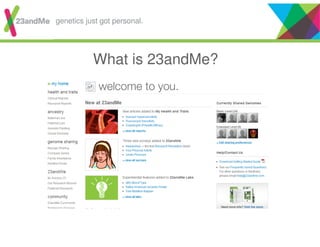
What is 23andMe?
• Web-based service that helps customers read and
understand their DNA - ancestry, inherited traits and disease
risk. Started in April 2006, launched in November 2007.
• Customers submit a small saliva sample that is processed
using a custom DNA chip.
• Data presented on a secure website using interactive tools.
• Facilitates research through an initiative called 23andWe
genetics just got personal.
What is 23andMe?
genetics just got personal.
• Illumina HumanHap550+ array (~580k SNPs)
–Opportunity to customize
–Maximum information per $
• Custom Content (30k SNPs)
–SNPs with reported associations (including rare variants)
–Pharmacogenetic SNPs (including DMET)
–Coverage of SNPs used in standard genetic tests
–HLA region
–Y and Mito
What is 23andMe?
genetics just got personal.
23andMe and personalized medicine
• Empowers individuals to understand and take
action based on their genetic data
• Creates a research platform that gives individuals
a voice in setting the direction of research
• Provides a community in which individuals can
exchange information with each other
genetics just got personal.
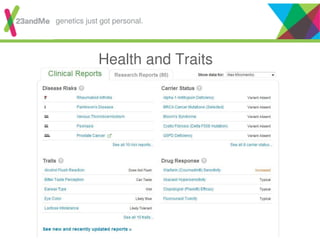
Health and Traits
genetics just got personal.
Prostate Cancer
Presentation of
the genotype-
specific risk
estimate
genetics just got personal.
Prostate Cancer
Markers used in
the risk estimate
and their effects
genetics just got personal.
Real-life example
genetics just got personal.
Real-life example
genetics just got personal.
Jeff Gulcher, CSO of deCODE
• Got his genetic data from a deCODEme test
• PSA test for prostate cancer at the age of 48
• Exploratory biopsy - aggressive form of cancer
• Underwent surgery right away
deCODEme blog, July 25, 2008
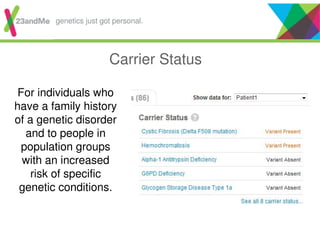
Carrier Status
For individuals who
have a family history
of a genetic disorder
and to people in
population groups
with an increased
risk of specific
genetic conditions.
genetics just got personal.
Pharmacogenetics
Warfarin:
Medicare won’t
pay for testing
across the board,
but would pay for
it in clinical trials.
FDA recommends
a genetic test.
genetics just got personal.
Pharmacogenetics
Plavix: a number
of patients getting
Plavix currently
get no benefit
from it, knowing
the genetic factors
can help choose
an alternative drug
(e.g. Effient).
genetics just got personal.
Real-life examples
genetics just got personal.
Had a blood clot at the
age of 35 and had to
start taking a blood thinner.
Went to the doctor with
23andMe data in hand.
Venous Thromboembolism (VTE)
There are known genetic mutations that increase the risk
of VTE considerably. Other known risk factors include
obesity, pregnancy, birth-control pills.
On September 15, 2008, the US Surgeon General, Rear
Admiral Steven K. Galson, MD, MPH, issued the first
Call to Action to Prevent Deep Vein Thrombosis and
Pulmonary Embolism.
genetics just got personal.
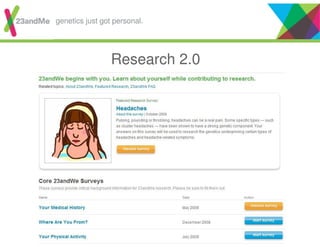
Research 2.0
genetics just got personal.
• People, not “subjects”
• Reduced barriers to participation
• Returning data to participants
• Sharing results with participants
• Allow participants to help guide
research direction and goals
• Utilization of the Web and social
networking tools
Active, engaged participants making a difference
Research 2.0
• 23andWe
- surveys, individual-vs-group results
• Parkinson’s Disease
- 3000+ individuals enrolled in a research study
• Research Revolution
- Patient-driven research, 10 candidate diseases
• Senior Games
- 4500+ athletes enrolled as a cohort
genetics just got personal.
Research 2.0
genetics just got personal.
Research 2.0
• Paper abstract presented at ASHG 2009: Web-
based, participant-driven studies yield novel
genetic associations for common traits.
• 3 novel associations, a number of replications.
“The strangeness of the 23andMe model is starting
to wear off, and presentations like this one will no
doubt help to convince scientists that this is a
company that at least is capable of doing solid
science.”
Daniel MacArthur, Genetic Future Blog, October 2009
genetics just got personal.
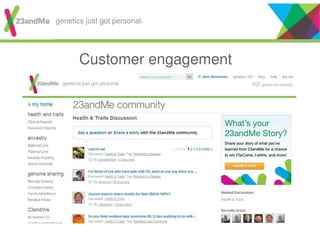
Customer engagement
genetics just got personal.
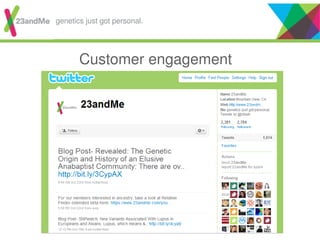
Customer engagement
genetics just got personal.
Customer engagement
Initial focus on early adopters, novelty and status
seekers. Press and event marketing. Lots of features,
eventual information overload. On-site community for
support, off-site community for outreach: twitter,
facebook, genetic genealogy mailing lists and forums.
The perception has changed dramatically in the 2 years
since we launched: encountering a lot less resistance
from scientific, research, medical communities. Need to
define and focus the product more.
genetics just got personal.
Customer engagement
Research Revolution – poor experience with patient
communities, resistance to outside voices, model. Lack of
internal advocates, even people who believed in what we
did were reluctant to lend their voice to the broad
discussion. One-on-one interactions were the most
successful.
On the ancestry front, the opposite experience: value
proposition is clear, people are used to paying for genetic
data, good success in marketing a discounted product
through key figures in target communities.
genetics just got personal.
Who benefits from usage of genetic data?
genetics just got personal.
• Patients
–Understand their own data, actively participate in care
• Doctors
–Preventive care, pharmacogenetics
• Payers
–Lower cost of care with the right drugs and therapies
• Drug companies
–Improved patient outcomes, faster drug development
• Researchers
–Patient-powered research platform, engaged community
Need to fill in the gaps!
genetics just got personal.
• 23andMe has established the initial connection with
consumers / patients
• How do we bring everyone else into the fold?
What do you think?
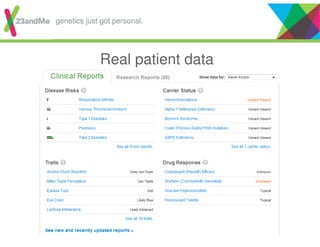
Real patient data
genetics just got personal.
Thank you!
genetics just got personal.
www.23andMe.com
Discount code: EPATIENT2009
Alex Khomenko
Director of Engineering
khomenko@23andme.com
@akhomenko

DNA and Personalized medicine

  • 1.
    DNA & Personalized Medicine e-Patient Connections October27, 2009 @23andme @akhomenko genetics just got personal.
  • 2.
    What is PersonalizedMedicine? “The application of genomic and molecular data to better target the delivery of health care, facilitate the discovery and clinical testing of new products, and help determine a person's predisposition to a particular disease or condition.” Proposed Senate Bill S.976 Sponsored by Barack Obama in 2007 genetics just got personal. “A form of medicine that uses information about a person’s genes, proteins, and environment to prevent, diagnose, and treat disease.” National Cancer Institute website “The use of genetic susceptibility or pharmacogenetic testing to tailor an individual's preventive care or drug therapy.” Nature Genetics website
  • 3.
    Brief History ofGenomics Human Genome Project: first complete sequence of the human genome - started in 1990 - first draft in 2000 - completed in 2003 genetics just got personal.
  • 4.
    Brief History ofGenomics HapMap project: haplotype map of the human genome, key resource for research - started in 2002 - phase 1 published in 2005 - phase 2 published in 2007 genetics just got personal.
  • 5.
    Brief History ofGenomics Genotyping chips (e.g from Affymetrix and Illumina): widely used in genome-wide association studies (GWAS) - 10k SNP arrays in 2004 - 500k SNP arrays in 2006 genetics just got personal.
  • 6.
    What is 23andMe? •Web-based service that helps customers read and understand their DNA - ancestry, inherited traits and disease risk. Started in April 2006, launched in November 2007. • Customers submit a small saliva sample that is processed using a custom DNA chip. • Data presented on a secure website using interactive tools. • Facilitates research through an initiative called 23andWe genetics just got personal.
  • 7.
    What is 23andMe? geneticsjust got personal. • Illumina HumanHap550+ array (~580k SNPs) –Opportunity to customize –Maximum information per $ • Custom Content (30k SNPs) –SNPs with reported associations (including rare variants) –Pharmacogenetic SNPs (including DMET) –Coverage of SNPs used in standard genetic tests –HLA region –Y and Mito
  • 8.
    What is 23andMe? geneticsjust got personal.
  • 9.
    23andMe and personalizedmedicine • Empowers individuals to understand and take action based on their genetic data • Creates a research platform that gives individuals a voice in setting the direction of research • Provides a community in which individuals can exchange information with each other genetics just got personal.
  • 10.
    Health and Traits geneticsjust got personal.
  • 11.
    Prostate Cancer Presentation of thegenotype- specific risk estimate genetics just got personal.
  • 12.
    Prostate Cancer Markers usedin the risk estimate and their effects genetics just got personal.
  • 13.
  • 14.
    Real-life example genetics justgot personal. Jeff Gulcher, CSO of deCODE • Got his genetic data from a deCODEme test • PSA test for prostate cancer at the age of 48 • Exploratory biopsy - aggressive form of cancer • Underwent surgery right away deCODEme blog, July 25, 2008
  • 15.
    Carrier Status For individualswho have a family history of a genetic disorder and to people in population groups with an increased risk of specific genetic conditions. genetics just got personal.
  • 16.
    Pharmacogenetics Warfarin: Medicare won’t pay fortesting across the board, but would pay for it in clinical trials. FDA recommends a genetic test. genetics just got personal.
  • 17.
    Pharmacogenetics Plavix: a number ofpatients getting Plavix currently get no benefit from it, knowing the genetic factors can help choose an alternative drug (e.g. Effient). genetics just got personal.
  • 18.
    Real-life examples genetics justgot personal. Had a blood clot at the age of 35 and had to start taking a blood thinner. Went to the doctor with 23andMe data in hand.
  • 19.
    Venous Thromboembolism (VTE) Thereare known genetic mutations that increase the risk of VTE considerably. Other known risk factors include obesity, pregnancy, birth-control pills. On September 15, 2008, the US Surgeon General, Rear Admiral Steven K. Galson, MD, MPH, issued the first Call to Action to Prevent Deep Vein Thrombosis and Pulmonary Embolism. genetics just got personal.
  • 20.
    Research 2.0 genetics justgot personal. • People, not “subjects” • Reduced barriers to participation • Returning data to participants • Sharing results with participants • Allow participants to help guide research direction and goals • Utilization of the Web and social networking tools Active, engaged participants making a difference
  • 21.
    Research 2.0 • 23andWe -surveys, individual-vs-group results • Parkinson’s Disease - 3000+ individuals enrolled in a research study • Research Revolution - Patient-driven research, 10 candidate diseases • Senior Games - 4500+ athletes enrolled as a cohort genetics just got personal.
  • 22.
  • 23.
    Research 2.0 • Paperabstract presented at ASHG 2009: Web- based, participant-driven studies yield novel genetic associations for common traits. • 3 novel associations, a number of replications. “The strangeness of the 23andMe model is starting to wear off, and presentations like this one will no doubt help to convince scientists that this is a company that at least is capable of doing solid science.” Daniel MacArthur, Genetic Future Blog, October 2009 genetics just got personal.
  • 24.
  • 25.
  • 26.
    Customer engagement Initial focuson early adopters, novelty and status seekers. Press and event marketing. Lots of features, eventual information overload. On-site community for support, off-site community for outreach: twitter, facebook, genetic genealogy mailing lists and forums. The perception has changed dramatically in the 2 years since we launched: encountering a lot less resistance from scientific, research, medical communities. Need to define and focus the product more. genetics just got personal.
  • 27.
    Customer engagement Research Revolution– poor experience with patient communities, resistance to outside voices, model. Lack of internal advocates, even people who believed in what we did were reluctant to lend their voice to the broad discussion. One-on-one interactions were the most successful. On the ancestry front, the opposite experience: value proposition is clear, people are used to paying for genetic data, good success in marketing a discounted product through key figures in target communities. genetics just got personal.
  • 28.
    Who benefits fromusage of genetic data? genetics just got personal. • Patients –Understand their own data, actively participate in care • Doctors –Preventive care, pharmacogenetics • Payers –Lower cost of care with the right drugs and therapies • Drug companies –Improved patient outcomes, faster drug development • Researchers –Patient-powered research platform, engaged community
  • 29.
    Need to fillin the gaps! genetics just got personal. • 23andMe has established the initial connection with consumers / patients • How do we bring everyone else into the fold? What do you think?
  • 30.
    Real patient data geneticsjust got personal.
  • 31.
    Thank you! genetics justgot personal. www.23andMe.com Discount code: EPATIENT2009 Alex Khomenko Director of Engineering khomenko@23andme.com @akhomenko