CHRISSY DELLA CORTE HRE 7723 NOVEMBER 15, 2011 Personality &  Transformational Leadership
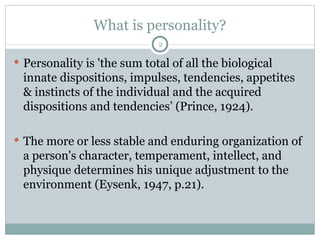
What is personality? Personality is 'the sum total of all the biological innate dispositions, impulses, tendencies, appetites & instincts of the individual and the acquired dispositions and tendencies’ (Prince, 1924). The more or less stable and enduring organization of a person's character, temperament, intellect, and physique determines his unique adjustment to the environment (Eysenk, 1947, p.21).
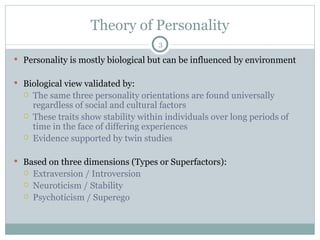
Theory of Personality Personality is mostly biological but can be influenced by environment Biological view validated by: The same three personality orientations are found universally regardless of social and cultural factors These traits show stability within individuals over long periods of time in the face of differing experiences Evidence supported by twin studies Based on three dimensions (Types or Superfactors): Extraversion / Introversion Neuroticism / Stability Psychoticism / Superego
Personality of Leaders Outgoing Extraverted Sociable Confident High self esteem Positive Optimistic Emotionally balanced Innovators Risk-takers
Personality, cont. Personality is just one of the (highly) complex variables that need to be correlated among many others in order to do a "deep evaluation" of ourselves.  How we behave depends on the situation. Our situation  at any given moment  must always be taken into consideration, as well as the many dimensions of self, or individual.  So, we have both the  individual  structure  (the personality, self-needs, abilities, satisfaction, goals, etc.)  and those of the  organization   (boss, colleagues, reward system, tasks, their personalities, etc.).  People with similar styles problem-solve well together. Personality distinguishes humans from other species, and oneself from other humans.
What is temperament? Temperament is about individual differences.  Temperament is composed of the traits, with which a person is born, which are genetic in nature.  It differs from personality, which is a combination of person’s temperament and life experiences. Temperament is "the stable individual differences in quality and intensity of emotional reaction" and is present at birth (Berk, 1998).
Temperament, cont. McCall (1984) defined temperament as “biologically based individual differences in reactions to the world”.  He also described further that these reactions are relatively stable over time and it is not personality but is one of the bases of later personality traits.  Personality characteristics are based on traits and behaviors which are normally acquired after infancy.  Some of the personality characteristics are not influenced by the biological factors.  Temperament traits are not completely inherited.  The key aspects of people’s personalities are habits, goals, and self-perceptions which are not considered as temperament traits.
What is a learning style? Learning Style:  A consistent way an individual responds to, and uses stimuli in the context of learning. (Claxton & Ralston, 1978). Cognitive Style:  The consistent individual differences found in ways of organizing and processing information and experience. (Messick, 1984).
Types of Learning Styles MBTI – Jung (1960) GEFT – Witkin etc. (1973) KAI– Kirton (1976) Multiple Intelligences – Gardner (1983) LSI – Kolb (1984) VAK – Fleming (2001)
Why study learning styles? People learn better when info is presented in their own learning style. For every study that finds this to be true, there is another study finding it false.
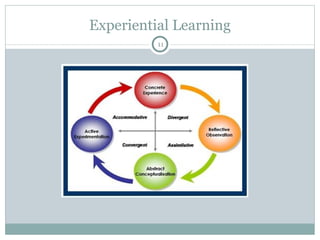
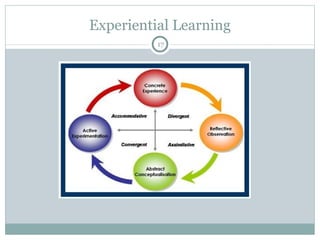
Experiential Learning
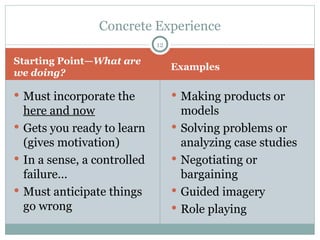
Starting Point— What are we doing? Examples Must incorporate the  here and now Gets you ready to learn (gives motivation) In a sense, a controlled failure… Must anticipate things go wrong Making products or models Solving problems or analyzing case studies Negotiating or bargaining Guided imagery Role playing Concrete Experience
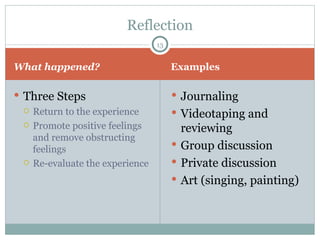
What happened? Examples Three Steps Return to the experience Promote positive feelings and remove obstructing feelings Re-evaluate the experience Journaling Videotaping and reviewing Group discussion Private discussion Art (singing, painting) Reflection
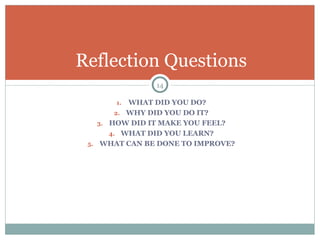
WHAT DID YOU DO? WHY DID YOU DO IT? HOW DID IT MAKE YOU FEEL? WHAT DID YOU LEARN? WHAT CAN BE DONE TO IMPROVE? Reflection Questions
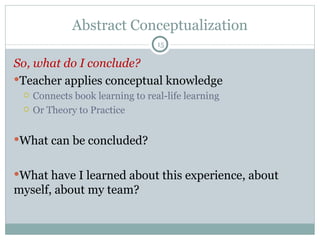
Abstract Conceptualization So, what do I conclude? Teacher applies conceptual knowledge Connects book learning to real-life learning Or Theory to Practice What can be concluded? What have I learned about this experience, about myself, about my team?
Active Experimentation Now what do I do? Application of new knowledge (requires a plan) A chance to do better Reach level of expertise desired by teacher Provides another opportunity for a concrete experience Again, needs pre-teaching
Experiential Learning
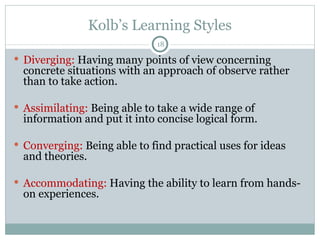
Kolb’s Learning Styles Diverging:  Having many points of view concerning concrete situations with an approach of observe rather than to take action. Assimilating:  Being able to take a wide range of information and put it into concise logical form. Converging:  Being able to find practical uses for ideas and theories. Accommodating:  Having the ability to learn from hands-on experiences.
Kirton’s Adaption Innovation Theory In problem-solving… ALL PEOPLE ARE CREATIVE!!! Some people are  more adaptive. Some people are  more innovative. Both  adaptors  and  innovators  are needed to solve complex problems.
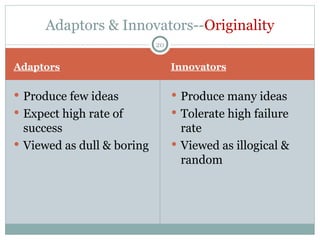
Adaptors Innovators Produce few ideas Expect high rate of success Viewed as dull & boring Produce many ideas Tolerate high failure rate Viewed as illogical & random Adaptors & Innovators-- Originality
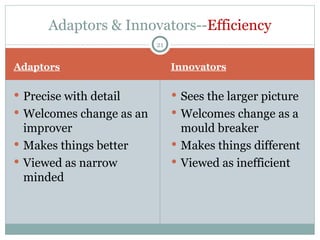
Adaptors Innovators Precise with detail Welcomes change as an improver Makes things better Viewed as narrow minded Sees the larger picture Welcomes change as a mould breaker Makes things different Viewed as inefficient Adaptors & Innovators-- Efficiency
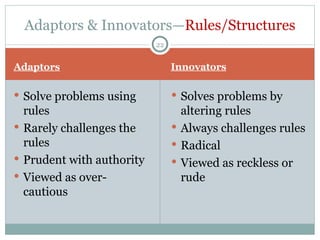
Adaptors Innovators Solve problems using rules Rarely challenges the rules Prudent with authority Viewed as over-cautious Solves problems by altering rules Always challenges rules Radical Viewed as reckless or rude Adaptors & Innovators— Rules/Structures
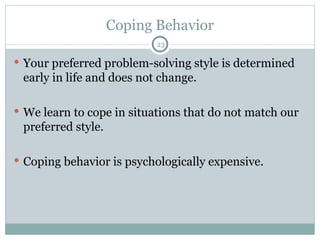
Coping Behavior Your preferred problem-solving style is determined early in life and does not change. We learn to cope in situations that do not match our preferred style. Coping behavior is psychologically expensive.
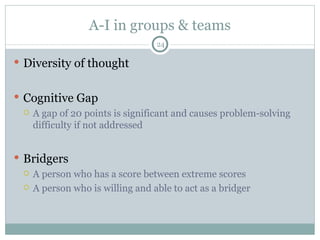
A-I in groups & teams Diversity of thought Cognitive Gap A gap of 20 points is significant and causes problem-solving difficulty if not addressed Bridgers A person who has a score between extreme scores A person who is willing and able to act as a bridger
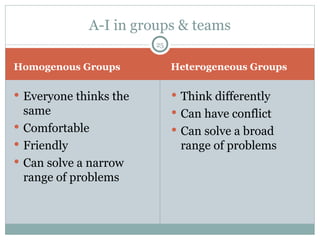
Homogenous Groups Heterogeneous Groups Everyone thinks the same Comfortable Friendly Can solve a narrow range of problems Think differently Can have conflict Can solve a broad range of problems A-I in groups & teams
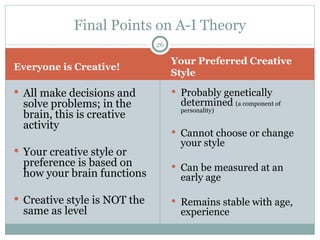
Everyone is Creative! Your Preferred Creative Style All make decisions and solve problems; in the brain, this is creative activity Your creative style or preference is based on how your brain functions Creative style is NOT the same as level Probably genetically determined  (a component of personality) Cannot choose or change your style Can be measured at an early age Remains stable with age, experience Final Points on A-I Theory
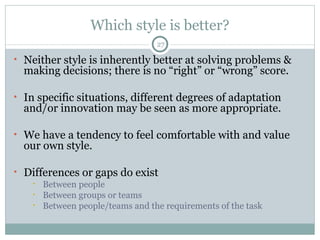
Which style is better? Neither style is inherently better at solving problems & making decisions; there is no “right” or “wrong” score. In specific situations, different degrees of adaptation and/or innovation may be seen as more appropriate. We have a tendency to feel comfortable with and value our own style. Differences or gaps do exist Between people Between groups or teams Between people/teams and the requirements of the task
CREATIVE QUESTIONNAIRE HTTP://TALENTDEVELOP.COM/SELFTEST.HTML KEIRSEY TEMPERAMENT SORTER (KTS-II) HTTP://WWW.KEIRSEY.COM/SORTER/INSTRUMENTS2.ASPX?PARTID=0 VAK VISUAL, AUDITORY, AND KINESTHETIC LEARNING STYLE HTTP://SOS.NET/~DONCLARK/HRD/STYLES/VAKT.HTML KOLB LEARNING STYLE INVENTORY (LSI) HTTP://LEARNINGFROMEXPERIENCE.COM/TOOLS/KOLB-LEARNING-STYLE-INVENTORY-LSI/ HTTP://WWW.BUSINESSBALLS.COM/KOLBLEARNINGSTYLES.HTM Any Questions?

Personality & Transformational Leadership

  • 1.
    CHRISSY DELLA CORTEHRE 7723 NOVEMBER 15, 2011 Personality & Transformational Leadership
  • 2.
    What is personality?Personality is 'the sum total of all the biological innate dispositions, impulses, tendencies, appetites & instincts of the individual and the acquired dispositions and tendencies’ (Prince, 1924). The more or less stable and enduring organization of a person's character, temperament, intellect, and physique determines his unique adjustment to the environment (Eysenk, 1947, p.21).
  • 3.
    Theory of PersonalityPersonality is mostly biological but can be influenced by environment Biological view validated by: The same three personality orientations are found universally regardless of social and cultural factors These traits show stability within individuals over long periods of time in the face of differing experiences Evidence supported by twin studies Based on three dimensions (Types or Superfactors): Extraversion / Introversion Neuroticism / Stability Psychoticism / Superego
  • 4.
    Personality of LeadersOutgoing Extraverted Sociable Confident High self esteem Positive Optimistic Emotionally balanced Innovators Risk-takers
  • 5.
    Personality, cont. Personalityis just one of the (highly) complex variables that need to be correlated among many others in order to do a "deep evaluation" of ourselves. How we behave depends on the situation. Our situation at any given moment must always be taken into consideration, as well as the many dimensions of self, or individual. So, we have both the individual structure (the personality, self-needs, abilities, satisfaction, goals, etc.) and those of the organization (boss, colleagues, reward system, tasks, their personalities, etc.). People with similar styles problem-solve well together. Personality distinguishes humans from other species, and oneself from other humans.
  • 6.
    What is temperament?Temperament is about individual differences. Temperament is composed of the traits, with which a person is born, which are genetic in nature. It differs from personality, which is a combination of person’s temperament and life experiences. Temperament is "the stable individual differences in quality and intensity of emotional reaction" and is present at birth (Berk, 1998).
  • 7.
    Temperament, cont. McCall(1984) defined temperament as “biologically based individual differences in reactions to the world”. He also described further that these reactions are relatively stable over time and it is not personality but is one of the bases of later personality traits. Personality characteristics are based on traits and behaviors which are normally acquired after infancy. Some of the personality characteristics are not influenced by the biological factors. Temperament traits are not completely inherited. The key aspects of people’s personalities are habits, goals, and self-perceptions which are not considered as temperament traits.
  • 8.
    What is alearning style? Learning Style: A consistent way an individual responds to, and uses stimuli in the context of learning. (Claxton & Ralston, 1978). Cognitive Style: The consistent individual differences found in ways of organizing and processing information and experience. (Messick, 1984).
  • 9.
    Types of LearningStyles MBTI – Jung (1960) GEFT – Witkin etc. (1973) KAI– Kirton (1976) Multiple Intelligences – Gardner (1983) LSI – Kolb (1984) VAK – Fleming (2001)
  • 10.
    Why study learningstyles? People learn better when info is presented in their own learning style. For every study that finds this to be true, there is another study finding it false.
  • 11.
  • 12.
    Starting Point— Whatare we doing? Examples Must incorporate the here and now Gets you ready to learn (gives motivation) In a sense, a controlled failure… Must anticipate things go wrong Making products or models Solving problems or analyzing case studies Negotiating or bargaining Guided imagery Role playing Concrete Experience
  • 13.
    What happened? ExamplesThree Steps Return to the experience Promote positive feelings and remove obstructing feelings Re-evaluate the experience Journaling Videotaping and reviewing Group discussion Private discussion Art (singing, painting) Reflection
  • 14.
    WHAT DID YOUDO? WHY DID YOU DO IT? HOW DID IT MAKE YOU FEEL? WHAT DID YOU LEARN? WHAT CAN BE DONE TO IMPROVE? Reflection Questions
  • 15.
    Abstract Conceptualization So,what do I conclude? Teacher applies conceptual knowledge Connects book learning to real-life learning Or Theory to Practice What can be concluded? What have I learned about this experience, about myself, about my team?
  • 16.
    Active Experimentation Nowwhat do I do? Application of new knowledge (requires a plan) A chance to do better Reach level of expertise desired by teacher Provides another opportunity for a concrete experience Again, needs pre-teaching
  • 17.
  • 18.
    Kolb’s Learning StylesDiverging: Having many points of view concerning concrete situations with an approach of observe rather than to take action. Assimilating: Being able to take a wide range of information and put it into concise logical form. Converging: Being able to find practical uses for ideas and theories. Accommodating: Having the ability to learn from hands-on experiences.
  • 19.
    Kirton’s Adaption InnovationTheory In problem-solving… ALL PEOPLE ARE CREATIVE!!! Some people are more adaptive. Some people are more innovative. Both adaptors and innovators are needed to solve complex problems.
  • 20.
    Adaptors Innovators Producefew ideas Expect high rate of success Viewed as dull & boring Produce many ideas Tolerate high failure rate Viewed as illogical & random Adaptors & Innovators-- Originality
  • 21.
    Adaptors Innovators Precisewith detail Welcomes change as an improver Makes things better Viewed as narrow minded Sees the larger picture Welcomes change as a mould breaker Makes things different Viewed as inefficient Adaptors & Innovators-- Efficiency
  • 22.
    Adaptors Innovators Solveproblems using rules Rarely challenges the rules Prudent with authority Viewed as over-cautious Solves problems by altering rules Always challenges rules Radical Viewed as reckless or rude Adaptors & Innovators— Rules/Structures
  • 23.
    Coping Behavior Yourpreferred problem-solving style is determined early in life and does not change. We learn to cope in situations that do not match our preferred style. Coping behavior is psychologically expensive.
  • 24.
    A-I in groups& teams Diversity of thought Cognitive Gap A gap of 20 points is significant and causes problem-solving difficulty if not addressed Bridgers A person who has a score between extreme scores A person who is willing and able to act as a bridger
  • 25.
    Homogenous Groups HeterogeneousGroups Everyone thinks the same Comfortable Friendly Can solve a narrow range of problems Think differently Can have conflict Can solve a broad range of problems A-I in groups & teams
  • 26.
    Everyone is Creative!Your Preferred Creative Style All make decisions and solve problems; in the brain, this is creative activity Your creative style or preference is based on how your brain functions Creative style is NOT the same as level Probably genetically determined (a component of personality) Cannot choose or change your style Can be measured at an early age Remains stable with age, experience Final Points on A-I Theory
  • 27.
    Which style isbetter? Neither style is inherently better at solving problems & making decisions; there is no “right” or “wrong” score. In specific situations, different degrees of adaptation and/or innovation may be seen as more appropriate. We have a tendency to feel comfortable with and value our own style. Differences or gaps do exist Between people Between groups or teams Between people/teams and the requirements of the task
  • 28.
    CREATIVE QUESTIONNAIRE HTTP://TALENTDEVELOP.COM/SELFTEST.HTMLKEIRSEY TEMPERAMENT SORTER (KTS-II) HTTP://WWW.KEIRSEY.COM/SORTER/INSTRUMENTS2.ASPX?PARTID=0 VAK VISUAL, AUDITORY, AND KINESTHETIC LEARNING STYLE HTTP://SOS.NET/~DONCLARK/HRD/STYLES/VAKT.HTML KOLB LEARNING STYLE INVENTORY (LSI) HTTP://LEARNINGFROMEXPERIENCE.COM/TOOLS/KOLB-LEARNING-STYLE-INVENTORY-LSI/ HTTP://WWW.BUSINESSBALLS.COM/KOLBLEARNINGSTYLES.HTM Any Questions?