Managing Time and Designing
Success
Chapter 2
Copyright © 2014, 2009 by Mosby, Inc., an imprint of Elsevier Inc.
BEHAVIORS
Positive
 Organized
 Strong support system
 Financially stable
 Good health
 Positive attitude
Negative
 Unorganized
 No support system
 In Debt
 Poor health
 Attitude
Copyright © 2014, 2009 by Mosby, Inc., an imprint of Elsevier Inc.2
Identifying Individual Learning
Tools
 Empowerment
 Provides a way for doing something, to set free the ability to
move forward, to enable
 Personal empowerment
 Giving yourself the opportunity to succeed or enabling your own
success
 Improve personal empowerment skills by
 Assuming an internal locus of control
 Practicing positive self-talk
 Eliminating self-defeating behaviors
 Managing the work of success
 Managing health
Copyright © 2014, 2009 by Mosby, Inc., an imprint of Elsevier Inc.3
Gifts and Barriers
 Self-awareness
 Be conscious of and understand yourself.
 Correct or minimize your weaknesses (barriers) and
capitalize on or maximize your gifts.
 Write a plan of action to support the outcome priorities for
the gifts and barriers.
 Review the plan from time to time.
 Keep a journal.
Copyright © 2014, 2009 by Mosby, Inc., an imprint of Elsevier Inc.4
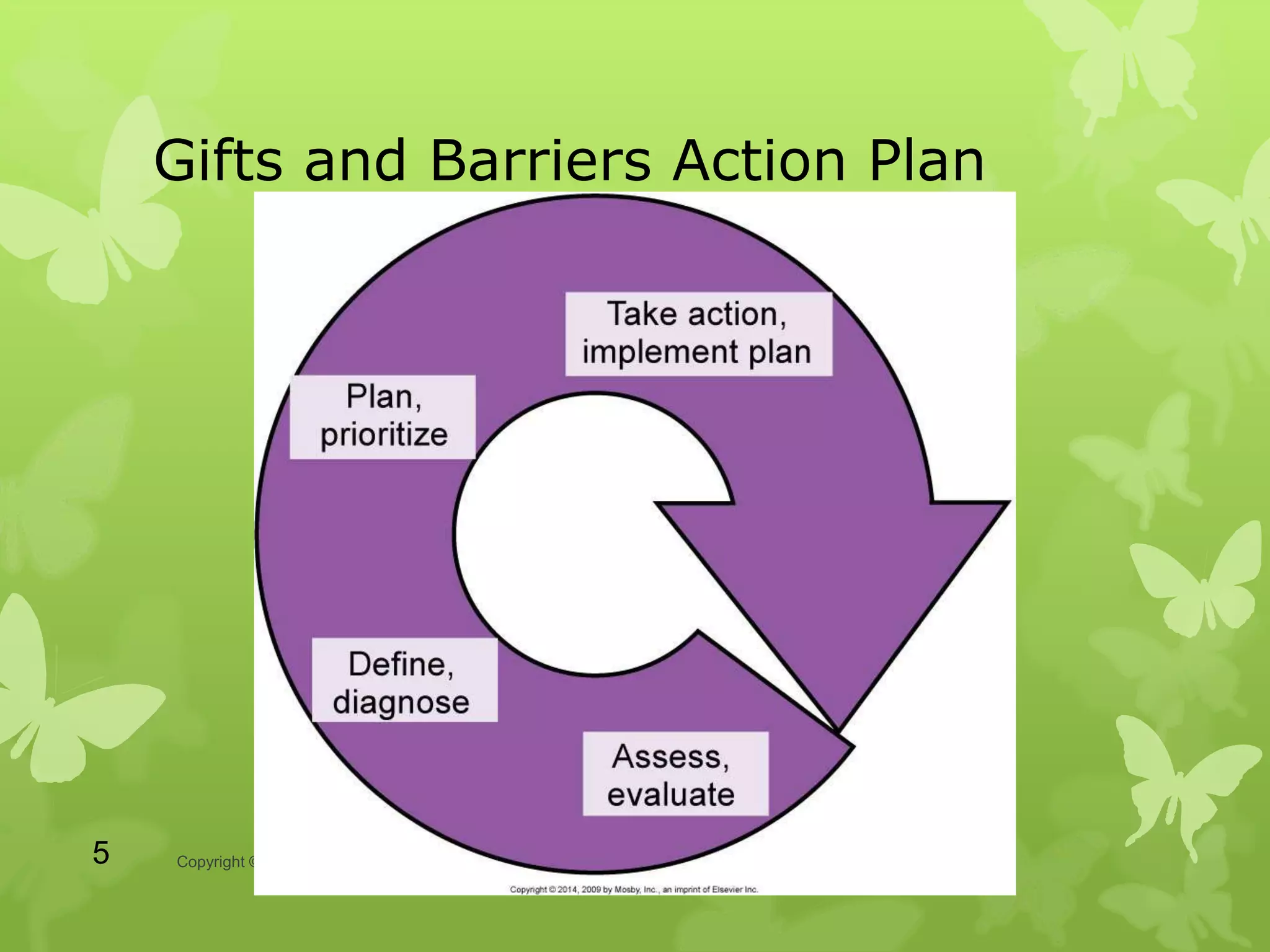
Gifts and Barriers Action Plan
Copyright © 2014, 2009 by Mosby, Inc., an imprint of Elsevier Inc.5
Learning Styles
 The manners in which you prefer to learn
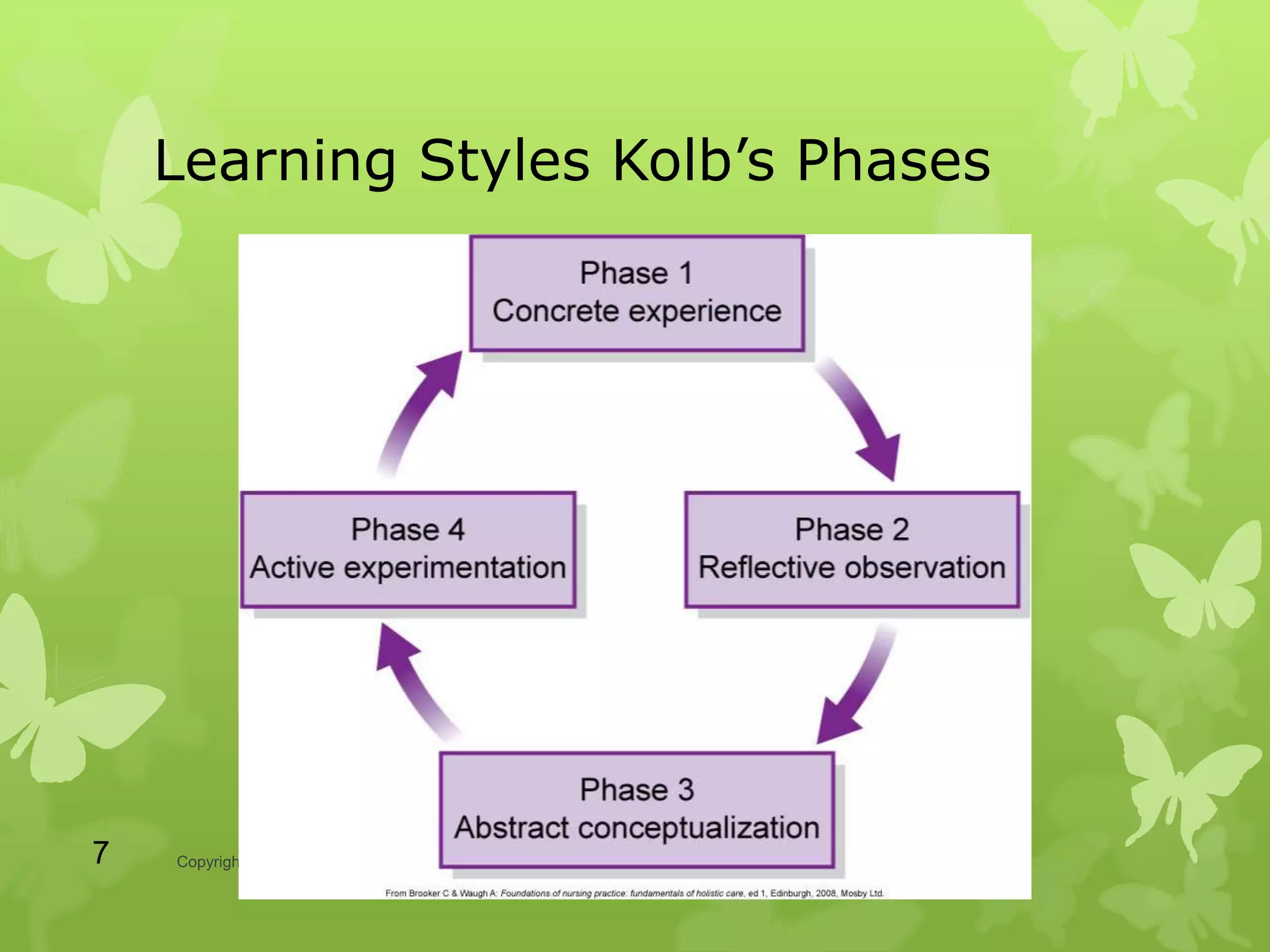
 Kolb
 Phases
 Concrete experience
 Directly involved with hands on
 Reflective observation
 Rather watch to learn
 Abstract conceptualization
 Must organize learning
 Active experimentation
 Learn best by doing, by “trying it out”
 As a learner matures, the preferred style becomes more of
an integration of the traits of all four categories.
Copyright © 2014, 2009 by Mosby, Inc., an imprint of Elsevier Inc.6
Learning Styles Kolb’s Phases
Copyright © 2014, 2009 by Mosby, Inc., an imprint of Elsevier Inc.7
Personality Traits and Learning
 Meyers-Briggs Type Indicator (MBTI)
 Extroversion vs. introversion
 Talk to people to learn vs. want privacy
 Sensing vs. intuition
 Relates new, abstract concepts to prior concrete
knowledge vs. observes abstractly and through
imagination
 Thinking vs. feeling
 Must know the content vs. helping others know
 Judgment vs. perception
 Careful planning vs. study if feels like it
 Research states that people have and use both
traits in each category but that one is displayed
more than the other (Lawrence, 1993).
Copyright © 2014, 2009 by Mosby, Inc., an imprint of Elsevier Inc.8
Personality Traits and Learning
(Cont'd)
 Preferred Learning Style Index
 Receptive vs. discovery learners
 Organized, systematic delivery of information vs.
experimentation and problem solving
 Gregorc’s Theory of Mediation Ability
 Perception
 Abstract
 Concrete
 Ordering
 Sequentially
 Randomly
Copyright © 2014, 2009 by Mosby, Inc., an imprint of Elsevier Inc.9
Personality Traits and Learning
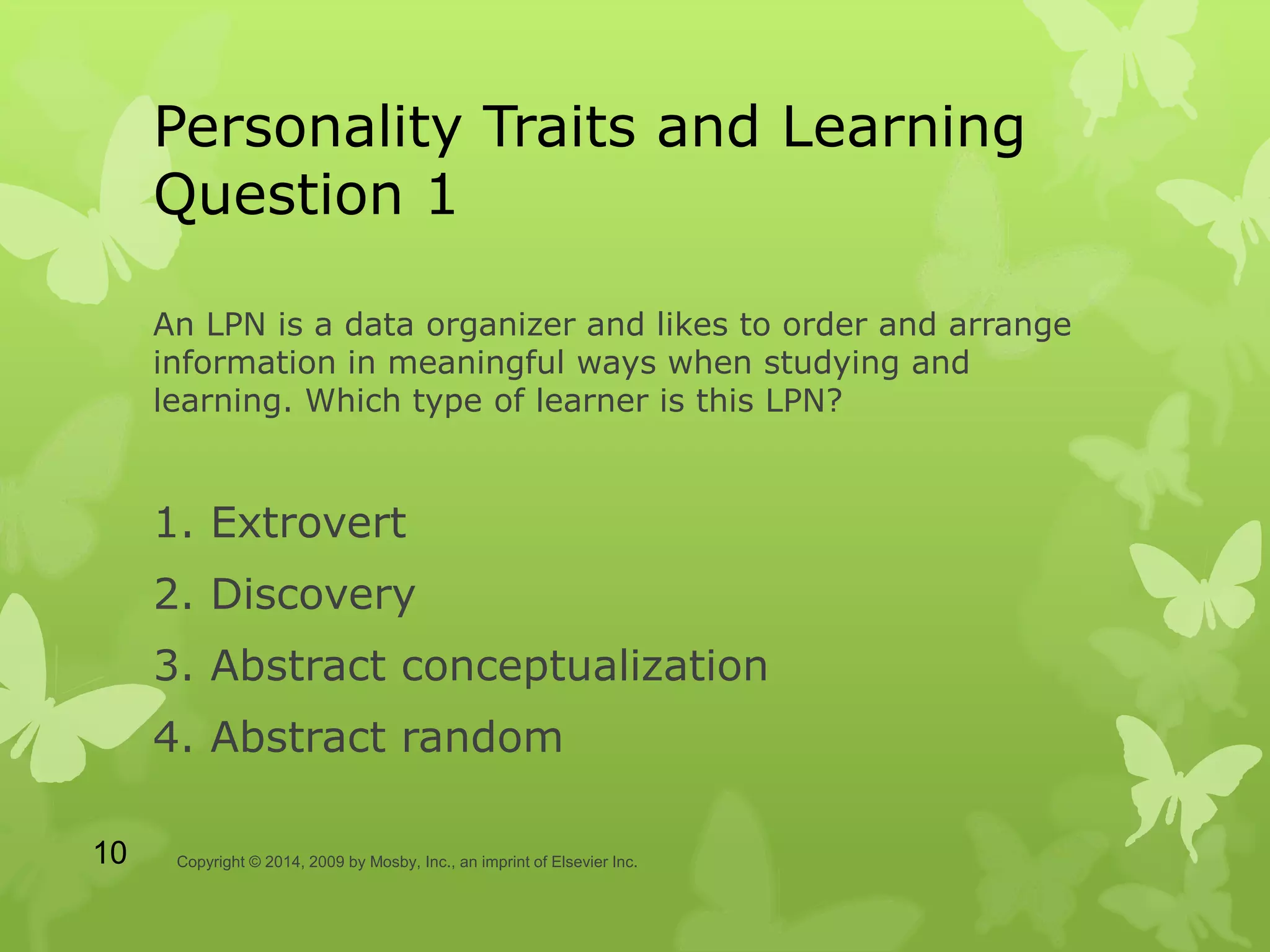
Question 1
An LPN is a data organizer and likes to order and arrange
information in meaningful ways when studying and
learning. Which type of learner is this LPN?
1. Extrovert
2. Discovery
3. Abstract conceptualization
4. Abstract random
Copyright © 2014, 2009 by Mosby, Inc., an imprint of Elsevier Inc.10
Self-Directedness
 Associated with successful learners
 Assuming ownership of the learning
 Initiative
 Independence
 Persistence
 Discipline
 Determination
 Requires practice, time, and experience
 Responsible for own learning
 Faculty serve as guides and facilitators
Copyright © 2014, 2009 by Mosby, Inc., an imprint of Elsevier Inc.11
Self-Directedness (Cont'd)
 Model for empowerment
 Goal identification
 Knowledge
 Self-efficacy
 Competence
 Action
 Impact
Copyright © 2014, 2009 by Mosby, Inc., an imprint of Elsevier Inc.12
Assuming an Internal Locus of
Control
 Describes where you believe the power in your life
resides
 Can be internal or external
 Internal: responsibility lies within oneself
 External: responsibility lies outside oneself
Copyright © 2014, 2009 by Mosby, Inc., an imprint of Elsevier Inc.13
Positive Self-Talk
 Defined as speaking to yourself and others kindly and
with encouraging words, in a manner that would support
and affirm
 Being as kind, understanding, forgiving, and
encouraging to yourself as you would be to
a fellow student, a child, or a friend who is doing the
best possible
 Stopping negative self-talk
 Speaking affirmations out loud
Copyright © 2014, 2009 by Mosby, Inc., an imprint of Elsevier Inc.14
Elimination of Self-Defeating
Behaviors
 Pessimism
 Nit-picking
 Worrying
 Perfectionism
 Blaming
Copyright © 2014, 2009 by Mosby, Inc., an imprint of Elsevier Inc.15
Managing the Work of Success
 Decision-making
 Planning
 Commitment
 Time management
Copyright © 2014, 2009 by Mosby, Inc., an imprint of Elsevier Inc.16
Time Management
 Assessment
 Setting goals and prioritizing
 Use calendars
 Time wasters
 Procrastination
 Paralysis by planning
 Perfection
 Boredom
 Hostility
 Adrenaline rush
Copyright © 2014, 2009 by Mosby, Inc., an imprint of Elsevier Inc.17
Managing Your Health
 Stress
 Sources of stress are many and varied.
 It affects you and your significant others.
 What are your stressors?
 Stress reduction
 Achieve awareness.
 Identify automatic thoughts.
 Identify cognitive distortions.
Copyright © 2014, 2009 by Mosby, Inc., an imprint of Elsevier Inc.18
Identify Cognitive Distortions
 All-or-nothing thinking
 Overgeneralization
 Mental filtering
 Disqualifying the positive
 Jumping to conclusions
 Magnification
 “Should” statements
 Emotional reasoning
 Labeling
 Personalizations
Copyright © 2014, 2009 by Mosby, Inc., an imprint of Elsevier Inc.19
Choose Coping Mechanisms That
Work
 Distraction
 Direct action
 Relaxation
 Reframing
 Affirmation
 Assertive communication
 Spirituality
 Catharsis
 Journal writing
 Social support
 Empathy
 Acceptance
Copyright © 2014, 2009 by Mosby, Inc., an imprint of Elsevier Inc.20

Chapter 2_mcgee

  • 1.
    Managing Time andDesigning Success Chapter 2 Copyright © 2014, 2009 by Mosby, Inc., an imprint of Elsevier Inc.
  • 2.
    BEHAVIORS Positive  Organized  Strongsupport system  Financially stable  Good health  Positive attitude Negative  Unorganized  No support system  In Debt  Poor health  Attitude Copyright © 2014, 2009 by Mosby, Inc., an imprint of Elsevier Inc.2
  • 3.
    Identifying Individual Learning Tools Empowerment  Provides a way for doing something, to set free the ability to move forward, to enable  Personal empowerment  Giving yourself the opportunity to succeed or enabling your own success  Improve personal empowerment skills by  Assuming an internal locus of control  Practicing positive self-talk  Eliminating self-defeating behaviors  Managing the work of success  Managing health Copyright © 2014, 2009 by Mosby, Inc., an imprint of Elsevier Inc.3
  • 4.
    Gifts and Barriers Self-awareness  Be conscious of and understand yourself.  Correct or minimize your weaknesses (barriers) and capitalize on or maximize your gifts.  Write a plan of action to support the outcome priorities for the gifts and barriers.  Review the plan from time to time.  Keep a journal. Copyright © 2014, 2009 by Mosby, Inc., an imprint of Elsevier Inc.4
  • 5.
    Gifts and BarriersAction Plan Copyright © 2014, 2009 by Mosby, Inc., an imprint of Elsevier Inc.5
  • 6.
    Learning Styles  Themanners in which you prefer to learn  Kolb  Phases  Concrete experience  Directly involved with hands on  Reflective observation  Rather watch to learn  Abstract conceptualization  Must organize learning  Active experimentation  Learn best by doing, by “trying it out”  As a learner matures, the preferred style becomes more of an integration of the traits of all four categories. Copyright © 2014, 2009 by Mosby, Inc., an imprint of Elsevier Inc.6
  • 7.
    Learning Styles Kolb’sPhases Copyright © 2014, 2009 by Mosby, Inc., an imprint of Elsevier Inc.7
  • 8.
    Personality Traits andLearning  Meyers-Briggs Type Indicator (MBTI)  Extroversion vs. introversion  Talk to people to learn vs. want privacy  Sensing vs. intuition  Relates new, abstract concepts to prior concrete knowledge vs. observes abstractly and through imagination  Thinking vs. feeling  Must know the content vs. helping others know  Judgment vs. perception  Careful planning vs. study if feels like it  Research states that people have and use both traits in each category but that one is displayed more than the other (Lawrence, 1993). Copyright © 2014, 2009 by Mosby, Inc., an imprint of Elsevier Inc.8
  • 9.
    Personality Traits andLearning (Cont'd)  Preferred Learning Style Index  Receptive vs. discovery learners  Organized, systematic delivery of information vs. experimentation and problem solving  Gregorc’s Theory of Mediation Ability  Perception  Abstract  Concrete  Ordering  Sequentially  Randomly Copyright © 2014, 2009 by Mosby, Inc., an imprint of Elsevier Inc.9
  • 10.
    Personality Traits andLearning Question 1 An LPN is a data organizer and likes to order and arrange information in meaningful ways when studying and learning. Which type of learner is this LPN? 1. Extrovert 2. Discovery 3. Abstract conceptualization 4. Abstract random Copyright © 2014, 2009 by Mosby, Inc., an imprint of Elsevier Inc.10
  • 11.
    Self-Directedness  Associated withsuccessful learners  Assuming ownership of the learning  Initiative  Independence  Persistence  Discipline  Determination  Requires practice, time, and experience  Responsible for own learning  Faculty serve as guides and facilitators Copyright © 2014, 2009 by Mosby, Inc., an imprint of Elsevier Inc.11
  • 12.
    Self-Directedness (Cont'd)  Modelfor empowerment  Goal identification  Knowledge  Self-efficacy  Competence  Action  Impact Copyright © 2014, 2009 by Mosby, Inc., an imprint of Elsevier Inc.12
  • 13.
    Assuming an InternalLocus of Control  Describes where you believe the power in your life resides  Can be internal or external  Internal: responsibility lies within oneself  External: responsibility lies outside oneself Copyright © 2014, 2009 by Mosby, Inc., an imprint of Elsevier Inc.13
  • 14.
    Positive Self-Talk  Definedas speaking to yourself and others kindly and with encouraging words, in a manner that would support and affirm  Being as kind, understanding, forgiving, and encouraging to yourself as you would be to a fellow student, a child, or a friend who is doing the best possible  Stopping negative self-talk  Speaking affirmations out loud Copyright © 2014, 2009 by Mosby, Inc., an imprint of Elsevier Inc.14
  • 15.
    Elimination of Self-Defeating Behaviors Pessimism  Nit-picking  Worrying  Perfectionism  Blaming Copyright © 2014, 2009 by Mosby, Inc., an imprint of Elsevier Inc.15
  • 16.
    Managing the Workof Success  Decision-making  Planning  Commitment  Time management Copyright © 2014, 2009 by Mosby, Inc., an imprint of Elsevier Inc.16
  • 17.
    Time Management  Assessment Setting goals and prioritizing  Use calendars  Time wasters  Procrastination  Paralysis by planning  Perfection  Boredom  Hostility  Adrenaline rush Copyright © 2014, 2009 by Mosby, Inc., an imprint of Elsevier Inc.17
  • 18.
    Managing Your Health Stress  Sources of stress are many and varied.  It affects you and your significant others.  What are your stressors?  Stress reduction  Achieve awareness.  Identify automatic thoughts.  Identify cognitive distortions. Copyright © 2014, 2009 by Mosby, Inc., an imprint of Elsevier Inc.18
  • 19.
    Identify Cognitive Distortions All-or-nothing thinking  Overgeneralization  Mental filtering  Disqualifying the positive  Jumping to conclusions  Magnification  “Should” statements  Emotional reasoning  Labeling  Personalizations Copyright © 2014, 2009 by Mosby, Inc., an imprint of Elsevier Inc.19
  • 20.
    Choose Coping MechanismsThat Work  Distraction  Direct action  Relaxation  Reframing  Affirmation  Assertive communication  Spirituality  Catharsis  Journal writing  Social support  Empathy  Acceptance Copyright © 2014, 2009 by Mosby, Inc., an imprint of Elsevier Inc.20

Editor's Notes

  • #11 ANSWER AND RATIONALE: 3. Abstract conceptualization. Those predisposed to abstract conceptualization are considered data organizers. These learners order and arrange information in meaningful ways and are often happier in a lecture-type format, where they will write and arrange notes to their liking. Extroverts prefer to talk about things. They are seen as action-oriented, outgoing people. 2. Discovery learners prefer to arrive at information on their own through experimentation and problem solving. 4. Abstract random learners use their emotions and senses to grasp new information.
  • #12 11