

One
 style
doesn’t
 fit all
 The different ways
 people learn and
 why it matters
“   Learning.
    There’s a right
    way and there’s

               ”
    a right way
Ok, let’s say you’ve just got a new phone; one
with all the latest bells and whistles. How do
you go about learning to use it?

   Do you:
     Read the instruction manual from cover to cover and absorb
   n	
     every new feature so that you can understand what a difference
     it will make to your phone’s communications potential?

     Read the quick start guide at the beginning of the instruction
   n	
     manual and work the rest out later?

     Base your understanding on your last phone – after
   n	
     all, they can’t be that different can they?

     Watch other people on the bus with the same phone. Work it
   n	
     out from observation?

   n	 your teenage children to show you how it works?
     Ask

   n	 it in a drawer and use your landline?
     Put


The fact is that all the above methods (apart from the last one!) will
mean you can use your new phone. The point is we have a preferred
way of learning. It’s not that we can’t read the quick start guide or pick
up the phone and use it – it’s just that we generally prefer one method
over another.

We call these preferences ‘learning styles’. We all have a preferred
learning style and some of us are more balanced in our learning
preferences than others. This booklet explores what that means to
us in terms of our own learning and how we work with others.
                                                                         1
One style doesn’t fit all
When you’re working with other people the more
you understand about the way they learn things
(their learning styles) the more you’ll be able to help.
To try and motivate someone by saying, ‘go and read this book’,
when they don’t learn that way, is going to be as frustrating for
them as it is for you. Especially when you find out later that they
can’t do what you expected the book to teach them. However, if
you recognize that they need to watch you do something to learn
how to do it, then you will organize your time differently to achieve
your objectives.

As a leader in a group you need to be aware of your own style too,
because it has implications for the impact you make on the team.
Without acknowledging your own style you may encourage your
team to focus on issues from a certain perspective and miss the
opportunities that result from different approaches. A team has a
collective learning style all of its own. For example, if you have a
group of sales managers who all share a preference for action, they
are less likely to stop and think about the underlying framework
and rationale for their actions (with a tendency for headless chicken
syndrome!). As their leader, your job is to guide this group and help
them to understand the strengths and potential weaknesses or blind
spots associated with their learning styles.

Hay Group can help you look at your own learning style and those
of your team so you’re better able to tune into the needs of others,
to the aims of the group and to the optimal way of using your
collective time, resources and capabilities.


2
The North, South, East
and West of learning
We all learn differently, learn in different ways
according to different circumstances. To discover
which methods suit different people best, David
Kolb, Ph.D. began developing the Learning Style
Inventory in 1971.
Kolb’s work has been influential in studies on learning styles around
the world. Kolb’s extensive research highlights four phases within the
learning process:

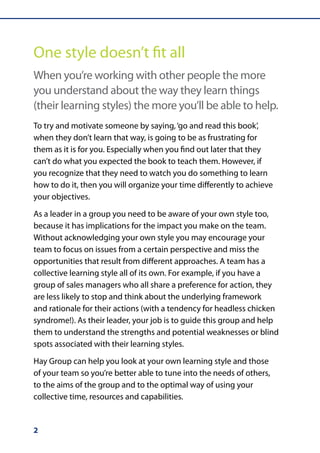
Experiencing:	earning from specific experiences, being sensitive to
              l
              feelings and people
Observation: 	 bserving before making judgments, viewing issues from
              o
              different perspectives, looking for the meaning of things
Thinking: 	logically analyzing ideas, planning systematically, acting
              on an intellectual basis
Action: 	learning through ‘hands on’ activities, dealing with
              people and events through action


                             experiencing


                          the do-er   the creator

            action                                  observation
                       the decision   the planner
                             maker


                               thinking
                                                                         3
The Learning Cycle.
Where do you start?
From the combinations of observation,
experience, thinking and action, Kolb developed
what he called a ‘cycle of learning’ to explain how
these phases describe the way we learn.
We all have preferences for some phases over others.
We may stay too long in one, or skip another entirely.

For instance, you are faced with a new problem but you don’t tend
to focus on planning. You might jump straight to action to solve the
problem. It’s undoubtedly a positive approach, but unless you’ve
asked yourself what’s going on first, then you’ll be lucky to choose
exactly the right way of dealing with the problem.


        combinations of
    observations, experience,
             thinking
    and action


4
Learning isn’t just
labels (but here are
a few anyway)
The creator
(diverging style)

The planner
(assimilating style)

The decision maker
(converging style)

The do-er
(accommodating style)


                        5
Because we can’t cram years of research and
learning theory into one booklet we’ve simplified
things a bit by sketching out some descriptions
of the kinds of strengths and weaknesses you can
find in each quadrant of the learning cycle.
We’re not suggesting that anyone conforms totally to these types
but we’re sure you’ll recognize some of the qualities and how they
affect the way you learn or communicate.


    The ‘Creator’ (Diverging style)
    Your strengths are taking in information through concrete
    experience and processing it through your powers of
    observation. Your imaginative ability enables you to generate
    many alternative ideas. You love brainstorming. You’re
    interested in people and are very feeling-oriented.

    Where you get stuck
    If you rely on these skills too much you can become
    overwhelmed by alternatives and indecisiveness. Try not to
    prioritize urgent challenges above important challenges, or
    treat mere symptoms as challenges.


6
The ‘Planner’ (Assimilating style)
You have an ability to take in new information abstractly and
process disparate observations into an integrated rational
explanation. You’re good at inductive reasoning and the
creation of models and theories. You’re a systematic planner,
a goal setter.

Where you get stuck
Beware of a tendency to create ‘castles in the air’. Your style can
often have a slender grip on the practical implications. Avoid
premature discussion of solutions and make sure the critical
facts are known.


The ‘Decision maker’ (Converging style)
You are able to take in new information in the abstract and
process it into a concrete solution. You use hypothetical
deductive reasoning to arrive at a single best solution to a
question or problem. Your great strength is your ability to solve
problems and make decisions.

Where you get stuck
Don’t be too hasty though; your style can lead to a premature
definition of the problem. Avoid focusing prematurely or
creating unproductive conflict and competition.


                                                                      7
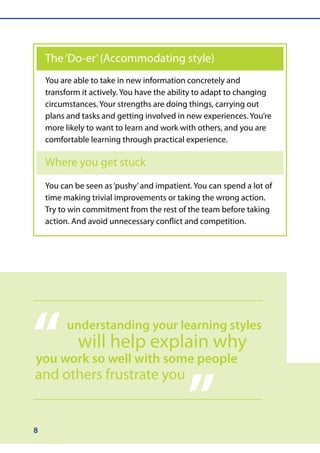
The ‘Do-er’ (Accommodating style)
    You are able to take in new information concretely and
    transform it actively. You have the ability to adapt to changing
    circumstances. Your strengths are doing things, carrying out
    plans and tasks and getting involved in new experiences. You’re
    more likely to want to learn and work with others, and you are
    comfortable learning through practical experience.

    Where you get stuck
    You can be seen as ‘pushy’ and impatient. You can spend a lot of
    time making trivial improvements or taking the wrong action.
    Try to win commitment from the rest of the team before taking
    action. And avoid unnecessary conflict and competition.


“         understanding your learning styles
             will help explain why
you work so well with some people


                                            ”
and others frustrate you


8
What have you learnt so far?
Hopefully by understanding more about the way
you and your team learn, you can start to position
the contribution of others around the phases of the
learning cycle where they can add most value.
For example, if you’re looking at future strategies for growth, people
with ‘creator’ preferences can be immensely helpful in generating lots
of ideas about how you can achieve this growth.

The more you understand about the learning styles of others, the more
you can target your efforts towards their key concerns. For example,
someone with ‘planning’ preferences pays a lot of attention to the
detailed facts of a situation. So when you approach them to approve
that critical business case, knowing all the relevant facts and being
able to recite them backwards is a great start.

Understanding your learning styles will also help to explain why you work
so well with some people, and yet others frustrate you! For example,
someone who has a ‘planning’ style likes organizing information,
building conceptual models and analyzing quantitative data. They
work really well with a ‘decision-maker’ who receives the analysis and
theories and builds on them, making decisions, setting goals, creating
new ways of thinking and experimenting with new ideas.


                                                                         9
Putting what you learn into practice
Now you understand something about the various
styles of learning, how do they apply to the way
that you lead and manage other people?


Take this example:
We were working with the board of a technical organization. We were
seeing some strange behavior in the boardroom, that seemed to
exclude one person in particular. We invited the board members to
complete the Kolb Learning Style Inventory. Of the ten people in the
boardroom, nine were people more interested in creating models, and
setting goals than practical implementation. Only one was focused on
the practical issues around implementation and would say, ‘but what
shall we do?’ Unsurprisingly, he tended to be singing a different song
during discussions.

When they recognized this not only did the nine people who
consistently asked the question ‘why?’ realize why they found it
so difficult to move through to the decision making, they also
understood that they should pay much more attention to the person
who was saying, ‘what shall we do about it’. It altered their perception
that he was just being awkward when cutting across the fascinating
conversations they were having that were leading nowhere.


10
Can people develop their
learning styles?
The first step is to recognize what their own style
is, and understand its strengths and weaknesses.
It may be that their style is entirely in keeping with
the role they have.
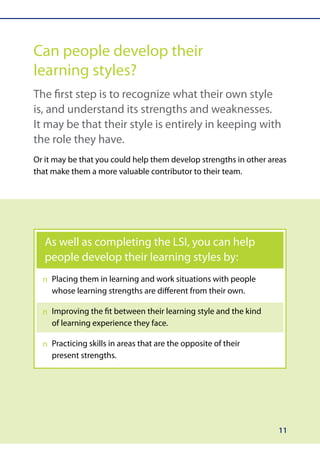
Or it may be that you could help them develop strengths in other areas
that make them a more valuable contributor to their team.


   As well as completing the LSI, you can help
   people develop their learning styles by:
    Placing them in learning and work situations with people
  n	
    whose learning strengths are different from their own.

    Improving the fit between their learning style and the kind
  n	
    of learning experience they face.

  n	 racticing skills in areas that are the opposite of their
     P
     present strengths.


                                                                   11
How Hay Group can help
you learn more
Hay Group have a range of Learning Styles tools
that can be used by anyone to identify learning
preferences and help them be more effective at
their job and to get more out of life generally.
If you would like to find out more about our learning resources
contact us today.


“
generally
         get more out of life

          ”
12
Hay Group is a global consulting firm that works
with leaders to transform strategy into reality.
We develop talent, organize people to be more
effective and motivate them to perform at their best.
Our focus is on making change happen and
helping people and organizations realize
their potential.
Hay Group Gurgaon
t| 91 124 4177400

Hay Group Mumbai
t| 91 22 43480888

w| www.haygroup.com/in

Learning Styles : One Style Doesn't Fit All

  • 1.
    One style doesn’t fitall The different ways people learn and why it matters
  • 2.
    Learning. There’s a right way and there’s ” a right way
  • 3.
    Ok, let’s sayyou’ve just got a new phone; one with all the latest bells and whistles. How do you go about learning to use it? Do you: Read the instruction manual from cover to cover and absorb n every new feature so that you can understand what a difference it will make to your phone’s communications potential? Read the quick start guide at the beginning of the instruction n manual and work the rest out later? Base your understanding on your last phone – after n all, they can’t be that different can they? Watch other people on the bus with the same phone. Work it n out from observation? n your teenage children to show you how it works? Ask n it in a drawer and use your landline? Put The fact is that all the above methods (apart from the last one!) will mean you can use your new phone. The point is we have a preferred way of learning. It’s not that we can’t read the quick start guide or pick up the phone and use it – it’s just that we generally prefer one method over another. We call these preferences ‘learning styles’. We all have a preferred learning style and some of us are more balanced in our learning preferences than others. This booklet explores what that means to us in terms of our own learning and how we work with others. 1
  • 4.
    One style doesn’tfit all When you’re working with other people the more you understand about the way they learn things (their learning styles) the more you’ll be able to help. To try and motivate someone by saying, ‘go and read this book’, when they don’t learn that way, is going to be as frustrating for them as it is for you. Especially when you find out later that they can’t do what you expected the book to teach them. However, if you recognize that they need to watch you do something to learn how to do it, then you will organize your time differently to achieve your objectives. As a leader in a group you need to be aware of your own style too, because it has implications for the impact you make on the team. Without acknowledging your own style you may encourage your team to focus on issues from a certain perspective and miss the opportunities that result from different approaches. A team has a collective learning style all of its own. For example, if you have a group of sales managers who all share a preference for action, they are less likely to stop and think about the underlying framework and rationale for their actions (with a tendency for headless chicken syndrome!). As their leader, your job is to guide this group and help them to understand the strengths and potential weaknesses or blind spots associated with their learning styles. Hay Group can help you look at your own learning style and those of your team so you’re better able to tune into the needs of others, to the aims of the group and to the optimal way of using your collective time, resources and capabilities. 2
  • 5.
    The North, South,East and West of learning We all learn differently, learn in different ways according to different circumstances. To discover which methods suit different people best, David Kolb, Ph.D. began developing the Learning Style Inventory in 1971. Kolb’s work has been influential in studies on learning styles around the world. Kolb’s extensive research highlights four phases within the learning process: Experiencing: earning from specific experiences, being sensitive to l feelings and people Observation: bserving before making judgments, viewing issues from o different perspectives, looking for the meaning of things Thinking: logically analyzing ideas, planning systematically, acting on an intellectual basis Action: learning through ‘hands on’ activities, dealing with people and events through action experiencing the do-er the creator action observation the decision the planner maker thinking 3
  • 6.
    The Learning Cycle. Wheredo you start? From the combinations of observation, experience, thinking and action, Kolb developed what he called a ‘cycle of learning’ to explain how these phases describe the way we learn. We all have preferences for some phases over others. We may stay too long in one, or skip another entirely. For instance, you are faced with a new problem but you don’t tend to focus on planning. You might jump straight to action to solve the problem. It’s undoubtedly a positive approach, but unless you’ve asked yourself what’s going on first, then you’ll be lucky to choose exactly the right way of dealing with the problem. combinations of observations, experience, thinking and action 4
  • 7.
    Learning isn’t just labels(but here are a few anyway) The creator (diverging style) The planner (assimilating style) The decision maker (converging style) The do-er (accommodating style) 5
  • 8.
    Because we can’tcram years of research and learning theory into one booklet we’ve simplified things a bit by sketching out some descriptions of the kinds of strengths and weaknesses you can find in each quadrant of the learning cycle. We’re not suggesting that anyone conforms totally to these types but we’re sure you’ll recognize some of the qualities and how they affect the way you learn or communicate. The ‘Creator’ (Diverging style) Your strengths are taking in information through concrete experience and processing it through your powers of observation. Your imaginative ability enables you to generate many alternative ideas. You love brainstorming. You’re interested in people and are very feeling-oriented. Where you get stuck If you rely on these skills too much you can become overwhelmed by alternatives and indecisiveness. Try not to prioritize urgent challenges above important challenges, or treat mere symptoms as challenges. 6
  • 9.
    The ‘Planner’ (Assimilatingstyle) You have an ability to take in new information abstractly and process disparate observations into an integrated rational explanation. You’re good at inductive reasoning and the creation of models and theories. You’re a systematic planner, a goal setter. Where you get stuck Beware of a tendency to create ‘castles in the air’. Your style can often have a slender grip on the practical implications. Avoid premature discussion of solutions and make sure the critical facts are known. The ‘Decision maker’ (Converging style) You are able to take in new information in the abstract and process it into a concrete solution. You use hypothetical deductive reasoning to arrive at a single best solution to a question or problem. Your great strength is your ability to solve problems and make decisions. Where you get stuck Don’t be too hasty though; your style can lead to a premature definition of the problem. Avoid focusing prematurely or creating unproductive conflict and competition. 7
  • 10.
    The ‘Do-er’ (Accommodatingstyle) You are able to take in new information concretely and transform it actively. You have the ability to adapt to changing circumstances. Your strengths are doing things, carrying out plans and tasks and getting involved in new experiences. You’re more likely to want to learn and work with others, and you are comfortable learning through practical experience. Where you get stuck You can be seen as ‘pushy’ and impatient. You can spend a lot of time making trivial improvements or taking the wrong action. Try to win commitment from the rest of the team before taking action. And avoid unnecessary conflict and competition. “ understanding your learning styles will help explain why you work so well with some people ” and others frustrate you 8
  • 11.
    What have youlearnt so far? Hopefully by understanding more about the way you and your team learn, you can start to position the contribution of others around the phases of the learning cycle where they can add most value. For example, if you’re looking at future strategies for growth, people with ‘creator’ preferences can be immensely helpful in generating lots of ideas about how you can achieve this growth. The more you understand about the learning styles of others, the more you can target your efforts towards their key concerns. For example, someone with ‘planning’ preferences pays a lot of attention to the detailed facts of a situation. So when you approach them to approve that critical business case, knowing all the relevant facts and being able to recite them backwards is a great start. Understanding your learning styles will also help to explain why you work so well with some people, and yet others frustrate you! For example, someone who has a ‘planning’ style likes organizing information, building conceptual models and analyzing quantitative data. They work really well with a ‘decision-maker’ who receives the analysis and theories and builds on them, making decisions, setting goals, creating new ways of thinking and experimenting with new ideas. 9
  • 12.
    Putting what youlearn into practice Now you understand something about the various styles of learning, how do they apply to the way that you lead and manage other people? Take this example: We were working with the board of a technical organization. We were seeing some strange behavior in the boardroom, that seemed to exclude one person in particular. We invited the board members to complete the Kolb Learning Style Inventory. Of the ten people in the boardroom, nine were people more interested in creating models, and setting goals than practical implementation. Only one was focused on the practical issues around implementation and would say, ‘but what shall we do?’ Unsurprisingly, he tended to be singing a different song during discussions. When they recognized this not only did the nine people who consistently asked the question ‘why?’ realize why they found it so difficult to move through to the decision making, they also understood that they should pay much more attention to the person who was saying, ‘what shall we do about it’. It altered their perception that he was just being awkward when cutting across the fascinating conversations they were having that were leading nowhere. 10
  • 13.
    Can people developtheir learning styles? The first step is to recognize what their own style is, and understand its strengths and weaknesses. It may be that their style is entirely in keeping with the role they have. Or it may be that you could help them develop strengths in other areas that make them a more valuable contributor to their team. As well as completing the LSI, you can help people develop their learning styles by: Placing them in learning and work situations with people n whose learning strengths are different from their own. Improving the fit between their learning style and the kind n of learning experience they face. n racticing skills in areas that are the opposite of their P present strengths. 11
  • 14.
    How Hay Groupcan help you learn more Hay Group have a range of Learning Styles tools that can be used by anyone to identify learning preferences and help them be more effective at their job and to get more out of life generally. If you would like to find out more about our learning resources contact us today. “ generally get more out of life ” 12
  • 15.
    Hay Group isa global consulting firm that works with leaders to transform strategy into reality. We develop talent, organize people to be more effective and motivate them to perform at their best. Our focus is on making change happen and helping people and organizations realize their potential.
  • 16.
    Hay Group Gurgaon t|91 124 4177400 Hay Group Mumbai t| 91 22 43480888 w| www.haygroup.com/in