Personality Development
Dr Ros Weston
Psychology
Definition:
Child (1968)
“More or less stable, internal factors that make one person’s behaviour consistent
from one time to another, and different from the behaviour other people would
manifest in comparable situations”
• Stable
• Internal
• Consistent
• Different
Personality is ‘INTERNAL’
Freud’s theories on Personality Development
Change and development are the key words : internal process + past experiences
The dynamics of behaviour which is what distinguishes this theory from the cognitive
(Glassman, 1995)
Innate drives + early experiences
id ego super ego pleasure principle defence mechanisms
Anna Freud
“defence against instinct”
The child learns
defensive behaviours to
control id
Defence Mechanisms
1 Repression
2 Displacement
3 Projection
4 Denial
5 Intellectualisation
Psycho - sexual Development
Energy - libido
&
Eros & Thanatos
•Oral
•Anal
•Phallic (Oedipus & Electra complexes)
•Latency
•Genital
Other Defence Mechanisms
• Fixation
Affective strategies in personality development
• Regression
Case studies: Anna O
Little Hans
Myers & Brewin (1994) Childhood Memories
Williams (1994) Sexual Abuse
McGunnies (1949) Perception defence
“things are likely to be ignored if they are unpleasant or
emotionally threatening”
Levinger & Clarke (1961) supported this using emotionally
provoking words. (they recalled the words that had neutral
associations)
(Evaluatory comment on each of these and on Freud’s theory of personality
development)
Neo - Freudians
Erikson (1959)
Conflict
WAR
natural processes expectations of
of maturation society
Parents
friends
teachers
employers
norms &
values
Chart of Eight Stages
Evaluatory Comments
• Used clinical evidence (therapist case studies using Freud’s clinical method)
• theory imprecise & anecdotal
• experimental research provides indirect support for Erikson
(Ainsworth & Bell: 1970) (Bowlby, 1952)
• Stage 4 has been supported by work of Damon & Hart (1988)
(older children used more internal psychological terms. Younger children
focused on concrete & tangible )
• Strengths : - focuses on social process & ego development
- the facing of developmental tension / conflicts
- most of the conflicts lie with the family (Freud also said : When
you are looking at a ‘sick’ (mentally) or disturbed person you often
don’t have to look far for a cause. (that does not mean the parents
are to blame. It is the conflict that is problematic)
• Does not give detail of how you move from one stage to another
• Dwaretzky (1996) feels there is little convincing evidence for E theory
• Hard to test this theory
• The evidence is correlational
It gives a very tidy account of development
Social Learning Theory
Key term : Significant others
Social Modelling
• Attention
• Retention
• Reproduction
• Motivation
• Conditioning
• Bandura’s work
• What would help a child learn self - efficacy?
-? -? -? -?
Continue…………
Classical
Operant
Observation &
internalisation
Vicarious
reinforcement
Reciprocal determination
Self efficacy (self -
image & belief in self
This is exact
opposite of learned
helplessness
• Evidence - Bobo doll
- Harter & Monsour (1992)
- Bandura & Cervone (1983)
• Evaluatory Comment
- More than one self? (Baars, 1997)
- Not a development theory
Situationalism
• Bandura suggested that personality is not a stable trait of an individual
• Mischel & Peake’s theory (1982) suggest a consistency paradox. Research
failed to show consistency
• Behavioural specificity (M & P, 1982)
• We think it is a stable trait because we see people in similar situations
• Individual differences (M & P, 1993)
Person variables
• Cognitive & behavioural
• Encoding & personal constructs
• Expectancy
• Subjective stimulus value
• self - regulatory systems & plans
Evidence
• Context - dependent learning research (Abernety, 1940)
• Generalising learning
• Lack of fragmentation
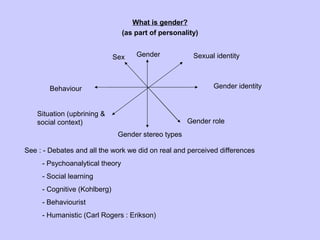
What is gender?
(as part of personality)
Sex Gender Sexual identity
Gender identity
Gender role
Gender stereo types
Situation (upbrining &
social context)
Behaviour
See : - Debates and all the work we did on real and perceived differences
- Psychoanalytical theory
- Social learning
- Cognitive (Kohlberg)
- Behaviourist
- Humanistic (Carl Rogers : Erikson)
Kohlbergs (1966) Cognitive - developmental theory (1966)
“The child actively constructs his own experiences and they are not products of
social
training”
• Basic - gender identity (2-3½)
• Gender stability (3½ - 4½)
• Gender consistency (4½ - 7yrs)
(fits with Piaget’s notion of conservation)
Evidence
• Munroe, Shimmin & Munroe (1984)
These stages are cross - cultural.
Slaby & Frey (1975) - attending to some sex models.
Ruble, Balabon & Cooper (1981) Adverts & gender consistency.
Evaluatory Comments
• Cross cultural
• interactivity
• gender identity - increases gender role
• How they interact in the world requires gender identity
• Criticism : gender role behaviour - depends on gender consistency
• Contradictions
• Individualistic (not social context)
Gender Schema Theory
An organised set of beliefs about the sexes (Martin et al, 1987)
• in group, out group schema
• our gender schema
• children are not passive
• gender - schema’s help them pay attention to ………… & interpret the world &
what they remember
• gender schemas structure experience
Evidence : (Martin et al, 1987)
(Bradbard et al, 1986)
(Masters et al, (1979)
Evaluatory Comment
• seems to explain & fit with other theories of child development specially
cognitive
• individualistic
• schemas are overaggerated
• should be able to change schemas. As Durkin (1995) found: it is easier to
change concepts
Continued……...
Now :
Compare social learning theory yourself using biological; social
biological theory by explaining
• Theory (giving)
• evidence (including)
• evaluatory comment
Theories of Adolescent Development
Delinquency
Relationship with parents
Relationship with peers Cultural
differences
What evidence
is there that
these are
important
Marcia’s theory (1966-1980)
-Alternatives to choose from
-Have fun commitment been made
Four possible identity statuses
-Identity diffusion
-Foreclosure
-Moratorium
-Identity achievement
Evidence to support : Meilman
(1979)
Evidence against : (Munroe &
Adams (1977)
Coleman’s focal theory
(1974)
‘Storm & Stress’
Erikson’s theory (1902, 1994)
-Identity diffusion
-Identity crisis
-Counter evidence
-Support evidence
Intimacy
Diffusion
Diffusion
of
industry
Negative
identity
Gender &
individual
differences
alpha & beta
bias
The Isle of Wight Study
(1976) Rutter’s large scale
study.
What factors cause
disturbance in young people?
What is the problem of
retrospective data?

Personality development

  • 1.
  • 2.
    Definition: Child (1968) “More orless stable, internal factors that make one person’s behaviour consistent from one time to another, and different from the behaviour other people would manifest in comparable situations” • Stable • Internal • Consistent • Different Personality is ‘INTERNAL’ Freud’s theories on Personality Development Change and development are the key words : internal process + past experiences The dynamics of behaviour which is what distinguishes this theory from the cognitive (Glassman, 1995)
  • 3.
    Innate drives +early experiences id ego super ego pleasure principle defence mechanisms Anna Freud “defence against instinct” The child learns defensive behaviours to control id Defence Mechanisms 1 Repression 2 Displacement 3 Projection 4 Denial 5 Intellectualisation Psycho - sexual Development Energy - libido & Eros & Thanatos •Oral •Anal •Phallic (Oedipus & Electra complexes) •Latency •Genital
  • 4.
    Other Defence Mechanisms •Fixation Affective strategies in personality development • Regression Case studies: Anna O Little Hans Myers & Brewin (1994) Childhood Memories Williams (1994) Sexual Abuse McGunnies (1949) Perception defence “things are likely to be ignored if they are unpleasant or emotionally threatening” Levinger & Clarke (1961) supported this using emotionally provoking words. (they recalled the words that had neutral associations) (Evaluatory comment on each of these and on Freud’s theory of personality development)
  • 5.
    Neo - Freudians Erikson(1959) Conflict WAR natural processes expectations of of maturation society Parents friends teachers employers norms & values
  • 6.
    Chart of EightStages Evaluatory Comments • Used clinical evidence (therapist case studies using Freud’s clinical method) • theory imprecise & anecdotal • experimental research provides indirect support for Erikson (Ainsworth & Bell: 1970) (Bowlby, 1952) • Stage 4 has been supported by work of Damon & Hart (1988) (older children used more internal psychological terms. Younger children focused on concrete & tangible ) • Strengths : - focuses on social process & ego development - the facing of developmental tension / conflicts - most of the conflicts lie with the family (Freud also said : When you are looking at a ‘sick’ (mentally) or disturbed person you often don’t have to look far for a cause. (that does not mean the parents are to blame. It is the conflict that is problematic) • Does not give detail of how you move from one stage to another • Dwaretzky (1996) feels there is little convincing evidence for E theory • Hard to test this theory • The evidence is correlational It gives a very tidy account of development
  • 7.
    Social Learning Theory Keyterm : Significant others Social Modelling • Attention • Retention • Reproduction • Motivation • Conditioning • Bandura’s work • What would help a child learn self - efficacy? -? -? -? -? Continue………… Classical Operant Observation & internalisation Vicarious reinforcement Reciprocal determination Self efficacy (self - image & belief in self This is exact opposite of learned helplessness
  • 8.
    • Evidence -Bobo doll - Harter & Monsour (1992) - Bandura & Cervone (1983) • Evaluatory Comment - More than one self? (Baars, 1997) - Not a development theory
  • 9.
    Situationalism • Bandura suggestedthat personality is not a stable trait of an individual • Mischel & Peake’s theory (1982) suggest a consistency paradox. Research failed to show consistency • Behavioural specificity (M & P, 1982) • We think it is a stable trait because we see people in similar situations • Individual differences (M & P, 1993) Person variables • Cognitive & behavioural • Encoding & personal constructs • Expectancy • Subjective stimulus value • self - regulatory systems & plans Evidence • Context - dependent learning research (Abernety, 1940) • Generalising learning • Lack of fragmentation
  • 10.
    What is gender? (aspart of personality) Sex Gender Sexual identity Gender identity Gender role Gender stereo types Situation (upbrining & social context) Behaviour See : - Debates and all the work we did on real and perceived differences - Psychoanalytical theory - Social learning - Cognitive (Kohlberg) - Behaviourist - Humanistic (Carl Rogers : Erikson)
  • 11.
    Kohlbergs (1966) Cognitive- developmental theory (1966) “The child actively constructs his own experiences and they are not products of social training” • Basic - gender identity (2-3½) • Gender stability (3½ - 4½) • Gender consistency (4½ - 7yrs) (fits with Piaget’s notion of conservation) Evidence • Munroe, Shimmin & Munroe (1984) These stages are cross - cultural. Slaby & Frey (1975) - attending to some sex models. Ruble, Balabon & Cooper (1981) Adverts & gender consistency. Evaluatory Comments • Cross cultural • interactivity • gender identity - increases gender role • How they interact in the world requires gender identity • Criticism : gender role behaviour - depends on gender consistency • Contradictions • Individualistic (not social context)
  • 12.
    Gender Schema Theory Anorganised set of beliefs about the sexes (Martin et al, 1987) • in group, out group schema • our gender schema • children are not passive • gender - schema’s help them pay attention to ………… & interpret the world & what they remember • gender schemas structure experience Evidence : (Martin et al, 1987) (Bradbard et al, 1986) (Masters et al, (1979) Evaluatory Comment • seems to explain & fit with other theories of child development specially cognitive • individualistic • schemas are overaggerated • should be able to change schemas. As Durkin (1995) found: it is easier to change concepts Continued……...
  • 13.
    Now : Compare sociallearning theory yourself using biological; social biological theory by explaining • Theory (giving) • evidence (including) • evaluatory comment
  • 14.
    Theories of AdolescentDevelopment Delinquency Relationship with parents Relationship with peers Cultural differences What evidence is there that these are important Marcia’s theory (1966-1980) -Alternatives to choose from -Have fun commitment been made Four possible identity statuses -Identity diffusion -Foreclosure -Moratorium -Identity achievement Evidence to support : Meilman (1979) Evidence against : (Munroe & Adams (1977) Coleman’s focal theory (1974) ‘Storm & Stress’ Erikson’s theory (1902, 1994) -Identity diffusion -Identity crisis -Counter evidence -Support evidence Intimacy Diffusion Diffusion of industry Negative identity Gender & individual differences alpha & beta bias The Isle of Wight Study (1976) Rutter’s large scale study. What factors cause disturbance in young people? What is the problem of retrospective data?