SOCIAL AND EMOTIONAL
DEVELOPMENT
REPORTERS: PREAGOLA, ABEGAEL C.
RAPOSON, ALNIE
WHAT IS SOCIAL AND EMOTIONAL?
DEVELOPMENT
• SOCIAL DEVELOPMENT- refers to a child’s ability
to crete and sustain meaningful relationships with
adults and other child.
• EMOYIONAL DEVELOPMENT- is a child’s ability to
express,recognize, and manage his or her
emotions, as well as respond appropriately to
others’ emotions.
A. SOCIO-EMOTIONAL
DEVELOPMENT
B. DEVELOPMENT OF SELF AND
SOCIAL UNDERSTANDINGS
1.PSYCHOANALYTIC THEORY 2.PSYCHOSOCIAL THEORY
(FREUD) (ERICKSON)
3. SOCIAL LEARNING THEORY
(BANDURA)
SOCIO-EMOTIONAL
DEVELOPMENT
- How ,children start to understand who
they are what they are feeling and what to
expect when interacting with others.
- Sets a foundation for children to engagen
other development tasks.
- Expressing yourself with your in a
different way than your parents.
- Understand ing tyour thoughts and
feelings, and being able to relate to others.
The main focus of the Socio-Emotional
Development in the Ability to Establish
and Maintain Relationships
Relationships are the core of socila emotional
development. A child’s ability to establish and keep
relationship is very important aspect of their
development. This is primarily seen in a child’s ability
to make and keep friends.
DEVELOPMENT OF SELF
AND SOCIAL
UNDERSTANDING
PSYHOANALYTIC THEORY
(FREUD)
-Is part of a collection of psychoanalytic thoeries and
therapeutic techniques originating in the work of SIGMUD
FREUD,who developed Psychoanalytic theory, coming the
term “PSYCHOANALYSIS” in 1896.
-The theory encompasses the idea that all people have
unconscios thoughts, memories,emotions,and desires,and
that therapy should be used to access the mind’s repressed
feelings and experiences.
SIGMUD FREUD PSYCHOANALYTIC
THEORY
- states that human personalities evolve though a series of
phases: the Id,Ego,Superego. According to freud, these
phases are development by the unconsious mind’s inner
struggles;
-he theorized that there are three levels of
consciousness:consciousness,preconsciousness,and
unconsciosness. He believed these levels also influenced
the Id,Egp,Superego. Most of his research was based on
his observation in thefeld of hysteria, now called POST-
TRAUMATIC STRESS SYNDROME.
THREE LEVELS OF PERSONALITIES
ID
-is the biological components of the personality and includes your
instinccts.
-operates in our unconscious mind. It is like the little devil sitting on
the cartoon characters shoulder that is always selfish and needy.
SUPEREGO
-exists in all three levels of consciosness.
-is like the little angel. it is always concerned with what is socially
acceptable.
EGO
-is the part of the personality that make your
decisions; is in the middle, makes the decison, faces
the consequences.
-operates according to the reality principle.The reality
principle is the idea that the desires of the id must be
satisfied in a method that is both socially appropriate
and realistic.
-must mediate the demands of the id, the superego
and reality.
THREE LEVELS OF
CONSCIOUSNESS
UNCONSCIOUS MIND- which exixts outside of your
awareness at all times.
PRECONCIOUS MIND- which includes all
information that you are not currently aware of but
that can be recalled.
CONSCIOUS MIND- is your current state of
awareness.
WHO IS SIGMUD FREUD?
-is one of the most famous names in psychology. Even
though most of his ideas have been abandoned by modern
psychology, his PSYCHOANALYTC THEORY formed the
basis for many current mind and its role in human behavior.
-for coining the term “psychoanalysis” and his many
theories concerning the development of the human
personality, its levels of conscioness and origin of its
behaviors.
-is considered the father of psychoanalysis and has
contributed many theories concerning human behavior and
personally development.
-his work has given rise to both supporter and critics alike,
his significant addition to the field of psychology have
inspired others in the same field to both study his work and
put it into practice for the assistance of people in need of
psychological help.
PSYHCOSOCIAL THEORY
(ERIKSON)
- maintained that personality develops in a
predetermined order through eight stages of
psychosocial development , from infancy to
adulthood. During each stage, the person
experiences a psychosocial crisis that could
positively or negatively ffect personality development.
STAGE 1: TRUST VS. MISTRUST
-is the first stage in erick erikson’s theory pf
psychosocial development. This stage begins at birth
continues to approximately 18 months of age.During
this stage, the infant is uncertain about the world in
which they live, and l-ooks towards their primary
caregiver for stability and consistency of care.
STAGE 2: AUTONOMY VS. SHAM/DOUBT
- is the second stage of erik erikson’s stage of
psychosocial development. this stage occurs
between the ages of 18 months to approximately 3
years. According to erikson, children at this stage are
focused on developing a sense of independence
STAGE 3: INTIATIVE VS. GUILT
-during the initiative vs. guilt stage, children assert
themselves more frequently through directing play
and other social interaction
STAGE 4: INDUSTRY VS. INFERIORITY
-during childhood between the age of five and twelve. n this
stage , children start to compare themselve with their peers
to gauge their abilities and worth.
STAGE 5: IDENTITY VS. ROLE CONFUSION
- it occurs during adolescents search for a sense of
self and personal identify, through an intense
exploration of personal values, beliefs, and goals.
STAGE 6: INTIMACY VS. ISOLATION
-This stage takes place during young adulthood between
the age of aprpximately 18 to 40 yrs. During this stage the
major conflict centers on forming intimate, loving
relationships with other people.
STAGE 7: GENERATIVITY VS. STAGNATION
-during middle adulthood age 40 to 65 yrs. during
this stage , individuals focus more on building our
lives, primarily through our careers, families, and
contributions to society.
STAGE 8: EGO INTEGRITY VS. DESPAIR
-this stage begins at approximately age 65 and end at
death. it is during this time that we contemplate our
accomplishments and can develop integrity if we see
ourselves as leading a successful life.
SOCIAL LEARNING THEORY
(BANDURA)
WHAT IS SOCIAL LEARNING
THEORY?
- Social leraning theory considers how both
environmental and cognitive factors interact to
influence human learning and behavior.
- Social learning theory, proposed by ALBERT
BANDURA,emphasizes the importance of
observing, modeling, and imitating the
behaviors, attitudes, and emotional reactions of
others.
- Albert Bandura (1977) agree with the behaviorist
learning theories of Classical conditioning and
Operant conditioning.
1.Mediating processes occur between stimuli &
responses.
2.Behavior is learned from the environment through
the process of observartional learning.
WHAT IS OBSERVATIONAL LEARNING?
- is a key aspect of social learning theory, where individuals
learn and adopt behaviors by observing others.
- Individuals that are observed are called models. In society,
children are surrounded by many influential models, such
as parent within the family, chaacters on children’s TV,
friends within their peer group, and teachers at school.
- Based on Bandura’s resaerch, several factors enchance
the likehood of a behavior when imitated. We are more
prone to imtitate behaviors when the following conditions
apply.
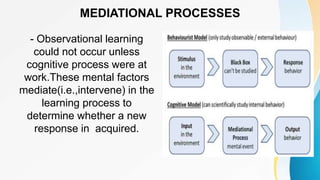
MEDIATIONAL PROCESSES
- Observational learning
could not occur unless
cognitive process were at
work.These mental factors
mediate(i.e.,intervene) in the
learning process to
determine whether a new
response in acquired.
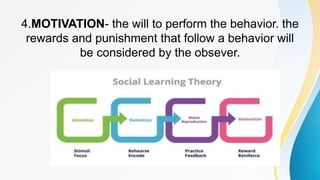
1.ATTENTION - The individual needs to pay
attention to the behavior and its consequences and
form a mental representation of the behavior.
2.RETENTION- how well behavior ir remenbered.
the behavior may be noticed, but it is not always
remembered , which obviously prevents imitation.
3.MOTOR REPRODUCTION- the ability to perform
the behavior that the model has just demonstrated.
we see much behavoir daily that we would like to be
imitate, but this is not always possible.
4.MOTIVATION- the will to perform the behavior. the
rewards and punishment that follow a behavior will
be considered by the obsever.
WHO IS ALBERT BANDURA?
- was a prominent canadian-american psychologist known
for his work in social learning theory and the concept of self-
efficacy.
- his groundbreaking reseach on observational learning,
through experiments such as the Bobo Doll experiment,
shifted the focus of psychologicl theory fromn behvaiorism
to cognitive processes.
- is best known for his contribution to the field of
psychology, particularly in the areas of social learning
theory ,self-efficacy, and agression. he is consudered one of
the most influential psychologist of the 20th century.
THANK YOU FOR
LISTENING!

PROF-ED1.pptx

  • 1.
    SOCIAL AND EMOTIONAL DEVELOPMENT REPORTERS:PREAGOLA, ABEGAEL C. RAPOSON, ALNIE
  • 2.
    WHAT IS SOCIALAND EMOTIONAL? DEVELOPMENT • SOCIAL DEVELOPMENT- refers to a child’s ability to crete and sustain meaningful relationships with adults and other child. • EMOYIONAL DEVELOPMENT- is a child’s ability to express,recognize, and manage his or her emotions, as well as respond appropriately to others’ emotions.
  • 3.
    A. SOCIO-EMOTIONAL DEVELOPMENT B. DEVELOPMENTOF SELF AND SOCIAL UNDERSTANDINGS 1.PSYCHOANALYTIC THEORY 2.PSYCHOSOCIAL THEORY (FREUD) (ERICKSON) 3. SOCIAL LEARNING THEORY (BANDURA)
  • 4.
  • 5.
    - How ,childrenstart to understand who they are what they are feeling and what to expect when interacting with others. - Sets a foundation for children to engagen other development tasks. - Expressing yourself with your in a different way than your parents. - Understand ing tyour thoughts and feelings, and being able to relate to others.
  • 6.
    The main focusof the Socio-Emotional Development in the Ability to Establish and Maintain Relationships Relationships are the core of socila emotional development. A child’s ability to establish and keep relationship is very important aspect of their development. This is primarily seen in a child’s ability to make and keep friends.
  • 7.
    DEVELOPMENT OF SELF ANDSOCIAL UNDERSTANDING
  • 8.
    PSYHOANALYTIC THEORY (FREUD) -Is partof a collection of psychoanalytic thoeries and therapeutic techniques originating in the work of SIGMUD FREUD,who developed Psychoanalytic theory, coming the term “PSYCHOANALYSIS” in 1896. -The theory encompasses the idea that all people have unconscios thoughts, memories,emotions,and desires,and that therapy should be used to access the mind’s repressed feelings and experiences.
  • 9.
    SIGMUD FREUD PSYCHOANALYTIC THEORY -states that human personalities evolve though a series of phases: the Id,Ego,Superego. According to freud, these phases are development by the unconsious mind’s inner struggles; -he theorized that there are three levels of consciousness:consciousness,preconsciousness,and unconsciosness. He believed these levels also influenced the Id,Egp,Superego. Most of his research was based on his observation in thefeld of hysteria, now called POST- TRAUMATIC STRESS SYNDROME.
  • 10.
    THREE LEVELS OFPERSONALITIES ID -is the biological components of the personality and includes your instinccts. -operates in our unconscious mind. It is like the little devil sitting on the cartoon characters shoulder that is always selfish and needy. SUPEREGO -exists in all three levels of consciosness. -is like the little angel. it is always concerned with what is socially acceptable.
  • 11.
    EGO -is the partof the personality that make your decisions; is in the middle, makes the decison, faces the consequences. -operates according to the reality principle.The reality principle is the idea that the desires of the id must be satisfied in a method that is both socially appropriate and realistic. -must mediate the demands of the id, the superego and reality.
  • 12.
    THREE LEVELS OF CONSCIOUSNESS UNCONSCIOUSMIND- which exixts outside of your awareness at all times. PRECONCIOUS MIND- which includes all information that you are not currently aware of but that can be recalled. CONSCIOUS MIND- is your current state of awareness.
  • 13.
    WHO IS SIGMUDFREUD? -is one of the most famous names in psychology. Even though most of his ideas have been abandoned by modern psychology, his PSYCHOANALYTC THEORY formed the basis for many current mind and its role in human behavior. -for coining the term “psychoanalysis” and his many theories concerning the development of the human personality, its levels of conscioness and origin of its behaviors. -is considered the father of psychoanalysis and has contributed many theories concerning human behavior and personally development.
  • 14.
    -his work hasgiven rise to both supporter and critics alike, his significant addition to the field of psychology have inspired others in the same field to both study his work and put it into practice for the assistance of people in need of psychological help.
  • 15.
    PSYHCOSOCIAL THEORY (ERIKSON) - maintainedthat personality develops in a predetermined order through eight stages of psychosocial development , from infancy to adulthood. During each stage, the person experiences a psychosocial crisis that could positively or negatively ffect personality development.
  • 17.
    STAGE 1: TRUSTVS. MISTRUST -is the first stage in erick erikson’s theory pf psychosocial development. This stage begins at birth continues to approximately 18 months of age.During this stage, the infant is uncertain about the world in which they live, and l-ooks towards their primary caregiver for stability and consistency of care.
  • 18.
    STAGE 2: AUTONOMYVS. SHAM/DOUBT - is the second stage of erik erikson’s stage of psychosocial development. this stage occurs between the ages of 18 months to approximately 3 years. According to erikson, children at this stage are focused on developing a sense of independence
  • 19.
    STAGE 3: INTIATIVEVS. GUILT -during the initiative vs. guilt stage, children assert themselves more frequently through directing play and other social interaction
  • 20.
    STAGE 4: INDUSTRYVS. INFERIORITY -during childhood between the age of five and twelve. n this stage , children start to compare themselve with their peers to gauge their abilities and worth.
  • 21.
    STAGE 5: IDENTITYVS. ROLE CONFUSION - it occurs during adolescents search for a sense of self and personal identify, through an intense exploration of personal values, beliefs, and goals.
  • 22.
    STAGE 6: INTIMACYVS. ISOLATION -This stage takes place during young adulthood between the age of aprpximately 18 to 40 yrs. During this stage the major conflict centers on forming intimate, loving relationships with other people.
  • 23.
    STAGE 7: GENERATIVITYVS. STAGNATION -during middle adulthood age 40 to 65 yrs. during this stage , individuals focus more on building our lives, primarily through our careers, families, and contributions to society.
  • 24.
    STAGE 8: EGOINTEGRITY VS. DESPAIR -this stage begins at approximately age 65 and end at death. it is during this time that we contemplate our accomplishments and can develop integrity if we see ourselves as leading a successful life.
  • 27.
  • 28.
    WHAT IS SOCIALLEARNING THEORY? - Social leraning theory considers how both environmental and cognitive factors interact to influence human learning and behavior. - Social learning theory, proposed by ALBERT BANDURA,emphasizes the importance of observing, modeling, and imitating the behaviors, attitudes, and emotional reactions of others.
  • 29.
    - Albert Bandura(1977) agree with the behaviorist learning theories of Classical conditioning and Operant conditioning. 1.Mediating processes occur between stimuli & responses. 2.Behavior is learned from the environment through the process of observartional learning.
  • 30.
    WHAT IS OBSERVATIONALLEARNING? - is a key aspect of social learning theory, where individuals learn and adopt behaviors by observing others. - Individuals that are observed are called models. In society, children are surrounded by many influential models, such as parent within the family, chaacters on children’s TV, friends within their peer group, and teachers at school. - Based on Bandura’s resaerch, several factors enchance the likehood of a behavior when imitated. We are more prone to imtitate behaviors when the following conditions apply.
  • 31.
    MEDIATIONAL PROCESSES - Observationallearning could not occur unless cognitive process were at work.These mental factors mediate(i.e.,intervene) in the learning process to determine whether a new response in acquired.
  • 32.
    1.ATTENTION - Theindividual needs to pay attention to the behavior and its consequences and form a mental representation of the behavior. 2.RETENTION- how well behavior ir remenbered. the behavior may be noticed, but it is not always remembered , which obviously prevents imitation. 3.MOTOR REPRODUCTION- the ability to perform the behavior that the model has just demonstrated. we see much behavoir daily that we would like to be imitate, but this is not always possible.
  • 33.
    4.MOTIVATION- the willto perform the behavior. the rewards and punishment that follow a behavior will be considered by the obsever.
  • 34.
    WHO IS ALBERTBANDURA? - was a prominent canadian-american psychologist known for his work in social learning theory and the concept of self- efficacy. - his groundbreaking reseach on observational learning, through experiments such as the Bobo Doll experiment, shifted the focus of psychologicl theory fromn behvaiorism to cognitive processes. - is best known for his contribution to the field of psychology, particularly in the areas of social learning theory ,self-efficacy, and agression. he is consudered one of the most influential psychologist of the 20th century.
  • 35.