Oyewole O. Sarumi |PhD|
PERSONAL
DEVELOPMENT
FOR
CHRISTIAN LEADERS
Objectives
 Helps you to identify the skills you need to set life
and ministry goals which can enhance your
prospects, raise your confidence and lead to a more
fulfilling, higher quality life.
 Plan to make relevant, positive and effective life
choices and decisions for your future to enable
personal empowerment.
 Help in your personal and spiritual growth so that
you can be more relevant in the kingdom labour.
"God first. Others second. I'm third."
I’M THIRD
The rare person gets
somewhere on purpose.
Everyone gets somewhere
in life…
A Portuguese Couple Story
 I remember a couple in our church in Ireland when they first arrived, they
could not speak English. They realised very quickly that for them to succeed
in Ireland they must find a way to learn, understand and communicate well
in English. The wife enrolled in an English class and took Cambridge exams
and out of twelve people in her class only two passed and she was one of
the two. Today, she works in sales in a busy company. They told me they
took it upon themselves not to speak their native tongue at home
(Portuguese) but speak only English there. The husband works in an English-
speaking computer firm and he concluded his degree in the Dublin Business
School and went on to obtain a Masters in one of Ireland’s foremost
universities.
 This couple, yes they are Christians and are children of the Most High and
have all the promises in the Bible but they had to develop themselves in
order to actualise those promises in their lives and un-lay the wealth of the
wicked that had been stored up for them in Christ. Friend, it’s time to rise up
and act. It’s time to stop wishing and complaining. It’s time to take
responsibility for your personal development and attainment of your goals.
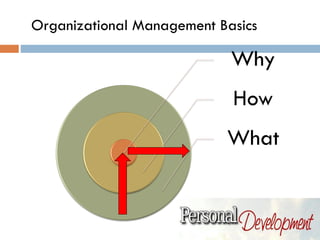
Why
How
What
Organizational Management Basics
The Church
Write Your Response:
Why does your
ministry exist?
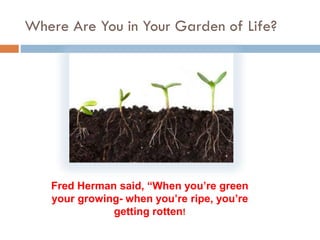
Where Are You in Your Garden of Life?
Fred Herman said, “When you’re green
your growing- when you’re ripe, you’re
getting rotten!
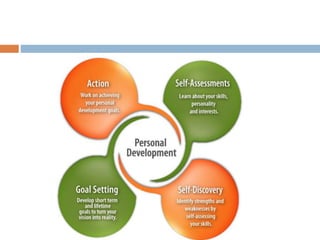
Personal Development is….
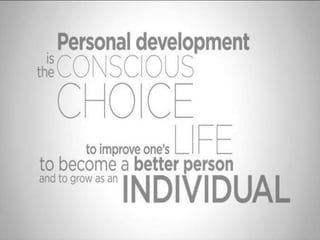
 …..the process of improving oneself through such activities
as enhancing employment skills, increasing consciousness and
building wealth.*
 …is a lifelong process. It’s a way for people to assess their
skills and qualities, consider their aims in life and set goals in
order to realise and maximise their potential.**
 …the conscious pursuit of personal growth by expanding
self-awareness and knowledge and improving personal
skills.
*http://www.businessdictionary.com/definition/personal-development.html
**http://www.skillsyouneed.com/ps/personal-development.html#ixzz4IiV5dzCs
Making the Unconscious Conscious
 “Until you make the unconscious conscious, it will direct your
life and you will call it fate.” ~ Carl Gustav Jung
 Much of personal development is about making the
unconscious conscious. It’s always the first part to become
conscious of how we really work on the inside. Only then we
can get control over it.
 For instance, the idea of telling yourself the truth,
acceptance, is just the same: to make the unconscious reality,
that we may have ignored before, conscious. Just that we
can make progress now, while before it wasn’t even on our
radar – in was just unconscious. In psychology this is
called the four stages of competence:
In psychology, this is called the four
stages of competence:
 Unconscious incompetence
The individual does not understand or know how to do
something and does not necessarily recognize the
deficit. They may deny the usefulness of the skill. The
individual must recognise their own incompetence, and
the value of the new skill, before moving on to the
next stage. The length of time an individual spends in
this stage depends on the strength of the stimulus to
learn.
Quote from Wikipedia:
 Conscious incompetence
Though the individual does not understand or know
how to do something, he or she does recognize the
deficit, as well as the value of a new skill in
addressing the deficit. The making of mistakes can be
integral to the learning process at this stage.
 Conscious competence
The individual understands or knows how to do
something. However, demonstrating the skill or
knowledge requires concentration. It may be broken
down into steps, and there is heavy conscious
involvement in executing the new skill.
 Unconscious competence
The individual has had so much practice with a skill
that it has become “second nature” and can be
performed easily. As a result, the skill can be
performed while executing another task. The
individual may be able to teach it to others,
depending upon how and when it was learned.
Quote from Wikipedia:
 In Personal Development, we are talking about this
process for our whole personality: Taking
responsibility for our lives, change self limiting
beliefs, set a life-vision and some exciting new
goals for our life, get more self-awareness and
improve our mental focus, get more energy and how
to use it intelligently etc.
“What do you do for personal
development?”
 Whether you call it personal development, personal
growth, self-actualization, self-transcendence, or
spirituality does not matter. What matters is
realizing that the reason you were born is to
become the best human being you can possibly be.
Personal development is not a tool for reaching a
bigger goal. Becoming a complete human being is
already the biggest and most noble goal you can
aspire to. – August Turak
Personal Development & Personal
Empowerment – The Difference
 ‘Personal Development’ and ‘Personal Empowerment’
are two areas that overlap.
 Personal empowerment is about looking at who you are
and becoming more aware of yourself as a unique
individual.
 Personal empowerment involves developing the
confidence and strength to set realistic goals and fulfil
your potential. Everyone has strengths and weaknesses
and a range of skills that are used in everyday
situations, but all too often people remain unaware of,
or undervalue, their true abilities.
 A person aiming for empowerment is able to take
control of their life by making positive choices and
setting goals. Developing self-awareness, an
understanding of your strengths and weaknesses -
knowing your own limitations is key to personal
empowerment.
 Taking steps to set and achieve goals - both short
and longer-term and developing new skills, acts to
increase confidence which, in itself, is essential to
self-empowerment.
 Personal empowerment is not a static thing that you
can do once in your life.
 Please view personal empowerment as ongoing
personal development.
 As circumstances change and develop, and as we
ourselves change and develop, so do our needs for
development and empowerment.
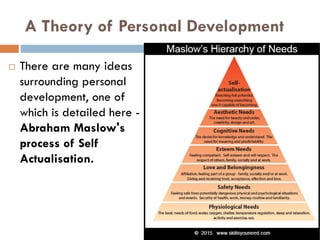
A Theory of Personal Development
 There are many ideas
surrounding personal
development, one of
which is detailed here -
Abraham Maslow's
process of Self
Actualisation.
Self Actualisation
 Maslow (1970) suggests that all individuals have an in-
built need for personal development which occurs
through the process called self-actualisation.
 The extent to which people are able to develop depends on
certain needs being met and these needs form a
hierarchy. Only when one level of need is satisfied can a
higher one be developed. As change occurs throughout life,
however, the level of need motivating someone’s behaviour
at any one time will also change.
 Maslow (1970, p.383) says that all individuals have the
need to see themselves as competent and autonomous, also
that every person has limitless room for growth.
 Self-actualisation refers to the desire that
everybody has ‘to become everything that they are
capable of becoming’. In other words, it refers to
self-fulfilment and the need to reach full potential
as a unique human being.
 For Maslow, the path to self-actualisation
involves being in touch with your feelings,
experiencing life fully and with total
concentration.
Maslow, A. H. (1970), Motivation and Personality, (2nd Edition), Harper & Row, New York.
Christian Personal Development
 These definitions failed to add the God factor
which is understandable because they defined only
personal development from world view.
 Christian Personal Development is therefore a
process of allowing God and His principles to guide
your conscious pursuit of personal growth through the
expansion of self-awareness and knowledge, the
improvement of personal skills and the development
of others.
 Moses’ personal development from his fumbling
start with God in Exodus 3 and 4 to becoming one
of the world’s most effective leaders and servant of
God could only be possible because he allowed
God and His principles to shape him.
 The personal development of a creation will not be
complete or adequate without the input of the
creator. God is our Creator, only He can effectively
help us to develop adequately.
It is Your Responsibility
 Your personal development is really your personal
responsibility.
 God told Abraham when He was giving him the
Promised Land, God said “as far as your eyes can see,
that I have given you”.
 Abraham had responsibility to get out of his tent, get on
the top of the highest mountain on a sunny day so he
could have a clear view and then look northward, and
then southwards and then eastward and then westward.
That was one of the things he did and reaped the
reward of the Promised Land.
 You need to take the responsibility to find out and
acquire the relevant information for the path God has
chosen for you either in ministry or career and focus on
it.
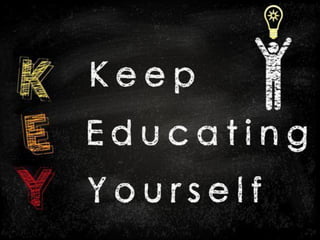
 Become a lifelong student and have desire to learn
things that will improve your skill in any field of
endeavour, be it ministry, marriage, planning or
anything that will position you for greatness.
 Some tools of responsibility include studying,
diligence, & fighting for what you believe and desire.
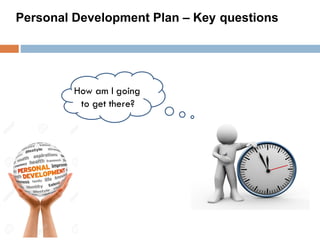
Personal Development Plan – Key questions
How am I going
to get there?
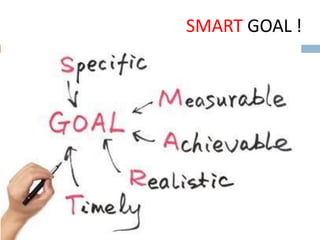
SMART GOAL !
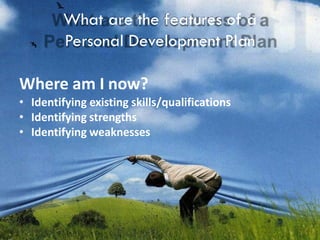
What are the features of a
Personal Development Plan
Where am I now?
• Identifying existing skills/qualifications
• Identifying strengths
• Identifying weaknesses
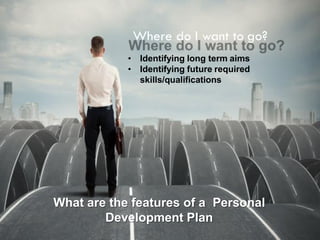
What are the features of a Personal
Development Plan
Where do I want to go?
• Identifying long term aims
• Identifying future required
skills/qualifications
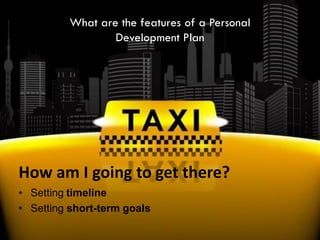
How am I going to get there?
• Setting timeline
• Setting short-term goals
What are the features of a Personal
Development Plan
The 7 Healthy Goals to Pursue for
Personal Effectiveness in Ministry
 There are 7 types of goals you need to know and
cultivate if you are going to develop yourself to
sustainable level where you will not only be useful to
yourself, but to others. They are:
 Spiritual -
 Social - Relational
 Family -
 Work/Business/Career
 Financial -
 Ministerial - KS
 Personal - Character
 Emotional - Feeling
Pastoral Leadership Academy, Lagos. http://pl-academy.org. Tel: 0803
304 1421
1. Develop the church organization to meet its mission
2. Measure individual and church organizational
performance
3. Link training and development to spiritual outcomes
4. Set Clear Expectations – Establishing Measures that are
compatible with church organizational goals, and
focusing on the “critical few”
44
 Have a better understanding of who you are:
 Gain insight into personal capabilities
 Identify strengths and gaps
 Begin a process of self-management and self-development
 Construct a personal development plan
 Accentuate strengths and minimize areas of potential
weakness
45
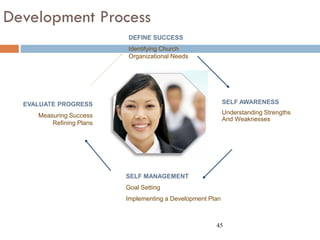
Development Process
DEFINE SUCCESS
Identifying Church
Organizational Needs
SELF MANAGEMENT
Goal Setting
Implementing a Development Plan
EVALUATE PROGRESS
Measuring Success
Refining Plans
SELF AWARENESS
Understanding Strengths
And Weaknesses
46
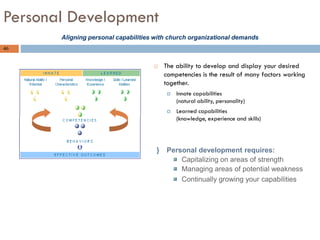
Personal Development
 The ability to develop and display your desired
competencies is the result of many factors working
together.
 Innate capabilities
(natural ability, personality)
 Learned capabilities
(knowledge, experience and skills)
Aligning personal capabilities with church organizational demands
} Personal development requires:
Capitalizing on areas of strength
Managing areas of potential weakness
Continually growing your capabilities
How To Increase Your Effectiveness
 There are four steps you can take to increase your
Personal effectiveness as a leader in your current or
future ministry context:
 Know yourself as a leader
 Know your leadership context
 Compare yourself as a leader with the ministry context
 Make the necessary adjustments
Step 1: Know Yourself as a Leader
 You must have alignment: What you believe must align
with the church you serve.
 You must know your core ministry values: why you do
what you do as a ministry. You must know your core
values.
 You must know your leadership style: director,
inspirational, diplomat, or analytical
 Know your capabilities: you God given and natural
gifts, passions, temperament, and abilities.
 Know your theology -what you believe the bible
teaches about ministry
 Know your philosophy – what you believe about how
the church does ministry, how it does what it does.
Step 2: Know Your Leadership Context
 You must know the ministry context in which you
serve: the setting, environment, climate, and culture
 You must know the church’s doctrinal beliefs
 You must know the core values of the ministry
 You must know the leadership style of the ministry you
serve
 You must know the church’s capabilities
Step 2: Know Your Leadership Context
 You must know the church’s theology and
philosophy of ministry
 The church’s ministry circumstances
 The church’s level of trust
 The church’s power structure
 The church demographics and
psychographics
Step 3: Compare Yourself as a Leader
with the Ministry Context
 Place your identity next to the church’s identity to
discover whether there is alignment:
 Compare:
 Beliefs
 Values
 Leadership Style
 Capabilities
 Theology and Philosophy
 Trust
Step 4: Make the Necessary
Adjustments
 Option 1: Leaders can attempt to adjust how they
lead
 Option 2: Leaders can attempt to change their
context
 Pray for the church
 Build up your leadership credibility
 Implement leadership development
 Work on ministry alignment
 Option 3: Leaders can leave the ministry situation.
Why You Need Personal Development
 Here are 5 good reasons to incorporate your
personal development into your budget.
 1-You can’t always depend on the
church/employer to train you.
Your church or employer has priorities and budgets
to respect. If what you need to bring yourself closer
to your spiritual and career goals which is not being
taken care of by your pastor or boss, frustration
and blame won’t help. It’s your future, you must take
care of it yourself!
 2-Excuses will not help you get ahead
There will always be excuses. Lack of time, children
to take care of, more urgent expenses winking at
you etc. If you always put your personal
development last, you may be missing opportunities
you don’t even know exist right now. By planning
your personal development in your budget and in
your annual planning, you make it a priority and
can enjoy it without guilt.
 3-We don’t always make it by ourselves.
When we really need help, (to either develop our
skills or untangle our emotions) it’s a shame to be
confronted with financial issues. If you have an
amount set aside for training, you could use it to
give yourself a push when you need it the most.
Think about it. It could be your best investment ever.
 4-Passion is essential to a balanced life
If you can’t find your passion at work or ministry, or
can’t express your creativity, you need to find ways
to do it differently or life will pull you down.
Personal development is also feeding the various
aspects of our personality.
 5-You do not know what the future holds.
We don’t know what life holds for us. You could lose
your job, want new challenges or a career change.
It’s your responsibility to develop your interests,
your skills and knowledge to be ready to face any
eventuality, which is part of life.
“…People will never do
ministry that matters until
they know what matters”.
ppppppppppppp
The Personal Ministry Mission
 A personal ministry mission is a statement of what God
wants Christians to accomplish with their lives:
 You discover God’s mission for your life through two D’s:
design and direction
 Design is based on life experience and God given desires
 Ask: What are my God given gifts and abilities and what in
particular makes me distinct from everyone else?
 Ask: What is it that bring to any ministry?
 Ask : What are my natural and spiritual gifts and passions?
Developing a Personal Ministry Mission
 “To develop a personal ministry mission statement we
must combine what we know about our divine gifts, our
divine direction, and other factors such as where and
when we might minister and how this might affect other
people”.
 Example of a personal mission statement:
 “I desire to be used of God to equip a new generation of
leaders nationally and internationally for high impact
ministry in the 21st century.
 Personal slogan:
 “Equipping tomorrow’s leaders today”
Biblical Examples of Personal Ministry
Mission Statements
 Adam and Eve’s (Gen. 1:28)
 Moses (Exod. 3:10)
 Joshua (Josh. 1:2)
 David (2 Sam. 5:2; 7:8)
 Nehemiah (Neh. 2: 17-18)
 Jesus (Matt. 20: 28; Mark 10:45)
 Paul (Acts 20:24; 2 Tim 3: 10)
What was the
mission of each of
these biblical
figures?
The Personal Ministry Vision
“While a personal mission
helps your people know
where they’re going
personal vision helps them
see where they are
going.”
 Discovering a Personal Ministry Vision
 It should be clear
 It is challenging
 Paints a picture of the person’s life and
ministry
 Gives the person an idea about the future
 Challenges you to answer the question:.”
“What can God accomplish through me to
make a difference in this church and
community”
 A personal vision fuels passion in people’s
hearts
Practical Steps to Personal
Development
 Practical steps can be taken to enhance personal
development, including:
 Organising your time.
 Producing a personal CV or résumé.
 Undertaking a skills appraisal.
 Looking at your transferable skills.
 Overcoming barriers to learning a new skill.
 Making Personal Development your way of life.
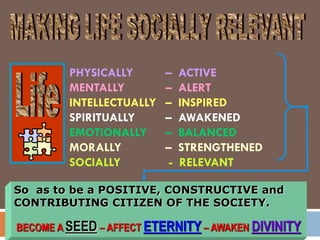
PHYSICALLY – ACTIVE
MENTALLY – ALERT
INTELLECTUALLY – INSPIRED
SPIRITUALLY – AWAKENED
EMOTIONALLY – BALANCED
MORALLY – STRENGTHENED
SOCIALLY - RELEVANT
So as to be a POSITIVE, CONSTRUCTIVE and
CONTRIBUTING CITIZEN OF THE SOCIETY.
BECOME A SEED – AFFECT ETERNITY – AWAKEN DIVINITY
What should you do for personal
development?
 I won’t suggest you do anything for personal
development, but…..
 Like the monks, simply live your life.
 Build your whole life around personal development.
 Make it the only thing I truly care about till you depart
to GLORY.
 Let pursuing personal development become so habitual
that you never think about it.
 In this sense everything you’ll do is filtered through the
screen of personal development.
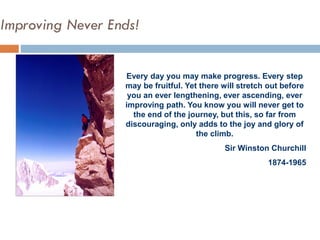
Improving Never Ends!
Every day you may make progress. Every step
may be fruitful. Yet there will stretch out before
you an ever lengthening, ever ascending, ever
improving path. You know you will never get to
the end of the journey, but this, so far from
discouraging, only adds to the joy and glory of
the climb.
Sir Winston Churchill
1874-1965
 “Man is a mystery. If you spend your entire life
trying to puzzle it out do not say that you’ve wasted
your time. I occupy myself with this mystery because
I want to be a man”. - Fyodor Dostoevsky
 “Like a good Trappist monk, Dostoevsky didn’t see
personal development as a way to become a great
writer, but writing as a way to pursue personal
development. And if we want authentic rather than
ersatz success in life we must do the same”. August
Turak
References Consulted
 August Turak. Business Secrets of the Trappist Monks:
One CEO’s Quest for Meaning and Authenticity.
Columbia Business School Publishing; July 2013.

Personal development for christian leaders

  • 1.
    Oyewole O. Sarumi|PhD| PERSONAL DEVELOPMENT FOR CHRISTIAN LEADERS
  • 2.
    Objectives  Helps youto identify the skills you need to set life and ministry goals which can enhance your prospects, raise your confidence and lead to a more fulfilling, higher quality life.  Plan to make relevant, positive and effective life choices and decisions for your future to enable personal empowerment.  Help in your personal and spiritual growth so that you can be more relevant in the kingdom labour.
  • 3.
    "God first. Otherssecond. I'm third." I’M THIRD
  • 4.
    The rare persongets somewhere on purpose. Everyone gets somewhere in life…
  • 5.
    A Portuguese CoupleStory  I remember a couple in our church in Ireland when they first arrived, they could not speak English. They realised very quickly that for them to succeed in Ireland they must find a way to learn, understand and communicate well in English. The wife enrolled in an English class and took Cambridge exams and out of twelve people in her class only two passed and she was one of the two. Today, she works in sales in a busy company. They told me they took it upon themselves not to speak their native tongue at home (Portuguese) but speak only English there. The husband works in an English- speaking computer firm and he concluded his degree in the Dublin Business School and went on to obtain a Masters in one of Ireland’s foremost universities.  This couple, yes they are Christians and are children of the Most High and have all the promises in the Bible but they had to develop themselves in order to actualise those promises in their lives and un-lay the wealth of the wicked that had been stored up for them in Christ. Friend, it’s time to rise up and act. It’s time to stop wishing and complaining. It’s time to take responsibility for your personal development and attainment of your goals.
  • 7.
  • 8.
  • 9.
    Write Your Response: Whydoes your ministry exist?
  • 10.
    Where Are Youin Your Garden of Life? Fred Herman said, “When you’re green your growing- when you’re ripe, you’re getting rotten!
  • 12.
    Personal Development is…. …..the process of improving oneself through such activities as enhancing employment skills, increasing consciousness and building wealth.*  …is a lifelong process. It’s a way for people to assess their skills and qualities, consider their aims in life and set goals in order to realise and maximise their potential.**  …the conscious pursuit of personal growth by expanding self-awareness and knowledge and improving personal skills. *http://www.businessdictionary.com/definition/personal-development.html **http://www.skillsyouneed.com/ps/personal-development.html#ixzz4IiV5dzCs
  • 13.
    Making the UnconsciousConscious  “Until you make the unconscious conscious, it will direct your life and you will call it fate.” ~ Carl Gustav Jung  Much of personal development is about making the unconscious conscious. It’s always the first part to become conscious of how we really work on the inside. Only then we can get control over it.  For instance, the idea of telling yourself the truth, acceptance, is just the same: to make the unconscious reality, that we may have ignored before, conscious. Just that we can make progress now, while before it wasn’t even on our radar – in was just unconscious. In psychology this is called the four stages of competence:
  • 14.
    In psychology, thisis called the four stages of competence:  Unconscious incompetence The individual does not understand or know how to do something and does not necessarily recognize the deficit. They may deny the usefulness of the skill. The individual must recognise their own incompetence, and the value of the new skill, before moving on to the next stage. The length of time an individual spends in this stage depends on the strength of the stimulus to learn. Quote from Wikipedia:
  • 15.
     Conscious incompetence Thoughthe individual does not understand or know how to do something, he or she does recognize the deficit, as well as the value of a new skill in addressing the deficit. The making of mistakes can be integral to the learning process at this stage.
  • 16.
     Conscious competence Theindividual understands or knows how to do something. However, demonstrating the skill or knowledge requires concentration. It may be broken down into steps, and there is heavy conscious involvement in executing the new skill.
  • 17.
     Unconscious competence Theindividual has had so much practice with a skill that it has become “second nature” and can be performed easily. As a result, the skill can be performed while executing another task. The individual may be able to teach it to others, depending upon how and when it was learned. Quote from Wikipedia:
  • 18.
     In PersonalDevelopment, we are talking about this process for our whole personality: Taking responsibility for our lives, change self limiting beliefs, set a life-vision and some exciting new goals for our life, get more self-awareness and improve our mental focus, get more energy and how to use it intelligently etc.
  • 19.
    “What do youdo for personal development?”  Whether you call it personal development, personal growth, self-actualization, self-transcendence, or spirituality does not matter. What matters is realizing that the reason you were born is to become the best human being you can possibly be. Personal development is not a tool for reaching a bigger goal. Becoming a complete human being is already the biggest and most noble goal you can aspire to. – August Turak
  • 20.
    Personal Development &Personal Empowerment – The Difference  ‘Personal Development’ and ‘Personal Empowerment’ are two areas that overlap.  Personal empowerment is about looking at who you are and becoming more aware of yourself as a unique individual.  Personal empowerment involves developing the confidence and strength to set realistic goals and fulfil your potential. Everyone has strengths and weaknesses and a range of skills that are used in everyday situations, but all too often people remain unaware of, or undervalue, their true abilities.
  • 21.
     A personaiming for empowerment is able to take control of their life by making positive choices and setting goals. Developing self-awareness, an understanding of your strengths and weaknesses - knowing your own limitations is key to personal empowerment.  Taking steps to set and achieve goals - both short and longer-term and developing new skills, acts to increase confidence which, in itself, is essential to self-empowerment.
  • 22.
     Personal empowermentis not a static thing that you can do once in your life.  Please view personal empowerment as ongoing personal development.  As circumstances change and develop, and as we ourselves change and develop, so do our needs for development and empowerment.
  • 23.
    A Theory ofPersonal Development  There are many ideas surrounding personal development, one of which is detailed here - Abraham Maslow's process of Self Actualisation.
  • 24.
    Self Actualisation  Maslow(1970) suggests that all individuals have an in- built need for personal development which occurs through the process called self-actualisation.  The extent to which people are able to develop depends on certain needs being met and these needs form a hierarchy. Only when one level of need is satisfied can a higher one be developed. As change occurs throughout life, however, the level of need motivating someone’s behaviour at any one time will also change.  Maslow (1970, p.383) says that all individuals have the need to see themselves as competent and autonomous, also that every person has limitless room for growth.
  • 25.
     Self-actualisation refersto the desire that everybody has ‘to become everything that they are capable of becoming’. In other words, it refers to self-fulfilment and the need to reach full potential as a unique human being.  For Maslow, the path to self-actualisation involves being in touch with your feelings, experiencing life fully and with total concentration. Maslow, A. H. (1970), Motivation and Personality, (2nd Edition), Harper & Row, New York.
  • 26.
    Christian Personal Development These definitions failed to add the God factor which is understandable because they defined only personal development from world view.  Christian Personal Development is therefore a process of allowing God and His principles to guide your conscious pursuit of personal growth through the expansion of self-awareness and knowledge, the improvement of personal skills and the development of others.
  • 27.
     Moses’ personaldevelopment from his fumbling start with God in Exodus 3 and 4 to becoming one of the world’s most effective leaders and servant of God could only be possible because he allowed God and His principles to shape him.  The personal development of a creation will not be complete or adequate without the input of the creator. God is our Creator, only He can effectively help us to develop adequately.
  • 28.
    It is YourResponsibility  Your personal development is really your personal responsibility.  God told Abraham when He was giving him the Promised Land, God said “as far as your eyes can see, that I have given you”.  Abraham had responsibility to get out of his tent, get on the top of the highest mountain on a sunny day so he could have a clear view and then look northward, and then southwards and then eastward and then westward. That was one of the things he did and reaped the reward of the Promised Land.
  • 29.
     You needto take the responsibility to find out and acquire the relevant information for the path God has chosen for you either in ministry or career and focus on it.  Become a lifelong student and have desire to learn things that will improve your skill in any field of endeavour, be it ministry, marriage, planning or anything that will position you for greatness.  Some tools of responsibility include studying, diligence, & fighting for what you believe and desire.
  • 31.
    Personal Development Plan– Key questions How am I going to get there?
  • 32.
  • 33.
    What are thefeatures of a Personal Development Plan Where am I now? • Identifying existing skills/qualifications • Identifying strengths • Identifying weaknesses
  • 34.
    What are thefeatures of a Personal Development Plan Where do I want to go? • Identifying long term aims • Identifying future required skills/qualifications
  • 36.
    How am Igoing to get there? • Setting timeline • Setting short-term goals What are the features of a Personal Development Plan
  • 39.
    The 7 HealthyGoals to Pursue for Personal Effectiveness in Ministry  There are 7 types of goals you need to know and cultivate if you are going to develop yourself to sustainable level where you will not only be useful to yourself, but to others. They are:  Spiritual -  Social - Relational  Family -  Work/Business/Career  Financial -  Ministerial - KS  Personal - Character  Emotional - Feeling Pastoral Leadership Academy, Lagos. http://pl-academy.org. Tel: 0803 304 1421
  • 40.
    1. Develop thechurch organization to meet its mission 2. Measure individual and church organizational performance 3. Link training and development to spiritual outcomes 4. Set Clear Expectations – Establishing Measures that are compatible with church organizational goals, and focusing on the “critical few”
  • 41.
    44  Have abetter understanding of who you are:  Gain insight into personal capabilities  Identify strengths and gaps  Begin a process of self-management and self-development  Construct a personal development plan  Accentuate strengths and minimize areas of potential weakness
  • 42.
    45 Development Process DEFINE SUCCESS IdentifyingChurch Organizational Needs SELF MANAGEMENT Goal Setting Implementing a Development Plan EVALUATE PROGRESS Measuring Success Refining Plans SELF AWARENESS Understanding Strengths And Weaknesses
  • 43.
    46 Personal Development  Theability to develop and display your desired competencies is the result of many factors working together.  Innate capabilities (natural ability, personality)  Learned capabilities (knowledge, experience and skills) Aligning personal capabilities with church organizational demands } Personal development requires: Capitalizing on areas of strength Managing areas of potential weakness Continually growing your capabilities
  • 44.
    How To IncreaseYour Effectiveness  There are four steps you can take to increase your Personal effectiveness as a leader in your current or future ministry context:  Know yourself as a leader  Know your leadership context  Compare yourself as a leader with the ministry context  Make the necessary adjustments
  • 46.
    Step 1: KnowYourself as a Leader  You must have alignment: What you believe must align with the church you serve.  You must know your core ministry values: why you do what you do as a ministry. You must know your core values.  You must know your leadership style: director, inspirational, diplomat, or analytical  Know your capabilities: you God given and natural gifts, passions, temperament, and abilities.  Know your theology -what you believe the bible teaches about ministry  Know your philosophy – what you believe about how the church does ministry, how it does what it does.
  • 47.
    Step 2: KnowYour Leadership Context  You must know the ministry context in which you serve: the setting, environment, climate, and culture  You must know the church’s doctrinal beliefs  You must know the core values of the ministry  You must know the leadership style of the ministry you serve  You must know the church’s capabilities
  • 48.
    Step 2: KnowYour Leadership Context  You must know the church’s theology and philosophy of ministry  The church’s ministry circumstances  The church’s level of trust  The church’s power structure  The church demographics and psychographics
  • 49.
    Step 3: CompareYourself as a Leader with the Ministry Context  Place your identity next to the church’s identity to discover whether there is alignment:  Compare:  Beliefs  Values  Leadership Style  Capabilities  Theology and Philosophy  Trust
  • 50.
    Step 4: Makethe Necessary Adjustments  Option 1: Leaders can attempt to adjust how they lead  Option 2: Leaders can attempt to change their context  Pray for the church  Build up your leadership credibility  Implement leadership development  Work on ministry alignment  Option 3: Leaders can leave the ministry situation.
  • 51.
    Why You NeedPersonal Development  Here are 5 good reasons to incorporate your personal development into your budget.  1-You can’t always depend on the church/employer to train you. Your church or employer has priorities and budgets to respect. If what you need to bring yourself closer to your spiritual and career goals which is not being taken care of by your pastor or boss, frustration and blame won’t help. It’s your future, you must take care of it yourself!
  • 52.
     2-Excuses willnot help you get ahead There will always be excuses. Lack of time, children to take care of, more urgent expenses winking at you etc. If you always put your personal development last, you may be missing opportunities you don’t even know exist right now. By planning your personal development in your budget and in your annual planning, you make it a priority and can enjoy it without guilt.
  • 53.
     3-We don’talways make it by ourselves. When we really need help, (to either develop our skills or untangle our emotions) it’s a shame to be confronted with financial issues. If you have an amount set aside for training, you could use it to give yourself a push when you need it the most. Think about it. It could be your best investment ever.
  • 54.
     4-Passion isessential to a balanced life If you can’t find your passion at work or ministry, or can’t express your creativity, you need to find ways to do it differently or life will pull you down. Personal development is also feeding the various aspects of our personality.
  • 55.
     5-You donot know what the future holds. We don’t know what life holds for us. You could lose your job, want new challenges or a career change. It’s your responsibility to develop your interests, your skills and knowledge to be ready to face any eventuality, which is part of life.
  • 57.
    “…People will neverdo ministry that matters until they know what matters”. ppppppppppppp
  • 58.
    The Personal MinistryMission  A personal ministry mission is a statement of what God wants Christians to accomplish with their lives:  You discover God’s mission for your life through two D’s: design and direction  Design is based on life experience and God given desires  Ask: What are my God given gifts and abilities and what in particular makes me distinct from everyone else?  Ask: What is it that bring to any ministry?  Ask : What are my natural and spiritual gifts and passions?
  • 59.
    Developing a PersonalMinistry Mission  “To develop a personal ministry mission statement we must combine what we know about our divine gifts, our divine direction, and other factors such as where and when we might minister and how this might affect other people”.  Example of a personal mission statement:  “I desire to be used of God to equip a new generation of leaders nationally and internationally for high impact ministry in the 21st century.  Personal slogan:  “Equipping tomorrow’s leaders today”
  • 60.
    Biblical Examples ofPersonal Ministry Mission Statements  Adam and Eve’s (Gen. 1:28)  Moses (Exod. 3:10)  Joshua (Josh. 1:2)  David (2 Sam. 5:2; 7:8)  Nehemiah (Neh. 2: 17-18)  Jesus (Matt. 20: 28; Mark 10:45)  Paul (Acts 20:24; 2 Tim 3: 10) What was the mission of each of these biblical figures?
  • 61.
    The Personal MinistryVision “While a personal mission helps your people know where they’re going personal vision helps them see where they are going.”  Discovering a Personal Ministry Vision  It should be clear  It is challenging  Paints a picture of the person’s life and ministry  Gives the person an idea about the future  Challenges you to answer the question:.” “What can God accomplish through me to make a difference in this church and community”  A personal vision fuels passion in people’s hearts
  • 62.
    Practical Steps toPersonal Development  Practical steps can be taken to enhance personal development, including:  Organising your time.  Producing a personal CV or résumé.  Undertaking a skills appraisal.  Looking at your transferable skills.  Overcoming barriers to learning a new skill.  Making Personal Development your way of life.
  • 63.
    PHYSICALLY – ACTIVE MENTALLY– ALERT INTELLECTUALLY – INSPIRED SPIRITUALLY – AWAKENED EMOTIONALLY – BALANCED MORALLY – STRENGTHENED SOCIALLY - RELEVANT So as to be a POSITIVE, CONSTRUCTIVE and CONTRIBUTING CITIZEN OF THE SOCIETY. BECOME A SEED – AFFECT ETERNITY – AWAKEN DIVINITY
  • 66.
    What should youdo for personal development?  I won’t suggest you do anything for personal development, but…..  Like the monks, simply live your life.  Build your whole life around personal development.  Make it the only thing I truly care about till you depart to GLORY.  Let pursuing personal development become so habitual that you never think about it.  In this sense everything you’ll do is filtered through the screen of personal development.
  • 67.
    Improving Never Ends! Everyday you may make progress. Every step may be fruitful. Yet there will stretch out before you an ever lengthening, ever ascending, ever improving path. You know you will never get to the end of the journey, but this, so far from discouraging, only adds to the joy and glory of the climb. Sir Winston Churchill 1874-1965
  • 68.
     “Man isa mystery. If you spend your entire life trying to puzzle it out do not say that you’ve wasted your time. I occupy myself with this mystery because I want to be a man”. - Fyodor Dostoevsky  “Like a good Trappist monk, Dostoevsky didn’t see personal development as a way to become a great writer, but writing as a way to pursue personal development. And if we want authentic rather than ersatz success in life we must do the same”. August Turak
  • 70.
    References Consulted  AugustTurak. Business Secrets of the Trappist Monks: One CEO’s Quest for Meaning and Authenticity. Columbia Business School Publishing; July 2013.