Optimistic About the Future,
But How Well Prepared?
College Students’ Views on
College Learning and Career Success
Key findings from survey among 400 employers and 613 college students
conducted in November and December 2014
for The Association of American Colleges and Universities
by Hart Research Associates
Methodology
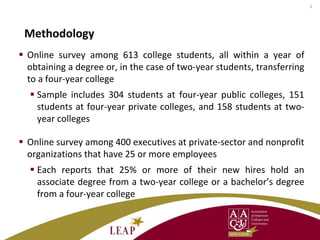
 Online survey among 613 college students, all within a year of
obtaining a degree or, in the case of two-year students, transferring
to a four-year college
 Sample includes 304 students at four-year public colleges, 151
students at four-year private colleges, and 158 students at two-
year colleges
 Online survey among 400 executives at private-sector and nonprofit
organizations that have 25 or more employees
 Each reports that 25% or more of their new hires hold an
associate degree from a two-year college or a bachelor’s degree
from a four-year college
2
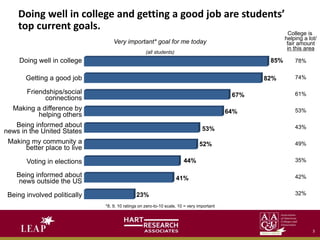
Doing well in college and getting a good job are students’
top current goals.
23%
41%
44%
52%
53%
64%
67%
82%
85%
Very important* goal for me today
(all students)
Doing well in college
Getting a good job
Friendships/social
connections
Making a difference by
helping others
Being informed about
news in the United States
Making my community a
better place to live
Voting in elections
Being informed about
news outside the US
Being involved politically
College is
helping a lot/
fair amount
in this area
78%
74%
61%
53%
43%
49%
35%
42%
32%
3
*8, 9, 10 ratings on zero-to-10 scale, 10 = very important
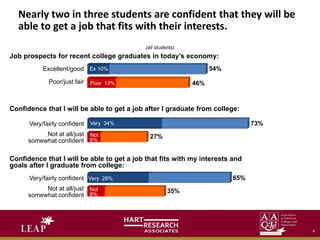
Nearly two in three students are confident that they will be
able to get a job that fits with their interests.
(all students)
Job prospects for recent college graduates in today’s economy:
Confidence that I will be able to get a job after I graduate from college:
Confidence that I will be able to get a job that fits with my interests and
goals after I graduate from college:
Excellent/good
Poor/just fair
Very/fairly confident
Not at all/just
somewhat confident
Ex 10%
Poor 13%
Very 34%
Not
6%
Very 28%
Not
8%
54%
46%
73%
27%
65%
35%
Very/fairly confident
Not at all/just
somewhat confident
4
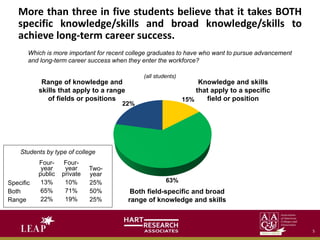
More than three in five students believe that it takes BOTH
specific knowledge/skills and broad knowledge/skills to
achieve long-term career success.
15%
63%
22%
Which is more important for recent college graduates to have who want to pursue advancement
and long-term career success when they enter the workforce?
Knowledge and skills
that apply to a specific
field or position
Range of knowledge and
skills that apply to a range
of fields or positions
Both field-specific and broad
range of knowledge and skills
(all students)
Specific
Both
Range
Four-
year
public
13%
65%
22%
Students by type of college
Four-
year
private
10%
71%
19%
Two-
year
25%
50%
25%
5
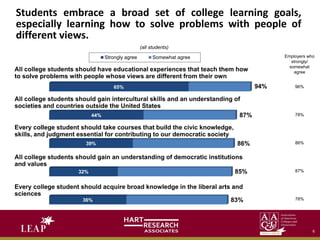
Students embrace a broad set of college learning goals,
especially learning how to solve problems with people of
different views.
36%
32%
39%
44%
65%
Strongly agree Somewhat agree
All college students should have educational experiences that teach them how
to solve problems with people whose views are different from their own
All college students should gain intercultural skills and an understanding of
societies and countries outside the United States
Every college student should take courses that build the civic knowledge,
skills, and judgment essential for contributing to our democratic society
All college students should gain an understanding of democratic institutions
and values
Every college student should acquire broad knowledge in the liberal arts and
sciences
94%
87%
86%
85%
83%
6
Employers who
strongly/
somewhat
agree
96%
78%
86%
87%
78%
(all students)
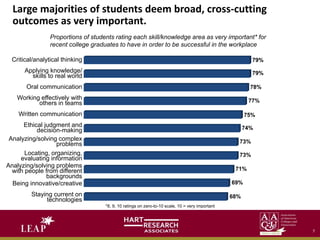
Large majorities of students deem broad, cross-cutting
outcomes as very important.
68%
69%
71%
73%
73%
74%
75%
77%
78%
79%
79%Critical/analytical thinking
Applying knowledge/
skills to real world
Oral communication
Working effectively with
others in teams
Written communication
Ethical judgment and
decision-making
Analyzing/solving complex
problems
Locating, organizing,
evaluating information
Analyzing/solving problems
with people from different
backgrounds
Being innovative/creative
Staying current on
technologies
Proportions of students rating each skill/knowledge area as very important* for
recent college graduates to have in order to be successful in the workplace
*8, 9, 10 ratings on zero-to-10 scale, 10 = very important
7
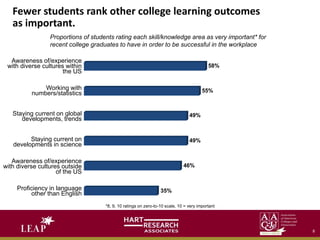
Fewer students rank other college learning outcomes
as important.
35%
46%
49%
49%
55%
58%
Awareness of/experience
with diverse cultures within
the US
Working with
numbers/statistics
Staying current on global
developments, trends
Staying current on
developments in science
Awareness of/experience
with diverse cultures outside
of the US
Proficiency in language
other than English
Proportions of students rating each skill/knowledge area as very important* for
recent college graduates to have in order to be successful in the workplace
*8, 9, 10 ratings on zero-to-10 scale, 10 = very important
8
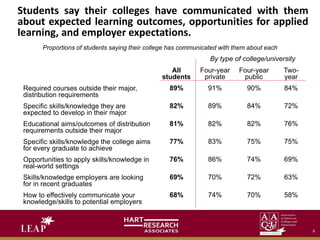
Students say their colleges have communicated with them
about expected learning outcomes, opportunities for applied
learning, and employer expectations.
Proportions of students saying their college has communicated with them about each
Required courses outside their major,
distribution requirements
Specific skills/knowledge they are
expected to develop in their major
Educational aims/outcomes of distribution
requirements outside their major
Specific skills/knowledge the college aims
for every graduate to achieve
Opportunities to apply skills/knowledge in
real-world settings
Skills/knowledge employers are looking
for in recent graduates
How to effectively communicate your
knowledge/skills to potential employers
All
students
89%
82%
81%
77%
76%
69%
68%
Four-year
private
91%
89%
82%
83%
86%
70%
74%
Four-year
public
90%
84%
82%
75%
74%
72%
70%
Two-
year
84%
72%
76%
75%
69%
63%
58%
By type of college/university
9
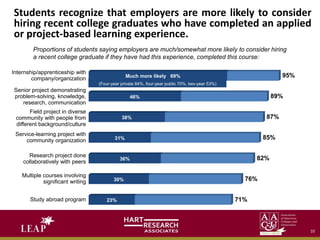
Students recognize that employers are more likely to consider
hiring recent college graduates who have completed an applied
or project-based learning experience.
23%
30%
36%
31%
38%
46%
Proportions of students saying employers are much/somewhat more likely to consider hiring
a recent college graduate if they have had this experience, completed this course:
Internship/apprenticeship with
company/organization
Senior project demonstrating
problem-solving, knowledge,
research, communication
Field project in diverse
community with people from
different background/culture
Service-learning project with
community organization
Research project done
collaboratively with peers
Multiple courses involving
significant writing
Study abroad program
95%
89%
87%
85%
82%
76%
71%
Much more likely 69%
(Four-year private 84%, four-year public 70%, two-year 53%)
10
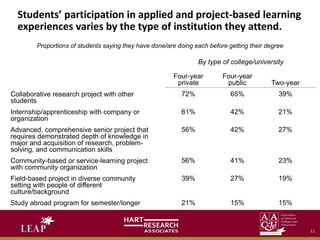
Students’ participation in applied and project-based learning
experiences varies by the type of institution they attend.
Proportions of students saying they have done/are doing each before getting their degree
Collaborative research project with other
students
Internship/apprenticeship with company or
organization
Advanced, comprehensive senior project that
requires demonstrated depth of knowledge in
major and acquisition of research, problem-
solving, and communication skills
Community-based or service-learning project
with community organization
Field-based project in diverse community
setting with people of different
culture/background
Study abroad program for semester/longer
By type of college/university
Four-year
private
72%
61%
56%
56%
39%
21%
Four-year
public
65%
42%
42%
41%
27%
15%
Two-year
39%
21%
27%
23%
19%
15%
11
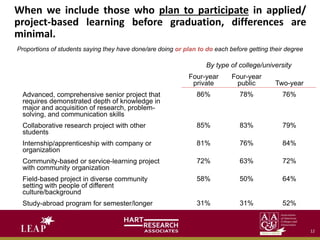
When we include those who plan to participate in applied/
project-based learning before graduation, differences are
minimal.
Proportions of students saying they have done/are doing or plan to do each before getting their degree
Advanced, comprehensive senior project that
requires demonstrated depth of knowledge in
major and acquisition of research, problem-
solving, and communication skills
Collaborative research project with other
students
Internship/apprenticeship with company or
organization
Community-based or service-learning project
with community organization
Field-based project in diverse community
setting with people of different
culture/background
Study-abroad program for semester/longer
By type of college/university
Four-year
private
86%
85%
81%
72%
58%
31%
Four-year
public
78%
83%
76%
63%
50%
31%
Two-year
76%
79%
84%
72%
64%
52%
12
74%
64%
How well is your college/university doing in ensuring that graduates possess the full set of skills and
knowledge that they will need for success in this?
Doing
good job
Improvements
are needed
Major 4%
Moderate
16%
Minor 6%
26%
Doing
good job
Improvements
are needed
36%
Entry-level positions after graduating Advancement/promotion in the workforce
Major 6%
Moderate
20%
Minor 10%
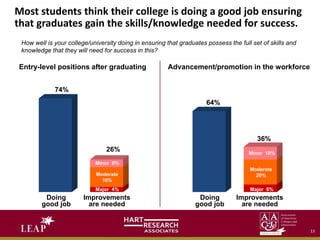
Most students think their college is doing a good job ensuring
that graduates gain the skills/knowledge needed for success.
13
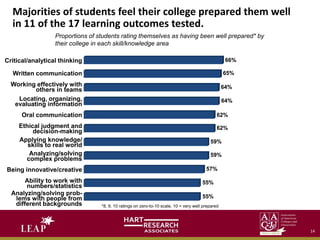
Majorities of students feel their college prepared them well
in 11 of the 17 learning outcomes tested.
55%
55%
57%
59%
59%
62%
62%
64%
64%
65%
66%Critical/analytical thinking
Written communication
Working effectively with
others in teams
Locating, organizing,
evaluating information
Oral communication
Ethical judgment and
decision-making
Applying knowledge/
skills to real world
Analyzing/solving
complex problems
Being innovative/creative
Ability to work with
numbers/statistics
Analyzing/solving prob-
lems with people from
different backgrounds
Proportions of students rating themselves as having been well prepared* by
their college in each skill/knowledge area
*8, 9, 10 ratings on zero-to-10 scale, 10 = very well prepared
14
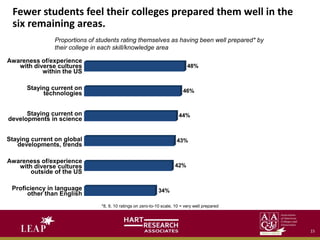
Fewer students feel their colleges prepared them well in the
six remaining areas.
34%
42%
43%
44%
46%
48%
Awareness of/experience
with diverse cultures
within the US
Staying current on
technologies
Staying current on
developments in science
Staying current on global
developments, trends
Awareness of/experience
with diverse cultures
outside of the US
Proficiency in language
other than English
Proportions of students rating themselves as having been well prepared* by
their college in each skill/knowledge area
*8, 9, 10 ratings on zero-to-10 scale, 10 = very well prepared
15
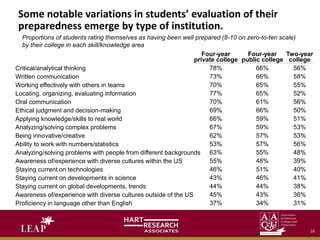
Some notable variations in students’ evaluation of their
preparedness emerge by type of institution.
Critical/analytical thinking
Written communication
Working effectively with others in teams
Locating, organizing, evaluating information
Oral communication
Ethical judgment and decision-making
Applying knowledge/skills to real world
Analyzing/solving complex problems
Being innovative/creative
Ability to work with numbers/statistics
Analyzing/solving problems with people from different backgrounds
Awareness of/experience with diverse cultures within the US
Staying current on technologies
Staying current on developments in science
Staying current on global developments, trends
Awareness of/experience with diverse cultures outside of the US
Proficiency in language other than English
Proportions of students rating themselves as having been well prepared (8-10 on zero-to-ten scale)
by their college in each skill/knowledge area
Four-year
private college
78%
73%
70%
77%
70%
69%
66%
67%
62%
53%
63%
55%
46%
43%
44%
45%
37%
Four-year
public college
66%
66%
65%
65%
61%
66%
59%
59%
57%
57%
55%
48%
51%
46%
44%
43%
34%
Two-year
college
56%
58%
55%
52%
56%
50%
51%
53%
53%
56%
48%
39%
40%
41%
38%
36%
31%
16
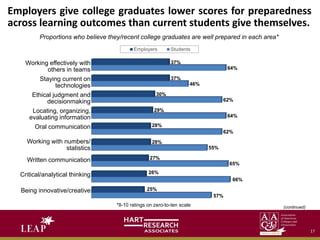
Employers give college graduates lower scores for preparedness
across learning outcomes than current students give themselves.
57%
66%
65%
55%
62%
64%
62%
46%
64%
25%
26%
27%
28%
28%
29%
30%
37%
37%
Employers Students
Proportions who believe they/recent college graduates are well prepared in each area*
*8-10 ratings on zero-to-ten scale
Working effectively with
others in teams
Staying current on
technologies
Ethical judgment and
decisionmaking
Locating, organizing,
evaluating information
Oral communication
Working with numbers/
statistics
Written communication
Critical/analytical thinking
Being innovative/creative
(continued)
17
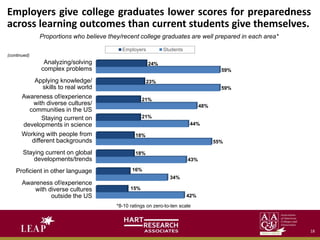
Employers give college graduates lower scores for preparedness
across learning outcomes than current students give themselves.
42%
34%
43%
55%
44%
48%
59%
59%
15%
16%
18%
18%
21%
21%
23%
24%
Employers Students
Proportions who believe they/recent college graduates are well prepared in each area*
(continued)
Analyzing/solving
complex problems
Applying knowledge/
skills to real world
Awareness of/experience
with diverse cultures/
communities in the US
Staying current on
developments in science
Working with people from
different backgrounds
Staying current on global
developments/trends
Proficient in other language
Awareness of/experience
with diverse cultures
outside the US
*8-10 ratings on zero-to-ten scale
18

Optimistic About the Future, But How Well Prepared? College Students' Views on College Learning and Career Success

  • 1.
    Optimistic About theFuture, But How Well Prepared? College Students’ Views on College Learning and Career Success Key findings from survey among 400 employers and 613 college students conducted in November and December 2014 for The Association of American Colleges and Universities by Hart Research Associates
  • 2.
    Methodology  Online surveyamong 613 college students, all within a year of obtaining a degree or, in the case of two-year students, transferring to a four-year college  Sample includes 304 students at four-year public colleges, 151 students at four-year private colleges, and 158 students at two- year colleges  Online survey among 400 executives at private-sector and nonprofit organizations that have 25 or more employees  Each reports that 25% or more of their new hires hold an associate degree from a two-year college or a bachelor’s degree from a four-year college 2
  • 3.
    Doing well incollege and getting a good job are students’ top current goals. 23% 41% 44% 52% 53% 64% 67% 82% 85% Very important* goal for me today (all students) Doing well in college Getting a good job Friendships/social connections Making a difference by helping others Being informed about news in the United States Making my community a better place to live Voting in elections Being informed about news outside the US Being involved politically College is helping a lot/ fair amount in this area 78% 74% 61% 53% 43% 49% 35% 42% 32% 3 *8, 9, 10 ratings on zero-to-10 scale, 10 = very important
  • 4.
    Nearly two inthree students are confident that they will be able to get a job that fits with their interests. (all students) Job prospects for recent college graduates in today’s economy: Confidence that I will be able to get a job after I graduate from college: Confidence that I will be able to get a job that fits with my interests and goals after I graduate from college: Excellent/good Poor/just fair Very/fairly confident Not at all/just somewhat confident Ex 10% Poor 13% Very 34% Not 6% Very 28% Not 8% 54% 46% 73% 27% 65% 35% Very/fairly confident Not at all/just somewhat confident 4
  • 5.
    More than threein five students believe that it takes BOTH specific knowledge/skills and broad knowledge/skills to achieve long-term career success. 15% 63% 22% Which is more important for recent college graduates to have who want to pursue advancement and long-term career success when they enter the workforce? Knowledge and skills that apply to a specific field or position Range of knowledge and skills that apply to a range of fields or positions Both field-specific and broad range of knowledge and skills (all students) Specific Both Range Four- year public 13% 65% 22% Students by type of college Four- year private 10% 71% 19% Two- year 25% 50% 25% 5
  • 6.
    Students embrace abroad set of college learning goals, especially learning how to solve problems with people of different views. 36% 32% 39% 44% 65% Strongly agree Somewhat agree All college students should have educational experiences that teach them how to solve problems with people whose views are different from their own All college students should gain intercultural skills and an understanding of societies and countries outside the United States Every college student should take courses that build the civic knowledge, skills, and judgment essential for contributing to our democratic society All college students should gain an understanding of democratic institutions and values Every college student should acquire broad knowledge in the liberal arts and sciences 94% 87% 86% 85% 83% 6 Employers who strongly/ somewhat agree 96% 78% 86% 87% 78% (all students)
  • 7.
    Large majorities ofstudents deem broad, cross-cutting outcomes as very important. 68% 69% 71% 73% 73% 74% 75% 77% 78% 79% 79%Critical/analytical thinking Applying knowledge/ skills to real world Oral communication Working effectively with others in teams Written communication Ethical judgment and decision-making Analyzing/solving complex problems Locating, organizing, evaluating information Analyzing/solving problems with people from different backgrounds Being innovative/creative Staying current on technologies Proportions of students rating each skill/knowledge area as very important* for recent college graduates to have in order to be successful in the workplace *8, 9, 10 ratings on zero-to-10 scale, 10 = very important 7
  • 8.
    Fewer students rankother college learning outcomes as important. 35% 46% 49% 49% 55% 58% Awareness of/experience with diverse cultures within the US Working with numbers/statistics Staying current on global developments, trends Staying current on developments in science Awareness of/experience with diverse cultures outside of the US Proficiency in language other than English Proportions of students rating each skill/knowledge area as very important* for recent college graduates to have in order to be successful in the workplace *8, 9, 10 ratings on zero-to-10 scale, 10 = very important 8
  • 9.
    Students say theircolleges have communicated with them about expected learning outcomes, opportunities for applied learning, and employer expectations. Proportions of students saying their college has communicated with them about each Required courses outside their major, distribution requirements Specific skills/knowledge they are expected to develop in their major Educational aims/outcomes of distribution requirements outside their major Specific skills/knowledge the college aims for every graduate to achieve Opportunities to apply skills/knowledge in real-world settings Skills/knowledge employers are looking for in recent graduates How to effectively communicate your knowledge/skills to potential employers All students 89% 82% 81% 77% 76% 69% 68% Four-year private 91% 89% 82% 83% 86% 70% 74% Four-year public 90% 84% 82% 75% 74% 72% 70% Two- year 84% 72% 76% 75% 69% 63% 58% By type of college/university 9
  • 10.
    Students recognize thatemployers are more likely to consider hiring recent college graduates who have completed an applied or project-based learning experience. 23% 30% 36% 31% 38% 46% Proportions of students saying employers are much/somewhat more likely to consider hiring a recent college graduate if they have had this experience, completed this course: Internship/apprenticeship with company/organization Senior project demonstrating problem-solving, knowledge, research, communication Field project in diverse community with people from different background/culture Service-learning project with community organization Research project done collaboratively with peers Multiple courses involving significant writing Study abroad program 95% 89% 87% 85% 82% 76% 71% Much more likely 69% (Four-year private 84%, four-year public 70%, two-year 53%) 10
  • 11.
    Students’ participation inapplied and project-based learning experiences varies by the type of institution they attend. Proportions of students saying they have done/are doing each before getting their degree Collaborative research project with other students Internship/apprenticeship with company or organization Advanced, comprehensive senior project that requires demonstrated depth of knowledge in major and acquisition of research, problem- solving, and communication skills Community-based or service-learning project with community organization Field-based project in diverse community setting with people of different culture/background Study abroad program for semester/longer By type of college/university Four-year private 72% 61% 56% 56% 39% 21% Four-year public 65% 42% 42% 41% 27% 15% Two-year 39% 21% 27% 23% 19% 15% 11
  • 12.
    When we includethose who plan to participate in applied/ project-based learning before graduation, differences are minimal. Proportions of students saying they have done/are doing or plan to do each before getting their degree Advanced, comprehensive senior project that requires demonstrated depth of knowledge in major and acquisition of research, problem- solving, and communication skills Collaborative research project with other students Internship/apprenticeship with company or organization Community-based or service-learning project with community organization Field-based project in diverse community setting with people of different culture/background Study-abroad program for semester/longer By type of college/university Four-year private 86% 85% 81% 72% 58% 31% Four-year public 78% 83% 76% 63% 50% 31% Two-year 76% 79% 84% 72% 64% 52% 12
  • 13.
    74% 64% How well isyour college/university doing in ensuring that graduates possess the full set of skills and knowledge that they will need for success in this? Doing good job Improvements are needed Major 4% Moderate 16% Minor 6% 26% Doing good job Improvements are needed 36% Entry-level positions after graduating Advancement/promotion in the workforce Major 6% Moderate 20% Minor 10% Most students think their college is doing a good job ensuring that graduates gain the skills/knowledge needed for success. 13
  • 14.
    Majorities of studentsfeel their college prepared them well in 11 of the 17 learning outcomes tested. 55% 55% 57% 59% 59% 62% 62% 64% 64% 65% 66%Critical/analytical thinking Written communication Working effectively with others in teams Locating, organizing, evaluating information Oral communication Ethical judgment and decision-making Applying knowledge/ skills to real world Analyzing/solving complex problems Being innovative/creative Ability to work with numbers/statistics Analyzing/solving prob- lems with people from different backgrounds Proportions of students rating themselves as having been well prepared* by their college in each skill/knowledge area *8, 9, 10 ratings on zero-to-10 scale, 10 = very well prepared 14
  • 15.
    Fewer students feeltheir colleges prepared them well in the six remaining areas. 34% 42% 43% 44% 46% 48% Awareness of/experience with diverse cultures within the US Staying current on technologies Staying current on developments in science Staying current on global developments, trends Awareness of/experience with diverse cultures outside of the US Proficiency in language other than English Proportions of students rating themselves as having been well prepared* by their college in each skill/knowledge area *8, 9, 10 ratings on zero-to-10 scale, 10 = very well prepared 15
  • 16.
    Some notable variationsin students’ evaluation of their preparedness emerge by type of institution. Critical/analytical thinking Written communication Working effectively with others in teams Locating, organizing, evaluating information Oral communication Ethical judgment and decision-making Applying knowledge/skills to real world Analyzing/solving complex problems Being innovative/creative Ability to work with numbers/statistics Analyzing/solving problems with people from different backgrounds Awareness of/experience with diverse cultures within the US Staying current on technologies Staying current on developments in science Staying current on global developments, trends Awareness of/experience with diverse cultures outside of the US Proficiency in language other than English Proportions of students rating themselves as having been well prepared (8-10 on zero-to-ten scale) by their college in each skill/knowledge area Four-year private college 78% 73% 70% 77% 70% 69% 66% 67% 62% 53% 63% 55% 46% 43% 44% 45% 37% Four-year public college 66% 66% 65% 65% 61% 66% 59% 59% 57% 57% 55% 48% 51% 46% 44% 43% 34% Two-year college 56% 58% 55% 52% 56% 50% 51% 53% 53% 56% 48% 39% 40% 41% 38% 36% 31% 16
  • 17.
    Employers give collegegraduates lower scores for preparedness across learning outcomes than current students give themselves. 57% 66% 65% 55% 62% 64% 62% 46% 64% 25% 26% 27% 28% 28% 29% 30% 37% 37% Employers Students Proportions who believe they/recent college graduates are well prepared in each area* *8-10 ratings on zero-to-ten scale Working effectively with others in teams Staying current on technologies Ethical judgment and decisionmaking Locating, organizing, evaluating information Oral communication Working with numbers/ statistics Written communication Critical/analytical thinking Being innovative/creative (continued) 17
  • 18.
    Employers give collegegraduates lower scores for preparedness across learning outcomes than current students give themselves. 42% 34% 43% 55% 44% 48% 59% 59% 15% 16% 18% 18% 21% 21% 23% 24% Employers Students Proportions who believe they/recent college graduates are well prepared in each area* (continued) Analyzing/solving complex problems Applying knowledge/ skills to real world Awareness of/experience with diverse cultures/ communities in the US Staying current on developments in science Working with people from different backgrounds Staying current on global developments/trends Proficient in other language Awareness of/experience with diverse cultures outside the US *8-10 ratings on zero-to-ten scale 18

Editor's Notes