APPROACH TO ACHILD WITH PERSISTERN
DIARRHEA
Presenter
Muhwezi Chris Badiga
outline
• Introduction
• Pathophysiology of diarrhea
• Causes of persistent diarrhea
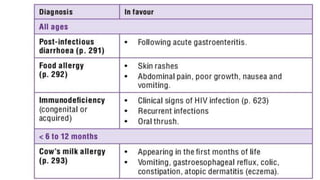
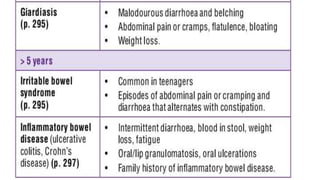
• DDX
• Classification
• Severe persistent diarrhea
• Non severe persistent diarrhea
• Management of causes
• Follow up
Introduction;
• Persistent diarrhea is diarrhea that presents with or without blood,
begins acutely and lasts for 14 days and more.
Pathophysiology
• The absorption and secretion of water and electrolytes throughout the gastrointestinal
tract is a finely balanced, dynamic process and, when there is loss of this balance
caused either by decreased absorption or increased secretion, diarrhea results.
• Diarrhea remains a major cause of morbidity and mortality worldwide, accounting for 3
million deaths per year in young children.
Diarrhea can be considered to be either osmotic or secretory.
• Osmotic diarrhea occurs when excessive osmotically active particles are present in the
lumen, resulting in more fluid passively moving into the bowel lumen down the osmotic
gradient.
• Secretory diarrhea occurs when the bowel mucosa secretes excessive amounts of fluid
into the gut lumen, either due to activation of a pathway by a toxin, or due to inherent
abnormalities in the enterocytes.
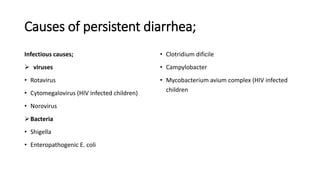
Causes of persistent diarrhea;
Infectious causes;
 viruses
• Rotavirus
• Cytomegalovirus (HIV infected children)
• Norovirus
Bacteria
• Shigella
• Enteropathogenic E. coli
• Clotridium dificile
• Campylobacter
• Mycobacterium avium complex (HIV infected
children
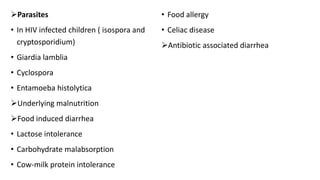
Parasites
• In HIV infected children ( isospora and
cryptosporidium)
• Giardia lamblia
• Cyclospora
• Entamoeba histolytica
Underlying malnutrition
Food induced diarrhea
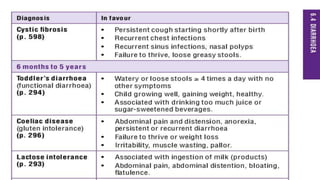
• Lactose intolerance
• Carbohydrate malabsorption
• Cow-milk protein intolerance
• Food allergy
• Celiac disease
Antibiotic associated diarrhea
Classification;
• Persistent diarrhea is classified depending association of the
condition with dehydration ;
A. Severe persistent diarrhea
B. Non-severe persistent diarrhea
A; severe persistent diarrhea
• This involves infants or children with diarrhea lasting 14 days or more
with signs of dehydration
• They require hospital treatment
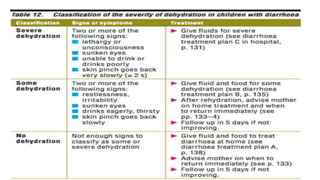
• Assess the child for signs of dehydration
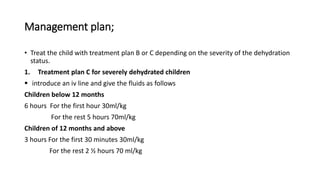
Management plan;
• Treat the child with treatment plan B or C depending on the severity of the dehydration
status.
1. Treatment plan C for severely dehydrated children
 introduce an iv line and give the fluids as follows
Children below 12 months
6 hours For the first hour 30ml/kg
For the rest 5 hours 70ml/kg
Children of 12 months and above
3 hours For the first 30 minutes 30ml/kg
For the rest 2 ½ hours 70 ml/kg
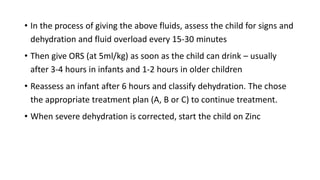
• In the process of giving the above fluids, assess the child for signs and
dehydration and fluid overload every 15-30 minutes
• Then give ORS (at 5ml/kg) as soon as the child can drink – usually
after 3-4 hours in infants and 1-2 hours in older children
• Reassess an infant after 6 hours and classify dehydration. The chose
the appropriate treatment plan (A, B or C) to continue treatment.
• When severe dehydration is corrected, start the child on Zinc
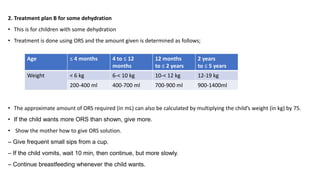
2. Treatment plan B for some dehydration
• This is for children with some dehydration
• Treatment is done using ORS and the amount given is determined as follows;
• The approximate amount of ORS required (in mL) can also be calculated by multiplying the child’s weight (in kg) by 75.
• If the child wants more ORS than shown, give more.
• Show the mother how to give ORS solution.
– Give frequent small sips from a cup.
– If the child vomits, wait 10 min, then continue, but more slowly.
– Continue breastfeeding whenever the child wants.
Age ≤ 4 months 4 to ≤ 12
months
12 months
to ≤ 2 years
2 years
to ≤ 5 years
Weight < 6 kg 6-< 10 kg 10-< 12 kg 12-19 kg
200-400 ml 400-700 ml 700-900 ml 900-1400ml
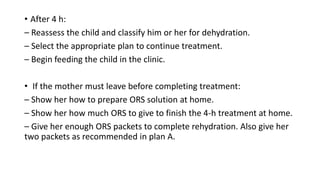
• After 4 h:
– Reassess the child and classify him or her for dehydration.
– Select the appropriate plan to continue treatment.
– Begin feeding the child in the clinic.
• If the mother must leave before completing treatment:
– Show her how to prepare ORS solution at home.
– Show her how much ORS to give to finish the 4-h treatment at home.
– Give her enough ORS packets to complete rehydration. Also give her
two packets as recommended in plan A.
Explain the four rules of home treatment:
• Give extra fluid.
• 2. Give zinc supplements.
• 3. Continue feeding.
• 4. Know when to return to the clinic
• Supplementary multivitamins and minerals
• Give all children with persistent diarrhea daily supplementary multivitamins and minerals for 2
weeks.
• These should provide as broad a range of vitamins and minerals as possible, including at least two
recommended daily allowances of folate, vitamin A, zinc, magnesium and copper.
• As a guide, one recommended daily allowance for a child aged 1 year is:
folate, 50 μg
zinc, 10 mg
vitamin A, 400 μg
iron, 10 mg
copper, 1 mg
magnesium, 80 mg
B; Non severe persistent diarrhea
• Children with non-severe persistent diarrhea do not require hospital
treatment
• but need special feeding and extra fluids at home.
• Children with diarrhea lasting 14 days or more but with no signs of
dehydration or severe malnutrition
Treatment plan
• Management involve using treatment plan A, the childe is treated as
an out patient
• Supplementary multivitamins and minerals are given as above.
Treatment plan A
• Counsel the mother on the four rules of home treatment: give extra
fluid. Give zinc supplements. Continue feeding. Know when to return
to the clinic.
1. Give as much extra fluid as the child will take.
• Tell the mother to:
– Breastfeed frequently and for longer at each feed.
– If the child is exclusively breastfed, give ORS or clean water in
addition to breast milk
– If the child is not exclusively breastfed, give one or more of the
following: ORS solution, food-based fluids (such as soup, rice water and
yoghurt drinks) or clean water.
• It is especially important to give ORS at home when:
– the child has been treated according to plan B or plan C during this
visit.
– the child cannot return to a clinic if the diarrhea gets worse.
• Teach the mother how to mix and give ORS. Give the mother two
packets of ORS to use at home.
• Show the mother how much fluid to give in addition to the usual
fluid intake:
≤ 2 years: 50–100 ml after each loose stool
≥ 2 years: 100–200 ml after each loose stool
• Tell the mother to:
– Give frequent small sips from a cup.
– If the child vomits, wait 10 min. Then continue, but more slowly.
– Continue giving extra fluid until the diarrhea stops.
• 2. Give zinc supplements.
• Tell the mother how much zinc to give:
≤ 6 months: half tablet (10 mg) per day for 10–14 days
≥ 6 months: one tablet (20 mg) per day for 10–14 days
• Show the mother how to give zinc supplement:
– For infants, dissolve the tablet in a small amount of clean water,
expressed
milk or ORS in a small cup or spoon.
– Older children can chew the tablet or drink it dissolved in a small
amount of clean water in a cup or spoon.
• Remind the mother to give the zinc supplement for the full 10–14
days.
• 3. Continue feeding.
• 4. Know when to return to the clinic.
Manage the cause of the persistent diarrhea as follows
• Examine every child with persistent diarrhea for non-intestinal infections such as pneumonia,
sepsis, urinary tract infection, oral thrush and otitis media, and treat appropriately
• Treat persistent diarrhea with blood in the stools with an oral antibiotic effective for Shigella.
• Give oral metronidazole at 10 mg/kg three times a day for 5 days only if:
– microscopic examination of fresh faeces reveals trophozoites of Entamoeba histolytica within red
blood cells; or
– trophozoites or cysts of giardia are seen in the faeces, or
– two different antibiotics that are usually effective for Shigella locally have been given without
clinical improvement.
– if stool examination is not possible, when diarrhea persists for > 1 month.
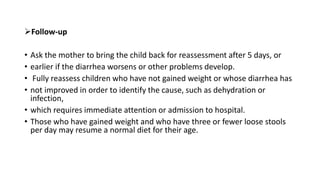
Follow-up
• Ask the mother to bring the child back for reassessment after 5 days, or
• earlier if the diarrhea worsens or other problems develop.
• Fully reassess children who have not gained weight or whose diarrhea has
• not improved in order to identify the cause, such as dehydration or
infection,
• which requires immediate attention or admission to hospital.
• Those who have gained weight and who have three or fewer loose stools
per day may resume a normal diet for their age.
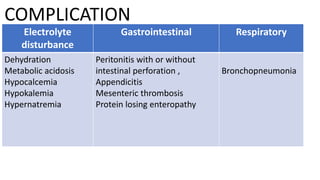
COMPLICATION
Electrolyte
disturbance
Gastrointestinal Respiratory
Dehydration
Metabolic acidosis
Hypocalcemia
Hypokalemia
Hypernatremia
Peritonitis with or without
intestinal perforation ,
Appendicitis
Mesenteric thrombosis
Protein losing enteropathy
Bronchopneumonia
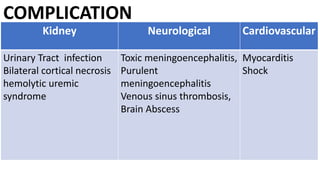
COMPLICATION
Kidney Neurological Cardiovascular
Urinary Tract infection
Bilateral cortical necrosis
hemolytic uremic
syndrome
Toxic meningoencephalitis,
Purulent
meningoencephalitis
Venous sinus thrombosis,
Brain Abscess
Myocarditis
Shock
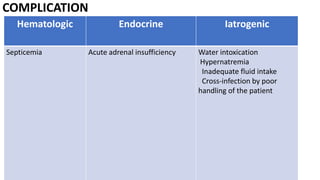
COMPLICATION
Hematologic Endocrine Iatrogenic
Septicemia Acute adrenal insufficiency Water intoxication
Hypernatremia
Inadequate fluid intake
Cross-infection by poor
handling of the patient
References
• WHO pocket hand book for paediatrics and Adolescents
• Medscape, 2021

PERSISTENT DIARRHEA.pptx

  • 1.
    APPROACH TO ACHILDWITH PERSISTERN DIARRHEA Presenter Muhwezi Chris Badiga
  • 2.
    outline • Introduction • Pathophysiologyof diarrhea • Causes of persistent diarrhea • DDX • Classification • Severe persistent diarrhea • Non severe persistent diarrhea • Management of causes • Follow up
  • 3.
    Introduction; • Persistent diarrheais diarrhea that presents with or without blood, begins acutely and lasts for 14 days and more.
  • 4.
    Pathophysiology • The absorptionand secretion of water and electrolytes throughout the gastrointestinal tract is a finely balanced, dynamic process and, when there is loss of this balance caused either by decreased absorption or increased secretion, diarrhea results. • Diarrhea remains a major cause of morbidity and mortality worldwide, accounting for 3 million deaths per year in young children. Diarrhea can be considered to be either osmotic or secretory. • Osmotic diarrhea occurs when excessive osmotically active particles are present in the lumen, resulting in more fluid passively moving into the bowel lumen down the osmotic gradient. • Secretory diarrhea occurs when the bowel mucosa secretes excessive amounts of fluid into the gut lumen, either due to activation of a pathway by a toxin, or due to inherent abnormalities in the enterocytes.
  • 5.
    Causes of persistentdiarrhea; Infectious causes;  viruses • Rotavirus • Cytomegalovirus (HIV infected children) • Norovirus Bacteria • Shigella • Enteropathogenic E. coli • Clotridium dificile • Campylobacter • Mycobacterium avium complex (HIV infected children
  • 6.
    Parasites • In HIVinfected children ( isospora and cryptosporidium) • Giardia lamblia • Cyclospora • Entamoeba histolytica Underlying malnutrition Food induced diarrhea • Lactose intolerance • Carbohydrate malabsorption • Cow-milk protein intolerance • Food allergy • Celiac disease Antibiotic associated diarrhea
  • 10.
    Classification; • Persistent diarrheais classified depending association of the condition with dehydration ; A. Severe persistent diarrhea B. Non-severe persistent diarrhea
  • 11.
    A; severe persistentdiarrhea • This involves infants or children with diarrhea lasting 14 days or more with signs of dehydration • They require hospital treatment • Assess the child for signs of dehydration
  • 13.
    Management plan; • Treatthe child with treatment plan B or C depending on the severity of the dehydration status. 1. Treatment plan C for severely dehydrated children  introduce an iv line and give the fluids as follows Children below 12 months 6 hours For the first hour 30ml/kg For the rest 5 hours 70ml/kg Children of 12 months and above 3 hours For the first 30 minutes 30ml/kg For the rest 2 ½ hours 70 ml/kg
  • 14.
    • In theprocess of giving the above fluids, assess the child for signs and dehydration and fluid overload every 15-30 minutes • Then give ORS (at 5ml/kg) as soon as the child can drink – usually after 3-4 hours in infants and 1-2 hours in older children • Reassess an infant after 6 hours and classify dehydration. The chose the appropriate treatment plan (A, B or C) to continue treatment. • When severe dehydration is corrected, start the child on Zinc
  • 15.
    2. Treatment planB for some dehydration • This is for children with some dehydration • Treatment is done using ORS and the amount given is determined as follows; • The approximate amount of ORS required (in mL) can also be calculated by multiplying the child’s weight (in kg) by 75. • If the child wants more ORS than shown, give more. • Show the mother how to give ORS solution. – Give frequent small sips from a cup. – If the child vomits, wait 10 min, then continue, but more slowly. – Continue breastfeeding whenever the child wants. Age ≤ 4 months 4 to ≤ 12 months 12 months to ≤ 2 years 2 years to ≤ 5 years Weight < 6 kg 6-< 10 kg 10-< 12 kg 12-19 kg 200-400 ml 400-700 ml 700-900 ml 900-1400ml
  • 16.
    • After 4h: – Reassess the child and classify him or her for dehydration. – Select the appropriate plan to continue treatment. – Begin feeding the child in the clinic. • If the mother must leave before completing treatment: – Show her how to prepare ORS solution at home. – Show her how much ORS to give to finish the 4-h treatment at home. – Give her enough ORS packets to complete rehydration. Also give her two packets as recommended in plan A.
  • 17.
    Explain the fourrules of home treatment: • Give extra fluid. • 2. Give zinc supplements. • 3. Continue feeding. • 4. Know when to return to the clinic
  • 18.
    • Supplementary multivitaminsand minerals • Give all children with persistent diarrhea daily supplementary multivitamins and minerals for 2 weeks. • These should provide as broad a range of vitamins and minerals as possible, including at least two recommended daily allowances of folate, vitamin A, zinc, magnesium and copper. • As a guide, one recommended daily allowance for a child aged 1 year is: folate, 50 μg zinc, 10 mg vitamin A, 400 μg iron, 10 mg copper, 1 mg magnesium, 80 mg
  • 19.
    B; Non severepersistent diarrhea • Children with non-severe persistent diarrhea do not require hospital treatment • but need special feeding and extra fluids at home. • Children with diarrhea lasting 14 days or more but with no signs of dehydration or severe malnutrition
  • 20.
    Treatment plan • Managementinvolve using treatment plan A, the childe is treated as an out patient • Supplementary multivitamins and minerals are given as above. Treatment plan A • Counsel the mother on the four rules of home treatment: give extra fluid. Give zinc supplements. Continue feeding. Know when to return to the clinic.
  • 21.
    1. Give asmuch extra fluid as the child will take. • Tell the mother to: – Breastfeed frequently and for longer at each feed. – If the child is exclusively breastfed, give ORS or clean water in addition to breast milk – If the child is not exclusively breastfed, give one or more of the following: ORS solution, food-based fluids (such as soup, rice water and yoghurt drinks) or clean water.
  • 22.
    • It isespecially important to give ORS at home when: – the child has been treated according to plan B or plan C during this visit. – the child cannot return to a clinic if the diarrhea gets worse. • Teach the mother how to mix and give ORS. Give the mother two packets of ORS to use at home. • Show the mother how much fluid to give in addition to the usual fluid intake: ≤ 2 years: 50–100 ml after each loose stool ≥ 2 years: 100–200 ml after each loose stool
  • 23.
    • Tell themother to: – Give frequent small sips from a cup. – If the child vomits, wait 10 min. Then continue, but more slowly. – Continue giving extra fluid until the diarrhea stops. • 2. Give zinc supplements. • Tell the mother how much zinc to give: ≤ 6 months: half tablet (10 mg) per day for 10–14 days ≥ 6 months: one tablet (20 mg) per day for 10–14 days
  • 24.
    • Show themother how to give zinc supplement: – For infants, dissolve the tablet in a small amount of clean water, expressed milk or ORS in a small cup or spoon. – Older children can chew the tablet or drink it dissolved in a small amount of clean water in a cup or spoon. • Remind the mother to give the zinc supplement for the full 10–14 days. • 3. Continue feeding. • 4. Know when to return to the clinic.
  • 25.
    Manage the causeof the persistent diarrhea as follows • Examine every child with persistent diarrhea for non-intestinal infections such as pneumonia, sepsis, urinary tract infection, oral thrush and otitis media, and treat appropriately • Treat persistent diarrhea with blood in the stools with an oral antibiotic effective for Shigella. • Give oral metronidazole at 10 mg/kg three times a day for 5 days only if: – microscopic examination of fresh faeces reveals trophozoites of Entamoeba histolytica within red blood cells; or – trophozoites or cysts of giardia are seen in the faeces, or – two different antibiotics that are usually effective for Shigella locally have been given without clinical improvement. – if stool examination is not possible, when diarrhea persists for > 1 month.
  • 26.
    Follow-up • Ask themother to bring the child back for reassessment after 5 days, or • earlier if the diarrhea worsens or other problems develop. • Fully reassess children who have not gained weight or whose diarrhea has • not improved in order to identify the cause, such as dehydration or infection, • which requires immediate attention or admission to hospital. • Those who have gained weight and who have three or fewer loose stools per day may resume a normal diet for their age.
  • 27.
    COMPLICATION Electrolyte disturbance Gastrointestinal Respiratory Dehydration Metabolic acidosis Hypocalcemia Hypokalemia Hypernatremia Peritonitiswith or without intestinal perforation , Appendicitis Mesenteric thrombosis Protein losing enteropathy Bronchopneumonia
  • 28.
    COMPLICATION Kidney Neurological Cardiovascular UrinaryTract infection Bilateral cortical necrosis hemolytic uremic syndrome Toxic meningoencephalitis, Purulent meningoencephalitis Venous sinus thrombosis, Brain Abscess Myocarditis Shock
  • 29.
    COMPLICATION Hematologic Endocrine Iatrogenic SepticemiaAcute adrenal insufficiency Water intoxication Hypernatremia Inadequate fluid intake Cross-infection by poor handling of the patient
  • 30.
    References • WHO pockethand book for paediatrics and Adolescents • Medscape, 2021