ACUTE DIARRHOEAL DISEASE
DEFINITION; Passage of three or more loose/watery stool or one voluminous
loose/watery stool per day. excessive daily stool liquid volume ( >10ml stool/body
weigt)
WHAT DIARHOEA IS NOT ;( REASSURE )
Frequent formed stools
pasty stools in breastfed child
stools during or after feeding
CLASSIFICATION OF DIARRHOEAL DISEASES
RISK FACTORS
1. Young age group
2. immune deficient individuals
3. measles
4. malnutrition
5. travel to endemic areas
6. lack of breast feeding
7. exposure to unsanitory conditions
8. attendance to child care centers poor maternal education
CLASIFICATION
1. ACCORDING TO PATHOGENS/ AETIOLOGY
2. ACCORDING TO DURATION
3. ACCORDING TO MECHANISM OF DIARHEA
4. ACCORDING TO CLINICAL TYPES OF DIARHEA
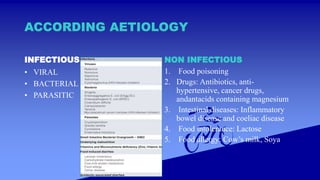
ACCORDING AETIOLOGY
INFECTIOUS
• VIRAL
• BACTERIAL
• PARASITIC
NON INFECTIOUS
1. Food poisoning
2. Drugs: Antibiotics, anti-
hypertensive, cancer drugs,
andantacids containing magnesium
3. Intestinal diseases: Inflammatory
bowel disease and coeliac disease
4. Food intolerance: Lactose
5. Food allergy: Cow’s milk, Soya
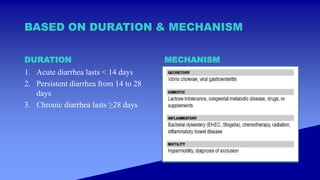
BASED ON DURATION & MECHANISM
DURATION
1. Acute diarrhea lasts < 14 days
2. Persistent diarrhea from 14 to 28
days
3. Chronic diarrhea lasts ≥28 days
MECHANISM
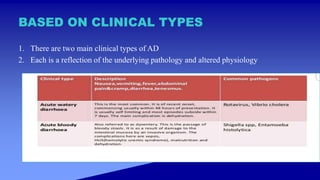
BASED ON CLINICAL TYPES
1. There are two main clinical types of AD
2. Each is a reflection of the underlying pathology and altered physiology
CLINICAL FEATURES & EVALUATION
CLINICAL FEATURES
1. Watery or loose stools ± bloody
stools
2. Abdominal cramps
3. Tenesmus
4. Urgency
5. Abdominal pain
6. May be associated with vomiting
and fever, poor appetite
7. Dehydration
ASSESMENT
• Divided into four components to
guide clinical management:
1. Classification of the type of
diarrhoeal illness
2. Assessment of hydration status
3. Assessment of nutritional status
4. Assessment of co-morbid conditions
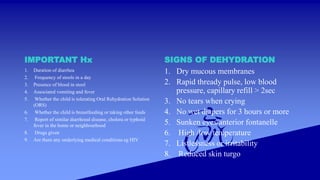
IMPORTANT Hx
1. Duration of diarrhea
2. Frequency of stools in a day
3. Presence of blood in stool
4. Associated vomiting and fever
5. Whether the child is tolerating Oral Rehydration Solution
(ORS)
6. Whether the child is breastfeeding or taking other feeds
7. Report of similar diarrhoeal disease, cholera or typhoid
fever in the home or neighbourhood
8. Drugs given
9. Are there any underlying medical conditions eg HIV
SIGNS OF DEHYDRATION
1. Dry mucous membranes
2. Rapid thready pulse, low blood
pressure, capillary refill > 2sec
3. No tears when crying
4. No wet diapers for 3 hours or more
5. Sunken eyes/anterior fontanelle
6. High /low temperature
7. Listlessness or irritability
8. Reduced skin turgo
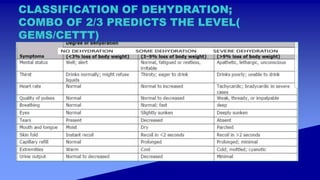
CLASSIFICATION OF DEHYDRATION;
COMBO OF 2/3 PREDICTS THE LEVEL(
GEMS/CETTT)
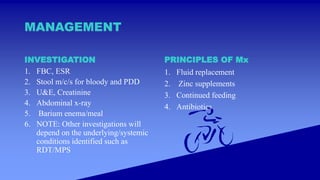
MANAGEMENT
INVESTIGATION
1. FBC, ESR
2. Stool m/c/s for bloody and PDD
3. U&E, Creatinine
4. Abdominal x-ray
5. Barium enema/meal
6. NOTE: Other investigations will
depend on the underlying/systemic
conditions identified such as
RDT/MPS
PRINCIPLES OF Mx
1. Fluid replacement
2. Zinc supplements
3. Continued feeding
4. Antibiotics
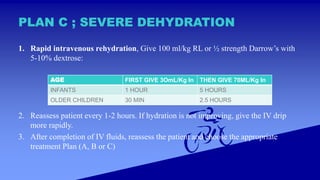
PLAN C ; SEVERE DEHYDRATION
1. Rapid intravenous rehydration, Give 100 ml/kg RL or ½ strength Darrow’s with
5-10% dextrose:
2. Reassess patient every 1-2 hours. If hydration is not improving, give the IV drip
more rapidly.
3. After completion of IV fluids, reassess the patient and choose the appropriate
treatment Plan (A, B or C)
AGE FIRST GIVE 3OmL/Kg In THEN GIVE 70ML/Kg In
INFANTS 1 HOUR 5 HOURS
OLDER CHILDREN 30 MIN 2.5 HOURS
4. Repeat Plan C once if no improvement
5. If IV therapy is not available, then ORS by nasogastric tube or orally at 20
ml/kg/hour for 6 hours (total of 120ml/kg) should be given. If abdomen becomes
distended or the child vomits repeatedly, then ORS should be given more slowly
PLAN B ; SOME DEHYDRATION
1. 75mls of ORS x patient’s weight (kg) to be given in 4 hours
2. After 4 hours, reassess the child and decide what treatment to be given next as per
level of dehydration
3. Children who continue to have some dehydration even after 4 hours should receive
ORS by nasogastric tube or ½ strength Darrow’s intravenously (75 ml/kg in 4
hours).
4. In case of Resistant vomiting despite appropriate oral fluid administration, IV fluids
may be used (Avoid Promethazine (Phenergan), Ondansetron may be used up to two
doses)
5. If abdominal distension occurs, oral rehydration should be withheld and only IV
rehydration should be given.
PLAN A ; NO DEHYDRATION
1. Amount of ORS to be given per loose stool dependent on specific age as listed below;
ZINC SUPLEMENTATION
1. Give zinc supplement for 10 to 14 days
2. Infants below 6months of age 10mg daily
3. Children 6months and above 20mg daily
4. BENEFITS OF ZINC ;
AGE ( years) < 2 years 2-5 OLDER
CHILDREN
ORS(mls) 50 - 100 100 - 200 As much as they
want
BENEFITS & MOA OF ZINC
1. There are several mechanisms of action of zinc in diarrhea, these include:
a) Re-epitheliazation: zinc restores mucosal barrier integrity and enterocyte brush
boarder enzyme activity
b) Promotes the production of antibodies and circulating lymphocytes against intestinal
pathogens
c) Has a direct effect on ion channels acting as a potassium channel blocker of cAMP
mediated chloride secretion
2. Zinc therefore reduces the duration, morbidity and mortality of diarrhea both for the
current episode and next episodes in the next 3 months.
CONTINUED FEEDING
1. Children presenting with diarrhoea should be assessed for malnutrition according to
WHO standards.
2. Children with acute diarrhoea and malnutrition are at increased risk for developing
fluid overload and heart failure during rehydration.
3. The risk of serious bacterial infection is also increased.
4. Such children require an individualized approach to rehydration and nutritional care.
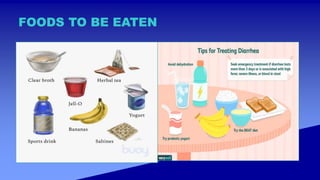
5. Give appropriate feeds. Avoid juices and carbonated drinks.
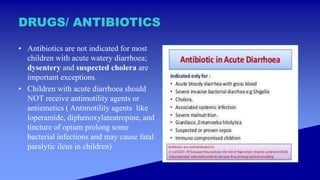
DRUGS/ ANTIBIOTICS
• Antibiotics are not indicated for most
children with acute watery diarrhoea;
dysentery and suspected cholera are
important exceptions.
• Children with acute diarrhoea should
NOT receive antimotility agents or
antiemetics ( Antimotility agents like
loperamide, diphenoxylateatropine, and
tincture of opium prolong some
bacterial infections and may cause fatal
paralytic ileus in children)
FOODS TO BE EATEN
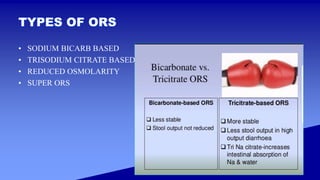
• SODIUM BICARB BASED
• TRISODIUM CITRATE BASED
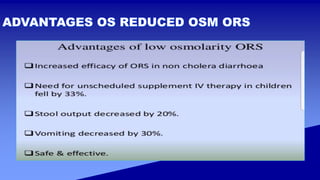
• REDUCED OSMOLARITY
• SUPER ORS
DIARHEAL DISEASES.pptx management everything

DIARHEAL DISEASES.pptx management everything

  • 2.
    ACUTE DIARRHOEAL DISEASE DEFINITION;Passage of three or more loose/watery stool or one voluminous loose/watery stool per day. excessive daily stool liquid volume ( >10ml stool/body weigt) WHAT DIARHOEA IS NOT ;( REASSURE ) Frequent formed stools pasty stools in breastfed child stools during or after feeding CLASSIFICATION OF DIARRHOEAL DISEASES
  • 3.
    RISK FACTORS 1. Youngage group 2. immune deficient individuals 3. measles 4. malnutrition 5. travel to endemic areas 6. lack of breast feeding 7. exposure to unsanitory conditions 8. attendance to child care centers poor maternal education
  • 4.
    CLASIFICATION 1. ACCORDING TOPATHOGENS/ AETIOLOGY 2. ACCORDING TO DURATION 3. ACCORDING TO MECHANISM OF DIARHEA 4. ACCORDING TO CLINICAL TYPES OF DIARHEA
  • 5.
    ACCORDING AETIOLOGY INFECTIOUS • VIRAL •BACTERIAL • PARASITIC NON INFECTIOUS 1. Food poisoning 2. Drugs: Antibiotics, anti- hypertensive, cancer drugs, andantacids containing magnesium 3. Intestinal diseases: Inflammatory bowel disease and coeliac disease 4. Food intolerance: Lactose 5. Food allergy: Cow’s milk, Soya
  • 6.
    BASED ON DURATION& MECHANISM DURATION 1. Acute diarrhea lasts < 14 days 2. Persistent diarrhea from 14 to 28 days 3. Chronic diarrhea lasts ≥28 days MECHANISM
  • 7.
    BASED ON CLINICALTYPES 1. There are two main clinical types of AD 2. Each is a reflection of the underlying pathology and altered physiology
  • 8.
    CLINICAL FEATURES &EVALUATION CLINICAL FEATURES 1. Watery or loose stools ± bloody stools 2. Abdominal cramps 3. Tenesmus 4. Urgency 5. Abdominal pain 6. May be associated with vomiting and fever, poor appetite 7. Dehydration ASSESMENT • Divided into four components to guide clinical management: 1. Classification of the type of diarrhoeal illness 2. Assessment of hydration status 3. Assessment of nutritional status 4. Assessment of co-morbid conditions
  • 9.
    IMPORTANT Hx 1. Durationof diarrhea 2. Frequency of stools in a day 3. Presence of blood in stool 4. Associated vomiting and fever 5. Whether the child is tolerating Oral Rehydration Solution (ORS) 6. Whether the child is breastfeeding or taking other feeds 7. Report of similar diarrhoeal disease, cholera or typhoid fever in the home or neighbourhood 8. Drugs given 9. Are there any underlying medical conditions eg HIV SIGNS OF DEHYDRATION 1. Dry mucous membranes 2. Rapid thready pulse, low blood pressure, capillary refill > 2sec 3. No tears when crying 4. No wet diapers for 3 hours or more 5. Sunken eyes/anterior fontanelle 6. High /low temperature 7. Listlessness or irritability 8. Reduced skin turgo
  • 10.
    CLASSIFICATION OF DEHYDRATION; COMBOOF 2/3 PREDICTS THE LEVEL( GEMS/CETTT)
  • 11.
    MANAGEMENT INVESTIGATION 1. FBC, ESR 2.Stool m/c/s for bloody and PDD 3. U&E, Creatinine 4. Abdominal x-ray 5. Barium enema/meal 6. NOTE: Other investigations will depend on the underlying/systemic conditions identified such as RDT/MPS PRINCIPLES OF Mx 1. Fluid replacement 2. Zinc supplements 3. Continued feeding 4. Antibiotics
  • 12.
    PLAN C ;SEVERE DEHYDRATION 1. Rapid intravenous rehydration, Give 100 ml/kg RL or ½ strength Darrow’s with 5-10% dextrose: 2. Reassess patient every 1-2 hours. If hydration is not improving, give the IV drip more rapidly. 3. After completion of IV fluids, reassess the patient and choose the appropriate treatment Plan (A, B or C) AGE FIRST GIVE 3OmL/Kg In THEN GIVE 70ML/Kg In INFANTS 1 HOUR 5 HOURS OLDER CHILDREN 30 MIN 2.5 HOURS
  • 13.
    4. Repeat PlanC once if no improvement 5. If IV therapy is not available, then ORS by nasogastric tube or orally at 20 ml/kg/hour for 6 hours (total of 120ml/kg) should be given. If abdomen becomes distended or the child vomits repeatedly, then ORS should be given more slowly
  • 14.
    PLAN B ;SOME DEHYDRATION 1. 75mls of ORS x patient’s weight (kg) to be given in 4 hours 2. After 4 hours, reassess the child and decide what treatment to be given next as per level of dehydration 3. Children who continue to have some dehydration even after 4 hours should receive ORS by nasogastric tube or ½ strength Darrow’s intravenously (75 ml/kg in 4 hours). 4. In case of Resistant vomiting despite appropriate oral fluid administration, IV fluids may be used (Avoid Promethazine (Phenergan), Ondansetron may be used up to two doses) 5. If abdominal distension occurs, oral rehydration should be withheld and only IV rehydration should be given.
  • 15.
    PLAN A ;NO DEHYDRATION 1. Amount of ORS to be given per loose stool dependent on specific age as listed below; ZINC SUPLEMENTATION 1. Give zinc supplement for 10 to 14 days 2. Infants below 6months of age 10mg daily 3. Children 6months and above 20mg daily 4. BENEFITS OF ZINC ; AGE ( years) < 2 years 2-5 OLDER CHILDREN ORS(mls) 50 - 100 100 - 200 As much as they want
  • 16.
    BENEFITS & MOAOF ZINC 1. There are several mechanisms of action of zinc in diarrhea, these include: a) Re-epitheliazation: zinc restores mucosal barrier integrity and enterocyte brush boarder enzyme activity b) Promotes the production of antibodies and circulating lymphocytes against intestinal pathogens c) Has a direct effect on ion channels acting as a potassium channel blocker of cAMP mediated chloride secretion 2. Zinc therefore reduces the duration, morbidity and mortality of diarrhea both for the current episode and next episodes in the next 3 months.
  • 17.
    CONTINUED FEEDING 1. Childrenpresenting with diarrhoea should be assessed for malnutrition according to WHO standards. 2. Children with acute diarrhoea and malnutrition are at increased risk for developing fluid overload and heart failure during rehydration. 3. The risk of serious bacterial infection is also increased. 4. Such children require an individualized approach to rehydration and nutritional care. 5. Give appropriate feeds. Avoid juices and carbonated drinks.
  • 18.
    DRUGS/ ANTIBIOTICS • Antibioticsare not indicated for most children with acute watery diarrhoea; dysentery and suspected cholera are important exceptions. • Children with acute diarrhoea should NOT receive antimotility agents or antiemetics ( Antimotility agents like loperamide, diphenoxylateatropine, and tincture of opium prolong some bacterial infections and may cause fatal paralytic ileus in children)
  • 19.
  • 20.
    • SODIUM BICARBBASED • TRISODIUM CITRATE BASED • REDUCED OSMOLARITY • SUPER ORS