YES/NO QUESTION

COMPILED BY :
FIRMANSYAH
AGAM
-Yes/No Questions are questions which
answers are either yes or no.

(Yes - No Questions adalah pertanyaan tanpa kata tanya (Question
Words) pada awal kalimat, yang hanya membutuhkan jawaban
Yes/No.)
Yes/No Question
Yes/No Questions are questions which answers are either yes or no. To
build a yes/no question we need:
To be (is, am, are, was, were)
For example: Is he an actor? Yes, he is.
Was the doctor in? Yes, he was.
Helping verb / auxiliary verb (do, does, did)
For example: Do you know him? No, I don’t.
Did he do this? No, he didn’t.
Modals (can, may, should, must, might, could, will, shall)
For example: Can you help me? Yes, I can.
Should you go now? No, I shouldn’t.






Information Question adalah Pertanyaan yang menanyakan
informasi dengan menggunakan kata tanya. Kata tanya atau
question word disini biasanya berawalan “WH”. Oleh karena
itu, disebagian literatur atau buku referensi, anda akan
menjumpai WH question.
Beberapa Wh question seperti : Who, Where, What, dll.
Contoh kalimat :
A : Where does She work?
B : At Smith Company
Nah, bisa anda perhatikan kalimat “Where does She work?”
merupakan kalimat yang meminta atau menanyakan
informasi tentang dimana dia (perempuan) bekerja. Kalimat
inilah yang dinamakan Information Question.


Biasanya, untuk membentuk atau membuat
suatu kalimat yes no question, mengikuti pola :

Auxiliary

?

+ Subject + Verb

For example : Does He study?
 (untuk contoh:Dia belajar apa?)


For example:Does She write?
 (untuk contoh:Dia menulis apa?)















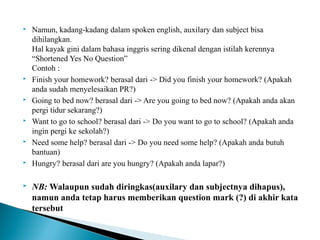
Namun, kadang-kadang dalam spoken english, auxilary dan subject bisa
dihilangkan.
Hal kayak gini dalam bahasa inggris sering dikenal dengan istilah kerennya
“Shortened Yes No Question”
Contoh :
Finish your homework? berasal dari -> Did you finish your homework? (Apakah
anda sudah menyelesaikan PR?)
Going to bed now? berasal dari -> Are you going to bed now? (Apakah anda akan
pergi tidur sekarang?)
Want to go to school? berasal dari -> Do you want to go to school? (Apakah anda
ingin pergi ke sekolah?)
Need some help? berasal dari -> Do you need some help? (Apakah anda butuh
bantuan)
Hungry? berasal dari are you hungry? (Apakah anda lapar?)

NB: Walaupun sudah diringkas(auxilary dan subjectnya dihapus),
namun anda tetap harus memberikan question mark (?) di akhir kata
tersebut












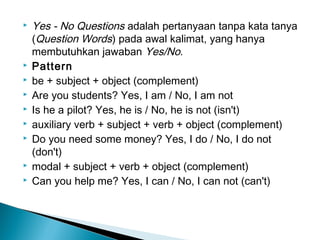
Yes - No Questions adalah pertanyaan tanpa kata tanya
(Question Words) pada awal kalimat, yang hanya
membutuhkan jawaban Yes/No.
Pattern
be + subject + object (complement)
Are you students? Yes, I am / No, I am not
Is he a pilot? Yes, he is / No, he is not (isn't)
auxiliary verb + subject + verb + object (complement)
Do you need some money? Yes, I do / No, I do not
(don't)
modal + subject + verb + object (complement)
Can you help me? Yes, I can / No, I can not (can't) 


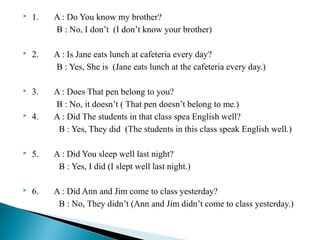
1.

A : Do You know my brother?
B : No, I don’t (I don’t know your brother)



2.

A : Is Jane eats lunch at cafeteria every day?
B : Yes, She is (Jane eats lunch at the cafeteria every day.)



3.



4.

A : Does That pen belong to you?
B : No, it doesn’t ( That pen doesn’t belong to me.)
A : Did The students in that class spea English well?
B : Yes, They did (The students in this class speak English well.)



5.

A : Did You sleep well last night?
B : Yes, I did (I slept well last night.)



6.

A : Did Ann and Jim come to class yesterday?
B : No, They didn’t (Ann and Jim didn’t come to class yesterday.)













7.

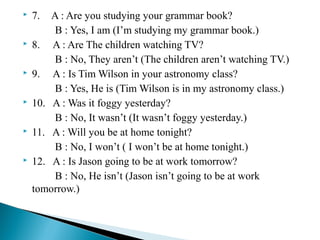
A : Are you studying your grammar book?
B : Yes, I am (I’m studying my grammar book.)
8. A : Are The children watching TV?
B : No, They aren’t (The children aren’t watching TV.)
9. A : Is Tim Wilson in your astronomy class?
B : Yes, He is (Tim Wilson is in my astronomy class.)
10. A : Was it foggy yesterday?
B : No, It wasn’t (It wasn’t foggy yesterday.)
11. A : Will you be at home tonight?
B : No, I won’t ( I won’t be at home tonight.)
12. A : Is Jason going to be at work tomorrow?
B : No, He isn’t (Jason isn’t going to be at work
tomorrow.)
THANK’S FOR
ATTENTION

Persentation yesno question

  • 2.
    YES/NO QUESTION COMPILED BY: FIRMANSYAH AGAM
  • 3.
    -Yes/No Questions arequestions which answers are either yes or no. (Yes - No Questions adalah pertanyaan tanpa kata tanya (Question Words) pada awal kalimat, yang hanya membutuhkan jawaban Yes/No.)
  • 4.
    Yes/No Question Yes/No Questionsare questions which answers are either yes or no. To build a yes/no question we need: To be (is, am, are, was, were) For example: Is he an actor? Yes, he is. Was the doctor in? Yes, he was. Helping verb / auxiliary verb (do, does, did) For example: Do you know him? No, I don’t. Did he do this? No, he didn’t. Modals (can, may, should, must, might, could, will, shall) For example: Can you help me? Yes, I can. Should you go now? No, I shouldn’t.
  • 5.
       Information Question adalahPertanyaan yang menanyakan informasi dengan menggunakan kata tanya. Kata tanya atau question word disini biasanya berawalan “WH”. Oleh karena itu, disebagian literatur atau buku referensi, anda akan menjumpai WH question. Beberapa Wh question seperti : Who, Where, What, dll. Contoh kalimat : A : Where does She work? B : At Smith Company Nah, bisa anda perhatikan kalimat “Where does She work?” merupakan kalimat yang meminta atau menanyakan informasi tentang dimana dia (perempuan) bekerja. Kalimat inilah yang dinamakan Information Question.
  • 6.
     Biasanya, untuk membentukatau membuat suatu kalimat yes no question, mengikuti pola : Auxiliary ? + Subject + Verb For example : Does He study?  (untuk contoh:Dia belajar apa?)  For example:Does She write?  (untuk contoh:Dia menulis apa?) 
  • 7.
           Namun, kadang-kadang dalamspoken english, auxilary dan subject bisa dihilangkan. Hal kayak gini dalam bahasa inggris sering dikenal dengan istilah kerennya “Shortened Yes No Question” Contoh : Finish your homework? berasal dari -> Did you finish your homework? (Apakah anda sudah menyelesaikan PR?) Going to bed now? berasal dari -> Are you going to bed now? (Apakah anda akan pergi tidur sekarang?) Want to go to school? berasal dari -> Do you want to go to school? (Apakah anda ingin pergi ke sekolah?) Need some help? berasal dari -> Do you need some help? (Apakah anda butuh bantuan) Hungry? berasal dari are you hungry? (Apakah anda lapar?) NB: Walaupun sudah diringkas(auxilary dan subjectnya dihapus), namun anda tetap harus memberikan question mark (?) di akhir kata tersebut
  • 8.
             Yes - NoQuestions adalah pertanyaan tanpa kata tanya (Question Words) pada awal kalimat, yang hanya membutuhkan jawaban Yes/No. Pattern be + subject + object (complement) Are you students? Yes, I am / No, I am not Is he a pilot? Yes, he is / No, he is not (isn't) auxiliary verb + subject + verb + object (complement) Do you need some money? Yes, I do / No, I do not (don't) modal + subject + verb + object (complement) Can you help me? Yes, I can / No, I can not (can't) 
  • 9.
     1. A : DoYou know my brother? B : No, I don’t (I don’t know your brother)  2. A : Is Jane eats lunch at cafeteria every day? B : Yes, She is (Jane eats lunch at the cafeteria every day.)  3.  4. A : Does That pen belong to you? B : No, it doesn’t ( That pen doesn’t belong to me.) A : Did The students in that class spea English well? B : Yes, They did (The students in this class speak English well.)  5. A : Did You sleep well last night? B : Yes, I did (I slept well last night.)  6. A : Did Ann and Jim come to class yesterday? B : No, They didn’t (Ann and Jim didn’t come to class yesterday.)
  • 10.
            7. A : Areyou studying your grammar book? B : Yes, I am (I’m studying my grammar book.) 8. A : Are The children watching TV? B : No, They aren’t (The children aren’t watching TV.) 9. A : Is Tim Wilson in your astronomy class? B : Yes, He is (Tim Wilson is in my astronomy class.) 10. A : Was it foggy yesterday? B : No, It wasn’t (It wasn’t foggy yesterday.) 11. A : Will you be at home tonight? B : No, I won’t ( I won’t be at home tonight.) 12. A : Is Jason going to be at work tomorrow? B : No, He isn’t (Jason isn’t going to be at work tomorrow.)
  • 11.