ぶんぽう: レッスン1 
Grammar: Lesson 1
aisatsu 
あいさつ- Greetings
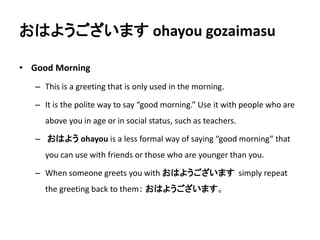
おはようございますohayou gozaimasu 
• Good Morning 
– This is a greeting that is only used in the morning. 
– It is the polite way to say “good morning.” Use it with people who are 
above you in age or in social status, such as teachers. 
– おはようohayou is a less formal way of saying “good morning” that 
you can use with friends or those who are younger than you. 
– When someone greets you with おはようございますsimply repeat 
the greeting back to them: おはようございます。
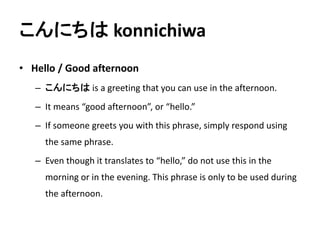
こんにちはkonnichiwa 
• Hello / Good afternoon 
– こんにちはis a greeting that you can use in the afternoon. 
– It means “good afternoon”, or “hello.” 
– If someone greets you with this phrase, simply respond using 
the same phrase. 
– Even though it translates to “hello,” do not use this in the 
morning or in the evening. This phrase is only to be used during 
the afternoon.
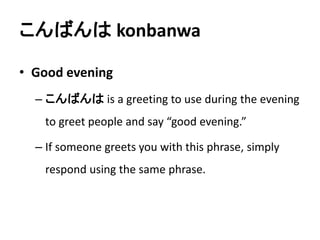
こんばんはkonbanwa 
• Good evening 
– こんばんはis a greeting to use during the evening 
to greet people and say “good evening.” 
– If someone greets you with this phrase, simply 
respond using the same phrase.
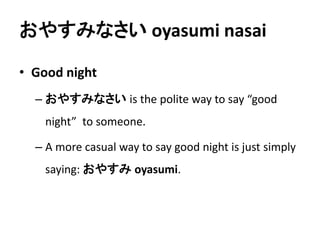
おやすみなさいoyasumi nasai 
• Good night 
– おやすみなさいis the polite way to say “good 
night” to someone. 
– A more casual way to say good night is just simply 
saying: おやすみoyasumi.
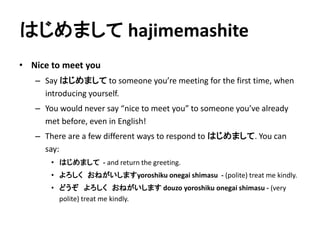
はじめましてhajimemashite 
• Nice to meet you 
– Say はじめましてto someone you’re meeting for the first time, when 
introducing yourself. 
– You would never say “nice to meet you” to someone you’ve already 
met before, even in English! 
– There are a few different ways to respond to はじめまして. You can 
say: 
• はじめまして- and return the greeting. 
• よろしくおねがいしますyoroshiku onegai shimasu - (polite) treat me kindly. 
• どうぞよろしくおねがいしますdouzo yoroshiku onegai shimasu - (very 
polite) treat me kindly.
namae 
なまえ- Names
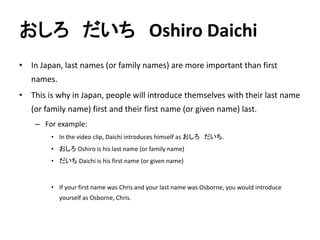
おしろだいちOshiro Daichi 
• In Japan, last names (or family names) are more important than first 
names. 
• This is why in Japan, people will introduce themselves with their last name 
(or family name) first and their first name (or given name) last. 
– For example: 
• In the video clip, Daichi introduces himself as おしろだいち. 
• おしろOshiro is his last name (or family name) 
• だいちDaichi is his first name (or given name) 
• If your first name was Chris and your last name was Osborne, you would introduce 
yourself as Osborne, Chris.
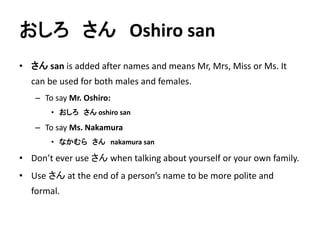
おしろさんOshiro san 
• さんsan is added after names and means Mr, Mrs, Miss or Ms. It 
can be used for both males and females. 
– To say Mr. Oshiro: 
• おしろさんoshiro san 
– To say Ms. Nakamura 
• なかむらさんnakamura san 
• Don’t ever use さんwhen talking about yourself or your own family. 
• Use さんat the end of a person’s name to be more polite and 
formal.
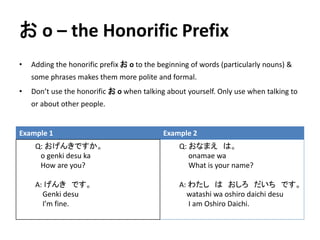
おo – the Honorific Prefix 
• Adding the honorific prefix おo to the beginning of words (particularly nouns) & 
some phrases makes them more polite and formal. 
• Don’t use the honorific おo when talking about yourself. Only use when talking to 
or about other people. 
Example 1 Example 2 
Q: おげんきですか。 
o genki desu ka 
How are you? 
A: げんきです。 
Genki desu 
I’m fine. 
Q: おなまえは。 
onamae wa 
What is your name? 
A: わたしはおしろだいちです。 
watashi wa oshiro daichi desu 
I am Oshiro Daichi.
PRONOUNS IN JAPANESE
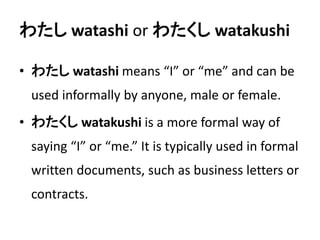
わたしwatashi or わたくしwatakushi 
• わたしwatashi means “I” or “me” and can be 
used informally by anyone, male or female. 
• わたくしwatakushi is a more formal way of 
saying “I” or “me.” It is typically used in formal 
written documents, such as business letters or 
contracts.
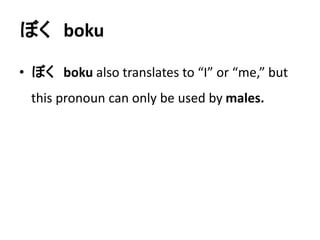
ぼくboku 
• ぼくboku also translates to “I” or “me,” but 
this pronoun can only be used by males.
JAPANESE SENTENCE STRUCTURE
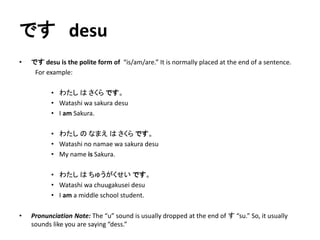
ですdesu 
• ですdesu is the polite form of “is/am/are.” It is normally placed at the end of a sentence. 
For example: 
• わたしはさくらです。 
• Watashi wa sakura desu 
• I am Sakura. 
• わたしのなまえはさくらです。 
• Watashi no namae wa sakura desu 
• My name is Sakura. 
• わたしはちゅうがくせいです。 
• Watashi wa chuugakusei desu 
• I am a middle school student. 
• Pronunciation Note: The “u” sound is usually dropped at the end of す“su.” So, it usually 
sounds like you are saying “dess.”
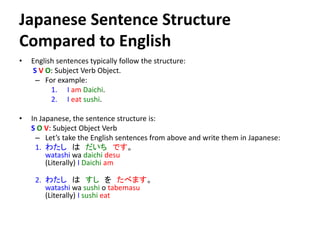
Japanese Sentence Structure 
Compared to English 
• English sentences typically follow the structure: 
S V O: Subject Verb Object. 
– For example: 
1. I am Daichi. 
2. I eat sushi. 
• In Japanese, the sentence structure is: 
S O V: Subject Object Verb 
– Let’s take the English sentences from above and write them in Japanese: 
1. わたしはだいちです。 
watashi wa daichi desu 
(Literally) I Daichi am 
2. わたしはすしをたべます。 
watashi wa sushi o tabemasu 
(Literally) I sushi eat
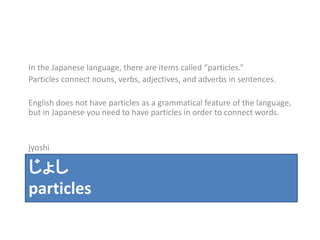
In the Japanese language, there are items called “particles.” 
Particles connect nouns, verbs, adjectives, and adverbs in sentences. 
English does not have particles as a grammatical feature of the language, 
but in Japanese you need to have particles in order to connect words. 
jyoshi 
じょし 
particles
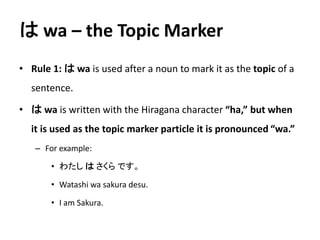
はwa – the Topic Marker 
• Rule 1: はwa is used after a noun to mark it as the topic of a 
sentence. 
• はwa is written with the Hiragana character “ha,” but when 
it is used as the topic marker particle it is pronounced “wa.” 
– For example: 
• わたしはさくらです。 
• Watashi wa sakura desu. 
• I am Sakura.
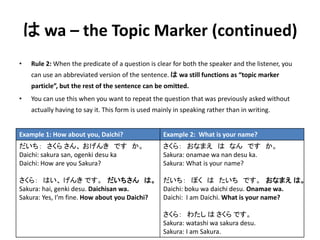
はwa – the Topic Marker (continued) 
• Rule 2: When the predicate of a question is clear for both the speaker and the listener, you 
can use an abbreviated version of the sentence. はwa still functions as “topic marker 
particle”, but the rest of the sentence can be omitted. 
• You can use this when you want to repeat the question that was previously asked without 
actually having to say it. This form is used mainly in speaking rather than in writing. 
Example 1: How about you, Daichi? Example 2: What is your name? 
だいち: さくらさん、おげんきですか。 
Daichi: sakura san, ogenki desu ka 
Daichi: How are you Sakura? 
さくら: はい、げんきです。だいちさんは。 
Sakura: hai, genki desu. Daichisan wa. 
Sakura: Yes, I’m fine. How about you Daichi? 
さくら: おなまえはなんですか。 
Sakura: onamae wa nan desu ka. 
Sakura: What is your name? 
だいち: ぼくはたいちです。おなまえは。 
Daichi: boku wa daichi desu. Onamae wa. 
Daichi: I am Daichi. What is your name? 
さくら: わたしはさくらです。 
Sakura: watashi wa sakura desu. 
Sakura: I am Sakura.
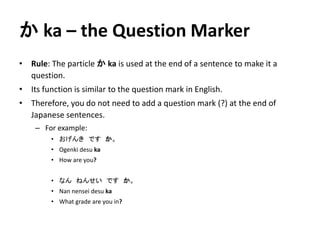
かka – the Question Marker 
• Rule: The particle かka is used at the end of a sentence to make it a 
question. 
• Its function is similar to the question mark in English. 
• Therefore, you do not need to add a question mark (?) at the end of 
Japanese sentences. 
– For example: 
• おげんきですか。 
• Ogenki desu ka 
• How are you? 
• なんねんせいですか。 
• Nan nensei desu ka 
• What grade are you in?
おわり 
This is the end of the Grammar Notes for 
this lesson. 
You can print these notes for your reference 
using the link above this slideshow.

M1 L1 grammar

  • 1.
  • 2.
  • 3.
    おはようございますohayou gozaimasu •Good Morning – This is a greeting that is only used in the morning. – It is the polite way to say “good morning.” Use it with people who are above you in age or in social status, such as teachers. – おはようohayou is a less formal way of saying “good morning” that you can use with friends or those who are younger than you. – When someone greets you with おはようございますsimply repeat the greeting back to them: おはようございます。
  • 4.
    こんにちはkonnichiwa • Hello/ Good afternoon – こんにちはis a greeting that you can use in the afternoon. – It means “good afternoon”, or “hello.” – If someone greets you with this phrase, simply respond using the same phrase. – Even though it translates to “hello,” do not use this in the morning or in the evening. This phrase is only to be used during the afternoon.
  • 5.
    こんばんはkonbanwa • Goodevening – こんばんはis a greeting to use during the evening to greet people and say “good evening.” – If someone greets you with this phrase, simply respond using the same phrase.
  • 6.
    おやすみなさいoyasumi nasai •Good night – おやすみなさいis the polite way to say “good night” to someone. – A more casual way to say good night is just simply saying: おやすみoyasumi.
  • 7.
    はじめましてhajimemashite • Niceto meet you – Say はじめましてto someone you’re meeting for the first time, when introducing yourself. – You would never say “nice to meet you” to someone you’ve already met before, even in English! – There are a few different ways to respond to はじめまして. You can say: • はじめまして- and return the greeting. • よろしくおねがいしますyoroshiku onegai shimasu - (polite) treat me kindly. • どうぞよろしくおねがいしますdouzo yoroshiku onegai shimasu - (very polite) treat me kindly.
  • 8.
  • 9.
    おしろだいちOshiro Daichi •In Japan, last names (or family names) are more important than first names. • This is why in Japan, people will introduce themselves with their last name (or family name) first and their first name (or given name) last. – For example: • In the video clip, Daichi introduces himself as おしろだいち. • おしろOshiro is his last name (or family name) • だいちDaichi is his first name (or given name) • If your first name was Chris and your last name was Osborne, you would introduce yourself as Osborne, Chris.
  • 10.
    おしろさんOshiro san •さんsan is added after names and means Mr, Mrs, Miss or Ms. It can be used for both males and females. – To say Mr. Oshiro: • おしろさんoshiro san – To say Ms. Nakamura • なかむらさんnakamura san • Don’t ever use さんwhen talking about yourself or your own family. • Use さんat the end of a person’s name to be more polite and formal.
  • 11.
    おo – theHonorific Prefix • Adding the honorific prefix おo to the beginning of words (particularly nouns) & some phrases makes them more polite and formal. • Don’t use the honorific おo when talking about yourself. Only use when talking to or about other people. Example 1 Example 2 Q: おげんきですか。 o genki desu ka How are you? A: げんきです。 Genki desu I’m fine. Q: おなまえは。 onamae wa What is your name? A: わたしはおしろだいちです。 watashi wa oshiro daichi desu I am Oshiro Daichi.
  • 12.
  • 13.
    わたしwatashi or わたくしwatakushi • わたしwatashi means “I” or “me” and can be used informally by anyone, male or female. • わたくしwatakushi is a more formal way of saying “I” or “me.” It is typically used in formal written documents, such as business letters or contracts.
  • 14.
    ぼくboku • ぼくbokualso translates to “I” or “me,” but this pronoun can only be used by males.
  • 15.
  • 16.
    ですdesu • ですdesuis the polite form of “is/am/are.” It is normally placed at the end of a sentence. For example: • わたしはさくらです。 • Watashi wa sakura desu • I am Sakura. • わたしのなまえはさくらです。 • Watashi no namae wa sakura desu • My name is Sakura. • わたしはちゅうがくせいです。 • Watashi wa chuugakusei desu • I am a middle school student. • Pronunciation Note: The “u” sound is usually dropped at the end of す“su.” So, it usually sounds like you are saying “dess.”
  • 17.
    Japanese Sentence Structure Compared to English • English sentences typically follow the structure: S V O: Subject Verb Object. – For example: 1. I am Daichi. 2. I eat sushi. • In Japanese, the sentence structure is: S O V: Subject Object Verb – Let’s take the English sentences from above and write them in Japanese: 1. わたしはだいちです。 watashi wa daichi desu (Literally) I Daichi am 2. わたしはすしをたべます。 watashi wa sushi o tabemasu (Literally) I sushi eat
  • 18.
    In the Japaneselanguage, there are items called “particles.” Particles connect nouns, verbs, adjectives, and adverbs in sentences. English does not have particles as a grammatical feature of the language, but in Japanese you need to have particles in order to connect words. jyoshi じょし particles
  • 19.
    はwa – theTopic Marker • Rule 1: はwa is used after a noun to mark it as the topic of a sentence. • はwa is written with the Hiragana character “ha,” but when it is used as the topic marker particle it is pronounced “wa.” – For example: • わたしはさくらです。 • Watashi wa sakura desu. • I am Sakura.
  • 20.
    はwa – theTopic Marker (continued) • Rule 2: When the predicate of a question is clear for both the speaker and the listener, you can use an abbreviated version of the sentence. はwa still functions as “topic marker particle”, but the rest of the sentence can be omitted. • You can use this when you want to repeat the question that was previously asked without actually having to say it. This form is used mainly in speaking rather than in writing. Example 1: How about you, Daichi? Example 2: What is your name? だいち: さくらさん、おげんきですか。 Daichi: sakura san, ogenki desu ka Daichi: How are you Sakura? さくら: はい、げんきです。だいちさんは。 Sakura: hai, genki desu. Daichisan wa. Sakura: Yes, I’m fine. How about you Daichi? さくら: おなまえはなんですか。 Sakura: onamae wa nan desu ka. Sakura: What is your name? だいち: ぼくはたいちです。おなまえは。 Daichi: boku wa daichi desu. Onamae wa. Daichi: I am Daichi. What is your name? さくら: わたしはさくらです。 Sakura: watashi wa sakura desu. Sakura: I am Sakura.
  • 21.
    かka – theQuestion Marker • Rule: The particle かka is used at the end of a sentence to make it a question. • Its function is similar to the question mark in English. • Therefore, you do not need to add a question mark (?) at the end of Japanese sentences. – For example: • おげんきですか。 • Ogenki desu ka • How are you? • なんねんせいですか。 • Nan nensei desu ka • What grade are you in?
  • 22.
    おわり This isthe end of the Grammar Notes for this lesson. You can print these notes for your reference using the link above this slideshow.

Editor's Notes

  • #18 I is the subject Am is the verb And Daichi is the object I is the subject Eat is the verb And sushi is the object Watashi is the subject Daichi is the object Desu is the verb Watashi is the subject Sushi is the object Tabemasu is the verb. Wa and o are called particles – let’s talk about those next.
  • #20 As you can see, は follows わたし (I), so we now know that わたし is the topic of the sentence.