Grammar Pointers:Word Order: Declarative SentencesProf. Myrna MonllorJiménezEnglish 112
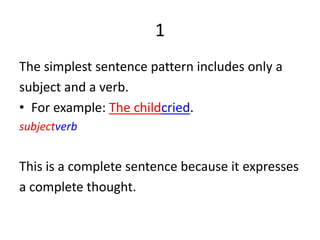
1The simplest sentence pattern includes only asubject and a verb.For example: The childcried.subjectverbThis is a complete sentence because it expressesa complete thought.
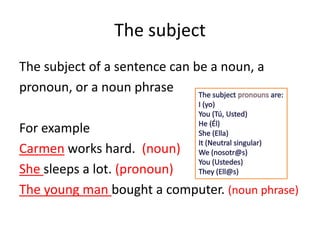
The subjectThe subject of a sentence can be a noun, apronoun, or a noun phraseFor exampleCarmen works hard.  (noun)She sleeps a lot. (pronoun)The young man bought a computer. (noun phrase)The subject pronouns are:I (yo)You (Tú, Usted)He (Él)She (Ella)It (Neutral singular)We (nosotr@s)You (Ustedes)They (Ell@s)
The Noun PhraseThe noun phrase can include an article, anadjective, a prepositional phrase, and a nounThe young manA bookThe beautiful girl in the blue dressThe articles in English are: a, an, the
2Other verbs need something to complete thethought. The thought can be completed by usinga noun, an adjective, an adverb, a prepositionalphrase, or a clause after the verb.
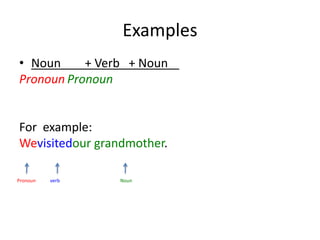
ExamplesNoun        + Verb   + Noun	Pronoun	PronounFor  example: Wevisitedour grandmother.PronounverbNoun
Noun        +  Verb  + Adjective                PronounShe is pretty .(only some verbs can be followed by an adjective: is, am, was, were, seem, appear, look, taste, sound…)
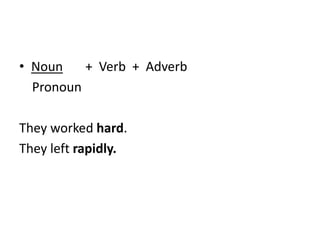
Noun       +  Verb  +  Adverb    PronounThey worked hard.They left rapidly.
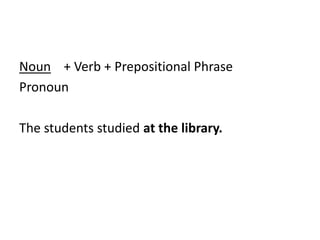
Noun    + Verb + Prepositional PhrasePronounThe students studied at the library.
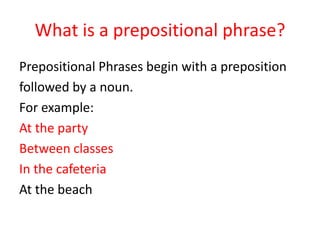
What is a prepositional phrase?Prepositional Phrases begin with a prepositionfollowed by a noun.For example:At the partyBetween classesIn the cafeteriaAt the beach
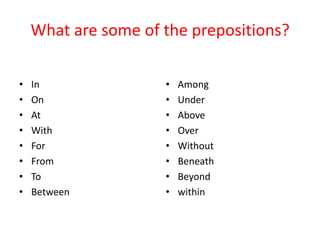
What are some of the prepositions?InOnAtWithForFromToBetweenAmongUnderAboveOverWithoutBeneathBeyondwithin
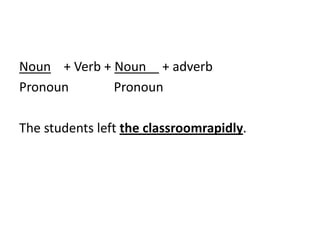
Noun    + Verb + Noun     + adverbPronoun              PronounThe students left the classroomrapidly.
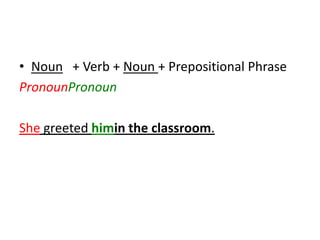
Noun   + Verb + Noun + Prepositional PhrasePronounPronounShe greeted himin the classroom.
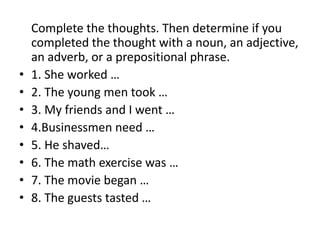
	Complete the thoughts. Then determine if you completed the thought with a noun, an adjective, an adverb, or a prepositional phrase.1. She worked …	2. The young men took …3. My friends and I went …4.Businessmen need …   5. He shaved…		6. The math exercise was …7. The movie began …	8. The guests tasted …
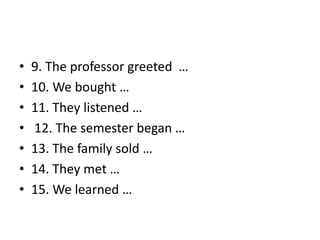
9. The professor greeted  …10. We bought …		11. They listened …                       12. The semester began …13. The family sold …		14. They met …	15. We learned …

Grammar Pointers

  • 1.
    Grammar Pointers:Word Order:Declarative SentencesProf. Myrna MonllorJiménezEnglish 112
  • 2.
    1The simplest sentencepattern includes only asubject and a verb.For example: The childcried.subjectverbThis is a complete sentence because it expressesa complete thought.
  • 3.
    The subjectThe subjectof a sentence can be a noun, apronoun, or a noun phraseFor exampleCarmen works hard. (noun)She sleeps a lot. (pronoun)The young man bought a computer. (noun phrase)The subject pronouns are:I (yo)You (Tú, Usted)He (Él)She (Ella)It (Neutral singular)We (nosotr@s)You (Ustedes)They (Ell@s)
  • 4.
    The Noun PhraseThenoun phrase can include an article, anadjective, a prepositional phrase, and a nounThe young manA bookThe beautiful girl in the blue dressThe articles in English are: a, an, the
  • 5.
    2Other verbs needsomething to complete thethought. The thought can be completed by usinga noun, an adjective, an adverb, a prepositionalphrase, or a clause after the verb.
  • 6.
    ExamplesNoun + Verb + Noun Pronoun PronounFor example: Wevisitedour grandmother.PronounverbNoun
  • 7.
    Noun + Verb + Adjective PronounShe is pretty .(only some verbs can be followed by an adjective: is, am, was, were, seem, appear, look, taste, sound…)
  • 8.
    Noun + Verb + Adverb PronounThey worked hard.They left rapidly.
  • 9.
    Noun + Verb + Prepositional PhrasePronounThe students studied at the library.
  • 10.
    What is aprepositional phrase?Prepositional Phrases begin with a prepositionfollowed by a noun.For example:At the partyBetween classesIn the cafeteriaAt the beach
  • 11.
    What are someof the prepositions?InOnAtWithForFromToBetweenAmongUnderAboveOverWithoutBeneathBeyondwithin
  • 12.
    Noun + Verb + Noun + adverbPronoun PronounThe students left the classroomrapidly.
  • 13.
    Noun + Verb + Noun + Prepositional PhrasePronounPronounShe greeted himin the classroom.
  • 14.
    Complete the thoughts.Then determine if you completed the thought with a noun, an adjective, an adverb, or a prepositional phrase.1. She worked … 2. The young men took …3. My friends and I went …4.Businessmen need … 5. He shaved… 6. The math exercise was …7. The movie began … 8. The guests tasted …
  • 15.
    9. The professorgreeted …10. We bought … 11. They listened … 12. The semester began …13. The family sold … 14. They met … 15. We learned …