Want to learn more about managing poor
performance? Call Pathway on 0121 707 0550
or visit www.Elearning.pathwaycourses.co.uk
Want to learn more about managing poor
performance? Call Pathway on 0121 707 0550
or visit www.Elearning.pathwaycourses.co.uk
Want to learn more about managing poor
performance? Call Pathway on 0121 707 0550
or visit www.Elearning.pathwaycourses.co.uk
Advice for handling
poor performance?
 Deal with it immediately – letting poor performance
carry on creates problem for the staff member and
resentment in the team
 Don’t pre-judge – Ask questions at first, there may be
external reasons for poor performance
 Be specific – don’t use hearsay and opinion, use facts
and evidence
 Be calm – Don’t let emotions run the situation. Deal
with poor performance with a clear head
 Offer support – The goal is to improve the performance
of the individual. Provide the support necessary to do
this
Want to learn more about managing poor performance? Call Pathway
on 0121 707 0550 or visit www.Elearning.pathwaycourses.co.uk
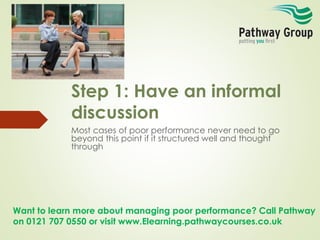
Step 1: Have an informal
discussion
Most cases of poor performance never need to go
beyond this point if it structured well and thought
through
Want to learn more about managing poor
performance? Call Pathway on 0121 707 0550
or visit www.Elearning.pathwaycourses.co.uk
An informal discussion
 Find a timely, relaxed and private opportunity to
discuss the issues you have
 State the issue clearly and be precise about the
standards required
 Ask for the team members view on their
performance (they often know they are not
doing their best)
 Ask them to suggest a way forward
 Agree a plan
 Set yourself reminders to review progress and
encourage positive changes
Want to learn more about managing poor performance? Call Pathway
on 0121 707 0550 or visit www.Elearning.pathwaycourses.co.uk
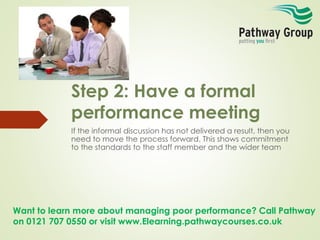
Step 2: Have a formal
performance meeting
If the informal discussion has not delivered a result, then you
need to move the process forward. This shows commitment
to the standards to the staff member and the wider team
Want to learn more about managing poor
performance? Call Pathway on 0121 707 0550
or visit www.Elearning.pathwaycourses.co.uk
A formal performance
meeting - Preparation
 Write down the key performance
issues with specific examples
 List the problems that this poor
performance creates for the business
and team
 Describe clearly the action that will
need to be taken
 Set out the resources that will be
made available to help them
Want to learn more about managing poor
performance? Call Pathway on 0121 707 0550
or visit www.Elearning.pathwaycourses.co.uk
A formal performance
meeting – 5 Ps
 Prepare – In detail, as described
 Private – remove distractions such as phones and
ensure the meeting wont be interrupted
 Participate – Get the employee to describe their
thoughts and ways they can improve
 Precise – Don’t sugar-coat things – be clear on
the negative impact of the poor performance
 Plan – Clearly and in detail, what will happen
next so both sides are clear
Want to learn more about managing poor
performance? Call Pathway on 0121 707 0550
or visit www.Elearning.pathwaycourses.co.uk
A formal performance
meeting
 Give 48 hours notice of the meeting and ensure
preparations are discreet and professional
 Have a colleague or HR representative
accompany you in the meeting
 Consider the facts and decide on a course of
action or appropriate sanction such as a
warning
Want to learn more about managing poor performance? Call Pathway
on 0121 707 0550 or visit www.Elearning.pathwaycourses.co.uk
Step 3: After the meeting
The meetings are important, however as a manager your
commitment to the process will be truly evident by the
nature in which you follow through on the meeting actions
Want to learn more about managing poor
performance? Call Pathway on 0121 707 0550
or visit www.Elearning.pathwaycourses.co.uk
1. The precise nature of the performance issues
2. The level of improvement needed and timescales
3. How they will be supported
4. The consequences of not achieving standards
5. How long a warning will stay on record (if issued)
6. Consequences of continued failure to reach
standards
7. Reasons for dismissal (if appropriate)
8. Rights of appeal (if appropriate)
Want to learn more about managing poor
performance? Call Pathway on 0121 707 0550
or visit www.Elearning.pathwaycourses.co.uk
1. Identify precise and measurable
performance targets
2. Diarise key follow up points
3. Specify any required training
4. Identify the positive results if the plan is
successful
5. Incorporate employee suggestions into
the plan
6. Give enough time for the employee to
improve
Want to learn more about managing poor
performance? Call Pathway on 0121 707 0550
or visit www.Elearning.pathwaycourses.co.uk
Want to learn more about managing poor
performance? Call Pathway on 0121 707 0550
or visit www.Elearning.pathwaycourses.co.uk
Want to learn more about managing poor
performance? Call Pathway on 0121 707 0550
or visit www.Elearning.pathwaycourses.co.uk
Offers training courses on managing poor
performance – teaching:
 Knowledge & skills to tackle performance problems effectively
 How to prepare & conduct a formal capability meeting.
 What the purpose & benefits of capability management are &
how to put it into practice.
 Improve communication skills & remain fair & consistent with all
staff
 The importance of preventive action
 Tackle performance problems effectively
 Questioning & interviewing techniques
 Setting clear objectives
Pathway Group

Managing staff poor performance handling staff capability issues

  • 2.
    Want to learnmore about managing poor performance? Call Pathway on 0121 707 0550 or visit www.Elearning.pathwaycourses.co.uk
  • 3.
    Want to learnmore about managing poor performance? Call Pathway on 0121 707 0550 or visit www.Elearning.pathwaycourses.co.uk
  • 4.
    Want to learnmore about managing poor performance? Call Pathway on 0121 707 0550 or visit www.Elearning.pathwaycourses.co.uk Advice for handling poor performance?  Deal with it immediately – letting poor performance carry on creates problem for the staff member and resentment in the team  Don’t pre-judge – Ask questions at first, there may be external reasons for poor performance  Be specific – don’t use hearsay and opinion, use facts and evidence  Be calm – Don’t let emotions run the situation. Deal with poor performance with a clear head  Offer support – The goal is to improve the performance of the individual. Provide the support necessary to do this
  • 5.
    Want to learnmore about managing poor performance? Call Pathway on 0121 707 0550 or visit www.Elearning.pathwaycourses.co.uk Step 1: Have an informal discussion Most cases of poor performance never need to go beyond this point if it structured well and thought through
  • 6.
    Want to learnmore about managing poor performance? Call Pathway on 0121 707 0550 or visit www.Elearning.pathwaycourses.co.uk An informal discussion  Find a timely, relaxed and private opportunity to discuss the issues you have  State the issue clearly and be precise about the standards required  Ask for the team members view on their performance (they often know they are not doing their best)  Ask them to suggest a way forward  Agree a plan  Set yourself reminders to review progress and encourage positive changes
  • 7.
    Want to learnmore about managing poor performance? Call Pathway on 0121 707 0550 or visit www.Elearning.pathwaycourses.co.uk Step 2: Have a formal performance meeting If the informal discussion has not delivered a result, then you need to move the process forward. This shows commitment to the standards to the staff member and the wider team
  • 8.
    Want to learnmore about managing poor performance? Call Pathway on 0121 707 0550 or visit www.Elearning.pathwaycourses.co.uk A formal performance meeting - Preparation  Write down the key performance issues with specific examples  List the problems that this poor performance creates for the business and team  Describe clearly the action that will need to be taken  Set out the resources that will be made available to help them
  • 9.
    Want to learnmore about managing poor performance? Call Pathway on 0121 707 0550 or visit www.Elearning.pathwaycourses.co.uk A formal performance meeting – 5 Ps  Prepare – In detail, as described  Private – remove distractions such as phones and ensure the meeting wont be interrupted  Participate – Get the employee to describe their thoughts and ways they can improve  Precise – Don’t sugar-coat things – be clear on the negative impact of the poor performance  Plan – Clearly and in detail, what will happen next so both sides are clear
  • 10.
    Want to learnmore about managing poor performance? Call Pathway on 0121 707 0550 or visit www.Elearning.pathwaycourses.co.uk A formal performance meeting  Give 48 hours notice of the meeting and ensure preparations are discreet and professional  Have a colleague or HR representative accompany you in the meeting  Consider the facts and decide on a course of action or appropriate sanction such as a warning
  • 11.
    Want to learnmore about managing poor performance? Call Pathway on 0121 707 0550 or visit www.Elearning.pathwaycourses.co.uk Step 3: After the meeting The meetings are important, however as a manager your commitment to the process will be truly evident by the nature in which you follow through on the meeting actions
  • 12.
    Want to learnmore about managing poor performance? Call Pathway on 0121 707 0550 or visit www.Elearning.pathwaycourses.co.uk 1. The precise nature of the performance issues 2. The level of improvement needed and timescales 3. How they will be supported 4. The consequences of not achieving standards 5. How long a warning will stay on record (if issued) 6. Consequences of continued failure to reach standards 7. Reasons for dismissal (if appropriate) 8. Rights of appeal (if appropriate)
  • 13.
    Want to learnmore about managing poor performance? Call Pathway on 0121 707 0550 or visit www.Elearning.pathwaycourses.co.uk 1. Identify precise and measurable performance targets 2. Diarise key follow up points 3. Specify any required training 4. Identify the positive results if the plan is successful 5. Incorporate employee suggestions into the plan 6. Give enough time for the employee to improve
  • 14.
    Want to learnmore about managing poor performance? Call Pathway on 0121 707 0550 or visit www.Elearning.pathwaycourses.co.uk
  • 15.
    Want to learnmore about managing poor performance? Call Pathway on 0121 707 0550 or visit www.Elearning.pathwaycourses.co.uk
  • 16.
    Want to learnmore about managing poor performance? Call Pathway on 0121 707 0550 or visit www.Elearning.pathwaycourses.co.uk Offers training courses on managing poor performance – teaching:  Knowledge & skills to tackle performance problems effectively  How to prepare & conduct a formal capability meeting.  What the purpose & benefits of capability management are & how to put it into practice.  Improve communication skills & remain fair & consistent with all staff  The importance of preventive action  Tackle performance problems effectively  Questioning & interviewing techniques  Setting clear objectives Pathway Group