
Effectively managing performance

by Toronto Training and HR

October 2013
CONTENTS
5-6
7-8
9-10
11-12
13-14
15-16
17-18
19-20
21-22
23-24
25-28
29-30
31-33
34-38
39-40
41-46
47-48
49-50

Definition
The process of performance management
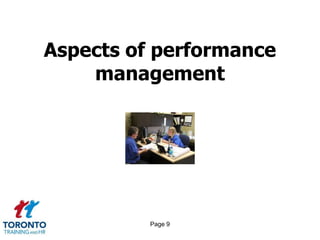
Aspects of performance management
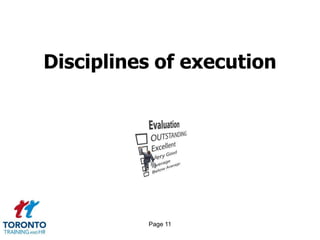
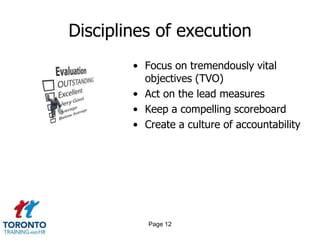
Disciplines of execution
Pay for performance
Creating and implementing a balanced scorecard
Selecting the right metrics
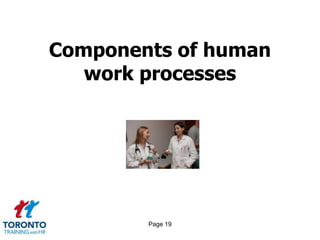
Components of human work processes
Motivation and performance
Employee engagement
Performance reviews
Trust
Legal considerations
High achievers and low performers
Key components for world-class performance
Organizations which are high-performing
Ensuring performance management is a success
Conclusion and questions

Page 2
Introduction

Page 3
Introduction to Toronto Training
and HR
Toronto Training and HR is a specialist training and
human resources consultancy headed by Timothy Holden
10 years in banking
10 years in training and human resources
Freelance practitioner since 2006
The core services provided by Toronto Training and HR
are:
Training event design
Training event delivery
Reducing costs, saving time plus improving
employee engagement and morale
Services for job seekers
Page 4
Definition

Page 5
Definition
• Performance management

Page 6
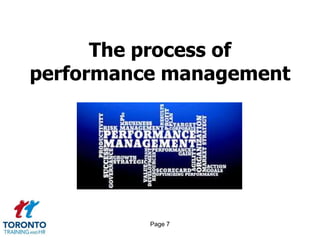
The process of
performance management

Page 7
The process of performance
management
• Define performance
expectations
• Provide ongoing feedback and
coaching
• Conducting performance
reviews and evaluation
discussions
• Determining performance
rewards/consequences
• Undertaking development and
career opportunity discussions
Page 8
Aspects of performance
management

Page 9
Aspects of performance
management
•
•
•
•
•

Developing
Monitoring
Planning
Rating
Rewarding

Page 10
Disciplines of execution

Page 11
Disciplines of execution
• Focus on tremendously vital
objectives (TVO)
• Act on the lead measures
• Keep a compelling scoreboard
• Create a culture of accountability

Page 12
Pay for performance

Page 13
Pay for performance
•
•
•
•

Stability
Ease of measurement
Designing a plan
Merit pay grids

Page 14
Creating and
implementing a balanced
scorecard

Page 15
Creating and implementing a
balanced scorecard
• Collect historical data from the
organization
• Sort out and prepare the final
database
• Determine and identify the numbers
of strategic perspectives and
performance indicators
• Construct the cause and effect link
between all strategic perspectives
• Operate this management tool for
long-term planning
Page 16
Selecting the right metrics

Page 17
Selecting the right metrics
• Define your governing objective
• Develop a theory of cause and effect
to assess presumed drivers of value
• Identify the specific activities that
employees need to do in order to
achieve the governing objective
• Regularly re-evaluate the chosen
statistics to ensure that they continue
to link employee activities with the
governing objective

Page 18
Components of human
work processes

Page 19
Components of human work
processes
•
•
•
•
•
•
•

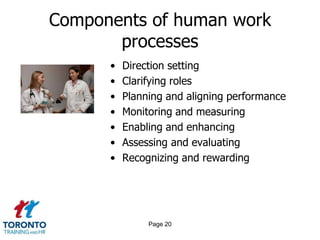
Direction setting
Clarifying roles
Planning and aligning performance
Monitoring and measuring
Enabling and enhancing
Assessing and evaluating
Recognizing and rewarding

Page 20
Motivation and
performance

Page 21
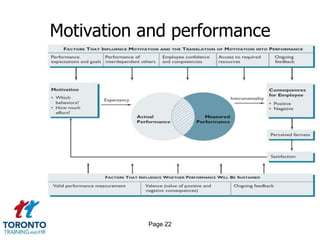
Motivation and performance

Page 22
Employee engagement

Page 23
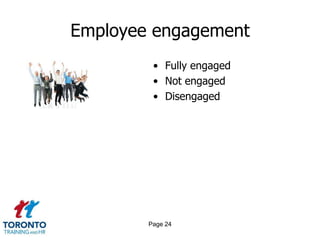
Employee engagement
• Fully engaged
• Not engaged
• Disengaged

Page 24
Performance reviews

Page 25
Performance reviews 1 of 3
•
•
•
•
•

Formats
360 degree feedback
Errors
An effective process
Preparation

Page 26
Performance reviews 2 of 3
TRENDS
• Preset performance objectives for
individuals
• Discussion of development held
separately from the performance
review
• Competency models which are based
on strategy
• Competencies
• Calibration meetings to compare
ratings by different managers
• Ownership of performance
management by line management
Performance reviews 3 of 3
AMENDMENTS
• Change what is rated
• Change the rating scale
• Change who rates
• Change the objectives

Page 28
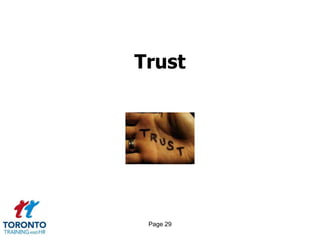
Trust

Page 29
Trust
• Leader behaviours to build trust
• Employee responses

Page 30
Legal considerations

Page 31
Legal considerations 1 of 2
• Evaluate employees on job-relevant
factors
• Inform employees of expectations and
evaluation standards in advance
• Have a documented process with
specified roles for managers and
employees
• Train managers and employees on the
performance management process
and relevant skills

Page 32
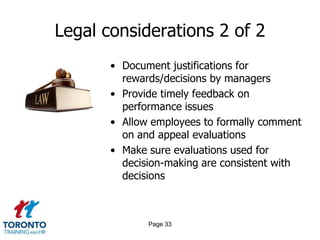
Legal considerations 2 of 2
• Document justifications for
rewards/decisions by managers
• Provide timely feedback on
performance issues
• Allow employees to formally comment
on and appeal evaluations
• Make sure evaluations used for
decision-making are consistent with
decisions

Page 33
High achievers and low
performers

Page 34
High achievers and low performers
1 of 4
• Carefully select who will be important
for you to invest time, energy and
other resources in to developing their
performance
• Keep hope alive for all
performers, even those who are
chronically low
• Cut your losses relatively early

Page 35
High achievers and low performers
2 of 4
ADDRESSING CHRONIC LOW
PERFORMERS
• If after setting clear expectations,
monitoring their performance,
providing feedback, coaching them
and letting them know the
consequences of underperforming…let
them go
• If the organization can’t afford to let
low performers go in order to keep
operating, then reassign them
Page 36
High achievers and low performers
3 of 4
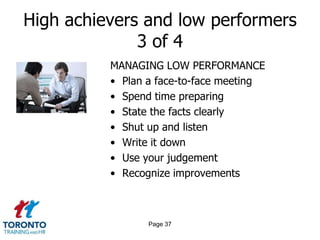
MANAGING LOW PERFORMANCE
• Plan a face-to-face meeting
• Spend time preparing
• State the facts clearly
• Shut up and listen
• Write it down
• Use your judgement
• Recognize improvements

Page 37
High achievers and low performers
4 of 4
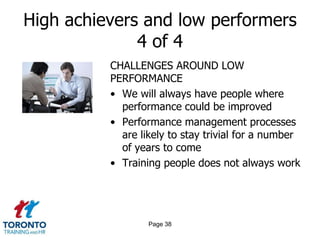
CHALLENGES AROUND LOW
PERFORMANCE
• We will always have people where
performance could be improved
• Performance management processes
are likely to stay trivial for a number
of years to come
• Training people does not always work

Page 38
Key components for
world-class performance

Page 39
Key components for world-class
performance
•
•
•
•
•
•

Page 40

Technical
Tactical
Mental
Physical
Contextual
Emotional
Organizations which are
high-performing

Page 41
Organizations which are highperforming 1 of 5
FACTORS TO CONSIDER
• Management quality
• Openness and action orientation
• Long-term orientation
• Continuous improvement
• Employee quality

Page 42
Organizations which are highperforming 2 of 5
STEPS TO DEVELOPING A HIGHPERFORMANCE CULTURE
• Motivate change
• Lay foundations
• Sustain behaviour
• Monitor and improve

Page 43
Organizations which are highperforming 3 of 5
WHAT DOES A HIGH-PERFORMING
ORGANIZATION LOOK LIKE?
• The right people in the right
roles, focused on what matters
most
• Organizational design that
encourages the right balance of
wider collaboration
• Ways of working that help people
to be productive and fulfilled

Page 44
Organizations which are highperforming 4 of 5
BECOMING A HIGH-PERFORMING
ORGANIZATION
• Find out what employees know and
don’t know
• Formulate objectives with employees
and roles to play
• Evaluate the impact on employees
• Determine with employees the
resources needed
• Make sure everyone continuously
receives information on progress
Page 45
Organizations which are highperforming 5 of 5
BECOMING A HIGH-PERFORMING
ORGANIZATION (CONTINUED)
• Ask employees for feedback on
un

Page 46
Ensuring performance
management is a success

Page 47
Ensuring performance management
is a success
•
•
•
•
•

Communicate the big picture
Set SMART objectives
Give effective and regular feedback
Prepare and train managers
Differentiate based on contribution
not remuneration
• Identify opportunities for learning &
development

Page 48
Conclusion and questions

Page 49
Conclusion and questions
Summary
Videos
Questions

Page 50

Performance management October 2013

  • 1.
    Effectively managing performance byToronto Training and HR October 2013
  • 2.
    CONTENTS 5-6 7-8 9-10 11-12 13-14 15-16 17-18 19-20 21-22 23-24 25-28 29-30 31-33 34-38 39-40 41-46 47-48 49-50 Definition The process ofperformance management Aspects of performance management Disciplines of execution Pay for performance Creating and implementing a balanced scorecard Selecting the right metrics Components of human work processes Motivation and performance Employee engagement Performance reviews Trust Legal considerations High achievers and low performers Key components for world-class performance Organizations which are high-performing Ensuring performance management is a success Conclusion and questions Page 2
  • 3.
  • 4.
    Introduction to TorontoTraining and HR Toronto Training and HR is a specialist training and human resources consultancy headed by Timothy Holden 10 years in banking 10 years in training and human resources Freelance practitioner since 2006 The core services provided by Toronto Training and HR are: Training event design Training event delivery Reducing costs, saving time plus improving employee engagement and morale Services for job seekers Page 4
  • 5.
  • 6.
  • 7.
    The process of performancemanagement Page 7
  • 8.
    The process ofperformance management • Define performance expectations • Provide ongoing feedback and coaching • Conducting performance reviews and evaluation discussions • Determining performance rewards/consequences • Undertaking development and career opportunity discussions Page 8
  • 9.
  • 10.
  • 11.
  • 12.
    Disciplines of execution •Focus on tremendously vital objectives (TVO) • Act on the lead measures • Keep a compelling scoreboard • Create a culture of accountability Page 12
  • 13.
  • 14.
    Pay for performance • • • • Stability Easeof measurement Designing a plan Merit pay grids Page 14
  • 15.
    Creating and implementing abalanced scorecard Page 15
  • 16.
    Creating and implementinga balanced scorecard • Collect historical data from the organization • Sort out and prepare the final database • Determine and identify the numbers of strategic perspectives and performance indicators • Construct the cause and effect link between all strategic perspectives • Operate this management tool for long-term planning Page 16
  • 17.
    Selecting the rightmetrics Page 17
  • 18.
    Selecting the rightmetrics • Define your governing objective • Develop a theory of cause and effect to assess presumed drivers of value • Identify the specific activities that employees need to do in order to achieve the governing objective • Regularly re-evaluate the chosen statistics to ensure that they continue to link employee activities with the governing objective Page 18
  • 19.
    Components of human workprocesses Page 19
  • 20.
    Components of humanwork processes • • • • • • • Direction setting Clarifying roles Planning and aligning performance Monitoring and measuring Enabling and enhancing Assessing and evaluating Recognizing and rewarding Page 20
  • 21.
  • 22.
  • 23.
  • 24.
    Employee engagement • Fullyengaged • Not engaged • Disengaged Page 24
  • 25.
  • 26.
    Performance reviews 1of 3 • • • • • Formats 360 degree feedback Errors An effective process Preparation Page 26
  • 27.
    Performance reviews 2of 3 TRENDS • Preset performance objectives for individuals • Discussion of development held separately from the performance review • Competency models which are based on strategy • Competencies • Calibration meetings to compare ratings by different managers • Ownership of performance management by line management
  • 28.
    Performance reviews 3of 3 AMENDMENTS • Change what is rated • Change the rating scale • Change who rates • Change the objectives Page 28
  • 29.
  • 30.
    Trust • Leader behavioursto build trust • Employee responses Page 30
  • 31.
  • 32.
    Legal considerations 1of 2 • Evaluate employees on job-relevant factors • Inform employees of expectations and evaluation standards in advance • Have a documented process with specified roles for managers and employees • Train managers and employees on the performance management process and relevant skills Page 32
  • 33.
    Legal considerations 2of 2 • Document justifications for rewards/decisions by managers • Provide timely feedback on performance issues • Allow employees to formally comment on and appeal evaluations • Make sure evaluations used for decision-making are consistent with decisions Page 33
  • 34.
    High achievers andlow performers Page 34
  • 35.
    High achievers andlow performers 1 of 4 • Carefully select who will be important for you to invest time, energy and other resources in to developing their performance • Keep hope alive for all performers, even those who are chronically low • Cut your losses relatively early Page 35
  • 36.
    High achievers andlow performers 2 of 4 ADDRESSING CHRONIC LOW PERFORMERS • If after setting clear expectations, monitoring their performance, providing feedback, coaching them and letting them know the consequences of underperforming…let them go • If the organization can’t afford to let low performers go in order to keep operating, then reassign them Page 36
  • 37.
    High achievers andlow performers 3 of 4 MANAGING LOW PERFORMANCE • Plan a face-to-face meeting • Spend time preparing • State the facts clearly • Shut up and listen • Write it down • Use your judgement • Recognize improvements Page 37
  • 38.
    High achievers andlow performers 4 of 4 CHALLENGES AROUND LOW PERFORMANCE • We will always have people where performance could be improved • Performance management processes are likely to stay trivial for a number of years to come • Training people does not always work Page 38
  • 39.
    Key components for world-classperformance Page 39
  • 40.
    Key components forworld-class performance • • • • • • Page 40 Technical Tactical Mental Physical Contextual Emotional
  • 41.
  • 42.
    Organizations which arehighperforming 1 of 5 FACTORS TO CONSIDER • Management quality • Openness and action orientation • Long-term orientation • Continuous improvement • Employee quality Page 42
  • 43.
    Organizations which arehighperforming 2 of 5 STEPS TO DEVELOPING A HIGHPERFORMANCE CULTURE • Motivate change • Lay foundations • Sustain behaviour • Monitor and improve Page 43
  • 44.
    Organizations which arehighperforming 3 of 5 WHAT DOES A HIGH-PERFORMING ORGANIZATION LOOK LIKE? • The right people in the right roles, focused on what matters most • Organizational design that encourages the right balance of wider collaboration • Ways of working that help people to be productive and fulfilled Page 44
  • 45.
    Organizations which arehighperforming 4 of 5 BECOMING A HIGH-PERFORMING ORGANIZATION • Find out what employees know and don’t know • Formulate objectives with employees and roles to play • Evaluate the impact on employees • Determine with employees the resources needed • Make sure everyone continuously receives information on progress Page 45
  • 46.
    Organizations which arehighperforming 5 of 5 BECOMING A HIGH-PERFORMING ORGANIZATION (CONTINUED) • Ask employees for feedback on un Page 46
  • 47.
  • 48.
    Ensuring performance management isa success • • • • • Communicate the big picture Set SMART objectives Give effective and regular feedback Prepare and train managers Differentiate based on contribution not remuneration • Identify opportunities for learning & development Page 48
  • 49.
  • 50.