1
Performance Evaluation
of Information Retrieval Systems
Many slides in this section are adapted
from Prof. Joydeep Ghosh (UT ECE) who
in turn adapted them from Prof. Dik Lee
(Univ. of Science and Tech, Hong Kong)
2
Why System Evaluation?
• There are many retrieval models/ algorithms/
systems, which one is the best?
• What is the best component for:
– Ranking function (dot-product, cosine, …)
– Term selection (stopword removal, stemming…)
– Term weighting (TF, TF-IDF,…)
• How far down the ranked list will a user need
to look to find some/all relevant documents?
3
Difficulties in Evaluating IR Systems
• Effectiveness is related to the relevancy of retrieved
items.
• Relevancy is not typically binary but continuous.
• Even if relevancy is binary, it can be a difficult
judgment to make.
• Relevancy, from a human standpoint, is:
– Subjective: Depends upon a specific user’s judgment.
– Situational: Relates to user’s current needs.
– Cognitive: Depends on human perception and behavior.
– Dynamic: Changes over time.
4
Human Labeled Corpora
(Gold Standard)
• Start with a corpus of documents.
• Collect a set of queries for this corpus.
• Have one or more human experts
exhaustively label the relevant documents
for each query.
• Typically assumes binary relevance
judgments.
• Requires considerable human effort for
large document/query corpora.
5
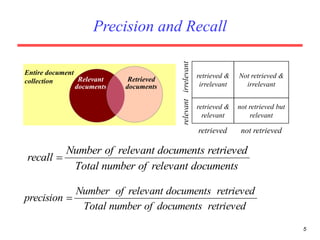
documentsrelevantofnumberTotal
retrieveddocumentsrelevantofNumber
recall 
retrieveddocumentsofnumberTotal
retrieveddocumentsrelevantofNumber
precision 
Relevant
documents
Retrieved
documents
Entire document
collection
retrieved &
relevant
not retrieved but
relevant
retrieved &
irrelevant
Not retrieved &
irrelevant
retrieved not retrieved
relevantirrelevant
Precision and Recall
6
Precision and Recall
• Precision
– The ability to retrieve top-ranked documents
that are mostly relevant.
• Recall
– The ability of the search to find all of the
relevant items in the corpus.
7
Determining Recall is Difficult
• Total number of relevant items is sometimes
not available:
– Sample across the database and perform
relevance judgment on these items.
– Apply different retrieval algorithms to the same
database for the same query. The aggregate of
relevant items is taken as the total relevant set.
8
Trade-off between Recall and Precision
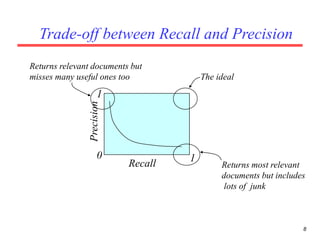
10
1
Recall
Precision
The ideal
Returns relevant documents but
misses many useful ones too
Returns most relevant
documents but includes
lots of junk
9
Computing Recall/Precision Points
• For a given query, produce the ranked list of
retrievals.
• Adjusting a threshold on this ranked list produces
different sets of retrieved documents, and therefore
different recall/precision measures.
• Mark each document in the ranked list that is
relevant according to the gold standard.
• Compute a recall/precision pair for each position
in the ranked list that contains a relevant
document.
10
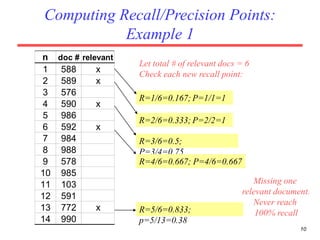
R=3/6=0.5;
P=3/4=0.75
Computing Recall/Precision Points:
Example 1
n doc # relevant
1 588 x
2 589 x
3 576
4 590 x
5 986
6 592 x
7 984
8 988
9 578
10 985
11 103
12 591
13 772 x
14 990
Let total # of relevant docs = 6
Check each new recall point:
R=1/6=0.167; P=1/1=1
R=2/6=0.333; P=2/2=1
R=5/6=0.833;
p=5/13=0.38
R=4/6=0.667; P=4/6=0.667
Missing one
relevant document.
Never reach
100% recall
11
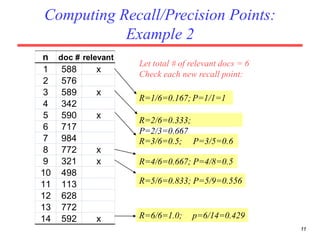
R=3/6=0.5; P=3/5=0.6
Computing Recall/Precision Points:
Example 2
n doc # relevant
1 588 x
2 576
3 589 x
4 342
5 590 x
6 717
7 984
8 772 x
9 321 x
10 498
11 113
12 628
13 772
14 592 x
Let total # of relevant docs = 6
Check each new recall point:
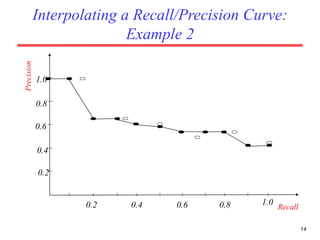
R=1/6=0.167; P=1/1=1
R=2/6=0.333;
P=2/3=0.667
R=6/6=1.0; p=6/14=0.429
R=4/6=0.667; P=4/8=0.5
R=5/6=0.833; P=5/9=0.556
12
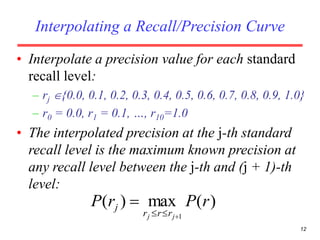
Interpolating a Recall/Precision Curve
• Interpolate a precision value for each standard
recall level:
– rj {0.0, 0.1, 0.2, 0.3, 0.4, 0.5, 0.6, 0.7, 0.8, 0.9, 1.0}
– r0 = 0.0, r1 = 0.1, …, r10=1.0
• The interpolated precision at the j-th standard
recall level is the maximum known precision at
any recall level between the j-th and (j + 1)-th
level:
)(max)(
1
rPrP
jj rrr
j


13
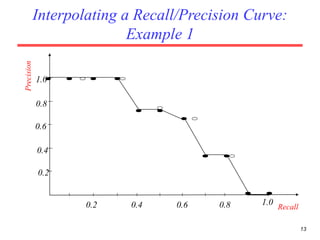
Interpolating a Recall/Precision Curve:
Example 1
0.4 0.8
1.0
0.8
0.6
0.4
0.2
0.2 1.00.6 Recall
Precision
14
Interpolating a Recall/Precision Curve:
Example 2
0.4 0.8
1.0
0.8
0.6
0.4
0.2
0.2 1.00.6 Recall
Precision
15
Average Recall/Precision Curve
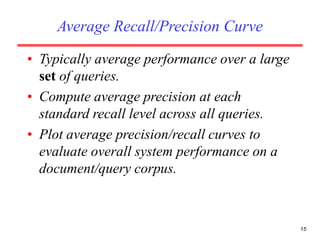
• Typically average performance over a large
set of queries.
• Compute average precision at each
standard recall level across all queries.
• Plot average precision/recall curves to
evaluate overall system performance on a
document/query corpus.
16
Compare Two or More Systems
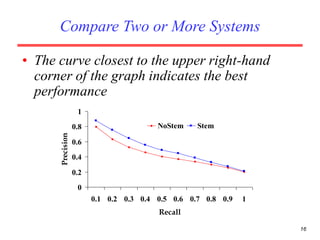
• The curve closest to the upper right-hand
corner of the graph indicates the best
performance
0
0.2
0.4
0.6
0.8
1
0.1 0.2 0.3 0.4 0.5 0.6 0.7 0.8 0.9 1
Recall
Precision
NoStem Stem
17
Sample RP Curve for CF Corpus
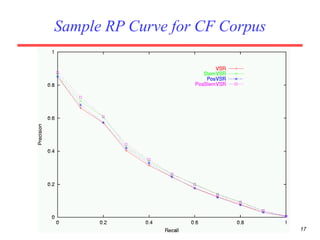
18
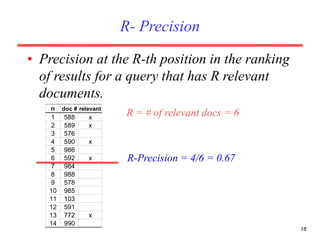
R- Precision
• Precision at the R-th position in the ranking
of results for a query that has R relevant
documents.
n doc # relevant
1 588 x
2 589 x
3 576
4 590 x
5 986
6 592 x
7 984
8 988
9 578
10 985
11 103
12 591
13 772 x
14 990
R = # of relevant docs = 6
R-Precision = 4/6 = 0.67
19
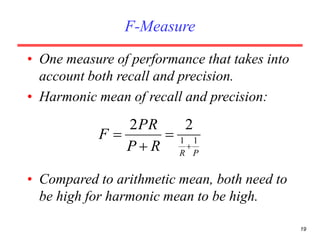
F-Measure
• One measure of performance that takes into
account both recall and precision.
• Harmonic mean of recall and precision:
• Compared to arithmetic mean, both need to
be high for harmonic mean to be high.
PR
RP
PR
F 11
22




20
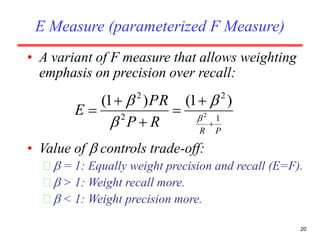
E Measure (parameterized F Measure)
• A variant of F measure that allows weighting
emphasis on precision over recall:
• Value of  controls trade-off:
  = 1: Equally weight precision and recall (E=F).
  > 1: Weight recall more.
  < 1: Weight precision more.
PR
RP
PR
E 1
2
2
2
2
)1()1(





 



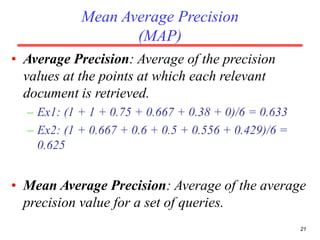
Mean Average Precision
(MAP)
• Average Precision: Average of the precision
values at the points at which each relevant
document is retrieved.
– Ex1: (1 + 1 + 0.75 + 0.667 + 0.38 + 0)/6 = 0.633
– Ex2: (1 + 0.667 + 0.6 + 0.5 + 0.556 + 0.429)/6 =
0.625
• Mean Average Precision: Average of the average
precision value for a set of queries.
21
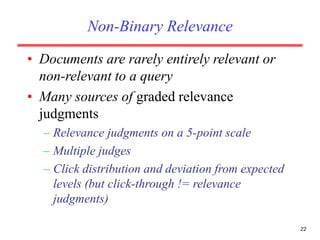
Non-Binary Relevance
• Documents are rarely entirely relevant or
non-relevant to a query
• Many sources of graded relevance
judgments
– Relevance judgments on a 5-point scale
– Multiple judges
– Click distribution and deviation from expected
levels (but click-through != relevance
judgments)
22
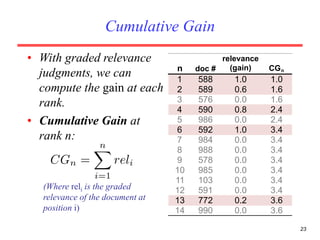
Cumulative Gain
• With graded relevance
judgments, we can
compute the gain at each
rank.
• Cumulative Gain at
rank n:
(Where reli is the graded
relevance of the document at
position i)
23
n doc #
relevance
(gain) CGn
1 588 1.0 1.0
2 589 0.6 1.6
3 576 0.0 1.6
4 590 0.8 2.4
5 986 0.0 2.4
6 592 1.0 3.4
7 984 0.0 3.4
8 988 0.0 3.4
9 578 0.0 3.4
10 985 0.0 3.4
11 103 0.0 3.4
12 591 0.0 3.4
13 772 0.2 3.6
14 990 0.0 3.6
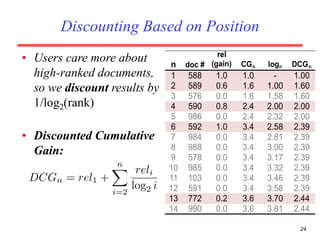
Discounting Based on Position
• Users care more about
high-ranked documents,
so we discount results by
1/log2(rank)
• Discounted Cumulative
Gain:
24
n doc #
rel
(gain) CGn logn DCGn
1 588 1.0 1.0 - 1.00
2 589 0.6 1.6 1.00 1.60
3 576 0.0 1.6 1.58 1.60
4 590 0.8 2.4 2.00 2.00
5 986 0.0 2.4 2.32 2.00
6 592 1.0 3.4 2.58 2.39
7 984 0.0 3.4 2.81 2.39
8 988 0.0 3.4 3.00 2.39
9 578 0.0 3.4 3.17 2.39
10 985 0.0 3.4 3.32 2.39
11 103 0.0 3.4 3.46 2.39
12 591 0.0 3.4 3.58 2.39
13 772 0.2 3.6 3.70 2.44
14 990 0.0 3.6 3.81 2.44
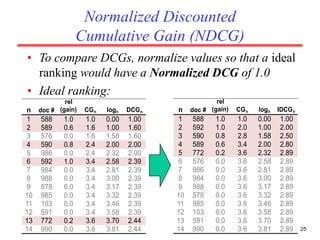
Normalized Discounted
Cumulative Gain (NDCG)
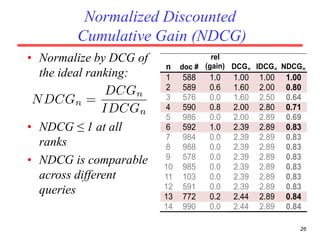
• To compare DCGs, normalize values so that a ideal
ranking would have a Normalized DCG of 1.0
• Ideal ranking:
25
n doc #
rel
(gain) CGn logn DCGn
1 588 1.0 1.0 0.00 1.00
2 589 0.6 1.6 1.00 1.60
3 576 0.0 1.6 1.58 1.60
4 590 0.8 2.4 2.00 2.00
5 986 0.0 2.4 2.32 2.00
6 592 1.0 3.4 2.58 2.39
7 984 0.0 3.4 2.81 2.39
8 988 0.0 3.4 3.00 2.39
9 578 0.0 3.4 3.17 2.39
10 985 0.0 3.4 3.32 2.39
11 103 0.0 3.4 3.46 2.39
12 591 0.0 3.4 3.58 2.39
13 772 0.2 3.6 3.70 2.44
14 990 0.0 3.6 3.81 2.44
n doc #
rel
(gain) CGn logn IDCGn
1 588 1.0 1.0 0.00 1.00
2 592 1.0 2.0 1.00 2.00
3 590 0.8 2.8 1.58 2.50
4 589 0.6 3.4 2.00 2.80
5 772 0.2 3.6 2.32 2.89
6 576 0.0 3.6 2.58 2.89
7 986 0.0 3.6 2.81 2.89
8 984 0.0 3.6 3.00 2.89
9 988 0.0 3.6 3.17 2.89
10 578 0.0 3.6 3.32 2.89
11 985 0.0 3.6 3.46 2.89
12 103 0.0 3.6 3.58 2.89
13 591 0.0 3.6 3.70 2.89
14 990 0.0 3.6 3.81 2.89
Normalized Discounted
Cumulative Gain (NDCG)
• Normalize by DCG of
the ideal ranking:
• NDCG ≤ 1 at all
ranks
• NDCG is comparable
across different
queries
26
n doc #
rel
(gain)
1 588 1.0
2 589 0.6
3 576 0.0
4 590 0.8
5 986 0.0
6 592 1.0
7 984 0.0
8 988 0.0
9 578 0.0
10 985 0.0
11 103 0.0
12 591 0.0
13 772 0.2
14 990 0.0
DCGn IDCGn NDCGn
1.00 1.00 1.00
1.60 2.00 0.80
1.60 2.50 0.64
2.00 2.80 0.71
2.00 2.89 0.69
2.39 2.89 0.83
2.39 2.89 0.83
2.39 2.89 0.83
2.39 2.89 0.83
2.39 2.89 0.83
2.39 2.89 0.83
2.39 2.89 0.83
2.44 2.89 0.84
2.44 2.89 0.84
27
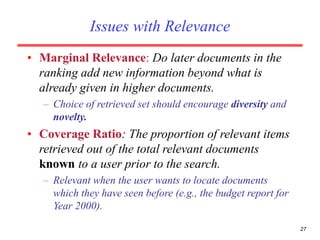
Issues with Relevance
• Marginal Relevance: Do later documents in the
ranking add new information beyond what is
already given in higher documents.
– Choice of retrieved set should encourage diversity and
novelty.
• Coverage Ratio: The proportion of relevant items
retrieved out of the total relevant documents
known to a user prior to the search.
– Relevant when the user wants to locate documents
which they have seen before (e.g., the budget report for
Year 2000).
28
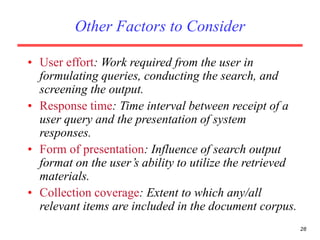
Other Factors to Consider
• User effort: Work required from the user in
formulating queries, conducting the search, and
screening the output.
• Response time: Time interval between receipt of a
user query and the presentation of system
responses.
• Form of presentation: Influence of search output
format on the user’s ability to utilize the retrieved
materials.
• Collection coverage: Extent to which any/all
relevant items are included in the document corpus.
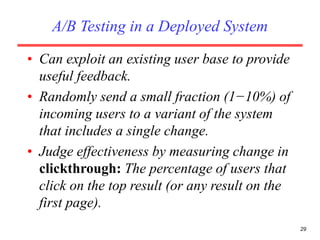
A/B Testing in a Deployed System
• Can exploit an existing user base to provide
useful feedback.
• Randomly send a small fraction (1−10%) of
incoming users to a variant of the system
that includes a single change.
• Judge effectiveness by measuring change in
clickthrough: The percentage of users that
click on the top result (or any result on the
first page).
29
30
Experimental Setup for Benchmarking
• Analytical performance evaluation is difficult for
document retrieval systems because many
characteristics such as relevance, distribution of
words, etc., are difficult to describe with
mathematical precision.
• Performance is measured by benchmarking. That
is, the retrieval effectiveness of a system is
evaluated on a given set of documents, queries, and
relevance judgments.
• Performance data is valid only for the environment
under which the system is evaluated.
31
Benchmarks
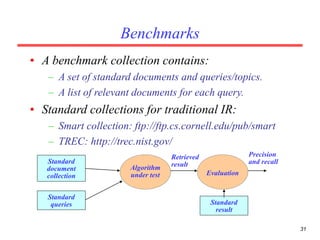
• A benchmark collection contains:
– A set of standard documents and queries/topics.
– A list of relevant documents for each query.
• Standard collections for traditional IR:
– Smart collection: ftp://ftp.cs.cornell.edu/pub/smart
– TREC: http://trec.nist.gov/
Standard
document
collection
Standard
queries
Algorithm
under test Evaluation
Standard
result
Retrieved
result
Precision
and recall
32
Benchmarking  The Problems
• Performance data is valid only for a
particular benchmark.
• Building a benchmark corpus is a difficult
task.
• Benchmark web corpora are just starting to
be developed.
• Benchmark foreign-language corpora are
just starting to be developed.
33
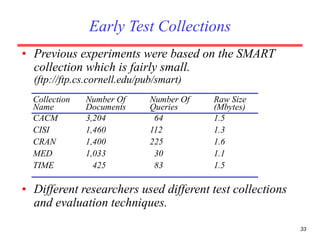
• Previous experiments were based on the SMART
collection which is fairly small.
(ftp://ftp.cs.cornell.edu/pub/smart)
Collection Number Of Number Of Raw Size
Name Documents Queries (Mbytes)
CACM 3,204 64 1.5
CISI 1,460 112 1.3
CRAN 1,400 225 1.6
MED 1,033 30 1.1
TIME 425 83 1.5
• Different researchers used different test collections
and evaluation techniques.
Early Test Collections
34
The TREC Benchmark
• TREC: Text REtrieval Conference (http://trec.nist.gov/)
Originated from the TIPSTER program sponsored by
Defense Advanced Research Projects Agency (DARPA).
• Became an annual conference in 1992, co-sponsored by the
National Institute of Standards and Technology (NIST) and
DARPA.
• Participants submit the P/R values for the final document
and query corpus and present their results at the
conference.
35
TREC Tasks
• Ad hoc: New questions are being asked on a static
set of data.
• Routing: Same questions are being asked, but new
information is being searched. (news clipping,
library profiling).
• New tasks added after TREC 5 - Interactive,
multilingual, natural language, multiple database
merging, filtering, very large corpus (20 GB, 7.5
million documents), question answering.
36
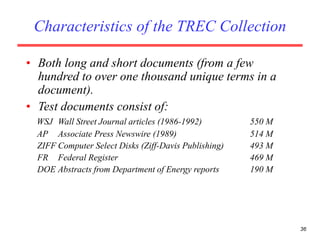
Characteristics of the TREC Collection
• Both long and short documents (from a few
hundred to over one thousand unique terms in a
document).
• Test documents consist of:
WSJ Wall Street Journal articles (1986-1992) 550 M
AP Associate Press Newswire (1989) 514 M
ZIFF Computer Select Disks (Ziff-Davis Publishing) 493 M
FR Federal Register 469 M
DOE Abstracts from Department of Energy reports 190 M
37
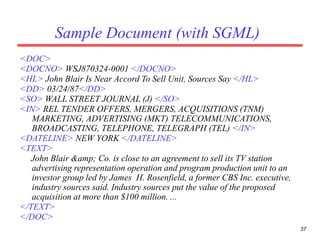
Sample Document (with SGML)
<DOC>
<DOCNO> WSJ870324-0001 </DOCNO>
<HL> John Blair Is Near Accord To Sell Unit, Sources Say </HL>
<DD> 03/24/87</DD>
<SO> WALL STREET JOURNAL (J) </SO>
<IN> REL TENDER OFFERS, MERGERS, ACQUISITIONS (TNM)
MARKETING, ADVERTISING (MKT) TELECOMMUNICATIONS,
BROADCASTING, TELEPHONE, TELEGRAPH (TEL) </IN>
<DATELINE> NEW YORK </DATELINE>
<TEXT>
John Blair &amp; Co. is close to an agreement to sell its TV station
advertising representation operation and program production unit to an
investor group led by James H. Rosenfield, a former CBS Inc. executive,
industry sources said. Industry sources put the value of the proposed
acquisition at more than $100 million. ...
</TEXT>
</DOC>
38
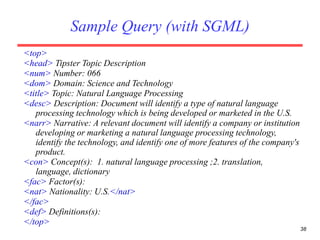
Sample Query (with SGML)
<top>
<head> Tipster Topic Description
<num> Number: 066
<dom> Domain: Science and Technology
<title> Topic: Natural Language Processing
<desc> Description: Document will identify a type of natural language
processing technology which is being developed or marketed in the U.S.
<narr> Narrative: A relevant document will identify a company or institution
developing or marketing a natural language processing technology,
identify the technology, and identify one of more features of the company's
product.
<con> Concept(s): 1. natural language processing ;2. translation,
language, dictionary
<fac> Factor(s):
<nat> Nationality: U.S.</nat>
</fac>
<def> Definitions(s):
</top>
39
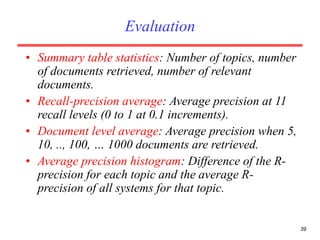
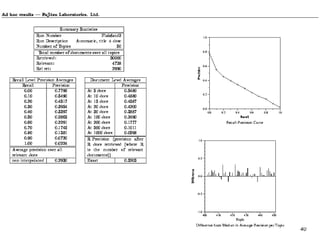
Evaluation
• Summary table statistics: Number of topics, number
of documents retrieved, number of relevant
documents.
• Recall-precision average: Average precision at 11
recall levels (0 to 1 at 0.1 increments).
• Document level average: Average precision when 5,
10, .., 100, … 1000 documents are retrieved.
• Average precision histogram: Difference of the R-
precision for each topic and the average R-
precision of all systems for that topic.
40
41
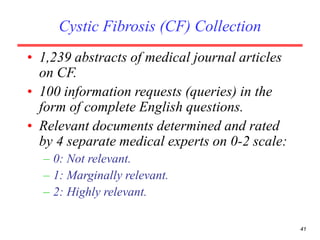
Cystic Fibrosis (CF) Collection
• 1,239 abstracts of medical journal articles
on CF.
• 100 information requests (queries) in the
form of complete English questions.
• Relevant documents determined and rated
by 4 separate medical experts on 0-2 scale:
– 0: Not relevant.
– 1: Marginally relevant.
– 2: Highly relevant.
42
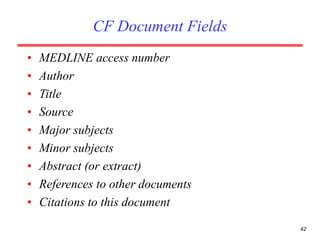
CF Document Fields
• MEDLINE access number
• Author
• Title
• Source
• Major subjects
• Minor subjects
• Abstract (or extract)
• References to other documents
• Citations to this document
43
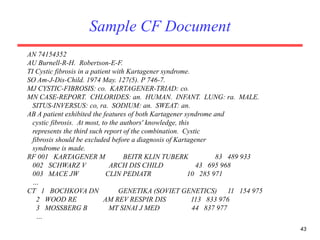
Sample CF Document
AN 74154352
AU Burnell-R-H. Robertson-E-F.
TI Cystic fibrosis in a patient with Kartagener syndrome.
SO Am-J-Dis-Child. 1974 May. 127(5). P 746-7.
MJ CYSTIC-FIBROSIS: co. KARTAGENER-TRIAD: co.
MN CASE-REPORT. CHLORIDES: an. HUMAN. INFANT. LUNG: ra. MALE.
SITUS-INVERSUS: co, ra. SODIUM: an. SWEAT: an.
AB A patient exhibited the features of both Kartagener syndrome and
cystic fibrosis. At most, to the authors' knowledge, this
represents the third such report of the combination. Cystic
fibrosis should be excluded before a diagnosis of Kartagener
syndrome is made.
RF 001 KARTAGENER M BEITR KLIN TUBERK 83 489 933
002 SCHWARZ V ARCH DIS CHILD 43 695 968
003 MACE JW CLIN PEDIATR 10 285 971
…
CT 1 BOCHKOVA DN GENETIKA (SOVIET GENETICS) 11 154 975
2 WOOD RE AM REV RESPIR DIS 113 833 976
3 MOSSBERG B MT SINAI J MED 44 837 977
…
44
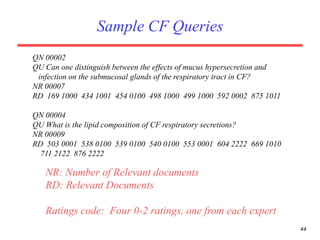
Sample CF Queries
QN 00002
QU Can one distinguish between the effects of mucus hypersecretion and
infection on the submucosal glands of the respiratory tract in CF?
NR 00007
RD 169 1000 434 1001 454 0100 498 1000 499 1000 592 0002 875 1011
QN 00004
QU What is the lipid composition of CF respiratory secretions?
NR 00009
RD 503 0001 538 0100 539 0100 540 0100 553 0001 604 2222 669 1010
711 2122 876 2222
NR: Number of Relevant documents
RD: Relevant Documents
Ratings code: Four 0-2 ratings, one from each expert
45
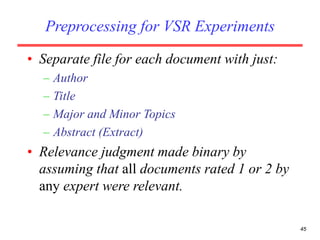
Preprocessing for VSR Experiments
• Separate file for each document with just:
– Author
– Title
– Major and Minor Topics
– Abstract (Extract)
• Relevance judgment made binary by
assuming that all documents rated 1 or 2 by
any expert were relevant.

Performance evaluation of IR models

  • 1.
    1 Performance Evaluation of InformationRetrieval Systems Many slides in this section are adapted from Prof. Joydeep Ghosh (UT ECE) who in turn adapted them from Prof. Dik Lee (Univ. of Science and Tech, Hong Kong)
  • 2.
    2 Why System Evaluation? •There are many retrieval models/ algorithms/ systems, which one is the best? • What is the best component for: – Ranking function (dot-product, cosine, …) – Term selection (stopword removal, stemming…) – Term weighting (TF, TF-IDF,…) • How far down the ranked list will a user need to look to find some/all relevant documents?
  • 3.
    3 Difficulties in EvaluatingIR Systems • Effectiveness is related to the relevancy of retrieved items. • Relevancy is not typically binary but continuous. • Even if relevancy is binary, it can be a difficult judgment to make. • Relevancy, from a human standpoint, is: – Subjective: Depends upon a specific user’s judgment. – Situational: Relates to user’s current needs. – Cognitive: Depends on human perception and behavior. – Dynamic: Changes over time.
  • 4.
    4 Human Labeled Corpora (GoldStandard) • Start with a corpus of documents. • Collect a set of queries for this corpus. • Have one or more human experts exhaustively label the relevant documents for each query. • Typically assumes binary relevance judgments. • Requires considerable human effort for large document/query corpora.
  • 5.
    5 documentsrelevantofnumberTotal retrieveddocumentsrelevantofNumber recall  retrieveddocumentsofnumberTotal retrieveddocumentsrelevantofNumber precision  Relevant documents Retrieved documents Entiredocument collection retrieved & relevant not retrieved but relevant retrieved & irrelevant Not retrieved & irrelevant retrieved not retrieved relevantirrelevant Precision and Recall
  • 6.
    6 Precision and Recall •Precision – The ability to retrieve top-ranked documents that are mostly relevant. • Recall – The ability of the search to find all of the relevant items in the corpus.
  • 7.
    7 Determining Recall isDifficult • Total number of relevant items is sometimes not available: – Sample across the database and perform relevance judgment on these items. – Apply different retrieval algorithms to the same database for the same query. The aggregate of relevant items is taken as the total relevant set.
  • 8.
    8 Trade-off between Recalland Precision 10 1 Recall Precision The ideal Returns relevant documents but misses many useful ones too Returns most relevant documents but includes lots of junk
  • 9.
    9 Computing Recall/Precision Points •For a given query, produce the ranked list of retrievals. • Adjusting a threshold on this ranked list produces different sets of retrieved documents, and therefore different recall/precision measures. • Mark each document in the ranked list that is relevant according to the gold standard. • Compute a recall/precision pair for each position in the ranked list that contains a relevant document.
  • 10.
    10 R=3/6=0.5; P=3/4=0.75 Computing Recall/Precision Points: Example1 n doc # relevant 1 588 x 2 589 x 3 576 4 590 x 5 986 6 592 x 7 984 8 988 9 578 10 985 11 103 12 591 13 772 x 14 990 Let total # of relevant docs = 6 Check each new recall point: R=1/6=0.167; P=1/1=1 R=2/6=0.333; P=2/2=1 R=5/6=0.833; p=5/13=0.38 R=4/6=0.667; P=4/6=0.667 Missing one relevant document. Never reach 100% recall
  • 11.
    11 R=3/6=0.5; P=3/5=0.6 Computing Recall/PrecisionPoints: Example 2 n doc # relevant 1 588 x 2 576 3 589 x 4 342 5 590 x 6 717 7 984 8 772 x 9 321 x 10 498 11 113 12 628 13 772 14 592 x Let total # of relevant docs = 6 Check each new recall point: R=1/6=0.167; P=1/1=1 R=2/6=0.333; P=2/3=0.667 R=6/6=1.0; p=6/14=0.429 R=4/6=0.667; P=4/8=0.5 R=5/6=0.833; P=5/9=0.556
  • 12.
    12 Interpolating a Recall/PrecisionCurve • Interpolate a precision value for each standard recall level: – rj {0.0, 0.1, 0.2, 0.3, 0.4, 0.5, 0.6, 0.7, 0.8, 0.9, 1.0} – r0 = 0.0, r1 = 0.1, …, r10=1.0 • The interpolated precision at the j-th standard recall level is the maximum known precision at any recall level between the j-th and (j + 1)-th level: )(max)( 1 rPrP jj rrr j  
  • 13.
    13 Interpolating a Recall/PrecisionCurve: Example 1 0.4 0.8 1.0 0.8 0.6 0.4 0.2 0.2 1.00.6 Recall Precision
  • 14.
    14 Interpolating a Recall/PrecisionCurve: Example 2 0.4 0.8 1.0 0.8 0.6 0.4 0.2 0.2 1.00.6 Recall Precision
  • 15.
    15 Average Recall/Precision Curve •Typically average performance over a large set of queries. • Compute average precision at each standard recall level across all queries. • Plot average precision/recall curves to evaluate overall system performance on a document/query corpus.
  • 16.
    16 Compare Two orMore Systems • The curve closest to the upper right-hand corner of the graph indicates the best performance 0 0.2 0.4 0.6 0.8 1 0.1 0.2 0.3 0.4 0.5 0.6 0.7 0.8 0.9 1 Recall Precision NoStem Stem
  • 17.
    17 Sample RP Curvefor CF Corpus
  • 18.
    18 R- Precision • Precisionat the R-th position in the ranking of results for a query that has R relevant documents. n doc # relevant 1 588 x 2 589 x 3 576 4 590 x 5 986 6 592 x 7 984 8 988 9 578 10 985 11 103 12 591 13 772 x 14 990 R = # of relevant docs = 6 R-Precision = 4/6 = 0.67
  • 19.
    19 F-Measure • One measureof performance that takes into account both recall and precision. • Harmonic mean of recall and precision: • Compared to arithmetic mean, both need to be high for harmonic mean to be high. PR RP PR F 11 22    
  • 20.
    20 E Measure (parameterizedF Measure) • A variant of F measure that allows weighting emphasis on precision over recall: • Value of  controls trade-off:   = 1: Equally weight precision and recall (E=F).   > 1: Weight recall more.   < 1: Weight precision more. PR RP PR E 1 2 2 2 2 )1()1(          
  • 21.
    Mean Average Precision (MAP) •Average Precision: Average of the precision values at the points at which each relevant document is retrieved. – Ex1: (1 + 1 + 0.75 + 0.667 + 0.38 + 0)/6 = 0.633 – Ex2: (1 + 0.667 + 0.6 + 0.5 + 0.556 + 0.429)/6 = 0.625 • Mean Average Precision: Average of the average precision value for a set of queries. 21
  • 22.
    Non-Binary Relevance • Documentsare rarely entirely relevant or non-relevant to a query • Many sources of graded relevance judgments – Relevance judgments on a 5-point scale – Multiple judges – Click distribution and deviation from expected levels (but click-through != relevance judgments) 22
  • 23.
    Cumulative Gain • Withgraded relevance judgments, we can compute the gain at each rank. • Cumulative Gain at rank n: (Where reli is the graded relevance of the document at position i) 23 n doc # relevance (gain) CGn 1 588 1.0 1.0 2 589 0.6 1.6 3 576 0.0 1.6 4 590 0.8 2.4 5 986 0.0 2.4 6 592 1.0 3.4 7 984 0.0 3.4 8 988 0.0 3.4 9 578 0.0 3.4 10 985 0.0 3.4 11 103 0.0 3.4 12 591 0.0 3.4 13 772 0.2 3.6 14 990 0.0 3.6
  • 24.
    Discounting Based onPosition • Users care more about high-ranked documents, so we discount results by 1/log2(rank) • Discounted Cumulative Gain: 24 n doc # rel (gain) CGn logn DCGn 1 588 1.0 1.0 - 1.00 2 589 0.6 1.6 1.00 1.60 3 576 0.0 1.6 1.58 1.60 4 590 0.8 2.4 2.00 2.00 5 986 0.0 2.4 2.32 2.00 6 592 1.0 3.4 2.58 2.39 7 984 0.0 3.4 2.81 2.39 8 988 0.0 3.4 3.00 2.39 9 578 0.0 3.4 3.17 2.39 10 985 0.0 3.4 3.32 2.39 11 103 0.0 3.4 3.46 2.39 12 591 0.0 3.4 3.58 2.39 13 772 0.2 3.6 3.70 2.44 14 990 0.0 3.6 3.81 2.44
  • 25.
    Normalized Discounted Cumulative Gain(NDCG) • To compare DCGs, normalize values so that a ideal ranking would have a Normalized DCG of 1.0 • Ideal ranking: 25 n doc # rel (gain) CGn logn DCGn 1 588 1.0 1.0 0.00 1.00 2 589 0.6 1.6 1.00 1.60 3 576 0.0 1.6 1.58 1.60 4 590 0.8 2.4 2.00 2.00 5 986 0.0 2.4 2.32 2.00 6 592 1.0 3.4 2.58 2.39 7 984 0.0 3.4 2.81 2.39 8 988 0.0 3.4 3.00 2.39 9 578 0.0 3.4 3.17 2.39 10 985 0.0 3.4 3.32 2.39 11 103 0.0 3.4 3.46 2.39 12 591 0.0 3.4 3.58 2.39 13 772 0.2 3.6 3.70 2.44 14 990 0.0 3.6 3.81 2.44 n doc # rel (gain) CGn logn IDCGn 1 588 1.0 1.0 0.00 1.00 2 592 1.0 2.0 1.00 2.00 3 590 0.8 2.8 1.58 2.50 4 589 0.6 3.4 2.00 2.80 5 772 0.2 3.6 2.32 2.89 6 576 0.0 3.6 2.58 2.89 7 986 0.0 3.6 2.81 2.89 8 984 0.0 3.6 3.00 2.89 9 988 0.0 3.6 3.17 2.89 10 578 0.0 3.6 3.32 2.89 11 985 0.0 3.6 3.46 2.89 12 103 0.0 3.6 3.58 2.89 13 591 0.0 3.6 3.70 2.89 14 990 0.0 3.6 3.81 2.89
  • 26.
    Normalized Discounted Cumulative Gain(NDCG) • Normalize by DCG of the ideal ranking: • NDCG ≤ 1 at all ranks • NDCG is comparable across different queries 26 n doc # rel (gain) 1 588 1.0 2 589 0.6 3 576 0.0 4 590 0.8 5 986 0.0 6 592 1.0 7 984 0.0 8 988 0.0 9 578 0.0 10 985 0.0 11 103 0.0 12 591 0.0 13 772 0.2 14 990 0.0 DCGn IDCGn NDCGn 1.00 1.00 1.00 1.60 2.00 0.80 1.60 2.50 0.64 2.00 2.80 0.71 2.00 2.89 0.69 2.39 2.89 0.83 2.39 2.89 0.83 2.39 2.89 0.83 2.39 2.89 0.83 2.39 2.89 0.83 2.39 2.89 0.83 2.39 2.89 0.83 2.44 2.89 0.84 2.44 2.89 0.84
  • 27.
    27 Issues with Relevance •Marginal Relevance: Do later documents in the ranking add new information beyond what is already given in higher documents. – Choice of retrieved set should encourage diversity and novelty. • Coverage Ratio: The proportion of relevant items retrieved out of the total relevant documents known to a user prior to the search. – Relevant when the user wants to locate documents which they have seen before (e.g., the budget report for Year 2000).
  • 28.
    28 Other Factors toConsider • User effort: Work required from the user in formulating queries, conducting the search, and screening the output. • Response time: Time interval between receipt of a user query and the presentation of system responses. • Form of presentation: Influence of search output format on the user’s ability to utilize the retrieved materials. • Collection coverage: Extent to which any/all relevant items are included in the document corpus.
  • 29.
    A/B Testing ina Deployed System • Can exploit an existing user base to provide useful feedback. • Randomly send a small fraction (1−10%) of incoming users to a variant of the system that includes a single change. • Judge effectiveness by measuring change in clickthrough: The percentage of users that click on the top result (or any result on the first page). 29
  • 30.
    30 Experimental Setup forBenchmarking • Analytical performance evaluation is difficult for document retrieval systems because many characteristics such as relevance, distribution of words, etc., are difficult to describe with mathematical precision. • Performance is measured by benchmarking. That is, the retrieval effectiveness of a system is evaluated on a given set of documents, queries, and relevance judgments. • Performance data is valid only for the environment under which the system is evaluated.
  • 31.
    31 Benchmarks • A benchmarkcollection contains: – A set of standard documents and queries/topics. – A list of relevant documents for each query. • Standard collections for traditional IR: – Smart collection: ftp://ftp.cs.cornell.edu/pub/smart – TREC: http://trec.nist.gov/ Standard document collection Standard queries Algorithm under test Evaluation Standard result Retrieved result Precision and recall
  • 32.
    32 Benchmarking  TheProblems • Performance data is valid only for a particular benchmark. • Building a benchmark corpus is a difficult task. • Benchmark web corpora are just starting to be developed. • Benchmark foreign-language corpora are just starting to be developed.
  • 33.
    33 • Previous experimentswere based on the SMART collection which is fairly small. (ftp://ftp.cs.cornell.edu/pub/smart) Collection Number Of Number Of Raw Size Name Documents Queries (Mbytes) CACM 3,204 64 1.5 CISI 1,460 112 1.3 CRAN 1,400 225 1.6 MED 1,033 30 1.1 TIME 425 83 1.5 • Different researchers used different test collections and evaluation techniques. Early Test Collections
  • 34.
    34 The TREC Benchmark •TREC: Text REtrieval Conference (http://trec.nist.gov/) Originated from the TIPSTER program sponsored by Defense Advanced Research Projects Agency (DARPA). • Became an annual conference in 1992, co-sponsored by the National Institute of Standards and Technology (NIST) and DARPA. • Participants submit the P/R values for the final document and query corpus and present their results at the conference.
  • 35.
    35 TREC Tasks • Adhoc: New questions are being asked on a static set of data. • Routing: Same questions are being asked, but new information is being searched. (news clipping, library profiling). • New tasks added after TREC 5 - Interactive, multilingual, natural language, multiple database merging, filtering, very large corpus (20 GB, 7.5 million documents), question answering.
  • 36.
    36 Characteristics of theTREC Collection • Both long and short documents (from a few hundred to over one thousand unique terms in a document). • Test documents consist of: WSJ Wall Street Journal articles (1986-1992) 550 M AP Associate Press Newswire (1989) 514 M ZIFF Computer Select Disks (Ziff-Davis Publishing) 493 M FR Federal Register 469 M DOE Abstracts from Department of Energy reports 190 M
  • 37.
    37 Sample Document (withSGML) <DOC> <DOCNO> WSJ870324-0001 </DOCNO> <HL> John Blair Is Near Accord To Sell Unit, Sources Say </HL> <DD> 03/24/87</DD> <SO> WALL STREET JOURNAL (J) </SO> <IN> REL TENDER OFFERS, MERGERS, ACQUISITIONS (TNM) MARKETING, ADVERTISING (MKT) TELECOMMUNICATIONS, BROADCASTING, TELEPHONE, TELEGRAPH (TEL) </IN> <DATELINE> NEW YORK </DATELINE> <TEXT> John Blair &amp; Co. is close to an agreement to sell its TV station advertising representation operation and program production unit to an investor group led by James H. Rosenfield, a former CBS Inc. executive, industry sources said. Industry sources put the value of the proposed acquisition at more than $100 million. ... </TEXT> </DOC>
  • 38.
    38 Sample Query (withSGML) <top> <head> Tipster Topic Description <num> Number: 066 <dom> Domain: Science and Technology <title> Topic: Natural Language Processing <desc> Description: Document will identify a type of natural language processing technology which is being developed or marketed in the U.S. <narr> Narrative: A relevant document will identify a company or institution developing or marketing a natural language processing technology, identify the technology, and identify one of more features of the company's product. <con> Concept(s): 1. natural language processing ;2. translation, language, dictionary <fac> Factor(s): <nat> Nationality: U.S.</nat> </fac> <def> Definitions(s): </top>
  • 39.
    39 Evaluation • Summary tablestatistics: Number of topics, number of documents retrieved, number of relevant documents. • Recall-precision average: Average precision at 11 recall levels (0 to 1 at 0.1 increments). • Document level average: Average precision when 5, 10, .., 100, … 1000 documents are retrieved. • Average precision histogram: Difference of the R- precision for each topic and the average R- precision of all systems for that topic.
  • 40.
  • 41.
    41 Cystic Fibrosis (CF)Collection • 1,239 abstracts of medical journal articles on CF. • 100 information requests (queries) in the form of complete English questions. • Relevant documents determined and rated by 4 separate medical experts on 0-2 scale: – 0: Not relevant. – 1: Marginally relevant. – 2: Highly relevant.
  • 42.
    42 CF Document Fields •MEDLINE access number • Author • Title • Source • Major subjects • Minor subjects • Abstract (or extract) • References to other documents • Citations to this document
  • 43.
    43 Sample CF Document AN74154352 AU Burnell-R-H. Robertson-E-F. TI Cystic fibrosis in a patient with Kartagener syndrome. SO Am-J-Dis-Child. 1974 May. 127(5). P 746-7. MJ CYSTIC-FIBROSIS: co. KARTAGENER-TRIAD: co. MN CASE-REPORT. CHLORIDES: an. HUMAN. INFANT. LUNG: ra. MALE. SITUS-INVERSUS: co, ra. SODIUM: an. SWEAT: an. AB A patient exhibited the features of both Kartagener syndrome and cystic fibrosis. At most, to the authors' knowledge, this represents the third such report of the combination. Cystic fibrosis should be excluded before a diagnosis of Kartagener syndrome is made. RF 001 KARTAGENER M BEITR KLIN TUBERK 83 489 933 002 SCHWARZ V ARCH DIS CHILD 43 695 968 003 MACE JW CLIN PEDIATR 10 285 971 … CT 1 BOCHKOVA DN GENETIKA (SOVIET GENETICS) 11 154 975 2 WOOD RE AM REV RESPIR DIS 113 833 976 3 MOSSBERG B MT SINAI J MED 44 837 977 …
  • 44.
    44 Sample CF Queries QN00002 QU Can one distinguish between the effects of mucus hypersecretion and infection on the submucosal glands of the respiratory tract in CF? NR 00007 RD 169 1000 434 1001 454 0100 498 1000 499 1000 592 0002 875 1011 QN 00004 QU What is the lipid composition of CF respiratory secretions? NR 00009 RD 503 0001 538 0100 539 0100 540 0100 553 0001 604 2222 669 1010 711 2122 876 2222 NR: Number of Relevant documents RD: Relevant Documents Ratings code: Four 0-2 ratings, one from each expert
  • 45.
    45 Preprocessing for VSRExperiments • Separate file for each document with just: – Author – Title – Major and Minor Topics – Abstract (Extract) • Relevance judgment made binary by assuming that all documents rated 1 or 2 by any expert were relevant.