Retrieval Evaluation
by
Dr Wareesa Sharif
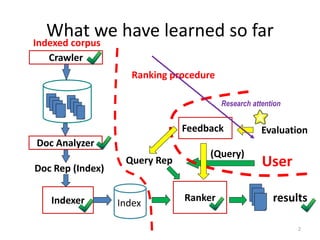
What we have learned so far
2
User
results
Query Rep
Doc Rep (Index)
Ranker
Indexer
Doc Analyzer
Index
Crawler
(Query)
Evaluation
Feedback
Indexed corpus
Ranking procedure
Research attention
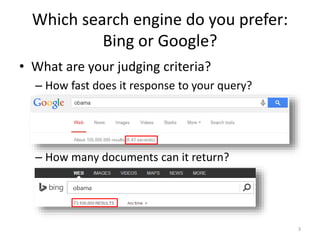
Which search engine do you prefer:
Bing or Google?
• What are your judging criteria?
– How fast does it response to your query?
– How many documents can it return?
3
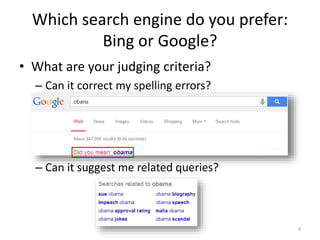
Which search engine do you prefer:
Bing or Google?
• What are your judging criteria?
– Can it correct my spelling errors?
– Can it suggest me related queries?
4
Retrieval evaluation
• Aforementioned evaluation criteria are all
good, but not essential
– Goal of any IR system
• Satisfying users’ information need
– Core quality measure criterion
• “how well a system meets the information needs of its
users.” – wiki
• Unfortunately vague and hard to execute
5
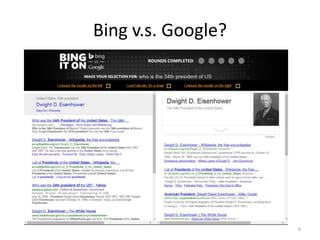
Bing v.s. Google?
6
Quantify the IR quality measure
• Information need
– “an individual or group's desire to locate and
obtain information to satisfy a conscious or
unconscious need” – wiki
– Reflected by user query
– Categorization of information need
• Navigational
• Informational
• Transactional
7
Quantify the IR quality measure
• Satisfaction
– “the opinion of the user about a specific computer
application, which they use” – wiki
– Reflected by
• Increased result clicks
• Repeated/increased visits
• Result relevance
8
Classical IR evaluation
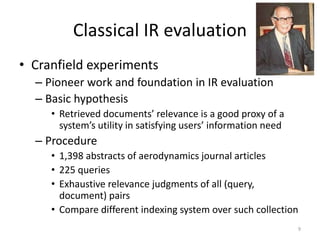
• Cranfield experiments
– Pioneer work and foundation in IR evaluation
– Basic hypothesis
• Retrieved documents’ relevance is a good proxy of a
system’s utility in satisfying users’ information need
– Procedure
• 1,398 abstracts of aerodynamics journal articles
• 225 queries
• Exhaustive relevance judgments of all (query,
document) pairs
• Compare different indexing system over such collection
9
Classical IR evaluation
• Three key elements for IR evaluation
1. A document collection
2. A test suite of information needs, expressible as
queries
3. A set of relevance judgments, e.g., binary
assessment of either relevant or nonrelevant for
each query-document pair
10
Search relevance
• Users’ information needs are translated into
queries
• Relevance is judged with respect to the
information need, not the query
– E.g., Information need: “When should I renew my
Virginia driver’s license?”
Query: “Virginia driver’s license renewal”
Judgment: whether a document contains the right
answer, e.g., every 8 years; rather than if it literally
contains those four words
11
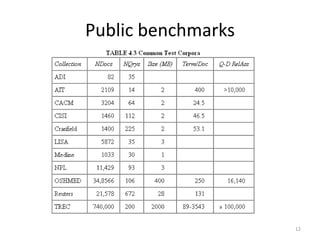
Public benchmarks
12
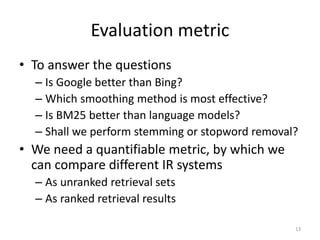
Evaluation metric
• To answer the questions
– Is Google better than Bing?
– Which smoothing method is most effective?
– Is BM25 better than language models?
– Shall we perform stemming or stopword removal?
• We need a quantifiable metric, by which we
can compare different IR systems
– As unranked retrieval sets
– As ranked retrieval results
13
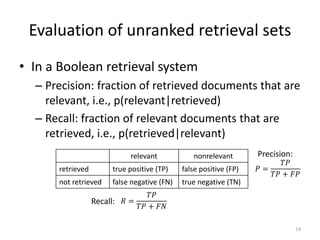
Evaluation of unranked retrieval sets
• In a Boolean retrieval system
– Precision: fraction of retrieved documents that are
relevant, i.e., p(relevant|retrieved)
– Recall: fraction of relevant documents that are
retrieved, i.e., p(retrieved|relevant)
relevant nonrelevant
retrieved true positive (TP) false positive (FP)
not retrieved false negative (FN) true negative (TN)
𝑅 =
𝑇𝑃
𝑇𝑃 + 𝐹𝑁
Recall:
𝑃 =
𝑇𝑃
𝑇𝑃 + 𝐹𝑃
Precision:
14
Evaluation of unranked retrieval sets
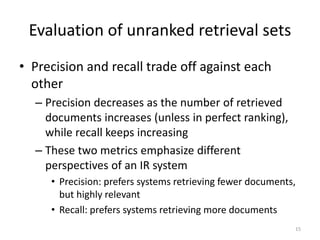
• Precision and recall trade off against each
other
– Precision decreases as the number of retrieved
documents increases (unless in perfect ranking),
while recall keeps increasing
– These two metrics emphasize different
perspectives of an IR system
• Precision: prefers systems retrieving fewer documents,
but highly relevant
• Recall: prefers systems retrieving more documents
15
Evaluation of unranked retrieval sets
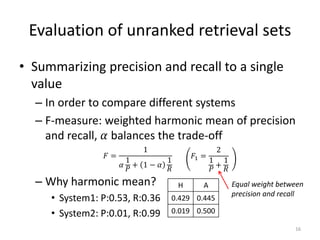
• Summarizing precision and recall to a single
value
– In order to compare different systems
– F-measure: weighted harmonic mean of precision
and recall, 𝛼 balances the trade-off
– Why harmonic mean?
• System1: P:0.53, R:0.36
• System2: P:0.01, R:0.99
𝐹 =
1
𝛼
1
𝑃
+ 1 − 𝛼
1
𝑅
𝐹1 =
2
1
𝑃 +
1
𝑅
Equal weight between
precision and recall
16
H A
0.429 0.445
0.019 0.500
Evaluation of ranked retrieval results
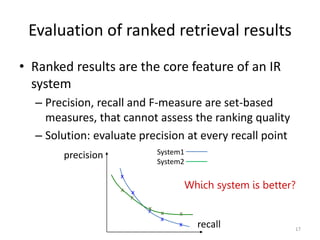
• Ranked results are the core feature of an IR
system
– Precision, recall and F-measure are set-based
measures, that cannot assess the ranking quality
– Solution: evaluate precision at every recall point
Which system is better?
x
precision
recall
x
x
x
x
System1
System2
x
x
x
x
x
17
0.0
0.2
0.4
0.6
0.8
1.0
0.0 0.2 0.4 0.6 0.8 1.0
Precision
Recall
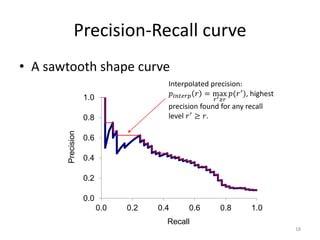
Precision-Recall curve
• A sawtooth shape curve
Interpolated precision:
𝑝𝑖𝑛𝑡𝑒𝑟𝑝 𝑟 = max
𝑟′≥𝑟
𝑝(𝑟′), highest
precision found for any recall
level 𝑟′ ≥ 𝑟.
18
Evaluation of ranked retrieval results
• Summarize the ranking performance with a
single number
– Binary relevance
• Eleven-point interpolated average precision
• Precision@K (P@K)
• Mean Average Precision (MAP)
• Mean Reciprocal Rank (MRR)
– Multiple grades of relevance
• Normalized Discounted Cumulative Gain (NDCG)
19
0
0.2
0.4
0.6
0.8
1
0 0.2 0.4 0.6 0.8 1
Precision
Recall
Eleven-point interpolated average precision
• At the 11 recall levels [0,0.1,0.2,…,1.0],
compute arithmetic mean of interpolated
precision over all the queries
20
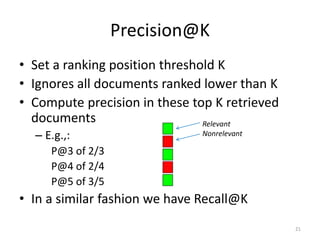
Precision@K
• Set a ranking position threshold K
• Ignores all documents ranked lower than K
• Compute precision in these top K retrieved
documents
– E.g.,:
P@3 of 2/3
P@4 of 2/4
P@5 of 3/5
• In a similar fashion we have Recall@K
Relevant
Nonrelevant
21
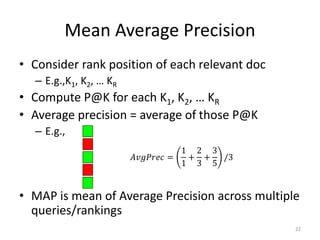
Mean Average Precision
• Consider rank position of each relevant doc
– E.g.,K1, K2, … KR
• Compute P@K for each K1, K2, … KR
• Average precision = average of those P@K
– E.g.,
• MAP is mean of Average Precision across multiple
queries/rankings
𝐴𝑣𝑔𝑃𝑟𝑒𝑐 =
1
1
+
2
3
+
3
5
/3
22
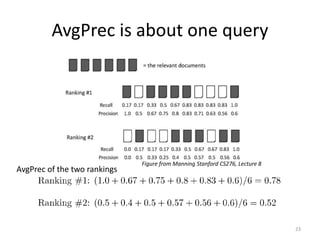
AvgPrec is about one query
23
Figure from Manning Stanford CS276, Lecture 8
AvgPrec of the two rankings
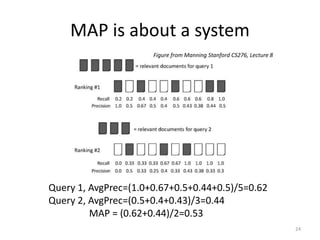
MAP is about a system
Figure from Manning Stanford CS276, Lecture 8
Query 1, AvgPrec=(1.0+0.67+0.5+0.44+0.5)/5=0.62
Query 2, AvgPrec=(0.5+0.4+0.43)/3=0.44
MAP = (0.62+0.44)/2=0.53
24
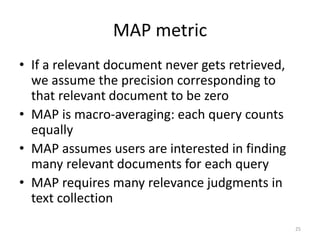
MAP metric
• If a relevant document never gets retrieved,
we assume the precision corresponding to
that relevant document to be zero
• MAP is macro-averaging: each query counts
equally
• MAP assumes users are interested in finding
many relevant documents for each query
• MAP requires many relevance judgments in
text collection
25
Thanx
26

Lecture 10- Information Retrieval Evaluation.pptx

  • 1.
  • 2.
    What we havelearned so far 2 User results Query Rep Doc Rep (Index) Ranker Indexer Doc Analyzer Index Crawler (Query) Evaluation Feedback Indexed corpus Ranking procedure Research attention
  • 3.
    Which search enginedo you prefer: Bing or Google? • What are your judging criteria? – How fast does it response to your query? – How many documents can it return? 3
  • 4.
    Which search enginedo you prefer: Bing or Google? • What are your judging criteria? – Can it correct my spelling errors? – Can it suggest me related queries? 4
  • 5.
    Retrieval evaluation • Aforementionedevaluation criteria are all good, but not essential – Goal of any IR system • Satisfying users’ information need – Core quality measure criterion • “how well a system meets the information needs of its users.” – wiki • Unfortunately vague and hard to execute 5
  • 6.
  • 7.
    Quantify the IRquality measure • Information need – “an individual or group's desire to locate and obtain information to satisfy a conscious or unconscious need” – wiki – Reflected by user query – Categorization of information need • Navigational • Informational • Transactional 7
  • 8.
    Quantify the IRquality measure • Satisfaction – “the opinion of the user about a specific computer application, which they use” – wiki – Reflected by • Increased result clicks • Repeated/increased visits • Result relevance 8
  • 9.
    Classical IR evaluation •Cranfield experiments – Pioneer work and foundation in IR evaluation – Basic hypothesis • Retrieved documents’ relevance is a good proxy of a system’s utility in satisfying users’ information need – Procedure • 1,398 abstracts of aerodynamics journal articles • 225 queries • Exhaustive relevance judgments of all (query, document) pairs • Compare different indexing system over such collection 9
  • 10.
    Classical IR evaluation •Three key elements for IR evaluation 1. A document collection 2. A test suite of information needs, expressible as queries 3. A set of relevance judgments, e.g., binary assessment of either relevant or nonrelevant for each query-document pair 10
  • 11.
    Search relevance • Users’information needs are translated into queries • Relevance is judged with respect to the information need, not the query – E.g., Information need: “When should I renew my Virginia driver’s license?” Query: “Virginia driver’s license renewal” Judgment: whether a document contains the right answer, e.g., every 8 years; rather than if it literally contains those four words 11
  • 12.
  • 13.
    Evaluation metric • Toanswer the questions – Is Google better than Bing? – Which smoothing method is most effective? – Is BM25 better than language models? – Shall we perform stemming or stopword removal? • We need a quantifiable metric, by which we can compare different IR systems – As unranked retrieval sets – As ranked retrieval results 13
  • 14.
    Evaluation of unrankedretrieval sets • In a Boolean retrieval system – Precision: fraction of retrieved documents that are relevant, i.e., p(relevant|retrieved) – Recall: fraction of relevant documents that are retrieved, i.e., p(retrieved|relevant) relevant nonrelevant retrieved true positive (TP) false positive (FP) not retrieved false negative (FN) true negative (TN) 𝑅 = 𝑇𝑃 𝑇𝑃 + 𝐹𝑁 Recall: 𝑃 = 𝑇𝑃 𝑇𝑃 + 𝐹𝑃 Precision: 14
  • 15.
    Evaluation of unrankedretrieval sets • Precision and recall trade off against each other – Precision decreases as the number of retrieved documents increases (unless in perfect ranking), while recall keeps increasing – These two metrics emphasize different perspectives of an IR system • Precision: prefers systems retrieving fewer documents, but highly relevant • Recall: prefers systems retrieving more documents 15
  • 16.
    Evaluation of unrankedretrieval sets • Summarizing precision and recall to a single value – In order to compare different systems – F-measure: weighted harmonic mean of precision and recall, 𝛼 balances the trade-off – Why harmonic mean? • System1: P:0.53, R:0.36 • System2: P:0.01, R:0.99 𝐹 = 1 𝛼 1 𝑃 + 1 − 𝛼 1 𝑅 𝐹1 = 2 1 𝑃 + 1 𝑅 Equal weight between precision and recall 16 H A 0.429 0.445 0.019 0.500
  • 17.
    Evaluation of rankedretrieval results • Ranked results are the core feature of an IR system – Precision, recall and F-measure are set-based measures, that cannot assess the ranking quality – Solution: evaluate precision at every recall point Which system is better? x precision recall x x x x System1 System2 x x x x x 17
  • 18.
    0.0 0.2 0.4 0.6 0.8 1.0 0.0 0.2 0.40.6 0.8 1.0 Precision Recall Precision-Recall curve • A sawtooth shape curve Interpolated precision: 𝑝𝑖𝑛𝑡𝑒𝑟𝑝 𝑟 = max 𝑟′≥𝑟 𝑝(𝑟′), highest precision found for any recall level 𝑟′ ≥ 𝑟. 18
  • 19.
    Evaluation of rankedretrieval results • Summarize the ranking performance with a single number – Binary relevance • Eleven-point interpolated average precision • Precision@K (P@K) • Mean Average Precision (MAP) • Mean Reciprocal Rank (MRR) – Multiple grades of relevance • Normalized Discounted Cumulative Gain (NDCG) 19
  • 20.
    0 0.2 0.4 0.6 0.8 1 0 0.2 0.40.6 0.8 1 Precision Recall Eleven-point interpolated average precision • At the 11 recall levels [0,0.1,0.2,…,1.0], compute arithmetic mean of interpolated precision over all the queries 20
  • 21.
    Precision@K • Set aranking position threshold K • Ignores all documents ranked lower than K • Compute precision in these top K retrieved documents – E.g.,: P@3 of 2/3 P@4 of 2/4 P@5 of 3/5 • In a similar fashion we have Recall@K Relevant Nonrelevant 21
  • 22.
    Mean Average Precision •Consider rank position of each relevant doc – E.g.,K1, K2, … KR • Compute P@K for each K1, K2, … KR • Average precision = average of those P@K – E.g., • MAP is mean of Average Precision across multiple queries/rankings 𝐴𝑣𝑔𝑃𝑟𝑒𝑐 = 1 1 + 2 3 + 3 5 /3 22
  • 23.
    AvgPrec is aboutone query 23 Figure from Manning Stanford CS276, Lecture 8 AvgPrec of the two rankings
  • 24.
    MAP is abouta system Figure from Manning Stanford CS276, Lecture 8 Query 1, AvgPrec=(1.0+0.67+0.5+0.44+0.5)/5=0.62 Query 2, AvgPrec=(0.5+0.4+0.43)/3=0.44 MAP = (0.62+0.44)/2=0.53 24
  • 25.
    MAP metric • Ifa relevant document never gets retrieved, we assume the precision corresponding to that relevant document to be zero • MAP is macro-averaging: each query counts equally • MAP assumes users are interested in finding many relevant documents for each query • MAP requires many relevance judgments in text collection 25
  • 26.