Download to read offline
![IJRET: International Journal of Research in Engineering and Technology eISSN: 2319-1163 | pISSN: 2321-7308
__________________________________________________________________________________________
Volume: 03 Special Issue: 03 | May-2014 | NCRIET-2014, Available @ http://www.ijret.org 53
PERFORMANCE ANALYSIS OF SOBEL EDGE FILTER ON HETEROGENEOUS SYSTEM USING OPENCL Aruna Dore1, Sunitha Lasrado2 14th Sem M.Tech, VLSI Design and Embedded System, NMAMIT, Nitte, Karnataka, India 2Assistant Professor, Electronics and Communication, NMAMIT, Nitte, Karnataka, India Abstract The fundamental task required for any image or Video processing applications like video surveillance, medical imaging is Edge detection. Any of the filters available can be used to detect the edges. In this paper Sobel Edge filter is used for comparing the performance analysis on CPUs and GPUs and from this study it is found that the performance analysis on GPUs is much higher as compared to CPUs. Also it is seen that parallel execution time is much less as compared to sequential execution for the heterogeneous systems. Keywords: OpenCL, GPU, Convolution Filter
----------------------------------------------------------------------***------------------------------------------------------------------------ 1. INTRODUCTION OpenCL is a parallel framework for heterogeneous computations. It is a standard which is royalty free which is platform independent and is used to work on any kind of computational device. It is a programming language that allows the programmer to write one version of the code that can be executed virtually on any device that has OpenCL drivers .OpenCL consists of an API for coordinating parallel computations in heterogeneous computational environment and a cross–platform programming language based on C99[9]. CUDA (Compute Unified Device Architecture) [8] is a popular development tool for scientific GPU computing provided by the NVIDIA manufacturer for its GPU products. OpenCL programming model [9], supports cross-platform, parallel programming of heterogeneous processing systems while CUDA is not designed for heterogeneous systems. CUDA is a parallel computing framework designed only for NVIDIA‟s GPUs [3], and OpenCL is a standard designed for diverse platforms including CUDA-enabled GPUs, some ATI- GPUs, multi-core CPUs from Intel and AMD, and other processors such as the Cell Broadband Engine. Sobel Edge detection using CUDA gives the performance analysis of different sized images. In this paper OpenCL is used to detect edges for images of different sizes and we see that the performance of a GPU is greater than the performance got through CPU for which the explanation will be given in the next section.
2. OPENCL STANDARD
2.1 OpenCL Architecture
Open Computing Language is a framework for writing programs that execute across heterogeneous platform consisting of Central Processing Units (CPUs), Graphics Processing Units (GPUs), Digital Signal Processor (DSPs), Field Programmable Gate arrays and other computing devices. The OpenCL architecture consists of following programming models:
Platform Model
Execution Model
Memory Model
Programming Model
2.1.1 Platform Model OpenCL platform model consists of host and „n‟ number of compute devices. The compute device consists of compute units which in turn consist of processing elements. This can be viewed as in Figure1.These processing elements execute code as Single Instruction Multiple Data (SIMD) or Single Program Multiple Data (SPMD). Fig -1: OpenCL Platform Model](https://image.slidesharecdn.com/performanceanalysisofsobeledgefilteronheterogeneoussystemusingopencl-140822050624-phpapp02/85/Performance-analysis-of-sobel-edge-filter-on-heterogeneous-system-using-opencl-1-320.jpg)
![IJRET: International Journal of Research in Engineering and Technology eISSN: 2319-1163 | pISSN: 2321-7308
__________________________________________________________________________________________
Volume: 03 Special Issue: 03 | May-2014 | NCRIET-2014, Available @ http://www.ijret.org 53
PERFORMANCE ANALYSIS OF SOBEL EDGE FILTER ON HETEROGENEOUS SYSTEM USING OPENCL Aruna Dore1, Sunitha Lasrado2 14th Sem M.Tech, VLSI Design and Embedded System, NMAMIT, Nitte, Karnataka, India 2Assistant Professor, Electronics and Communication, NMAMIT, Nitte, Karnataka, India Abstract The fundamental task required for any image or Video processing applications like video surveillance, medical imaging is Edge detection. Any of the filters available can be used to detect the edges. In this paper Sobel Edge filter is used for comparing the performance analysis on CPUs and GPUs and from this study it is found that the performance analysis on GPUs is much higher as compared to CPUs. Also it is seen that parallel execution time is much less as compared to sequential execution for the heterogeneous systems. Keywords: OpenCL, GPU, Convolution Filter
----------------------------------------------------------------------***------------------------------------------------------------------------ 1. INTRODUCTION OpenCL is a parallel framework for heterogeneous computations. It is a standard which is royalty free which is platform independent and is used to work on any kind of computational device. It is a programming language that allows the programmer to write one version of the code that can be executed virtually on any device that has OpenCL drivers .OpenCL consists of an API for coordinating parallel computations in heterogeneous computational environment and a cross–platform programming language based on C99[9]. CUDA (Compute Unified Device Architecture) [8] is a popular development tool for scientific GPU computing provided by the NVIDIA manufacturer for its GPU products. OpenCL programming model [9], supports cross-platform, parallel programming of heterogeneous processing systems while CUDA is not designed for heterogeneous systems. CUDA is a parallel computing framework designed only for NVIDIA‟s GPUs [3], and OpenCL is a standard designed for diverse platforms including CUDA-enabled GPUs, some ATI- GPUs, multi-core CPUs from Intel and AMD, and other processors such as the Cell Broadband Engine. Sobel Edge detection using CUDA gives the performance analysis of different sized images. In this paper OpenCL is used to detect edges for images of different sizes and we see that the performance of a GPU is greater than the performance got through CPU for which the explanation will be given in the next section.
2. OPENCL STANDARD
2.1 OpenCL Architecture
Open Computing Language is a framework for writing programs that execute across heterogeneous platform consisting of Central Processing Units (CPUs), Graphics Processing Units (GPUs), Digital Signal Processor (DSPs), Field Programmable Gate arrays and other computing devices. The OpenCL architecture consists of following programming models:
Platform Model
Execution Model
Memory Model
Programming Model
2.1.1 Platform Model OpenCL platform model consists of host and „n‟ number of compute devices. The compute device consists of compute units which in turn consist of processing elements. This can be viewed as in Figure1.These processing elements execute code as Single Instruction Multiple Data (SIMD) or Single Program Multiple Data (SPMD). Fig -1: OpenCL Platform Model](https://image.slidesharecdn.com/performanceanalysisofsobeledgefilteronheterogeneoussystemusingopencl-140822050624-phpapp02/75/Performance-analysis-of-sobel-edge-filter-on-heterogeneous-system-using-opencl-1-2048.jpg)
![IJRET: International Journal of Research in Engineering and Technology eISSN: 2319-1163 | pISSN: 2321-7308
__________________________________________________________________________________________
Volume: 03 Special Issue: 03 | May-2014 | NCRIET-2014, Available @ http://www.ijret.org 54
2.1.2 Execution Model
The OpenCL application is split into two parts kernel and
compute device. The part that runs on the host is named host
program and the part that runs on the compute devices is
called a kernel. To facilitate parallel execution an index space
is created when the kernel is submitted to the device for
computation. An instance of the kernel is called work-item
.The work-items are organized in an N-Dimensional Range
(NDRange)[7] where N can be 1, 2, or 3. Work-items can be
grouped into work-group shown in Figure.2. The host program
defines the device context which includes program objects,
memory objects and kernel function. The interaction between
host and OpenCL device is controlled by the host program
using command queues. These commands can be memory
commands which control all memory transfers, kernel
execution commands which submit the kernel code for
execution on the devices and synchronization commands
which control the order of command execution.
Fig -2: NDRange Index Space
2.1.3 Memory Model
The memory model of OpenCL includes Private memory,
Local memory, Constant memory, and the Global memory.
Host processor has host memory this memory is on CPU and
accessible by the CPU. Compute device has global memory as
well as constant memory. The compute device used in this
work is GPU. The GPU architecture is discussed in next
section.
Fig -3: Memory Model of OpenCL [1]
Global Memory: In this region all the work-item and work-group
has both read and write access on both the compute
device and the host.
Constant Memory: This is Read only-Global memory
accessible to all work-items.
Local Memory: Each work-group has Local memory.
Memory is shared within the work-group, i.e. work-items
within the same work-group can access this memory region
Private Memory: Memory visible to only work-item.
2.1.4 Programming Model
Under the OpenCL [9] programming model, computation can
be done in data parallel, task parallel, or a hybrid of these two
models.
3. GRAPHIC PROCESSOR AND CENTRAL
PROCESSING UNIT
Modern GPUs are highly optimized and highly parallel
computational units can outperform the traditional CPU both
in terms of arithmetic operations and memory bandwidth.GPU
uses hundreds [5] of simple cores in parallel to enhance
performance. The performance of the CPU could hardly be
increased anymore by increasing the clock frequency so they
developed a CPU into which they installed several cores in
order to increase performance. The comparison of the number
of cores on CPU and GPU is shown in Figure 4.
CPU Multiple cores
GPU (hundreds of cores)
Fig-4: Comparison of the number of cores on a CPU and a
GPU](https://image.slidesharecdn.com/performanceanalysisofsobeledgefilteronheterogeneoussystemusingopencl-140822050624-phpapp02/85/Performance-analysis-of-sobel-edge-filter-on-heterogeneous-system-using-opencl-2-320.jpg)
![IJRET: International Journal of Research in Engineering and Technology eISSN: 2319-1163 | pISSN: 2321-7308
__________________________________________________________________________________________
Volume: 03 Special Issue: 03 | May-2014 | NCRIET-2014, Available @ http://www.ijret.org 55
3.1 Graphics Processor Architecture
GPUs comprise of set of parallel multi processors which are
called as Streaming multi processors(SM). Each SM contains
an instruction cache, an instruction queue, a warp-scheduler,
registers, 32 CUDA cores and special-function units (SFUs) as
shown in Figure.5. Fermi contains up to 448 general purpose
arithmetic units known as Streaming Processors (SP) .64
Special Function Units (SFU) for computing special
transcendental and algebraic functions not provided by the
SPs. Groups of 32 SPs, 16 LDSTs, 4 SFUs, and 4 TEXs
compose a Streaming Multiprocessor (SM). Each CUDA
cores consists of single Arithmetic Logic Unit (ALU) and
Floating Point Unit (FPU).
Fig-5: Each Fermi SM includes 32 cores, 16 load/store units,
four special-function units, a 32K-word register file, 64K of
configurable RAM, and thread control logic. Each core has
both floating-point and integer execution units. (Source:
NVIDIA)
3. IMAGE CONVOLUTION
Edge detection is a common image processing technique used
in feature detection and extraction. Applying edge detection
on an image can significantly reduce the amount of data
needed to be processed at a later phase while maintaining the
important structure of the image. The idea is to remove
everything from the image except the pixels that are part of an
edge. A simple edge detection algorithm is to apply the Sobel
edge detection algorithm. It involves convolving the image
using a filter.
Sobel operator consists of a pair of 3×3 convolution kernels as
shown in Figure 6. One kernel is simply the other rotated by
90°.
Fig-6: Masks used by Sobel Operator [4]
3.1 Mathematical Representation of Convolution
Convolution is a simple mathematical operation which is used
by many common image processing operators. The
convolution theorem specifies that the applying convolution is
the same as a per-frequency multiplication in the frequency
domain i.e. if the basis for both the convolution kernel and the
image were to be changed to one that consists of simple sine
and cosine functions by applying a discrete Fourier transform
then we can take each of these components, multiply them and
get the same result. This means that Fourier transform of the
convolution kernel can be taken and the dampened frequencies
can be seen (those having an amplitude<1), strengthen (>1) or
leave unchanged (=1).A maximum amplitude value of one
indicates that each of the different frequencies are
independently attenuated, i.e. the frequency components in an
image can be filtered out. The convolution of 2 functions f (t)
and g (t) is denoted by (f * g) (t) .Convolution theorem gives
the inverse Laplace transform of a product of two transformed
functions [2]:
L-1{F(s) G(s)} = (f * g) (t) (1)
Let f (t) and g (t) be two functions of t. The convolution of f
(t) and g (t) is also a function of t, denoted by (f * g) (t).And is
defined by the relation
However, if f and g are both causal functions then f (t) and g
(t) are written as f (t) u (t) and g (t) u (t) respectively, so that
Because of the properties of the step functions (u (t – x) = 0 if
x>t and u(x) = 0 if x<0).
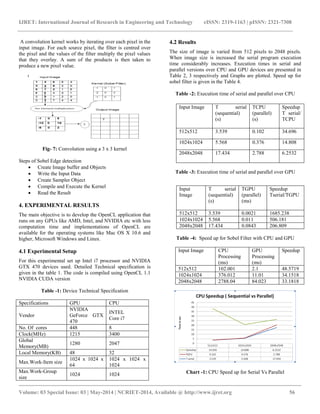
Image convolution can be efficiently implemented on
massively parallel hardware, since the same operator gets
executed independently for each image pixel. Figure7 shows
the convolution using a small 3 x 3 kernel.](https://image.slidesharecdn.com/performanceanalysisofsobeledgefilteronheterogeneoussystemusingopencl-140822050624-phpapp02/85/Performance-analysis-of-sobel-edge-filter-on-heterogeneous-system-using-opencl-3-320.jpg)
![IJRET: International Journal of Research in Engineering and Technology eISSN: 2319-1163 | pISSN: 2321-7308
__________________________________________________________________________________________
Volume: 03 Special Issue: 03 | May-2014 | NCRIET-2014, Available @ http://www.ijret.org 57
Chart -2: GPU Speed up for Serial Vs Parallel
Speed up for Sobel with CPU and GPU
0
10
20
30
40
50
60
512x512 1024x1024 2592x3240
Input Image
Processing Time (ms)
Speed UP
Chart -3: Speed up for Sobel with CPU and GPU
Efficiency = Speedup/#.of cores
Chart -4: Efficiency of CPU Vs GPU for Sobel filter
5. CONCLUSIONS
In this work parallel programming of OpenCL studied.
OpenCL is tool used for programming on GPU regardless of
vendors. OpenCL provides an interface for the interaction of
hosts with accelerator devices like GPUs, DSPs and FPGAs.
Graphics Processing Units are highly useful in parallel
computing. In this paper Sobel edge detection is implemented
on GPU using OpenCL in C and compared with sequential
execution and efficiency of CPU and GPU is discussed. As the
input size is increased the OpenCL gives good performance.
The technologies advances in FPGA devices offering
hundreds GFLOPs (Giga Flip Flop per Seconds) with
maximum power efficiency has made way for parallel
processing community towards them. As a future expansion
the use of FPGAs using OpenCL as programming language
will be considered for comparison of speed ups with the
CPUs, GPUs, and FPGAs
REFERENCES
[1]. Aaftab Munshi, Bendict R. Gaster, Timothy G. Mattson,
“OpenCL Programming Guide,”Published by Pearson
Inc.,2012
[2]. Anirud Pande,Rohit Chandna,”Matrix Convolution using
Parallel Programming,” International Journal of Science and
Reasearch (IJSR),India Volume 2 Issue 7, July 2013
[3]. Jia Tse, “Image Processing with CUDA,” Master‟s Thesis,
University Of Nevada, Las Vegas, August2012
[4]. J inu Prabhakar.K.P , Anitha Mary.X,” FPGA Based
Lane Deviation System Using System Generator” in
International Journal of Advanced Research in Computer
Science and Software Engineering ,Volume 3, Issue 2,
February 2013
[5]. K. Fatahalian and M. Houston, “A closer look at GPUs,”
Communications of the ACM, vol.51, No. 10, October 2008.
[6]. Krishnahari Thouti and S.R.Sathe, “A Methodology for
translating C-Programs to OpenCL,”, vol. 82, International
Journal of Computer Applications(0975- 8887), 2013, pp. 11-
16.
[7]. Matthew Scarpino,”OpenCL in Action,” by Manning
Publications Co., 2012
[8]. Nvidia, OpenCL Programming Guide Version 2.3.pdf
[9]. OpenCL, “The open standard for parallel programming of
heterogeneous systems,” [Online]. Available:
http://www.khronos.org/opencl.
[10]. Tadeusz Puzniakowski, “Performance of OpenCL” The
University of Gdansk, 2012](https://image.slidesharecdn.com/performanceanalysisofsobeledgefilteronheterogeneoussystemusingopencl-140822050624-phpapp02/85/Performance-analysis-of-sobel-edge-filter-on-heterogeneous-system-using-opencl-5-320.jpg)

This document discusses performance analysis of the Sobel edge detection filter on heterogeneous systems using OpenCL. It begins with an introduction to OpenCL and describes its architecture, including the platform model, execution model, memory model, and programming model. It then provides an overview of GPUs and CPUs, comparing their architectures and number of cores. It also gives mathematical representations of image convolution and describes how the Sobel filter works. The document analyzes the performance of implementing Sobel edge detection using OpenCL on CPUs and GPUs and finds that GPUs provide much higher performance compared to CPUs.


