International Journal of Innovative Research in Information Security (IJIRIS) ISSN: 2349-7009(P)
Issue 05, Volume 04 (March 2017) SPECIAL ISSUE www.ijiris.com ISSN: 2349-7017(O)
_____________________________________________________________________________________________________
IJIRIS: Impact Factor Value – SJIF: Innospace, Morocco (2016): 4.346
ISRAJIF (2016): 3.318 & Indexcopernicus ICV (2015):73.48
© 2014- 17, IJIRAE- All Rights Reserved Page -53
Performance Analysis of Communication Protocols for Post
Disaster Communication
1
Rashmi R 3
Mamatha C R, 2
Sahana.S.Reddy
1, 3
Asst. Prof Department of CSE 2
Department of CSE
Vemana Institute of Technology Spurthy Group of Institutions
Bangalore, India Bangalore, India
Abstract—Natural and catastrophic disasters can cause damage to the communication system, the damage may be
complete or it may be partial. In such areas communication and exchange of information plays a very important role and
become difficult to happen in such situations. So, the rescue systems should be installed in those areas for the rescue
operations and to take important decisions about how to make a connection from there to the outside world. Wireless
communication network architecture should be setup in disaster areas for the communication to happen and to gather
information. In this document, wireless ad-hoc access node network architecture has been proposed. These access nodes
acts as hotspot for certain area in which they are set up such that the Wi-Fi capable devices get connected to them for
communication to happen. If the mobile battery is drained in such situations wireless charging using microwave is shown
in this paper. Performance analysis of the communication transport layer protocols is shown and new-SCTP algorithm is
developed which shows the better results in terms of cumulative packet loss.
Keywords—Disaster, Ad-hoc, Wi-Fi, Smart Devices.
I. INTRODUCTION
World has been suffering from numerous disasters where destructions occur in mass almost every day. It may be natural
disasters or the manmade catastrophes. People get struck without any means of help with no water, electricity nor
communication. In many situations people doesn’t have any way to know whether their near and dear ones are affected. In
order to know the information of the people in the disaster area there should be a proper communication system to
communicate with the people. Communication and Exchange of information are the two important factors of any disaster
response. Management of resources in such situation is very difficult. In this environment wireless ad-hoc networks can
significantly enhance situational awareness by improving the automating updates and reacting to status will be changes and
extending data communications across entire disaster [1]. There are many ways of communication networks using internet over
the combination of wired and wireless network. In some situation when the wired networks are completely spoiled then it is
necessary to move to wireless network [2] [4]. Many wireless networks were setup for the communication, public protection
and disaster relief (PPDR) network was introduced for the emergency wireless communication operations, in which the LTE
was used because LTE is the main wireless technology for broad band communication in [5]. In disaster areas people face
difficulty to communicate inside and the outside the disaster site, heterogeneous wireless network is setup for the
communication purpose, first the wireless sensor networks (WSN) are placed in the disaster areas to know the information
update of that area and mobile ad-hoc networks (MANET) are also placed in the disaster site for the local communication, then
the cellular gateways and satellite gateways are used to communicate to the outside world [7]. Devices having wireless
communication technologies such as Wi-Fi can be used as the nodes and access points for the communication. Using Wi-Fi
capable smart devices and laptops the ad-hoc architecture can be established. Many researchers have focused their research
towards different architectures, and also focus on many protocols and schemes for disaster management, among them well
known architecture are WSNPDM (wireless sensor network protocol for disaster management) and LEACH (low-energy
adaptive clustering hierarchy) [3]. Implementing the architectures and doing the performance analysis of disaster management
network will be useful for the whole world to manage great disasters. In this paper we have proposed a wireless ad-hoc
communication system aiming disaster relief communication. Nowadays most of the people carry Wi-Fi capable smart devices
equipped with IEEE 802.11, this type of smart phones are used to give access to the system [8]. Satellite communication is used
to communicate with the data base center and EOC (emergency operations control center), MEOC (mobile emergency
operations control center). If in case the mobile batteries are drained up, we have used a new technic called microwave
charging for the mobile devices to charge the battery pack in this paper. Performance analysis of the transport layer
communication protocols are compared and results are plotted, and we have also newly proposed new SCTP algorithm to show
better results in cumulative packets received.
International Journal of Innovative Research in Information Security (IJIRIS) ISSN: 2349-7009(P)
Issue 05, Volume 04 (March 2017) SPECIAL ISSUE www.ijiris.com ISSN: 2349-7017(O)
_____________________________________________________________________________________________________
IJIRIS: Impact Factor Value – SJIF: Innospace, Morocco (2016): 4.346
ISRAJIF (2016): 3.318 & Indexcopernicus ICV (2015):73.48
© 2014- 17, IJIRAE- All Rights Reserved Page -54
The system meets with many problems in the existing emergency communication system; the problems can be improved in
various ways. The rest of the document is planned as follows. Second section explains existing related work towards disaster
relief communication. Section III covers the system model in detail. Section IV covers transport layer protocols. V section
shows our simulation results and conclusion in section VI.
II. RELATED WORK
There are many ways of setting up the disaster relief rescue systems. The rescue systems maybe wired and wireless network
systems, when the disaster has happened communication and exchange of information plays a major role in the disaster areas.
If the wired networks are completely damaged then the wireless network systems are used for communication purpose. In
one of the paper they have set up the wireless sensor nodes in the predicted disaster areas to know the prier information about
that area, this sensor nodes sense the information and sends it to base station, it was mainly location based sensors, this
sensors sense the information and gives the update but does not anyway help in the communication purpose in [1]. Public
protection and disaster relief (PPDR) this architecture is setup in one of the paper for rescue operation, in this integration of
satellite and LTE were used and also show how both infrastructure-based and infrastructure-less scenarios were considered
but architecture failed to work for the wireless operations [5][6][9]. In later years an emergency communication system
(IECS) was proposed by integrating newly- deployed or still-available heterogeneous wireless networks in which WSN,
MANET, satellite network and cellular network were all used , in this paper wired network is also considered and shows how
both wired and wireless networks are used for communication [7][11]. In one of the paper WLAN was widely used in the
emergency situations, also developed the WLAN AP selection algorithm to select the access points in the emergency areas
mainly focusing on two problems coverage and capacity. They have proposed a dynamic load balancing fairness algorithm
(DLBF) for efficient AP selections [12]. If suppose the Wi-Fi equipped smart devices battery is drained up then the
communication becomes a problem, so to charge the mobile devices wireless microwave charging is used, antenna pole is
placed in the disaster area and mobile devices are should be equipped with the rectenna and a filter to receive the microwave
frequencies [10]. A disaster management network architecture for communication purpose is setup wirelessly in our paper,
our architecture is different from all the others because it is only based on the wireless communication in disaster relief areas.
So we say our architecture is the best method for the rescue operation. Wi-Fi routers are made use as the access points and
data base center is used to monitor the disaster area, according to the EOC instructions the MEOC does the rescue operations,
if the mobile battery is drained up in the disaster area microwave charging is used on certain constraints to charge the mobile
devices. Performance analysis of the transport layer communication protocols were analyzed, in current paper one of the
protocol is improved and shown the betterment in the results.
III. SYSTEM MODEL
The system architecture is shown in Fig. 1. In disaster area for setting up the system architecture Wi-Fi routers were made
used as the wireless access points, these nodes are portable so that can be carried to field easily. Nodes are installed in the
form of ad-hoc link with a distance less than 100 m of operation area. Wi-Fi capable smart devices are used to connect to the
access point. Ad-hoc link network is connected to data base center using long distance communication link. The super node
consist of the long distance transceiver unit, it is defined as a gateway to wide area network through which the disaster
information can be exchanged. Data base center collect the information from the access points and store the information for
decision makings. In worst case scenarios when the disaster happens data base center receives the information from the access
nodes, if the disaster is serious data base center passes the information to EOC (emergency operations control center) thought
the satellite communication,
Fig. 1. System architecture
International Journal of Innovative Research in Information Security (IJIRIS) ISSN: 2349-7009(P)
Issue 05, Volume 04 (March 2017) SPECIAL ISSUE www.ijiris.com ISSN: 2349-7017(O)
_____________________________________________________________________________________________________
IJIRIS: Impact Factor Value – SJIF: Innospace, Morocco (2016): 4.346
ISRAJIF (2016): 3.318 & Indexcopernicus ICV (2015):73.48
© 2014- 17, IJIRAE- All Rights Reserved Page -55
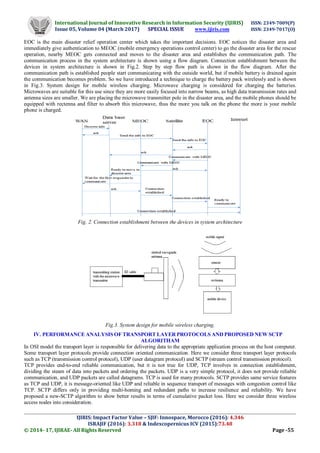
EOC is the main disaster relief operation center which takes the important decisions. EOC notices the disaster area and
immediately give authentication to MEOC (mobile emergency operations control center) to go the disaster area for the rescue
operation, nearby MEOC gets connected and moves to the disaster area and establishes the communication path. The
communication process in the system architecture is shown using a flow diagram. Connection establishment between the
devices in system architecture is shown in Fig.2. Step by step flow path is shown in the flow diagram. After the
communication path is established people start communicating with the outside world, but if mobile battery is drained again
the communication becomes problem. So we have introduced a technique to charge the battery pack wirelessly and is shown
in Fig.3. System design for mobile wireless charging. Microwave charging is considered for charging the batteries.
Microwaves are suitable for this use since they are more easily focused into narrow beams, as high data transmission rates and
antenna sizes are smaller. We are placing the microwave transmitter pole in the disaster area, and the mobile phones should be
equipped with rectenna and filter to absorb this microwave, thus the more you talk on the phone the more is your mobile
phone is charged.
Fig. 2. Connection establishment between the devices in system architecture
Fig.3. System design for mobile wireless charging.
IV. PERFORMANCE ANALYSIS OF TRANSPORT LAYER PROTOCOLS AND PROPOSED NEW SCTP
ALGORITHAM
In OSI model the transport layer is responsible for delivering data to the appropriate application process on the host computer.
Some transport layer protocols provide connection oriented communication. Here we consider three transport layer protocols
such as TCP (transmission control protocol), UDP (user datagram protocol) and SCTP (stream control transmission protocol).
TCP provides end-to-end reliable communication, but it is not true for UDP, TCP involves in connection establishment,
dividing the steam of data into packets and ordering the packets. UDP is a very simple protocol, it does not provide reliable
communication, and UDP packets are called datagrams. TCP is used for many protocols. SCTP provides same service features
as TCP and UDP, it is message-oriented like UDP and reliable in sequence transport of messages with congestion control like
TCP. SCTP differs only in providing multi-homing and redundant paths to increase resilience and reliability. We have
proposed a new-SCTP algorithm to show better results in terms of cumulative packet loss. Here we consider three wireless
access nodes into consideration.
International Journal of Innovative Research in Information Security (IJIRIS) ISSN: 2349-7009(P)
Issue 05, Volume 04 (March 2017) SPECIAL ISSUE www.ijiris.com ISSN: 2349-7017(O)
_____________________________________________________________________________________________________
IJIRIS: Impact Factor Value – SJIF: Innospace, Morocco (2016): 4.346
ISRAJIF (2016): 3.318 & Indexcopernicus ICV (2015):73.48
© 2014- 17, IJIRAE- All Rights Reserved Page -56
Also consider the sender and receiver, the data passes through all the three wireless access nodes. For wireless access node
routers AQM (advanced quantitative method) is implemented .Steps involved in transferring the packets from sender to
receiver are as follows:
Step1: There is a sender and receiver and several access points between them. We consider there are three wireless access
nodes between them.
Step 2: Data is transmitted from the sender to receiver.
Step 3: AQM method is implemented in the wireless access nodes because it is efficient way to control network congestion and
to maintain queue size stability.
Step 4: Packet drop is based on the deviation of the queue length.
Step 5: Each access point has one queue with maximum size Q.
Step 6: Queue is shared between each sender has a proportional contribution and each queue based on its packets application.
Step 7: Proportional contributions are considered as follows
Where,
S= number of senders.
P[i]=portion of senders [i] at queue of access point [j].
J= wireless access point number.
V. SIMULATION RESULTS
We have simulated the performance analysis of different transport layer communication protocols and compared there packets
received at the sink, path loss and residual energy using MATLAB (R2015a) simulator. The simulation results for packets
received at sink verses time is compared for TCP, UDP and SCTP is shown in figure 4. It is shown that SCTP is best in terms
of packets received. The simulation results of TCP, UDP and SCTP are compared for residual energy and path loss with respect
to time is shown in figure 5.
Fig. 4. Packets received at sink vs. Time
In TCP and SCTP congestion control and quantity of packets to be transmitted is achieved by changing the congestion window
size. To evaluate the performance of the proposed algorithm, capacity of the link is 20mbps and link delay is set 10ms. Three
wireless access nodes are concerned on each access point.
Fig. 5. Residual energy vs. Time
International Journal of Innovative Research in Information Security (IJIRIS) ISSN: 2349-7009(P)
Issue 05, Volume 04 (March 2017) SPECIAL ISSUE www.ijiris.com ISSN: 2349-7017(O)
_____________________________________________________________________________________________________
IJIRIS: Impact Factor Value – SJIF: Innospace, Morocco (2016): 4.346
ISRAJIF (2016): 3.318 & Indexcopernicus ICV (2015):73.48
© 2014- 17, IJIRAE- All Rights Reserved Page -57
Maximum buffer size of each access node as taken 50 packets. The current simulation focuses on cumulative packet loss. Fig.6.
depicts the cumulative packet loss for new SCTP as well as standard SCTP. The new SCTP has lower cumulative packet loss
so the proposed algorithm implements proper.
Fig. 6. Packet loss vs. time for existing and proposed SCTP protocol
VI. CONCLUSION
In this paper, we have setup one of the best method of communication system for communication in the disaster area, and also
showed how the mobile phones are charged using the microwave charging. Performance analysis of the three standard transport
layer communication protocols are shown for packets received at the sink and residual energy. We have also proposed new
SCTP algorithm and compared it with the standard SCTP protocol and result is show for cumulative packet loss using the
MATLAB simulator.
REFERENCES
[1]. S.M.George, w.zhou, H.Chenji.M.Won,Y.O.Lee, A.Pazarloglou and R.Stoleru, DistressNet:A wireless Adhoc and
Senser Network Architecture for situation Management in Disaster Response IEEE Communications Magzine ,PP:-128-
136, March 2010.
[2]. Yoshitaka shibata, daisuke nakamura, noriki uchida, kazoo takahata,”residents oriented disaster information network”,
IEEE proc on SAINT’2003,pp. 317-322, January 2003.
[3]. Daigo sakamoto, koji hashimoto, kazoo takahata, yoshitaka etal. ,”performance evalution of evacuation information
network system based on wireless wide area network”, DPS, 100-12, (in Japanese) November 2000.
[4]. Noriki uchida, hideaki asahi, yoshitaka shibata,”disaster information system and its wireless recovery protocol”, IEEE
proc on SAINT’04, pp.317-322, January 2004.
[5]. Maurizio Casoni, Carlo Augusto Grazia, Martin Klapez, Natale Patriciello, A. Amditis, and E. Sdongos, “ Integration of
Satellite and LTE for Disaster Recovery” IEEE Communications Magazine ., March.2015.
[6]. Sayan Kumar Ray, Roopak Sinha, Swapan Kumar Ray, 10th Conference on Industrial Electronics and Applications “A
Smartphone-based Post-Disaster Management Mechanism Using Wi-Fi Tethering” IEEE 2015
[7]. Daniele tarchi, romano fantacci, and dania marabissi. The communication infrastructure foe emergency management :
the integrated system for emergency vision. In preceedings of IWCMC’09., june 21-24,2009.
[8]. Ionut crdei, yueshi wu, and james junco. Backup Wi-Fi ad-hoc network for emergency response in scenarios with
sporadic connectivity and primary users. In 10th
international conference on mobile ad-hoc sensor networks, pages 66-
73, Hawaii, December 2014.
[9]. PPDR-TC Consortium, “PPDR’s Needs and Requirements,” Project Deliverable D2.2, Jan. 2014.
[10]. Neeraj single,” wireless charging of mobile phone using microwaves or radio frequency signals”, international journal of
advanced research in computer science and technology (IJARCST2014) vol.2 issue 1 jan-march 2014
[11]. Maneesha, V Ramesh, Nisha M.S, “Design of medium independent handover based emergency communication scheme
using vehicular technology” IEEE 3rd
international conference on communication software and networks (ICCSN),
2011.
[12]. Maneesha, V Ramesh, Nisha M.S, “Design of optimization algorithm for WLAN AP selection during emergency
situations” IEEE 3rd
international conference on communication software and networks (ICCSN), 2011.

Performance Analysis of Communication Protocols for Post Disaster Communication

  • 1.
    International Journal ofInnovative Research in Information Security (IJIRIS) ISSN: 2349-7009(P) Issue 05, Volume 04 (March 2017) SPECIAL ISSUE www.ijiris.com ISSN: 2349-7017(O) _____________________________________________________________________________________________________ IJIRIS: Impact Factor Value – SJIF: Innospace, Morocco (2016): 4.346 ISRAJIF (2016): 3.318 & Indexcopernicus ICV (2015):73.48 © 2014- 17, IJIRAE- All Rights Reserved Page -53 Performance Analysis of Communication Protocols for Post Disaster Communication 1 Rashmi R 3 Mamatha C R, 2 Sahana.S.Reddy 1, 3 Asst. Prof Department of CSE 2 Department of CSE Vemana Institute of Technology Spurthy Group of Institutions Bangalore, India Bangalore, India Abstract—Natural and catastrophic disasters can cause damage to the communication system, the damage may be complete or it may be partial. In such areas communication and exchange of information plays a very important role and become difficult to happen in such situations. So, the rescue systems should be installed in those areas for the rescue operations and to take important decisions about how to make a connection from there to the outside world. Wireless communication network architecture should be setup in disaster areas for the communication to happen and to gather information. In this document, wireless ad-hoc access node network architecture has been proposed. These access nodes acts as hotspot for certain area in which they are set up such that the Wi-Fi capable devices get connected to them for communication to happen. If the mobile battery is drained in such situations wireless charging using microwave is shown in this paper. Performance analysis of the communication transport layer protocols is shown and new-SCTP algorithm is developed which shows the better results in terms of cumulative packet loss. Keywords—Disaster, Ad-hoc, Wi-Fi, Smart Devices. I. INTRODUCTION World has been suffering from numerous disasters where destructions occur in mass almost every day. It may be natural disasters or the manmade catastrophes. People get struck without any means of help with no water, electricity nor communication. In many situations people doesn’t have any way to know whether their near and dear ones are affected. In order to know the information of the people in the disaster area there should be a proper communication system to communicate with the people. Communication and Exchange of information are the two important factors of any disaster response. Management of resources in such situation is very difficult. In this environment wireless ad-hoc networks can significantly enhance situational awareness by improving the automating updates and reacting to status will be changes and extending data communications across entire disaster [1]. There are many ways of communication networks using internet over the combination of wired and wireless network. In some situation when the wired networks are completely spoiled then it is necessary to move to wireless network [2] [4]. Many wireless networks were setup for the communication, public protection and disaster relief (PPDR) network was introduced for the emergency wireless communication operations, in which the LTE was used because LTE is the main wireless technology for broad band communication in [5]. In disaster areas people face difficulty to communicate inside and the outside the disaster site, heterogeneous wireless network is setup for the communication purpose, first the wireless sensor networks (WSN) are placed in the disaster areas to know the information update of that area and mobile ad-hoc networks (MANET) are also placed in the disaster site for the local communication, then the cellular gateways and satellite gateways are used to communicate to the outside world [7]. Devices having wireless communication technologies such as Wi-Fi can be used as the nodes and access points for the communication. Using Wi-Fi capable smart devices and laptops the ad-hoc architecture can be established. Many researchers have focused their research towards different architectures, and also focus on many protocols and schemes for disaster management, among them well known architecture are WSNPDM (wireless sensor network protocol for disaster management) and LEACH (low-energy adaptive clustering hierarchy) [3]. Implementing the architectures and doing the performance analysis of disaster management network will be useful for the whole world to manage great disasters. In this paper we have proposed a wireless ad-hoc communication system aiming disaster relief communication. Nowadays most of the people carry Wi-Fi capable smart devices equipped with IEEE 802.11, this type of smart phones are used to give access to the system [8]. Satellite communication is used to communicate with the data base center and EOC (emergency operations control center), MEOC (mobile emergency operations control center). If in case the mobile batteries are drained up, we have used a new technic called microwave charging for the mobile devices to charge the battery pack in this paper. Performance analysis of the transport layer communication protocols are compared and results are plotted, and we have also newly proposed new SCTP algorithm to show better results in cumulative packets received.
  • 2.
    International Journal ofInnovative Research in Information Security (IJIRIS) ISSN: 2349-7009(P) Issue 05, Volume 04 (March 2017) SPECIAL ISSUE www.ijiris.com ISSN: 2349-7017(O) _____________________________________________________________________________________________________ IJIRIS: Impact Factor Value – SJIF: Innospace, Morocco (2016): 4.346 ISRAJIF (2016): 3.318 & Indexcopernicus ICV (2015):73.48 © 2014- 17, IJIRAE- All Rights Reserved Page -54 The system meets with many problems in the existing emergency communication system; the problems can be improved in various ways. The rest of the document is planned as follows. Second section explains existing related work towards disaster relief communication. Section III covers the system model in detail. Section IV covers transport layer protocols. V section shows our simulation results and conclusion in section VI. II. RELATED WORK There are many ways of setting up the disaster relief rescue systems. The rescue systems maybe wired and wireless network systems, when the disaster has happened communication and exchange of information plays a major role in the disaster areas. If the wired networks are completely damaged then the wireless network systems are used for communication purpose. In one of the paper they have set up the wireless sensor nodes in the predicted disaster areas to know the prier information about that area, this sensor nodes sense the information and sends it to base station, it was mainly location based sensors, this sensors sense the information and gives the update but does not anyway help in the communication purpose in [1]. Public protection and disaster relief (PPDR) this architecture is setup in one of the paper for rescue operation, in this integration of satellite and LTE were used and also show how both infrastructure-based and infrastructure-less scenarios were considered but architecture failed to work for the wireless operations [5][6][9]. In later years an emergency communication system (IECS) was proposed by integrating newly- deployed or still-available heterogeneous wireless networks in which WSN, MANET, satellite network and cellular network were all used , in this paper wired network is also considered and shows how both wired and wireless networks are used for communication [7][11]. In one of the paper WLAN was widely used in the emergency situations, also developed the WLAN AP selection algorithm to select the access points in the emergency areas mainly focusing on two problems coverage and capacity. They have proposed a dynamic load balancing fairness algorithm (DLBF) for efficient AP selections [12]. If suppose the Wi-Fi equipped smart devices battery is drained up then the communication becomes a problem, so to charge the mobile devices wireless microwave charging is used, antenna pole is placed in the disaster area and mobile devices are should be equipped with the rectenna and a filter to receive the microwave frequencies [10]. A disaster management network architecture for communication purpose is setup wirelessly in our paper, our architecture is different from all the others because it is only based on the wireless communication in disaster relief areas. So we say our architecture is the best method for the rescue operation. Wi-Fi routers are made use as the access points and data base center is used to monitor the disaster area, according to the EOC instructions the MEOC does the rescue operations, if the mobile battery is drained up in the disaster area microwave charging is used on certain constraints to charge the mobile devices. Performance analysis of the transport layer communication protocols were analyzed, in current paper one of the protocol is improved and shown the betterment in the results. III. SYSTEM MODEL The system architecture is shown in Fig. 1. In disaster area for setting up the system architecture Wi-Fi routers were made used as the wireless access points, these nodes are portable so that can be carried to field easily. Nodes are installed in the form of ad-hoc link with a distance less than 100 m of operation area. Wi-Fi capable smart devices are used to connect to the access point. Ad-hoc link network is connected to data base center using long distance communication link. The super node consist of the long distance transceiver unit, it is defined as a gateway to wide area network through which the disaster information can be exchanged. Data base center collect the information from the access points and store the information for decision makings. In worst case scenarios when the disaster happens data base center receives the information from the access nodes, if the disaster is serious data base center passes the information to EOC (emergency operations control center) thought the satellite communication, Fig. 1. System architecture
  • 3.
    International Journal ofInnovative Research in Information Security (IJIRIS) ISSN: 2349-7009(P) Issue 05, Volume 04 (March 2017) SPECIAL ISSUE www.ijiris.com ISSN: 2349-7017(O) _____________________________________________________________________________________________________ IJIRIS: Impact Factor Value – SJIF: Innospace, Morocco (2016): 4.346 ISRAJIF (2016): 3.318 & Indexcopernicus ICV (2015):73.48 © 2014- 17, IJIRAE- All Rights Reserved Page -55 EOC is the main disaster relief operation center which takes the important decisions. EOC notices the disaster area and immediately give authentication to MEOC (mobile emergency operations control center) to go the disaster area for the rescue operation, nearby MEOC gets connected and moves to the disaster area and establishes the communication path. The communication process in the system architecture is shown using a flow diagram. Connection establishment between the devices in system architecture is shown in Fig.2. Step by step flow path is shown in the flow diagram. After the communication path is established people start communicating with the outside world, but if mobile battery is drained again the communication becomes problem. So we have introduced a technique to charge the battery pack wirelessly and is shown in Fig.3. System design for mobile wireless charging. Microwave charging is considered for charging the batteries. Microwaves are suitable for this use since they are more easily focused into narrow beams, as high data transmission rates and antenna sizes are smaller. We are placing the microwave transmitter pole in the disaster area, and the mobile phones should be equipped with rectenna and filter to absorb this microwave, thus the more you talk on the phone the more is your mobile phone is charged. Fig. 2. Connection establishment between the devices in system architecture Fig.3. System design for mobile wireless charging. IV. PERFORMANCE ANALYSIS OF TRANSPORT LAYER PROTOCOLS AND PROPOSED NEW SCTP ALGORITHAM In OSI model the transport layer is responsible for delivering data to the appropriate application process on the host computer. Some transport layer protocols provide connection oriented communication. Here we consider three transport layer protocols such as TCP (transmission control protocol), UDP (user datagram protocol) and SCTP (stream control transmission protocol). TCP provides end-to-end reliable communication, but it is not true for UDP, TCP involves in connection establishment, dividing the steam of data into packets and ordering the packets. UDP is a very simple protocol, it does not provide reliable communication, and UDP packets are called datagrams. TCP is used for many protocols. SCTP provides same service features as TCP and UDP, it is message-oriented like UDP and reliable in sequence transport of messages with congestion control like TCP. SCTP differs only in providing multi-homing and redundant paths to increase resilience and reliability. We have proposed a new-SCTP algorithm to show better results in terms of cumulative packet loss. Here we consider three wireless access nodes into consideration.
  • 4.
    International Journal ofInnovative Research in Information Security (IJIRIS) ISSN: 2349-7009(P) Issue 05, Volume 04 (March 2017) SPECIAL ISSUE www.ijiris.com ISSN: 2349-7017(O) _____________________________________________________________________________________________________ IJIRIS: Impact Factor Value – SJIF: Innospace, Morocco (2016): 4.346 ISRAJIF (2016): 3.318 & Indexcopernicus ICV (2015):73.48 © 2014- 17, IJIRAE- All Rights Reserved Page -56 Also consider the sender and receiver, the data passes through all the three wireless access nodes. For wireless access node routers AQM (advanced quantitative method) is implemented .Steps involved in transferring the packets from sender to receiver are as follows: Step1: There is a sender and receiver and several access points between them. We consider there are three wireless access nodes between them. Step 2: Data is transmitted from the sender to receiver. Step 3: AQM method is implemented in the wireless access nodes because it is efficient way to control network congestion and to maintain queue size stability. Step 4: Packet drop is based on the deviation of the queue length. Step 5: Each access point has one queue with maximum size Q. Step 6: Queue is shared between each sender has a proportional contribution and each queue based on its packets application. Step 7: Proportional contributions are considered as follows Where, S= number of senders. P[i]=portion of senders [i] at queue of access point [j]. J= wireless access point number. V. SIMULATION RESULTS We have simulated the performance analysis of different transport layer communication protocols and compared there packets received at the sink, path loss and residual energy using MATLAB (R2015a) simulator. The simulation results for packets received at sink verses time is compared for TCP, UDP and SCTP is shown in figure 4. It is shown that SCTP is best in terms of packets received. The simulation results of TCP, UDP and SCTP are compared for residual energy and path loss with respect to time is shown in figure 5. Fig. 4. Packets received at sink vs. Time In TCP and SCTP congestion control and quantity of packets to be transmitted is achieved by changing the congestion window size. To evaluate the performance of the proposed algorithm, capacity of the link is 20mbps and link delay is set 10ms. Three wireless access nodes are concerned on each access point. Fig. 5. Residual energy vs. Time
  • 5.
    International Journal ofInnovative Research in Information Security (IJIRIS) ISSN: 2349-7009(P) Issue 05, Volume 04 (March 2017) SPECIAL ISSUE www.ijiris.com ISSN: 2349-7017(O) _____________________________________________________________________________________________________ IJIRIS: Impact Factor Value – SJIF: Innospace, Morocco (2016): 4.346 ISRAJIF (2016): 3.318 & Indexcopernicus ICV (2015):73.48 © 2014- 17, IJIRAE- All Rights Reserved Page -57 Maximum buffer size of each access node as taken 50 packets. The current simulation focuses on cumulative packet loss. Fig.6. depicts the cumulative packet loss for new SCTP as well as standard SCTP. The new SCTP has lower cumulative packet loss so the proposed algorithm implements proper. Fig. 6. Packet loss vs. time for existing and proposed SCTP protocol VI. CONCLUSION In this paper, we have setup one of the best method of communication system for communication in the disaster area, and also showed how the mobile phones are charged using the microwave charging. Performance analysis of the three standard transport layer communication protocols are shown for packets received at the sink and residual energy. We have also proposed new SCTP algorithm and compared it with the standard SCTP protocol and result is show for cumulative packet loss using the MATLAB simulator. REFERENCES [1]. S.M.George, w.zhou, H.Chenji.M.Won,Y.O.Lee, A.Pazarloglou and R.Stoleru, DistressNet:A wireless Adhoc and Senser Network Architecture for situation Management in Disaster Response IEEE Communications Magzine ,PP:-128- 136, March 2010. [2]. Yoshitaka shibata, daisuke nakamura, noriki uchida, kazoo takahata,”residents oriented disaster information network”, IEEE proc on SAINT’2003,pp. 317-322, January 2003. [3]. Daigo sakamoto, koji hashimoto, kazoo takahata, yoshitaka etal. ,”performance evalution of evacuation information network system based on wireless wide area network”, DPS, 100-12, (in Japanese) November 2000. [4]. Noriki uchida, hideaki asahi, yoshitaka shibata,”disaster information system and its wireless recovery protocol”, IEEE proc on SAINT’04, pp.317-322, January 2004. [5]. Maurizio Casoni, Carlo Augusto Grazia, Martin Klapez, Natale Patriciello, A. Amditis, and E. Sdongos, “ Integration of Satellite and LTE for Disaster Recovery” IEEE Communications Magazine ., March.2015. [6]. Sayan Kumar Ray, Roopak Sinha, Swapan Kumar Ray, 10th Conference on Industrial Electronics and Applications “A Smartphone-based Post-Disaster Management Mechanism Using Wi-Fi Tethering” IEEE 2015 [7]. Daniele tarchi, romano fantacci, and dania marabissi. The communication infrastructure foe emergency management : the integrated system for emergency vision. In preceedings of IWCMC’09., june 21-24,2009. [8]. Ionut crdei, yueshi wu, and james junco. Backup Wi-Fi ad-hoc network for emergency response in scenarios with sporadic connectivity and primary users. In 10th international conference on mobile ad-hoc sensor networks, pages 66- 73, Hawaii, December 2014. [9]. PPDR-TC Consortium, “PPDR’s Needs and Requirements,” Project Deliverable D2.2, Jan. 2014. [10]. Neeraj single,” wireless charging of mobile phone using microwaves or radio frequency signals”, international journal of advanced research in computer science and technology (IJARCST2014) vol.2 issue 1 jan-march 2014 [11]. Maneesha, V Ramesh, Nisha M.S, “Design of medium independent handover based emergency communication scheme using vehicular technology” IEEE 3rd international conference on communication software and networks (ICCSN), 2011. [12]. Maneesha, V Ramesh, Nisha M.S, “Design of optimization algorithm for WLAN AP selection during emergency situations” IEEE 3rd international conference on communication software and networks (ICCSN), 2011.