Developmental Stages in
Middle and Late
Adolescence
HUMAN DEVELOPMENTAL STAGES
• Human development focuses on
human growth and changes
across the lifespan, including
physical, cognitive, social,
intellectual, perceptual,
personality and emotional
growth.
• The study of human development
is essential to understanding how
humans learn, mature, and
adapt.
• Throughout their lives, humans go through
various stages of development.
• The human being is either in a state of
growth or decline, but either condition
imparts change.
• Some aspects of our life change very little
over time, are consistent.
• Other aspects change dramatically.
• By understanding these changes, we can
better respond and plan ahead effectively.
HUMAN DEVELOPMENTAL STAGES
Erik Erikson
STAGES
BASIC
CONFLICT
/ CRISIS
IMPORTAN
T EVENTS
VIRTUES DESCRIPTION OUTCOME
Stage 1
INFANCY
(birth to
18
months)
Trust
Vs.
Mistrust
Feeding Hope
At this stage babies
learn to trust that
their parents will
meet their needs.
If a child’s basic
needs aren’t
properly met at
this age, he/she
might grow up with
a general mistrust
of the world.
Children
develop a sense
of trust when
caregivers
provide
reliability, care,
and affection. A
lack of this will
lead to mistrust.
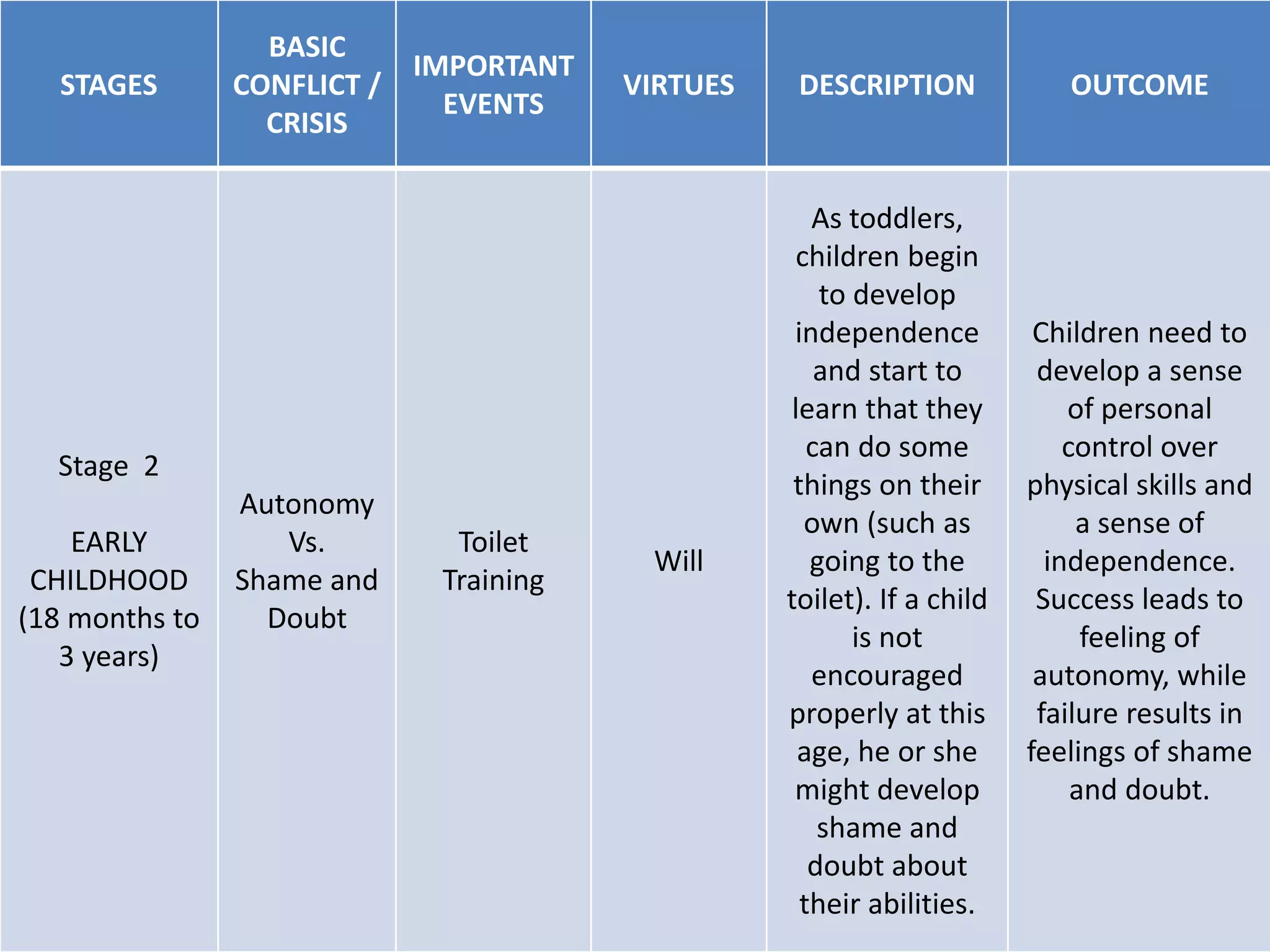
STAGES
BASIC
CONFLICT /
CRISIS
IMPORTANT
EVENTS
VIRTUES DESCRIPTION OUTCOME
Stage 2
EARLY
CHILDHOOD
(18 months to
3 years)
Autonomy
Vs.
Shame and
Doubt
Toilet
Training
Will
As toddlers,
children begin
to develop
independence
and start to
learn that they
can do some
things on their
own (such as
going to the
toilet). If a child
is not
encouraged
properly at this
age, he or she
might develop
shame and
doubt about
their abilities.
Children need to
develop a sense
of personal
control over
physical skills and
a sense of
independence.
Success leads to
feeling of
autonomy, while
failure results in
feelings of shame
and doubt.
STAGES
BASIC
CONFLICT /
CRISIS
IMPORTANT
EVENTS
VIRTUES DESCRIPTION OUTCOME
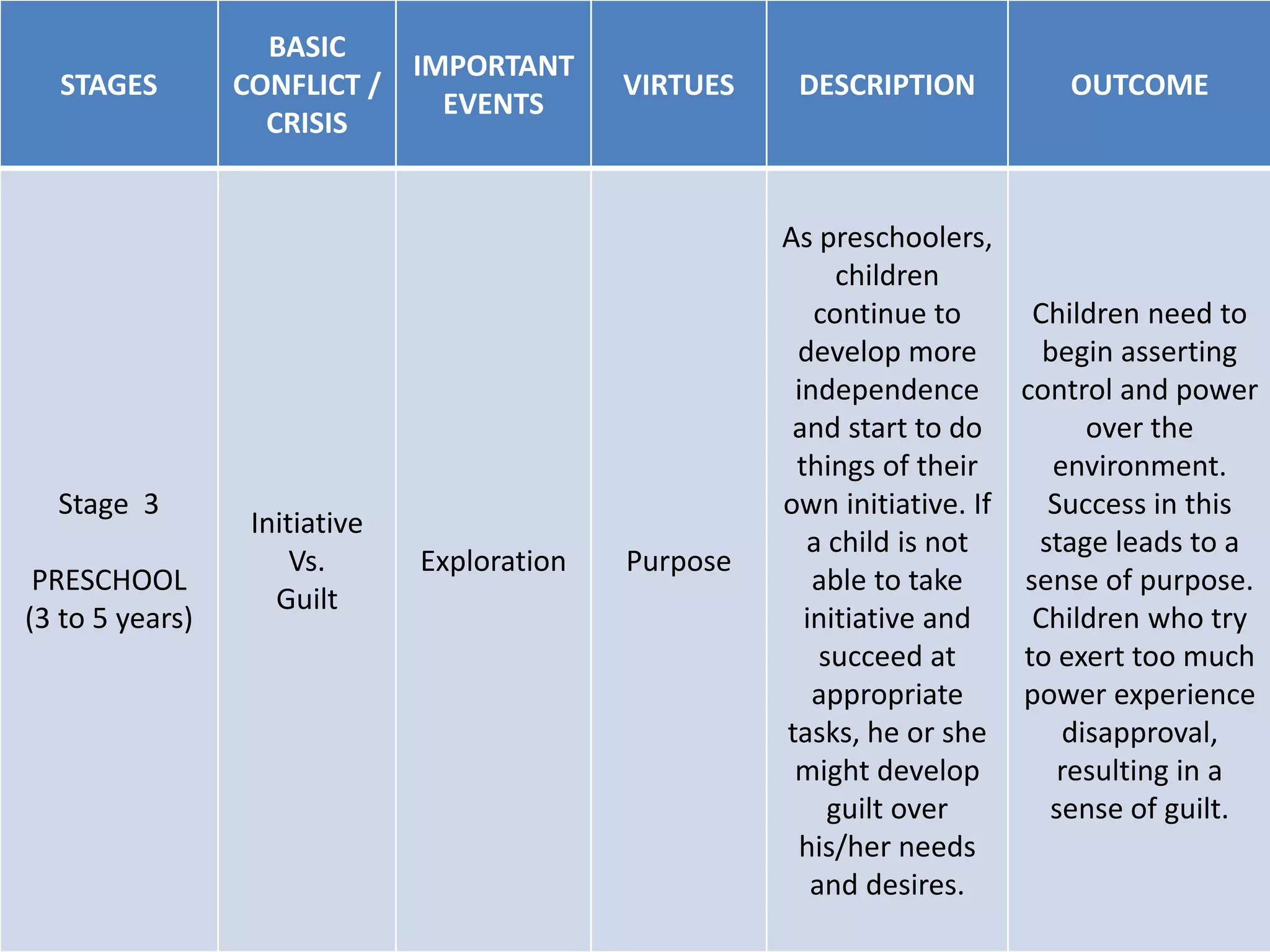
Stage 3
PRESCHOOL
(3 to 5 years)
Initiative
Vs.
Guilt
Exploration Purpose
As preschoolers,
children
continue to
develop more
independence
and start to do
things of their
own initiative. If
a child is not
able to take
initiative and
succeed at
appropriate
tasks, he or she
might develop
guilt over
his/her needs
and desires.
Children need to
begin asserting
control and power
over the
environment.
Success in this
stage leads to a
sense of purpose.
Children who try
to exert too much
power experience
disapproval,
resulting in a
sense of guilt.
STAGES
BASIC
CONFLICT /
CRISIS
IMPORTANT
EVENTS
VIRTUES DESCRIPTION OUTCOME
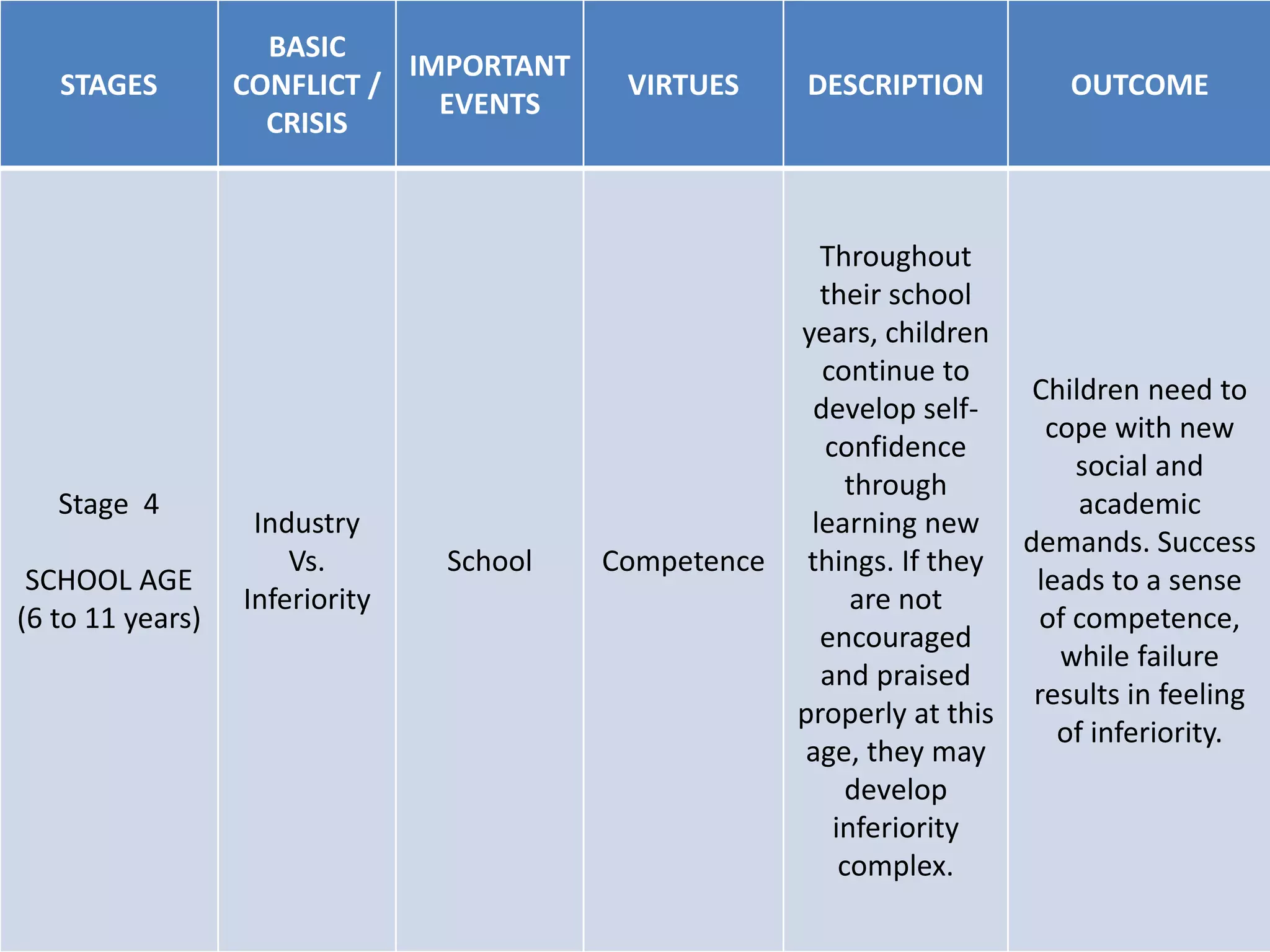
Stage 4
SCHOOL AGE
(6 to 11 years)
Industry
Vs.
Inferiority
School Competence
Throughout
their school
years, children
continue to
develop self-
confidence
through
learning new
things. If they
are not
encouraged
and praised
properly at this
age, they may
develop
inferiority
complex.
Children need to
cope with new
social and
academic
demands. Success
leads to a sense
of competence,
while failure
results in feeling
of inferiority.
STAGES
BASIC
CONFLICT
/ CRISIS
IMPORTANT
EVENTS
VIRTUES DESCRIPTION OUTCOME
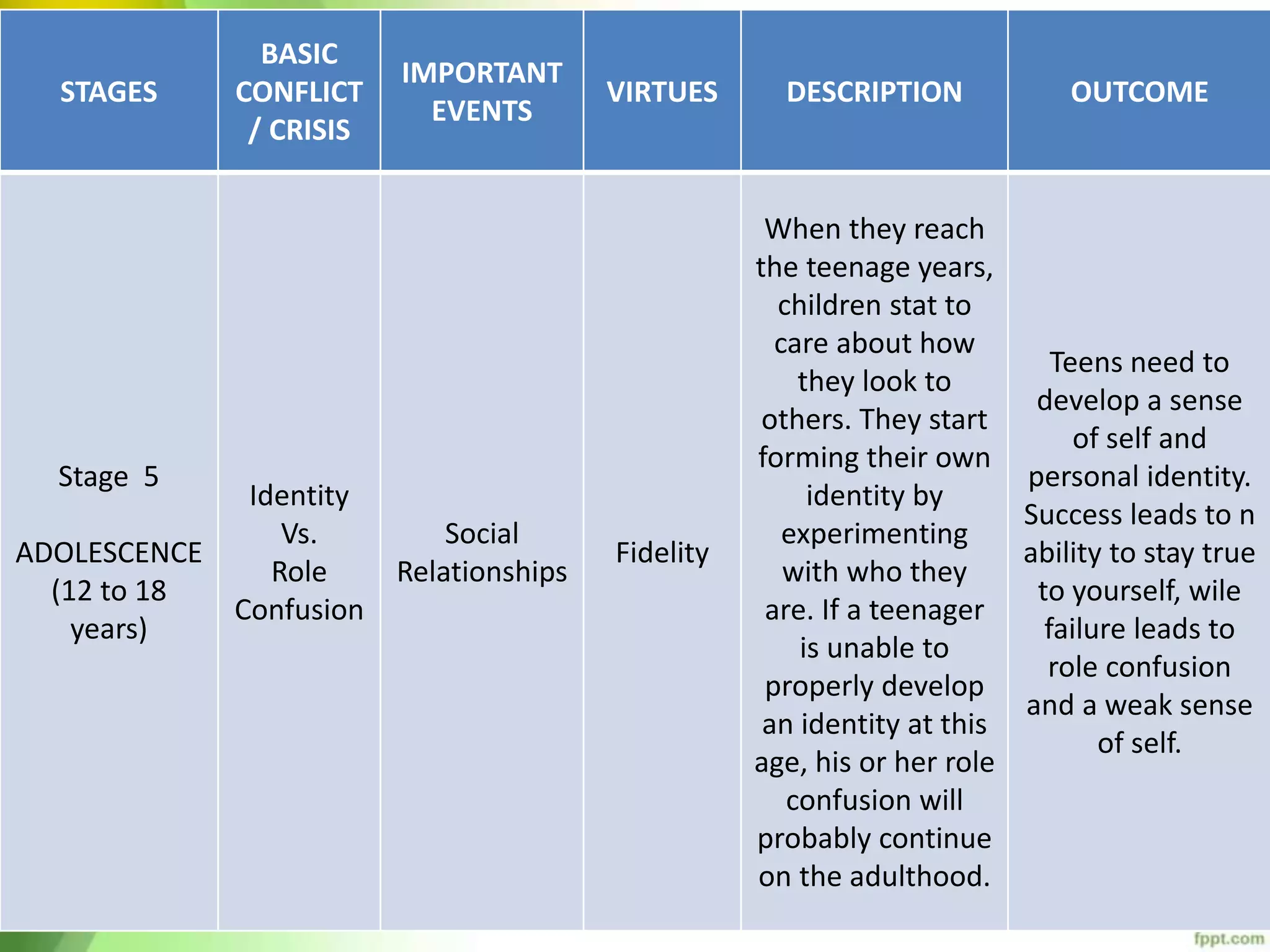
Stage 5
ADOLESCENCE
(12 to 18
years)
Identity
Vs.
Role
Confusion
Social
Relationships
Fidelity
When they reach
the teenage years,
children stat to
care about how
they look to
others. They start
forming their own
identity by
experimenting
with who they
are. If a teenager
is unable to
properly develop
an identity at this
age, his or her role
confusion will
probably continue
on the adulthood.
Teens need to
develop a sense
of self and
personal identity.
Success leads to n
ability to stay true
to yourself, wile
failure leads to
role confusion
and a weak sense
of self.
STAGES
BASIC
CONFLICT
/ CRISIS
IMPORTANT
EVENTS
VIRTUES DESCRIPTION OUTCOME
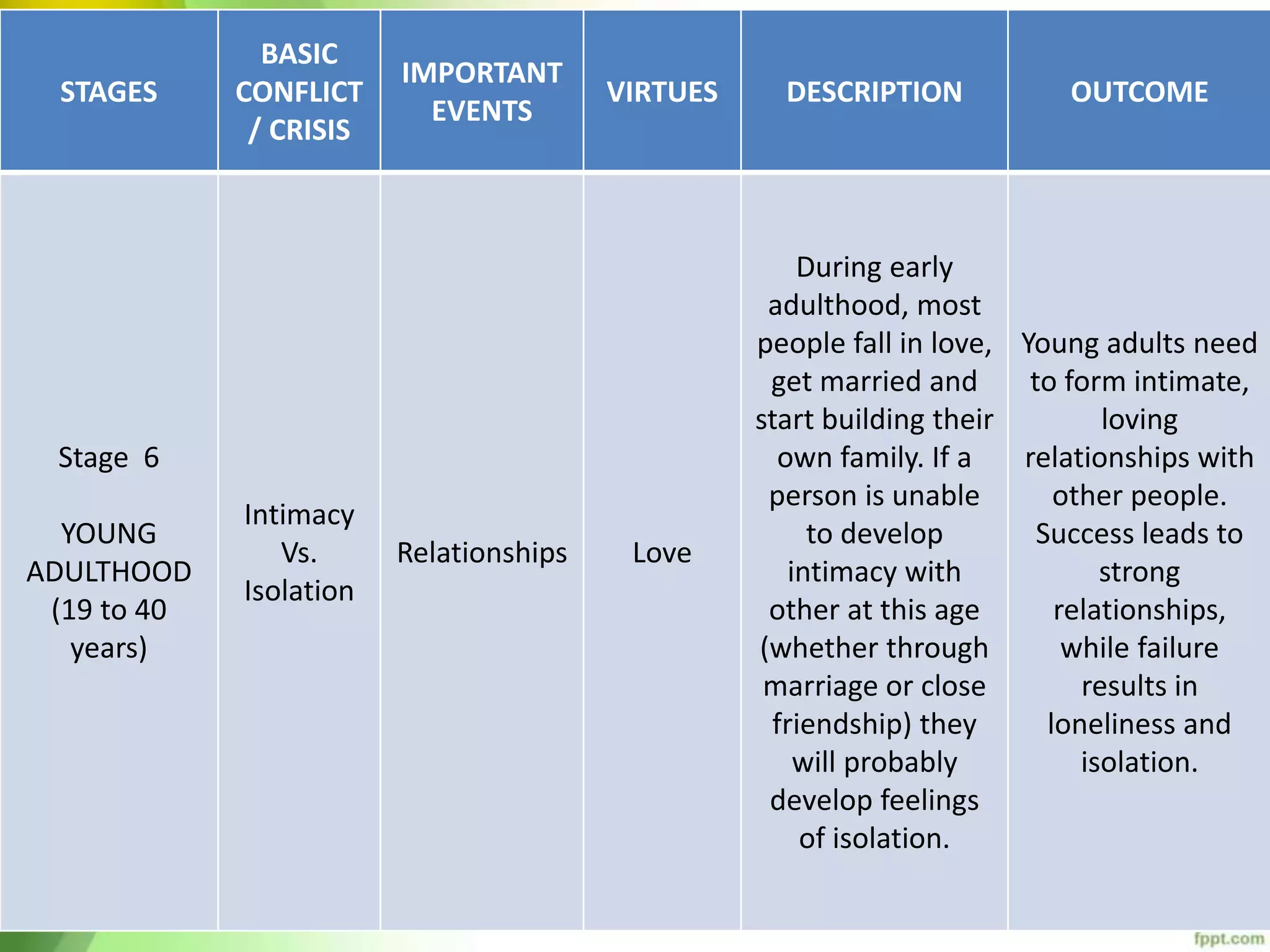
Stage 6
YOUNG
ADULTHOOD
(19 to 40
years)
Intimacy
Vs.
Isolation
Relationships Love
During early
adulthood, most
people fall in love,
get married and
start building their
own family. If a
person is unable
to develop
intimacy with
other at this age
(whether through
marriage or close
friendship) they
will probably
develop feelings
of isolation.
Young adults need
to form intimate,
loving
relationships with
other people.
Success leads to
strong
relationships,
while failure
results in
loneliness and
isolation.
STAGES
BASIC
CONFLICT /
CRISIS
IMPORTANT
EVENTS
VIRTUES DESCRIPTION OUTCOME
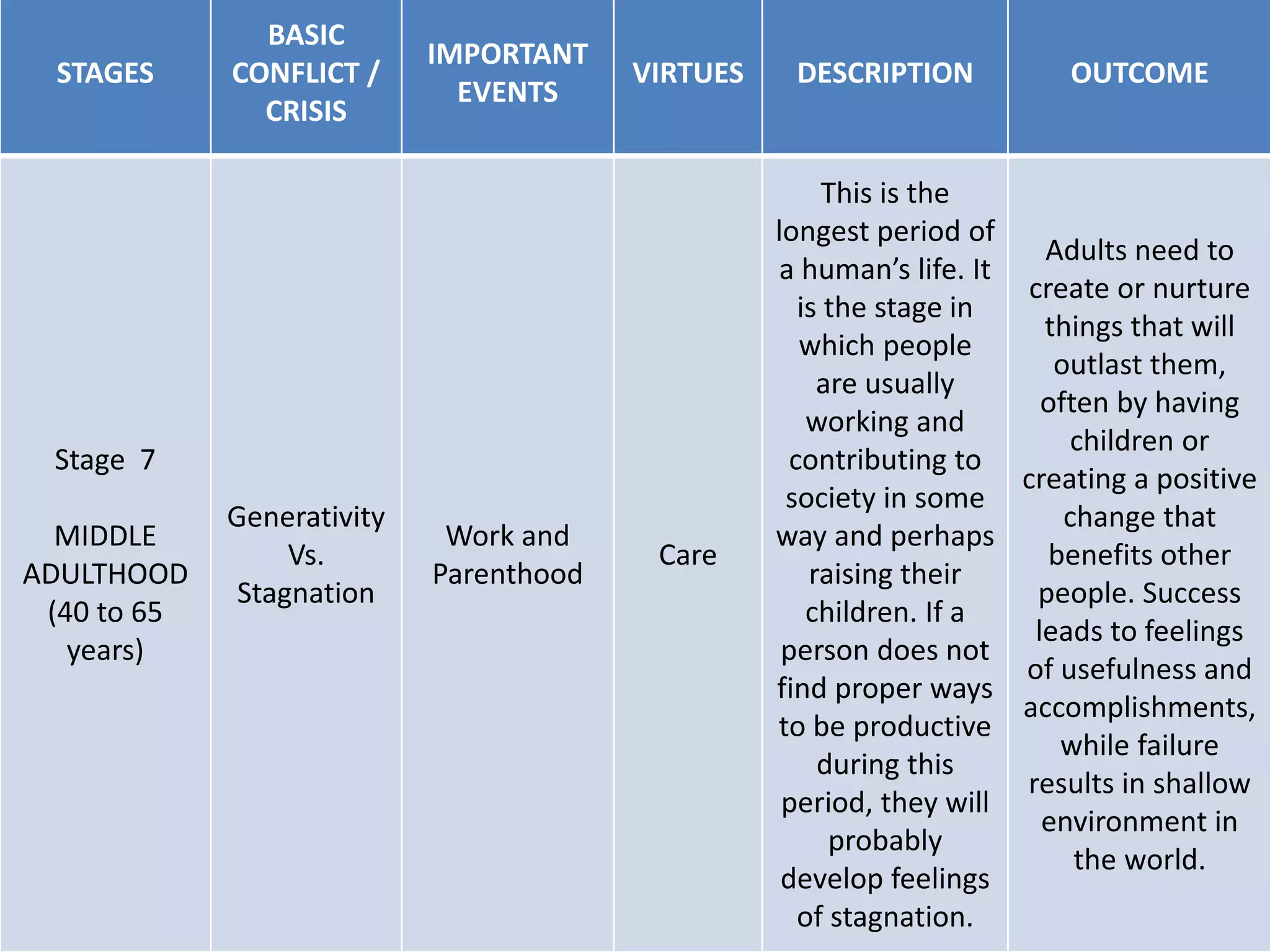
Stage 7
MIDDLE
ADULTHOOD
(40 to 65
years)
Generativity
Vs.
Stagnation
Work and
Parenthood
Care
This is the
longest period of
a human’s life. It
is the stage in
which people
are usually
working and
contributing to
society in some
way and perhaps
raising their
children. If a
person does not
find proper ways
to be productive
during this
period, they will
probably
develop feelings
of stagnation.
Adults need to
create or nurture
things that will
outlast them,
often by having
children or
creating a positive
change that
benefits other
people. Success
leads to feelings
of usefulness and
accomplishments,
while failure
results in shallow
environment in
the world.
STAGES
BASIC
CONFLICT /
CRISIS
IMPORTANT
EVENTS
VIRTUES DESCRIPTION OUTCOME
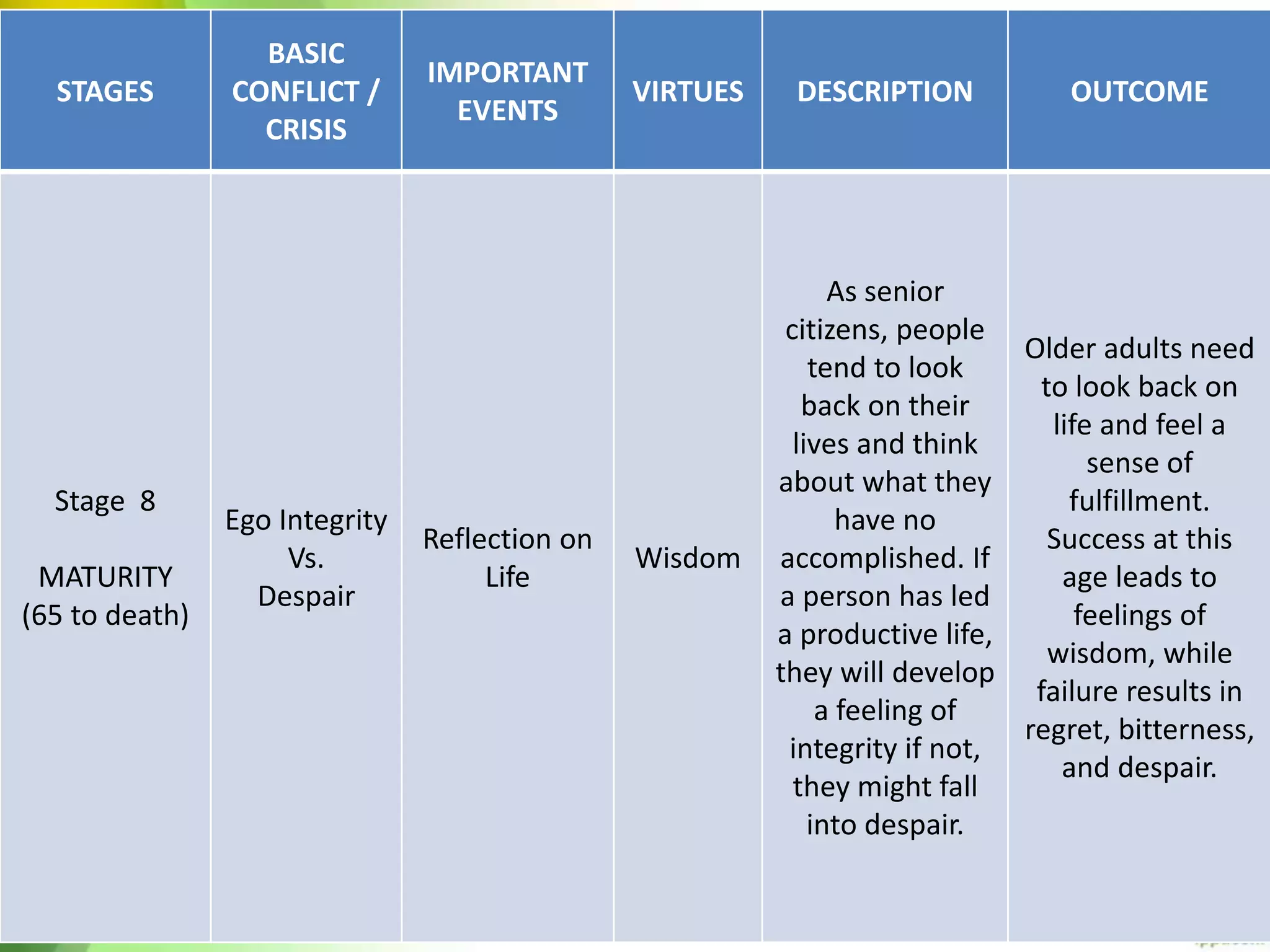
Stage 8
MATURITY
(65 to death)
Ego Integrity
Vs.
Despair
Reflection on
Life
Wisdom
As senior
citizens, people
tend to look
back on their
lives and think
about what they
have no
accomplished. If
a person has led
a productive life,
they will develop
a feeling of
integrity if not,
they might fall
into despair.
Older adults need
to look back on
life and feel a
sense of
fulfillment.
Success at this
age leads to
feelings of
wisdom, while
failure results in
regret, bitterness,
and despair.
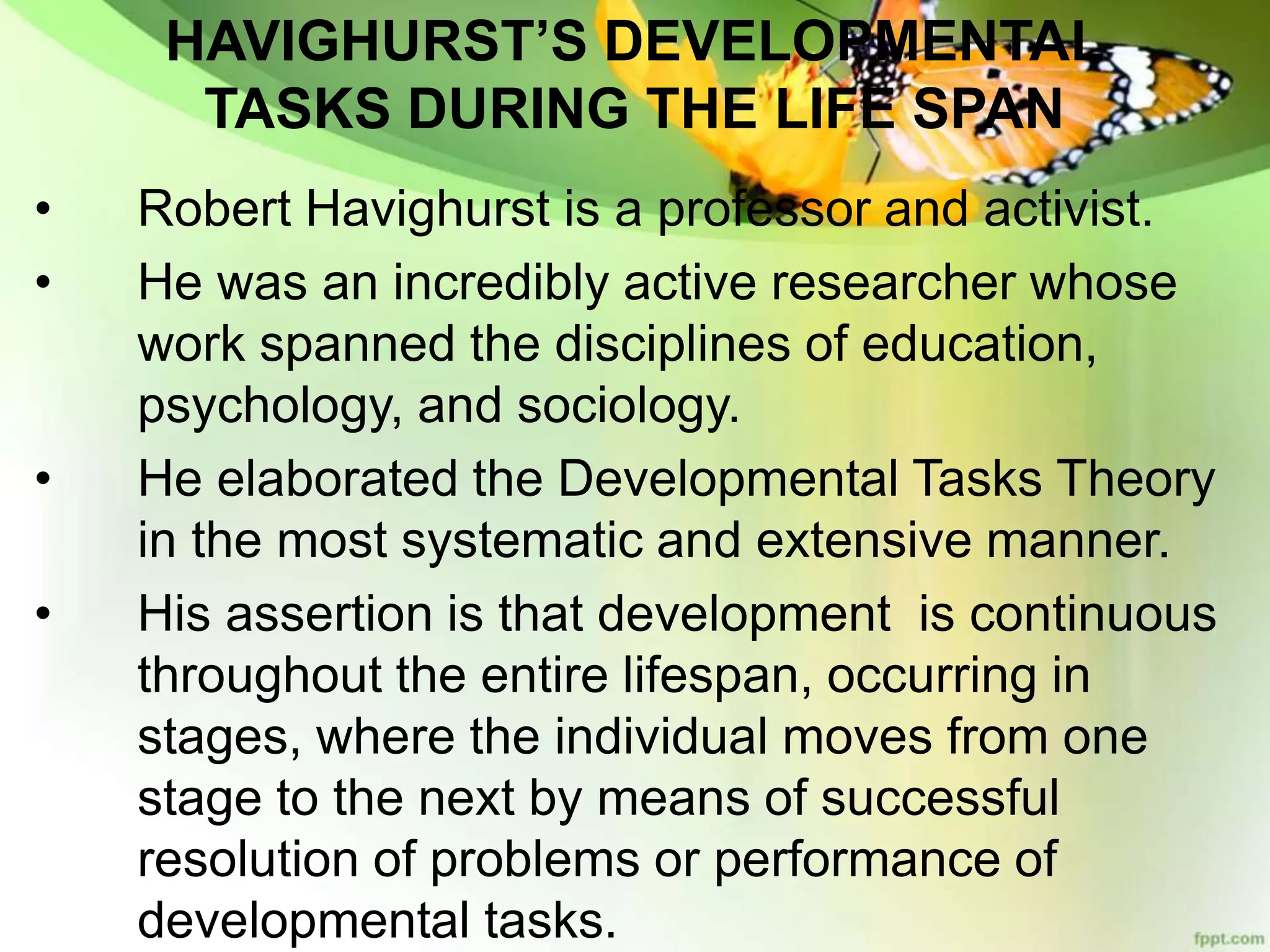
HAVIGHURST’S DEVELOPMENTAL
TASKS DURING THE LIFE SPAN
• Robert Havighurst is a professor and activist.
• He was an incredibly active researcher whose
work spanned the disciplines of education,
psychology, and sociology.
• He elaborated the Developmental Tasks Theory
in the most systematic and extensive manner.
• His assertion is that development is continuous
throughout the entire lifespan, occurring in
stages, where the individual moves from one
stage to the next by means of successful
resolution of problems or performance of
developmental tasks.
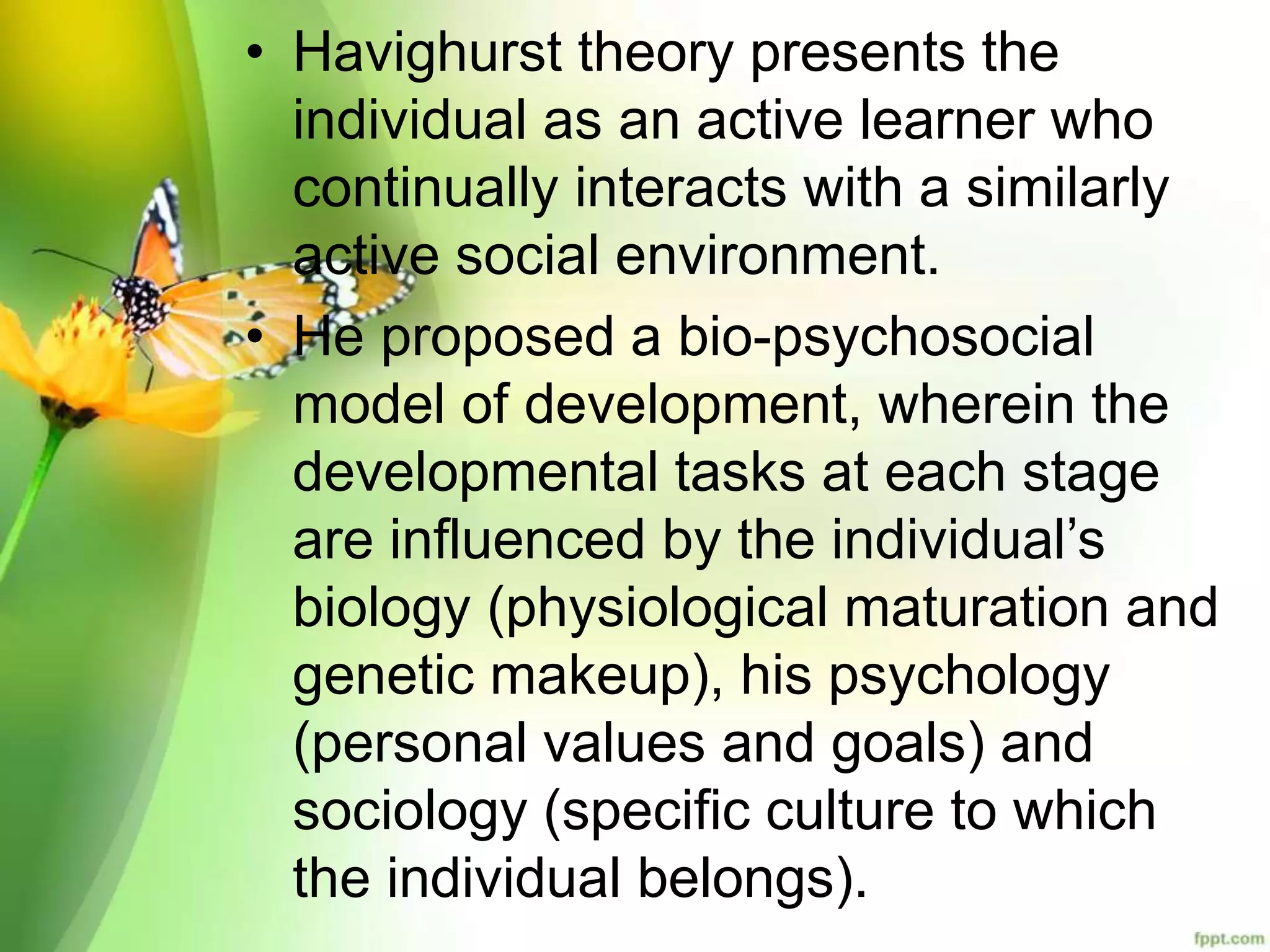
• Havighurst theory presents the
individual as an active learner who
continually interacts with a similarly
active social environment.
• He proposed a bio-psychosocial
model of development, wherein the
developmental tasks at each stage
are influenced by the individual’s
biology (physiological maturation and
genetic makeup), his psychology
(personal values and goals) and
sociology (specific culture to which
the individual belongs).
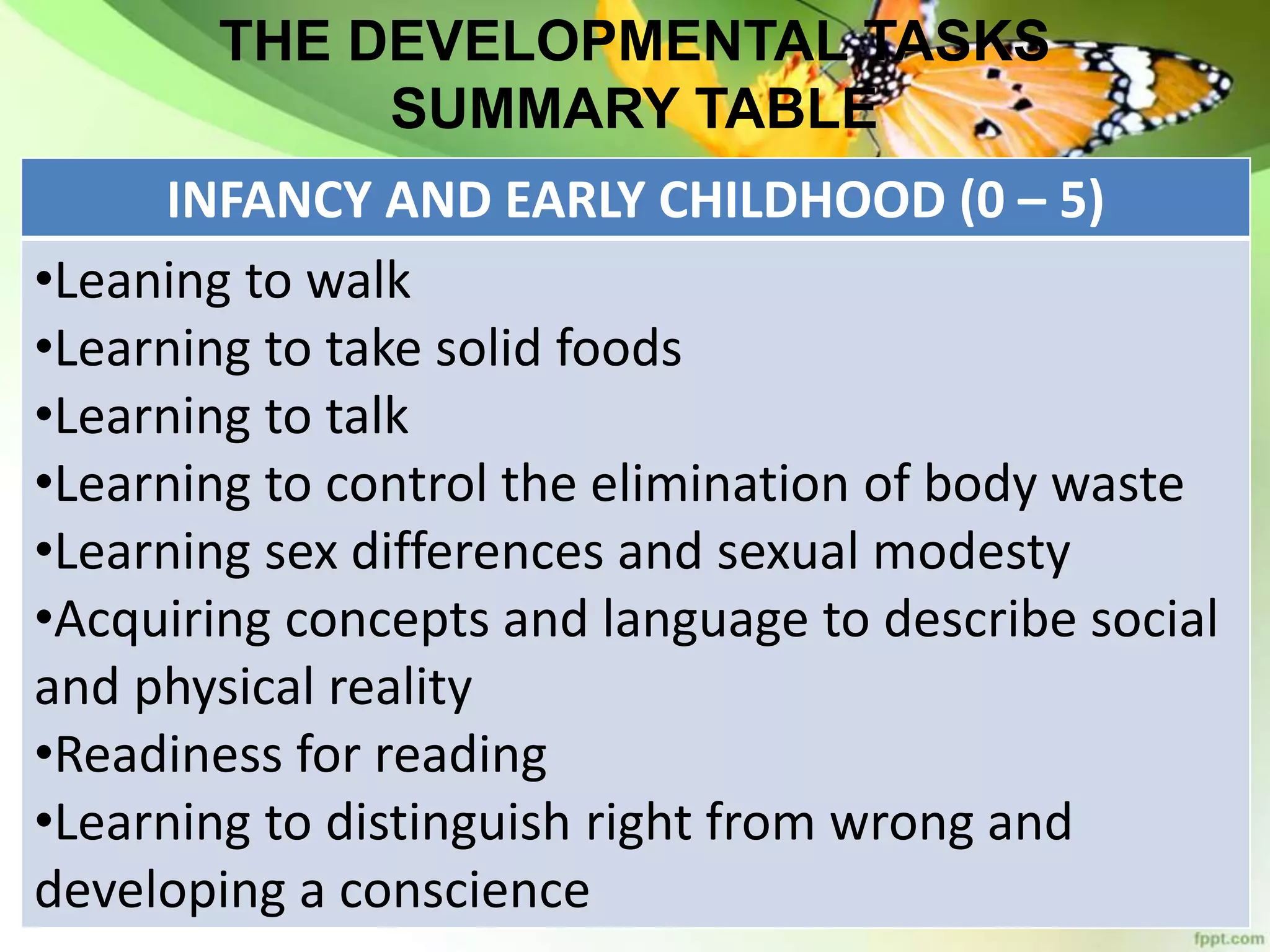
THE DEVELOPMENTAL TASKS
SUMMARY TABLE
INFANCY AND EARLY CHILDHOOD (0 – 5)
•Leaning to walk
•Learning to take solid foods
•Learning to talk
•Learning to control the elimination of body waste
•Learning sex differences and sexual modesty
•Acquiring concepts and language to describe social
and physical reality
•Readiness for reading
•Learning to distinguish right from wrong and
developing a conscience
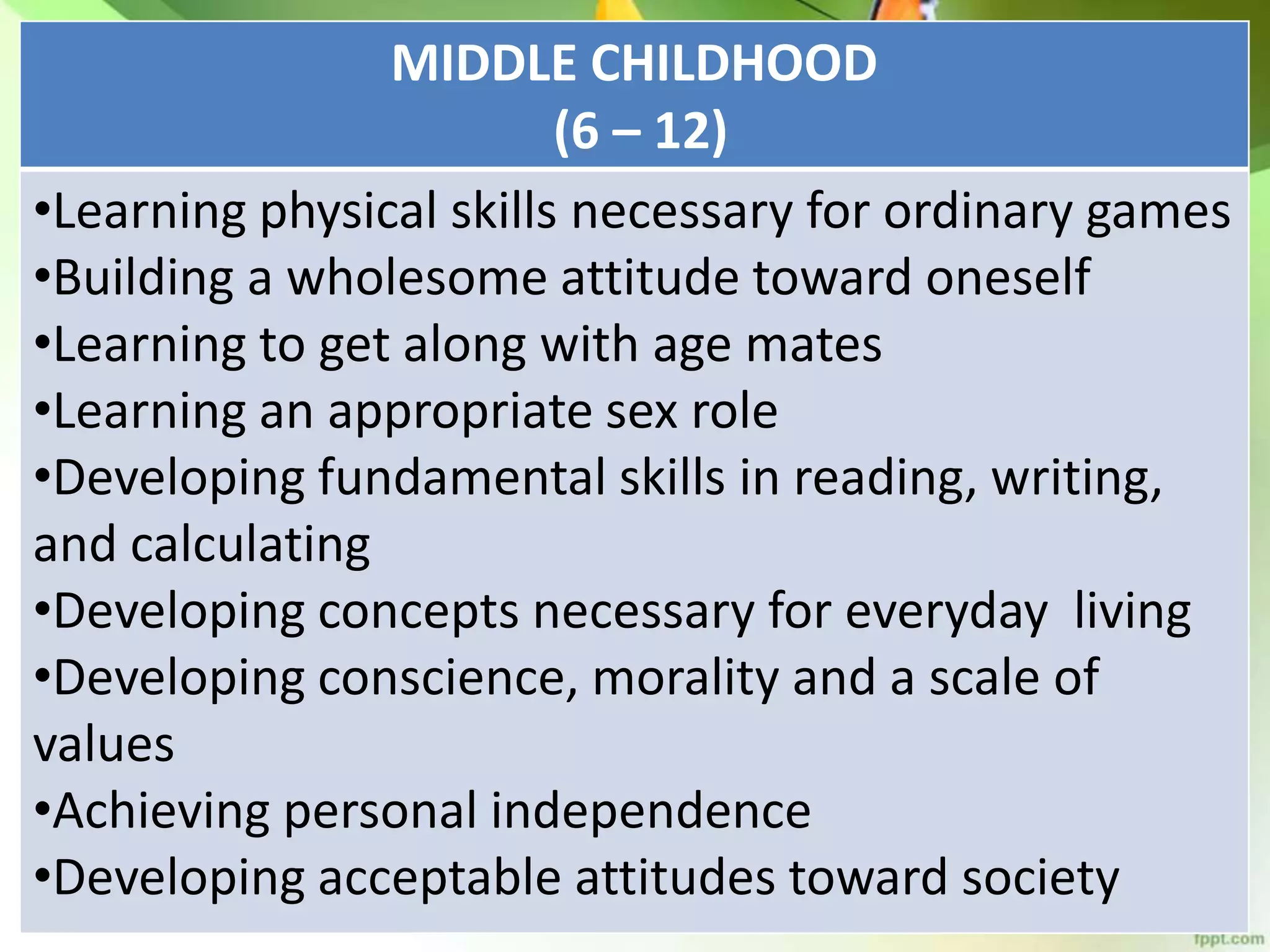
MIDDLE CHILDHOOD
(6 – 12)
•Learning physical skills necessary for ordinary games
•Building a wholesome attitude toward oneself
•Learning to get along with age mates
•Learning an appropriate sex role
•Developing fundamental skills in reading, writing,
and calculating
•Developing concepts necessary for everyday living
•Developing conscience, morality and a scale of
values
•Achieving personal independence
•Developing acceptable attitudes toward society
ADOLESCENCE
(13 – 18)
•Achieving mature relations with both sexes
•Achieving a masculine or feminine social role
•Accepting one’s physique
•Achieving emotional independence of adults
•Preparing for marriage and family life
•Preparing for an economic career
•Acquiring values and an ethical system to guide
behavior
•Desiring and achieving socially responsibility
behavior
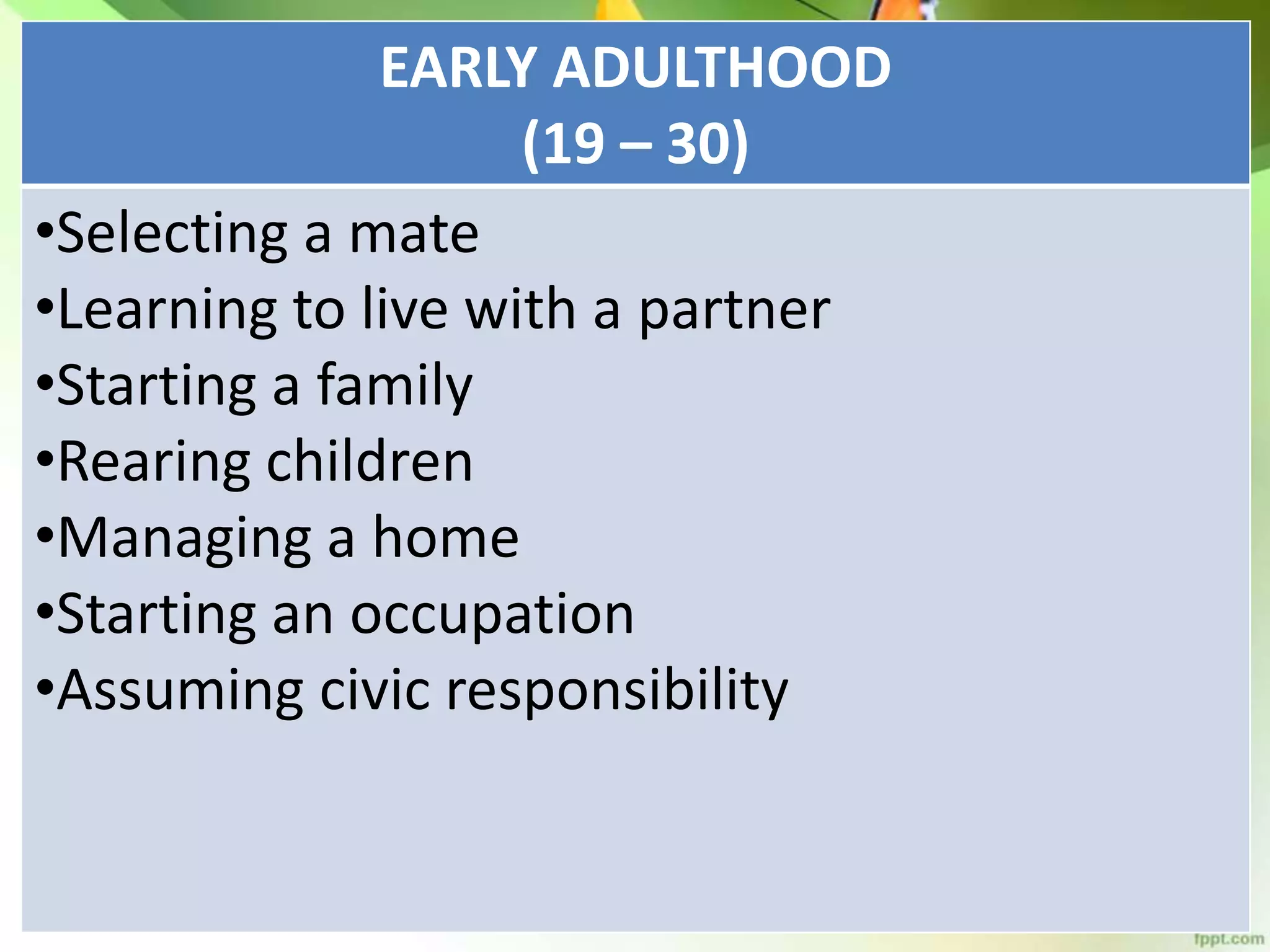
EARLY ADULTHOOD
(19 – 30)
•Selecting a mate
•Learning to live with a partner
•Starting a family
•Rearing children
•Managing a home
•Starting an occupation
•Assuming civic responsibility
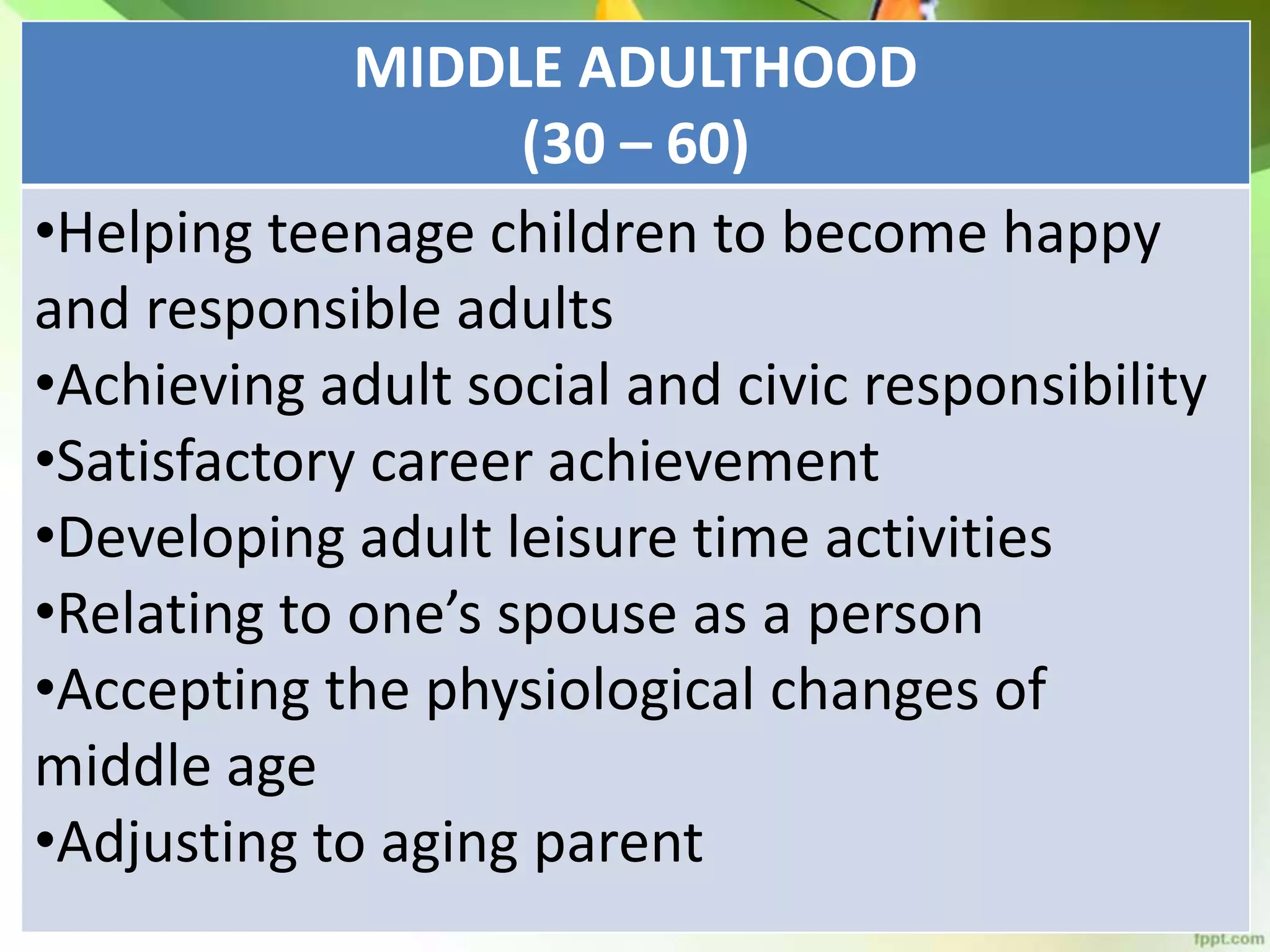
MIDDLE ADULTHOOD
(30 – 60)
•Helping teenage children to become happy
and responsible adults
•Achieving adult social and civic responsibility
•Satisfactory career achievement
•Developing adult leisure time activities
•Relating to one’s spouse as a person
•Accepting the physiological changes of
middle age
•Adjusting to aging parent
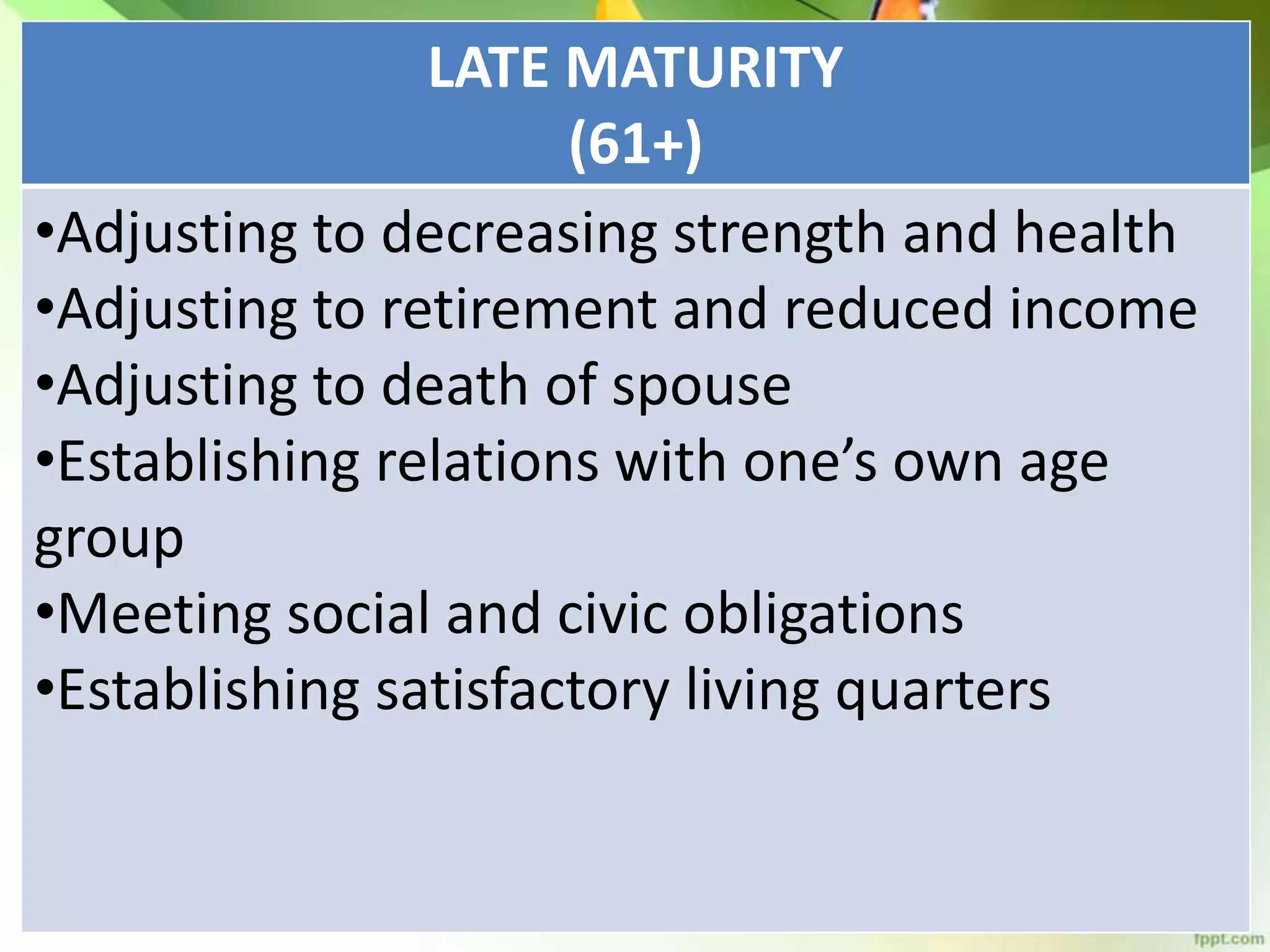
LATE MATURITY
(61+)
•Adjusting to decreasing strength and health
•Adjusting to retirement and reduced income
•Adjusting to death of spouse
•Establishing relations with one’s own age
group
•Meeting social and civic obligations
•Establishing satisfactory living quarters
ACTIVITY: GROUP WORK
Using the Developmental Tasks Summary Table,
assess your own level of development as a
Grade 11 student. Use the worksheet below:
Answer the following Processing Questions:
What are the
expected tasks
you have
successfully
accomplished?
What are the
expected tasks
you have partially
accomplished?
What are the
expected tasks
you have not
accomplished?
1. Being in Grade 11, what are the developmental
tasks expected of you? Rate yourself from 1 – 10
(10 as the highest) whether you have
accomplished those expected tasks.
2. As you are in Grade 11, you are in transition from
high school to college, from being an adolescent
to young adult. How do you feel about this
transition? What is your turning point?
3. Do you think you are ready in this transition which
may mean more responsibilities and greater
accountability? If no, what are the expected tasks
you need to work on? If yes, what are the ways so
you can better plan for the future?
PROCESSING QUESTIONS:

Personal development: human developmental stages

  • 1.
    Developmental Stages in Middleand Late Adolescence
  • 2.
    HUMAN DEVELOPMENTAL STAGES •Human development focuses on human growth and changes across the lifespan, including physical, cognitive, social, intellectual, perceptual, personality and emotional growth. • The study of human development is essential to understanding how humans learn, mature, and adapt.
  • 3.
    • Throughout theirlives, humans go through various stages of development. • The human being is either in a state of growth or decline, but either condition imparts change. • Some aspects of our life change very little over time, are consistent. • Other aspects change dramatically. • By understanding these changes, we can better respond and plan ahead effectively. HUMAN DEVELOPMENTAL STAGES
  • 4.
    HUMAN DEVELOPMENTAL STAGES ErikErikson STAGES BASIC CONFLICT / CRISIS IMPORTAN T EVENTS VIRTUES DESCRIPTION OUTCOME Stage 1 INFANCY (birth to 18 months) Trust Vs. Mistrust Feeding Hope At this stage babies learn to trust that their parents will meet their needs. If a child’s basic needs aren’t properly met at this age, he/she might grow up with a general mistrust of the world. Children develop a sense of trust when caregivers provide reliability, care, and affection. A lack of this will lead to mistrust.
  • 5.
    STAGES BASIC CONFLICT / CRISIS IMPORTANT EVENTS VIRTUES DESCRIPTIONOUTCOME Stage 2 EARLY CHILDHOOD (18 months to 3 years) Autonomy Vs. Shame and Doubt Toilet Training Will As toddlers, children begin to develop independence and start to learn that they can do some things on their own (such as going to the toilet). If a child is not encouraged properly at this age, he or she might develop shame and doubt about their abilities. Children need to develop a sense of personal control over physical skills and a sense of independence. Success leads to feeling of autonomy, while failure results in feelings of shame and doubt.
  • 6.
    STAGES BASIC CONFLICT / CRISIS IMPORTANT EVENTS VIRTUES DESCRIPTIONOUTCOME Stage 3 PRESCHOOL (3 to 5 years) Initiative Vs. Guilt Exploration Purpose As preschoolers, children continue to develop more independence and start to do things of their own initiative. If a child is not able to take initiative and succeed at appropriate tasks, he or she might develop guilt over his/her needs and desires. Children need to begin asserting control and power over the environment. Success in this stage leads to a sense of purpose. Children who try to exert too much power experience disapproval, resulting in a sense of guilt.
  • 7.
    STAGES BASIC CONFLICT / CRISIS IMPORTANT EVENTS VIRTUES DESCRIPTIONOUTCOME Stage 4 SCHOOL AGE (6 to 11 years) Industry Vs. Inferiority School Competence Throughout their school years, children continue to develop self- confidence through learning new things. If they are not encouraged and praised properly at this age, they may develop inferiority complex. Children need to cope with new social and academic demands. Success leads to a sense of competence, while failure results in feeling of inferiority.
  • 8.
    STAGES BASIC CONFLICT / CRISIS IMPORTANT EVENTS VIRTUES DESCRIPTIONOUTCOME Stage 5 ADOLESCENCE (12 to 18 years) Identity Vs. Role Confusion Social Relationships Fidelity When they reach the teenage years, children stat to care about how they look to others. They start forming their own identity by experimenting with who they are. If a teenager is unable to properly develop an identity at this age, his or her role confusion will probably continue on the adulthood. Teens need to develop a sense of self and personal identity. Success leads to n ability to stay true to yourself, wile failure leads to role confusion and a weak sense of self.
  • 9.
    STAGES BASIC CONFLICT / CRISIS IMPORTANT EVENTS VIRTUES DESCRIPTIONOUTCOME Stage 6 YOUNG ADULTHOOD (19 to 40 years) Intimacy Vs. Isolation Relationships Love During early adulthood, most people fall in love, get married and start building their own family. If a person is unable to develop intimacy with other at this age (whether through marriage or close friendship) they will probably develop feelings of isolation. Young adults need to form intimate, loving relationships with other people. Success leads to strong relationships, while failure results in loneliness and isolation.
  • 10.
    STAGES BASIC CONFLICT / CRISIS IMPORTANT EVENTS VIRTUES DESCRIPTIONOUTCOME Stage 7 MIDDLE ADULTHOOD (40 to 65 years) Generativity Vs. Stagnation Work and Parenthood Care This is the longest period of a human’s life. It is the stage in which people are usually working and contributing to society in some way and perhaps raising their children. If a person does not find proper ways to be productive during this period, they will probably develop feelings of stagnation. Adults need to create or nurture things that will outlast them, often by having children or creating a positive change that benefits other people. Success leads to feelings of usefulness and accomplishments, while failure results in shallow environment in the world.
  • 11.
    STAGES BASIC CONFLICT / CRISIS IMPORTANT EVENTS VIRTUES DESCRIPTIONOUTCOME Stage 8 MATURITY (65 to death) Ego Integrity Vs. Despair Reflection on Life Wisdom As senior citizens, people tend to look back on their lives and think about what they have no accomplished. If a person has led a productive life, they will develop a feeling of integrity if not, they might fall into despair. Older adults need to look back on life and feel a sense of fulfillment. Success at this age leads to feelings of wisdom, while failure results in regret, bitterness, and despair.
  • 12.
    HAVIGHURST’S DEVELOPMENTAL TASKS DURINGTHE LIFE SPAN • Robert Havighurst is a professor and activist. • He was an incredibly active researcher whose work spanned the disciplines of education, psychology, and sociology. • He elaborated the Developmental Tasks Theory in the most systematic and extensive manner. • His assertion is that development is continuous throughout the entire lifespan, occurring in stages, where the individual moves from one stage to the next by means of successful resolution of problems or performance of developmental tasks.
  • 13.
    • Havighurst theorypresents the individual as an active learner who continually interacts with a similarly active social environment. • He proposed a bio-psychosocial model of development, wherein the developmental tasks at each stage are influenced by the individual’s biology (physiological maturation and genetic makeup), his psychology (personal values and goals) and sociology (specific culture to which the individual belongs).
  • 14.
    THE DEVELOPMENTAL TASKS SUMMARYTABLE INFANCY AND EARLY CHILDHOOD (0 – 5) •Leaning to walk •Learning to take solid foods •Learning to talk •Learning to control the elimination of body waste •Learning sex differences and sexual modesty •Acquiring concepts and language to describe social and physical reality •Readiness for reading •Learning to distinguish right from wrong and developing a conscience
  • 15.
    MIDDLE CHILDHOOD (6 –12) •Learning physical skills necessary for ordinary games •Building a wholesome attitude toward oneself •Learning to get along with age mates •Learning an appropriate sex role •Developing fundamental skills in reading, writing, and calculating •Developing concepts necessary for everyday living •Developing conscience, morality and a scale of values •Achieving personal independence •Developing acceptable attitudes toward society
  • 16.
    ADOLESCENCE (13 – 18) •Achievingmature relations with both sexes •Achieving a masculine or feminine social role •Accepting one’s physique •Achieving emotional independence of adults •Preparing for marriage and family life •Preparing for an economic career •Acquiring values and an ethical system to guide behavior •Desiring and achieving socially responsibility behavior
  • 17.
    EARLY ADULTHOOD (19 –30) •Selecting a mate •Learning to live with a partner •Starting a family •Rearing children •Managing a home •Starting an occupation •Assuming civic responsibility
  • 18.
    MIDDLE ADULTHOOD (30 –60) •Helping teenage children to become happy and responsible adults •Achieving adult social and civic responsibility •Satisfactory career achievement •Developing adult leisure time activities •Relating to one’s spouse as a person •Accepting the physiological changes of middle age •Adjusting to aging parent
  • 19.
    LATE MATURITY (61+) •Adjusting todecreasing strength and health •Adjusting to retirement and reduced income •Adjusting to death of spouse •Establishing relations with one’s own age group •Meeting social and civic obligations •Establishing satisfactory living quarters
  • 20.
    ACTIVITY: GROUP WORK Usingthe Developmental Tasks Summary Table, assess your own level of development as a Grade 11 student. Use the worksheet below: Answer the following Processing Questions: What are the expected tasks you have successfully accomplished? What are the expected tasks you have partially accomplished? What are the expected tasks you have not accomplished?
  • 21.
    1. Being inGrade 11, what are the developmental tasks expected of you? Rate yourself from 1 – 10 (10 as the highest) whether you have accomplished those expected tasks. 2. As you are in Grade 11, you are in transition from high school to college, from being an adolescent to young adult. How do you feel about this transition? What is your turning point? 3. Do you think you are ready in this transition which may mean more responsibilities and greater accountability? If no, what are the expected tasks you need to work on? If yes, what are the ways so you can better plan for the future? PROCESSING QUESTIONS: