Ing. Alessio Fabiani
Dott. Giovanni Allegri
Ing. Simone Giannecchini
One GeoNode
Many GeoNodes
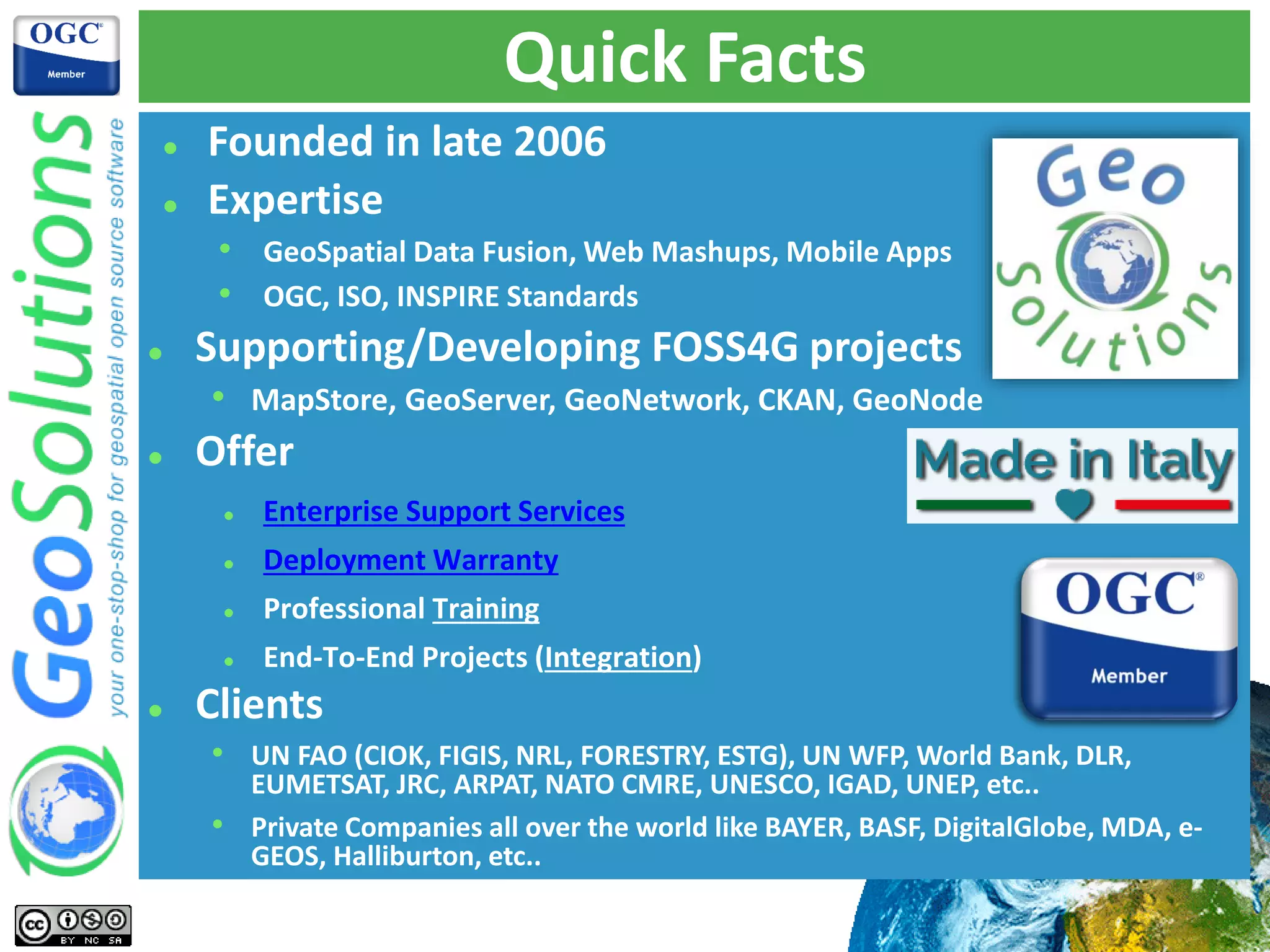
Quick Facts
 Founded in late 2006
 Expertise
• GeoSpatial Data Fusion, Web Mashups, Mobile Apps
• OGC, ISO, INSPIRE Standards
 Supporting/Developing FOSS4G projects
• MapStore, GeoServer, GeoNetwork, CKAN, GeoNode
 Offer
 Enterprise Support Services
 Deployment Warranty
 Professional Training
 End-To-End Projects (Integration)
 Clients
• UN FAO (CIOK, FIGIS, NRL, FORESTRY, ESTG), UN WFP, World Bank, DLR,
EUMETSAT, JRC, ARPAT, NATO CMRE, UNESCO, IGAD, UNEP, etc..
• Private Companies all over the world like BAYER, BASF, DigitalGlobe, MDA, e-
GEOS, Halliburton, etc..
One GeoNode
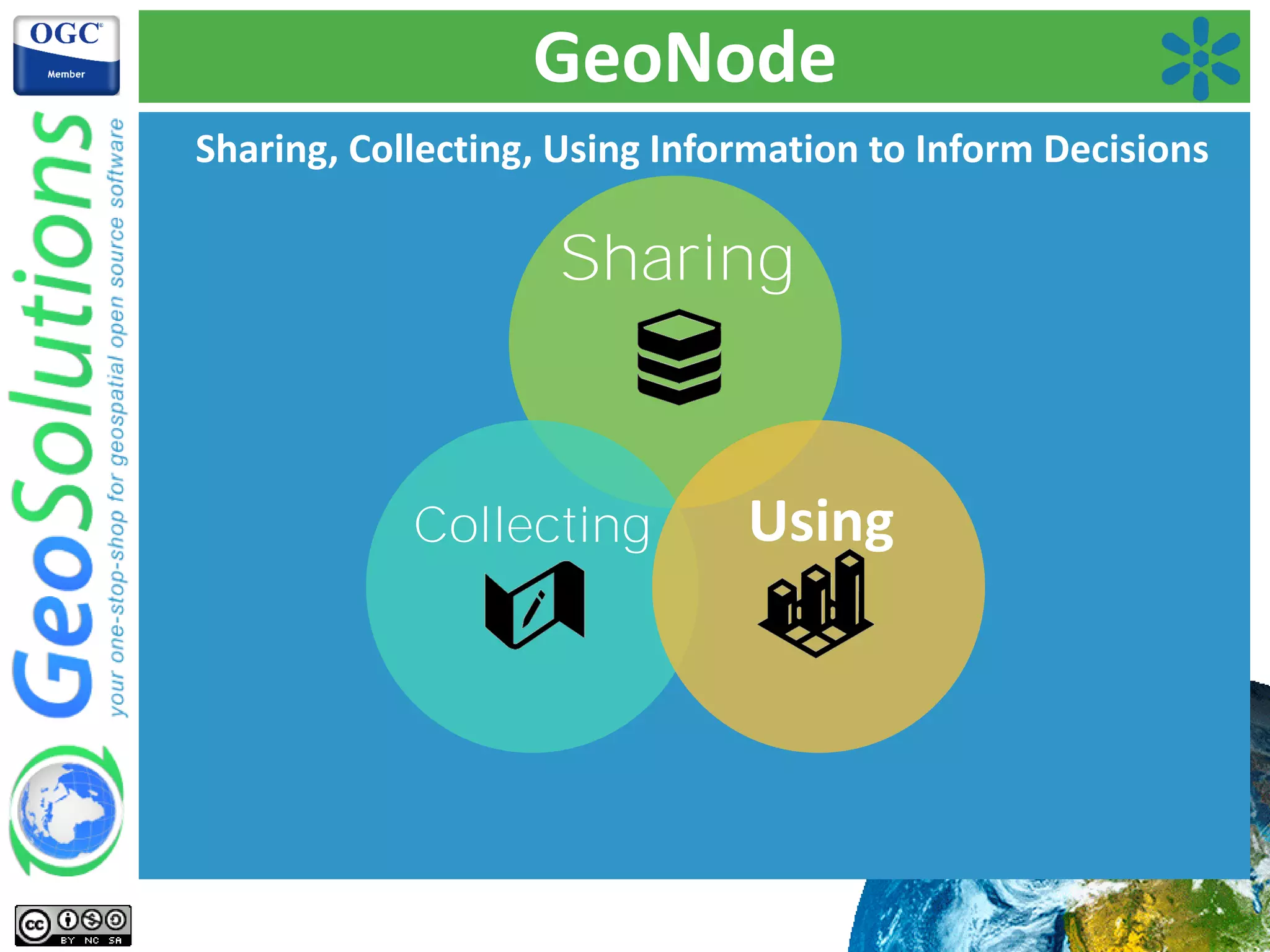
Sharing, Collecting, Using Information to Inform Decisions
Collecting
Sharing
Using
GeoNode
It's open source, Of course!
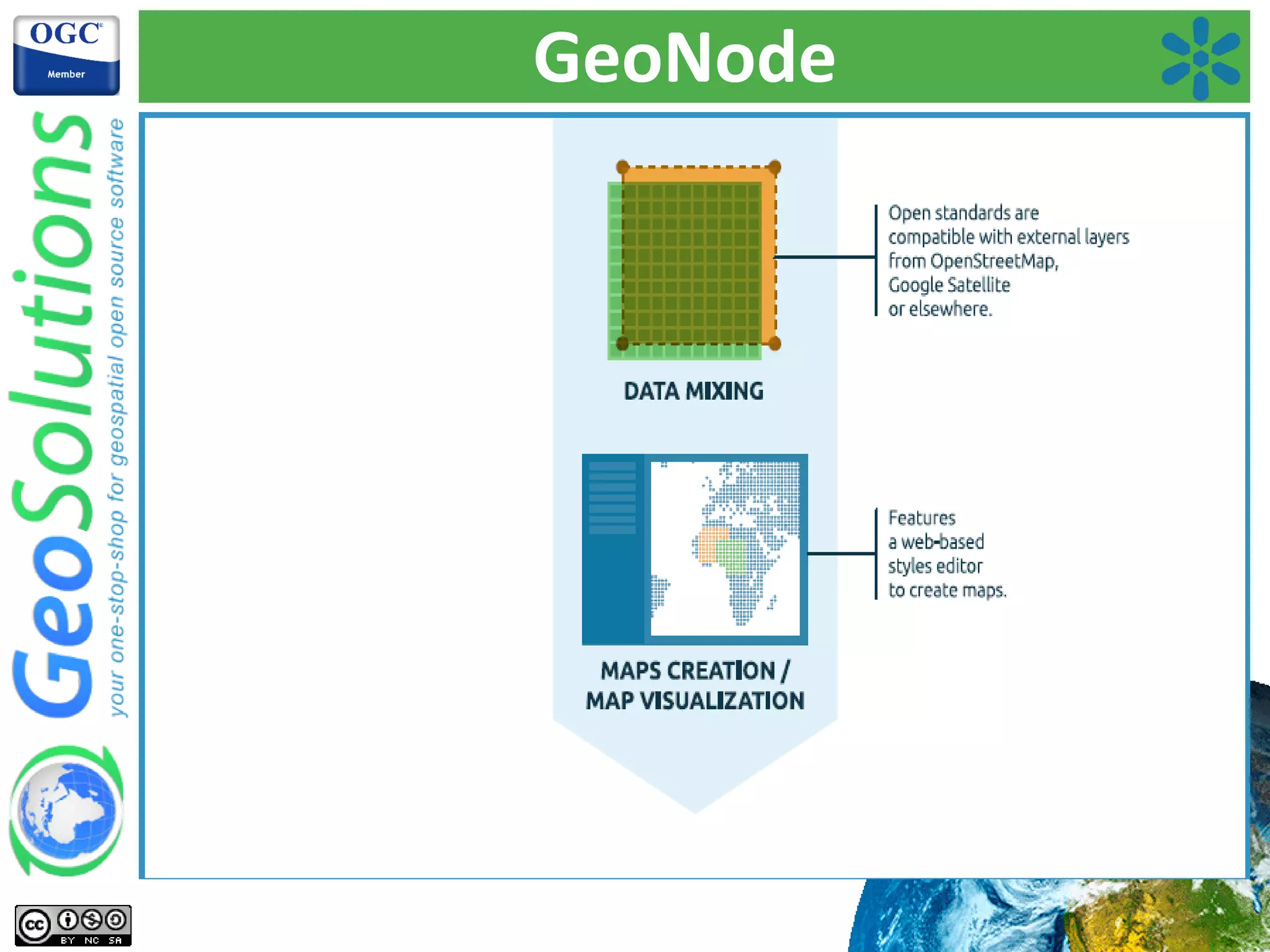
GeoNode
GeoNode
GeoNode
GeoNode
GeoNode
GeoNode
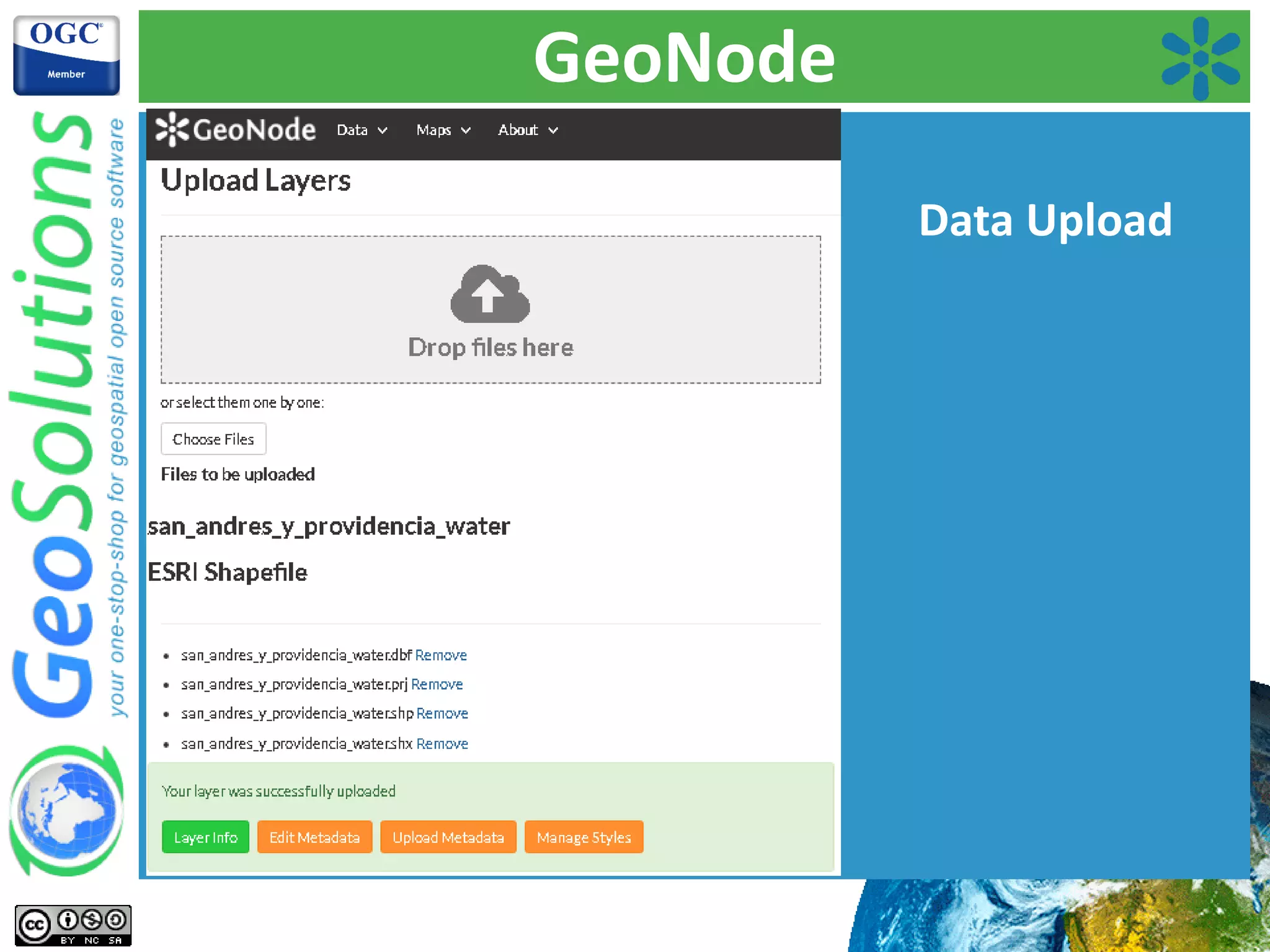
Data Upload
GeoNode
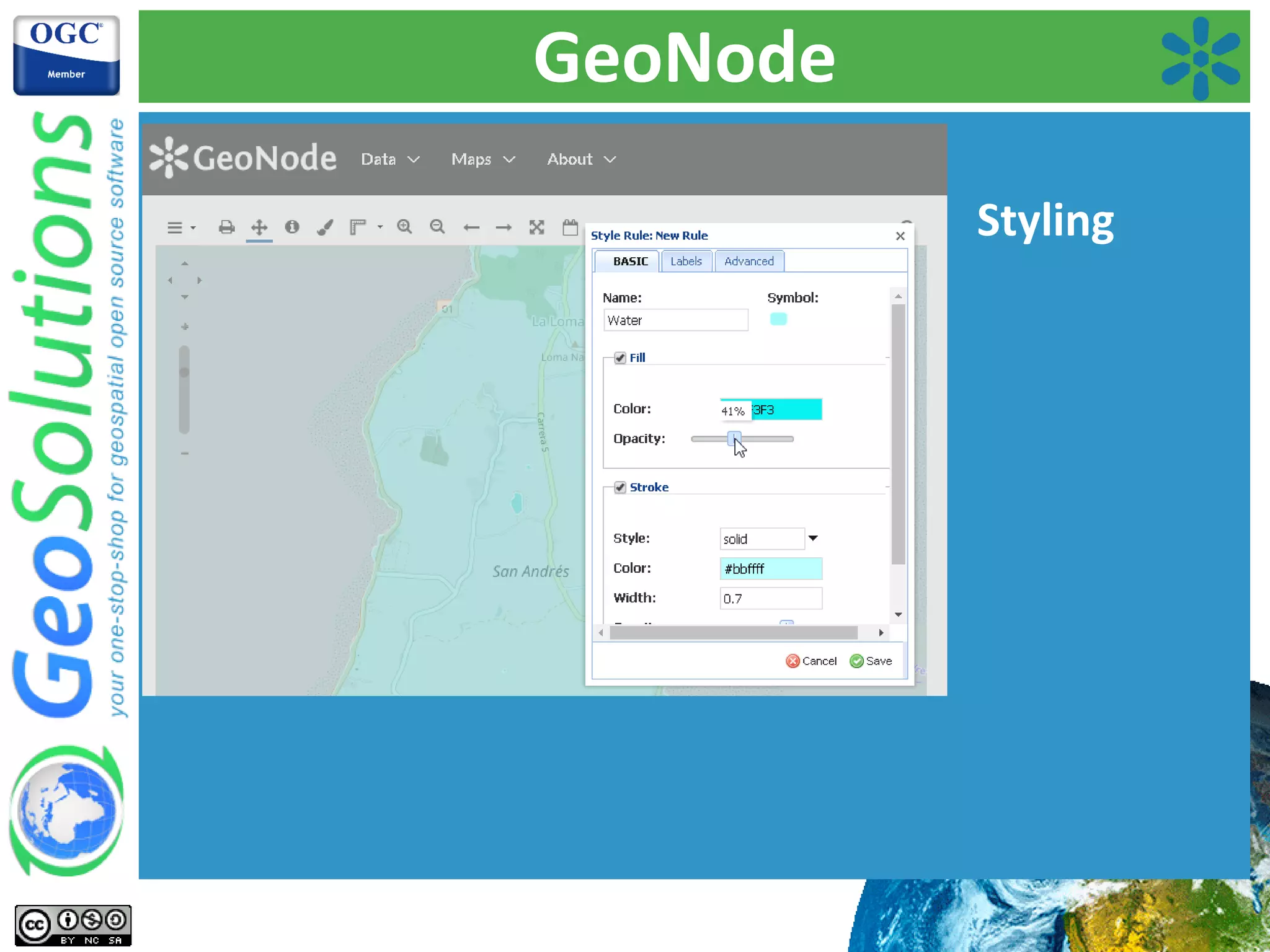
Styling
GeoNode
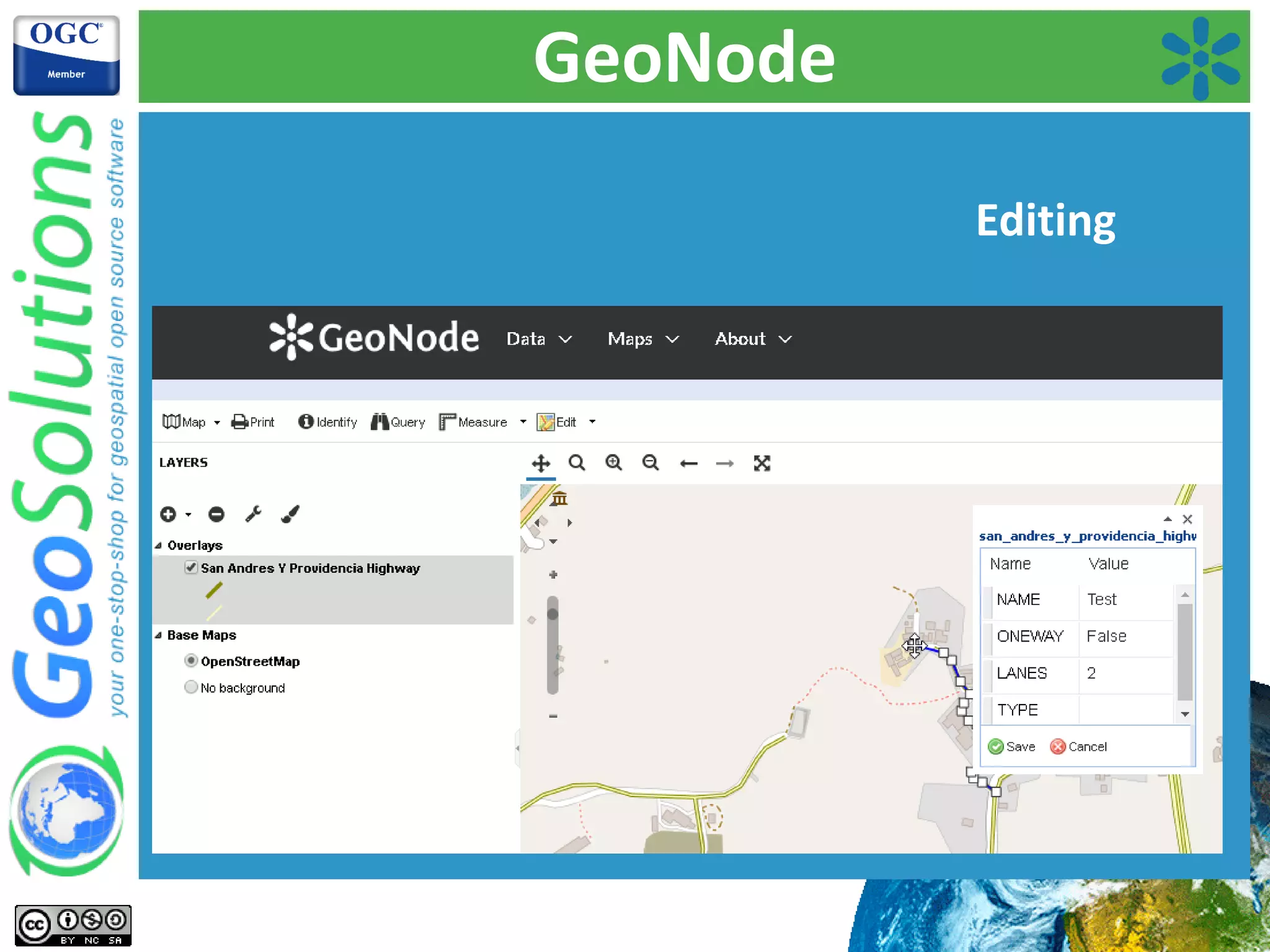
Editing
GeoNode
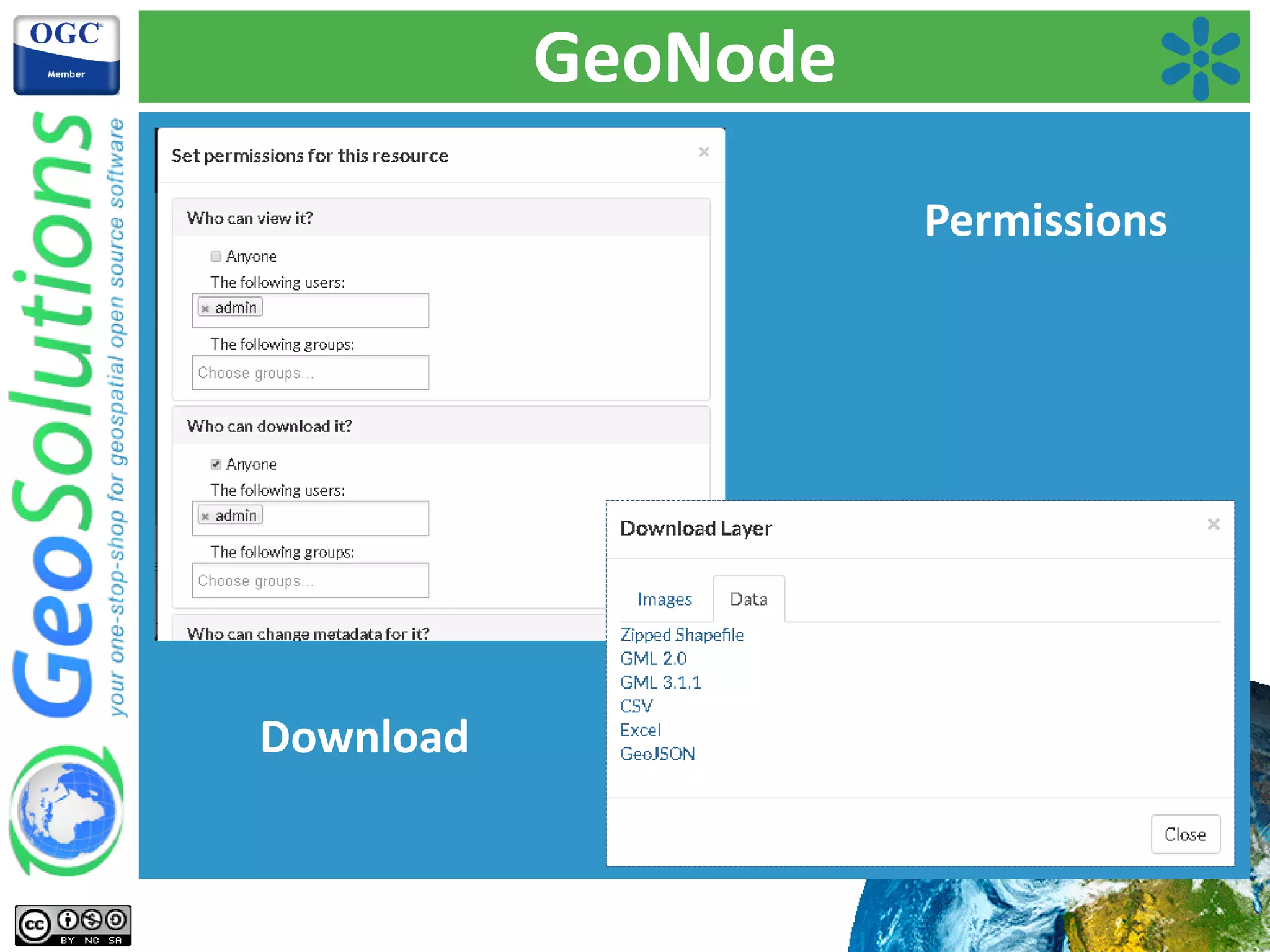
Permissions
Download
GeoNode
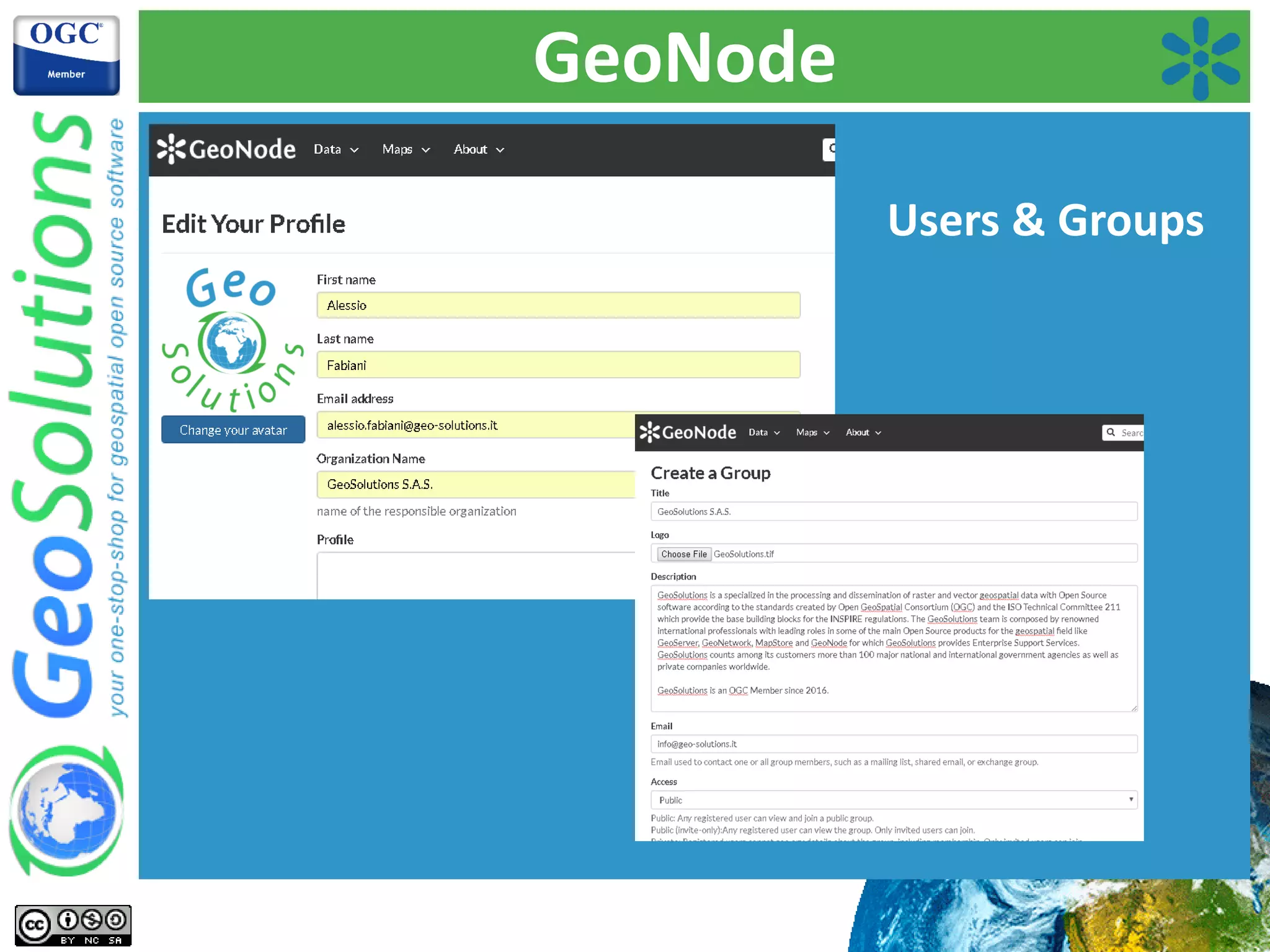
Users & Groups
GeoNode
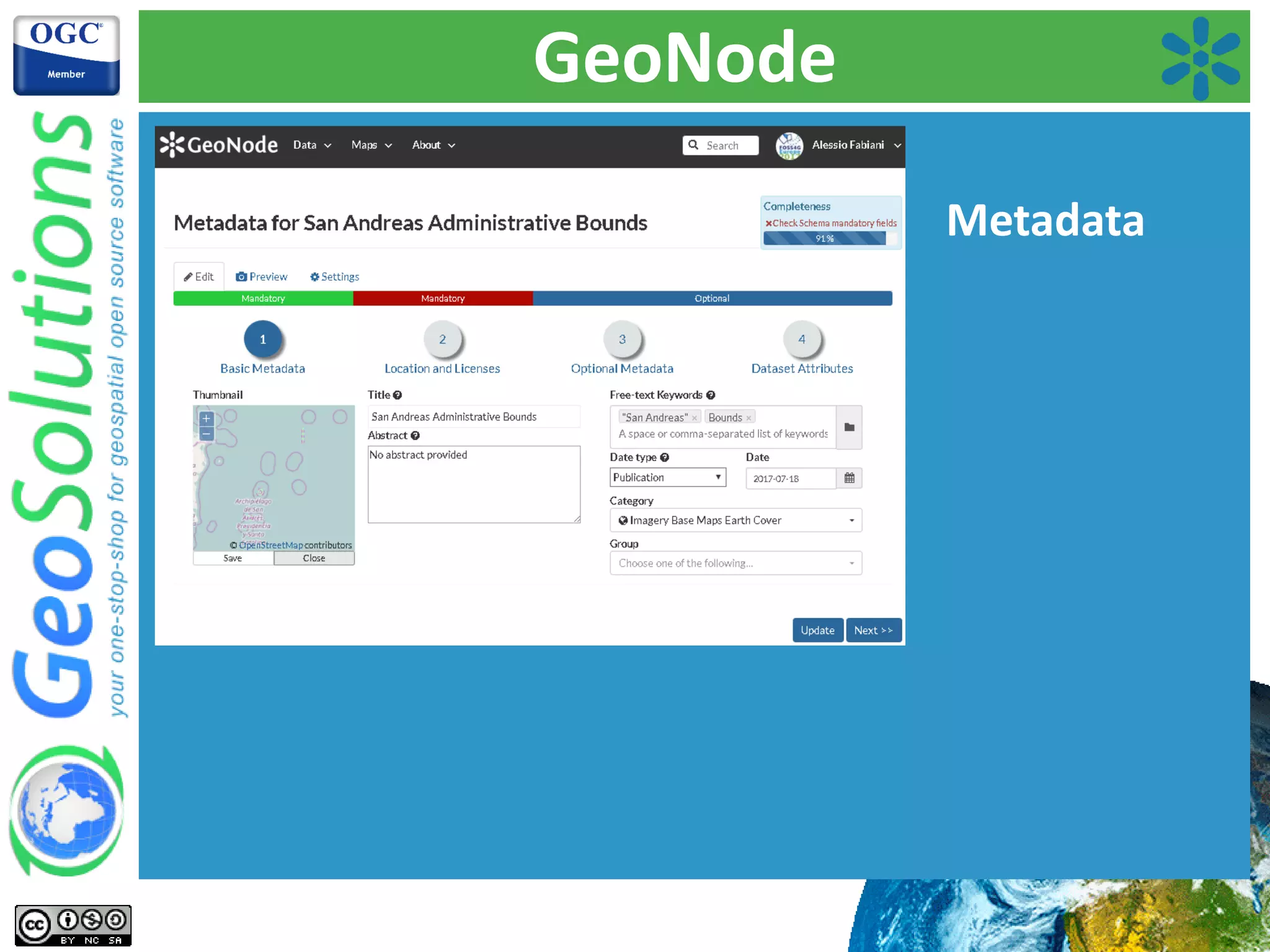
Metadata
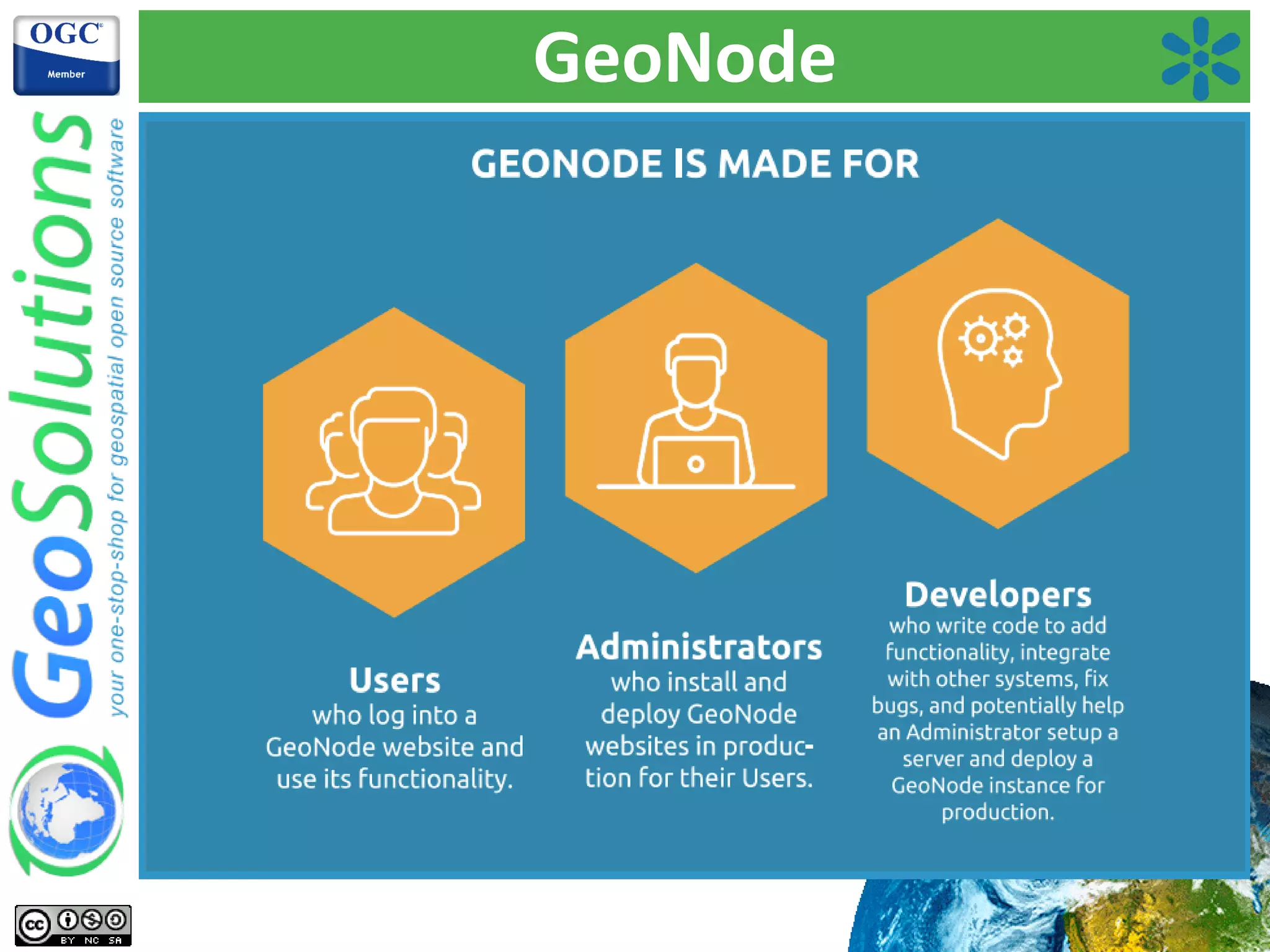
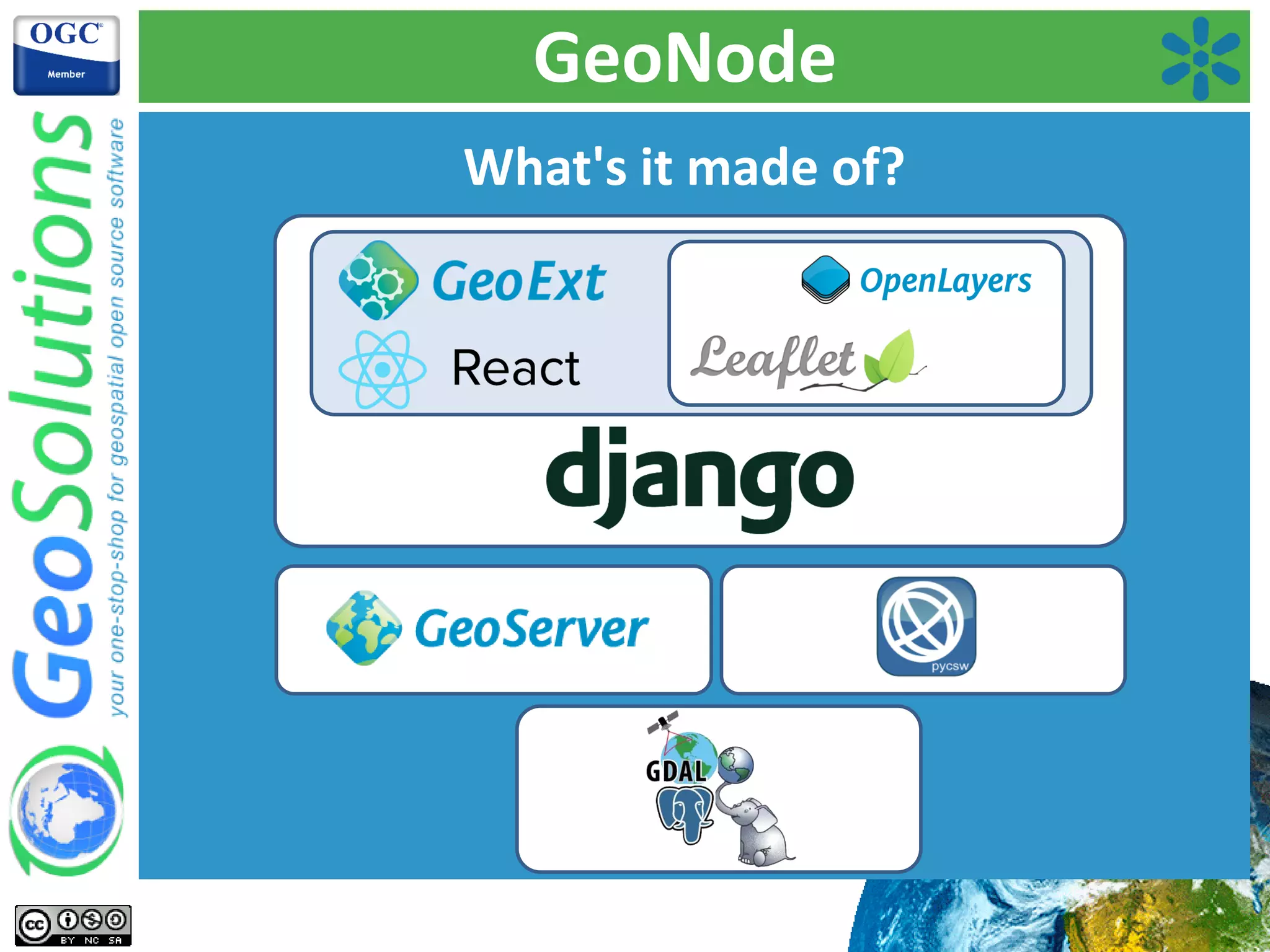
What's it made of?
GeoNode
Many GeoNodes
Creating Downstream Applications
• GeoNode cannot address all use cases
• Avoid reinventing the wheel
• Avoid implicit/explicit forks
 Custom GeoNode Applications to the rescue!
• A proper “GeoNode Project”:
• Start from a template (geonode-project)
• Generate a “materialized” Django project
• It extends the “vanilla” GeoNode
• It provides a custom Django app
• It addresses specific use cases
• You develop something of general interest?
• Donate back to Core GeoNode!
Creating Downstream Applications
This approach offers several opportunities
• Customize GeoNode look and feel
• Extend its models without modifying GeoNode Core
• Extend its functionalities without modifying GeoNode Core
• Define a brand new end user interface
This approach allows us to
• make the most out of what GeoNode core offers
• without sacrificing versatility
• without sacrificing specific project needs
It’s doable, we did it (or at least we tried to ☺ )
Hold tight, awesome examples next!
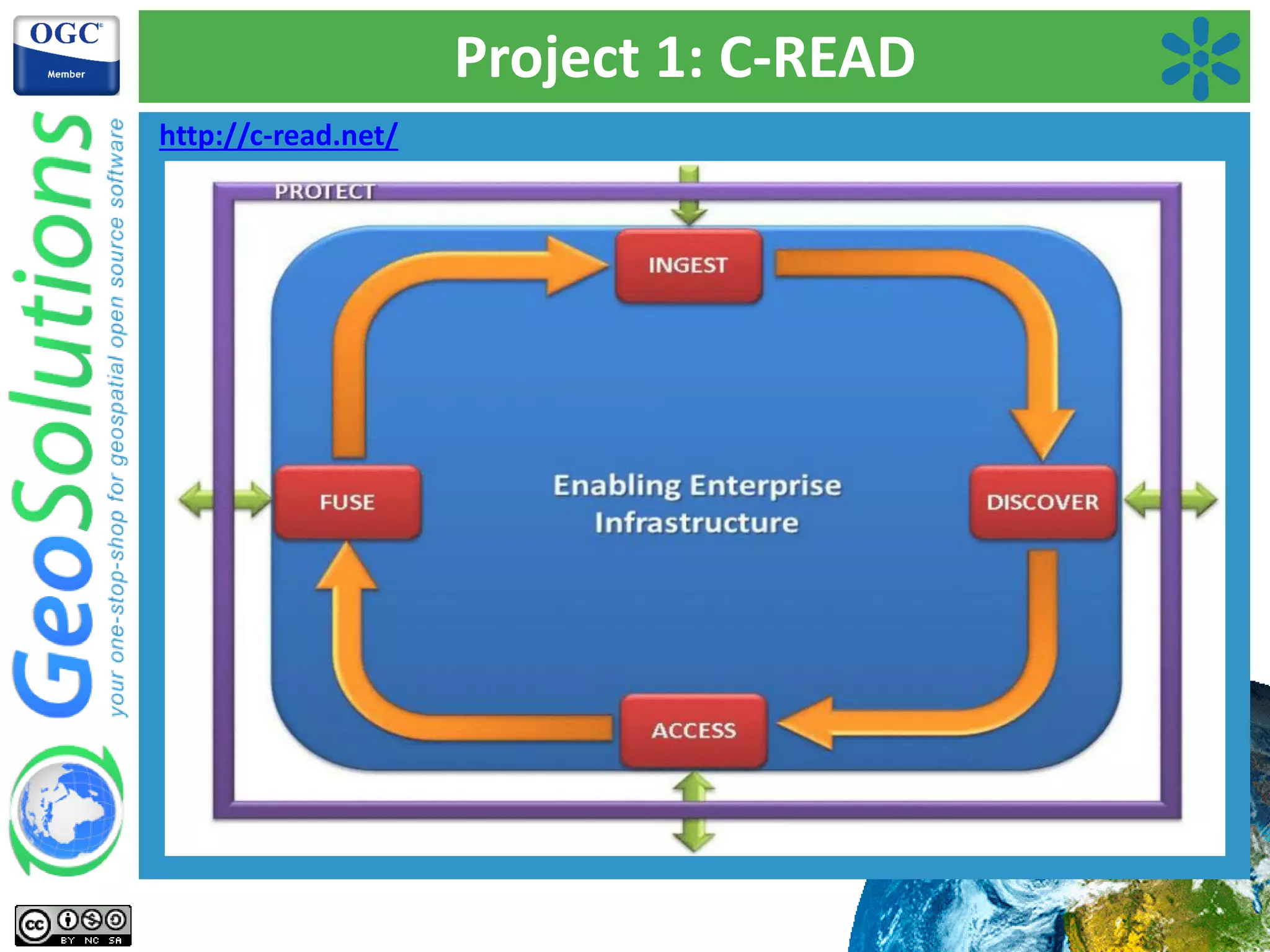
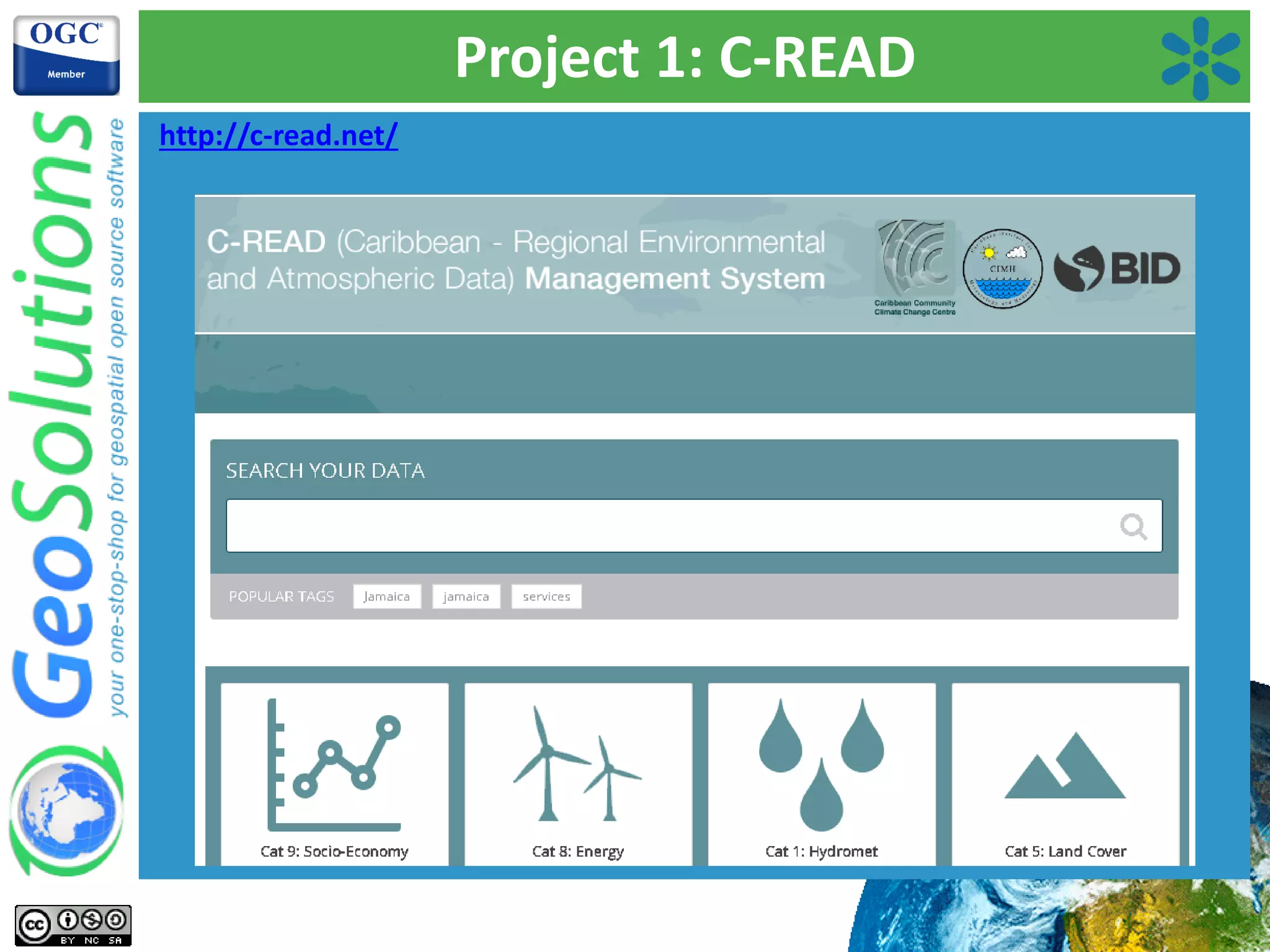
Project 1: C-READ
• Caribbean Community Climate Change Centre – C-READ
(Regional Environment and Atmospheric Data)
• Development and Installation of a Database Management System for
a Regional Integrated Observing Network for Environmental Change
in the Wider Caribbean
• Ingest, to provide functionalities to preprocess, transform, load and
refine the data that needs to be ingested into the system for later
reuse
• Discover, in order to allow external and internal players to search
for data and information for later access and fusion
• Access, to support the dissemination of data and information both
in raw form as well as in more sophisticated forms like portrayals,
reports and maps (superimpositions of multiple portrayals of raw
data)
• Fuse, to provide advanced geoprocessing functionalities to extract
higher level information from the data and information managed
by the data warehouse
• http://c-read.net
Project 1: C-READ
http://c-read.net/
Project 1: C-READ
http://c-read.net/
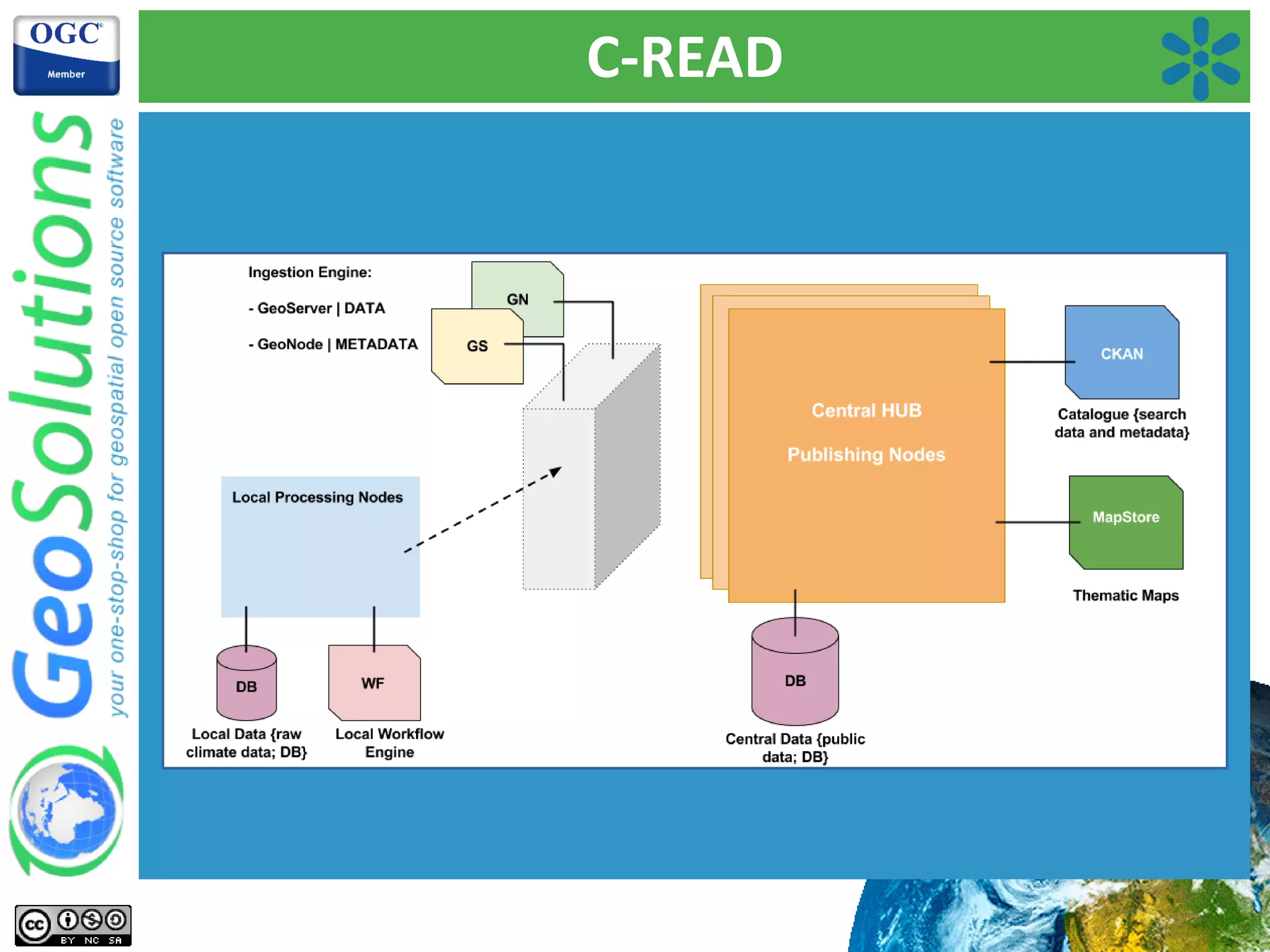
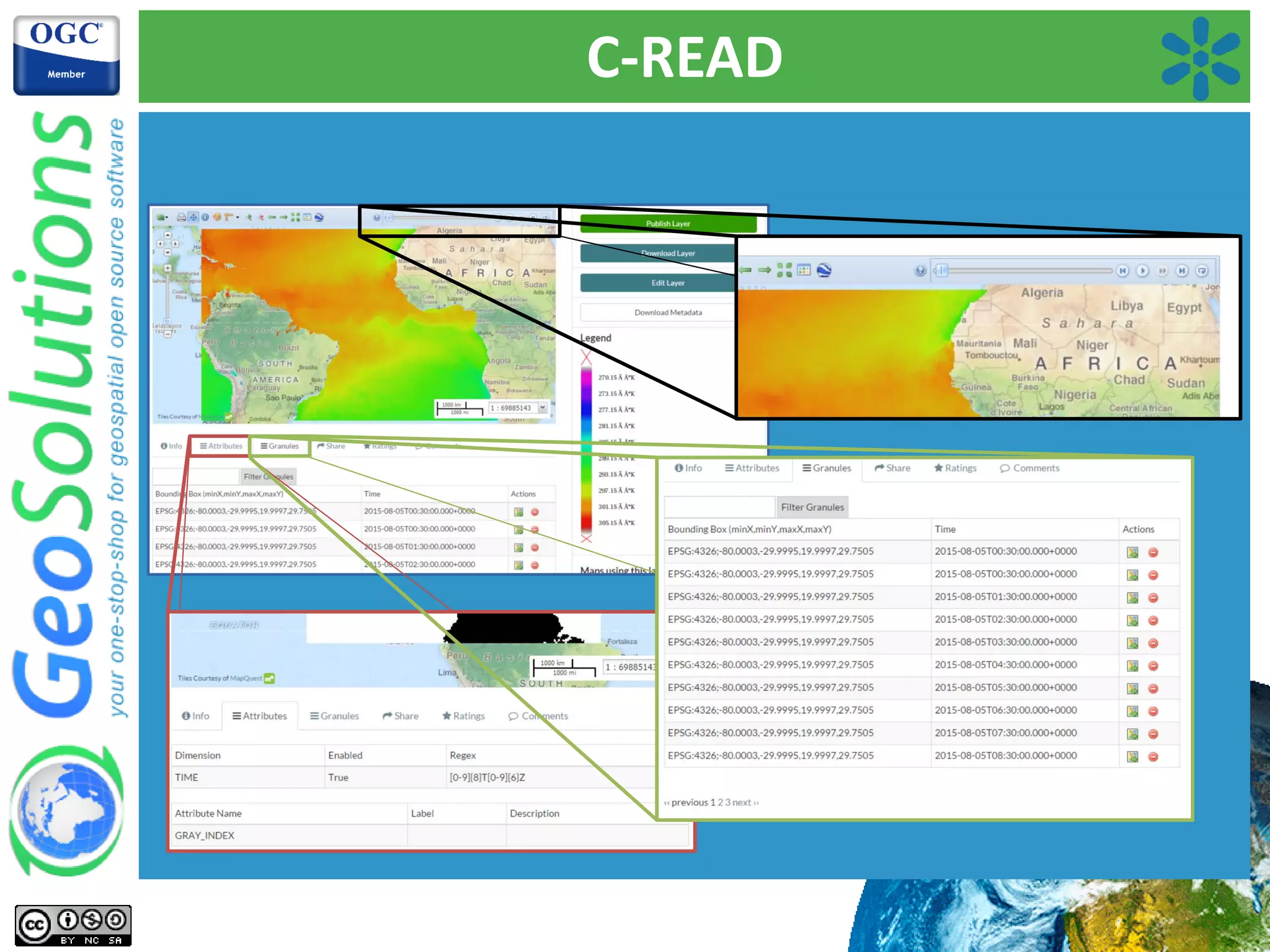
C-READ
C-READ
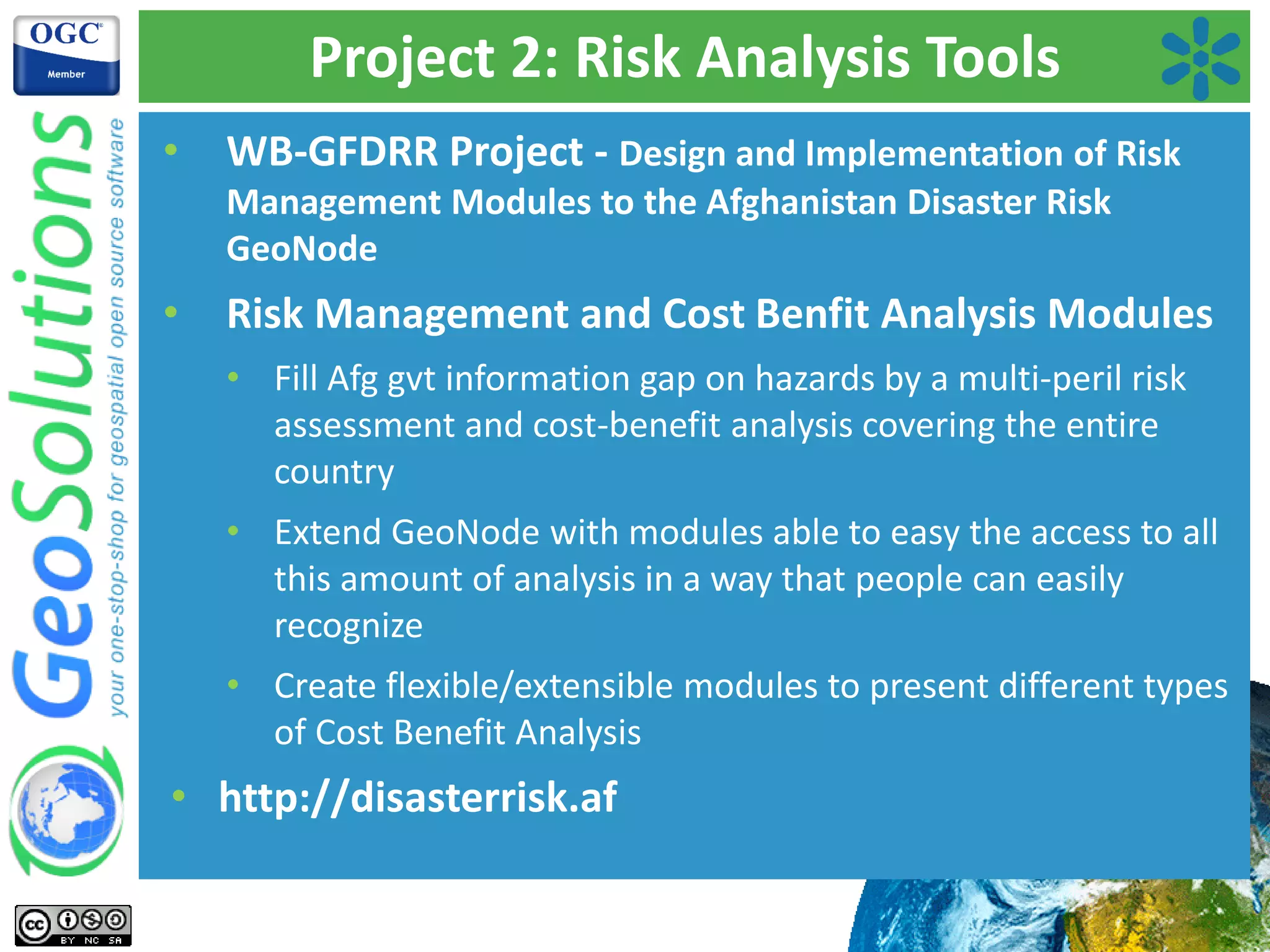
Project 2: Risk Analysis Tools
• WB-GFDRR Project - Design and Implementation of Risk
Management Modules to the Afghanistan Disaster Risk
GeoNode
• Risk Management and Cost Benfit Analysis Modules
• Fill Afg gvt information gap on hazards by a multi-peril risk
assessment and cost-benefit analysis covering the entire
country
• Extend GeoNode with modules able to easy the access to all
this amount of analysis in a way that people can easily
recognize
• Create flexible/extensible modules to present different types
of Cost Benefit Analysis
• http://disasterrisk.af
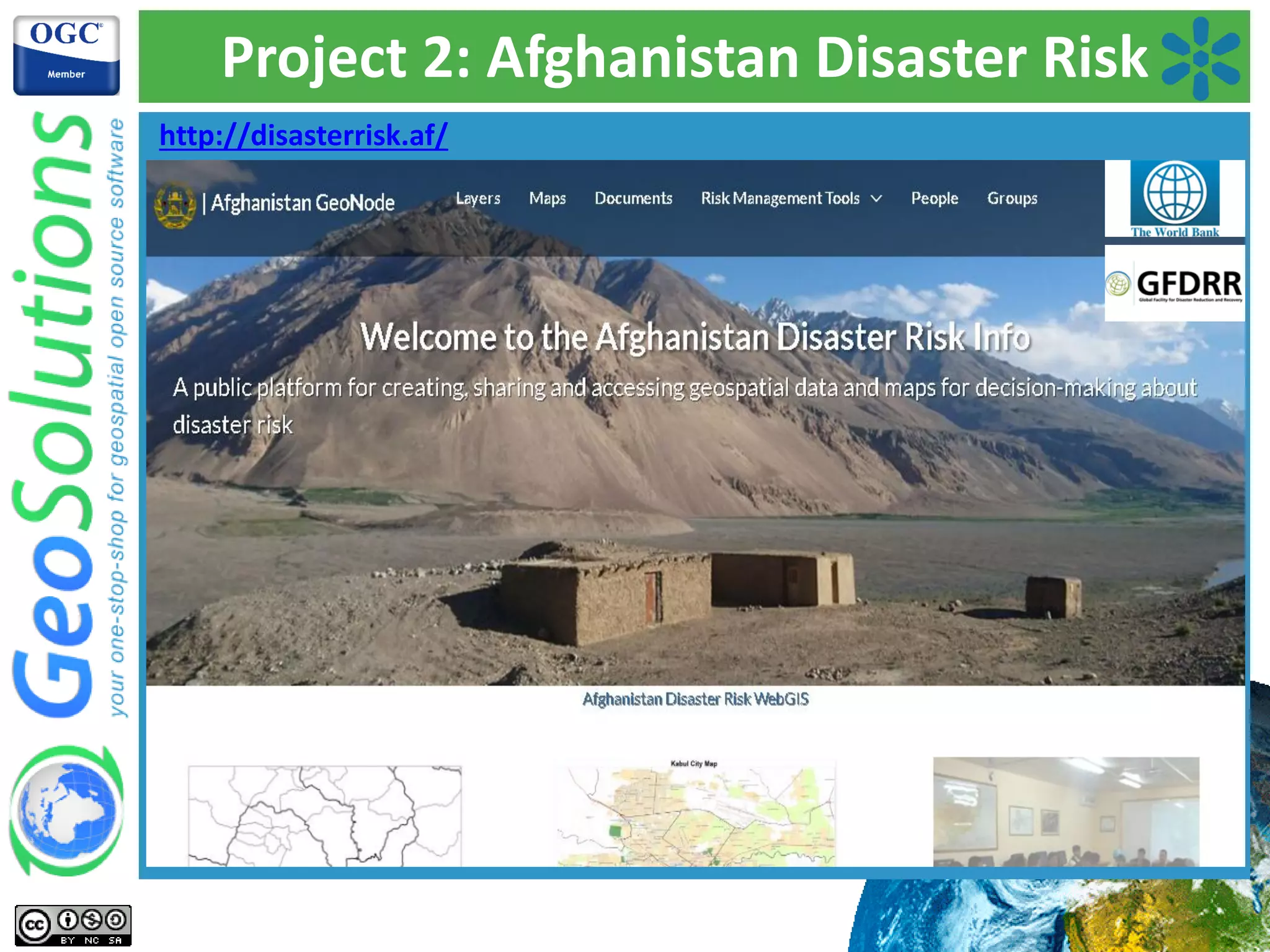
Project 2: Afghanistan Disaster Risk
http://disasterrisk.af/
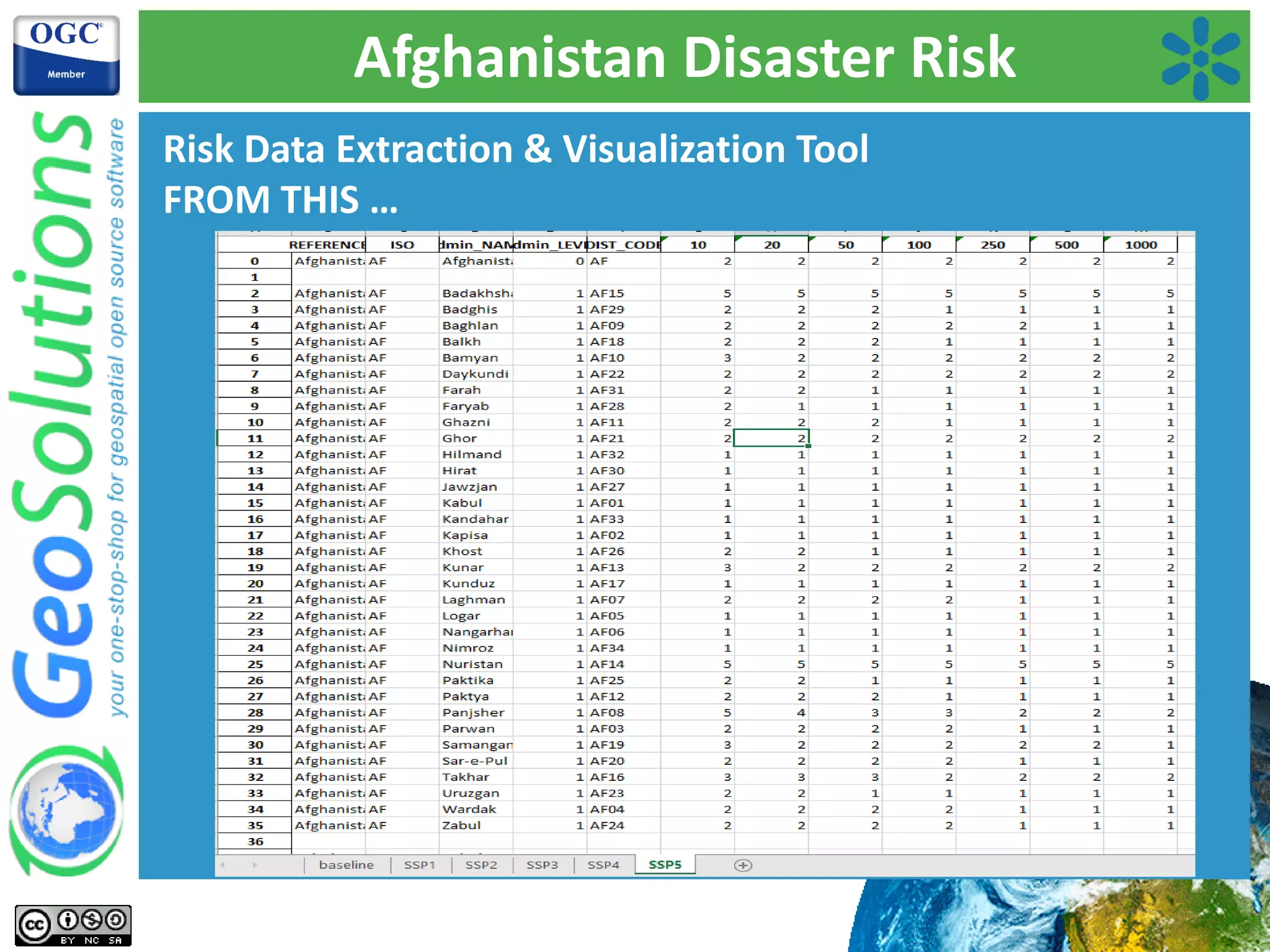
Afghanistan Disaster Risk
Risk Data Extraction & Visualization Tool
FROM THIS …
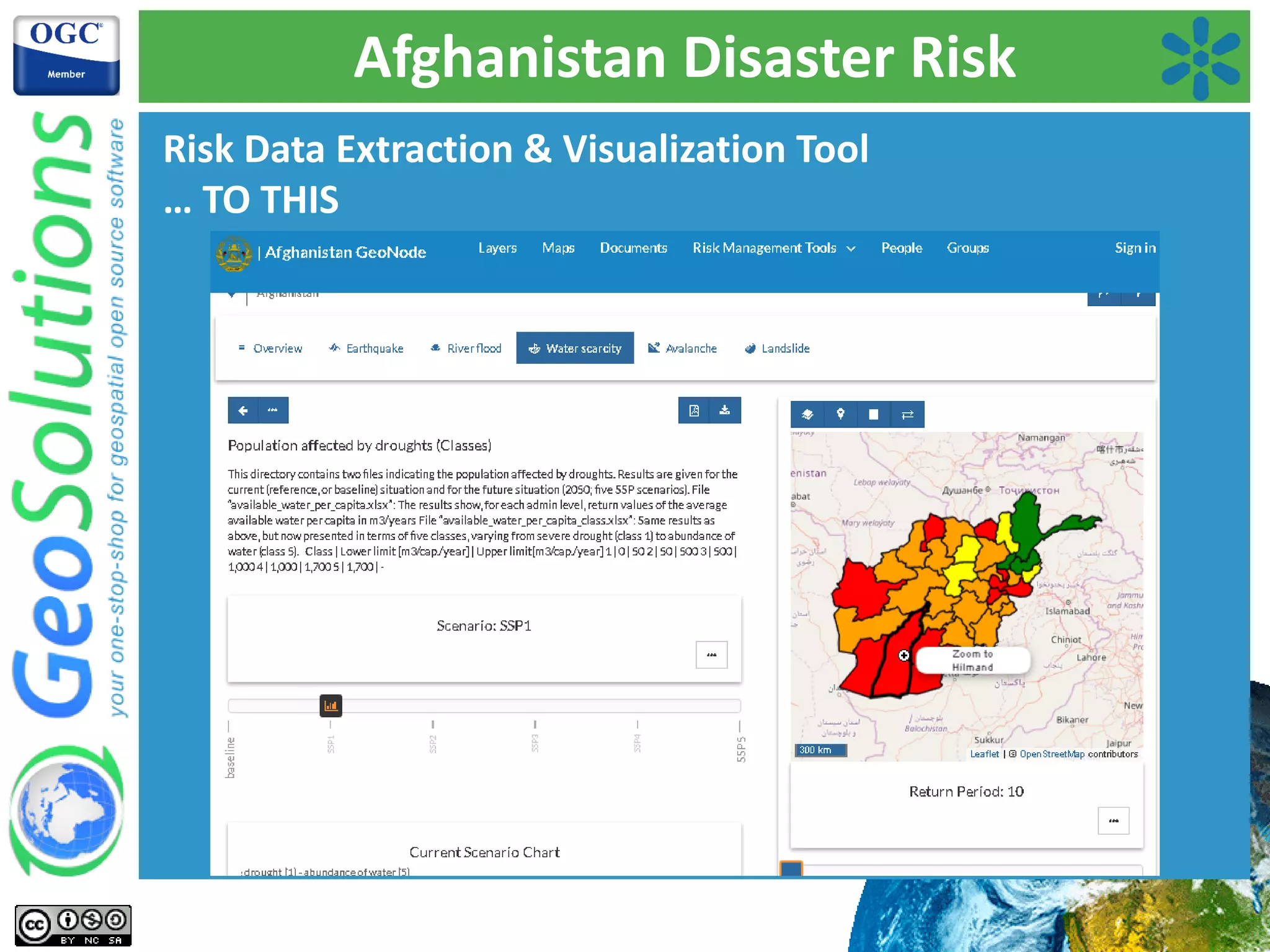
Afghanistan Disaster Risk
Risk Data Extraction & Visualization Tool
… TO THIS
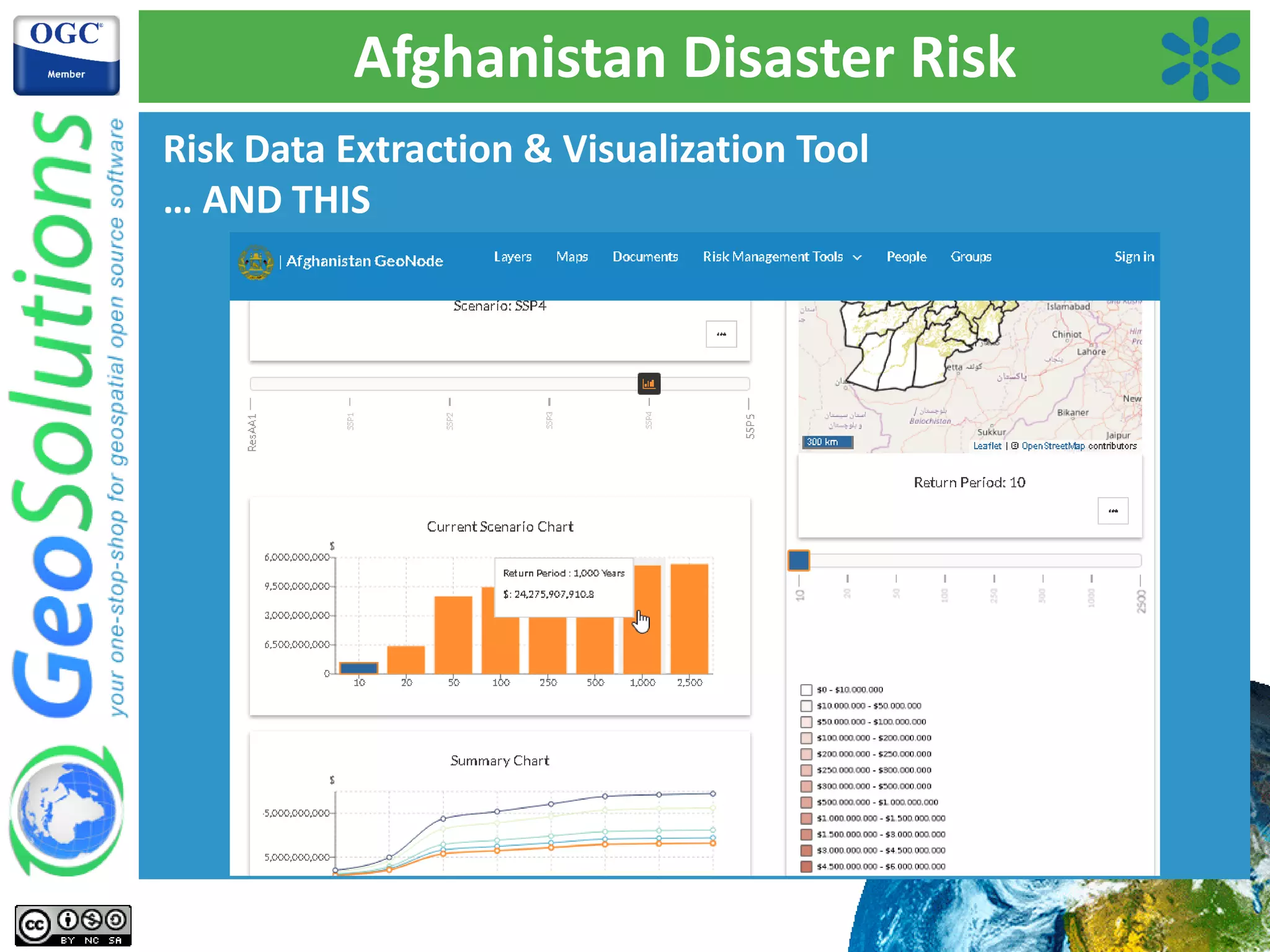
Afghanistan Disaster Risk
Risk Data Extraction & Visualization Tool
… AND THIS
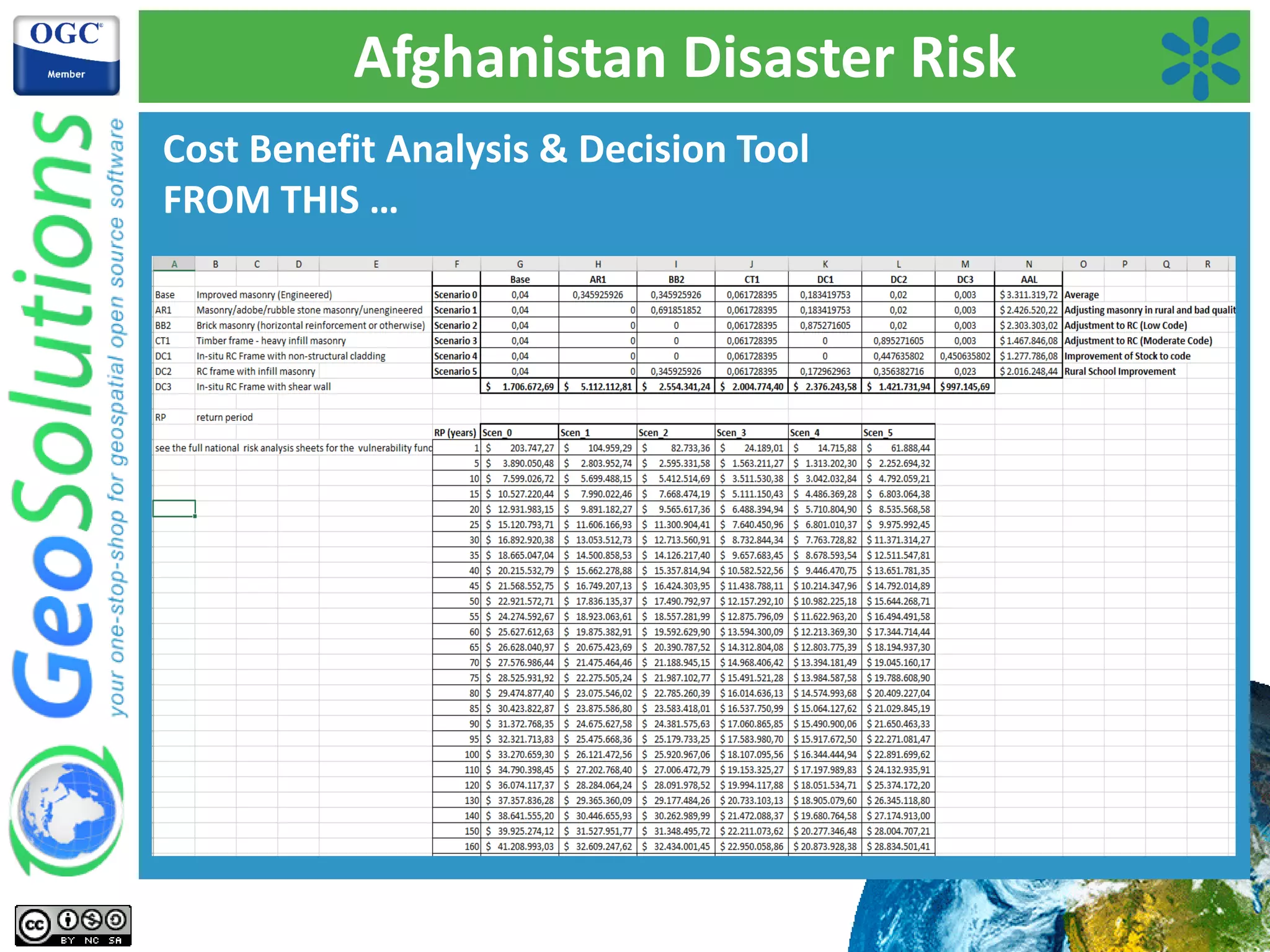
Afghanistan Disaster Risk
Cost Benefit Analysis & Decision Tool
FROM THIS …
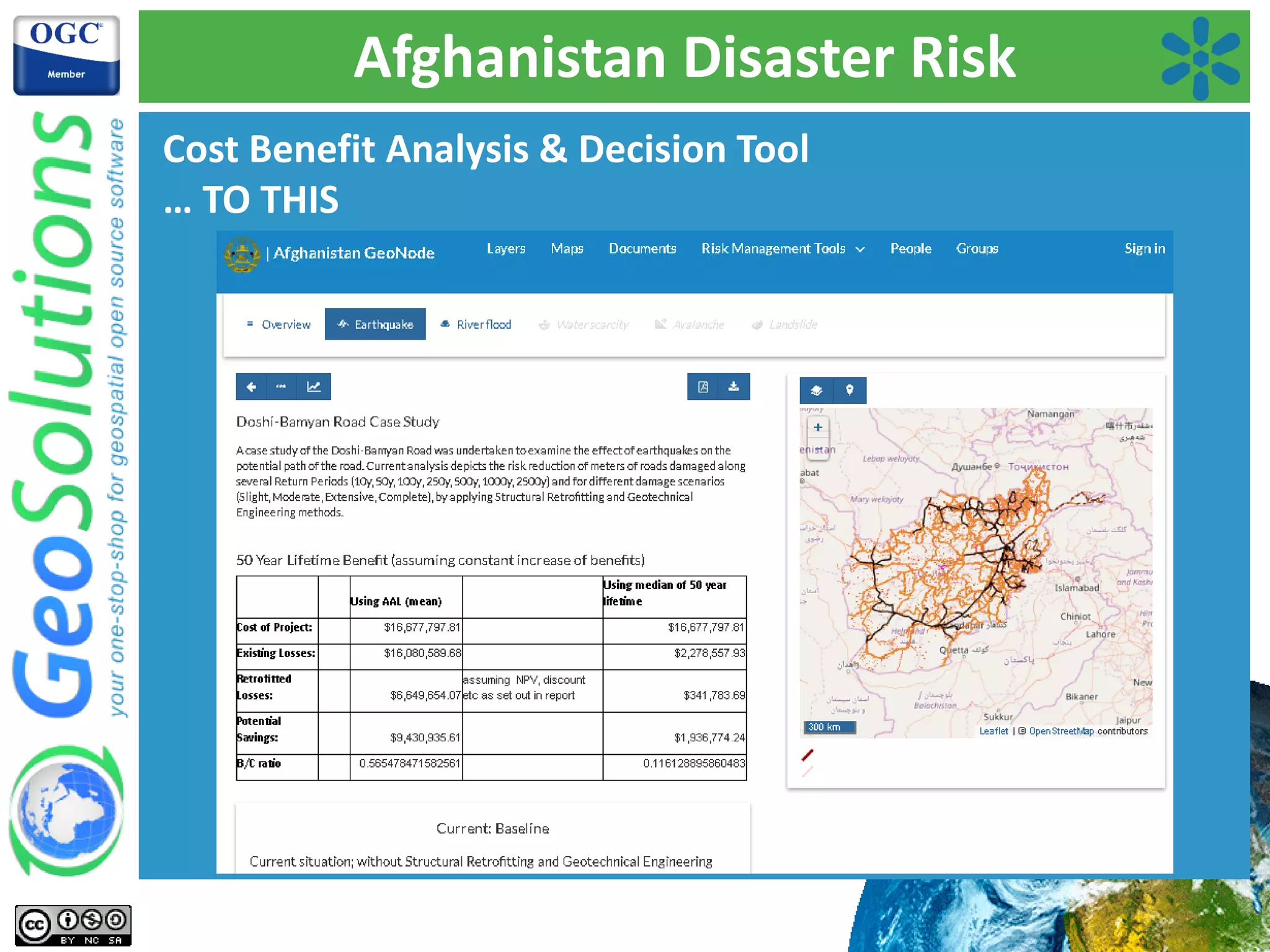
Afghanistan Disaster Risk
Cost Benefit Analysis & Decision Tool
… TO THIS
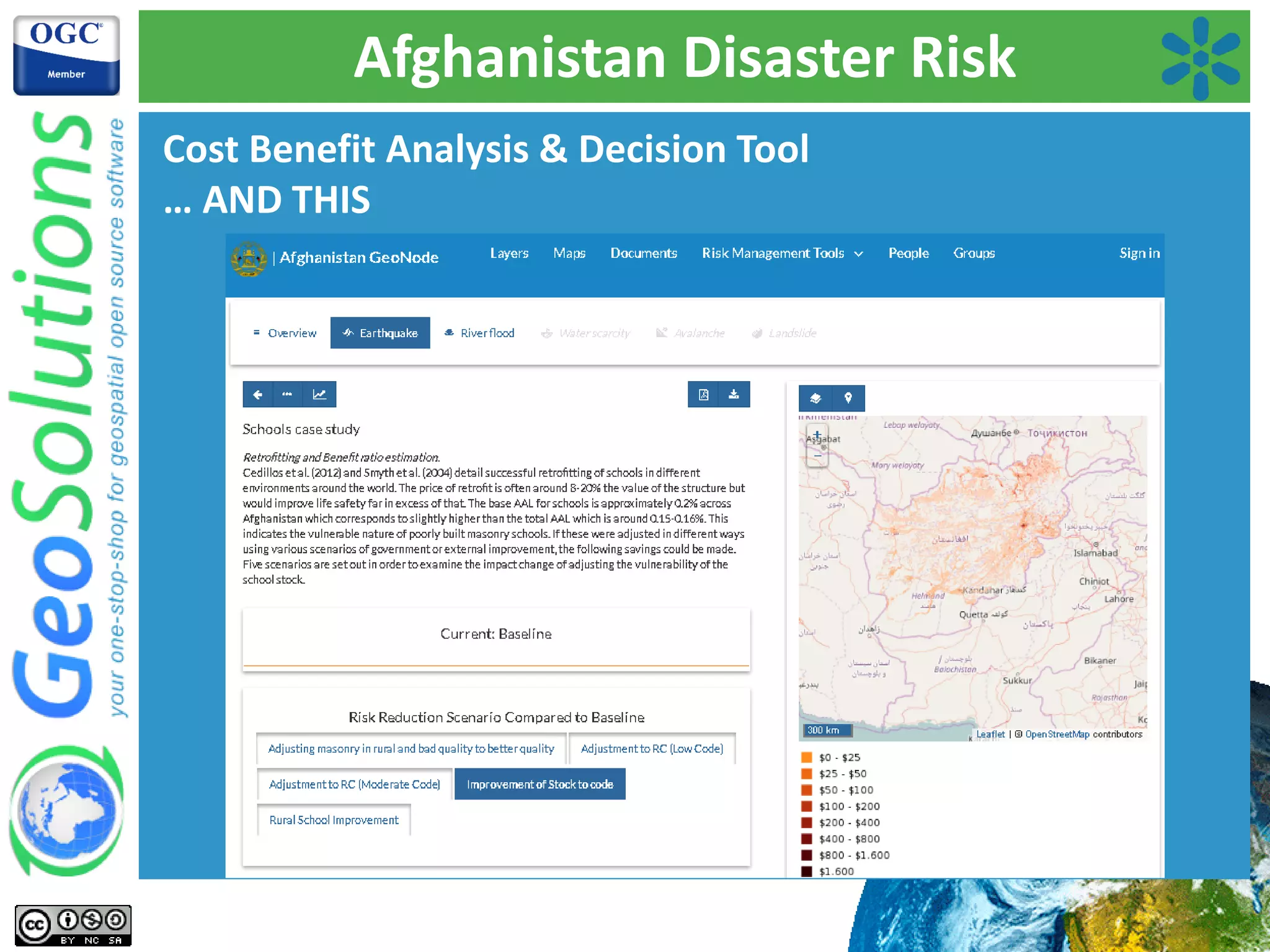
Afghanistan Disaster Risk
Cost Benefit Analysis & Decision Tool
… AND THIS
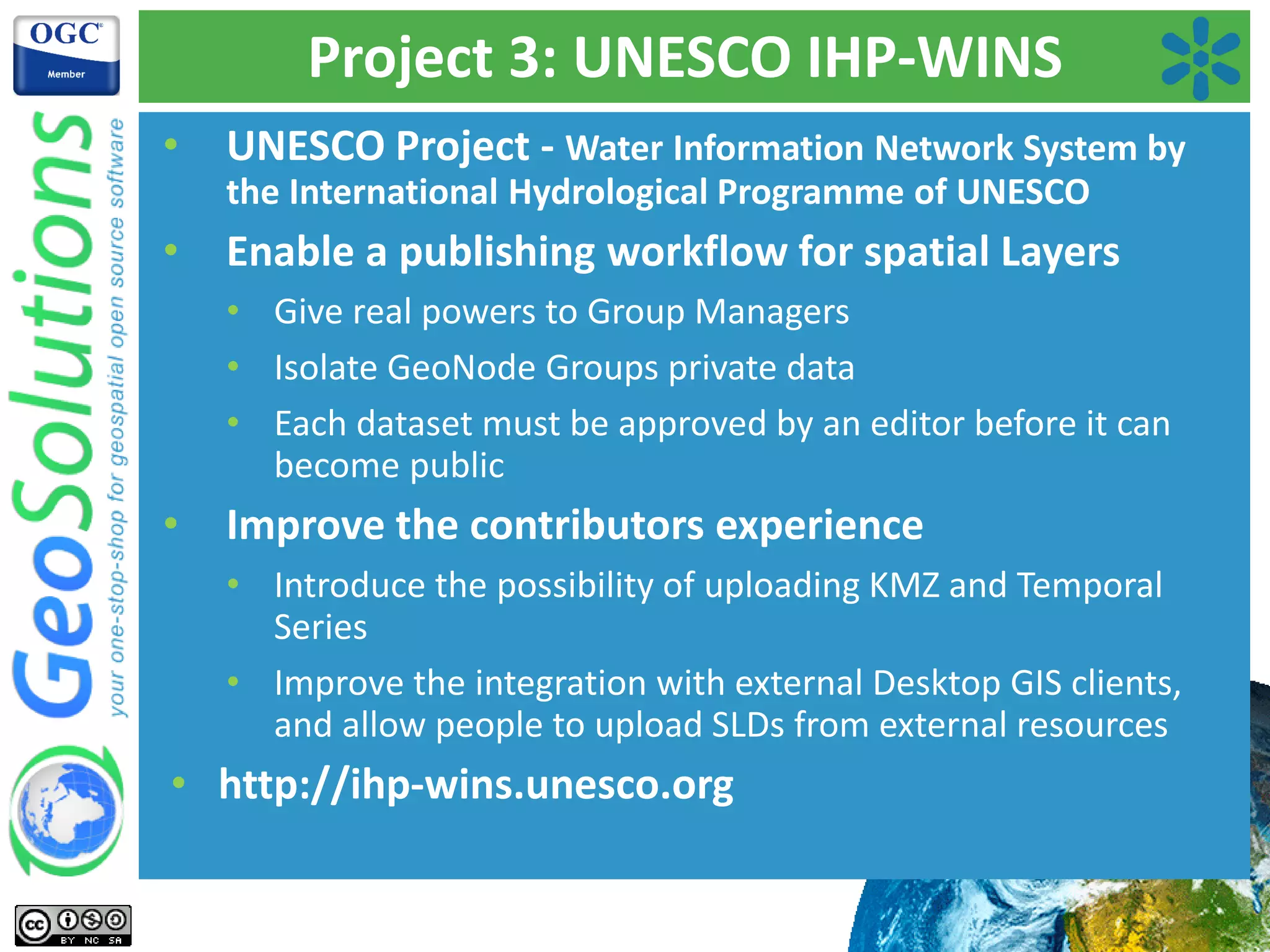
Project 3: UNESCO IHP-WINS
• UNESCO Project - Water Information Network System by
the International Hydrological Programme of UNESCO
• Enable a publishing workflow for spatial Layers
• Give real powers to Group Managers
• Isolate GeoNode Groups private data
• Each dataset must be approved by an editor before it can
become public
• Improve the contributors experience
• Introduce the possibility of uploading KMZ and Temporal
Series
• Improve the integration with external Desktop GIS clients,
and allow people to upload SLDs from external resources
• http://ihp-wins.unesco.org
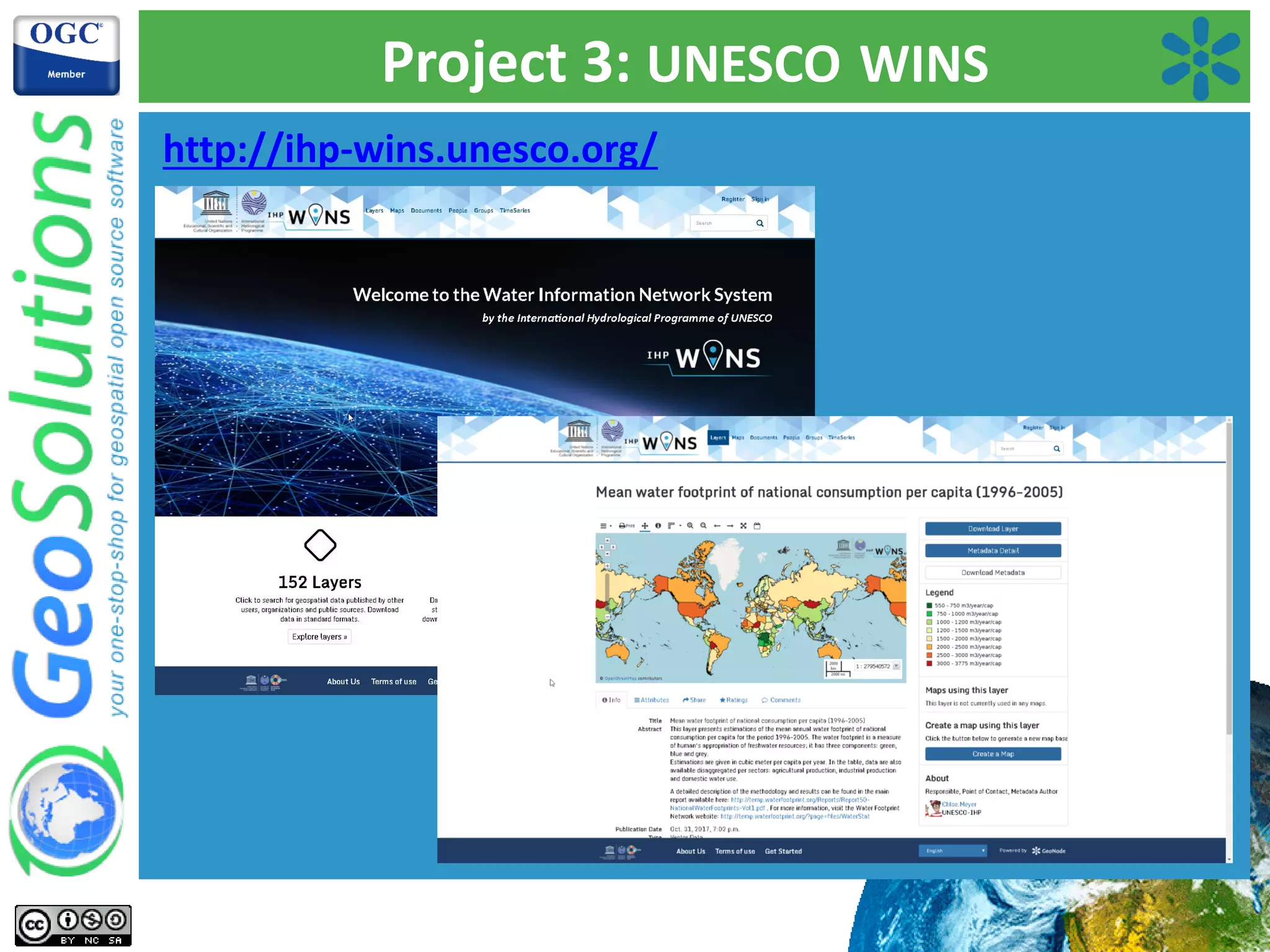
Project 3: UNESCO WINS
http://ihp-wins.unesco.org/
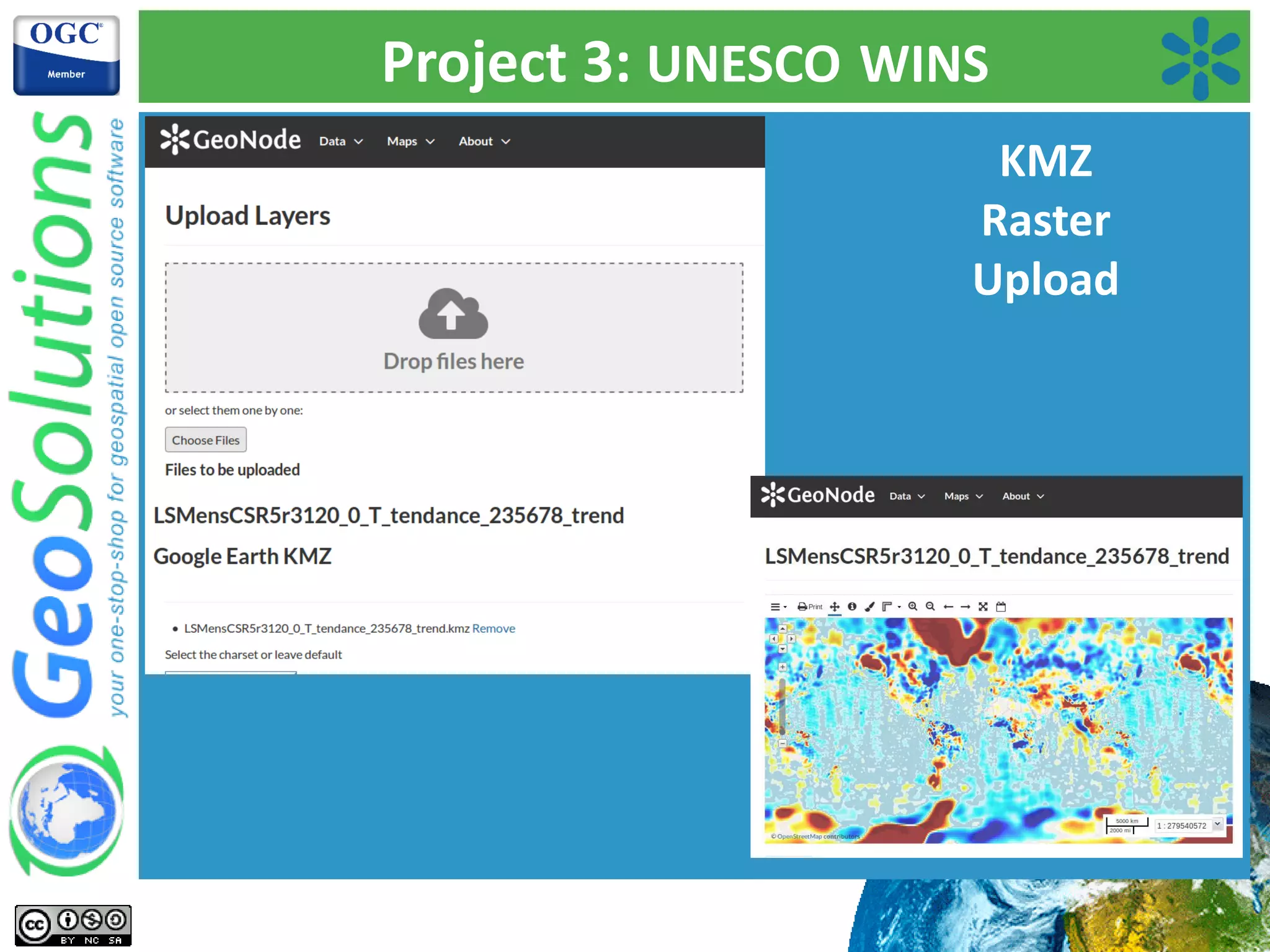
Project 3: UNESCO WINS
KMZ
Raster
Upload
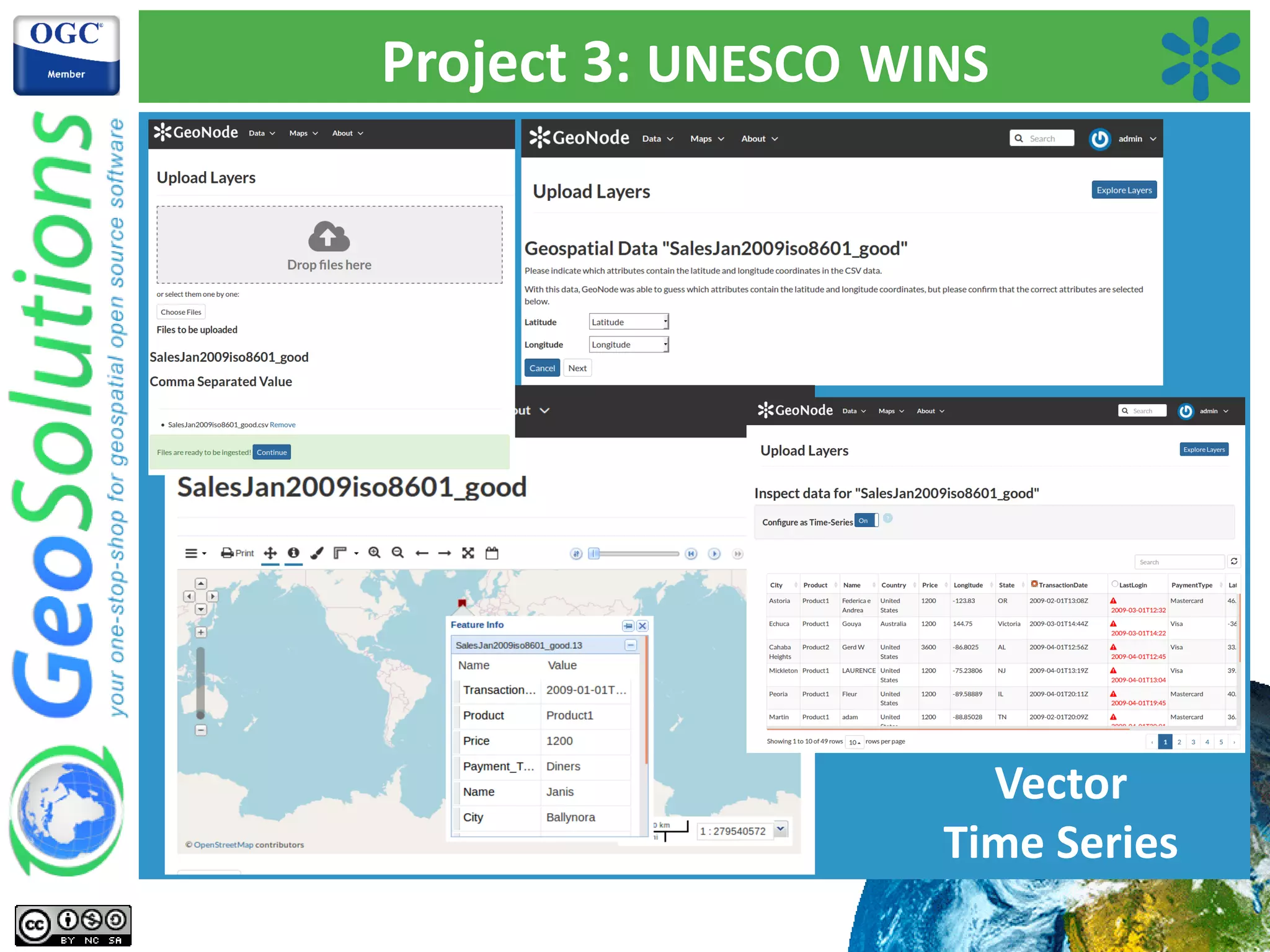
Project 3: UNESCO WINS
Vector
Time Series
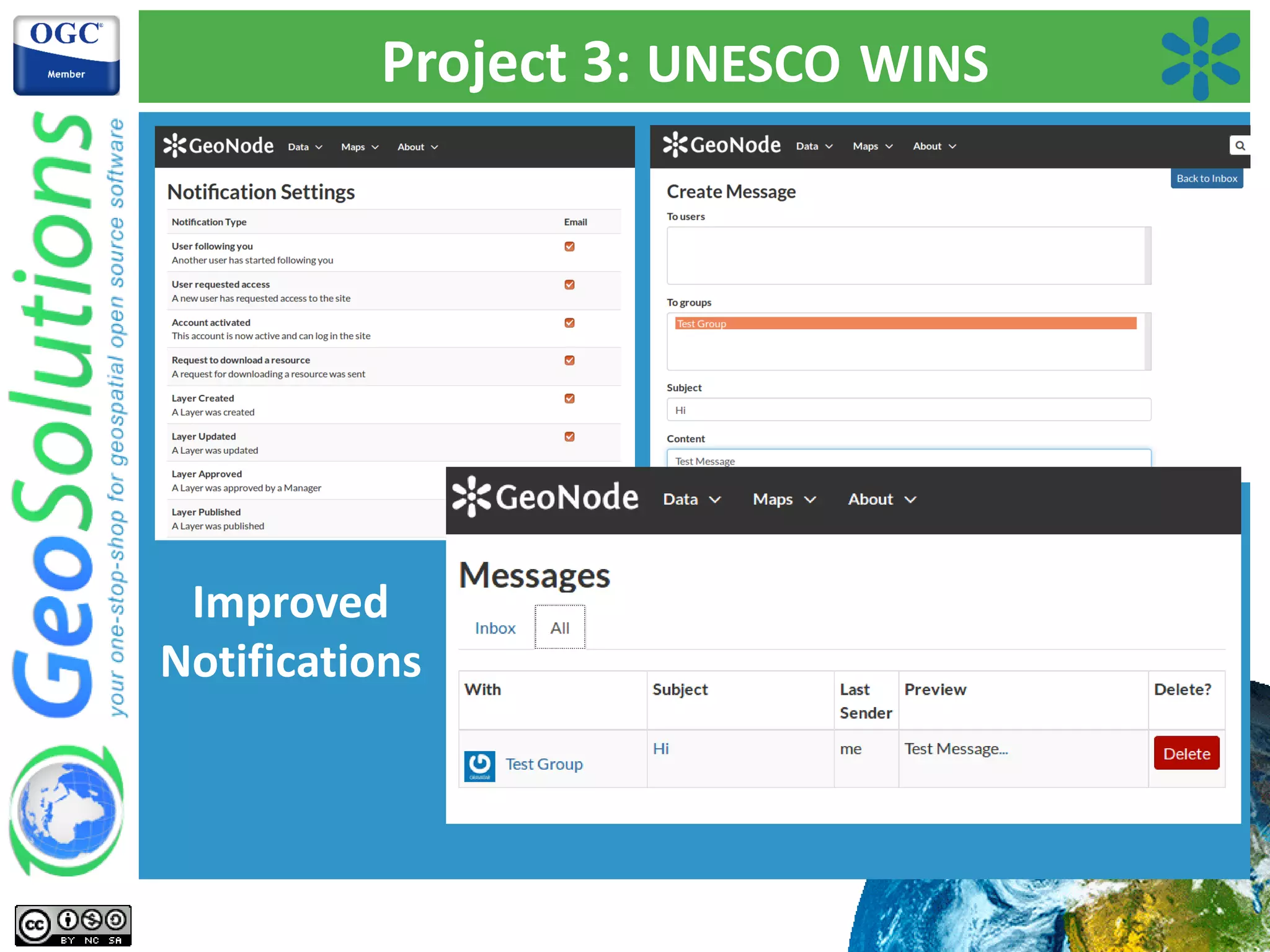
Project 3: UNESCO WINS
Improved
Notifications
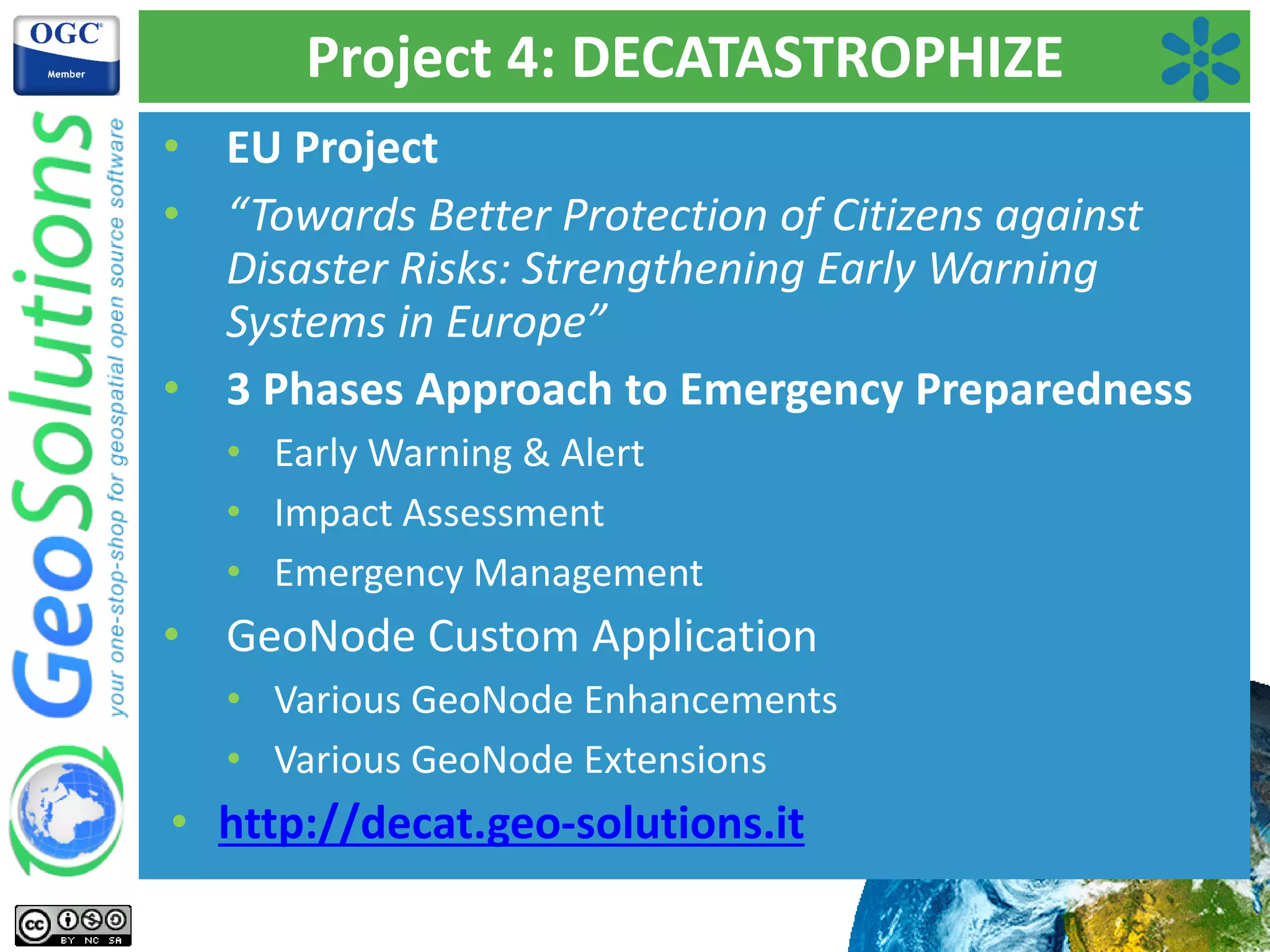
Project 4: DECATASTROPHIZE
• EU Project
• “Towards Better Protection of Citizens against
Disaster Risks: Strengthening Early Warning
Systems in Europe”
• 3 Phases Approach to Emergency Preparedness
• Early Warning & Alert
• Impact Assessment
• Emergency Management
• GeoNode Custom Application
• Various GeoNode Enhancements
• Various GeoNode Extensions
• http://decat.geo-solutions.it
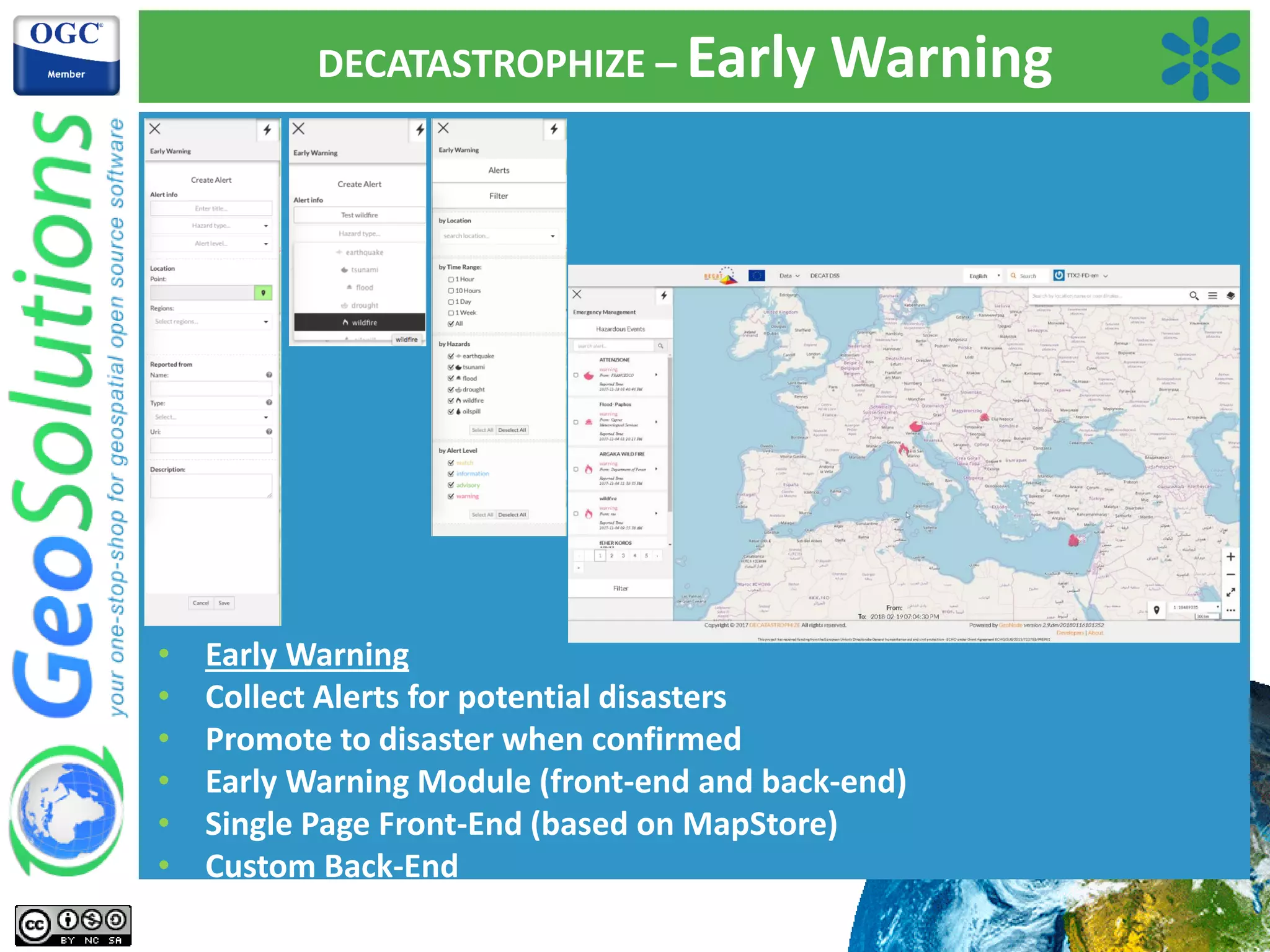
DECATASTROPHIZE – Early Warning
• Early Warning
• Collect Alerts for potential disasters
• Promote to disaster when confirmed
• Early Warning Module (front-end and back-end)
• Single Page Front-End (based on MapStore)
• Custom Back-End
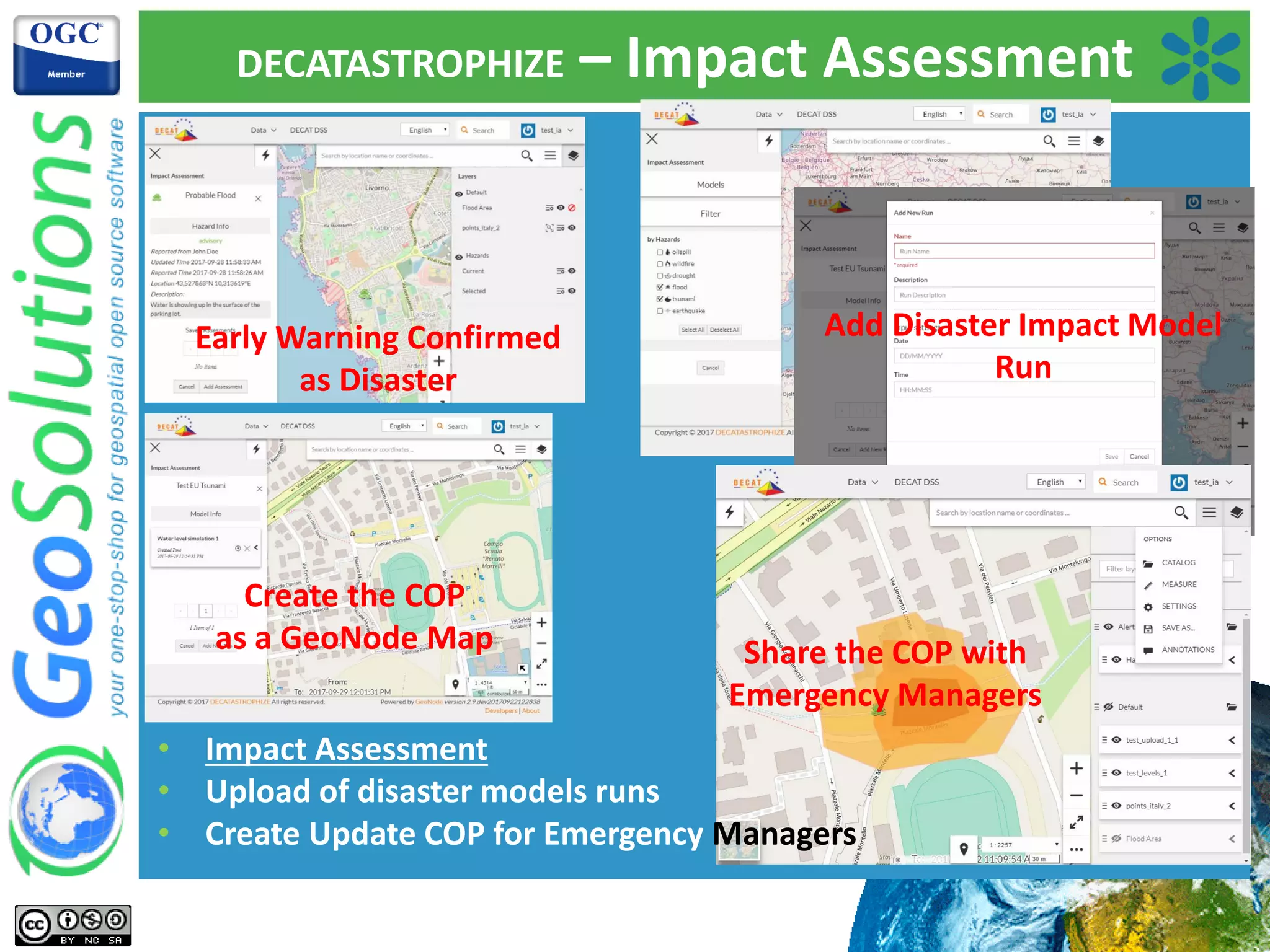
DECATASTROPHIZE – Impact Assessment
Early Warning Confirmed
as Disaster
Add Disaster Impact Model
Run
Create the COP
as a GeoNode Map Share the COP with
Emergency Managers
• Impact Assessment
• Upload of disaster models runs
• Create Update COP for Emergency Managers
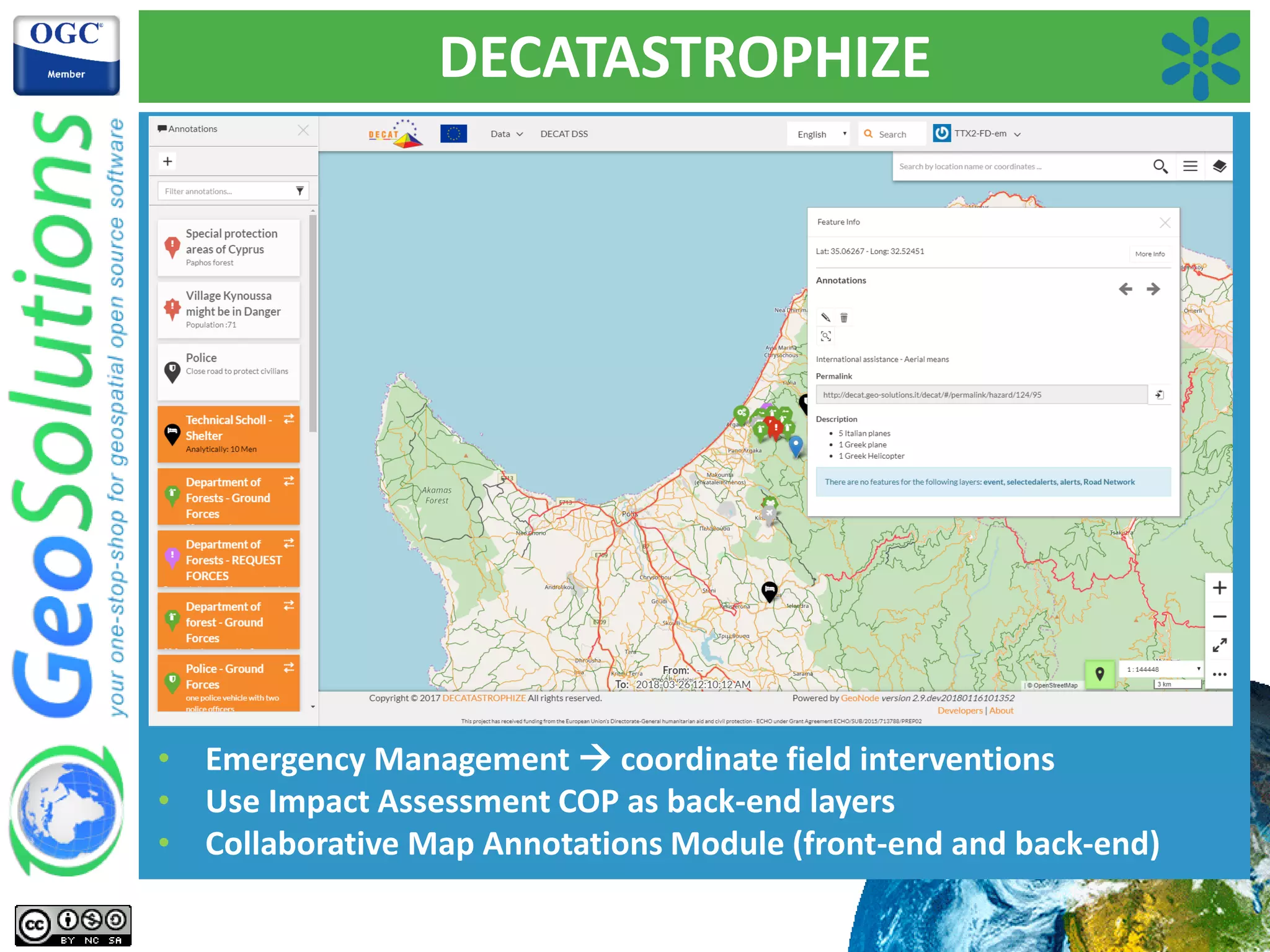
DECATASTROPHIZE
• Emergency Management  coordinate field interventions
• Use Impact Assessment COP as back-end layers
• Collaborative Map Annotations Module (front-end and back-end)
Project 5: HEV-E
• GFDRR and UK Department for International
Development
• “Hazards, Exposures and Vulnerabilities Explorer”
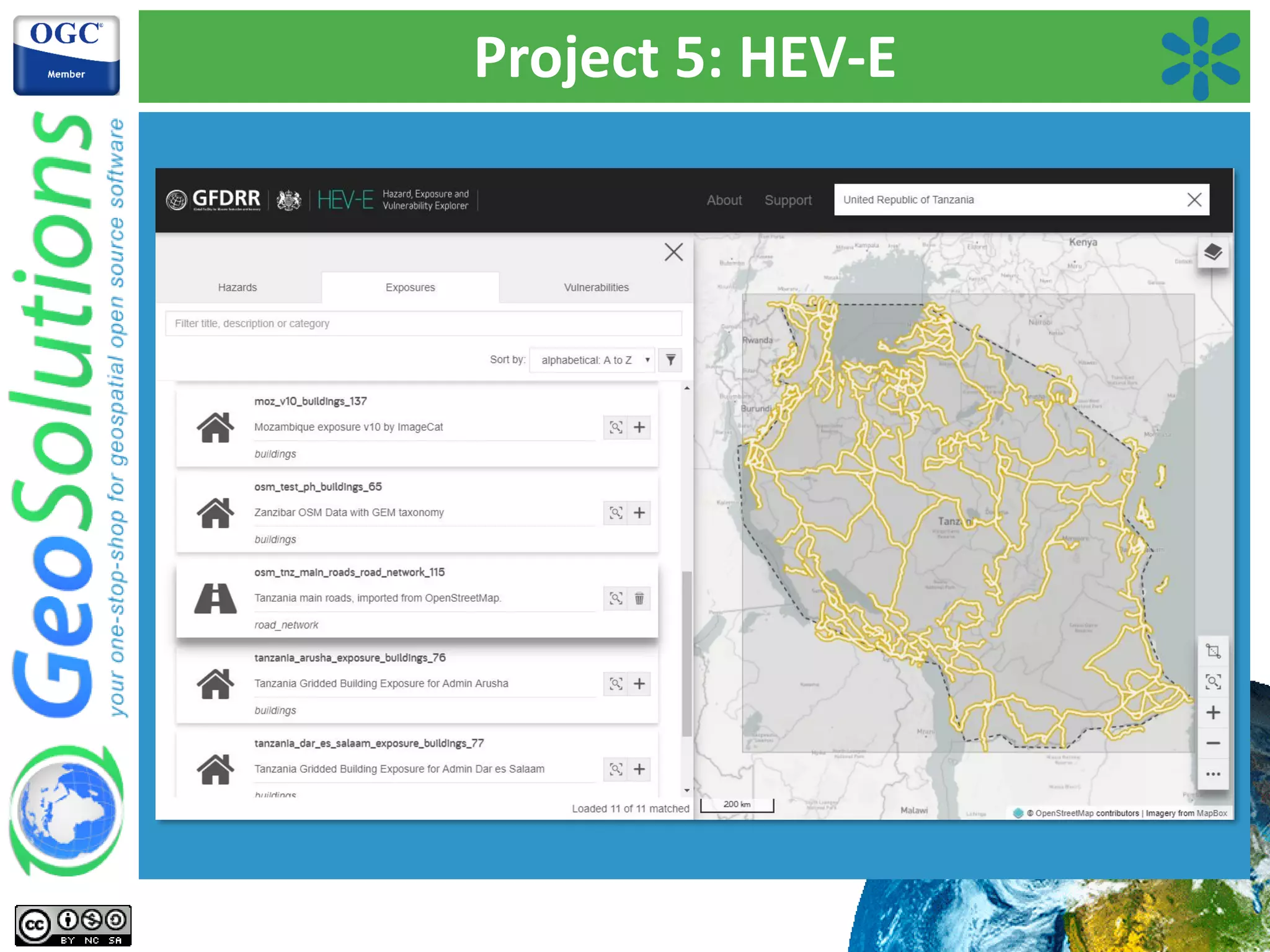
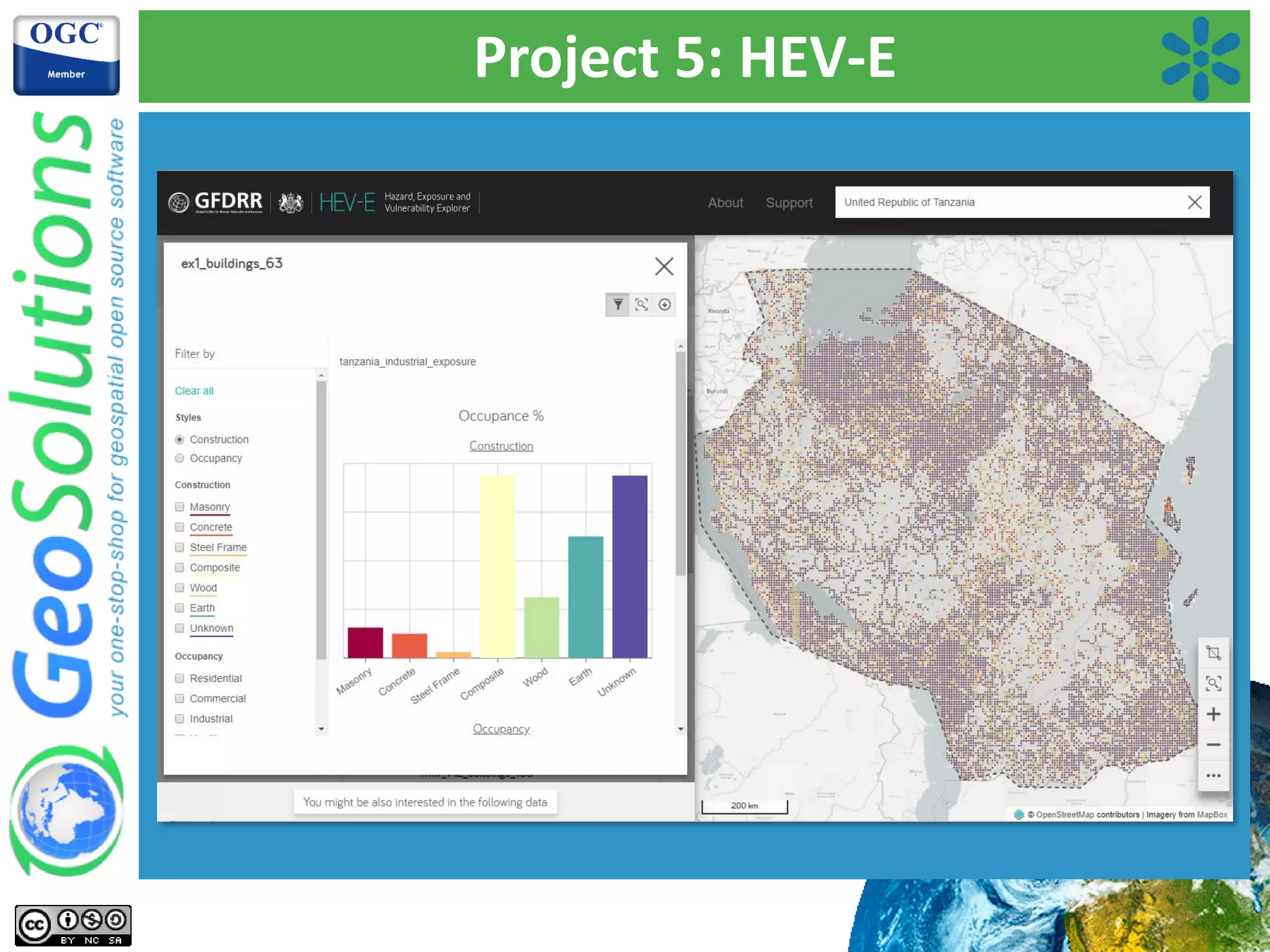
• Explore, preview and download risk related
global data
• Hazards (British Geological Survey)
• Exposures (GEM)
• Vulnerabilities (University College London)
• GeoNode Custom Application
• Custom API + GeoNode API
• Custom frontend (REST API)
Project 5: HEV-E
Project 5: HEV-E
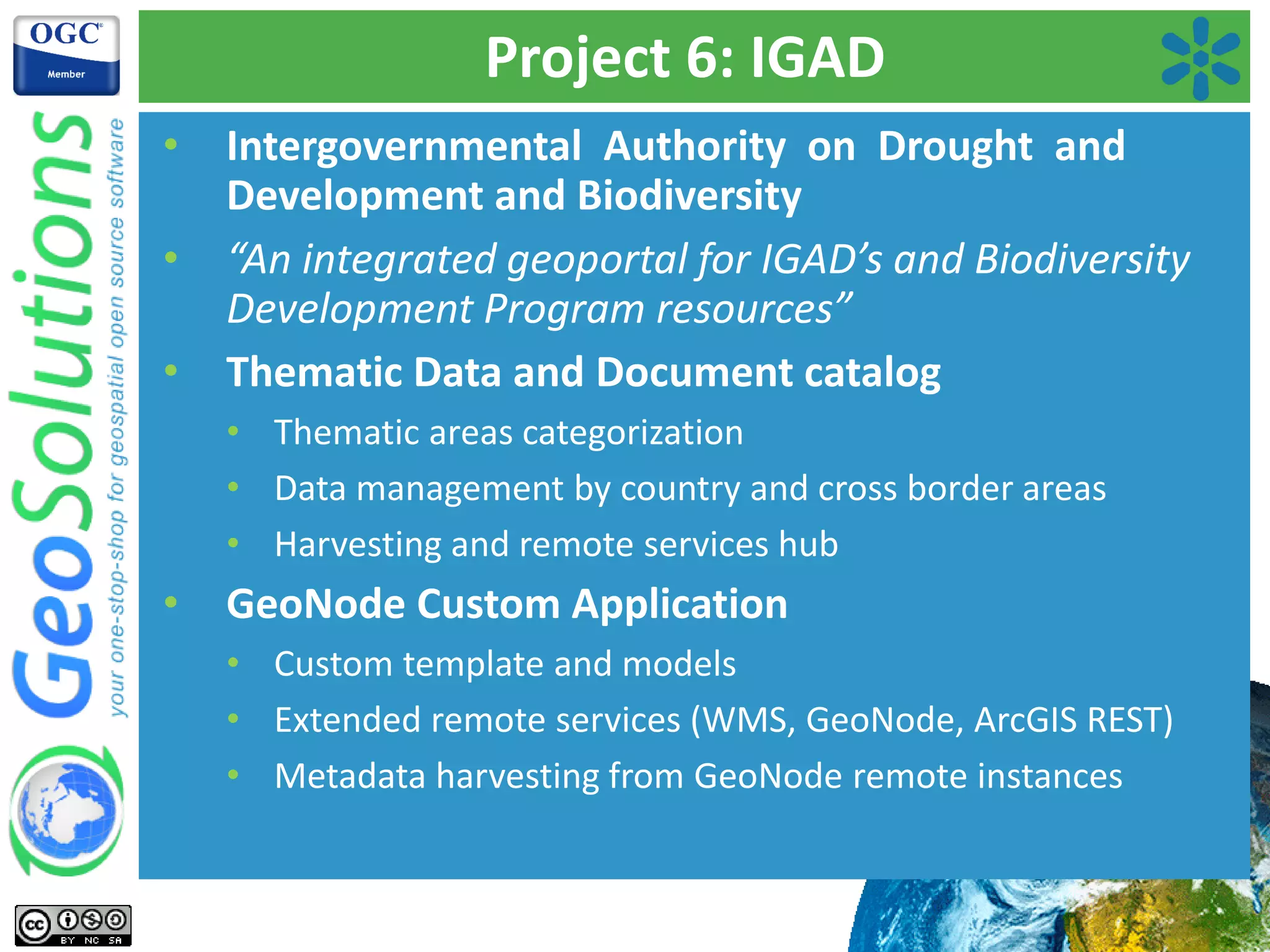
Project 6: IGAD
• Intergovernmental Authority on Drought and
Development and Biodiversity
• “An integrated geoportal for IGAD’s and Biodiversity
Development Program resources”
• Thematic Data and Document catalog
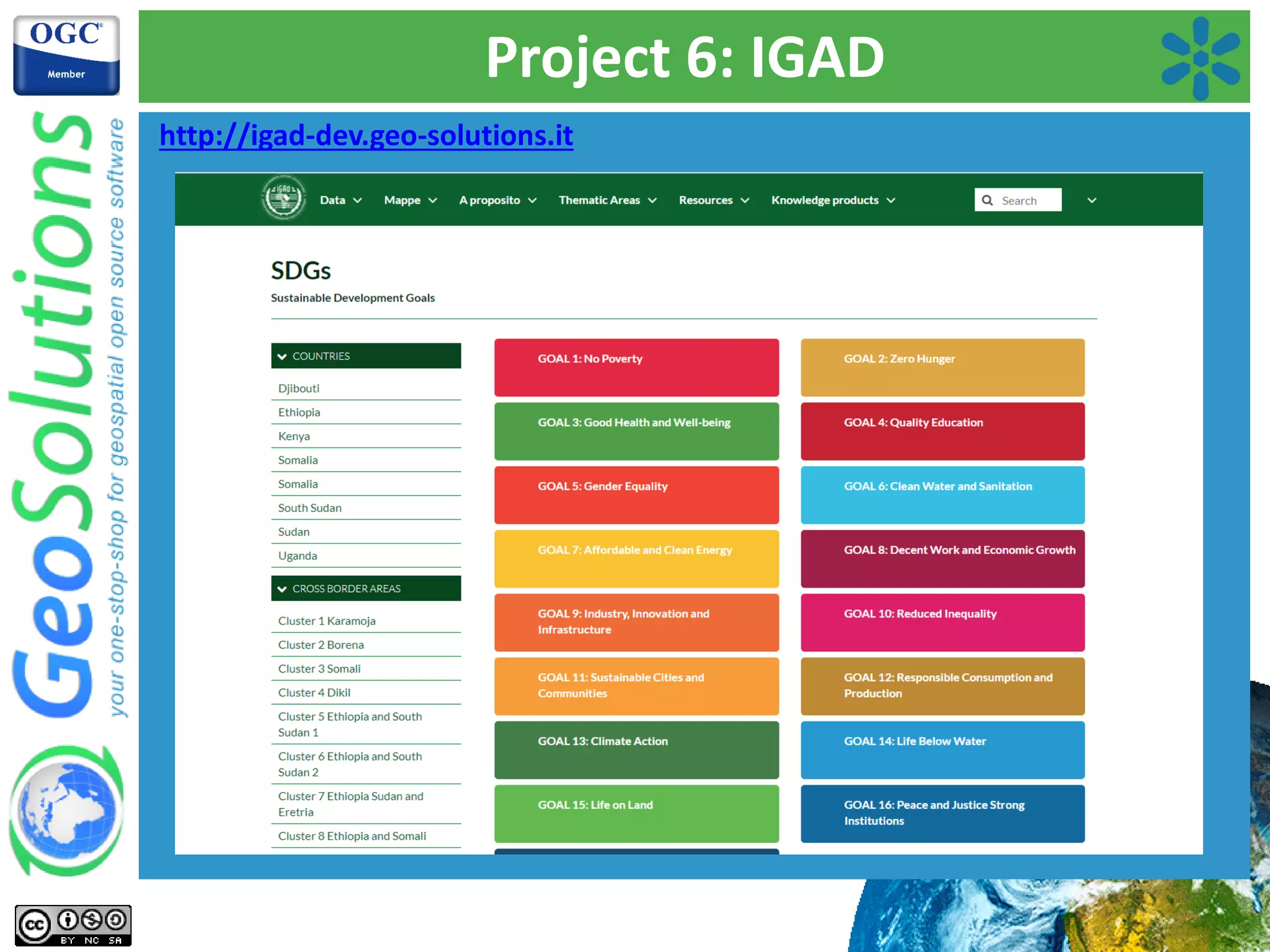
• Thematic areas categorization
• Data management by country and cross border areas
• Harvesting and remote services hub
• GeoNode Custom Application
• Custom template and models
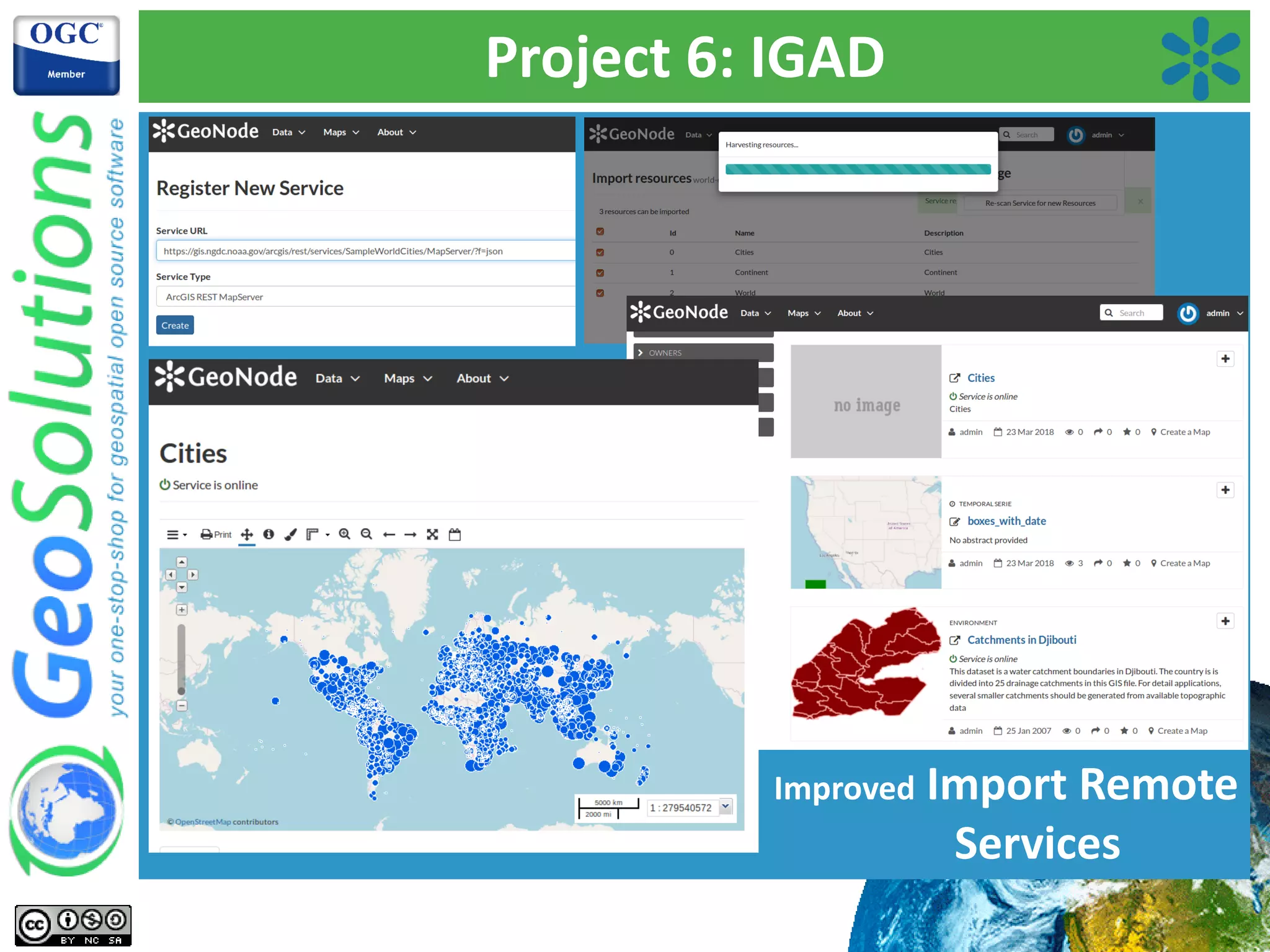
• Extended remote services (WMS, GeoNode, ArcGIS REST)
• Metadata harvesting from GeoNode remote instances
Project 6: IGAD
http://igad-dev.geo-solutions.it
Project 6: IGAD
Improved Import Remote
Services
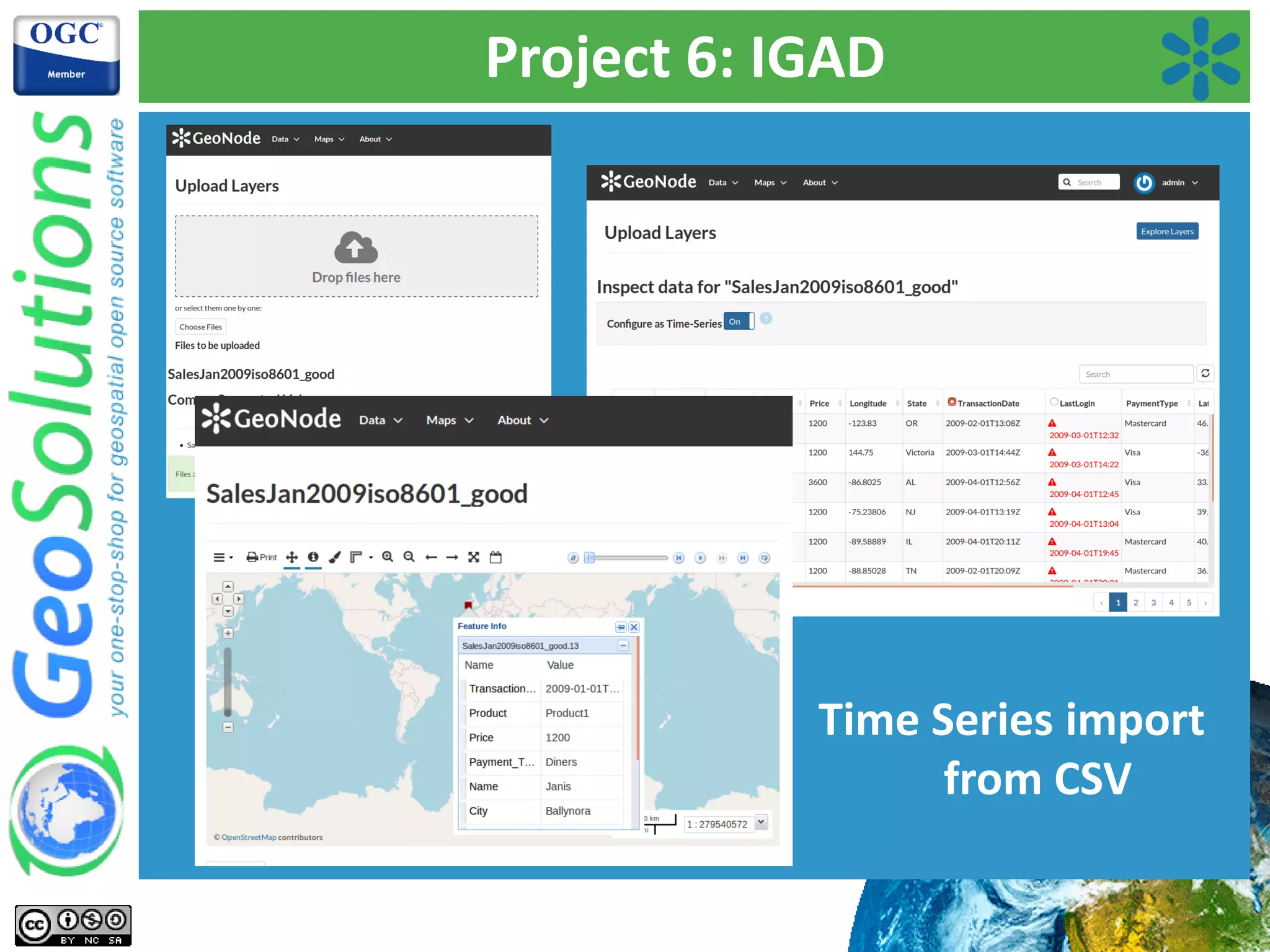
Project 6: IGAD
Time Series import
from CSV
Too Many GeoNodes?
The Future: Docker
Our current and future needs:
• Development and Deployment of multiple different
GeoNode projects.
• On premise and on cloud instances management and
monitoring
• Continuous Delivery and Continuous Deployment
requirements
• HA and Failover
The Future: Docker
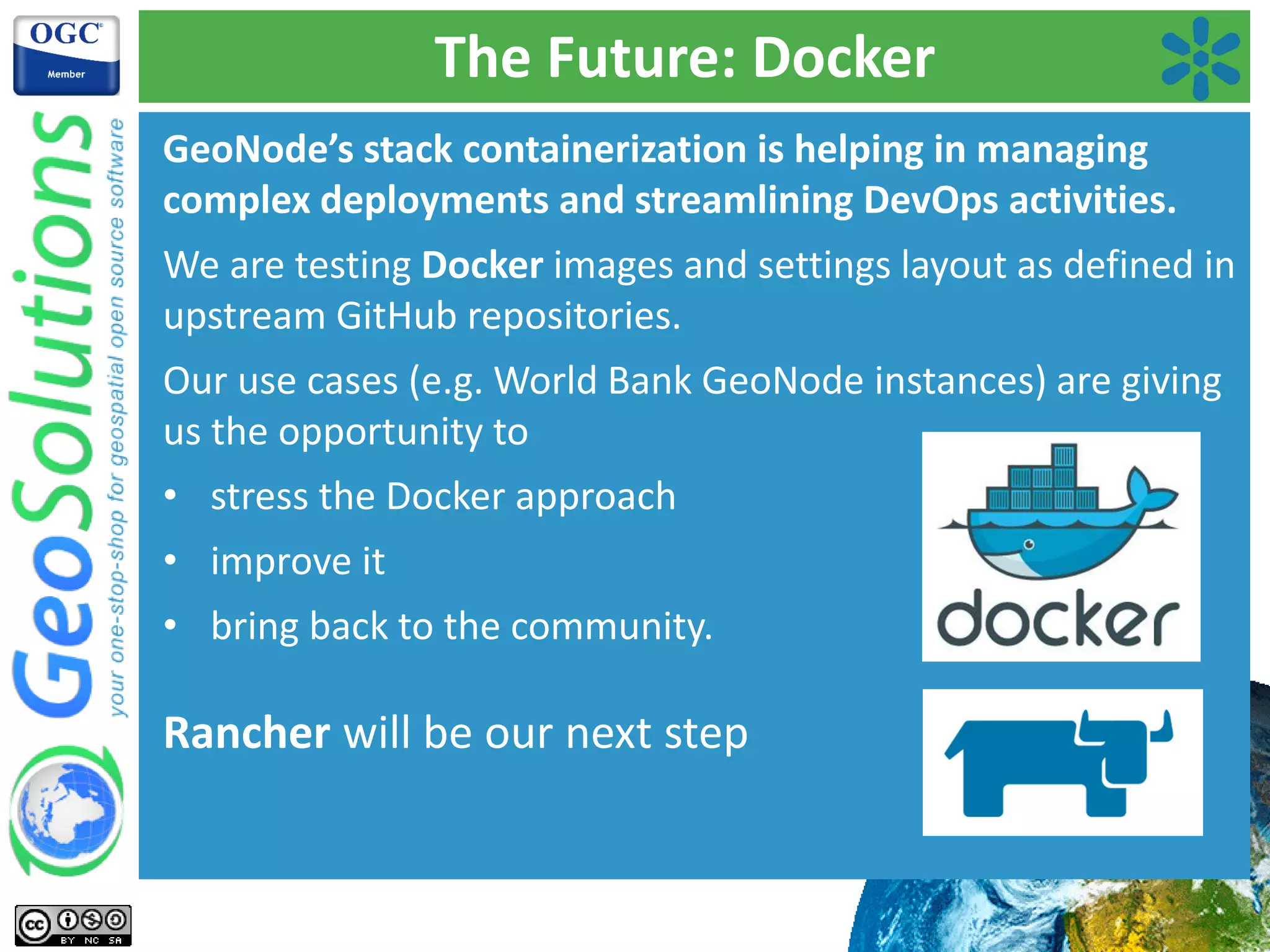
GeoNode’s stack containerization is helping in managing
complex deployments and streamlining DevOps activities.
We are testing Docker images and settings layout as defined in
upstream GitHub repositories.
Our use cases (e.g. World Bank GeoNode instances) are giving
us the opportunity to
• stress the Docker approach
• improve it
• bring back to the community.
Rancher will be our next step
The Future: Single Page Front-End
We experienced that custom end user frontends and APIs are
often required.
We are seeking to:
• design a replicable and versatile approach to implement
custom frontends
• extend and enhance GeoNode’s APIs, both as exposed
methods and API architecture
• enhance the geonode-project approach
We think the next GeoNode should be a modular
framework to easily adopt / adapt it within the most
disparate custom projects.
That’s all!
http://www.geo-solutions.it/contacts
info@geo-solutions.it

One GeoNode, many GeoNodes

  • 1.
    Ing. Alessio Fabiani Dott.Giovanni Allegri Ing. Simone Giannecchini One GeoNode Many GeoNodes
  • 2.
    Quick Facts  Foundedin late 2006  Expertise • GeoSpatial Data Fusion, Web Mashups, Mobile Apps • OGC, ISO, INSPIRE Standards  Supporting/Developing FOSS4G projects • MapStore, GeoServer, GeoNetwork, CKAN, GeoNode  Offer  Enterprise Support Services  Deployment Warranty  Professional Training  End-To-End Projects (Integration)  Clients • UN FAO (CIOK, FIGIS, NRL, FORESTRY, ESTG), UN WFP, World Bank, DLR, EUMETSAT, JRC, ARPAT, NATO CMRE, UNESCO, IGAD, UNEP, etc.. • Private Companies all over the world like BAYER, BASF, DigitalGlobe, MDA, e- GEOS, Halliburton, etc..
  • 3.
  • 4.
    Sharing, Collecting, UsingInformation to Inform Decisions Collecting Sharing Using GeoNode
  • 5.
    It's open source,Of course! GeoNode
  • 6.
  • 7.
  • 8.
  • 9.
  • 10.
  • 11.
  • 12.
  • 13.
  • 14.
  • 15.
  • 16.
    What's it madeof? GeoNode
  • 17.
  • 18.
    Creating Downstream Applications •GeoNode cannot address all use cases • Avoid reinventing the wheel • Avoid implicit/explicit forks  Custom GeoNode Applications to the rescue! • A proper “GeoNode Project”: • Start from a template (geonode-project) • Generate a “materialized” Django project • It extends the “vanilla” GeoNode • It provides a custom Django app • It addresses specific use cases • You develop something of general interest? • Donate back to Core GeoNode!
  • 19.
    Creating Downstream Applications Thisapproach offers several opportunities • Customize GeoNode look and feel • Extend its models without modifying GeoNode Core • Extend its functionalities without modifying GeoNode Core • Define a brand new end user interface This approach allows us to • make the most out of what GeoNode core offers • without sacrificing versatility • without sacrificing specific project needs It’s doable, we did it (or at least we tried to ☺ ) Hold tight, awesome examples next!
  • 20.
    Project 1: C-READ •Caribbean Community Climate Change Centre – C-READ (Regional Environment and Atmospheric Data) • Development and Installation of a Database Management System for a Regional Integrated Observing Network for Environmental Change in the Wider Caribbean • Ingest, to provide functionalities to preprocess, transform, load and refine the data that needs to be ingested into the system for later reuse • Discover, in order to allow external and internal players to search for data and information for later access and fusion • Access, to support the dissemination of data and information both in raw form as well as in more sophisticated forms like portrayals, reports and maps (superimpositions of multiple portrayals of raw data) • Fuse, to provide advanced geoprocessing functionalities to extract higher level information from the data and information managed by the data warehouse • http://c-read.net
  • 21.
  • 22.
  • 23.
  • 24.
  • 25.
    Project 2: RiskAnalysis Tools • WB-GFDRR Project - Design and Implementation of Risk Management Modules to the Afghanistan Disaster Risk GeoNode • Risk Management and Cost Benfit Analysis Modules • Fill Afg gvt information gap on hazards by a multi-peril risk assessment and cost-benefit analysis covering the entire country • Extend GeoNode with modules able to easy the access to all this amount of analysis in a way that people can easily recognize • Create flexible/extensible modules to present different types of Cost Benefit Analysis • http://disasterrisk.af
  • 26.
    Project 2: AfghanistanDisaster Risk http://disasterrisk.af/
  • 27.
    Afghanistan Disaster Risk RiskData Extraction & Visualization Tool FROM THIS …
  • 28.
    Afghanistan Disaster Risk RiskData Extraction & Visualization Tool … TO THIS
  • 29.
    Afghanistan Disaster Risk RiskData Extraction & Visualization Tool … AND THIS
  • 30.
    Afghanistan Disaster Risk CostBenefit Analysis & Decision Tool FROM THIS …
  • 31.
    Afghanistan Disaster Risk CostBenefit Analysis & Decision Tool … TO THIS
  • 32.
    Afghanistan Disaster Risk CostBenefit Analysis & Decision Tool … AND THIS
  • 33.
    Project 3: UNESCOIHP-WINS • UNESCO Project - Water Information Network System by the International Hydrological Programme of UNESCO • Enable a publishing workflow for spatial Layers • Give real powers to Group Managers • Isolate GeoNode Groups private data • Each dataset must be approved by an editor before it can become public • Improve the contributors experience • Introduce the possibility of uploading KMZ and Temporal Series • Improve the integration with external Desktop GIS clients, and allow people to upload SLDs from external resources • http://ihp-wins.unesco.org
  • 34.
    Project 3: UNESCOWINS http://ihp-wins.unesco.org/
  • 35.
    Project 3: UNESCOWINS KMZ Raster Upload
  • 36.
    Project 3: UNESCOWINS Vector Time Series
  • 37.
    Project 3: UNESCOWINS Improved Notifications
  • 38.
    Project 4: DECATASTROPHIZE •EU Project • “Towards Better Protection of Citizens against Disaster Risks: Strengthening Early Warning Systems in Europe” • 3 Phases Approach to Emergency Preparedness • Early Warning & Alert • Impact Assessment • Emergency Management • GeoNode Custom Application • Various GeoNode Enhancements • Various GeoNode Extensions • http://decat.geo-solutions.it
  • 39.
    DECATASTROPHIZE – EarlyWarning • Early Warning • Collect Alerts for potential disasters • Promote to disaster when confirmed • Early Warning Module (front-end and back-end) • Single Page Front-End (based on MapStore) • Custom Back-End
  • 40.
    DECATASTROPHIZE – ImpactAssessment Early Warning Confirmed as Disaster Add Disaster Impact Model Run Create the COP as a GeoNode Map Share the COP with Emergency Managers • Impact Assessment • Upload of disaster models runs • Create Update COP for Emergency Managers
  • 41.
    DECATASTROPHIZE • Emergency Management coordinate field interventions • Use Impact Assessment COP as back-end layers • Collaborative Map Annotations Module (front-end and back-end)
  • 42.
    Project 5: HEV-E •GFDRR and UK Department for International Development • “Hazards, Exposures and Vulnerabilities Explorer” • Explore, preview and download risk related global data • Hazards (British Geological Survey) • Exposures (GEM) • Vulnerabilities (University College London) • GeoNode Custom Application • Custom API + GeoNode API • Custom frontend (REST API)
  • 43.
  • 44.
  • 45.
    Project 6: IGAD •Intergovernmental Authority on Drought and Development and Biodiversity • “An integrated geoportal for IGAD’s and Biodiversity Development Program resources” • Thematic Data and Document catalog • Thematic areas categorization • Data management by country and cross border areas • Harvesting and remote services hub • GeoNode Custom Application • Custom template and models • Extended remote services (WMS, GeoNode, ArcGIS REST) • Metadata harvesting from GeoNode remote instances
  • 46.
  • 47.
    Project 6: IGAD ImprovedImport Remote Services
  • 48.
    Project 6: IGAD TimeSeries import from CSV
  • 49.
  • 50.
    The Future: Docker Ourcurrent and future needs: • Development and Deployment of multiple different GeoNode projects. • On premise and on cloud instances management and monitoring • Continuous Delivery and Continuous Deployment requirements • HA and Failover
  • 51.
    The Future: Docker GeoNode’sstack containerization is helping in managing complex deployments and streamlining DevOps activities. We are testing Docker images and settings layout as defined in upstream GitHub repositories. Our use cases (e.g. World Bank GeoNode instances) are giving us the opportunity to • stress the Docker approach • improve it • bring back to the community. Rancher will be our next step
  • 52.
    The Future: SinglePage Front-End We experienced that custom end user frontends and APIs are often required. We are seeking to: • design a replicable and versatile approach to implement custom frontends • extend and enhance GeoNode’s APIs, both as exposed methods and API architecture • enhance the geonode-project approach We think the next GeoNode should be a modular framework to easily adopt / adapt it within the most disparate custom projects.
  • 53.