THE ABOVE PICTURE IS FLAT
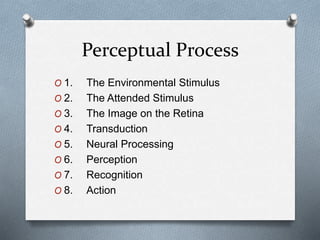
Perceptual Process
O 1. The Environmental Stimulus
O 2. The Attended Stimulus
O 3. The Image on the Retina
O 4. Transduction
O 5. Neural Processing
O 6. Perception
O 7. Recognition
O 8. Action
THE ENVIRONMENTAL
STIMULUS
O Everything in our environment that has
the potential to be perceived.
O EXAMPLE Duck splash in near by pond
Bright Light
loud sound
Fragrance
ATTENDED STIMULUS
O The attended stimulus is the specific
object in the environment on which our
attention is focused.
O EXAMPLE
Face of a friend in a crowd of
strangers
Duck floating in the nearby pond ,The
duck represents the attended stimulus.
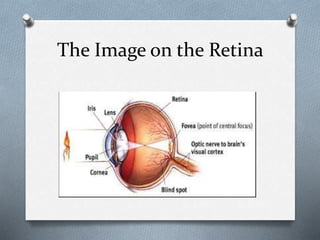
The Image on the Retina
TRANSDUCTION
O Image on the retina is then transformed
into electrical signals in a process known
as transduction.
O This allows the visual messages to be
transmitted to the brain to be interpreted.
NEURAL PROCESSING
O The electrical signals then undergo neural
processing .
O The path followed by a particular signal
depends on what type of signal it is
O Example- the image of a duck floating in
the pond is received as light on the retina,
which is then transduced into an electrical
signal and then processed through the
neurons in the visual network.
PERCEPTION
O We now perceive the stimulus object in
the environment. It is at this point that we
become consciously aware of the
stimulus.
O Example-At this stage we have become
aware of that there is something out on
the pond to perceive.
RECOGNITION
O Our mental ability to interpret and give
meaning to the object is the next step
known as recognition .
O Example it is at the recognition stage of
the perceptual process that we realize that
there is a duck floating on the water.
ACTION
O The final step of the perceptual process
involves some sort of action in response
to the environmental stimulus.
O Example turning your head for a closer
look
Of duck.
DETERMINANTS
OF
PERCEPTION
(A) SUBJECTIVE FACTORS
O MOTIVES OR NEEDS
O INTERESTS AND VALUES
O PAST EXPERIENCE
O AGE
O PREPARATORY SET
O SOCIAL AND CULTURAL INFLUENCES
DETERMINANTS OF PERCEPTION
(B) OBJECTIVE FACTORS
O INTENSITY
O SIZE
O DISTINCT AND STRIKING
O MOVEMENT
O NOVELTY
O DURATION
O REPETITION
O ABRUPT CHANGE
TYPES OF PERCEPTION
O AUTISTIC PERCEPTS-Are determined more by
subjective factors.
O REALISTIC PERCEPTS-Are determined more by
objective factors.
O ERRORS IN PERCEPTION-Extreme forms of
autistic percepts are hallucinations. If we see
something even when there is no stimulus ,it is
hallucination or false perception.
Example –A snake perceived as a snake due to semi-
darkness.
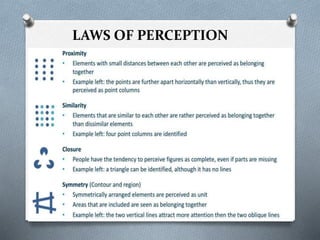
LAWS OF PERCEPTION
MEMORY
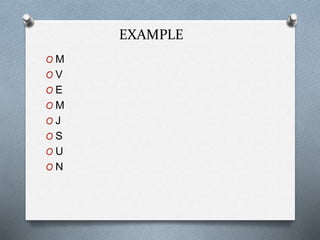
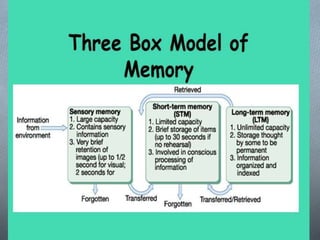
O “Memory is the means by which we draw
on our past experiences in order to use
this information in the present’’ (Sternberg,
1999).
O “Memory is the process of maintaining
information over time.”(Matlin,2005)
EXAMPLE
O M
O V
O E
O M
O J
O S
O U
O N
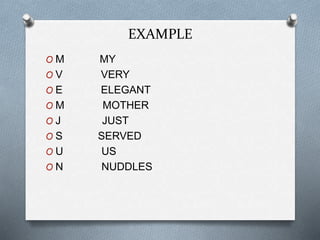
EXAMPLE
O M MY
O V VERY
O E ELEGANT
O M MOTHER
O J JUST
O S SERVED
O U US
O N NUDDLES
ATTENTION
O “Attention is the process of getting an object of
thought clearly before the mind .”
ROSS(1951)
O “ Attention is a state of mind in which there is no
contradiction”
J.KRISHNAMURTI
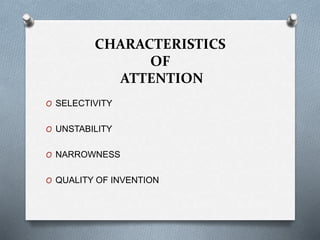
CHARACTERISTICS
OF
ATTENTION
O SELECTIVITY
O UNSTABILITY
O NARROWNESS
O QUALITY OF INVENTION
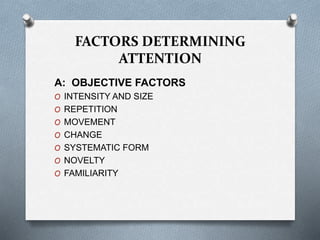
FACTORS DETERMINING
ATTENTION
A: OBJECTIVE FACTORS
O INTENSITY AND SIZE
O REPETITION
O MOVEMENT
O CHANGE
O SYSTEMATIC FORM
O NOVELTY
O FAMILIARITY
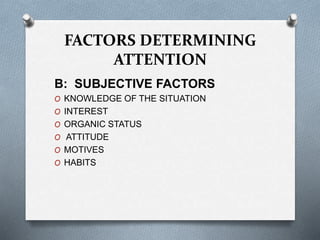
FACTORS DETERMINING
ATTENTION
B: SUBJECTIVE FACTORS
O KNOWLEDGE OF THE SITUATION
O INTEREST
O ORGANIC STATUS
O ATTITUDE
O MOTIVES
O HABITS
SIGNIFICANCE OF ATTENTION
O Brings mental alertness and preparedness
O Helps to distinguish or identify the object of
attention from others.
O Reinforce sensory process leading to better
organization of the perceptual field for maximum
clarity.
O Provides strength and ability to continue the task.
O Yields better results.

Perception,memory and attitude presentation

  • 3.
  • 4.
    Perceptual Process O 1.The Environmental Stimulus O 2. The Attended Stimulus O 3. The Image on the Retina O 4. Transduction O 5. Neural Processing O 6. Perception O 7. Recognition O 8. Action
  • 5.
    THE ENVIRONMENTAL STIMULUS O Everythingin our environment that has the potential to be perceived. O EXAMPLE Duck splash in near by pond Bright Light loud sound Fragrance
  • 6.
    ATTENDED STIMULUS O Theattended stimulus is the specific object in the environment on which our attention is focused. O EXAMPLE Face of a friend in a crowd of strangers Duck floating in the nearby pond ,The duck represents the attended stimulus.
  • 7.
    The Image onthe Retina
  • 8.
    TRANSDUCTION O Image onthe retina is then transformed into electrical signals in a process known as transduction. O This allows the visual messages to be transmitted to the brain to be interpreted.
  • 9.
    NEURAL PROCESSING O Theelectrical signals then undergo neural processing . O The path followed by a particular signal depends on what type of signal it is O Example- the image of a duck floating in the pond is received as light on the retina, which is then transduced into an electrical signal and then processed through the neurons in the visual network.
  • 10.
    PERCEPTION O We nowperceive the stimulus object in the environment. It is at this point that we become consciously aware of the stimulus. O Example-At this stage we have become aware of that there is something out on the pond to perceive.
  • 11.
    RECOGNITION O Our mentalability to interpret and give meaning to the object is the next step known as recognition . O Example it is at the recognition stage of the perceptual process that we realize that there is a duck floating on the water.
  • 12.
    ACTION O The finalstep of the perceptual process involves some sort of action in response to the environmental stimulus. O Example turning your head for a closer look Of duck.
  • 13.
    DETERMINANTS OF PERCEPTION (A) SUBJECTIVE FACTORS OMOTIVES OR NEEDS O INTERESTS AND VALUES O PAST EXPERIENCE O AGE O PREPARATORY SET O SOCIAL AND CULTURAL INFLUENCES
  • 14.
    DETERMINANTS OF PERCEPTION (B)OBJECTIVE FACTORS O INTENSITY O SIZE O DISTINCT AND STRIKING O MOVEMENT O NOVELTY O DURATION O REPETITION O ABRUPT CHANGE
  • 15.
    TYPES OF PERCEPTION OAUTISTIC PERCEPTS-Are determined more by subjective factors. O REALISTIC PERCEPTS-Are determined more by objective factors. O ERRORS IN PERCEPTION-Extreme forms of autistic percepts are hallucinations. If we see something even when there is no stimulus ,it is hallucination or false perception. Example –A snake perceived as a snake due to semi- darkness.
  • 16.
  • 17.
    MEMORY O “Memory isthe means by which we draw on our past experiences in order to use this information in the present’’ (Sternberg, 1999). O “Memory is the process of maintaining information over time.”(Matlin,2005)
  • 19.
    EXAMPLE O M O V OE O M O J O S O U O N
  • 20.
    EXAMPLE O M MY OV VERY O E ELEGANT O M MOTHER O J JUST O S SERVED O U US O N NUDDLES
  • 25.
    ATTENTION O “Attention isthe process of getting an object of thought clearly before the mind .” ROSS(1951) O “ Attention is a state of mind in which there is no contradiction” J.KRISHNAMURTI
  • 26.
  • 28.
    FACTORS DETERMINING ATTENTION A: OBJECTIVEFACTORS O INTENSITY AND SIZE O REPETITION O MOVEMENT O CHANGE O SYSTEMATIC FORM O NOVELTY O FAMILIARITY
  • 29.
    FACTORS DETERMINING ATTENTION B: SUBJECTIVEFACTORS O KNOWLEDGE OF THE SITUATION O INTEREST O ORGANIC STATUS O ATTITUDE O MOTIVES O HABITS
  • 30.
    SIGNIFICANCE OF ATTENTION OBrings mental alertness and preparedness O Helps to distinguish or identify the object of attention from others. O Reinforce sensory process leading to better organization of the perceptual field for maximum clarity. O Provides strength and ability to continue the task. O Yields better results.