Submitted to : Sir Azeem
By Syed Salman Jilani
Pentium is a brand used for a series of x86-compatible
microprocessors produced by Intel
The name Pentium is originally derived from the Greek word
pente meaning "five" as the original Pentium processors used
Intel's fifth-generation micro architecture
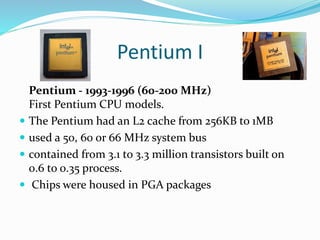
Pentium I
Pentium - 1993-1996 (60-200 MHz)
First Pentium CPU models.
 The Pentium had an L2 cache from 256KB to 1MB
 used a 50, 60 or 66 MHz system bus
 contained from 3.1 to 3.3 million transistors built on
0.6 to 0.35 process.
 Chips were housed in PGA packages
Pentium II
Pentium II - 1997-1999 (233-450 MHz)
The Pentium II used a 66 or 100 MHz system bus
Desktop models had 7.5 million transistors
512KB L2 cache and were housed in SECC packages
Mobile models had 27.4 million transistors 256KB L2
cache and were housed in either BGA or Mobile
Minicartridge (MMC) packages
Pentium III
Pentium III - 1999-2001 (500 MHz-1.13 GHz)
The Pentium III added 70 additional instructions to
the Pentium II.
 The Pentium III used a 100 or 133 MHz system bus and
either a 512KB L2 cache or a 256KB L2 Advanced
Transfer Cache.
 it contained from 9.5 to 28 million transistors, used
the 0.25 or 0.18 micron process
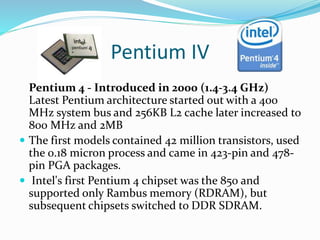
Pentium IV
Pentium 4 - Introduced in 2000 (1.4-3.4 GHz)
Latest Pentium architecture started out with a 400
MHz system bus and 256KB L2 cache later increased to
800 MHz and 2MB
 The first models contained 42 million transistors, used
the 0.18 micron process and came in 423-pin and 478-
pin PGA packages.
 Intel's first Pentium 4 chipset was the 850 and
supported only Rambus memory (RDRAM), but
subsequent chipsets switched to DDR SDRAM.
Dual Core & Core 2 duo Chaos
Meaning of dual core and core 2 duo
"Core" was the name by Intel for their newer processor.
"Core 2" was the name for the next version of that "Core"
processor.
When you see "Duo" then that means there are two
processors in the same packaged chip.
Thus “Dual Core" and "Core 2 Duo" are both two processor
chips, one being the newer "Core 2" variety
Dual-Core
 Dual-Core (2006-2009) (1.3 to 2.6 GHz)
 FSB (Front side Bus) speeds 533 MHz to 800 MHz
Min. feature size 65 nm to 45 nm
Instruction set MMX, SSE, SSE2, SSE3, SSSE3, x86-64
Core name(s)
 Yonah
 Merom-2M
 Allendale
 Wolfdale-3M
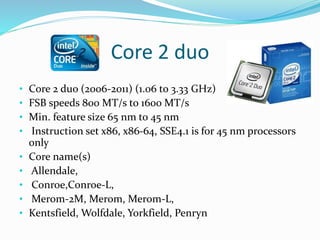
Core 2 duo
• Core 2 duo (2006-2011) (1.06 to 3.33 GHz)
• FSB speeds 800 MT/s to 1600 MT/s
• Min. feature size 65 nm to 45 nm
• Instruction set x86, x86-64, SSE4.1 is for 45 nm processors
only
• Core name(s)
• Allendale,
• Conroe,Conroe-L,
• Merom-2M, Merom, Merom-L,
• Kentsfield, Wolfdale, Yorkfield, Penryn
Core I[x] Odd Chaos
 Why does Intel produce core i3, core i5 and core i7
processors, but not core i2, core i4 or core i6 processors?
 The information on letters and numbers is not longer
corresponding to a specific technical features or
technology on the Products.
 This naming scheme is now divided as low-level units
(Core i3), mid-range units (Core i5) and high-end
performance processors (Core i7).
 These names were selected only for marketing purposes.
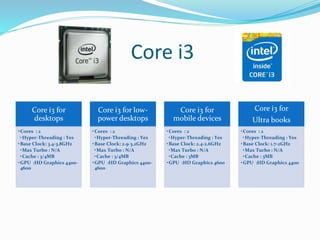
Core i3
Core i3 for
desktops
•Cores : 2
•Hyper-Threading : Yes
•Base Clock: 3.4-3.8GHz
•Max Turbo : N/A
•Cache : 3/4MB
•GPU :HD Graphics 4400-
4600
Core i3 for low-
power desktops
•Cores : 2
•Hyper-Threading : Yes
•Base Clock: 2.9-3.2GHz
•Max Turbo : N/A
•Cache : 3/4MB
•GPU :HD Graphics 4400-
4600
Core i3 for
mobile devices
•Cores : 2
•Hyper-Threading : Yes
•Base Clock: 2.4-2.6GHz
•Max Turbo : N/A
•Cache : 3MB
•GPU :HD Graphics 4600
Core i3 for
Ultra books
•Cores : 2
•Hyper-Threading : Yes
•Base Clock: 1.7-2GHz
•Max Turbo : N/A
•Cache : 3MB
•GPU :HD Graphics 4400
Core i5
Core i5 for
desktops
•Cores : 4
•Hyper-Threading : Yes
•Base Clock: 3-3.5GHz
•Max Turbo : 400MHz
•Cache : 6MB
•GPU :HD Graphics 4600
Core i5 for low-
power desktops
•Cores : 4
•Hyper-Threading : Yes
•Base Clock: 1.9-2.5GHz
•Max Turbo :1GHz
•Cache : 6MB
•GPU :HD Graphics 4600
Core i3 for
mobile devices
•Cores : 2
•Hyper-Threading : Yes
•Base Clock: 2.5-2.9GHz
•Max Turbo : 700MHz
•Cache : 3MB
•GPU :HD Graphics 4400
Core i3 for
Ultra books
•Cores : 2
•Hyper-Threading : Yes
•Base Clock: 1.3-2GHz
•Max Turbo : 1.5GHz
•Cache : 3MB
•GPU :HD Graphics 4400-
5000
Core i7
Core i7 for
desktops
•Cores : 4
•Hyper-Threading : Yes
•Base Clock: 3.4-4GHz
•Max Turbo : 500MHz
•Cache : 8MB
•GPU :HD Graphics 4600
Core i7 for low-
power desktops
•Cores : 4
•Hyper-Threading : Yes
•Base Clock: 2-2.7GHz
•Max Turbo :1.2GHz
•Cache : 8MB
•GPU :HD Graphics 4600
Core i7 for
mobile devices
•Cores : 2
•Hyper-Threading : Yes
•Base Clock: 2.9-3GHz
•Max Turbo : 700MHz
•Cache : 4MB
•GPU :HD Graphics 4600
Core i7 for
Ultra books
•Cores : 2
•Hyper-Threading : Yes
•Base Clock: 1.5-2.1GHz
•Max Turbo : 1.6GHz
•Cache : 4MB
•GPU :HD Graphics 4400-
5000
Core i7
Core i7 quad-core
for mobile devices
•Cores : 4
•Hyper-Threading : Yes
•Base Clock: 2.2-3.1GHz
•Max Turbo : 1GHz
•Cache : 8MB
•GPU :HD Graphics 4600
Core i7 quad-core
for high-end mobile
devices
•Cores : 4
•Hyper-Threading : Yes
•Base Clock: 2-2.6GHz
•Max Turbo :1.2GHz
•Cache : 8MB
•GPU :HD Graphics 4600 / Iris Pro Graphics 5200
Pentium processor

Pentium processor

  • 2.
    Submitted to :Sir Azeem By Syed Salman Jilani
  • 3.
    Pentium is abrand used for a series of x86-compatible microprocessors produced by Intel The name Pentium is originally derived from the Greek word pente meaning "five" as the original Pentium processors used Intel's fifth-generation micro architecture
  • 4.
    Pentium I Pentium -1993-1996 (60-200 MHz) First Pentium CPU models.  The Pentium had an L2 cache from 256KB to 1MB  used a 50, 60 or 66 MHz system bus  contained from 3.1 to 3.3 million transistors built on 0.6 to 0.35 process.  Chips were housed in PGA packages
  • 5.
    Pentium II Pentium II- 1997-1999 (233-450 MHz) The Pentium II used a 66 or 100 MHz system bus Desktop models had 7.5 million transistors 512KB L2 cache and were housed in SECC packages Mobile models had 27.4 million transistors 256KB L2 cache and were housed in either BGA or Mobile Minicartridge (MMC) packages
  • 6.
    Pentium III Pentium III- 1999-2001 (500 MHz-1.13 GHz) The Pentium III added 70 additional instructions to the Pentium II.  The Pentium III used a 100 or 133 MHz system bus and either a 512KB L2 cache or a 256KB L2 Advanced Transfer Cache.  it contained from 9.5 to 28 million transistors, used the 0.25 or 0.18 micron process
  • 7.
    Pentium IV Pentium 4- Introduced in 2000 (1.4-3.4 GHz) Latest Pentium architecture started out with a 400 MHz system bus and 256KB L2 cache later increased to 800 MHz and 2MB  The first models contained 42 million transistors, used the 0.18 micron process and came in 423-pin and 478- pin PGA packages.  Intel's first Pentium 4 chipset was the 850 and supported only Rambus memory (RDRAM), but subsequent chipsets switched to DDR SDRAM.
  • 8.
    Dual Core &Core 2 duo Chaos Meaning of dual core and core 2 duo "Core" was the name by Intel for their newer processor. "Core 2" was the name for the next version of that "Core" processor. When you see "Duo" then that means there are two processors in the same packaged chip. Thus “Dual Core" and "Core 2 Duo" are both two processor chips, one being the newer "Core 2" variety
  • 9.
    Dual-Core  Dual-Core (2006-2009)(1.3 to 2.6 GHz)  FSB (Front side Bus) speeds 533 MHz to 800 MHz Min. feature size 65 nm to 45 nm Instruction set MMX, SSE, SSE2, SSE3, SSSE3, x86-64 Core name(s)  Yonah  Merom-2M  Allendale  Wolfdale-3M
  • 10.
    Core 2 duo •Core 2 duo (2006-2011) (1.06 to 3.33 GHz) • FSB speeds 800 MT/s to 1600 MT/s • Min. feature size 65 nm to 45 nm • Instruction set x86, x86-64, SSE4.1 is for 45 nm processors only • Core name(s) • Allendale, • Conroe,Conroe-L, • Merom-2M, Merom, Merom-L, • Kentsfield, Wolfdale, Yorkfield, Penryn
  • 11.
    Core I[x] OddChaos  Why does Intel produce core i3, core i5 and core i7 processors, but not core i2, core i4 or core i6 processors?  The information on letters and numbers is not longer corresponding to a specific technical features or technology on the Products.  This naming scheme is now divided as low-level units (Core i3), mid-range units (Core i5) and high-end performance processors (Core i7).  These names were selected only for marketing purposes.
  • 12.
    Core i3 Core i3for desktops •Cores : 2 •Hyper-Threading : Yes •Base Clock: 3.4-3.8GHz •Max Turbo : N/A •Cache : 3/4MB •GPU :HD Graphics 4400- 4600 Core i3 for low- power desktops •Cores : 2 •Hyper-Threading : Yes •Base Clock: 2.9-3.2GHz •Max Turbo : N/A •Cache : 3/4MB •GPU :HD Graphics 4400- 4600 Core i3 for mobile devices •Cores : 2 •Hyper-Threading : Yes •Base Clock: 2.4-2.6GHz •Max Turbo : N/A •Cache : 3MB •GPU :HD Graphics 4600 Core i3 for Ultra books •Cores : 2 •Hyper-Threading : Yes •Base Clock: 1.7-2GHz •Max Turbo : N/A •Cache : 3MB •GPU :HD Graphics 4400
  • 13.
    Core i5 Core i5for desktops •Cores : 4 •Hyper-Threading : Yes •Base Clock: 3-3.5GHz •Max Turbo : 400MHz •Cache : 6MB •GPU :HD Graphics 4600 Core i5 for low- power desktops •Cores : 4 •Hyper-Threading : Yes •Base Clock: 1.9-2.5GHz •Max Turbo :1GHz •Cache : 6MB •GPU :HD Graphics 4600 Core i3 for mobile devices •Cores : 2 •Hyper-Threading : Yes •Base Clock: 2.5-2.9GHz •Max Turbo : 700MHz •Cache : 3MB •GPU :HD Graphics 4400 Core i3 for Ultra books •Cores : 2 •Hyper-Threading : Yes •Base Clock: 1.3-2GHz •Max Turbo : 1.5GHz •Cache : 3MB •GPU :HD Graphics 4400- 5000
  • 14.
    Core i7 Core i7for desktops •Cores : 4 •Hyper-Threading : Yes •Base Clock: 3.4-4GHz •Max Turbo : 500MHz •Cache : 8MB •GPU :HD Graphics 4600 Core i7 for low- power desktops •Cores : 4 •Hyper-Threading : Yes •Base Clock: 2-2.7GHz •Max Turbo :1.2GHz •Cache : 8MB •GPU :HD Graphics 4600 Core i7 for mobile devices •Cores : 2 •Hyper-Threading : Yes •Base Clock: 2.9-3GHz •Max Turbo : 700MHz •Cache : 4MB •GPU :HD Graphics 4600 Core i7 for Ultra books •Cores : 2 •Hyper-Threading : Yes •Base Clock: 1.5-2.1GHz •Max Turbo : 1.6GHz •Cache : 4MB •GPU :HD Graphics 4400- 5000
  • 15.
    Core i7 Core i7quad-core for mobile devices •Cores : 4 •Hyper-Threading : Yes •Base Clock: 2.2-3.1GHz •Max Turbo : 1GHz •Cache : 8MB •GPU :HD Graphics 4600 Core i7 quad-core for high-end mobile devices •Cores : 4 •Hyper-Threading : Yes •Base Clock: 2-2.6GHz •Max Turbo :1.2GHz •Cache : 8MB •GPU :HD Graphics 4600 / Iris Pro Graphics 5200