MESYUARAT PENGURUSAN GIGITAN HAIWAN
DAN PENCEGAHAN PENYAKIT RABIES DI NEGERI
PERAK
MEETING OBJECTIVES
 To coordinate the management of animal bites and rabies prevention
activities in all our healthcare facilities in Perak State
 To review the current available guidelines
 To propose and to get consensus of local flow chart of management at primary care
level and hospital intervention
SITUASI SEMASA NOTIFIKASI KES GIGITAN HAIWAN DI PERAK (JAN-
MEI 2023)
 524 notifikasi kes gigitan haiwan telah diterima di Perak iaitu peningkatan 85.8% notifikasi berbanding tempoh yang sama
pada tahun 2022
 88.7% adalah gigitan anjing, 8.8% gigitan kucing, 1.7% gigitan tikus, dan 0.8% adalah gigitan haiwan lain-lain. Daripada
jumlah ini juga hanya 19.8% haiwan tersebut telah mempunyai suntikan rabies dan baki status adalah tidak diketahui atau
tidak dapat dijalankan verifikasi suntikan.
 Kategori gigitan:
- 11.1% adalah kategori 1
- 45.4% adalah kategori 2
- 42.4% adalah kategori 3
- 1.1% tiada maklumat kategori
 Rawatan PEP: 23.7% daripada jumlah gigitan haiwan di Perak telah dimulakan suntikan Post Exposure Prophylaxis (PEP)
dan setakat ini tiada Rabies Immunoglobulin (RIG) diberikan di Perak.
TREN NOTIFIKASI KES GIGITAN HAIWAN
2021 – MEI 2023
Januari Februari Mac April Mei Jun Julai Ogos September Oktober November Disember
2021 58 40 65 63 56 56 11 3 21 38 76 172
2022 70 48 63 81 77 84 64 105 92 98 96 121
2023 120 122 104 78 100
0
20
40
60
80
100
120
140
160
180
200
2021 2022 2023
BILANGAN NOTIFIKASI KES GIGITAN HAIWAN MENGIKUT DAERAH
JAN – MEI 2023
BAGAN DATUK
BATANG
PADANG
HILIR PERAK HULU PERAK KAMPAR KERIAN KINTA
KUALA
KANGSAR
LMS MANJUNG MUALLIM
PERAK
TENGAH
Januari 5 10 5 9 7 5 12 9 37 16 5 0
Februari 7 4 6 24 8 1 7 48 11 5 0
Mac 3 4 5 1 7 8 19 6 37 10 3 1
April 5 7 7 4 12 6 20 8 1 5 1 2
Mei 4 7 5 4 10 6 18 10 32 2 1 1
0
10
20
30
40
50
60
Januari Februari Mac April Mei
TIMELINE OF RABIES CASES IN ANIMAL AND HUMAN, MALAYSIA
ANIMAL RABIES HUMAN RABIES
1925 • Kedah
• Perlis
(Beginning 1884) Reported cases but records lost in
WWII
1945 • Province of Wellesley (Seberang
Perai), Penang
• Perak
1924 1st record of human case traced
1946 - 1951 Throughout peninsular Malaysia
(Perak – Highly endemic)
1952 -1954 Selangor Kuala Lumpur 1952 – 1954 • Selangor
1954 • Malaysia declared ‘Rabies Free’. Immune belt established.
1963 • Perlis
• Selangor (through army dogs
from Perlis)
1965 Kelantan (sporadic cases)
1972 Kedah (sporadic case) 1970 • Kedah
• Perlis 11 cases
1973 Kedah (1 canine case) 1973 • Kedah (1 case)
1974 Kedah (2 canine case) 1974 • Kedah (1 case)
ANIMAL RABIES HUMAN RABIES
1975 • Kedah (1 canine case)
• Penang (2 canine cases)
1975 •Penang (2 case)
1977 - 1978 • Perlis (3 canine case)
1980 • Perlis (5 canine case) 1980 • Perlis (1 case)
• Kroh, Perak (1 case)
1995 - 1997 • Terengganu
• Perlis
• Kedah
1996 •Kedah (1 case) •Terengganu (4
cases)
1999 • Last recorded case 1997 • Kedah (7 cases - 3 died)
2013 • Declared rabies-free by OIE 1998 • Kedah (1 case)
2015 • Perlis
• Kedah
• Penang
2017 • Perak – Kuala Sepetang
• Sarawak
2017 • Sarawak – 6 cases: 5 children, 1
adult (5 died, 1 survived)
2018 • Sarawak
• Perlis
• Perak – LMS (end of Dec)
2018 Sarawak • 10 cases: 2 children, 8 adults (all
died)
2019 • Sarawak (outbreak still ongoing to date)
• Perak – LMS (early Jan)
2019 -2021 • Sarawak – 25 cases: 20 adults, 5
child (24 died, 1 survived)
RABIES IMMUNE
BELT
April 1954, the country was declared free from Rabies.
Subsequently as a pre-emptive measure, in the year 1955 an immunebelt of 50-80 km wide from the
Malaysia-Thailand border was established to allow continuous intensive control and containment to be
carried out.
HUMAN RABIES IN MALAYSIA
*2022: All cases reported was from Sarawak
except two (2) cases from Selangor
**2023:All cases reported was from Sarawak
except one (1) case from Selangor (imported
case from India)
Year
No of
cases No of death CFR(%)
2017 6 5 83.3
2018 10 10 100.0
2019 6 6 100.0
2020 9 8 88.9
2021 10 10 100.0
2022 16* 12 75.0
2023 5** 3 60.0
2017 2018 2019 2020 2021
cases
Survival
6 10 6 9 10 16
2022
Rabies Cases and death in Malaysia, 2017-ME8/2023
2023
5
PREVENTION AND CONTROL OF HUMAN RABIES
 Category of human exposure
 Possible exposure: A person who had close contact including bite, scratch,
mucosal (eyes, nose and mouth) or open wound exposure to body fluids of
animals displaying clinical signs consistent with rabies at the time of or
within 14 days following the incidence.
 Exposed: A person who has had close contact usually a bite or scratch or
mucosal (eyes, nose and mouth) or open wound exposure with a laboratory
confirmed rabid animal.
POST-EXPOSURE
MANAGEMENT
 Post-exposure prevention
consists of
i. local treatment of the wound,
ii. anti-rabies vaccination
iii. administration of rabies
immunoglobulin (if
indicated).
 Immediate and thorough
flushing and washing of the
wound for a minimum of 15
minutes with running water
and soap or detergent, the
wound is dressed with
povidone iodine or alcohol
 Secondary suturing should
be avoided to prevent
inoculating the virus deeper
into the wound
 Inpatient care of patients
with animal bite/s may be
needed if wounds are
extensive or are on the
face, hands and genitalia,
or surgical repair or
replacement of blood loss
is required, or if infection
occurs.
POST-BITE RISK
ASSESSMENT
Category Risks
The nature of contact (bite event) i. provoked versus unprovoked attack.
ii. time between bite & consultation.
the presence of rabies infected
animals in the area where the
contact occurred (event location)
based on
• Surveillance data: canine/wildlife rabies, human
rabies.
Risk category i. Wound type.
ii. Animal species.
Wound characteristics i. Location, bare body part versus protected by
clothing.
ii. Single versus multiple
Animal characteristics i. Fully confined and supervised pet versus free-
roaming pet versus stray.
ii. The vaccination status of the animal.
iii. Features that may suggestive of animal rabies
features at the event time.
iv. Current status of the animal.
v. Any other human and/or animal bitten by the
same animal over the past 14 days.
Feasibility to have the animal
observed for 14 days
i. Still alive versus missing versus death.
ii. Veterinary department involved.
iii. Owner is known and contactable.
iv. The results of laboratory testing of the animal
for rabies, if available
Patient immune status i. Rabies: have received complete pre-exposure
prophylaxis (PrEP) or post-exposure prophylaxis
(PEP) previously.
WOUND CATEGORIZATION
RISK CATEGORY TYPE OF EXPOSURE ACTION TO BE TAKEN
I. Touching/feeding animal.
II. Licking of intact skin.
• Nil if history is reliable.
• If history not reliable and in presence of visible wound,
treat as Category 2.
I. Nibbling of uncovered skin.
II. Superficial scratch or abrasions through
bite with no bleeding.
III. Licking of broken skin (when scabs has not
been formed yet)
• Apply appropriate wound treatment. Administer anti-
tetanus if indicated. Assess for need to administer
vaccine.
• Do not administer anti-rabies immunoglobulin (RIG) in
immune-competent patient.
• Stop vaccination if animal is rabies negative in
laboratory tests, or remains healthy at/after 14 days’
observation
I. Bites/scratches with teeth which penetrate
the skin and draw blood spontaneously.
II. Licking mucous membrane (eyes, nose
and mouth) or open wound.
III. Exposure to potential infectious materials
such as saliva, brain tissue, urine, CSF.
IV. Multiple bites.
• Apply appropriate wound treatment.
• Administer anti-tetanus as indicated.
• Assess for need to administer vaccine.
• Administer RIG.
• Stop vaccination if animal is rabies negative in
laboratory tests, or remains healthy after 14 days’
observation.
SPECIAL CONSIDERATION
 Rabies vaccination or RIG may be delayed if the bite occurs in:
 Rabies non-endemic area while awaiting laboratory investigation and/or
animal observation result.
 Rabies endemic area (or where there are reported cases of animal rabies)
and the animal is healthy at time of bite and it can be observed closely for
the next 14 days.
 Rabies vaccination or RIG should be commenced immediately if the animal
under observation became sick or died or went missing or culled
during the period of observation.
IMPORTANT NOTES FOR RABIES FREE STATES
(INCLUDING GAZETTED IMMUNE BELT AREAS)
• Patient with an animal bite wound category 2 and 3 should be referred** to FMS / Infectious
Disease (ID) Physician or ID Paediatrician for assessment and commencement of PEP and/or RIG
• Animal is found/captured: Notify the nearest District Veterinary Office. Follow up the status of
the animal. Start PEP and/or RIG if animal is sick or died within 14 days of observation; and after
consulting ID Physician or Paediatrician for further assessment of the case
• Stray animal: please consult FMS/ ID Physician or Paediatrician for further assessment of animal
bite cases. PEP and/or RIG will be given based on the evaluation from the specialist
**Not necessary to refer patient to Hospital (Via Casualty department) unless if indicated
**Phone or VC consultation with ID is adequate
ANIMAL BITE MANAGEMENT
FOR PREVIOUSLY
UNVACCINATED PERSON
ANIMAL BITE MANAGEMENT
FOR PREVIOUSLY*
VACCINATED PERSON
MANAGEMENT OF CASE
WITH OLD ANIMAL BITE
(MORE THAN 14 DAYS
POST BITE)
Primary Setting
• clinical assessment,
• wound care and start antibiotic if wound appears contaminated.
• Patient with risk category 2 or 3 should be referred** to hospitals with availability of rabies vaccine and RIG.
• Patient with risk category 1 can be discharged with reassurance that there is no risk of rabies infection
Secondary Setting:
• Casualty Team / Primary care team will assess the case
• Notify the nearest District Veterinary Office. If the animal is found or capture, follow up the status of the
animal.
• Start PEP and/or RIG if animal is sick or died within 14 days of observation; and after consulting FMS/ ID
Physician or Paediatrician for further assessment of the case.
• If animal is not found, consult FMS / ID Physician or Paediatrician for assessment and PEP and/or RIG.
• Symptomatic patient: admit to ward immediately for further assessment. PEP/RIG is not indicated
Follow up
• Patient with wound category 2 and 3 who received complete PEP must be followed up at Month 1 and
Month 3
ANIMAL BITE CASE MANAGEMENT AT PRIMARY AND SECONDARY SETTING IN RABIES
INFECTED AREAS
**Not necessary to refer patient to Hospital (Via Casualty department) unless if indicated
**Phone or VC consultation with ID s adequate
REFERRAL TO HOSPITAL
 Inpatient care of patients with animal bite/s may be needed if:
 wounds are extensive or are on the face or head and neck region, hands
and genitalia,
 or surgical repair or bone frecture
 or replacement of blood loss is required,
 or if infection occurs.
ANIMAL BITE CLINIC
 The establishment of an Animal Bite Clinic (ABC) is to:
a. provide a more comprehensive care to victims of dog (+/- other animal) bite in an event of
continuous / extended rabies infected areas where the number of patients can be
overwhelming to the emergency department.
b. provide continuous care to the bite victims to ensure those high-risk cases complete their
rabies vaccination series for an optimum protection of PEP.
c. pool available resources such as rabies vaccine and RIG, which might not be sufficient to
meet the demand during a rabies outbreak.
PUBLIC HEALTH RESPONSE
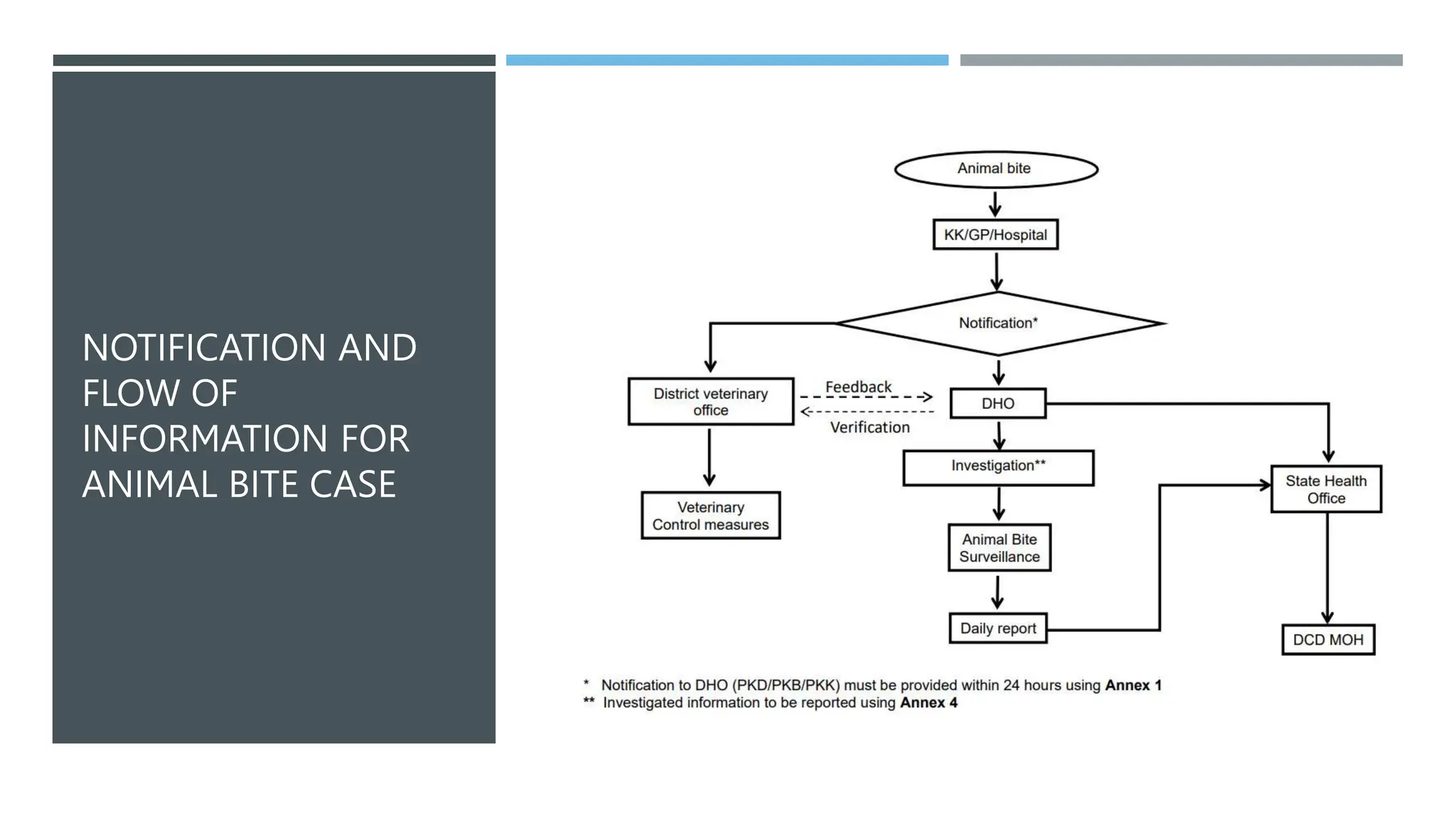
 Animal bite notification within 24 hours to the nearest DHO
 DHO must notify the nearest District Veterinary Office (DVO) immediately by
phone followed by submission of Animal Bite Notification Form through fax.
 DHO should carry out these actions:
 Investigate all notified cases.
 Find any other animal bite case(s)(ACD) in the locality.
 In rabies infected areas, there might be other bite cases exposed to rabid animal whom have not seek
medical treatment
 do public announcement to alert other bite victims to seek medical
advice.
NOTIFICATION AND
FLOW OF
INFORMATION FOR
ANIMAL BITE CASE
 It is the responsibility of DHO to:
 Notify the animal bite cases to the nearest Veterinary District Office (VDO) using
Annex 1.
 clarify the animal status* with the respective VDO within 48 hours.
 * animal – whether found or not found. If found and able to observe (clarify the health
status of the animal for 14 days. If not found, clarify the rabies status among animals in
that area (Animal Surveillance System).
 Rabies is a
vaccine-
preventable viral
disease
 Our goal: zero
human rabies
deaths by 2030
DISCUSSION
 Primary care intervention – initial management and Prevention
 Allowable Time frame to delay vaccine / Rig due to Logistic purpose
THANK YOU
 Q & A session
Pengurusan gigitan haiwan di negeri Perak.pptx

Pengurusan gigitan haiwan di negeri Perak.pptx

  • 1.
    MESYUARAT PENGURUSAN GIGITANHAIWAN DAN PENCEGAHAN PENYAKIT RABIES DI NEGERI PERAK
  • 2.
    MEETING OBJECTIVES  Tocoordinate the management of animal bites and rabies prevention activities in all our healthcare facilities in Perak State  To review the current available guidelines  To propose and to get consensus of local flow chart of management at primary care level and hospital intervention
  • 3.
    SITUASI SEMASA NOTIFIKASIKES GIGITAN HAIWAN DI PERAK (JAN- MEI 2023)  524 notifikasi kes gigitan haiwan telah diterima di Perak iaitu peningkatan 85.8% notifikasi berbanding tempoh yang sama pada tahun 2022  88.7% adalah gigitan anjing, 8.8% gigitan kucing, 1.7% gigitan tikus, dan 0.8% adalah gigitan haiwan lain-lain. Daripada jumlah ini juga hanya 19.8% haiwan tersebut telah mempunyai suntikan rabies dan baki status adalah tidak diketahui atau tidak dapat dijalankan verifikasi suntikan.  Kategori gigitan: - 11.1% adalah kategori 1 - 45.4% adalah kategori 2 - 42.4% adalah kategori 3 - 1.1% tiada maklumat kategori  Rawatan PEP: 23.7% daripada jumlah gigitan haiwan di Perak telah dimulakan suntikan Post Exposure Prophylaxis (PEP) dan setakat ini tiada Rabies Immunoglobulin (RIG) diberikan di Perak.
  • 4.
    TREN NOTIFIKASI KESGIGITAN HAIWAN 2021 – MEI 2023 Januari Februari Mac April Mei Jun Julai Ogos September Oktober November Disember 2021 58 40 65 63 56 56 11 3 21 38 76 172 2022 70 48 63 81 77 84 64 105 92 98 96 121 2023 120 122 104 78 100 0 20 40 60 80 100 120 140 160 180 200 2021 2022 2023
  • 5.
    BILANGAN NOTIFIKASI KESGIGITAN HAIWAN MENGIKUT DAERAH JAN – MEI 2023 BAGAN DATUK BATANG PADANG HILIR PERAK HULU PERAK KAMPAR KERIAN KINTA KUALA KANGSAR LMS MANJUNG MUALLIM PERAK TENGAH Januari 5 10 5 9 7 5 12 9 37 16 5 0 Februari 7 4 6 24 8 1 7 48 11 5 0 Mac 3 4 5 1 7 8 19 6 37 10 3 1 April 5 7 7 4 12 6 20 8 1 5 1 2 Mei 4 7 5 4 10 6 18 10 32 2 1 1 0 10 20 30 40 50 60 Januari Februari Mac April Mei
  • 6.
    TIMELINE OF RABIESCASES IN ANIMAL AND HUMAN, MALAYSIA ANIMAL RABIES HUMAN RABIES 1925 • Kedah • Perlis (Beginning 1884) Reported cases but records lost in WWII 1945 • Province of Wellesley (Seberang Perai), Penang • Perak 1924 1st record of human case traced 1946 - 1951 Throughout peninsular Malaysia (Perak – Highly endemic) 1952 -1954 Selangor Kuala Lumpur 1952 – 1954 • Selangor 1954 • Malaysia declared ‘Rabies Free’. Immune belt established. 1963 • Perlis • Selangor (through army dogs from Perlis) 1965 Kelantan (sporadic cases) 1972 Kedah (sporadic case) 1970 • Kedah • Perlis 11 cases 1973 Kedah (1 canine case) 1973 • Kedah (1 case) 1974 Kedah (2 canine case) 1974 • Kedah (1 case)
  • 7.
    ANIMAL RABIES HUMANRABIES 1975 • Kedah (1 canine case) • Penang (2 canine cases) 1975 •Penang (2 case) 1977 - 1978 • Perlis (3 canine case) 1980 • Perlis (5 canine case) 1980 • Perlis (1 case) • Kroh, Perak (1 case) 1995 - 1997 • Terengganu • Perlis • Kedah 1996 •Kedah (1 case) •Terengganu (4 cases) 1999 • Last recorded case 1997 • Kedah (7 cases - 3 died) 2013 • Declared rabies-free by OIE 1998 • Kedah (1 case) 2015 • Perlis • Kedah • Penang 2017 • Perak – Kuala Sepetang • Sarawak 2017 • Sarawak – 6 cases: 5 children, 1 adult (5 died, 1 survived) 2018 • Sarawak • Perlis • Perak – LMS (end of Dec) 2018 Sarawak • 10 cases: 2 children, 8 adults (all died) 2019 • Sarawak (outbreak still ongoing to date) • Perak – LMS (early Jan) 2019 -2021 • Sarawak – 25 cases: 20 adults, 5 child (24 died, 1 survived)
  • 8.
    RABIES IMMUNE BELT April 1954,the country was declared free from Rabies. Subsequently as a pre-emptive measure, in the year 1955 an immunebelt of 50-80 km wide from the Malaysia-Thailand border was established to allow continuous intensive control and containment to be carried out.
  • 9.
    HUMAN RABIES INMALAYSIA *2022: All cases reported was from Sarawak except two (2) cases from Selangor **2023:All cases reported was from Sarawak except one (1) case from Selangor (imported case from India) Year No of cases No of death CFR(%) 2017 6 5 83.3 2018 10 10 100.0 2019 6 6 100.0 2020 9 8 88.9 2021 10 10 100.0 2022 16* 12 75.0 2023 5** 3 60.0
  • 10.
    2017 2018 20192020 2021 cases Survival 6 10 6 9 10 16 2022 Rabies Cases and death in Malaysia, 2017-ME8/2023 2023 5
  • 11.
    PREVENTION AND CONTROLOF HUMAN RABIES  Category of human exposure  Possible exposure: A person who had close contact including bite, scratch, mucosal (eyes, nose and mouth) or open wound exposure to body fluids of animals displaying clinical signs consistent with rabies at the time of or within 14 days following the incidence.  Exposed: A person who has had close contact usually a bite or scratch or mucosal (eyes, nose and mouth) or open wound exposure with a laboratory confirmed rabid animal.
  • 12.
    POST-EXPOSURE MANAGEMENT  Post-exposure prevention consistsof i. local treatment of the wound, ii. anti-rabies vaccination iii. administration of rabies immunoglobulin (if indicated).
  • 13.
     Immediate andthorough flushing and washing of the wound for a minimum of 15 minutes with running water and soap or detergent, the wound is dressed with povidone iodine or alcohol  Secondary suturing should be avoided to prevent inoculating the virus deeper into the wound  Inpatient care of patients with animal bite/s may be needed if wounds are extensive or are on the face, hands and genitalia, or surgical repair or replacement of blood loss is required, or if infection occurs.
  • 14.
    POST-BITE RISK ASSESSMENT Category Risks Thenature of contact (bite event) i. provoked versus unprovoked attack. ii. time between bite & consultation. the presence of rabies infected animals in the area where the contact occurred (event location) based on • Surveillance data: canine/wildlife rabies, human rabies. Risk category i. Wound type. ii. Animal species. Wound characteristics i. Location, bare body part versus protected by clothing. ii. Single versus multiple Animal characteristics i. Fully confined and supervised pet versus free- roaming pet versus stray. ii. The vaccination status of the animal. iii. Features that may suggestive of animal rabies features at the event time. iv. Current status of the animal. v. Any other human and/or animal bitten by the same animal over the past 14 days. Feasibility to have the animal observed for 14 days i. Still alive versus missing versus death. ii. Veterinary department involved. iii. Owner is known and contactable. iv. The results of laboratory testing of the animal for rabies, if available Patient immune status i. Rabies: have received complete pre-exposure prophylaxis (PrEP) or post-exposure prophylaxis (PEP) previously.
  • 15.
    WOUND CATEGORIZATION RISK CATEGORYTYPE OF EXPOSURE ACTION TO BE TAKEN I. Touching/feeding animal. II. Licking of intact skin. • Nil if history is reliable. • If history not reliable and in presence of visible wound, treat as Category 2. I. Nibbling of uncovered skin. II. Superficial scratch or abrasions through bite with no bleeding. III. Licking of broken skin (when scabs has not been formed yet) • Apply appropriate wound treatment. Administer anti- tetanus if indicated. Assess for need to administer vaccine. • Do not administer anti-rabies immunoglobulin (RIG) in immune-competent patient. • Stop vaccination if animal is rabies negative in laboratory tests, or remains healthy at/after 14 days’ observation I. Bites/scratches with teeth which penetrate the skin and draw blood spontaneously. II. Licking mucous membrane (eyes, nose and mouth) or open wound. III. Exposure to potential infectious materials such as saliva, brain tissue, urine, CSF. IV. Multiple bites. • Apply appropriate wound treatment. • Administer anti-tetanus as indicated. • Assess for need to administer vaccine. • Administer RIG. • Stop vaccination if animal is rabies negative in laboratory tests, or remains healthy after 14 days’ observation.
  • 16.
    SPECIAL CONSIDERATION  Rabiesvaccination or RIG may be delayed if the bite occurs in:  Rabies non-endemic area while awaiting laboratory investigation and/or animal observation result.  Rabies endemic area (or where there are reported cases of animal rabies) and the animal is healthy at time of bite and it can be observed closely for the next 14 days.  Rabies vaccination or RIG should be commenced immediately if the animal under observation became sick or died or went missing or culled during the period of observation.
  • 17.
    IMPORTANT NOTES FORRABIES FREE STATES (INCLUDING GAZETTED IMMUNE BELT AREAS) • Patient with an animal bite wound category 2 and 3 should be referred** to FMS / Infectious Disease (ID) Physician or ID Paediatrician for assessment and commencement of PEP and/or RIG • Animal is found/captured: Notify the nearest District Veterinary Office. Follow up the status of the animal. Start PEP and/or RIG if animal is sick or died within 14 days of observation; and after consulting ID Physician or Paediatrician for further assessment of the case • Stray animal: please consult FMS/ ID Physician or Paediatrician for further assessment of animal bite cases. PEP and/or RIG will be given based on the evaluation from the specialist **Not necessary to refer patient to Hospital (Via Casualty department) unless if indicated **Phone or VC consultation with ID is adequate
  • 18.
    ANIMAL BITE MANAGEMENT FORPREVIOUSLY UNVACCINATED PERSON
  • 19.
    ANIMAL BITE MANAGEMENT FORPREVIOUSLY* VACCINATED PERSON
  • 20.
    MANAGEMENT OF CASE WITHOLD ANIMAL BITE (MORE THAN 14 DAYS POST BITE)
  • 21.
    Primary Setting • clinicalassessment, • wound care and start antibiotic if wound appears contaminated. • Patient with risk category 2 or 3 should be referred** to hospitals with availability of rabies vaccine and RIG. • Patient with risk category 1 can be discharged with reassurance that there is no risk of rabies infection Secondary Setting: • Casualty Team / Primary care team will assess the case • Notify the nearest District Veterinary Office. If the animal is found or capture, follow up the status of the animal. • Start PEP and/or RIG if animal is sick or died within 14 days of observation; and after consulting FMS/ ID Physician or Paediatrician for further assessment of the case. • If animal is not found, consult FMS / ID Physician or Paediatrician for assessment and PEP and/or RIG. • Symptomatic patient: admit to ward immediately for further assessment. PEP/RIG is not indicated Follow up • Patient with wound category 2 and 3 who received complete PEP must be followed up at Month 1 and Month 3 ANIMAL BITE CASE MANAGEMENT AT PRIMARY AND SECONDARY SETTING IN RABIES INFECTED AREAS **Not necessary to refer patient to Hospital (Via Casualty department) unless if indicated **Phone or VC consultation with ID s adequate
  • 22.
    REFERRAL TO HOSPITAL Inpatient care of patients with animal bite/s may be needed if:  wounds are extensive or are on the face or head and neck region, hands and genitalia,  or surgical repair or bone frecture  or replacement of blood loss is required,  or if infection occurs.
  • 23.
    ANIMAL BITE CLINIC The establishment of an Animal Bite Clinic (ABC) is to: a. provide a more comprehensive care to victims of dog (+/- other animal) bite in an event of continuous / extended rabies infected areas where the number of patients can be overwhelming to the emergency department. b. provide continuous care to the bite victims to ensure those high-risk cases complete their rabies vaccination series for an optimum protection of PEP. c. pool available resources such as rabies vaccine and RIG, which might not be sufficient to meet the demand during a rabies outbreak.
  • 24.
    PUBLIC HEALTH RESPONSE Animal bite notification within 24 hours to the nearest DHO  DHO must notify the nearest District Veterinary Office (DVO) immediately by phone followed by submission of Animal Bite Notification Form through fax.  DHO should carry out these actions:  Investigate all notified cases.  Find any other animal bite case(s)(ACD) in the locality.  In rabies infected areas, there might be other bite cases exposed to rabid animal whom have not seek medical treatment  do public announcement to alert other bite victims to seek medical advice.
  • 25.
  • 26.
     It isthe responsibility of DHO to:  Notify the animal bite cases to the nearest Veterinary District Office (VDO) using Annex 1.  clarify the animal status* with the respective VDO within 48 hours.  * animal – whether found or not found. If found and able to observe (clarify the health status of the animal for 14 days. If not found, clarify the rabies status among animals in that area (Animal Surveillance System).
  • 27.
     Rabies isa vaccine- preventable viral disease  Our goal: zero human rabies deaths by 2030
  • 28.
    DISCUSSION  Primary careintervention – initial management and Prevention  Allowable Time frame to delay vaccine / Rig due to Logistic purpose
  • 29.
    THANK YOU  Q& A session

Editor's Notes

  • #11 * 2 kes Paon Rimu Bakong