Peer tutoring at school 
with migrant students: 
Intercultural Mentoring 
Programme 
Paloma No Gutiérrez 
UNIVERSIDAD DE SALAMANCA 
Mª José Rodríguez Conde 
UNIVERSIDAD DE SALAMANCA 
Valentina Zangrando 
UNIVERSIDAD DE SALAMANCA 
Antonio M. Seoane Pardo 
UNIVERSIDAD DE SALAMANCA 
Lorenzo Luatti 
OXFAM
INDEX 
1. FRAMEWORK 
2. KEY CONCEPTS 
3. WORK HYPOTHESIS 
4. VARIABLES 
5. DESIGN AND IMPLEMENTATION OF THE PROGRAMME 
1. DESIGN OF THE GENERAL NEED ANALYSIS 
6. RESULTS OF THE GENERAL NEED ANALYSIS
1. FRAMEWORK 
•INTO project (Intercultural Mentoring tools to 
support migrant integration at school), a Comenius 
Multilateral Project, leaded by Oxfam Italia, aims to 
introduce in the partner countries’ Secondary School 
context peer tutoring actions which could help 
migrant students in risk of early leaving school or 
school failure in order to improve not only their 
marks but their future opportunities as well.
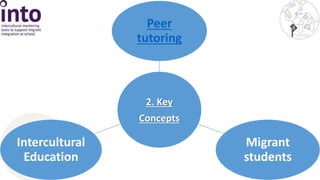
Peer 
tutoring 
2. Key 
Concepts 
Migrant 
students 
Intercultural 
Education
“ a cooperative learning method based on the creation 
of students couples, with an asymmetric 
relationship, with a common aim, known and 
shared (like the teaching and learning process of a 
subject), that takes place through a relationship 
between said students, planned by the teacher” (David 
Durán, 2004).
3. WORK HYPOTHESIS 
• The kind of mentoring programme designed as part of the 
INTO project for migrant students in risk will help to 
improve their integration in the classroom and school 
environment and support a higher participation in their 
formative process, not just inside the school, but in the 
society in general, decreasing early leaving school rates of 
this group and improving their academic performance.
4. VARIABLES (I) 
The most important dependent variables of this research 
will be the following: 
a. Migrant students level of integration in the school and 
in the society. 
b. Early leaving school and absenteeism rates 
c. School performance. 
d. Level of satisfaction with the program.
4. VARIABLES (II) 
The independent variable will be the type of Mentoring 
Programme design within the INTO Project. 
The control variables are the level of implication of the 
mentor students, teachers, the level of motivation of the 
migrant students, generation of migrant (first or second 
generation). Type of school, family socioeconomic status, 
level of family implication…
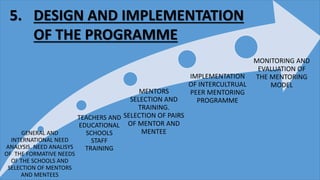
5. DESIGN AND IMPLEMENTATION 
OF THE PROGRAMME 
GENERAL AND 
INTERNATIONAL NEED 
ANALYSIS. NEED ANALISYS 
OF THE FORMATIVE NEEDS 
OF THE SCHOOLS AND 
SELECTION OF MENTORS 
AND MENTEES 
TEACHERS AND 
EDUCATIONAL 
SCHOOLS 
STAFF 
TRAINING 
MENTORS 
SELECTION AND 
TRAINING. 
SELECTION OF PAIRS 
OF MENTOR AND 
MENTEE 
IMPLEMENTATION 
OF INTERCULTRUAL 
PEER MENTORING 
PROGRAMME 
MONITORING AND 
EVALUATION OF 
THE MENTORING 
MODEL
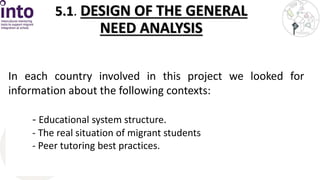
5.1. DESIGN OF THE GENERAL 
NEED ANALYSIS 
In each country involved in this project we looked for 
information about the following contexts: 
- Educational system structure. 
- The real situation of migrant students 
- Peer tutoring best practices.
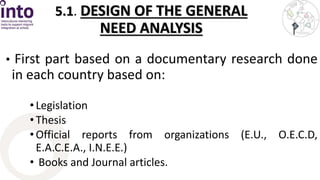
5.1. DESIGN OF THE GENERAL 
NEED ANALYSIS 
• First part based on a documentary research done 
in each country based on: 
• Legislation 
• Thesis 
• Official reports from organizations (E.U., O.E.C.D, 
E.A.C.E.A., I.N.E.E.) 
• Books and Journal articles.
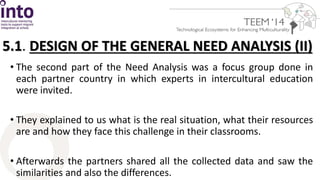
5.1. DESIGN OF THE GENERAL NEED ANALYSIS (II) 
• The second part of the Need Analysis was a focus group done in 
each partner country in which experts in intercultural education 
were invited. 
• They explained to us what is the real situation, what their resources 
are and how they face this challenge in their classrooms. 
• Afterwards the partners shared all the collected data and saw the 
similarities and also the differences.
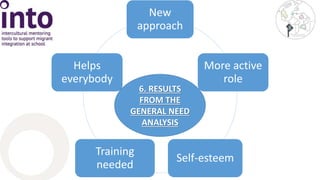
New 
approach 
More active 
role 
6. RESULTS 
FROM THE 
GENERAL NEED 
Self-esteem 
Helps 
everybody 
Training 
needed 
ANALYSIS
6. RESULTS FROM THE GENERAL 
NEED ANALYSIS (VI) 
• Most common themes that emerged from the focus group 
meetings: 
• About Students 
• About Schools 
• About our Model
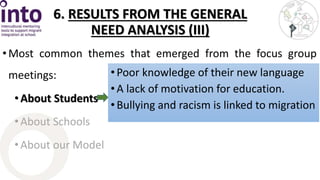
6. RESULTS FROM THE GENERAL 
NEED ANALYSIS (III) 
• Most common themes that emerged from the focus group 
meetings: 
• About Students 
• About Schools 
• About our Model 
• Poor knowledge of their new language 
• A lack of motivation for education. 
• Bullying and racism is linked to migration
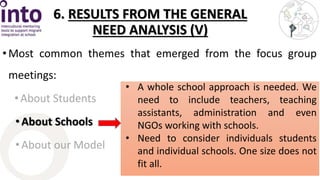
6. RESULTS FROM THE GENERAL 
NEED ANALYSIS (V) 
• Most common themes that emerged from the focus group 
meetings: 
• About Students 
• About Schools 
• About our Model 
• A whole school approach is needed. We 
need to include teachers, teaching 
assistants, administration and even 
NGOs working with schools. 
• Need to consider individuals students 
and individual schools. One size does not 
fit all.
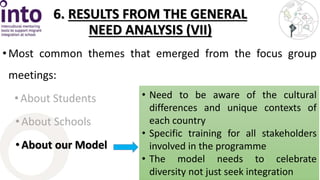
6. RESULTS FROM THE GENERAL 
NEED ANALYSIS (VII) 
• Most common themes that emerged from the focus group 
meetings: 
• About Students 
• About Schools 
• About our Model 
• Need to be aware of the cultural 
differences and unique contexts of 
each country 
• Specific training for all stakeholders 
involved in the programme 
• The model needs to celebrate 
diversity not just seek integration
THANK YOU SO 
MUCH FOR 
YOUR 
ATTENTION 
www.interculturalmentoring.eu

Peer tutoring at school with migrant students: Intercultural Mentoring Program

  • 1.
    Peer tutoring atschool with migrant students: Intercultural Mentoring Programme Paloma No Gutiérrez UNIVERSIDAD DE SALAMANCA Mª José Rodríguez Conde UNIVERSIDAD DE SALAMANCA Valentina Zangrando UNIVERSIDAD DE SALAMANCA Antonio M. Seoane Pardo UNIVERSIDAD DE SALAMANCA Lorenzo Luatti OXFAM
  • 2.
    INDEX 1. FRAMEWORK 2. KEY CONCEPTS 3. WORK HYPOTHESIS 4. VARIABLES 5. DESIGN AND IMPLEMENTATION OF THE PROGRAMME 1. DESIGN OF THE GENERAL NEED ANALYSIS 6. RESULTS OF THE GENERAL NEED ANALYSIS
  • 3.
    1. FRAMEWORK •INTOproject (Intercultural Mentoring tools to support migrant integration at school), a Comenius Multilateral Project, leaded by Oxfam Italia, aims to introduce in the partner countries’ Secondary School context peer tutoring actions which could help migrant students in risk of early leaving school or school failure in order to improve not only their marks but their future opportunities as well.
  • 4.
    Peer tutoring 2.Key Concepts Migrant students Intercultural Education
  • 5.
    “ a cooperativelearning method based on the creation of students couples, with an asymmetric relationship, with a common aim, known and shared (like the teaching and learning process of a subject), that takes place through a relationship between said students, planned by the teacher” (David Durán, 2004).
  • 6.
    3. WORK HYPOTHESIS • The kind of mentoring programme designed as part of the INTO project for migrant students in risk will help to improve their integration in the classroom and school environment and support a higher participation in their formative process, not just inside the school, but in the society in general, decreasing early leaving school rates of this group and improving their academic performance.
  • 7.
    4. VARIABLES (I) The most important dependent variables of this research will be the following: a. Migrant students level of integration in the school and in the society. b. Early leaving school and absenteeism rates c. School performance. d. Level of satisfaction with the program.
  • 8.
    4. VARIABLES (II) The independent variable will be the type of Mentoring Programme design within the INTO Project. The control variables are the level of implication of the mentor students, teachers, the level of motivation of the migrant students, generation of migrant (first or second generation). Type of school, family socioeconomic status, level of family implication…
  • 9.
    5. DESIGN ANDIMPLEMENTATION OF THE PROGRAMME GENERAL AND INTERNATIONAL NEED ANALYSIS. NEED ANALISYS OF THE FORMATIVE NEEDS OF THE SCHOOLS AND SELECTION OF MENTORS AND MENTEES TEACHERS AND EDUCATIONAL SCHOOLS STAFF TRAINING MENTORS SELECTION AND TRAINING. SELECTION OF PAIRS OF MENTOR AND MENTEE IMPLEMENTATION OF INTERCULTRUAL PEER MENTORING PROGRAMME MONITORING AND EVALUATION OF THE MENTORING MODEL
  • 10.
    5.1. DESIGN OFTHE GENERAL NEED ANALYSIS In each country involved in this project we looked for information about the following contexts: - Educational system structure. - The real situation of migrant students - Peer tutoring best practices.
  • 11.
    5.1. DESIGN OFTHE GENERAL NEED ANALYSIS • First part based on a documentary research done in each country based on: • Legislation • Thesis • Official reports from organizations (E.U., O.E.C.D, E.A.C.E.A., I.N.E.E.) • Books and Journal articles.
  • 12.
    5.1. DESIGN OFTHE GENERAL NEED ANALYSIS (II) • The second part of the Need Analysis was a focus group done in each partner country in which experts in intercultural education were invited. • They explained to us what is the real situation, what their resources are and how they face this challenge in their classrooms. • Afterwards the partners shared all the collected data and saw the similarities and also the differences.
  • 13.
    New approach Moreactive role 6. RESULTS FROM THE GENERAL NEED Self-esteem Helps everybody Training needed ANALYSIS
  • 14.
    6. RESULTS FROMTHE GENERAL NEED ANALYSIS (VI) • Most common themes that emerged from the focus group meetings: • About Students • About Schools • About our Model
  • 15.
    6. RESULTS FROMTHE GENERAL NEED ANALYSIS (III) • Most common themes that emerged from the focus group meetings: • About Students • About Schools • About our Model • Poor knowledge of their new language • A lack of motivation for education. • Bullying and racism is linked to migration
  • 16.
    6. RESULTS FROMTHE GENERAL NEED ANALYSIS (V) • Most common themes that emerged from the focus group meetings: • About Students • About Schools • About our Model • A whole school approach is needed. We need to include teachers, teaching assistants, administration and even NGOs working with schools. • Need to consider individuals students and individual schools. One size does not fit all.
  • 17.
    6. RESULTS FROMTHE GENERAL NEED ANALYSIS (VII) • Most common themes that emerged from the focus group meetings: • About Students • About Schools • About our Model • Need to be aware of the cultural differences and unique contexts of each country • Specific training for all stakeholders involved in the programme • The model needs to celebrate diversity not just seek integration
  • 18.
    THANK YOU SO MUCH FOR YOUR ATTENTION www.interculturalmentoring.eu

Editor's Notes

  • #11 O.E.C.D. Organization for Economic Co-operation and Development E.A.C.E.A. Education, Audiovisual and Culture Executive Agency I.N.E.E. Instituto Nacional de Evaluación Educativa
  • #12 O.E.C.D. Organization for Economic Co-operation and Development E.A.C.E.A. Education, Audiovisual and Culture Executive Agency I.N.E.E. Instituto Nacional de Evaluación Educativa