RE-ENGAGE VULNERABLE ADULTS
WITH EUROPE
Addressing learners’ diversity and contact the
labour market .
CEPA El Fontán.Oviedo
Oviedo 8,9 April 2014
1. INTRODUCTION
2. RATIONALE
3. OBJECTIVES
4. CONTEXT
5. METHODOLOGY
6. EVALUATION
7. PROJECT IMPLEMENTATION
INDEX
THE TEAM
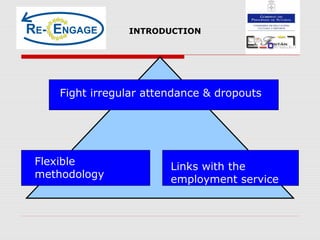
Fight irregular attendance & dropouts
Links with the
employment service
Flexible
methodology
INTRODUCTION
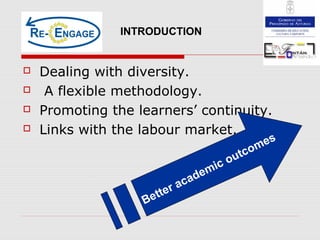
 Dealing with diversity.
 A flexible methodology.
 Promoting the learners’ continuity.
 Links with the labour market.
Better academic outcomes
INTRODUCTION
This experience is open to:
 Adults with an early dropout of
Secondary Education.
 Adults with a poor learning experience.
 Precarious workers with little training
or at risk of exclusion.
 Unemployed or low skilled employees.
INTRODUCTION
These learners meet some or most of the
following criteria:
 They have family or work obligations
that make their attendance very
irregular.
 They had an inadequate schooling or
had a bad school experience.
 They lack specific learning skills.
 They look for an easier way to learn.
INTRODUCTION
We follow our colleague at the CEPA El
Fontán Dr. María Luz Pontón and her
doctoral thesis:
“Adaptive teaching to enhance English
language acquisition in Secondary
Education for Adults”.
RATIONALE
We respond to diversity taking into
account that adults learn…
RATIONALE
At their own pace
In a different way
Following their own cognitive styles
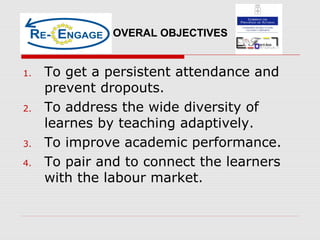
1. To get a persistent attendance and
prevent dropouts.
2. To address the wide diversity of
learnes by teaching adaptively.
3. To improve academic performance.
4. To pair and to connect the learners
with the labour market.
OVERAL OBJECTIVES
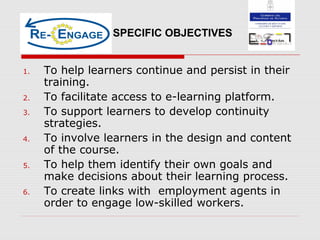
1. To help learners continue and persist in their
training.
2. To facilitate access to e-learning platform.
3. To support learners to develop continuity
strategies.
4. To involve learners in the design and content
of the course.
5. To help them identify their own goals and
make decisions about their learning process.
6. To create links with employment agents in
order to engage low-skilled workers.
SPECIFIC OBJECTIVES
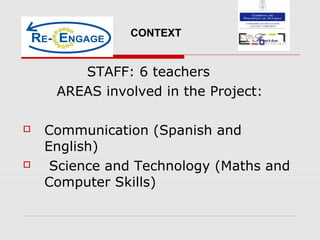
STAFF: 6 teachers
AREAS involved in the Project:
 Communication (Spanish and
English)
 Science and Technology (Maths and
Computer Skills)
CONTEXT
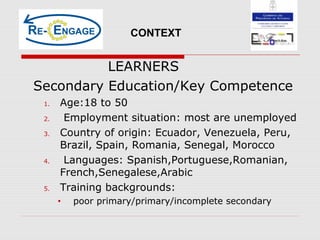
LEARNERS
Secondary Education/Key Competence
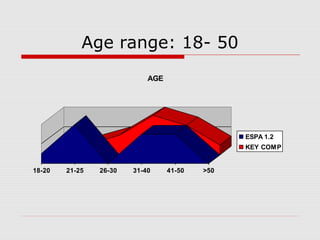
1. Age:18 to 50
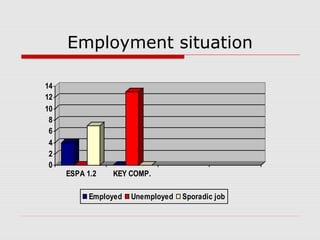
2. Employment situation: most are unemployed
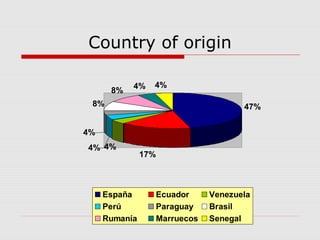
3. Country of origin: Ecuador, Venezuela, Peru,
Brazil, Spain, Romania, Senegal, Morocco
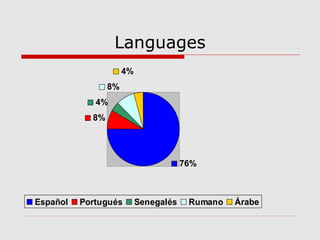
4. Languages: Spanish,Portuguese,Romanian,
French,Senegalese,Arabic
5. Training backgrounds:
• poor primary/primary/incomplete secondary
CONTEXT
Age range: 18- 50
18-20 21-25 26-30 31-40 41-50 >50
AGE
ESPA 1.2
KEY COMP
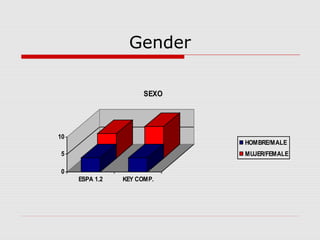
Gender
0
5
10
ESPA 1.2 KEY COMP.
SEXO
HOMBRE/MALE
MUJER/FEMALE
Country of origin
47%
17%
4%4%
4%
8%
8%
4% 4%
España Ecuador Venezuela
Perú Paraguay Brasil
Rumanía Marruecos Senegal
Languages
76%
8%
4%
8%
4%
Español Portugués Senegalés Rumano Árabe
Employment situation
0
2
4
6
8
10
12
14
ESPA 1.2 KEY COMP.
Employed Unemployed Sporadic job
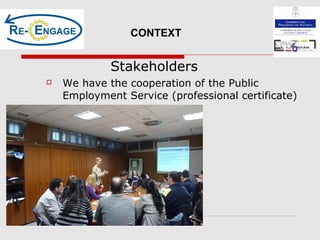
Stakeholders
 We have the cooperation of the Public
Employment Service (professional certificate)
CONTEXT
CONTEXT
Engage learners in cultural events as part of their training.
Resources and support
 We have the support of the directive
team that provides:
 A schedule for the coordination of
teachers involved in the project.
 Availability for carrying out the
activities.
 A shared schedule of three teachers.
 Trainee teachers who help us carry out
the activities.
CONTEXT
Resources and support
 We also have:
 A computer room.
 The E-learning platforms :
http://aulaelfontan.com/course/view.php?
id=20
 http://campus.educastur.es/course/view.php?
id=5754
 The research made by one of the participants, Dr.
Maria Luz Pontón Álvarez for her doctoral thesis.
 Previously prepared materials.
CONTEXT
Difficulties
 The schedule for coordination and
teamwork is quite short.
 Coordination with trainee teachers is
difficult.
 Stay at the centre is limited in time.
 Reluctant to work with adults.
 Timing of the courses.
 We would like to have annual term courses.
CONTEXT
1. Teacher role
2. Student autonomy
3. Personal support
4. High expectations for all
learners
5. Relevant learning
6. Avoiding negative feeling
METHODOLOGY
EVALUATION
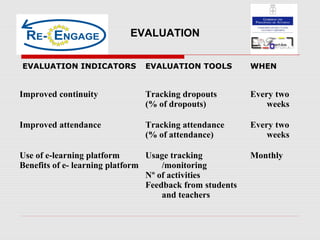
EVALUATION INDICATORS EVALUATION TOOLS WHEN
Improved continuity Tracking dropouts
(% of dropouts)
Every two
weeks
Improved attendance Tracking attendance
(% of attendance)
Every two
weeks
Use of e-learning platform
Benefits of e- learning platform
Usage tracking
/monitoring
Nº of activities
Feedback from students
and teachers
Monthly
EVALUATION
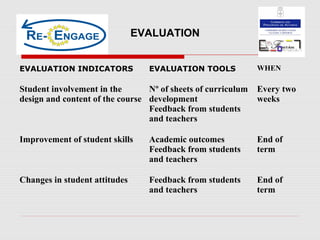
EVALUATION INDICATORS EVALUATION TOOLS WHEN
Student involvement in the
design and content of the course
Nº of sheets of curriculum
development
Feedback from students
and teachers
Every two
weeks
Improvement of student skills Academic outcomes
Feedback from students
and teachers
End of
term
Changes in student attitudes Feedback from students
and teachers
End of
term
EVALUATION
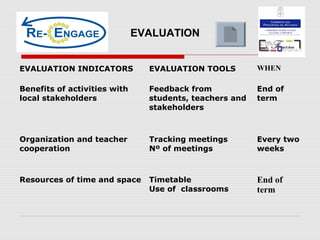
EVALUATION INDICATORS EVALUATION TOOLS WHEN
Benefits of activities with
local stakeholders
Feedback from
students, teachers and
stakeholders
End of
term
Organization and teacher
cooperation
Tracking meetings
Nº of meetings
Every two
weeks
Resources of time and space Timetable
Use of classrooms
End of
term
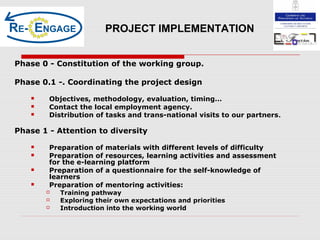
Phase 0 - Constitution of the working group.
Phase 0.1 -. Coordinating the project design
 Objectives, methodology, evaluation, timing…
 Contact the local employment agency.
 Distribution of tasks and trans-national visits to our partners.
Phase 1 - Attention to diversity
 Preparation of materials with different levels of difficulty
 Preparation of resources, learning activities and assessment
for the e-learning platform
 Preparation of a questionnaire for the self-knowledge of
learners
 Preparation of mentoring activities:
 Training pathway
 Exploring their own expectations and priorities
 Introduction into the working world
PROJECT IMPLEMENTATION
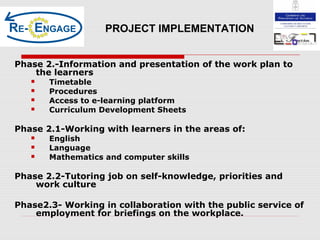
Phase 2.-Information and presentation of the work plan to
the learners
 Timetable
 Procedures
 Access to e-learning platform
 Curriculum Development Sheets
Phase 2.1-Working with learners in the areas of:
 English
 Language
 Mathematics and computer skills
Phase 2.2-Tutoring job on self-knowledge, priorities and
work culture
Phase2.3- Working in collaboration with the public service of
employment for briefings on the workplace.
PROJECT IMPLEMENTATION
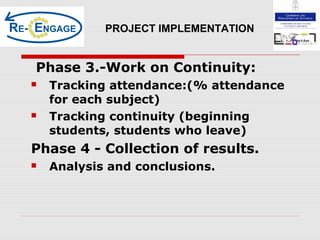
Phase 3.-Work on Continuity:
 Tracking attendance:(% attendance
for each subject)
 Tracking continuity (beginning
students, students who leave)
Phase 4 - Collection of results.
 Analysis and conclusions.
PROJECT IMPLEMENTATION
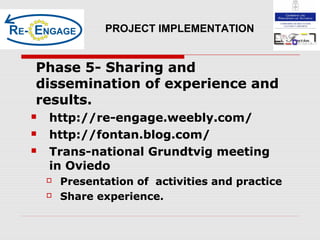
Phase 5- Sharing and
dissemination of experience and
results.
 http://re-engage.weebly.com/
 http://fontan.blog.com/
 Trans-national Grundtvig meeting
in Oviedo
 Presentation of activities and practice
 Share experience
PROJECT IMPLEMENTATION
Phase 5- Sharing and
dissemination of experience and
results.
 http://re-engage.weebly.com/
 http://fontan.blog.com/
 Trans-national Grundtvig meeting
in Oviedo
 Presentation of activities and practice
 Share experience.
Any ?????

Addressing diversity

  • 1.
    RE-ENGAGE VULNERABLE ADULTS WITHEUROPE Addressing learners’ diversity and contact the labour market . CEPA El Fontán.Oviedo Oviedo 8,9 April 2014
  • 2.
    1. INTRODUCTION 2. RATIONALE 3.OBJECTIVES 4. CONTEXT 5. METHODOLOGY 6. EVALUATION 7. PROJECT IMPLEMENTATION INDEX
  • 3.
  • 4.
    Fight irregular attendance& dropouts Links with the employment service Flexible methodology INTRODUCTION
  • 5.
     Dealing withdiversity.  A flexible methodology.  Promoting the learners’ continuity.  Links with the labour market. Better academic outcomes INTRODUCTION
  • 6.
    This experience isopen to:  Adults with an early dropout of Secondary Education.  Adults with a poor learning experience.  Precarious workers with little training or at risk of exclusion.  Unemployed or low skilled employees. INTRODUCTION
  • 7.
    These learners meetsome or most of the following criteria:  They have family or work obligations that make their attendance very irregular.  They had an inadequate schooling or had a bad school experience.  They lack specific learning skills.  They look for an easier way to learn. INTRODUCTION
  • 8.
    We follow ourcolleague at the CEPA El Fontán Dr. María Luz Pontón and her doctoral thesis: “Adaptive teaching to enhance English language acquisition in Secondary Education for Adults”. RATIONALE
  • 9.
    We respond todiversity taking into account that adults learn… RATIONALE At their own pace In a different way Following their own cognitive styles
  • 10.
    1. To geta persistent attendance and prevent dropouts. 2. To address the wide diversity of learnes by teaching adaptively. 3. To improve academic performance. 4. To pair and to connect the learners with the labour market. OVERAL OBJECTIVES
  • 11.
    1. To helplearners continue and persist in their training. 2. To facilitate access to e-learning platform. 3. To support learners to develop continuity strategies. 4. To involve learners in the design and content of the course. 5. To help them identify their own goals and make decisions about their learning process. 6. To create links with employment agents in order to engage low-skilled workers. SPECIFIC OBJECTIVES
  • 12.
    STAFF: 6 teachers AREASinvolved in the Project:  Communication (Spanish and English)  Science and Technology (Maths and Computer Skills) CONTEXT
  • 13.
    LEARNERS Secondary Education/Key Competence 1.Age:18 to 50 2. Employment situation: most are unemployed 3. Country of origin: Ecuador, Venezuela, Peru, Brazil, Spain, Romania, Senegal, Morocco 4. Languages: Spanish,Portuguese,Romanian, French,Senegalese,Arabic 5. Training backgrounds: • poor primary/primary/incomplete secondary CONTEXT
  • 14.
    Age range: 18-50 18-20 21-25 26-30 31-40 41-50 >50 AGE ESPA 1.2 KEY COMP
  • 15.
    Gender 0 5 10 ESPA 1.2 KEYCOMP. SEXO HOMBRE/MALE MUJER/FEMALE
  • 16.
    Country of origin 47% 17% 4%4% 4% 8% 8% 4%4% España Ecuador Venezuela Perú Paraguay Brasil Rumanía Marruecos Senegal
  • 17.
  • 18.
    Employment situation 0 2 4 6 8 10 12 14 ESPA 1.2KEY COMP. Employed Unemployed Sporadic job
  • 19.
    Stakeholders  We havethe cooperation of the Public Employment Service (professional certificate) CONTEXT
  • 20.
    CONTEXT Engage learners incultural events as part of their training.
  • 21.
    Resources and support We have the support of the directive team that provides:  A schedule for the coordination of teachers involved in the project.  Availability for carrying out the activities.  A shared schedule of three teachers.  Trainee teachers who help us carry out the activities. CONTEXT
  • 22.
    Resources and support We also have:  A computer room.  The E-learning platforms : http://aulaelfontan.com/course/view.php? id=20  http://campus.educastur.es/course/view.php? id=5754  The research made by one of the participants, Dr. Maria Luz Pontón Álvarez for her doctoral thesis.  Previously prepared materials. CONTEXT
  • 23.
    Difficulties  The schedulefor coordination and teamwork is quite short.  Coordination with trainee teachers is difficult.  Stay at the centre is limited in time.  Reluctant to work with adults.  Timing of the courses.  We would like to have annual term courses. CONTEXT
  • 24.
    1. Teacher role 2.Student autonomy 3. Personal support 4. High expectations for all learners 5. Relevant learning 6. Avoiding negative feeling METHODOLOGY
  • 25.
    EVALUATION EVALUATION INDICATORS EVALUATIONTOOLS WHEN Improved continuity Tracking dropouts (% of dropouts) Every two weeks Improved attendance Tracking attendance (% of attendance) Every two weeks Use of e-learning platform Benefits of e- learning platform Usage tracking /monitoring Nº of activities Feedback from students and teachers Monthly
  • 26.
    EVALUATION EVALUATION INDICATORS EVALUATIONTOOLS WHEN Student involvement in the design and content of the course Nº of sheets of curriculum development Feedback from students and teachers Every two weeks Improvement of student skills Academic outcomes Feedback from students and teachers End of term Changes in student attitudes Feedback from students and teachers End of term
  • 27.
    EVALUATION EVALUATION INDICATORS EVALUATIONTOOLS WHEN Benefits of activities with local stakeholders Feedback from students, teachers and stakeholders End of term Organization and teacher cooperation Tracking meetings Nº of meetings Every two weeks Resources of time and space Timetable Use of classrooms End of term
  • 28.
    Phase 0 -Constitution of the working group. Phase 0.1 -. Coordinating the project design  Objectives, methodology, evaluation, timing…  Contact the local employment agency.  Distribution of tasks and trans-national visits to our partners. Phase 1 - Attention to diversity  Preparation of materials with different levels of difficulty  Preparation of resources, learning activities and assessment for the e-learning platform  Preparation of a questionnaire for the self-knowledge of learners  Preparation of mentoring activities:  Training pathway  Exploring their own expectations and priorities  Introduction into the working world PROJECT IMPLEMENTATION
  • 29.
    Phase 2.-Information andpresentation of the work plan to the learners  Timetable  Procedures  Access to e-learning platform  Curriculum Development Sheets Phase 2.1-Working with learners in the areas of:  English  Language  Mathematics and computer skills Phase 2.2-Tutoring job on self-knowledge, priorities and work culture Phase2.3- Working in collaboration with the public service of employment for briefings on the workplace. PROJECT IMPLEMENTATION
  • 30.
    Phase 3.-Work onContinuity:  Tracking attendance:(% attendance for each subject)  Tracking continuity (beginning students, students who leave) Phase 4 - Collection of results.  Analysis and conclusions. PROJECT IMPLEMENTATION
  • 31.
    Phase 5- Sharingand dissemination of experience and results.  http://re-engage.weebly.com/  http://fontan.blog.com/  Trans-national Grundtvig meeting in Oviedo  Presentation of activities and practice  Share experience PROJECT IMPLEMENTATION Phase 5- Sharing and dissemination of experience and results.  http://re-engage.weebly.com/  http://fontan.blog.com/  Trans-national Grundtvig meeting in Oviedo  Presentation of activities and practice  Share experience.
  • 32.