A comprehensive approach to investigating the social 
dimension in European higher education systems – 
EUROSTUDENT and the PL4SD Country Reviews 
Future of Higher Education – Bologna Process Researchers’ Conference FOHE-BPRC 
24 – 26 November 2014, National Library, Bucharest, Romania 
Dr. Dominic Orr (orr@dzhw.eu) and Shweta Mishra, PhD (mishra@dzhw.eu) 
DZHW Hannover
The social dimension’s character of uniqueness 
‘participative equity’ 
“the student body entering, participating in and completing higher education 
at all levels [reflects] the diversity of (…) populations” in the European Higher 
Education Area (EHEA) (London communiqué 2007). 
…as implementation policy? 
• “the social dimension is a policy item that found a way into the Bologna 
Process agenda, but could not grow into an implementable policy” (Yagci 
2014) 
• “the [social] dimension’s limited success (and more recent displacement 
from policy, if not rhetoric) can be put down in large part to the difficulties 
of encapsulating complex and contested social priorities in internationally 
acceptable indicators (…).” (Holford 2014) 
Higher education from the social dimension perspective 2
EUROSTUDENT 
PL4SD 
Higher education from the social dimension perspective 3 
Three problems 
• Indicators related to social dimension of higher education call 
for data on students’ (and potential students’) character and 
biography 
• To ensure that higher education students represent the 
diversity in the student population, changes are needed at 
multiple levels – the school system, admission policies, entry 
routes, flexible study structures and provision for student 
support and counselling services; but first you must 
understand how a specific national system “works” (normal 
system plus interventions) 
• Still, it remains difficult to set clear overarching goals, which 
are appropriate for all countries and across topic areas.
Collecting data for the Social Dimension: EUROSTUDENT 
www.eurostudent.eu 
Higher education from the social dimension perspective 4
EUROSTUDENT: data set of student life 
Higher education from the social dimension perspective 5
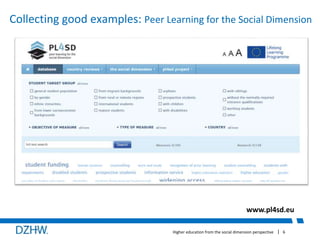
Collecting good examples: Peer Learning for the Social Dimension 
www.pl4sd.eu 
Higher education from the social dimension perspective 6
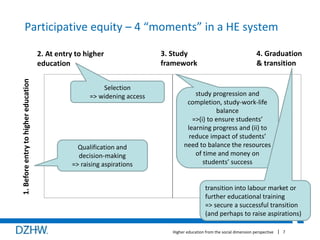
Participative equity – 4 “moments” in a HE system 
=> widening access study progression and 
Higher education from the social dimension perspective 7 
2. At entry to higher 
education 
3. Study 
framework 
4. Graduation 
& transition 
1. Before entry to higher education 
Selection 
Qualification and 
decision-making 
=> raising aspirations 
completion, study-work-life 
balance 
=>(i) to ensure students’ 
learning progress and (ii) to 
reduce impact of students’ 
need to balance the resources 
of time and money on 
students’ success 
transition into labour market or 
further educational training 
=> secure a successful transition 
(and perhaps to raise aspirations)
10 challenges for higher education provision based on policy 
discussions and measures in various countries 
Access Study conditions Successful completion 
Challenges 
Higher education from the social dimension perspective 8 
1. Facilitate participation in 
HE 
2. Facilitate participation in 
the best courses at the 
best colleges / 
universities 
3. Facilitate participation in 
supplementary 
experiences, esp. 
mobility programmes 
4. Support prospective 
students in making the 
‘right’ choices 
5. Flexible provision for variable 
study intensity 
6. Assure the commitment of 
new types of students to their 
programmes 
7. Provide teaching and learning 
according to new pedagogical 
concepts 
8. Provide incentives for colleges 
/ universities to retain 
students and increase 
completion rates 
9. Provide counselling and advice 
during study period 
10. Facilitate the 
transition of 
graduates to the 
labour market
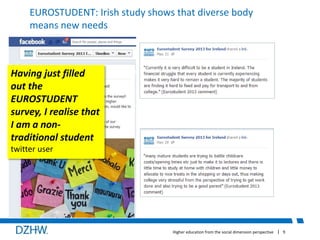
EUROSTUDENT: Irish study shows that diverse body 
means new needs 
Higher education from the social dimension perspective 9 
Having just filled 
out the 
EUROSTUDENT 
survey, I realise that 
I am a non-traditional 
student 
twitter user
Formative evaluations as the basis for peer 
learning (and some summative evaluations) 
Student groups – regular 
and new 
Study framework 
Remedial Differentiation 
Higher education from the social dimension perspective 10 
Students’ abilities and 
characteristics 
Higher education systems 
People 
Processes 
(Photo from Xosé Castro Roig CC BY-NC-ND 2.0)

A comprehensive approach to investigating the social dimension in European higher education systems – EUROSTUDENT and the PL4SD Country Reviews

  • 1.
    A comprehensive approachto investigating the social dimension in European higher education systems – EUROSTUDENT and the PL4SD Country Reviews Future of Higher Education – Bologna Process Researchers’ Conference FOHE-BPRC 24 – 26 November 2014, National Library, Bucharest, Romania Dr. Dominic Orr (orr@dzhw.eu) and Shweta Mishra, PhD (mishra@dzhw.eu) DZHW Hannover
  • 2.
    The social dimension’scharacter of uniqueness ‘participative equity’ “the student body entering, participating in and completing higher education at all levels [reflects] the diversity of (…) populations” in the European Higher Education Area (EHEA) (London communiqué 2007). …as implementation policy? • “the social dimension is a policy item that found a way into the Bologna Process agenda, but could not grow into an implementable policy” (Yagci 2014) • “the [social] dimension’s limited success (and more recent displacement from policy, if not rhetoric) can be put down in large part to the difficulties of encapsulating complex and contested social priorities in internationally acceptable indicators (…).” (Holford 2014) Higher education from the social dimension perspective 2
  • 3.
    EUROSTUDENT PL4SD Highereducation from the social dimension perspective 3 Three problems • Indicators related to social dimension of higher education call for data on students’ (and potential students’) character and biography • To ensure that higher education students represent the diversity in the student population, changes are needed at multiple levels – the school system, admission policies, entry routes, flexible study structures and provision for student support and counselling services; but first you must understand how a specific national system “works” (normal system plus interventions) • Still, it remains difficult to set clear overarching goals, which are appropriate for all countries and across topic areas.
  • 4.
    Collecting data forthe Social Dimension: EUROSTUDENT www.eurostudent.eu Higher education from the social dimension perspective 4
  • 5.
    EUROSTUDENT: data setof student life Higher education from the social dimension perspective 5
  • 6.
    Collecting good examples:Peer Learning for the Social Dimension www.pl4sd.eu Higher education from the social dimension perspective 6
  • 7.
    Participative equity –4 “moments” in a HE system => widening access study progression and Higher education from the social dimension perspective 7 2. At entry to higher education 3. Study framework 4. Graduation & transition 1. Before entry to higher education Selection Qualification and decision-making => raising aspirations completion, study-work-life balance =>(i) to ensure students’ learning progress and (ii) to reduce impact of students’ need to balance the resources of time and money on students’ success transition into labour market or further educational training => secure a successful transition (and perhaps to raise aspirations)
  • 8.
    10 challenges forhigher education provision based on policy discussions and measures in various countries Access Study conditions Successful completion Challenges Higher education from the social dimension perspective 8 1. Facilitate participation in HE 2. Facilitate participation in the best courses at the best colleges / universities 3. Facilitate participation in supplementary experiences, esp. mobility programmes 4. Support prospective students in making the ‘right’ choices 5. Flexible provision for variable study intensity 6. Assure the commitment of new types of students to their programmes 7. Provide teaching and learning according to new pedagogical concepts 8. Provide incentives for colleges / universities to retain students and increase completion rates 9. Provide counselling and advice during study period 10. Facilitate the transition of graduates to the labour market
  • 9.
    EUROSTUDENT: Irish studyshows that diverse body means new needs Higher education from the social dimension perspective 9 Having just filled out the EUROSTUDENT survey, I realise that I am a non-traditional student twitter user
  • 10.
    Formative evaluations asthe basis for peer learning (and some summative evaluations) Student groups – regular and new Study framework Remedial Differentiation Higher education from the social dimension perspective 10 Students’ abilities and characteristics Higher education systems People Processes (Photo from Xosé Castro Roig CC BY-NC-ND 2.0)