





Acute Rheumatic Fever
Presenter : Manya Sachdeva
Definition
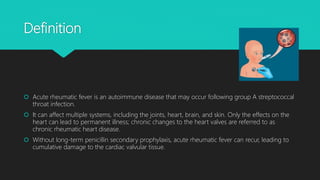
 Acute rheumatic fever is an autoimmune disease that may occur following group A streptococcal
throat infection.
 It can affect multiple systems, including the joints, heart, brain, and skin. Only the effects on the
heart can lead to permanent illness; chronic changes to the heart valves are referred to as
chronic rheumatic heart disease.
 Without long-term penicillin secondary prophylaxis, acute rheumatic fever can recur, leading to
cumulative damage to the cardiac valvular tissue.
Etiology
 Acute rheumatic fever is a systemic disease of childhood,often recurrent that follows group A
beta hemolytic streptococcal infection
 It is a delayed non-suppurative sequelae to URTI with GABH streptococci.
 It is a diffuse inflammatory disease of connective tissue,primarily involving heart,blood
vessels,joints, subcut.tissue and CNS
Epidemiology
 Ages 5-15 yrs. are most susceptible
 Rare <3 yrs.
 Girls > boys
 Common in 3rd world countries
 Environmental factors-- over crowding, poor sanitation, poverty,
 Incidence more during fall ,winter & early spring
Pathogenesis
 Delayed immune response to infection with group.A beta hemolytic streptococci.
 After a latent period of 1-3 weeks, antibody induced immunological damage occur to heart
valves,joints, subcutaneous tissue & basal ganglia of brain.
Causes
Causes
 Rheumatic fever is caused by a bacterium called group A Streptococcus. This bacterium
causes strep throat or, in a small percentage of people, scarlet fever. It’s an
inflammatory disorder.
 Rheumatic fever causes the body to attack its own tissues. This reaction causes
widespread inflammation throughout the body, which is the basis for all symptoms of
rheumatic fever.
Symptoms
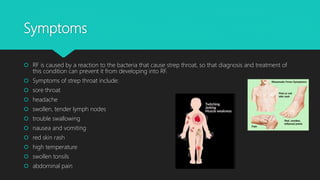
 RF is caused by a reaction to the bacteria that cause strep throat, so that diagnosis and treatment of
this condition can prevent it from developing into RF.
 Symptoms of strep throat include:
 sore throat
 headache
 swollen, tender lymph nodes
 trouble swallowing
 nausea and vomiting
 red skin rash
 high temperature
 swollen tonsils
 abdominal pain
Diagnosis
 The doctor will ask about the patient's symptoms and recent medical history.
They will pay particular attention to any recent illness along with the following:
 swelling, pain, and stiffness in the joints
 any jerky, involuntary movements
 a red or pink skin rash
 small nodules or lumps and bumps under the skin, especially on the elbows,
ankles, knees, and knuckles
 irregular heart rhythm
Prognosis
 Rheumatic fever can recur whenever the individual experience new GABH streptococcal
infection,if not on prophylactic medicines
 Good prognosis for older age group & if no carditis during the initial attack
 Bad prognosis for younger children & those with carditis with valvar lesions
Group A BetAa Hemolytic Streptococcus
 Strains that produces rheumatic fever - M types l, 3, 5, 6,18 & 24
 Pharyngitis- produced by GABHS can lead to- acute rheumatic fever ,
rheumatic heart disease & post strept. Glomerulonepritis
 Skin infection- produced by GABHS leads to post streptococcal glomerulo nephritis only. It will
not result in Rh.Fever or carditis
Clinical Features
 Migratory polyarthritis, involving major joints
 Commonly involved joints-knee,ankle,elbow & wrist
 Occur in 80%,involved joints are exquisitely tender
 In children below 5 yrs arthritis usually mild but carditis more prominent
 Arthritis do not progress to chronic disease
1.Arthritis
 Manifest as pancarditis(endocarditis, myocarditis and pericarditis),occur in 40-50% of cases
 Carditis is the only manifestation of rheumatic fever that leaves a sequelae & permanent damage
to the organ
 Valvulitis occur in acute phase
 Chronic phase- fibrosis,calcification & stenosis of heart valves.
2.Carditis
 Occur in 5-10% of cases
 Mainly in girls of 1-15 yrs age
 May appear even 6 months after the attack of rheumatic fever
 Clinically manifest as-clumsiness, deterioration of handwriting,emotional lability or grimacing of
face
3.Sydenham Chorea
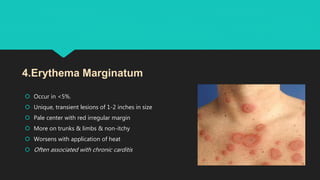
 Occur in <5%.
 Unique, transient lesions of 1-2 inches in size
 Pale center with red irregular margin
 More on trunks & limbs & non-itchy
 Worsens with application of heat
 Often associated with chronic carditis
4.Erythema Marginatum
 Occur in 10%
 Painless,pea-sized,palpable nodules
 Mainly over extensor surfaces of joints,spine,scapulae & scalp
 Associated with strong seropositivity
 Always associated with severe carditis
5.Subcutaneous nodules
 Fever – Low grade
 Arthralgia
 Pallor
 Anorexia
 Loss of weight
Other features (Minor features)
Laboratory Findings
 High ESR
 Anemia, leucocytosis
 Elevated C-reactive protien
 ASO titre >200. (Peak value attained at 3 weeks,then comes
down to normal by 6 weeks)
 Anti-DNAse B test
 Throat culture-GABHstreptococci
 ECG- prolonged PR interval
 Echo - valve edema,mitral regurgitation, LA & LV dilatation,pericardial effusion,decreased
contractility
Diagnosis
 Rheumatic fever is mainly a clinical diagnosis
 No single diagnostic sign or specific laboratory test available for diagnosis
 Diagnosis based on MODIFIED JONES CRITERIA
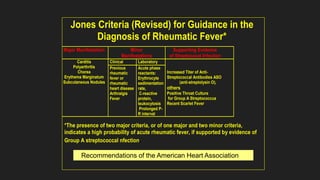
Jones Criteria (Revised) for Guidance in the
Diagnosis of Rheumatic Fever*
Major Manifestation Minor
Manifestations
Supporting Evidence
of Streptococal Infection
Carditis
Polyarthritis
Chorea
Erythema Marginatum
Subcutaneous Nodules
Clinical Laboratory
Increased Titer of Anti-
Streptococcal Antibodies ASO
(anti-streptolysin O),
others
Positive Throat Culture
for Group A Streptococcus
Recent Scarlet Fever
Previous
rheumatic
fever or
rheumatic
heart disease
Arthralgia
Fever
Acute phase
reactants:
Erythrocyte
sedimentation
rate,
C-reactive
protein,
leukocytosis
Prolonged P-
R interval
*The presence of two major criteria, or of one major and two minor criteria,
indicates a high probability of acute rheumatic fever, if supported by evidence of
Group A streptococcal nfection.
Recommendations of the American Heart Association
Treatment
 Treatment aims to destroy the bacteria, relieve symptoms, control inflammation, and prevent recurrences of RF.
 Antibiotics, such as penicillin, may be given to destroy any remaining strep bacteria in the body. Further antibiotics may
be prescribed, to prevent recurrence. This may continue for 5-10 years depending on the age of the person and
whether or not the heart is affected.
 Long-term, and even lifelong, preventive antibiotics may be necessary to prevent recurring inflammation of the heart.
 It is important to remove all traces of streptococcal bacteria, as any remaining bacteria can lead to repeated
occurrences of RF and a significantly higher risk of heart damage, which can become permanent.
 Anti-inflammatory drugs: Naproxen, for example, may help to reduce pain, inflammation, and fever.
 Corticosteroids: Prednisone may be given if the patient does not respond to first-line anti-
inflammatory medications, or if there is inflammation of the heart.
 Aspirin: This is not usually recommended for children aged under 16 years because of the risk of
developing Reye's syndrome, which can cause liver and brain damage, and even death, but an
is usually made in cases of RA because the benefits are greater than the risks.
 Anticonvulsant medications: These can treat severe chorea symptoms. Examples include valproic acid
(Depakene or Stavzor), carbamazepine (Carbatrol or Equetro), haloperidol (Haldol)
and risperidoneTrusted Source (Risperdal).
 Anyone who has RF as a child will need to inform their doctor as they get older because heart damage
can appear many years later.
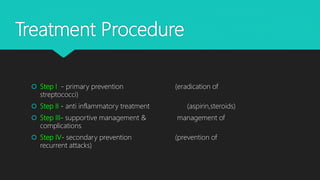
Treatment Procedure
 Step I - primary prevention (eradication of
streptococci)
 Step II - anti inflammatory treatment (aspirin,steroids)
 Step III- supportive management & management of
complications
 Step IV- secondary prevention (prevention of
recurrent attacks)
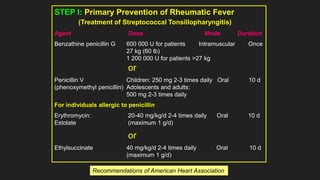
STEP I: Primary Prevention of Rheumatic Fever
(Treatment of Streptococcal Tonsillopharyngitis)
Agent Dose Mode Duration
Benzathine penicillin G 600 000 U for patients Intramuscular Once
27 kg (60 lb)
1 200 000 U for patients >27 kg
or
Penicillin V Children: 250 mg 2-3 times daily Oral 10 d
(phenoxymethyl penicillin) Adolescents and adults:
500 mg 2-3 times daily
For individuals allergic to penicillin
Erythromycin: 20-40 mg/kg/d 2-4 times daily Oral 10 d
Estolate (maximum 1 g/d)
or
Ethylsuccinate 40 mg/kg/d 2-4 times daily Oral 10 d
(maximum 1 g/d)
Recommendations of American Heart Association
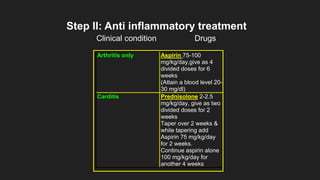
Arthritis only Aspirin 75-100
mg/kg/day,give as 4
divided doses for 6
weeks
(Attain a blood level 20-
30 mg/dl)
Carditis Prednisolone 2-2.5
mg/kg/day, give as two
divided doses for 2
weeks
Taper over 2 weeks &
while tapering add
Aspirin 75 mg/kg/day
for 2 weeks.
Continue aspirin alone
100 mg/kg/day for
another 4 weeks
Step II: Anti inflammatory treatment
Clinical condition Drugs
 Bed rest
 Treatment of congestive cardiac failure: -digitalis,diuretics
 Treatment of chorea: -diazepam or haloperidol
 Rest to joints & supportive splinting
3.Step III: Supportive management &
management of complications
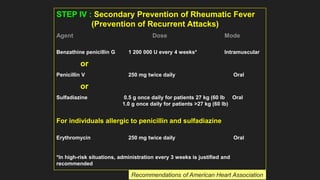
STEP IV : Secondary Prevention of Rheumatic Fever
(Prevention of Recurrent Attacks)
Agent Dose Mode
Benzathine penicillin G 1 200 000 U every 4 weeks* Intramuscular
or
Penicillin V 250 mg twice daily Oral
or
Sulfadiazine 0.5 g once daily for patients 27 kg (60 lb Oral
1.0 g once daily for patients >27 kg (60 lb)
For individuals allergic to penicillin and sulfadiazine
Erythromycin 250 mg twice daily Oral
*In high-risk situations, administration every 3 weeks is justified and
recommended
Recommendations of American Heart Association
Acute Rheumatic Fever

Acute Rheumatic Fever

  • 1.
  • 2.
    Definition  Acute rheumaticfever is an autoimmune disease that may occur following group A streptococcal throat infection.  It can affect multiple systems, including the joints, heart, brain, and skin. Only the effects on the heart can lead to permanent illness; chronic changes to the heart valves are referred to as chronic rheumatic heart disease.  Without long-term penicillin secondary prophylaxis, acute rheumatic fever can recur, leading to cumulative damage to the cardiac valvular tissue.
  • 3.
    Etiology  Acute rheumaticfever is a systemic disease of childhood,often recurrent that follows group A beta hemolytic streptococcal infection  It is a delayed non-suppurative sequelae to URTI with GABH streptococci.  It is a diffuse inflammatory disease of connective tissue,primarily involving heart,blood vessels,joints, subcut.tissue and CNS
  • 4.
    Epidemiology  Ages 5-15yrs. are most susceptible  Rare <3 yrs.  Girls > boys  Common in 3rd world countries  Environmental factors-- over crowding, poor sanitation, poverty,  Incidence more during fall ,winter & early spring
  • 5.
    Pathogenesis  Delayed immuneresponse to infection with group.A beta hemolytic streptococci.  After a latent period of 1-3 weeks, antibody induced immunological damage occur to heart valves,joints, subcutaneous tissue & basal ganglia of brain. Causes
  • 6.
    Causes  Rheumatic feveris caused by a bacterium called group A Streptococcus. This bacterium causes strep throat or, in a small percentage of people, scarlet fever. It’s an inflammatory disorder.  Rheumatic fever causes the body to attack its own tissues. This reaction causes widespread inflammation throughout the body, which is the basis for all symptoms of rheumatic fever.
  • 7.
    Symptoms  RF iscaused by a reaction to the bacteria that cause strep throat, so that diagnosis and treatment of this condition can prevent it from developing into RF.  Symptoms of strep throat include:  sore throat  headache  swollen, tender lymph nodes  trouble swallowing  nausea and vomiting  red skin rash  high temperature  swollen tonsils  abdominal pain
  • 8.
    Diagnosis  The doctorwill ask about the patient's symptoms and recent medical history. They will pay particular attention to any recent illness along with the following:  swelling, pain, and stiffness in the joints  any jerky, involuntary movements  a red or pink skin rash  small nodules or lumps and bumps under the skin, especially on the elbows, ankles, knees, and knuckles  irregular heart rhythm
  • 9.
    Prognosis  Rheumatic fevercan recur whenever the individual experience new GABH streptococcal infection,if not on prophylactic medicines  Good prognosis for older age group & if no carditis during the initial attack  Bad prognosis for younger children & those with carditis with valvar lesions
  • 10.
    Group A BetAaHemolytic Streptococcus  Strains that produces rheumatic fever - M types l, 3, 5, 6,18 & 24  Pharyngitis- produced by GABHS can lead to- acute rheumatic fever , rheumatic heart disease & post strept. Glomerulonepritis  Skin infection- produced by GABHS leads to post streptococcal glomerulo nephritis only. It will not result in Rh.Fever or carditis
  • 11.
    Clinical Features  Migratorypolyarthritis, involving major joints  Commonly involved joints-knee,ankle,elbow & wrist  Occur in 80%,involved joints are exquisitely tender  In children below 5 yrs arthritis usually mild but carditis more prominent  Arthritis do not progress to chronic disease 1.Arthritis
  • 12.
     Manifest aspancarditis(endocarditis, myocarditis and pericarditis),occur in 40-50% of cases  Carditis is the only manifestation of rheumatic fever that leaves a sequelae & permanent damage to the organ  Valvulitis occur in acute phase  Chronic phase- fibrosis,calcification & stenosis of heart valves. 2.Carditis
  • 13.
     Occur in5-10% of cases  Mainly in girls of 1-15 yrs age  May appear even 6 months after the attack of rheumatic fever  Clinically manifest as-clumsiness, deterioration of handwriting,emotional lability or grimacing of face 3.Sydenham Chorea
  • 14.
     Occur in<5%.  Unique, transient lesions of 1-2 inches in size  Pale center with red irregular margin  More on trunks & limbs & non-itchy  Worsens with application of heat  Often associated with chronic carditis 4.Erythema Marginatum
  • 15.
     Occur in10%  Painless,pea-sized,palpable nodules  Mainly over extensor surfaces of joints,spine,scapulae & scalp  Associated with strong seropositivity  Always associated with severe carditis 5.Subcutaneous nodules
  • 16.
     Fever –Low grade  Arthralgia  Pallor  Anorexia  Loss of weight Other features (Minor features)
  • 17.
    Laboratory Findings  HighESR  Anemia, leucocytosis  Elevated C-reactive protien  ASO titre >200. (Peak value attained at 3 weeks,then comes down to normal by 6 weeks)  Anti-DNAse B test  Throat culture-GABHstreptococci  ECG- prolonged PR interval  Echo - valve edema,mitral regurgitation, LA & LV dilatation,pericardial effusion,decreased contractility
  • 18.
    Diagnosis  Rheumatic feveris mainly a clinical diagnosis  No single diagnostic sign or specific laboratory test available for diagnosis  Diagnosis based on MODIFIED JONES CRITERIA
  • 19.
    Jones Criteria (Revised)for Guidance in the Diagnosis of Rheumatic Fever* Major Manifestation Minor Manifestations Supporting Evidence of Streptococal Infection Carditis Polyarthritis Chorea Erythema Marginatum Subcutaneous Nodules Clinical Laboratory Increased Titer of Anti- Streptococcal Antibodies ASO (anti-streptolysin O), others Positive Throat Culture for Group A Streptococcus Recent Scarlet Fever Previous rheumatic fever or rheumatic heart disease Arthralgia Fever Acute phase reactants: Erythrocyte sedimentation rate, C-reactive protein, leukocytosis Prolonged P- R interval *The presence of two major criteria, or of one major and two minor criteria, indicates a high probability of acute rheumatic fever, if supported by evidence of Group A streptococcal nfection. Recommendations of the American Heart Association
  • 20.
    Treatment  Treatment aimsto destroy the bacteria, relieve symptoms, control inflammation, and prevent recurrences of RF.  Antibiotics, such as penicillin, may be given to destroy any remaining strep bacteria in the body. Further antibiotics may be prescribed, to prevent recurrence. This may continue for 5-10 years depending on the age of the person and whether or not the heart is affected.  Long-term, and even lifelong, preventive antibiotics may be necessary to prevent recurring inflammation of the heart.  It is important to remove all traces of streptococcal bacteria, as any remaining bacteria can lead to repeated occurrences of RF and a significantly higher risk of heart damage, which can become permanent.
  • 21.
     Anti-inflammatory drugs:Naproxen, for example, may help to reduce pain, inflammation, and fever.  Corticosteroids: Prednisone may be given if the patient does not respond to first-line anti- inflammatory medications, or if there is inflammation of the heart.  Aspirin: This is not usually recommended for children aged under 16 years because of the risk of developing Reye's syndrome, which can cause liver and brain damage, and even death, but an is usually made in cases of RA because the benefits are greater than the risks.  Anticonvulsant medications: These can treat severe chorea symptoms. Examples include valproic acid (Depakene or Stavzor), carbamazepine (Carbatrol or Equetro), haloperidol (Haldol) and risperidoneTrusted Source (Risperdal).  Anyone who has RF as a child will need to inform their doctor as they get older because heart damage can appear many years later.
  • 22.
    Treatment Procedure  StepI - primary prevention (eradication of streptococci)  Step II - anti inflammatory treatment (aspirin,steroids)  Step III- supportive management & management of complications  Step IV- secondary prevention (prevention of recurrent attacks)
  • 23.
    STEP I: PrimaryPrevention of Rheumatic Fever (Treatment of Streptococcal Tonsillopharyngitis) Agent Dose Mode Duration Benzathine penicillin G 600 000 U for patients Intramuscular Once 27 kg (60 lb) 1 200 000 U for patients >27 kg or Penicillin V Children: 250 mg 2-3 times daily Oral 10 d (phenoxymethyl penicillin) Adolescents and adults: 500 mg 2-3 times daily For individuals allergic to penicillin Erythromycin: 20-40 mg/kg/d 2-4 times daily Oral 10 d Estolate (maximum 1 g/d) or Ethylsuccinate 40 mg/kg/d 2-4 times daily Oral 10 d (maximum 1 g/d) Recommendations of American Heart Association
  • 24.
    Arthritis only Aspirin75-100 mg/kg/day,give as 4 divided doses for 6 weeks (Attain a blood level 20- 30 mg/dl) Carditis Prednisolone 2-2.5 mg/kg/day, give as two divided doses for 2 weeks Taper over 2 weeks & while tapering add Aspirin 75 mg/kg/day for 2 weeks. Continue aspirin alone 100 mg/kg/day for another 4 weeks Step II: Anti inflammatory treatment Clinical condition Drugs
  • 25.
     Bed rest Treatment of congestive cardiac failure: -digitalis,diuretics  Treatment of chorea: -diazepam or haloperidol  Rest to joints & supportive splinting 3.Step III: Supportive management & management of complications
  • 26.
    STEP IV :Secondary Prevention of Rheumatic Fever (Prevention of Recurrent Attacks) Agent Dose Mode Benzathine penicillin G 1 200 000 U every 4 weeks* Intramuscular or Penicillin V 250 mg twice daily Oral or Sulfadiazine 0.5 g once daily for patients 27 kg (60 lb Oral 1.0 g once daily for patients >27 kg (60 lb) For individuals allergic to penicillin and sulfadiazine Erythromycin 250 mg twice daily Oral *In high-risk situations, administration every 3 weeks is justified and recommended Recommendations of American Heart Association