A Cognitive Era education –
GO BEYOND SCHOOL
thoughts of a parent
Paula Cassin
MY KIDS.
47% of current
highly skilled jobs
at risk of
replacement
Carl Benedikt Frey and Michael A. Osborne, September 17, 2013
Oxford Martin Programme on the Impacts of Future Technology
Do well in school,
get a college degree
…and you’ll succeed?
“I was an educated idiot.”
TERI P MOORE, The Secular Homeschooler – A Guide For Helping Kids Build Competence,
Independence And Ethics Outside Of A School Environment
McKinsey Global Institute
May 2015 Fortune article by Dobbs, Manyika, Woetzel
0
10
20
30
40
50
60
70
80
90
100
skilled labor shortage unskilled worker surplus
Millions
Shortage of skilled labor,
surplus of workers
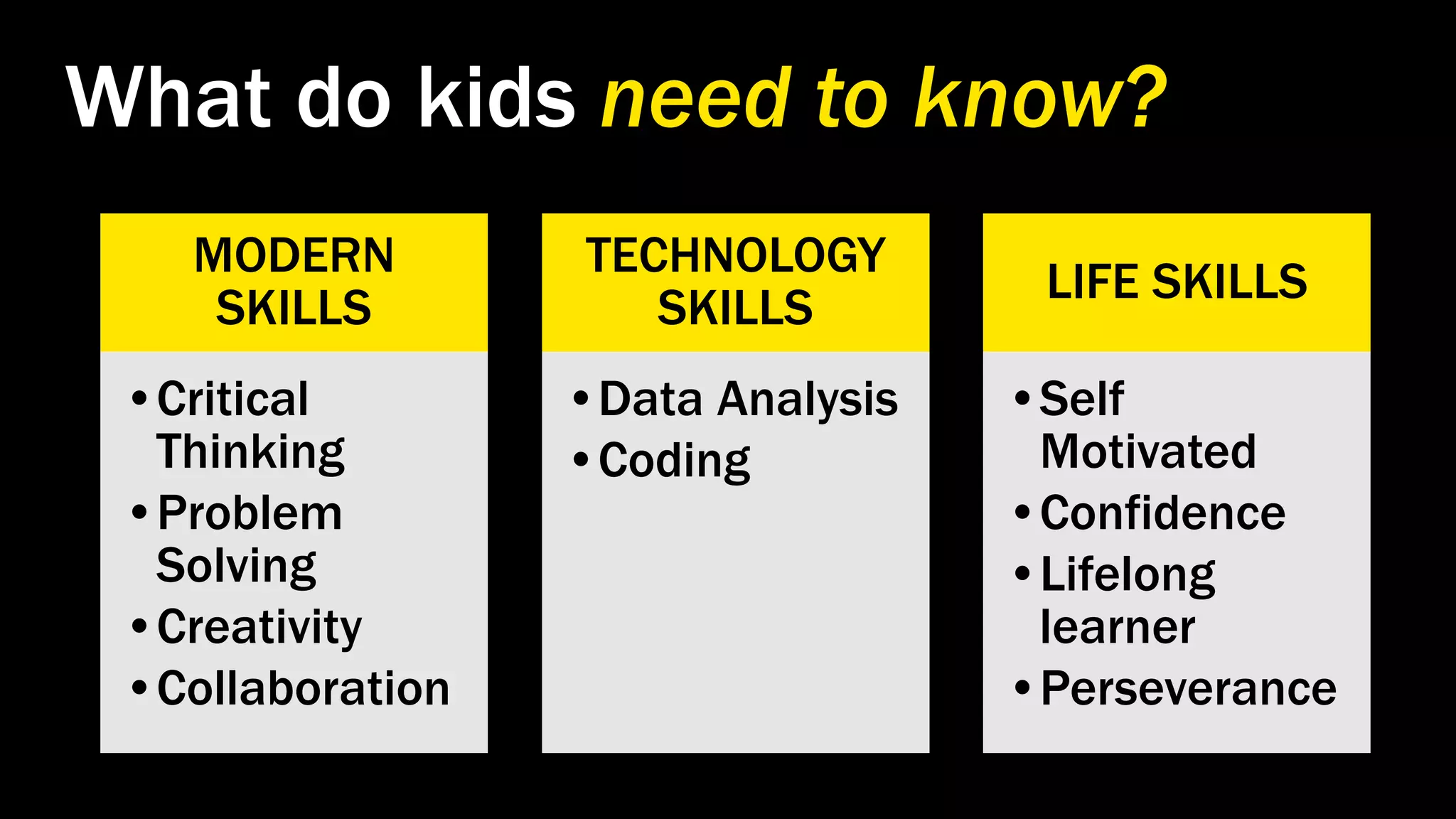
What do kids need to know?
MODERN
SKILLS
•Critical
Thinking
•Problem
Solving
•Creativity
•Collaboration
TECHNOLOGY
SKILLS
•Data Analysis
•Coding
LIFE SKILLS
•Self
Motivated
•Confidence
•Lifelong
learner
•Perseverance
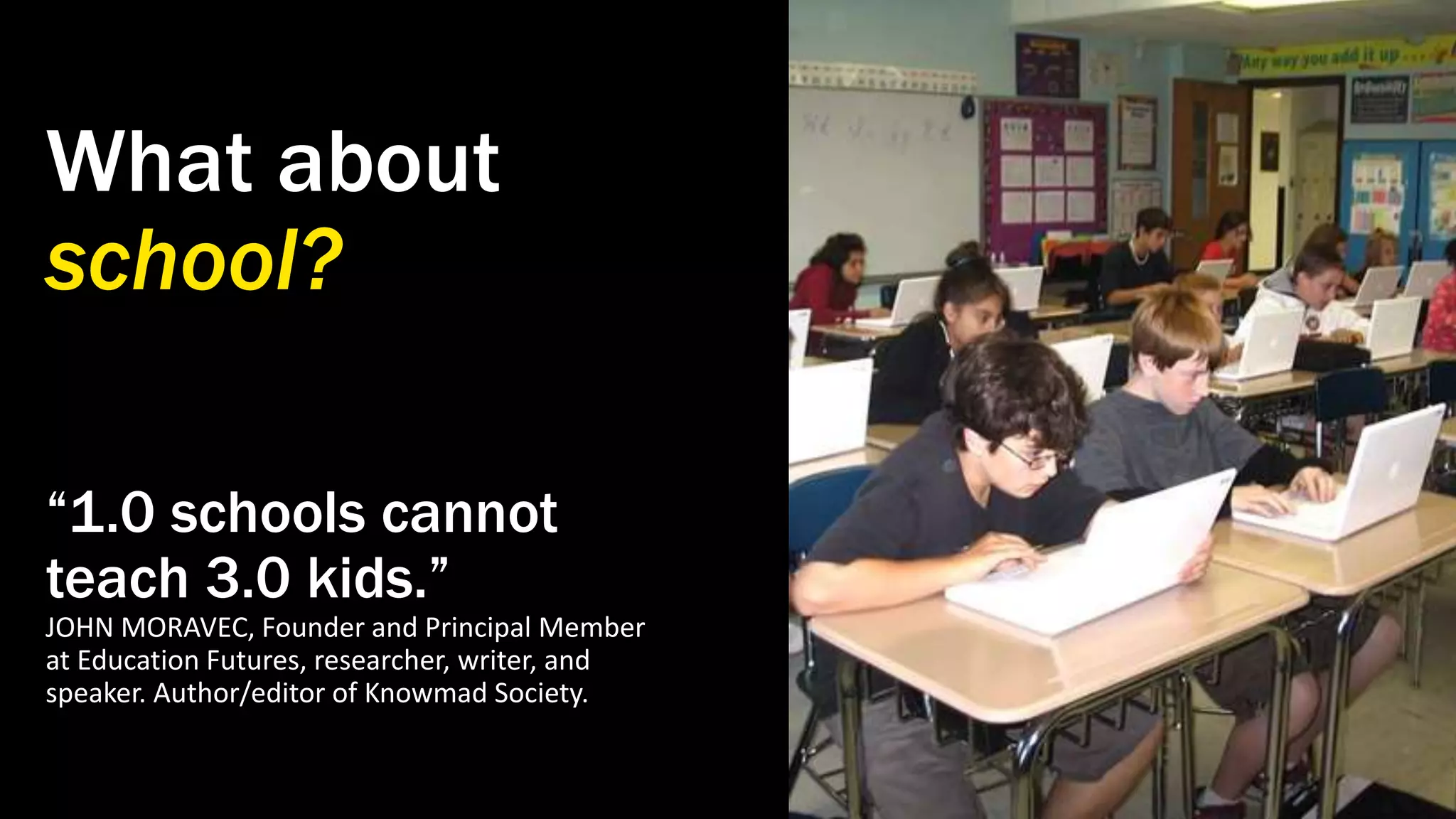
What about
school?
“1.0 schools cannot
teach 3.0 kids.”
JOHN MORAVEC, Founder and Principal Member
at Education Futures, researcher, writer, and
speaker. Author/editor of Knowmad Society.
“Can you imagine if someone
told Einstein, ‘Okay, wrap up this
relativity thing, we’re moving on
to European history?’”
― Salman Khan, The One World Schoolhouse: Education Reimagined
14% SAY STUDENTS ARE PREPARED FOR COLLEGE
(28% IN 2004)
29% SAY STUDENTS ARE PREPARED FOR CAREER
(49% IN 2004)
You cannot
depend on
schools to teach
your kids what
they need to
know.
Modern Skills
Life Skills
Technology
Skills
THE GOOD NEWS IS…
THE SAME WORLD MAKING
HUMANS LESS VALUABLE
GIVES US ACCESS TO
SOLUTIONS.
Ask yourself:
what does your child need most
right now?
What experience can
you bring to help
him/her address it?
Drink from the firehose.
Project-based
learning
Afterschool
activities
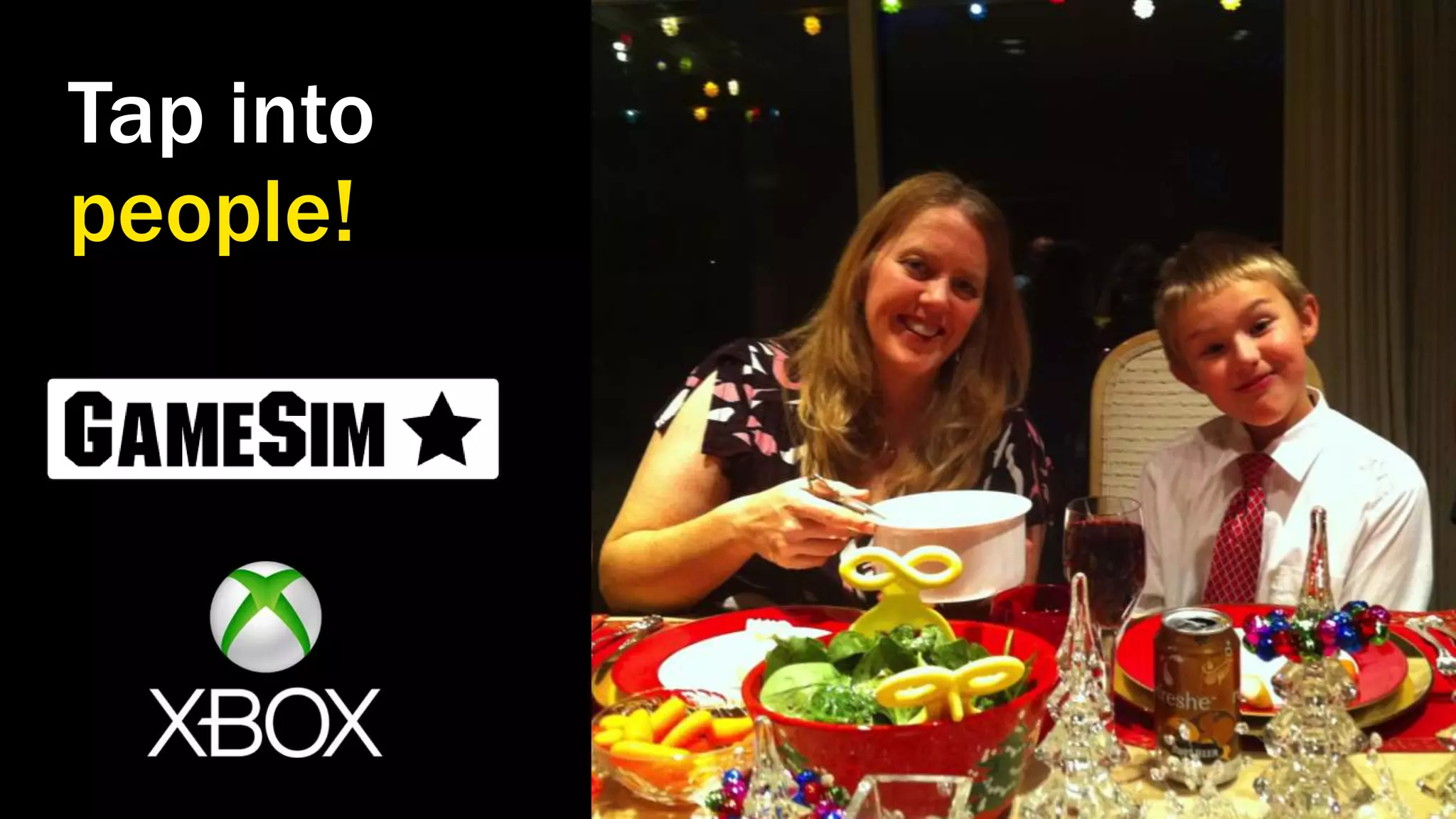
Tap into
people!
Encourage your teachers & school
Create new schools
WHAT
WILL
YOU
DO?

Pecha Kucha - Cognitive Computing Era Education - Think beyond school

  • 1.
    A Cognitive Eraeducation – GO BEYOND SCHOOL thoughts of a parent Paula Cassin
  • 3.
  • 4.
    47% of current highlyskilled jobs at risk of replacement Carl Benedikt Frey and Michael A. Osborne, September 17, 2013 Oxford Martin Programme on the Impacts of Future Technology
  • 5.
    Do well inschool, get a college degree …and you’ll succeed? “I was an educated idiot.” TERI P MOORE, The Secular Homeschooler – A Guide For Helping Kids Build Competence, Independence And Ethics Outside Of A School Environment
  • 6.
    McKinsey Global Institute May2015 Fortune article by Dobbs, Manyika, Woetzel 0 10 20 30 40 50 60 70 80 90 100 skilled labor shortage unskilled worker surplus Millions Shortage of skilled labor, surplus of workers
  • 7.
    What do kidsneed to know? MODERN SKILLS •Critical Thinking •Problem Solving •Creativity •Collaboration TECHNOLOGY SKILLS •Data Analysis •Coding LIFE SKILLS •Self Motivated •Confidence •Lifelong learner •Perseverance
  • 8.
    What about school? “1.0 schoolscannot teach 3.0 kids.” JOHN MORAVEC, Founder and Principal Member at Education Futures, researcher, writer, and speaker. Author/editor of Knowmad Society.
  • 9.
    “Can you imagineif someone told Einstein, ‘Okay, wrap up this relativity thing, we’re moving on to European history?’” ― Salman Khan, The One World Schoolhouse: Education Reimagined
  • 10.
    14% SAY STUDENTSARE PREPARED FOR COLLEGE (28% IN 2004) 29% SAY STUDENTS ARE PREPARED FOR CAREER (49% IN 2004)
  • 11.
    You cannot depend on schoolsto teach your kids what they need to know. Modern Skills Life Skills Technology Skills
  • 12.
    THE GOOD NEWSIS… THE SAME WORLD MAKING HUMANS LESS VALUABLE GIVES US ACCESS TO SOLUTIONS.
  • 13.
    Ask yourself: what doesyour child need most right now? What experience can you bring to help him/her address it?
  • 14.
    Drink from thefirehose.
  • 15.
  • 16.
  • 17.
  • 18.
  • 19.
  • 20.

Editor's Notes

  • #3 3 months ago at a work conference, I heard Pavan Arora, Director of Content at IBM WATSON spend an hour describing the cognitive computing era we’re entering, knowledge as a commodity, and the amazing ways technology is going to change the world – helping cancer researchers find DNA markers in days/months, rather than years, for example. As example upon example stacked up, it became clear to me that there’s going to be an even bigger divide between low skilled, high substitute jobs (think retail), and highly paid, high skilled jobs. https://www.flickr.com/photos/55814174@N02/8264210151
  • #4 My next thought was what about my kids? My job as a parent is to help them develop skills and qualities that will contribute to a happy, productive life. And I don’t think getting good grades and going to college is enough, especially in light of cognitive computing. So this talk is about what I see as the problem, the future skills needed, and how to provide kids chances to acquire them.
  • #5 I started doing a lot of research online, in books etc. and found some decent data, forecasting that yes, some high skilled jobs are at risk of computerization, which is rather new – technology replaced human labor in the 1800s and 1900,s and we all moved off the farm into other jobs, middle skilled jobs have been reduced by automation and outsourcing, and now what we call highly skilled jobs will change as well. THE FUTURE OF EMPLOYMENT: HOW SUSCEPTIBLE ARE JOBS TO COMPUTERISATION?∗ Carl Benedikt Frey† and Michael A. Osborne‡ September 17, 2013 Oxford Martin Programme on the Impacts of Future Technology http://www.futuretech.ox.ac.uk/sites/futuretech.ox.ac.uk/files/The_Future_of_Employment_OMS_Working_Paper_1.pdf
  • #6 While the average salary of a college grad is higher than those who DON’T go to college, do you really think a degree is the best recipe for success as a grown up? My friend Teri put it this way after she graduated with multiple degrees, the ability to do GREAT in school and at university, but with little practice applying knowledge in the real world. College is just a starting point now, costs a lot and is losing value as a signal of one’s capabilities.
  • #7 Mckinsey says that by 2020, there will be a shortage of 45 million skilled workers -even though many highly skilled jobs will be computerized, we’re still missing people with skills that organizations need. I think I’d like to have my kids perhaps look at these missing skills, and make sure they have them! Why not be at the high end of value rather than the low end? Companies facing SHORTAGE of people they need. Skills that aren’t taught.
  • #8 There are heaps of studies/conclusions about the skills needed and this is my take on what it boils down to: data analysis – being able to access, assess and implement knowledge on demand, rather than memorizing facts, is the way we’ll tap into big data and solve problems. Problem solving, coming up with new ideas, being self directed, working with others in collaborative environments. All of these are pretty key to the future of work.
  • #9 So when you think of school, do you think of these skills at all? Data Analysis, being self directed, solving problems? Knowledge used to be locked up in textbooks and teachers heads, and had to be transferred to kids, but now you can find the answer to a question or look up a fact in a minute or two online. https://www.flickr.com/photos/rpstanton/3382665453 Flickr “We’re operating on a 200- year-old paradigm in a world that needs an entirely different skill set.”  Madeline Levine, author of Teach Your Children Well The education system still focuses on teaching facts, doing what you’re told, regurgitating facts on tests – to show how much you’ve managed to stuff into your brain. Computers are better at this than us, and they’re doing it for us right now! “The jobs are there, but kids applying for jobs don’t have the kinds of skills they need.”
  • #10 At his recent talk here in town, Sal Kahn of the Khan Academy, pointed out that classes by age/grade, everyone forced to learn at the same pace, teachers telling everyone what to do when – none of this actually helps learning and we don’t need it any more, not in an age where knowledge isn’t locked up in teachers heads, or in books but is easily available.
  • #11 And if that’s too anecdotal and vague, there is some decent research saying K-12 isn’t working as well as it used to -surveys of college professors and surveys of employers say fewer students/grades have the skills needed – and Guess which are on the list? Critical thinking, written communications, work habits, problem solving and research (which touches on data))
  • #12 I’m not planning to depend on school to develop the skills and learning that my kids need. And I wouldn’t think you’d want to either. What kids need to learn, as well as how and when they learn, needs an overhaul. And what’s coming out of Washington is really efforts to improve performance of the existing curriculum, rather than question what the point of school is.
  • #13 The GOOD NEWS, is that this amazing age we’re in that’s generated this skills gap, also has given us pretty much free access to solutions to the problem. As Pavan from IBM Watson described several months ago, knowledge is no longer scarce and difficult to access; in fact, it’s growing at a massive rate – I’ve gone out and found dozens of amazing people who’ve thought about this very issue way more than me, and can leverage their experience and ideas, and build on them. So here are my ideas for you as to what to do.
  • #14 I think you’ll want to assess each child individually - what traits, habits, academic achievements, interests do they have that you want to encourage, and what skills do you want them to start developing? Have they worked out what they’re interested in? I have one daughter who’s a people pleaser, and I see my job as helping her know what SHE wants, and develop internal motivation, not just make her teachers happy or me happy. This was me as a kid by the way. But my other daughter DEFINITELY knows her own mind, and needs more chances to work with others, develop empathy, see other’s points of view.
  • #15 Once you know what it would be good for your child to learn or experience, just start looking for groups, activities, books, videos, etc. This is one of my favorite books for thinking about learning, which I found by accident on a random forum. There are fantastic Ted talks on modern education, and a kids channel too that can inspire. 20 mins of kahn academy, a tinker crate project every month, etc.
  • #16 Project Based learning is a great way to develop collaboration, creativity, communication, even critical thinking skills. We’re building R2D2, Bronze, build a lemon launcher… After delving into this now for many months, I think project based learning is something fantastic for teaching some of these modern skills, having fun, and learning without it being a slog. This photo is from the makersfaire in San Mateo two years ago – Clara my daughter fell in love with R2D2, and we are now starting to build a full size R2D2 – there’s no kit; but there are a heap of passionate people sharing information and selling some of the parts. And you could enter your family or friends as a team at the Goleta Lemon Festival and build a lemon launcher! We also do Girl Scouts and the Bronze, Silver, Gold Awards are great for project based learning. WAYFINDING ACADEMY. http://www.wayfindingacademy.org/#reimagine-higher-education http://www.discoverpraxis.com/ Spend a year working at a company…
  • #17 PICK DELIBERATELY, or create them! PILOTS. I suggest you pick afterschool activities based on what you want your kids to learn – my older son is an introvert, I couldn’t get him interested in Boy Scouts, but I found this great teen leadership program at the YMCA called PILOTS where they get the group to choose and organize community projects, and do a lot of fun team building – he ran for president, got tons of significance from it, and is getting tons of experience actually communicating and collaborating. You can also create activities yourself – I’ve been helping Caroline a friend of mine set up a Girls Who Code club afterschool at Goleta Valley Jr High – she researched options, pitched it to a principal who was very happy to see it happen, and there’s now 25 girls coding every Monday after school.
  • #18 My son know he loves coding wants to be a programmer – my sister in Seattle knows people at Xbox. So this summer I’ll send Caleb up there to spend a week with her, go visit Xbox, shadow her friend – and find out what it’s like to work there – get a glimpse into what it really is. He’s so excited.
  • #19 Look for signs of these modern skills in your schools, encourage them support them, and talk to teachers about Ken Robinson’s take on creativity, Will Richardson’s take on what we should be teaching, or project based learning. If you’re in a private school, check and see if they’re just doing old school with higher standards and better technology? Or are they adopting project based learning, are they starting to see teachers as facilitators, do they know what self organized learning entities are…for example. If you’re in a public school, find out how much influence students have on projects they work on, what kind of group work is going on, I think many teachers want to see more change, but are stopped by the current system. These are some of my favorite resources right now – project based learning, and ideas on how what, when and how we teach needs to be changing.
  • #20 There are many schools popping up, mainly private and charter, who DO see the need to develop these future skills and take advantage of our knowledge age in school – these are three – a fantastic teacher friend of mine and I are working to visit them soon and evaluate whether we can start a new school here in town or influence an existing school to change.
  • #21 While schools are starting to change, it won’t happen fast enough for my kids, so I’m taking action to ensure they AND I HOPE, many OTHER STUDENTS, end up ready for the future of work and with the tools they need for success and satisfying lives. These are just my ideas – what are yours? You AND your kids will accomplish more if you start now. Don’t wait for schools to change – hack your own learning.