Subject :
tools methods approaches of
pedagogy
Topic :IDEALISM
Presented By :
Devaraju B.N.
First B.Ed.
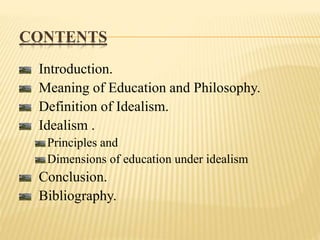
CONTENTS
Introduction.
Meaning of Education and Philosophy.
Definition of Idealism.
Idealism .
Principles and
Dimensions of education under idealism
Conclusion.
Bibliography.
INTRODUCTION :
Human life is a great creation of god. It has 2
aspects one is biological and second is
sociological .
Education is not only required to teach the
specific students in a specific place in a specific
time it is required for over all development of an
individual.
MEANING OF EDUCATION AND PHILOSOPHY
Education word derived from 4 Latin words
 Educare to bring up
 Educere to lead out
 Educatum to train up
 Educo to continue or co-operate
Philosophy derived from Greek words philo and
sophiyo. Philo means love and sophiyo means
wisdom or knowledge therefore philosophy means
love of knowledge or love of wisdom.
Definition of Idealism.
According to HORNE,
“An idealistic philosophy of education is an
account of man finding himself as a integral part
of universe of mind.
IDEALISM
Educational philosophy have expressed different
views about various activities of education like
curriculum, methodology,aims of education, freedom,
discipline, teacher etc.
All the opinion are broadly classified into 3
categories.
 Idealism .
 Naturalism.
 Pragmatism.
Ploto, Gandhiji, Hegal, Tagore, Kapila are believed
in idealism.
PRINCIPLES
 Spiritual world is more important than material
world
 God is the main source of knowledge and
creation.
 Only two values moral and spiritual values.
 Values are eternal , absolute and unchangeable.
DIMENSIONS OF EDUCATION UNDER IDEALISM
Aims of education
 Self –realization and personality enhancement.
 Prepare for holy life.
 Spiritual and moral development.
 Universal education for universe individual.
Curriculum
Idealism stress on values like truth , goodness and
beauty they determine the intelligence , vibrant and aesthetic.
 Priority for study of humanity.
 Attention to religion and ethics.
Methodology
There is no specific method for teaching but Socrates
used question and answering methods, Aristotle used inductive
and deductive method. It is depends on the capacity and learning
abilities of the students.
Teacher
 Teacher must have a ideal personality
 Idealism consider the teacher should be act as a facilitator , friend,
philosopher and guide and parent.
Disciline
 It believe the inner discipline
 Freedom and follow of rules and regulations.
CONCLUSION :
Present world is full of stress, strains,
conflicts, materials therefore idealistic education
essential for peaceful living of human
begins.Idealism give more preference to man than
material.
BIBLIOGRAPHY :
Book:
Philosophical and sociological foundation of
education.
by. N.R.Swaroop saxena
Internet source:
http//Idealism india.wikipedia.pdf
http//Idealism and Aims of education.html.

PE-2[1].pptx

  • 1.
    Subject : tools methodsapproaches of pedagogy Topic :IDEALISM Presented By : Devaraju B.N. First B.Ed.
  • 2.
    CONTENTS Introduction. Meaning of Educationand Philosophy. Definition of Idealism. Idealism . Principles and Dimensions of education under idealism Conclusion. Bibliography.
  • 3.
    INTRODUCTION : Human lifeis a great creation of god. It has 2 aspects one is biological and second is sociological . Education is not only required to teach the specific students in a specific place in a specific time it is required for over all development of an individual.
  • 4.
    MEANING OF EDUCATIONAND PHILOSOPHY Education word derived from 4 Latin words  Educare to bring up  Educere to lead out  Educatum to train up  Educo to continue or co-operate Philosophy derived from Greek words philo and sophiyo. Philo means love and sophiyo means wisdom or knowledge therefore philosophy means love of knowledge or love of wisdom.
  • 5.
    Definition of Idealism. Accordingto HORNE, “An idealistic philosophy of education is an account of man finding himself as a integral part of universe of mind.
  • 6.
    IDEALISM Educational philosophy haveexpressed different views about various activities of education like curriculum, methodology,aims of education, freedom, discipline, teacher etc. All the opinion are broadly classified into 3 categories.  Idealism .  Naturalism.  Pragmatism. Ploto, Gandhiji, Hegal, Tagore, Kapila are believed in idealism.
  • 8.
    PRINCIPLES  Spiritual worldis more important than material world  God is the main source of knowledge and creation.  Only two values moral and spiritual values.  Values are eternal , absolute and unchangeable.
  • 9.
    DIMENSIONS OF EDUCATIONUNDER IDEALISM Aims of education  Self –realization and personality enhancement.  Prepare for holy life.  Spiritual and moral development.  Universal education for universe individual. Curriculum Idealism stress on values like truth , goodness and beauty they determine the intelligence , vibrant and aesthetic.  Priority for study of humanity.  Attention to religion and ethics.
  • 10.
    Methodology There is nospecific method for teaching but Socrates used question and answering methods, Aristotle used inductive and deductive method. It is depends on the capacity and learning abilities of the students. Teacher  Teacher must have a ideal personality  Idealism consider the teacher should be act as a facilitator , friend, philosopher and guide and parent. Disciline  It believe the inner discipline  Freedom and follow of rules and regulations.
  • 11.
    CONCLUSION : Present worldis full of stress, strains, conflicts, materials therefore idealistic education essential for peaceful living of human begins.Idealism give more preference to man than material.
  • 12.
    BIBLIOGRAPHY : Book: Philosophical andsociological foundation of education. by. N.R.Swaroop saxena Internet source: http//Idealism india.wikipedia.pdf http//Idealism and Aims of education.html.