Philosophy
Presentation:
Idealism
PHILOS0PHY
 The word philosophy is derived from the Greek words philia
(love) and sophia (wisdom) and means "the love of
wisdom".
 Philosophy is the study of general and fundamental
problems, such as those connected with existence,
knowledge, values, reason, mind, and language.
 Philosophy is the rational attempt to formulate,
understand, and answer fundamental questions Philosophy
is the systematic inquiry into the principles and
presuppositions of any field of study.
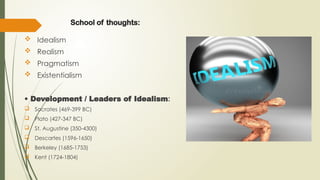
School of thoughts:
 Idealism
 Realism
 Pragmatism
 Existentialism
• Development / Leaders of Idealism:
 Socrates (469-399 BC)
 Plato (427-347 BC)
 St. Augustine (350-4300)
 Descartes (1596-1650)
 Berkeley (1685-1753)
 Kent (1724-1804)
History and father of idealism
 Idealism is the oldest system of philosophy known to man. Its origins go
back to ancient India in the East, and to Plato in the West.:) Its basic
viewpoint stresses the human spirit as the most important element in life.
The universe is viewed as essentially nonmaterial in its ultimate nature.
 Although Idealist philosophers vary enormously on many specifics, they
agree on the following two points:
 The human spirit is the most important element in life; and
 The universe is essentially nonmaterial in its ultimate nature.
 Idealism is one of the most important philosophies that have ever been
formulated. This talks of the attainment of perfection of human beings.
The term is derived from Greek word that means to see.
 Plato is considered by many to be the most important philosopher
who ever lived. He is known as the father of idealism in philosophy.
His ideas were elitist, with the philosopher king the ideal ruler. Plato
is perhaps best known to college students for his parable of a cave,
which appears in Plato's Republic.
 Plato, father of Idealism, espoused this view about 400 years BC, in
his famous book, The Republic. Plato believed that there are two
worlds.:) The first is the spiritual or mental world, which is eternal,
permanent, orderly, regular, and universal.
 The second is world of appearance, the world experienced
through sight, touch, smell, taste, and sound, that is changing,
imperfect, and disorderly.
Idealism
 Idealism is a term with several related meanings. It comes directly from the
Greek "idealismos" which derives from the word (idea).
 The term entered the English language by 1796. In ordinary use, as when
speaking of Woodrow Wilsons political idealism it often suggests the formation
and influence of ideals, the importance of principles, values and goals as well as
present realities, perhaps a tendency to represent things as they might be rather
than as they are.
 Idealism, in philosophy, any view that stresses the central role of the ideal or the
spiritual in the interpretation of experience.
 The practice of forming ideals or living under their influence. something that is
idealized.:) A theory that the essential nature of reality lies in consciousness or
reason.
Example of Idealism
 When you're idealistic, you dream of perfection, whether in
yourself or other people. For example, you might have the
idealistic goal of bringing an end to childhood poverty in the
world. The adjective idealistic describes someone whose plans or
goals of helping others are lofty, grand, and possibly unrealistic.
 Reform schools provide a good example of an idealist education.
Reform schools typically seek to train students that need further
instruction in character development, creating or strengthening
morals and values in each of the students, all while teaching the
basic core curriculum that is taught in a typical school.
.
Idealism in real
 Idealism is the idea that reality as
humans know it is mostly or
completely mentally constructed.
This differs from realism that
suggests that the physical nature
of things greatly impacts the
human experience.
Idealism in Islam
 Idealism is an ideology
that the highest
knowledge and truth is an
ideas or sense of human
thought
Educational Aims of Idealism
A philosophy of education represent answers to Questions about the
purpose of schooling, a teacher's role, and what should be taught
and by what methods.
Idealists generally agree that education should not only stress
development of the mind but also encourage students to focus on all
things of lasting value. Along with Plato, they believe that the aim of
education should be directed toward the search for true ideas.
 • Develop the Mind
 • Search for true ideas
 • Character development
 •Preservation and Transmission of culture
 •Preparation for Whole Life
 • Self-Realization and exaltations of personality
 •Spiritual development.
 •Realization of truth goodness and beauty
 •Conversation promotion and transition of cultural heritage
 •Development of Mind
 •Search for true ideas
 •character development
 •Development of intelligence and rationality...
Self Realization.
 First aim of education according to is to develop the self of the individual
higher and higher still self realization achieved.
To Ensure the spiritual development..
 Idealist give greater Importance to spiritual value in comparison with material
attainment..
 The second aim of education is to develop the child mentally , morally and
above all spiritually.
To Cultivate Truth, beauty, Goodness
 Truth, Beauty and goodness should be encouraged more and More
 The More an individual realizes these ideals, The more spiritually developed he
will become..
Importance/In the perspective of education
What is Education in Idealism?
 Education is transformation and ideas can change lives.
What is importance of idealism?
 From a philosophical point of view, idealism helps in realizing that ideas, emotions and morals
are more significant than material objects and also highlights that human development should
be according to moral, ethical and spiritual values as this helps the person in gaining a variety of
knowledge of unity . A philosophy of education represent answers to Questions about the
purpose of schooling , a teacher's role, and what should be taught and by what methods.
Purposes of educational History of education basically tells ,indicates and suggest the ways and
means to cover previous educational flaws.
 To analyze background of human culture, civilization and education in accordance with
modern approaches
 To study evolution human approaches and practies
 To introduce innovation in the field of education
 To help individuals to secure religious and prime moral values etc..
Weaknesses and Limitations of Idealism
• To much emphasis on mind and spirituality
• over emphasis on bookish knowledge
• Less Importance to child in the educative process.
•Concepts like spirit, mind , soul etc. are abstract in nature..
• Idealistic scheme of education pay less attention to the highly technological
environment of the present...
• Idealism is concerned with the ultimate end of life. it avoids the real problems
day by day livings.. Education should be such as to make individual capable to
solve the problems that confront them from time to time and are able to lead a
happy and contented life.
• Idealistic education give more Importance to teacher's in relation to the child..
Modern psychology emphasize cramming and rote memory...
Fundamental Principles
 The Universe is created by God
 Spiritual world is Superior to Material world
 Physical object have no reality.
 Ultimate aim of human life is Self-Realization.
 Idealist believe that God has created knowledge and people can discover it
trying to find God.
 Man is the best creation of the world and his mind is the most important part.
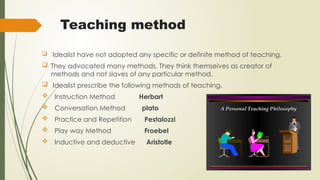
Teaching method
 Idealist have not adopted any specific or definite method of teaching.
 They advocated many methods. They think themselves as creator of
methods and not slaves of any particular method.
 Idealist prescribe the following methods of teaching.
 Instruction Method Herbart
 Conversation Method plato
 Practice and Repetition Pestalozzi
 Play way Method Froebel
 Inductive and deductive Aristotle
Role of teacher
 Idealism is a philosophical thought that greatly effects education.
This report discuss about the teacher in an idealist classroom set up .
This ideal teacher's characteristics is made possible by considering
the environment, teaching methodologies, students, subject matter
and culture. Report show the teachers in idealistic classroom setup
tends to mainly focus on the intellectuality of the students and might
not considers other factors which lies in the real world; knowledge
that can be obtained through the learner's senses.
Characteristics of the teachers in the
idealist classroom
 The kind of a person who commands the respect of the learner by the virtue of
what he himself is.
 A persona friend of the individual student.
 A person who awakness in the learner the desire to learn . True teaching makes
learning so attractive and compelling in interest that pupils want to learn.
 A master of the art of living. The genuine teacher can lead the learner .
 A co-worker with God in perfecting man, at time he becomes the very father of
the learner's soul.
 One who communicates his subject. He knows his students and the subject matter
he teaches.
 One who Appreciates the subject he teaches.
 One who always learns at the same time that he teaches.
Curriculum of Idealism
 Teach students to think.
 Idealists think that humans can become more noble and rational by developing the ability to think.
 Educational materials like reading materials.
 Teacher should encourage and help students to explore curriculum materials for ideas.
 The curriculum should be concerned with the whole humanity and it's experiences.
 Knowledge of spiritual and natural environment should be included in the curriculum.
 Knowledge of natural science acquired through math , science, geography.
 And spiritual development through art, literature, religion and ethics.
 Ross stated that " Aim of education should be self realization the making actual or real the highest potentiality
of the self ".
 Self realization is only possible when a child has a deep insight into his cultural heritage as well as maturity to
think reason and judge.
 These can be attained by three types of activity.
 Intellectual activity__ languages, literature , history, geography, math and science.
 Aesthetic activity__ arts and poetry.
 Moral activities__ religion, metaphysics , metaphysics and ethics.
Idealists
• A person who is guided more by ideals than by practical considerations.
• Idealists, as a temperament, are passionately concerned with personal
growth and development.
• Idealists strive to discover who they are and how they can become their
best possible self.
Characteristics
• Tend to be giving, trusting, spiritual, and they are focused on personal
journeys and human potentials.
• Pride themselves on being loving, kindhearted, and authentic.
• They make intense mates, nurturing parents, and inspirational leaders.
Types
• Teachers
• Counselors
• Champions
The Idealist Personality
The future is always bright :
Their outlook on the future is always optimistic; the world can and will become
a better place and everyone will eventually live together peacefully and in
harmony.
The truth always matters :
Idealists search for conversations and observations that hold deeper universal
truths. They like to use metaphor to express their profound, insightful
observations.
Rules are Guidelines :
Despite not disregarding rules, they do see them as mere guidelines for living
and don’t shy away from bending and breaking rules when they think the
situation demands it.
How to communicate
• The Idealist is quite laid-back in all aspects of their life – including their
communication style . Ever compassionate, diplomatic and nurturing, the
Idealist prefers to keep all communication casual and positive. The Idealist
can be a bit reserved, so if you want to get to know them better, talking
about political or philosophical topics will usually get their attention.
Communication Tips
• Do: Give them clear, detailed instructions – you may even want to provide
them with a list.
• Don’t: Be overly assertive or deferential – rather, talk to them as a
respected equal.
When Idealism Meets Reality
• Take control of what I can influence. Focus on things that are in my ability
to change and try to live my ideals to the best I can.
• Focus on my own ideals. Focus on what the ideals mean to me and let go
of the others, learn that what I think is best might not be the best for others.
• Think big and act small. Know where the long term goal is and take small
steps towards that goal.
• Find others who think differently and try to understand their different
perspectives.
Two Forms of the Idealist View
1 : Extreme View
• Omnipotence ( having unlimited power, force or authoriry) and all
powerfull nature of state.
• No question of independent individuality arises.
• Chief exponent of this aspect of idealism is Hegal.
2: Moderate View
Representation of this view - Green & Bosanquet exalted view of the state
ethical institution obedience to it is obedience to ourselves.
Idealist Theory or Idealism
• Idealism stands for improving the course of international relations by
eliminating war, hunger, inequality, force, suppression and violence from
international relations. To remove these evils is the objective before
humankind. Idealism accepts the possibility of creating a world free from
these evils by depending upon reason, science and education.
How many philosophers are idealistic ?
 Many philosophers are idealism.
• In the west, idealism dates as far back as Pythagoras (600 BCE )
• Plato first formalized idealism through his “ Theory of the forms” .
• KANTIAN (1724-1804)
• In the history of idealism kant is obviously the first philosopher who calls himself an idealist.
Give the prevalent condemnation of idealism in eighteenth-century philosophy this is rather
surprising.
GEORGE BERKELEY (1685-1753)
•Berkeley claimed that only the conscious minds and ideas / perceptions are reality.
•The external world is a collection of perception we mistakenly call physical reality.
•For Berkeley, all the things we perceive around us are nothing more than bundles of our
perception.
•Berkeley’s idealism included elements;
Objective and Subjective
AUGUSTINE (350-430)
•He argued that what is real is the spiritual world; the flesh is only temporary.
•People do not create knowledge; God has already create it , but people can
discover it through trying to find God.
DESCARTES (1596-1650)
•Wrestled with the question of want was real and did he really exist (perhaps he
was a dream). He finally concluded; “ I think , therefore I am”
•Thinking and ideas are the ultimate truth.
PLATO (427-347BC)
 He is known as the father of idealism in philosophy. His ideas were elitist, with
the philosopher king the ideal ruler.
 A general philosophical position deriving both directly and indirectly from the
writings of Greek philosophers plato.
PERCENTAGE OF PEOPLE
 Idealists are relatively rare, making up no more than 15 to 20
percent of population. But their ability to inspire people with
their enthusiasm and their idealism has given them influence
far beyond their numbers.
 Idealists are sure that friendly cooperation is the best way
for people to achieve their goals. Conflict and confrontation
upset them because they seem to put up angry barriers
between people. Idealists dream of creating harmonious,
even caring personal relations.
IS IDEALISM POSITIVE OR NEGATIVE ?
POSITIVE ASPECTS:
Idealism is a positive quality.
 They are most effective problem solvers.
 They are able to imagine an outcome that is better than anything
otherwise conceived of. That doesn’t mean it’s always practical, but the
ability to even fathom it is the first step to making it possible.
 Idealistic characters are valued for their honesty, their ability to listen, and
their genuine, caring natures. They make strong peacemakers and
advisors by ignoring the fluff, focusing instead on the heart of a problem
and what it will take to make those involved more happy and fulfilled.
.
,
 How is idealism treated?
Spend time alone
 While Idealists are often at the forefront of charitable causes and fighting for the
downtrodden, they also need a lot of time to recharge their batteries. The best way to do
this is to spend some time on your own. If you feel you have taken on too much, you may
need to lighten your usual schedule and cut back on some activities.
Exercise
 Regular exercise can help to alleviate the tension that builds up when you take on the
stresses, worries and anxieties of other people. Solitary walks in nature and gentle stretching
exercises can provide a welcome respite from your hectic life.
Learn to say ‘no’
 Idealists are givers by nature, but that doesn’t mean you should keep saying ‘yes’ to every
request. Establishing clear boundaries is critical if you are to value yourself and your own
needs. Without this clarity of purpose, you can do too much and become burned out. Don’t
worry that others will see you as confrontational or rude if you say ‘no’ every now and again
– a study from Columbia University suggests this isn’t the case.
 Surround yourself with positive people
 While Idealists are committed to helping others, they also need someone to believe in
them. Be sure to surround yourself with supportive people who won’t take advantage of
you and who will validate your feelings.
Take up a project
 Idealists tend to throw themselves into good causes wherever they go, whether it’s
organizing a charity event or being a shoulder to cry on. Idealists are often creative
people, so consider a project such as painting, writing, photography, gardening or
cooking.
Learn to accept criticism
 Idealists have a tendency towards perfectionism, often expecting more of
themselves than anyone else. Over time, these high standards can take a toll on your
feelings of self-worth as you berate yourself for failing to reach the mark. Instead of
seeing criticism as an attack, try to see it as an opportunity to learn something.
IDEALISM IN PSYCHOLOGY
 Idealism is a philosophical concept that places importance on the mental
and spiritual aspects in interpretation of our experiences and our
environment. Idealists believe that ideas are what construct our reality and
that things do not exist outside of the mental realm. The world and our reality
are mentally constructed and intangible. Human ideas and concepts (such
as morals and beliefs) are what ultimately shape our society and these non-
physical components are what make up our perception of reality.
 In philosophy the position that reality, including the natural world, is not
independent of mind. Positions range from strong form, holding that mind
constitutes the things of reality, to weaker form, holding that reality is
correlated with the workings of the mind.
 In philosophy, when discussing the issues of perception, idealism is a theory
that states that our reality is shaped by our thoughts and ideas.
Idealism
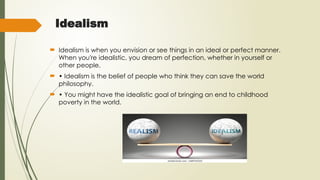
 Idealism is when you envision or see things in an ideal or perfect manner.
When you're idealistic, you dream of perfection, whether in yourself or
other people.
 • Idealism is the belief of people who think they can save the world
philosophy.
 • You might have the idealistic goal of bringing an end to childhood
poverty in the world.
Realism
Tends toward a more pragmatic and actual view of a situation. Realism
is a representation of how things really are or being practical and
facing facts .
Examples
 Realism is a representation Of how things really are, or being practical and
facing facts.
 Realism is the rejection of mythical beings.
Modern idealism
Father of idealism philosophy:
 The ancient Greek philosopher Plato (circa 427 BCE to circa
347 BCE)is considered to be the father of idealism in
philosophy.
 Modern idealist questioned Existence, God, and perception,
most famously in Descartes ' declaration:" I think, therefore I
am. "Modern idealist Educators Consider their students to be
rational , thinking beings who are capable of seeking and
understanding the truth.
Limitations
• Too much emphasis on mind and spirituality.
• Over emphasis on bookish knowledge.
• Less importance to child in the educative process.
• Concepts like spirit, mind, soul, etc. are abstract in nature.
types of idealism
1. Subjective idealism
2. Objective idealism
3. Personal idealism
Subjective idealism
 It give more important to mind or spirit and their perceptions or ideas
 The type of idealism also called mentalism and phenomenalismthe
 Chief exponents are George,john locke etc
Objective idealism
 This type of idealism gave more importance to nature of universe the mean
The universe is one
 According to them nature existed before me the individual itself, and will
exit after me, natural also existed before the present community of selves
 The chief exponents are plato, Hegel.
PERSONAL IDEALISM
 The give more impressive to person or self
 It emphasizes the reality and worthy of the individual people, moral values
and human freedom
 Chief exponents are rudolf herman Ltze , boden .
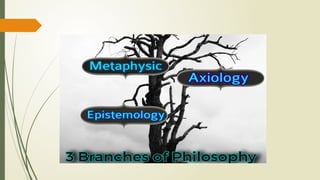
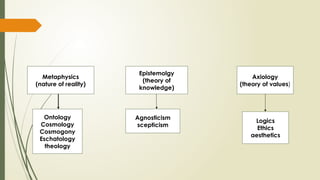
Metaphysics
(nature of reality)
Epistemolgy
(theory of
knowledge)
Axiology
(theory of values)
Ontology
Cosmology
Cosmogony
Eschatology
theology
Agnosticism
scepticism
Logics
Ethics
aesthetics
METAPHYSICS (NATURE OF REALITY)
Metaphysics is the branch of philosophy that deals with the (NATURE OF
BEING OR REALITY)
Metaphysics is derived from greek word ‘Meta’ means (beyond, upon or
after)and physika ’ means (physics)
It asks questions such as
 What is reality?
 The problem of evil?
 Does god exist and if so, can we prove it,
 Ontology(science of being)
 It arise from two Greek word onto existence or being real and logos
 It studies concepts that directly relate to existence and reality and their overall
relationship
1. What are the fundamental parts of world
2. How they relate to each other
 Cosmology
Which is the study of the universe ,its ,contents and history (nature of universe)
 Cosmogony
Derived from Greek word cosmogony kosmos means universe and genesis birth
or origin
 Cosmogony is the study of the universe from its beginning or its origin
(especially the solar system)
Theology
 It is the philosophy of studying the concept of god or the study of the
nature of god and religious belief
Eschatology
The part of theology concerned with death ,judgement and the final
destiny of the soul and of humankind.
 It is also known as doctrines (set of belief)of last thing
Epistemology (theory of knowledge)
 Episteme means (knowledge)and logos means (study of ) so in other
word we can say that epistemology is the study of the nature source
and validity of knowledge.
Question in this philosophy can be
 What is knowledge
 What are the source of knowledge
Agnosticism
Is the view that the existence of god of the divine or the supernatural is
unknown or unknowable
Scepticism
The theory that certain knowledge is impossible this involves asking
questions about any knowledge
Axiology(theory of values)
Made of two Greek words ‘axios’ means value or worth and logos means study
of
Axiology is the philosophical study of the value and the value originally meant
the worth of something
Axiology have roots is the writings of Socrates and plato
Axiology asks the questions
What is value
Where do value come from
What is good or bad
What is right or wrong
Logics
It can be defined as coming conclusion through inquiry and through
inductive deductive reasoning
Ethics
The branch of knowledge that deals with moral principles or conduct
For example how should I behave
Aesthetics
Is the branch of philosophy concerned with the nature and appreciation
of art beauty and good taste
For example what is good music what is beautiful


Philosophical foundation Idealism, oldest philosophy

  • 2.
  • 3.
    PHILOS0PHY  The wordphilosophy is derived from the Greek words philia (love) and sophia (wisdom) and means "the love of wisdom".  Philosophy is the study of general and fundamental problems, such as those connected with existence, knowledge, values, reason, mind, and language.  Philosophy is the rational attempt to formulate, understand, and answer fundamental questions Philosophy is the systematic inquiry into the principles and presuppositions of any field of study.
  • 4.
    School of thoughts: Idealism  Realism  Pragmatism  Existentialism • Development / Leaders of Idealism:  Socrates (469-399 BC)  Plato (427-347 BC)  St. Augustine (350-4300)  Descartes (1596-1650)  Berkeley (1685-1753)  Kent (1724-1804)
  • 5.
    History and fatherof idealism  Idealism is the oldest system of philosophy known to man. Its origins go back to ancient India in the East, and to Plato in the West.:) Its basic viewpoint stresses the human spirit as the most important element in life. The universe is viewed as essentially nonmaterial in its ultimate nature.  Although Idealist philosophers vary enormously on many specifics, they agree on the following two points:  The human spirit is the most important element in life; and  The universe is essentially nonmaterial in its ultimate nature.  Idealism is one of the most important philosophies that have ever been formulated. This talks of the attainment of perfection of human beings. The term is derived from Greek word that means to see.
  • 6.
     Plato isconsidered by many to be the most important philosopher who ever lived. He is known as the father of idealism in philosophy. His ideas were elitist, with the philosopher king the ideal ruler. Plato is perhaps best known to college students for his parable of a cave, which appears in Plato's Republic.  Plato, father of Idealism, espoused this view about 400 years BC, in his famous book, The Republic. Plato believed that there are two worlds.:) The first is the spiritual or mental world, which is eternal, permanent, orderly, regular, and universal.  The second is world of appearance, the world experienced through sight, touch, smell, taste, and sound, that is changing, imperfect, and disorderly.
  • 7.
    Idealism  Idealism isa term with several related meanings. It comes directly from the Greek "idealismos" which derives from the word (idea).  The term entered the English language by 1796. In ordinary use, as when speaking of Woodrow Wilsons political idealism it often suggests the formation and influence of ideals, the importance of principles, values and goals as well as present realities, perhaps a tendency to represent things as they might be rather than as they are.  Idealism, in philosophy, any view that stresses the central role of the ideal or the spiritual in the interpretation of experience.  The practice of forming ideals or living under their influence. something that is idealized.:) A theory that the essential nature of reality lies in consciousness or reason.
  • 8.
    Example of Idealism When you're idealistic, you dream of perfection, whether in yourself or other people. For example, you might have the idealistic goal of bringing an end to childhood poverty in the world. The adjective idealistic describes someone whose plans or goals of helping others are lofty, grand, and possibly unrealistic.  Reform schools provide a good example of an idealist education. Reform schools typically seek to train students that need further instruction in character development, creating or strengthening morals and values in each of the students, all while teaching the basic core curriculum that is taught in a typical school.
  • 9.
    . Idealism in real Idealism is the idea that reality as humans know it is mostly or completely mentally constructed. This differs from realism that suggests that the physical nature of things greatly impacts the human experience. Idealism in Islam  Idealism is an ideology that the highest knowledge and truth is an ideas or sense of human thought
  • 10.
    Educational Aims ofIdealism A philosophy of education represent answers to Questions about the purpose of schooling, a teacher's role, and what should be taught and by what methods. Idealists generally agree that education should not only stress development of the mind but also encourage students to focus on all things of lasting value. Along with Plato, they believe that the aim of education should be directed toward the search for true ideas.
  • 11.
     • Developthe Mind  • Search for true ideas  • Character development  •Preservation and Transmission of culture  •Preparation for Whole Life  • Self-Realization and exaltations of personality  •Spiritual development.  •Realization of truth goodness and beauty  •Conversation promotion and transition of cultural heritage  •Development of Mind  •Search for true ideas  •character development  •Development of intelligence and rationality...
  • 12.
    Self Realization.  Firstaim of education according to is to develop the self of the individual higher and higher still self realization achieved. To Ensure the spiritual development..  Idealist give greater Importance to spiritual value in comparison with material attainment..  The second aim of education is to develop the child mentally , morally and above all spiritually. To Cultivate Truth, beauty, Goodness  Truth, Beauty and goodness should be encouraged more and More  The More an individual realizes these ideals, The more spiritually developed he will become..
  • 13.
    Importance/In the perspectiveof education What is Education in Idealism?  Education is transformation and ideas can change lives. What is importance of idealism?  From a philosophical point of view, idealism helps in realizing that ideas, emotions and morals are more significant than material objects and also highlights that human development should be according to moral, ethical and spiritual values as this helps the person in gaining a variety of knowledge of unity . A philosophy of education represent answers to Questions about the purpose of schooling , a teacher's role, and what should be taught and by what methods. Purposes of educational History of education basically tells ,indicates and suggest the ways and means to cover previous educational flaws.  To analyze background of human culture, civilization and education in accordance with modern approaches  To study evolution human approaches and practies  To introduce innovation in the field of education  To help individuals to secure religious and prime moral values etc..
  • 14.
    Weaknesses and Limitationsof Idealism • To much emphasis on mind and spirituality • over emphasis on bookish knowledge • Less Importance to child in the educative process. •Concepts like spirit, mind , soul etc. are abstract in nature.. • Idealistic scheme of education pay less attention to the highly technological environment of the present... • Idealism is concerned with the ultimate end of life. it avoids the real problems day by day livings.. Education should be such as to make individual capable to solve the problems that confront them from time to time and are able to lead a happy and contented life. • Idealistic education give more Importance to teacher's in relation to the child.. Modern psychology emphasize cramming and rote memory...
  • 15.
    Fundamental Principles  TheUniverse is created by God  Spiritual world is Superior to Material world  Physical object have no reality.  Ultimate aim of human life is Self-Realization.  Idealist believe that God has created knowledge and people can discover it trying to find God.  Man is the best creation of the world and his mind is the most important part.
  • 16.
    Teaching method  Idealisthave not adopted any specific or definite method of teaching.  They advocated many methods. They think themselves as creator of methods and not slaves of any particular method.  Idealist prescribe the following methods of teaching.  Instruction Method Herbart  Conversation Method plato  Practice and Repetition Pestalozzi  Play way Method Froebel  Inductive and deductive Aristotle
  • 17.
    Role of teacher Idealism is a philosophical thought that greatly effects education. This report discuss about the teacher in an idealist classroom set up . This ideal teacher's characteristics is made possible by considering the environment, teaching methodologies, students, subject matter and culture. Report show the teachers in idealistic classroom setup tends to mainly focus on the intellectuality of the students and might not considers other factors which lies in the real world; knowledge that can be obtained through the learner's senses.
  • 18.
    Characteristics of theteachers in the idealist classroom  The kind of a person who commands the respect of the learner by the virtue of what he himself is.  A persona friend of the individual student.  A person who awakness in the learner the desire to learn . True teaching makes learning so attractive and compelling in interest that pupils want to learn.  A master of the art of living. The genuine teacher can lead the learner .  A co-worker with God in perfecting man, at time he becomes the very father of the learner's soul.  One who communicates his subject. He knows his students and the subject matter he teaches.  One who Appreciates the subject he teaches.  One who always learns at the same time that he teaches.
  • 19.
    Curriculum of Idealism Teach students to think.  Idealists think that humans can become more noble and rational by developing the ability to think.  Educational materials like reading materials.  Teacher should encourage and help students to explore curriculum materials for ideas.  The curriculum should be concerned with the whole humanity and it's experiences.  Knowledge of spiritual and natural environment should be included in the curriculum.  Knowledge of natural science acquired through math , science, geography.  And spiritual development through art, literature, religion and ethics.  Ross stated that " Aim of education should be self realization the making actual or real the highest potentiality of the self ".  Self realization is only possible when a child has a deep insight into his cultural heritage as well as maturity to think reason and judge.  These can be attained by three types of activity.  Intellectual activity__ languages, literature , history, geography, math and science.  Aesthetic activity__ arts and poetry.  Moral activities__ religion, metaphysics , metaphysics and ethics.
  • 20.
    Idealists • A personwho is guided more by ideals than by practical considerations. • Idealists, as a temperament, are passionately concerned with personal growth and development. • Idealists strive to discover who they are and how they can become their best possible self.
  • 21.
    Characteristics • Tend tobe giving, trusting, spiritual, and they are focused on personal journeys and human potentials. • Pride themselves on being loving, kindhearted, and authentic. • They make intense mates, nurturing parents, and inspirational leaders.
  • 22.
  • 23.
    The Idealist Personality Thefuture is always bright : Their outlook on the future is always optimistic; the world can and will become a better place and everyone will eventually live together peacefully and in harmony. The truth always matters : Idealists search for conversations and observations that hold deeper universal truths. They like to use metaphor to express their profound, insightful observations.

  • 24.
    Rules are Guidelines: Despite not disregarding rules, they do see them as mere guidelines for living and don’t shy away from bending and breaking rules when they think the situation demands it.
  • 25.
    How to communicate •The Idealist is quite laid-back in all aspects of their life – including their communication style . Ever compassionate, diplomatic and nurturing, the Idealist prefers to keep all communication casual and positive. The Idealist can be a bit reserved, so if you want to get to know them better, talking about political or philosophical topics will usually get their attention.
  • 26.
    Communication Tips • Do:Give them clear, detailed instructions – you may even want to provide them with a list. • Don’t: Be overly assertive or deferential – rather, talk to them as a respected equal.
  • 27.
    When Idealism MeetsReality • Take control of what I can influence. Focus on things that are in my ability to change and try to live my ideals to the best I can. • Focus on my own ideals. Focus on what the ideals mean to me and let go of the others, learn that what I think is best might not be the best for others.
  • 28.
    • Think bigand act small. Know where the long term goal is and take small steps towards that goal. • Find others who think differently and try to understand their different perspectives.
  • 29.
    Two Forms ofthe Idealist View 1 : Extreme View • Omnipotence ( having unlimited power, force or authoriry) and all powerfull nature of state. • No question of independent individuality arises. • Chief exponent of this aspect of idealism is Hegal.
  • 30.
    2: Moderate View Representationof this view - Green & Bosanquet exalted view of the state ethical institution obedience to it is obedience to ourselves.
  • 31.
    Idealist Theory orIdealism • Idealism stands for improving the course of international relations by eliminating war, hunger, inequality, force, suppression and violence from international relations. To remove these evils is the objective before humankind. Idealism accepts the possibility of creating a world free from these evils by depending upon reason, science and education.
  • 32.
    How many philosophersare idealistic ?  Many philosophers are idealism. • In the west, idealism dates as far back as Pythagoras (600 BCE ) • Plato first formalized idealism through his “ Theory of the forms” . • KANTIAN (1724-1804) • In the history of idealism kant is obviously the first philosopher who calls himself an idealist. Give the prevalent condemnation of idealism in eighteenth-century philosophy this is rather surprising. GEORGE BERKELEY (1685-1753) •Berkeley claimed that only the conscious minds and ideas / perceptions are reality. •The external world is a collection of perception we mistakenly call physical reality. •For Berkeley, all the things we perceive around us are nothing more than bundles of our perception. •Berkeley’s idealism included elements; Objective and Subjective
  • 33.
    AUGUSTINE (350-430) •He arguedthat what is real is the spiritual world; the flesh is only temporary. •People do not create knowledge; God has already create it , but people can discover it through trying to find God. DESCARTES (1596-1650) •Wrestled with the question of want was real and did he really exist (perhaps he was a dream). He finally concluded; “ I think , therefore I am” •Thinking and ideas are the ultimate truth. PLATO (427-347BC)  He is known as the father of idealism in philosophy. His ideas were elitist, with the philosopher king the ideal ruler.  A general philosophical position deriving both directly and indirectly from the writings of Greek philosophers plato.
  • 34.
    PERCENTAGE OF PEOPLE Idealists are relatively rare, making up no more than 15 to 20 percent of population. But their ability to inspire people with their enthusiasm and their idealism has given them influence far beyond their numbers.  Idealists are sure that friendly cooperation is the best way for people to achieve their goals. Conflict and confrontation upset them because they seem to put up angry barriers between people. Idealists dream of creating harmonious, even caring personal relations.
  • 35.
    IS IDEALISM POSITIVEOR NEGATIVE ? POSITIVE ASPECTS: Idealism is a positive quality.  They are most effective problem solvers.  They are able to imagine an outcome that is better than anything otherwise conceived of. That doesn’t mean it’s always practical, but the ability to even fathom it is the first step to making it possible.  Idealistic characters are valued for their honesty, their ability to listen, and their genuine, caring natures. They make strong peacemakers and advisors by ignoring the fluff, focusing instead on the heart of a problem and what it will take to make those involved more happy and fulfilled. . ,
  • 36.
     How isidealism treated? Spend time alone  While Idealists are often at the forefront of charitable causes and fighting for the downtrodden, they also need a lot of time to recharge their batteries. The best way to do this is to spend some time on your own. If you feel you have taken on too much, you may need to lighten your usual schedule and cut back on some activities. Exercise  Regular exercise can help to alleviate the tension that builds up when you take on the stresses, worries and anxieties of other people. Solitary walks in nature and gentle stretching exercises can provide a welcome respite from your hectic life. Learn to say ‘no’  Idealists are givers by nature, but that doesn’t mean you should keep saying ‘yes’ to every request. Establishing clear boundaries is critical if you are to value yourself and your own needs. Without this clarity of purpose, you can do too much and become burned out. Don’t worry that others will see you as confrontational or rude if you say ‘no’ every now and again – a study from Columbia University suggests this isn’t the case.
  • 37.
     Surround yourselfwith positive people  While Idealists are committed to helping others, they also need someone to believe in them. Be sure to surround yourself with supportive people who won’t take advantage of you and who will validate your feelings. Take up a project  Idealists tend to throw themselves into good causes wherever they go, whether it’s organizing a charity event or being a shoulder to cry on. Idealists are often creative people, so consider a project such as painting, writing, photography, gardening or cooking. Learn to accept criticism  Idealists have a tendency towards perfectionism, often expecting more of themselves than anyone else. Over time, these high standards can take a toll on your feelings of self-worth as you berate yourself for failing to reach the mark. Instead of seeing criticism as an attack, try to see it as an opportunity to learn something.
  • 38.
    IDEALISM IN PSYCHOLOGY Idealism is a philosophical concept that places importance on the mental and spiritual aspects in interpretation of our experiences and our environment. Idealists believe that ideas are what construct our reality and that things do not exist outside of the mental realm. The world and our reality are mentally constructed and intangible. Human ideas and concepts (such as morals and beliefs) are what ultimately shape our society and these non- physical components are what make up our perception of reality.  In philosophy the position that reality, including the natural world, is not independent of mind. Positions range from strong form, holding that mind constitutes the things of reality, to weaker form, holding that reality is correlated with the workings of the mind.  In philosophy, when discussing the issues of perception, idealism is a theory that states that our reality is shaped by our thoughts and ideas.
  • 39.
    Idealism  Idealism iswhen you envision or see things in an ideal or perfect manner. When you're idealistic, you dream of perfection, whether in yourself or other people.  • Idealism is the belief of people who think they can save the world philosophy.  • You might have the idealistic goal of bringing an end to childhood poverty in the world.
  • 40.
    Realism Tends toward amore pragmatic and actual view of a situation. Realism is a representation of how things really are or being practical and facing facts . Examples  Realism is a representation Of how things really are, or being practical and facing facts.  Realism is the rejection of mythical beings.
  • 41.
    Modern idealism Father ofidealism philosophy:  The ancient Greek philosopher Plato (circa 427 BCE to circa 347 BCE)is considered to be the father of idealism in philosophy.  Modern idealist questioned Existence, God, and perception, most famously in Descartes ' declaration:" I think, therefore I am. "Modern idealist Educators Consider their students to be rational , thinking beings who are capable of seeking and understanding the truth.
  • 42.
    Limitations • Too muchemphasis on mind and spirituality. • Over emphasis on bookish knowledge. • Less importance to child in the educative process. • Concepts like spirit, mind, soul, etc. are abstract in nature.
  • 43.
    types of idealism 1.Subjective idealism 2. Objective idealism 3. Personal idealism Subjective idealism  It give more important to mind or spirit and their perceptions or ideas  The type of idealism also called mentalism and phenomenalismthe  Chief exponents are George,john locke etc
  • 44.
    Objective idealism  Thistype of idealism gave more importance to nature of universe the mean The universe is one  According to them nature existed before me the individual itself, and will exit after me, natural also existed before the present community of selves  The chief exponents are plato, Hegel. PERSONAL IDEALISM  The give more impressive to person or self  It emphasizes the reality and worthy of the individual people, moral values and human freedom  Chief exponents are rudolf herman Ltze , boden .
  • 46.
    Metaphysics (nature of reality) Epistemolgy (theoryof knowledge) Axiology (theory of values) Ontology Cosmology Cosmogony Eschatology theology Agnosticism scepticism Logics Ethics aesthetics
  • 47.
    METAPHYSICS (NATURE OFREALITY) Metaphysics is the branch of philosophy that deals with the (NATURE OF BEING OR REALITY) Metaphysics is derived from greek word ‘Meta’ means (beyond, upon or after)and physika ’ means (physics) It asks questions such as  What is reality?  The problem of evil?  Does god exist and if so, can we prove it,
  • 48.
     Ontology(science ofbeing)  It arise from two Greek word onto existence or being real and logos  It studies concepts that directly relate to existence and reality and their overall relationship 1. What are the fundamental parts of world 2. How they relate to each other  Cosmology Which is the study of the universe ,its ,contents and history (nature of universe)  Cosmogony Derived from Greek word cosmogony kosmos means universe and genesis birth or origin  Cosmogony is the study of the universe from its beginning or its origin (especially the solar system)
  • 49.
    Theology  It isthe philosophy of studying the concept of god or the study of the nature of god and religious belief Eschatology The part of theology concerned with death ,judgement and the final destiny of the soul and of humankind.  It is also known as doctrines (set of belief)of last thing
  • 50.
    Epistemology (theory ofknowledge)  Episteme means (knowledge)and logos means (study of ) so in other word we can say that epistemology is the study of the nature source and validity of knowledge. Question in this philosophy can be  What is knowledge  What are the source of knowledge Agnosticism Is the view that the existence of god of the divine or the supernatural is unknown or unknowable Scepticism The theory that certain knowledge is impossible this involves asking questions about any knowledge
  • 51.
    Axiology(theory of values) Madeof two Greek words ‘axios’ means value or worth and logos means study of Axiology is the philosophical study of the value and the value originally meant the worth of something Axiology have roots is the writings of Socrates and plato Axiology asks the questions What is value Where do value come from What is good or bad What is right or wrong
  • 52.
    Logics It can bedefined as coming conclusion through inquiry and through inductive deductive reasoning Ethics The branch of knowledge that deals with moral principles or conduct For example how should I behave Aesthetics Is the branch of philosophy concerned with the nature and appreciation of art beauty and good taste For example what is good music what is beautiful