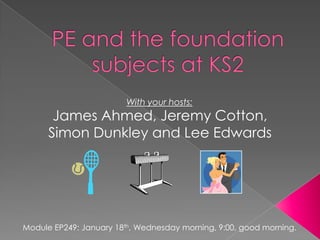
With your hosts:
       James Ahmed, Jeremy Cotton,
      Simon Dunkley and Lee Edwards


Module EP249: January 18th, Wednesday morning, 9:00, good morning.
 Theme of lesson: World War II
    PE strand: Dance, lesson 2 of 6, year 5
    Linked foundation subjects:
     History, Music, ICT, PSHE and ART with links to English core
     subject
    Aim: Using dance to “generate own ideas from given
     stimuli, experiment with creative approaches, learning to work
     collaboratively with a group, develop motor skills and enable
     cross-curricular study.”*
   Learning Objectives for the lesson:
    LO1) To create and explore movements in response to
     stimuli (Music, video, prior history lessons)
    LO2) To create a sequence of movements that reflects
     the actions, emotions and gestures of people involved
     in war (PE bulk of lesson, warm up, groups, practice)
    LO3) To evaluate and improve performance (ICT,
     digital capturing and playback)
* Pocknell & Smith. (2011) Learning and Teaching through dance.
Breadth of study
5. During the key stage, pupils should be taught the knowledge, skills and
understanding through dance activities, games activities and gymnastic
activities.
Dance activities
6. Pupils should be taught to:
a. use movement imaginatively, responding to stimuli, including music, and
performing basic skills [for example, travelling, being still, making a
shape, jumping, turning and gesturing]
b. change the rhythm, speed, level and direction of their movements
c. create and perform dances using simple movement patterns, including
those from different times and cultures
d. express and communicate ideas and feelings.


                          National Curriculum 2011
Knowledge, skills and understanding
Acquiring and developing skills
1. Pupils should be taught to:
a. consolidate their existing skills and gain new ones
b. perform actions and skills with more consistent control and quality.
Selecting and applying skills, tactics and compositional ideas
2. Pupils should be taught to:
a. plan, use and adapt strategies, tactics and compositional ideas for
individual, pair, small-group and small-team activities
b. develop and use their knowledge of the principles behind the
strategies, tactics and ideas to improve their effectiveness
c. apply rules and conventions for different activities.
Evaluating and improving performance
3. Pupils should be taught to:
a. identify what makes a performance effective
b. suggest improvements based on this information
Lesson is based loosely on this QCA Unit, using aspects of it for input.
Key areas of note highlighted in yellow, can use other areas as needed.
Lesson is based loosely on this QCA Unit, using aspects of it for input.
Key areas of note highlighted in yellow, can use other areas as needed.
Lesson is based loosely on this QCA Unit, using aspects of it for input.
Key areas of note highlighted in yellow, can use other areas as needed.
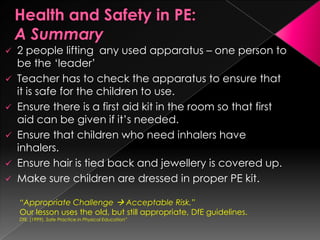
   2 people lifting any used apparatus – one person to
    be the „leader‟
   Teacher has to check the apparatus to ensure that
    it is safe for the children to use.
   Ensure there is a first aid kit in the room so that first
    aid can be given if it‟s needed.
   Ensure that children who need inhalers have
    inhalers.
   Ensure hair is tied back and jewellery is covered up.
   Make sure children are dressed in proper PE kit.

    “Appropriate Challenge  Acceptable Risk.”
    Our lesson uses the old, but still appropriate, DfE guidelines.
    DfE. (1999). Safe Practice in Physical Education”
Now archived, but good guidance.
  DfE. (1999). Safe Practice in Physical Education”
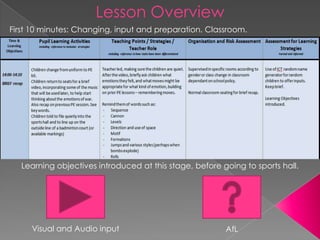
Lesson Overview
First 10 minutes: Changing, input and preparation. Classroom.


   Learning objectives introduced at this stage, before going to sports hall.


     Visual and Audio input                              AfL
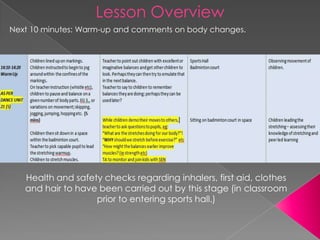
Lesson Overview
Next 10 minutes: Warm-up and comments on body changes.


   Health and safety checks regarding inhalers, first aid, clothes
   and hair to have been carried out by this stage (in classroom
                   prior to entering sports hall.)
Lesson Overview
Example of sheet available:
Lesson Overview
Next 30 minutes: Main activity, modelling and task description.


  TA, Mr Jim Nastiques, to move between groups and capture children practicing
                  on digital cameras for ICT evaluation later. (AfL)

    Differentiated by input and output: Some groups have less input from teacher
                abut sequence or are prompted for longer sequences.
Lesson Overview
Next 15 minutes: Performances and cool down.


   Final performances also recorded on digital cameras. These are
    then transferred to the computer for display on the Interactive
     Whiteboard and evaluation while children change back into
                             school uniform.
     Children evaluate each other‟s performances live in the hall.
   Positivity encouraged by teacher. What was good and why did
       you like it? Detailed evaluation with ICT recordings later.
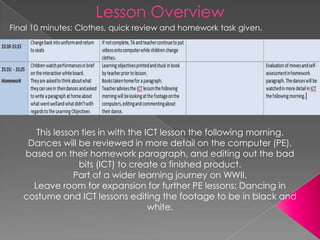
Lesson Overview
Final 10 minutes: Clothes, quick review and homework task given.


      This lesson ties in with the ICT lesson the following morning.
    Dances will be reviewed in more detail on the computer (PE),
   based on their homework paragraph, and editing out the bad
                 bits (ICT) to create a finished product.
                Part of a wider learning journey on WWII.
     Leave room for expansion for further PE lessons: Dancing in
   costume and ICT lessons editing the footage to be in black and
                                    white.
Resources Used


ICT lessons and future PE lessons to make use of the
digital footage for evaluation. Computer suite
needed.
Inclusion and Cross-curricular
Inclusion strategies:


  Ofsted reports that schools with outstanding curricula provide
  both skilled subject teaching and opportunities for children to benefit
  from rich, cross-curricular studies which make connections between
  subjects and encourage pupils to apply what they have learned in one
  subject to others, thus reinforcing learning and deepening their
  understanding.
  (DfE, 2008)

   Opportunity to use and apply their learning!
Cross-curricular Links Explained
Explanatory notes and cross-curriculum references
Note for 3b - Cross reference to English
En1 Speaking and listening: Group discussion and interaction
3. To talk effectively as members of a group, pupils should be taught to:
b. vary contributions to suit the activity and purpose, including exploratory and
tentative comments where ideas are being collected together, and reasoned,
evaluative comments as discussion moves to conclusions or actions
Note for 6 - Cross reference to music
Responding and reviewing - appraising skills
3. Pupils should be taught how to:
b. explore and explain their own ideas and feelings about music using movement,
dance, expressive language and musical vocabulary
Breadth of study
5. During the key stage, pupils should be taught the knowledge, skills and
understanding through:
b. responding to a range of musical and non-musical starting points
HISTORY CURRICULUM:
Britain since 1930
b. A study of the impact of the Second World War or social and technological changes
that have taken place since 1930, on the lives of men, women and children from
different sections of society.
Examples for 11b: Britain since 1930
Impact of the Second World War: the Blitz and evacuation; rationing; serving in the
land army or the home guard; new technologies such as code breaking; the Second
World War in the local area.
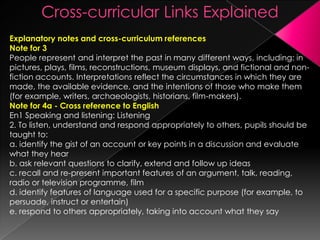
Cross-curricular Links Explained
Explanatory notes and cross-curriculum references
Note for 3
People represent and interpret the past in many different ways, including: in
pictures, plays, films, reconstructions, museum displays, and fictional and non-
fiction accounts. Interpretations reflect the circumstances in which they are
made, the available evidence, and the intentions of those who make them
(for example, writers, archaeologists, historians, film-makers).
Note for 4a - Cross reference to English
En1 Speaking and listening: Listening
2. To listen, understand and respond appropriately to others, pupils should be
taught to:
a. identify the gist of an account or key points in a discussion and evaluate
what they hear
b. ask relevant questions to clarify, extend and follow up ideas
c. recall and re-present important features of an argument, talk, reading,
radio or television programme, film
d. identify features of language used for a specific purpose (for example, to
persuade, instruct or entertain)
e. respond to others appropriately, taking into account what they say
Assessment for learning strategies used:
“AfL: Three key processes involved in successful assessment for learning in
KS2:
 - Planning for improvement, progress and achievement
 - Teaching and assessing for improvement, progress and achievement
 - Reviewing for improvement, progress and achievement.”
Casbon and Spackman. (2005)
Casbon, C. and Spackman, L. (2005). Assessment for learning in physical education. Leeds: Coachwise.

DfE. (1999). Safe Practice in Physical Education: Millennium edition. [online]. Crown copyright. Available:
< https://www.education.gov.uk/publications/eOrderingDownload/DfES%200147%20200MIG2031.pdf>.
[Accessed January 2012].

DfE. (2011). History: Key Stage 2 Curriculum. [online]. Crown copyright. Available: <
http://www.education.gov.uk/schools/teachingandlearning/curriculum/primary/b00199012/history/ks2
>. [Accessed January 1st 2012].

DfE. (2011). Physical education (PE): Key Stage 2 Curriculum. [online]. Crown copyright. Available: <
http://www.education.gov.uk/schools/teachingandlearning/curriculum/primary/b00199167/pe/ks2 >.
[Accessed January 1st 2012].

DfE, (2008). The Independent Review Of The Primary Curriculum. [online]. Crown copyright. Available:
<http://www.educationengland.org.uk/documents/pdfs/2008-IRPC-interim-report.pdf> . [Accessed
January 2012].

Pocknell, L. and Smith, F. (2011). “Learning and teaching through dance” in Stidder, G. and Hayes, S (Ed)
“The Really Useful Physical Education Book.” Learning & Teaching across the 7-14 age range. Routledge:
Oxon.

QCA. (2000). PE at key stages 1 and 2. Unit 21: Dance activities (5). [online]. QCA. Available: <
http://webarchive.nationalarchives.gov.uk/20090608182316/http://standards.dfes.gov.uk/schemes2/ph
e/phedance5/?view=Download> [Accessed December 2011].

PE Lesson Plan - An Overview Example

  • 1.
    With your hosts: James Ahmed, Jeremy Cotton, Simon Dunkley and Lee Edwards Module EP249: January 18th, Wednesday morning, 9:00, good morning.
  • 2.
     Theme oflesson: World War II  PE strand: Dance, lesson 2 of 6, year 5  Linked foundation subjects: History, Music, ICT, PSHE and ART with links to English core subject  Aim: Using dance to “generate own ideas from given stimuli, experiment with creative approaches, learning to work collaboratively with a group, develop motor skills and enable cross-curricular study.”* Learning Objectives for the lesson:  LO1) To create and explore movements in response to stimuli (Music, video, prior history lessons)  LO2) To create a sequence of movements that reflects the actions, emotions and gestures of people involved in war (PE bulk of lesson, warm up, groups, practice)  LO3) To evaluate and improve performance (ICT, digital capturing and playback) * Pocknell & Smith. (2011) Learning and Teaching through dance.
  • 3.
    Breadth of study 5.During the key stage, pupils should be taught the knowledge, skills and understanding through dance activities, games activities and gymnastic activities. Dance activities 6. Pupils should be taught to: a. use movement imaginatively, responding to stimuli, including music, and performing basic skills [for example, travelling, being still, making a shape, jumping, turning and gesturing] b. change the rhythm, speed, level and direction of their movements c. create and perform dances using simple movement patterns, including those from different times and cultures d. express and communicate ideas and feelings. National Curriculum 2011
  • 4.
    Knowledge, skills andunderstanding Acquiring and developing skills 1. Pupils should be taught to: a. consolidate their existing skills and gain new ones b. perform actions and skills with more consistent control and quality. Selecting and applying skills, tactics and compositional ideas 2. Pupils should be taught to: a. plan, use and adapt strategies, tactics and compositional ideas for individual, pair, small-group and small-team activities b. develop and use their knowledge of the principles behind the strategies, tactics and ideas to improve their effectiveness c. apply rules and conventions for different activities. Evaluating and improving performance 3. Pupils should be taught to: a. identify what makes a performance effective b. suggest improvements based on this information
  • 5.
    Lesson is basedloosely on this QCA Unit, using aspects of it for input. Key areas of note highlighted in yellow, can use other areas as needed.
  • 6.
    Lesson is basedloosely on this QCA Unit, using aspects of it for input. Key areas of note highlighted in yellow, can use other areas as needed.
  • 7.
    Lesson is basedloosely on this QCA Unit, using aspects of it for input. Key areas of note highlighted in yellow, can use other areas as needed.
  • 8.
    2 people lifting any used apparatus – one person to be the „leader‟  Teacher has to check the apparatus to ensure that it is safe for the children to use.  Ensure there is a first aid kit in the room so that first aid can be given if it‟s needed.  Ensure that children who need inhalers have inhalers.  Ensure hair is tied back and jewellery is covered up.  Make sure children are dressed in proper PE kit. “Appropriate Challenge  Acceptable Risk.” Our lesson uses the old, but still appropriate, DfE guidelines. DfE. (1999). Safe Practice in Physical Education”
  • 9.
    Now archived, butgood guidance. DfE. (1999). Safe Practice in Physical Education”
  • 10.
    Lesson Overview First 10minutes: Changing, input and preparation. Classroom. Learning objectives introduced at this stage, before going to sports hall. Visual and Audio input AfL
  • 11.
    Lesson Overview Next 10minutes: Warm-up and comments on body changes. Health and safety checks regarding inhalers, first aid, clothes and hair to have been carried out by this stage (in classroom prior to entering sports hall.)
  • 12.
  • 13.
    Lesson Overview Next 30minutes: Main activity, modelling and task description. TA, Mr Jim Nastiques, to move between groups and capture children practicing on digital cameras for ICT evaluation later. (AfL) Differentiated by input and output: Some groups have less input from teacher abut sequence or are prompted for longer sequences.
  • 14.
    Lesson Overview Next 15minutes: Performances and cool down. Final performances also recorded on digital cameras. These are then transferred to the computer for display on the Interactive Whiteboard and evaluation while children change back into school uniform. Children evaluate each other‟s performances live in the hall. Positivity encouraged by teacher. What was good and why did you like it? Detailed evaluation with ICT recordings later.
  • 15.
    Lesson Overview Final 10minutes: Clothes, quick review and homework task given. This lesson ties in with the ICT lesson the following morning. Dances will be reviewed in more detail on the computer (PE), based on their homework paragraph, and editing out the bad bits (ICT) to create a finished product. Part of a wider learning journey on WWII. Leave room for expansion for further PE lessons: Dancing in costume and ICT lessons editing the footage to be in black and white.
  • 16.
    Resources Used ICT lessonsand future PE lessons to make use of the digital footage for evaluation. Computer suite needed.
  • 17.
    Inclusion and Cross-curricular Inclusionstrategies: Ofsted reports that schools with outstanding curricula provide both skilled subject teaching and opportunities for children to benefit from rich, cross-curricular studies which make connections between subjects and encourage pupils to apply what they have learned in one subject to others, thus reinforcing learning and deepening their understanding. (DfE, 2008) Opportunity to use and apply their learning!
  • 18.
    Cross-curricular Links Explained Explanatorynotes and cross-curriculum references Note for 3b - Cross reference to English En1 Speaking and listening: Group discussion and interaction 3. To talk effectively as members of a group, pupils should be taught to: b. vary contributions to suit the activity and purpose, including exploratory and tentative comments where ideas are being collected together, and reasoned, evaluative comments as discussion moves to conclusions or actions Note for 6 - Cross reference to music Responding and reviewing - appraising skills 3. Pupils should be taught how to: b. explore and explain their own ideas and feelings about music using movement, dance, expressive language and musical vocabulary Breadth of study 5. During the key stage, pupils should be taught the knowledge, skills and understanding through: b. responding to a range of musical and non-musical starting points HISTORY CURRICULUM: Britain since 1930 b. A study of the impact of the Second World War or social and technological changes that have taken place since 1930, on the lives of men, women and children from different sections of society. Examples for 11b: Britain since 1930 Impact of the Second World War: the Blitz and evacuation; rationing; serving in the land army or the home guard; new technologies such as code breaking; the Second World War in the local area.
  • 19.
    Cross-curricular Links Explained Explanatorynotes and cross-curriculum references Note for 3 People represent and interpret the past in many different ways, including: in pictures, plays, films, reconstructions, museum displays, and fictional and non- fiction accounts. Interpretations reflect the circumstances in which they are made, the available evidence, and the intentions of those who make them (for example, writers, archaeologists, historians, film-makers). Note for 4a - Cross reference to English En1 Speaking and listening: Listening 2. To listen, understand and respond appropriately to others, pupils should be taught to: a. identify the gist of an account or key points in a discussion and evaluate what they hear b. ask relevant questions to clarify, extend and follow up ideas c. recall and re-present important features of an argument, talk, reading, radio or television programme, film d. identify features of language used for a specific purpose (for example, to persuade, instruct or entertain) e. respond to others appropriately, taking into account what they say
  • 20.
    Assessment for learningstrategies used: “AfL: Three key processes involved in successful assessment for learning in KS2: - Planning for improvement, progress and achievement - Teaching and assessing for improvement, progress and achievement - Reviewing for improvement, progress and achievement.” Casbon and Spackman. (2005)
  • 21.
    Casbon, C. andSpackman, L. (2005). Assessment for learning in physical education. Leeds: Coachwise. DfE. (1999). Safe Practice in Physical Education: Millennium edition. [online]. Crown copyright. Available: < https://www.education.gov.uk/publications/eOrderingDownload/DfES%200147%20200MIG2031.pdf>. [Accessed January 2012]. DfE. (2011). History: Key Stage 2 Curriculum. [online]. Crown copyright. Available: < http://www.education.gov.uk/schools/teachingandlearning/curriculum/primary/b00199012/history/ks2 >. [Accessed January 1st 2012]. DfE. (2011). Physical education (PE): Key Stage 2 Curriculum. [online]. Crown copyright. Available: < http://www.education.gov.uk/schools/teachingandlearning/curriculum/primary/b00199167/pe/ks2 >. [Accessed January 1st 2012]. DfE, (2008). The Independent Review Of The Primary Curriculum. [online]. Crown copyright. Available: <http://www.educationengland.org.uk/documents/pdfs/2008-IRPC-interim-report.pdf> . [Accessed January 2012]. Pocknell, L. and Smith, F. (2011). “Learning and teaching through dance” in Stidder, G. and Hayes, S (Ed) “The Really Useful Physical Education Book.” Learning & Teaching across the 7-14 age range. Routledge: Oxon. QCA. (2000). PE at key stages 1 and 2. Unit 21: Dance activities (5). [online]. QCA. Available: < http://webarchive.nationalarchives.gov.uk/20090608182316/http://standards.dfes.gov.uk/schemes2/ph e/phedance5/?view=Download> [Accessed December 2011].