1
How to optimize
processes
Practical guide how to lower costs and improve quality
2
In this presentation I will discuss 3 things
General approach to
optimizing processes
Useful Techniques &
Tools
Case Study –
Optimizing processes
at Retailer
3
Let’s start with the first aspect
General approach to
optimizing processes
Useful Techniques &
Tools
Case Study –
Optimizing processes
at Retailer
4
Observation and initial
analyses
Data gathering
Process
optimization in
selected unit
Modification of
the process for
other units
Implementation
in the whole
organization
 Observation of process in
real life
 Analyses of the formal
description of the process
 Analyses of available data
 Proposal of KPIs needed to
set goal for each and every
process
 Preparation of list of data
and format for data entry
 Workshop
 Data gathering
 Data preparation according
to provided formats
 Usually you select one of the
units where you measure
and optimize the processes
i.e. in a specific store /
region / factory / site
 Analyses of the process as is
especially its efficiency and
costs
 Redesign of the process
 Creation of tools supporting
the execution of the new
process
 Test of new processes in
chosen locations
 Modification of processes
 Creation of manuals
supporting the new process
 Implementation of new
redesigned processes in the
whole organization
 Consulting Firm
 The Customer
 The Customer  Consulting Firm
 The Customer
 Consulting Firm
 The Customer
 Usually the Customer with
some support from the
Consulting Firm
Process optimization is usually divided in the following phases
Who does it?
Description
5
During the processes many problems will occur
Processes may not be described or
even named
Every unit is doing things differently
There is no defined customer
experience
Specific processes have no goals /
KPIs
The Customer does not have the
knowledge and resources to optimize
Not-invented here attitude
Lack of resources or will to
implement the new processes
Inertia in the organization
6
Let’s have a look at some tools and techniques that are useful
General approach to
optimizing processes
Useful Techniques &
Tools
Case Study –
Optimizing processes
at Retailer
7
Tools overview
8
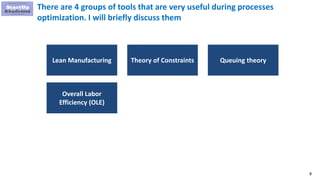
There are 4 groups of tools that are very useful during processes
optimization. I will briefly discuss them
Lean Manufacturing Theory of Constraints Queuing theory
Overall Labor
Efficiency (OLE)
9
Elements of lean
manufacturing
10
5
60
35
Adds value Does not add value
and not obligatory
Obligator but does
not add value
Lean Manufacturing starts with an interesting observation. Due to different
of waste we only use 5% to create value
Source: Report Going Lean, P. Hines, D. Taylor; Lean enterprise research centre; Cardiff Business School; 2000
In lean manufacturing We
have different types of
waste:
• Overproduction
• Defects
• Inventory
• Over-Processing
• Transport
• Motion
• Waiting
Share in total
%
11
Overproduction  Overproduction is making too much or too early. This is usually because of working with oversize
batches, long lead times, poor supplier relations and a host of other reasons.
Defects  You produce faulty things or not up to agreed standard. This may be due to errors done by production
people, quality issues or faulty materials
Transport  Transport is the movement of materials, people, machines from one location to another. This is a waste
as it adds zero value to the product.
Waiting  Long periods of no action due to lack of materials , resources, people
Motion  Unnecessary motions of workers due to the way working space is organized
Inventory  Too high inventory that cos t you money, space and causes operational problems
Over-Processing  When you use the wrong tools, procedures or methods you are creating waste as well
You have not used the
employee’s creativity
 If you waste peoples’ efforts and creativity you will stop developing
Definition
Lean Manufacturing defines 8 types of waste that we want to eliminate
12
Too much movement
(people, resources, materials)
Lower the need to move
Move faster
Change the timing of the
movements
Eliminate the movement
Peak of activities
Set priorities
Assign specific people to perform
the activity during peaks
Decrease the difference between
high and low periods
Use different frequency for
different activity
For example in the case of Retailers we have 2 main sources
13
For more on Lean Manufacturing check another presentation of mine
Essential Lean Manufacturing
for Management Consultants
Practical guide how to cut costs
presentation
14
Elements of theory of
constraints
15
Example 1
7 5 7
Example 2
5 10 20
Example 3
5 5 3
x Stage capacity
x Bottleneck
Theory of constraints is about dealing with so called bottleneck that are
limiting the capacity of the whole system. Have a look at 3 examples
16
Due to bottlenecks the system the whole system is not efficient. Some people have
nothing to do whereas others are stranded with too much work
17
That is why theory of constraints are very useful to optimize processes not
only in Production but also in Retail and Services
 Throughput of the whole
system
 Inventory of materials,
finished products, WIP
 Operational costs of the
production
Production
 Throughput measured in
number of customers
served
 Inventory of goods
 Operational costs of the
store
Retail
 Throughput measured in
number of customers
served
 Inventory of materials
 Operational costs of the
service point
Services
18
The aim of the theory of constraints is to increase the throughput in
bottlenecks and in this way to improve the whole system. Below how to do it
 Identify the bottleneck
 See how you can use in better way the time of the bottleneck
 Everything should be aligned with the bottleneck
 Increase the capacity of the bottleneck to meet the full demand (add machines,
people, resources, increase the time of work)
1
2
3
4
19
OEE and OLE
20
Open hours
Maintenance Machine uptime
Uptime utilizationIdle time
60%
60%
OEE =
60 %
60 %
x
x
98%
Proportion of good quality
products
98%
35%
It means that we used only 35% of machine paid
time
In the case of machines you can measure Overall Equipment Efficiency. Similar
concept can be used to measure efficiency of people
21
Similar to OEE that is designed for machines you can define the Overall
Labour Efficiency (OLE) for people
 Estimated for machines
 Shows you what percentage of
the machine is used to create
value for which you are paid by
the customer
 It makes sense to analyze it
especially for expensive machines
and bottlenecks
OEE
 Estimated for people
 Shows you what percentage of
the people is used to create value
for which you are paid by the
customer
 It makes sense to analyze it
especially for people that are
representative of a big group of
your employees
OLE
22
Below an example of analysis of the time spend by store employees. As you
can see OLE is pretty low
31%
29%
21%
18%
100%
Sales advising
Shelf replenishment
Transport and
movement
Others
Total
 Only sales advising and shelf
replenishment are added value
activities for which customer is willing
to pay
 This means that the OLE for a sales
reps is equal to 60% at most
23
Queuing systems
24
In many cases to optimize processes you have to identify queues in your
systems to be able to serve your customers in the proper pace
Customer appears Exit
Number of service
point (servers)
Queue
Delivery of service
25
In queuing system there are 2 parameters you have to estimate to see
how big the problem is
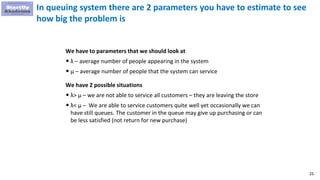
We have to parameters that we should look at
• λ – average number of people appearing in the system
• μ – average number of people that the system can service
We have 2 possible situations
• λ> μ – we are not able to service all customers – they are leaving the store
• λ< μ – We are able to service customers quite well yet occasionally we can
have still queues. The customer in the queue may give up purchasing or can
be less satisfied (not return for new purchase)
26
Even small difference between the number of appearing customers and your
capacity to service can cause fast big queues
0,0
20,0
40,0
60,0
80,0
100,0
120,0
1,0 1,4 1,8 2,2 2,6 3,0 3,4 3,8 4,2 4,6 5,0 5,4 5,8 6,2 6,6 7,0 7,4 7,8 8,2 8,6 9,0 9,4 9,8 λ – average
number of
people
appearing in
the system
Size of the queue μ =10
27
In complicated systems you can have 2 types of queues
 Clear service points
 People know where they are and how
to queue
 A good example is the queue to cash
till in a retail store
Visible
 No clear service points or service
points not visible
 People cannot find the service points
and don’t know how to queue to them
 A good example is the invisible queues
to sales reps for advices in the retail
store
Invisible
28
Have a look how the service level (advice during the purchasing process
of the customer) looks in an example of store
DIY test store example
• λ = 126 customers
• μ = 6 sales rep x 9 customer
serviced in during the hour 54
customers
Conclusions:
• A big part of customer cannot be
served
• Some of the customer will not buy
at all (lower conversion) or will
buy less (lower average
transaction value – ATV)
• μ can be increased by increasing
the number of sales reps,
increasing the time they devote
to servicing customers or
shortening the time of service
29
Let’s have move to a case study
General approach to
optimizing processes
Useful Techniques &
Tools
Case Study –
Optimizing processes
at Retailer
30
We will discuss examples of process optimization of a price change process for
a retailer that is working in DIY / Home improvement industry
DIY look Brands
31
Price change process
optimization
32
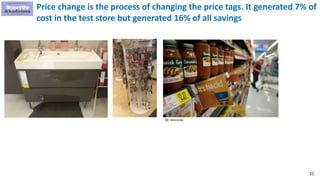
Price change is the process of changing the price tags. It generated 7% of
cost in the test store but generated 16% of all savings
CC: Wikimedia
33
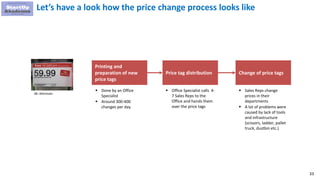
Let’s have a look how the price change process looks like
Printing and
preparation of new
price tags
Price tag distribution Change of price tags
 Done by an Office
Specialist
 Around 300-400
changes per day
 Office Specialist calls 4-
7 Sales Reps to the
Office and hands them
over the price tags
 Sales Reps change
prices in their
departments
 A lot of problems were
caused by lack of tools
and infrastructure
(scissors, ladder, pallet
truck, dustbin etc.)
CC: Wikimedia
34
Click on the icon below to see the movie showing how we managed to
optimize this process of price change and save a lot of money for the
Retailer
35
Management Consulting Project –
Behind the Scenes
$90
$10
Check my online course were you find a detailed overview of the whole
optimization processes and examples of improvements done to all processes
along with calculation of savings in Excel
Click here to check my course
36
Badass
Consultants
Blog
Subscribe to our channels:
37
How to be a badass manager &
CEO
Practical Guide
presentation
Check my other presentations
38
Strategy for Management
Consultants & Business Analysts
Practical Guide
presentation
For more information on Strategy check also my other presentation
39
FMCG for Management
Consultants & Business Analysts
Practical Guide
presentation
Check also my other presentations
40
Supply Chain for Management
Consultants
Practical Guide
presentation
For more information on Supply Chain check also my other presentation
41
Essential Excel for Business
Analysts and Consultants
A practical guide
presentation
Check also my other presentations
42
Top 10 courses that every
Management Consultant should
take
My super objective view
presentation
Check also my other presentations
43
Top 25 books that every
Management Consultant should
read
My super objective view
presentation
Check also my other presentations
44
Management Consulting Tools,
Techniques and Frameworks
A practical guide
presentation
Check also my other presentations
45
How to manage a consulting
project?
A practical guide
presentation
Check also my other presentations
46
Business modeling of offline
businesses in Excel
A practical guide
presentation
Check also my other presentations
47
Supply Chain for Management
Consultants
Practical Guide
presentation
Check also my other presentations
48
Sales Analysis for Business
Analysts and Consultants
A practical guide
presentation
Check also my other presentations
49
Retail for Business Analysts and
Management Consultants
A practical guide
presentation
Check also my other presentations
50
Management consultant
productivity hacks
How to be lazy and still get things done
presentation
Check also my other presentations
51
Market research
Practical guide for startups and entrepreneurs
presentation
Check also my other presentations
52
5 examples of business /
financial models in Excel
Practical guide how to check whether the business makes
sense
presentation
Check also my other presentations
53
Essential Lean Manufacturing
for Management Consultants
Practical guide how to cut costs
presentation
Check also my other presentations
54
What is an issue tree and how
to use it?
Practical guide with examples
presentation
Check also my other presentations
55
Excel shortcuts for Management
Consultants and Business
Analysts
Practical guide how to work fast in Excel
presentation
Check also my other presentations
56
Financial Modeling for Business
Analysts and Management
Consultants
Step by step guide
presentation
Check also my other presentations
57
Management Consulting
Presentations
Practical guide how to prepare a great presentation
presentation
Check also my other presentations
58
How to get into consulting
Practical guide how to pass the case part
presentation
Check also my other presentations
59
How to become world class
analyst
A practical guide
presentation
Check also my other presentations
60
Management Consulting
Presentations
Practical guide how to prepare a great presentation
presentation
Check also my other presentations
61
Production for Management
Consultants
Practical guide
presentation
Check also my other presentations
62
Business models
Practical guide for startups and entrepreneurs
presentation
Check also my other presentations
63
How to create management
consulting presentations?
A practical guide
presentation
Check also my other presentations
64
Management consultant
productivity hacks
How to be lazy and still get things done
presentation
Check also my other presentations
65
Start and run consulting
company
A practical guide
presentation
Check also my other presentations
66
How to open a successful
restaurant
A practical guide
presentation
Check also my other presentations
67
On-line Business Models
A practical guide
presentation
Check also my other presentations
68
MVP – how to test your
business idea without building
the product
A practical guide
presentation
Check also my other presentations
69
Processes optimization
70
Introduction to processes
optimization
71
Process Optimization went much better than expected
It lasted 4 instead of 5 days
Most of the things were done in 2
days
The team changed from skeptics to
deep believers
Leaders of each implementation
team were the driving forces
I was mainly coordinating,
motivating and arguing
We did more than the planned scope
72
As a reminder the original timeline
Tasks 20 21 22 23 24
Overview of process – definition of KPIs and measuring the current costs
Designing of new solution, testing and modifying them
Final touch, creation of tools and final modification to the processes
February
73
We managed to do much more as assumed in 4 days
 Tried to apply techniques they have learnt during
the workshop
 Measured assigned process – how long it took
what where the obstacles
 Looked for ways to improve
Day 1
Implementation teams Me
 Explained techniques and showing them the waste
 Gave them tips on how to improve
 I was moving between groups and sometimes talking to
the leaders separately
 Continued activities from Day 1
 For some of the process they have implemented
the quick wins in improving themDay 2
 Continued activities from Day 1
 Monitoring changes
 We made a trip to the competitors to try to see how the process are organized there
 We tried to see the pros and cons of the whole process
 We came back to improving the process at the DIY
 We measured the results with t he new processes
Day 3
 We finished the changes to the process
 The team that was doing the customer service went beyond the scope and worked on improving the
basket (ATV) size as well conversion rateDay 4
74
The store and the processes
75
The test store was 4 000 sq. m big (43 000 sq. ft.)
Warehouse
Offices
Warehouse /store racks
(shelving)
Cash Till
Employee
Customer
76
• In-bound Logistics including
replenishment of the shelves
As you may remember there were over 20 process that we
optimized in the test store
Group Process
• Special orders
• Direct orders
• Orders from Central Warehouse (CW)
• Cyclical orders
• Price change management • Price change
• Price monitoring
• Communication between stores and
Head Office
• ?
• Promotion area management • Promotion area management
• Change of assortment • Range Change
• 1 to 1
• Customer support • Selling the product at the cash till
• Return of goods
• Complaint from a customer
• Sales via telephone
• Deposit and transportation management
• To be confirmed
• Direct deliveries
• Deliveries from Central Warehouse (CW)
• Direct returns
• Returns via CW
• Transfers between stores
• Partial stocktaking
• Control of empty spaces
77
I will show you in details what we did in the case of the following 4
process
Price change
Shelf replenishment
Advising customers
Cash till and info point
78
Price change
79
Price change is the process of changing the price tags. It generated 7% of
cost in the test store but generated 16% of all savings
CC: Wikimedia
80
Let’s have a look how the price change process looks
Printing and
preparation of new
price tags
Price tag distribution Change of price tags
 Done by an Office
Specialist
 Around 300-400
changes per day
 Office Specialist calls 4-
7 Sales Reps to the
Office and hands them
over the price tags
 Sales Reps change
prices in their
departments
 A lot of problems were
caused by lack of tools
and infrastructure
(scissors, ladder, pallet
truck, dustbin etc.)
CC: Wikimedia

How to optimize processes in practice during consulting projects

  • 1.
    1 How to optimize processes Practicalguide how to lower costs and improve quality
  • 2.
    2 In this presentationI will discuss 3 things General approach to optimizing processes Useful Techniques & Tools Case Study – Optimizing processes at Retailer
  • 3.
    3 Let’s start withthe first aspect General approach to optimizing processes Useful Techniques & Tools Case Study – Optimizing processes at Retailer
  • 4.
    4 Observation and initial analyses Datagathering Process optimization in selected unit Modification of the process for other units Implementation in the whole organization  Observation of process in real life  Analyses of the formal description of the process  Analyses of available data  Proposal of KPIs needed to set goal for each and every process  Preparation of list of data and format for data entry  Workshop  Data gathering  Data preparation according to provided formats  Usually you select one of the units where you measure and optimize the processes i.e. in a specific store / region / factory / site  Analyses of the process as is especially its efficiency and costs  Redesign of the process  Creation of tools supporting the execution of the new process  Test of new processes in chosen locations  Modification of processes  Creation of manuals supporting the new process  Implementation of new redesigned processes in the whole organization  Consulting Firm  The Customer  The Customer  Consulting Firm  The Customer  Consulting Firm  The Customer  Usually the Customer with some support from the Consulting Firm Process optimization is usually divided in the following phases Who does it? Description
  • 5.
    5 During the processesmany problems will occur Processes may not be described or even named Every unit is doing things differently There is no defined customer experience Specific processes have no goals / KPIs The Customer does not have the knowledge and resources to optimize Not-invented here attitude Lack of resources or will to implement the new processes Inertia in the organization
  • 6.
    6 Let’s have alook at some tools and techniques that are useful General approach to optimizing processes Useful Techniques & Tools Case Study – Optimizing processes at Retailer
  • 7.
  • 8.
    8 There are 4groups of tools that are very useful during processes optimization. I will briefly discuss them Lean Manufacturing Theory of Constraints Queuing theory Overall Labor Efficiency (OLE)
  • 9.
  • 10.
    10 5 60 35 Adds value Doesnot add value and not obligatory Obligator but does not add value Lean Manufacturing starts with an interesting observation. Due to different of waste we only use 5% to create value Source: Report Going Lean, P. Hines, D. Taylor; Lean enterprise research centre; Cardiff Business School; 2000 In lean manufacturing We have different types of waste: • Overproduction • Defects • Inventory • Over-Processing • Transport • Motion • Waiting Share in total %
  • 11.
    11 Overproduction  Overproductionis making too much or too early. This is usually because of working with oversize batches, long lead times, poor supplier relations and a host of other reasons. Defects  You produce faulty things or not up to agreed standard. This may be due to errors done by production people, quality issues or faulty materials Transport  Transport is the movement of materials, people, machines from one location to another. This is a waste as it adds zero value to the product. Waiting  Long periods of no action due to lack of materials , resources, people Motion  Unnecessary motions of workers due to the way working space is organized Inventory  Too high inventory that cos t you money, space and causes operational problems Over-Processing  When you use the wrong tools, procedures or methods you are creating waste as well You have not used the employee’s creativity  If you waste peoples’ efforts and creativity you will stop developing Definition Lean Manufacturing defines 8 types of waste that we want to eliminate
  • 12.
    12 Too much movement (people,resources, materials) Lower the need to move Move faster Change the timing of the movements Eliminate the movement Peak of activities Set priorities Assign specific people to perform the activity during peaks Decrease the difference between high and low periods Use different frequency for different activity For example in the case of Retailers we have 2 main sources
  • 13.
    13 For more onLean Manufacturing check another presentation of mine Essential Lean Manufacturing for Management Consultants Practical guide how to cut costs presentation
  • 14.
    14 Elements of theoryof constraints
  • 15.
    15 Example 1 7 57 Example 2 5 10 20 Example 3 5 5 3 x Stage capacity x Bottleneck Theory of constraints is about dealing with so called bottleneck that are limiting the capacity of the whole system. Have a look at 3 examples
  • 16.
    16 Due to bottlenecksthe system the whole system is not efficient. Some people have nothing to do whereas others are stranded with too much work
  • 17.
    17 That is whytheory of constraints are very useful to optimize processes not only in Production but also in Retail and Services  Throughput of the whole system  Inventory of materials, finished products, WIP  Operational costs of the production Production  Throughput measured in number of customers served  Inventory of goods  Operational costs of the store Retail  Throughput measured in number of customers served  Inventory of materials  Operational costs of the service point Services
  • 18.
    18 The aim ofthe theory of constraints is to increase the throughput in bottlenecks and in this way to improve the whole system. Below how to do it  Identify the bottleneck  See how you can use in better way the time of the bottleneck  Everything should be aligned with the bottleneck  Increase the capacity of the bottleneck to meet the full demand (add machines, people, resources, increase the time of work) 1 2 3 4
  • 19.
  • 20.
    20 Open hours Maintenance Machineuptime Uptime utilizationIdle time 60% 60% OEE = 60 % 60 % x x 98% Proportion of good quality products 98% 35% It means that we used only 35% of machine paid time In the case of machines you can measure Overall Equipment Efficiency. Similar concept can be used to measure efficiency of people
  • 21.
    21 Similar to OEEthat is designed for machines you can define the Overall Labour Efficiency (OLE) for people  Estimated for machines  Shows you what percentage of the machine is used to create value for which you are paid by the customer  It makes sense to analyze it especially for expensive machines and bottlenecks OEE  Estimated for people  Shows you what percentage of the people is used to create value for which you are paid by the customer  It makes sense to analyze it especially for people that are representative of a big group of your employees OLE
  • 22.
    22 Below an exampleof analysis of the time spend by store employees. As you can see OLE is pretty low 31% 29% 21% 18% 100% Sales advising Shelf replenishment Transport and movement Others Total  Only sales advising and shelf replenishment are added value activities for which customer is willing to pay  This means that the OLE for a sales reps is equal to 60% at most
  • 23.
  • 24.
    24 In many casesto optimize processes you have to identify queues in your systems to be able to serve your customers in the proper pace Customer appears Exit Number of service point (servers) Queue Delivery of service
  • 25.
    25 In queuing systemthere are 2 parameters you have to estimate to see how big the problem is We have to parameters that we should look at • λ – average number of people appearing in the system • μ – average number of people that the system can service We have 2 possible situations • λ> μ – we are not able to service all customers – they are leaving the store • λ< μ – We are able to service customers quite well yet occasionally we can have still queues. The customer in the queue may give up purchasing or can be less satisfied (not return for new purchase)
  • 26.
    26 Even small differencebetween the number of appearing customers and your capacity to service can cause fast big queues 0,0 20,0 40,0 60,0 80,0 100,0 120,0 1,0 1,4 1,8 2,2 2,6 3,0 3,4 3,8 4,2 4,6 5,0 5,4 5,8 6,2 6,6 7,0 7,4 7,8 8,2 8,6 9,0 9,4 9,8 λ – average number of people appearing in the system Size of the queue μ =10
  • 27.
    27 In complicated systemsyou can have 2 types of queues  Clear service points  People know where they are and how to queue  A good example is the queue to cash till in a retail store Visible  No clear service points or service points not visible  People cannot find the service points and don’t know how to queue to them  A good example is the invisible queues to sales reps for advices in the retail store Invisible
  • 28.
    28 Have a lookhow the service level (advice during the purchasing process of the customer) looks in an example of store DIY test store example • λ = 126 customers • μ = 6 sales rep x 9 customer serviced in during the hour 54 customers Conclusions: • A big part of customer cannot be served • Some of the customer will not buy at all (lower conversion) or will buy less (lower average transaction value – ATV) • μ can be increased by increasing the number of sales reps, increasing the time they devote to servicing customers or shortening the time of service
  • 29.
    29 Let’s have moveto a case study General approach to optimizing processes Useful Techniques & Tools Case Study – Optimizing processes at Retailer
  • 30.
    30 We will discussexamples of process optimization of a price change process for a retailer that is working in DIY / Home improvement industry DIY look Brands
  • 31.
  • 32.
    32 Price change isthe process of changing the price tags. It generated 7% of cost in the test store but generated 16% of all savings CC: Wikimedia
  • 33.
    33 Let’s have alook how the price change process looks like Printing and preparation of new price tags Price tag distribution Change of price tags  Done by an Office Specialist  Around 300-400 changes per day  Office Specialist calls 4- 7 Sales Reps to the Office and hands them over the price tags  Sales Reps change prices in their departments  A lot of problems were caused by lack of tools and infrastructure (scissors, ladder, pallet truck, dustbin etc.) CC: Wikimedia
  • 34.
    34 Click on theicon below to see the movie showing how we managed to optimize this process of price change and save a lot of money for the Retailer
  • 35.
    35 Management Consulting Project– Behind the Scenes $90 $10 Check my online course were you find a detailed overview of the whole optimization processes and examples of improvements done to all processes along with calculation of savings in Excel Click here to check my course
  • 36.
  • 37.
    37 How to bea badass manager & CEO Practical Guide presentation Check my other presentations
  • 38.
    38 Strategy for Management Consultants& Business Analysts Practical Guide presentation For more information on Strategy check also my other presentation
  • 39.
    39 FMCG for Management Consultants& Business Analysts Practical Guide presentation Check also my other presentations
  • 40.
    40 Supply Chain forManagement Consultants Practical Guide presentation For more information on Supply Chain check also my other presentation
  • 41.
    41 Essential Excel forBusiness Analysts and Consultants A practical guide presentation Check also my other presentations
  • 42.
    42 Top 10 coursesthat every Management Consultant should take My super objective view presentation Check also my other presentations
  • 43.
    43 Top 25 booksthat every Management Consultant should read My super objective view presentation Check also my other presentations
  • 44.
    44 Management Consulting Tools, Techniquesand Frameworks A practical guide presentation Check also my other presentations
  • 45.
    45 How to managea consulting project? A practical guide presentation Check also my other presentations
  • 46.
    46 Business modeling ofoffline businesses in Excel A practical guide presentation Check also my other presentations
  • 47.
    47 Supply Chain forManagement Consultants Practical Guide presentation Check also my other presentations
  • 48.
    48 Sales Analysis forBusiness Analysts and Consultants A practical guide presentation Check also my other presentations
  • 49.
    49 Retail for BusinessAnalysts and Management Consultants A practical guide presentation Check also my other presentations
  • 50.
    50 Management consultant productivity hacks Howto be lazy and still get things done presentation Check also my other presentations
  • 51.
    51 Market research Practical guidefor startups and entrepreneurs presentation Check also my other presentations
  • 52.
    52 5 examples ofbusiness / financial models in Excel Practical guide how to check whether the business makes sense presentation Check also my other presentations
  • 53.
    53 Essential Lean Manufacturing forManagement Consultants Practical guide how to cut costs presentation Check also my other presentations
  • 54.
    54 What is anissue tree and how to use it? Practical guide with examples presentation Check also my other presentations
  • 55.
    55 Excel shortcuts forManagement Consultants and Business Analysts Practical guide how to work fast in Excel presentation Check also my other presentations
  • 56.
    56 Financial Modeling forBusiness Analysts and Management Consultants Step by step guide presentation Check also my other presentations
  • 57.
    57 Management Consulting Presentations Practical guidehow to prepare a great presentation presentation Check also my other presentations
  • 58.
    58 How to getinto consulting Practical guide how to pass the case part presentation Check also my other presentations
  • 59.
    59 How to becomeworld class analyst A practical guide presentation Check also my other presentations
  • 60.
    60 Management Consulting Presentations Practical guidehow to prepare a great presentation presentation Check also my other presentations
  • 61.
    61 Production for Management Consultants Practicalguide presentation Check also my other presentations
  • 62.
    62 Business models Practical guidefor startups and entrepreneurs presentation Check also my other presentations
  • 63.
    63 How to createmanagement consulting presentations? A practical guide presentation Check also my other presentations
  • 64.
    64 Management consultant productivity hacks Howto be lazy and still get things done presentation Check also my other presentations
  • 65.
    65 Start and runconsulting company A practical guide presentation Check also my other presentations
  • 66.
    66 How to opena successful restaurant A practical guide presentation Check also my other presentations
  • 67.
    67 On-line Business Models Apractical guide presentation Check also my other presentations
  • 68.
    68 MVP – howto test your business idea without building the product A practical guide presentation Check also my other presentations
  • 69.
  • 70.
  • 71.
    71 Process Optimization wentmuch better than expected It lasted 4 instead of 5 days Most of the things were done in 2 days The team changed from skeptics to deep believers Leaders of each implementation team were the driving forces I was mainly coordinating, motivating and arguing We did more than the planned scope
  • 72.
    72 As a reminderthe original timeline Tasks 20 21 22 23 24 Overview of process – definition of KPIs and measuring the current costs Designing of new solution, testing and modifying them Final touch, creation of tools and final modification to the processes February
  • 73.
    73 We managed todo much more as assumed in 4 days  Tried to apply techniques they have learnt during the workshop  Measured assigned process – how long it took what where the obstacles  Looked for ways to improve Day 1 Implementation teams Me  Explained techniques and showing them the waste  Gave them tips on how to improve  I was moving between groups and sometimes talking to the leaders separately  Continued activities from Day 1  For some of the process they have implemented the quick wins in improving themDay 2  Continued activities from Day 1  Monitoring changes  We made a trip to the competitors to try to see how the process are organized there  We tried to see the pros and cons of the whole process  We came back to improving the process at the DIY  We measured the results with t he new processes Day 3  We finished the changes to the process  The team that was doing the customer service went beyond the scope and worked on improving the basket (ATV) size as well conversion rateDay 4
  • 74.
    74 The store andthe processes
  • 75.
    75 The test storewas 4 000 sq. m big (43 000 sq. ft.) Warehouse Offices Warehouse /store racks (shelving) Cash Till Employee Customer
  • 76.
    76 • In-bound Logisticsincluding replenishment of the shelves As you may remember there were over 20 process that we optimized in the test store Group Process • Special orders • Direct orders • Orders from Central Warehouse (CW) • Cyclical orders • Price change management • Price change • Price monitoring • Communication between stores and Head Office • ? • Promotion area management • Promotion area management • Change of assortment • Range Change • 1 to 1 • Customer support • Selling the product at the cash till • Return of goods • Complaint from a customer • Sales via telephone • Deposit and transportation management • To be confirmed • Direct deliveries • Deliveries from Central Warehouse (CW) • Direct returns • Returns via CW • Transfers between stores • Partial stocktaking • Control of empty spaces
  • 77.
    77 I will showyou in details what we did in the case of the following 4 process Price change Shelf replenishment Advising customers Cash till and info point
  • 78.
  • 79.
    79 Price change isthe process of changing the price tags. It generated 7% of cost in the test store but generated 16% of all savings CC: Wikimedia
  • 80.
    80 Let’s have alook how the price change process looks Printing and preparation of new price tags Price tag distribution Change of price tags  Done by an Office Specialist  Around 300-400 changes per day  Office Specialist calls 4- 7 Sales Reps to the Office and hands them over the price tags  Sales Reps change prices in their departments  A lot of problems were caused by lack of tools and infrastructure (scissors, ladder, pallet truck, dustbin etc.) CC: Wikimedia