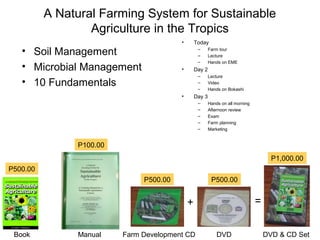
A Natural Farming System for Sustainable
                  Agriculture in the Tropics
                                        •       Today
   • Soil Management                             –
                                                 –
                                                        Farm tour
                                                        Lecture
                                                 –      Hands on EME
   • Microbial Management               •       Day 2
                                                 –      Lecture
   • 10 Fundamentals                             –
                                                 –
                                                        Video
                                                        Hands on Bokashi
                                        •       Day 3
                                                 –      Hands on all morning
                                                 –      Afternoon review
                                                 –      Exam
                                                 –      Farm planning
                                                 –      Marketing


               P100.00
                                                                                     P1,000.00
P500.00
                              P500.00                    P500.00


                                            +                                  =


 Book          Manual    Farm Development CD                DVD                    DVD & CD Set
Permaculture


Permaculture is about designing ecological human
habitats and food production systems. It is a land
  use and community building movement which
 strives for the harmonious integration of human
 dwellings, microclimates, annual and perennial
   plants, animals, soils, and water into stable,
              productive communities.
Permaculture Ethics
Care of the Earth can be
taken to mean caring for the
living soil. The state of the soil
is often the best measure for
the health and well-being of
society.


                                                            Care of the Earth
                                                            Rebuild natural capital


                              Fair Share
                              Set limits to consumption and                           Care of People
                              reproduction, and redistribute surplus                  Look after self, kin and community
Holmgren's 12 design
              principles
These restatements of the principles of permaculture appear in Holmgren's Permaculture:
  Principles and Pathways Beyond Sustainability also see permacultureprinciples.com


  • 1.Observe and interact - By taking time to
    engage with nature we can design solutions
    that suit our particular situation.
Green Water Culture        Gills covered
                          With membrane
                          To digest algae
      compost

          4 kilo N
         1-2 Kilo P
                                                       Tilapia


             High O2


                                      30cm protein                     hotter
                           Vertical column of Phytoplankton
1 to 1.5 m


                       Low O2                                 cooler
Sechi disk


30cm
Pond 3 2009

April 7     55 cm
April 14    54 cm
April 21    48 cm
April 28    33 cm


           Observe and interact - By taking time to
           engage with nature we can design solutions
           that suit our particular situation
Holmgren's 12 design
          principles
These restatements of the principles of permaculture appear in Holmgren's
 Permaculture: Principles and Pathways Beyond Sustainability also see
                      permacultureprinciples.com
        • 1.Observe and interact - By taking time to engage
          with nature we can design solutions that suit our
          particular situation.
        • 2.Catch and store energy - By developing systems
          that collect resources at peak abundance, we can use
          them in times of need.
Green
house
run off


 Low cost
 water
 storage
Ferro cement
Low cost water storage


                         Form is re-used
      Ferro cement
Holmgren's 12 design
          principles
These restatements of the principles of permaculture appear in Holmgren's
 Permaculture: Principles and Pathways Beyond Sustainability also see
                      permacultureprinciples.com
        • 1.Observe and interact - By taking time to engage
          with nature we can design solutions that suit our
          particular situation.
        • 2.Catch and store energy - By developing systems
          that collect resources at peak abundance, we can use
          them in times of need.
        • 3.Obtain a yield - Ensure that you are getting truly
          useful rewards as part of the work that you are doing.
May 2012
May 2012
May 2012
June 2012
June 2012
June 2012
June 2012
June 2012
June 2012
June 2012
June 2012
July 2012
July 2012
July 2012
July 2012
July 2012
Holmgren's 12 design
          principles
These restatements of the principles of permaculture appear in Holmgren's
 Permaculture: Principles and Pathways Beyond Sustainability also see
                      permacultureprinciples.com
                  • 1.Observe and interact - By taking time to
                    engage with nature we can design solutions that
                    suit our particular situation.
                  • 2.Catch and store energy - By developing
                    systems that collect resources at peak
                    abundance, we can use them in times of need.
                  • 3.Obtain a yield - Ensure that you are getting
                    truly useful rewards as part of the work that you
                    are doing.
                  • 4.Apply self-regulation and accept
                    feedback - We need to discourage
                    inappropriate activity to ensure that systems can
                    continue to function well.
Holmgren's 12 design
          principles
These restatements of the principles of permaculture appear in Holmgren's
 Permaculture: Principles and Pathways Beyond Sustainability also see
                      permacultureprinciples.com
                • 1.Observe and interact - By taking time to engage
                  with nature we can design solutions that suit our
                  particular situation.
                • 2.Catch and store energy - By developing systems
                  that collect resources at peak abundance, we can use
                  them in times of need.
                • 3.Obtain a yield - Ensure that you are getting truly
                  useful rewards as part of the work that you are doing.
                • 4.Apply self-regulation and accept feedback -
                  We need to discourage inappropriate activity to ensure
                  that systems can continue to function well.
                • 5.Use and value renewable resources and
                  services - Make the best use of nature's abundance to
                  reduce our consumptive behavior and dependence on
                  non-renewable resources.
Holmgren's 12 design
          principles
These restatements of the principles of permaculture appear in Holmgren's
 Permaculture: Principles and Pathways Beyond Sustainability also see
               • 1.Observe and interact - By taking time to engage
                        permacultureprinciples.com
                  with nature we can design solutions that suit our
                  particular situation.
               • 2.Catch and store energy - By developing systems
                  that collect resources at peak abundance, we can use
                  them in times of need.
               • 3.Obtain a yield - Ensure that you are getting truly
                  useful rewards as part of the work that you are doing.
               • 4.Apply self-regulation and accept feedback - We
                  need to discourage inappropriate activity to ensure that
                  systems can continue to function well.
               • 5.Use and value renewable resources and
                  services - Make the best use of nature's abundance to
                  reduce our consumptive behavior and dependence on
                  non-renewable resources.
               • 6.Produce no waste - By valuing and making use of
                  all the resources that are available to us, nothing goes to
                  waste.
Compost
Holmgren's 12 design
          principles
These restatements of the principles of permaculture appear in Holmgren's
 Permaculture: Principles and Pathways Beyond Sustainability also see
                      permacultureprinciples.com
                  • 5.Use and value renewable resources and
                     services - Make the best use of nature's
                     abundance to reduce our consumptive behavior and
                     dependence on non-renewable resources.
                  • 6.Produce no waste - By valuing and making use
                     of all the resources that are available to us, nothing
                     goes to waste.
                  • 7.Design from patterns to details - By
                     stepping back, we can observe patterns in nature
                     and society. These can form the backbone of our
                     designs, with the details filled in as we go.
Holmgren's 12 design
          principles
These restatements of the principles of permaculture appear in Holmgren's
 Permaculture: Principles and Pathways Beyond Sustainability also see
                      permacultureprinciples.com


                   • 6.Produce no waste - By valuing and making use
                     of all the resources that are available to us, nothing
                     goes to waste.
                   • 7.Design from patterns to details - By stepping
                     back, we can observe patterns in nature and society.
                     These can form the backbone of our designs, with
                     the details filled in as we go.
                   • 8.Integrate rather than segregate - By putting
                     the right things in the right place, relationships
                     develop between those things and they work
                     together to support each other.
Fish ladder with mild diversion and plant filtration
Holmgren's 12 design
          principles
These restatements of the principles of permaculture appear in Holmgren's
 Permaculture: Principles and Pathways Beyond Sustainability also see
                      permacultureprinciples.com


                       • 6.Produce no waste - By valuing and making use of all the
                         resources that are available to us, nothing goes to waste.
                       • 7.Design from patterns to details - By stepping back, we
                         can observe patterns in nature and society. These can form
                         the backbone of our designs, with the details filled in as we go.
                       • 8.Integrate rather than segregate - By putting the right
                         things in the right place, relationships develop between those
                         things and they work together to support each other.
                       • 9.Use small and slow solutions - Small and slow
                         systems are easier to maintain than big ones, making better
                         use of local resources and producing more sustainable
                         outcomes.
Holmgren's 12 design
          principles
These restatements of the principles of permaculture appear in Holmgren's
 Permaculture: Principles and Pathways Beyond Sustainability also see
                      permacultureprinciples.com
                        • 7.Design from patterns to details - By stepping
                          back, we can observe patterns in nature and society.
                          These can form the backbone of our designs, with the
                          details filled in as we go.
                        • 8.Integrate rather than segregate - By putting
                          the right things in the right place, relationships
                          develop between those things and they work together
                          to support each other.
                        • 9.Use small and slow solutions - Small and slow
                          systems are easier to maintain than big ones, making
                          better use of local resources and producing more
                          sustainable outcomes.
                        • 10.Use and value diversity - Diversity reduces
                          vulnerability to a variety of threats and takes
                          advantage of the unique nature of the environment in
                          which it resides.
Holmgren's 12 design
          principles
These restatements of the principles of permaculture appear in Holmgren's
 Permaculture: Principles and Pathways Beyond Sustainability also see
                      permacultureprinciples.com
               • 8.Integrate rather than segregate - By putting the
                 right things in the right place, relationships develop
                 between those things and they work together to support
                 each other.
               • 9.Use small and slow solutions - Small and slow
                 systems are easier to maintain than big ones, making
                 better use of local resources and producing more
                 sustainable outcomes.
               • 10.Use and value diversity - Diversity reduces
                 vulnerability to a variety of threats and takes advantage
                 of the unique nature of the environment in which it
                 resides.
               • 11.Use edges and value the marginal - The
                 interface between things is where the most interesting
                 events take place. These are often the most valuable,
                 diverse and productive elements in the system.
Holmgren's 12 design
          principles
These restatements of the principles of permaculture appear in Holmgren's
 Permaculture: Principles and Pathways Beyond Sustainability also see
                      permacultureprinciples.com
               • 8.Integrate rather than segregate - By putting the right
                 things in the right place, relationships develop between
                 those things and they work together to support each other.
               • 9.Use small and slow solutions - Small and slow
                 systems are easier to maintain than big ones, making better
                 use of local resources and producing more sustainable
                 outcomes.
               • 10.Use and value diversity - Diversity reduces
                 vulnerability to a variety of threats and takes advantage of
                 the unique nature of the environment in which it resides.
               • 11.Use edges and value the marginal - The interface
                 between things is where the most interesting events take
                 place. These are often the most valuable, diverse and
                 productive elements in the system.
               • 12.Creatively use and respond to change - We can
                 have a positive impact on inevitable change by carefully
                 observing, and then intervening at the right time.
Land & Nature
Stewardship
Bio-intensive gardening
Use of compost, double digging, companion planting and
natural pest control to produce the maximum amount of food
in the minimum area.

Forest gardening
Producing food from trees, perennial and annual plants in a
system that mimics a natural forest.

Seed saving
Collecting and storing seeds, often with the aim of maintaining
certain strains.

Organic agriculture
Commercial agriculture that uses natural fertilisers and pest
control methods.

Natural farming
A Japanese system of organic agriculture involving minimal or
no use of tillage and animal manures, most notably
associated with Masanobu Fukuoka.

Keyline water harvesting
A system of landscape analysis, water harvesting and soil
development using dams, channels and soil condition
ploughing, developed by P.A.Yeomans.

Agroforestry
Integrated production of pastures and/or crops with timber and/or
tree crops.
Building
Passive solar design
Sun oriented glazing and shading, thermal mass, passive venting.

Natural construction materials
Earth, strawbale, lime plaster, round pole, stone.

Water harvesting & Waste Reuse
Water tanks, compost toilets and reedbeds.

Biotechture
The manipulation of tree form to grow structures and buildings.

Earth sheltered construction
“Earthships” and other designs that build into the ground.

Natural disaster resistant construction
Bushfire, wind, flood & earthquake.

Owner building
Empowerment and financial autonomy of residents and
communities in constructing their own housing using accessible
technologies and materials.

Pattern Language
Organic design theory and tools of Christopher Alexander.
00 permaculture

00 permaculture

  • 1.
    A Natural FarmingSystem for Sustainable Agriculture in the Tropics • Today • Soil Management – – Farm tour Lecture – Hands on EME • Microbial Management • Day 2 – Lecture • 10 Fundamentals – – Video Hands on Bokashi • Day 3 – Hands on all morning – Afternoon review – Exam – Farm planning – Marketing P100.00 P1,000.00 P500.00 P500.00 P500.00 + = Book Manual Farm Development CD DVD DVD & CD Set
  • 2.
    Permaculture Permaculture is aboutdesigning ecological human habitats and food production systems. It is a land use and community building movement which strives for the harmonious integration of human dwellings, microclimates, annual and perennial plants, animals, soils, and water into stable, productive communities.
  • 3.
    Permaculture Ethics Care ofthe Earth can be taken to mean caring for the living soil. The state of the soil is often the best measure for the health and well-being of society. Care of the Earth Rebuild natural capital Fair Share Set limits to consumption and Care of People reproduction, and redistribute surplus Look after self, kin and community
  • 4.
    Holmgren's 12 design principles These restatements of the principles of permaculture appear in Holmgren's Permaculture: Principles and Pathways Beyond Sustainability also see permacultureprinciples.com • 1.Observe and interact - By taking time to engage with nature we can design solutions that suit our particular situation.
  • 5.
    Green Water Culture Gills covered With membrane To digest algae compost 4 kilo N 1-2 Kilo P Tilapia High O2 30cm protein hotter Vertical column of Phytoplankton 1 to 1.5 m Low O2 cooler
  • 6.
  • 7.
    Pond 3 2009 April7 55 cm April 14 54 cm April 21 48 cm April 28 33 cm Observe and interact - By taking time to engage with nature we can design solutions that suit our particular situation
  • 8.
    Holmgren's 12 design principles These restatements of the principles of permaculture appear in Holmgren's Permaculture: Principles and Pathways Beyond Sustainability also see permacultureprinciples.com • 1.Observe and interact - By taking time to engage with nature we can design solutions that suit our particular situation. • 2.Catch and store energy - By developing systems that collect resources at peak abundance, we can use them in times of need.
  • 9.
    Green house run off Lowcost water storage
  • 10.
    Ferro cement Low costwater storage Form is re-used Ferro cement
  • 12.
    Holmgren's 12 design principles These restatements of the principles of permaculture appear in Holmgren's Permaculture: Principles and Pathways Beyond Sustainability also see permacultureprinciples.com • 1.Observe and interact - By taking time to engage with nature we can design solutions that suit our particular situation. • 2.Catch and store energy - By developing systems that collect resources at peak abundance, we can use them in times of need. • 3.Obtain a yield - Ensure that you are getting truly useful rewards as part of the work that you are doing.
  • 13.
  • 14.
  • 15.
  • 16.
  • 17.
  • 18.
  • 19.
  • 20.
  • 21.
  • 22.
  • 23.
  • 24.
  • 25.
  • 26.
  • 27.
  • 28.
  • 29.
    Holmgren's 12 design principles These restatements of the principles of permaculture appear in Holmgren's Permaculture: Principles and Pathways Beyond Sustainability also see permacultureprinciples.com • 1.Observe and interact - By taking time to engage with nature we can design solutions that suit our particular situation. • 2.Catch and store energy - By developing systems that collect resources at peak abundance, we can use them in times of need. • 3.Obtain a yield - Ensure that you are getting truly useful rewards as part of the work that you are doing. • 4.Apply self-regulation and accept feedback - We need to discourage inappropriate activity to ensure that systems can continue to function well.
  • 31.
    Holmgren's 12 design principles These restatements of the principles of permaculture appear in Holmgren's Permaculture: Principles and Pathways Beyond Sustainability also see permacultureprinciples.com • 1.Observe and interact - By taking time to engage with nature we can design solutions that suit our particular situation. • 2.Catch and store energy - By developing systems that collect resources at peak abundance, we can use them in times of need. • 3.Obtain a yield - Ensure that you are getting truly useful rewards as part of the work that you are doing. • 4.Apply self-regulation and accept feedback - We need to discourage inappropriate activity to ensure that systems can continue to function well. • 5.Use and value renewable resources and services - Make the best use of nature's abundance to reduce our consumptive behavior and dependence on non-renewable resources.
  • 33.
    Holmgren's 12 design principles These restatements of the principles of permaculture appear in Holmgren's Permaculture: Principles and Pathways Beyond Sustainability also see • 1.Observe and interact - By taking time to engage permacultureprinciples.com with nature we can design solutions that suit our particular situation. • 2.Catch and store energy - By developing systems that collect resources at peak abundance, we can use them in times of need. • 3.Obtain a yield - Ensure that you are getting truly useful rewards as part of the work that you are doing. • 4.Apply self-regulation and accept feedback - We need to discourage inappropriate activity to ensure that systems can continue to function well. • 5.Use and value renewable resources and services - Make the best use of nature's abundance to reduce our consumptive behavior and dependence on non-renewable resources. • 6.Produce no waste - By valuing and making use of all the resources that are available to us, nothing goes to waste.
  • 34.
  • 35.
    Holmgren's 12 design principles These restatements of the principles of permaculture appear in Holmgren's Permaculture: Principles and Pathways Beyond Sustainability also see permacultureprinciples.com • 5.Use and value renewable resources and services - Make the best use of nature's abundance to reduce our consumptive behavior and dependence on non-renewable resources. • 6.Produce no waste - By valuing and making use of all the resources that are available to us, nothing goes to waste. • 7.Design from patterns to details - By stepping back, we can observe patterns in nature and society. These can form the backbone of our designs, with the details filled in as we go.
  • 39.
    Holmgren's 12 design principles These restatements of the principles of permaculture appear in Holmgren's Permaculture: Principles and Pathways Beyond Sustainability also see permacultureprinciples.com • 6.Produce no waste - By valuing and making use of all the resources that are available to us, nothing goes to waste. • 7.Design from patterns to details - By stepping back, we can observe patterns in nature and society. These can form the backbone of our designs, with the details filled in as we go. • 8.Integrate rather than segregate - By putting the right things in the right place, relationships develop between those things and they work together to support each other.
  • 40.
    Fish ladder withmild diversion and plant filtration
  • 41.
    Holmgren's 12 design principles These restatements of the principles of permaculture appear in Holmgren's Permaculture: Principles and Pathways Beyond Sustainability also see permacultureprinciples.com • 6.Produce no waste - By valuing and making use of all the resources that are available to us, nothing goes to waste. • 7.Design from patterns to details - By stepping back, we can observe patterns in nature and society. These can form the backbone of our designs, with the details filled in as we go. • 8.Integrate rather than segregate - By putting the right things in the right place, relationships develop between those things and they work together to support each other. • 9.Use small and slow solutions - Small and slow systems are easier to maintain than big ones, making better use of local resources and producing more sustainable outcomes.
  • 44.
    Holmgren's 12 design principles These restatements of the principles of permaculture appear in Holmgren's Permaculture: Principles and Pathways Beyond Sustainability also see permacultureprinciples.com • 7.Design from patterns to details - By stepping back, we can observe patterns in nature and society. These can form the backbone of our designs, with the details filled in as we go. • 8.Integrate rather than segregate - By putting the right things in the right place, relationships develop between those things and they work together to support each other. • 9.Use small and slow solutions - Small and slow systems are easier to maintain than big ones, making better use of local resources and producing more sustainable outcomes. • 10.Use and value diversity - Diversity reduces vulnerability to a variety of threats and takes advantage of the unique nature of the environment in which it resides.
  • 46.
    Holmgren's 12 design principles These restatements of the principles of permaculture appear in Holmgren's Permaculture: Principles and Pathways Beyond Sustainability also see permacultureprinciples.com • 8.Integrate rather than segregate - By putting the right things in the right place, relationships develop between those things and they work together to support each other. • 9.Use small and slow solutions - Small and slow systems are easier to maintain than big ones, making better use of local resources and producing more sustainable outcomes. • 10.Use and value diversity - Diversity reduces vulnerability to a variety of threats and takes advantage of the unique nature of the environment in which it resides. • 11.Use edges and value the marginal - The interface between things is where the most interesting events take place. These are often the most valuable, diverse and productive elements in the system.
  • 51.
    Holmgren's 12 design principles These restatements of the principles of permaculture appear in Holmgren's Permaculture: Principles and Pathways Beyond Sustainability also see permacultureprinciples.com • 8.Integrate rather than segregate - By putting the right things in the right place, relationships develop between those things and they work together to support each other. • 9.Use small and slow solutions - Small and slow systems are easier to maintain than big ones, making better use of local resources and producing more sustainable outcomes. • 10.Use and value diversity - Diversity reduces vulnerability to a variety of threats and takes advantage of the unique nature of the environment in which it resides. • 11.Use edges and value the marginal - The interface between things is where the most interesting events take place. These are often the most valuable, diverse and productive elements in the system. • 12.Creatively use and respond to change - We can have a positive impact on inevitable change by carefully observing, and then intervening at the right time.
  • 54.
    Land & Nature Stewardship Bio-intensivegardening Use of compost, double digging, companion planting and natural pest control to produce the maximum amount of food in the minimum area. Forest gardening Producing food from trees, perennial and annual plants in a system that mimics a natural forest. Seed saving Collecting and storing seeds, often with the aim of maintaining certain strains. Organic agriculture Commercial agriculture that uses natural fertilisers and pest control methods. Natural farming A Japanese system of organic agriculture involving minimal or no use of tillage and animal manures, most notably associated with Masanobu Fukuoka. Keyline water harvesting A system of landscape analysis, water harvesting and soil development using dams, channels and soil condition ploughing, developed by P.A.Yeomans. Agroforestry Integrated production of pastures and/or crops with timber and/or tree crops.
  • 55.
    Building Passive solar design Sunoriented glazing and shading, thermal mass, passive venting. Natural construction materials Earth, strawbale, lime plaster, round pole, stone. Water harvesting & Waste Reuse Water tanks, compost toilets and reedbeds. Biotechture The manipulation of tree form to grow structures and buildings. Earth sheltered construction “Earthships” and other designs that build into the ground. Natural disaster resistant construction Bushfire, wind, flood & earthquake. Owner building Empowerment and financial autonomy of residents and communities in constructing their own housing using accessible technologies and materials. Pattern Language Organic design theory and tools of Christopher Alexander.