Ranking and evaluating light to heavy rare earth
             deposits worldwide:
 exploration considerations to economic assessment


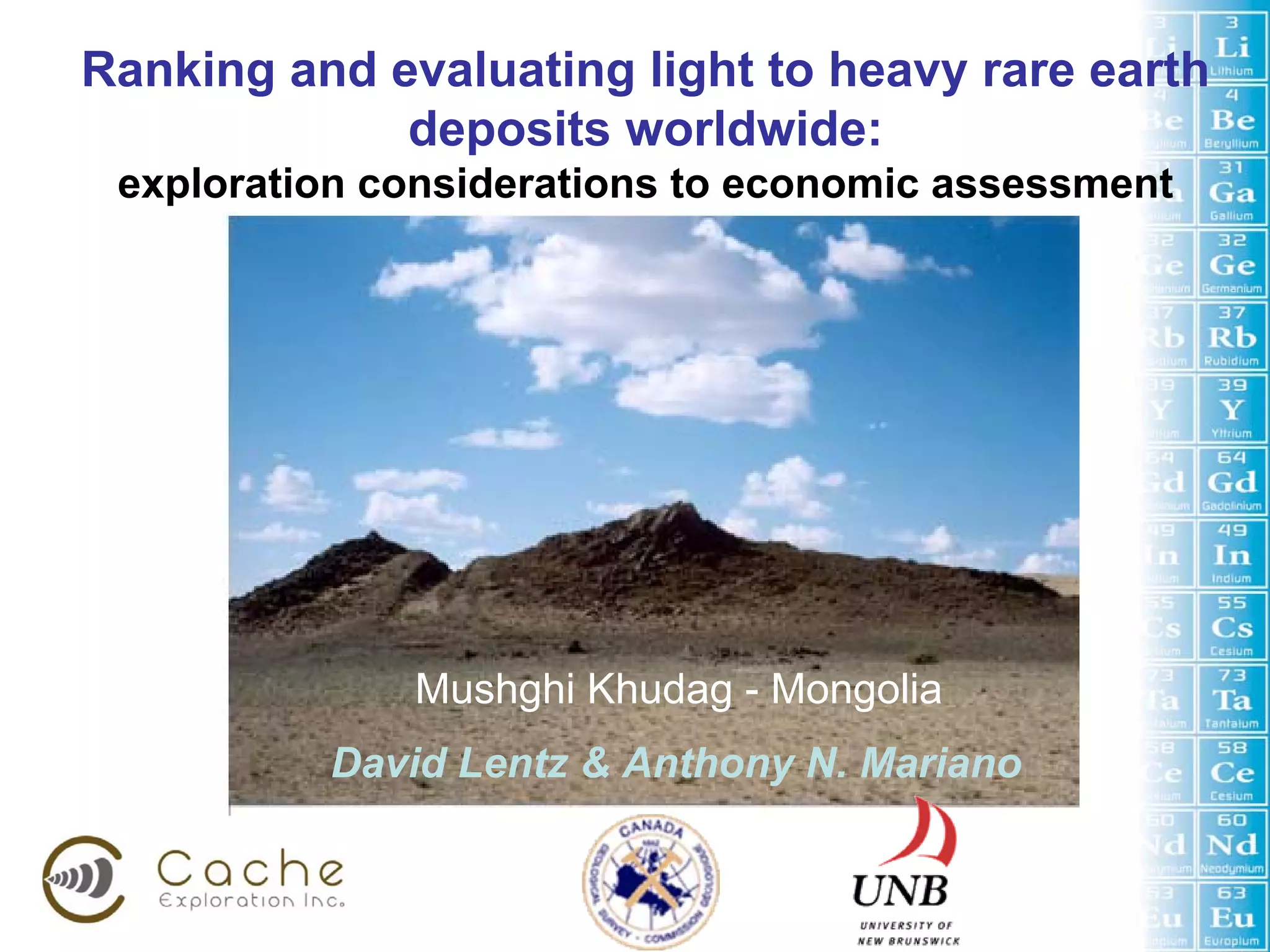
              Mushghi Khudag - Mongolia
          David Lentz & Anthony N. Mariano
Major Considerations
Assuming a favourable political climate and good logistics, conditions
determining the viability of deposits that can compete in the world market
are as follows…


 1) Mineralogy and favourable lanthanide distribution
 2) Grade and tonnage
  3) Amenability to mining and mineral processing at low costs, and
successful chemical cracking of the individual lanthanides for their
isolation
 4) Acceptable low values of accompanying deleterious impurities
 5) Minimum impact on the environment


 Any lower production costs can significantly reduce the grade
requirements
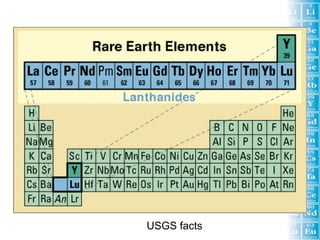
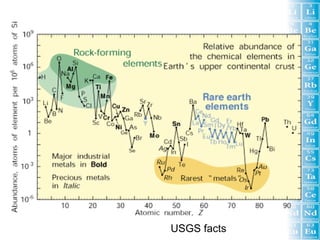
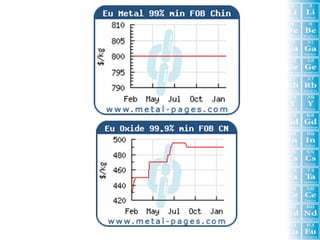
USGS facts
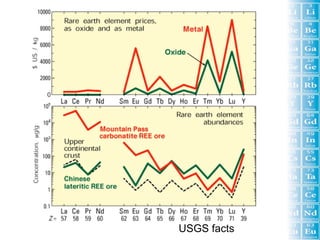
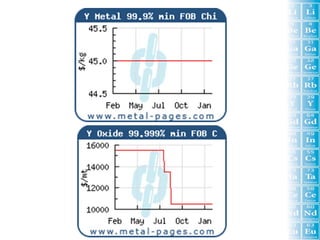
USGS facts
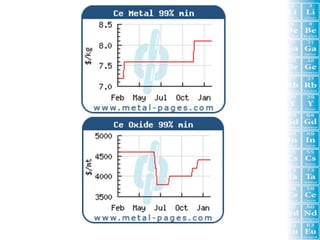
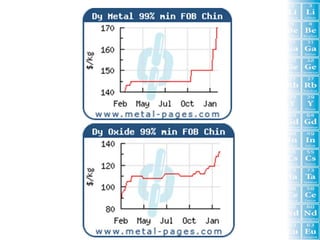
USGS facts
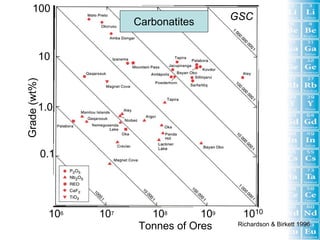
100
                                             GSC
                           Carbonatites


              10
Grade (wt%)


          1.0


              0.1


               106   107     108       109     1010
                           Tonnes of Ores     Richardson & Birkett 1996
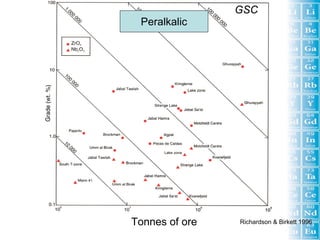
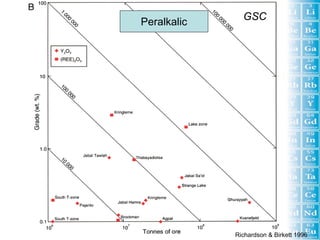
GSC
 Peralkalic


Tonnes of ore   Richardson & Birkett 1996
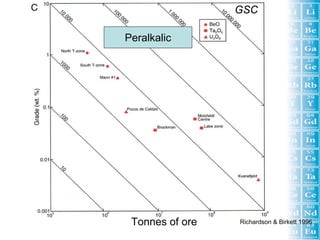
GSC
Peralkalic


             Richardson & Birkett 1996
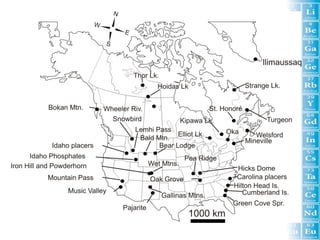
GSC

Peralkalic


 Tonnes of ore   Richardson & Birkett 1996
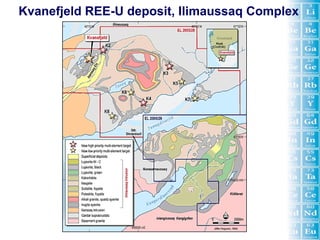
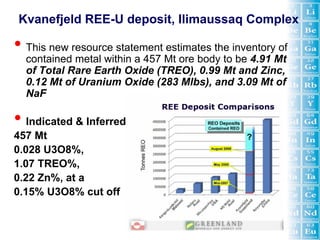
Kvanefjeld REE-U deposit, Ilimaussaq Complex

• This new resource statement estimates the inventory of
  contained metal within a 457 Mt ore body to be 4.91 Mt
  of Total Rare Earth Oxide (TREO), 0.99 Mt and Zinc,
  0.12 Mt of Uranium Oxide (283 Mlbs), and 3.09 Mt of
  NaF

• Indicated & Inferred
457 Mt
0.028 U3O8%,
1.07 TREO%,
0.22 Zn%, at a
0.15% U3O8% cut off
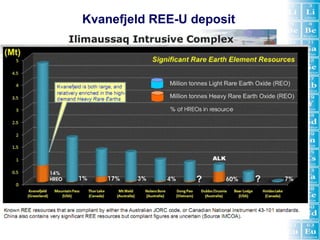
Kvanefjeld REE-U deposit
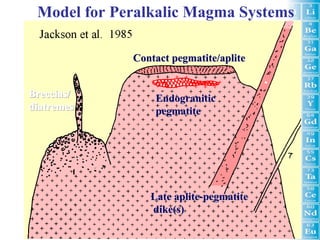
Model for Peralkalic Magma Systems

             Contact pegmatite/aplite


Breccias/        Endogranitic
diatremes        pegmatite


                Late aplite-pegmatite
                dike(s)
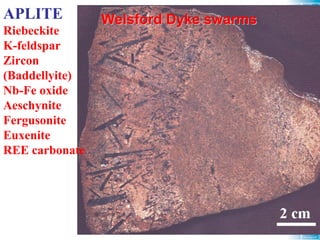
APLITE          Welsford Dyke swarms
Riebeckite
K-feldspar
Zircon
(Baddellyite)
Nb-Fe oxide
Aeschynite
Fergusonite
Euxenite
REE carbonate
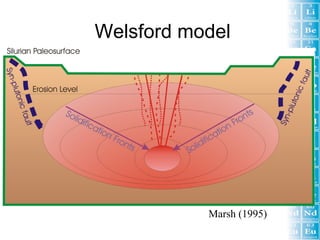
Welsford model


           Marsh (1995)
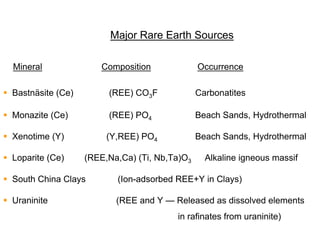
Major Rare Earth Sources

  Mineral               Composition             Occurrence

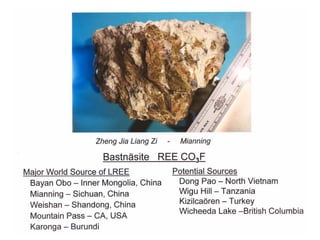
 Bastnäsite (Ce)        (REE) CO3F             Carbonatites

 Monazite (Ce)          (REE) PO4              Beach Sands, Hydrothermal

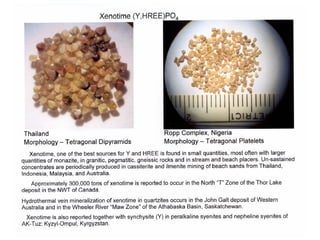
 Xenotime (Y)           (Y,REE) PO4            Beach Sands, Hydrothermal

 Loparite (Ce)     (REE,Na,Ca) (Ti, Nb,Ta)O3     Alkaline igneous massif

 South China Clays        (Ion-adsorbed REE+Y in Clays)

 Uraninite                (REE and Y — Released as dissolved elements
                                         in rafinates from uraninite)
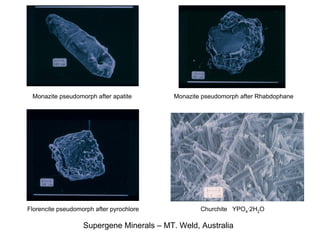
Monazite pseudomorph after apatite        Monazite pseudomorph after Rhabdophane


Florencite pseudomorph after pyrochlore            Churchite YPO4·2H2O

                   Supergene Minerals – MT. Weld, Australia
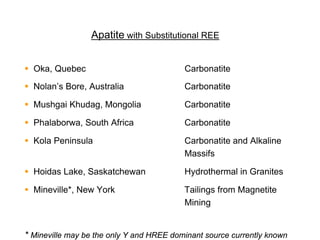
Apatite with Substitutional REE


 Oka, Quebec                             Carbonatite
 Nolan’s Bore, Australia                 Carbonatite

 Mushgai Khudag, Mongolia                Carbonatite

 Phalaborwa, South Africa                Carbonatite

 Kola Peninsula                          Carbonatite and Alkaline
                                          Massifs

 Hoidas Lake, Saskatchewan               Hydrothermal in Granites

 Mineville*, New York                    Tailings from Magnetite
                                          Mining


* Mineville may be the only Y and HREE dominant source currently known
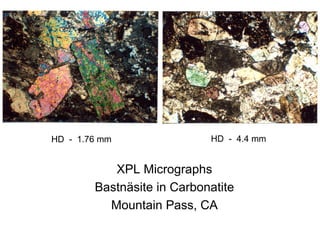
HD - 1.76 mm                HD - 4.4 mm


           XPL Micrographs
        Bastnäsite in Carbonatite
          Mountain Pass, CA
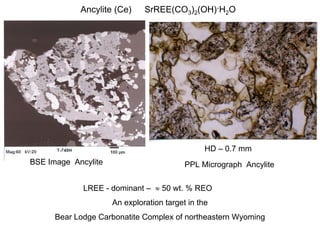
Ancylite (Ce)     SrREE(CO3)2(OH)·H2O


                                                HD – 0.7 mm
BSE Image Ancylite                        PPL Micrograph Ancylite

             LREE - dominant –  50 wt. % REO
                     An exploration target in the
      Bear Lodge Carbonatite Complex of northeastern Wyoming
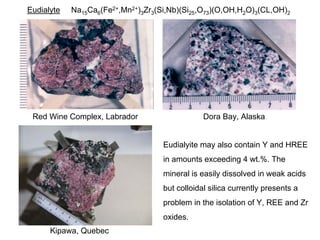
Eudialyte   Na15Ca6(Fe2+,Mn2+)3Zr3(Si,Nb)(Si25,O73)(O,OH,H2O)3(CL,OH)2


 Red Wine Complex, Labrador                     Dora Bay, Alaska


                                    Eudialyite may also contain Y and HREE
                                    in amounts exceeding 4 wt.%. The
                                    mineral is easily dissolved in weak acids
                                    but colloidal silica currently presents a
                                    problem in the isolation of Y, REE and Zr
                                    oxides.
      Kipawa, Quebec
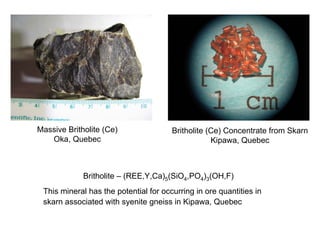
Massive Britholite (Ce)                Britholite (Ce) Concentrate from Skarn
   Oka, Quebec                                     Kipawa, Quebec


             Britholite – (REE,Y,Ca)5(SiO4,PO4)3(OH,F)
 This mineral has the potential for occurring in ore quantities in
 skarn associated with syenite gneiss in Kipawa, Quebec
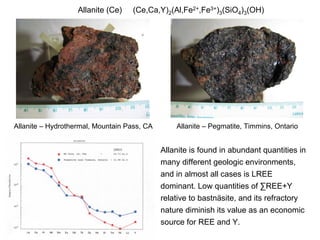
Allanite (Ce)    (Ce,Ca,Y)2(Al,Fe2+,Fe3+)3(SiO4)3(OH)


Allanite – Hydrothermal, Mountain Pass, CA       Allanite – Pegmatite, Timmins, Ontario


                                             Allanite is found in abundant quantities in
                                             many different geologic environments,
                                             and in almost all cases is LREE
                                             dominant. Low quantities of ∑REE+Y
                                             relative to bastnäsite, and its refractory
                                             nature diminish its value as an economic
                                             source for REE and Y.
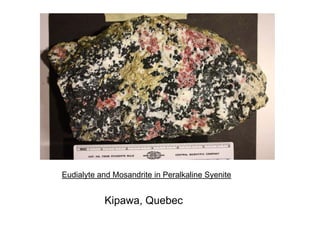
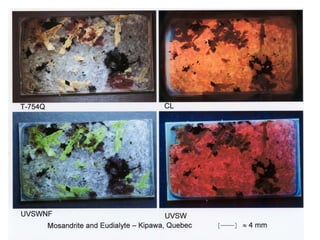
Eudialyte and Mosandrite in Peralkaline Syenite


           Kipawa, Quebec
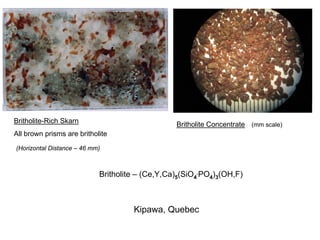
Britholite-Rich Skarn                            Britholite Concentrate (mm scale)
All brown prisms are britholite
(Horizontal Distance – 46 mm)


                            Britholite – (Ce,Y,Ca)5(SiO4.PO4)3(OH,F)


                                     Kipawa, Quebec
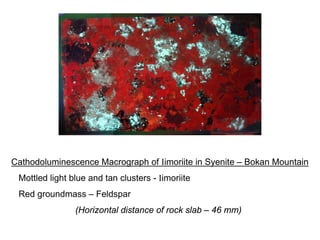
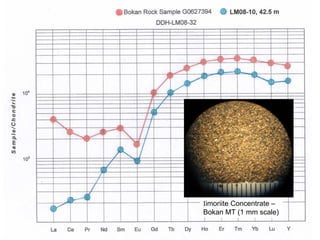
Cathodoluminescence Macrograph of Iimoriite in Syenite – Bokan Mountain
 Mottled light blue and tan clusters - Iimoriite
 Red groundmass – Feldspar
                (Horizontal distance of rock slab – 46 mm)
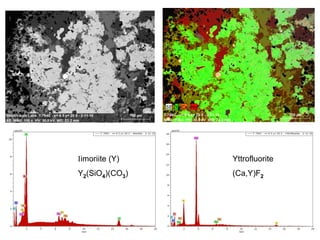
Iimoriite (Y)   Yttrofluorite
Y2(SiO4)(CO3)   (Ca,Y)F2
Iimoriite Concentrate –
Bokan MT (1 mm scale)
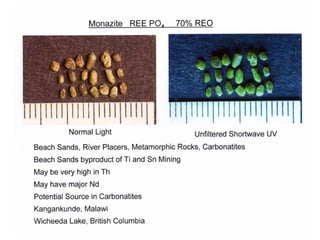
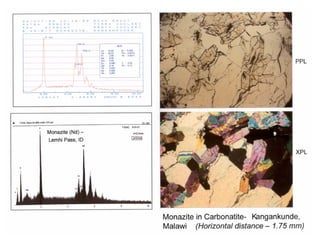
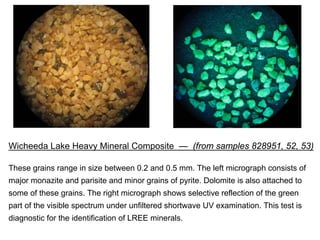
Wicheeda Lake Heavy Mineral Composite — (from samples 828951, 52, 53)

These grains range in size between 0.2 and 0.5 mm. The left micrograph consists of
major monazite and parisite and minor grains of pyrite. Dolomite is also attached to
some of these grains. The right micrograph shows selective reflection of the green
part of the visible spectrum under unfiltered shortwave UV examination. This test is
diagnostic for the identification of LREE minerals.
As a final statement it should be emphasized…

1) Carbonatites containing as much as 5 wt. % LREE must compete with
   Bayan Obo, Maoniuping, and Mountain Pass which have much higher
   grade, and have established physical and chemical processing plants.
2) Deposits that are mineralized with allanite and LREE-enriched apatite
   can not compete economically with carbonatites or peralkalic systems
   that have the high REE mineralogy.
3) Naturally higher radioactivity in all REE systems makes them easier to
   find with airborne and ground gamma-ray spectrometry.
4) Uraniferous systems commonly have anomalous LREE & HREE, which
   has been recovered in some deposits, i.e., rafinates from uranium
   mining
5) Although ion-adsorbed REE in clays from South China provide the bulk
   of HREE to the market place, in other countries, high costs for labor
   and necessary supplies, power costs, and environmental restrictions
   may render similar deposits uneconomical.
Rare Earth Elements
• Name something of a misnomer
  – Rarest REEs are over 200 times more
    abundant then gold


• Variation in distribution for two reasons
  – Compatibility with common rock forming
    materials
  – Cosmic/Crustal abundances
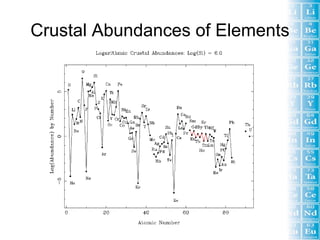
Crustal Abundances of Elements
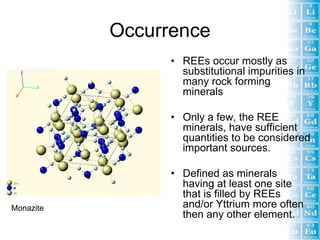
Occurrence
                 • REEs occur mostly as
                   substitutional impurities in
                   many rock forming
                   minerals

                 • Only a few, the REE
                   minerals, have sufficient
                   quantities to be considered
                   important sources.

                 • Defined as minerals
                   having at least one site
                   that is filled by REEs
Monazite           and/or Yttrium more often
                   then any other element.
Rare Earth Minerals
• Form by primary crystalization from
  magma or by hydrothermal reactions

• Found hosted in carbonate rocks, in
  pegmatites and as accessory minerals in
  igneous rocks.

• Stable REE minerals and can be
  concentrated in weathering zones.
REE Minerals
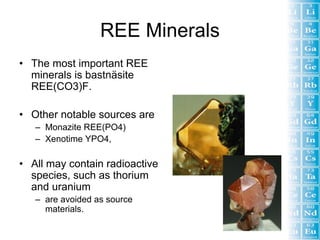
• The most important REE
  minerals is bastnäsite
  REE(CO3)F.

• Other notable sources are
   – Monazite REE(PO4)
   – Xenotime YPO4,

• All may contain radioactive
  species, such as thorium
  and uranium
   – are avoided as source
     materials.
Bastnesite
     • Bastnasite
       [(REE)(CO3)F], is the
       world’s most important
       source of rare earth
       elements

     • Containing 60 to 70%
       rare earth oxides
       (REOs)

     • REE site is most
       commonly filled by
       LREEs and Y
Other REE minerals
• Monazite [(LREE,Y,Th)PO4]
  – Contains about 50–78% rare earth oxides.
  – Forms in heavy mineral sands; placer deposits
    associated with beach environments


• Xenotime [(YPO4)]
  – Contains 54–65% rare earth oxides
  – Yttrium, Erbium and Cerium most common
  – Found in heavy mineral sands; can also be a
    component in pegmatite and igneous rocks.
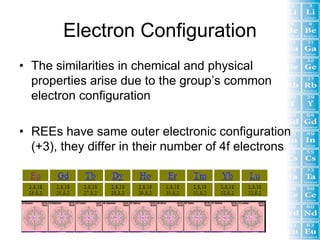
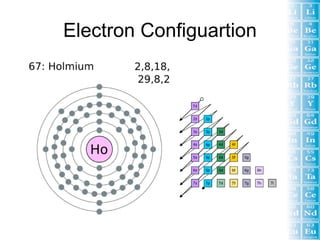
Electron Configuration
• The similarities in chemical and physical
  properties arise due to the group’s common
  electron configuration

• REEs have same outer electronic configuration
  (+3), they differ in their number of 4f electrons
Electron Configuartion
REE Behavior
• Because of their shared behaviour, REEs tend to be
  present in nature as a group. All REEs commonly
  substitute for one another in minerals.

• Yet, the REEs are capable of showing great variation in
  their distributions.

• Comes about due to:
   –   Differences in ionic radius;
   –   Crystal structure (Coordination Number)
   –   Basicity of the mineral
   –   The element’s solubility and ability to migrate in the environment
   –   Content of REEs in source fluids,
Ionic Radius
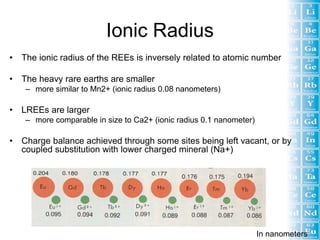
•   The ionic radius of the REEs is inversely related to atomic number

•   The heavy rare earths are smaller
     – more similar to Mn2+ (ionic radius 0.08 nanometers)

•   LREEs are larger
     – more comparable in size to Ca2+ (ionic radius 0.1 nanometer)

•   Charge balance achieved through some sites being left vacant, or by
    coupled substitution with lower charged mineral (Na+)


                                                                      In nanometers
Coordination Number
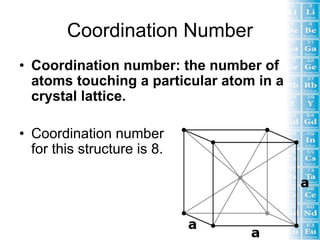
• Coordination number: the number of
  atoms touching a particular atom in a
  crystal lattice.

• Coordination number
  for this structure is 8.
Coordination Number
• The heavy and light REEs differ in the coordination
  numbers (CN) with oxygen
   – HREEs have CN between six to nine
   – LREEs have higher CNs

• Minerals with high CNs associated with REE site will
  favor LREEs
   – Bastnasite CN = 11
   – Monazite CN = 9


• Those with low CNs will preferentially select HREEs.
   – Xenotime has a value of 8
Other Factors
• Minerals basicity
   – Alkalic rocks host minerals with elevated LREE content
   – Rocks with lower basicity have lower amounts of LREEs relative
     to their HREE content


• Solubility
   – LREEs are more soluble in water then the HREEs
   – Important characteristic for hydrothermally derived minerals


• Magma/Hydrothermal fluid composition
   – Minerals will take what they can get
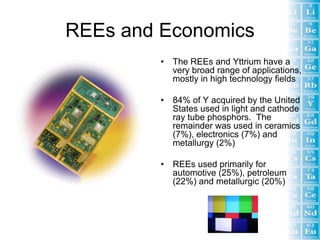
REEs and Economics
         •   The REEs and Yttrium have a
             very broad range of applications,
             mostly in high technology fields

         •   84% of Y acquired by the United
             States used in light and cathode
             ray tube phosphors. The
             remainder was used in ceramics
             (7%), electronics (7%) and
             metallurgy (2%)

         •   REEs used primarily for
             automotive (25%), petroleum
             (22%) and metallurgic (20%)
HREEs and Magnetism


• HREEs exhibit complex magnetic
  behaviour on account of electron structure
  – They share the same outer shell electron
    configuration (valence = +3)
  – Differ in number of 4f electrons
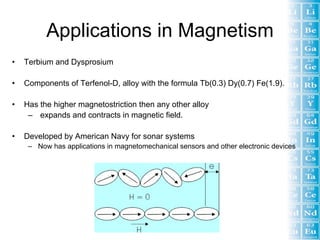
Applications in Magnetism
•   Terbium and Dysprosium

•   Components of Terfenol-D, alloy with the formula Tb(0.3) Dy(0.7) Fe(1.9).

•   Has the higher magnetostriction then any other alloy
     – expands and contracts in magnetic field.

•   Developed by American Navy for sonar systems
     – Now has applications in magnetomechanical sensors and other electronic devices
Applications in Magnetism
• Holmium

• Possesses the highest magnetic moment
  (10.6µB) of any of the naturally-occurring
  elements

• Creates the strongest artificially generated
  magnetic fields
  – In research where strong magnetic fields are needed
HREEs and Nuclear Technology
• Dysprosium, Homium, Erbium

• High neutron absorption cross-section
  – Measure of probability of neutron capture


• Used in neutron-absorbing control rods in
  nuclear reactors
HREEs and Nuclear Technology
• Lutetium
• Radioactive isotope used in radiometric
  dating.

• Thulium
• Stable thulium used as a radiation source
  in portable X-ray devices.
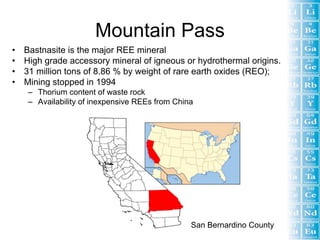
Mountain Pass
• Bastnasite is the major REE mineral
• High grade accessory mineral of igneous or hydrothermal origins.
• 31 million tons of 8.86 % by weight of rare earth oxides (REO);
• Mining stopped in 1994
   – Thorium content of waste rock
   – Availability of inexpensive REEs from China


                                               San Bernardino County
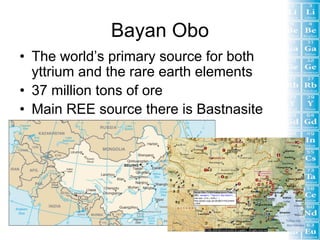
Bayan Obo
• The world’s primary source for both
  yttrium and the rare earth elements
• 37 million tons of ore
• Main REE source there is Bastnasite
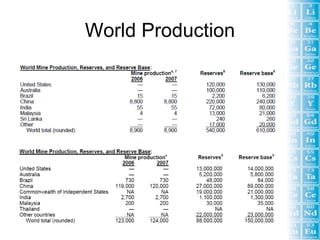
World Production
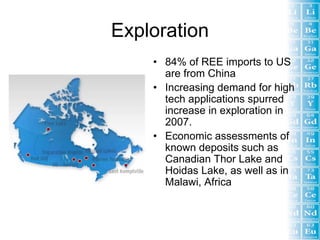
Exploration
    • 84% of REE imports to US
      are from China
    • Increasing demand for high
      tech applications spurred
      increase in exploration in
      2007.
    • Economic assessments of
      known deposits such as
      Canadian Thor Lake and
      Hoidas Lake, as well as in
      Malawi, Africa
Environmental Considerations
• REE soil and food contamination
• Acid Mine Drainage and groundwater
  systems
• Radioactive elements
REE Fertilizer
• In China, REE enriched fertilizer has been used in crop
  fields since 1990.

• At the turn of the century, 50 to 100 million tons of REEs
  were being applied to an area of about 4 million hectares
  every year.
• Research and agricultural practice that provides
  evidence that REEs will improve crop quality an yield.
• The ramifications environmental and human exposure to
  REEs are not well understood.
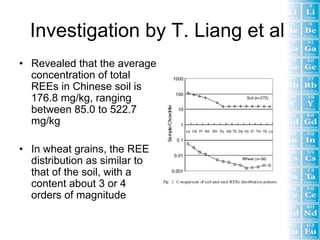
Investigation by T. Liang et al.
• Revealed that the average
  concentration of total
  REEs in Chinese soil is
  176.8 mg/kg, ranging
  between 85.0 to 522.7
  mg/kg

• In wheat grains, the REE
  distribution as similar to
  that of the soil, with a
  content about 3 or 4
  orders of magnitude
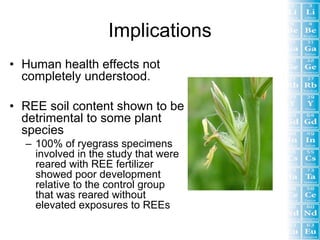
Implications
• Human health effects not
  completely understood.

• REE soil content shown to be
  detrimental to some plant
  species
  – 100% of ryegrass specimens
    involved in the study that were
    reared with REE fertilizer
    showed poor development
    relative to the control group
    that was reared without
    elevated exposures to REEs
Acid Mine Drainage (AMD)
• Rain waters contacts waste rock, facilitating acid forming
  reactions

• Increases the capacity of the water to leach potentially
  harmful elements from waste piles.

• Process mobilizes established ecotoxins (lead and
  mercury) as well as elements whose effects are less
  understood, namely the rare earth elements.

• Historically dismissed as minor environmental risk
Radioactive Elements
• REEs associated with uranium and
  thorium

• Bastnesite: 3.2% thorium

• Monazite sands: 6 to 12% thorium oxide

• Ores containing radioactive elements are
  avoided as sources of REEs
Radioactive Hazards
•   Mountain Pass

•   Accidents
     – In 1977, major pipeline break spilled over 2 million gallons of radioactive
       water

•   Health Effects
     –   inflammatory bowel disease
     –   Prolonged seizures
     –   Cysts
     –   Cancers

•   Waste Disposal
     – Yucca Mountain
Summary
•   REE concentrations in the crust are rare

•   Several geochemical factors influencing distribution, including ionic
    radius and coordination number

•   Main REE minerals are bastnasite, monazite and xenotime

•   Most important deposits are found at Bayan Obo, China and
    Mountain Pass, USA.

•   Important electronic and nuclear applications

•   Environmental concerns associated with REE production and use
    are exposure to the environment and people, liberation and water
    system contamination though acid mine drainage, association with
    radioactive elements.
References
•   E. Orvini, M. Speziali, A. Salvini, C. Herborg, “Rare earth elements determination in environmental matrices by
    INAA”, Microchemical Journal, 67, 2000, 97-104
•   Tao Liang et al., “Environmental biogeochemical behaviors of rare earth elements in soi-plant systems”,
    Environmental Geochemistry and health, 27, 2005, 301-311
•   G. Protano and F. Riccobono, “High contents of rare earth elements (REEs) in stream wates of a CU-Pb-Zn
    mining area”, Environmental Pollution, 117, 2002, 499-514
•   B Lipin “Geochemistry and mineralogy of rare earth elements”, Mineralogical Association of America, 1989
•   The Government of South Australia: www.pir.sa.gov.au
•   The US geological Survey: Minerals.usgs.gov
•   www.elementsdatabase.com/
•   www.astro.lsa.umich.edu/~cowley/intro2.html
•   www.johnbetts-fineminerals.com/jhbnyc/gifs/40129.htm
•   webmineral.com/data/Monazite-(Ce).shtml
•   www.nature.com/nature/journal/v446/n7136/abs/nature05668.html
•   www.steve.gb.com/images/science/orbital_filling.png
•   www.chemicalelements.com/elements/eu.html
•   boomeria.org/chemlectures/textass2/table10-9.jpg
•   lost.contentquake.com/files/2008/02/holmium.png
•   china.geocitylocator.com/cities/China/Qinghai/
•   geo.web.ru/druza/l-Bayan-Obo.htm
•   en.wikipedia.org/wiki/San_Bernardino_County,_California
•   www.worldcountries.info/Maps/Region/Europe-450-Italy.jpg
•   en.wikipedia.org/wiki/Monazite
•   webmineral.com/data/Bastnasite-(La).shtml
•   www.gbrw.org/index.php?option=com_content&view=category&layout=blog&id=58&Itemid=73
•   http://www.avalonventures.com
•   www.newsweek.com/id/43884
•   http://accipiter.hawk-conservancy.org/MeadowMuses/200608.shtml
•   http://www.cse.scitech.ac.uk/about_us/Frontiers2007/Hughes%20-%20Lanthanide%20contraction%20-
    %20CSE%20Frontiers%202007.pdf

Ranking Light to Heavy Rare Earth Deposits Worldwide

  • 1.
    Ranking and evaluatinglight to heavy rare earth deposits worldwide: exploration considerations to economic assessment Mushghi Khudag - Mongolia David Lentz & Anthony N. Mariano
  • 2.
    Major Considerations Assuming afavourable political climate and good logistics, conditions determining the viability of deposits that can compete in the world market are as follows… 1) Mineralogy and favourable lanthanide distribution 2) Grade and tonnage 3) Amenability to mining and mineral processing at low costs, and successful chemical cracking of the individual lanthanides for their isolation 4) Acceptable low values of accompanying deleterious impurities 5) Minimum impact on the environment Any lower production costs can significantly reduce the grade requirements
  • 4.
  • 5.
  • 6.
  • 11.
    100 GSC Carbonatites 10 Grade (wt%) 1.0 0.1 106 107 108 109 1010 Tonnes of Ores Richardson & Birkett 1996
  • 12.
    GSC Peralkalic Tonnes ofore Richardson & Birkett 1996
  • 13.
    GSC Peralkalic Richardson & Birkett 1996
  • 14.
    GSC Peralkalic Tonnes ofore Richardson & Birkett 1996
  • 16.
    Kvanefjeld REE-U deposit,Ilimaussaq Complex
  • 17.
    Kvanefjeld REE-U deposit,Ilimaussaq Complex • This new resource statement estimates the inventory of contained metal within a 457 Mt ore body to be 4.91 Mt of Total Rare Earth Oxide (TREO), 0.99 Mt and Zinc, 0.12 Mt of Uranium Oxide (283 Mlbs), and 3.09 Mt of NaF • Indicated & Inferred 457 Mt 0.028 U3O8%, 1.07 TREO%, 0.22 Zn%, at a 0.15% U3O8% cut off
  • 18.
  • 20.
    Model for PeralkalicMagma Systems Contact pegmatite/aplite Breccias/ Endogranitic diatremes pegmatite Late aplite-pegmatite dike(s)
  • 21.
    APLITE Welsford Dyke swarms Riebeckite K-feldspar Zircon (Baddellyite) Nb-Fe oxide Aeschynite Fergusonite Euxenite REE carbonate
  • 22.
    Welsford model Marsh (1995)
  • 23.
    Major Rare EarthSources Mineral Composition Occurrence  Bastnäsite (Ce) (REE) CO3F Carbonatites  Monazite (Ce) (REE) PO4 Beach Sands, Hydrothermal  Xenotime (Y) (Y,REE) PO4 Beach Sands, Hydrothermal  Loparite (Ce) (REE,Na,Ca) (Ti, Nb,Ta)O3 Alkaline igneous massif  South China Clays (Ion-adsorbed REE+Y in Clays)  Uraninite (REE and Y — Released as dissolved elements in rafinates from uraninite)
  • 26.
    Monazite pseudomorph afterapatite Monazite pseudomorph after Rhabdophane Florencite pseudomorph after pyrochlore Churchite YPO4·2H2O Supergene Minerals – MT. Weld, Australia
  • 27.
    Apatite with SubstitutionalREE  Oka, Quebec Carbonatite  Nolan’s Bore, Australia Carbonatite  Mushgai Khudag, Mongolia Carbonatite  Phalaborwa, South Africa Carbonatite  Kola Peninsula Carbonatite and Alkaline Massifs  Hoidas Lake, Saskatchewan Hydrothermal in Granites  Mineville*, New York Tailings from Magnetite Mining * Mineville may be the only Y and HREE dominant source currently known
  • 32.
    HD - 1.76mm HD - 4.4 mm XPL Micrographs Bastnäsite in Carbonatite Mountain Pass, CA
  • 36.
    Ancylite (Ce) SrREE(CO3)2(OH)·H2O HD – 0.7 mm BSE Image Ancylite PPL Micrograph Ancylite LREE - dominant –  50 wt. % REO An exploration target in the Bear Lodge Carbonatite Complex of northeastern Wyoming
  • 37.
    Eudialyte Na15Ca6(Fe2+,Mn2+)3Zr3(Si,Nb)(Si25,O73)(O,OH,H2O)3(CL,OH)2 Red Wine Complex, Labrador Dora Bay, Alaska Eudialyite may also contain Y and HREE in amounts exceeding 4 wt.%. The mineral is easily dissolved in weak acids but colloidal silica currently presents a problem in the isolation of Y, REE and Zr oxides. Kipawa, Quebec
  • 38.
    Massive Britholite (Ce) Britholite (Ce) Concentrate from Skarn Oka, Quebec Kipawa, Quebec Britholite – (REE,Y,Ca)5(SiO4,PO4)3(OH,F) This mineral has the potential for occurring in ore quantities in skarn associated with syenite gneiss in Kipawa, Quebec
  • 39.
    Allanite (Ce) (Ce,Ca,Y)2(Al,Fe2+,Fe3+)3(SiO4)3(OH) Allanite – Hydrothermal, Mountain Pass, CA Allanite – Pegmatite, Timmins, Ontario Allanite is found in abundant quantities in many different geologic environments, and in almost all cases is LREE dominant. Low quantities of ∑REE+Y relative to bastnäsite, and its refractory nature diminish its value as an economic source for REE and Y.
  • 42.
    Eudialyte and Mosandritein Peralkaline Syenite Kipawa, Quebec
  • 44.
    Britholite-Rich Skarn Britholite Concentrate (mm scale) All brown prisms are britholite (Horizontal Distance – 46 mm) Britholite – (Ce,Y,Ca)5(SiO4.PO4)3(OH,F) Kipawa, Quebec
  • 46.
    Cathodoluminescence Macrograph ofIimoriite in Syenite – Bokan Mountain Mottled light blue and tan clusters - Iimoriite Red groundmass – Feldspar (Horizontal distance of rock slab – 46 mm)
  • 47.
    Iimoriite (Y) Yttrofluorite Y2(SiO4)(CO3) (Ca,Y)F2
  • 48.
  • 49.
    Wicheeda Lake HeavyMineral Composite — (from samples 828951, 52, 53) These grains range in size between 0.2 and 0.5 mm. The left micrograph consists of major monazite and parisite and minor grains of pyrite. Dolomite is also attached to some of these grains. The right micrograph shows selective reflection of the green part of the visible spectrum under unfiltered shortwave UV examination. This test is diagnostic for the identification of LREE minerals.
  • 50.
    As a finalstatement it should be emphasized… 1) Carbonatites containing as much as 5 wt. % LREE must compete with Bayan Obo, Maoniuping, and Mountain Pass which have much higher grade, and have established physical and chemical processing plants. 2) Deposits that are mineralized with allanite and LREE-enriched apatite can not compete economically with carbonatites or peralkalic systems that have the high REE mineralogy. 3) Naturally higher radioactivity in all REE systems makes them easier to find with airborne and ground gamma-ray spectrometry. 4) Uraniferous systems commonly have anomalous LREE & HREE, which has been recovered in some deposits, i.e., rafinates from uranium mining 5) Although ion-adsorbed REE in clays from South China provide the bulk of HREE to the market place, in other countries, high costs for labor and necessary supplies, power costs, and environmental restrictions may render similar deposits uneconomical.
  • 52.
    Rare Earth Elements •Name something of a misnomer – Rarest REEs are over 200 times more abundant then gold • Variation in distribution for two reasons – Compatibility with common rock forming materials – Cosmic/Crustal abundances
  • 53.
  • 54.
    Occurrence • REEs occur mostly as substitutional impurities in many rock forming minerals • Only a few, the REE minerals, have sufficient quantities to be considered important sources. • Defined as minerals having at least one site that is filled by REEs Monazite and/or Yttrium more often then any other element.
  • 55.
    Rare Earth Minerals •Form by primary crystalization from magma or by hydrothermal reactions • Found hosted in carbonate rocks, in pegmatites and as accessory minerals in igneous rocks. • Stable REE minerals and can be concentrated in weathering zones.
  • 56.
    REE Minerals • Themost important REE minerals is bastnäsite REE(CO3)F. • Other notable sources are – Monazite REE(PO4) – Xenotime YPO4, • All may contain radioactive species, such as thorium and uranium – are avoided as source materials.
  • 57.
    Bastnesite • Bastnasite [(REE)(CO3)F], is the world’s most important source of rare earth elements • Containing 60 to 70% rare earth oxides (REOs) • REE site is most commonly filled by LREEs and Y
  • 58.
    Other REE minerals •Monazite [(LREE,Y,Th)PO4] – Contains about 50–78% rare earth oxides. – Forms in heavy mineral sands; placer deposits associated with beach environments • Xenotime [(YPO4)] – Contains 54–65% rare earth oxides – Yttrium, Erbium and Cerium most common – Found in heavy mineral sands; can also be a component in pegmatite and igneous rocks.
  • 59.
    Electron Configuration • Thesimilarities in chemical and physical properties arise due to the group’s common electron configuration • REEs have same outer electronic configuration (+3), they differ in their number of 4f electrons
  • 60.
  • 61.
    REE Behavior • Becauseof their shared behaviour, REEs tend to be present in nature as a group. All REEs commonly substitute for one another in minerals. • Yet, the REEs are capable of showing great variation in their distributions. • Comes about due to: – Differences in ionic radius; – Crystal structure (Coordination Number) – Basicity of the mineral – The element’s solubility and ability to migrate in the environment – Content of REEs in source fluids,
  • 62.
    Ionic Radius • The ionic radius of the REEs is inversely related to atomic number • The heavy rare earths are smaller – more similar to Mn2+ (ionic radius 0.08 nanometers) • LREEs are larger – more comparable in size to Ca2+ (ionic radius 0.1 nanometer) • Charge balance achieved through some sites being left vacant, or by coupled substitution with lower charged mineral (Na+) In nanometers
  • 63.
    Coordination Number • Coordinationnumber: the number of atoms touching a particular atom in a crystal lattice. • Coordination number for this structure is 8.
  • 64.
    Coordination Number • Theheavy and light REEs differ in the coordination numbers (CN) with oxygen – HREEs have CN between six to nine – LREEs have higher CNs • Minerals with high CNs associated with REE site will favor LREEs – Bastnasite CN = 11 – Monazite CN = 9 • Those with low CNs will preferentially select HREEs. – Xenotime has a value of 8
  • 65.
    Other Factors • Mineralsbasicity – Alkalic rocks host minerals with elevated LREE content – Rocks with lower basicity have lower amounts of LREEs relative to their HREE content • Solubility – LREEs are more soluble in water then the HREEs – Important characteristic for hydrothermally derived minerals • Magma/Hydrothermal fluid composition – Minerals will take what they can get
  • 66.
    REEs and Economics • The REEs and Yttrium have a very broad range of applications, mostly in high technology fields • 84% of Y acquired by the United States used in light and cathode ray tube phosphors. The remainder was used in ceramics (7%), electronics (7%) and metallurgy (2%) • REEs used primarily for automotive (25%), petroleum (22%) and metallurgic (20%)
  • 67.
    HREEs and Magnetism •HREEs exhibit complex magnetic behaviour on account of electron structure – They share the same outer shell electron configuration (valence = +3) – Differ in number of 4f electrons
  • 68.
    Applications in Magnetism • Terbium and Dysprosium • Components of Terfenol-D, alloy with the formula Tb(0.3) Dy(0.7) Fe(1.9). • Has the higher magnetostriction then any other alloy – expands and contracts in magnetic field. • Developed by American Navy for sonar systems – Now has applications in magnetomechanical sensors and other electronic devices
  • 69.
    Applications in Magnetism •Holmium • Possesses the highest magnetic moment (10.6µB) of any of the naturally-occurring elements • Creates the strongest artificially generated magnetic fields – In research where strong magnetic fields are needed
  • 70.
    HREEs and NuclearTechnology • Dysprosium, Homium, Erbium • High neutron absorption cross-section – Measure of probability of neutron capture • Used in neutron-absorbing control rods in nuclear reactors
  • 71.
    HREEs and NuclearTechnology • Lutetium • Radioactive isotope used in radiometric dating. • Thulium • Stable thulium used as a radiation source in portable X-ray devices.
  • 72.
    Mountain Pass • Bastnasiteis the major REE mineral • High grade accessory mineral of igneous or hydrothermal origins. • 31 million tons of 8.86 % by weight of rare earth oxides (REO); • Mining stopped in 1994 – Thorium content of waste rock – Availability of inexpensive REEs from China San Bernardino County
  • 73.
    Bayan Obo • Theworld’s primary source for both yttrium and the rare earth elements • 37 million tons of ore • Main REE source there is Bastnasite
  • 74.
  • 75.
    Exploration • 84% of REE imports to US are from China • Increasing demand for high tech applications spurred increase in exploration in 2007. • Economic assessments of known deposits such as Canadian Thor Lake and Hoidas Lake, as well as in Malawi, Africa
  • 76.
    Environmental Considerations • REEsoil and food contamination • Acid Mine Drainage and groundwater systems • Radioactive elements
  • 77.
    REE Fertilizer • InChina, REE enriched fertilizer has been used in crop fields since 1990. • At the turn of the century, 50 to 100 million tons of REEs were being applied to an area of about 4 million hectares every year. • Research and agricultural practice that provides evidence that REEs will improve crop quality an yield. • The ramifications environmental and human exposure to REEs are not well understood.
  • 78.
    Investigation by T.Liang et al. • Revealed that the average concentration of total REEs in Chinese soil is 176.8 mg/kg, ranging between 85.0 to 522.7 mg/kg • In wheat grains, the REE distribution as similar to that of the soil, with a content about 3 or 4 orders of magnitude
  • 79.
    Implications • Human healtheffects not completely understood. • REE soil content shown to be detrimental to some plant species – 100% of ryegrass specimens involved in the study that were reared with REE fertilizer showed poor development relative to the control group that was reared without elevated exposures to REEs
  • 80.
    Acid Mine Drainage(AMD) • Rain waters contacts waste rock, facilitating acid forming reactions • Increases the capacity of the water to leach potentially harmful elements from waste piles. • Process mobilizes established ecotoxins (lead and mercury) as well as elements whose effects are less understood, namely the rare earth elements. • Historically dismissed as minor environmental risk
  • 81.
    Radioactive Elements • REEsassociated with uranium and thorium • Bastnesite: 3.2% thorium • Monazite sands: 6 to 12% thorium oxide • Ores containing radioactive elements are avoided as sources of REEs
  • 82.
    Radioactive Hazards • Mountain Pass • Accidents – In 1977, major pipeline break spilled over 2 million gallons of radioactive water • Health Effects – inflammatory bowel disease – Prolonged seizures – Cysts – Cancers • Waste Disposal – Yucca Mountain
  • 83.
    Summary • REE concentrations in the crust are rare • Several geochemical factors influencing distribution, including ionic radius and coordination number • Main REE minerals are bastnasite, monazite and xenotime • Most important deposits are found at Bayan Obo, China and Mountain Pass, USA. • Important electronic and nuclear applications • Environmental concerns associated with REE production and use are exposure to the environment and people, liberation and water system contamination though acid mine drainage, association with radioactive elements.
  • 84.
    References • E. Orvini, M. Speziali, A. Salvini, C. Herborg, “Rare earth elements determination in environmental matrices by INAA”, Microchemical Journal, 67, 2000, 97-104 • Tao Liang et al., “Environmental biogeochemical behaviors of rare earth elements in soi-plant systems”, Environmental Geochemistry and health, 27, 2005, 301-311 • G. Protano and F. Riccobono, “High contents of rare earth elements (REEs) in stream wates of a CU-Pb-Zn mining area”, Environmental Pollution, 117, 2002, 499-514 • B Lipin “Geochemistry and mineralogy of rare earth elements”, Mineralogical Association of America, 1989 • The Government of South Australia: www.pir.sa.gov.au • The US geological Survey: Minerals.usgs.gov • www.elementsdatabase.com/ • www.astro.lsa.umich.edu/~cowley/intro2.html • www.johnbetts-fineminerals.com/jhbnyc/gifs/40129.htm • webmineral.com/data/Monazite-(Ce).shtml • www.nature.com/nature/journal/v446/n7136/abs/nature05668.html • www.steve.gb.com/images/science/orbital_filling.png • www.chemicalelements.com/elements/eu.html • boomeria.org/chemlectures/textass2/table10-9.jpg • lost.contentquake.com/files/2008/02/holmium.png • china.geocitylocator.com/cities/China/Qinghai/ • geo.web.ru/druza/l-Bayan-Obo.htm • en.wikipedia.org/wiki/San_Bernardino_County,_California • www.worldcountries.info/Maps/Region/Europe-450-Italy.jpg • en.wikipedia.org/wiki/Monazite • webmineral.com/data/Bastnasite-(La).shtml • www.gbrw.org/index.php?option=com_content&view=category&layout=blog&id=58&Itemid=73 • http://www.avalonventures.com • www.newsweek.com/id/43884 • http://accipiter.hawk-conservancy.org/MeadowMuses/200608.shtml • http://www.cse.scitech.ac.uk/about_us/Frontiers2007/Hughes%20-%20Lanthanide%20contraction%20- %20CSE%20Frontiers%202007.pdf