Rare Earth Elements
Whatdo we know about them?
James R. Kuipers, P.E., Kuipers & Associates
Presented at
Western Mining Action Network 2011 Conference
“Working Together As One: Sustaining Water, Culture and Healthy
Communities”.
Saskatchewan, Canada
2.
Rare Earth Elements
WhatAre They?
– The 30 rare earth elements are composed of the
lanthanide and actinide series.
• One element of the lanthanide series and most of the
elements in the actinide series are called trans-uranium,
which means synthetic or man-made.
– 17 common rare earth elements found in nature:
cerium, dysprosium, erbium, europium, gadolinium,
holmium, lanthanum, lutetium, neodymium,
praseodymium, samarium, terbium, thulium, ytterbium,
yttrium, ferrocerium, monazite, bastnasite, mischmetal
3.
Rare Earth Elements
Presentand Future Uses
• Estimated 2009 distribution of rare earths by end use, in decreasing order,
was as follows (USGS 2011):
– chemical catalysts, 22%;
– metallurgical applications and alloys, 21%;
– petroleum refining catalysts, 14%;
– automotive catalytic converters, 13%;
– glass polishing and ceramics, 9%;
– rare-earth phosphors for computer monitors, lighting, radar, televisions, and x-ray-intensifying
film, 8%;
– permanent magnets, 7%;
– electronics, 3%;
– and other, 3%.
• The trend appears to be for a continued increase in the use of rare earths in
many applications, especially automotive catalytic converters, permanent
magnets, and rechargeable batteries for electric and hybrid vehicles.
4.
Rare Earth Elements
Occurrence
–First discovered in the 19th Century in Sweden, they were believed to be some of the
most uncommon elements.
– Rare-earths have been found to be relatively abundant in the Earth's crust, but rarely
concentrated.
– High cost of extraction means that only deposits with high concentrations are likely to be
developed.
Rare earth minerals are usually found in association with alkaline to peralkaline igneous
complexes, in pegmatites associated with alkaline magmas and in or associated with
carbonatite intrusives. Perovskite mineral phases are common hosts to rare earth
elements within the alkaline complexes. Mantle derived carbonate melts also are
carriers of the rare earths. Hydrothermal deposits associated with alkaline magmatism
contain a variety of rare earth minerals.
5.
Rare Earth Elements
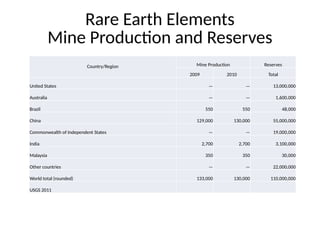
MineProduction and Reserves
Country/Region Mine Production Reserves
2009 2010 Total
United States — — 13,000,000
Australia — — 1,600,000
Brazil 550 550 48,000
China 129,000 130,000 55,000,000
Commonwealth of Independent States — — 19,000,000
India 2,700 2,700 3,100,000
Malaysia 350 350 30,000
Other countries — — 22,000,000
World total (rounded) 133,000 130,000 110,000,000
USGS 2011
6.
Rare Earth Elements
WorldResources
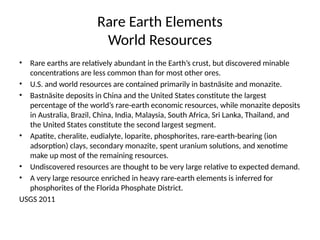
• Rare earths are relatively abundant in the Earth’s crust, but discovered minable
concentrations are less common than for most other ores.
• U.S. and world resources are contained primarily in bastnäsite and monazite.
• Bastnäsite deposits in China and the United States constitute the largest
percentage of the world’s rare-earth economic resources, while monazite deposits
in Australia, Brazil, China, India, Malaysia, South Africa, Sri Lanka, Thailand, and
the United States constitute the second largest segment.
• Apatite, cheralite, eudialyte, loparite, phosphorites, rare-earth-bearing (ion
adsorption) clays, secondary monazite, spent uranium solutions, and xenotime
make up most of the remaining resources.
• Undiscovered resources are thought to be very large relative to expected demand.
• A very large resource enriched in heavy rare-earth elements is inferred for
phosphorites of the Florida Phosphate District.
USGS 2011
7.
Rare Earth Elements
FutureMines
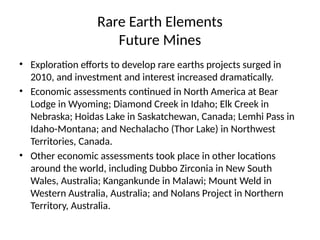
• Exploration efforts to develop rare earths projects surged in
2010, and investment and interest increased dramatically.
• Economic assessments continued in North America at Bear
Lodge in Wyoming; Diamond Creek in Idaho; Elk Creek in
Nebraska; Hoidas Lake in Saskatchewan, Canada; Lemhi Pass in
Idaho-Montana; and Nechalacho (Thor Lake) in Northwest
Territories, Canada.
• Other economic assessments took place in other locations
around the world, including Dubbo Zirconia in New South
Wales, Australia; Kangankunde in Malawi; Mount Weld in
Western Australia, Australia; and Nolans Project in Northern
Territory, Australia.
8.
Rare Earth Elements
Mining,Processing and Refining
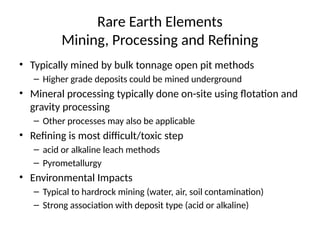
• Typically mined by bulk tonnage open pit methods
– Higher grade deposits could be mined underground
• Mineral processing typically done on-site using flotation and
gravity processing
– Other processes may also be applicable
• Refining is most difficult/toxic step
– acid or alkaline leach methods
– Pyrometallurgy
• Environmental Impacts
– Typical to hardrock mining (water, air, soil contamination)
– Strong association with deposit type (acid or alkaline)
9.
Rare Earth Elements
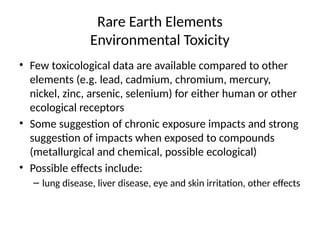
EnvironmentalToxicity
• Few toxicological data are available compared to other
elements (e.g. lead, cadmium, chromium, mercury,
nickel, zinc, arsenic, selenium) for either human or other
ecological receptors
• Some suggestion of chronic exposure impacts and strong
suggestion of impacts when exposed to compounds
(metallurgical and chemical, possible ecological)
• Possible effects include:
– lung disease, liver disease, eye and skin irritation, other effects
10.
Rare Earth Elements
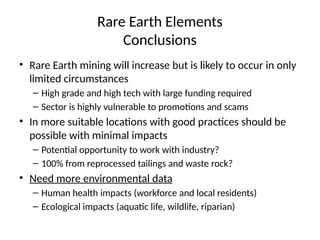
Conclusions
•Rare Earth mining will increase but is likely to occur in only
limited circumstances
– High grade and high tech with large funding required
– Sector is highly vulnerable to promotions and scams
• In more suitable locations with good practices should be
possible with minimal impacts
– Potential opportunity to work with industry?
– 100% from reprocessed tailings and waste rock?
• Need more environmental data
– Human health impacts (workforce and local residents)
– Ecological impacts (aquatic life, wildlife, riparian)