Patents- Practical Aspects of
International Patent Procurement/Prosecution
June 2015
Patent Cooperation Treaty
(PCT) Practice Overview
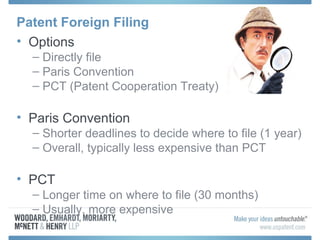
Patent Foreign Filing
• Options
– Directly file
– Paris Convention
– PCT (Patent Cooperation Treaty)
• Paris Convention
– Shorter deadlines to decide where to file (1 year)
– Overall, typically less expensive than PCT
• PCT
– Longer time on where to file (30 months)
– Usually, more expensive
Paris Convention- Overall Procedure
• Paris Convention
– Utility Patents- One year to foreign file from
original filing date
– Design Patents/Industrial Designs- Six months to
foreign file from original filing date
• What about non-Paris Convention (and non-
PCT) Countries
– Some provide a one year grace period to file
(e.g., Taiwan)
– Most have an absolute novelty requirement, so
you need to file before disclosure
Overall Procedure
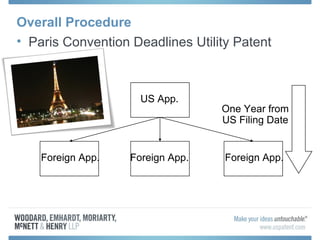
• Paris Convention Deadlines Utility Patent
US App.
Foreign App. Foreign App. Foreign App.
One Year from
US Filing Date
Paris Convention- Why Pick?
• Reasons to Pick Paris Convention Filing
– Less Expensive Overall
– Less Delay
– Know the Specific Countries & Client Will Not
Change Mind in the Future
• Reasons to Not Pick Paris Convention Filing
– Uncertain where to file (e.g., not sure about
market)
– Want to delay to give more time to develop
product, market, etc.
– More fees up front with Paris Convention
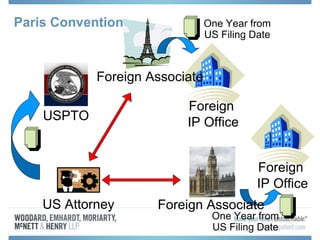
Paris Convention
Foreign Associate
US Attorney
Foreign
IP OfficeUSPTO
One Year from
US Filing Date
Foreign
IP Office
One Year from
US Filing Date
Foreign Associate
• 7
PCT General Information
• Generally worldwide, about 50%
of all cases foreign filed are filed
through the PCT.
• Currently 148 country members
to PCT.
• PCT preserves your right to
foreign file for an additional 18
months.
• 8
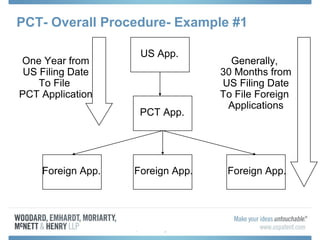
PCT- Overall Procedure- Example #1
PCT App.
Foreign App. Foreign App. Foreign App.
US App.
One Year from
US Filing Date
To File
PCT Application
Generally,
30 Months from
US Filing Date
To File Foreign
Applications
• 9
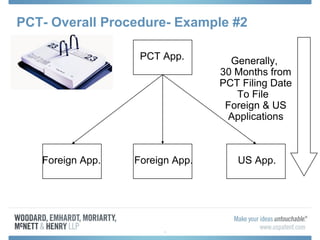
PCT- Overall Procedure- Example #2
PCT App.
Foreign App. Foreign App. US App.
Generally,
30 Months from
PCT Filing Date
To File
Foreign & US
Applications
PCT General Procedure
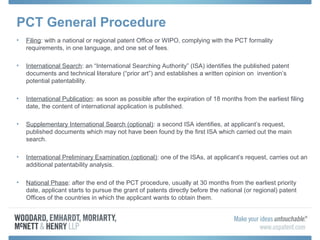
• Filing: with a national or regional patent Office or WIPO, complying with the PCT formality
requirements, in one language, and one set of fees.
• International Search: an “International Searching Authority” (ISA) identifies the published patent
documents and technical literature (“prior art”) and establishes a written opinion on invention’s
potential patentability.
• International Publication: as soon as possible after the expiration of 18 months from the earliest filing
date, the content of international application is published.
• Supplementary International Search (optional): a second ISA identifies, at applicant’s request,
published documents which may not have been found by the first ISA which carried out the main
search.
• International Preliminary Examination (optional): one of the ISAs, at applicant’s request, carries out an
additional patentability analysis.
• National Phase: after the end of the PCT procedure, usually at 30 months from the earliest priority
date, applicant starts to pursue the grant of patents directly before the national (or regional) patent
Offices of the countries in which the applicant wants to obtain them.
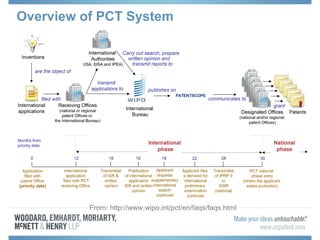
Overview of PCT System
From: http://www.wipo.int/pct/en/faqs/faqs.html
PCT Terminology
• Offices
• Receiving Office (RO)- office in which the International Application
must be filed. For our purposes, the USPTO will be the RO, but in
some circumstances the International Bureau (IB) will also act as
the RO for U.S. residents and nationals.
• International Searching Authority (ISA)- responsible for the patent
search and initial written opinion. In the Request form you can
select U.S., AU, Korea, EPO, etc. as the ISA. Note the EPO has
limitations as to subject matter that will be searched. The ISA is
normally responsible for the International Search Report and
Written Opinion, but the IPEA (see below) has the discretion to
issue its own written opinion.
• International Bureau (IB)- maintains the master file of all
international applications and acts as publisher as well as central
coordinating body. The World Intellectual Property Organization
in Geneva, Switzerland performs the duty of the IB.
PCT Terminology
• Offices
– International Preliminary Examining Authority (IPEA)- The IPEA
establishes the International Preliminary Examination Report
(IPER) which presents the examiner’s final position as to whether
the claim is novel, involves an inventive step, and is industrially
applicable. The ISA normally creates the initial written opinion, but
the IPEA has the discretion to issue its own written opinion.
– Designated Office (DO)- is the national patent office acting for the
state or region designated under Chapter I. Generally, it is where
you can nationalize the application under Chapter I. (Not that
important now.)
– Elected Office (EO)- is the national patent office acting for the state
or region elected under Chapter II. Generally, it is where you can
nationalize the application under Chapter II. (Not that important
now.)
PCT Terminology
• Chapter I
– Examination without interaction between
applicant and examiner
– Automatic- Default
– Examination Result= International Preliminary
Report on Patentability (IPRP) (i.e., ISA-WO)
• Chapter II
– Examination with interaction (argument) between
applicant and examiner
– Requires Filing of a Demand + Fee
– Examination Result= International Preliminary
Examination Report (IPER) (IPEA issues)
PCT Terminology
• Paperwork
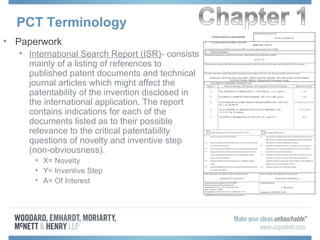
• International Search Report (ISR)- consists
mainly of a listing of references to
published patent documents and technical
journal articles which might affect the
patentability of the invention disclosed in
the international application. The report
contains indications for each of the
documents listed as to their possible
relevance to the critical patentability
questions of novelty and inventive step
(non-obviousness).
• X= Novelty
• Y= Inventive Step
• A= Of Interest
PCT Terminology
• Paperwork
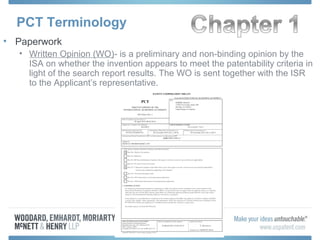
• Written Opinion (WO)- is a preliminary and non-binding opinion by the
ISA on whether the invention appears to meet the patentability criteria in
light of the search report results. The WO is sent together with the ISR
to the Applicant’s representative.
PCT Terminology
• Paperwork
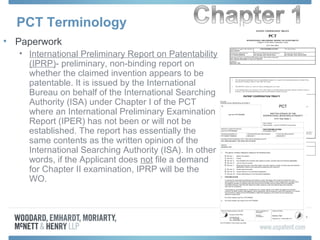
• International Preliminary Report on Patentability
(IPRP)- preliminary, non-binding report on
whether the claimed invention appears to be
patentable. It is issued by the International
Bureau on behalf of the International Searching
Authority (ISA) under Chapter I of the PCT
where an International Preliminary Examination
Report (IPER) has not been or will not be
established. The report has essentially the
same contents as the written opinion of the
International Searching Authority (ISA). In other
words, if the Applicant does not file a demand
for Chapter II examination, IPRP will be the
WO.
PCT Terminology
• Paperwork
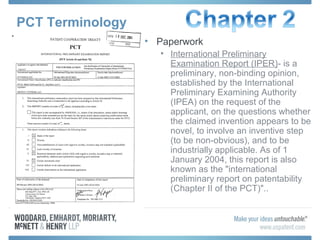
• International Preliminary
Examination Report (IPER)- is a
preliminary, non-binding opinion,
established by the International
Preliminary Examining Authority
(IPEA) on the request of the
applicant, on the questions whether
the claimed invention appears to be
novel, to involve an inventive step
(to be non-obvious), and to be
industrially applicable. As of 1
January 2004, this report is also
known as the "international
preliminary report on patentability
(Chapter II of the PCT)"..
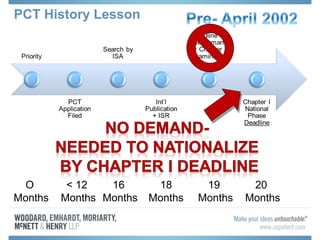
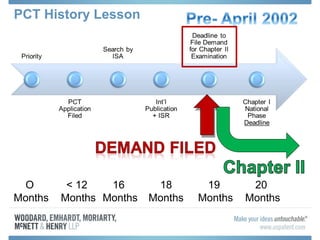
PCT History Lesson
O
Months
< 12
Months
16
Months
18
Months
19
Months
20
Months
PCT History Lesson
O
Months
< 12
Months
16
Months
18
Months
19
Months
20
Months
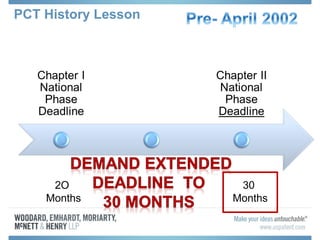
PCT History Lesson
2O
Months
30
Months
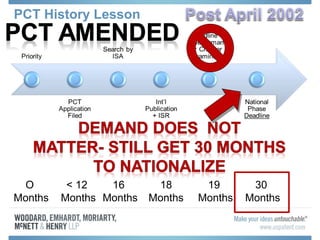
PCT History Lesson
O
Months
< 12
Months
16
Months
18
Months
19
Months
30
Months
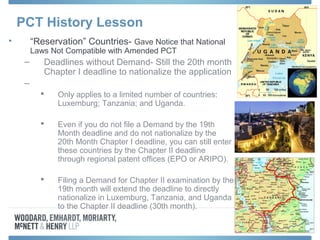
PCT History Lesson
• “Reservation” Countries- Gave Notice that National
Laws Not Compatible with Amended PCT
– Deadlines without Demand- Still the 20th month
Chapter I deadline to nationalize the application
–
 Only applies to a limited number of countries:
Luxemburg; Tanzania; and Uganda.
 Even if you do not file a Demand by the 19th
Month deadline and do not nationalize by the
20th Month Chapter I deadline, you can still enter
these countries by the Chapter II deadline
through regional patent offices (EPO or ARIPO).
 Filing a Demand for Chapter II examination by the
19th month will extend the deadline to directly
nationalize in Luxemburg, Tanzania, and Uganda
to the Chapter II deadline (30th month).
PCT History Lesson
• ISA now issue ISR and WO
• Demand for International Preliminary
Examination (Chapter II)
– Deadline Changed to Later of:
 22 Months or
 3 Months From Mailing Date of ISR/WO
• Why Now File a Demand for Examination?
– Examiner Interaction- Get Positive IPER
– Make Amendments to Spec. and Drawings
PCT Pointers
• Chapter II
– Provides for additional procedures for
examination of the international application.
– Deadline to nationalize the application is at
least 30 months from the earliest priority
date.
– For most countries, the application
automatically has the Chapter II deadline
 Again, exceptions are Luxemburg, Tanzania,
and Uganda,
PCT Pointers
• Calculation of docket
deadlines is based on the
earliest priority date
claimed.
• Chapter I and Chapter II-
distinction is less important
under current PCT practice
PCT Filing
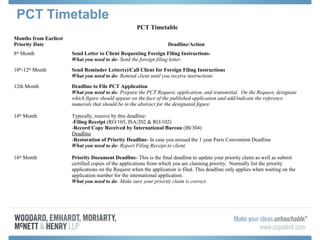
PCT Timetable
PCT Timetable
Months from Earliest
Priority Date Deadline/Action
8th
Month Send Letter to Client Requesting Foreign Filing Instructions-
What you need to do- Send the foreign filing letter.
10th
-12th
Month Send Reminder Letter(s)/Call Client for Foreign Filing Instructions
What you need to do- Remind client until you receive instructions
12th Month Deadline to File PCT Application
What you need to do- Prepare the PCT Request, application, and transmittal. On the Request, designate
which figure should appear on the face of the published application and add/indicate the reference
numerals that should be in the abstract for the designated figure.
14th
Month Typically, receive by this deadline:
-Filing Receipt (RO/105, ISA/202 & RO/102)
-Record Copy Received by International Bureau (IB/304)
Deadline
-Restoration of Priority Deadline- In case you missed the 1 year Paris Convention Deadline
What you need to do- Report Filing Receipt to client.
16th
Month Priority Document Deadline- This is the final deadline to update your priority claim as well as submit
certified copies of the applications from which you are claiming priority. Normally list the priority
applications on the Request when the application is filed. This deadline only applies when waiting on the
application number for the international application.
What you need to do- Make sure your priority claim is correct.
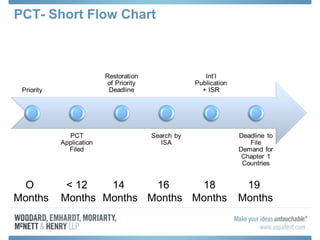
PCT- Short Flow Chart
O
Months
< 12
Months
14
Months
16
Months
18
Months
19
Months
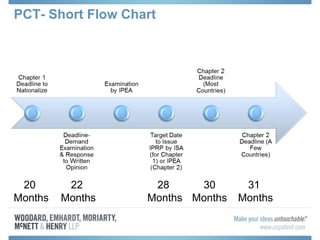
PCT- Short Flow Chart
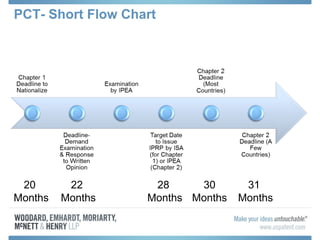
20
Months
28
Months
30
Months
31
Months
22
Months
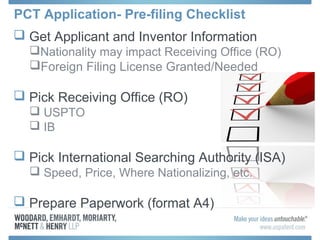
PCT Application- Pre-filing Checklist
 Get Applicant and Inventor Information
Nationality may impact Receiving Office (RO)
Foreign Filing License Granted/Needed
 Pick Receiving Office (RO)
 USPTO
 IB
 Pick International Searching Authority (ISA)
 Speed, Price, Where Nationalizing, etc.
 Prepare Paperwork (format A4)
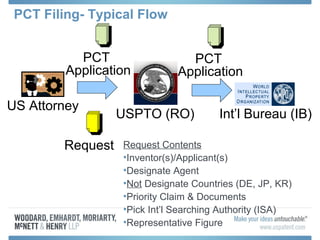
PCT Filing- Typical Flow
US Attorney
USPTO (RO) Int’l Bureau (IB)
PCT
Application
Request
PCT
Application
Request Contents
•Inventor(s)/Applicant(s)
•Designate Agent
•Not Designate Countries (DE, JP, KR)
•Priority Claim & Documents
•Pick Int’l Searching Authority (ISA)
•Representative Figure
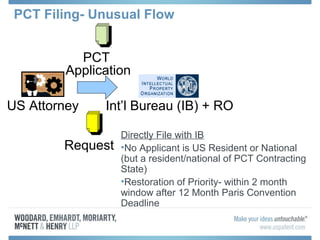
PCT Filing- Unusual Flow
US Attorney Int’l Bureau (IB) + RO
PCT
Application
Request
Directly File with IB
•No Applicant is US Resident or National
(but a resident/national of PCT Contracting
State)
•Restoration of Priority- within 2 month
window after 12 Month Paris Convention
Deadline
PCT Receiving Office (RO)
• How to Pick a Receiving Office (RO)
– Depends on where applicant is a national or
residence
• Two Options
– Applicant’s National Patent Office (if allowed)
 Normally, USPTO
– WIPO International Bureau (IB)
• From US Perspective, if no US Applicant,
need to file with IB as RO and pick local
attorney to prosecute.
Filing USPTO as Receiving Office (RO)
1. Familiarity with E-filing procedures.
2. File pdf’s of documents.
3. Instant Electronic Acknowledgment.
4. Payment via Credit Card in US Dollars.
5. Access to Documents in Private PAIR.
6. For invention made in the US, no separate
request for a foreign filing license is needed.
Filing WIPO-IB as Receiving Office (RO)
1. Will need to obtain a WIPO Digital Certificate
for each person who will physically file the
applications.
2. The Digital Certificate must be used ONLY
on the computer on which it was validated.
3. The Digital Certificate must be renewed
every two years.
4. Will need to download and use PCT Easy
software, which needs updating regularly.
Filing WIPO-IB as Receiving Office (RO)
5. Will need to open a WIPO Deposit Account
1. Otherwise, file an application at the
International Bureau, then receive a link
electronically to make an Epayment on WIPO
via credit card.
2. You may have added conversion fees from US
$ to Swiss francs on your credit card bill.
3. Pay by bank transfer to WIPO’s bank account
or postal account
5. Will never have access to complete file
history.
Filing WIPO-IB as Receiving Office (RO)
7. If invention made in the US, you will need a
foreign filing license from the USPTO to file a
PCT application at the IB.
8. Can file via fax; however, original must be
delivered within 14 days from the fax
transmission (FedEx preferred).
9. Lose valuable filing time since WIPO is six
hours ahead of us.
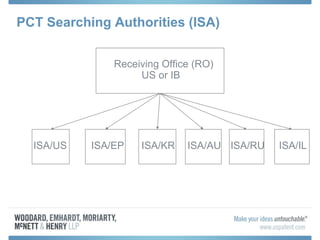
PCT Searching Authorities (ISA)
• Right Now, You Can Select From Among
Several Patent Offices to Conduct the Search
• US Searching Authorities Include
– USPTO
– EPO (European Patent Office)
– KIPO (Korea)
– Australia (IPAU)
– Russia (Rospatent)
– Israel (ILPO)
• Note: Option Secondary ISA
PCT Searching Authorities (ISA)
Receiving Office (RO)
US or IB
ISA/US ISA/EP ISA/KR ISA/AU ISA/RU ISA/IL
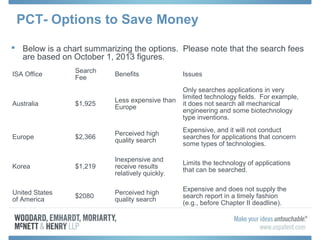
PCT- Options to Save Money
 Below is a chart summarizing the options. Please note that the search fees
are based on October 1, 2013 figures.
ISA Office
Search
Fee
Benefits Issues
Australia $1,925
Less expensive than
Europe
Only searches applications in very
limited technology fields. For example,
it does not search all mechanical
engineering and some biotechnology
type inventions.
Europe $2,366
Perceived high
quality search
Expensive, and it will not conduct
searches for applications that concern
some types of technologies.
Korea $1,219
Inexpensive and
receive results
relatively quickly.
Limits the technology of applications
that can be searched.
United States
of America
$2080
Perceived high
quality search
Expensive and does not supply the
search report in a timely fashion
(e.g., before Chapter II deadline).
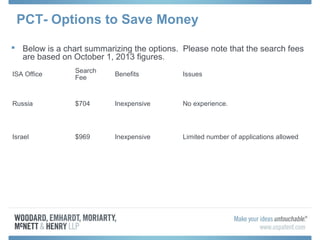
PCT- Options to Save Money
 Below is a chart summarizing the options. Please note that the search fees
are based on October 1, 2013 figures.
ISA Office
Search
Fee
Benefits Issues
Russia $704 Inexpensive No experience.
Israel $969 Inexpensive Limited number of applications allowed
 Generally two ways to prepare/file the "paperwork" for a PCT
application.
 PDF forms (e.g., Request, transmittal, etc.)
 PCT-SAFE (SAFE = Secure Applications Filed Electronically)
software helps to prepare the electronic forms for filing. Two
modes:
– Fully electronic mode: The description, claims, abstract and
drawings are attached in PDF, TIFF or XML format.
– PCT-EASY mode: The request form as well as the application
body are submitted on paper, accompanied by a physical
medium (floppy disk, CD, etc.) which contains a zip file with the
request form, the abstract and a log file created through PCT-
SAFE.
 For ease of viewing, the presentation will show the PDF forms.
How to File a PCT Application
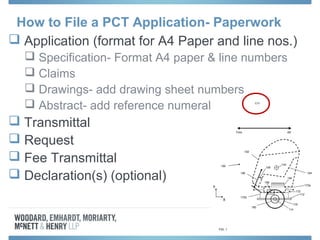
 Application (format for A4 Paper and line nos.)
 Specification- Format A4 paper & line numbers
 Claims
 Drawings- add drawing sheet numbers
 Abstract- add reference numerals
 Transmittal
 Request
 Fee Transmittal
 Declaration(s) (optional)
How to File a PCT Application- Paperwork
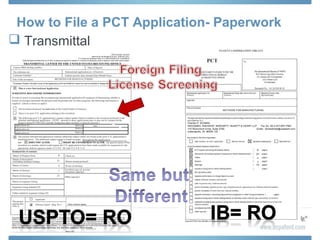
 Transmittal
How to File a PCT Application- Paperwork
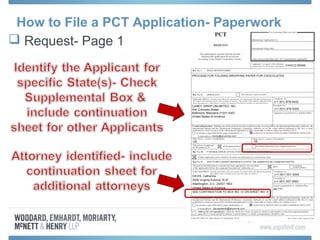
 Request- Page 1
How to File a PCT Application- Paperwork
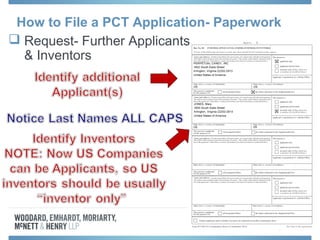
 Request- Further Applicants
& Inventors
How to File a PCT Application- Paperwork
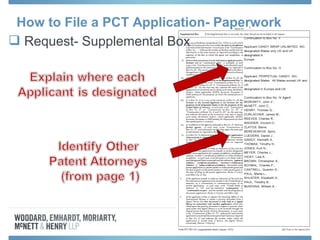
 Request- Supplemental Box
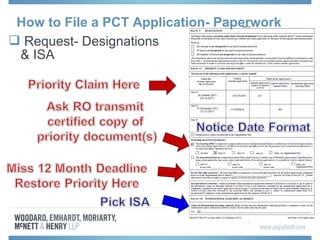
 Request- Designations
& ISA
How to File a PCT Application- Paperwork
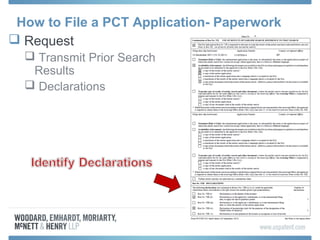
 Request
 Transmit Prior Search
Results
 Declarations
How to File a PCT Application- Paperwork
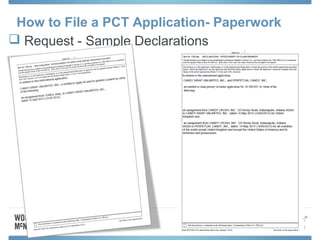
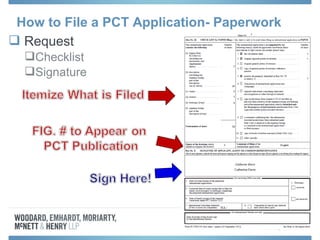
 Request - Sample Declarations
 Request
Checklist
Signature
How to File a PCT Application- Paperwork
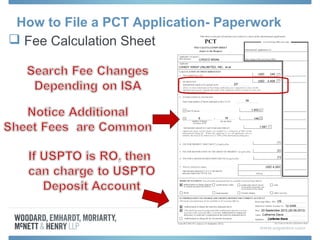
 Fee Calculation Sheet
PCT Search & Publication
PCT Timetable
PCT Timetable
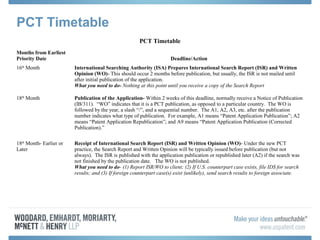
Months from Earliest
Priority Date Deadline/Action
16th
Month International Searching Authority (ISA) Prepares International Search Report (ISR) and Written
Opinion (WO)- This should occur 2 months before publication, but usually, the ISR is not mailed until
after initial publication of the application.
What you need to do- Nothing at this point until you receive a copy of the Search Report
18th
Month Publication of the Application- Within 2 weeks of this deadline, normally receive a Notice of Publication
(IB/311). “WO” indicates that it is a PCT publication, as opposed to a particular country. The WO is
followed by the year, a slash “/”, and a sequential number. The A1, A2, A3, etc. after the publication
number indicates what type of publication. For example, A1 means “Patent Application Publication”; A2
means “Patent Application Republication”; and A9 means “Patent Application Publication (Corrected
Publication).”
18th
Month- Earlier or
Later
Receipt of International Search Report (ISR) and Written Opinion (WO)- Under the new PCT
practice, the Search Report and Written Opinion will be typically issued before publication (but not
always). The ISR is published with the application publication or republished later (A2) if the search was
not finished by the publication date. The WO is not published.
What you need to do- (1) Report ISR/WO to client; (2) If U.S. counterpart case exists, file IDS for search
results; and (3) If foreign counterpart case(s) exist (unlikely), send search results to foreign associate.
PCT Search (ISA)
• Search & Examination based generally on
the following:
– Novelty- similar to (but not the same as) the
anticipation standard in the U.S. (absolute
novelty and no grace period)
– Inventive Step- similar to (but not the same as)
as the nonobviousness requirement in the U.S.
– Industrial applicability- it can be made or used
(in the technological sense) in any kind of
industry. Usually, it does not include business
methods.
PCT Search/Examination Pointers
• Unity of Invention- although similar, not the
same standard as in U.S. restriction practice.
– If you want to search for other claimed
inventions you will need to pay additional
search fees.
– Even if you pay additional search fees, you will
then need to pay examination fees to have the
additionally searched claims examined.
– Not paying search fees may limit the claims
you can initially nationalize.
• Generally speaking, search and examination
fees are a waste of money.
– But in view of recent EPO rules you might want
to consider paying the fees if you are going to
nationalize in Europe
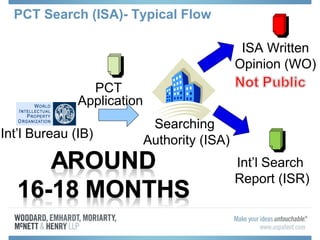
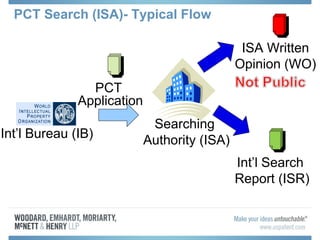
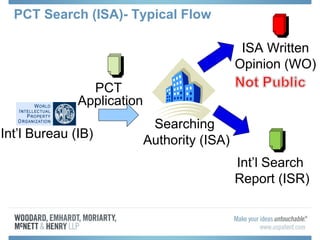
PCT Search (ISA)- Typical Flow
Int’l Bureau (IB)
PCT
Application
Searching
Authority (ISA)
ISA Written
Opinion (WO)
Int’l Search
Report (ISR)
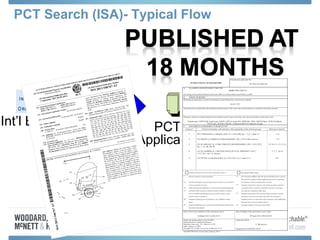
PCT Search (ISA)- Typical Flow
Int’l Bureau (IB) PCT
Application
Int’l Search
Report (ISR)
PCT Amendments & Examination
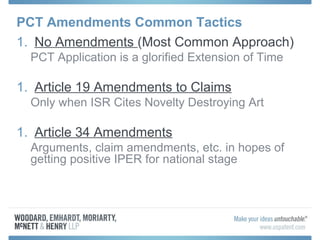
PCT Amendments Common Tactics
1. No Amendments (Most Common Approach)
PCT Application is a glorified Extension of Time
1. Article 19 Amendments to Claims
Only when ISR Cites Novelty Destroying Art
1. Article 34 Amendments
Arguments, claim amendments, etc. in hopes of
getting positive IPER for national stage
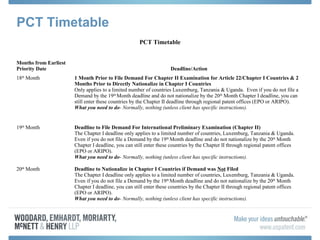
PCT Timetable
PCT Timetable
Months from Earliest
Priority Date Deadline/Action
18th
Month 1 Month Prior to File Demand For Chapter II Examination for Article 22/Chapter I Countries & 2
Months Prior to Directly Nationalize in Chapter I Countries
Only applies to a limited number of countries Luxemburg, Tanzania & Uganda. Even if you do not file a
Demand by the 19th
Month deadline and do not nationalize by the 20th
Month Chapter I deadline, you can
still enter these countries by the Chapter II deadline through regional patent offices (EPO or ARIPO).
What you need to do- Normally, nothing (unless client has specific instructions).
19th
Month Deadline to File Demand For International Preliminary Examination (Chapter II)
The Chapter I deadline only applies to a limited number of countries, Luxemburg, Tanzania & Uganda.
Even if you do not file a Demand by the 19th
Month deadline and do not nationalize by the 20th
Month
Chapter I deadline, you can still enter these countries by the Chapter II through regional patent offices
(EPO or ARIPO).
What you need to do- Normally, nothing (unless client has specific instructions).
20th
Month Deadline to Nationalize in Chapter I Countries if Demand was Not Filed
The Chapter I deadline only applies to a limited number of countries, Luxemburg, Tanzania & Uganda.
Even if you do not file a Demand by the 19th
Month deadline and do not nationalize by the 20th
Month
Chapter I deadline, you can still enter these countries by the Chapter II through regional patent offices
(EPO or ARIPO).
What you need to do- Normally, nothing (unless client has specific instructions).
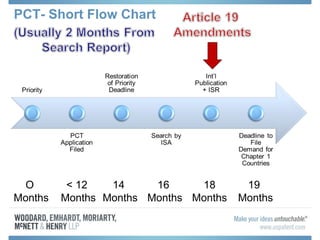
PCT- Short Flow Chart
O
Months
< 12
Months
14
Months
16
Months
18
Months
19
Months
PCT- Short Flow Chart
20
Months
28
Months
30
Months
31
Months
22
Months
PCT Timetable
PCT Timetable
Months from Earliest
Priority Date Deadline/Action
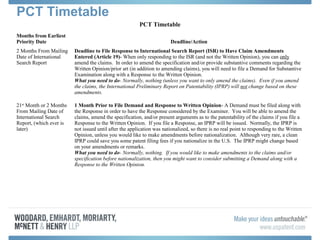
2 Months From Mailing
Date of International
Search Report
Deadline to File Response to International Search Report (ISR) to Have Claim Amendments
Entered (Article 19)- When only responding to the ISR (and not the Written Opinion), you can only
amend the claims. In order to amend the specification and/or provide substantive comments regarding the
Written Opinion/prior art (in addition to amending claims), you will need to file a Demand for Substantive
Examination along with a Response to the Written Opinion.
What you need to do- Normally, nothing (unless you want to only amend the claims). Even if you amend
the claims, the International Preliminary Report on Patentability (IPRP) will not change based on these
amendments.
21st
Month or 2 Months
From Mailing Date of
International Search
Report, (which ever is
later)
1 Month Prior to File Demand and Response to Written Opinion- A Demand must be filed along with
the Response in order to have the Response considered by the Examiner. You will be able to amend the
claims, amend the specification, and/or present arguments as to the patentability of the claims if you file a
Response to the Written Opinion. If you file a Response, an IPRP will be issued. Normally, the IPRP is
not issued until after the application was nationalized, so there is no real point to responding to the Written
Opinion, unless you would like to make amendments before nationalization. Although very rare, a clean
IPRP could save you some patent filing fees if you nationalize in the U.S. The IPRP might change based
on your amendments or remarks.
What you need to do- Normally, nothing. If you would like to make amendments to the claims and/or
specification before nationalization, then you might want to consider submitting a Demand along with a
Response to the Written Opinion.
PCT- Short Flow Chart
20
Months
28
Months
30
Months
31
Months
22
Months
PCT Timetable
PCT Timetable
Months from Earliest
Priority Date Deadline/Action
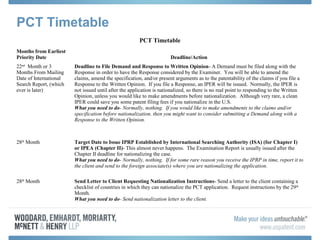
22nd
Month or 3
Months From Mailing
Date of International
Search Report, (which
ever is later)
Deadline to File Demand and Response to Written Opinion- A Demand must be filed along with the
Response in order to have the Response considered by the Examiner. You will be able to amend the
claims, amend the specification, and/or present arguments as to the patentability of the claims if you file a
Response to the Written Opinion. If you file a Response, an IPER will be issued. Normally, the IPER is
not issued until after the application is nationalized, so there is no real point to responding to the Written
Opinion, unless you would like to make amendments before nationalization. Although very rare, a clean
IPER could save you some patent filing fees if you nationalize in the U.S.
What you need to do- Normally, nothing. If you would like to make amendments to the claims and/or
specification before nationalization, then you might want to consider submitting a Demand along with a
Response to the Written Opinion.
28th
Month Target Date to Issue IPRP Established by International Searching Authority (ISA) (for Chapter I)
or IPEA (Chapter II)- This almost never happens. The Examination Report is usually issued after the
Chapter II deadline for nationalizing the case.
What you need to do- Normally, nothing. If for some rare reason you receive the IPRP in time, report it to
the client and send to the foreign associate(s) where you are nationalizing the application.
28th
Month Send Letter to Client Requesting Nationalization Instructions- Send a letter to the client containing a
checklist of countries in which they can nationalize the PCT application. Request instructions by the 29th
Month.
What you need to do- Send nationalization letter to the client.
How to Make Changes
Changes to Application Information (Formalities)
 Fix Typo’s
 Change, Add, or Delete Applicants/Inventors
Change Claims
 Article 19 Amendment (Response to ISR)
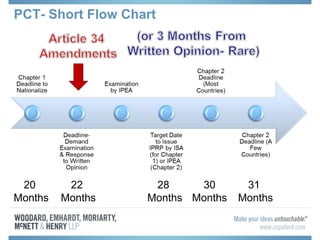
 Article 34 Amendment (Response to WO)
Change Specification and Drawings
 Article 34 Amendment (Only)
Argue Against Cited Prior Art
 Article 34 Amendment (Only)
Formality Changes
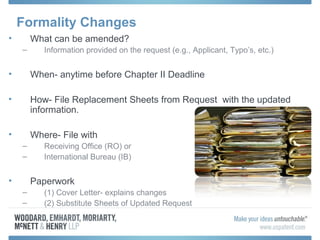
• What can be amended?
– Information provided on the request (e.g., Applicant, Typo’s, etc.)
• When- anytime before Chapter II Deadline
• How- File Replacement Sheets from Request with the updated
information.
• Where- File with
– Receiving Office (RO) or
– International Bureau (IB)
• Paperwork
– (1) Cover Letter- explains changes
– (2) Substitute Sheets of Updated Request
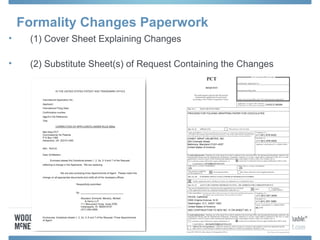
Formality Changes Paperwork
• (1) Cover Sheet Explaining Changes
• (2) Substitute Sheet(s) of Request Containing the Changes
Article 19 Amendments (Response to ISR)
• What can be amended?
– Claims only
 The only way to make substantive changes if only using Chapter 1 route
• When- After received International Search Report (ISR) and Written Opinion
(WO), and Later of
– 16 Months from priority date
– 2 Months from transmittal of ISR and WO
– (OR received before technical preparations of international publication has been
complete)
• Article 19 NOT allowed when International Search Authority (ISA) indicated
that no ISR will be established.
• Where- Filed with IB
– But if file Demand for International Preliminary Examination is filed send a copy to
International Preliminary Examining Authority (IPEA)
• Paperwork
– (1) Cover letter indicating differences between claims filed and amended plus basis for
amendment.
– (2) Complete set of replacement claims
– (3) Optional Statement under Article 19
Article 19 Paperwork
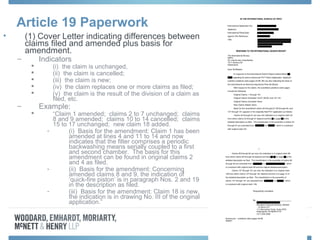
• (1) Cover Letter indicating differences between
claims filed and amended plus basis for
amendment.
– Indicators
 (i) the claim is unchanged,
 (ii) the claim is cancelled;
 (iii) the claim is new;
 (iv) the claim replaces one or more claims as filed;
 (v) the claim is the result of the division of a claim as
filed, etc.
– Example:
 “Claim 1 amended; claims 2 to 7 unchanged; claims
8 and 9 amended; claims 10 to 14 cancelled; claims
15 to 17 unchanged; new claim 18 added.
- (i) Basis for the amendment: Claim 1 has been
amended at lines 4 and 11 to 14 and now
indicates that the filter comprises a periodic
backwashing means serially coupled to a first
and second chamber. The basis for this
amendment can be found in original claims 2
and 4 as filed.
- (ii) Basis for the amendment: Concerning
amended claims 8 and 9, the indication of
‘quick-fire piston’ is in paragraph Nos. 2 and 19
in the description as filed.
- (iii) Basis for the amendment: Claim 18 is new,
the indication is in drawing No. III of the original
application.”
Article 19 Paperwork
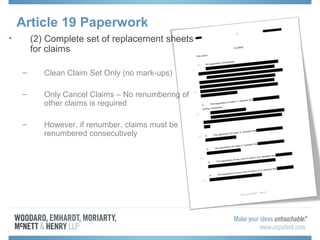
• (2) Complete set of replacement sheets
for claims
– Clean Claim Set Only (no mark-ups)
– Only Cancel Claims – No renumbering of
other claims is required
– However, if renumber, claims must be
renumbered consecutively
Article 19 Paperwork
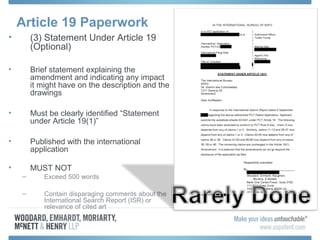
• (3) Statement Under Article 19
(Optional)
• Brief statement explaining the
amendment and indicating any impact
it might have on the description and the
drawings
• Must be clearly identified “Statement
under Article 19(1)”
• Published with the international
application
• MUST NOT
– Exceed 500 words
– Contain disparaging comments about the
International Search Report (ISR) or
relevance of cited art
Article 34 Amendments (Response to WO)
• What can you do?
– Amend Claims
– Amend Specification
– Amend Drawings
– Present arguments as to the patentability of the claims
• When? (Later of)
– 22 Months from Priority Date
– 3 Months from Mailing of Search Report
• Where?- Can Pick IPEA in Demand
– USPTO (if RO) or EP (if ISA)
• Paperwork
– (1) Demand for International Preliminary Examination under Article 31
 And Fee
– (2) Response to Written Opinion- indicating changes + arguments
– (3) Replacement sheets for any amended Claims, Specification, Drawings
Article 34 Paperwork (Response to WO)
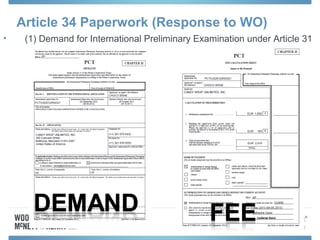
• (1) Demand for International Preliminary Examination under Article 31
Article 34 Paperwork (Response to WO)
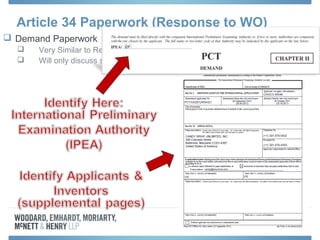
 Demand Paperwork
 Very Similar to Request
 Will only discuss significant differences
Article 34 Paperwork (Response to WO)
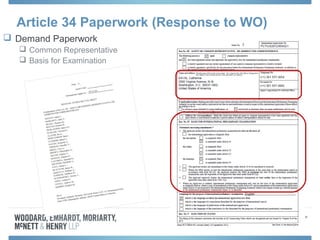
 Demand Paperwork
 Common Representative
 Basis for Examination
Article 34 Paperwork (Response to WO)
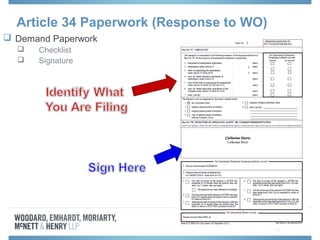
 Demand Paperwork
 Checklist
 Signature
Article 34 Paperwork (Response to WO)
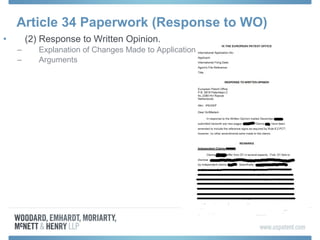
• (2) Response to Written Opinion.
– Explanation of Changes Made to Application
– Arguments
Article 34 Paperwork (Response to WO)
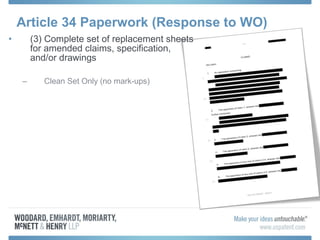
• (3) Complete set of replacement sheets
for amended claims, specification,
and/or drawings
– Clean Set Only (no mark-ups)
Article 19 v. 34 Amendments
• If Demand filed, no need to amend claims under Article 19, unless
you want provisional protection.
– Article 19 Amendments are published, so you may gain provisional rights
to the published Article 19 claim amendments (i.e., damages clock)
• Article 19
– Only need to amend the claims (not drawings or specification)
– Don’t want to make any arguments
• Article 34
– Does not require to first file Article 19 Amendments
– Want to Argue
– Need to makes changes to specification, drawings (or claims)
PCT Examination Report
• Type of Examination Report Depends on
Whether Applicant Requested Examination
(Chapter II) or Not
PCT Search (ISA)- Typical Flow
Int’l Bureau (IB)
PCT
Application
Searching
Authority (ISA)
ISA Written
Opinion (WO)
Int’l Search
Report (ISR)
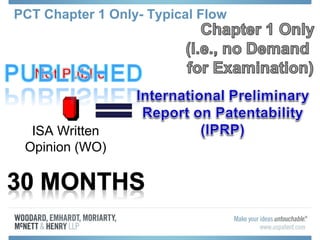
PCT Chapter 1 Only- Typical Flow
ISA Written
Opinion (WO)
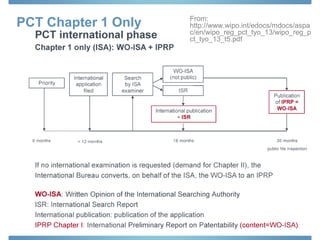
PCT Chapter 1 Only From:
http://www.wipo.int/edocs/mdocs/aspa
c/en/wipo_reg_pct_tyo_13/wipo_reg_p
ct_tyo_13_t5.pdf
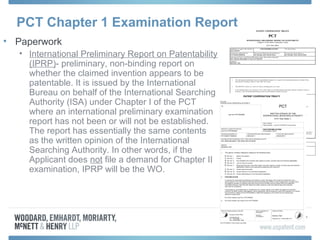
• Paperwork
• International Preliminary Report on Patentability
(IPRP)- preliminary, non-binding report on
whether the claimed invention appears to be
patentable. It is issued by the International
Bureau on behalf of the International Searching
Authority (ISA) under Chapter I of the PCT
where an international preliminary examination
report has not been or will not be established.
The report has essentially the same contents
as the written opinion of the International
Searching Authority. In other words, if the
Applicant does not file a demand for Chapter II
examination, IPRP will be the WO.
PCT Chapter 1 Examination Report
PCT Search (ISA)- Typical Flow
Int’l Bureau (IB)
PCT
Application
Searching
Authority (ISA)
ISA Written
Opinion (WO)
Int’l Search
Report (ISR)
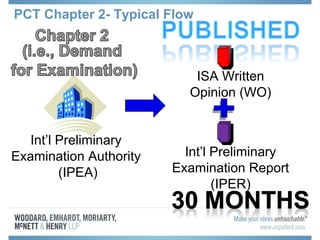
PCT Chapter 2- Typical Flow
ISA Written
Opinion (WO)
Int’l Preliminary
Examination Authority
(IPEA)
Int’l Preliminary
Examination Report
(IPER)
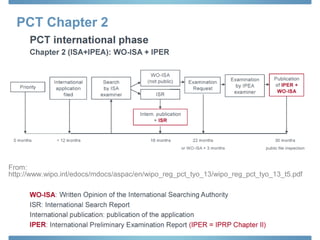
PCT Chapter 2
From:
http://www.wipo.int/edocs/mdocs/aspac/en/wipo_reg_pct_tyo_13/wipo_reg_pct_tyo_13_t5.pdf
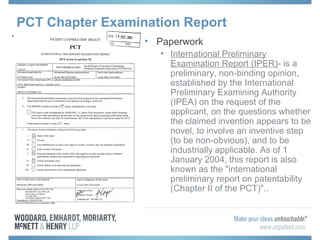
PCT Chapter Examination Report
• Paperwork
• International Preliminary
Examination Report (IPER)- is a
preliminary, non-binding opinion,
established by the International
Preliminary Examining Authority
(IPEA) on the request of the
applicant, on the questions whether
the claimed invention appears to be
novel, to involve an inventive step
(to be non-obvious), and to be
industrially applicable. As of 1
January 2004, this report is also
known as the "international
preliminary report on patentability
(Chapter II of the PCT)"..
PCT National Phase
• Please see Nationalizing PCT Applications in
the US presentation that compares the
371 National Stage Procedure with the
Bypass Continuation Application Procedure
– http://www.slideshare.net/wemmh/best-way-to-
nationalize-pct-applications-in
– Presentation is Dated- Some Changes Required
Due to AIA
– Updated Presentation Coming Soon!
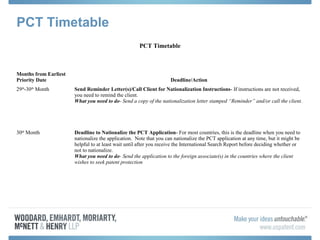
PCT Timetable
PCT Timetable
Months from Earliest
Priority Date Deadline/Action
29th
-30th
Month Send Reminder Letter(s)/Call Client for Nationalization Instructions- If instructions are not received,
you need to remind the client.
What you need to do- Send a copy of the nationalization letter stamped “Reminder” and/or call the client.
30th
Month Deadline to Nationalize the PCT Application- For most countries, this is the deadline when you need to
nationalize the application. Note that you can nationalize the PCT application at any time, but it might be
helpful to at least wait until after you receive the International Search Report before deciding whether or
not to nationalize.
What you need to do- Send the application to the foreign associate(s) in the countries where the client
wishes to seek patent protection
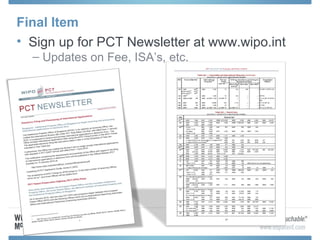
Final Item
• Sign up for PCT Newsletter at www.wipo.int
– Updates on Fee, ISA’s, etc.
Need More Information?
Please Contact:
Chuck Schmal (cschmal@uspatent.com)
Woodard, Emhardt, Moriarty, McNett & Henry LLPWoodard, Emhardt, Moriarty, McNett & Henry LLP
111 Monument Circle, Suite 3700
Indianapolis, IN 46204
(317) 634-3456
www.uspatent.com
Patents- Practical Aspects of
International Patent Procurement/Prosecution
June 2015
Patent Cooperation Treaty
(PCT) Practice Overview

PCT Practice Presentation

  • 1.
    Patents- Practical Aspectsof International Patent Procurement/Prosecution June 2015 Patent Cooperation Treaty (PCT) Practice Overview
  • 2.
    Patent Foreign Filing •Options – Directly file – Paris Convention – PCT (Patent Cooperation Treaty) • Paris Convention – Shorter deadlines to decide where to file (1 year) – Overall, typically less expensive than PCT • PCT – Longer time on where to file (30 months) – Usually, more expensive
  • 3.
    Paris Convention- OverallProcedure • Paris Convention – Utility Patents- One year to foreign file from original filing date – Design Patents/Industrial Designs- Six months to foreign file from original filing date • What about non-Paris Convention (and non- PCT) Countries – Some provide a one year grace period to file (e.g., Taiwan) – Most have an absolute novelty requirement, so you need to file before disclosure
  • 4.
    Overall Procedure • ParisConvention Deadlines Utility Patent US App. Foreign App. Foreign App. Foreign App. One Year from US Filing Date
  • 5.
    Paris Convention- WhyPick? • Reasons to Pick Paris Convention Filing – Less Expensive Overall – Less Delay – Know the Specific Countries & Client Will Not Change Mind in the Future • Reasons to Not Pick Paris Convention Filing – Uncertain where to file (e.g., not sure about market) – Want to delay to give more time to develop product, market, etc. – More fees up front with Paris Convention
  • 6.
    Paris Convention Foreign Associate USAttorney Foreign IP OfficeUSPTO One Year from US Filing Date Foreign IP Office One Year from US Filing Date Foreign Associate
  • 7.
    • 7 PCT GeneralInformation • Generally worldwide, about 50% of all cases foreign filed are filed through the PCT. • Currently 148 country members to PCT. • PCT preserves your right to foreign file for an additional 18 months.
  • 8.
    • 8 PCT- OverallProcedure- Example #1 PCT App. Foreign App. Foreign App. Foreign App. US App. One Year from US Filing Date To File PCT Application Generally, 30 Months from US Filing Date To File Foreign Applications
  • 9.
    • 9 PCT- OverallProcedure- Example #2 PCT App. Foreign App. Foreign App. US App. Generally, 30 Months from PCT Filing Date To File Foreign & US Applications
  • 10.
    PCT General Procedure •Filing: with a national or regional patent Office or WIPO, complying with the PCT formality requirements, in one language, and one set of fees. • International Search: an “International Searching Authority” (ISA) identifies the published patent documents and technical literature (“prior art”) and establishes a written opinion on invention’s potential patentability. • International Publication: as soon as possible after the expiration of 18 months from the earliest filing date, the content of international application is published. • Supplementary International Search (optional): a second ISA identifies, at applicant’s request, published documents which may not have been found by the first ISA which carried out the main search. • International Preliminary Examination (optional): one of the ISAs, at applicant’s request, carries out an additional patentability analysis. • National Phase: after the end of the PCT procedure, usually at 30 months from the earliest priority date, applicant starts to pursue the grant of patents directly before the national (or regional) patent Offices of the countries in which the applicant wants to obtain them.
  • 11.
    Overview of PCTSystem From: http://www.wipo.int/pct/en/faqs/faqs.html
  • 12.
    PCT Terminology • Offices •Receiving Office (RO)- office in which the International Application must be filed. For our purposes, the USPTO will be the RO, but in some circumstances the International Bureau (IB) will also act as the RO for U.S. residents and nationals. • International Searching Authority (ISA)- responsible for the patent search and initial written opinion. In the Request form you can select U.S., AU, Korea, EPO, etc. as the ISA. Note the EPO has limitations as to subject matter that will be searched. The ISA is normally responsible for the International Search Report and Written Opinion, but the IPEA (see below) has the discretion to issue its own written opinion. • International Bureau (IB)- maintains the master file of all international applications and acts as publisher as well as central coordinating body. The World Intellectual Property Organization in Geneva, Switzerland performs the duty of the IB.
  • 13.
    PCT Terminology • Offices –International Preliminary Examining Authority (IPEA)- The IPEA establishes the International Preliminary Examination Report (IPER) which presents the examiner’s final position as to whether the claim is novel, involves an inventive step, and is industrially applicable. The ISA normally creates the initial written opinion, but the IPEA has the discretion to issue its own written opinion. – Designated Office (DO)- is the national patent office acting for the state or region designated under Chapter I. Generally, it is where you can nationalize the application under Chapter I. (Not that important now.) – Elected Office (EO)- is the national patent office acting for the state or region elected under Chapter II. Generally, it is where you can nationalize the application under Chapter II. (Not that important now.)
  • 14.
    PCT Terminology • ChapterI – Examination without interaction between applicant and examiner – Automatic- Default – Examination Result= International Preliminary Report on Patentability (IPRP) (i.e., ISA-WO) • Chapter II – Examination with interaction (argument) between applicant and examiner – Requires Filing of a Demand + Fee – Examination Result= International Preliminary Examination Report (IPER) (IPEA issues)
  • 15.
    PCT Terminology • Paperwork •International Search Report (ISR)- consists mainly of a listing of references to published patent documents and technical journal articles which might affect the patentability of the invention disclosed in the international application. The report contains indications for each of the documents listed as to their possible relevance to the critical patentability questions of novelty and inventive step (non-obviousness). • X= Novelty • Y= Inventive Step • A= Of Interest
  • 16.
    PCT Terminology • Paperwork •Written Opinion (WO)- is a preliminary and non-binding opinion by the ISA on whether the invention appears to meet the patentability criteria in light of the search report results. The WO is sent together with the ISR to the Applicant’s representative.
  • 17.
    PCT Terminology • Paperwork •International Preliminary Report on Patentability (IPRP)- preliminary, non-binding report on whether the claimed invention appears to be patentable. It is issued by the International Bureau on behalf of the International Searching Authority (ISA) under Chapter I of the PCT where an International Preliminary Examination Report (IPER) has not been or will not be established. The report has essentially the same contents as the written opinion of the International Searching Authority (ISA). In other words, if the Applicant does not file a demand for Chapter II examination, IPRP will be the WO.
  • 18.
    PCT Terminology • Paperwork •International Preliminary Examination Report (IPER)- is a preliminary, non-binding opinion, established by the International Preliminary Examining Authority (IPEA) on the request of the applicant, on the questions whether the claimed invention appears to be novel, to involve an inventive step (to be non-obvious), and to be industrially applicable. As of 1 January 2004, this report is also known as the "international preliminary report on patentability (Chapter II of the PCT)"..
  • 19.
    PCT History Lesson O Months <12 Months 16 Months 18 Months 19 Months 20 Months
  • 20.
    PCT History Lesson O Months <12 Months 16 Months 18 Months 19 Months 20 Months
  • 21.
  • 22.
    PCT History Lesson O Months <12 Months 16 Months 18 Months 19 Months 30 Months
  • 23.
    PCT History Lesson •“Reservation” Countries- Gave Notice that National Laws Not Compatible with Amended PCT – Deadlines without Demand- Still the 20th month Chapter I deadline to nationalize the application –  Only applies to a limited number of countries: Luxemburg; Tanzania; and Uganda.  Even if you do not file a Demand by the 19th Month deadline and do not nationalize by the 20th Month Chapter I deadline, you can still enter these countries by the Chapter II deadline through regional patent offices (EPO or ARIPO).  Filing a Demand for Chapter II examination by the 19th month will extend the deadline to directly nationalize in Luxemburg, Tanzania, and Uganda to the Chapter II deadline (30th month).
  • 24.
    PCT History Lesson •ISA now issue ISR and WO • Demand for International Preliminary Examination (Chapter II) – Deadline Changed to Later of:  22 Months or  3 Months From Mailing Date of ISR/WO • Why Now File a Demand for Examination? – Examiner Interaction- Get Positive IPER – Make Amendments to Spec. and Drawings
  • 25.
    PCT Pointers • ChapterII – Provides for additional procedures for examination of the international application. – Deadline to nationalize the application is at least 30 months from the earliest priority date. – For most countries, the application automatically has the Chapter II deadline  Again, exceptions are Luxemburg, Tanzania, and Uganda,
  • 26.
    PCT Pointers • Calculationof docket deadlines is based on the earliest priority date claimed. • Chapter I and Chapter II- distinction is less important under current PCT practice
  • 27.
  • 28.
    PCT Timetable PCT Timetable Monthsfrom Earliest Priority Date Deadline/Action 8th Month Send Letter to Client Requesting Foreign Filing Instructions- What you need to do- Send the foreign filing letter. 10th -12th Month Send Reminder Letter(s)/Call Client for Foreign Filing Instructions What you need to do- Remind client until you receive instructions 12th Month Deadline to File PCT Application What you need to do- Prepare the PCT Request, application, and transmittal. On the Request, designate which figure should appear on the face of the published application and add/indicate the reference numerals that should be in the abstract for the designated figure. 14th Month Typically, receive by this deadline: -Filing Receipt (RO/105, ISA/202 & RO/102) -Record Copy Received by International Bureau (IB/304) Deadline -Restoration of Priority Deadline- In case you missed the 1 year Paris Convention Deadline What you need to do- Report Filing Receipt to client. 16th Month Priority Document Deadline- This is the final deadline to update your priority claim as well as submit certified copies of the applications from which you are claiming priority. Normally list the priority applications on the Request when the application is filed. This deadline only applies when waiting on the application number for the international application. What you need to do- Make sure your priority claim is correct.
  • 29.
    PCT- Short FlowChart O Months < 12 Months 14 Months 16 Months 18 Months 19 Months
  • 30.
    PCT- Short FlowChart 20 Months 28 Months 30 Months 31 Months 22 Months
  • 31.
    PCT Application- Pre-filingChecklist  Get Applicant and Inventor Information Nationality may impact Receiving Office (RO) Foreign Filing License Granted/Needed  Pick Receiving Office (RO)  USPTO  IB  Pick International Searching Authority (ISA)  Speed, Price, Where Nationalizing, etc.  Prepare Paperwork (format A4)
  • 32.
    PCT Filing- TypicalFlow US Attorney USPTO (RO) Int’l Bureau (IB) PCT Application Request PCT Application Request Contents •Inventor(s)/Applicant(s) •Designate Agent •Not Designate Countries (DE, JP, KR) •Priority Claim & Documents •Pick Int’l Searching Authority (ISA) •Representative Figure
  • 33.
    PCT Filing- UnusualFlow US Attorney Int’l Bureau (IB) + RO PCT Application Request Directly File with IB •No Applicant is US Resident or National (but a resident/national of PCT Contracting State) •Restoration of Priority- within 2 month window after 12 Month Paris Convention Deadline
  • 34.
    PCT Receiving Office(RO) • How to Pick a Receiving Office (RO) – Depends on where applicant is a national or residence • Two Options – Applicant’s National Patent Office (if allowed)  Normally, USPTO – WIPO International Bureau (IB) • From US Perspective, if no US Applicant, need to file with IB as RO and pick local attorney to prosecute.
  • 35.
    Filing USPTO asReceiving Office (RO) 1. Familiarity with E-filing procedures. 2. File pdf’s of documents. 3. Instant Electronic Acknowledgment. 4. Payment via Credit Card in US Dollars. 5. Access to Documents in Private PAIR. 6. For invention made in the US, no separate request for a foreign filing license is needed.
  • 36.
    Filing WIPO-IB asReceiving Office (RO) 1. Will need to obtain a WIPO Digital Certificate for each person who will physically file the applications. 2. The Digital Certificate must be used ONLY on the computer on which it was validated. 3. The Digital Certificate must be renewed every two years. 4. Will need to download and use PCT Easy software, which needs updating regularly.
  • 37.
    Filing WIPO-IB asReceiving Office (RO) 5. Will need to open a WIPO Deposit Account 1. Otherwise, file an application at the International Bureau, then receive a link electronically to make an Epayment on WIPO via credit card. 2. You may have added conversion fees from US $ to Swiss francs on your credit card bill. 3. Pay by bank transfer to WIPO’s bank account or postal account 5. Will never have access to complete file history.
  • 38.
    Filing WIPO-IB asReceiving Office (RO) 7. If invention made in the US, you will need a foreign filing license from the USPTO to file a PCT application at the IB. 8. Can file via fax; however, original must be delivered within 14 days from the fax transmission (FedEx preferred). 9. Lose valuable filing time since WIPO is six hours ahead of us.
  • 39.
    PCT Searching Authorities(ISA) • Right Now, You Can Select From Among Several Patent Offices to Conduct the Search • US Searching Authorities Include – USPTO – EPO (European Patent Office) – KIPO (Korea) – Australia (IPAU) – Russia (Rospatent) – Israel (ILPO) • Note: Option Secondary ISA
  • 40.
    PCT Searching Authorities(ISA) Receiving Office (RO) US or IB ISA/US ISA/EP ISA/KR ISA/AU ISA/RU ISA/IL
  • 41.
    PCT- Options toSave Money  Below is a chart summarizing the options. Please note that the search fees are based on October 1, 2013 figures. ISA Office Search Fee Benefits Issues Australia $1,925 Less expensive than Europe Only searches applications in very limited technology fields. For example, it does not search all mechanical engineering and some biotechnology type inventions. Europe $2,366 Perceived high quality search Expensive, and it will not conduct searches for applications that concern some types of technologies. Korea $1,219 Inexpensive and receive results relatively quickly. Limits the technology of applications that can be searched. United States of America $2080 Perceived high quality search Expensive and does not supply the search report in a timely fashion (e.g., before Chapter II deadline).
  • 42.
    PCT- Options toSave Money  Below is a chart summarizing the options. Please note that the search fees are based on October 1, 2013 figures. ISA Office Search Fee Benefits Issues Russia $704 Inexpensive No experience. Israel $969 Inexpensive Limited number of applications allowed
  • 43.
     Generally twoways to prepare/file the "paperwork" for a PCT application.  PDF forms (e.g., Request, transmittal, etc.)  PCT-SAFE (SAFE = Secure Applications Filed Electronically) software helps to prepare the electronic forms for filing. Two modes: – Fully electronic mode: The description, claims, abstract and drawings are attached in PDF, TIFF or XML format. – PCT-EASY mode: The request form as well as the application body are submitted on paper, accompanied by a physical medium (floppy disk, CD, etc.) which contains a zip file with the request form, the abstract and a log file created through PCT- SAFE.  For ease of viewing, the presentation will show the PDF forms. How to File a PCT Application
  • 44.
     Application (formatfor A4 Paper and line nos.)  Specification- Format A4 paper & line numbers  Claims  Drawings- add drawing sheet numbers  Abstract- add reference numerals  Transmittal  Request  Fee Transmittal  Declaration(s) (optional) How to File a PCT Application- Paperwork
  • 45.
    How to Filea PCT Application- Paperwork  Transmittal
  • 46.
    How to Filea PCT Application- Paperwork  Request- Page 1
  • 47.
    How to Filea PCT Application- Paperwork  Request- Further Applicants & Inventors
  • 48.
    How to Filea PCT Application- Paperwork  Request- Supplemental Box
  • 49.
     Request- Designations &ISA How to File a PCT Application- Paperwork
  • 50.
     Request  TransmitPrior Search Results  Declarations How to File a PCT Application- Paperwork
  • 51.
    How to Filea PCT Application- Paperwork  Request - Sample Declarations
  • 52.
     Request Checklist Signature How toFile a PCT Application- Paperwork
  • 53.
    How to Filea PCT Application- Paperwork  Fee Calculation Sheet
  • 54.
    PCT Search &Publication
  • 55.
    PCT Timetable PCT Timetable Monthsfrom Earliest Priority Date Deadline/Action 16th Month International Searching Authority (ISA) Prepares International Search Report (ISR) and Written Opinion (WO)- This should occur 2 months before publication, but usually, the ISR is not mailed until after initial publication of the application. What you need to do- Nothing at this point until you receive a copy of the Search Report 18th Month Publication of the Application- Within 2 weeks of this deadline, normally receive a Notice of Publication (IB/311). “WO” indicates that it is a PCT publication, as opposed to a particular country. The WO is followed by the year, a slash “/”, and a sequential number. The A1, A2, A3, etc. after the publication number indicates what type of publication. For example, A1 means “Patent Application Publication”; A2 means “Patent Application Republication”; and A9 means “Patent Application Publication (Corrected Publication).” 18th Month- Earlier or Later Receipt of International Search Report (ISR) and Written Opinion (WO)- Under the new PCT practice, the Search Report and Written Opinion will be typically issued before publication (but not always). The ISR is published with the application publication or republished later (A2) if the search was not finished by the publication date. The WO is not published. What you need to do- (1) Report ISR/WO to client; (2) If U.S. counterpart case exists, file IDS for search results; and (3) If foreign counterpart case(s) exist (unlikely), send search results to foreign associate.
  • 56.
    PCT Search (ISA) •Search & Examination based generally on the following: – Novelty- similar to (but not the same as) the anticipation standard in the U.S. (absolute novelty and no grace period) – Inventive Step- similar to (but not the same as) as the nonobviousness requirement in the U.S. – Industrial applicability- it can be made or used (in the technological sense) in any kind of industry. Usually, it does not include business methods.
  • 57.
    PCT Search/Examination Pointers •Unity of Invention- although similar, not the same standard as in U.S. restriction practice. – If you want to search for other claimed inventions you will need to pay additional search fees. – Even if you pay additional search fees, you will then need to pay examination fees to have the additionally searched claims examined. – Not paying search fees may limit the claims you can initially nationalize. • Generally speaking, search and examination fees are a waste of money. – But in view of recent EPO rules you might want to consider paying the fees if you are going to nationalize in Europe
  • 58.
    PCT Search (ISA)-Typical Flow Int’l Bureau (IB) PCT Application Searching Authority (ISA) ISA Written Opinion (WO) Int’l Search Report (ISR)
  • 59.
    PCT Search (ISA)-Typical Flow Int’l Bureau (IB) PCT Application Int’l Search Report (ISR)
  • 60.
    PCT Amendments &Examination
  • 61.
    PCT Amendments CommonTactics 1. No Amendments (Most Common Approach) PCT Application is a glorified Extension of Time 1. Article 19 Amendments to Claims Only when ISR Cites Novelty Destroying Art 1. Article 34 Amendments Arguments, claim amendments, etc. in hopes of getting positive IPER for national stage
  • 62.
    PCT Timetable PCT Timetable Monthsfrom Earliest Priority Date Deadline/Action 18th Month 1 Month Prior to File Demand For Chapter II Examination for Article 22/Chapter I Countries & 2 Months Prior to Directly Nationalize in Chapter I Countries Only applies to a limited number of countries Luxemburg, Tanzania & Uganda. Even if you do not file a Demand by the 19th Month deadline and do not nationalize by the 20th Month Chapter I deadline, you can still enter these countries by the Chapter II deadline through regional patent offices (EPO or ARIPO). What you need to do- Normally, nothing (unless client has specific instructions). 19th Month Deadline to File Demand For International Preliminary Examination (Chapter II) The Chapter I deadline only applies to a limited number of countries, Luxemburg, Tanzania & Uganda. Even if you do not file a Demand by the 19th Month deadline and do not nationalize by the 20th Month Chapter I deadline, you can still enter these countries by the Chapter II through regional patent offices (EPO or ARIPO). What you need to do- Normally, nothing (unless client has specific instructions). 20th Month Deadline to Nationalize in Chapter I Countries if Demand was Not Filed The Chapter I deadline only applies to a limited number of countries, Luxemburg, Tanzania & Uganda. Even if you do not file a Demand by the 19th Month deadline and do not nationalize by the 20th Month Chapter I deadline, you can still enter these countries by the Chapter II through regional patent offices (EPO or ARIPO). What you need to do- Normally, nothing (unless client has specific instructions).
  • 63.
    PCT- Short FlowChart O Months < 12 Months 14 Months 16 Months 18 Months 19 Months
  • 64.
    PCT- Short FlowChart 20 Months 28 Months 30 Months 31 Months 22 Months
  • 65.
    PCT Timetable PCT Timetable Monthsfrom Earliest Priority Date Deadline/Action 2 Months From Mailing Date of International Search Report Deadline to File Response to International Search Report (ISR) to Have Claim Amendments Entered (Article 19)- When only responding to the ISR (and not the Written Opinion), you can only amend the claims. In order to amend the specification and/or provide substantive comments regarding the Written Opinion/prior art (in addition to amending claims), you will need to file a Demand for Substantive Examination along with a Response to the Written Opinion. What you need to do- Normally, nothing (unless you want to only amend the claims). Even if you amend the claims, the International Preliminary Report on Patentability (IPRP) will not change based on these amendments. 21st Month or 2 Months From Mailing Date of International Search Report, (which ever is later) 1 Month Prior to File Demand and Response to Written Opinion- A Demand must be filed along with the Response in order to have the Response considered by the Examiner. You will be able to amend the claims, amend the specification, and/or present arguments as to the patentability of the claims if you file a Response to the Written Opinion. If you file a Response, an IPRP will be issued. Normally, the IPRP is not issued until after the application was nationalized, so there is no real point to responding to the Written Opinion, unless you would like to make amendments before nationalization. Although very rare, a clean IPRP could save you some patent filing fees if you nationalize in the U.S. The IPRP might change based on your amendments or remarks. What you need to do- Normally, nothing. If you would like to make amendments to the claims and/or specification before nationalization, then you might want to consider submitting a Demand along with a Response to the Written Opinion.
  • 66.
    PCT- Short FlowChart 20 Months 28 Months 30 Months 31 Months 22 Months
  • 67.
    PCT Timetable PCT Timetable Monthsfrom Earliest Priority Date Deadline/Action 22nd Month or 3 Months From Mailing Date of International Search Report, (which ever is later) Deadline to File Demand and Response to Written Opinion- A Demand must be filed along with the Response in order to have the Response considered by the Examiner. You will be able to amend the claims, amend the specification, and/or present arguments as to the patentability of the claims if you file a Response to the Written Opinion. If you file a Response, an IPER will be issued. Normally, the IPER is not issued until after the application is nationalized, so there is no real point to responding to the Written Opinion, unless you would like to make amendments before nationalization. Although very rare, a clean IPER could save you some patent filing fees if you nationalize in the U.S. What you need to do- Normally, nothing. If you would like to make amendments to the claims and/or specification before nationalization, then you might want to consider submitting a Demand along with a Response to the Written Opinion. 28th Month Target Date to Issue IPRP Established by International Searching Authority (ISA) (for Chapter I) or IPEA (Chapter II)- This almost never happens. The Examination Report is usually issued after the Chapter II deadline for nationalizing the case. What you need to do- Normally, nothing. If for some rare reason you receive the IPRP in time, report it to the client and send to the foreign associate(s) where you are nationalizing the application. 28th Month Send Letter to Client Requesting Nationalization Instructions- Send a letter to the client containing a checklist of countries in which they can nationalize the PCT application. Request instructions by the 29th Month. What you need to do- Send nationalization letter to the client.
  • 68.
    How to MakeChanges Changes to Application Information (Formalities)  Fix Typo’s  Change, Add, or Delete Applicants/Inventors Change Claims  Article 19 Amendment (Response to ISR)  Article 34 Amendment (Response to WO) Change Specification and Drawings  Article 34 Amendment (Only) Argue Against Cited Prior Art  Article 34 Amendment (Only)
  • 69.
    Formality Changes • Whatcan be amended? – Information provided on the request (e.g., Applicant, Typo’s, etc.) • When- anytime before Chapter II Deadline • How- File Replacement Sheets from Request with the updated information. • Where- File with – Receiving Office (RO) or – International Bureau (IB) • Paperwork – (1) Cover Letter- explains changes – (2) Substitute Sheets of Updated Request
  • 70.
    Formality Changes Paperwork •(1) Cover Sheet Explaining Changes • (2) Substitute Sheet(s) of Request Containing the Changes
  • 71.
    Article 19 Amendments(Response to ISR) • What can be amended? – Claims only  The only way to make substantive changes if only using Chapter 1 route • When- After received International Search Report (ISR) and Written Opinion (WO), and Later of – 16 Months from priority date – 2 Months from transmittal of ISR and WO – (OR received before technical preparations of international publication has been complete) • Article 19 NOT allowed when International Search Authority (ISA) indicated that no ISR will be established. • Where- Filed with IB – But if file Demand for International Preliminary Examination is filed send a copy to International Preliminary Examining Authority (IPEA) • Paperwork – (1) Cover letter indicating differences between claims filed and amended plus basis for amendment. – (2) Complete set of replacement claims – (3) Optional Statement under Article 19
  • 72.
    Article 19 Paperwork •(1) Cover Letter indicating differences between claims filed and amended plus basis for amendment. – Indicators  (i) the claim is unchanged,  (ii) the claim is cancelled;  (iii) the claim is new;  (iv) the claim replaces one or more claims as filed;  (v) the claim is the result of the division of a claim as filed, etc. – Example:  “Claim 1 amended; claims 2 to 7 unchanged; claims 8 and 9 amended; claims 10 to 14 cancelled; claims 15 to 17 unchanged; new claim 18 added. - (i) Basis for the amendment: Claim 1 has been amended at lines 4 and 11 to 14 and now indicates that the filter comprises a periodic backwashing means serially coupled to a first and second chamber. The basis for this amendment can be found in original claims 2 and 4 as filed. - (ii) Basis for the amendment: Concerning amended claims 8 and 9, the indication of ‘quick-fire piston’ is in paragraph Nos. 2 and 19 in the description as filed. - (iii) Basis for the amendment: Claim 18 is new, the indication is in drawing No. III of the original application.”
  • 73.
    Article 19 Paperwork •(2) Complete set of replacement sheets for claims – Clean Claim Set Only (no mark-ups) – Only Cancel Claims – No renumbering of other claims is required – However, if renumber, claims must be renumbered consecutively
  • 74.
    Article 19 Paperwork •(3) Statement Under Article 19 (Optional) • Brief statement explaining the amendment and indicating any impact it might have on the description and the drawings • Must be clearly identified “Statement under Article 19(1)” • Published with the international application • MUST NOT – Exceed 500 words – Contain disparaging comments about the International Search Report (ISR) or relevance of cited art
  • 75.
    Article 34 Amendments(Response to WO) • What can you do? – Amend Claims – Amend Specification – Amend Drawings – Present arguments as to the patentability of the claims • When? (Later of) – 22 Months from Priority Date – 3 Months from Mailing of Search Report • Where?- Can Pick IPEA in Demand – USPTO (if RO) or EP (if ISA) • Paperwork – (1) Demand for International Preliminary Examination under Article 31  And Fee – (2) Response to Written Opinion- indicating changes + arguments – (3) Replacement sheets for any amended Claims, Specification, Drawings
  • 76.
    Article 34 Paperwork(Response to WO) • (1) Demand for International Preliminary Examination under Article 31
  • 77.
    Article 34 Paperwork(Response to WO)  Demand Paperwork  Very Similar to Request  Will only discuss significant differences
  • 78.
    Article 34 Paperwork(Response to WO)  Demand Paperwork  Common Representative  Basis for Examination
  • 79.
    Article 34 Paperwork(Response to WO)  Demand Paperwork  Checklist  Signature
  • 80.
    Article 34 Paperwork(Response to WO) • (2) Response to Written Opinion. – Explanation of Changes Made to Application – Arguments
  • 81.
    Article 34 Paperwork(Response to WO) • (3) Complete set of replacement sheets for amended claims, specification, and/or drawings – Clean Set Only (no mark-ups)
  • 82.
    Article 19 v.34 Amendments • If Demand filed, no need to amend claims under Article 19, unless you want provisional protection. – Article 19 Amendments are published, so you may gain provisional rights to the published Article 19 claim amendments (i.e., damages clock) • Article 19 – Only need to amend the claims (not drawings or specification) – Don’t want to make any arguments • Article 34 – Does not require to first file Article 19 Amendments – Want to Argue – Need to makes changes to specification, drawings (or claims)
  • 83.
    PCT Examination Report •Type of Examination Report Depends on Whether Applicant Requested Examination (Chapter II) or Not
  • 84.
    PCT Search (ISA)-Typical Flow Int’l Bureau (IB) PCT Application Searching Authority (ISA) ISA Written Opinion (WO) Int’l Search Report (ISR)
  • 85.
    PCT Chapter 1Only- Typical Flow ISA Written Opinion (WO)
  • 86.
    PCT Chapter 1Only From: http://www.wipo.int/edocs/mdocs/aspa c/en/wipo_reg_pct_tyo_13/wipo_reg_p ct_tyo_13_t5.pdf
  • 87.
    • Paperwork • InternationalPreliminary Report on Patentability (IPRP)- preliminary, non-binding report on whether the claimed invention appears to be patentable. It is issued by the International Bureau on behalf of the International Searching Authority (ISA) under Chapter I of the PCT where an international preliminary examination report has not been or will not be established. The report has essentially the same contents as the written opinion of the International Searching Authority. In other words, if the Applicant does not file a demand for Chapter II examination, IPRP will be the WO. PCT Chapter 1 Examination Report
  • 88.
    PCT Search (ISA)-Typical Flow Int’l Bureau (IB) PCT Application Searching Authority (ISA) ISA Written Opinion (WO) Int’l Search Report (ISR)
  • 89.
    PCT Chapter 2-Typical Flow ISA Written Opinion (WO) Int’l Preliminary Examination Authority (IPEA) Int’l Preliminary Examination Report (IPER)
  • 90.
  • 91.
    PCT Chapter ExaminationReport • Paperwork • International Preliminary Examination Report (IPER)- is a preliminary, non-binding opinion, established by the International Preliminary Examining Authority (IPEA) on the request of the applicant, on the questions whether the claimed invention appears to be novel, to involve an inventive step (to be non-obvious), and to be industrially applicable. As of 1 January 2004, this report is also known as the "international preliminary report on patentability (Chapter II of the PCT)"..
  • 92.
    PCT National Phase •Please see Nationalizing PCT Applications in the US presentation that compares the 371 National Stage Procedure with the Bypass Continuation Application Procedure – http://www.slideshare.net/wemmh/best-way-to- nationalize-pct-applications-in – Presentation is Dated- Some Changes Required Due to AIA – Updated Presentation Coming Soon!
  • 93.
    PCT Timetable PCT Timetable Monthsfrom Earliest Priority Date Deadline/Action 29th -30th Month Send Reminder Letter(s)/Call Client for Nationalization Instructions- If instructions are not received, you need to remind the client. What you need to do- Send a copy of the nationalization letter stamped “Reminder” and/or call the client. 30th Month Deadline to Nationalize the PCT Application- For most countries, this is the deadline when you need to nationalize the application. Note that you can nationalize the PCT application at any time, but it might be helpful to at least wait until after you receive the International Search Report before deciding whether or not to nationalize. What you need to do- Send the application to the foreign associate(s) in the countries where the client wishes to seek patent protection
  • 94.
    Final Item • Signup for PCT Newsletter at www.wipo.int – Updates on Fee, ISA’s, etc.
  • 95.
    Need More Information? PleaseContact: Chuck Schmal (cschmal@uspatent.com) Woodard, Emhardt, Moriarty, McNett & Henry LLPWoodard, Emhardt, Moriarty, McNett & Henry LLP 111 Monument Circle, Suite 3700 Indianapolis, IN 46204 (317) 634-3456 www.uspatent.com
  • 96.
    Patents- Practical Aspectsof International Patent Procurement/Prosecution June 2015 Patent Cooperation Treaty (PCT) Practice Overview