June 22, 20181
Taking Advantage of the PCT:
Strategies, Tips, and Best Practices
Jay Erstling
January 6, 2015
Overview of the PCT System
PCT applications
India & the PCT
Decision making process
Factors to consider
SM
© 2014 Patterson Thuente Pedersen, P.A., some rights reserved - www.ptslaw.com
DISCLAIMER: This presentation and any information contained herein is intended for informational purposes only and should not be construed as legal
advice. Seek competent legal counsel for advice on any legal matter.
Taking Advantage of the PCT:
Strategies, Tips, and Best
Practices
Jay Erstling
World IP Forum 2015
New Delhi, India
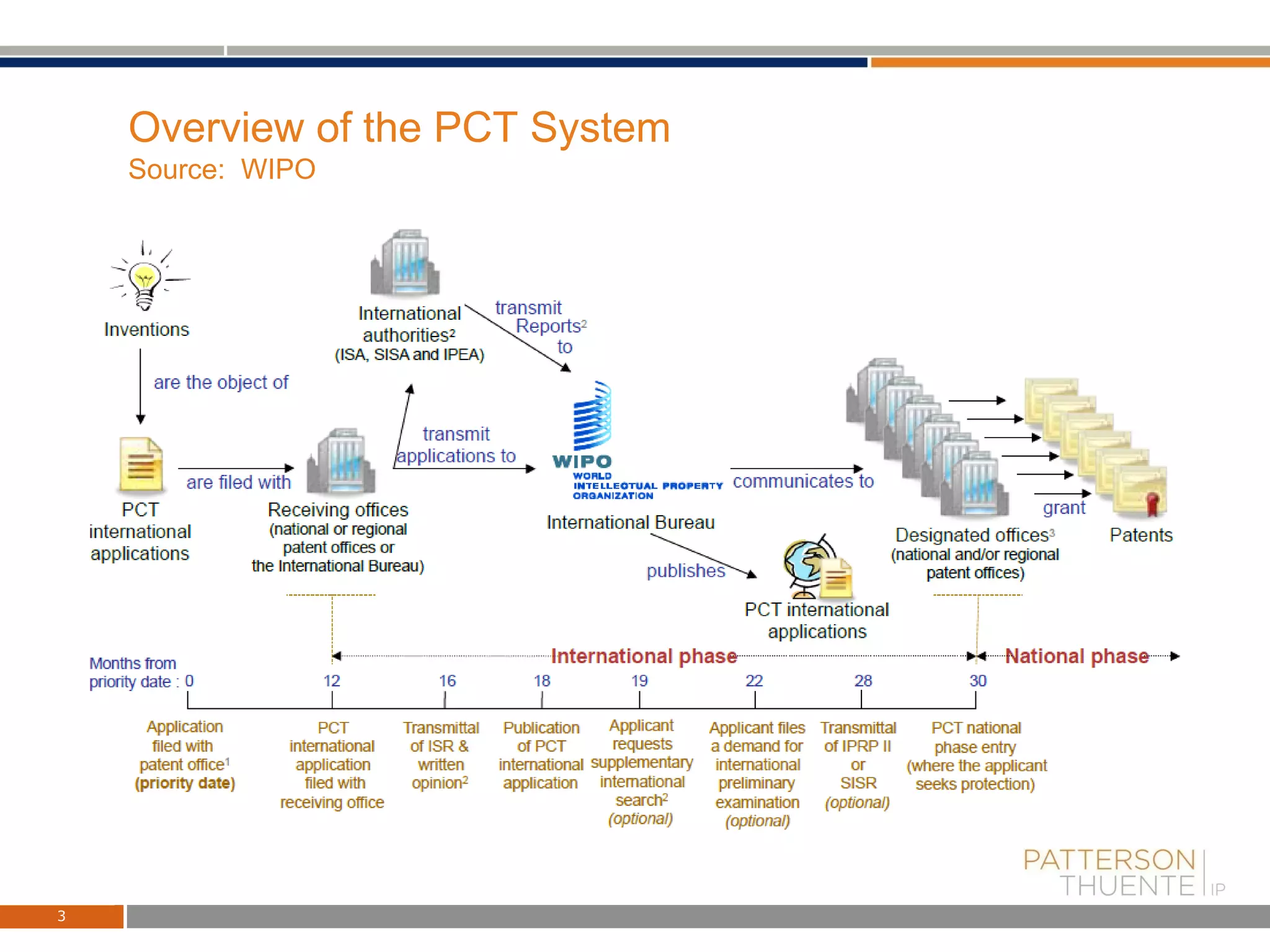
Overview of the PCT System
Source: WIPO
3
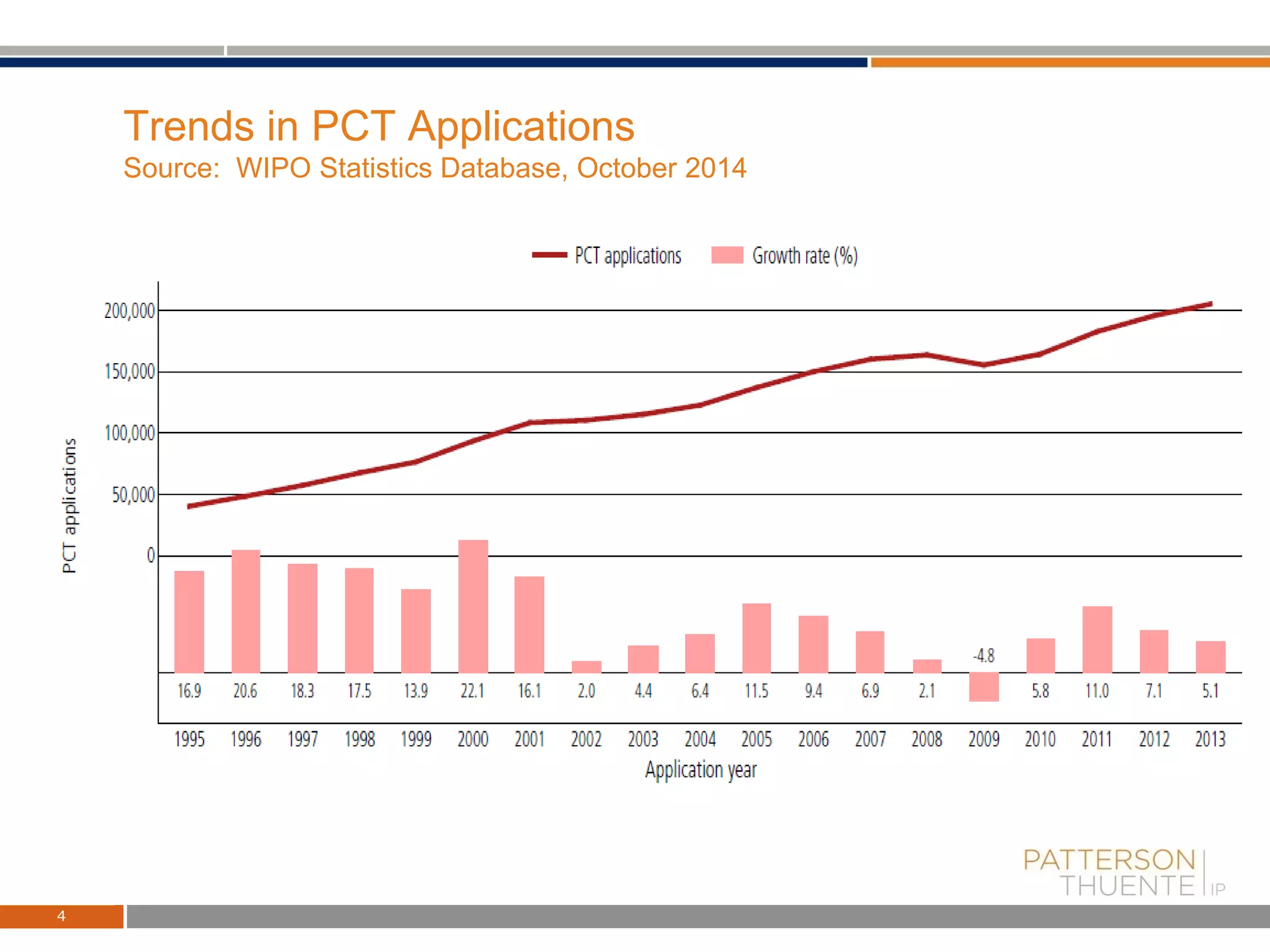
Trends in PCT Applications
Source: WIPO Statistics Database, October 2014
4
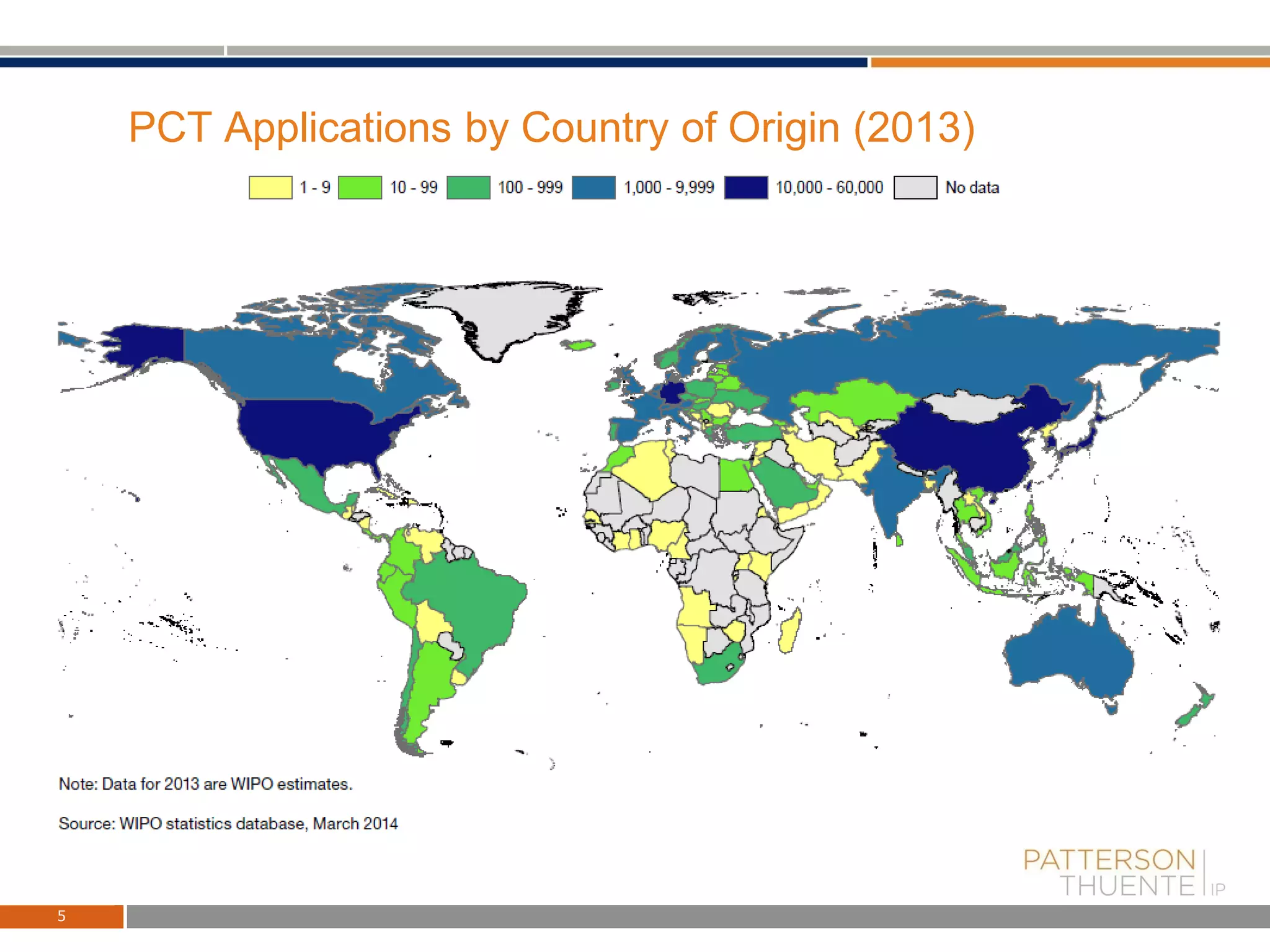
PCT Applications by Country of Origin (2013)
5
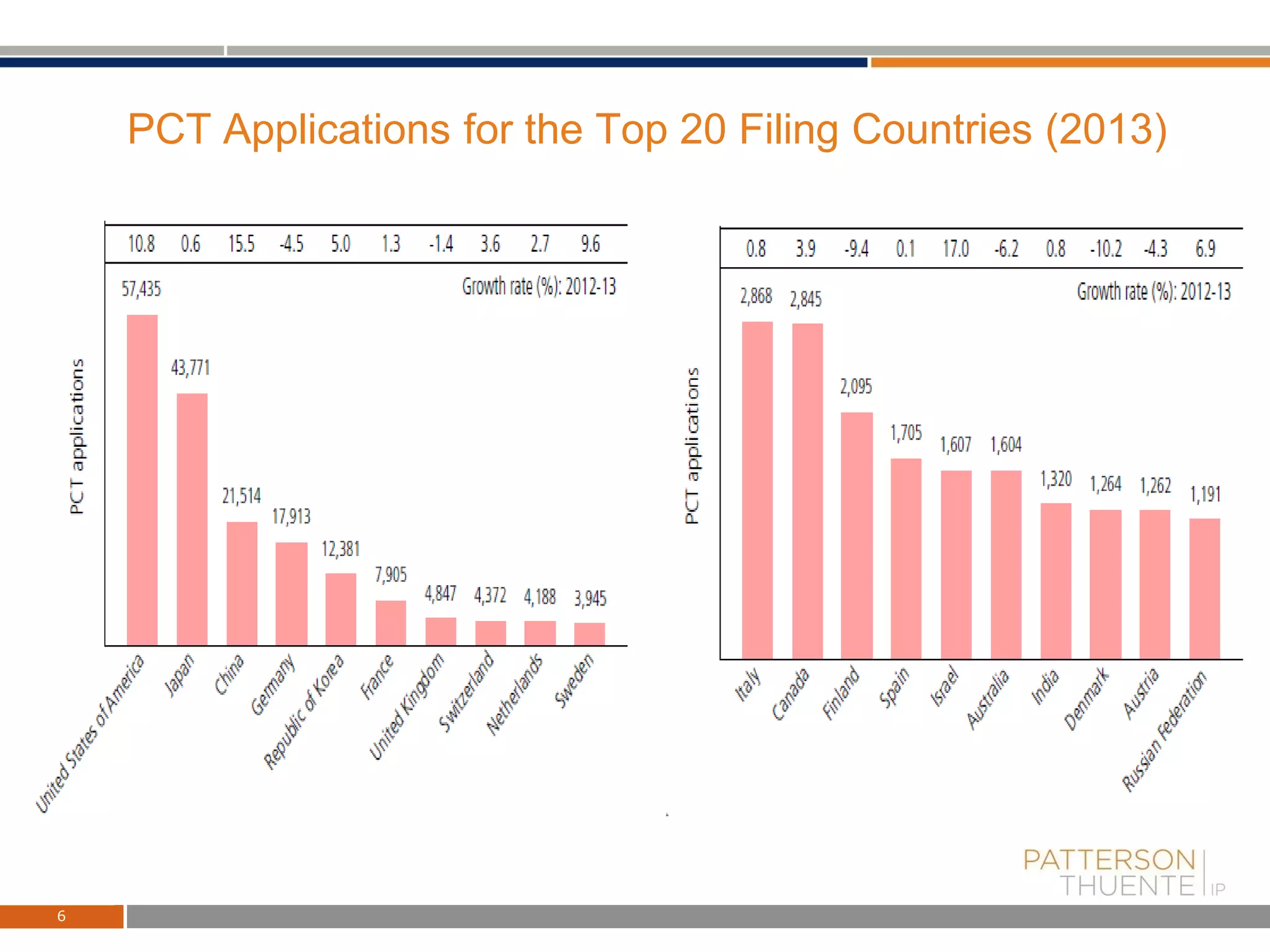
PCT Applications for the Top 20 Filing Countries (2013)
6
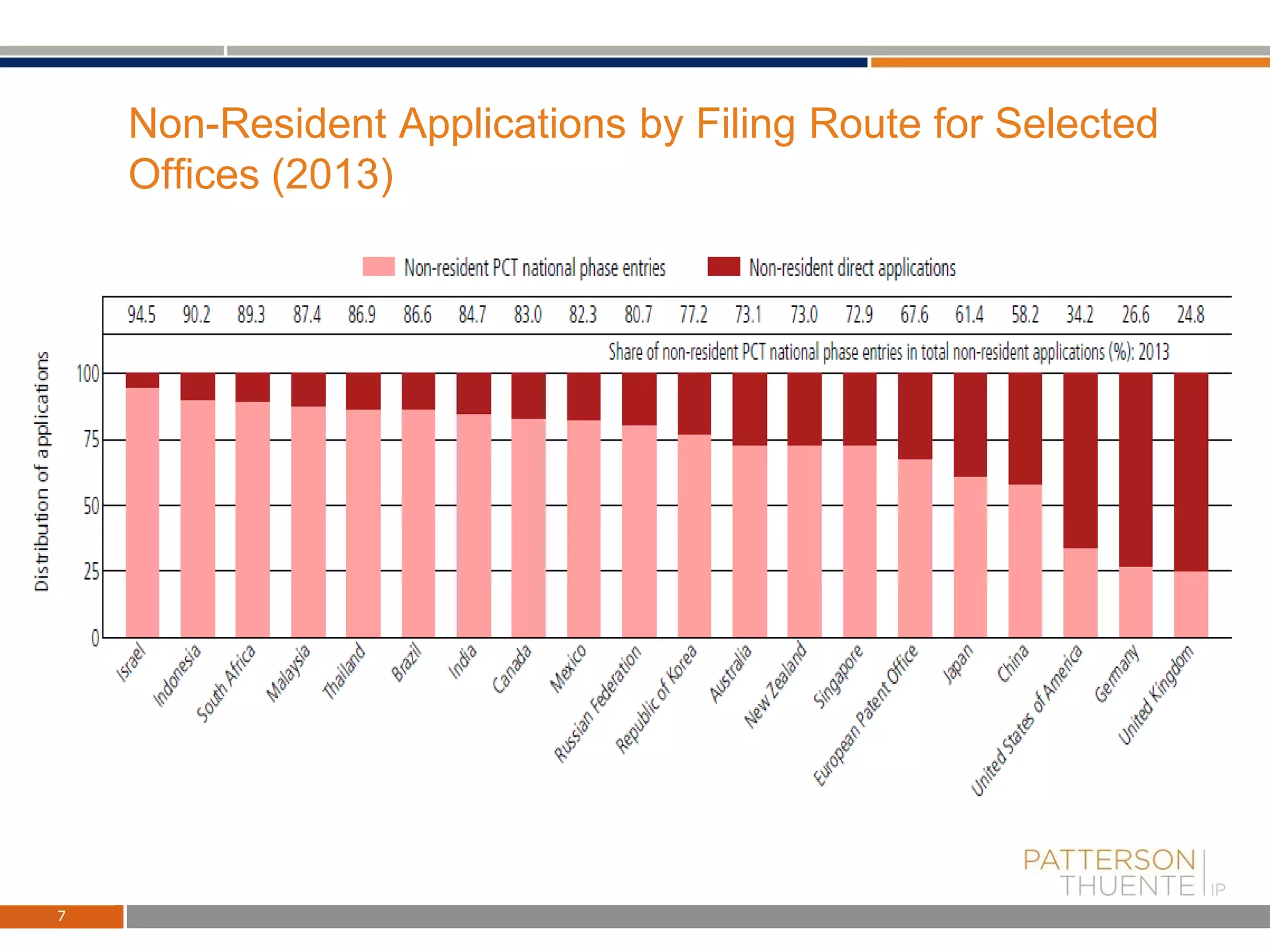
Non-Resident Applications by Filing Route for Selected
Offices (2013)
7
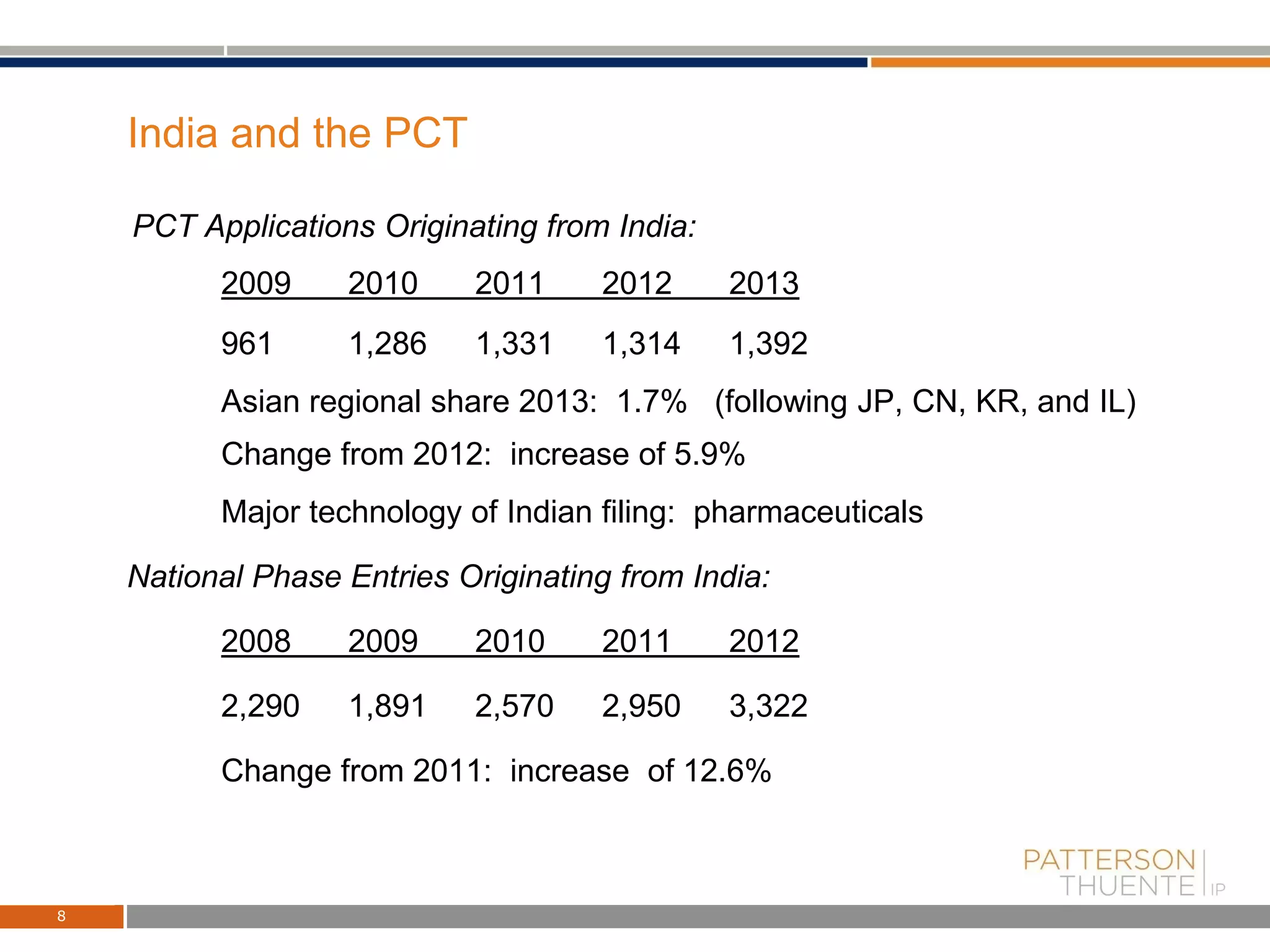
India and the PCT
PCT Applications Originating from India:
2009 2010 2011 2012 2013
961 1,286 1,331 1,314 1,392
Asian regional share 2013: 1.7% (following JP, CN, KR, and IL)
Change from 2012: increase of 5.9%
Major technology of Indian filing: pharmaceuticals
National Phase Entries Originating from India:
2008 2009 2010 2011 2012
2,290 1,891 2,570 2,950 3,322
Change from 2011: increase of 12.6%
8
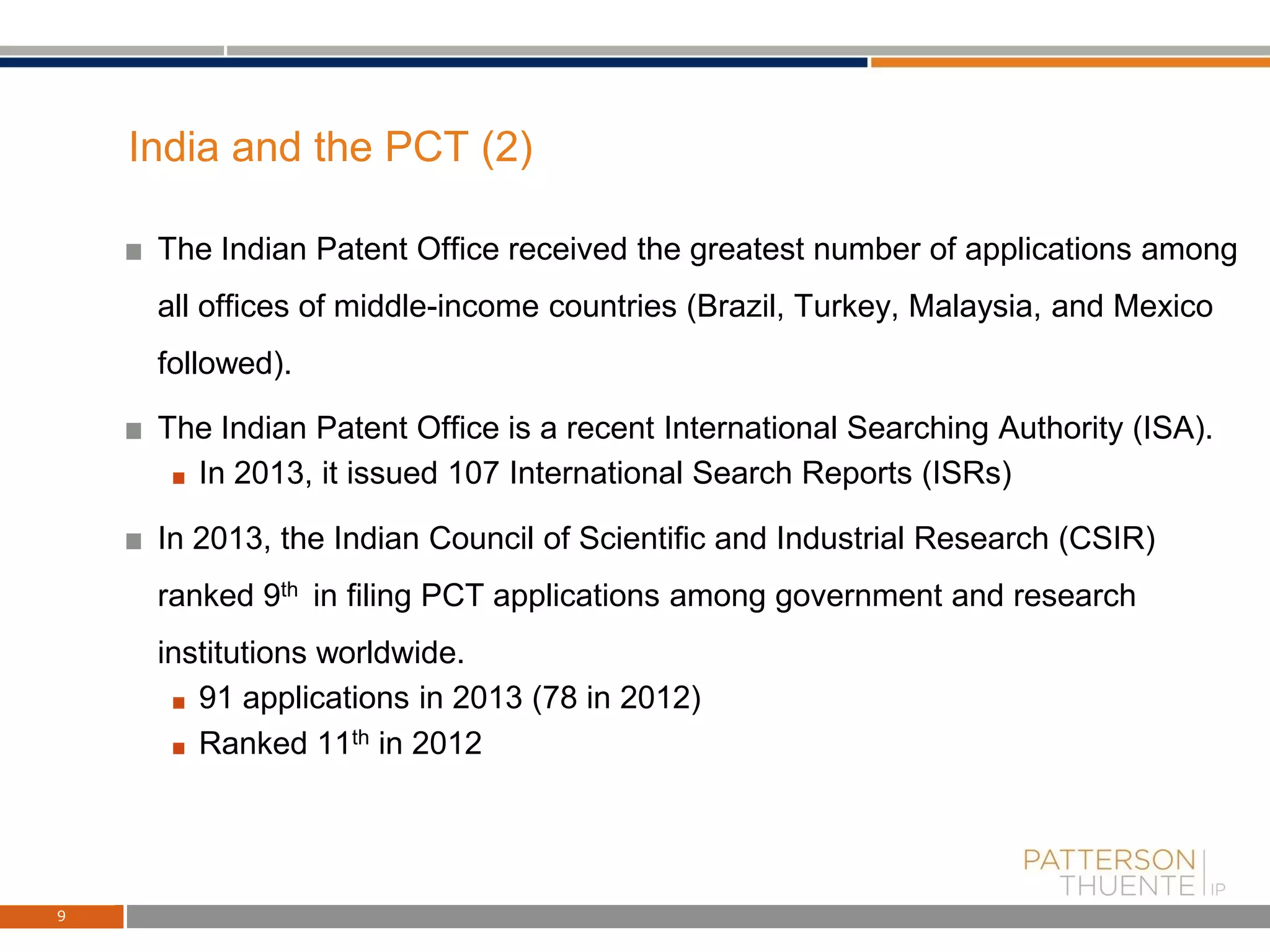
India and the PCT (2)
The Indian Patent Office received the greatest number of applications among
all offices of middle-income countries (Brazil, Turkey, Malaysia, and Mexico
followed).
The Indian Patent Office is a recent International Searching Authority (ISA).
In 2013, it issued 107 International Search Reports (ISRs)
In 2013, the Indian Council of Scientific and Industrial Research (CSIR)
ranked 9th in filing PCT applications among government and research
institutions worldwide.
91 applications in 2013 (78 in 2012)
Ranked 11th in 2012
9
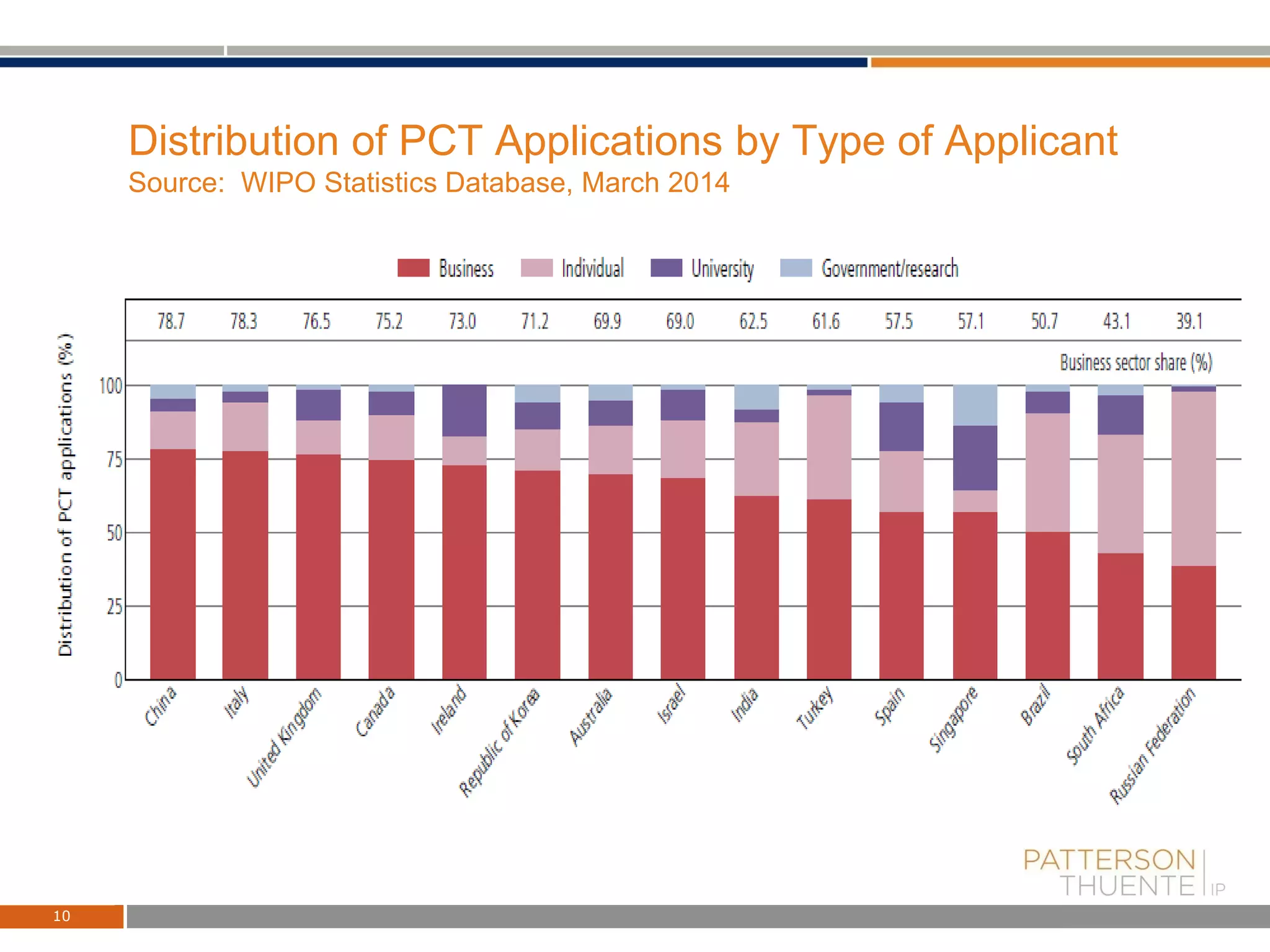
Distribution of PCT Applications by Type of Applicant
Source: WIPO Statistics Database, March 2014
10
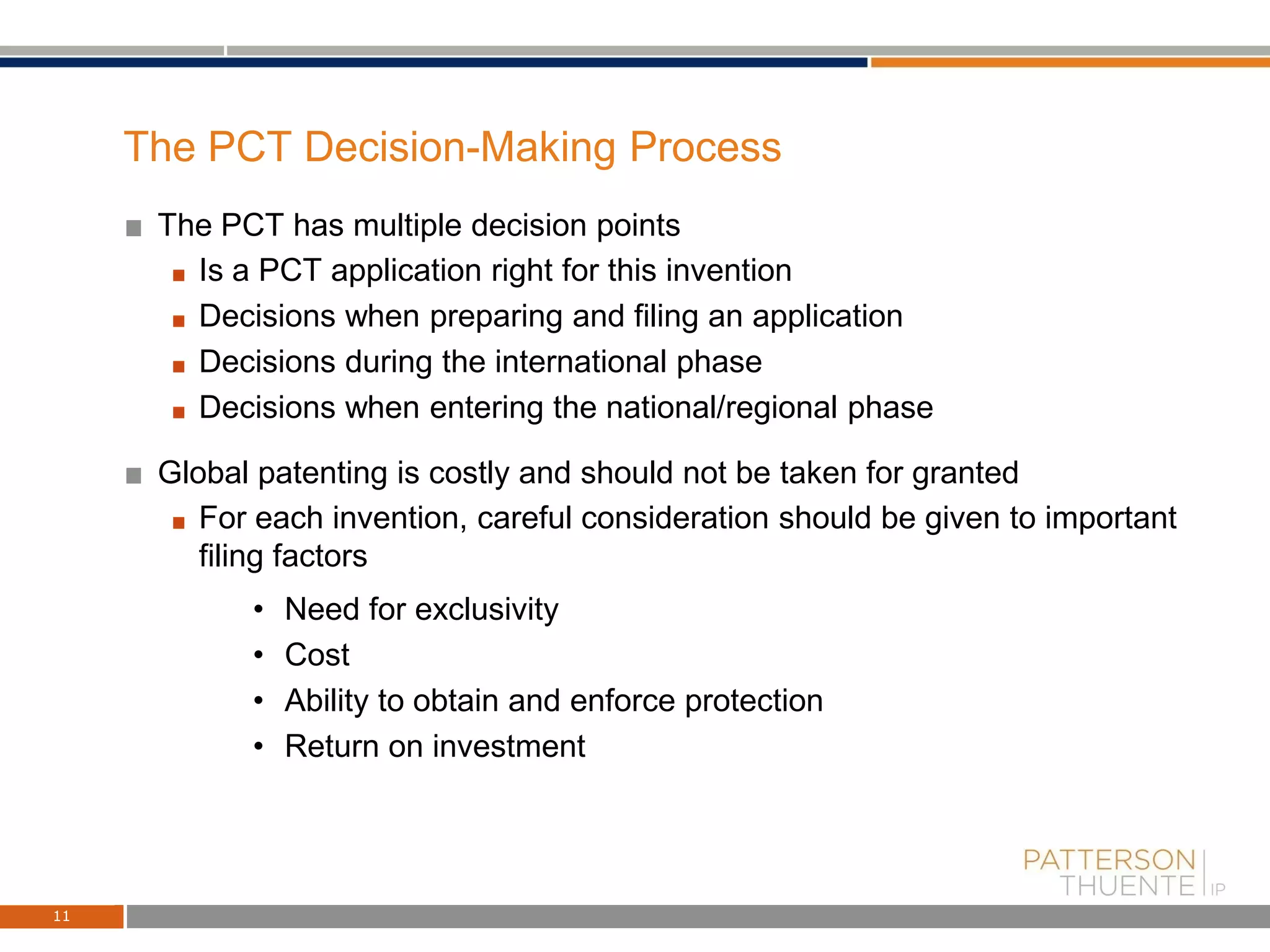
The PCT Decision-Making Process
The PCT has multiple decision points
Is a PCT application right for this invention
Decisions when preparing and filing an application
Decisions during the international phase
Decisions when entering the national/regional phase
Global patenting is costly and should not be taken for granted
For each invention, careful consideration should be given to important
filing factors
• Need for exclusivity
• Cost
• Ability to obtain and enforce protection
• Return on investment
11
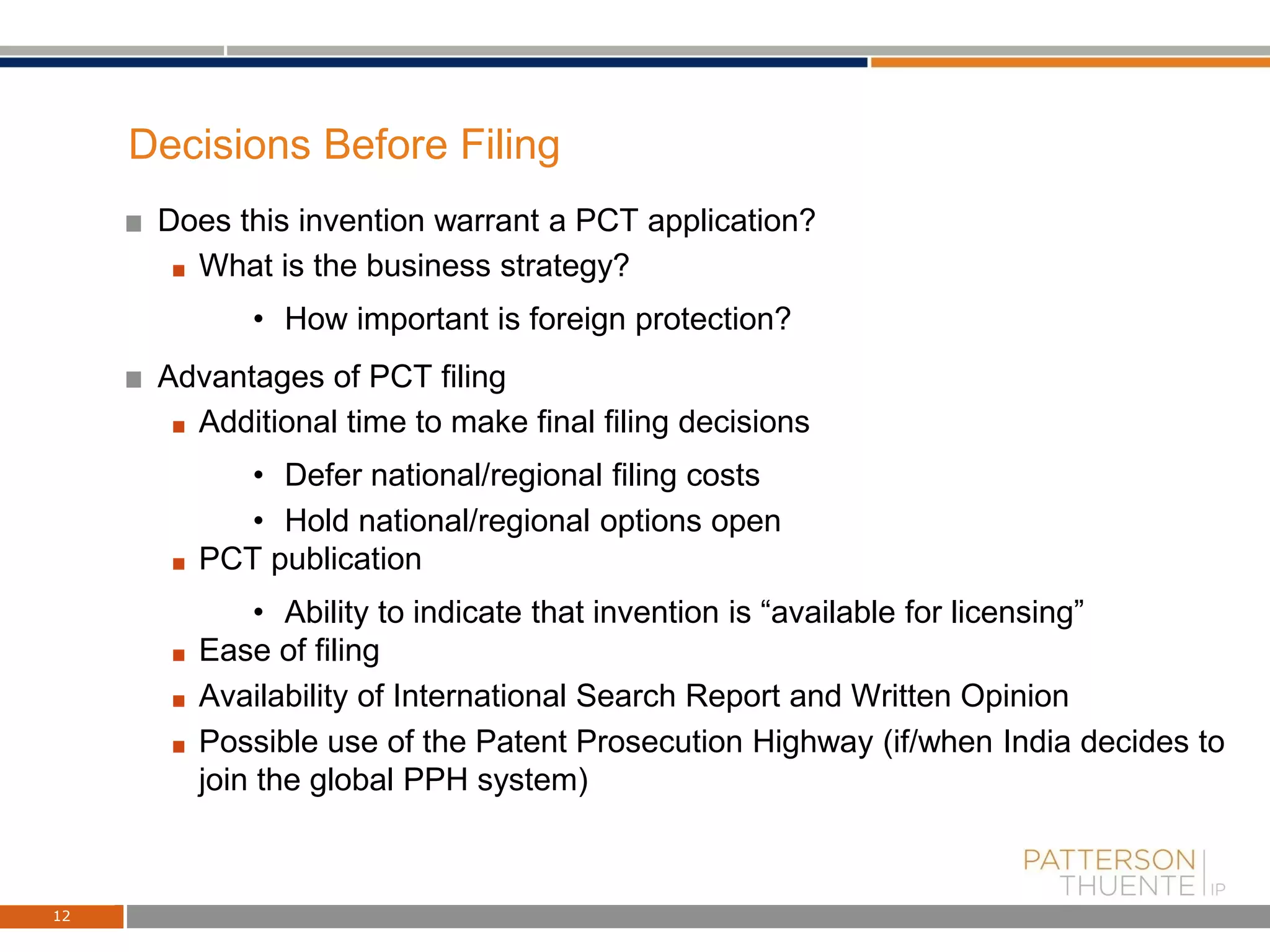
Decisions Before Filing
Does this invention warrant a PCT application?
What is the business strategy?
• How important is foreign protection?
Advantages of PCT filing
Additional time to make final filing decisions
• Defer national/regional filing costs
• Hold national/regional options open
PCT publication
• Ability to indicate that invention is “available for licensing”
Ease of filing
Availability of International Search Report and Written Opinion
Possible use of the Patent Prosecution Highway (if/when India decides to
join the global PPH system)
12
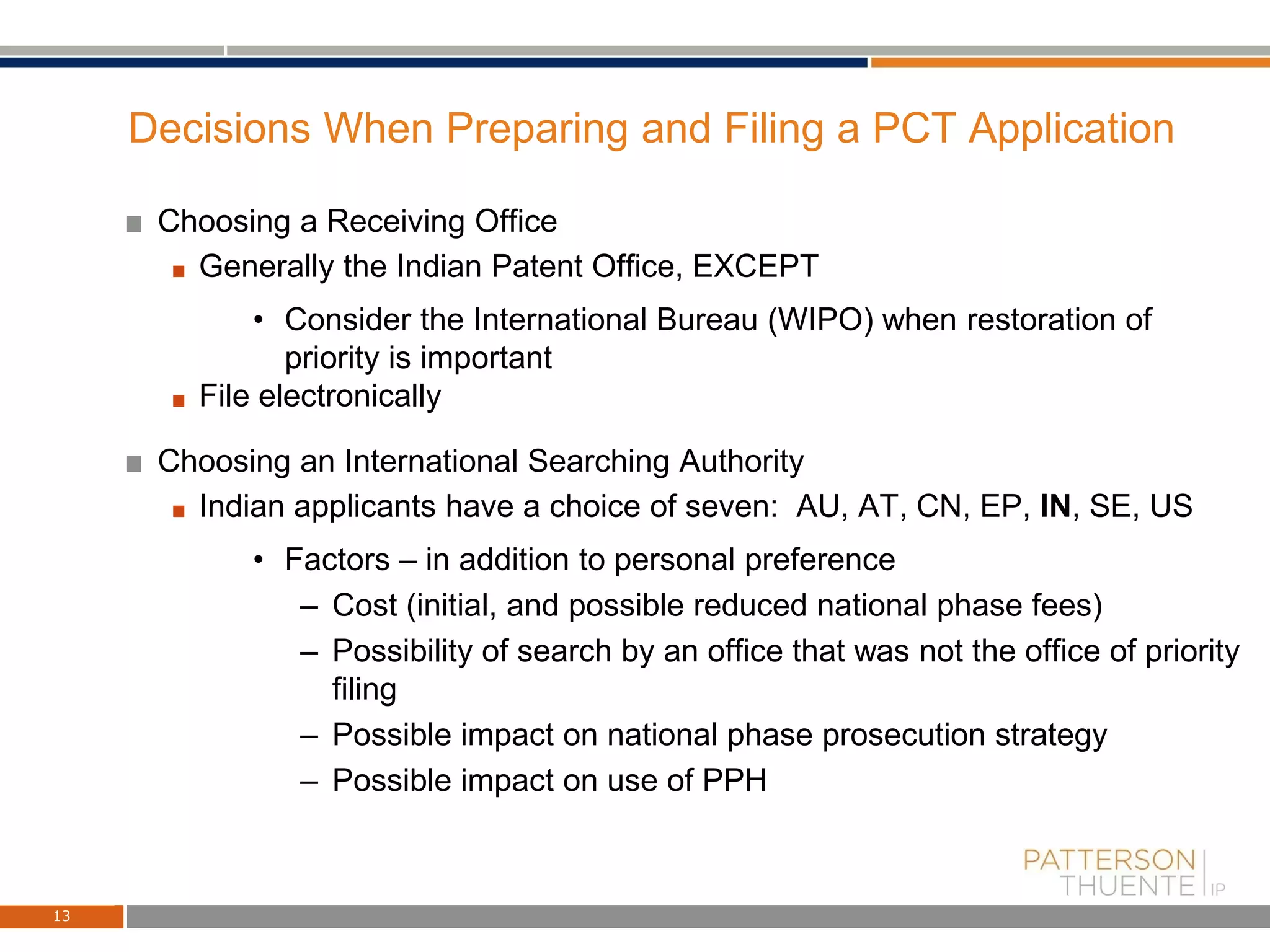
Decisions When Preparing and Filing a PCT Application
Choosing a Receiving Office
Generally the Indian Patent Office, EXCEPT
• Consider the International Bureau (WIPO) when restoration of
priority is important
File electronically
Choosing an International Searching Authority
Indian applicants have a choice of seven: AU, AT, CN, EP, IN, SE, US
• Factors – in addition to personal preference
– Cost (initial, and possible reduced national phase fees)
– Possibility of search by an office that was not the office of priority
filing
– Possible impact on national phase prosecution strategy
– Possible impact on use of PPH
13
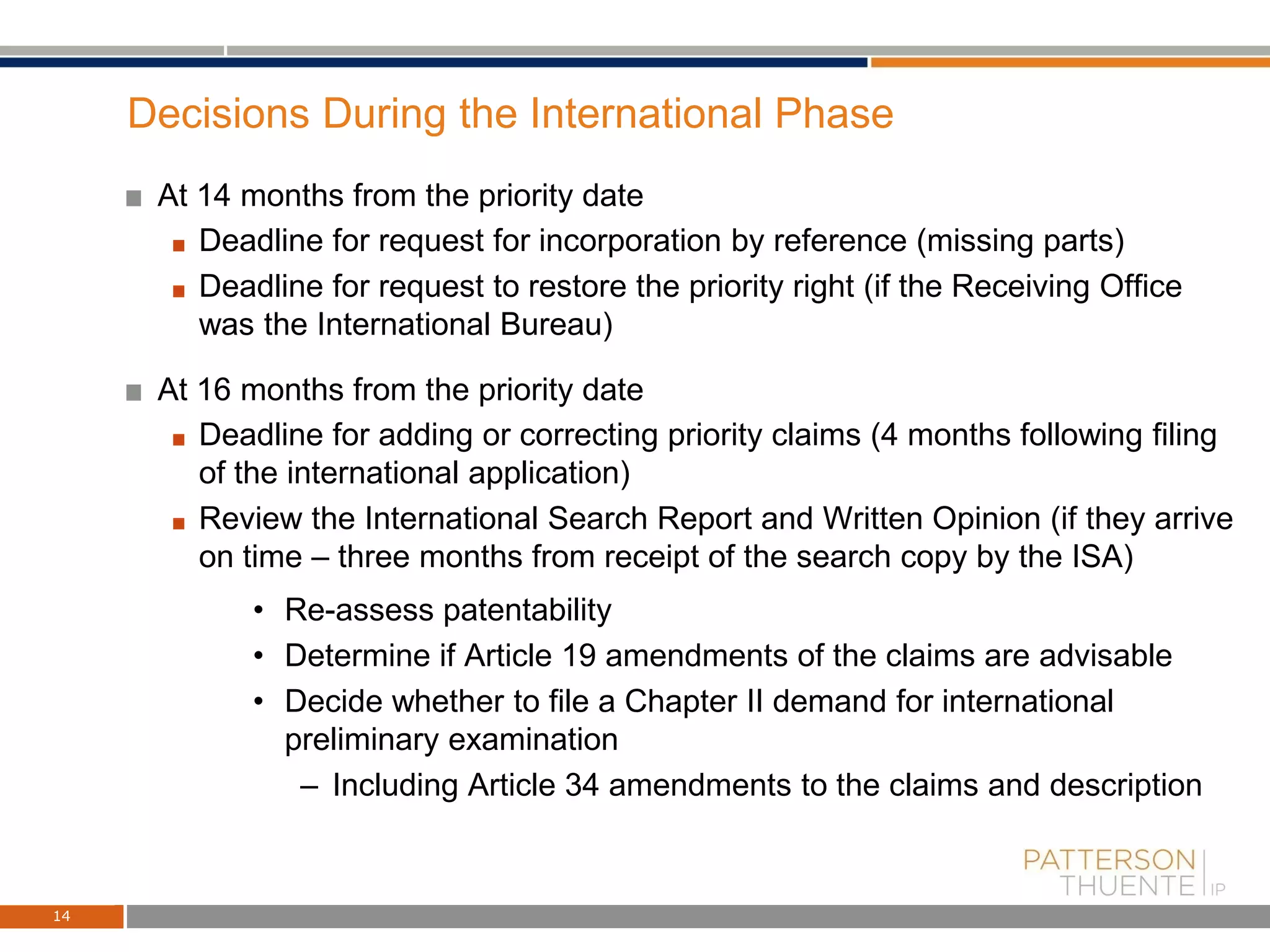
Decisions During the International Phase
At 14 months from the priority date
Deadline for request for incorporation by reference (missing parts)
Deadline for request to restore the priority right (if the Receiving Office
was the International Bureau)
At 16 months from the priority date
Deadline for adding or correcting priority claims (4 months following filing
of the international application)
Review the International Search Report and Written Opinion (if they arrive
on time – three months from receipt of the search copy by the ISA)
• Re-assess patentability
• Determine if Article 19 amendments of the claims are advisable
• Decide whether to file a Chapter II demand for international
preliminary examination
– Including Article 34 amendments to the claims and description
14
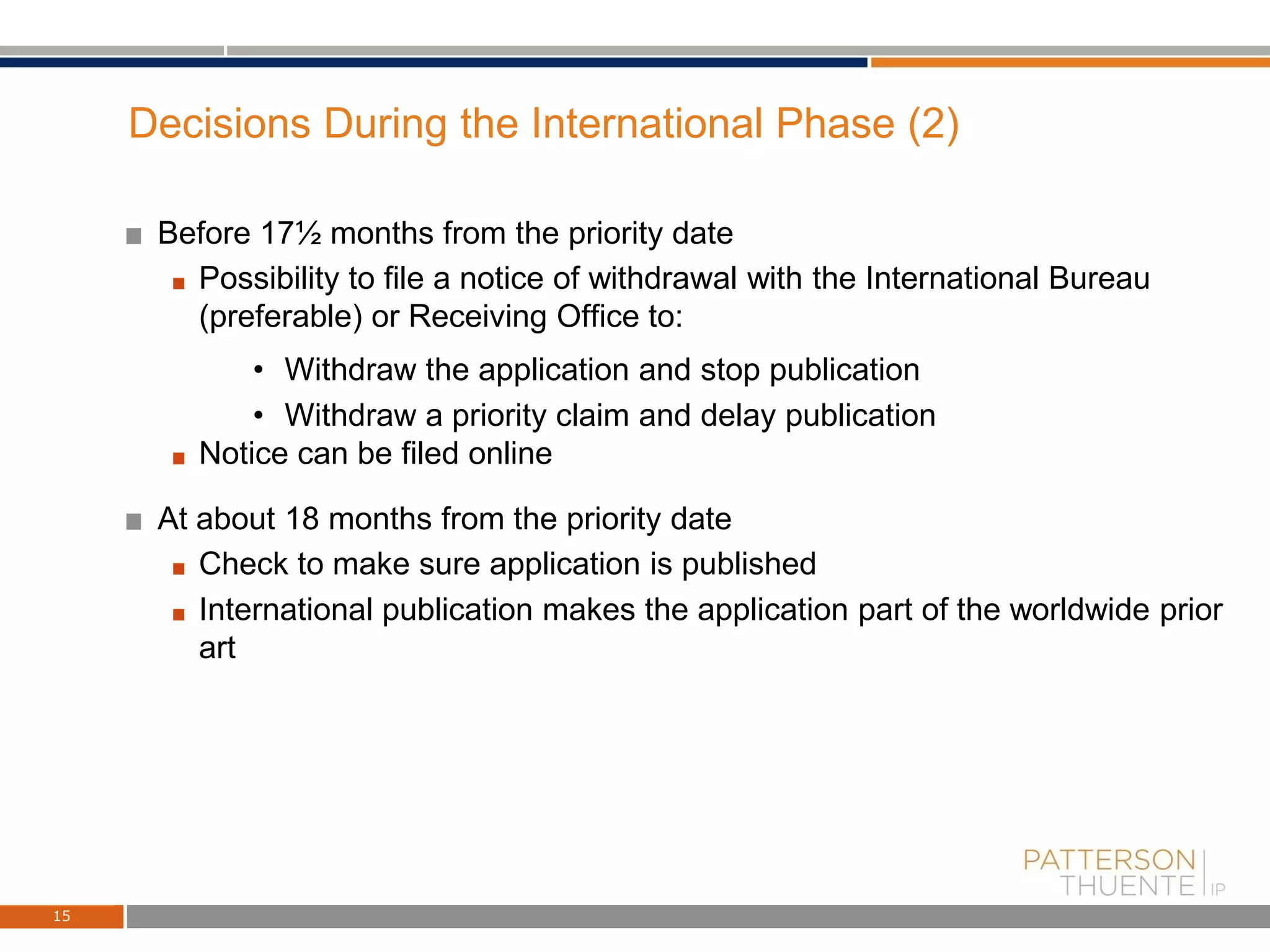
Decisions During the International Phase (2)
Before 17½ months from the priority date
Possibility to file a notice of withdrawal with the International Bureau
(preferable) or Receiving Office to:
• Withdraw the application and stop publication
• Withdraw a priority claim and delay publication
Notice can be filed online
At about 18 months from the priority date
Check to make sure application is published
International publication makes the application part of the worldwide prior
art
15
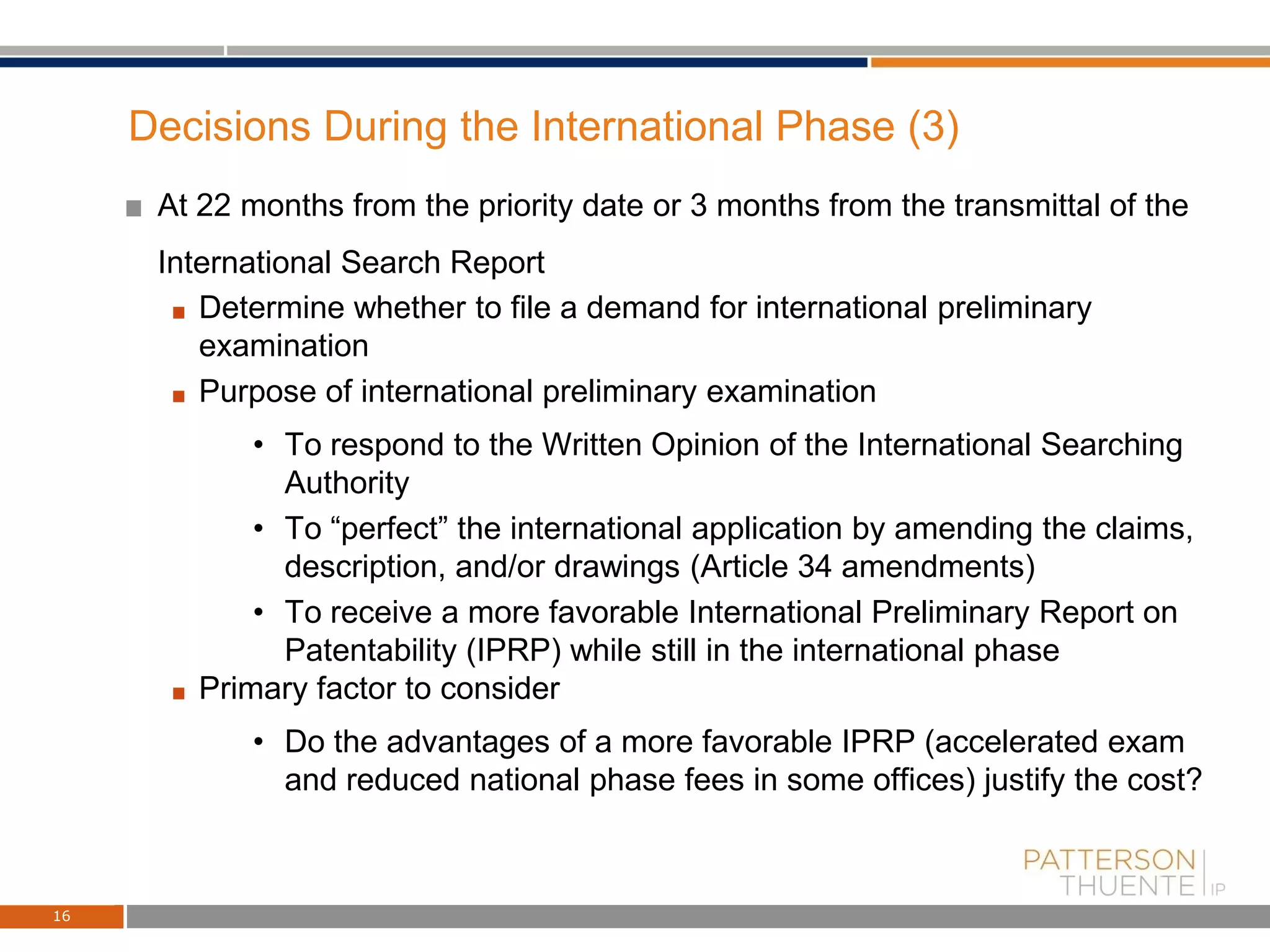
Decisions During the International Phase (3)
At 22 months from the priority date or 3 months from the transmittal of the
International Search Report
Determine whether to file a demand for international preliminary
examination
Purpose of international preliminary examination
• To respond to the Written Opinion of the International Searching
Authority
• To “perfect” the international application by amending the claims,
description, and/or drawings (Article 34 amendments)
• To receive a more favorable International Preliminary Report on
Patentability (IPRP) while still in the international phase
Primary factor to consider
• Do the advantages of a more favorable IPRP (accelerated exam
and reduced national phase fees in some offices) justify the cost?
16
Preparation for Entering the National/Regional Phase
Beginning at about 28 months from the priority date
Consider the preliminary amendments and arguments that may be
needed in national/regional phase in order to overcome deficiencies in the
IPRP and reduce national/regional claim fees
Review the contents of the international application file on the
PATENTSCOPE or ePCT databases to make sure that the file is
complete and correct.
• Verify that the title of the invention, names of applicants and
inventors, priority claims, and the application contents are correct
– If the name, residence, nationality, or address of the applicant,
or the name or address of the inventor or agent have changed,
file 92bis corrections, and ensure that an IB/306 form has been
issued
• Check for the IB/304 form to ensure that the International Bureau
has received a certified copy of the priority document[s]
• Check the IB/308 to ensure that the PCT application is available to
national offices
17
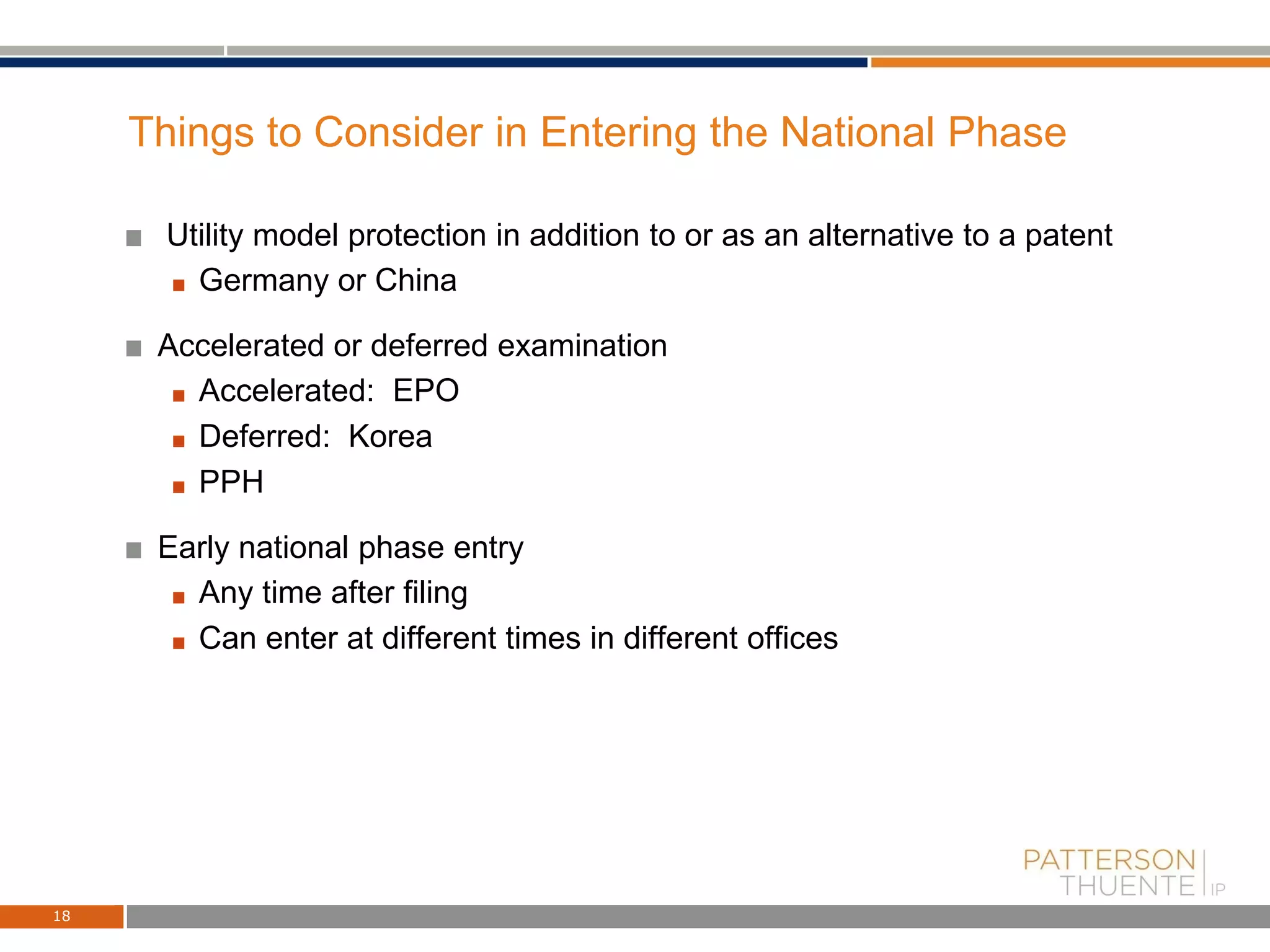
Things to Consider in Entering the National Phase
Utility model protection in addition to or as an alternative to a patent
Germany or China
Accelerated or deferred examination
Accelerated: EPO
Deferred: Korea
PPH
Early national phase entry
Any time after filing
Can enter at different times in different offices
18
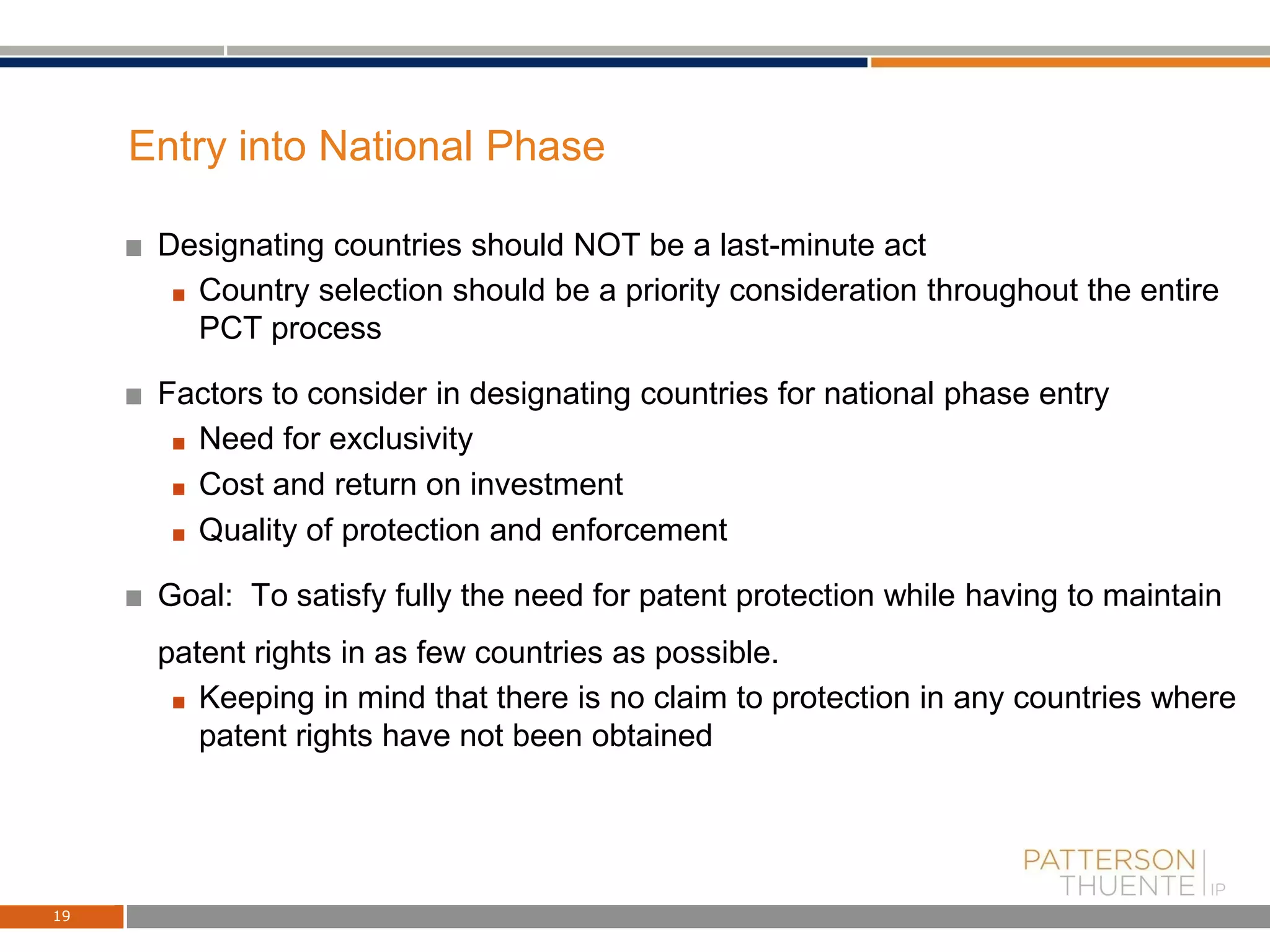
Entry into National Phase
Designating countries should NOT be a last-minute act
Country selection should be a priority consideration throughout the entire
PCT process
Factors to consider in designating countries for national phase entry
Need for exclusivity
Cost and return on investment
Quality of protection and enforcement
Goal: To satisfy fully the need for patent protection while having to maintain
patent rights in as few countries as possible.
Keeping in mind that there is no claim to protection in any countries where
patent rights have not been obtained
19
Factors to Consider in Evaluating Need for Exclusivity
Purpose for obtaining the patent
Strategic value of the invention
Place[s] where the invention will be manufactured or used
Market for the invention: How large and where is it located
Is there a geographic area/region that is most critical
What is each country’s potential market share
The competition: who and where are they located
Ease or difficulty to design around the invention
Ease with which the invention can be copied
Expected commercial viability of the invention
Size of the patenting budget
20
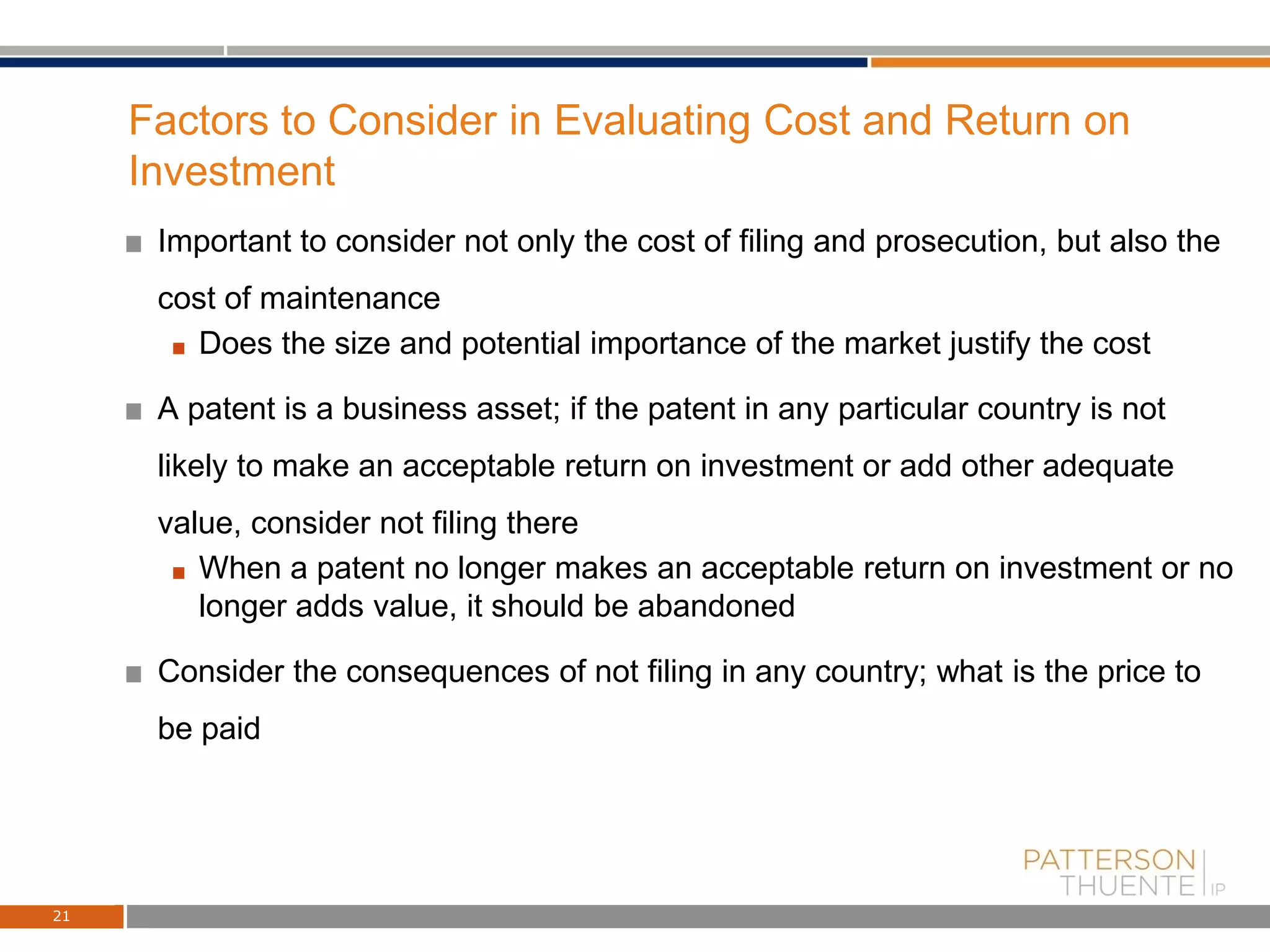
Factors to Consider in Evaluating Cost and Return on
Investment
Important to consider not only the cost of filing and prosecution, but also the
cost of maintenance
Does the size and potential importance of the market justify the cost
A patent is a business asset; if the patent in any particular country is not
likely to make an acceptable return on investment or add other adequate
value, consider not filing there
When a patent no longer makes an acceptable return on investment or no
longer adds value, it should be abandoned
Consider the consequences of not filing in any country; what is the price to
be paid
21
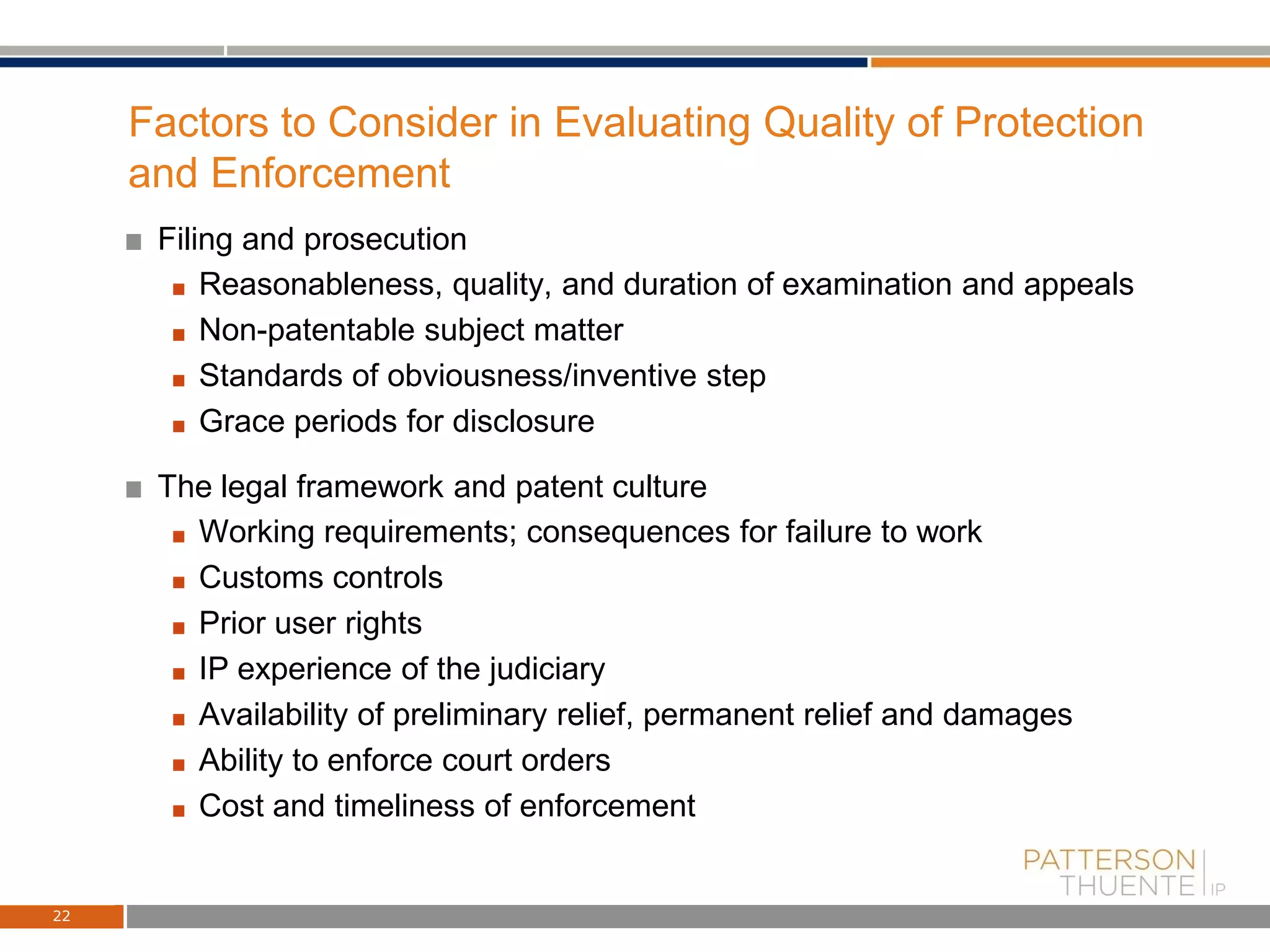
Factors to Consider in Evaluating Quality of Protection
and Enforcement
Filing and prosecution
Reasonableness, quality, and duration of examination and appeals
Non-patentable subject matter
Standards of obviousness/inventive step
Grace periods for disclosure
The legal framework and patent culture
Working requirements; consequences for failure to work
Customs controls
Prior user rights
IP experience of the judiciary
Availability of preliminary relief, permanent relief and damages
Ability to enforce court orders
Cost and timeliness of enforcement
22
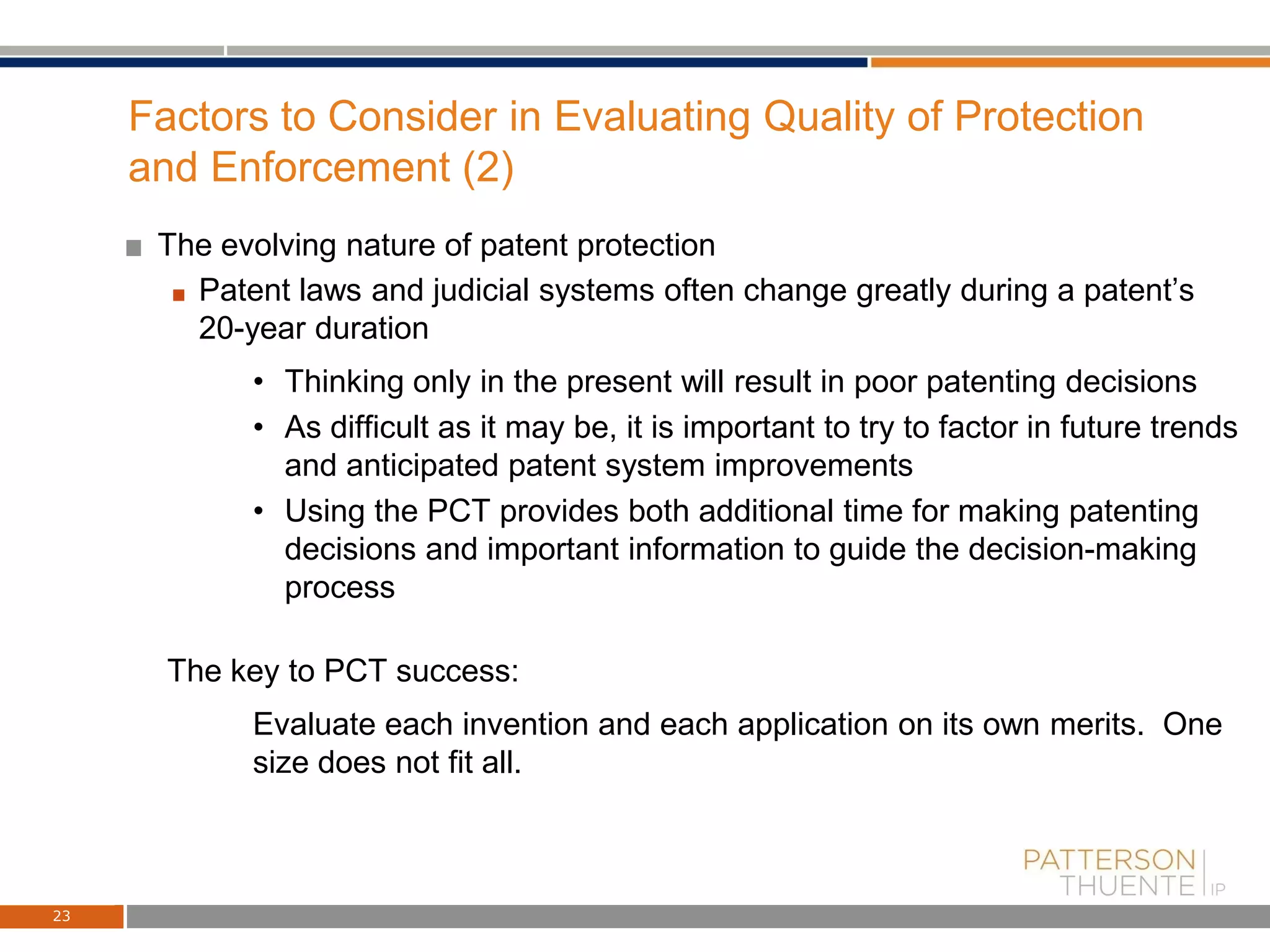
Factors to Consider in Evaluating Quality of Protection
and Enforcement (2)
The evolving nature of patent protection
Patent laws and judicial systems often change greatly during a patent’s
20-year duration
• Thinking only in the present will result in poor patenting decisions
• As difficult as it may be, it is important to try to factor in future trends
and anticipated patent system improvements
• Using the PCT provides both additional time for making patenting
decisions and important information to guide the decision-making
process
The key to PCT success:
Evaluate each invention and each application on its own merits. One
size does not fit all.
23
Questions?
Jay Erstling | +612-349-5740 | erstling@ptslaw.com
24

Taking Advantage of the PCT: Strategies, Tips, and Best Practices

  • 1.
    June 22, 20181 TakingAdvantage of the PCT: Strategies, Tips, and Best Practices Jay Erstling January 6, 2015 Overview of the PCT System PCT applications India & the PCT Decision making process Factors to consider
  • 2.
    SM © 2014 PattersonThuente Pedersen, P.A., some rights reserved - www.ptslaw.com DISCLAIMER: This presentation and any information contained herein is intended for informational purposes only and should not be construed as legal advice. Seek competent legal counsel for advice on any legal matter. Taking Advantage of the PCT: Strategies, Tips, and Best Practices Jay Erstling World IP Forum 2015 New Delhi, India
  • 3.
    Overview of thePCT System Source: WIPO 3
  • 4.
    Trends in PCTApplications Source: WIPO Statistics Database, October 2014 4
  • 5.
    PCT Applications byCountry of Origin (2013) 5
  • 6.
    PCT Applications forthe Top 20 Filing Countries (2013) 6
  • 7.
    Non-Resident Applications byFiling Route for Selected Offices (2013) 7
  • 8.
    India and thePCT PCT Applications Originating from India: 2009 2010 2011 2012 2013 961 1,286 1,331 1,314 1,392 Asian regional share 2013: 1.7% (following JP, CN, KR, and IL) Change from 2012: increase of 5.9% Major technology of Indian filing: pharmaceuticals National Phase Entries Originating from India: 2008 2009 2010 2011 2012 2,290 1,891 2,570 2,950 3,322 Change from 2011: increase of 12.6% 8
  • 9.
    India and thePCT (2) The Indian Patent Office received the greatest number of applications among all offices of middle-income countries (Brazil, Turkey, Malaysia, and Mexico followed). The Indian Patent Office is a recent International Searching Authority (ISA). In 2013, it issued 107 International Search Reports (ISRs) In 2013, the Indian Council of Scientific and Industrial Research (CSIR) ranked 9th in filing PCT applications among government and research institutions worldwide. 91 applications in 2013 (78 in 2012) Ranked 11th in 2012 9
  • 10.
    Distribution of PCTApplications by Type of Applicant Source: WIPO Statistics Database, March 2014 10
  • 11.
    The PCT Decision-MakingProcess The PCT has multiple decision points Is a PCT application right for this invention Decisions when preparing and filing an application Decisions during the international phase Decisions when entering the national/regional phase Global patenting is costly and should not be taken for granted For each invention, careful consideration should be given to important filing factors • Need for exclusivity • Cost • Ability to obtain and enforce protection • Return on investment 11
  • 12.
    Decisions Before Filing Doesthis invention warrant a PCT application? What is the business strategy? • How important is foreign protection? Advantages of PCT filing Additional time to make final filing decisions • Defer national/regional filing costs • Hold national/regional options open PCT publication • Ability to indicate that invention is “available for licensing” Ease of filing Availability of International Search Report and Written Opinion Possible use of the Patent Prosecution Highway (if/when India decides to join the global PPH system) 12
  • 13.
    Decisions When Preparingand Filing a PCT Application Choosing a Receiving Office Generally the Indian Patent Office, EXCEPT • Consider the International Bureau (WIPO) when restoration of priority is important File electronically Choosing an International Searching Authority Indian applicants have a choice of seven: AU, AT, CN, EP, IN, SE, US • Factors – in addition to personal preference – Cost (initial, and possible reduced national phase fees) – Possibility of search by an office that was not the office of priority filing – Possible impact on national phase prosecution strategy – Possible impact on use of PPH 13
  • 14.
    Decisions During theInternational Phase At 14 months from the priority date Deadline for request for incorporation by reference (missing parts) Deadline for request to restore the priority right (if the Receiving Office was the International Bureau) At 16 months from the priority date Deadline for adding or correcting priority claims (4 months following filing of the international application) Review the International Search Report and Written Opinion (if they arrive on time – three months from receipt of the search copy by the ISA) • Re-assess patentability • Determine if Article 19 amendments of the claims are advisable • Decide whether to file a Chapter II demand for international preliminary examination – Including Article 34 amendments to the claims and description 14
  • 15.
    Decisions During theInternational Phase (2) Before 17½ months from the priority date Possibility to file a notice of withdrawal with the International Bureau (preferable) or Receiving Office to: • Withdraw the application and stop publication • Withdraw a priority claim and delay publication Notice can be filed online At about 18 months from the priority date Check to make sure application is published International publication makes the application part of the worldwide prior art 15
  • 16.
    Decisions During theInternational Phase (3) At 22 months from the priority date or 3 months from the transmittal of the International Search Report Determine whether to file a demand for international preliminary examination Purpose of international preliminary examination • To respond to the Written Opinion of the International Searching Authority • To “perfect” the international application by amending the claims, description, and/or drawings (Article 34 amendments) • To receive a more favorable International Preliminary Report on Patentability (IPRP) while still in the international phase Primary factor to consider • Do the advantages of a more favorable IPRP (accelerated exam and reduced national phase fees in some offices) justify the cost? 16
  • 17.
    Preparation for Enteringthe National/Regional Phase Beginning at about 28 months from the priority date Consider the preliminary amendments and arguments that may be needed in national/regional phase in order to overcome deficiencies in the IPRP and reduce national/regional claim fees Review the contents of the international application file on the PATENTSCOPE or ePCT databases to make sure that the file is complete and correct. • Verify that the title of the invention, names of applicants and inventors, priority claims, and the application contents are correct – If the name, residence, nationality, or address of the applicant, or the name or address of the inventor or agent have changed, file 92bis corrections, and ensure that an IB/306 form has been issued • Check for the IB/304 form to ensure that the International Bureau has received a certified copy of the priority document[s] • Check the IB/308 to ensure that the PCT application is available to national offices 17
  • 18.
    Things to Considerin Entering the National Phase Utility model protection in addition to or as an alternative to a patent Germany or China Accelerated or deferred examination Accelerated: EPO Deferred: Korea PPH Early national phase entry Any time after filing Can enter at different times in different offices 18
  • 19.
    Entry into NationalPhase Designating countries should NOT be a last-minute act Country selection should be a priority consideration throughout the entire PCT process Factors to consider in designating countries for national phase entry Need for exclusivity Cost and return on investment Quality of protection and enforcement Goal: To satisfy fully the need for patent protection while having to maintain patent rights in as few countries as possible. Keeping in mind that there is no claim to protection in any countries where patent rights have not been obtained 19
  • 20.
    Factors to Considerin Evaluating Need for Exclusivity Purpose for obtaining the patent Strategic value of the invention Place[s] where the invention will be manufactured or used Market for the invention: How large and where is it located Is there a geographic area/region that is most critical What is each country’s potential market share The competition: who and where are they located Ease or difficulty to design around the invention Ease with which the invention can be copied Expected commercial viability of the invention Size of the patenting budget 20
  • 21.
    Factors to Considerin Evaluating Cost and Return on Investment Important to consider not only the cost of filing and prosecution, but also the cost of maintenance Does the size and potential importance of the market justify the cost A patent is a business asset; if the patent in any particular country is not likely to make an acceptable return on investment or add other adequate value, consider not filing there When a patent no longer makes an acceptable return on investment or no longer adds value, it should be abandoned Consider the consequences of not filing in any country; what is the price to be paid 21
  • 22.
    Factors to Considerin Evaluating Quality of Protection and Enforcement Filing and prosecution Reasonableness, quality, and duration of examination and appeals Non-patentable subject matter Standards of obviousness/inventive step Grace periods for disclosure The legal framework and patent culture Working requirements; consequences for failure to work Customs controls Prior user rights IP experience of the judiciary Availability of preliminary relief, permanent relief and damages Ability to enforce court orders Cost and timeliness of enforcement 22
  • 23.
    Factors to Considerin Evaluating Quality of Protection and Enforcement (2) The evolving nature of patent protection Patent laws and judicial systems often change greatly during a patent’s 20-year duration • Thinking only in the present will result in poor patenting decisions • As difficult as it may be, it is important to try to factor in future trends and anticipated patent system improvements • Using the PCT provides both additional time for making patenting decisions and important information to guide the decision-making process The key to PCT success: Evaluate each invention and each application on its own merits. One size does not fit all. 23
  • 24.
    Questions? Jay Erstling |+612-349-5740 | erstling@ptslaw.com 24