1
A Seminar submitted to
Vijaya Institute of Pharmaceutical Sciences for Women
In partial fulfillment of the requirements for the award of
the degree
Bachelor of Pharmacy
Under the Guidance of
Mrs. D. Santhi Krupa, M. Pharm.,
Asst., Professor
Department of Pharmacology
POLYCYSTIC OVARIAN DISORDER
AND ITS IMPACT ON INFERTILITY
Submitted by
Kranthi
INTRODUCTION
Poly cystic ovarian syndrome (PCOS) is a chronic hyper
androgenic state.
Women have two ovaries that produce eggs, as well as the
hormones estrogen and progesterone.
During a woman's menstrual cycle, an egg grows in a sac called a
follicle. This sac is located inside the ovaries.
In most cases, this follicle or sac breaks open and releases an egg.
But if the follicle doesn't break open, the fluid inside the follicle can
form a cyst on the ovary. The syndrome is best described as
"hyperandrogenic anovulation.“
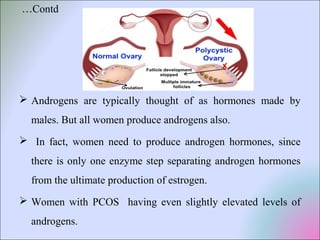
 Androgens are typically thought of as hormones made by
males. But all women produce androgens also.
 In fact, women need to produce androgen hormones, since
there is only one enzyme step separating androgen hormones
from the ultimate production of estrogen.
 Women with PCOS having even slightly elevated levels of
androgens.
Contd…
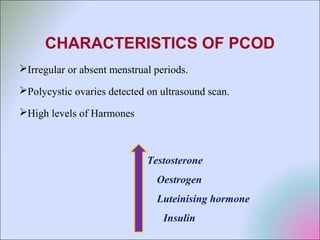
CHARACTERISTICS OF PCOD
Irregular or absent menstrual periods.
Polycystic ovaries detected on ultrasound scan.
High levels of Harmones
Testosterone
Oestrogen
Luteinising hormone
Insulin
EPIDEMOLOGY
Prevalence estimates for PCOS, as defined by the NIH/NICHD
criteria, indicate that PCOS is a common endocrinopathy
affecting 4%-8% of woman of reproductive age i.e., 24-28
years. The prevalence of PCOS appears to be higher from 37 to
90% in woman with the menstrual abnormalities and also
increase in the presence of certain diseases.
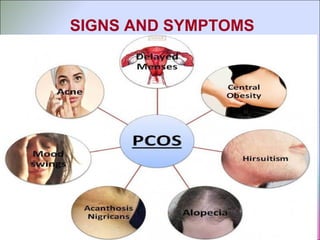
SIGNS AND SYMPTOMS
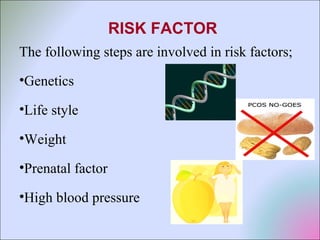
RISK FACTOR
The following steps are involved in risk factors;
•Genetics
•Life style
•Weight
•Prenatal factor
•High blood pressure
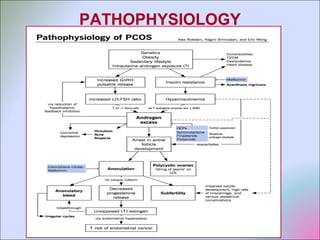
PATHOPHYSIOLOGY
contd…
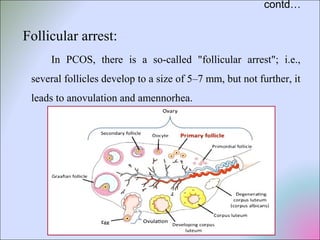
Follicular arrest:
In PCOS, there is a so-called "follicular arrest"; i.e.,
several follicles develop to a size of 5–7 mm, but not further, it
leads to anovulation and amennorhea.
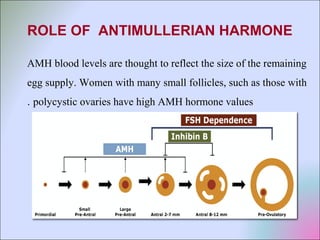
ROLE OF ANTIMULLERIAN HARMONE
AMH blood levels are thought to reflect the size of the remaining
egg supply. Women with many small follicles, such as those with
polycystic ovaries have high AMH hormone values.
THE ROLE OF ANDROGENS IN
PCOS
• In PCOS, theca cells have increased activities of 17 -hydroxylase,
17,20 lyase and 3 -hydroxysteroid dehydrogenase compared with
theca cells from normal women.
• The increased enzyme activities account for greater androgen
production due to gonadotropin stimulation in PCOS.
• Apart from this, the excess 5α-reduced androgens in the ovaries are
thought to inhibit the action of aromatase and therefore reduce
estradiol synthesis, which is required for further maturation.
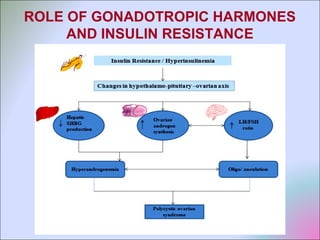
ROLE OF GONADOTROPIC HARMONES
AND INSULIN RESISTANCE
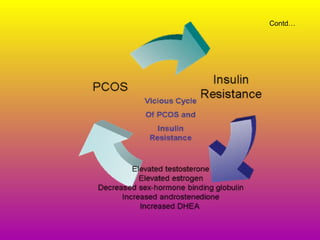
Contd…
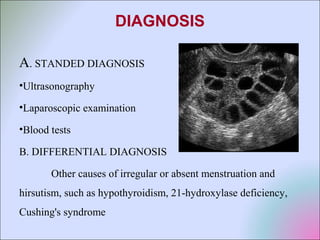
DIAGNOSIS
A. STANDED DIAGNOSIS
•Ultrasonography
•Laparoscopic examination
•Blood tests
B. DIFFERENTIAL DIAGNOSIS
Other causes of irregular or absent menstruation and
hirsutism, such as hypothyroidism, 21-hydroxylase deficiency,
Cushing's syndrome
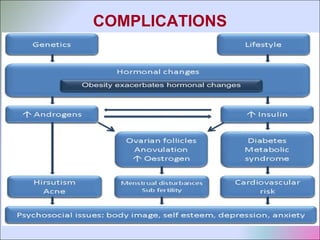
CONSEQUENCES OF PCOD
 Subfertility
 Miscarriage
 Cardiovascular diseases
 Type 2 Diabetes Mellitus
 Malignancies
 Psychiatric disorders
TREATMENT
PCOS is not curable, but the symptoms are treatable by:
•A healthy lifestyle
•Maintaining a healthy weight
Treatment include
•Non surgical treatment
•Surgical treatment
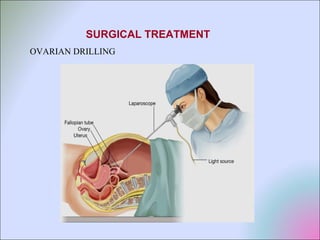
Ovarian Drilling
.Estrogen and progestin
oral contraceptive (OCP)
therapy
•Anti-androgens
•Antidiabetic drug
•Ovulation inducer
•Gonadotropin therapy
SURGICAL TREATMENT
OVARIAN DRILLING
COMPLICATIONS
PCOS IMPACT ON FEMALE INFERTILITY
 Infertility is defined as the absence of pregnency following 12
months unprotected intercourse. Infertility may be caused by
ovulatory dysfunction, blocked fallopian tube male factor
infertility or unexplained causes.
 The infertility rate with polycystic ovaries is very high. these
women usually will have difficulty getting pregnant - and
usually require treatment to improve chances for pregnancy.
 Some women with polycystic ovary syndrome will ovulate
(release a mature egg) occasionally - others do not ever
ovulate. In order to conceive, sperm must find and fertilize a
mature egg - so we need to ovulate.
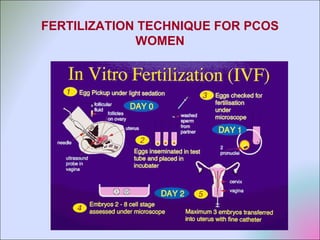
FERTILIZATION TECHNIQUE FOR PCOS
WOMEN
.
CONCLUSION
PCOS is one of the most common disorders affecting women of
reproductive age. For many women with this syndrome,
improving infertility is a primary goal of therapy. It is something
that can be treated by a primary health care physician. However,
maintaining a healthy and active lifestyle may decrease the
chance of developing this condition and its associated infertility.
REFERENCE
1.Stein I, Leventhal M. Amenorrhea associated with bilateral
polycystic ovaries. Am JObstet Gynecol. 1935; 29:181-91.
2.Azziz R, Woods KS, Reyna R, Key TJ, Knochenhauer ES,
Yildiz BO. The prevalence and features of the polycystic ovary
syndrome in an unselected population. J Clin Endocrinol Metab.
2004; 89(6):2745-9.
3.Diamanti-Kandarakis E, Kouli CR, Bergiele AT, Filandra FA,
Tsianateli TC, Spina GG, et al. A survey of the polycystic ovary
syndrome in the Greek island of Lesbos: hormonal and metabolic
profile. J Clin Endocrinol Metab. 1999; 84(11):4006-11.
Contd…….
4.Asuncion M, Calvo RM, San Millan JL, Sancho J, Avila S,
Escobar-Morreale HF. A prospective study of the prevalence of
the polycystic ovary syndrome in unselected Caucasian women
from Spain. J Clin Endocrinol Metab. 2000 Jul; 85(7):2434-8.
5.March WA, Moore VM, Willson KJ, Phillips DI, Norman RJ,
Davies MJ. The prevalence of polycystic ovary syndrome in a
community sample assessed under contrasting diagnostic criteria.
Hum Reprod. 2010;25(2):544-51.
PCOS IMPACT ON FERTILITY

PCOS IMPACT ON FERTILITY

  • 1.
    1 A Seminar submittedto Vijaya Institute of Pharmaceutical Sciences for Women In partial fulfillment of the requirements for the award of the degree Bachelor of Pharmacy Under the Guidance of Mrs. D. Santhi Krupa, M. Pharm., Asst., Professor Department of Pharmacology POLYCYSTIC OVARIAN DISORDER AND ITS IMPACT ON INFERTILITY Submitted by Kranthi
  • 2.
    INTRODUCTION Poly cystic ovariansyndrome (PCOS) is a chronic hyper androgenic state. Women have two ovaries that produce eggs, as well as the hormones estrogen and progesterone. During a woman's menstrual cycle, an egg grows in a sac called a follicle. This sac is located inside the ovaries. In most cases, this follicle or sac breaks open and releases an egg. But if the follicle doesn't break open, the fluid inside the follicle can form a cyst on the ovary. The syndrome is best described as "hyperandrogenic anovulation.“
  • 3.
     Androgens aretypically thought of as hormones made by males. But all women produce androgens also.  In fact, women need to produce androgen hormones, since there is only one enzyme step separating androgen hormones from the ultimate production of estrogen.  Women with PCOS having even slightly elevated levels of androgens. Contd…
  • 4.
    CHARACTERISTICS OF PCOD Irregularor absent menstrual periods. Polycystic ovaries detected on ultrasound scan. High levels of Harmones Testosterone Oestrogen Luteinising hormone Insulin
  • 5.
    EPIDEMOLOGY Prevalence estimates forPCOS, as defined by the NIH/NICHD criteria, indicate that PCOS is a common endocrinopathy affecting 4%-8% of woman of reproductive age i.e., 24-28 years. The prevalence of PCOS appears to be higher from 37 to 90% in woman with the menstrual abnormalities and also increase in the presence of certain diseases.
  • 6.
  • 7.
    RISK FACTOR The followingsteps are involved in risk factors; •Genetics •Life style •Weight •Prenatal factor •High blood pressure
  • 8.
  • 9.
    contd… Follicular arrest: In PCOS,there is a so-called "follicular arrest"; i.e., several follicles develop to a size of 5–7 mm, but not further, it leads to anovulation and amennorhea.
  • 10.
    ROLE OF ANTIMULLERIANHARMONE AMH blood levels are thought to reflect the size of the remaining egg supply. Women with many small follicles, such as those with polycystic ovaries have high AMH hormone values.
  • 11.
    THE ROLE OFANDROGENS IN PCOS • In PCOS, theca cells have increased activities of 17 -hydroxylase, 17,20 lyase and 3 -hydroxysteroid dehydrogenase compared with theca cells from normal women. • The increased enzyme activities account for greater androgen production due to gonadotropin stimulation in PCOS. • Apart from this, the excess 5α-reduced androgens in the ovaries are thought to inhibit the action of aromatase and therefore reduce estradiol synthesis, which is required for further maturation.
  • 12.
    ROLE OF GONADOTROPICHARMONES AND INSULIN RESISTANCE
  • 13.
  • 14.
    DIAGNOSIS A. STANDED DIAGNOSIS •Ultrasonography •Laparoscopicexamination •Blood tests B. DIFFERENTIAL DIAGNOSIS Other causes of irregular or absent menstruation and hirsutism, such as hypothyroidism, 21-hydroxylase deficiency, Cushing's syndrome
  • 15.
    CONSEQUENCES OF PCOD Subfertility  Miscarriage  Cardiovascular diseases  Type 2 Diabetes Mellitus  Malignancies  Psychiatric disorders
  • 16.
    TREATMENT PCOS is notcurable, but the symptoms are treatable by: •A healthy lifestyle •Maintaining a healthy weight Treatment include •Non surgical treatment •Surgical treatment Ovarian Drilling .Estrogen and progestin oral contraceptive (OCP) therapy •Anti-androgens •Antidiabetic drug •Ovulation inducer •Gonadotropin therapy
  • 17.
  • 18.
  • 19.
    PCOS IMPACT ONFEMALE INFERTILITY  Infertility is defined as the absence of pregnency following 12 months unprotected intercourse. Infertility may be caused by ovulatory dysfunction, blocked fallopian tube male factor infertility or unexplained causes.  The infertility rate with polycystic ovaries is very high. these women usually will have difficulty getting pregnant - and usually require treatment to improve chances for pregnancy.  Some women with polycystic ovary syndrome will ovulate (release a mature egg) occasionally - others do not ever ovulate. In order to conceive, sperm must find and fertilize a mature egg - so we need to ovulate.
  • 20.
  • 21.
    . CONCLUSION PCOS is oneof the most common disorders affecting women of reproductive age. For many women with this syndrome, improving infertility is a primary goal of therapy. It is something that can be treated by a primary health care physician. However, maintaining a healthy and active lifestyle may decrease the chance of developing this condition and its associated infertility.
  • 22.
    REFERENCE 1.Stein I, LeventhalM. Amenorrhea associated with bilateral polycystic ovaries. Am JObstet Gynecol. 1935; 29:181-91. 2.Azziz R, Woods KS, Reyna R, Key TJ, Knochenhauer ES, Yildiz BO. The prevalence and features of the polycystic ovary syndrome in an unselected population. J Clin Endocrinol Metab. 2004; 89(6):2745-9. 3.Diamanti-Kandarakis E, Kouli CR, Bergiele AT, Filandra FA, Tsianateli TC, Spina GG, et al. A survey of the polycystic ovary syndrome in the Greek island of Lesbos: hormonal and metabolic profile. J Clin Endocrinol Metab. 1999; 84(11):4006-11.
  • 23.
    Contd……. 4.Asuncion M, CalvoRM, San Millan JL, Sancho J, Avila S, Escobar-Morreale HF. A prospective study of the prevalence of the polycystic ovary syndrome in unselected Caucasian women from Spain. J Clin Endocrinol Metab. 2000 Jul; 85(7):2434-8. 5.March WA, Moore VM, Willson KJ, Phillips DI, Norman RJ, Davies MJ. The prevalence of polycystic ovary syndrome in a community sample assessed under contrasting diagnostic criteria. Hum Reprod. 2010;25(2):544-51.