By DR. Tabassum Azmi, PT
ASSISTANT PROFESSOR
MPT (OBS AND GYNAE)
 Polycystic Ovarian Disease (PCOD).
 Almost 10% of women worldwide are affected by this disease.
 They miss their menstrual cycles as a result of this hormonal imbalance, which also
makes it more difficult for women to conceive.
 The medical condition known as PCOD means that there is excessive production of
immature or partly developed eggs by a woman's ovaries, which over time, develop
into ovarian cysts.
 This results in enlarged ovaries that release high amounts of androgens (imbalance of
hormones), which can lead to infertility, irregular menstruation periods, hair loss, and
unnatural weight gain.
 Although there is presently no treatment for this illness, it may be controlled & managed
by making changes to one's diet and lifestyle.
 Polycystic ovarian syndrome.
 Almost 5-13% of women affected by the pcos.
 It is a metabolic disorder in which the ovaries produce a higher number of
androgen than usual.
 It interferes in the development and release of an egg that develops into cysts.
 Polycystic ovarian syndrome.
 Almost 5-13% of women affected by the pcos.
 It is a metabolic disorder in which the ovaries produce a higher number of
androgen than usual.
 It interferes in the development and release of an egg that develops into cysts.
 At the time of the first menstrual cycle of puberty, PCOD signs and symptoms often start to
manifest.
 Polycystic Ovarian Disease could also appear later as a result of gaining weight over
time.
 Many women are mostly unaware that they have PCOD.
 The symptoms of PCOD can show up when a girl menstruates for the first time, though
they may also occur later in life.
 These symptoms can vary in severity and occurrence between patients. For example,
some women may not have excess belly fat but still be affected by PCOD.
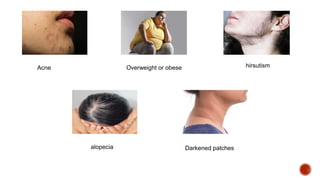
 There are some common signs of PCOD that includes:
- Severe menstrual bleeding
- Acne (facial, chest, and upper back)
- Overweight or obese
- Hair thinning on the crown (alopecia)
- Irregular, missed, or prolonged menstruation
- Excess hair growth on the face and body (hirsutism)
- Belly fat around the lower part of the abdomen
- Infertility
- Darkened patches of skin (neck & groin)
hirsutism
Overweight or obese
Acne
alopecia Darkened patches
Although the precise cause of PCOD problems in certain women is unknown, the following
are some key contributing factors:
Insulin Resistance - Peripheral insulin resistance affects around 70% of women who have
PCOD. A male hormone called androgen is produced in very small amounts in females but
may be produced more often by the body if there is an excess of insulin, and it causes
problems with ovulation. Studies have shown that women with PCOD usually have
difficulty in utilizing insulin to manage blood glucose levels. This can lead to a rise in blood
glucose and cause the body to produce even more insulin. Excess insulin can, in turn,
trigger the production of more male hormones.
Overproduction of Androgens - The ovaries generate unusually high levels of androgen
hormones, which can cause acne and hirsutism.
Minor Inflammation - Inflammation levels in women may rise as a result of PCOD.
Inflammation can also be exacerbated by being overweight. Inflammation in the body can
also stimulate the production of male hormones, like androgen, which are noticeably
higher in women with PCOD
Heredity - Women who have close female relatives with PCOD are 50% more likely to
develop this condition.
Weight - Occasionally, being overweight might make insulin resistance and polycystic
ovarian disease symptoms worse.
Low progesterone: If a woman’s body does not make enough of progesterone, she might
skip periods for extended periods of time.
PCOD often goes unnoticed in many women until it impacts fertility by lowering the
frequency of ovulation. Women with PCOD can still conceive; however, they may need to
be put on certain medications in order to get pregnant.
The PCOD side effects that call for medical attention are listed below:
- Abnormal bleeding in the uterus.
- Type 2 diabetes
- Miscarriage
- Sleep apnea
- Premature delivery and preterm labor
- Infertility or hypertension Infertility
- Chronic Liver inflammation
- Metabolic syndrome; risk for high blood sugar, high blood pressure, heart disease,
diabetes, and stroke.
- Due to unwanted hair growth and other symptoms, many women experience depression
and anxiety.
- Endometrial cancer caused by an enlarged uterus
- Untreatable acne showing signs of hormone imbalance
- Depression
As such, PCOD is not a disease that merely impacts one aspect of health. It can
profoundly affect the overall quality of life, if left untreated
Moreover, studies show that by the age of 40, almost 50% of women with PCOD would
have pre-diabetes or be diabetic, and many others would experience infertility throughout
their reproductive years.
 PCOD can be diagnosed with blood tests and imaging since PCOD has physical
symptoms that impact many bodily systems.
 The gynecologist will inquire about your medical history, eating and drinking habits,
and the use of any regular medications, including vitamins and supplements.
 Your diagnosis process will depend on your symptoms like irregular periods, male-
pattern hair growth on a woman's face, chest, or back, acne, or thinning of scalp hair.
 Depending on the PCOD diagnosis, a gynecologist could suggest the following tests:
- Medical history evaluation
- Physical examination
- Pelvic examination (ultrasound)
- Blood tests
- Imaging test
 The gynecologist may suggest further tests in addition to the ones listed above to look for
PCOD problems. They could include:
- Monitoring of cholesterol, glucose tolerance, blood pressure, and triglyceride levels on a
regular basis.
- Checking for depression and anxiety.
- Screening for obstructive sleep apnea
 The first steps in PCOD treatment often involve dietary adjustments, exercise, and weight
loss. Women who suffer from PCOD must exercise regularly and keep a balanced diet
and a healthy lifestyle. While there are various healthy lifestyle choices for women with
PCOD, you are recommended to stick to a PCOD diet that is low in fat and high in
carbohydrates. This would stop any unexpected spikes in your blood sugar levels and
assist you in maintaining a healthy weight.
 Women can successfully manage the symptoms of PCOD and live normal lives with the
help of following:
o Medications: Doctors may prescribe medications such as birth control pills to regulate
menstrual cycles and reduce excess hair growth. Other medications may also be
prescribed to manage additional symptoms for regulating hormones and improving insulin
resistance.
o Lifestyle changes: While medications can help manage certain symptoms of PCOD,
lifestyle changes may act as an important PCOD problem solution. Maintaining a healthy
diet, regular exercise, stopping smoking and excessive alcohol intake, and weight
management can help improve a lot of PCOD symptoms and lead a healthy, physically
active life.
o Laser Hair Removal: Women who suffer from hirsutism or excess body hair due to PCOD
may opt for laser hair removal treatments to get rid of the excessive hair.
o Acne treatment: PCOD-related acne treatment is available for women who suffer from a
lot of acne due to hormonal imbalances. Oral or topical medications and acne scar
treatment can be used to get rid of acne and its marks.
o Fertility treatments: PCOD is often diagnosed when women try to conceive and are
unsuccessful. Women with PCOD who are trying to conceive may benefit from certain
medications and assisted reproductive technologies (ART) like In Vitro Fertilization
(IVF), IUI etc. Thankfully, there are now several fertility treatments available that make it
possible for women to become pregnant and have a healthy pregnancy.
o Surgery: Surgery is most often not required for PCOD. However, in rare cases, surgery
may be recommended to remove cysts or scar tissue from the ovaries or if the symptoms
are too severe and all other lines of treatments have failed. In such cases, surgical
treatments like ovarian drilling, ovarian wedge resection, etc., may be done.
 A physiotherapist and dietician are highly
recommended as these are considered
first-line treatments.
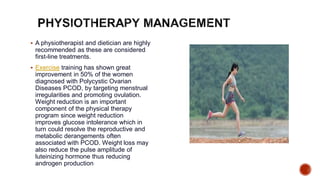
 Exercise training has shown great
improvement in 50% of the women
diagnosed with Polycystic Ovarian
Diseases PCOD, by targeting menstrual
irregularities and promoting ovulation.
Weight reduction is an important
component of the physical therapy
program since weight reduction
improves glucose intolerance which in
turn could resolve the reproductive and
metabolic derangements often
associated with PCOD. Weight loss may
also reduce the pulse amplitude of
luteinizing hormone thus reducing
androgen production.
 Physical therapists should also be aware of the clinical presentation of Polycystic Ovarian
Diseases PCOD. Women with PCOD may experience low back pain, sacral pain, and
lower quadrant abdominal pain. However, a thorough patient history can provide
information about a gynecologic/metabolic connection. The concern of the possible
presence of Polycystic Ovarian Diseases PCOD requires immediate referral to a
physician.
 In treating patients with a past medical history of Polycystic Ovarian Diseases PCOD for a
non-related condition, be aware of related medical concerns that may affect the patient's
ability to participate in activities including glucose intolerance and insulin resistance.
 Side effects of medications need to also be taken into account. For example, the side
effects of clomiphene citrate, an ovulation inducer, include insomnia, nausea/vomiting,
blurry vision, and frequent urination.
High Intensity Interval Training (HIIT)
 High Intensity Interval Training (HIIT) training is a popular style of fitness training that consists
of a series of exercises being performed at a fast paced to elicit both an aerobic and anaerobic
response. Anaerobic HIIT is a highly desirable workout because it engages all muscle fibers,
the fast twitch as well as the slow twitch. This makes anaerobic HIIT good for a complete
training effect (Anaerobic Exercise). The benefits of H.I.I.T training for PCOD include
improvements of glycemic control, “improvements in aerobic capacity, insulin sensitivity,
menstrual regulation and hormonal profiles.“ HIIT has also been shown to decrease stress,
anxiety, and depression level.
A H.I.I.T workout for PCOD would include:
-Warm Up such as walking, jogging, biking to a 50-65% of heart rate’s max.
- 2-3 rounds of 2 minutes of exercises performed at a high speed with low to moderate weight
varying in difficulty and heart rate max as low as 65%-90%
 Example:
Round 1: Squats and shoulder presses for 2 minutes
Round 2: Mountain climbers and high knees for 2 minutes
Round 3: Side lunges and triceps dips for 2 minutes
-Cool down such as walking, active stretching to lower heart rate max
 The kind of exercises can vary depending on the individual's abilities and accessibility to
equipment, but the method is consistent. To benefit from aerobic and anaerobic training
simultaneously, exercises must be performed at a fast rate in a series of rounds while
maintaining 50-90% of the participant’s heart rate max depending on the round of H.I.I.T.
To understand target heart rate max, you must first calculate heart rate max prior to
training, by subtracting the participants age from 220 and multiplying that value by the
percentage you aim to target. During training the participant can use a watch that monitors
their heart rate to make sure they are meeting the target heart rate for the corresponding
stage in H.I.I.T or they may count their pulse for a minute immediately after exercise and
determine if their intensity such as performed speed or resistance needs to be modified.
 Aerobic Training
 Aerobic training can include running, walking, and bike riding. There is no specific method
that is superior to the other, each type of aerobic training can help to alleviate the severity
of PCOD symptoms. Performing an aerobic activity that will increase your heart rate to
sixty to seventy percent can chow improvements in autonomic and inflammatory
functions. PCOD can impact each woman differently, and due to this weight and level of
perceived intensity will be specific to the individual. The intensity of aerobic training will
depend on personal max heart rate. The target heart rate of sixty to seventy percent can
be calculated by taking your age and multiplying it by .07 or .06 and then subtracting 220.
The sum of this calculation will be the target heart rate. A great way to monitor, to make
sure the cardiovascular training is sufficiently reaching the target heart rate that benefits
women with PCOD, is to track heart rate manually or with watch devices that report heart
rate in real time.
Resistance Training
 Resistance training (RT) is the “increase in muscle strength by making muscles work
against a weight or force” and is another effective way to help improve and decrease
PCOD symptoms. RT has been shown to reduce testosterone levels, waist circumference
and increase functional capacity. Additionally, it has been found that RT can also help
improve “menstrual cyclicity, Ferriman-Gallwey scores [used to score hirsutism],
testosterone, DHEA-S, sex hormone binding globulin levels and free androgen index
scores”.All these hormones are part of the pathophysiology of PCOD. By improving the
hormonal level, RT is helping to address some of the hormonal imbalance caused by
PCOD and can improve symptoms and overall health.
 A general recommendation for resistance training for women with PCOD includes training
2-3 days per week for 30-60 minutes per session. “Loading for strength training should be
between 8 and 15 repetitions with a 1RM percentage between 60% and 85%.” Shrestha et
al., n.d. Physiopedia article discusses how you can find your 1RM. Exercises can include
dumbbells, barbells, Thera-bands, weighted pulley machines, and body weight. Full-body
exercises can be squats, pushups, and burpees, while isolated body parts exercises
include biceps, triceps, or hamstring curls and single leg raises. Depending on the
resources available, a variety of RT exercises can be done. A physical therapist can help
assess and evaluate the specific needs of each individual and can create a treatment plan
that involves resistance training to help manage PCOD.
 Modalities
Transcutaneous electrical nerve stimulation (TENS)
Hot pack/Heat Therapy
PCOD , Diet plan, Physiotherapy management & Lifestyle modification .pdf

PCOD , Diet plan, Physiotherapy management & Lifestyle modification .pdf

  • 1.
    By DR. TabassumAzmi, PT ASSISTANT PROFESSOR MPT (OBS AND GYNAE)
  • 2.
     Polycystic OvarianDisease (PCOD).  Almost 10% of women worldwide are affected by this disease.  They miss their menstrual cycles as a result of this hormonal imbalance, which also makes it more difficult for women to conceive.  The medical condition known as PCOD means that there is excessive production of immature or partly developed eggs by a woman's ovaries, which over time, develop into ovarian cysts.
  • 3.
     This resultsin enlarged ovaries that release high amounts of androgens (imbalance of hormones), which can lead to infertility, irregular menstruation periods, hair loss, and unnatural weight gain.  Although there is presently no treatment for this illness, it may be controlled & managed by making changes to one's diet and lifestyle.
  • 4.
     Polycystic ovariansyndrome.  Almost 5-13% of women affected by the pcos.  It is a metabolic disorder in which the ovaries produce a higher number of androgen than usual.  It interferes in the development and release of an egg that develops into cysts.
  • 5.
     Polycystic ovariansyndrome.  Almost 5-13% of women affected by the pcos.  It is a metabolic disorder in which the ovaries produce a higher number of androgen than usual.  It interferes in the development and release of an egg that develops into cysts.
  • 6.
     At thetime of the first menstrual cycle of puberty, PCOD signs and symptoms often start to manifest.  Polycystic Ovarian Disease could also appear later as a result of gaining weight over time.  Many women are mostly unaware that they have PCOD.  The symptoms of PCOD can show up when a girl menstruates for the first time, though they may also occur later in life.  These symptoms can vary in severity and occurrence between patients. For example, some women may not have excess belly fat but still be affected by PCOD.
  • 7.
     There aresome common signs of PCOD that includes: - Severe menstrual bleeding - Acne (facial, chest, and upper back) - Overweight or obese - Hair thinning on the crown (alopecia) - Irregular, missed, or prolonged menstruation - Excess hair growth on the face and body (hirsutism) - Belly fat around the lower part of the abdomen - Infertility - Darkened patches of skin (neck & groin)
  • 8.
  • 9.
    Although the precisecause of PCOD problems in certain women is unknown, the following are some key contributing factors: Insulin Resistance - Peripheral insulin resistance affects around 70% of women who have PCOD. A male hormone called androgen is produced in very small amounts in females but may be produced more often by the body if there is an excess of insulin, and it causes problems with ovulation. Studies have shown that women with PCOD usually have difficulty in utilizing insulin to manage blood glucose levels. This can lead to a rise in blood glucose and cause the body to produce even more insulin. Excess insulin can, in turn, trigger the production of more male hormones.
  • 10.
    Overproduction of Androgens- The ovaries generate unusually high levels of androgen hormones, which can cause acne and hirsutism. Minor Inflammation - Inflammation levels in women may rise as a result of PCOD. Inflammation can also be exacerbated by being overweight. Inflammation in the body can also stimulate the production of male hormones, like androgen, which are noticeably higher in women with PCOD Heredity - Women who have close female relatives with PCOD are 50% more likely to develop this condition. Weight - Occasionally, being overweight might make insulin resistance and polycystic ovarian disease symptoms worse. Low progesterone: If a woman’s body does not make enough of progesterone, she might skip periods for extended periods of time.
  • 11.
    PCOD often goesunnoticed in many women until it impacts fertility by lowering the frequency of ovulation. Women with PCOD can still conceive; however, they may need to be put on certain medications in order to get pregnant. The PCOD side effects that call for medical attention are listed below: - Abnormal bleeding in the uterus. - Type 2 diabetes - Miscarriage - Sleep apnea - Premature delivery and preterm labor - Infertility or hypertension Infertility - Chronic Liver inflammation
  • 12.
    - Metabolic syndrome;risk for high blood sugar, high blood pressure, heart disease, diabetes, and stroke. - Due to unwanted hair growth and other symptoms, many women experience depression and anxiety. - Endometrial cancer caused by an enlarged uterus - Untreatable acne showing signs of hormone imbalance - Depression As such, PCOD is not a disease that merely impacts one aspect of health. It can profoundly affect the overall quality of life, if left untreated Moreover, studies show that by the age of 40, almost 50% of women with PCOD would have pre-diabetes or be diabetic, and many others would experience infertility throughout their reproductive years.
  • 13.
     PCOD canbe diagnosed with blood tests and imaging since PCOD has physical symptoms that impact many bodily systems.  The gynecologist will inquire about your medical history, eating and drinking habits, and the use of any regular medications, including vitamins and supplements.  Your diagnosis process will depend on your symptoms like irregular periods, male- pattern hair growth on a woman's face, chest, or back, acne, or thinning of scalp hair.
  • 14.
     Depending onthe PCOD diagnosis, a gynecologist could suggest the following tests: - Medical history evaluation - Physical examination - Pelvic examination (ultrasound) - Blood tests - Imaging test  The gynecologist may suggest further tests in addition to the ones listed above to look for PCOD problems. They could include: - Monitoring of cholesterol, glucose tolerance, blood pressure, and triglyceride levels on a regular basis. - Checking for depression and anxiety. - Screening for obstructive sleep apnea
  • 15.
     The firststeps in PCOD treatment often involve dietary adjustments, exercise, and weight loss. Women who suffer from PCOD must exercise regularly and keep a balanced diet and a healthy lifestyle. While there are various healthy lifestyle choices for women with PCOD, you are recommended to stick to a PCOD diet that is low in fat and high in carbohydrates. This would stop any unexpected spikes in your blood sugar levels and assist you in maintaining a healthy weight.  Women can successfully manage the symptoms of PCOD and live normal lives with the help of following: o Medications: Doctors may prescribe medications such as birth control pills to regulate menstrual cycles and reduce excess hair growth. Other medications may also be prescribed to manage additional symptoms for regulating hormones and improving insulin resistance.
  • 16.
    o Lifestyle changes:While medications can help manage certain symptoms of PCOD, lifestyle changes may act as an important PCOD problem solution. Maintaining a healthy diet, regular exercise, stopping smoking and excessive alcohol intake, and weight management can help improve a lot of PCOD symptoms and lead a healthy, physically active life. o Laser Hair Removal: Women who suffer from hirsutism or excess body hair due to PCOD may opt for laser hair removal treatments to get rid of the excessive hair. o Acne treatment: PCOD-related acne treatment is available for women who suffer from a lot of acne due to hormonal imbalances. Oral or topical medications and acne scar treatment can be used to get rid of acne and its marks.
  • 17.
    o Fertility treatments:PCOD is often diagnosed when women try to conceive and are unsuccessful. Women with PCOD who are trying to conceive may benefit from certain medications and assisted reproductive technologies (ART) like In Vitro Fertilization (IVF), IUI etc. Thankfully, there are now several fertility treatments available that make it possible for women to become pregnant and have a healthy pregnancy. o Surgery: Surgery is most often not required for PCOD. However, in rare cases, surgery may be recommended to remove cysts or scar tissue from the ovaries or if the symptoms are too severe and all other lines of treatments have failed. In such cases, surgical treatments like ovarian drilling, ovarian wedge resection, etc., may be done.
  • 18.
     A physiotherapistand dietician are highly recommended as these are considered first-line treatments.  Exercise training has shown great improvement in 50% of the women diagnosed with Polycystic Ovarian Diseases PCOD, by targeting menstrual irregularities and promoting ovulation. Weight reduction is an important component of the physical therapy program since weight reduction improves glucose intolerance which in turn could resolve the reproductive and metabolic derangements often associated with PCOD. Weight loss may also reduce the pulse amplitude of luteinizing hormone thus reducing androgen production.
  • 19.
     Physical therapistsshould also be aware of the clinical presentation of Polycystic Ovarian Diseases PCOD. Women with PCOD may experience low back pain, sacral pain, and lower quadrant abdominal pain. However, a thorough patient history can provide information about a gynecologic/metabolic connection. The concern of the possible presence of Polycystic Ovarian Diseases PCOD requires immediate referral to a physician.  In treating patients with a past medical history of Polycystic Ovarian Diseases PCOD for a non-related condition, be aware of related medical concerns that may affect the patient's ability to participate in activities including glucose intolerance and insulin resistance.  Side effects of medications need to also be taken into account. For example, the side effects of clomiphene citrate, an ovulation inducer, include insomnia, nausea/vomiting, blurry vision, and frequent urination.
  • 20.
    High Intensity IntervalTraining (HIIT)  High Intensity Interval Training (HIIT) training is a popular style of fitness training that consists of a series of exercises being performed at a fast paced to elicit both an aerobic and anaerobic response. Anaerobic HIIT is a highly desirable workout because it engages all muscle fibers, the fast twitch as well as the slow twitch. This makes anaerobic HIIT good for a complete training effect (Anaerobic Exercise). The benefits of H.I.I.T training for PCOD include improvements of glycemic control, “improvements in aerobic capacity, insulin sensitivity, menstrual regulation and hormonal profiles.“ HIIT has also been shown to decrease stress, anxiety, and depression level. A H.I.I.T workout for PCOD would include: -Warm Up such as walking, jogging, biking to a 50-65% of heart rate’s max. - 2-3 rounds of 2 minutes of exercises performed at a high speed with low to moderate weight varying in difficulty and heart rate max as low as 65%-90%  Example: Round 1: Squats and shoulder presses for 2 minutes Round 2: Mountain climbers and high knees for 2 minutes Round 3: Side lunges and triceps dips for 2 minutes -Cool down such as walking, active stretching to lower heart rate max
  • 21.
     The kindof exercises can vary depending on the individual's abilities and accessibility to equipment, but the method is consistent. To benefit from aerobic and anaerobic training simultaneously, exercises must be performed at a fast rate in a series of rounds while maintaining 50-90% of the participant’s heart rate max depending on the round of H.I.I.T. To understand target heart rate max, you must first calculate heart rate max prior to training, by subtracting the participants age from 220 and multiplying that value by the percentage you aim to target. During training the participant can use a watch that monitors their heart rate to make sure they are meeting the target heart rate for the corresponding stage in H.I.I.T or they may count their pulse for a minute immediately after exercise and determine if their intensity such as performed speed or resistance needs to be modified.
  • 23.
     Aerobic Training Aerobic training can include running, walking, and bike riding. There is no specific method that is superior to the other, each type of aerobic training can help to alleviate the severity of PCOD symptoms. Performing an aerobic activity that will increase your heart rate to sixty to seventy percent can chow improvements in autonomic and inflammatory functions. PCOD can impact each woman differently, and due to this weight and level of perceived intensity will be specific to the individual. The intensity of aerobic training will depend on personal max heart rate. The target heart rate of sixty to seventy percent can be calculated by taking your age and multiplying it by .07 or .06 and then subtracting 220. The sum of this calculation will be the target heart rate. A great way to monitor, to make sure the cardiovascular training is sufficiently reaching the target heart rate that benefits women with PCOD, is to track heart rate manually or with watch devices that report heart rate in real time.
  • 25.
    Resistance Training  Resistancetraining (RT) is the “increase in muscle strength by making muscles work against a weight or force” and is another effective way to help improve and decrease PCOD symptoms. RT has been shown to reduce testosterone levels, waist circumference and increase functional capacity. Additionally, it has been found that RT can also help improve “menstrual cyclicity, Ferriman-Gallwey scores [used to score hirsutism], testosterone, DHEA-S, sex hormone binding globulin levels and free androgen index scores”.All these hormones are part of the pathophysiology of PCOD. By improving the hormonal level, RT is helping to address some of the hormonal imbalance caused by PCOD and can improve symptoms and overall health.  A general recommendation for resistance training for women with PCOD includes training 2-3 days per week for 30-60 minutes per session. “Loading for strength training should be between 8 and 15 repetitions with a 1RM percentage between 60% and 85%.” Shrestha et al., n.d. Physiopedia article discusses how you can find your 1RM. Exercises can include dumbbells, barbells, Thera-bands, weighted pulley machines, and body weight. Full-body exercises can be squats, pushups, and burpees, while isolated body parts exercises include biceps, triceps, or hamstring curls and single leg raises. Depending on the resources available, a variety of RT exercises can be done. A physical therapist can help assess and evaluate the specific needs of each individual and can create a treatment plan that involves resistance training to help manage PCOD.
  • 27.
     Modalities Transcutaneous electricalnerve stimulation (TENS) Hot pack/Heat Therapy