Project Cycle
Management
(PCM)
Why for BB2C? Why Now?
Ela Gerthnerova
Source: MDF (2010-2013). RBM: Monitoring and Planning Course. MDF
Pacific-Indonesia, Training and Consultancy.
PCM Presentation Outline
 Evolution of the concept
 Why do we need it?
 What is it exactly?
 Phases of PCM
 Format of the documents & example
 Logical Framework Matrix
 Limitations of PCM instruments & procedures
 Further readings
Evolution
 Throughout history of development
cooperation (40+ years) - difficulties to be fully
satisfied with the results of the interventions
(projects, programmes)
 Need to learn from the past experience to
better perform in the future – this is the
objective of Project Cycle Management (PCM)
 Addressing the real needs of the beneficiaries
 Analysis of the existing situation →
stakeholders´ participation→ ownership
creation.
PCM: Why do we need it?
 An approach to ease communication and
to improve decision-making
 Effective & efficient funds utilization
 Determines our intervention results in both
technical and organizational nature
 Determines the project/programme
performance and impact (measurability)
 Increases organizational credibility in the
eyes of donors
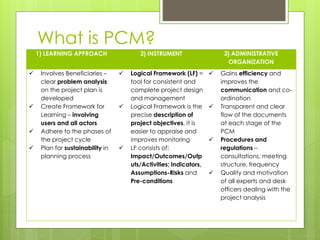
What is PCM?
1) LEARNING APPROACH 2} INSTRUMENT 3} ADMINISTRATIVE
ORGANIZATION
 Involves Beneficiaries –
clear problem analysis
on the project plan is
developed
 Create Framework for
Learning – involving
users and all actors
 Adhere to the phases of
the project cycle
 Plan for sustainability in
planning process
 Logical Framework (LF) =
tool for consistent and
complete project design
and management
 Logical Framework is the
precise description of
project objectives, it is
easier to appraise and
improves monitoring
 LF consists of:
Impact/Outcomes/Outp
uts/Activities; Indicators,
Assumptions-Risks and
Pre-conditions
 Gains efficiency and
improves the
communication and co-
ordination
 Transparent and clear
flow of the documents
at each stage of the
PCM
 Procedures and
regulations –
consultations, meeting
structure, frequency
 Quality and motivation
of all experts and desk
officers dealing with the
project analysis
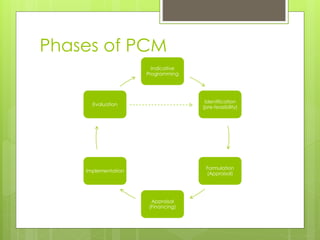
Phases of PCM
Indicative
Programming
Identification
(pre-feasibility)
Formulation
(Appraisal)
Appraisal
(Financing)
Implementation
Evaluation
I. Indicative Programming
 Includes specific aid thematic focuses in
a country
 Sets out a number of ideas for projects or
programmes
 Includes policy guidelines or strategic
framework of a recipient country
(government)
II. Identification/Pre-feasibility
 Concerns the initial formulation of a
project/programme idea in terms of
objectives, results and activities
 Determines whether it is worthwhile to do
a feasibility study
 If yes – drawing Terms of Reference for the
study
III. Appraisal/Financing
 Drafting financial proposals
 Examination
 A comparative appraisal by a financing
committee (if there is one)
 Drafting and signing of a financing
agreement
IV. Implementation
 Concerns the execution of the
project/programme (usually drawing on the
resources provided by the financing
agreement)
 Aims to achieve desired results and the
purpose of the project/programme
 Various reports are produced: inception
report or plan of operations, annual work
plans and monitoring reports/field visits
reports.
V. Evaluation
 The results and impact of the
project/programme are analyzed
 The evaluation part can start during the
implementation phase
 It is used to recommend possibilities for
corrections
 If done after implementation, it formulates
recommendations how to improve
guidance for similar interventions
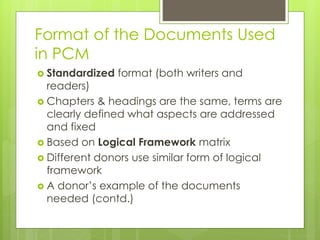
Format of the Documents Used
in PCM
 Standardized format (both writers and
readers)
 Chapters & headings are the same, terms are
clearly defined what aspects are addressed
and fixed
 Based on Logical Framework matrix
 Different donors use similar form of logical
framework
 A donor’s example of the documents
needed (contd.)
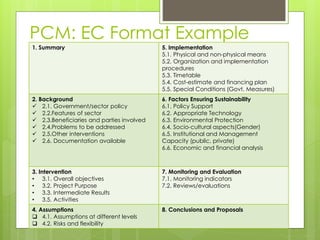
PCM: EC Format Example
1. Summary 5. Implementation
5.1. Physical and non-physical means
5.2. Organization and implementation
procedures
5.3. Timetable
5.4. Cost-estimate and financing plan
5.5. Special Conditions (Govt. Measures)
2. Background
 2.1. Government/sector policy
 2.2.Features of sector
 2.3.Beneficiaries and parties involved
 2.4.Problems to be addressed
 2.5.Other interventions
 2.6. Documentation available
6. Factors Ensuring Sustainability
6.1. Policy Support
6.2. Appropriate Technology
6.3. Environmental Protection
6.4. Socio-cultural aspects(Gender)
6.5. Institutional and Management
Capacity (public, private)
6.6. Economic and financial analysis
3. Intervention
• 3.1. Overall objectives
• 3.2. Project Purpose
• 3.3. Intermediate Results
• 3.5. Activities
7. Monitoring and Evaluation
7.1. Monitoring indicators
7.2. Reviews/evaluations
4. Assumptions
 4.1. Assumptions at different levels
 4.2. Risks and flexibility
8. Conclusions and Proposals
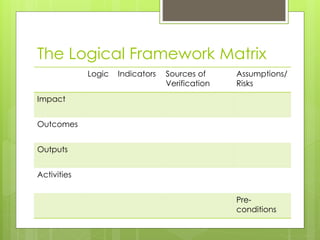
The Logical Framework Matrix
Logic Indicators Sources of
Verification
Assumptions/
Risks
Impact
Outcomes
Outputs
Activities
Pre-
conditions
Limitations of PCM instruments
and Procedures
 PCM alone cannot guarantee successful
results of our projects/programmes!
 Valuable for those who prepare and control
the implementation of the projects
 Available information has to be of high
quality
 Planners, implementers and and
beneficiaries have to be genuinely
committed
Misunderstandings of PCM
 PCM is not just a formal exercise resulting in a
blue-print for a project/programme
 It is a result of analysis at a certain point in
time
 Necessary to always adapt the plan to the
changing situation!
Further Readings
 NORAD (1999). Logical Framework Approach
(LFA). Handbook for Objectives-Oriented
Planning. Fourth edition.
 European Commission (2004). Aid Delivery
methods. Project Cycle Management
Guidelines: Supporting effective
implementation of EC external assistance.
Volume 1.
 EC & ITAD (1999). Project Cycle Management
Training Handbook. Version 1

PCM+LFA-_food.forthought

  • 1.
    Project Cycle Management (PCM) Why forBB2C? Why Now? Ela Gerthnerova Source: MDF (2010-2013). RBM: Monitoring and Planning Course. MDF Pacific-Indonesia, Training and Consultancy.
  • 2.
    PCM Presentation Outline Evolution of the concept  Why do we need it?  What is it exactly?  Phases of PCM  Format of the documents & example  Logical Framework Matrix  Limitations of PCM instruments & procedures  Further readings
  • 3.
    Evolution  Throughout historyof development cooperation (40+ years) - difficulties to be fully satisfied with the results of the interventions (projects, programmes)  Need to learn from the past experience to better perform in the future – this is the objective of Project Cycle Management (PCM)  Addressing the real needs of the beneficiaries  Analysis of the existing situation → stakeholders´ participation→ ownership creation.
  • 4.
    PCM: Why dowe need it?  An approach to ease communication and to improve decision-making  Effective & efficient funds utilization  Determines our intervention results in both technical and organizational nature  Determines the project/programme performance and impact (measurability)  Increases organizational credibility in the eyes of donors
  • 5.
    What is PCM? 1)LEARNING APPROACH 2} INSTRUMENT 3} ADMINISTRATIVE ORGANIZATION  Involves Beneficiaries – clear problem analysis on the project plan is developed  Create Framework for Learning – involving users and all actors  Adhere to the phases of the project cycle  Plan for sustainability in planning process  Logical Framework (LF) = tool for consistent and complete project design and management  Logical Framework is the precise description of project objectives, it is easier to appraise and improves monitoring  LF consists of: Impact/Outcomes/Outp uts/Activities; Indicators, Assumptions-Risks and Pre-conditions  Gains efficiency and improves the communication and co- ordination  Transparent and clear flow of the documents at each stage of the PCM  Procedures and regulations – consultations, meeting structure, frequency  Quality and motivation of all experts and desk officers dealing with the project analysis
  • 6.
  • 7.
    I. Indicative Programming Includes specific aid thematic focuses in a country  Sets out a number of ideas for projects or programmes  Includes policy guidelines or strategic framework of a recipient country (government)
  • 8.
    II. Identification/Pre-feasibility  Concernsthe initial formulation of a project/programme idea in terms of objectives, results and activities  Determines whether it is worthwhile to do a feasibility study  If yes – drawing Terms of Reference for the study
  • 9.
    III. Appraisal/Financing  Draftingfinancial proposals  Examination  A comparative appraisal by a financing committee (if there is one)  Drafting and signing of a financing agreement
  • 10.
    IV. Implementation  Concernsthe execution of the project/programme (usually drawing on the resources provided by the financing agreement)  Aims to achieve desired results and the purpose of the project/programme  Various reports are produced: inception report or plan of operations, annual work plans and monitoring reports/field visits reports.
  • 11.
    V. Evaluation  Theresults and impact of the project/programme are analyzed  The evaluation part can start during the implementation phase  It is used to recommend possibilities for corrections  If done after implementation, it formulates recommendations how to improve guidance for similar interventions
  • 12.
    Format of theDocuments Used in PCM  Standardized format (both writers and readers)  Chapters & headings are the same, terms are clearly defined what aspects are addressed and fixed  Based on Logical Framework matrix  Different donors use similar form of logical framework  A donor’s example of the documents needed (contd.)
  • 13.
    PCM: EC FormatExample 1. Summary 5. Implementation 5.1. Physical and non-physical means 5.2. Organization and implementation procedures 5.3. Timetable 5.4. Cost-estimate and financing plan 5.5. Special Conditions (Govt. Measures) 2. Background  2.1. Government/sector policy  2.2.Features of sector  2.3.Beneficiaries and parties involved  2.4.Problems to be addressed  2.5.Other interventions  2.6. Documentation available 6. Factors Ensuring Sustainability 6.1. Policy Support 6.2. Appropriate Technology 6.3. Environmental Protection 6.4. Socio-cultural aspects(Gender) 6.5. Institutional and Management Capacity (public, private) 6.6. Economic and financial analysis 3. Intervention • 3.1. Overall objectives • 3.2. Project Purpose • 3.3. Intermediate Results • 3.5. Activities 7. Monitoring and Evaluation 7.1. Monitoring indicators 7.2. Reviews/evaluations 4. Assumptions  4.1. Assumptions at different levels  4.2. Risks and flexibility 8. Conclusions and Proposals
  • 14.
    The Logical FrameworkMatrix Logic Indicators Sources of Verification Assumptions/ Risks Impact Outcomes Outputs Activities Pre- conditions
  • 15.
    Limitations of PCMinstruments and Procedures  PCM alone cannot guarantee successful results of our projects/programmes!  Valuable for those who prepare and control the implementation of the projects  Available information has to be of high quality  Planners, implementers and and beneficiaries have to be genuinely committed
  • 16.
    Misunderstandings of PCM PCM is not just a formal exercise resulting in a blue-print for a project/programme  It is a result of analysis at a certain point in time  Necessary to always adapt the plan to the changing situation!
  • 17.
    Further Readings  NORAD(1999). Logical Framework Approach (LFA). Handbook for Objectives-Oriented Planning. Fourth edition.  European Commission (2004). Aid Delivery methods. Project Cycle Management Guidelines: Supporting effective implementation of EC external assistance. Volume 1.  EC & ITAD (1999). Project Cycle Management Training Handbook. Version 1